James 3:2

Greek (Tischendorf 8th ed.) James 3:2 appears in the Greek New Testament. The text above is from the Tischendorf 8th edition. Each word links to its Strong’s number and a concise gloss. Click any word for its full Thayer’s Greek Lexicon entry.
Download image
Cite this verse

James 3:2 (World English Bible). Public Domain. Lemma interlinear Bible study tool, https://lemma.gebible.app/v/james/3/2.

Show BibTeX & RIS
BibTeX
RIS
English Translation
For in many things we all stumble. If anyone doesn't stumble in word, the same is a perfect man, able to bridle the whole body also.
World English Bible · Public Domain
Download a study sheet

One document with this verse’s original text, its word-by-word gloss line, the meaning frame, cross-references with their text, attributed commentary, and full source and license credits — printable, and it pastes into notes with its structure intact.

This verse Autodidact and up

Study sheet (.html) Plain text (.txt)

A passage Seminary Student

Up to 50 verses in one chapter. A passage sheet keeps up to 6 commentary sources and 12 cross-references per verse, in the order this page ranks them, and says so on the sheet whenever that leaves anything out. Ask for a single verse and you get the Autodidact verse sheet above.

Everything on this page stays free to read, with no account — the sheet is a download of what is already on screen, not access to it.

Want to remove ads? Support Godless Engineer
Compare translations 3

The same verse in 3 English versions, stacked beneath the original-language interlinear above. Click any original word for its lexicon entry.

Each is an independent rendering of the whole verse — the interlinear is not word-aligned to these translations.

Highlighted words mark where these versions differ — a whole-verse word diff, not a word-by-word alignment.

  • World English Bible Public Domain
    For in many things we all stumble. If anyone doesn't stumble in word, the same is a perfect man, able to bridle the whole body also.
  • King James Version Public Domain
    For in many things we offend all. If any man offend not in word, the same is a perfect man, and able also to bridle the whole body.
  • unfoldingWord Literal Text CC BY-SA 4.0
    For we all stumble much. If anyone does not stumble in word, he a perfect man, able to bridle even the whole body.

unfoldingWord Literal Text — © unfoldingWord, licensed CC BY-SA 4.0. Word-aligned USFM3 via Door43 (git.door43.org/unfoldingWord/en_ult).

Versions to compare (up to 4)

3 of 4 selected

Show all 19 translations

Every available English version of this verse, each an independent rendering of the whole verse.

  • World English Bible Public Domain
    For in many things we all stumble. If anyone doesn't stumble in word, the same is a perfect man, able to bridle the whole body also.
  • Berean Standard Bible Public Domain
    We all stumble in many ways. If anyone is never at fault in what he says, he is a perfect man, able to control his whole body.
  • Majority Standard Bible Public Domain
    We all stumble in many ways. If anyone is never at fault in what he says, he is a perfect man, able to control his whole body.
  • King James Version Public Domain
    For in many things we offend all. If any man offend not in word, the same is a perfect man, and able also to bridle the whole body.
  • American Standard Version (1901) Public Domain
    For in many things we all stumble. If any stumbleth not in word, the same is a perfect man, able to bridle the whole body also.
  • Revised Version (1885) Public Domain
    For in many things we all stumble. If any stumbleth not in word, the same is a perfect man, able to bridle the whole body also.
  • Geneva Bible (1599) Public Domain
    For in many things we sinne all. If any man sinne not in word, he is a perfect man, and able to bridle all the body.
  • Douay-Rheims (1899) Public Domain
    For in many things we all offend. If any man offend not in word, the same is a perfect man. He is able also with a bridle to lead about the whole body.
  • Young's Literal Translation Public Domain
    for we all make many stumbles; if any one in word doth not stumble, this one `is' a perfect man, able to bridle also the whole body;
  • Literal Standard Version CC BY-SA 4.0
    for we all make many stumbles; if anyone does not stumble in word, this one [is] a perfect man, able to also bridle the whole body;
  • Unlocked Literal Bible CC BY-SA 4.0
    For we all stumble in many ways. If anyone does not stumble in words, he is a perfect man, able to control even his whole body.
  • unfoldingWord Literal Text CC BY-SA 4.0
    For we all stumble much. If anyone does not stumble in word, he a perfect man, able to bridle even the whole body.
  • Darby Bible Public Domain
    For we all often offend. If any one offend not in word, *he* [is] a perfect man, able to bridle the whole body too.
  • World Messianic Bible Public Domain
    For we all stumble in many things. Anyone who doesn’t stumble in word is a perfect person, able to bridle the whole body also.
  • Webster's Bible Public Domain
    For in many things we all offend. If any man offendeth not in word, the same is a perfect man, able also to bridle the whole body.
  • Free Bible Version CC BY-SA 4.0
    All of us make mistakes in many ways. Anyone who doesn't make mistakes in what they say is truly a good person who can keep the whole body under control.
  • Bible in Basic English Public Domain
    For we all go wrong in a number of things. If a man never makes a slip in his talk, then he is a complete man and able to keep all his body in control.
  • Text-Critical English NT CC BY 4.0
    For we all stumble in many ways. If anyone does not stumble in what he says, he is a perfect man, able to bridle his entire body as well.
  • Tyndale New Testament (1534) Public Domain
    for in many thinges we synne all. Yf a man synne not in worde the same is a parfecte man and able to tame all the body.

Literal Standard Version (2020), Covenant Press — licensed CC BY-SA 4.0. Text via the HelloAO Bible API (eBible.org). Unlocked Literal Bible (unfoldingWord) — licensed CC BY-SA 4.0. Text via the HelloAO Bible API (eBible.org). unfoldingWord Literal Text — © unfoldingWord, licensed CC BY-SA 4.0. Word-aligned USFM3 via Door43 (git.door43.org/unfoldingWord/en_ult). Free Bible Version, Dr. Jonathan Gallagher — licensed CC BY-SA 4.0. Text via the HelloAO Bible API (eBible.org).

Word by word

More ways to search: Search by grammar → Find every occurrence → Compare this word →

Practice this passage: Drill this verse → Learn its vocabulary →

χαλιναγωγῆσαι
chalinagōgéō
G5468
“to bridle”
Verb, Aorist, Active, Infinitive
Part of Speech
Verb
Tense
Aorist
Voice
Active
Mood
Infinitive
Full Thayer's Definition

Origin: from a compound of G5469 and the reduplicated form of G71

TDNT: None

1. to lead by a bridle, to guide 2. to bridle, hold in check, restrain
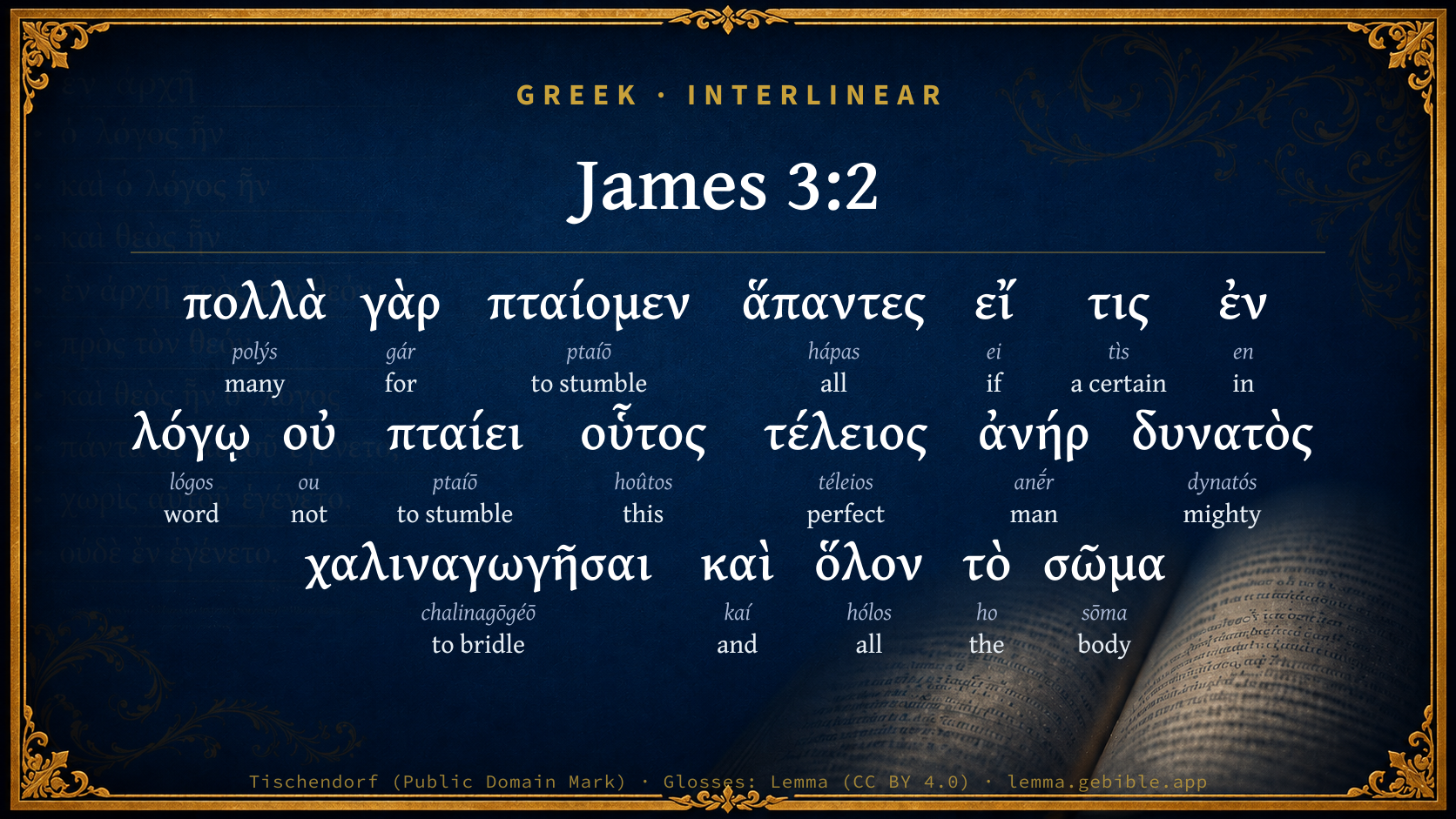
  1. πολλὰ polýs G4183 “many” Adjective, Accusative, Plural, Neuter
  2. γὰρ gár G1063 “for” Conjunction
  3. πταίομεν ptaíō G4417 “to stumble” Verb, Present, Active, Indicative, 1st person, Plural
  4. ἅπαντες hápas G537 “all” Adjective, Nominative, Plural, Masculine
  5. εἴ ei G1487 “if” Conditional
  6. τις tìs G5100 “a certain” Indefinite pronoun, Nominative, Singular, Masculine
  7. ἐν en G1722 “in” Preposition
  8. λόγῳ lógos G3056 “word” Noun, Dative, Singular, Masculine
  9. οὐ ou G3756 “not” Particle, Negative
  10. πταίει ptaíō G4417 “to stumble” Verb, Present, Active, Indicative, 3rd person, Singular
  11. οὗτος hoûtos G3778 “this” Demonstrative pronoun, Nominative, Singular, Masculine
  12. τέλειος téleios G5046 “perfect” Adjective, Nominative, Singular, Masculine
  13. ἀνήρ anḗr G435 “man” Noun, Nominative, Singular, Masculine
  14. δυνατὸς dynatós G1415 “mighty” Adjective, Nominative, Singular, Masculine
  15. καὶ kaí G2532 “and” Conjunction
  16. ὅλον hólos G3650 “all” Adjective, Accusative, Singular, Neuter
  17. τὸ ho G3588 “the” Article, Accusative, Singular, Neuter
  18. σῶμα sōma G4983 “body” Noun, Accusative, Singular, Neuter

About this verse

These counts appear in no published source. They are computed here, from the morphology-tagged text and Lemma’s own curated glosses. What Lemma adds →

19
words
18
distinct lemmas
General Epistles
section

Notable vocabulary

The rarest word here is χαλιναγωγῆσαι to bridle G5468 — appearing just 2 times in the whole Greek New Testament.

Shared distinctive vocabulary

χαλιναγωγῆσαι to bridle G5468 occurs in 2 verses of the Greek New Testament. Also found in:

Repetition

A word recurs within this verse:

  • πταίομεν to stumble G4417 ×2

Cross-references

23

Topical passages linked to James 3:2 in the Treasury of Scripture Knowledge — connected by theme and wording, ordered by reader-vote popularity; previews shown in the World English Bible.

  • James 1:26 If anyone among you thinks himself to be religious while he doesn't bridle his tongue, but deceives his heart, this man's religion is worthless.
  • Proverbs 13:3 He who guards his mouth guards his soul. One who opens wide his lips comes to ruin.
  • 1 Peter 3:10 For, "He who would love life, And see good days, Let him keep his tongue from evil, And his lips from speaking deceit.
  • Matthew 12:37 For by your words you will be justified, and by your words you will be condemned."
  • James 3:5–6 So the tongue is also a little member, and boasts great things. See how a small fire can spread to a large forest!
  • Psalms 34:13 Keep your tongue from evil, And your lips from speaking lies.
  • Proverbs 20:9 Who can say, "I have made my heart pure. I am clean and without sin?"
  • 1 John 1:8–10 If we say that we have no sin, we deceive ourselves, and the truth is not in us.
  • Ecclesiastes 7:20 Surely there is not a righteous man on earth, who does good and doesn't sin.
  • Romans 3:10 As it is written, "There is no one righteous. No, not one.
  • James 1:4 Let endurance have its perfect work, that you may be perfect and complete, lacking in nothing.
  • 1 Kings 8:46 If they sin against you (for there is no man who doesn't sin), and you are angry with them, and deliver them to the enemy, so that they carry them away captive to the land of the enemy, far off or near;
  • 1 Corinthians 9:27 but I beat my body and bring it into submission, lest by any means, after I have preached to others, I myself should be rejected.
  • James 2:10 For whoever shall keep the whole law, and yet stumble in one point, he has become guilty of all.
  • Isaiah 64:6 For we are all become as one who is unclean, and all our righteousness are as a polluted garment: and we all do fade as a leaf; and our iniquities, like the wind, take us away.
  • 2 Chronicles 6:36 If they sin against you (for there is no man who doesn't sin), and you are angry with them, and deliver them to the enemy, so that they carry them away captive to a land far off or near;
  • Colossians 1:28 whom we proclaim, admonishing every man and teaching every man in all wisdom, that we may present every man perfect in Christ Jesus;
  • Colossians 4:12 Epaphras, who is one of you, a servant of Christ, salutes you, always striving for you in his prayers, that you may stand perfect and complete in all the will of God.
  • Hebrews 13:21 make you complete in every good work to do his will, working in you that which is well pleasing in his sight, through Jesus Christ, to whom be the glory forever and ever. Amen.
  • Galatians 3:22 But the Scriptures shut up all things under sin, that the promise by faith in Jesus Christ might be given to those who believe.
  • Galatians 5:17 For the flesh lusts against the Spirit, and the Spirit against the flesh; and these are contrary to one other, that you may not do the things that you desire.
  • 1 Peter 5:10 But may the God of all grace, who called you to his eternal glory by Christ Jesus, after you have suffered a little while, perfect, establish, strengthen, and settle you.
  • Romans 7:21 I find then the law, that, to me, while I desire to do good, evil is present.

Cross-references courtesy of OpenBible.info (CC BY 4.0).

Commentary

Notes on James 3:2 from classic Christian and Jewish commentators (each source and its license shown beneath its notes). The classic Christian expositions comment on the surrounding passage and are grouped to its opening verse, so a note may address several verses; the Jewish commentaries on the Tanakh (Rashi and others) are per-verse, so they appear only where the commentator wrote on this verse.

Lemma curates 59 commentaries, every one of them public domain or Creative Commons licensed, each selected and text-cleaned for this edition rather than reprinted as found. About our sources →

The Biblical Illustrator

Joseph S. Exell

Jam_3:2

In many things we offend all

No perfection in this life

I.

How THIS APPEARS.

1. From other passages of Scripture (Ecc_7:20; Pr 2Ch_6:36; 1Jn_1:8; 1Jn_1:10).

2. That none can expect to arrive at a sinless perfection in this life will appear, if we consider the many instances which are recorded in the Scripture of the sins of some of the most eminent saints and servants of God.

3. The experience of our own times confirms this same sad truth, that all have their infirmities, and in many things offend.

4. That all do and will offend in many things, will appear if we consider the extensiveness and spirituality of the law of God.

5. Natural corruption is not fully subdued in any here on earth; therefore in many things all will offend.

6. You are here on earth in a state of temptation, and therefore will not be sinless till you leave the world.

II. IN WHAT RESPECTS WE ALL OFFEND.

1. With regard to the disposition and inclination of the heart.

2. As to the internal employment of the mind.

3. In our communication.

4. In innumerable ways in the actions of life. Conclusion:

1. Here we may infer the impropriety of being saved by the covenant of works, the terms of which were unerring obedience--Do this, and live.

2. See here what infinite reason you have to bless God for the new covenant; herein is your salvation.

3. See here how highly you are concerned to seek an interest in this new covenant.

4. You must take heed that you do not take encouragement to be in the least degree more careless in your life from the miscarriages of good men.

5. Though you will never be able to keep Gods commandments perfectly whilst you are in the present state, yet you should press on towards perfection, (T. Whitty.)

The sins of good men

1. None are absolutely freed and exempted from sinning (1Jn_1:8; Pro_20:9). Well, then--

(1) Walk with more caution; you carry a sinning heart about you. As long as there is fuel for temptation we cannot be secure; he that hath gunpowder about him will be afraid of sparkles.

(2) Censure with the more tenderness; give every action the allowance of human frailty (Gal_6:1).

(3) Be the more earnest with God for grace; God will keep you still dependent, and beholden to His power.

(4) Magnify the love of God with the more praise. Paul groaneth under his corruptions (Rom_7:1-25., latter end); and then admireth the happiness of those that are in Christ (Rom_8:1).

2. The sins of the best are many.

(1) Be not altogether dismayed at the sight of failings. A godly person observed that Christians were usually to blame for three things: They seek for that in themselves which they can only find in Christ; for that in the law which shall only be had in the gospel; and that upon earth which shall only be enjoyed in heaven. We complain of sin; and when shall the earthly estate be free? You should not murmur, but run to your Advocate.

(2) However, bewail these failings, the evils that abound in your hearts, in your duties, that you cannot serve God as entirely as you served Satan; your evil works were merely evil, but your good are not purely good; there your heart was poured out (Jud_1:11), here it is restrained; there isfilthiness in your righteousness (Isa_64:1-12.)

3. To be able to bridle the tongue is an argument of some growth and happy progress in grace (Pro_18:21; Mat_12:37; Pro_13:3). There were special reasons why our apostle should be so much in pressing it.

(1) Because this was the sin of that age, as appeareth by the frequent dissuasions from vain boasting of themselves, and detracting from others, in the 1Jam_2:1-26 nd chapters; and it is a high point of grace not to be snared with the evils of our own times.

(2) It is the best discovery of the heart; speech is the express image of it Mat_12:34).

(3) It is the hypocrites sin; they abstain from grosser actions, but usually offend in their words, in boasting professions, and proud censures (see Jam_1:26).

(4) All of us are apt to offend with the tongue many ways; most of a mans sins are in his words.

(5) It is a sin into which we usually and easily fall, partly by reason of that quick intercourse that is between the tongue and the heart--we sin in an instant; and partly because speech is a human act which is performed without labour; and so we sin that way incogitantly, without noting or judging it. Well, then, take care, not only of your actions, but your speeches (Psa_39:1).

Consider--

1. Your speeches are noted. Xenophon would have all speeches written, to make men more serious. They are recorded (Jam_2:12). Every idle word is brought into judgment (Mat_12:36): light words weigh heavy in Gods balance.

2. They are punished (Psa_64:8).

3. Consider what a vile thing it is to abuse the tongue to strife, censure, or insultation.

4. It is not of small regard that God in nature would show that He hath set bounds to the tongue: He hath hedged it in with a row of teeth. For apt remedies--

(1) Get a pure heart; there is the tongues treasury and storehouse. A good man is always ready to discourse, not forced by the company, but because the law of God is in his heart (Pr

15:7).

(2) Watch and guard speech (Pro_30:32).

(3) All our endeavours are nothing. Go to God (Psa_141:3).

(4) That you may not offend in your words, let them be often employed about holy uses (Eph_4:29). (T. Manton.)

Christian imperfection

I. SOME OF THOSE THINGS IN WHICH BELIEVERS OFFEND.

1. In the exercises of the heart. Many remains of the carnal mind.

2. In the communications of their lips.

3. In the actions of their lives.

II. FROM WHENCE ARISE THESE IMPERFECTIONS IN THE CHRISTIAN CHARACTER.

1. From the absolute purity of the Divine law. Transcript of the

Divine mind.

2. From the frailty and weakness of human nature.

3. From unwatchfulness and neglect. Not sufficiently alive to our best interests. Graces allowed to be languid, &c.

III. WHAT INFLUENCE SHOULD A CONSIDERATION OF OUR IMPERFECTIONS PRODUCE UPON US?

1. Deep humility.

2. Spiritual diligence.

3. Fervent prayer.

4. Forbearance and charity to others.

5. Excite within us a longing for heaven. There we shall be sinless inhabitants of a sinless world. (J. Buries. D. D.)

There are none blameless

A gentleman of the perfectionist school of thought called to see an old Christian of his neighbourhood, and began enlarging upon that interesting topic. Can you point to a single perfect man or woman in the Bible? inquired the aged saint. Yes, readily answered the other; turn to Luk_1:6, you will there read of two--Elisabeth and Zacharias walked in all the commandments and ordinances of the Lord, blameless. Then you consider yourself a believer like Zacharias? Certainly I do, said the visitor. Ah, replied the old man, I thought you might be; and we read a few verses further on that he was struck dumb for his unbelief.

Faults

Bad men excuse their faults, good men will leave them. (Johnson.)

We all have faults

I have been a good deal up and down in the world, and I never did see either a perfect horse or a perfect man, and I never shall until two Sundays come together. The old saying is, Lifeless, faultless. Of dead men we would say nothing but good, but as for the living, they are all tarred more or less with the black brush, and half an eye can see it. Every head has a soft place in it, and every heart has its black drop. Every rose has its prickles, and every day its night. Even the sun shows spots, and skies are darkened with clouds. Nobody is so wise but he has folly enough to stock a stall at Vanity Fair. Where I have not seen the fools cap, I have, nevertheless, heard the bells jingle. As there is no sunshine without some shadow, so is all human good mixed up with more or less evil; even poor law guardians have their little failings, and parish beadles are not wholly of heavenly nature. The best wine has its lees. All mens faults are not written on their foreheads, and its quite as well they are not, or hats would need wide brims; yet as sure as eggs are eggs, faults of some sort nestle in every mans bosom. There is no telling when a mans sins may show themselves, for hares pop out of a ditch just when you are not looking for them. A horse that is weak in the legs may not stumble for a mile or two, but its in him, and the rider had better hold him up well. The tabby-cat is not lapping milk just now, but leave the dairy door open, and we shall see if she is not as bad a thief as the kitten. Theres fire in the flint, cool as it looks; wait till the steel gets a knock at it, and you will see. Everybody can read that riddle, but it is not everybody that will remember to keep his gunpowder out of the way of the candle. (C. H. Spurgeon.)

All are deficient when tried by Divine law

Judgment is comparison of things with some standard. There are standard weights and measures in the Tower to which all in the country ought to conform, and if not they are condemned. So a mason judges by his plumb-line of a wall, if true to the perpendicular. If an inspector of weights and measures finds a tradesman using false ones, he takes him before a magistrate for punishment. If the builder finds the wall untrue, he orders it to be pulled down. Now God has a standard by which He judges us, viz., His holy law; and it is because we know we are deficient that the word judgment has such an awful sound to us, for we know that to the sinner it includes condemnation and punishment.

If any man offend not in word

On the evils of speech

I. I SHALL BEGIN WITH MAKING SOME OBSERVATIONS UPON THE SUBJECT IN GENERAL.

1. The first general observation which occurs to us upon this subject is the difficulty of ruling the tongue. When a man looks into his own mind, the mass of thoughts of all kinds which he meets with there will amaze him. All mens ideas are much alike, and wisdom consists more in the degree of power which a man has to restrain his thoughts, and bring only such forth as are proper, than in the thoughts themselves. What renders it still more difficult to oppose this mass are the passions by which it is often agitated. These press upon it with violence, and force for themselves a passage. Temptations, too, add their pressure, unguarded moments offer, and men are almost always employed, from various motives, to draw your defence, and to draw your thoughts from you. Difficult, however, as the government of speech is, we must observe that it is not impracticable. If a man cannot restrain it completely, he has it in his power at least to moderate it.

2. The second general observation, which offers itself to us upon the government of speech, is the simplicity of it, considered as a method of governing the passions. In the most complex machines there is always one part of them which commands the rest, and a small degree of power applied there will stop their most multiplex operations. It seems in the present case to be exactly so with man. When you restrain the tongue you stop the passions at their commanding point. You do not merely drive them back into their repositories, but you destroy their motion and their force. They acquire strength from motion, and the way to keep them quiet is to restrain them at the issue. This is done easily if you apply your care at the mouth, and suppress the first expression of them. Prevent the movement of the passions and you prevent their violence.

II. I COME NOW TO CONSIDER PARTICULARLY THE ABUSES OF IT IN SOCIETY, AND THE IMPORTANCE OF OBTAINING SOME SHARE AT LEAST OF DUE GOVERNMENT OVER IT.

1. TO this part of the subject let me proceed by observing, first in general, that much talking of any kind is but a bad practice. It is a sure waste of time in the first place, and is apt to lead a man into a habit of trifling in the next. But the greatest disadvantage of all is, that much speaking is an enemy to much thinking. The man who talks perpetually is also constantly in danger of discovering what he should conceal, and of prejudicing, by this means, both his own affairs and those of other men. How many occasions of offence, how many breaches among friends, holy many fatal enmities have arisen from this cause! The system of education adopted by the Persians was simple, but extremely rational. They taught their youth two things: to be secret, and to tell the truth. This was well adapted to inspire both the confidence and the respect of men.

2. In the second place, let me observe that the evils of speech, upon a general view of them, may be considered as arising from two sources: design and accident, and frequently also from a mixture of both.

3. I shall now mention, as shortly as possible, the most remarkable classes of vain talkers with which life is pestered, and society so often set on fire.

(1) The first class whom I shall mention are your abusive talkers. These people value themselves upon nothing so much as upon putting a sober person out of countenance, and they recount their victories of this sort with as much pleasure as if they had performed some memorable achievements. What they say does not necessarily proceed from malice, and they will be friends with you next day if you desire it. But they have the misfortune to be born with violent passions, and as they have never been taught to restrain them, they have at last lost all self-command, and are under the necessity of giving vent to them.

(2) The second class of talkers, or of people who offend in word, are your evil speakers. These are your people who are noted in society for a most unhappy habit of detracting from the merit, or of censuring the actions and the lives of others.

(3) The last class of talkers whom I shall mention here, and who abuse the faculty of speech more than all the rest, are your plain liars. This is a most amazing set of people. They have acquired a habit which is most pernicious to society, and to their own minds. It misleads others and destroys their own principles. It is not only pernicious, but contemptible. (John Mackenzie, D. D.)

The use of the tongue

1. The use of the tongue constitutes a large portion of human business. It is by that organ that very many of the most important transactions of life are carried on. Speech has been appropriately called the rudder that steereth human affairs, the spring that setteth the wheels of action on going.

(2) Speech is the index of the mind (Psa_39:3). Thought and feeling dictate the language of the lips; and a habitually right use of speech is an indication of a habitually right condition of the mind. Speak, said Socrates, that I may see thee. The whirlwind of the tongue is but the outburst of the tumult of the soul. Wise, meek, and generous discourse is the counterpart of the enlightened, tranquil, and benevolent spirit which possesses the hidden man of the heart.

3. It is a work of much difficulty tightly to regulate the tongue. On the one hand, it is a very facile member, often called, and easily roused, into active exercise; and on the other, one is apt not to associate the idea of so much guilt as is readily attributed to the sins of outward action with an ill-regulated tongue--insomuch that many who would not blasphemously say, Our lips are our own, who is lord over us? do not reckon themselves bound to watch, with any special diligence, over what they say.

4. As fearful evil is wont to result from the violation by the tongue of the laws of piety, truth, charity, chastity, and wisdom, so its right regulation is taught with glorious effects to him who speaks, and, it may be, also to him who hears. (A. S. Patterson, D. D.)

Helpful and unhelpful speech

There cannot be a doubt that speech may be the most helpful or unhelpful of all the powers we possess; because it is the expression of our inward life, whatever that inward life may be. And it is not the amount of speech we are capable of which is the main consideration in the ease, so much as the quality and quantity of heart which lies at the back of the tongue which determines the helpfulness or unhelpfulness of speech. A sensitive man would about as soon his enemy came and put a dagger into his heart and finish him, as go about stabbing him behind his back with cruel words. For there are words in which the spirit of murder lurks. We may be naturally very ready of speech or very slow of speech--inconveniently candid or reticent even to niggard-ness; and yet our speech will be helpful or unhelpful to others according to the condition of heart which lies behind it. And so the old text, Keep thy heart with all diligence, for out of it are the issues of life, controls the region covered by the word speech. If there be envy in the heart, its tone will get into the speech. If there be hatred in the heart, the speech will betray it to all who have educated ears. If there be a settled deposit of uncharitableness in the heart, a report of it will be in the speech--not only in the matter of it, but especially in the manner of it. So that the first and chief necessity to helpful speech--that without which speech would be very unhelpful--is to keep the heart with all diligence. If we allow evil feelings to take up their abode in our hearts, speech cannot be helpful. If there be a skunk in the cellar, it will be known in every room of the house without asking the eyes to look upon the creature itself hiding away in the basement. The lovableness or lovelessness of the heart is certain to report itself in helpful or unhelpful speech. And so, in order to alter the quality of speech, if it needs altering, we must begin at the centre; we must keep the heart with all diligence, because speech is only one of the streams which issue out of it. The art of speech has been studied from Aristotle downwards. But the morals of speech, the spiritual meaning of helpful and unhelpful speech, this region has not been adequately explored. Such a subject as this--how to be a good conversationalist, interests not a few, because it suggests that this ability may be acquired. How much larger and more important than that is this; how to be under no undue restraint in speech; how to be free, easy, and at home in the use of this faculty and yet how to be always helpful and not unhelpful in the employment of it. Remembering, then, that speech is a sign, a revealer, both as to matter and manner, and that the first necessity for helpful speech is a regenerated heart--that is, a heart in which envy, hatred, and uncharitableness are not encouraged as guests; but if one or the other of them pay a short visit they are never made welcome and entertained as a guest, never supplied with bed and board--remembering this, that without an honest and good heart, continuous honest and good speech is an impossibility--we may be allowed to say that the power of helpful speech will increase in the ratio of our own self-improvement; as the result of processes of inward growth. The rational conversableness of men will come as an effect of their improved rationality. If you have read well, and looked about, and thought on what you have seen, you will show good quality in your speech, and I repeat, it is the quality in the speech which is the main thing towards its helpfulness. If your words be stumbling and broken, the matter and the meaning will redeem them from contempt. It may be sad to have nothing to say, but it is much sadder to say a great deal with nothing in it. Gilded surface easily passes in the stead of golden substance. We cannot, of course, speak helpfully or at all without words, unless we allow that the silent expression of the eye and many other signs are language; but we are not occupied with those mute organs of eloquence now; and yet words are so different from each other that they make speech this or that according to the words chosen. Some words are a blank wall; others are windows through which you see a varied landscape beyond. Real eloquence is always rich in these transparent words. Every great thinker suggests more than he says. Thought starts thinking. I am more and more convinced, however, that speech is helpful or unhelpful, according to the feeling with which it is satured. The same words uttered by two different persons produce effects in feeling, oh, how different! Have you never known what it is to feel a kind of shudder from a compliment--something intended to be sweet, but it was not satured with sweetness? In another case some one comes to you and tries to say a severe thing, attempts reproof, even satire, and the thing fails utterly because the individual has not venom enough in his nature to kill a fly. And so, if you will give attention to the matter you will find that words carry feeling quite as much as they carry intelligence. (Reuen Thomas, D. D.)

Offences of the tongue

Any one who carefully studies Scripture is often struck with this, that the sacred writers attach the most serious importance to duties of which men make but little account; so here--one who knows how lightly Christians regard the duty of not offending in word is impressed with the solemnity with which the apostle treats the obligation--looking upon the whole character as concerned in it; for he sayswhoever is faithful in this respect is a thorough man, strong in self-mastery, equal to all the duties of life. He considers faithfulness or unfaithfulness in this respect as a sure indication of the presence or want of Christian principle;--yes, the surest, for it is only in unguarded hours that his character appears precisely as it is. Words flow carelessly and unthought-of from the tongue; they come from the overflowing of the heart. The apostle also calls our attention to the effect which the management of the tongue has upon the life. It is, he says, as the bit to the horse or the rudder to the vessel; it determines which way we shall go. Thus he thinks that a mans course is not only indicated, but also shaped, by his conduct in this respect. There is another view which he takes of the subject, which is new and strange to many. He says that harsh and bitter language cannot come from a good heart. But let us look a little more nearly at some of those offences of the tongue which the apostle considers so dangerous. First, there are those sharp and angry words of which we hear so many in the world. How often do we see the flashing eye and the cheek flushed with passion, and hear the most savage and bitter retorts and replies from lips which are also opened in prayer to God--how sincerely, how acceptably, we must leave it for eternity to tell! Men think very little of these things; the passion subsides, and they feel as if all was the same as before. But no. As each autumnal storm affects the foliage and hurries on the wintry desolation, so does each and every storm of passion leave much unseen injury, though perhaps few visible traces in the heart. It is impossible to overestimate the injury which is done by these hasty excesses. Human beings are connected with each other by many fine and delicate ties; and this flame of hasty anger burns them like tow. At every flash some of them snap asunder, and there is no power that can replace them. Again, there is a sort of violent language where there is not much anger, but rather malice and bitterness strongly felt and strongly expressed, and, strange as it may seem, indulged in without the least consciousness of sin. How little moral sensibility there is in relation to this appears from the manner of some who think it a crime to smite with the fist of wickedness, but indemnify themselves for this forbearance by using the hardest terms of reproach which the language affords;--as if the bands of love bound nothing but the hands; as if, not striking with the sword, they might strike the harder with the edge of the tongue! The most painful exhibition we ever see of this kind of violent language is witnessed in the exciting times of party. To this the apostles strong terms, earthly, sensual, devilish, would most fitly apply. There is something appalling in this cannibal spirit, perfectly unscrupulous, perfectly hateful, in which so many indulge with perfect unconsciousness of their guilt and danger, though to a superior being who listened to their voice it would seem as if the world had broken entirely loose from the moral government of God. In the intercourse of social life there are many things which show how difficult, and yet how necessary, it is to apply religious principle to the words--difficult because we do not think what we are doing. But we ought to think, it is our duty to think, what we are doing; and the neglect of this duty is the last thing that we can plead in excuse for injurious language or any other sin. There are many who enjoy ridicule cast upon others, and many also who are ready to cast it, showing off their penetrating discernment and power of sarcasm without reflecting that they are guilty of inhumanity--that every indulgence of the kind is a sin against God and His law of love; without reflecting, too, that every indulgence of the kind is exerting a petrifying power upon their own hearts. There are many ways in which the law of love is broken in the social intercouse of life, broken by that thoughtless malice which is so common, but which, however thoughtless, is malice still. Whoever retails the floating reproach, whoever puts a bad construction on the conduct of another, whoever deals bitterly and harshly with the character of others, may do it thoughtlessly, but still he is responsible, perhaps the more so; for if he were conscientious he would reflect, and never, except in cases of necessity, say that which may injure anothers feelings, reputation, or peace. There is one way in which unmeasured evil is brought into social life. It is by repeating to a friend the evil that has been said of him by another. If you produce any alienation or unkindness, you do it at your peril; and however you may say you did not think of it, the day will come when you will be obliged to think of it with a heavy heart. We may see in the conversation of social life many other things which show the wisdom and necessity of the charge to be swift to hear, but slow to speak. How many there are who talk themselves into what they call their opinions! When any subject is presented they speak without reflection, according to their impressions, or party associations, or perhaps guided by chance alone, and what they have once happened to say becomes their opinion. They maintain it not seriously and earnestly, as they would if they had seriously formed it; but when they hear it questioned they become angry with those who differ from them, because they have thought upon the subject and deliberately make up their minds. When we consider how much our judgment of moral questions, our views of what is passing round us, our feelings towards others--indeed, how much all the interests of the mind and heart are involved in this thoughtless way of speaking, we see how important it becomes to set a guard at the door of our lips, suffering nothing to pass till we at least know what it is--till we consider whether it will go forth for good or for evil, whether it will be a blessing or a curse to mankind. (W. B. O. Peabody, D. D.)

The government of the tongue

I. IF IT BE OUT OF THE ABUNDANCE OF THE HEART THAT THE MOUTH SPEAKETH, THEN THE UTTERANCE OF THE TONGUE IS ONE OF THE SUREST INDICATIONS OF THE ACTUAL STATE OF THE HEART. Falsehood, evasion, artifice, dissimulation, may for a time conceal the state of the heart, but when unmasked, they declare it as surely as the most genuine expressions of sincerity can.

II. AND WHAT ARE THE MEANS WHICH THE NEW, OR PERFECT MAN USES, IN ORDER THAT HE MAY NOT OFFEND IN WORD?

1. First he lives in an atmosphere of prayer, and in watchfulness against every outward influence that might surprise him into the inconsistency of speaking hastily or unadvisedly with his tongue.

2. If the habit of consideration be needful at all times, it is especially needful when we are conscious of any excitement of our inward feelings, occasioned by outward circumstances beyond our control.

3. The perfect man, the true child of God, is studiously careful for the welfare, while he respects the very feelings of others; and on this account he bridles his tongue, so that he may not, by even an inconsiderate word, injure the one, or wound the other.

4. There is another respect in which the true Christian, aiming at real consistency, is perpetually watchful. Having become aware of those subjects which most occasioned the sinful utterance of his tongue, before he received from God the power of bridling it, he now resolutely abstains altogether from these subjects. If they recur to his mind, he represses them; if unexpectedly he be drawn into them by others, and if at any time he feels tempted to speak in a way that becomes him not of others, he perhaps calls to mind what has been very wisely and truly said, Weak and foolish minds chatter about persons; strong and wise minds converse about things. And then will come to his aid some holy admonition from the Word of God; or he will call to mind the words of David--I said, I will take heed to my ways, that I offend not with my tongue; I will keep my mouth with a bridle, when the wicked is before me. Hence he will take heed, that when provoked by the perversity of others, or when wounded by their unbridled tongue, no unchristian bitterness of retort shall escape his lips. (G. Fisk, LL. B.)

The government of the tongue

I. WHAT IS INCLUDED IN THE DUE GOVERNMENT OF THE TONGUE.

1. The proper restraint of the tongue.

(1) The preservation of a seasonable silence.

(2) Constant care to avoid those sins of the tongue into which men are in most danger of being betrayed. Profaneness: Lying: Slander: Talebearing.

2. A proper employment of the tongue.

(1) We should be ever ready to employ our tongues in contributing, as we may be able, to the interest and instruction of the social circle.

(2) We muss ever be ready, as occasion may call for it, to testify our regard for Christ and determined obedience to His will.

(3) We should watch for and improve every occasion of using this faculty, in suggesting such hints as our own circumstances will justify us in offering, and as the cases of others may evidently require.

II. THE GREAT IMPORTANCE OF THE DUE GOVERNMENT OF THE TONGUE. This will appear when we view it--

1. As a criterion of our Christian character, and the extent of our religious attainments.

2. The powerful influence of speech over the human passions and conduct.

3. The solemn responsibility in which we are involved, in reference to the government of the tongue (Mat_12:36-37).

III. SUGGESTIONS WHICH MAY AID IN ATTAINING A DUE GOVERNMENT OF THE TONGUE.

1. Let us seek a renewed and more spiritual state of the heart and affections.

2. Let special vigilance be exerted where special danger is probable. If brought into the society of the ungodly, let us take heed, like David, that we sin not with our tongue; that we are not betrayed by the force of example or the power of ridicule into a levity or impropriety of speech we may have cause to regret.

3. Let us earnestly implore Divine assistance and Divine restraint.

4. Let us seek habitually to conduct all the intercourse of life with a more vivid impression of our accountability to God. (Essex Remembrancer.)

Not to offend in word, an evidence of a high pitch of virtue

1. A good governance of speech is a strong evidence of a good mind; of a mind pure from vicious desires, calm from disorderly passions, void of dishonest intentions.

2. From hence, that the use of speech is itself a great ingredient into our practice, and hath a very general influence on whatever we do, may be inferred, that whoever governeth it well cannot also but well order his whole life.

3. To govern the tongue well is a matter of exceeding difficulty, requiring not only hearty goodness, but great judgment and art, together with much vigilance and circumspection; whence the doing it argues a high pitch of virtue.

4. Irregular speech hath commonly more advantages for it, and fewer checks on it, than other bad practices have: that is, a man is apt to speak ill with less dissatisfaction and regret from within; he may do it with less control and hazard from without, than he can act ill.

5. Whereas most of the enormities and troubles whereby the souls of men are defiled and their lives disquieted are the fruits of ill-governed speech, he that by well governing it preserves himself from guilt and inconvenience, must necessarily be, not only a wise and happy, but a good and worthy person.

6. His tongue also so ruled cannot but produce very good fruits of honour to God, of benefit to his neighbour, and of comfort to himself.

7. The observation how unusual this practice is, in any good degree, may strongly assure us of its excellency: for the rarer, especially in morals, any good thing is, the more noble and worthy it is; that rarity arguing somewhat of peculiar difficulty in the attainment of it. (I. Barrow, D. D.)

Offences of speech

The offences of speech are various in kind; so many as there be of thought and of action, unto which they do run parallel: accordingly they well may be distinguished from the difference of objects which they do specially respect. Whence

1. Some of them are committed against God, and confront piety;

2. Others against our neighbour, and violate justice, or charity, or peace;

3. Others against ourselves, infringing sobriety, discretion, or modesty; or,

4. Some are of a more general and abstracted nature, rambling through all matters, and crossing all the heads of duty. Now I shall confine my discourse to the first sort, the offences against piety; and even of them I shall only touch two or three, insinuating some reasons why we should eschew them.

These are--

1. Speaking blasphemously against God, or reproachfully concerning religion, or to the disgrace of piety, with intent to subvert mens faith in God, or to impair their reverence of Him. This of all impieties is the most prodigiously gigantic, the most signal practice of enmity towards God, and downright waging of war against heaven. Of all weapons formed against God, the tongue most notoriously doth impugn Him; for we cannot reach heaven with our hands, or immediately assault God by our actions: other ill-practice indeed obliquely or by consequence dishonoureth God, and defameth goodness; but profane discourse is directly levelled at them.

2. To speak loosely and wantonly about holy things, to make such things the matter of sport and mockery, to play and trifle with them.

3. Rash and vain swearing in common discourse; an offence which now strangely reigns and rages in the world, passing about in a specious garb and under glorious titles, as a gentle and graceful quality, a mark of fine breeding, and a point of high gallantry.

4. Finally, consider, that as we ourselves, with all our members and powers, were chiefly designed and framed to serve and glorify our Maker, so especially our tongue and speaking faculty were given us to declare our admiration and reverence of Him, to express our love and gratitude toward Him, to celebrate His praises, to acknowledge His benefits, to promote His honour and service. (I. Barrow, D. D.)

The tongue

There are two thoughts in this passage distinct from each other. The first is that the tongue is an index of the character. If a man offend not in word, he will offend in no way; if he gets the mastery of that unruly member, you may rely on it he is able to control all the rest of his powers. The doctor, when called in to see a patient, asks at once, Let me see your tongue. the mans physical condition is indicated by the state of his tongue, and, if St. James may be believed, the moral condition of every one is to be determined by the state of the tongue. What is the state of your tongue? The other idea of St. James is more extraordinary still, Not only is the tongue an index of character, it shows what a man is; but the apostle goes beyond that in the figure of the bit which guides the horse, and the helm which turns the ship. The tongue determines character; it makes character; it leads and guides and directs a man into good or bad ways. I solemnly believe this to be true. If, when one is angry, he will refrain from uttering a word, he will soon get the mastery of his temper; he is like a horse held in by the bit; but if he allow himself to begin to speak he will become more and more angry, and like an unrestrained horse or ship, will break over all bounds, and do mischief to himself and others. It is a well-known fact that a man may tell a lie until he comes to believe it himself, while a sort of converse of this is true that a Christian may talk so humbly of himself as unworthy that he shall greatly foster his spiritual pride. (T. H.Pritchard, D. D.)

Temper nine-tenths of religion

It was once pleaded on behalf of a man who had been criticised and condemned as unsatisfactory, that he was a good man, all but his temper. All but his temper! was the not unreasonable reply, as if temper were not nine-tenths of religion. (A. Plummer, D. D.)

Unserviceable because rash

The Adige at Verona appears to be a river quite broad and deep enough for navigation, but its current is so rapid as to make it quite unserviceable. Many men are so rash and impetuous, and at the same time so suddenly angry and excited, that their otherwise most valuable abilities are rendered useless for any good purpose. (C. H.Spurgeon.)

Restraint of the tongue

The habit of restraint in speech was admirably illustrated by Lord Palmerston at the cutlers feast in Sheffield, at the time of the great struggle between the North and the South in the United States. Mr. Roebuck had made a violent speech, urging England to side with the South. It was Lord Palmerstons place to reply, and a word from him might kindle the flames of war. He rose, and every eye was fixed on him. What he said, however, was merely, I beg to propose a toast--The Ladies!

Command of the tongue

Learn to hold thy tongue. Five words cost Zacharias forty weeks silence. (R. Fuller.)

Control of the tongue

A babbler, being at table with a number of persons, among whom was one of the seven sages of Greece, expressed his astonishment that a man so wise did not utter a single word. The sage instantly replied, A fool cannot hold his tongue.

Curbing the tongue, a difficult art

Some men remind one of the young man who was sent to Socrates to learn oratory. On being introduced to the philosopher, he talked so incessantly that Socrates asked for double fees. Why charge me double? said the young fellow. Because, replied the orator, I must teach you two sciences; the one how to hold your tongue, and the other how to speak. The first science is the more difficult. (C. H.Spurgeon.)

Government of tongue

He was a wise philosopher who bound his scholars to a silence of five years, that they might not use their tongues till they knew how to govern them, nor speak till they had something to say.

The Biblical Illustrator, edited by Joseph S. Exell (c. 1880s–1900s) — public domain. Text from a community e-Sword module.

Tyndale Open Study Notes

Tyndale Open Resources

3:2 we all: James’s primary concern is with the speech of church members as they influence interpersonal relationships (3:9-10, 14; 4:1-3).

Tyndale Open Study Notes — © Tyndale Open Resources, licensed CC BY-SA 4.0. Text via the HelloAO Bible API.

Bengel's Gnomon

Johann Albrecht Bengel

Jas 3:2. Πολλὰ) in many and various circumstances and ways.—ἅπαντες, all) The apostles do not even except themselves; 1Jn 1:8.—ἐν λόγῳ, in word) viz. in a single word. Opposed to many things. The tongue does not always answer to the feeling.—πταίει, offend) This word is properly used of any fault or slip of the tongue.—οὗτος) he indeed.—δυνατὸς—σῶμα, able to bridle the whole body) The description of a perfect man.—τὸ σῶμα, the body) that is, the man himself. Antithetical to the tongue, which is a member; Jas 3:5. Comp. body, Jas 3:3; Jas 3:6.

Bengel's Gnomon of the New Testament — English translation (T&T Clark, Edinburgh, 1860) — public domain. Text from a community e-Sword module.

Meyer's Critical & Exegetical Commentary

Heinrich August Wilhelm Meyer

Jam_3:2. The reason (γάρ) of the preceding; yet not so much of the warning: μὴ … γίνεσθε (Schneckenburger),this is conditioned by εἰδότες κ.τ.λ.,as rather of the thought μεῖζον κρῖμα ληψόμεθα; namely, so that the first clause refers only to κρῖμα ληψόμεθα, and only that which follows to the idea μεῖζον; whilst in the expression εἴ τις κ.τ.λ. the idea is contained, that as οὐ πταίειν ἐν λόγῳ conditions τελειότης, sinful man is thus not in a position to bridle the tongue. Brückner incorrectly considers the clause εἴ τις κ.τ.λ. as the explanatory reason of the directly preceding sentence: we all offend frequently, for whosoever offends not in word he only preserves himself from πολλὰ πταίειν.

The words πολλὰ πταίομεν ἅπαντες] are to be taken in their widest sense (Wiesinger, Brückner); by ἅπαντες (a stronger form than πάντες) neither the διδάσκαλοι simply are meant, nor is it = plerique (Grotius), and πταίειν points not expressly to errores, qui docentibus obvenire possint (Grotius), or to speech which is used in teaching (de Wette), but it comprehends all and every moral error of whatever kind it may be.[169]

πολλά] is adverbial, as in Mat_9:14.

To this first thought that which follows is annexed ἀσυνδέτως.

εἴ τις] see chap. Jam_1:5; Jam_1:23; Jam_1:26 = ὅστις.

ἐν λόγῳ] is not to be limited to teaching proper (Pott = ἐν διδασκαλίᾳ), but is equivalent to ἐν τῷ λαλῆσαι, chap. Jam_1:19; ἐν denotes the sphere within which the οὐ πταίειν occurs; otherwise in chap. Jam_2:10. On οὐ after εἰ, see on chap. Jam_2:11.

To οὗτος τέλειος ἀνήρ, ἐστι is to be supplied; οὗτος is emphatic; what follows δυνατὸς κ.τ.λ. is in apposition to τέλ. ἀνήρ; the word ἀνήρ is used here as in chap. Jam_1:8.

The meaning is: Whosoever offends (sins) not in speech, and thus is able to bridle his tongue, proves himself thereby to be a perfect man who is able to rule also the whole body, that is, all the other members, so that it is subject to his will. James here places the body in opposition to the man as a relative independent power which offers moral resistance to the will of the Ego (Wiesinger), which it is his task to bridle. The καρδία, indeed, is the fountain of evil deeds (Mat_15:19), but the lust which is rooted therein has so thoroughly appropriated the members of man, and as it were fixed its dwelling in them (Rom_7:23), that they appear as lusting subjects, and may be represented as such in lively concrete language. By such explanations as ὅλον τὸ σῶμα, equivalent to the whole connection of the actions and changes of man (Baumgarten), or = reliquae peccandi illecebrae (Pott), or = tota vita (Schneckenburger), the idea lying at the foundation does not receive its full meaning. Even the remark of de Wette, that τὸ σῶμα denotes not only all organs proper, but even the affections, is not to be retained; on which account Brückner adds: the latter only in so far as they are expressed by the former. The explanation of Lange is also arbitrary, that the body here denotes the organ and symbol of all other modes of human action, with the exception of speech. Laurentius rightly observes: nihil obstat, quo minus per totum corpus intelligamus caetera corporis nostri membra: manus, pedes, etc.

[169] Brückner correctly asserts, against de Wette, that the subject in ἅπαντες has experienced an extension, and that the circumstance that in what follows ἐν λόγῳ πταίειν is particularly brought forward, requires for πταίειν here a more universal meaning.

Meyer — Critical and Exegetical Commentary on the New Testament — English translation by Peter Christie, edited by Frederick Crombie (T&T Clark, 1880) — public domain. Text from a community e-Sword module.

Expositor's Greek Testament

ed. W. Robertson Nicoll

Jas 3:2 . πταίομεν : see note above on this word Jas 2:10 . εἴ τις ἐν λογῳ οὐ πταίει : Cf. Sir 19:16 , τίς οὐχ ἥμαρτεν ἐν τῇ γλώσσῃ αὐτοῦ ; τέλειος : see note on Jas 1:4 . ἀνήρ : see note on Jas 1:12 . χαλιναγωγῆσαι : see note on Jas 1:26 . καὶ ὅλον τὸ σῶμα : it is quite possible that these words are meant literally; the exaggerated gesticulation of an Oriental in the excitement of debate is proverbial; that the reference here is to even more than this is also quite within the bounds of possibility, cf. Joh 18:22 ; Act 23:2-3 .

The Expositor's Greek Testament, edited by W. Robertson Nicoll (1897–1910) — public domain. Text from a community e-Sword module.

Geneva Bible (1599)

Geneva Bible translators

Or, stumble.

The seventh place, touching the bridling of the tongue, joined with the former, so that it is manifest that there is no man which may not justly be found fault withal, seeing it is a rare virtue to bridle the tongue.

Geneva Bible (1599) marginal notes — public domain. Text via Bolls.life.

Jamieson, Fausset & Brown

Robert Jamieson, A. R. Fausset & David Brown

all--The Greek implies "all without exception": even the apostles.

offend not--literally "stumbleth not": is void of offence or "slip" in word: in which respect one is especially tried who sets up to be a "teacher."

Jamieson, Fausset & Brown — Commentary Critical and Explanatory on the Whole Bible (1871) — public domain (CC PDM 1.0). Text via the HelloAO Bible API.

Adam Clarke's Commentary

Verse 2. In many things we offend all.] πταιομεν απαντες. We all stumble or trip. Dr. Barrow very properly observes: "As the general course of life is called a way, and particular actions steps, so going on in a regular course of right action is walking uprightly; and acting amiss, tripping or stumbling." There are very few who walk so closely with God, and inoffensively with men, as never to stumble; and although it is the privilege of every follower of God to be sincere and without offence to the day of Christ, yet few of them are so. Were this unavoidable, it would be useless to make it a subject of regret; but as every man may receive grace from his God to enable him to walk in every respect uprightly, it is to be deplored that so few live up to their privileges. Some have produced these words as a proof that "no man can live without sinning against God; for James himself, a holy apostle speaking of himself, all the apostles, and the whole Church of Christ, says, In many things we offend all." This is a very bad and dangerous doctrine; and, pushed to its consequences, would greatly affect the credibility of the whole Gospel system. Besides, were the doctrine as true as it is dangerous and false, it is foolish to ground it upon such a text; because St. James, after the common mode of all teachers, includes himself in his addresses to his hearers. And were we to suppose that where he appears by the use of the plural pronoun to include himself, he means to be thus understood, we must then grant that himself was one of those many teachers who were to receive a great condemnation, Jas 3:1; that he was a horse-breaker, because he says, "we put bits in the horses' mouths, that they may obey us," Jas 3:3; that his tongue was a world of iniquity, and set on fire of hell, for he says, "so is the tongue among our members," Jas 3:6; that he cursed men, "wherewith curse we men, Jas 3:9. No man possessing common sense could imagine that James, or any man of even tolerable morals, could be guilty of those things. But some of those were thus guilty to whom he wrote; and to soften his reproofs, and to cause them to enter the more deeply into their hearts, he appears to include himself in his own censure; and yet not one of his readers would understand him as being a brother delinquent.

Offend not in word, the same is a perfect man] To understand this properly we must refer to the caution St. James gives in the preceding verse: Be not many masters or teachers-do not affect that for which you are not qualified, because in your teaching, not knowing the heavenly doctrine, ye may sin against the anology of faith. But, says he, if any man offend not, ουπταιει, trip not, ενλογω, in doctrine, teaching the truth, the whole truth, and nothing but the truth, the same is τελειοςανηρ, a man fully instructed in Divine things: How often the term λογος, which we render word, is used to express doctrine, and the doctrine of the Gospel, we have seen in many parts of the preceding comment. And how often the word τελειος, which we translate perfect, is used to signify an adult Christian, one thoroughly instructed in the doctrines of the Gospel, may be seen in various parts of St. Paul's writings. See among others, 1Co 2:6; 1Co 14:20; Eph 4:13; Php 3:15; Col 4:12; Heb 5:14. The man, therefore, who advanced no false doctrine, and gave no imperfect view of any of the great truths of Christianity; that man proved himself thereby to be thoroughly instructed in Divine things; to be no novice, and consequently, among the many teachers, to be a perfect master, and worthy of the sacred vocation.

Able also to bridle the whole body.] Grotius, by body, believed that the Church of Christ was intended; and this the view we have taken of the preceding clauses renders very probable. But some think the passions and appetites are intended; yet these persons understand not offending in word as referring simply to well guarded speech. Now how a man's cautiousness in what he says can be a proof that he has every passion and appetite under control, I cannot see. Indeed, I have seen so many examples of a contrary kind, that I can have no doubt of the impropriety of this exposition. But it is objected "that χαλιναγωγεω signifies to check, turn, or rule with a bridle; and is never applied to the government of the Church of Christ." Probably not: but St. James is a very peculiar writer; his phraseology, metaphors, and diction in general, are different from all the rest of the New Testament writers, so as to have scarcely any thing in common with them, but only that he writes in Greek. The sixth verse Jas 3:6 is supposed to be a proof against the opinion of Grotius; but I conceive that verse to belong to a different subject, which commences Jas 3:3.

Adam Clarke's Commentary on the Bible (1810–1826) — public domain. Text from a community e-Sword/MySword module.

John Calvin's Commentaries

2 For in many things we offend all. This may be taken as having been said by way of concession, as though he had said, “Be it that thou findest what is blamable in thy brethren, for no one is free from sins; but dost thou think that thou art perfect who usest a slanderous and virulent tongue?” But James seems to me to exhort us by this argument to meekness, since we are ourselves also surrounded with many infirmities; for he acts unjustly who denies to others the pardon he needs himself. So also Paul says, when he bids the fallen to be reproved kindly, and in the spirit of meekness; for he immediately adds,

“considering thyself, lest thou also be tempted.” (Galatians 6:1.)

For there is nothing which serves more to moderate extreme rigor than the knowledge of our own infirmity.

If any man offend not in word. After having said that there is no one who does not sin in many things, he now shews that the disease of evil-speaking is more odious than other sins; for by saying that he who offends not with his tongue is perfect, he intimates that the restraining of the tongue is a great virtue, and one of the chief virtues. Hence they act most perversely who curiously examine every fault, even the least, and yet so grossly indulge themselves.

He then indirectly touches here on the hypocrisy of censors, because in examining themselves they omitted the chief thing, and that was of great moment even their evil-speaking; for they who reproved others pretended a zeal for perfect holiness, but they ought to have begun with the tongue, if they wished to be perfect. As they made no account of bridling the tongue, but, on the contrary, did bite and tear others, they exhibited only a fictitious sanctity. It is hence evident that they were the most reprehensible of all, because they neglected a primary virtue. This connection renders the meaning of the Apostle plain to us.

John Calvin's Commentaries (1540-1563) — public domain. Text from the Calvin Translation Society English edition (1840s-50s) via the Christian Classics Ethereal Library (ccel.org). Calvin's coverage is partial (roughly two-thirds of the Bible); uncommented books and verses are honest gaps, never fabricated. The 19th-century editor's footnotes and remarks are omitted so the notes are faithfully Calvin's own voice.

Ellicott's Commentary for English Readers

(2) For in many things we offend all.—Better thus, For in many things we all offend: not, what might be inferred, “we are an offence to all,” as Mat_24:9; 1Co_4:13, et al. Humble, indeed, was the holy mind of James, but this confession of error uplifts him in all right appreciation, and in no way casts him down. The very human weakness of Peter, and Paul, and James, endears them to us; for so we know assuredly that they were “men of like passions” with ourselves (Act_14:15), and, where they succeeded, we, by the like grace of God, may also win the crown.

If any man offend not in word, the same is a perfect man.—If any man: much more one who fain would teach his fellows. To “offend” means to stumble over something, and fall, and in this sense we get the exact meaning of “offending” by an unguarded allusion to a subject painful in the mind of another. “A constant governance of our speech, according to duty and reason, is a high instance, and a special argument of a thoroughly sincere and solid goodness,” says Isaac Barrow; but the meekest of men failed once, and blessed indeed is he who takes heed to his ways that he sins not with his tongue (Psa_39:1).

Able also to bridle the whole body.—Not that if the tongue be stilled all the members of the body are consequently in peace; but, because the work of ruling the one rebel is so great, that a much less corresponding effort will keep the others in subjection.

A Bible Commentary for English Readers, edited by Charles John Ellicott (1878–1897) — public domain. Text from a community e-Sword module.

The Cambridge Bible for Schools and Colleges

gen. ed. J. J. S. Perowne

2. we offend all] The word is the same as that in ch. Jas_2:10. See note there.

a perfect man …] One who has attained the fulness of moral growth, as in 1Co_14:20, Heb_5:14, the same word denotes that of physical growth. Control of speech is named, not as in itself constituting perfection, but as a crucial test indicating whether the man has or has not attained unto it.

able also to bridle the whole body] St James returns to the besetting sin of those to whom he writes, uses the same phrase as in ch. Jas_1:26, and then proceeds to develope the metaphor which it suggests. The “whole body” is used to sum up the aggregate of all the temptations which come to us through the avenues of sense.

The Cambridge Bible for Schools and Colleges (gen. ed. J. J. S. Perowne; Cambridge University Press, 1878–1918) — public domain. Text from a community e-Sword module.

John Gill's Exposition

For in many things we offend all,.... Or "we all offend", slip and fall; no man lives without sin; in many, in most, if not in all things, a good man himself does, he sins; and this extends to the most solemn services, and best works of a good man; there is sin in his holy things, imperfections in all his performances; his righteousnesses are as filthy rags; hence no man can be justified by his works before God, nor is any man perfect in this life, so as to be without sin in himself: the apostle includes himself in this account, and that not out of modesty merely, or in a complaisant way, but as matter of fact, and what he found in himself, and observed in the conduct of his life: and now this is given as a reason why persons should not be anxious of teaching others, since in many instances, in common speech and conversation, men are apt to offend, and much more in a work which requires a multitude of words; or why men should be careful how they charge, censure, and reprove others, in a rash, furious, and unchristian manner; since they themselves are in the body, and may be tempted, and are attended with many infirmities, slips, and falls in common life.

If any man offend not in word; from slips and falls in general, the apostle proceeds to the slips of the tongue, and to the use and abuse of that member; and his sense is, that if a man has so much guard upon himself, and such a command over his tongue, and so much wisdom to use it, as to give no offence by it, to his fellow creatures, and fellow Christians:

the same is a perfect man; not that he is perfect in himself, and without sin, that is denied before; unless this is considered as a mere hypothesis, and by way of concession; that could there be found out a man that never, for instance, offends in word in anyone part of life, that man may be allowed, and be set down to be a perfect man; but no such man is to be found, and therefore none perfect: but rather the sense is, that he who in common is so careful of his speech, as not to offend his brethren, may be looked upon as a sincere and truly religious man; See Jam 1:26 or he may be accounted a wise and prudent man, such an one as in Jam 3:13 he is not a babe in understanding, a child in conduct, but a grown man; at full age; a perfect man; in which sense the word is used in Co1 2:6.

And able also to bridle the whole body; either to govern the whole body, the church, to teach a society of Christians, and to feed them with knowledge, and with understanding; or rather, as he appears to be able to bridle that member of the body, the tongue, so likewise to be able, through the grace of God, to keep under the whole body, that sin shall not reign in it, or the lusts of it be in common obeyed.

John Gill's Exposition of the Whole Bible (1746–1763) — public domain (CC PDM 1.0). Text via the HelloAO Bible API.

Trapp's Complete Commentary

John Trapp

2 For in many things we offend all. If any man offend not in word, the same is a perfect man, and able also to bridle the whole body.

Ver. 2. For in many things, &c.] This is triste mortalitatis privilegium, the sad privilege of mankind, as one phraseth it, to have leave to offend sometimes. Every pomegranate hath at least one rotten grain within it, saith Crates. And it is the honour of God alone to be perfect, saith Plato (Euphormio). Jerome pronounceth a curse upon him that shall say that the fulfilling of the whole law is impossible to any. But patres legendi cum venia; Jerome was out in this, and too to blame, μονου Θεου γερας εστι ειναι τετραγωνον. St James, a far better man than Jerome (for he was worthily called James the Just), affirmeth here of himself and other sanctified persons, We offend or stumble all, πταιομεν, impingimus omnes.

A perfect man] That is, a prudent man, Psa 37:30-31.

John Trapp, A Commentary or Exposition upon All the Books of the Old and New Testament (1647–1656) — public domain. Text from a community e-Sword module.

Albert Barnes' Notes on the Bible

For in many things we offend all - We all offend. The word here rendered offend, means to stumble, to fall; then to err, to fail in duty; and the meaning here is, that all were liable to commit error, and that this consideration should induce men to be cautious in seeking an office where an error would be likely to do so much injury. The particular thing, doubtless, which the apostle had in his eye, was the peculiar liability to commit error, or to do wrong with the tongue. Of course, this liability is very great in an office where the very business is public speaking. If anywhere the improper use of the tongue will do mischief, it is in the office of a religious teacher; and to show the danger of this, and the importance of caution in seeking that office, the apostle proceeds to show what mischief the tongue is capable of effecting.

If any man offend not in word - In his speech; in the use of his tongue.

The same is a perfect man - Perfect in the sense in which the apostle immediately explains himself; that he is able to keep every other member of his body in subjection. His object is not to represent the man as absolutely spotless in every sense, and as wholly free from sin, for he had himself just said that “all offend in many things;” but the design is to show that if a man can control his tongue, he has complete dominion over himself, as much as a man has over a horse by the bit, or as a steersman has over a ship if he has hold of the rudder. He is perfect in that sense, that he has complete control over himself, and will not be liable to error in anything. The design is to show the important position which the tongue occupies, as governing the whole man. On the meaning of the word perfect, see the notes at Job 1:1.

And able also to bridle the whole body - To control his whole body, that is, every other part of himself, as a man does a horse by the bridle. The word rendered “to bridle,” means to lead or guide with a bit; then to rein in, to check, to moderate, to restrain. A man always has complete government over himself if he has the entire control of his tongue. It is that by which he gives expression to his thoughts and passions; and if that is kept under proper restraint, all the rest of his members are as easily controlled as the horse is by having the control of the bit.

Albert Barnes' Notes on the Bible (1834–1885) — public domain. Text from a community e-Sword/MySword module.

Haydock's Catholic Bible Commentary

For in many things we all offend,[1] fall into many, at least failings. --- If any man offend not in word, the same is a perfect man. He that in all occurrences can govern his tongue, has attained to a great degree of perfection. --- He is able also with a bridle to lead about he whole body. He alludes to the comparison in the following verse; and the sense is, that when he has once perfectly subdued this unruly adversary, it may be presumed he can govern himself as to other passions, and the whole body of his actions. (Witham)

===============================

[BIBLIOGRAPHY]

Offendimus, Greek: ptaiomen, we stumble, rather than fall.

George Leo Haydock (1774–1849), Haydock's Catholic Family Bible and Commentary, 1859 edition — public domain. Excludes Psalms (Douay-Rheims chapter numbering differs from Protestant) and Deuterocanonical books (Catholic canon only).

Matthew Poole's English Annotations

For in many things we offend all: there is no man absolutely free from sin, 1Ki 8:46; Job 14:4; Pro 20:9; Ecc 7:20; 1Jo 1:8,10; and therefore we must not be too critical in other men’s actions, having so many failings ourselves, Gal 6:1.

If any man offend not in word; know how to govern his tongue aright, speak what, and when; as he ought.

The same is a perfect man; either sincere, in opposition to the hypocrisy of those that pretend so great zeal in correcting others, when they are alike or more guilty themselves: or rather, we may understand it comparatively, and with respect to others, of one that hath made good proficiency in religion, and is of greater attainments than others: see 1Co 2:6.

And able also to bridle the whole body; to govern all the other parts, (eyes, ears, hands, &c.,) as to those actions which are performed by them. No member of the body being more ready to offend than the tongue, he that can rule that, may rule all else.

Matthew Poole's English Annotations on the Holy Bible (1683–1685) — public domain. Text from a community e-Sword/MySword module.

Whedon's Commentary on the Bible

Daniel D. Whedon

2. For—In explanation of the greater condemnation.

We offend— Literally, we stumble. The Greek word is cognate with the Greek word to fall, and they are finely distinguished by St. Paul, Rom_11:11, where he says that Israel has not stumbled that they should fall. (A Greek proverb, “not to stumble twice at the same stone.”)

All—The mere English reader is very apt to understand our translation to mean, we offend every body; making all the object. The true meaning is, that in many things we all stumble; that is, make intellectual and moral mistakes and blunders; which is true enough of the wisest and holiest of us. And, therefore, our apostle cautions us to avoid setting up for too much.

Offend not— Stumble not.

In word—In performance of his assumption to be a teacher in the synagogue.

Perfect man—He has become in mind and spirit what he doubtless has in body—a completely grown, filled out, and proportioned man.

Able also—For, so far as he is able to speak perfectly right, it is probable that he can do perfectly right. The wisdom and moral power with which he can govern his tongue is very likely to govern his whole body. The body, as the whole organ of the soul, with its susceptibilities to temptation, and its limbs as the instruments of right or wrong, as the I, the will, directs.

Daniel D. Whedon (gen. ed.), Commentary on the Old and New Testaments (1874–1909) — public domain. Text from a community e-Sword module.

The Pulpit Commentary

Gar gives the reason for this krima. We shall be judged because in many things we all stumble, and it is implied that teachers are in danger of greater condemnation, because it is almost impossible to govern the tongue completely. With the thought comp. Ecc_7:20, "There is not a just man upon earth that doeth good and sinneth not." Polla is adverbial, as in Mat_9:14, and may be either

(1) "in many things," or

(2) "oft.

Apantev.

se ipsos quidem excipiunt apostoli" (Bengel). If any stumbleth not in word (R.V). "Control of speech is named, not as in itself constituting perfection, but as a crucial test indicating whether the man has or has not attained unto it" (Plumptre). Teleiov. (see Jam_1:4) Calinagwgein. (cf. Jam_1:26) It is only found in these two passages; never in the LXX

Vers. 2-6.

The Power of the tongue.

Passing from the peculiar responsibility which attaches to teachers of religion, James proceeds to speak generally of the enormous influence of the faculty of speech, especially upon the speaker himself, and of the abuse to which it is liable.

I A DIRECT STATEMENT OF THIS POWER. "If any stumbleth not in word, the same," etc. (ver. 2). In most cases, the capacity to control one"s utterances indicates the measure of one"s attainment as regards the keeping of his heart. Sins of the tongue form so large a portion of our multitudinous "stumblings they so frequently help to seduce us into other sins and they afford such a searching test of character, that any one who has learned to avoid riffling into them may without exaggeration be described as "a perfect man." Of course, no person lives in this world of whom it can be affirmed that he never errs in word. James has just remarked that "in many things we all stumble." But he is now suggesting an ideal case that of a man who is perfectly free from lip-sins; and he asserts that such a person would be found to be both blameless and morally strong over the whole area of his character. The power which can bridle the tongue can control the entire nature. So great is the influence of human speech!

II SOME ILLUSTRATIONS OF THIS POWER. (Vers. 3-6.) The apostle here compares the tongue first to two familiar mechanical appliances, and then to one of the mighty forces of nature. In all the three selected cases very insignificant-looking means suffice to accomplish great results. The illustrations are extremely graphic; each is more telling than the preceding. They together show that James, the apostle of practical Christianity, possessed the perceptions and the instincts of a poet.

1. The horse-bridle. (Ver. 3.) The first illustration only emphasizes the thought which underlies the word "bridle" in ver. 2, and in Jam_1:26. The wild horses that roam at will over the American prairies seem quite unsubduable. Yet how complete is the control which man acquires over the tame horse! By means of the bit the part of the bridle, which the animal bites he is kept completely under command. The horse is controlled literally by the tongue. Now, in like manner, a man may "turn about his whole body" by subjecting his speech to firm self-government. The spirited steed of this verse may be regarded as a symbol of the flesh, with its lusts and passions. But the man who uses his tongue aright will find its influence very powerful in helping him to subdue his depraved carnal nature.

2. The shifts rudder. (Ver. 4.) Both romance and poetry gather round the idea of a ship. Even the old "galley with oars" was a "gallant" spectacle; and in our time there is no sight more picturesque than that of a sailing-vessel.

Behold! upon the murmuring waves A glorious shape appearing! A broad-winged vessel, through the shower Of glimmering luster steering!

She seems to hold her home in view, And sails as if the path she knew; So calm and stately in her motion Across the unfathomed, trackless ocean. (John Wilson. )

The merchantmen of the ancients were of considerable size; (Act_27:28) but in our day naval architecture works on a colossal scale of which the ancients never dreamed. And what is it that directs the largest vessel so steadily on its course, and enables it to persevere even in spite of furious storms? It is simply that little tongue, or rudder, at the stern. The steering apparatus is very small" in proportion to the bulk of the ship; but how wonderfully great its influence! It not only "turns about" the body of the vessel itself; its action is also powerful enough to counteract the driving force of "rough winds." Now, the faculty of speech is the rudder of human nature. The tongue "boasteth great things;" and well it may, for "death and life are in its power". (Pro_18:21) If the spirited horse is a symbol of the flesh, the "rough winds" which beat upon the ship are suggestive of the world. The rudder of speech, rightly directed, will help us to continue straight on our heavenward course, despite the fierce gusts and gales of external temptation.

3. The little fire. (Vers. 5, 6.) What a terrific power there is in fire! One tiny neglected spark may kindle a conflagration that will consume a city. The great fire of 1666 in London, which began in a little wooden shop near London Bridge, burned down every building between the Tower and the Temple. And how terrible are the seas of fire, kindled often by some casual spark, which roll along the prairies of North America! The power of a little tongue of flame is simply stupendous; and thus it is a most apposite illustration of the destructive energy of human speech. For "the tongue is a fire." Sometimes this tremendous power is exerted for good; indeed, the "tongue of fire" is the appropriate emblem of Christianity as the dispensation of the Holy Spirit. (Act_2:3) More usually, however, fire is contemplated as an instrument of evil. So "the tongue is a fire" as regards its intense energy. Unsanctified speech scorches and consumes. The liar scatters firebrands; the slanderer kindles lambent flames; the profane swearer spits the fire of hell into the face of God. "The world of iniquity among our members is the tongue;" i.e. a whole microcosm of evil resides within the sphere of its operation. It "defileth the whole body;" just as fire soils with its smoke, the tongue stirs up the heart"s corruption, and uses it to stain one"s own life and character. It "setteth on fire the wheel of nature; for the whole circle of an unsanctified life, from birth onwards, is kept burning by the evil tongue. And it "is set on fire by hell;" for the ultimate inspiration of this destructive agency is of internal origin. This fire is devil-lighted, hell-kindled. Satan loaded the human tongue at the Fall with dynamite; and every day he ignites the treacherous magazine from the unquenchable fire. Thus, as the spirited horse represents the flesh, and the fierce winds the world, the raging fire leads us to think of the devil the power of "the evil one.

CONCLUSION. Let us earnestly seek the grace of God, to deliver our tongue from the deceits of the world, the flesh, and the devil. Let us guard the portals of our lips, so that no uncharitable or slanderous words may issue from them. Let us welcome the Pentecostal "tongue of fire," that it may purify us from the evil tongue which is "set on fire by hell. C.J.

The Pulpit Commentary (1880–1919), ed. H.D.M. Spence-Jones & Joseph S. Exell — public domain. Text from a community e-Sword module.

John Wesley's Explanatory Notes

The same is able to bridle the whole body - That is, the whole man. And doubtless some are able to do this, and so are in this sense perfect.

John Wesley, Explanatory Notes Upon the Whole Bible (1754–1765) — public domain. Text via the GEBible commentary corpus.

Scofield Reference Notes

C. I. Scofield

perfect

(See Scofield "Mat 5:48").

The Scofield Reference Bible (1917 edition), notes by C. I. Scofield — public domain. Text from a community e-Sword module.

Burkitt's Expository Notes on the New Testament

William Burkitt

As if the apostle had said, "We had need be very candid in censuring others, for we all of us offend in many things ourselves, especially with and by our tongue, which is an engine of more mischief, both to ourselves and others, than any other member of the body;" and accordingly he is called here, not a gracious man, but a perfect man, one that has attained to the fullest measures, and highest degrees of grace, that can bridle his tongue: to be able to bridle the tongue is an argument of considerable growth, and happy progress in grace; he that can bridle his tongue, can bridle his whole body, that is, govern all the other actions of his life; he is a very extraordinary Christian.

William Burkitt's Expository Notes on the New Testament (1700–1703) — public domain. Text from a community e-Sword module.

Godbey's Commentary on the New Testament

William B. Godbey

2. “For in many things we all fail. If any one fail not in word, the same is a perfect man, truly able to bridle the whole body.” Sanctification renders no one infallible, but it leaves us encumbered with many infirmities, for glorification to remove “when this mortal puts on immortality.” The Greek logos means God’s Word revealed in the Bible, while reema means man’s word. In this verse we have logos, i.e., God’s Word. In the experience of entire sanctification, the whole Bible enters into the heart; meanwhile the Holy Ghost freely imparts all the grace we need to obey and live in harmony with it. While this perfect man, who is simply the normal gospel saint, is very fallible in his own word and deportment, yet he does not fail in the Word of God, because his experience is in perfect harmony with it, and he receives freely each fleeting moment all the grace he needs to obey all the commandments of God.

William B. Godbey, Commentary on the New Testament (1896–1900) — public domain. Text from a community e-Sword module.

The People's New Testament

B. W. Johnson

2. For in many things. All are liable to stumble and make mistakes. These can hardly be excused in the teacher. Same is a perfect man. He who controls his tongue gives proof of his ability to maintain entire self control.

B. W. Johnson's The People's New Testament with Notes (1889–1891) — public domain. Electronic text from the Christian Classics Ethereal Library (CCEL) ThML edition.

Cambridge Greek Testament for Schools and Colleges

2–12. FROM THIS THOUGHT OF THE TEACHING OFFICE AND ITS RESPONSIBILITIES AND FAILURES THERE IS A NATURAL TRANSITION TO THE USE AND GOVERNMENT OF THE TONGUE. Yet so passionate and agitated is the rebuke, that we may imagine it to have been occasioned by an actual experience of gross slander or grievous inconsistency of conduct

2. πολλά, in many ways apart from speech.

εἴ τις ἐν λόγῳ οὐ πραίει. Comp. γλώσσῃ σὺ δεινός· ἄνδρα δʼ οὐδένʼ οἶδʼ ἐγὼ | δίκαιον ὅστις ἐξ ἃπαντος εὖ λέγει. | KP. χωπὶς τό τʼ εἰπεῖν πολλὰ και τὰ καίρια Soph. Oed. Col. 806–808; si volumus aequi omnium rerum judices esse … hoc primum nobis suadeamus neminem nostrum esse sine culpa, Seneca de Ira LI. 27; ἄνθρωπος οὐκ ἔστι δίκαιος ἐν τῇ γῇ ὄς ποιήσει ἀγαθὸν καὶ οὐχ ἁμαρτήσεται, Ecc 7:20.

For the use of οὐ after εἰ, see note Jas 2:11.

τέλειος, see note Jas 1:4. The respect in which he is τέλειος is defined by the following clause δυνατὸς—σῶμα. Control over the tongue implies perfect control over the whole body.

For χαλιναγωγῆσαι, see Jas 1:26. The word suggests the illustration which follows.

Cambridge Greek Testament for Schools and Colleges (Cambridge University Press, 1896; 21 vols, various authors incl. Carr, Maclear, Plummer, Farrar, Lumby, Moule, M. R. James, Simcox) — public domain. Text from a community e-Sword module.

Alford’s Greek Testament

Henry Alford

2.] For (see above: this supplies the ellipsis) oftentimes (adverbial: see reff. and Winer, § 54. 1) we all (without exception: ἅπαντες is a stronger form than πάντες, being originally contracted from ἅμα πάντες) offend (πταίω, cognate with πίπτω, πέπτωκα, πτῶσις, see Buttmann, Lexil. i. p. 295, to stumble, fall: cf. the proverb, μὴ δὶς πρὸς τὸν αὐτὸν λίθον πταίειν: hence figuratively, to err or offend morally. The present assertion is to be taken in the widest moral sense, as an axiom applying to our whole conduct. It is in the next clause limited to the subject in hand, viz. the tongue): if any man (see ch. 1:5, 23, 26) offendeth not (is void of offence: οὐ, because the negative belongs, not subjectively to the hypothesis, but objectively to the fact included within the hypothesis) in word (in speaking: and therefore the hypothesis is applicable to these many who set up for teachers, seeing that thus their chances of offence would be multiplied many fold), he (is) a perfect man (explained by what follows), able to bridle the whole body also (I cannot see the force of De Wette’s objections against the general sense of the πολλὰ πταίομεν ἅπαντες. The sense surely runs well thus: We all oftentimes offend: and of those frequent offences, sins of the tongue are so weighty a part and so constant a cause, that he who is free from them may be said to be perfect, inasmuch as he is able to rule every other minor cause of offence: ‘the whole body’ standing for all those other members by which, as by the tongue, sin may be committed: which may be ὅπλα ἀδικίας τῇ ἁμαρτίᾳ or ὅπλα δικαιοσύνης τῷ θεῷ, Rom 6:13).

Henry Alford, The Greek Testament (1849–1861) — public domain. Text from a community e-Sword module.

International Critical Commentary

2-12. The Hellenistic associations of the following passage, vv. 2-12, are shown in the references in the notes. The more striking parallels have been effectively put together by J. Geffcken, Kynika und Verwandtes, 1909, pp. 45-53. Geffcken thinks that James here betrays dependence on a written tract on calumny, or some such subject, which he has adapted and expanded. This is not impossible, but the infelicities in the sequence of James’s thought in the passage, on which Geffcken’s theory rests, are not quite sufficient to prove anything more than dependence on ideas which had been worked out for a different purpose by others, and were familiar commonplaces of popular moral preaching.

2. πολλὰ γὰρ πταίομεν ἅπαντες. This gives the reason (γάρ) for the warning of v. 1. All men stumble, and of all faults those of the tongue are the hardest to avoid. Hence the profession of teacher is the most difficult mode of life conceivable.

On the universality of sin, cf. Rom 3:9-18, 1Jn 1:8, Ecc 7:20, Ecclus. 19:16, 2 Ezr 8:35, and the similar observations of Greek and Latin writers collected by Wetstein, Schneckenburger, and Mayor, e. g. Seneca, De clem. i, 6 peccavimus omnes, alii graviora alii leviora.

The besetting danger of sins of speech and of the misuse of the tongue was clearly seen and often mentioned by ancient moralists. Noteworthy O. T. passages (among many others) are Pro 15:1-4, Pro 15:7, Pro 15:23, Pro 15:26, Pro 15:28, Ecclus. 5:11-6:1, 22:27, 28:13-26.

εἰ οὐ, see note on 2:11.

οὗτος, cf. 1:23.

τέλειος ἀνήρ, cf. 1:4 and note. Used of moral perfection, “blameless,” cf. Mat 5:48, Mat 19:21, Col 1:28, Col 4:12, Wisd. 9:6, Gen 6:9, Ecclus. 44:17. The same Hebrew word תָּמִים, used in the same sense, is translated in Gen 6:9 by τέλειος, in Gen 17:1 by ἄμεμπτος.

δυνατός κτλ. Expands the idea of τέλειος.

χαλιναγωγῆσαι, “hold in check,” cf. 1:26 and note.

ὅλον τὸ σῶμα, i. e. the whole man. The contrast of the tongue and the body, as of a part and the whole, has led here to a mode of expression which seems to imply that sin does not exist apart from the body. But the writer shows himself to be fully aware that sin resides in the inner man, although on the whole its more conspicuous manifestations are prominently connected with the body. The body is thought of as providing the man with his organs of expression and action. It is a natural and popular, not a philosophical or theological, mode of expression. Cf. v. 6 ἐν τοῖς μέλεσιν, 4:1, Rom 8:13.

2. Another aspect of the turning of a wheel is that it goes round and round on its own axis, making no real progress and finding no given termination of its motion; or, to state the same thing from a different point of view, that its figure is circular, and so continuous, returning on itself, without beginning and without end. Hence arose various derived senses for both “wheel” and “circle.” Thus the rhetoricians and grammarians speak of the “circle of the period,” much as we might say the “rounded period,” and of the closed “circle” of an argument; a verse beginning and ending with the same word was called a “circle,” and so was a continuous series of myths (especially the “epic cycle”).*

For instance, Ocellus Lucanus (neo-pythagorean), Libellus de universi natura, i, 15 (Mullach, Fragmenta philosophorum grœcorum, i, p. 394), ἥ τε γὰρ τοῦ σχήματος ἰδέα κύκλος· οὗτος δὲ πάντοθεν ἴσος καὶ ὅμοιος. διόπερ ἄναρχος καὶ ἀτελεύτητος.

In physiology the continual cycle of breathing in and out is described by Plato (Tim. 79 B) as οἷον τροχοῦ περιαγομένου (cf. also Galen, De placitis Hippocratis et Platonis, p. 711). More important to be considered here are the following uses:

(a) In general, “wheel” and “circle” are used of the round of human life, the cycle of successive generations which endlessly are born and disappear; and the same mode of thought was applied to the whole universe, all parts of which are subject to endless succession of formation and decay.†

Thus Euripides, Ino, fragm. 415, fragm. 419, ed. Nauck (in Plutarch, Consol. ad Apollonium, 6, p. 104 B):

κύκλος γὰρ αὑτὸς καρπίμοις τε γῆς φυτοῖς,

θνητῶν τε γενεᾷ· τῶν μὲν αὔξεται βίος,

τῶν δὲ φθίνει τε καὶ θερίζεται πάλιν.

A good statement of the same idea (but without the word κύκλος) is that of Plutarch (Consol. ad Apollonium, 10, p. 106 E) in a neighbouring context to that in which he cites the above fragment (p. 104 B). He refers to the doctrines of Heraclitus, and compares the progress of the generations—our grandparents, our parents, ourselves—to the continuous flow of a river (ὁ τῆς γενέσεως ποταμὸς οὗτος ἐνδελεχῶς ῥέων οὔποτε στήσεται), while in the opposite direction flows the corresponding river of death (καὶ πάλιν ἐξ ἐναντίας αὐτῷ ὁ τῆς φθορᾶς). But here the contrast of γένεσις and φθορά shows that γένεσις has its proper sense of “coming into being,” not the meaning which we have to assume for it in James.

Simplicius (c. 500 a.d.) Comm. in Epicteti enchiridion, ed. Didot, ch. 8, p. 42, uses the phrase “the endless circle of becoming” (ὠφέλιμος …τῷ ἀπεράντῳ τῆς γενέσεως κύκλῳ, διὰ τοῦτο ἐπʼ ἄπειρον προϊόντι, διὰ τὸ τὴν ἄλλου φθορὰν ἄλλου γένεσιν εἷναι), and similarly, ed. Didot, ch. 27, p. 76 (quoted by Hort, St. James, p. 73).*

These passages well illustrate that conception of the circle itself which is probably the basis of James’s use of τροχός, but in them γένεσις means not “nature,” in the sense of ἡ κτίσις, but “becoming,” “origination,” as the context shows. Thus the close similarity of expression to that of James turns out to be mainly accidental, and the passages are not directly available for the interpretation of the phrase in the epistle.

In accordance with this general method of thought Isidore of Pelusium († c. 440), Ep. ii, 158, interprets the phrase in James (which he misquotes τὸν τροχὸν τῆς ζωῆς) to mean “time” and says ὄτι τὸν τροχὸν τὸν χρόνον ἐκάλεσε διὰ τὸ τροχοειδὲς καὶ κυκλικὸν σχῆμα, εἰς ἑαυτὸν γὰρ ἀνελίττεται.† His general interpretation is on the right track, but the phrase in the epistle does not mean “time.”

(b) In connection with the Orphic and Pythagorean doctrine of the transmigration of souls to new bodies after death, the term “wheel,” or “circle,” was naturally used to describe the unending round of death and rebirth. Metempsychosis, which in its primitive Thracian form had been a means of gaining after death a full life, such as was inconceivable apart from a body, became for Greek religious thought a form of purifying punishment, from whose dismal cycle salvation could come only from the god and to those alone who had pursued the ascetic practises of the “Orphic life.”‡ To “cease from the Wheel and breathe again from ill” (κύκλου τʼ ἂν λήξαὶ καὶ ἀναπνεύσαι κακότητος, Orph. fragm. 226, Proclus, In Plat. Tim. comm. v, p. 330 B) was the goal of the religious life of the Orphic initiate, and in the ritual a wheel seems to have played a part. “The first article in the creed or confession of the Orphic soul is κύκλου δʼἐξέπταν βαρυπενθέος ἀργαλέοιο, ‘I have flown out of the sorrowful weary wheel.’ ”*

This Orphic round of birth, death, reincarnation, over and over again repeated, is described as “the wheel of fate and birth” (ὁ τῆς εἱμαρμένης τε καὶ γενέσεως τροχός)† and “the circle of birth” (ὁ κύκλος τῆς γενέσεως).‡ The phrase “compulsory circle” (κύκλος ἀνάγκης) is also found in a statement of the kindred transmigration doctrine attributed to Pythagoras.§ But the phrases, although almost identical with that of Jas 3:6, do not throw any light upon it. To think of the tongue as enflaming the “wheel” of metempsychosis is nonsense; and, on the other side, nothing could be more opposed to James’s robust doctrine of moral responsibility than the idea of a fatalistic circle.

It is therefore impossible to draw the inference that the author of the epistle had direct contact with Orphic mysteries and ideas. The resemblance of language may well be a mere accident, and even if we suppose that he had picked up and misused a chance phrase, that would be fully accounted for by acquaintance with Cynic popular preachers, or Stoic-cynic writers of diatribes, who must have given currency to such catch-words incidentally to their satirical attacks on the ideas which the phrases conveyed. ||

(c) Similar expressions are used of fatalistic necessity. So Philo, De somn. ii, 6, p. 664, κύκλον καὶ τροχὸν ἀνάγκης ἀτελευτήτου. In the magic literature are found such expressions as κύκλα τῆς ἀνάγκης; see O. Gruppe, Griech. Mythologie und Religionsgeschichte, 1906, p. 1086, note 1.

In this connection it may be observed that γένεσις in later philosophical use means “necessity” (for instances, see Clementine Recognitions, viii, 2, 4, 6, 7, etc.). But this whole field of fatalistic thought is diametrically opposed to everything that James held dear.

ὑπὸ τῆς γεέννης. Gehenna, a term elsewhere used in the N. T. only in the Synoptic Gospels, here means the place of punishment of the wicked. It was naturally associated with fire, cf. Mat 5:22, Mat 18:9, Mar 9:45, and see HDB, “Gehenna.” Observe the sudden intrusion of a purely Jewish idea into a notably Greek context.

International Critical Commentary — older volumes (1896–1929), various authors — public domain. Text from a community e-Sword module.

Vincent's Word Studies in the New Testament

Marvin R. Vincent

Offend [πταιομεν] . Lit., stumble, as Rev. Compare ch. 2 10.

To bridle. See on ch. Jas 1:26.

Marvin R. Vincent, Word Studies in the New Testament (1887–1900) — public domain. Text from a community e-Sword/MySword module.

Lesson kit

Teaching starters — assembled from the data on this page, not authored interpretation. Every prompt links to the verse data it draws on. Edit before teaching.

James, in the General Epistles, opens this verse with 19 words (18 distinct Greek lemmas). Its most distinctive word is chalinagōgéō (“to bridle”). A historical commentator’s framing appears above. Read the whole chapter for the surrounding context.

Discussion questions

  1. How does “to bridle” (chalinagōgéō) shape what this verse is saying?
  2. How does James 1:26, which shares the word «to bridle», read alongside this verse?
  3. What does the repetition of “to stumble” (2× in this one verse) do in this verse?
  4. These translations render this verse differently; the difference is in the English rendering, not the original. What questions does that raise?
  5. Compare how The Biblical Illustrator and Tyndale Open Study Notes read this verse. Where do they agree or differ?

Things to notice

  • These translations choose different wording for 12 words in this verse.
  • “to stumble” occurs 2× in this single verse.
  • 18 distinct Greek lemmas span 19 words in this verse.

Reading settings

Reading text

Shown beneath each verse's original-language words.

Old Testament
Old Testament edition

Read the OT as the Masoretic Hebrew (MT) or the Greek Septuagint (LXX).

English shown for the Greek Septuagint (in the Hebrew ↔ Greek comparison).

Comparing translations? Open the Compare panel on any verse page to stack up to four side by side.