James 2:3

Greek (Tischendorf 8th ed.) James 2:3 appears in the Greek New Testament. The text above is from the Tischendorf 8th edition. Each word links to its Strong’s number and a concise gloss. Click any word for its full Thayer’s Greek Lexicon entry.
Download image
Cite this verse

James 2:3 (World English Bible). Public Domain. Lemma interlinear Bible study tool, https://lemma.gebible.app/v/james/2/3.

Show BibTeX & RIS
BibTeX
RIS
English Translation
and you pay special attention to him who wears the fine clothing, and say, "Sit here in a good place;" and you tell the poor man, "Stand there," or "Sit by my footstool;"
World English Bible · Public Domain
Download a study sheet

One document with this verse’s original text, its word-by-word gloss line, the meaning frame, cross-references with their text, attributed commentary, and full source and license credits — printable, and it pastes into notes with its structure intact.

This verse Autodidact and up

Study sheet (.html) Plain text (.txt)

A passage Seminary Student

Up to 50 verses in one chapter. A passage sheet keeps up to 6 commentary sources and 12 cross-references per verse, in the order this page ranks them, and says so on the sheet whenever that leaves anything out. Ask for a single verse and you get the Autodidact verse sheet above.

Everything on this page stays free to read, with no account — the sheet is a download of what is already on screen, not access to it.

Want to remove ads? Support Godless Engineer
Compare translations 3

The same verse in 3 English versions, stacked beneath the original-language interlinear above. Click any original word for its lexicon entry.

Each is an independent rendering of the whole verse — the interlinear is not word-aligned to these translations.

Highlighted words mark where these versions differ — a whole-verse word diff, not a word-by-word alignment.

  • World English Bible Public Domain
    and you pay special attention to him who wears the fine clothing, and say, "Sit here in a good place;" and you tell the poor man, "Stand there," or "Sit by my footstool;"
  • King James Version Public Domain
    And ye have respect to him that weareth the gay clothing, and say unto him, Sit thou here in a good place; and say to the poor, Stand thou there, or sit here under my footstool:
  • unfoldingWord Literal Text CC BY-SA 4.0
    and you look at the one wearing the splendid clothing and say, “You sit here well,” and to the poor one you say, “You stand there,” or, “Sit by my footstool,”

unfoldingWord Literal Text — © unfoldingWord, licensed CC BY-SA 4.0. Word-aligned USFM3 via Door43 (git.door43.org/unfoldingWord/en_ult).

Versions to compare (up to 4)

3 of 4 selected

Show all 19 translations

Every available English version of this verse, each an independent rendering of the whole verse.

  • World English Bible Public Domain
    and you pay special attention to him who wears the fine clothing, and say, "Sit here in a good place;" and you tell the poor man, "Stand there," or "Sit by my footstool;"
  • Berean Standard Bible Public Domain
    If you lavish attention on the man in fine clothes and say, “Here is a seat of honor,” but say to the poor man, “You must stand” or “Sit at my feet,”
  • Majority Standard Bible Public Domain
    If you lavish attention on the man in fine clothes and say, “Here is a seat of honor,” but say to the poor man, “You must stand” or “Sit here under my footstool,”
  • King James Version Public Domain
    And ye have respect to him that weareth the gay clothing, and say unto him, Sit thou here in a good place; and say to the poor, Stand thou there, or sit here under my footstool:
  • American Standard Version (1901) Public Domain
    and ye have regard to him that weareth the fine clothing, and say, Sit thou here in a good place; and ye say to the poor man, Stand thou there, or sit under my footstool;
  • Revised Version (1885) Public Domain
    and ye have regard to him that weareth the fine clothing, and say, Sit thou here in a good place; and ye say to the poor man, Stand thou there, or sit under my footstool;
  • Geneva Bible (1599) Public Domain
    And ye haue a respect to him that weareth the gaie clothing; and say vnto him, Sit thou here in a goodly place, and say vnto the poore, Stand thou there, or sit here vnder my footestoole,
  • Douay-Rheims (1899) Public Domain
    And you have respect to him that is clothed with the fine apparel, and shall say to him: Sit thou here well; but say to the poor man: Stand thou there, or sit under my footstool:
  • Young's Literal Translation Public Domain
    and ye may look upon him bearing the gay raiment, and may say to him, `Thou -- sit thou here well,' and to the poor man may say, `Thou -- stand thou there, or, Sit thou here under my footstool,' --
  • Literal Standard Version CC BY-SA 4.0
    and you may look on him bearing the radiant clothing, and may say to him, “You—sit here well,” and may say to the poor man, “You—stand there,” or, “Sit here under my footstool,”
  • Unlocked Literal Bible CC BY-SA 4.0
    If you look at the person wearing fine clothes and say, “You sit here in a good place,” but you say to the poor man, “You stand over there” or “Sit at my feet,”
  • unfoldingWord Literal Text CC BY-SA 4.0
    and you look at the one wearing the splendid clothing and say, “You sit here well,” and to the poor one you say, “You stand there,” or, “Sit by my footstool,”
  • Darby Bible Public Domain
    and ye look upon him who wears the splendid apparel, and say, Do thou sit here well, and say to the poor, Do thou stand there, or sit here under my footstool:
  • World Messianic Bible Public Domain
    and you pay special attention to him who wears the fine clothing and say, “Sit here in a good place;” and you tell the poor man, “Stand there,” or “Sit by my footstool”
  • Webster's Bible Public Domain
    And ye have respect to him that weareth the gay clothing, and say to him, Sit thou here in a good place; and say to the poor, Stand thou there, or sit here under my footstool:
  • Free Bible Version CC BY-SA 4.0
    If you pay special attention to the well-dressed man, and say, “Please sit here in a seat of honor,” while you say to the poor man, “Stand over there, or sit on the floor by my feet,”
  • Bible in Basic English Public Domain
    And you do honour to the man in fair clothing and say, Come here and take this good place; and you say to the poor man, Take up your position there, or be seated at my feet;
  • Text-Critical English NT CC BY 4.0
    If you pay attention to the man who is wearing fine clothing and say to him, “Yoʋ sit here in a good place,” but you say to the poor man, “Yoʋ stand there, or sit here under my footstool,”
  • Tyndale New Testament (1534) Public Domain
    and ye have a respecte to him that weareth the gaye clothynge and saye vnto him. Sit thou here in a good place: and saye vnto the poore stonde thou there or sit here vnder my fotestole:

Literal Standard Version (2020), Covenant Press — licensed CC BY-SA 4.0. Text via the HelloAO Bible API (eBible.org). Unlocked Literal Bible (unfoldingWord) — licensed CC BY-SA 4.0. Text via the HelloAO Bible API (eBible.org). unfoldingWord Literal Text — © unfoldingWord, licensed CC BY-SA 4.0. Word-aligned USFM3 via Door43 (git.door43.org/unfoldingWord/en_ult). Free Bible Version, Dr. Jonathan Gallagher — licensed CC BY-SA 4.0. Text via the HelloAO Bible API (eBible.org).

Word by word

More ways to search: Search by grammar → Find every occurrence → Compare this word →

Practice this passage: Drill this verse → Learn its vocabulary →

ἐπιβλέψητε
epiblépō
G1914
“to look upon”
Verb, Aorist, Active, Subjunctive, 2nd person, Plural
Part of Speech
Verb
Tense
Aorist
Voice
Active
Mood
Subjunctive
Person
2nd person
Number
Plural
Full Thayer's Definition

Origin: from G1909 and G991

TDNT: None

1. to turn the eyes upon, to look upon, gaze upon 2. to look up to, regard 3. to have regard for, to regard
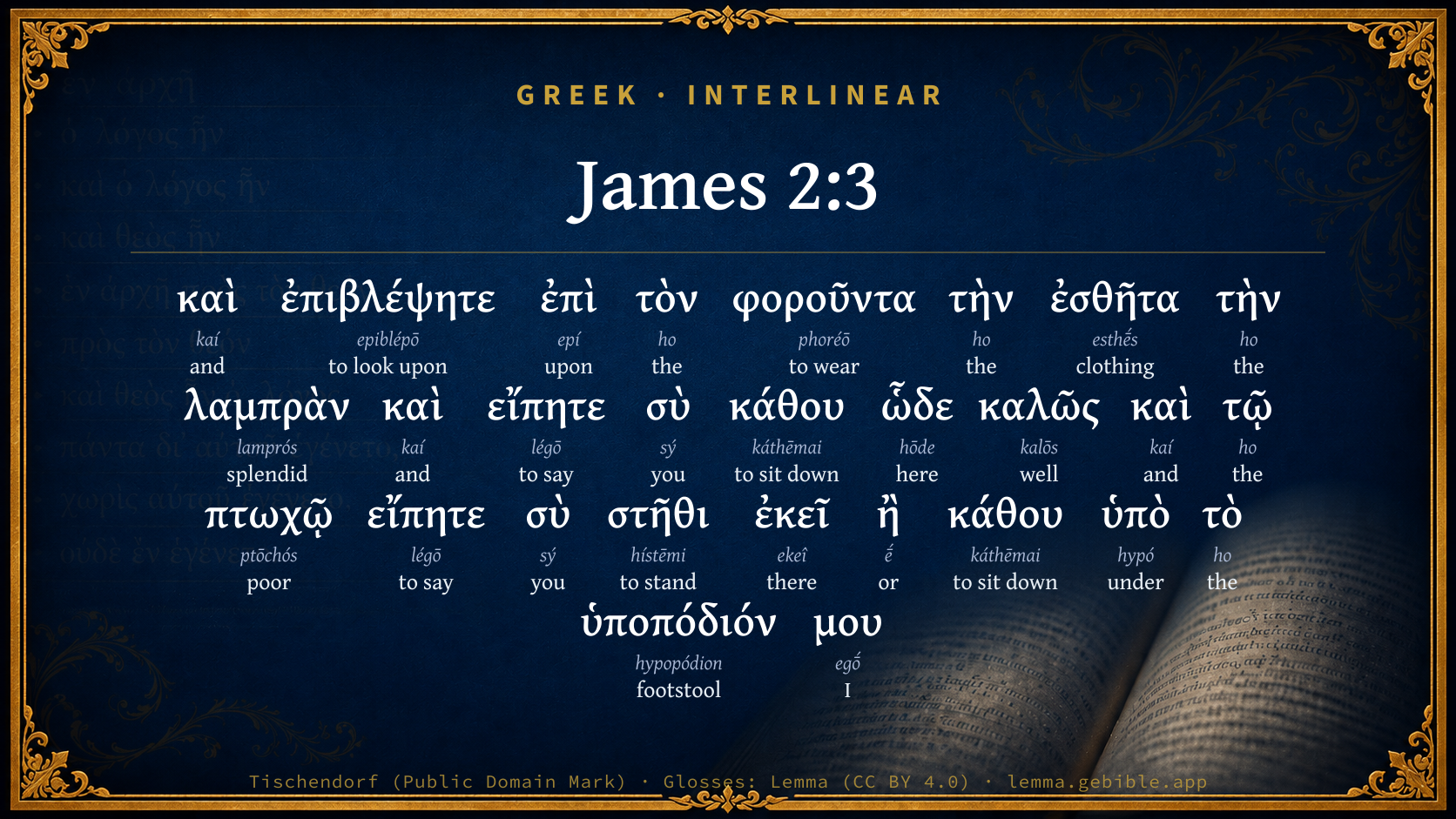
  1. καὶ kaí G2532 “and” Conjunction
  2. ἐπὶ epí G1909 “upon” Preposition
  3. τὸν ho G3588 “the” Article, Accusative, Singular, Masculine
  4. φοροῦντα phoréō G5409 “to wear” Verb, Present, Active, Participle, Accusative, Singular, Masculine
  5. τὴν ho G3588 “the” Article, Accusative, Singular, Feminine
  6. ἐσθῆτα esthḗs G2066 “clothing” Noun, Accusative, Singular, Feminine
  7. τὴν ho G3588 “the” Article, Accusative, Singular, Feminine
  8. λαμπρὰν lamprós G2986 “splendid” Adjective, Accusative, Singular, Feminine
  9. καὶ kaí G2532 “and” Conjunction
  10. εἴπητε légō G3004 “to say” Verb, Aorist, Active, Subjunctive, 2nd person, Plural
  11. σὺ sý G4771 “you” Personal pronoun, 2nd person, Nominative, Singular
  12. κάθου káthēmai G2521 “to sit down” Verb, Present, Middle or Passive deponent, Imperative, 2nd person, Singular
  13. ὧδε hōde G5602 “here” Adverb
  14. καλῶς kalōs G2573 “well” Adverb
  15. καὶ kaí G2532 “and” Conjunction
  16. τῷ ho G3588 “the” Article, Dative, Singular, Masculine
  17. πτωχῷ ptōchós G4434 “poor” Adjective, Dative, Singular, Masculine
  18. εἴπητε légō G3004 “to say” Verb, Aorist, Active, Subjunctive, 2nd person, Plural
  19. σὺ sý G4771 “you” Personal pronoun, 2nd person, Nominative, Singular
  20. στῆθι hístēmi G2476 “to stand” Verb, Aorist, Active, Imperative, 2nd person, Singular
  21. ἐκεῖ ekeî G1563 “there” Adverb
  22. ἢ ḗ G2228 “or” Particle
  23. κάθου káthēmai G2521 “to sit down” Verb, Present, Middle or Passive deponent, Imperative, 2nd person, Singular
  24. ὑπὸ hypó G5259 “under” Preposition
  25. τὸ ho G3588 “the” Article, Accusative, Singular, Neuter
  26. ὑποπόδιόν hypopódion G5286 “footstool” Noun, Accusative, Singular, Neuter
  27. μου egṓ G1473 “I” Personal pronoun, 1st person, Genitive, Singular

About this verse

These counts appear in no published source. They are computed here, from the morphology-tagged text and Lemma’s own curated glosses. What Lemma adds →

28
words
19
distinct lemmas
General Epistles
section

Notable vocabulary

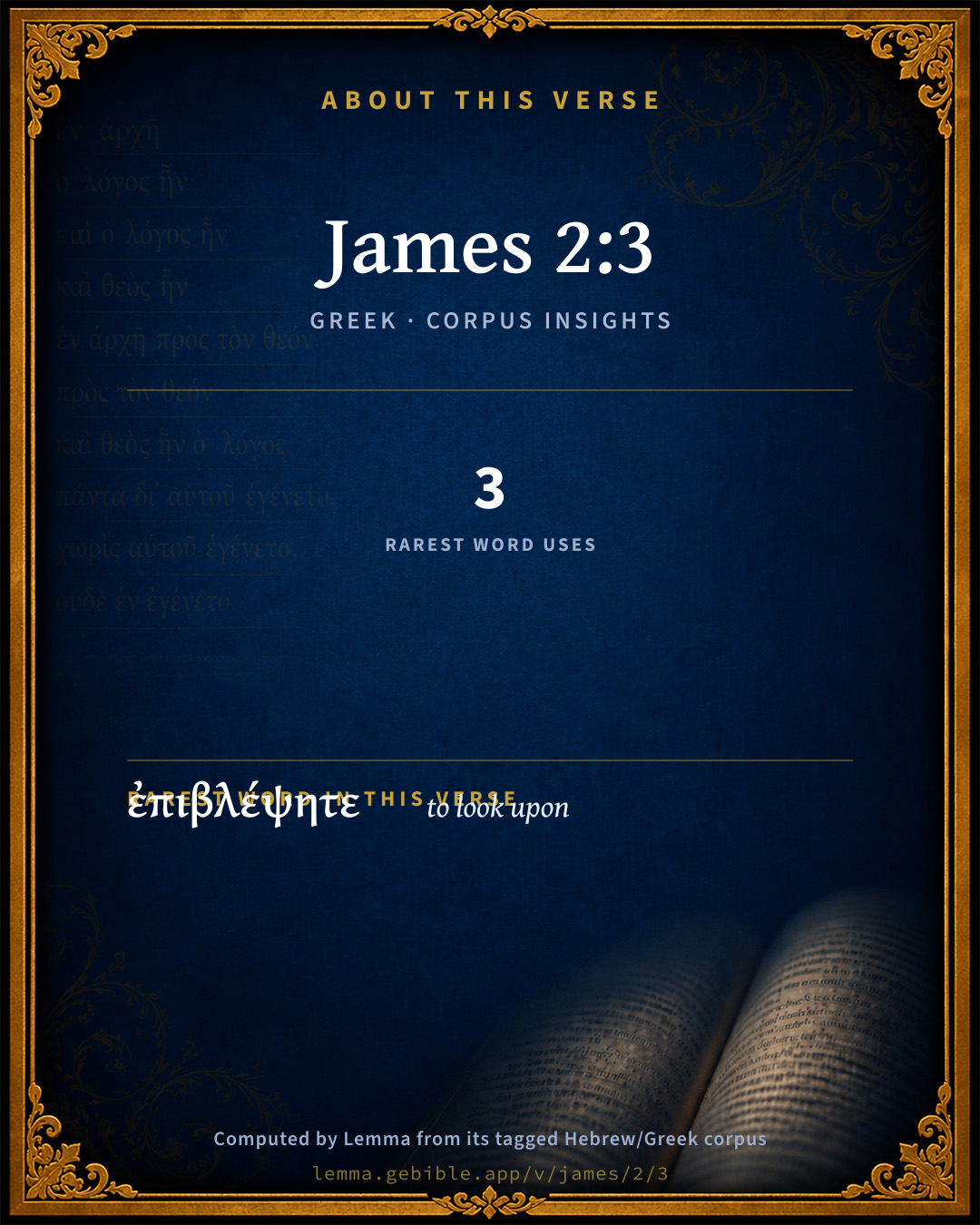
The rarest word here is ἐπιβλέψητε to look upon G1914 — appearing just 3 times in the whole Greek New Testament.

Shared distinctive vocabulary

ἐπιβλέψητε to look upon G1914 occurs in 3 verses of the Greek New Testament. Also found in:

Repetition

Words recur within this verse:

  • εἴπητε to say G3004 ×2
  • κάθου to sit down G2521 ×2
  • τὸν the G3588 ×5
  • καὶ and G2532 ×3
  • σὺ you G4771 ×2

Cross-references

5

Topical passages linked to James 2:3 in the Treasury of Scripture Knowledge — connected by theme and wording, ordered by reader-vote popularity; previews shown in the World English Bible.

  • 2 Corinthians 8:9 For you know the grace of our Lord Jesus Christ, that, though he was rich, yet for your sakes he became poor, that you through his poverty might become rich.
  • James 2:6 But you have dishonored the poor man. Don't the rich oppress you, and personally drag you before the courts?
  • Luke 7:44–46 Turning to the woman, he said to Simon, "Do you see this woman? I entered into your house, and you gave me no water for my feet, but she has wet my feet with her tears, and wiped them with the hair of her head.
  • Isaiah 65:5 who say, Stand by yourself, don't come near to me, for I am holier than you. These are a smoke in my nose, a fire that burns all the day.
  • Jude 1:16 These are murmurers and complainers, walking after their lusts (and their mouth speaks proud things), showing respect of persons to gain advantage.

Cross-references courtesy of OpenBible.info (CC BY 4.0).

Commentary

Notes on James 2:3 from classic Christian and Jewish commentators (each source and its license shown beneath its notes). The classic Christian expositions comment on the surrounding passage and are grouped to its opening verse, so a note may address several verses; the Jewish commentaries on the Tanakh (Rashi and others) are per-verse, so they appear only where the commentator wrote on this verse.

Lemma curates 59 commentaries, every one of them public domain or Creative Commons licensed, each selected and text-cleaned for this edition rather than reprinted as found. About our sources →

Tyndale Open Study Notes

Tyndale Open Resources

2:3-4 It is natural to give special attention to wealthy people because of their social status, political power, and potential generosity as patrons. By serving and publicly honoring the wealthy, the church could gain whatever economic benefits they wished to give. James warns that this discrimination reflects evil motives, a division between loyalty to God (1:6) and a desire for the benefits of worldly wealth (4:4).

Tyndale Open Study Notes — © Tyndale Open Resources, licensed CC BY-SA 4.0. Text via the HelloAO Bible API.

Bengel's Gnomon

Johann Albrecht Bengel

Jas 2:3. Ἐπιβλέψητε, ye look upon) with admiration.—τὸν φοροῦντα, him that weareth) although you are ignorant who he is; when perhaps he may be a heathen.—σὺ—σὺ, thou—thou) This has here the force of a proper name.—κάθου ὧδε, sit here) The antithesis is, stand there.—καλῶς) הטיב; Septuagint, καλῶς, honourably.—ἐκεῖ, there) at a distance from us.

Bengel's Gnomon of the New Testament — English translation (T&T Clark, Edinburgh, 1860) — public domain. Text from a community e-Sword module.

Meyer's Critical & Exegetical Commentary

Heinrich August Wilhelm Meyer

Jam_2:3 describes the conduct of the church toward the two incomers. Many ancient expositors understand this as a figurative representation of the preference which was generally given in the congregation to the rich; this is arbitrary. The whole description points rather to something which James has actually in view; but in reprimanding this, he condemns partiality generally, which certainly showed itself in many other ways. By the descriptive words ἐπιβλέψητε … τὴν λαμπράν, which precede εἴπητε (in reference to the poor there is only εἴπητε), is indicated in a lively manner the admiring look at the external glitter; ἐπιβλέπειν, emphatice sumendum est (Pott); the rich man is characteristically described as ὁ φορῶν τὴν ἐσθ. τ. λαμπράν; the splendid garment is that which attracts the eye, the character of the man is entirely overlooked; φορεῖν, a secondary form of φέρειν, is also in Mat_11:8 used of garments; by the article before λαμπράν this idea is strengthened as the chief idea.

The contrast is sharply expressed in the different address to the one and to the other; already they are distinguished from one another by σὺ … σύ, and then κάθου and στῆθει, ὧδε and ἐκεῖ, καλῶς and ὑπὸ τὸ ὑποπόδιόν μου, are opposed. The form κάθου (instead of κάθησο) is foreign to classical Greek; see Winer, p. 75 [E. T. 98].

καλῶς refers to comfort (Wiesinger); it is not = honorifice (Wahl); and still less is it to be resolved into Be so good as (Storr). A place is pointed out to the rich man, where he can be comfortably seated, whilst to the poor man it is said stand there. The second clause, separated from the first by ἤ, is not a special address, but the two clauses form one saying, whilst after ἤ a thought is to be supplied, as If thou wilt rather sit; by the addition of these words the depreciation of the poor is yet more strongly marked.

ὑπὸ τὸ ὑποπόδιον] means not under, but below my footstool (Wiesinger), by which the floor is pointed out as the fitting place for the poor to sit (Bouman). The expression involves contempt: as it were under ones feet. Not on the footstool (Lange). The word ὑποπόδιον (not unicum, as Wiesinger asserts) belongs only to the later classics. Often in N. T., and also in LXX.

Meyer — Critical and Exegetical Commentary on the New Testament — English translation by Peter Christie, edited by Frederick Crombie (T&T Clark, 1880) — public domain. Text from a community e-Sword module.

Expositor's Greek Testament

ed. W. Robertson Nicoll

Jas 2:3 . ἐπιβλέψητε : “look upon with admiration,” the exact force of the word is conditioned by the context; it quite expresses the Hebrew פנה אל , the meaning of which varies according to the context, e.g. , in Psa 25:16 (Sept. Psa 24:16) it is “to look graciously,” in Deu 9:27 , “to look sternly”. σὺ κάθου ὦδε καλῶς : the reference is to the kind of seat rather than to its position; chairs, or something corresponding to these, were provided for the elders and scribes ( cf. Mat 23:6 ; Mar 12:39 ; Luk 11:43 ), and would no doubt have been offered to persons of rank who might enter, while the poorer men would sit on the floor, which is indeed clearly implied by the words ὑπὸ τὸ ὑποπόδιόν μου . The official who directed people to their seats was called the חזן ( Chazzan ) i.e. , the man who “had charge”; we read of the existence of this official in the Synagogue within the Temple precints in Jerusalem ( Yoma , vii. 1).

The Expositor's Greek Testament, edited by W. Robertson Nicoll (1897–1910) — public domain. Text from a community e-Sword module.

Geneva Bible (1599)

Geneva Bible translators

In a worshipful and honorable place.

Geneva Bible (1599) marginal notes — public domain. Text via Bolls.life.

Jamieson, Fausset & Brown

Robert Jamieson, A. R. Fausset & David Brown

have respect to him, &c.--though ye know not who he is, when perhaps he may be a heathen. It was the office of the deacons to direct to a seat the members of the congregation [CLEMENT OF ROME, Apostolical Constitutions, 2.57, 58].

unto him--not in the best manuscripts. Thus "thou" becomes more demonstratively emphatic.

there--at a distance from where the good seats are.

here--near the speaker.

under my footstool--not literally so; but on the ground, down by my footstool. The poor man must either stand, or if he sits, sit in a degrading position. The speaker has a footstool as well as a good seat.

Jamieson, Fausset & Brown — Commentary Critical and Explanatory on the Whole Bible (1871) — public domain (CC PDM 1.0). Text via the HelloAO Bible API.

Adam Clarke's Commentary

Verse 3. Sit here under my footstool] Thus evidently prejudging the cause, and giving the poor man to see that he was to expect no impartial administration of justice in his cause.

Adam Clarke's Commentary on the Bible (1810–1826) — public domain. Text from a community e-Sword/MySword module.

Ellicott's Commentary for English Readers

(3) And ye have respect to him that weareth the gay clothing (or, bright apparel).—Look on him, that is, because of his fine appearance, with undue respect and consideration.

And say unto him, Sit thou here in a good place (or, as margin, well); and say to the poor, Stand thou there, or sit here under my footstool.—The sidesman or elder in charge of the church finds a stall for the person of substantial presence, while anything does for the poor one; but—most considerate offer—he can stand; or, if he prefer it, sit under the great man’s footstool, lower down, that is, on the floor beneath. We know Christ’s words for those who loved of old “the chief seats in the synagogues” (Mat_23:6), nor can there be doubt as to their full application now. What is to be urged in excuse for the special pews in churches and chapels, hired and appropriated, furnished luxuriously, and secured by bolt and lock? If in the high places sit the men and women in goodly raiment still, while the poorly clad are crowded into side benches and corners, or beneficently told to stand and wait till room be found somewhere beneath the daintier feet,—how can there be escape from condemnation on the charge which follows?—namely this—

A Bible Commentary for English Readers, edited by Charles John Ellicott (1878–1897) — public domain. Text from a community e-Sword module.

The Cambridge Bible for Schools and Colleges

gen. ed. J. J. S. Perowne

3. And ye have respect to] Better, look with respect upon. The same word is used in Luk_1:48; Luk_9:38. The English version weakens the dramatic vividness of the Greek.

the gay clothing] The English presents a needless variation from the Greek, which has the same words as in the preceding verse. The translators would seem to have acted on their principle of bringing in as many English words as they could by way of fairness. See Preface to the Authorised Version.

Sit thou here in a good place] The English paraphrases the Greek, which runs literally, as in the margin, Sit here honourably. In practice the seats most coveted among the Jews were those near the end of the synagogue which looked towards Jerusalem, and at which stood the ark that contained the sacred roll of the Law. We do not know whether the first meeting-places of the Christian society followed the same arrangements, or whether then, as at a later period, the Table of the Lord took the place which had been occupied by the ark, and led them to covet the places that were near it, and therefore well placed for seeing and hearing the officiating elder.

Stand thou there …] The Christian, probably the elder or deacon, is supposed to point the poor man to his place at the other end of the synagogue, far from sight and hearing, giving him, it may be, the alternative of a seat on the ground, just below what we should call the “stall,” in which the rich man was invited to take his place, with a stool for his feet to rest on.

The Cambridge Bible for Schools and Colleges (gen. ed. J. J. S. Perowne; Cambridge University Press, 1878–1918) — public domain. Text from a community e-Sword module.

John Gill's Exposition

And ye have respect to him that wears the gay clothing,.... Take notice of him, and show favour to him, to the neglect and contempt of the other. This is an instance of respect of persons condemned and dissuaded from:

and say unto him, sit thou here in a good place; the best place; whether it be in a religious assembly, or in a civil court of judicature:

and say to the poor, stand thou there; or in a lower and meaner place:

or sit thou here under my footstool; this also was contrary to the Jewish canons (t), that one should sit, and another stand, while their cause was trying; the law runs thus:

"one shall not sit, and another stand, but both shall stand; but if the sanhedrim, or court, please to let them sit, they sit; but one does not sit above, and the other below; but one by the side of the other.''

(t) Maimon. ib. sect. 3. vid. T. Bab. Shebuot, fol. 30. 1.

John Gill's Exposition of the Whole Bible (1746–1763) — public domain (CC PDM 1.0). Text via the HelloAO Bible API.

Trapp's Complete Commentary

John Trapp

3 And ye have respect to him that weareth the gay clothing, and say unto him, Sit thou here in a good place; and say to the poor, Stand thou there, or sit here under my footstool:

Ver. 3. That weareth the gay cloth] As Hospinian tells us of the dogs that kept Vulcan’s temple, and as others say of the Bohemian curs, that they will fawn upon a good suit, but fly upon one that is in ragged apparel. So is it with many; Vestis virum.

John Trapp, A Commentary or Exposition upon All the Books of the Old and New Testament (1647–1656) — public domain. Text from a community e-Sword module.

Albert Barnes' Notes on the Bible

And ye have respect to him that weareth the gay clothing - If you show him superior attention on account of his rich and gay apparel, giving him a seat by himself, and treating others with neglect or contempt. Religion does not forbid proper respect to rank, to office, to age, or to distinguished talents and services, though even in such cases it does not require that we should feel that such persons have any peculiar claims to salvation, or that they are not on a level with all others, as sinners before God; it does not forbid that a man who has the means of procuring for himself an eligible pew in a church should be permitted to do so; but it requires that men shall be regarded and treated according to their moral worth, and not according to their external adorning; that all shall be considered as in fact on a level before God, and entitled to the privileges which grow out of the worship of the Creator. A stranger coming into any place of worship, no matter what his rank, dress, or complexion, should be treated with respect, and everything should be done that can be to win his heart to the service of God.

And say unto him, Sit thou here in a good place - Margin, as in Greek, “well” or “seemly;” that is, in an honorable place near the pulpit; or in some elevated place where he would be conspicuous. The meaning is, you treat him with distinguished marks of respect on the first appearance, merely from the indications that he is a rich man, without knowing any thing about his character.

And say to the poor, Stand thou there - Without even the civility of offering him a seat at all. This may be presumed not often to occur in a Christian church; yet it practically does sometimes, when no disposition is evinced to furnish a stranger with a seat.

Or sit here under my footstool - Perhaps some seats in the places of worship were raised, so that even the footstool would be elevated above a lower seat. The meaning is, that he would be treated as if he were not worth the least attention.

Albert Barnes' Notes on the Bible (1834–1885) — public domain. Text from a community e-Sword/MySword module.

Matthew Poole's English Annotations

And ye have respect to him; Greek, look upon, viz. with respect and veneration, or a care and concern to please him.

Sit thou here in a good place; an honourable place, either contrary to the usual orders of the churches, according to which, (as some say) the elder sat in chairs, the next to them on benches; and the novices on the pavement at their feet; the apostle taxing their carnal partiality in disposing these places to the people as rich, not as Christians; or it may note their disposing church offices to them that were rich, or favouring them in their causes rather than the poor.

Stand thou there, or sit here under my footstool; the meanest places, and belonging to the youngest disciples: both are expressions of contempt.

Matthew Poole's English Annotations on the Holy Bible (1683–1685) — public domain. Text from a community e-Sword/MySword module.

Whedon's Commentary on the Bible

Daniel D. Whedon

3, 4. Say—Huther well contrasts the opposite speeches: Thou… thou… sit… stand… here… there… in a good place… under (rather, at) my footstool. The dignified speaker has a footstool, and seems to be an official of the synagogue. It seems to be a regularly officered Church, with an edifice, and a furnishing; all indicating a mature period. The two clauses beginning with sit, stand, with an or between them, form not two, but one directive speech.

Partial in yourselves—A much debated interpretation. Huther gives a large number of explications, all of which he justly rejects because they do not give the exact meaning of the Greek verb here used, which usually signifies to doubt, to hesitate, or, as used by St. James in Jas_1:6, to waver. But Alford, following Huther and others, adopts the first of these two definitions, and interprets it of a doubt of their own Christianity! He gives the following far-fetched paraphrase: “Did you not, in making such distinction between rich and poor, become of the number of those who doubt respecting their faith?” But certainly this discrimination was no doubt of the Christian faith! If, however, our English version had translated it as in Jas_1:6, waver, they would have furnished the true thought. If ye so discriminated, did you not waver (from the straight course)? The writer charges, that, under the fascinations of the gorgeous attire, they were induced to veer and vibrate from Christian integrity. Judges (possessed) of evil thoughts—The evil thoughts were the inward quality of the judges. They became evil-thoughted judges. The word judges is used, not in a judicial, but in an opinionative or discriminative sense, and might be rendered discriminators. Translate the whole, then, If ye have done all this, have ye not wavered (as Christians) and become evil-thoughted discriminators?

Daniel D. Whedon (gen. ed.), Commentary on the Old and New Testaments (1874–1909) — public domain. Text from a community e-Sword module.

John Wesley's Explanatory Notes

Ye look upon him - With respect.

John Wesley, Explanatory Notes Upon the Whole Bible (1754–1765) — public domain. Text via the GEBible commentary corpus.

The People's New Testament

B. W. Johnson

3. And have respect. Show respect not to the character but to the clothes, by giving one a welcome and a good seat, while the other is treated contemptuously, allowed to stand or to sit in a very uncomfortable place. Does not this describe the spirit of half the churches of our time?

B. W. Johnson's The People's New Testament with Notes (1889–1891) — public domain. Electronic text from the Christian Classics Ethereal Library (CCEL) ThML edition.

Cambridge Greek Testament for Schools and Colleges

3. σὺ στῆθι ἐκεῖ ἢ κάθου. B places ἐκεῖ after κάθου, so also ff, an O. L. codex. The T. R. has ὧδε after κάθου with אC2KLP and many versions: the omission of ὧδε is supported by ABC* ff and V.

3. ἐπιβλέψητε. ἐπί indicates an earnest, fixed look. The rich man at once attracts attention.

σὺ κάθου ὧδε καλῶς. Sit thou here in a good place. The classical phrase is ἐν καλῷ. Dr Field, Otium Norv., quotes ἄγει μέ τις λαβὼν εἰς τὸ θέατρον, καθίσας ἐν καλῷ, Alciph. Ep. III. 20. Comp. Mat 23:6 φιλοῦσιν … τὰς πρωτοκαθεδρίας ἐν ταῖς συναγωγαῖς and Mar 12:39; Luk 11:43; Luk 20:46.

κάθου. See Veitch sub voc. κάθημαι. This form for the more classical κάθησο occurs in the Comic writers of the classical period and in late prose, as here and Psa 110:1 (cited Mat 22:44 and elsewhere). The use of a popular and vernacular form not used in literature is a touch of reality.

ὑπὸ τὸ ὑποπόδιόν μου, the words are now placed in the mouth of one person, perhaps the ἀρχισυνάγωγος.

Cambridge Greek Testament for Schools and Colleges (Cambridge University Press, 1896; 21 vols, various authors incl. Carr, Maclear, Plummer, Farrar, Lumby, Moule, M. R. James, Simcox) — public domain. Text from a community e-Sword module.

Alford’s Greek Testament

Henry Alford

3.] and (the δέ just expresses the change of subject, from the persons entering in, to the congregation) ye look upon (with respect, see reff.: so as to take into consideration) the man wearing a splendid garment (thus designated, because it is this which wins for him the respect—which attracts your notice) and say, Sit thou (κάθου for κάθησο, occurring Mat 22:44: Luk 20:42: Act 2:34: 1Ki 1:23; 1Ki 22:5: 4 Kings 2:6 al., is not found in pure Greek. See Winer, § 14. 4) here (pointing out a spot to him: and that, as the contrast between ὧδε and ἐκεῖ (shews, in the midst, near (for the words must be supposed to be spoken by those who would be the mouthpiece of the assembly) those in honour) in a good place (not, “honorifice,” as Wahl, still less must καλῶς be supposed to mean “be so good as to” &c., as Storr), and ye say to the poor man, Stand thou there, or sit under (i. e. not literally underneath; but ‘on the ground beside,’ ‘down by’) my footstool (Wiesinger calls ὑποπόδιον an ἅπαξ λεγόμενον: but see reff. Thus it is implied that the speaker is in a good place and furnished with a footstool.

The question, argued at considerable length by Wiesinger and Huther, who these incomers are supposed to be, whether Christians, or Jews who have looked in as strangers, is perhaps hardly worth the trouble spent upon it. The illustration merely requires that they should be strangers, not having a regular place in the congregation. Certainly so far I agree with Huther, that there appears nothing in the text which compels us to assume them to be Christians. They are taken merely as samples of a class, the rich and the poor: and these two are dealt with again in vv. 5 ff., as classes of persons, out of one of which God hath chosen His people for the most part, and out of the other of which the oppressors of His people arise. So that it is better to leave the examples in their general reference),

Henry Alford, The Greek Testament (1849–1861) — public domain. Text from a community e-Sword module.

International Critical Commentary

3. ἐπιβλέψητε, “look,” i. e. with favour, “have regard.” ἐπιβλέπειν has this sense also in Luk 1:48, Luk 9:38, apparently through the influence of the LXX usage; cf. 1Sa 1:11, 1Sa 9:16, Psa 25:16, Psa 69:16, Job 3:3, Judith 13:4, etc. The development of this sense in an appropriate context is a natural one; but in classical usage only Aristotle, Eth. Nic. iv, 2, p. 1120, is cited.

εἴπητε. Doubtless the speaker is one of the dignitaries of the congregation, cf. τὸ ὑποπόδιόν μου.

κάθου. This form of the imperative (for the more literary κάθησο), found uniformly in O. T. and N. T., was doubtless in ordinary colloquial use, as is attested by its occurrence in comic writers of the fifth and fourth centuries b.c. and in post-classical usage. See Lex. s. v. and Winer-Schmiedel, § 14, 3, note 3.

καλῶς. Usually explained as meaning “in a good seat,” “comfortably.” But the usage does not fully justify this (see Mayor’s citations), and some polite idiom in the sense of “please,” “pray,” is to be suspected. In various Greek liturgies the minister’s direction to the worshipping congregation, στῶμεν καλῶς, presents the same difficulty and suggests the same explanation. See F. E. Brightman, Liturgies, Eastern and Western, vol. i, Oxford, 1896, pp. 43, 49, 383, 471. The Syrian liturgies sometimes merely carry this over, “Stōmen kalōs, ” but also render by, “Stand we all fairly,” ibid. pp. 72, 74, 104. On the Jewish custom of distinguished places in the synagogue, cf. Mat 23:6, Mar 12:39, Luk 11:43, Luk 20:46, and see “Synagogue,” in EB and HDB

A noteworthy commentary on these verses is offered by a passage found in various ancient books of church order. Its oldest form is perhaps that in the Ethiopic Statutes of the Apostles (ed. Horner, 1904, pp. 195 f.): “And if any other man or woman comes in lay dress [i. e. in fine clothes], either a man of the district or from other districts, being brethren, thou, presbyter, while thou speakest the word which is concerning God, or while thou hearest or readest, thou shalt not respect persons, nor leave thy ministering to command places for them, but remain quiet, for the brethren shall receive them, and if they have no place (for them) the lover of brothers or of sisters, having risen, will leave place for them.

“… And if a poor man or woman either of the district or of the (other) districts should come in and there is no place for them, thou, presbyter, make place for such with all thy heart, even if thou wilt sit on the ground, that there should not be respecting the person of man but of God.”

See also the Syriac Didascalia apostolorum, 12; Apostolic Constitutions, ii, 58; E. v. d. Goltz, “Unbekannte Fragmente altchristlicher Gemeindeordnungen,” in Sitzungsberichte der kgl. preuss. Akademie, 1906, pp. 141-157. There is no sufficient indication that the passage is dependent on James.

στῆθι, in contrast to κάθου.

στῆθι ἢ κάθου ἐκεῖ] B ff.

στῆθι ἢ κάθου] sah.

στῆθι ἐκεῖ ἢ κάθου] A 33 minn Cyr vg Jer Aug syrhcl.

στῆθι ἐκεῖ ἢ κάθου ὧδε] אC2KLP minn boh syrpesh.

στῆθι ἐκεῖ καὶ κάθου] C*.

The reading of B ff makes the rough words an invitation to stand or to take a poor seat. So the Sahidic, which thus on the whole supports B ff. The readings of A al and א al seem to be different emendations, both due to the wish to make στῆθι explicit and so to create a better parallelism. But since the indefinite ἐκεῖ does not in itself imply any disrespect to the visitor, the effect is to lessen rather than intensify the rudeness of στῆθι, and the product is a weaker text than that of B ff (sah). The text of B ff is thus on both external (see p. 85) and internal grounds to be preferred.

ἢ κάθου ἐκεῖ ὑπὸ τὸ ὑποπόδιόν μου, i. e. in a humble place. This is a sorry alternative to standing. Cf. Deu 33:3 ὑπό σε, “at thy feet,” Luk 8:35, Luk 10:39, Act 22:3 παρὰ τοὺς πόδας.

These persons who come into the meeting are visitors, who may be won for the church, and the treatment of them at this critical moment reveals the real feeling of the members toward the relative worth of the different classes in society. The visitors seem clearly distinguished from the members of the congregation; and nothing indicates, or suggests, that they are members of sister churches. They are undoubtedly outsiders, whether Jews or Gentiles.

ὑπό] B3 P 33 minn have emendation to the easier ἐπί.

3. (a) In despair of any other solution, Pfleiderer, Urchristentum, 11887, p. 874; 21902, ii, p. 547; E. Y. Hincks (Journal of Bibl. Literature, xviii, 1899, pp. 199-201), Baljon, Katholieke Brieven, 1904, p. 42, have declared the text corrupt, and propose to read against all Mss. (except the Latin Codex Corbeiensis [ff], the reading of which is admittedly a secondary correction) σὺ ἔργα ἔχεις κἀγὼ πίστιν ἔχω.

The meaning will then be, as in the explanation defended above, an appeal by the opponent to the equal value of various religious gifts, faith and works both being good in their own way. In the text as reconstructed each gift will be assigned to the right person, faith to the opponent, works to James.

But (1) this reconstruction of the text is too violent a procedure to be acceptable so long as any other explanation can be found, and (2) the resulting text is unsatisfactory. For James’s own character and principles have not been in question, and to represent the defender as here drawing a sharp contrast specifically between James and himself is to make the words amount to an attack on James. Thus this solution is exposed to the same objections as that of Weiss already discussed.

(b) Of the same violent sort is the suggestion of Spitta, followed by Hollmann, that the objection originally introduced by ἀλλʼ ἐρεῖ τις has fallen out, so that originally σὺ πίστιν ἔχεις constituted the first words of James’s rejoinder.

But such a rejoinder, in which the writer declares that he possesses these highly prized works, would be very unnatural, to say nothing of the fact that James would not have admitted voluntarily and gratuitously that his own faith required proof. And Spitta’s attempt to reconstruct the objection introduced by ἐρεῖ τις is weak (“Aus dem Fehlen gewisser Werke könne nicht geschlossen werden, der Glaube sei nicht lebendig, und die Werke, auf welche Jakobus poche, könnten den Mangel der πίστις nicht ersetzen,” p. 79).

Hollmann’s attempt is equally unconvincing: “Allein da wird jemand sagen: [Was nützen Werke ohne Glauben? Ich aber habe Glauben!] Du hast Glauben und ich habe Werke? Zeige mir deinen Glauben” (in J. Weiss, Schriften des N. T. ii, 1908, p. 10).

International Critical Commentary — older volumes (1896–1929), various authors — public domain. Text from a community e-Sword module.

Vincent's Word Studies in the New Testament

Marvin R. Vincent

Ye have respect [επιβλεψητε] . Lit., ye look upon, with the idea of respectful consideration; ye regard. Compare Luk 1:48; Luk 9:38.

In a good place [καλως] . Lit., honorably; in a seat of honor.

Under. Not literally underneath, but down on the ground beside. Compare Mt 23:6, on the fondness of the Jews for the chief places in the synagogue.

Marvin R. Vincent, Word Studies in the New Testament (1887–1900) — public domain. Text from a community e-Sword/MySword module.

Lesson kit

Teaching starters — assembled from the data on this page, not authored interpretation. Every prompt links to the verse data it draws on. Edit before teaching.

James, in the General Epistles, opens this verse with 28 words (19 distinct Greek lemmas). Its most distinctive word is epiblépō (“to look upon”). A historical commentator’s framing appears above. Read the whole chapter for the surrounding context.

Discussion questions

  1. How does “to look upon” (epiblépō) shape what this verse is saying?
  2. How does Luke 1:48, which shares the word «to look upon», read alongside this verse?
  3. What does the repetition of “to say” (2× in this one verse) do in this verse?
  4. The translations on this page render this verse differently — a whole-verse word diff, not a word-by-word alignment. What might account for the different wordings?
  5. Compare how Tyndale Open Study Notes and Bengel's Gnomon read this verse. Where do they agree or differ?

Things to notice

Reading settings

Reading text

Shown beneath each verse's original-language words.

Old Testament
Old Testament edition

Read the OT as the Masoretic Hebrew (MT) or the Greek Septuagint (LXX).

English shown for the Greek Septuagint (in the Hebrew ↔ Greek comparison).

Comparing translations? Open the Compare panel on any verse page to stack up to four side by side.