

James 2:6
Greek (Tischendorf 8th ed.) James 2:6 appears in the Greek New Testament. The text above is from the Tischendorf 8th edition. Each word links to its Strong’s number and a concise gloss. Click any word for its full Thayer’s Greek Lexicon entry.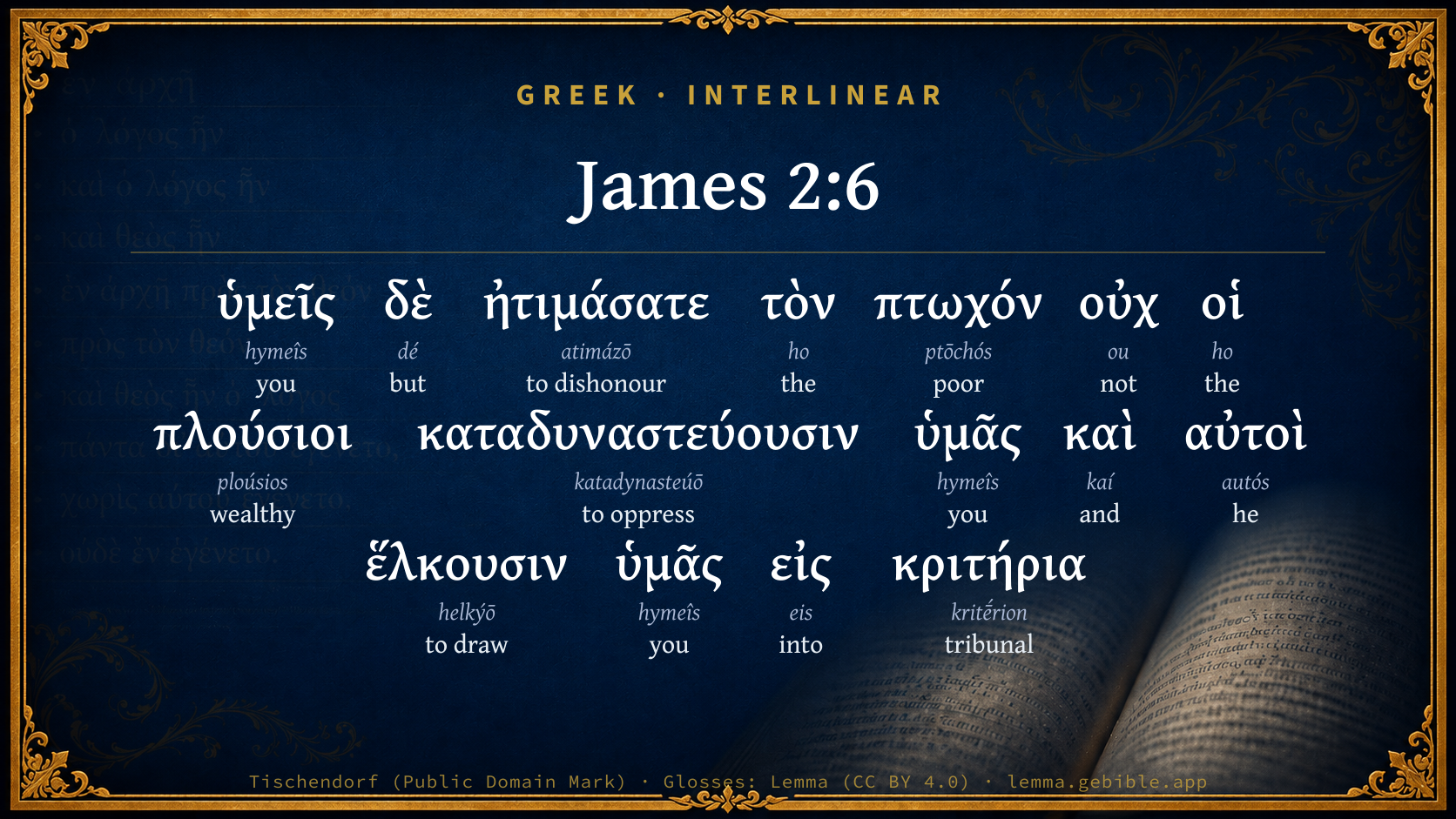
But you have dishonored the poor man. Don't the rich oppress you, and personally drag you before the courts?
Download a study sheet
One document with this verse’s original text, its word-by-word gloss line, the meaning frame, cross-references with their text, attributed commentary, and full source and license credits — printable, and it pastes into notes with its structure intact.
This verse Autodidact and up
A passage Seminary Student
Up to 50 verses in one chapter. A passage sheet keeps up to 6 commentary sources and 12 cross-references per verse, in the order this page ranks them, and says so on the sheet whenever that leaves anything out. Ask for a single verse and you get the Autodidact verse sheet above.
Everything on this page stays free to read, with no account — the sheet is a download of what is already on screen, not access to it.
Compare translations 3
The same verse in 3 English versions, stacked beneath the original-language interlinear above. Click any original word for its lexicon entry.
Each is an independent rendering of the whole verse — the interlinear is not word-aligned to these translations.
Highlighted words mark where these versions differ — a whole-verse word diff, not a word-by-word alignment.
-
World English Bible Public Domain
But you have dishonored the poor man. Don't the rich oppress you, and personally drag you before the courts?
-
King James Version Public Domain
But ye have despised the poor. Do not rich men oppress you, and draw you before the judgment seats?
-
unfoldingWord Literal Text CC BY-SA 4.0
But you dishonored the poor! Do not the rich overpower you and themselves drag you into court?
unfoldingWord Literal Text — © unfoldingWord, licensed CC BY-SA 4.0. Word-aligned USFM3 via Door43 (git.door43.org/unfoldingWord/en_ult).
Show all 19 translations
Every available English version of this verse, each an independent rendering of the whole verse.
-
World English Bible Public Domain
But you have dishonored the poor man. Don't the rich oppress you, and personally drag you before the courts?
-
Berean Standard Bible Public Domain
But you have dishonored the poor. Is it not the rich who oppress you and drag you into court?
-
Majority Standard Bible Public Domain
But you have dishonored the poor. Is it not the rich who oppress you and drag you into court?
-
King James Version Public Domain
But ye have despised the poor. Do not rich men oppress you, and draw you before the judgment seats?
-
American Standard Version (1901) Public Domain
But ye have dishonored the poor man. Do not the rich oppress you, and themselves drag you before the judgment-seats?
-
Revised Version (1885) Public Domain
But ye have dishonoured the poor man. Do not the rich oppress you, and themselves drag you before the judgment-seats?
-
Geneva Bible (1599) Public Domain
But ye haue despised the poore. Doe not the riche oppresse you by tyrannie, and doe not they drawe you before the iudgement seates?
-
Douay-Rheims (1899) Public Domain
But you have dishonoured the poor man. Do not the rich oppress you by might? and do not they draw you before the judgment seats?
-
Young's Literal Translation Public Domain
and ye did dishonour the poor one; do not the rich oppress you and themselves draw you to judgment-seats;
-
Literal Standard Version CC BY-SA 4.0
But you dishonored the poor one. Do the rich not oppress you and themselves draw you to judgment-seats?
-
Unlocked Literal Bible CC BY-SA 4.0
But you have dishonored the poor! Is it not the rich who oppress you? Are they not the ones who drag you to court?
-
unfoldingWord Literal Text CC BY-SA 4.0
But you dishonored the poor! Do not the rich overpower you and themselves drag you into court?
-
Darby Bible Public Domain
But *ye* have despised the poor [man]. Do not the rich oppress you, and [do not] *they* drag you before [the] tribunals?
-
World Messianic Bible Public Domain
But you have dishonored the poor man. Don’t the rich oppress you and personally drag you before the courts?
-
Webster's Bible Public Domain
But ye have despised the poor. Do not rich men oppress you, and draw you before the judgment-seats?
-
Free Bible Version CC BY-SA 4.0
But you've treated the poor shamefully. Isn't it the rich who oppress you and drag you before the courts?
-
Bible in Basic English Public Domain
But you have put the poor man to shame. Are not the men of wealth rulers over you? do they not take you by force before their judges?
-
Text-Critical English NT CC BY 4.0
But you have dishonored the poor man. Is it not the rich who oppress you? Are they not the ones who drag you into court?
-
Tyndale New Testament (1534) Public Domain
But ye have despised the poore. Are not the rych they which opresse you: and they which drawe you before iudges?
Literal Standard Version (2020), Covenant Press — licensed CC BY-SA 4.0. Text via the HelloAO Bible API (eBible.org). Unlocked Literal Bible (unfoldingWord) — licensed CC BY-SA 4.0. Text via the HelloAO Bible API (eBible.org). unfoldingWord Literal Text — © unfoldingWord, licensed CC BY-SA 4.0. Word-aligned USFM3 via Door43 (git.door43.org/unfoldingWord/en_ult). Free Bible Version, Dr. Jonathan Gallagher — licensed CC BY-SA 4.0. Text via the HelloAO Bible API (eBible.org).
Word by word
More ways to search: Search by grammar → Find every occurrence → Compare this word →
Practice this passage: Drill this verse → Learn its vocabulary →
- Appears 2× in the Greek New Testament
- First appears at Acts 10:38
- Part of Speech
- Verb
- Tense
- Present
- Voice
- Active
- Mood
- Indicative
- Person
- 3rd person
- Number
- Plural
Full Thayer's Definition
- ὑμεῖς hymeîs G5210 “you” Personal pronoun, 2nd person, Nominative, Plural
- δὲ dé G1161 “but” Conjunction
- ἠτιμάσατε atimázō G818 “to dishonour” Verb, Aorist, Active, Indicative, 2nd person, Plural
- τὸν ho G3588 “the” Article, Accusative, Singular, Masculine
- πτωχόν ptōchós G4434 “poor” Adjective, Accusative, Singular, Masculine
- οὐχ ou G3756 “not” Particle, Negative
- οἱ ho G3588 “the” Article, Nominative, Plural, Masculine
- πλούσιοι ploúsios G4145 “wealthy” Adjective, Nominative, Plural, Masculine
- καταδυναστεύουσιν katadynasteúō G2616 “to oppress” Verb, Present, Active, Indicative, 3rd person, Plural
- ὑμᾶς hymeîs G5210 “you” Personal pronoun, 2nd person, Accusative, Plural
- καὶ kaí G2532 “and” Conjunction
- αὐτοὶ autós G846 “he” Personal pronoun, Nominative, Plural, Masculine
- ἕλκουσιν helkýō G1670 “to draw” Verb, Present, Active, Indicative, 3rd person, Plural
- ὑμᾶς hymeîs G5210 “you” Personal pronoun, 2nd person, Accusative, Plural
- εἰς eis G1519 “into” Preposition
- κριτήρια kritḗrion G2922 “tribunal” Noun, Accusative, Plural, Neuter
About this verse
These counts appear in no published source. They are computed here, from the morphology-tagged text and Lemma’s own curated glosses. What Lemma adds →
- 16
- words
- 13
- distinct lemmas
- General Epistles
- section
Cross-references
36Topical passages linked to James 2:6 in the Treasury of Scripture Knowledge — connected by theme and wording, ordered by reader-vote popularity; previews shown in the World English Bible.
- Proverbs 17:5 Whoever mocks the poor reproaches his Maker. He who is glad at calamity shall not be unpunished.
- Proverbs 14:31 He who oppresses the poor shows contempt for his Maker, But he who is kind to the needy honors him.
- 1 Corinthians 11:22 What, don't you have houses to eat and to drink in? Or do you despise God's assembly, and put them to shame who don't have? What shall I tell you? Shall I praise you? In this I don't praise you.
- Psalms 14:6 You frustrate the plan of the poor, Because Yahweh is his refuge.
- Psalms 10:14 But you do see trouble and grief; You consider it to take it into your hand. You help the victim and the fatherless.
- Psalms 12:5 "Because of the oppression of the weak and because of the groaning of the needy, I will now arise," says Yahweh; "I will set him in safety from those who malign him."
- Proverbs 22:16 Whoever oppresses the poor for his own increase and whoever gives to the rich, Both come to poverty.
- Ecclesiastes 5:8 If you see the oppression of the poor, and the violent taking away of justice and righteousness in a district, don't marvel at the matter: for one official is eyed by a higher one; and there are officials over them.
- Ecclesiastes 9:15–16 Now a poor wise man was found in it, and he by his wisdom delivered the city; yet no man remembered that same poor man.
- Isaiah 3:14–15 Yahweh will enter into judgment with the elders of his people, And their leaders: "It is you who have eaten up the vineyard. The spoil of the poor is in your houses.
- Amos 2:6–7 Thus says Yahweh: "For three transgressions of Israel, yes, for four, I will not turn away its punishment; Because they have sold the righteous for silver, And the needy for a pair of shoes;
- Amos 5:11 Forasmuch therefore as you trample on the poor, And take taxes from him of wheat: You have built houses of hewn stone, But you will not dwell in them. You have planted pleasant vineyards, But you shall not drink their wine.
- Amos 8:4–6 Hear this, you who desire to swallow up the needy, And cause the poor of the land to fail,
- Micah 6:11–12 Shall I be pure with dishonest scales, And with a bag of deceitful weights?
- Zechariah 7:10 Don't oppress the widow, nor the fatherless, the foreigner, nor the poor; and let none of you devise evil against his brother in your heart.'
- Acts 8:3 But Saul ravaged the assembly, entering into every house, and dragged both men and women off to prison.
- Acts 13:50 But the Jews stirred up the devout and prominent women and the chief men of the city, and stirred up a persecution against Paul and Barnabas, and threw them out of their borders.
- Acts 16:19–20 But when her masters saw that the hope of their gain was gone, they seized Paul and Silas, and dragged them into the marketplace before the rulers.
- Acts 17:6 When they didn't find them, they dragged Jason and certain brothers before the rulers of the city, crying, "These who have turned the world upside down have come here also,
- James 2:3 and you pay special attention to him who wears the fine clothing, and say, "Sit here in a good place;" and you tell the poor man, "Stand there," or "Sit by my footstool;"
- James 5:4 Behold, the wages of the laborers who mowed your fields, which you have kept back by fraud, cry out, and the cries of those who reaped have entered into the ears of the Lord of Hosts.
- 1 Kings 21:11–13 The men of his city, even the elders and the nobles who lived in his city, did as Jezebel had sent to them, according as it was written in the letters which she had sent to them.
- Job 20:19 For he has oppressed and forsaken the poor. He has violently taken away a house, and he shall not build it up.
- Psalms 10:2 In arrogance, the wicked hunt down the weak; They are caught in the schemes that they devise.
- Psalms 10:8 He lies in wait near the villages. From ambushes, he murders the innocent. His eyes are secretly set against the helpless.
- Psalms 10:10 The helpless are crushed, they collapse, They fall under his strength.
- Isaiah 53:3 He was despised, and rejected by men; a man of suffering, and acquainted with disease: and as one from whom men hide their face he was despised; and we didn't respect him.
- Amos 4:1 Listen to this word, you cows of Bashan, who are on the mountain of Samaria, who oppress the poor, who crush the needy, who tell their lords, "Bring, and let us drink."
- Habakkuk 3:14 You pierced the heads of his warriors with their own spears. They came as a whirlwind to scatter me, Gloating as if to devour the wretched in secret.
- Acts 4:1–3 As they spoke to the people, the priests and the captain of the temple and the Sadducees came to them,
- Acts 4:26–28 The kings of the earth take a stand, And the rulers take council together, Against the Lord, and against his Christ.'
- Acts 5:17–18 But the high priest rose up, and all those who were with him (which is the sect of the Sadducees), and they were filled with jealousy,
- Acts 5:26–27 Then the captain went with the officers, and brought them without violence, for they were afraid that the people might stone them.
- Acts 18:12 But when Gallio was proconsul of Achaia, the Jews with one accord rose up against Paul and brought him before the judgment seat,
- James 5:6 You have condemned, you have murdered the righteous one. He doesn't resist you.
- John 8:49 Jesus answered, "I don't have a demon, but I honor my Father, and you dishonor me.
Cross-references courtesy of OpenBible.info (CC BY 4.0).
Lesson kit
Teaching starters — assembled from the data on this page, not authored interpretation. Every prompt links to the verse data it draws on. Edit before teaching.
James, in the General Epistles, opens this verse with 16 words (13 distinct Greek lemmas). Its most distinctive word is katadynasteúō (“to oppress”). A historical commentator’s framing appears above. Read the whole chapter for the surrounding context.
Discussion questions
- The word katadynasteúō carries the sense “to oppress.” How does it shape the verse?
- Acts 10:38 shares the word «to oppress» with this verse. How do the two illuminate each other?
- “you” occurs 3× in this one verse. What is the effect of the repetition?
- These translations render this verse differently; the difference is in the English rendering, not the original. What questions does that raise?
- Reading how The Pulpit Commentary and Bengel's Gnomon read this verse, where do the two commentators agree and where do they part?
Things to notice
- These translations choose different wording for 19 words in this verse.
- “you” occurs 3× in this single verse.
- 13 distinct Greek lemmas span 16 words in this verse.
Commentary
Notes on James 2:6 from classic Christian and Jewish commentators (each source and its license shown beneath its notes). The classic Christian expositions comment on the surrounding passage and are grouped to its opening verse, so a note may address several verses; the Jewish commentaries on the Tanakh (Rashi and others) are per-verse, so they appear only where the commentator wrote on this verse.
Lemma curates 59 commentaries, every one of them public domain or Creative Commons licensed, each selected and text-cleaned for this edition rather than reprinted as found. About our sources →
The Pulpit Commentary
The Pulpit Commentary (1880–1919), ed. H.D.M. Spence-Jones & Joseph S. Exell — public domain. Text from a community e-Sword module.
Bengel's Gnomon
Johann Albrecht Bengel
Bengel's Gnomon of the New Testament — English translation (T&T Clark, Edinburgh, 1860) — public domain. Text from a community e-Sword module.
Meyer's Critical & Exegetical Commentary
Heinrich August Wilhelm Meyer
Meyer — Critical and Exegetical Commentary on the New Testament — English translation by Peter Christie, edited by Frederick Crombie (T&T Clark, 1880) — public domain. Text from a community e-Sword module.
Expositor's Greek Testament
ed. W. Robertson Nicoll
The Expositor's Greek Testament, edited by W. Robertson Nicoll (1897–1910) — public domain. Text from a community e-Sword module.
Geneva Bible (1599)
Geneva Bible translators
Geneva Bible (1599) marginal notes — public domain. Text via Bolls.life.
Jamieson, Fausset & Brown
Robert Jamieson, A. R. Fausset & David Brown
Jamieson, Fausset & Brown — Commentary Critical and Explanatory on the Whole Bible (1871) — public domain (CC PDM 1.0). Text via the HelloAO Bible API.
Adam Clarke's Commentary
Adam Clarke's Commentary on the Bible (1810–1826) — public domain. Text from a community e-Sword/MySword module.
John Calvin's Commentaries
John Calvin's Commentaries (1540-1563) — public domain. Text from the Calvin Translation Society English edition (1840s-50s) via the Christian Classics Ethereal Library (ccel.org). Calvin's coverage is partial (roughly two-thirds of the Bible); uncommented books and verses are honest gaps, never fabricated. The 19th-century editor's footnotes and remarks are omitted so the notes are faithfully Calvin's own voice.
Ellicott's Commentary for English Readers
A Bible Commentary for English Readers, edited by Charles John Ellicott (1878–1897) — public domain. Text from a community e-Sword module.
The Cambridge Bible for Schools and Colleges
gen. ed. J. J. S. Perowne
The Cambridge Bible for Schools and Colleges (gen. ed. J. J. S. Perowne; Cambridge University Press, 1878–1918) — public domain. Text from a community e-Sword module.
John Gill's Exposition
John Gill's Exposition of the Whole Bible (1746–1763) — public domain (CC PDM 1.0). Text via the HelloAO Bible API.
Trapp's Complete Commentary
John Trapp
John Trapp, A Commentary or Exposition upon All the Books of the Old and New Testament (1647–1656) — public domain. Text from a community e-Sword module.
Albert Barnes' Notes on the Bible
Albert Barnes' Notes on the Bible (1834–1885) — public domain. Text from a community e-Sword/MySword module.
Matthew Poole's English Annotations
Matthew Poole's English Annotations on the Holy Bible (1683–1685) — public domain. Text from a community e-Sword/MySword module.
Whedon's Commentary on the Bible
Daniel D. Whedon
Daniel D. Whedon (gen. ed.), Commentary on the Old and New Testaments (1874–1909) — public domain. Text from a community e-Sword module.
John Wesley's Explanatory Notes
John Wesley, Explanatory Notes Upon the Whole Bible (1754–1765) — public domain. Text via the GEBible commentary corpus.
Burkitt's Expository Notes on the New Testament
William Burkitt
William Burkitt's Expository Notes on the New Testament (1700–1703) — public domain. Text from a community e-Sword module.
The People's New Testament
B. W. Johnson
B. W. Johnson's The People's New Testament with Notes (1889–1891) — public domain. Electronic text from the Christian Classics Ethereal Library (CCEL) ThML edition.
Cambridge Greek Testament for Schools and Colleges
Cambridge Greek Testament for Schools and Colleges (Cambridge University Press, 1896; 21 vols, various authors incl. Carr, Maclear, Plummer, Farrar, Lumby, Moule, M. R. James, Simcox) — public domain. Text from a community e-Sword module.
Alford’s Greek Testament
Henry Alford
Henry Alford, The Greek Testament (1849–1861) — public domain. Text from a community e-Sword module.
International Critical Commentary
International Critical Commentary — older volumes (1896–1929), various authors — public domain. Text from a community e-Sword module.
Vincent's Word Studies in the New Testament
Marvin R. Vincent
Marvin R. Vincent, Word Studies in the New Testament (1887–1900) — public domain. Text from a community e-Sword/MySword module.