James 1:6

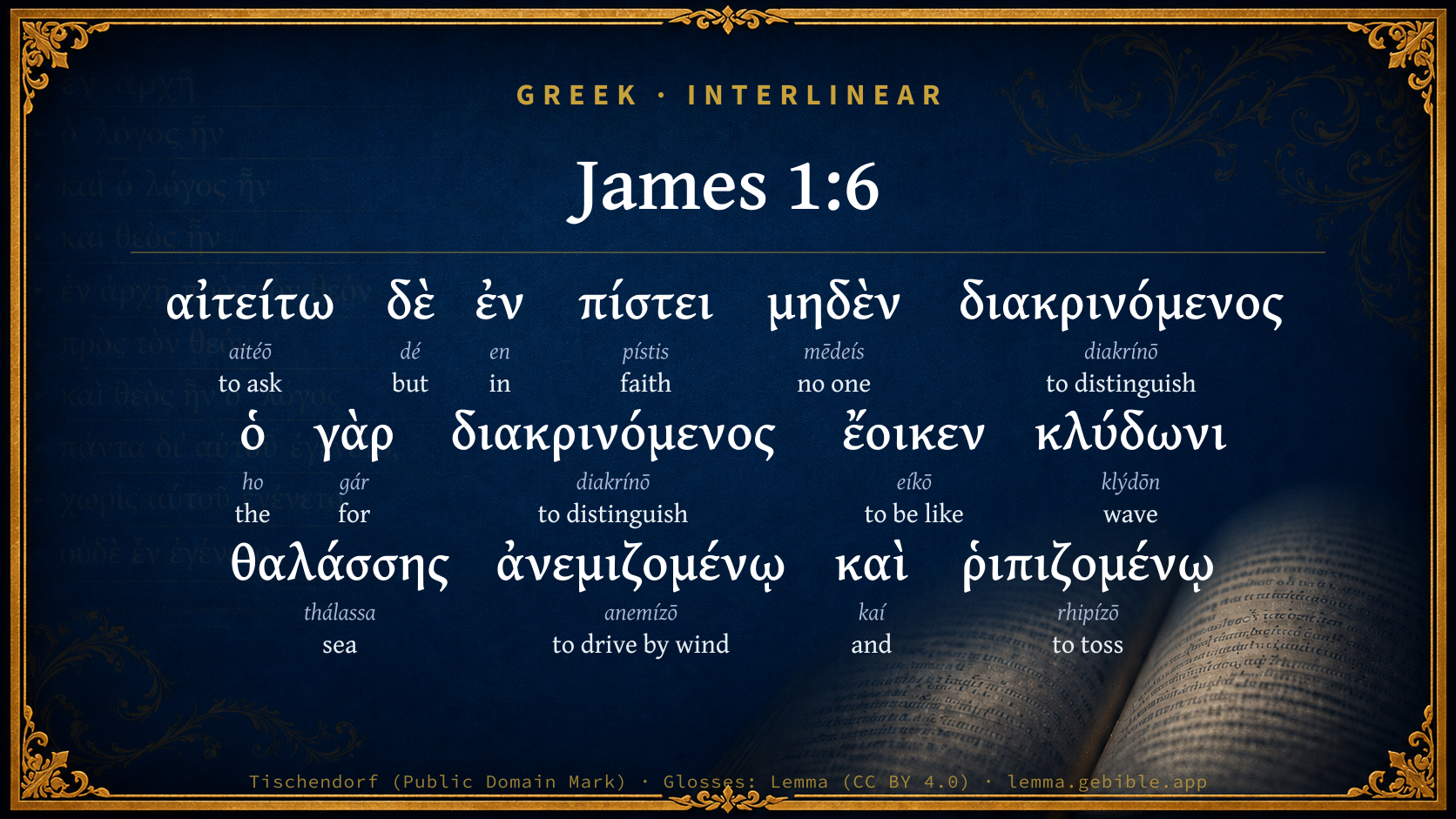
Greek (Tischendorf 8th ed.) James 1:6 appears in the Greek New Testament. The text above is from the Tischendorf 8th edition. Each word links to its Strong’s number and a concise gloss. Click any word for its full Thayer’s Greek Lexicon entry.
Download image
Cite this verse

James 1:6 (World English Bible). Public Domain. Lemma interlinear Bible study tool, https://lemma.gebible.app/v/james/1/6.

Show BibTeX & RIS
BibTeX
RIS
English Translation
But let him ask in faith, without any doubting, for he who doubts is like a wave of the sea, driven by the wind and tossed.
World English Bible · Public Domain
Highlights
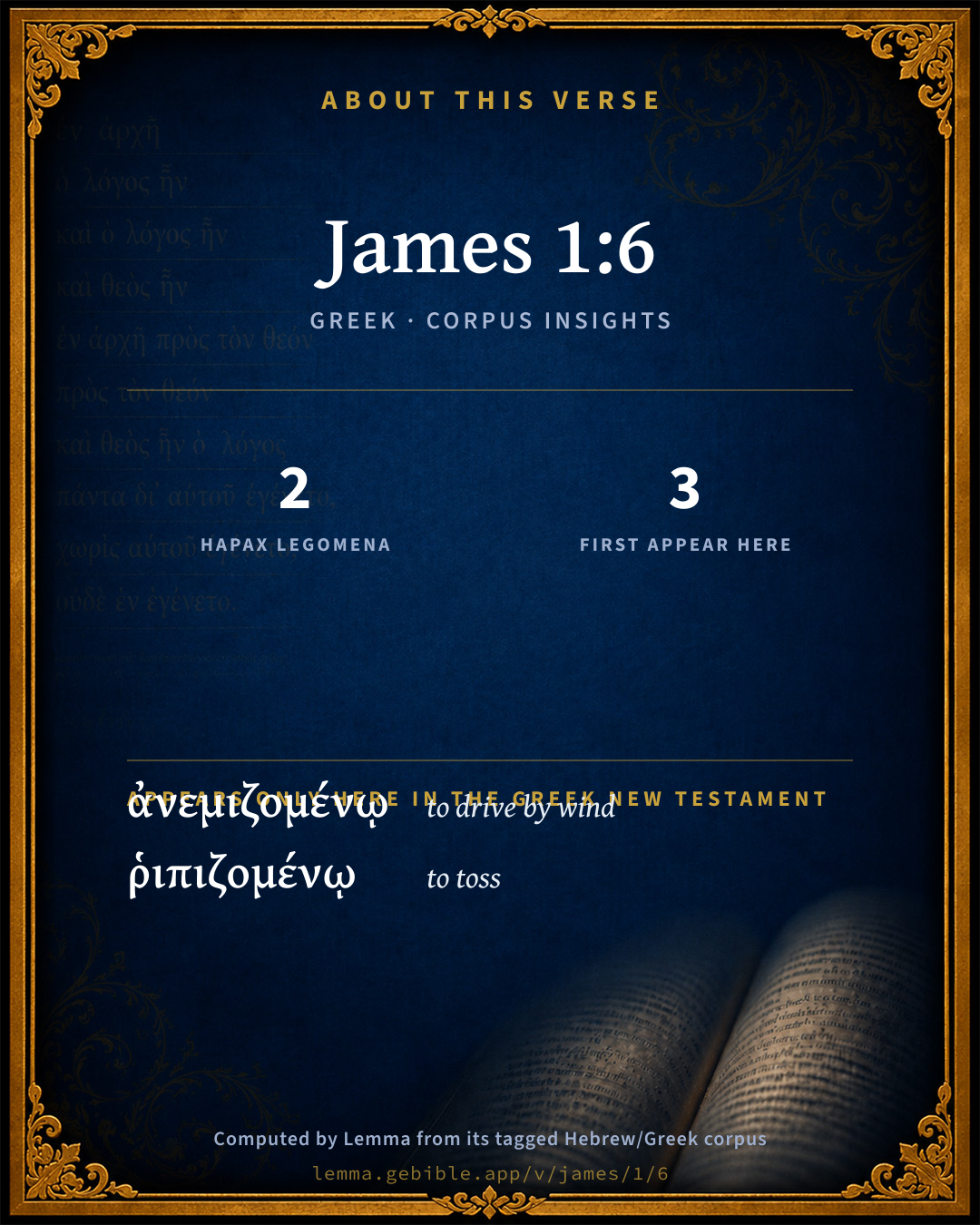
  • 2 hapax legomena — only here in the Greek New Testament
  • 3 first appearances in the Greek New Testament
Full analysis ↓
Download a study sheet

One document with this verse’s original text, its word-by-word gloss line, the meaning frame, cross-references with their text, attributed commentary, and full source and license credits — printable, and it pastes into notes with its structure intact.

This verse Autodidact and up

Study sheet (.html) Plain text (.txt)

A passage Seminary Student

Up to 50 verses in one chapter. A passage sheet keeps up to 6 commentary sources and 12 cross-references per verse, in the order this page ranks them, and says so on the sheet whenever that leaves anything out. Ask for a single verse and you get the Autodidact verse sheet above.

Everything on this page stays free to read, with no account — the sheet is a download of what is already on screen, not access to it.

Want to remove ads? Support Godless Engineer
Compare translations 3

The same verse in 3 English versions, stacked beneath the original-language interlinear above. Click any original word for its lexicon entry.

Each is an independent rendering of the whole verse — the interlinear is not word-aligned to these translations.

Highlighted words mark where these versions differ — a whole-verse word diff, not a word-by-word alignment.

  • World English Bible Public Domain
    But let him ask in faith, without any doubting, for he who doubts is like a wave of the sea, driven by the wind and tossed.
  • King James Version Public Domain
    But let him ask in faith, nothing wavering. For he that wavereth is like a wave of the sea driven with the wind and tossed.
  • unfoldingWord Literal Text CC BY-SA 4.0
    But let him ask in faith, doubting nothing, for the one doubting has become like a wave of the sea, wind-blown and tossed.

unfoldingWord Literal Text — © unfoldingWord, licensed CC BY-SA 4.0. Word-aligned USFM3 via Door43 (git.door43.org/unfoldingWord/en_ult).

Versions to compare (up to 4)

3 of 4 selected

Show all 19 translations

Every available English version of this verse, each an independent rendering of the whole verse.

  • World English Bible Public Domain
    But let him ask in faith, without any doubting, for he who doubts is like a wave of the sea, driven by the wind and tossed.
  • Berean Standard Bible Public Domain
    But he must ask in faith, without doubting, because he who doubts is like a wave of the sea, blown and tossed by the wind.
  • Majority Standard Bible Public Domain
    But he must ask in faith, without doubting, because he who doubts is like a wave of the sea, blown and tossed by the wind.
  • King James Version Public Domain
    But let him ask in faith, nothing wavering. For he that wavereth is like a wave of the sea driven with the wind and tossed.
  • American Standard Version (1901) Public Domain
    But let him ask in faith, nothing doubting: for he that doubteth is like the surge of the sea driven by the wind and tossed.
  • Revised Version (1885) Public Domain
    But let him ask in faith, nothing doubting: for he that doubteth is like the surge of the sea driven by the wind and tossed.
  • Geneva Bible (1599) Public Domain
    But let him aske in faith, and wauer not: for hee that wauereth, is like a waue of the sea, tost of the winde, and caried away.
  • Douay-Rheims (1899) Public Domain
    But let him ask in faith, nothing wavering. For he that wavereth is like a wave of the sea, which is moved and carried about by the wind.
  • Young's Literal Translation Public Domain
    and let him ask in faith, nothing doubting, for he who is doubting hath been like a wave of the sea, driven by wind and tossed,
  • Literal Standard Version CC BY-SA 4.0
    but let him ask in faith, doubting nothing, for he who is doubting has been like a wave of the sea, driven by wind and tossed;
  • Unlocked Literal Bible CC BY-SA 4.0
    But let him ask in faith, doubting nothing. For anyone who doubts is like a wave in the sea that is driven by the wind and tossed around.
  • unfoldingWord Literal Text CC BY-SA 4.0
    But let him ask in faith, doubting nothing, for the one doubting has become like a wave of the sea, wind-blown and tossed.
  • Darby Bible Public Domain
    but let him ask in faith, nothing doubting. For he that doubts is like a wave of the sea driven by the wind and tossed about;
  • World Messianic Bible Public Domain
    But let him ask in faith, without any doubting, for he who doubts is like a wave of the sea, driven by the wind and tossed.
  • Webster's Bible Public Domain
    But let him ask in faith, nothing wavering. For he that wavereth is like a wave of the sea driven with the wind and tossed.
  • Free Bible Version CC BY-SA 4.0
    But when you ask, remember to trust in God—don't have any doubts. Someone who doubts is like the crashing waves of the sea, tossed about and driven by the wind.
  • Bible in Basic English Public Domain
    Let him make his request in faith, doubting nothing; for he who has doubt in his heart is like the waves of the sea, which are troubled by the driving of the wind.
  • Text-Critical English NT CC BY 4.0
    But he must ask in faith without doubting, for he who doubts is like a wave of the sea that is driven by the wind and tossed about.
  • Tyndale New Testament (1534) Public Domain
    But let him axe in fayth and waver not. For he that douteth is lyke the waves of the see tost of the wynde and caried with violence.

Literal Standard Version (2020), Covenant Press — licensed CC BY-SA 4.0. Text via the HelloAO Bible API (eBible.org). Unlocked Literal Bible (unfoldingWord) — licensed CC BY-SA 4.0. Text via the HelloAO Bible API (eBible.org). unfoldingWord Literal Text — © unfoldingWord, licensed CC BY-SA 4.0. Word-aligned USFM3 via Door43 (git.door43.org/unfoldingWord/en_ult). Free Bible Version, Dr. Jonathan Gallagher — licensed CC BY-SA 4.0. Text via the HelloAO Bible API (eBible.org).

Word by word

More ways to search: Search by grammar → Find every occurrence → Compare this word →

Practice this passage: Drill this verse → Learn its vocabulary →

ἀνεμιζομένῳ
anemízō
G416
“to drive by wind”
Verb, Present, Passive, Participle, Dative, Singular, Masculine
Part of Speech
Verb
Tense
Present
Voice
Passive
Mood
Participle
Case
Dative
Number
Singular
Gender
Masculine
Full Thayer's Definition

Origin: from G417

TDNT: None

1. to agitate or drive by the wind
  1. αἰτείτω aitéō G154 “to ask” Verb, Present, Active, Imperative, 3rd person, Singular
  2. δὲ dé G1161 “but” Conjunction
  3. ἐν en G1722 “in” Preposition
  4. πίστει pístis G4102 “faith” Noun, Dative, Singular, Feminine
  5. μηδὲν mēdeís G3367 “no one” Adjective, Accusative, Singular, Neuter, Negative
  6. διακρινόμενος diakrínō G1252 “to distinguish” Verb, Present, Middle, Participle, Nominative, Singular, Masculine
  7. ὁ ho G3588 “the” Article, Nominative, Singular, Masculine
  8. γὰρ gár G1063 “for” Conjunction
  9. διακρινόμενος diakrínō G1252 “to distinguish” Verb, Present, Middle, Participle, Nominative, Singular, Masculine
  10. ἔοικεν eíkō G1503 “to be like” Verb, Perfect, Active, Indicative, 3rd person, Singular
  11. κλύδωνι klýdōn G2830 “wave” Noun, Dative, Singular, Masculine
  12. θαλάσσης thálassa G2281 “sea” Noun, Genitive, Singular, Feminine
  13. καὶ kaí G2532 “and” Conjunction
  14. ῥιπιζομένῳ rhipízō G4494 “to toss” Verb, Present, Passive, Participle, Dative, Singular, Masculine

About this verse

These counts appear in no published source. They are computed here, from the morphology-tagged text and Lemma’s own curated glosses. What Lemma adds →

15
words
14
distinct lemmas
General Epistles
section

Notable vocabulary

2 hapax legomena — words that appear only here in the entire Greek New Testament:

  • ἀνεμιζομένῳ to drive by wind G416
  • ῥιπιζομένῳ to toss G4494

First appearance in Scripture

These words make their first canonical appearance in the Greek New Testament here:

  • ἔοικεν to be like G1503
  • ἀνεμιζομένῳ to drive by wind G416
  • ῥιπιζομένῳ to toss G4494

Shared distinctive vocabulary

ἔοικεν to be like G1503 occurs in 2 verses of the Greek New Testament. Also found in:

Repetition

A word recurs within this verse:

  • διακρινόμενος to distinguish G1252 ×2

Cross-references

7

Topical passages linked to James 1:6 in the Treasury of Scripture Knowledge — connected by theme and wording, ordered by reader-vote popularity; previews shown in the World English Bible.

  • Matthew 21:21–22 Jesus answered them, "Most assuredly I tell you, if you have faith, and don't doubt, you will not only do what is done to the fig tree, but even if you told this mountain, 'Be taken up and cast into the sea,' it would be done.
  • Hebrews 11:6 Without faith it is impossible to be well pleasing to him, for he who comes to God must believe that he exists, and that he is a rewarder of those who seek him.
  • Mark 11:22–24 Jesus answered them, "Have faith in God.
  • Ephesians 4:14 that we may no longer be children, tossed back and forth and carried about with every wind of doctrine, by the trickery of men, in craftiness, after the wiles of error;
  • Hebrews 10:23 let us hold fast the confession of our hope unyieldingly. For he who promised is faithful.
  • Hebrews 13:9 Don't be carried away by various and strange teachings, for it is good that the heart be established by grace, not by food, through which those who were so occupied were not benefited.
  • 1 Timothy 2:8 I desire therefore that the men in every place pray, lifting up holy hands without wrath and doubting.

Cross-references courtesy of OpenBible.info (CC BY 4.0).

Commentary

Notes on James 1:6 from classic Christian and Jewish commentators (each source and its license shown beneath its notes). The classic Christian expositions comment on the surrounding passage and are grouped to its opening verse, so a note may address several verses; the Jewish commentaries on the Tanakh (Rashi and others) are per-verse, so they appear only where the commentator wrote on this verse.

Lemma curates 59 commentaries, every one of them public domain or Creative Commons licensed, each selected and text-cleaned for this edition rather than reprinted as found. About our sources →

The Biblical Illustrator

Joseph S. Exell

Jam_1:6

But let him ask in faith

Faith in prayer

What is it to ask in faith?

To this some things are requisite as necessary conditions, though more remotely; some things as essential ingredients.

I. THE NECESSARY CONDITIONS RESPECTING THE PETITIONER, ASKER, THE THING ASKED, THE MANNER OF ASKING.

1. The asker must be in the faith, or rather faith in him; the petitioner must be a believer. How can he ask in faith who has no faith? (Joh_16:23.) How can he ask in Christs name who believes not in it? There is no answer for him that is not a believer, God heareth not sinners (Joh_9:31). A fervent prayer for a thing unlawful is a crying sin.

2. The thing asked for must be an object of faith; such things as you may upon good grounds believe that God will grant (1Jn_5:14).

3. The manner of asking must be faithful.

(1) With fervency. He does not ask in faith that asks not fervently (chap. 5:16). If we pray as if we prayed not, God will hear as though He heard not, take little notice except to correct. Strong cries only pierce heaven; such were Christs.

(2) With submission.

(3) With right intentions. We must pray to glorify God, make us serviceable to Him, capable of communion with Him.

II. THE ESSENTIAL INGREDIENTS OF THIS DUTY ARE THE ACTINGS OF FAITH IN PRAYER, which are one or other of these four. He whose faith puts forth any one of these acts prays in faith.

1. Particular application. Believing the promises whereby God has engaged Himself to give what he asks; so to ask in faith is to pray with confidence the Lord will grant the petition, because He has promised.

2. Fiducial recumbence. Faith can read an answer of prayer in the name of God, and stay itself there, when a promise appears not, or, through faiths weakness, cannot support it (Isa_50:10-11).

3. A general persuasion that the prayer shall be heard. The prayer may be heard, though the thing desired be not presently bestowed, or not bestowed at all. And so a man may pray in faith, though he be not confident that what he prays for shall be given him, much more that it shall not be presently given.

4. A special confidence that the very same thing which is asked shall be given. Use: Take notice of the misery of unbelievers. They that cannot pray in faith must not expect to have their prayers heard. Of all duties and privileges, none more advantageous and comfortable than prayer; but it is faithful prayer: for without faith there is neither advantage by it, nor comfort in it. To pray, and not in faith, is to profane the ordinance. Pray as much, as often as you will, if not in faith, you lose your labour. The apostle is peremptory, Let not that man think he shall receive anything of the Lord (Jam_1:7).

Now to prevent this wavering, this doubting, so dishonourable and offensive to God; so prejudicial, dangerous, uncomfortable to you: let me prescribe some directions, the observance of which will establish the heart, and encourage faith, in your approaches to God.

1. Get assurance of your interest in the covenant; that Christ has loved you, and washed you from your sins in His blood; that He has given you His Spirit; that you are reconciled and in favour. If you be sure you are His favourites, you may be sure to have His ear.

2. Consider, the Lord is engaged to hear prayer. Faith may conclude He will hear, for He will not, He cannot, be false to His engagement; but He is engaged strongly, by His titles, attributes, dec. When you pray consider He is able to hear and give what you ask. It is gross atheism to doubt of this, to question omnipotency. Consider He can do abundantly (Eph_3:20). He can do more than we ask. Easily. He can do the greatest thing you ask more easily than you can do the least thing you think. Safely. Without any loss or damage to Himself, without any diminution of that infinite store that is in Himself. He is willing. Faith seldom questions Gods power; that which hinders its actings is doubts whether He is willing. But there is more reason to question this, for He is as willing as He is able.

3. Consider the nature and dignity of prayer, which affords divers arguments to confirm faith.

(1) It is Gods ordinance, instituted and enjoined for this end.

(2) He in Scripture adorns it with, and ascribes to it, many transcendent privileges, such as, considered, may fortify the most languishing faith. There is a strength in prayer which has power with God (Hos_12:3-4).

(3) Prayer is the Lords delight, the most pleasing service we can ordinarily tender; therefore He does not only most frequently command it, but importunately sue for it. Let me hear thy voice, says Christ to His spouse Son_2:14), for thy voice is sweet. It is sweet as incense Psa_141:2; Pro_15:8).

4. Consider the promises. The Lord has promised He will hear. If ye doubt He will hear, ye doubt He is faithful. Consider how many, how universal, how engaging.

5. Consider your relation to God. He is your Father; Christ teaches us to begin with this.

6. He gets glory by hearing prayer.

7. Consider the success of others, how effectual the prayers of Gods ancient people have been; this affords great encouragement.

8. Consider your own experiences, how many times God has answered your prayers formerly; that will be a great encouragement to trust Him for time to come. Those that have tried God are inexcusable if they will not trust Him.

9. Labour to remove those discouragements which hinder the exercise of faith in prayer, or weaken it in its actings. Try whether we pray in faith.

(1) Backwardness to pray is a sign that you pray not in faith.

(2) Carelessness in praying.

(3) Perplexity and solicitousness after prayer.

This was a sign Hannah prayed in faith (1Sa_1:1-28.).

(a) How can they believe their prayers will be accepted who see no ground to believe that their persons are accepted? There is a confidence to be found in unregenerate men in their addresses to God. The confidence of faith in prayer differs from this presumptuous confidence.

(1) In its rise. The carnal man arrives at this confidence he knows not how. He attained it with ease, it cost him nothing; it sprang up in him as a mushroom, on a sudden, without his care or industry. Whereas the confidence of faith is not in an ordinary way so soon, nor so easily, nor so insensibly attained.

(2) In the grounds. Presumption has either no ground at all, or else it is raised upon nothing but the sand; in some it springs from their natural temper. But now the confidence of faith is to be found in those who are most modest as to their natural constitutions, when once they are renewed and fortified by the power of grace. Christ and the promise is the ground of this confidence.

(3) In the attendants. Confidence of faith is accompanied with--

(a) Reverence; a filial and a holy fear of God.

(b) Resignation of his will and wisdom to the will and wisdom of God.

(4) In the effects. (D. Clarkson, B. D.)

Wavering prayer

1. The apostle condemneth it, first, from a comparison or similitude, wherein the doubtful person in prayer is compared to a wave of the sea. For as a wave or surge of the sea swelleth by the rising of the wind, and by the strength thereof is carried hither and thither, and never remaineth steady, but always is troubled, so is a wavering minded man; for his manifold imaginations, his sundry cogitations, his divers thoughts of heart, so toss him and carry him up and down, that his mind can never rest, but is always vexed and never surely fixed upon any one thing; for now he thinketh God will hear him, and by and by he mis-doubteth; now he persuadeth himself God can give him his hearts desire, and forthwith he mistrusteth; now he conceiveth hope, and immediately he fainteth; now he saith with himself, I will make sure to God; but straightway he feareth. Thus is he tossed and troubled by his own cogitations, and carried away with the wind of his own vanity, and never resteth: wherefore he is well compared to a wave, of the wind and moved air tossed and tumbled.

2. As by this plain similitude, de this doubtfulness and inconstancy is condemned, so in like manner, and secondly, by a reason from discommodity and disadvantage, which followeth this wavering, the reason is this: that which bringeth no good unto men, but procureth hurt rather, ought not to be used among the saints of God. If a man should come to his neighbour and say, Sir, I have a suit unto you, but I doubt I shall not obtain it, for I fear either you cannot, or at least you will not, perform my desire, doth he not stay the hand of the giver--doth he not make himself unworthy to receive anything that is so doubtful? Shall it not be replied, Shall I do for him that hath me in suspicion that I will not help him, and doubteth of my good nature and frank heart towards him?

3. The third and last way whereby he condemneth this is from a sentence generally received of all men, which he protested, as it were, proverbially. A double-minded man is unstable in all his ways, therefore wavering in prayer is condemned. Unstable, which is derived from the commonwealth, which, having laws and orders whereby it may be governed, and they carefully observed. The commonwealth thereby hath her quietness and stability, whatsoever hindereth the prosperous quietness of the commonwealth, whatsoever is against good laws and orders, as sedition, tumults, uproars, tyrannical empire and bearing rule, and the like is called unstable, so in like manner in the mind of man, whilst reason ruleth and executeth her office, the affections of man continue in their place, and mans mind resteth in her quiet constitution; but if the affections break the bonds which reason prefixeth, there ariseth disorderedness and instability. He therefore which, doubting and wavering, prayeth, hath a disturbed and disordered mind, and hath in himself an uproar and tumult of affections which follow another thing than faith prescribeth, therefore is said to be unstable in all his ways. The double and wavering minded man is like an old and tottering wall, which daily shaketh and is always in danger of falling; yea, like the foolish mans building in the gospel, whose foundation being but on the sand, at the rain falling, at the floods rising, at the wind blowing, and the tempest raging, is in daily danger of ruin. The inconstant and wavering minded man, like the weathercock, is always turning, never long staying. Sometimes the wind of vainglorious ambition carrieth him with mainsail to pride; sometimes the blast of filthy pleasure thrusteth him headlong to unclean conversation; sometimes the swelling waves and mighty surges of prosperous condition enforceth him to vain confidence; sometimes the woful state of adversity casteth him violently into utter desperation; sometimes by desire of gain he is carried into covetousness; sometimes as careless of his estate he lavisheth out at large, and spendeth his goods by prodigality; sometimes he is allured with fleshly pleasures, sometimes he is cast down with fear, sometimes he is carried away with contempt and arrogancy of his spirit; now his mind is set upon this thing, now upon another, that he may rightly say with St. James, that he is unstable in all his ways. The wavering minded man, subject to all affections that are evil, and to all dangerous alterations, may therefore be compared to the unstable reed, which boweth and turneth at every wind; his unstayedness and instability carrieth the wavering minded man now into this danger, now into that, and so is always near unto perdition. (R. Turnbull.)

How must we pray in faith

I. WHAT IS MEANT HERE BY ASKING IN FAITH.

1. TO ask in faith may be here spoken in reference to the person that prays; namely, he that prays must be in the faith, a faithful or righteous person (Psa_66:18). The prayer of a righteous man availeth much Jam_5:16).

2. To ask in faith is to believe that all we say in prayer is true. When we confess ourselves to be grievous sinners, we are to think ourselves to be as great sinners as we say we are; when we call God Almighty our Father, we are to believe Him to be so.

3. We are to believe that whatsoever we ask of God in prayer is according to His will.

II. As concerning the matter of our prayers we are to believe as hath been said, so AS TO GOD WE ARE TO BELIEVE SEVERAL THINGS. Indeed, scarce any of His attributes but some way or other we are to act our faith upon in prayer; but I shall choose some few on which the eye of faith is especially fixed in prayer.

1. The first is Gods omniscience; for else we shall be at a great loss. If we believe not this, how can we be assured that God hears our prayers?

2. We are to believe Gods providence, that He rules and orders all things. Whoso thinks that all things are ruled by second causes, by the power and policy of men, or by the stars, or chance, they will not pray at all, or go to God merely as a refuge: we shall pray to God, but trust to ourselves; or to medicines when we are sick, and to our food when we are well.

3. Gods omnipotence is to be believed. Else we will stagger through unbelief.

4. We must act our faith upon His goodness and bounty. If we do not believe that the goodness of God is as much above the love of our dearest friend, as we account His wisdom and power above our friends, we have unworthy thoughts of that attribute which God hath most abundantly manifested, and would have most glorified; and the love our friend bears us is but a drop from and of that ocean that is in God.

III. The third object of faith are THE PROMISES; and there are three kinds, some to prayer, some to the person praying. We are to act our faith upon all.

IV. The fourth and main object of faith which our faith must eye in our prayers, is CHRIST, in whom all the promises are Yea and Amen , who hath reconciled the person and attributes of God: and concerning Christ we are to believe--

1. The great love God bears to Christ. Which is doubtless greater than to the whole creation.

2. We are to believe the fulness of Christs satisfaction, and the greatness of the value and efficacy of the death of Christ. For if justice be not satisfied, we have no throne of grace, but a bar of justice, to come before.

The blood of Christ hath a pacifying, purifying, purchasing, perfuming, reconciling, satisfying, justifying, virtue.

3. We are to believe the efficacy and infallible success of Christs intercession. Christ doth four things as to our prayers.

(1) He indites them by His Spirit;

(2) He perfumes them by His merit; then--

(3) He presents our prayers and persons; for we have access through Him (Eph_3:12); and then--

(4) Superadds His own intercession, His blood crying louder than our sins, and better things than our prayers.

4. We are to believe and improve this truth; namely, that the Father exceedingly delights to Christ. And hereby God wonderfully honours Christ, by pardoning and receiving into favour such rebellious sinners as we are, for His sake, by forgiving anything for His sake.

5. We are to believe, improve, and obey Christs commands (Joh_14:13-14; Joh_16:23).

(1) We are to believe these things of God and Christ with an historical faith.

(2) With a faith, of recumbency. We are to rely upon the power, wisdom, and goodness of God, and upon Christs interest in God, &c.

(3) Saints are, by way of duty, but not by way of a necessary condition of obtaining whatsoever they ask, to believe with the faith of assurance of obtaining whatsoever we pray for. (Thos. White, LL. B.)

Man given to doubting

1. The trial of a true prayer is the faith of it.

(1) An actual reliance upon the grace and merits of Jesus Christ. We cannot lift up a thought of hope and trust but by Him. We must come humbly; we are sinners: but we must come in faith also; Christ is a Saviour: it is our folly, under colour of humbling ourselves, to have low thoughts of God. If we had skill, we should see that all graces, like the stones in the building, have a marvellous symmetry and compliance one with another; and we may come humbly, yet boldly, in Christ.

(2) We must put up no prayer but what we can put up in faith: prayer must be regulated by faith, and faith must not wander out of the limits of the word. If you have a promise, yon may be confident that your requests will be heard, though in Gods season: you cannot put up a carnal desire in 1Jn_5:14). All things are to be asked in faith; some things absolutely, as spiritual blessings--I mean, as considered in their essence, not degree. Degrees are arbitrary. Other things conditionally, as outward blessings. Let the prayer be according to the word, and the success will be according to the prayer.

(3) The soul must actually magnify Gods attributes in every prayer, and distinctly urge them against the present doubt and fear.

2. Mans nature is much given to disputes against the grace and promises of God. Carnal reason is faiths worst enemy. Then is our reason well employed, when it serves to urge conclusions of faith.

3. The less we doubt, the more we come up to the nature of true faith. Do not debate whether it be better to cast yourselves upon Gods promise and disposal, or to leave yourselves to your own carnal care; that is no faith when the heart wavers between hopes and fears, help and God (Luk_12:29). Get a clear interest in Christ, and a more distinct apprehension of Gods attributes. Ignorance perplexeth us, and filleth the soul with dark reasonings, but faith settleth the soul, and giveth it a greater constancy.

4. Doubts are perplexing, and torment the mind. An unbeliever is like the waves of the sea, always rolling; but a believer is like a tree, much shaken, but firm at root. (T. Manton.)

Faith necessary to successful prayer

While the prayer of faith, said an eloquent Welsh preacher, is sure to succeed, our prayers, alas! too often resemble the mischievous tricks of children in a town, who knock at their neighbours houses, and then run away. We often knock at mercys door, and then run away, instead of waiting for an entrance and an answer. Thus we act as if we were afraid of having our prayers answered (New Cyclopaedia of Illustrations.)

He that wavereth

Unstable men

Paul describes them as being driven about by every wind. You never know where to find them; they are scarcely ever two days alike. The chameleon is said to take its colour from its surroundings, and so would it seem do these religions changeabilities. But, after all, these are not so dangerous to other people as are those who for the most part are consistent, but who at rare intervals seem to fall into sin. A clock that ever varies is never trusted even when it is right, and therefore does but little mischief; but let the trusted time-keeper go wrong, and the whole town may be thrown into confusion. And this applies the more forcibly as our position may be more public and conspicuous. Your own watch in your pocket may be altogether wrong, and nobody may know it but yourself, but if the clock in the steeple be in error, the fact will be on every lip. What the good beacon is to the sailor, such should every Christian be amongst men. The pilot making his way towards the Thames is shaping his course by the lightship; but, alas! the lightship has broken from her moorings, and soon both the guide and the voyager are stranded on the Goodwins. I was sitting one day looking out on the beautiful Mediterranean as it was lashed by the gale, and I was struck by what appeared to be the hesitancy of a vessel to enter the harbour. She backed and filled and stood off and on, when, as I supposed, she might have entered forthwith. The secret, however, Soon explained itself. Amongst the breakers dashing along the shore, there was being tossed to and fro one of the large black buoys which had previously marked the channel entrance. During the gale it had been driven from its moorings, and from being a useful guide it had become a helpless log. Alas that any who have been guides to others should ever be found amongst the miserable breakers of sin, driven away from the moorings of Christian believing and of Christian living. (W. H. Burton.)

Doubts neutralise

Of course no blessing comes if the man doubts. God could not give in such a case, because the man could not receive. When the Father has promised His wisdom, a special spiritual gift, how can it rule me if I close all the avenues of my spirit by my unbelief? The object of the gift is to improve the relations between the Father and the child, but manifestly that cannot begin to be done if the child believes that the Father is a liar, or even if he fail to have the most perfect faith in the honour and good intentions of the Father. He must not doubt. If he is not willing to give God trust, how can he expect God to give him wisdom? (G. F. Deems, D. D.)

Wavering prayers

Place yourselves on the seashore in a storm; you see the billows rise up in varied form and size, but not one assumes its form or height independently of the rest. As the wind blows more or less violently, as it comes from this or that quarter, as the following wave presses on with greater or less force, will be the size and duration of each one that approaches you. And thus it is with the inclinations and wishes of men; they receive their direction from without, from this or that impulse, and fluctuate hither and thither as outward obstacles vary. Their wishes and resolves are never clear and determinate; their heart is always divided; they are fickle, wavering, inconstant, in all their ways. Is this the right condition of mind for prayer? For what are we especially to pray? To-day about one thing, to-morrow about another? At the present hour are we to pray ardently for a gift, about which at the next we shall be utterly careless? or shall we be earnestly interceding for an individual, to whose welfare in a few hours we are quite indifferent? Can this be what is meant by praying in faith? No; for in such a state of perpetual variation there is no faith, no certain assurance of the object of hope, no undoubting belief of that which we do not see. (B. Jacobi.)

A royal waverer

James the First of England, and the Sixth of Scotland, was a waverer. He was aware of this defect, and heard of a preacher who was singularly happy in his choice of texts. James appointed him to preach before him, that he might put his abilities to the test. The preacher, with the utmost gravity, gave out his text in the following words: James the First and Sixth [Jam_1:6], in the latter part of the verse, For he that wavereth, &c. He is at me already! said the king.

Want of application

An eminent Frenchman hit off in a single phrase the characteristic quality of the inhabitants of a particular district, in which a friend of his proposed to settle and buy land. Beware, said he, of making a purchase there; I know the men of that department; the pupils who come to it from our veterinary school at Paris do not strike hard on the anvil; they want energy, and you will not get a satisfactory return on any capital you may invest there. (S. Smiles.)

The Biblical Illustrator, edited by Joseph S. Exell (c. 1880s–1900s) — public domain. Text from a community e-Sword module.

Tyndale Open Study Notes

Tyndale Open Resources

1:6 Do not waver, for a person with divided loyalty: The Greek is often translated “Do not doubt, for a person who doubts,” but the sense here is of a person whose loyalty is divided between God and the world (see 1:8).

Tyndale Open Study Notes — © Tyndale Open Resources, licensed CC BY-SA 4.0. Text via the HelloAO Bible API.

Bengel's Gnomon

Johann Albrecht Bengel

Jas 1:6. Πίστει, in faith) James also begins and ends with “faith.” Comp. ch. Jas 5:15. In the middle of the Epistle he merely removes the hindrances to faith, [and shows its true character.—V. g.]—ἔοικε, is like) The same word occurs in Jas 1:23.—κλύδωνι θαλάσσης, a wave of the sea) Such is the man who is destitute of wisdom, not obtained by prayer.—ἀνεμιζομένῳ, which is driven by the wind) from without.—ῥιπιζομένῳ, which is tossed) from within, by its own instability.

Bengel's Gnomon of the New Testament — English translation (T&T Clark, Edinburgh, 1860) — public domain. Text from a community e-Sword module.

Meyer's Critical & Exegetical Commentary

Heinrich August Wilhelm Meyer

Jam_1:6. A more particular statement how prayer must be made; αἰτείτω δὲ ἐν πίστει] With αἰτείτω the αἰτείτω in Jam_1:5 is resumed; δέ indicates the carrying out of the thought.

The prayer, if it is to be heard, must be a εὐχὴ τῆς πίστεως, chap. Jam_5:15 (comp. Sir_7:10 : μὴ ὀλιγοψυχήσῃς ἐν τῇ προσευχῇ σου).

ἐν πίστει] that is, in the confident assurance of being heard; on what this is founded is not here expressed. The explanation of Calvin: fides est quae Dei promissionibus freta nos impetrandi, quod petimus, certos reddit (similarly Baumgarten), expresses what is in itself true, but is not here indicated by James. Some ancient commentators incorrectly supply to πίστει as a more definite statement Ἰησοῦ Χριστοῦ.

The object of the prayer (namely, τὴν σοφίαν) is not here named, where only the necessary condition of prayer is treated of. The remarks made by many expositors on the manner in which the Christian should ask for external good things are here inappropriate.

μηδὲν διακρινόμενος] expresses the same idea as ἐν πίστει, only in a negative form; μηδέν is here, as frequently, adverbial = on no account, nulla ratione. διακρίνεσθαι is, according to N. T. usage, to doubt; compare besides Act_10:20; Act_11:12 : particularly Mat_21:21 : ἐὰν ἔχητε πίστιν καὶ, μὴ διακριθῆτε; Rom_4:20 : οὐ διεκρίθη τῇ ἀπιστίᾳ; Rom_4:23; it is not = ἀπιστεῖν (Luk_24:21), or ἀπειθεῖν (Joh_3:36), but includes in it the essential character of ἀπιστία; while πίστις says Yes and ἀπιστία No, διακρίνεσθαι is the conjunction of Yes and No, but so that No has the preponderance; it is that internal wavering which leans not to πίστις, but to ἀπιστία. The deep-lying ground of it is pride, and so far Theophylact is right in saying διακρινόμενος δὲ ὁ μεθʼ ὑπεροψίας αἰτῶν, ὑβριστὴς ὁμολογουμένως, ὁ διακρινόμενος; whereas Oecumenius, in the words: λέγων ἐν σεαυτῷ, ὅτι πῶς δύναμαι αἰτησαί τι παρὰ τοῦ κυρίου καὶ λαβεῖν, ἡμαρτηκὼς τοσαῦτα εἰς αὐτόν, brings out a point which belongs not to διακρίνεσθαι, but to a yet weak faith.[49] Comp. with this passage Hermas James 29: tolle a te dubitationem et nihil omnino dubites petens aliquid a Deo.

The following words: Ὁ ΓᾺΡ ΔΙΑΚΡΙΝΌΜΕΝΟς Κ.Τ.Λ., are annexed to the preceding ΔΙΑΚΡΙΝΌΜΕΝΟς, more clearly explaining it (in figurative language) with reference to the exhortation ΑἸΤΕΊΤΩ Κ.Τ.Λ.; but the reason of this exhortation is given in Jam_1:7. The first ΓΆΡ, accordingly, has the meaning of namely, whereas the second has that of for. According to this interpretation, the relation of the thoughts expressed in Jam_1:6-7 is more correctly recognised than when we say that the first γάρ assigns the reason why we should pray nothing doubting, but that this thought is only brought to a conclusion in Jam_1:7 (Wiesinger, and so in the earlier edition of this commentary, where it is said that the sentence taken together would read: Ὁ ΓᾺΡ ΔΙΑΚΡΙΝΌΜΕΝΟς, ἘΟΙΚῺς ΚΛΎΔΩΝΙ … ΜῊ ΟἸΈΣΘΩ, ὍΤΙ ΛΉΜΨΕΤΑΊ ΤΙ Κ.Τ.Λ.). Lange incorrectly supposes that the first ΓΆΡ has a more limited meaning, whilst it declares the ΔΙΑΚΡΙΝΌΜΕΝΟς as incapable of praying aright; whereas the second ΓΆΡ refers in a wider sense to the unbelieving condition of the man to God, and therefore is to be rendered by also.

ἔοικε] only here in the N. T. and in Jam_1:23.

ΚΛΎΔΩΝ ΘΑΛΆΣΣΗς] only here in the N. T. and in Luk_8:24 (ΚΛΥΔ. ΤΟῦ ὝΔΑΤΟς); usually ΚῦΜΑ. The verb ΚΛΥΔΩΝΊΖΕΣΘΑΙ occurs in Eph_4:14; Isa_57:20, LXX. The point of comparison is contained in the subjoined words: ἈΝΕΜΙΖΟΜΈΝῼ ΚΑῚ ῬΙΠΙΖΟΜΈΝῼ] The verb ἈΝΕΜΊΖΕΣΘΑΙ is entirely an ἍΠΑΞ ΛΕΓ. occurring nowhere else, equivalent to ἈΝΕΜΟῦΣΘΑΙ, found in classical language (see Hegesippus James 6: ἉΛῸς ἨΝΕΜΩΜΈΝΗς) = agitated, i.e. agitated by the wind. The verb ῥιπίζεΙΝ (only here in N. T.) is also elsewhere used to denote the agitation or excitement of water by the wind; see Dio Chrysostom, xxxiii. p. 368 B: ΔῆΜΟς ἌΣΤΑΤΟΝ ΚΑΚῸΝ ΚΑῚ ΘΑΛΆΣΣῌ ΠΆΝΘʼ ὍΜΟΙΟΝ, ὙΠʼ ἈΝΈΜΟΥ ῬΙΠΊΖΕΤΑΙ; Philo, de mundo: πρὸς ἀνέμου ῥιπίζεται τὸ ὕδωρ. Heisen incorrectly explains ῬΙΠΊΖΕΣΘΑΙ as equivalent to calefieri et accendi; the word never has this meaning, although used of the kindling of fire.[50] The two expressions (which Lange incorrectly denies) are synonymous, and are placed together only for the sake of strengthening the idea. The opinion that ἀνεμίζ. refers to agitation coming from without, and ῥιπίζ. to agitation coming from within (Bengel), is without foundation; also the assertion that the former word denotes the cause and the latter the effect (Theile, Wiesinger) is not entirely correct, as ἀνεμίζεσθαι itself expresses the effect.

By this image the mind of the doubter is characterized as unsteady and wavering, to which a calm and sure rest is wanting.[51] Comp. Isa_57:20-21, LXX.: οἱ δὲ ἄδικοι κλυδωνισθήσονται καὶ ἀναπαύσασθαι οὐ δυνήσονται, οὐκ ἔστι χαίρειν (שָׁלוֹם) τοῖς ἀσεβέσιν.[52]

[49] As weak faith is to be distinguished from διακρίνεσθαι, so also is the doubt, of which the believer is conscious as a trial. Calvin strikingly remarks: Fieri quidem non potest in (hac) carnis infirmitate, quin variis tentationibus agitemur, quae sunt veluti machinae ad labefactandam nostram fiduciam: ita nemo reperietur, qui non sensu carnis suae vacillet ac trepidet. Sed oportet ejusmodi tentationes fide tandem superari, quemadmodum arbor, quae firmas radices jecit, quatitur quidem venti impulsu, sed non revellitur, quin potius suo loco stabilis manet.Whilst the διακρινόμενος, according to the proper meaning of the term, will not believe, it is the longing of the tried to be confirmed in the faith.

[50] Theile correctly rejects this explanation, saying: Hoc, quamquam undae spumantes ventis revera incalescunt Latinisque etiam ebullire aestusque dicuntur, longius tamen petitum est.The verb ῥιπίζειν comes either from ῥιπίς = (1) follis (a bellows); (2) flabellum, having the meaning both of kindling (the fire) and of fanning (for the sake of cooling); or from ῥιπή = vibration, which is also used of wind; thus ῥιπὴ Βορέαο, Il. xv. 171; ῥιπαὶ ἀνέμων, Sophocles, Ant. 137; also ῥιπή = storm, Pind. P. ix. 49. The original import of the German verbs schwingen, bewegen, is thus entirely equivalent to ἀνεμίζειν.

[51] A doubtful petitioner offers not to God a steady hand or heart, so that God cannot deposit in it His gift, Stier.

[52] Lange supposes that James has used these expressions with a conscious reference to the O. T. symbols, according to which the sea is the emblem of the national life, agitated hither and thither in pathological sympathies, whilst in his time these waves of the sea had already begun to roar.

Meyer — Critical and Exegetical Commentary on the New Testament — English translation by Peter Christie, edited by Frederick Crombie (T&T Clark, 1880) — public domain. Text from a community e-Sword module.

Expositor's Greek Testament

ed. W. Robertson Nicoll

Jas 1:6 . ἐν πίστει : πίστις , as used in this Epistle, refers to the state of mind in which a man not only believes in the existence of God, but in which His ethical character is apprehended and the evidence of His good-will towards man is acknowledged; it is a belief in the beneficent activity, as well as in the personality, of God; it includes reliance on God and the expectation that what is asked for will be granted by Him. The word here does not connote faith in the sense of a body of doctrine. This idea of faith is not specifically Christian; it was, and is, precisely that of the Jews; with these אמונה ( Emûnah ) is just that perfect trust in God which is expressed in what is called the “Creed of Maimonides,” or the “Thirteen principles of faith”; it is there said: “I believe with perfect faith that the Creator, blessed be His name, is the Author and Guide of everything that has been created, and that He alone has made, does make, and will make all things”. In Talmudical literature, which, in this as in so much else, embodies much ancient material, the Rabbis constantly insist on the need of faith as being that which is “perfect trust in God”; the měch ûsarê ’amanah , i.e. , “those who are lacking in faith,” ( cf. Mat 6:30 , ὀλιγόπιστοι = קטני אמונה ) are held up to rebuke; it is said in Sotah , ix. 12 that the disappearance of “men of faith” will bring about the downfall of the world. Faith therefore, in the sense in which it is used in this Epistle, was the characteristic mark of the Jew as well as of the Christian. In reference to αἰτείτω δὲ ἐν πίστε : Knowling draws attention to Hermas, Mand. , ix. 6, 7; Sim., Jas 1:4 ; Jas 1:3 . μηδὲν διακρινόμενος : διακρίνεσθαι means to be in a critical state of mind, which is obviously the antithesis to that of him who has faith; it excludes faith ipso facto; Cf. Mat 21:21 , If ye have faith and doubt not ( μὴ διακριθῆτε ) …; Aphraates quotes as a saying of our Lord’s: “Doubt not, that ye sink not into the world, as Simon, when he doubted, began to sink into the sea”. ἔοικεν κλύδωνι θαλάσσης : a very vivid picture; the instability of a billow, changing from moment to moment, is a wonderfully apt symbol of a mind that cannot fix itself in belief. ἔοικεν occurs only here and in Jas 1:23 in the N.T., κλύδων only elsewhere in Luk 8:24 . ἀνεμιζομένῳ : a number of verbs are used in this Epistle ending in - ιζω , viz. , ὀνειδίζω , ῥιπίζω , παραλογίζομαι , φλογίζω , ἐγγίζω , καθαρίζω , ἀγνίζω , ἀφανίζω , θησαυρίζω , θερίζω , στηρίζω , μακαρίζω ; the word before us is one of the sixteen used in the Epistle which do not occur elsewhere in the N.T., nor in the Septuagint. ῥιπιζομένῳ : from ῥιπίς a “fan”; it occurs here only in the N.T., but cf. Dan 2:35 (Septuagint), καὶ ἐρρίπισεν αὐτὰ ὁ ἄνεμος ; the word is not used in Theodotion’s version. With the verse before us cf. Eph 4:14 .… κλυδωνιζόμενοι καὶ περιφερόμενοι παντὶ ἀνέμῳ τῆς διδασκαλίας .

The Expositor's Greek Testament, edited by W. Robertson Nicoll (1897–1910) — public domain. Text from a community e-Sword module.

Geneva Bible (1599)

Geneva Bible translators

A digression or going aside from his matter, against prayers which are conceived with a doubting mind, whereas we have a certain promise of God, and this is that second part of the Epistle.

Why then what need other Mediator?

Geneva Bible (1599) marginal notes — public domain. Text via Bolls.life.

Jamieson, Fausset & Brown

Robert Jamieson, A. R. Fausset & David Brown

ask in faith--that is, the persuasion that God can and will give. James begins and ends with faith. In the middle of the Epistle he removes the hindrances to faith and shows its true character [BENGEL].

wavering--between belief and unbelief. Compare the case of the Israelites, who seemed to partly believe in God's power, but leaned more to unbelief by "limiting" it. On the other hand, compare Act 10:20; Rom 4:20 ("staggered not . . . through unbelief," literally, as here, "wavered not"); Ti1 2:8.

like a wave of the sea-- Isa 57:20; Eph 4:14, where the same Greek word occurs for "tossed to and fro," as is here translated, "driven with the wind."

driven with the wind--from without.

tossed--from within, by its own instability [BENGEL]. At one time cast on the shore of faith and hope, at another rolled back into the abyss of unbelief; at one time raised to the height of worldly pride, at another tossed in the sands of despair and affliction [WIESINGER].

Jamieson, Fausset & Brown — Commentary Critical and Explanatory on the Whole Bible (1871) — public domain (CC PDM 1.0). Text via the HelloAO Bible API.

Adam Clarke's Commentary

Verse 6. Let him ask in faith] Believing that God IS; that he has all good; and that he is ever ready to impart to his creatures whatever they need.

Nothing wavering.] μηδεν διακρινομενος. Not judging otherwise; having no doubt concerning the truth of these grand and fundamental principles, never supposing that God will permit him to ask in vain, when he asks sincerely and fervently. Let him not hesitate, let him not be irresolute; no man can believe too much good of God.

Is like a wave of the sea] The man who is not thoroughly persuaded that if he ask of God he shall receive, resembles a wave of the sea; he is in a state of continual agitation; driven by the wind, and tossed: now rising by hope, then sinking by despair.

Adam Clarke's Commentary on the Bible (1810–1826) — public domain. Text from a community e-Sword/MySword module.

John Calvin's Commentaries

6 But let him ask in faith. He shews here, first the right way of praying; for as we cannot pray without the word, as it were, leading the way, so we must believe before we pray; for we testify by prayer, that we hope to obtain from God the grace which he has promised. Thus every one who has no faith in the promises, prays dissemblingly. Hence, also, we learn what is true faith; for James, after having bidden us to ask in faith, adds this explanation, nothing wavering, or, doubting nothing. Then faith is that which relies on God’s promises, and makes us sure of obtaining what we ask. It hence follows, that it is connected with confidence and certainty as to God’s love towards us. The verb διακρίνεσθαι, which he uses, means properly to inquire into both sides of a question, after the manner of pleaders. He would have us then to be so convinced of what God has once promised, as not to admit a doubt whether he shall be heard or not.

He that wavereth, or doubteth. By this similitude he strikingly expresses how God punishes the unbelief of those who doubt his promises; for, by their own restlessness, they torment themselves inwardly; for there is never any calmness for our souls, except they recumb on the truth of God. He, at length, concludes, that such are unworthy to receive anything from God.

This is a remarkable passage, fitted to disprove that impious dogma which is counted as an oracle under the whole Papacy, that is, that we ought to pray doubtingly, and with uncertainty as to our success. This principle, then, we hold, that our prayers are not heard by the Lord, except when we have a confidence that we shall obtain. It cannot indeed be otherwise, but that through the infirmity of our flesh we must be tossed by various temptations, which are like engines employed to shake our confidence; so that no one is found who does not vacillate and tremble according to the feeling of his flesh; but temptations of this kind are at length to be overcome by faith. The case is the same as with a tree, which has struck firm roots; it shakes, indeed, through the blowing of the wind, but is not rooted up; on the contrary, it remains firm in its own place.

John Calvin's Commentaries (1540-1563) — public domain. Text from the Calvin Translation Society English edition (1840s-50s) via the Christian Classics Ethereal Library (ccel.org). Calvin's coverage is partial (roughly two-thirds of the Bible); uncommented books and verses are honest gaps, never fabricated. The 19th-century editor's footnotes and remarks are omitted so the notes are faithfully Calvin's own voice.

Ellicott's Commentary for English Readers

(6) But let him ask in faith, nothing wavering.—Surely this verse alone would redeem the Apostle from the charge of slighting the claims of faith. It is here put in the very forefront of necessity; without it all prayer is useless. And mark the addition—

Nothing wavering.—Or, doubting nothing: reechoing the words of our Saviour to the wondering disciples, as they gazed at the withered fig-tree on the road to Bethany (Mat_21:21). This “doubting” is the halting between belief and unbelief, with inclination towards the latter. But it may be asked by some one, whence and how is an unhesitating faith to be gained? And the reply to this will solve all similar questions: faith, in its first sense, is the direct gift of God; but it must be tended and used with love and zeal, or its precious faculties will soon be gone. In the hour of some besetting thought of unbelief “the shield of faith” will “quench all the fiery darts of the wicked” (Eph_6:16), but that shield must be lifted up, as it were, in an act of faith. “There is no God—at least, to care for me,” may be the hopeless cry, responsive to a cruel wound of the enemy. Let the battle-hymn of the Christian make quick answer, “I believe in God;” and often, with that very effort, the assault will cease for awhile. Further, let us take comfort in the thought that intellectual is not moral doubt: the unorthodox are not as the adulterous. Nevertheless, intellectual doubt may spring from an evil habit of carping criticism and self-opinion, for the foundation of which, in so far as a man himself has been either the wilful or the careless cause, he must bear the curse of its results.

For he that wavereth (or, douhteth) is like a wave of the sea driven with the wind and tossed.—Doubteth is preferable to “wavereth”; there is no play on the Greek words, as in the English text—“wavereth” and “wave.” Like storm-beaten sailors, the doubtful are “carried” up to heaven and down again to the deep; their soul melteth away because of the trouble (Psa_107:26). And who can describe the terror, even of the faithful, in those hours of darkness when the face of the Lord is hidden; when, as with the disciples of old, the ship is in the midst of the sea, tossed with the bitter waves. Nevertheless, the raging wind will clear the heavens soon from clouds, and by the radiance of the peaceful moon we too may behold our Helper near—the Lord Jesus walking on the sea—and if He come into the ship the storm must cease.

A Bible Commentary for English Readers, edited by Charles John Ellicott (1878–1897) — public domain. Text from a community e-Sword module.

The Cambridge Bible for Schools and Colleges

gen. ed. J. J. S. Perowne

6. let him ask in faith] The prominence thus given to faith at the very outset of the Epistle must be borne in mind in connection with the subsequent teaching of ch. Jas_2:14-26. Faith, i.e. trust in God, as distinct from belief in a dogma, is with him, as with St Paul, of the very essence of the spiritual life.

nothing wavering] Better, “nothing doubting.” Another echo from our Lord’s teaching (Mat_21:21). The variations in the English version hinder us from seeing that St Paul, when he said that “Abraham staggered not at the promise of God … but was strong in faith” (Rom_4:20), was reproducing the very thought and language of St James. The primary idea of the verb used, as here, in the middle voice, is that of the inner “debating” which implies doubt. It does not involve the absolute negation of unbelief, though, as in Rom_4:20, it tends to this, but represents the state of one who meets the question, “Will God keep His promise?” now with Yes, and now with No. The words of our own poet,

“Faith and Unfaith can ne’er be equal powers,

Unfaith in aught is want of faith in all.”

Tennyson’s Merlin and Vivien.

reproduce the substance of St James’s teaching.

he that wavereth is like a wave] Better, he that doubteth. The English play upon the word, though happy in itself, has nothing corresponding to it in the Greek. Wycliffe gives “doubt”. Tyndal introduced “waver” in the previous clause, but kept “doubteth” in this.

driven with the wind and tossed] Better, driven by the winds and blasts, both words describing the action of a storm at sea, the latter pointing especially to sudden gusts and squalls. The image, true at all times and for all nations, was specially forcible for a people to whom, like the Jews, the perils of the sea were comparatively unfamiliar. Comp. the description of the storm in Pro_23:34 and the comparison of the wicked to the “troubled sea” in Isa_57:20. Popular speech likens a man who has no stedfastness to a ship drifting on the troubled waves of life. St James goes one step farther and likens him to the unresting wave itself. Now he is in the depths, now uplifted high. In Eph_4:14 the same image describes those who are “carried about by every wind of doctrine.” So far as St James wrote from personal experience we trace, perhaps, a recollection of stormy nights upon the Sea of Galilee. If we could identify him with the son of Zebedee, we might think of him as remembering such a night as that of Mat_8:24 or Joh_6:18.

The Cambridge Bible for Schools and Colleges (gen. ed. J. J. S. Perowne; Cambridge University Press, 1878–1918) — public domain. Text from a community e-Sword module.

John Gill's Exposition

But let him ask in faith,.... Not only in the faith of the divine Being that God is; but in the faith of the promises he has made; and in the faith of his power and faithfulness to perform them; and in the faith of this, that whatever is asked, according to the will of God, and is for his glory, and his people's good, shall be given.

Nothing wavering; about the thing asked for, whether it is right or no to ask for it; for that should be settled before it is asked for; nor about the power of God to do it; nor about his will, in things he has declared he will do; nor about his faithfulness to his promises; nor at all questioning but what is proper, suitable, and convenient, will be given in God's own time and way.

For he that wavereth is like a wave of the sea driven with the wind and tossed; he is troubled, restless, unquiet, and impatient; and he is fickle, inconstant, unstable, and unsettled; and is easily carried away with every wind of doctrine, temptation, and lust.

John Gill's Exposition of the Whole Bible (1746–1763) — public domain (CC PDM 1.0). Text via the HelloAO Bible API.

Trapp's Complete Commentary

John Trapp

6 But let him ask in faith, nothing wavering. For he that wavereth is like a wave of the sea driven with the wind and tossed.

Ver. 6. But let him ask in faith] {See Trapp on "Heb 11:6"}

Nothing wavering] We are too ready in temptation to doubt, yea, to hold it a duty to doubt. This (saith one) is to light a candle before the devil, as we use to speak.

John Trapp, A Commentary or Exposition upon All the Books of the Old and New Testament (1647–1656) — public domain. Text from a community e-Sword module.

Albert Barnes' Notes on the Bible

But let him ask in faith - See the passages referred to in Jam 1:5. Compare the Mat 7:7 note, and Heb 11:6 note. We cannot hope to obtain any favor from God if there is not faith; and where, as in regard to the wisdom necessary to guide us, we are sure that it is in accordance with his will to grant it to us, we may come to him with the utmost confidence, the most entire assurance, that it will be granted. In this case, we should come to God without a doubt that, if we ask with a proper spirit, the very thing that we ask will be bestowed on us. We cannot in all other cases be so sure that what we ask will be for our good, or that it will be in accordance with his will to bestow it; and hence, we cannot in such cases come with the same kind of faith. We can then only come with unwavering confidence in God, that he will do what is right and best; and that if he sees that what we ask will be for our good, he will bestow it upon us. Here, however, nothing prevents our coming with the assurance that the very thing which we ask will be conferred on us.

Nothing wavering - (μηδὲν διακρινόμενος mēden diakrinomenos.) “Doubting or hesitating as to nothing, or in no respect.” See Act 20:20; Act 11:12. In regard to the matter under consideration, there is to be no hesitancy, no doubting, no vacillation of the mind. We are to come to God with the utmost confidence and assurance.

For he that wavereth, is like a wave of the sea ... - The propriety and beauty of this comparison will be seen at once. The wave of the sea has no stability. It is at the mercy of every wind, and seems to be driven and tossed every way. So he that comes to God with unsettled convictions and hopes, is liable to be driven about by every new feeling that may spring up in the mind. At one moment, hope and faith impel him to come to God; then the mind is at once filled with uncertainty and doubt, and the soul is agitated and restless as the ocean. Compare Isa 57:20. Hope on the one hand, and the fear of not obtaining the favor which is desired on the other, keep the mind restless and discomposed.

Albert Barnes' Notes on the Bible (1834–1885) — public domain. Text from a community e-Sword/MySword module.

Matthew Poole's English Annotations

But let him ask in faith; with confidence of God’s hearing, grounded on the Divine attributes and promises, Mar 11:24; 1Jo 5:14.

Nothing wavering; either not disputing God’s power or promise; or rather, not doubting, not slandering through unbelief, Rom 4:20, where the same Greek word is used: so Act 10:20, nothing doubting; and Mar 11:23, where it is opposed to believing.

For he that wavereth is like a wave of the sea driven with the wind and tossed: this notes either the emptiness and unprofitableness of faithless prayer, when men’s minds are thus at uncertainties, tossed to and fro; the confidence they sometimes seem to have, like waves, falls down and fails, and their prayers come to nothing: or, the disquiet and torment distrust works in the minds of such waverers, which are never settled till faith come and fix them, Isa 57:20.

Matthew Poole's English Annotations on the Holy Bible (1683–1685) — public domain. Text from a community e-Sword/MySword module.

Whedon's Commentary on the Bible

Daniel D. Whedon

6. In faith—The hearty and loving trust that God is ready and willing.

Nothing wavering—The measure of waver is the measure of the want of faith. And the want of faith arises from the lack of real sympathy and communion with God and real wish for the perfect life. A half wish would ask, and a half not-wish would contradict and cancel the ask; so that nothing is really asked, and the man will be quite as unsteady in his practice as in his prayer.

Wave of the sea—He is not a sailor, nor even a ship tossed on the waves; he is merely a pure wave. One wind blows this wave shoreward, and the next one drives it seaward, so that the shore is never reached. Vivid Greek epithets follow to finish the description.

Driven with the wind—A single word in Greek; winded, blast-driven.

Tossed—The Greek verb is derived from a word signifying to throw, to cast; hence, tossed or thrown by the winds.

Daniel D. Whedon (gen. ed.), Commentary on the Old and New Testaments (1874–1909) — public domain. Text from a community e-Sword module.

The Pulpit Commentary

The A.V "nothing wavering. For he that wavereth is like a wave of the sea," is unfortunate, as suggesting a play upon the words which has no existence in the original. Render, with R.V, nothing doubting: for he that doubteth is like the surge of the sea. Kludwn, the surge; ajnemizomenov and rJipizomenov both occur here only.

The Pulpit Commentary (1880–1919), ed. H.D.M. Spence-Jones & Joseph S. Exell — public domain. Text from a community e-Sword module.

John Wesley's Explanatory Notes

But let him ask in faith - A firm confidence in God. St. James also both begins and ends with faith, chap. v, 15; the hindrances of which he removes in the middle part of his epistle. He that doubteth is like a wave of the sea - Yea, such are all who have not asked and obtained wisdom. Driven with the wind - From without. And tossed - From within, by his own unstableness.

John Wesley, Explanatory Notes Upon the Whole Bible (1754–1765) — public domain. Text via the GEBible commentary corpus.

Godbey's Commentary on the New Testament

William B. Godbey

6. “But let him ask in faith doubting nothing for he that doubteth is like a wave of the sea, driven by the wind and tossed by the tempest.” Faith is the hand by which we receive the salvation of the Lord. Doubt is a paralysis, more or less affecting that hand, and defeating our efforts to receive the needed grace. Sanctification is the only doubt-killer. We here have a nautical metaphor presented by the Holy Ghost for our instruction. The unsanctified man, beleaguered with doubts, is the ship on the stormy sea, tossed by the merciless waves and driven by the angry tornadoes, while the sanctified soul is the ship safe in the harbor, secure from the raging tempest, never again to drift, the sport of the stormy billows.

William B. Godbey, Commentary on the New Testament (1896–1900) — public domain. Text from a community e-Sword module.

The People's New Testament

B. W. Johnson

6. Let him ask in faith. This is an essential condition to prevailing prayer. See Matt. 21:21; Mark 11:23. He that wavereth. Is undecided, of two minds. Like a wave of the sea. Driven hither and thither.

B. W. Johnson's The People's New Testament with Notes (1889–1891) — public domain. Electronic text from the Christian Classics Ethereal Library (CCEL) ThML edition.

unfoldingWord translationNotes

Door43 World Missions Community

in faith, doubting nothing

This can be stated in the positive. AT: "with complete certainty that God will answer" (See: Double Negatives)

For anyone who doubts is like a wave in the sea that is driven by the wind and tossed around

Anyone who doubts that God will help him is said to be like the water in the ocean or in a large lake, which keeps moving in different directions. (See: Simile)

is double-minded

The word "double-minded" refers to a person's thoughts when he is unable to make a decision. AT: "cannot decide if he will follow Jesus or not" (See: Metaphor)

unstable in all his ways

Here this person is spoken of as if he cannot stay on one path but instead goes from one to another. (See: Metaphor)

translationWords

faith

lord

unfoldingWord translationNotes — © Distant Shores Media and the Door43 World Missions Community, licensed CC BY-SA 4.0. Source: git.door43.org/Door43/en_tn.

Cambridge Greek Testament for Schools and Colleges

6. ἐν πίστει. πίστις here, reliance on a promise, trust in the character of God, the faith which was the necessary condition of a miracle.

διακρινόμενος. In middle voice διακρίνεσθαι=to get a thing decided, to decide for oneself, to set two issues before oneself; so to doubt, to be in a critical state of mind. The thought is of judicial hesitation which ceases when the verdict is given; hence, to dispute. See Act 11:2 διεκρίνοντο πρὸς αὐτόν. Jud 1:9 τῷ διαβόλῳ διακρινόμενος. The tense implies a continuance of hesitation which is not a Christian attitude. Comp. Mat 21:21 ἐὰν ἕχητε πίστιν καὶ μὴ διακριθῆτε, οὐ μόνον τὸ τῆς συκῆς ποιήσετε κ.τ.λ., a passage reflected here, πορεύου σὺν αὐτοῖς μηδὲν διακρινόμενος, Act 10:20. See Page on Acts loc. cit. and St Matthew in this series loc. cit.

κλύδυν. Only here and Luk 8:24 in N.T., but frequent in classics.

θαλάσσης. The absence of the article with this word is very rare. See Winer, P. III. § 19, and comp. ἠχοῦς θαλ. καὶ σάλου, Luk 21:25. κινδύνοις ἐν θαλάσσῃ, 2Co 11:26. κύματα ἄγρια θαλάσσης, Jud 1:13.

ἀνεμιζομένῳ καὶ ῥιπιζομένῳ. qui a vento fertur et circumfertur, V. Neither of these words is found in LXX. or elsewhere in N.T. ἀνεμίζεσθαι is ἅπαξ λεγ., but comp. for the thought κάλαμον ὑπὸ ἀνέμου σαλευόμενον, Mat 11:7. ῥιπίζειν is used in Aristoph. in the sense of fanning a flame: τεμάχη ῥιπίζεται, Eccl. 842. ῥιπαὶ expresses any rapid movement of wave, wind, fire, stars, ῥιπαὶ άστέρων, Soph. El. 106: the verb here possibly of the tide. Comp. ῥιπαὶ κυμάτων ἀνέμων τε, Pind. P. IV. 346. Comp. the proper name Εὔριπος, where the tide ebbed and flowed with unusual violence; hence the word is applied as here to an unstable man: τῶν τοιούτων γὰρ μένει τὰ βουλήματα καὶ οὐ μεταῤῥεῖ ὤσπερ Εὔριπος, Eth. Nic. IX. 6. 3. See also Eph 4:14, where κλυδωνιζόμενοι (ἅπ. λεγ.) καὶ περιφερόμενοι παντὶ ἀνέμῳ expresses the same idea and is possibly modelled on these words or similar words in St James’ teaching.

Cambridge Greek Testament for Schools and Colleges (Cambridge University Press, 1896; 21 vols, various authors incl. Carr, Maclear, Plummer, Farrar, Lumby, Moule, M. R. James, Simcox) — public domain. Text from a community e-Sword module.

Alford’s Greek Testament

Henry Alford

6.] But let him ask in faith (persuasion that God can and will give: cf. Mat 21:22, πάντα ὅσα ἐὰν αἰτήσητε ἐν τῇ προσευχῇ πιστεύοντες λήμψεσθε: and cf. εὐχή τῆς πίστεως, ch. 5:15), nothing (μηδέν is adverbial, as in Mar 5:26: Luk 4:35: Act 4:21; Act 10:20, μηδὲν διακρινόμενος as here: so also 11:12 al. In all these places it will of course admit of being understood ‘in nothing,’ the accus. of reference: but it is simpler to believe that it had got past this and become an adverb) doubting (cf. Mat 21:21, from which this is evidently taken, ἐὰν ἔχητε πίστιν καὶ μὴ διακριθῆτε, &c. Huther says well, “διακρίνεσθαι is not = ἀπιστεῖν (Luk 24:11), but includes in it the essential character of ἀπιστία: while πίστις says ‘Yes,’ and ἀπιστία ‘No,’ διακρίνεσθαι is the union of ‘Yes’ and ‘No,’ but so that ‘No’ is the weightier: it is that inward giving way which leans not to πίστις, but to ἀπιστία. The deep-lying ground of it is pride, and so far Thl. is right in saying, διακρινόμενος δὲ ὁ μεθʼ ὑπεροψίας αἰτῶν· ὑβριστὴς ὁμολογουμένως ὁ διακρινόμενος: whereas Œc. in the words, λέγων ἐν σεαυτῷ ὅτι πῶς δύναμαι αἰτῆσαί τι παρὰ τοῦ κυρίου καὶ λαβεῖν, ἡμαρτηκὼς τοσαῦτα εἰς αὐτόν, brings out a point which belongs not to διακρίνεσθαι, but to a yet weak faith”): for he that doubteth is like (reff.) a wave of the sea (reff. The verb κλυδωνίζεσθαι occurs Eph 4:14 and Isa 57:20, οἱ ἄδικοι … κλυδωνισθήσονται) driven by the wind (a word no where else found. The corresponding ἀνεμοῦσθαι occurs in Hippocr., Plato (Tim. p. 83 a), Ælian, Lucian, al. It explains itself) and tossed about (ῥιπίζεσθαι, from ῥιπή (ῥιπαὶ ἀνέμων, Pind. Pyth. ix. 85: Soph. Antig. 137 al.; κυμάτων ἀνέμων τε, Pind. Pyth. iv. 346), to be blown about by wind: so τί δέ, εἰ μὴ πρὸς ἀνέμου ῥιπίζοιτο τὸ ὕδωρ, Philo de Mundo, § 18, vol. ii. p. 620: δῆμος ἄστατον κακόν, καὶ θαλάσσῃ πάνθʼ ὅμοιον ὑπʼ ἀνέμου ῥιπίζεται, Dio Chrys. Orat. xxxii. p. 368 b. The more usual meaning of the verb (from ῥιπίς), to kindle (ῥιπίζεται, κατακαίεται, Hesych.), is not applicable here. The word forms a synonym with ἀνεμίζεσθαι; and the use of these synonymous expressions so close to one another is again a characteristic of St. James. A good explanation of the figure is quoted by Wiesinger from Heisen: “Modo ad litus fidei speique jactatur, modo in abyssum diffidentiæ revolvitur; modo in sublime tollitur fastus mundani, modo imis arenis miscetur nunc desperationis nunc afflictionis” &c.):

Henry Alford, The Greek Testament (1849–1861) — public domain. Text from a community e-Sword module.

International Critical Commentary

6. ἐν πίστει, cf. 5:15. Explained by μηδὲν διακρινόμενος as meaning “in constancy (ὑπομονή) of faith.” “Faith” is the fundamental religious attitude, not an incidental grace of character, and the words mean here more than “in confidence that he will receive his request.” ὁ διακρινόμενος is a man whose allegiance wavers, not one tormented by speculative intellectual questionings, which do not fall within James’s horizon. This is indicated by v. 7, which shows (as Beyschlag well remarks) that the kind of waverer whom James has in mind fully expects to receive some benefit from God.

διακρινόμενος, “wavering,” “doubting,” literally “divided,” “at variance with one’s self”; cf. Mat 21:21, Mar 11:23, Rom 4:20 (cf. Sanday’s note) 14:23, Jas 2:4. This sense is found in Protev. Jac. 11, Clem. Rom. ii, 40 (see the passages in Mayor), but has not been pointed out in writings earlier than the N. T. For ἀδιάκριτος in the corresponding sense, cf. Ign. Trall. 1 διάνοιαν ἀδιάκριτον ἐν ὑπομονῇ. In Ign. Magn. 15, Eph_3, Test. XII Patr. Zab. 7:2, the meaning is not certainly the same as here; see Zahn, Ignatius von Antiochien, 1873, p. 429, note 1.

On the general thought of the necessity of faith to success in prayer, cf. passages mentioned above, those given below on δίψυχος, v. 18, and Ecclus. 7:10 μὴ ὀλιγοψυχήσῃς ἐν τῇ προσευχῇ σου, Wisd. 1:1 ff., Enoch 91:4, Herm. Mand. 9, αἴτου ἀδιστάκτως (see Introduction, p. 89). But the God who would save sinners does not reject the prayer of the publican, nor the cry, “I believe, help thou mine unbelief.”

γάρ explains, and enforces by a figure, the importance of not wavering.

ἔοικεν. Not in LXX; in N. T. only here and 1:23.

κλύδωνι, “wave of the sea,” but with emphasis rather on size and extension than on separateness and succession (κῦμα), hence often used in a collective sense. It probably means here “the surge of the sea,” “the billowing sea”; cf. Luk 8:24 ἐπετίμησεν τῷ ἀνέμῳ καὶ τῷ κλύδωνι τοῦ ὕδατος, Wisd. 14:5.

ἀνεμιζομένῳ, “wind-driven,” a very rare word for the classical ἀνεμόω.

ῥιπιζομένῳ, “blown,” literally, “fanned,” from ῥιπίς, “fan.” Adds here nothing essential to the idea of ἀνεμιζομένῳ. The two participles together explain the comparison.

ῥιπίζω is frequently used in secular writers of the action of wind on the sea. See the passages quoted in Heisen, p. 444, and the full discussion in Hort, ad loc. Cf. the fragment in Dio Chrys. Or. 32, p. 368:

δῆμος ἄστατον κακόν,

καὶ θαλάττῃ πάνθʼ ὅμοιον ὑπʼ ἀνέμου ῥιπίζεται,

Philo, De gig. 11 ἰδὼν γάρ τις τὸν ἐν εἰρήνῃ συνεχῆ πόλεμον ἀνθρώπων, οὐ κατὰ τὰ ἔθνη καὶ χώρας καὶ πόλεις αὐτὸ μόνον συνιστάμενον, ἀλλὰ καὶ κατʼ οἰκίας, μᾶλλον δὲ καὶ καθʼ ἕνα ἄνδρα ἒκαστον, καὶ τὸν ἐν ταῖς ψυχαῖς ἄλεκτον καὶ βαρὺν χειμῶνα, ὂς ὑπὸ βιαιοτάτης φορᾶς τῶν κατὰ βίον πραγμάτων ἀναρριπίζεται, τεθαύμακεν εἰκότως, εἴ τις ἐν χειμῶνι εὐδίαν καὶ ἐν κλύδωνι κυμαινούσης θαλάσσης γαλήνην ἄγειν δύναται, and other passages in Wetstein and Mayor.

The point of comparison in James is the ordinary instability of the heaving sea, not the unusual violence of a storm. The sentence is made less forcible through the excessive elaboration of the figure. For the figure itself, cf. passages quoted above, Isa 57:20, Ecclus. 33:2, ὁ ὑποκρινόμενος ἐν αὐτῳ [sc. νόμῳ] ὡς ἐν καταιγίδι πλοῖον, Eph 4:14 with Robinson’s note and references, Jude, v. 13. Note also the elaborate metaphor of 4 Macc. 7:1-3, where the man of steadfast piety is described as a helmsman tenax propositi; and see references in Mayor, and Heisen, pp. 451 f.

International Critical Commentary — older volumes (1896–1929), various authors — public domain. Text from a community e-Sword module.

Vincent's Word Studies in the New Testament

Marvin R. Vincent

Doubting [διακρινομενος] . Compare Mt 21:21. Not equivalent to unbelief, but expressing the hesitation which balances between faith and unbelief, and inclines toward the latter. This idea is brought out in the next sentence.

A wave [κλυδωνι] . Rev., surge. Only here and Luk 8:24; though the kindred verb occurs at Eph 4:14. The word is admirably chosen, as by a writer who lived near the sea and was familiar with its aspects. The general distinction between this and the more common kuma, wave, is that kludwn describes the long ridges of water as they are propelled in horizontal lines over the vast surface of the sea; while kuma denotes the pointed masses which toss themselves up from these under the action of the wind. Hence the word kludwn here is explained, and the picture completed by what follows : a billow or surge, driven by the wind in lines, and tossed into waves. Both here and in the passage in Luke the word is used in connection with the wind. It emphasizes the idea of extension, while the other word throws forward the idea of concentrating into a crest at a given point. Hence, in the figure, the emphasis falls on the tossing; not only moving before the impulse of the wind, but not even moving in regular lines; tossed into rising and falling peaks.

Driven by the wind [ανεμιζομενω] . Only here in New Testament.

Tossed [ριπιζομενω] . Only here in New Testament. From rJipiv, a fan. Anyone who has watched the great ocean - swell throwing itself up into pointed waves, the tops of which are caught by the wind and fanned off into spray, will appreciate the vividness of the figure.

Marvin R. Vincent, Word Studies in the New Testament (1887–1900) — public domain. Text from a community e-Sword/MySword module.

Lesson kit

Teaching starters — assembled from the data on this page, not authored interpretation. Every prompt links to the verse data it draws on. Edit before teaching.

James, in the General Epistles, opens this verse with 15 words (14 distinct Greek lemmas). Its most distinctive word is anemízō (“to drive by wind”). A historical commentator’s framing appears above. Read the whole chapter for the surrounding context.

Discussion questions

  1. How does “to drive by wind” (anemízō) shape what this verse is saying?
  2. 2 words here appear nowhere else in the Greek New Testament. Why might the author reach for such rare wording?
  3. 3 words make their first appearance in Scripture here. What does this debut establish?
  4. How does James 1:23, which shares the word «to be like», read alongside this verse?
  5. What does the repetition of “to distinguish” (2× in this one verse) do in this verse?
  6. The translations on this page render this verse differently — a whole-verse word diff, not a word-by-word alignment. What might account for the different wordings?
  7. Compare how The Biblical Illustrator and Tyndale Open Study Notes read this verse. Where do they agree or differ?

Things to notice

  • 2 words in this verse appear nowhere else in the Greek New Testament.
  • 3 words make their first canonical appearance in Scripture here.
  • These translations choose different wording for 14 words in this verse.
  • “to distinguish” occurs 2× in this single verse.
  • 14 distinct Greek lemmas span 15 words in this verse.

Reading settings

Reading text

Shown beneath each verse's original-language words.

Old Testament
Old Testament edition

Read the OT as the Masoretic Hebrew (MT) or the Greek Septuagint (LXX).

English shown for the Greek Septuagint (in the Hebrew ↔ Greek comparison).

Comparing translations? Open the Compare panel on any verse page to stack up to four side by side.