
James 1:17

Greek (Tischendorf 8th ed.) James 1:17 appears in the Greek New Testament. The text above is from the Tischendorf 8th edition. Each word links to its Strong’s number and a concise gloss. Click any word for its full Thayer’s Greek Lexicon entry.
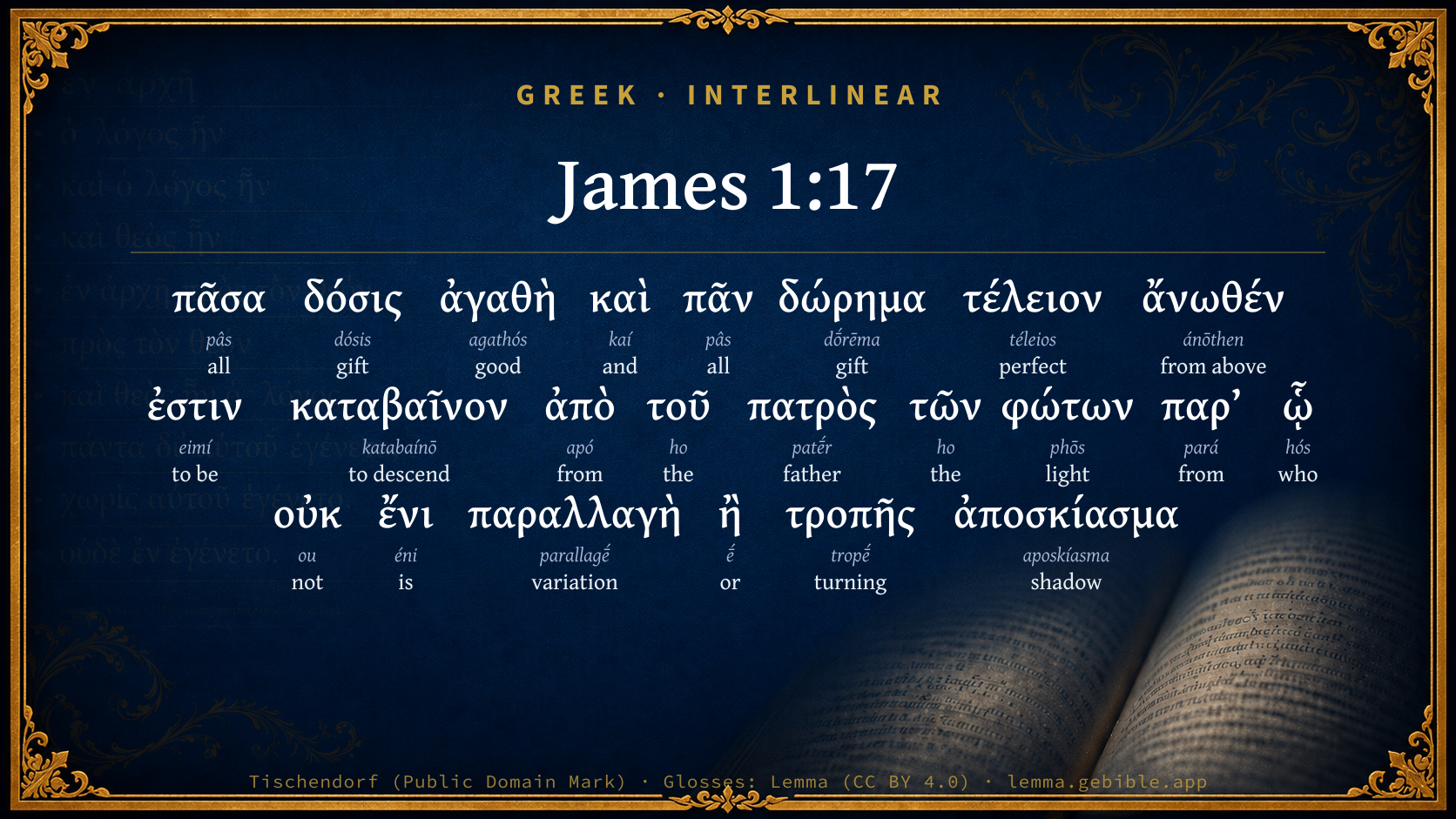
Download image
Cite this verse

James 1:17 (World English Bible). Public Domain. Lemma interlinear Bible study tool, https://lemma.gebible.app/v/james/1/17.

Show BibTeX & RIS
BibTeX
RIS
English Translation
Every good gift and every perfect gift is from above, coming down from the Father of lights, with whom can be no variation, nor turning shadow.
World English Bible · Public Domain
Highlights
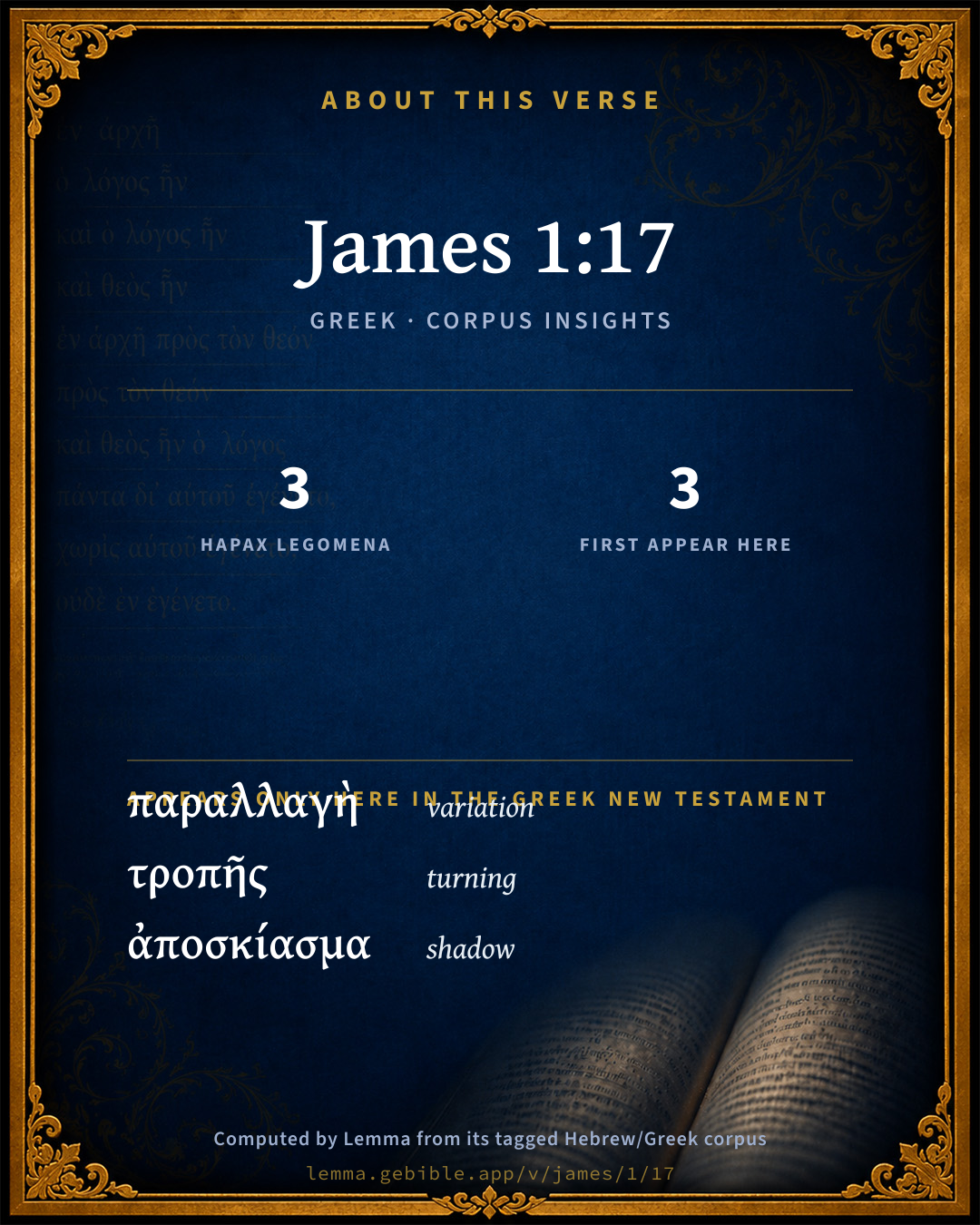
  • 3 hapax legomena — only here in the Greek New Testament
  • 3 first appearances in the Greek New Testament
Full analysis ↓
Download a study sheet

One document with this verse’s original text, its word-by-word gloss line, the meaning frame, cross-references with their text, attributed commentary, and full source and license credits — printable, and it pastes into notes with its structure intact.

This verse Autodidact and up

Study sheet (.html) Plain text (.txt)

A passage Seminary Student

Up to 50 verses in one chapter. A passage sheet keeps up to 6 commentary sources and 12 cross-references per verse, in the order this page ranks them, and says so on the sheet whenever that leaves anything out. Ask for a single verse and you get the Autodidact verse sheet above.

Everything on this page stays free to read, with no account — the sheet is a download of what is already on screen, not access to it.

Want to remove ads? Support Godless Engineer
Compare translations 3

The same verse in 3 English versions, stacked beneath the original-language interlinear above. Click any original word for its lexicon entry.

Each is an independent rendering of the whole verse — the interlinear is not word-aligned to these translations.

Highlighted words mark where these versions differ — a whole-verse word diff, not a word-by-word alignment.

  • World English Bible Public Domain
    Every good gift and every perfect gift is from above, coming down from the Father of lights, with whom can be no variation, nor turning shadow.
  • King James Version Public Domain
    Every good gift and every perfect gift is from above, and cometh down from the Father of lights, with whom is no variableness, neither shadow of turning.
  • unfoldingWord Literal Text CC BY-SA 4.0
    Every good present and every perfect gift is from above, coming down from the Father of lights, with whom there is no change or shadow of turning.

unfoldingWord Literal Text — © unfoldingWord, licensed CC BY-SA 4.0. Word-aligned USFM3 via Door43 (git.door43.org/unfoldingWord/en_ult).

Versions to compare (up to 4)

3 of 4 selected

Show all 19 translations

Every available English version of this verse, each an independent rendering of the whole verse.

  • World English Bible Public Domain
    Every good gift and every perfect gift is from above, coming down from the Father of lights, with whom can be no variation, nor turning shadow.
  • Berean Standard Bible Public Domain
    Every good and perfect gift is from above, coming down from the Father of the heavenly lights, with whom there is no change or shifting shadow.
  • Majority Standard Bible Public Domain
    Every good and perfect gift is from above, coming down from the Father of the heavenly lights, with whom there is no change or shifting shadow.
  • King James Version Public Domain
    Every good gift and every perfect gift is from above, and cometh down from the Father of lights, with whom is no variableness, neither shadow of turning.
  • American Standard Version (1901) Public Domain
    Every good gift and every perfect gift is from above, coming down from the Father of lights, with whom can be no variation, neither shadow that is cast by turning.
  • Revised Version (1885) Public Domain
    Every good gift and every perfect boon is from above, coming down from the Father of lights, with whom can be no variation, neither shadow that is cast by turning.
  • Geneva Bible (1599) Public Domain
    Euery good giuing, and euery perfect gift is from aboue, and commeth downe from the Father of lights, with whome is no variablenes, neither shadow of turning.
  • Douay-Rheims (1899) Public Domain
    Every best gift, and every perfect gift, is from above, coming down from the Father of lights, with whom there is no change, nor shadow of alteration.
  • Young's Literal Translation Public Domain
    every good giving, and every perfect gift is from above, coming down from the Father of the lights, with whom is no variation, or shadow of turning;
  • Literal Standard Version CC BY-SA 4.0
    Every good giving, and every perfect gift, is from above, coming down from the Father of lights, with whom is no variation, or shadow of turning;
  • Unlocked Literal Bible CC BY-SA 4.0
    Every good gift and every perfect gift is from above. It comes down from the Father of lights. With him there is no changing or shadow because of turning.
  • unfoldingWord Literal Text CC BY-SA 4.0
    Every good present and every perfect gift is from above, coming down from the Father of lights, with whom there is no change or shadow of turning.
  • Darby Bible Public Domain
    Every good gift and every perfect gift comes down from above, from the Father of lights, with whom is no variation nor shadow of turning.
  • World Messianic Bible Public Domain
    Every good gift and every perfect gift is from above, coming down from the Father of lights, with whom can be no variation nor turning shadow.
  • Webster's Bible Public Domain
    Every good gift and every perfect gift is from above, and cometh down from the Father of lights, with whom is no variableness, neither shadow of turning.
  • Free Bible Version CC BY-SA 4.0
    All that's good, every perfect gift, is from above, and comes down from the Father who made heaven's lights. Unlike them he doesn't change—he doesn't vary or cause shadows.
  • Bible in Basic English Public Domain
    Every good and true thing is given to us from heaven, coming from the Father of lights, with whom there is no change or any shade made by turning.
  • Text-Critical English NT CC BY 4.0
    Every good and perfect gift is from above, coming down from the Father of lights, with whom there is no variation or shadow of turning.
  • Tyndale New Testament (1534) Public Domain
    Every good gyfte and every parfayt gyft is from above and commeth doune from the father of light with whom is no variablenes nether is he chaunged vnto darcknes.

Literal Standard Version (2020), Covenant Press — licensed CC BY-SA 4.0. Text via the HelloAO Bible API (eBible.org). Unlocked Literal Bible (unfoldingWord) — licensed CC BY-SA 4.0. Text via the HelloAO Bible API (eBible.org). unfoldingWord Literal Text — © unfoldingWord, licensed CC BY-SA 4.0. Word-aligned USFM3 via Door43 (git.door43.org/unfoldingWord/en_ult). Free Bible Version, Dr. Jonathan Gallagher — licensed CC BY-SA 4.0. Text via the HelloAO Bible API (eBible.org).

Word by word

More ways to search: Search by grammar → Find every occurrence → Compare this word →

Practice this passage: Drill this verse → Learn its vocabulary →

παραλλαγὴ
parallagḗ
G3883
“variation”
Noun, Nominative, Singular, Feminine
Part of Speech
Noun
Case
Nominative
Number
Singular
Gender
Feminine
Full Thayer's Definition

Origin: from a compound of G3844 and G236

TDNT: None

1. variation, change
  1. πᾶσα pâs G3956 “all” Adjective, Nominative, Singular, Feminine
  2. δόσις dósis G1394 “gift” Noun, Nominative, Singular, Feminine
  3. ἀγαθὴ agathós G18 “good” Adjective, Nominative, Singular, Feminine
  4. καὶ kaí G2532 “and” Conjunction
  5. πᾶν pâs G3956 “all” Adjective, Nominative, Singular, Neuter
  6. δώρημα dṓrēma G1434 “gift” Noun, Nominative, Singular, Neuter
  7. τέλειον téleios G5046 “perfect” Adjective, Nominative, Singular, Neuter
  8. ἄνωθέν ánōthen G509 “from above” Adverb
  9. ἐστιν eimí G1510 “to be” Verb, Present, Active, Indicative, 3rd person, Singular
  10. καταβαῖνον katabaínō G2597 “to descend” Verb, Present, Active, Participle, Nominative, Singular, Neuter
  11. ἀπὸ apó G575 “from” Preposition
  12. τοῦ ho G3588 “the” Article, Genitive, Singular, Masculine
  13. πατρὸς patḗr G3962 “father” Noun, Genitive, Singular, Masculine
  14. τῶν ho G3588 “the” Article, Genitive, Plural, Neuter
  15. φώτων phōs G5457 “light” Noun, Genitive, Plural, Neuter
  16. παρ’ pará G3844 “from” Preposition
  17. ᾧ hós G3739 “who” Relative pronoun, Dative, Singular, Masculine
  18. οὐκ ou G3756 “not” Particle, Negative
  19. ἔνι éni G1762 “is” Verb, Present, Active, Indicative, 3rd person, Singular
  20. ἢ ḗ G2228 “or” Particle
  21. τροπῆς tropḗ G5157 “turning” Noun, Genitive, Singular, Feminine
  22. ἀποσκίασμα aposkíasma G644 “shadow” Noun, Nominative, Singular, Neuter

About this verse

These counts appear in no published source. They are computed here, from the morphology-tagged text and Lemma’s own curated glosses. What Lemma adds →

23
words
21
distinct lemmas
General Epistles
section

Notable vocabulary

3 hapax legomena — words that appear only here in the entire Greek New Testament:

  • παραλλαγὴ variation G3883
  • τροπῆς turning G5157
  • ἀποσκίασμα shadow G644

First appearance in Scripture

These words make their first canonical appearance in the Greek New Testament here:

  • παραλλαγὴ variation G3883
  • τροπῆς turning G5157
  • ἀποσκίασμα shadow G644

Shared distinctive vocabulary

δόσις gift G1394 occurs in 2 verses of the Greek New Testament. Also found in:
Repetition

Words recur within this verse:

Cross-references

57

Topical passages linked to James 1:17 in the Treasury of Scripture Knowledge — connected by theme and wording, ordered by reader-vote popularity; previews shown in the World English Bible.

  • John 3:27 John answered, "A man can receive nothing, unless it has been given him from heaven.
  • Matthew 7:11 If you then, being evil, know how to give good gifts to your children, how much more will your Father who is in heaven give good things to those who ask him!
  • Hebrews 13:8 Jesus Christ is the same yesterday, today, and forever.
  • John 8:12 Again, therefore, Jesus spoke to them, saying, "I am the light of the world. He who follows me will not walk in the darkness, but will have the light of life."
  • Numbers 23:19 God is not a man, that he should lie, Neither the son of man, that he should repent: Has he said, and will he not do it? Or has he spoken, and will he not make it good?
  • Psalms 84:11 For Yahweh God is a sun and a shield. Yahweh will give grace and glory. He withholds no good thing from those who walk blamelessly.
  • 1 John 1:5 This is the message which we have heard from him and announce to you, that God is light, and in him is no darkness at all.
  • Proverbs 2:6 For Yahweh gives wisdom. Out of his mouth comes knowledge and understanding.
  • James 3:17 But the wisdom that is from above is first pure, then peaceful, gentle, reasonable, full of mercy and good fruits, without partiality, and without hypocrisy.
  • Ephesians 2:8 for by grace you have been saved through faith, and that not of yourselves; it is the gift of God,
  • Luke 11:13 If you then, being evil, know how to give good gifts to your children, how much more will your heavenly Father give the Holy Spirit to those who ask him?"
  • Malachi 3:6 "For I, Yahweh, don't change; therefore you, sons of Jacob, are not consumed.
  • Genesis 1:2–5 Now the earth was formless and empty. Darkness was on the surface of the deep. God's Spirit was hovering over the surface of the waters.
  • Daniel 2:21–22 He changes the times and the seasons; he removes kings, and sets up kings; he gives wisdom to the wise, and knowledge to those who have understanding;
  • 1 Corinthians 4:7 For who makes you different? And what do you have that you didn't receive? But if you did receive it, why do you boast as if you had not received it?
  • Titus 3:3–5 For we were also once foolish, disobedient, deceived, serving various lusts and pleasures, living in malice and envy, hateful, and hating one another.
  • John 1:9 The true light that enlightens everyone was coming into the world.
  • Genesis 1:14–15 God said, "Let there be lights in the expanse of sky to divide the day from the night; and let them be for signs, and for seasons, and for days and years;
  • Ephesians 1:18 having the eyes of your hearts enlightened, that you may know what is the hope of his calling, and what are the riches of the glory of his inheritance in the saints,
  • 1 John 4:10 In this is love, not that we loved God, but that he loved us, and sent his Son as the atoning sacrifice for our sins.
  • Revelation 21:23 The city has no need for the sun, neither of the moon, to shine, for the very glory of God illuminated it, and its lamp is the Lamb.
  • Exodus 31:3–6 and I have filled him with the Spirit of God, in wisdom, and in understanding, and in knowledge, and in all manner of workmanship,
  • 1 Chronicles 22:12 May Yahweh give you discretion and understanding, and put you in charge of Israel; that so you may keep the law of Yahweh your God.
  • 2 Corinthians 4:6 seeing it is God who said, "Light will shine out of darkness," who has shone in our hearts, to give the light of the knowledge of the glory of God in the face of Jesus Christ.
  • 1 Samuel 15:29 Also the Strength of Israel will not lie nor repent; for he is not a man, that he should repent.
  • Isaiah 60:19 The sun shall be no more your light by day; neither for brightness shall the moon give light to you: but Yahweh will be to you an everlasting light, and your God your glory.
  • 1 Corinthians 12:4–12 Now there are various kinds of gifts, but the same Spirit.
  • Hebrews 1:11–12 They will perish, but you continue. They all will grow old like a garment does.
  • James 1:5 But if any of you lacks wisdom, let him ask of God, who gives to all liberally and without reproach; and it will be given to him.
  • Revelation 22:5 There will be no night, and they need no lamp light; for the Lord God will illuminate them. They will reign forever and ever.
  • Genesis 41:16 Joseph answered Pharaoh, saying, "It isn't in me. God will give Pharaoh an answer of peace."
  • Romans 12:6–8 Having gifts differing according to the grace that was given to us, if prophecy, let us prophesy according to the proportion of our faith;
  • 1 John 5:11–12 The testimony is this, that God gave to us eternal life, and this life is in his Son.
  • Numbers 11:17 I will come down and talk with you there: and I will take of the Spirit which is on you, and will put it on them; and they shall bear the burden of the people with you, that you not bear it yourself alone.
  • 1 Chronicles 29:19 and give to Solomon my son a perfect heart, to keep your commandments, your testimonies, and your statutes, and to do all these things, and to build the palace, for which I have made provision.
  • Daniel 2:27–30 Daniel answered before the king, and said, The secret which the king has demanded can neither wise men, enchanters, magicians, nor soothsayers, show to the king;
  • Romans 11:29–30 For the gifts and the calling of God are irrevocable.
  • Ephesians 4:8–11 Therefore he says, "When he ascended on high, he led captivity captive, and gave gifts to men."
  • Psalms 19:1–8 The heavens declare the glory of God. The expanse shows his handiwork.
  • Isaiah 45:7 I form the light, and create darkness; I make peace, and create evil. I am Yahweh, who does all these things.
  • Romans 6:23 For the wages of sin is death, but the free gift of God is eternal life in Christ Jesus our Lord.
  • Ephesians 2:3–5 among whom we also all once lived in the lust of our flesh, doing the desires of the flesh and of the mind, and were by nature children of wrath, even as the rest.
  • James 3:15 This wisdom is not that which comes down from above, but is earthly, sensual, and demonic.
  • Genesis 41:38–39 Pharaoh said to his servants, "Can we find such a one as this, a man in whom is the Spirit of God?"
  • Matthew 13:11–12 He answered them, "To you it is given to know the mysteries of the Kingdom of Heaven, but it is not given to them.
  • Acts 11:18 When they heard these things, they held their peace, and glorified God, saying, "Then God has also granted to the Gentiles repentance to life!"
  • Exodus 4:11–12 Yahweh said to him, "Who made man's mouth? Or who makes one mute, or deaf, or seeing, or blind? Isn't it I, Yahweh?
  • Numbers 11:25 Yahweh came down in the cloud, and spoke to him, and took of the Spirit that was on him, and put it on the seventy elders: and it happened that when the Spirit rested on them, they prophesied, but they did so no more.
  • Psalms 122:6 Pray for the peace of Jerusalem. Those who love you will prosper.
  • Isaiah 46:10 declaring the end from the beginning, and from ancient times things that are not [yet] done; saying, My counsel shall stand, and I will do all my pleasure;
  • Acts 5:31 God exalted him with his right hand to be a Prince and a Savior, to give repentance to Israel, and remission of sins.
  • Philippians 1:29 Because it has been granted to you on behalf of Christ, not only to believe in him, but also to suffer on his behalf,
  • Exodus 36:1–2 "Bezalel and Oholiab shall work with every wise-hearted man, in whom Yahweh has put wisdom and understanding to know how to work all the work for the service of the sanctuary, according to all that Yahweh has commanded."
  • Deuteronomy 4:19 and lest you lift up your eyes to the sky, and when you see the sun and the moon and the stars, even all the host of the sky, you are drawn away and worship them, and serve them, which Yahweh your God has allotted to all the peoples under the whole sky.
  • 2 Chronicles 1:11–12 God said to Solomon, Because this was in your heart, and you have not asked riches, wealth, or honor, nor the life of those who hate you, neither yet have asked long life; but have asked wisdom and knowledge for yourself, that you may judge my people, over whom I have made you king:
  • Isaiah 28:26 For his God does instruct him aright, [and] does teach him.
  • Matthew 11:25–26 At that time, Jesus answered, "I thank you, Father, Lord of heaven and earth, that you hid these things from the wise and understanding, and revealed them to infants.

Cross-references courtesy of OpenBible.info (CC BY 4.0).

Commentary

Notes on James 1:17 from classic Christian and Jewish commentators (each source and its license shown beneath its notes). The classic Christian expositions comment on the surrounding passage and are grouped to its opening verse, so a note may address several verses; the Jewish commentaries on the Tanakh (Rashi and others) are per-verse, so they appear only where the commentator wrote on this verse.

Lemma curates 59 commentaries, every one of them public domain or Creative Commons licensed, each selected and text-cleaned for this edition rather than reprinted as found. About our sources →

The Biblical Illustrator

Joseph S. Exell

Jam_1:17-18

Every good gift … is from above

Gifts front, above

It is not from the lowest but from the highest points that the best things in the world always come.

We get from the sky, and not from the earth, all those gracious influences without which our world would be only a gigantic lifeless cinder roiling through space. Light and heat come down to us from above; and so do the sunshine that warms and quickens and beautifies everything, and the rain and the dew that refresh the face of nature. The ground is to the plant mainly the soil in which its roots are fixed; it obtains its food chiefly from above, from the air and the sunshine and the showers of heaven. Then, too, it is from the highest parts of the earths surface, not from the lowest, that all the good things come which make the earth such a beautiful and comfortable home for man. The mountains, not the plains, are the sources of our greatest and most precious gifts. Were it not for the mountains there would be no streams to quench our thirst and water our fields--no winds to purify the air--no clouds to overshadow the earth in the heat of the day, and to keep in the warmth from being diffused in space at night. And is it not a very beautiful, as well as a very striking, thought, that all our flowers come to us originally from the mountains--from the highest and not from the lowest parts of the earth? They bloomed on the heights; and when the foul atmosphere of the plains and valleys vanished gradually, and the air and sunshine became so clear and bright that flowers could breathe in them, they descended as Gods good and perfect gifts from above to beautify the lowlands with their lovely presence. Thus you see that even in the natural world every good and perfect gift literally is from above. The things that make this world most beautiful and best fitted to be our abode come from the heights. And is there not a wise lesson for your souls from this fact? If your ordinary natural life is supported and enriched by the good things which come from the sky and the highest parts of the earth, how much more should your true life--the immortal life of your souls--be nourished and enriched by the good things that come to you from the highest of all sources, from the Author of every good and perfect gift--the Father of Lights? The best and most perfect of all gifts has come from above, the unspeakable gift of Gods dear Son; and with the gift of His own Son He gives you the gift of the Holy Spirit, that you may know and appreciate fully all the goodness and perfection of Jesus Christ, and make Him your own; that He may work in you the faith which is the gift of God, by which you may believe in Christ to the saving of your soul, and enjoy all the blessings of salvation. In Christ the blessings of this life itself come to you from above, strained and filtered of all their evil, and made truly satisfying without any sorrow being added. And you will get every good and perfect gift from above--from the Father of Lights, by that wonderful ladder set up between earth and heaven along which the angels are ascending and descending--the new and living way of Christs finished work--in answer to that real earnest prayer of yours which brings your heart and mind into closest contact with the mind and heart of God. (H. Macmillan, D. D.)

The best things are from shore

It is not the things that come to you from the earth that will fill the void of your nature, but the things that come to you from heaven. You cannot call any gift that comes to you from below a good gift, for it is mixed with the evil of the earth, like the pure snow when it is soiled by the mud of the ground; or a perfect gift, because it is passing and perishing, and even when at its best it ear, not satisfy your nature. There is ever some drawback to the goodness of the gift that you get from below; some imperfection that, like the worm in the apple, spoils the beauty and the sweetness of it. It is about the things that come from below that people always quarrel; about their lands and wealth and houses and properties--all of the earth, earthy. These are the causes of the frequent strifes and jealousies and greeds that make life often so unhappy. People do not quarrel about the things that come from above--the sunshine and the rain and the sweet influences of the starry Pleiades; and the things of Divine grace from a higher source still--the love and the beauty of heaven. The things that come from above sweeten and ennoble life, reconcile and unite men to one another, and make one family, one loving brotherhood of the human race. (H. Macmillan, D. D.)

The Divine bounty

To the bounteous hand of God we owe all that we have, more than we deserve, and all that we hope for. The breath of life was given us by Him, and is dependent upon His pleasure. The stores from which we draw our subsistence are only ours by His permission. It is in His power to withdraw them from us, or us from them, at any moment. We have cause to be thankful that He has so long allowed us the benefit of His mercies. By the good and perfect gift which is from above, he means more especially the Divine grace b which all other spiritual blessings are rendered attainable. Aptly, indeed, may the preventing and assisting influence of Gods Holy Spirit be denominated a good and perfect gift, since without it we could not make a beginning, much less any progress, in Christian goodness and perfection. (James Aspinall, M. A.)

Divine goodness in human history

I. ALL THE GOODNESS IN HUMAN HISTORY COMES FROM GOD. This principle applies in a specially direct manner to the spiritual forms of human good. Divine influences on the soul come directly from God. Strength, consolation, hope, holiness, are the results of the souls fellowship with God. Christian virtues are fruits of the Divine Spirit, coming down and operating on the individual character.

II. THE DIVINE GOODNESS IN HUMAN HISTORY COMES IN SEPARATE GIFTS AND DIFFERS IN DEGREE.

1. It comes in separate gifts as mans demands arise (1Ki_13:10).

2. It comes in different forms: physical; intellectual; spiritual. These forms differ in their intrinsic worth: Good--physical and intellectual; perfect spiritual. This subject--

(1) Sheds new light on the good of human life, and reveals its sacredness.

(2) Fixed as a habit is favourable to the culture of religious sentiment: humility; gratitude; devotedness.

(3) Reveals the stewardship of humanity.

(4) Discloses the wickedness of a selfish life. (Homilist.)

God not the Author of evil, but of good

The origin of evil is a problem which, in all probability, will never be solved until we reach the world in which there is no evil. And I think we should do well to approach this problem from its brighter rather than from its darker side. I see more hope of our learning what evil is, and even whence it came, if we first ask ourselves what goodness is and whence that came. Now by goodness we mean moral goodness; goodness as it exists, or may exist, in man. And by human or moral goodness we mean, not a mechanical and involuntary conformity to law, but a free and willing choice of the righteousness which the law ordains. Moral goodness implies free choice, and how can there be a free choice of that which is good if there be no possibility of choosing evil rather than good? The will of man must have this solemn alternative before it--good or evil--if it is ever to become a good will. God does not make us good, therefore, but He has so made us that we may become good; and in order that we may become good we must be free to choose evil. He is good, perfectly and absolutely good, because His will is fixed in its choice of goodness; and only as our wills rise to that steadfast attitude can we become good. Now if we start from this conception of goodness we shall define its moral opposite, evil, as the wrong choice of the will; we shall say that, just as men become good by freely choosing and doing that which is right, so they become evil by freely choosing and doing that which is wrong. And we shall not blame God for their bad choice, nor for leaving them free to make it; we shall admit that He must leave their will free if they are to be really good, and that, if the will is to be left free, it must be possible for them to choose evil rather than good. Thus we shall reach the conclusion that evil is from man, not from God; that it is not fatal necessity imposed upon them from above, but a wrong choice which they have made when a right choice was open to them. That evil springs from human lust, not from the will of God, St. James has shown us in the verses which precede these; and he now goes on to show how impossible it is that evil should come from God by considerations drawn from what God is in Himself, and from what He has done for us. Even his opening phrase, Do not err, my beloved brethren, indicates that he is about to resume and carry further the argument with which he has already dealt. Now on this question of the origin of evil men do perpetually err. They ascribe it to a Divine origin. St. James will have no part in such opinions as these. Evil only too certainly is, but he is sure that it is not from God. And he tries to make us sure by giving us the facts and arguments which had most impressed his own mind. His first argument is drawn from the conception he had formed of the nature of God. God cannot be the Author of evil, he argues, because He is the Author of good, because He is light, and in Him there is no darkness at all. Every good gift and every perfect boon is from Him; or, as the Greek implies, all that comes to us from God is good, and every good gift of His bestowal is perfect as well as good, perfect in kind and degree. But if all He gives is good, and even perfect, how can evil and imperfection spring from Him. As Bishop Sanderson has it, We are unthankful if we impute any good but to God, and we are unjust if we impute to Him anything but good. St. James, however, is not content with the argument from the acknowledged and absolute goodness of God. With the ease and simplicity which we so much admire in the proverbs and parables of our Lord, he rises into a fine illustration of his argument. The illustration comes to this: You might as well, and much more reasonably, attribute darkness to the sun as impute evil to God. But mark for a moment with what a natural and unforced ease he passes to his illustration. He had said, Every good gift and every perfect boon is from above, from yonder fair, pure world on high. And as, in thought, he glances upward to that world, he sees the sun which God has set to rule the day, the moon and the stars which He has set to rule the night. Of these lights God is the Father, and of all lights. But can the Source and Fountain of all light be the source and fountain of all darkness? Impossible. The sun gives light, and only light. If we are in darkness, that is only because the world has turned away from the sun, of our hemisphere of the world. And, in like manner, God gives good gifts, and only good. Thus, and so naturally, does St. James bring in his illustrative thought. But even yet he is not content with it. The thought grows as he considers it, grows somewhat thus. The Father of the lights must be more perfect than the lights He has called into being. They vary; even the sun for ever shifts its place, and its relation to the earth. But whatever inconstancy there may be in them, there is none in Him who made them. He is good, and doeth good only and continually. And now he advances another step. He argues that evil cannot be of God, because, of His own free will, God sets Himself to counterwork the death which evil works in us, by quickening us to a new and holy life: Of His own will begat He us, by a word of truth. If we, when we were sinners, were redeemed and made anew by the free action of Divine will, can we for a moment suppose that evil sprang from the will which delivered us from evil? We acknowledge with joyful certainty and gratitude that He who begat us to a new and holy life, when we were dead in trespasses and sins, must hate the evil from which He delivered us, that He cannot have been the Author of that which He sent His Son to destroy. It may be said, You who are redeemed and born anew by the grace of God, at the word of His truth, may have reason to believe in His goodness: but what reason has the world at large, the world which is not saved as yet? Perhaps, in logic, it would be a sufficient answer to this objection were we to say: The world may be saved if it will; God is always trying to save it; but, as we have seen, good as He is, He cannot make men good against their will. Logically, the answer is fair enough; but our hearts are not to be satisfied by mere logic, and they crave a more tender and hopeful answer than this. Happily, St. James supplies the very answer they crave. God, he says, has begotten us, by some word of truth which met our inward needs, into a new and better life; and therefore we are sure that He hates evil and death. But He has begotten us, not simply that we ourselves may be saved from evil, but also that we should be a kind of first-fruit of His creatures. Now the consecration of the first-fruits of the earth wan a recognition of Gods claim to the whole harvest, and pledge that it should be devoted, in various ways, to His service. This was the great lesson of the first-fruit offering. It was not a tax on payment of which the harvest was to be exempted; it was a confession that it was all the gift of God, and was all due to Him. When, therefore St. James says that the regenerate are kind of first-fruit of the creation, so far from implying that they alone are to be saved, he implies that all flesh shall see the salvation of God, and that the whole creation shall have a part in their redemption. (S. Cox, D. D.)

Every good and perfect gift

A gift is something that expresses the mind and betokens the love of the giver, and at the same time brings happiness to the receiver. What, then, is a good gift? That which fulfils these two requisitions. And what is a perfect gift? That which entirely fulfils these two ends. Now everything we have in the world--from the blade of grass, or the ray of sunshine--up to eternal glory; from the slenderest thought that darts through the mind to the highest flights of philosophy; from the earthly songs to the triumphant anthems of heaven--everything we touch, or feel, or see, or hear, everything is a gift. A gift! We did not make it; we did not buy it; we did not deserve it. It is God who gives it, and He gives it lovingly of His own free will, and He gaves it to make whoever receives it happier and better. That is a gift. But you may say, Is everything God gives us good? Does not He give us trials, sorrows, separations, sickness, bereavement, death? Are these good gifts? Yes, as they came from Him they were good. St. Paul was caught up to the third heaven, and heard unutterable things. It was a gift. Presently there was given him--it is his own expression--a thorn in the flesh. It was a gift, and a second gift. It was necessary to balance and make safe the first gift. Each alone was a good gift, but the two in combination make a perfect gift. Is there any difference between a good gift and a perfect gift, or are we to take it only as a repetition of the same thought, expressing the same meaning, rising to the same climax? I think there is a difference. A perfect gift is one which exactly fits the minds and the taste of the receiver; expresses the whole heart of the giver, and can never be taken away. A gift which has in it perfect adaptation and eternity. Now we might say that all light--the light of the world--was but one light; but we see it broken up into its prismatic colours. There is the light of nature; there is the light of reading; there is the light of grace; there is the light of knowledge; there is the light of love; there is the light of heaven. But it all comes from the same spring, and in every case it is the light which is on it which makes the value of the gift. Some of us have many gifts. They are all from above, from the same:Father; but from the want of the light which should reign in that gift, the gift is valueless. Nay, more, it is an unfulfilled possibility; it is the handle of temptation; it turns to self, to pride, to sin. The gift is abused; and in proportion as the gift is good and perfect, it becomes evil, and it incurs the heavier gift of condemnation. (James Vaughan, M. A.)

The work of Gods Spirit

This text, I believe more and more every day, is one of the most important ones in the whole Bible; and just at this time it is more important for us than ever, because the devil is particularly busy in trying to make people forget God, to make us acknowledge God in none of our ways, to make us look at ourselves and not to God, so that we may become earthly. He puts into our hearts such thoughts as these: Ay, all good gifts may come from God; but that only means all spiritual gifts. We are straightforward, simple people, who cannot feel fine fancies; if we can be honest, and industrious, and good-natured, and sober, and strong, and healthy, that is enough for us--and all that has nothing to do with religion. Those are not gifts which come from God. A man is strong and healthy by birth, and honest and good-natured by nature. Have you not all had such thoughts? But have you not all had very different thoughts; have you not, every one of you, at times, felt in the bottom of your hearts, after all, This strength and industry, this courage, and honesty, and good-nature of mine, must come from God; I did not get them myself. If I was born honest, and strong, and gentle, and brave, some one must have made me so when I was born, or before. The devil certainly did not make me so, therefore God must. These, too, are His gifts! Let us go through now a few of these good gifts which we call natural, and see what the Bible says of them, and from whom they come. First, now, that common gift of strength and courage. Who gives you that?--who gave it to David? For He that gives it to one is most likely to be He that gives it to another. David says to God, Thou teachest my hands to war, and my fingers to fight; by the help of God I can leap over a wall: He makes me strong that my arms can break even a bow of steel. That is plain-spoken enough, I think. God is working among us always, but we do not see Him; and the Bible just lifts up, once and for all, the veil which hides Him from us, and lets us see, in one instance, who it is that does all the wonderful things which go on round us to this day, that when we see anything like it happen we may know whom to thank for it. So, again, with skill and farming in agriculture. From whom does that come? The very heathens can tell us that; for it is curious, that among the heathen, in all ages and countries, those men who have found out great improvements in tilling the ground have been honoured and often worshipped as divine men--as gods; thereby showing that the heathen, among all their idolatries, had a true and just notion about mans practical skill and knowledge--that it could only come from heaven; that it was by the inspiration and guidance of God above that skill in agriculture arose. Again, wisdom and prudence, and a clear, powerful mind--are not they parts of Gods likeness? How is Gods Spirit described in Scripture? It is called the Spirit of wisdom and understanding, the Spirit of prudence and might. Or, again, good-nature and affection, love, generosity, pity--whose likeness are they? What is Gods name but love? Has not He revealed Himself as the God of mercy, full of long-suffering, compassion, and free forgiveness; and must not, then, all love and affection, all compassion and generosity, be His gift? Yes. As the rays come from the sun, and yet are not the sun, even so our love and pity, though they are not God, but merely a poor, weak image and reflection of Him, yet from Him alone they come. Or honesty, again, and justice--whose image are they but Gods? Is He not The Just One--the righteous God? Are not the laws of justice and honesty, by which man deals fairly with man, His laws--the laws by which God deals with us? Now here, again, I ask: If justice and honesty be Gods likeness, who made us like God in this who put into us this sense of justice which all have, though so few obey it? Can man make himself like God? Can a worm ape his Master? No. From Gods Spirit, the Spirit of Right, came this inborn feeling of justice, this knowledge of right and wrong, to us--part of the image of God in which He created man--part of the breath or spirit of life which He breathed into Adam. From whom else, I ask, can they come? Can they come from our bodies? What are they?--Flesh and bones, made up of air and water and earth--out of the dead bodies of the animals, the dead roots and fruits of plants which we eat. They are earth--matter. Can matter be courageous? Did you ever hear of a good-natured plant, or aa honest stone? Then this good-nature, and honesty, and courage of ours must belong to our souls--our spirits. Who put them there? Did we? Does a child makes its own character? Does its body make its character first? Can its father and mother makes its character? No. Our characters must come from some spirit above us--either from God or from the devil. And is the devil likely to make us honest, or brave, or kindly? I leave you to answer that. God--God alone is the Author of good--the help that is done on earth, He doeth it all Himself: every good gift and every perfect gift cometh from Him. (Canon Kingsley.)

All good gifts from above

I. THE GENERAL TRUTH THAT GOD IS THE GIVER OF EVERYTHING GOOD. Every good gift and every perfect gift is from above. The words rendered gift are not the same in the original. They are closely related, but not identical. The one signifies properly the act of giving, the other the thing given, a little before God is represented as He who giveth liberally and upbraideth not. He stands pre-eminent alone, in His mood of giving. In His case, act and object entirely harmonise. All giving which is really, absolutely good--good in its origin and exercise--good without any mixture of evil, is from the hand of the infinitely, only good God. And every perfect gift. Here He speaks of what is bestowed, of the benefaction itself. By perfect we are to understand complete of its kind, without radical defect, what is adequate, entire, fitted to serve the end, to accomplish the purpose intended. Every gift of this description, be it natural or spiritual, providential or gracious, ranging from common weekday mercies up to the highest crowning blessings of salvation, is of Divine origin and communication. Through whatever channel they reach us, in whatever quarter they present themselves to view, they are all from above--primarily and properly from above. And they are so, not merely as being originally from a celestial region, but as coming from a Divine bestower. They are from God Himself--from God alone. Now mark how He, the great Giver, is here described. He is called the Father of lights--literally of the lights. The primary, direct reference, apparently, is to the grand luminaries of the firmament--the sun, moon, and stars of heaven. These majestic orbs, before which so many nations in all ages have bowed down to worship, are preeminently the lights of the natural world, and they were at first created, as they are still sustained, by Jehovah. As their Maker, Originator, He may be appropriately termed their Father. Light is the brightest, purest, most gladsome of all material elements; and hence it is very often used in Scripture as an emblem of knowledge, holiness, and joy--of all excellence, intellectual, moral, and spiritual--of whatever is most precious and perfect. All the glory of heaven is often represented by the same symbol. Everything which resembles this element, of which it is a tilting figure, is here pointed at in the remarkable designation. The bright orbs above shadow forth a higher, nobler splendour than their own, that which adorns the world of spirits, the kingdom of grace and glory. The whole of this light, shine where it may, proceeds from Him, has Him as its great source and centre. But men are not uniform, undeviating in their spirit and actings. They change, at one time they go in opposition to what they have done at another. The most regular and constant of them are subject to disturbing influences. And is it not so even with the material symbols here introduced by the apostle? But God is not only infinitely clearer and purer, He is also steadier, more constant than the great orbs of heaven. Hence, it is added, With whom is no vaiableness, neither shadow of turning. He has no variableness about Him, no change, alternation, no fluctuation or uncertainty; no, not the least degree of it, not the most distant approach to anything of the kind, for He is without even the shadow of turning. In these terms there may be, as is generally supposed, an implied contrast between the Father of lights and the lights themselves. All good, then, comes from Him, all kinds and degrees of it, natural and spiritual. Every blessing, great and small, whether for the body or the soul, is of His bestowal. And so nothing but good comes from Him--no evil whatever. He sends trials, troubles, no doubt, but these are often blessings in disguise, and the very best blessings. Night and storm have their beneficial influence in the natural world, and so have frowning providences in the spiritual.

II. THE MORE SPECIAL TRUTH THAT GOD IS THE QUICKENER OF ALL THE SAVED. James speak of regeneration. It is evident that begat here is to be understood, not in the natural sense, but the spiritual; for he adds that it was effected by the word of truth. There is no admission to His favour and family, no possibility of being one of His sons and daughters, but by being born again.

1. The origin of this regeneration. It is here attributed to God as its Author. It is effected by Him, and Him alone. We pass in it from the carnal to the spiritual, from the earthly to the heavenly. We are thenceforth actuated by wholly different views, feelings, desires, and motives. But more is here stated. James says, Of His own will begat He us. When He regenerates, God acts according to His own free, sovereign purpose. It is always a most spontaneous, gracious proceeding. It is wholly self-moved. The new birth is never necessitated or merited by the creature. There is nothing about us to deserve it, to draw down the Divine power and mercy for its accomplishment (Eph_2:8-9; Tit_3:5; 1Pe_1:3).

2. The instrument of this regeneration. The word of truth, the word which is truth--truth without mixture of error, truth the purest and highest, truth absolute, Divine. Jesus prayed, Sanctify them through Thy truth; Thy Word is truth. It is the Spirit who is the efficient agent in working this change. It was thus that peace first entered the dark, troubled bosom of Augustine. It was from the old Bible found in the library at Erfurt that Luther learned the way of life, and began not only to walk in it himself, but to guide into it the feet of multitudes. It was as his eyes rested on the precious words, the blood of Jesus Christ, His Son, cleanseth us from all sin, that one of those noble soldiers of the Cross whom the army of our Queen has furnished, Captain Vicars, was led to that resolution, and entered on that course, which was followed by a career of eminent consistency and devotedness. This word is all pure, and is proved to be so by the influence it exerts, the holiness it produces in all who comes under its power.

3. The design or object of this regeneration. That we should be a kind of first-fruits of His creatures. He speaks of the creatures, and this term, perhaps, goes beyond the redeemed. It points probably to the wider deliverance--that emancipation extending to nature itself, which is associated with the manifestation of the sons of God hereafter (Rom_8:21-22).

(1) We may learn here a lesson of gratitude. Think of our providential bounties, think of our religious privileges--think, above all, of our spiritual and saving mercies, and of what acknowledgments are due to Him from whom they all issue!

(2) We may learn also a lesson of humility. We have not the slightest claim to any of these benefits. We have nothing to boast of, no worth, no merit, for our righteousness is no better than filthy rags, and our proper place is the dust of self-abasement.

(3) And, finally, we may learn a lesson of holiness. Is God the Giver only of good? Is His begetting us the greatest, best proof that evil cannot proceed from Him, that He stands essentially opposed to all sin at the utmost possible distance from everything of the kind? Then, clearly, if we would act in accordance with the nature and design of our new birth, if we would show ourselves the children of this Father of lights, we must cleanse ourselves from all filthiness of the flesh and spirit, we must ever sock to be sanctified wholly in heart and life, in soul and body. (John Adam.)

Divine gifts

I. THE CHARACTER OF THE GIVER.

1. The designation employed by the apostle is fitted to elevate our conception of Deity. God is the Father of lights, the Creator and Governor of sun, moon, and stars. God is Light. Not only has He kindled the luminaries of space, He is the Lord of all light, both physical, and also intellectual and moral.

2. The description of one of the Divine attributes exhibits the character of God still more clearly and delightfully. With Him there can be no variation, neither shadow that is cast by turning. There is no fickleness or caprice in the heart, in the action of the beneficent Almighty.

II. THE QUALITY OF HIS GIFTS.

1. They partake of the nature of their origin. From above. What have we that we did not receive? Yet too many men are like the swine that feast upon the acorns, but look not up to the tree whence the fruit falls.

There is a Divine flavour, a Divine fragrance, a Divine beauty, in all the gifts of God.

2. They are good. They have all of them a natural goodness, and they are all a means, if used aright, to moral and spiritual goodness, and thus lead to something better than themselves.

3. They are perfect.

(1) Commensurate with the character and resources of the Giver.

(2) Adapted to the recipient.

(3) Complete, being finished as they are begun.

III. THE SPECIAL ILLUSTRATION OF DIVINE GOODNESS. Instead of charging God with tempting us to sin, we are directed to observe, and gratefully to acknowledge, the provision He in His wisdom and love has made for our highest welfare.

1. What it is--the new life. He begat us, or brought us forth,--as it is differently translated. Our thoughts are thus led to the supreme blessing of Gods covenant of grace. Has God given us His Son? He has done so that we might have life, eternal life. Has God given us His Spirit? He has done so that by that Spirit we might be born anew. The new, the higher, the spiritual life of humanity is the great fact of revelation, the great fact of the worlds history.

2. Its origin in the Divine purpose. This gift came from God-of His own will. Christians are born not of the will of the flesh, nor of the will of man, but of God.

3. Its means and instrumentality. A moral end must be effected by moral means.

4. Its end. That we should be a kind of first-fruits of His creatures, is His aim in all He has done for our salvation. The early Christians were the first-fruits of a spiritual harvest, comprising the Church of Christ in all lands and through every age. Application:

1. Here we have an incentive to gratitude.

2. An inducement to confidence.

3. An encouragement to prayer.

4. An inspiration to hope. (J. R. Thomson, M. A.)

Natural and spiritual good

Whatever is excellent in the creature, is freely imparted to it by the bounty of the Creator; who is high in glory above all, perfect and unchangeable.

I. THE GOOD WHICH WE RECEIVE FROM GOD MAY BE DIVIDED INTO TWO SORTS, NATURAL GOOD AND SPIRITUAL GOOD.

1. Under natural good is comprehended the animal life of our bodies, its health, and all things that contribute to support and render it comfortable. The reason and understanding of man, his power of memory, and faculty of speech, with the knowledge he is enabled to gain by them, and the arts and improvements of life which arise from them, are to be ranked under the same notion.

2. Spiritual good is whatever contributes to purify the soul, to raise it towards heaven, and to prepare it for the presence of God. It bears its blossoms of hope and peace here on earth; but produces a fruit which is to be gathered in eternity.

II. LET US NEXT CONSIDER THE RIGHT USE AND IMPROVEMENT OF THIS DOCTRINE.

1. It should leach us gratitude and thanks for the blessings of life.

2. It should teach us a constant and humble dependence on the providence of God, under a sense of our own insufficiency to our welfare.

3. It teaches us submission to Gods blessed will in all things.

III. Hitherto we have been describing our duty to God, as lie is the Giver of all natural good; let us next consider it, AS HE IS THE AUTHOR OF ALL SPIRITUAL GOOD.

1. And, first, it is a duty which we owe to God and ourselves, when He sets such different objects before us, to weigh and examine their different value, and prefer the best. If what is temporal and worldly is oftentimes permitted to the unthankful and evil, let us desire some other blessing which is a surer token of the favour and loving-kindness of the Giver.

2. And to this we have the greatest encouragement, because He who is the Giver of this heavenly wisdom, hath graciously promised to bestow it on those who ask and seek it of Him.

3. The way, therefore, of asking and seeking so as to obtain, is by prayer, accompanied with a suitable practice. (T. Townson, D. D.)

Good things from God

1. That all good things are from above; they come to us from God. Mere evil is not from above: the same fountain doth not yield sweet and bitter waters. God is good, and immutably good, and therefore it cannot be from Him, which was Platos argument. But for good that floweth clearly from the upper spring, there are indeed some pipes and conveyances, as the Word, and prayer, and the seals; and for ordinary blessings, your industry and care. But your fresh springs are in God; and in all these things we must, as chickens, sip and look upwards.

2. Whatever we have from above, we have it in the way of a gift. There is nothing in us that could oblige God to bestow it; the favours of heaven are not set to sale.

3. Among all the gifts of God, spiritual blessings are the best: these are called here good and perfect, because these make us good and perfect.

4. That God is the Father of lights. Light being a simple and defecate quality, and, of all those which are bodily, most pure and spiritual, is often put to decipher the essence and glory of God, and also the essences and perfections of creatures as they are from God. The essence of God (1Jn_1:5). There light, being a creature simple and unmixed, is put to note the simplicity of the Divine essence. So also the glory of God (1Ti_6:16). So Jesus Christ, in regard as He received His personality and subsistence from the Father, is called in the Nicene Creed, Light of light, and very God of very God. So also the creatures, as they derive their perfections from God, are also called lights; as the angels

(2Co_11:10); the saints (Luk_16:8). Yea, reasonable creatures, as they have wisdom and understanding, are said to be lights; so Joh_1:9. Well, then, if God be the Father of lights--

(1) It presseth you to apply yourselves to God. If you want the light of grace, or knowledge, or comfort, you must shine in His beam and be kindled at His flame. We are dark bodies till the Lord fill us with His own glory.

(2) It shows the reason why wicked men hate God (Joh_3:19-21). He is the Father of lights; He hath a discerning eye, and a discovering beam.

(3) It presses the children of God to walk in all purity and innocency Eph_5:8).

5. The Lord is unchangeable in holiness and glory; He is a Sun that shineth always with a like brightness. This is an attribute that, like a silken string through a chain of pearl, runneth through all the rest: His mercy is unchangeable, His mercy endureth for ever (Psa_100:5). So His strength, and therefore He is called The Rock of Ages (Isa_26:4). So His counsel; He may change His sentence, the outward threatening or promise, but not His inward decree; He may will a change, but not change His will. So His love is immutable; His heart is the same to us in the diversity of outward conditions: we are changed in estate and opinion, but God He is not changed; therefore when Job saith (Job_30:21), Thouart turned to be cruel, he speaketh only according to his own feeling and apprehension. Well, then--

(1) The more mutable you are, the less you are like God. Oh! how should yon loathe yourselves when you are so fickle in your purposes, so changeable in your resolutions!

(2) Go to Him to establish and settle your spirits.

(3) Carry yourselves to Him as unto an immutable good; in the greatest change of things see Him always the same: when there is little in the creature, there is as much in God as ever (Psa_102:26-27). (T. Manton.)

Gods gifts to man, and mans responsibility as inferred therefrom

The word gift is one of the loveliest in the language. It is a flower-like word, and full of fragrance. It is a most significant and expansive term. Like the firmament, it is inclusive of all bright things visible to man in the doings of God. You might enumerate every act of the Father, from the creation of man to the gift of the Holy Ghost, and all the operations of His mercy since, and group them all together; you may call the roll of all His deeds of love to man, and all His gracious acts to us individually: and above them all, or upon the face of each separately, one might, with the accuracy of entire truthfulness, write Gift. They have all come to the race, and to each of us, fresh from His hand. There is not a hope I have in which I do not see my Fathers face; and the reflection of the face reveals the mirrors use, and makes it lovely. There is not a love known to your life, to which is any depth or purity, from which come not Divine reflections. Nor is there any sympathy in your heart or mine, friend, or any sweet impulse or prompting, no high aim or noble motive, no, nor any consolation which makes our sorrows like wounds which heal themselves in bleeding, not of God. I bring all these together, and string them like pearls upon one necklace, and lay them in the palm of His benevolence--a kind of tribute; my little gift to the All-giving. You may begin with the very lowest of His gifts to you--those that come through the ordinary channels of nature, and hence seem least connected with supernatural bestowment--even your bodily powers--and you can but see at a glance how perfectly you are equipped for usefulness and happiness upon the earth. In your own body find proof of your Creators love. What grace, what beauty, what sensitiveness, and subtlety of feeling, has been given to the body! How responsive it is to the mind I how willing its subjection I how free and generous its service! I know that it shall fail, and be not; I know that by-and-by we shall have a better; but for the time being, for the present state of soul-development, how adapted the instrument is to the wishes and wants of the player! But it is not until you contemplate man in respect to his mental and moral faculties; it is not until you look within yourself, and behold the powers of your mind, and the more subtle but incomparably superior attributes of the soul--that you fairly see what God has done for you. What costly, what magnificent furniture is this with which the almighty Architect has fitted up and adorned the temple of the Spirit! Here is Reason--that pale but lovely reflection of God--which draws the line between beast and man: on one side of which is mastery, the powers and pleasures of intelligence and eternal life; on the other, inbred subjection, absence of thought, and existence that hurries to extinction. This is ours--our birthright; given, not bought: bestowed, not acquired--the sign and proof of our sonship, and a bond that binds us as with ties of blood to His eternal Fatherhood. Here, too, is Memory--lifes great thesaurus, where we bestow all our jewels; that gallery in which are hung the faces of the loved as no limner could depict them; that chamber swathed thick with tapestry, on which the days, like flying fingers, have wrought grave and bright forms, and retained the otherwise transient joys. Who would give up his memory? who surrender this shield against forgetfulness? No one. And yet memory is one of Gods gifts to you. Here, too, is Imagination, the divinest faculty of them all, winged like an eagle, tuneful as a lark. Of all faculties, of all powers given of God, I count this the greatest, the most subtle, the most ethereal, and the most Divine. Are you not rich in gifts? Are you not blessed? What more could He have done for you than He has done? Has He not given as a father who as a God should give--generously, munificently? What, now, let me ask, have you done for Him? Where are your days of labour? where the long account of service? How and when have you cancelled the bond and obligation you are under? When your Father called, have you answered? when He directed, have you gone? when He commanded, have you obeyed? To what use have you put these faculties? Or again: to what use do you put your memories? Its lessons are many. Do you allow them to teach you wisdom? Do you not know that the highest of all attainments is to so live that recollection shall not be painful? Half of heaven will consist of remembrance: the endless song will derive half its pathos and power from retrospection. The day hasteth on, yea, is even nigh unto us, when we must own all these children of the mind, be they white or black; when they will swarm about us, and say to Him who shall then be sitting in judgment, This is our father and our mother! And, lastly, imagination--what have you been doing with that? What are you doing with it day by day? Do you fill its hand with tare-seeds, and send it forth over all the field of your future life, compelling its unwilling palms to sow for a dire harvest? or have you even debauched it until its former Divine repugnance to such service is lost, and it delights itself in wickedness? Christ alone can forgive your abuse of reason; He alone can take remorse from recollection, even by washing out the record of the transgression which feeds it; He alone can restore your imagination to its original purity, and make it as familiar with spiritual sights and uses as you have made it with sensual. And so you see that the bestowments of grace are even greater than the bestowments of nature; and that, in this offer to rectify the misadjustment of your faculties, God does more for you than He did even in their endowment. The mercy which forgives and reforms is greater than the goodness that created. (W. H. Murray, D. D.)

Different temperaments given by God

I. Apart from the religious view of the subject, no thoughtful person can fail to admire the wisdom and the goodness of Almighty God IN GRANTING TO US HIS CREATURES CONSTITUTIONS AND CHARACTERS SO DIVERSIFIED. By means of that wonderful variety human intercourse has received an interest which could not otherwise have attached to it; human thought has been deepened and diversified, so as to include manifold views of every subject which it contemplates, and the work of the world generally is done in a far more perfect manner.

II. We pass from the kingdom of nature to THE KINGDOM OF GRACE. These various temperaments with which God has endowed us, His rational creatures, were given for much higher ends than those which are merely natural.

1. Are you of the choleric temperament? God has need of you and of those gifts which He has bestowed upon you. He requires the earnestness of nature to be consecrated to the service of His grace, and He can raise the lofty aims of this temperament to a height to which nature never could aspire.

2. If we turn to the sanguine, we shall perceive that this has, no less, its own proper work for God. St. Peter was no unimportant element in the body of the apostles. Are not the great mass of men far too slow in receiving impressions of heavenly things?

3. So also the phlegmatic serves an important purpose in the Church of Christ. If we are called upon to a ready obedience to Gods holy will, there is another attribute of a faithful service which He no less requires and approves, a steady consistency and stability.

4. And assuredly if all these temperaments are intended by God to be sanctified in the individual and made thereby serviceable also to the Christian community, the same may be said of that which still remains--the melancholic. The temperament of tenderness and of depth could not be removed from the body of Christ without serious loss to every member of it.

III. I want you to believe that THERE IS FULL PROVISION IN THE GOSPEL OF JESUS CHRIST, AND IN THE DISPENSATION OF THE GRACE OF GOD, FOR THE SANCTIFICATION OF ALL THESE VARIOUS TEMPERAMENTS AND DISPOSITIONS.

1. We have referred to the example of our Lord as a means of sanctification and a proof of the possibility of every temperament being made holy and acceptable for the work of God. And this first view of the subject is not devoid of importance. Jesus Christ is the model man. He is much more; but He is this as well. He shows us in His life what man should be. Now in that life we behold all the four temperaments of which we have been speaking, and we behold them all perfectly sanctified.

(1) In Jesus we behold the melancholic temperament--He was a Man of sorrow and acquainted with grief; but we behold it sanctified and free from every stain of sin, calm and uncomplaining in the peace and the love of God.

(2) If we pass to the phlegmatic, we shall perceive that this was not lacking in the human constitution or in the earthly life of Christ. He had all its calmness, its peace, its silence.

(3) In Him, too, we see the excellences of the sanguine temperament; specially we may note its readiness and its trustfulness.

(4) And so, moreover, in Him we see the choleric temperament present and sanctified. The hypocritical misleaders of the people are called whited sepulchres. He calls the scribes and Pharisees hypocrites, &c. His life displays all the firmness, energy, and decision of this temper.

2. But, again, there is provision for the sanctification of this temperament in the redeeming work of Jesus. On the Cross He offered a fall, perfect, and sufficient sacrifice, oblation, and satisfaction for the sins of the whole world. He there tasted death not for one temperament, for one class, for one nation; but for every man. And as He died for all, so He ever liveth to make intercession for all who come unto Him.

3. There is all provision for the daily sanctification of the life of nature in the words of Jesus. To the choleric He prescribes, by His example and in His words, the spirit of love. To the sanguine He says, that if it would build a tower, it must sit down first and count the cost, etc. To the phlegmatic He says, If any man will come after Me, let him deny himself, &c. To the melancholy, longing for sympathy, He says, Lo, I am with you always; dreading the difficulties and dangers of an earthly life, He says, In the world ye shall have tribulation. But be of good cheer, dec.

4. Nor would it be right to overlook another important means which God has provided for correcting our natural faults, and disciplining our powers and faculties; I mean His providential dealings with us. They are far more; they are instruments of a Divine discipline, parts of that training which the good providence of God affords, in conjunction with those other means which are set forth in the gospel, and provided in the ministry and ordinances of the Church.

5. But once more let it be observed that the great agent in the sanctification of the human temperaments and of the human heart is the Holy Spirit of God. It is He who makes every other means efficacious--flowing in every channel as a stream of life. (W. R. Clark, M. A.)

All good gifts are from God

God is the fountain of all goodness, the giver of all good gifts, the author of all good things in men, He worketh whatsoever is good in the whole world. Here, hence St. Peter calleth Him the God of all grace (1Pe_5:10), because all grace and all go, d gifts come only from Him, as from a well-head and fountain. All the effects of Gods will are only good, and whatsoever virtue, grace, Food gifts, it is from God. In this place Almighty God is adorned with three ornaments, wherein His excellent goodness more appeareth.

1. First, He is called the Father of Lights, the Fountain and Well-spring, the Author and Cause from whence all good gifts flow and spring unto men.

2. Secondly, and moreover, it is attributed unto God that He is not variable, mutable, changeable, with whom there is, saith St. James, no variableness. This is added to prevent that which otherwise might have been objected, they might say, God, indeed, is sometimes the cause of good things among men, it followeth not therefore but that He may be sometimes in like manner the cause of evil. God is not variable, there is no changing with Him, He is constant, always alike, ever cause of good, never author of evil: whereof even Balaam the covetous prophet truly prophesied Num_23:19). When God altereth things at His own pleasure, saith Gregory, the things alter, but He remaineth the same, and changeth not. Therefore by His prophet Malachi He crieth, I am the Lord, I change not; and you sons of Jacob are not consumed.

3. Thirdly, as God changeth not, so there is no shadower turning with Him. He is not like the sun, the moon, the stars, which appear and shine sometimes, but at other times are covered with darkness, which have their changes and their courses, the day now, within ten, eleven, or twelve hours the night; the sun glorious now in beauty, but anon in an eclipse; the moon now in the fall, now in the wan, now new, now a quarter old, and so forth. The planets now in this place of heaven, now in that shining. There is no such turning with God. He is not now good, and now turned to the contrary, for He is always light, and with Him is no darkness at all. For His goodness is always clear, bright, and continually shining. (R. Turnbull.)

Every good gift is from God

There is no such thing as spontaneous goodness among men. If there be anything good in the universe, enjoyed by men or beasts, or any other thing living in heaven or on earth, visible or invisible, it is the gift of God. If it be a transient good, enjoyed and then gone, so that nothing but the memory of the enjoyment is left, it is the gift of God. If it be the fountain of a stream rolling out pleasure or power to irrigate the world, it is the gift of God. The universe may be searched. If anywhere anything can be found which any intellect can perceive, and any heart can feel to be good, it has come from God. If it be good for any mans body, good for any mans soul, good for any mans spirit, if it be good for any other animal, if it be good for the present or future inhabitants of the earth--find a good thing, and you find a Godsend. (C. F. Deems, D. D.)

Gods good gifts

First, perhaps, to strike the eye amongst the clusters of our Canaan is home--the fathers reason made silken by affection; the mothers voice sweeter than any music; the kindly strength of the brother; tire fondness of the sister; the comeliness and sparkle of little children. Friendship is a kindred cluster engolbing rich wine. Another fruition is philanthropy, delicious as a fruit of paradise plucked from some branch running over the wall. Then the eye longs to drink as well as the lip, and the ear to drink as well as the eye, so art displays creations refreshing as the vineyards purple wealth; the artist with marble and canvas unsealing fountains of beauty, the musician with pipe and string pouring streams of melody. Science shows the earth a great emerald cup, whose fulness flashes over the jewelled lip. Literature is a polished staff bearing grapes beyond those of Eshcol. Commerce is a whole vine in itself, and we gaze at its embarrassing lavishness with amazed delight. Patriotism is a first rate grape whose generous blood gives to the spirit that unselfish glow which surpasses all sensual pleasure; and the best wine runs last in that sentiment of humanity which gives the crowning joy to the festival of life. (W. L.Watkinson.)

Again, again, and again!

Iterum, iterum, iterumque--Again, again, and again. Such was the motto wittily adopted by the English dramatist, Samuel Foote, after he happily became the possessor of a third fortune, when two previous fortunes had been entirely squandered away. Again, again, and again be had been favoured; and placed each time in an increasingly responsible position. With each new endowment he had the experience of the past to guide him, and had less excuse to furnish for any misuse of his possessions. Samuel Footes motto may be adopted by every reader in relation to the mercies he has received. Not once, not twice only, has God blessed us, but again, again, and again. It would be an interesting calculation if the reader could survey his past life and tabulate the number of mercies, in the form of meals, he has received; the number in the shape of suits of apparel, and the number in the persons of friends to cheer lifes pilgrimage. Suppose you are twenty years of age, then God has placed upon your breakfast-table 7,300 refreshing repasts to fit you for the days duties. And if you have partaken of four meals a day, then in twenty years the bountiful Giver of every good and perfect gift has provided for you no fewer than 29,200 meals. This is irrespective of the delicious fruits which tie has oftentimes showered into your lap between the stated meals. Are all these mercies to be received and employed by us without acknowledgment? (J. H. Hitchens, D. D.)

God the Source of gifts

In 1808 a grand performance of the Creation took place at Vienna. Haydn himself was there, but so old and feeble that he had to be wheeled into the theatre in a chair. His presence roused intense enthusiasm among the audience, which could no longer be suppressed as the chorus and orchestra burst in full power upon the passages, And there was light. Amid the tumult of the enraptured audience the old composer was seen striving to raise himself. Once on his feet, he mustered up all his strength, and in reply to the applause of the audience, he cried out as loud as he was able, No, no! not from me, but, pointing to heaven, from thence--from heaven above--comes all! saying which he fell back in his chair, faint and exhausted, and had to be carried out of the room.

The Father of lights

The Father of lights

Among the good things, the best is light, the physical light which makes the things of the outer world visible, the intellectual light which enables any man to see truths and their relations, the spiritual light which enables a man to walk as seeing Him that is invisible and the invisible world by which He is surrounded. God is the Father of lights, the source of all conceivable modes of illumination, and Ha pours down upon men all the good things they have. It is not a shower, an occasional gift of things desirable, but it is an unceasing rain of blessings. It is incessant sunshine. As at all hours rays of light are going off in all directions from the sun, and covering all the space of the solar system, so are Gods gifts going from Him, descending from Him, ceaselessly, in an unbroken stream of blessing, and an uninterrupted radiation of light. He is the Father of lights, the Producer of the heavenly bodies, the Source of all the light of knowledge, all the light of wisdom, all the light of faith, all the light of hope, all the light of love, all the light of joy. If any man arise in his generation to shine as a star in the hemisphere of human society, God kindled the splendour of his intellect and the benign radiance of his high spiritual character, if any woman arise to brighten a home, or send the kindly light of her sweetness over any cheerless portion of our race, it was God who dwelt in her heart, and smiled through her life. If on the coast of our humanity we, mariners on lifes uncertain sea, behold lighthouses so placed along the shore as to enable us to take bearings or shape courses that bring us to our havens of safety, it is God who has erected each such lighthouse and kindled each such pharos. (C. F. Deems, D. D.)

The Father of lights

God, as the Author of all our spiritual light, receives a faint illustration from the sun, as the source of natural light. The rays from the sun are of three kinds, differing from one another probably only as to the lengths of the waves of which they are composed.

1. Light rays. Nearly all the light we receive comes from the sun. Even the moonlight is but reflected sunlight. Even when we are in the shade, or in the house where we cannot see the sun, the light we receive is sunlight, dispersed from the particles in the air, reflected from all things around us; even the light of our lamps and gas-burners is but sunlight which has been stored up in the earth. So it is that all our spiritual light, from whatever sources it seems to come, is really from God. Our white sunlight is really composed of thousands of colours, shades, and tints, which fill the world with beauty. Such variety is in the pure light from God, reflected from our manifold natures, needs, and circumstances.

2. Heat rays. Nearly all the heat in the world comes directly or indirectly from the sun. The fires that warm us and that are the source of power are from the wood or coal in which the heat of the sun has been stored. Such is Gods love to us.

3. Chemical rays, which act upon plants and cause the movements of life. These rays are in a sense the source of life, the instrumentality of life. So God is the Source of our spiritual life. Light, love, and life all come from the Father of lights. (Christian Age.)

Prayer for light

I suggest to you all the prayer of a Puritan who, during a debate, was observed to be absorbed in writing. His friends thought he was taking notes of his opponents speech, but when they got hold of his paper, they found nothing but these words, More light, Lord! More light, Lord! Oh, for more light from the great Father of lights! (C. H.Spurgeon.)

The Father of lights

The sun does not shine for a few trees and flowers, but for the wide worlds joy. The lonely pine on the mountain-top waves its sombre boughs and cries, Thou art my sun; and the little meadow violet lifts its cup of blue, and whispers with its perfumed breath, Thou art my sun. And the grain in a thousand fields rustles in the wind and makes answer, Thou art my sun. So God sits, effulgent in heaven, not for a favoured few, but for the universe of life; and there is no creature so poor or so low that he may not look up with childlike confidence and say, My Father, Thou art mine. (H. W. Beecher.)

With whom is no variableness

The unchangeableness of God

I. CONSIDER GOD, AS HE IS UNCHANGEABLE IN HIS OWN NATURE AND PERFECTIONS. This Author of all must be unchangeable. He cannot change for the better, because He hath in Himself all excellences. He cannot change for the worse, because neither can He have a will or a power to hurt Himself, nor can other beings be able to diminish His perfections, since they have no other strength than He gave them, and receive their nature and qualities from Him. Thus reason teacheth us to conclude that God is unchangeable. The Holy Scriptures also teach us the same.

II. CONSIDER GOD IN HIS DEALINGS WITH US, AS HE IS OUR RULER, AND SHOW THAT HE IS UNCHANGEABLE IN HIS WILL, HIS PURPOSES, AND DECREES. This is a manifest consequence of what has been said; for, if God is unchangeable in His nature and perfections, whatsoever He decrees and resolves concerning mankind in general, or any of us in particular, He must and infallibly will accomplish. To resolve and not to perform is a certain mark of imperfection,

III. CONSIDER THOSE ACTIONS AND THAT PART OF GODS CONDUCT TOWARDS MANKIND, WHICH SEEM TO ARGUE IN HIM INCONSTANCY AND CHANGE OF MIND.

1. When God is said to repent, and to be grieved, it is manifest that such popular expressions are to be understood as spoken in condescension to the weakness of our apprehensions.

2. We learn from the Scriptures that God gave the Jews ritual laws, which in themselves and of their own nature were not good, and which He afterwards repealed by His Son. The gospel is the natural and the moral law in full perfection; but, as we are imperfect, and cannot live up to it, it was suitable to perfect goodness and mercy to use some abatement and condescension. Therefore God, in compassion to our infirmities, to exact unsinning obedience, substitutes repentance, which is accepted through the propitiation and mediation of Christ.

3. We find in the Scriptures some promises and threatenings, which are so expressed that they seem to be absolute and irreversible; which yet, as the event showed, were not accomplished; and this seems not to agree with the unchangeable nature of God. The following observations may serve to explain this matter, and to set it in a true light.

(1) All the promises and threatenings contained in the New Testament are conditional, and the condition is plainly expressed. Thus our happiness or misery is made to depend upon our own choice and behaviour. In the Old Testament likewise, the far greater part of Gods promises and threatenings are of the same kind: they are conditional, and the condition is named expressly.

(2) Some of Gods decrees concerning societies or particular persons have no dependence upon the moral behaviour of men; and these consequently are absolute and irreversible.

(3) These decrees excepted which are prophetic and providential, all other declarations, though they may seem absolute and unchangeable, yet are not so; for God reserves to Himself a power of altering them, or suspending their execution.

Application--

1. The consideration of Gods unchangeable nature compared with our changeable condition, may teach us to entertain humble thoughts, and to know ourselves to be most imperfect creatures in all respects.

2. Since God is set forth in the Scriptures as the bright and perfect original which in all things we should resemble, His unchangeable nature reminds us that we must endeavour, like Him, to be constant in all that is good, in our love of virtue, and in our lawful promises to one another.

3. The unchangeable nature of God suggests very powerful dissuasions from vice. There is a law which declares that impenitent vice shall end in destruction. This law is eternal and unchangeable. (J. Jortin, D. D.)

The unchangeableness of God

I. EXPLAIN WHAT IS MEANT. By the immutability of God we mean that He always is, and was, and will be, the same; that He undergoes no changes either of His essence and Being, or of His properties and perfections.

II. SHOW THAT THIS IS ESSENTIAL TO GOD.

1. From the dictates of natural reason; which tells us that nothing argues greater weakness and imperfection than inconstancy and change. Now if the Divine nature were subject to change, this would cast an universal cloud upon all the Divine perfections, and obscure all other excellences. And, as mutability in God would darken all His other perfections, so would it take away the foundation and comfort of all religion; the ground of our faith, and hope, and fear; of our love and esteem of God, would be quite taken away.

2. This will yet more clearly appear from the Divine revelation of the Holy Scriptures, which tell us that God is unchangeable in His nature and in His perfections, in all His decrees, and purposes, and promises, in tits essence and Being. I am that I am (Exo_3:14); this is His name, whereby He made known Himself to the comfort of His people, and to the terror of the Egyptians, their oppressors. From everlasting to everlasting Thou art Psa_90:2). Thou art the same, and Thy years fail not Psa_102:27). I am the Lord, and change not (Mal_3:6). Hence it is that the title of the living God is so frequently attributed to Him; and He swears by this, as denoting not only His eternity, but His unchangeableness--As I live, saith the Lord. Hither, likewise, we may refer those texts where He is called the incorruptible God (Rom_1:23). The immortal King (1Ti_1:17), and is said only to have immortality (1Ti_6:16). And He is immutable, likewise, in His perfections; hence it is so often said in the Psalms that His goodness and His mercy endure for ever; His righteousness is likewise said to endure for ever (Psa_111:3), and to be like the great mountains (Psa_36:6); not only visible and conspicuous, but firm and immovable; and the same, likewise, is said of His truth and faithfulness, His truth endureth for Psa_117:2), and of His power, In the Lord Jehovah is everlasting strength (Isa_26:4). And so likewise in His decrees, andpurposes, and promises (Psa_33:11; Isa_14:24; Nu Psa_89:33). APPLICATION--

1. In regard to sinners and wicked men.

(1) The unchangeableness of God is matter of great terror to wicked men. Let but the sinner consider what God is, and the consideration of His unchangeable nature must needs terrify him (Hab_1:13; Psa_5:4-5; Exo_34:7; Psa_90:11; Psa_76:7; Rev_18:8).

(2) This should be a powerful argument to urge sinners to repentance.

2. In reference to good men, the consideration of Gods unchangeableness is matter of great consolation to them; in all the changes and vicissitudes of the world, their main comfort and hope is built upon a rock, it relies upon the unchangeable goodness and faithfulness of God, all whose promises are yea and amen, truth and certainty. (Abp. Tillotson.)

The unchanging God

There are two facts for us to look at here; the first fact, that this world and all that is in it are full of change; the second fact, that God who made us, and from whom comes every good gift, is unchanging. The face of the earth and the history of its people are always changing. If we turn from the world of nature and look at ourselves, we shall see change everywhere. Have you ever known what it is to revisit your home after an absence of many years? All changed. The place, once so familiar, looks strange and unnatural now. Yes, the tree lives yet, but the hand that planted it is gone. Seeing these constant changes in the world, in ourselves, in our friends, it becomes a tremendous thought that God is just the same as ever. The same as the God of the new-made universe, the same as the God of Abraham, of Moses; the same who took our flesh and was made man; the same who rose again and ascended into heaven, the Christ of the Gospels, ever the same. One great reason why our lives are so fall of change is that we may learn that this is not our rest. That we may look up from changing earth, to a changeless God, and on eternity, where a thousand years are but as yesterday. The gift of faith in believing, the gift of hope, and of life eternal--these things change not; the gifts of the world, the greatness of the world, pass away, God and His gifts alone remain unchanging.

1. First of all, Gods justice is unchanging.

2. Again, the lovingkindness of God is unchanging.

3. Again, the tender care of God for us is unchangeable.

4. Lastly, the forgiveness of God is unchangeable. God will forgive us our sins on the same conditions as of old, and on no other. (H. J.Wilmot Buxton, M. A.)

No variableness in God

Apart from revelation, men in general would not have supposed that God, the Creator of a changeful world, is Himself unchangeable. The heathen nations appear for the most part to have regarded their gods as beings subject to like passions, to the same fickleness of mind and purpose with themselves. Such was the common belief, though here and there one might be found gifted with a deeper insight (Num_23:19). The laws by which he governs as are as fixed and immutable, though to us as unsearchable, as those by which He directs the vicissitudes of the seasons and the succession of storm and calm, of sunshine and rain. The great event in the worlds history, the Incarnation of Christ, took place so as to seem an after-thought--an interruption in the course of things, occasioned by the sin of man; but what says the Scripture 1Pe_1:20; Rom_16:25; Eph_3:11) And this being true of the most wonderful work of His providence and love, we may be sure it holds good of all His dealings with us. His gracious purposes towards us do not vary, they are Yea and Amen. Though His favour may seem to be withdrawn, and His face turned away from us, it is not so even for a moment. God is said here to be the Father of lights. He is the Source of all illumination. The light of day, the light of earthly happiness, the light of reason, the light of conscience, the light of revelation, all are from Him, and whether they are continued to us or withdrawn, His purpose is the same--to prepare us for a still more marvellous light into which tie is bringing us, even the light of His presence. But while He is so constant, so immutable, what are we? How fickle, how moody, how unstable! We build castles in the air, and hovels on the ground; promising much, performing little; doing a thing to-day, wishing it undone tomorrow; full of bravery as to the future, and cowards for the present, changing our opinions at the bidding of our interests; making Our way through life, not like the bird of passage, intent upon an unseen home, but like the butterfly, in ancient times chosen as the emblem of the human soul, flitting this way and that, without any certain course in view. Above all, as to the most important concerns of our souls, often we keep not the same resolution for two days, or even two hours together--strongly impressed one hour with their overwhelming importance, aroused, distressed, anxious about them; the next, how glad to get rid of them, to be willingly, wilfully forgetful of them! But the changeableness of our nature has its good as well as its evil side. If you have given yourself up to some bad way, you are not to look upon it as a thing from which there is no escape, a prison from which you cannot get forth. If, indeed, you will not make the effort, you must be as you are; if you will, you may be made free. But in no case is it more true than in yours, that who would be free themselves must strike the blow. You will be aided, indeed, by Gods good Spirit. But you must strive as if all depended on yourself, and then the most inveterate propensity to evil may be overcome, and you may be transformed by the renewing of your mind, so as to know by your own experience what is that good and acceptable and perfect will of God. (W. G. Humphry, B. D.)

The changeless Father

It is not necessary to press the astronomical figures which St. James employs. It is clear that he means to assert most emphatically two things about God, namely, that with Him there is no alienation of goodness and no obscuration of goodness. As one says, God is always in the meridian. (C. F. Deems, D. D.)

Gods inflexibility

He cannot change. He cannot call that no sin which is sin; nor that a small sin which is a great sin; nor that a private sin which is a public sin. His purpose is not the easy, pliable, changeable thing which thine is. He is the God only wise, only righteous, only mighty, and is, therefore, above all such vacillations. O saint, remember that thou hast to do with a holy and unchangeable God! O sinner, think that thou hast also to do with Him, and that this inflexibility is as yet all against thee! He will not alter either His law or His gospel to suit you. You must take them as they are, or perish for ever!

Gods unchangeableness

An old writer says, A man travelling upon the road espies some great castle; sometimes it seems to be nigh, another time afar off; now on this hand, anon on that; now before, by and by behind; when all the while it standeth still unmoved. Thus it is with God; sometimes He seemeth to be angry with the sons of men, another time to be well pleased; now to be at hand, anon at a distance; now showing the light of His countenance, by and by hiding His face in displeasure: yet He is not changed at all. It is we, not He, that is changed.

God cannot change to become a tempter

There is never a time at which one could say that through momentary diminution in holiness it had become possible for Him to become a tempter. (A. Plummer, D. D.)

God unchangeable

There are many Christians, like young sailors, who think the shore and the whole land do move, when the ship and they themselves are moved; just so, not a few imagine that God moveth, and faileth, and changeth places, because their souls are subject to alteration; but the foundation of the Lord abideth sure.

The Biblical Illustrator, edited by Joseph S. Exell (c. 1880s–1900s) — public domain. Text from a community e-Sword module.

Tyndale Open Study Notes

Tyndale Open Resources

1:17 God is the Father of lights (see footnote) since he created everything in the heavens (Gen 1:3, 14-17). In contrast to the moving lights in the heavens, God never changes or casts a shifting shadow.

Tyndale Open Study Notes — © Tyndale Open Resources, licensed CC BY-SA 4.0. Text via the HelloAO Bible API.

Bengel's Gnomon

Johann Albrecht Bengel

Jas 1:17. Πᾶσα, every[11]) The connection of the discourse is evident, when thus resolved: δόσις, a “gift” (a giving), which is altogether good; δώρημα, a boon, which is altogether perfect. No evil things come from above, but only things good and perfect. The words “good” and “perfect” form the predicate of the sentence; “gift” and “boon” are the subject.[12] “Every,” in both clauses, if the meaning is considered, belongs to the subject.[13] Comp. “all,” Jas 1:2, note.—δόσις, a giving, a gift) A “good gift,” as opposed to “sin,” denotes those things which, from the beginning and by daily increase, tend to righteousness and piety. A “perfect boon,” as opposed to “when it is finished” and “death,” denotes those things which relate to perfection of character and a happy life: comp. 2Pe 1:3.—ἄνωθέν ἐστι καταβαῖνον) is that which descends from above. Comp. “descending,” Jas 3:15.—ἀπὸ, from) namely, “from the Father of lights.” The expression, from above, is hereby explained.—τοῦ Πατρὸς τῶν φώτων, the Father of lights) The title of Father is here used with great propriety. There follows, in the next verse, ἀπεκύησεν, “He begat us.” He stands in the place of father and mother. He is the Father even of spiritual lights in the kingdom of grace and glory. Much more then is He Himself “Light” 1Jn 1:5. Immediately on mention of “light,” there is added, as usual, mention of life, by regeneration, Jas 1:18.—πὰρ ᾧ οὐκ ἔνι παραλλαγὴ ἢ τροπῆς ἀποσκίασμα, with whom is no variableness, or shadow of turning) Παραλλαγὴ denotes a change in the understanding (see 2Ki 9:20,[14] Septuagint); τροπὴ, a change in the will. In each word there is a metaphor taken from the stars, and used with singular propriety in this passage, where mention is made of lights. Παραλλαγὴ and τροπὴ occur in nature (see τροπὰς in Job 38:33), which has a daily vicissitude of day and night, and has at one time a greater length of day, at another time a greater length of night; but there is nothing of this kind in God. He is pure, unsullied [nothing but] Light. Παραλλαγὴ and τροπὴ, variation and change, if they take place at all, take place in us, and not in the Father of lights. Ἀποσκίασμα sometimes has the meaning of ὁμοίωμα, likeness: for so Hesychius explains it; whence Gregory of Nazianzus uses as synonyms, τὸ τῆς ἀληθείας ἴνδαλμα καὶ ἀποσκίασμα, the appearance and likeness of the truth; and in Cicero, as Budæus observes, the outline of an object is opposed to its perfection. But in this passage it is opposed to lights, and is therefore used more correctly; so that ἀποσκίασμα τροπῆς is the first casting of a shadow, which is accompanied by a revolution. The same Hebraistic use of the genitive occurs shortly after in Jas 1:21, superfluity of naughtiness, from which we may infer, that there is an opposition between the words variableness and good gift; just as shadow of turning is opposed to the expression, perfect boon. Παραλλαγὴ denotes something greater: hence there is a gradation in the negative sentence: not even the shadow of turning. This at length [this, and this only] makes up perfection; the former is good. He is more perfect who has not even the shadow of turning.

[11] πᾶσα seems to be used like the Latin merus, in the sense of nothing but. See Raphelius on the passage.—T.

[12] By δόσις, we may understand the gift or act of giving; by δώρημα, the fulness of the benefit bestowed.—T.

[13] “The giving and gift that comes from above is all perfect;” not as Engl. Vers.—E.

[14] ἐν παραλλαγῇ ἐγένετο, is used to denote the violence of Jehu’s driving.—T.

Δόσις, the act of giving, the gift in its initiatory act: δώρημα, the thing given, the boon when perfected.—E.

Bengel's Gnomon of the New Testament — English translation (T&T Clark, Edinburgh, 1860) — public domain. Text from a community e-Sword module.

Meyer's Critical & Exegetical Commentary

Heinrich August Wilhelm Meyer

Jam_1:17. The sentiment in this verse, introduced by Jam_1:16, is designed for the complete rejection of ἀπὸ Θεοῦ πειράζομαι; the good comes from God, therefore πειράζεσθαι cannot come from God. The idea of the good is indicated by two synonymous expressions: δόσις ἀγαθή and δώρημα τέλειον. By δόσις, which has here not an active, as in Php_4:5 (Bouman, Lange), but a passive signification (as frequently in classical Greek and in the Apocrypha), and by δώρημα, the same thing is indicatedin contrast to ἰδία ἐπιθυμία, Jam_1:14as something given and presented, which thus proceeds not from man himself. By δώρημα τέλειον the idea already contained in δόσις ἀγαθή is heightened, δώρημα more definitely indicating the gift (δόσις) as a free present (which Gunkel incorrectly denies; see Rom_5:16, where δώρημα is parallel with χάρισμα), and τέλειον the idea of the good (ἀγαθή) as morally perfect[75] It is arbitrary to refer the two expressions to different gifts, and by δόσις to understand the gifts of the kingdom of nature or of the present life, and by ΔΏΡΗΜΑ those of the kingdom of grace or of the future life. Also ἈΓΑΘΉ is not, with Didymus, to be restricted to the idea of the useful. Several interpreters (Raphelius, Stolz, Rosenmüller, Bengel, Augusti, Pott, Hottinger, and others) put an exclusive force on Πᾶς, as if it were = non nisi, nothing but; but the thought is weakened thereby. James designs to say not onlyin contrast to the derivation of πειράζεσθαι from Godthat only good (thus not evil) gifts come from Him, but likewise that good gifts all come only from God (thus from none else) (Stier); πᾶς is accordingly to be taken in its usual meaning; but ἈΓΑΘΉ and ΤΈΛΕΙΟΝ are to be emphasized. Schneckenburger arbitrarily explains it as if James had written: ΠᾶΣΑ ΔΌΣΙς ΚΑῚ ΠᾶΝ ΔΏΡΗΜΑ ἌΝΩΘΕΝ ΚΑΤΑΒΑῖΝΟΝ ΤΈΛΕΙΌΝ ἘΣΤΙ.[76]

ἄνωθεν] = οὐράνοθεν (Act_14:17; Act_26:13; ἐκ τοῦ οὐρανοῦ, Joh_6:32-33), is put first for the sake of emphasis.

ἐστι καταβαῖνον] are not, with Wolf, Bengel, Kern, Bouman, and others, to be separated, so that ἐστι is to be joined to ἄνωθεν, and καταβαῖνον is added as an epexegesis; but to be united, and are put instead of καταβαίνει, only that by the participle the quality of the verbal idea is more brought out; see chap. Jam_3:15; so also Wiesinger and A. Buttmann, p. 266 [E. T. 310]; Winer, p. 311 [E. T. 438], and Schirlitz, p. 317, on the other hand, regard the expression as entirely equivalent to καταβαίνει.

The expression καταβαῖνον is explained from ἄνωθεν. The explanation of Laurentius: non cadens, sed descendens, quia ordinarie bona sua dona dat, is far-fetched.

ἀπὸ τοῦ πατρὸς τῶν φώτων] an epexegesis to the preceding. By τὰ φῶτα is to be understood neither spiritual light, whether knowledge (Hornejus), or joy (Michaelis), or goodness, wisdom (Wolf: omnis perfectio, bonitas, sapientia et prosperitas), or something similar, nor the spirits of light (Schol. ap. Matt.: ἤτοι τῶν ἀγγελικῶν δυνάμεων· ἢ τῶν πεφωτισμένων ἀνθρώπων; Lange: the whole series of organs of revelation from Abraham to Christ, as the representatives of all good spirits). Nor is there here any allusion to the Urim and Thummim of the high priest (Heisen); but by it are meant, as almost all modern expositors recognise, the heavenly bodies (see LXX. Psalms 135 :(136)7; Jer_4:23) = φωστῆρες, LXX. Gen_1:14. God is designated as the πατήρ of these, because He is their Creator and Preserver. This designation, for which Job_38:28 cannot be appealed to, is surprising, as it is without analogy either in the O. or N. T. (otherwise with profane writers and Philo). It has, however, its ground in this, that James considers the light of the heavenly bodies as a reflection of the essential light of God. Since God is the Father of light, the symbol of the holy ones (Wiesinger), so He Himself must be light, and thus nothing dark (consequently not πειράζεσθαι), but rather only all that is light, can proceed from Him. As the Father of lights, God, however, outshines these: their light is changing; His, on the contrary, is without change. The following words: with whom there is no variation nor shadow (in consequence) of change, express this idea; i.e., whilst with the stars a παραλλαγή or τροπῆς ἀποσκίασμα occurs, there is nothing similar to this with God.[77] According to Grotius, with whom various expositors agree, these expressions are termini technici of astronomy. But, in opposition to this, it is to be observed that παραλλαγή never occurs as an astronomical term (see Gebser in loco), and the astronomical signification of τροπή = solstitium, solstice (ΤΡΟΠΑῚ ΘΕΡΙΝΑΊ and ΧΕΙΜΕΡΙΝΑΊ; comp. Wis_7:18 : ΤΡΟΠῶΝ ἈΛΛΑΓΆς), is not here suitable, as the sun is not mentioned specially, nor is an ἈΠΟΣΚΊΑΣΜΑ effected by the solstice. James here uses not the language of astronomy, but that of ordinary life (Wiesinger).

ΠΑΡΑΛΛΑΓΉ is to be understood quite generally, variation. James adds to this general idea, in order to bring prominently forward that the essential light of God is not, as is the case with the stars, obscured by anything, the more definite idea τροπῆς ἀποσκίασμα. ἀποσκίασμα has not an active (de Wette: casting a shadow), but a passive signification, being shaded (so Brückner); and τροπῆς assigns the reason (ἈΠΟΣΚΊΑΣΜΑ quae oritur e ΤΡΟΠῇ, Schneckenburger): thus the shadowing of the stars, which is effected by their changeable position:[78] for that James has founded his idea in a change in the stars themselves is not probable.[79] Luthers translation: the change of light and darkness (similarly Stolz: changing obscuration), is only justified if it were said ΤΡΟΠῊ ἈΠΟΣΚΙΆΣΜΑΤΟς. Deviating entirely from the above explanation, the Greek interpreters take ἈΠΟΣΚΊΑΣΜΑ = ἼΧΝΟς; Oecumenius: ἈΝΤῚ ΤΟῦ· ΟὐΔῈ ΜΈΧΡΙς ὙΠΟΝΟΊΑς ΤΙΝῸς ὙΠΟΒΟΛΉ; Suidas: ἈΝΤῚ ΤΟῦ· ἈΛΛΟΙΏΣΕΩς ΚΑῚ ΜΕΤΑΒΟΛῆς ἼΧΝΟς· ΚΑῚ ὉΜΟΊΩΜΑ ΦΑΝΤΑΣΊΑς; and following them several recent writers; Morus: ne tantillum mutationes; Rosenmüller: no shadow of change; so Hensler and others. But in this signification ἈΠΟΣΚΊΑΣΜΑ never elsewhere occurs; also the here essential idea of obscuration (Bengel: ἀποσκίασμα, opponitur luminibus) would be lost.

The form ἔνΙ (besides here in the N. T. in 1Co_6:5; Gal_3:28; Col_3:11) is not, with Buttmann, II. 375; Winer, p. 74 [E. T. 96]; Schirlitz, 171, and others, to be taken as a peculiar form of ἘΝ, but is the abbreviation of ἜΝΕΣΤΙ (A. Buttmann, p. 64 [E. T. 72]); comp. 1Co_6:5 : ΟὐΚ ἜΝΙ ἘΝ ὙΜῖΝ ΣΟΦῸς ΟὐΔῈ ΕἾς (see Meyer in loco). ἔνι, however, is not, with Pott, to be explained as precisely equivalent with ἘΣΤΙΝ, yet the meaning of the preposition ἘΝ is so weakened, as the verb could be construed with any other preposition, as here with the preposition ΠΑΡΆ, which here, as frequently in the N. T., stands for what spiritually belongs to another, is in anothers possession; Demosthenes, de cor. p. 318, 13: εἰ δʼ οὖν ἐστι καὶ παρʼ ἐμοί τις ἐμπειρία τοιαύτη.

[75] Whilst de Wette finds the emphasis only in the adjectives, Theile correctly remarks: Et substantiva et adjectiva differunt ita, ut posterius priore sit definitius ideoque majus. So also Wiesinger and Brückner. Lange by δώρ. τέλ. understands the gift of God completed in Christianity; and by δόσ. ἀγ. everything which served to prepare this completed gift, especially in the old covenant.

[76] On the accidental hexameter which the words πᾶσα … τέλειον form, see Winer, p. 564 [E. T. 798].

[77] Flatt (Spicil. observatt. ad ep. Jacobi): Auctor siderum nitidorum ipsis etiam nitidior et nitoris, nullis unquam tenebris interrupti, majori constantia fulgens. Similarly it is said of Wisdom: ἔστι γὰρ αὕτη εὐπρεπεστέρα ἡλίου, καὶ ὑπὲρ πᾶσαν ἄστρων θέσιν, φωτὶ συγκρινομένη εὑρίσκεται προτέρα, Wis_7:29.

[78] Incorrectly Lange explains the expression: of the obscuration of the earth effected by the diurnal phenomenal revolution of the sun, moon, and stars. And the proper idea which James has in view is, according to Lange, that God makes no revolution with the Old Testament which would cast a night-shadow on the New, nor does He suffer the New Testament to cast a night-shadow on the Old!!

[79] Without reason, Baumgarten, Schneckenburger, and others assume that James here alludes to the astrological superstitions of the Jews.

Meyer — Critical and Exegetical Commentary on the New Testament — English translation by Peter Christie, edited by Frederick Crombie (T&T Clark, 1880) — public domain. Text from a community e-Sword module.

Expositor's Greek Testament

ed. W. Robertson Nicoll

Jas 1:17 . The following saying of R. Chaninah (first century, A.D.) is preserved: א״ר חנינא אין דבר רע יורד מלמעלה׃ (“R. Chaninah said, ‘No evil thing cometh down from above’ ”.). On the possible connection between this verse and the preceding section, see Introduction IV., § 1. πᾶσα δόσις ἀγαθὴ καὶ πᾶν δώρημα τέλειον : Mayor remarks on this: “It will be observed that the words make a hexameter line, with a short syllable lengthened by the metrical stress. I think Ewald is right in considering it to be a quotation from some Hellenistic poem.… The authority of a familiar line would add persuasion to the writer’s words, and account for the somewhat subtle distinction between δοσ . ἀγ . and δω . τελ .”. In Theodotion’s version of Dan 2:6 , occur the words: … δόματα καὶ δωρεὰς …, which represent מתנן and נבזבה in the corresponding Aramaic (the Septuagint has another reading); the distinction between these two is perhaps that the former refers to gifts in the ordinary sense, while the latter is a gift given in return for something done, i.e. , a reward; but it cannot be said that the Greek reflects this distinction, though it is worthy of note that Philo makes a special distinction between them, “inasmuch as the latter noun is much stronger than the former, and contains the idea of greatness and perfection which is lacking in the former; Philo, De Cherub. , 25; and so De Leg. Alleg. , iii. 70, where he applies to the latter noun the same epithet ‘perfect’ as in the Greek of the verse before us” (Knowling). ἄνωθέν ἐστιν : it is a question whether one should read: “Every good gift … from above comes down from …,” so the Peshiṭtâ; or “Every good gift … is from above, coming down from …”; Mayor thinks that on the whole “the rhythm and balance of the sentence is better preserved by separating ἐστι from καταβαῖνον ”. ἀπὸ τοῦ πατρὸς τῶν φώτων : Cf. on the one hand, Sir 43:9 , Κάλλος οὐρανοῦ , δόξα ἄστρων , κόσμος φωτίζων , ἐν ὑψίστοις Κύριος ; and, on the other 1Jn 1:5 , ὁ Θεὸς φῶς ἐστιν καὶ σκοτία ἐν αὐτῷ οὔκ ἐστιν οὐδεμία . There can be no doubt that in the passage before us this double meaning of light, literal and spiritual, is meant. παραλλαγή : only here in the N.T., and in 4 Kings 9:28 (Septuagint); it is rendered שוחלפא in the Peshiṭtâ, a word which is used variously of “change,” “caprice,” and even “apostasy” (see Brockelmann, Lex. Syr. , s.v.). In Greek, according to Mayor, the word may be taken “to express the contrast between the natural sun, which varies its position in the sky from hour to hour and month to month, and the eternal source of all light”. τροπῆς ἀποσκίασμα : neither of these words is found elsewhere in the N.T., and the latter does not occur in the Septuagint either; the former is used in the Septuagint of the movements of the heavenly bodies, Deu 33:14 : καὶ καθʼ ὥραν γενημάτων ἡλίου τροπῶν …; cf. Job 38:33 . The meaning of the latter part of the verse before us is well brought out by Luther: “Bei welchem ist keine Veränderung noch Wechsel des Lichts und Finsterniss”. If, as hinted above, there is a connection between this verse and the section Jas 1:5-8 , the meaning may perhaps be expressed thus: When, in answer to prayer, God promises the gift of wisdom, it is certain to be given, for He does not change; cf. for the thought, Rom 11:29 , ἀμεταμέλητα γὰρτὰ χαρίσματα καὶ ἡ κλῆσις τοῦ Θεοῦ .

The Expositor's Greek Testament, edited by W. Robertson Nicoll (1897–1910) — public domain. Text from a community e-Sword module.

International Critical Commentary

17. πᾶσα, “every”

Various commentators assign to πᾶσα here the meaning “only,” “nothing but” (see note on πᾶσαν χαράν, v. 2). But this is not necessary to the sense here, and is rendered almost, if not quite, impossible by the order of words πᾶσαα δόσις ἀγαθή. πᾶς with the sense of “only” (Ger. lauter) should stand next to the adjective to which it logically belongs, and usually stands directly before it.

δόσις, “gift,” either the act of giving or the thing given. Here the parallelism to δώρημα makes the latter sense probable. Cf. Ecclus. 11:17, 26:14, 32:11. The word is very common in Ecclesiasticus.

ἀγαθή. On this word lies strong emphasis, in contrast to the evil πειρασμός which ἡ ἰδία ἐπιθυμία and not God brings to man. The omission of the writer to make the implied complementary statement, that bad gifts do not come from God, adds to the rhetorical effect.

δώρημα, “present,” “donation,” “benefaction”; cf. Rom 5:16. A mainly poetical word. Not quite happily rendered by R.V. “boon.”

For the difference between διδωμι and δωρέομαι with their cognates, see Mayor’s and Hort’s notes, together with the huge collection of material in Heisen, pp. 541-592. The latter series of words often has the idea of generous giving; but here in James there is no special distinction intended, the repetition being solely for rhetorical effect, and very probably part of a poetical allusion or quotation.

τέλειον, cf. 1:4, 25, 3:2. “Perfect” in this case (note parallel to ἀγαθή) excludes any element of evil in the gift. Cf. 3:2 τέλειος ἀνήρ, Clem. Al. Pœd. i, 6, p. 113 τέλειος ὢν τέλεια χαριεῖται δήπουθεν, Philo, De sacr. Abel. et Cain. 14 θέμις δὲ οὐδὲν ἀτελὲς αὐτῷ χαρίζεσθαι, ὥσθʼ ὁλόκληροι καὶ παντελεῖς αἱ τοῦ ἀγενήτου δωρεαὶ πᾶσαι.

That πα̈́σᾰ δο̆ | σϊς ᾰγᾰ | θη̈́ καῖ | πα̈́ν δῶ | ρη̈́μᾰ τε̆ | λεΐο̆ν makes an hexameter, the second syllable of δόσῐς being lengthened under the ictus, may be an accident, although even so it might show a good ear for rhythm on the part of the writer. But the unusual and poetical word δώρημα and the imperfect antithesis to vv. 13-15 make it more likely that we have here a quotation from an unknown source.

ἄνωθεν, i. e. οὐρανόθεν, cf. 3:15, 17, Joh 3:31, Joh 19:11, referring to that which is from God.

So Philo, De somn. 1, 26 διὰ τὰς ὀμβρηθείσας ἄνωθεν δωρεὰς ἀγαθὸς καὶ τέλειος ἐξ ἀρχῆς ἐγένετο [sc. ὁ Ἰσαάκ.].

The thought that God is the source only of good, here clearly expressed, is found in Greek writers (see quotations in Mayor3, pp. 56 f., and Schneckenburger, p. 30), as well as in Philo, e. g. De decem orac. 33 θεὸς ἦν, εὐθὺς δὲ κύριος ἀγαθός, μόνων ἀγαθῶν αἲτιος, κακοῦ δʼ οὐδενός, De prof. 15, De confus. ling. 36 (see other quotations in Mayor and Schneckenburger).

It was evidently a familiar commonplace of Jewish thought, cf. Tob. 4:19 αὐτὸς ὁ κύριος δίδωσι πάντα τὰ ἀγαθά, also Beresh. r. 51. 5 dixit R. Chanina: non est res mala descendens desuper; Sanhedrin 59. 2.

καταβαῖνον expands ἄνωθεν, and so explains why the gifts are “good” and “perfect.” For similar phrases lagging after the first statement, cf. v. 14, 3:8, 4:12. This gives better force to each word than to connect ἐστίν with καταβαῖνον.

Hort (following Thos. Erskine, The Unconditional Freedom of the Gospel3, 1820, pp. 239 ff.) advocates the translation: “Every giving is good and every gift perfect from above (or from its first source), descending,” etc. This assumes that δόσις and δώρημα contain in themselves the idea of a divine gift, and in order to make ἄνωθεν fit the sentence requires for it the meaning “from their source,” “by reason of their origin,” which it can hardly have. It produces, however, the sense required by the context, and if the words were to be regarded as forming a complete sentence, it would be hard to give them any other translation than this. If they are a quotation, the original application would probably have been in the direction of the Greek proverb δῶρον δʼ ὅ τι δῷ τις ἐπαίνει and the Latin noli equi dentes inspicere donati (Jerome, Praef. comm. in Ephes.), “Don’t look a gift horse in the mouth”; see H. Fischer, in Philologus, 1891, pp. 377-379.

ἀπὸ τοῦ πατρὸς τῶν φώτων, i. e. God, here described as the creator of the heavenly bodies (cf. Psa 136:7 τῷ ποιήσαντι φῶτα μεγάλα μόνῳ, Jer 4:23 ἐπέβλεψα … εἰς τὸν οὐρανόν, καὶ οὐκ ἦν τὰ φῶτα αὐτοῦ), and thus as the ultimate source of all light and of all blessing, cf. Psa 36:9 ἐν τῷ φωτί σου ὀψόμεθα φῶς.

This designation and the developed figure which follows, in which God as the Sun of Righteousness (cf. Mal 4:2) is contrasted with the physical sun, seem to be suggested by the thought of the good gifts which descend from the heavens, at once the abode of God and the location of the sun. That it was natural to a Jew is shown by the benediction before Shema: “Blessed be the Lord our God who hath formed the lights.” Perhaps it hints at the thought of God’s nature as light. No astrological allusion is to be found here.

For πατήρ in this sense, cf. Job 38:28 (ὑετοῦ πατήρ and the whole verse), and note Philo’s constant use of ὁ πατὴρ τῶν ὅλων in sense of “the Creator.” Cf. Apocalypse of Moses, 36 (as read in Ceriani, Monumenta sacra et profana, v, 1) ἐνώπιον τοῦ φωτὸς τῶν ὅλων, τοῦ πατρὸς τῶν φώτων; Testament of Abraham (ed. M. R. James, 1892), Recension B, c. 7, πατὴρ τοῦ φωτός; Ephraem Syr. Opera, v, col. 489 (see above, p. 96).

Philo’s lofty thought of God as “archetypal Splendor” is mainly interesting here as showing the total absence from the mind of James of such metaphysical speculation, although he sees the ideal and poetical aspects of light. See Philo, De cherub. 28 (M. i, p. 156), De somn. i, 13 (M. i, p. 632), quoted by Hort.

παρʼ ᾧ. For παρά c. dat. used in the mention of an attribute, cf. Job 12:13, Eph 6:9, Rom 9:14, etc. Cf. also παρὰ τῷ θεῷ, Mar 10:27, Mat 19:26, Luk 18:27, Rom 2:11, Eph 6:9; so Gen 18:14 (Cod. A). Perhaps the indirectness of statement is due to a certain “instinct of reverence” (Hort), cf. ἀπό, v. 13.

The affirmation is that to send good gifts belongs to God’s unvarying nature. In this he is unlike the sun, which sends now the full light of noon, now the dimness of twilight, and which at night sends no light at all. God’s light ever shines; from him proceeds no turning shadow. So 1Jn 1:5 ὁ θεὸς φῶς ἐστὶν καὶ σκοτία οὐκ ἔστιν ἐν αὐτῷ οὐδεμία.

Closely similar are Isa 60:19, Isa 60:20 καὶ οὐκ ἔσται σοι ἔτι ὀ ἥλιος εἰς φῶς ἠμέρας, οὐδὲ ἀνατολὴ σελήνης φωτιεῖ σοι τὴν νύκτα, ἀλλʼ ἔσται σοι κύριος φῶς αἰώνιον, καὶ ὁ θεὸς δόξα σου. οὐ γὰρ δύσεται ὁ ἥλιός σοι, καὶ ἡ σελήνη σοι οὐκ ἐκλείψει· ἔσται γὰρ κύριός σοι φῶς αἰώνιον, Wisd. 7:29 f. φωτὶ συνκρινομένη εὑρίσκεται προτέρα· τοῦτο μὲν γὰρ διαδέχεται νύξ, σοφίας δὲ οὐκ ἀντισχύει κακία.

For the contrast between God and the heavens, the moon, and the stars, cf. Job 15:15, Job 25:5 f.. See also Enoch 41:8, “For the sun changes oft for a blessing or a curse”; Ecclus. 17:31 τί φωτεινότερον ἡλίου; καὶ τοῦτο ἐκλείπει. Cf. Epictetus, Diss. i, 1410, where the limitation of the sun, which is not able to illuminate the space where the shadow of the earth falls, is contrasted with the power of God (ὁ καὶ τὸν ἥλιον αὐτὸν πεποιηκὼς καὶ περιάγων).

The comparison of God with the sun is a natural one under any monotheistic conception. See Mayor’s or Schneckenburger’s references to Philo and Plato, also 1Jn 1:5 with Westcott’s note.

For the idea of the immutability of God, cf. Mal 3:6 διότι ἐγὼ κυριος ὁ θεὸς ὑμῶν καὶ οὐκ ἠλλοίωμαι, Heb 7:13-18, Philo, Leg. all. ii, 9; ii, 22 πάντα τὰ ἄλλα τρέπεται, μόνος δὲ αὐτὸς ἄτρεπτός ἐστι, and passages in Mayor3, p. 61. Cf. Clem. Al. Strom. i, 24, p. 418 τὸ ἑστὸς καὶ μόνιμον τοῦ θεοῦ καὶ τὸ ἄτρεπτον αὐτοῦ φῶς καὶ ἀσχημάτιστον.

οὐκ ἔνι] אR minn have substituted the weaker and more familiar οὐκ ἔστιν.

παραλλαγή, “variation.” This does not seem to be an astronomical terminus technicus, although in general senses (e. g. of the “variation” in the length of the day and in the daily course of the sun through the heavens; cf. references in Mayor3, p. 60, and Gebser, Brief des Jacobus, p. 83) it is used by astronomers, and its resemblance to the term παράλλαξις, “parallax,” gives it a quasi-astronomical sound. The contrast intended is mainly with the sun and moon, as being the most important and most changeable φῶτα.

παραλλαγὴ ἢ τροπῆς ἀποσκίασμα.

This is the reading of all printed editions of the N. T.; with this reading τροπῆς ἀποσκίασμα would mean “shadow that is cast by turning” (R.V.). The reading is, however, probably wrong (see textual note below), and for the last three words should be substituted ἡ τροπῆς ἀποσκιάσματος, the whole phrase meaning: “with whom is none of the variation that belongs to (‘consists in,’ ‘is observed in’) the turning of the shadow.” The general sense is the same as with the usual reading.

ἡ τροπῆς ἀποσκιάσματος] Bא*Pap. oxyrhynch. 1229.

ἢ τροπὴ ἀποσκιάσματος] 614 1108 ff (vel modicum obumbrationis) boh (nor a form of a shadow which passed).

ἢ τροπῆς ἀποσκίασμα] אcACKLP minn vg (vicissitudinis obumbratio) Jer (adv. Jov. i, 39 conversionis obumbraculum) Aug (momenti obumbratio).

ἢ τροπὴ ἢ τροπῆς ἀποσκίασμα 876 1518.

ἀποσκίασμα ἢ παραλλαγὴ ἢ τροπή sah.

Editors appear all to have read ἢ (instead of ἡ), and have consequently been unable to find any meaning in the phrase as found in א*B and recently (1914) confirmed by the discovery of the papyrus fragment (fourth century) published in The Oxyrhynchus Papyri, x, no. 1229. They have, therefore, been driven to adopt the reading of אcACKLP minn. Hort discusses the passage in “Introduction,” pp. 217 f., as follows:

“The only quite trustworthy evidence from internal character for derivation from a common proximate original consists in the presence of such erroneous identical readings as are evidently due to mere carelessness or caprice of individual scribes, and could not easily have escaped correction in passing through two or three transcriptions … א and B have in common but one such reading” [viz. the one in Jas 1:17 here under discussion].

In order to account for the origin of this reading of אB, which he assumed to be obviously false, Hort made the following ingenious suggestions: (1) that ἀποσκίασμα was incorporated with a following αὐτός (actually found in one minuscule); or (2) that it was assimilated to the preceding genitive τροπῆς; or (3) that ἀπο- became mentally separated from -σκιασμα, and that the supposed solecism was then corrected; or (4) that both the competing readings represent corruptions of an original ἀποσκιασμός not found in any Ms. (see “Introduction,” p. 218, and Mayor, textual apparatus to the passage).

Wordsworth, SB, i, p. 138, in part following Est, Commentarius in epistolam Jacobi, 1631, thinks that the modicum of ff and the momenti of Augustine imply ῥοπή, ῥοπῆς, “turn of the scale,” and that one or the other of these represents the original Greek. But neither ῥοπή nor ῥοπῆς makes good sense, and although (cf. Isa 40:15) a “little thing” may cause a “turn of the scale,” the Latin word modicum is not a natural translation for the Greek ῥοπή. Hence modicum obumbrationis is probably only a loose and general translation of τροπὴ ἀποσκιάσματος, in which the specific meaning of τροπή is neglected. On the other hand, momenti would indeed be an exact rendering of ῥοπῆς, but, in the sense of “movement,” it is equally apt as a translation of τροπῆς.* Accordingly, the Latin versions merely show that Jerome and Augustine had the reading of אcAC, while ff represents a different text, identical with that of 614 1108 boh.

The genitive ἀποσκιάσματος in 614 1108 ff boh gives important partial support to the text of Bא* pap, and makes it unlikely that the reading of these latter is due to an accidental error in a proximate common ancestor.

In fact, the reading of Bא* pap η τροπης ἀποσκιασματος makes excellent sense, if only η is taken as the article on which τροπῆς depends, the meaning being that given above (cf. Kühner-Gerth, Grammatik d. griech. Sprache3, ii, § 464. 3). The resulting phrase is apt and not without beauty, but the accumulation of long words makes it heavy, and it was broken up by taking η as meaning “or” and dropping the genitive termination from one or the other of the two nouns.†

It thus appears that the textual facts here do not indicate any close relation between B and א, but only that in this instance both are free from a process of emendation which, in one or the other direction, has affected all other witnesses except the papyrus. The reading of אcAC and that of 614 1108 are two independent corrections of the original as found in Bא* pap.

Both 614 and 1108 belong to von Soden’s group Ic. To the same group seems to belong also 876 (βscr), which, according to Scrivener, reads παραλλαγὴ ἢ τροπὴ ἢ τροπῆς ἀποσκίασμα. This is a conflation due to an unsuccessful attempt at conformation of one type of text to another; it is also found in 1518.

876, 1518, 1765, and 2138 have at the close of the verse a gloss οὐδὲ μέχρι ὑπονοίας τινὸς ὑποβολὴ ἀποσκιάσματος, “not even the least suspicion of a shadow.” Von Soden’s hypothesis (p. 1862) that the reading of Bא* was a trace of this gloss was unlikely in itself and is now seen to be unnecessary. The gloss itself has arisen from the comment of “Œcumenius”: τὸ δὲ “τροπῆς ἀποσκίασμα, ” ἀντὶ τοῦ, οὐδὲ μέχρις ὑπονοίας τινὸς ὑποβολή.

τροπή, “turning,” “change,” is another semi-astronomical word. It is used technically for the solstice (hence English, “tropic”), so Deu 33:14 ἡλίου τροπῶν, Wisd. 7:18 τροπῶν ἀλλαγάς, see Sophocles, Greek Lex. s. v. for many examples; but it is also applied to other movements of the heavenly bodies, so perhaps Job 38:33 ἐπίστασαι δὲ τροπὰς οὐρανοῦ, cf. references in L. and S. s. v., especially Plato, Tim. 11, p. 39 D.

The word is also used in the sense of change in general, and with reference to human fickleness and frailty; see Philo, Leg. all. ii, 9; De sacr. Abel. et Cain. 37, and references given at length by Mayor3, p. 61. These various meanings make possible the figurative use here, in which there is allusion to both senses. To exclude altogether the astronomical allusion, as some do, unduly weakens the passage and overlooks the suggestions of ὁ πατὴρ τῶν φώτων, παραλλαγή, and ἀποσκίασμα, but it is impossible to fix the meaning as a direct reference to any particular celestial phenomena, and there is nowhere any indication of contact with astrological language. The heavenly bodies are all, to popular notion, subject to change which affects their property of casting light on the earth.

Spitta thinks that τροπή refers to the return of the sun (and other luminaries) by way of the north to their place of rising in the east, after they have set in the west, and adduces Enoch 41:3 and 72:3-5, 35. The general sense need not exclude these movements of the sun and other heavenly bodies, but there is no evidence of a technical use of τροπή which would permit it to be understood in this sense without explanatory context. The same is true in even greater measure of Spitta’s interpretation of παραλλαγή as the regular seasonal variation to north and south in the rising and setting of the sun and other bodies.

ἀποσκίασμα, “shadow.”

The word is found only here and in Christian writers. ἀποσκιάζω means to “cast a shadow,” ἀποσκίασμα therefore (like σκίασμα, Diod. Plut.) is either the “shadow cast” or the “act of casting a shadow.”

Beyschlag, following Huther, wrongly insists that ἀποσκίασμα means “the state of being overshadowed” (“das Beschattetwerden”), and so interprets it of a shadow cast on God. For discussion of nouns in -μα, see Lightfoot, Colossians, pp. 255 ff.; J. A. Robinson, Ephesians, pp. 255 ff.

There is no thought here of a sun-dial. The word for shadow on a dial is ἀποσκιασμός, and even that word requires a context to define it in that meaning.

The explanation (of the ordinary text) given by late Greek commentators and lexicographers, “not a trace of turning,” “not a shadow of fickleness” (“Œcumenius,” Hesychius, Suidas, see the citations in Gebser, p. 86), and A.V. “neither shadow of turning,” is unlikely, even if the text were sound, because in that sense σκιά, and not the heavy and explicit compound ἀποσκίασμα, would be expected. The difference may be imperfectly suggested in English by comparing the words “shadow” and “shadowing.” Moreover, in a comparison with the sun, ἀποσκίασμα can hardly have been used without some thought of its proper meaning.

International Critical Commentary — older volumes (1896–1929), various authors — public domain. Text from a community e-Sword module.

Geneva Bible (1599)

Geneva Bible translators

From him who is the fountain and author of all goodness.

He goeth on in the metaphor: for the sun by his manifold and sundry kinds of turning, maketh hours, days, months, years, light and darkness.

Geneva Bible (1599) marginal notes — public domain. Text via Bolls.life.

Jamieson, Fausset & Brown

Robert Jamieson, A. R. Fausset & David Brown

gift . . . gift--not the same words in Greek: the first, the act of giving, or the gift in its initiatory stage; the second, the thing given, the boon, when perfected. As the "good gift" stands in contrast to "sin" in its initiatory stage (Jam 1:15), so the "perfect boon" is in contrast to "sin when it is finished," bringing forth death (Pe2 1:3).

from above--(Compare Jam 3:15).

Father of lights--Creator of the lights in heaven (compare Job 38:28 [ALFORD]; Gen 4:20-21; Heb 12:9). This accords with the reference to the changes in the light of the heavenly bodies alluded to in the end of the verse. Also, Father of the spiritual lights in the kingdom of grace and glory [BENGEL]. These were typified by the supernatural lights on the breastplate of the high priest, the Urim. As "God is light, and in Him is no darkness at all" (Jo1 1:5), He cannot in any way be the Author of sin (Jam 1:13), which is darkness (Joh 3:19).

no variableness . . . shadow of turning-- (Mal 3:6). None of the alternations of light and shadow which the physical "lights" undergo, and which even the spiritual lights are liable to, as compared with God. "Shadow of turning," literally, the dark "shadow-mark" cast from one of the heavenly bodies, arising from its "turning" or revolution, for example, when the moon is eclipsed by the shadow of the earth, and the sun by the body of the moon. BENGEL makes a climax, "no variation--not even the shadow of a turning"; the former denoting a change in the understanding; the latter, in the will.

Jamieson, Fausset & Brown — Commentary Critical and Explanatory on the Whole Bible (1871) — public domain (CC PDM 1.0). Text via the HelloAO Bible API.

Adam Clarke's Commentary

Verse 17. Every good gift and every perfect gift is from above] Whatever is good is from God; whatever is evil is from man himself. As from the sun, which is the father or fountain of light, all light comes; so from GOD, who is the infinite Fountain, Father, and Source of good, all good comes. And whatever can be called good, or pure, or light, or excellence of any kind, must necessarily spring from him, as he is the only source of all goodness and perfection.

With whom is no variableness] The sun, the fountain of light to the whole of our system, may be obscured by clouds; or the different bodies which revolve round him, and particularly the earth, may from time to time suffer a diminution of his light by the intervention of other bodies eclipsing his splendour; and his apparent tropical variation, shadow of turning; when, for instance, in our winter, he has declined to the southern tropic, the tropic of Capricorn, so that our days are greatly shortened, and we suffer in consequence a great diminution both of light and heat. But there is nothing of this kind with God; he is never affected by the changes and chances to which mortal things are exposed. He occupies no one place in the universe; he fills the heavens and the earth, is everywhere present, sees all, pervades all, and shines upon all; dispenses his blessings equally to the universe; hates nothing that he has made; is loving to every man; and his tender mercies are over all his works: therefore he is not affected with evil, nor does he tempt, or influence to sin, any man. The sun, the source of light, rises and sets with a continual variety as to the times of both, and the length of the time in which, in the course of three hundred and sixty-five days, five hours, forty-eight minutes, and forty-eight seconds, it has its revolution through the ecliptic, or rather the earth has its revolution round the sun; and by which its light and heat are, to the inhabitants of the earth, either constantly increasing or decreasing: but God, the Creator and Preserver of all things, is eternally the same, dispensing his good and perfect gifts-his earthly and heavenly blessings, to all his creatures, ever unclouded in himself, and ever nilling EVIL and willing GOOD. Men may hide themselves from his light by the works of darkness, as owls and bats hide themselves in dens and caves of the earth during the prevalency of the solar light: but his good will to his creatures is permanent; he wills not the death of a sinner, but rather that he may come unto him and live; and no man walks in wretchedness or misery but he who will not come unto God that he may have life. See diagram and notes at the end of this chapter. See Clarke on Jas 1:27.

Adam Clarke's Commentary on the Bible (1810–1826) — public domain. Text from a community e-Sword/MySword module.

John Calvin's Commentaries

This reasoning is far different from that of Plato, who maintained that no calamities are sent on men by God, because he is good; for though it is just that the crimes of men should be punished by God, yet it is not right, with regard to him, to regard among evils that punishment which he justly inflicts. Plato, indeed, was ignorant; but James, leaving to God his right and office of punishing, only removes blame from him. This passage teaches us, that we ought to be so affected by God’s innumerable blessings, which we daily receive from his hand, as to think of nothing but of his glory; and that we should abhor whatever comes to our mind, or is suggested by others, which is not compatible with his praise.

God is called the Father of lights, as possessing all excellency and the highest dignity. And when he immediately adds, that there is in him no shadow of turning, he continues the metaphor; so that we may not measure the brightness of God by the irradiation of the sun which appears to us.

John Calvin's Commentaries (1540-1563) — public domain. Text from the Calvin Translation Society English edition (1840s-50s) via the Christian Classics Ethereal Library (ccel.org). Calvin's coverage is partial (roughly two-thirds of the Bible); uncommented books and verses are honest gaps, never fabricated. The 19th-century editor's footnotes and remarks are omitted so the notes are faithfully Calvin's own voice.

Ellicott's Commentary for English Readers

(17) Every good gift and every perfect gift is from above.—This beautiful sentence, more musical still in the Greek, is thought to be the fragment of some Christian hymn. Two words are translated by our one “gift”; the first is rather the act of giving, the second the gift itself, and the effect of both together is a climax to the statement of God’s benevolence. The difference between the two is observed in the Genevan version of 1557. “There are diversities of gifts” (1Co_12:4), even as “one star differeth from another star in glory” (1Co_15:41), but “the same Spirit” is the giver of all. Where in St. John’s Gospel (Joh_3:1) we read, “Except a man be born again,” the most probable meaning is “from above,” expressed exactly as in the present case; and thus we know whence is the true birth of the soul.

Cometh down from the Father of lights.—Great difference of opinion is found concerning these “lights,” whether the term be figurative, as of goodness or wisdom; or a reference to the mysterious Urim (Exo_28:30, et seq.) which flamed on the breast of Aaron; or spiritual, as of grace and glory; or material, viz., the “lights” set “in the firmament of heaven” (Gen_1:14-15) “when the morning stars sang together” (Job_38:7). It were not amiss to take the whole of these interpretations, for they, and perhaps others, the purport of which we as yet can barely guess, are included in this Scripture. “God,” remarks Bishop Wordsworth, “is the Father of all lights—the light of the natural world, the sun, the moon, and stars, shining in the heavens; the light of reason and conscience; the light of His Law; the light of prophecy, shining in a dark place; the light of the gospel shining throughout the world; the light of apostles, confessors, martyrs, bishops, and priests, preaching that gospel to all nations; the light of the Holy Ghost shining in our hearts; the light of the heavenly city; God is the Father of them all. He is the everlasting Father of the everlasting Son, who is the Light of the world.” But that the mind of the sacred writer was mainly on the lights of the material universe may be seen from his next thought.

With whom is no variableness, neither shadow of turning.—The phraseology is almost scientific. There are changes, literally “parallaxes,” of the heavenly bodies themselves, and eclipses one of another by shadows projected through space, but no such variableness with God, nor changing of faintest shade. And even further, the greatest and most marvellous of His works on high “must be dissolved” (2Pe_3:11), “the sun darkened, the moon not give her light, the stars fall from heaven” (Mat_24:29), and the heavens themselves “be rolled together as a scroll” (Isa_34:4). But if “the things which are seen are temporal, the things which are not seen are eternal” (2Co_4:18). “I am the Lord,” is the burden of His latest prophet; “I change not” (Mal_3:6).

A Bible Commentary for English Readers, edited by Charles John Ellicott (1878–1897) — public domain. Text from a community e-Sword module.

The Cambridge Bible for Schools and Colleges

gen. ed. J. J. S. Perowne

17. Every good gift and every perfect gift] The two nouns are different in the Greek, the first expressing the abstract act of giving, the second the gift as actually bestowed. The perfection of the one flows from the goodness of the other. The “perfect gift” carries our thoughts beyond all temporal blessings which, though good, have yet an element of incompleteness, to the greater gifts of righteousness and peace and joy; the gift, i. e. of the Holy Spirit, which is the crowning gift of all. Singularly enough, the axiom, if we may so call it, falls into the cadence of a Greek hexameter, and it is conceivable that it may have been a quotation from a poem, or possibly from an early Christian hymn. Like instances of metre are found, besides the direct quotations in 1Co_15:33, Tit_1:12, in the Greek of Heb_12:13 and Rev_19:12. The whole passage reminds us once more of the Sermon on the Mount (Mat_7:11) and of the parallel promise in Luk_11:13.

is from above] The perfect gifts come then, as the new birth of the soul comes, from Heaven, not from Earth (comp. Joh_3:3, as in the margin), as does the true wisdom (chap. Jas_3:15; Jas_3:17). The prominence of the word and the thought in the Epistle is one of the links that connect it with the Gospel of St John, in which a like prominence is traceable (Joh_3:7; Joh_3:31; Joh_19:11).

from the Father of lights] The plural is used to express the thought, that light in all its forms, natural (as in the “great lights” of Psa_135:7), intellectual, spiritual, is an efflux from Him “who is light, and in whom is no darkness at all” (1Jn_1:5). This axiom as to the Divine Nature was also common to the two great teachers of the Church of the Circumcision, as it was to the teaching of the Apostle of the Gentiles, when he describes the children of God as being also “children of light” (Eph_5:8). There may possibly be a reference to the Urim and Thummim, the “lights” and “perfections” which symbolised God’s gifts of wisdom in its highest forms (Exo_28:30; Lev_8:8; Deu_33:8). Comp. also Psa_48:3.

with whom is no variableness] The noun is primarily a scientific term (our English parallax presents a cognate word) as expressing the change of position, real or apparent, of the stars. Here it is apparently suggested by the word “lights,” which primarily conveyed the thought of the heavenly bodies as the light-givers of the world. They, St James seems to say, have their changes, but not so their Creator and their Father.

shadow of turning] i.e. shadow caused by turning. The latter word, from which we get our “trope,” and “tropic,” is applied, as in the LXX. of Job_38:33; Deu_33:14, to the apparent motion of the lights of heaven, and so to any changes. The former is also a quasi-scientific term, applied to the effect produced on the sun’s disc by the moon in an eclipse. St James does not appear to use the terms with any very strict accuracy, but the fact that he employs them at all, and that they occur nowhere else in the New Testament, is in itself interesting as connecting him with the form of wisdom described in Wis_7:17-20, which deals with “the alterations of the turning of the sun” (the two terms are nearly identical with those which St James uses) and “the change of seasons.” Science, he seems to say, deals with the mutability of phænomena. Faith, and therefore Wisdom, rest on the immutability of God.

The Cambridge Bible for Schools and Colleges (gen. ed. J. J. S. Perowne; Cambridge University Press, 1878–1918) — public domain. Text from a community e-Sword module.

Trapp's Complete Commentary

John Trapp

17 Every good gift and every perfect gift is from above, and cometh down from the Father of lights, with whom is no variableness, neither shadow of turning.

Ver. 17. Every good gift, &c.] A hexameter verse in the Greek; as little intended perhaps by the apostle as the first line in Tacitus, which yet may be scanned a long verse.

And perfect giving] Not temporals only (which are good gifts), but spirituals also, those perfect givings. The greatest excellencies in us do as much depend upon God as the effigies in the glass doth upon the face that causeth it; or as the light doth upon the sun, that father of all the light in the lower world.

With whom is no variableness] παραλλαγη, no parallax, as there is with the sun, when he declines and leaves us darkling. This word notes the sun’s motion from east to west, as the following word τροπη, turning, notes his motion every year from north to south. That which the apostle would here assert is, that God tempts no man to evil, because he is unchangeably good, and can be no other.

John Trapp, A Commentary or Exposition upon All the Books of the Old and New Testament (1647–1656) — public domain. Text from a community e-Sword module.

Albert Barnes' Notes on the Bible

Every good gift and every perfect gift - The difference between good and perfect here, it is not easy to mark accurately. It may be that the former means that which is benevolent in its character and tendency; the latter that which is entire, where there is nothing even apparently wanting to complete it; where it can be regarded as good as a whole and in all its parts. The general sense is, that God is the author of all good. Every thing that is good on the earth we are to trace to him; evil has another origin. Compare Mat 13:28.

Is from above - From God, who is often represented as dwelling above - in heaven.

And cometh down from the Father of lights - From God, the source and fountain of all light. Light, in the Scriptures, is the emblem ot knowledge, purity, happiness; and God is often represented as light. Compare 1Jo 1:5. Notes, 1Ti 6:16. There is, doubtless, an allusion here to the heavenly bodies, among which the sun is the most brilliant. It appears to us to be the great original fountain of light, diffusing its radiance overall worlds. No cloud, no darkness seems to come from the sun, but it pours its rich effulgence on the farthest part of the universe. So it is with God. There is no darkness in him 1Jo 1:5; and all the moral light and purity which there is in the universe is to be traced to him. The word Father here is used in a sense which is common in Hebrew (Compare the notes at Mat 1:1) as denoting that which is the source of anything, or that from which anything proceeds. Compare the notes at Isa 9:6.

With whom is no variableness, neither shadow of turning - The design here is clearly to contrast God with the sun in a certain respect. As the source of light, there is a strong resemblance. But in the sun there are certain changes. It does not shine on all parts of the earth at the same time, nor in the same manner all the year. It rises and sets; it crosses the line, and seems to go far to the south, and sends its rays obliquely on the earth; then it ascends to the north, recrosses the line, and sends its rays obliquely on southern regions. By its revolutions it produces the changes of the seasons, and makes a constant variety on the earth in the productions of different climes. In this respect God is not indeed like the sun. With him there is no variableness, not even the appearance of turning. He is always the same, at all seasons of the year, and in all ages; there is no change in his character, his mode of being, his purposes and plans. What he was millions of ages before the worlds were made, he is now; what he is now, he will be countless millions of ages hence. We may be sure that whatever changes there may be in human affairs; whatever reverses we may undergo; whatever oceans we may cross, or whatever mountains we may climb, or in whatever worlds we may hereafter take up our abode, God is the same. The word which is here rendered “variableness” (παραλλαγὴ parallagē) occurs nowhere else in the New Testament. It means change, alteration, vicissitude, and would properly be applied to the changes observed in astronomy. See the examples quoted in Wetstein. The phrase rendered “shadow of turning” would properly refer to the different shade or shadow cast by the sun from an object, in its various revolutions, in rising and setting, and in its changes at the different seasons of the year. God, on the other hand, is as if the sun stood in the meridian at noon-day, and never cast any shadow.

Albert Barnes' Notes on the Bible (1834–1885) — public domain. Text from a community e-Sword/MySword module.

Matthew Poole's English Annotations

Every good gift; Greek, giving; and so it may be distinct from gift in the next clause; to show, that whereas men sometimes give good gifts in all evil way, and with an evil mind, God’s giving, as well as gift, is always good; and therefore when we receive any thing of him, we should look not only to the thing itself, but to his bounty and goodness in giving it. Or, it may be rendered as our translators do, gift, and so the word is sometimes used by profane writer’s themselves; and then, though it may be implied, that all good gifts, and of all kinds, of nature and of grace, are from God, yet the apostle’s design in this place being to prove that God is not the author of sin, good gifts may most fairly be understood the best gifts, those of grace, (spiritual blessings, Eph 1:3), such being contrary to sin, and destructive of it, in one of which he instanceth, viz. regeneration, Jam 1:18.

And every perfect gift; the highest degree of good gifts, those that perfect us most; to intimate, that all the parts and steps of spiritual life, from the first beginning of grace in regeneration to the consummation of it in glory, are of God.

Is from above; i.e. from heaven, Joh 3:27,31; and heaven is put for God that dwells there, Luk 15:21.

And cometh down from the Father; the Creator, Author, or First Cause, as Heb 12:9; it is spoken after the manner of the Hebrews: see Gen 4:20,21.

Of lights; God is the author of all perfection, and so of corporeal light; but here we are to understand spiritual light, the light of knowledge, faith, holiness, as opposed to the darkness of ignorance, unbelief, sin; of which he cannot be the author.

With whom is no variableness, neither shadow of turning: he here sets forth God as essentially and immutably good, and the Father of lights, by allusion to the sun, the fountain of corporeal light, and makes use of terms borrowed from astronomy. The sun, though it scattereth its beams every where, yet is not without its changes, parallaxes, and diversities of aspects, not only sometimes clear and sometimes eclipsed, but one while in the east, another in the south, then in the west; nor without its turnings in its annual course from tropic to tropic, (to which the Greek word here used seems to allude), its various accesses and recesses, by reason of which it casts different shadows: but God is always the same, like himself, constant in the emanations of his goodness, without casting any dark shadow of evil, which might infer a change in him.

Matthew Poole's English Annotations on the Holy Bible (1683–1685) — public domain. Text from a community e-Sword/MySword module.

Whedon's Commentary on the Bible

Daniel D. Whedon

17. Literally, every good giving and every perfect gift. Both the act of giving and the gift are named, one as good and the other as perfect.

Father of lights—Physically, he is Father of the material luminaries which beam upon us from above; spiritually, he is Father of all the heavenly and blessed lights which make the world of our soul luminous, and guide us to the land of lights. Of these spiritual lights the heavenly luminaries are a symbol.

No variableness—So that he truly gives us good alone.

Shadow of turning—He has no change, no, not even the shadow of a change. The revolving shadow on the dial-face reveals to us the truth that the firmamental lights are ever revolving; but of God there is no shadow of turning.

Daniel D. Whedon (gen. ed.), Commentary on the Old and New Testaments (1874–1909) — public domain. Text from a community e-Sword module.

The Pulpit Commentary

Every good gift, etc. The words form a hexameter verse, though this is probably accidental, and no sign that they are a quotation. Dosiv and dwrhma should be distinguished. "Every kind of gift that is good, and every one that is perfect in its kind" (Dean Scott). Dosiv and dwron occur together in the LXX in Pro_21:14. They are expressly distinguished by Philo, who says that the latter involves the idea of magnitude and fullness, which is wanting to the former (see Lightfoot on "Revision," p. 77) "Every good gift and every perfect boon, R.V The Father of lights (ajpo tou Patrotwn). The word must refer to the heavenly bodies, of which God may be said to be the Father, in that he is their Creator (for "Father," in the sense of Creator, cf. (Job_38:28) From him who "made the stars also" comes down every good and perfect gift, and with him "there can be no variation, neither shadow that is cast by turning." These last words appear to fix the meaning of fwta, as troph is used in the LXX as in classical writers for the changes of the heavenly bodies. (see Job_38:33; Deu_33:14 RAPC Wis 7:18) Oujk eni, "there is no room for." It negatives, not only the fact, but the possibility also. (cf. Gal_3:28; Col_3:11)

The Father of the lights:" a sermon to children.

Light is one of the most wonderful things in the world. Some heathen nations have been worshippers of fire or of the sun; but we should be thankful that we know better than they. Our souls want a living, loving God; and the sun does not love or live. We worship, not light, but the Father of the lights." Let us think of some of the lights of which God is the Father.

I SUN-LIGHT. The sun is a great work of God. It is adorned like a "bridegroom;" and it is strong like a "giant." Our whole world, and many others, get all their light from it. The moon takes the sun"s place during night; but its light is just sunlight second-hand. Star-light, too, is sun-light, for all the twinkling stars are suns. Now, God made all these upper lights. He made also all light and fire which man has on earth. Every coal-field is just so much "sown" light. Every lump of coal is full of bottled sunshine. Man may strike a light, but only God is its Father.

II LIFE-LIGHT. The light of life is a higher kind of light than sun-light, and it also comes from God. We see it:

1. In plants. What makes a flower so beautiful? It is the light of life. The eye of the daisy the "day"s eye is bright with this light.

2. In animals. Life-light makes the birds sing and the lambs gambol, and fills the air with the buzz of insect gladness. The lion is the king of beasts so long as he has the light of life, but "a living dog is better than a dead lion.

3. In man. In him this light is of a more precious kind, which shall burn on forever. "The soul that rises with us, our life"s star," shall never set. It shall blaze on alter the great lights of heaven shall have been put out.

4. In angels. Every angel is "a flame of fire." Those who stand before God"s throne are the brightest; they are the seraphim, the shining ones. The angels are "the morning stars," and God is their Father.

III TRUTH-LIGHT. This gives us the light of knowledge. Every useful book which tells us truth about nature, or the world, or our own bodies and minds, is a light from God. But the highest and best kind of truth is about God himself, and about the way to him. We have this truth in the Bible; and so the Bible is a lamp shining in a dark place." Those lauds are in darkness which have not the Bible; for it tells of Jesus the Savior, who lived and died and lives again Light of the world," the dear Son of "the Father of the lights.

IV GRACE-LIGHT. Truth-light is a light outside; but grace-light is one which God kindles within our hearts. Only those persons have the light of grace whose souls are illuminated by God"s Holy Spirit. No sooner does he touch our sin-blinded minds and our sin-darkened hearts than they begin to shine with God"s light. This new soul-light will "shine more and more unto the perfect day." All the lamps of grace are fed, as well as kindled, by "the Father of the lights.

V HEAVEN-LIGHT. The home of God there is full of light. In hell, all is darkness; on earth, there is mingled light and darkness; in heaven, there is only light. "There shall be no night there." God and the Lamb are "the light thereof." And everything in heaven reflects its light the jasper walls, the pearly gates, the golden streets, the crystal river, the white robes, Now it is holiness that is the light of heaven. All there is pure. Grace-light, when a good man dies, blazes up into glory-light. And all the holiness of heaven streams from the Holy, Holy, Holy One Father of the lights.

CONCLUSION.

1. "The Father of the lights" is the Father of little children, and he wants them to call him by that name.

2. He wishes to set the children among his lights. C.J.

The Pulpit Commentary (1880–1919), ed. H.D.M. Spence-Jones & Joseph S. Exell — public domain. Text from a community e-Sword module.

John Wesley's Explanatory Notes

No evil, but every good gift - Whatever tends to holiness. And every perfect gift - Whatever tends to glory. Descendeth from the Father of lights - The appellation of Father is here used with peculiar propriety. It follows, "he begat us." He is the Father of all light, material or spiritual, in the kingdom of grace and of glory. With whom is no variableness - No change in his understanding. Or shadow of turning - in his will. He infallibly discerns all good and evil; and invariably loves one, and hates the other. There is, in both the Greek words, a metaphor taken from the stars, particularly proper where the Father of lights is mentioned. Both are applicable to any celestial body, which has a daily vicissitude of day and night, and sometimes longer days, sometimes longer nights. In God is nothing of this kind. He is mere light. If there Is any such vicissitude, it is in ourselves, not in him.

John Wesley, Explanatory Notes Upon the Whole Bible (1754–1765) — public domain. Text via the GEBible commentary corpus.

Scofield Reference Notes

C. I. Scofield

gift

Two words are used in the original for "gift," the first meaning the act of giving; the second, the thing given.

The Scofield Reference Bible (1917 edition), notes by C. I. Scofield — public domain. Text from a community e-Sword module.

The People's New Testament

B. W. Johnson

17. Every good gift, etc. All gifts that truly bless us are God's gifts. Father of lights. God, the Creator of every light of the material world, and the source of all moral light. No variableness, etc. God is unchangeable, always the same, nor does he cast a shadow of turning like the sun. The allusion is to the constantly changing shadows of objects in the sunlight caused by the movement, not of the sun, but of the earth.

B. W. Johnson's The People's New Testament with Notes (1889–1891) — public domain. Electronic text from the Christian Classics Ethereal Library (CCEL) ThML edition.

unfoldingWord translationNotes

Door43 World Missions Community

Every good gift and every perfect gift

These two phrases mean basically the same thing. James uses them to emphasize that anything good that a person has comes from God. (See: Doublet)

the Father of lights

God, the creator of all the lights in the sky (sun, moon, and stars), is said to be their "Father." (See: Metaphor)

With him there is no changing or shadow because of turning

This expression pictures God as an unchanging light, like the sun, moon, planets, and stars in the sky. This is in contrast to shadows here on earth that constantly change. AT: "God does not change. He is as as constant as the sun, moon, and stars in the sky, rather than like shadows which appear and disappear on earth" (See: Simile)

to give us

The word "us" refers to James and his audience. (See: Inclusive "We")

give us birth

God, who brought us eternal life, is spoken of as if he had given us birth. (See: Metaphor)

the word of truth

Possible meanings are 1) "the message about the truth" or 2) "the true message."

so that we would be a kind of firstfruits

James is using the traditional Hebrew idea of firstfruits as a way to describe the value of the Christian believers to God. He implies that there will be many more believers in the future. AT: "so that we would be like an offering of firstfruits" (See: Simile)

translationWords

gift

God the Father

word of God

firstfruits

unfoldingWord translationNotes — © Distant Shores Media and the Door43 World Missions Community, licensed CC BY-SA 4.0. Source: git.door43.org/Door43/en_tn.

Cambridge Greek Testament for Schools and Colleges

17. א*B have the curious error τροπῆς ἀποσκιάσματος.

17. πᾶσα δόσις, κ.τ.λ. Note the hexameter rhythm here, πᾶσα … τέλειον; for similar instances see Heb 12:13; Joh 4:35.

δόσις, strictly an act of giving. Comp. Php 4:15 οὐδεμία μοι ἐκκλησία ἐκοινώνησεν εἰς λόγον δόσεως καὶ λήψεως, where, as Bp Light-foot notes, δόσεως καὶ λήψεως are used in the technical sense of ‘credit and debit.’ In the classics δόσις appears to signify the thing given, a gift, according to the lexicons, but in many of the examples quoted the active sense is still apparent, e.g. Hom. Od. VI. 208, δόσις δʼ ὀλίγη τε, φίλη τε, δόσις may well signify a giving rather than a gift, and this original and proper signification gives a real distinction between δόσις and δώρημα, which is lost if δόσις is rendered ‘a gift’ and becomes synonymous with δώρημα. δόσις is the act or mode of giving, which may be right or wrong, and δώρημα is the gift itself.

The position of ἀγαθή and τέλειον gives the force of an adverbial clause; if it be good or perfect it is a divine gift.

ἄνωθέν ἐστιν. This is rightly regarded as the predicate rather than ἄνωθέν ἐστιν καταβαῖνον. See however Winer, III. xlv. 5, where the second view is supported. ἄνωθεν from above, from heaven. See ch. Jas 3:15; Jas 3:17 and Joh 3:31; Joh 19:11, and comp. Col 3:1 τὰ ἄνω ζητεῖτε. Philo de Profug. T. r. p. 571. 2 speaks of σοφίαν ἄνωθεν ὀμβρηθεῖσαν ἀπʼ οὐρανοῦ.

τοῦ πατρὸς τῶν φώτων, the Father of lights. Primarily perhaps the Creator of the heavenly bodies, but also in a wider sense Father and Creator of light in all its manifestations; Giver of all gifts, spiritual, intellectual and moral, beauty of nature and excellence of art. For this use of the plural denoting the parts of which a whole is made up, comp. προφυλάττεσωαι ψύχη ἢ θάλπη, attacks of cold and heat, Xen. Mem. I. 4. 13. So in Latin: artes, Art in its various forma, works of art; regna the various elements in the regnum &c.

Although the expression τοῦ πατρὸς τῶν φώτων cannot be precisely parallelled, the association of light with the idea of God may be abundantly illustrated: the first creative word of God is “Let there be light,” Gen 1:3; comp. Isa 45:6-7 “I am Jehovah, there is none else, that form light and create darkness”: ἐγώ ὁ κατασκευάσας φῶς καὶ ποιήσας σκότος. So in the manifestation of Jehovah the light of the moon shall be as the light of the sun, and the light of the son shall be sevenfold as the light of seven days, Isa 30:26. Comp. also ἐν τῷ φωτί σου ὀψόμεθα φῶς, Psa 35:9; σὺ κατηρτίσω ἥλιον καὶ σελήνην, Psa 73:16; καὶ ἀνατελεῖ ὑμῖν ἥλιος δικαιοσύνης, Mal 4:2. In 1Jn 1:5 God is absolutely φῶς, and in Heb 1:3 Christ is regarded as the effulgence (ἀπαύγασμα) from the Father. So in Wis 7:26 σοφία is described as being ἀπαύγασμα φωτὸς ἀϊδίυ.

παρʼ ᾦ οὐκ ἔνι π., with whom there is no possibility of change. Lit. ‘there is no room for.’ See Lightfoot on Gal 3:28, who agrees with Winer (P. II. § xiv. p. 96) that ἔνι is not a contraction for ἔνεστι, but a form of ἐν or ἐνί with the accent thrown back as ἕπι, πάρα, &c. See also Col 3:11.

παραλλαγή, transmission from one condition to another, change, as π. κάλλους πρὸς αἶσχος, Arr. Epict. II. 23. 32. So here perhaps simply change from light to darkness, in which case the predominant thought both in this and the following expression would be absolute brightness, the negation of darkness—rather than absolute immutability, the negation of change. The context of the passage however suggests that παραλλαγή may be here used in a scientific sense, or at any rate in a way suggestive of the scientific term parallax. It is true that no instance is cited of such a use of παραλλαγή before the date of this Epistle, but neither is there an instance cited of παράλλαξις used in this sense earlier than Proclus, who, c. A.D. 440, wrote a paraphrase on a work of the astronomer Ptolemy (fl. A.D. 139), and the Modern Greek term for parallax appears to be παραλλαγή, not παράλλαξις. See Sophocles, Modern Greek Lexicon sub voc. This may represent a very ancient usage.

Parallax “may be defined in the most general way as the difference between the directions of a body as seen from two different points,” or, “apparent change in position produced by movement of the earth.” Newcomb’s Popular Astronomy, pp. 165 and 206. “The parallax of the sun was calculated, though erroneously, by Aristarchns c. 250 B.C. and Hipparchus 162–127 B.C., a calculation adopted by Ptolemy and adhered to for twelve centuries.” Young’s Text-Book of General Astronomy, § 666. The thought therefore would be familiar in St James’ tune. Moreover he was writing to men living in regions where astronomy had flourished from a remote antiquity. That astronomical phrases were known to the Greek-speaking Jew in the post-exile period appears from various passages in the LXX. αὐτὸς γάρ μοι ἔδωκεν τῶν ὄντων γνῶσιν ἀψευδῆ εἰδέναι σύστασιν κόσμου καὶ ἐνέργειαν στοιχείων, ἀρχὴν καὶ τέλος καὶ μεσότητα χρόνων, τροπῶν ἀλλαγὰς καὶ μεταβολὰς καιρῶν, ἐνιαυτῶν κύκλους καὶ ἀστέρων θέσεις, Wisdom of Solomon, Wis 7:17; καὶ καθʼ ὥραν γεννημάτων ἡλίου τροπῶν καὶ ἀπὸ συνόδων μηνῶν, Deu 33:14; ἐπίστασαι δὲ τροπὰς οὐρανοῦ, ἢ τὰ ὑπʼ οὐρανὸν ὁμοθυμαδὸν γινόμενα; Job 38:33.

In the Book of Enoch, ch. lxxi., there is an elaborate treatise on the laws and movements of the heavenly bodies, and the expression ‘Father of the lights’ finds a parallel in such phrases as: ‘The seasons, the years, and the days, Uriel shewed me; the angel whom the Lord of glory appointed over all the luminaries of heaven in heaven, and in the world,’ &c. ch. lxxiv.

If this view of the meaning of παραλλαγή be accepted, the expression would indicate the immutability of the Eternal Father, and the thought would be intensified by the results of modern science, according to which “the apparent displacement of the fixed stars, due to parallax, is so minute as to elude our investigation.” The παραλλαγή of the stars indeed is incalculable; with the Father of the lights παραλλαγή is inconceivable.

It is difficult to decide with certainty between these two possible senses of παραλλαγή. It is in favour of the first that the same thought of light and darkness would be retained in both expressions—παραλλαγή and τροπῆς ἀποσκίασμα. The second introduces the further thought of unchangeableness.

τροπή, turning or revolution, or perhaps the setting of a heavenly body. The genitive τροπῆς denotes occasion or cause.

ἀποσκίασμα is the shadow projected from one body on to another, or in any way caused by the movements of a body.

Hence τροπῆς ἀποσκίασμα is either (1) the shadow of night caused by the rotation of the earth, or, in popular phrase, by the setting of the sun (comp. οὔθʼ ὁπότʼ ἂν στείχῃσι πρὸς οὐρανὸν ἀστερόεντα | οὔθʼ ὅτʼ ἂν ἂψ ἐπὶ γαῖαν ἀπʼ οὐρανόθεν προτράπηται· | ἀλλʼ ἐπὶ νὺξ ὀλοὴ τέταται δειλοῖσι βροτοῖσιν, Od. XI. 17–19; τροπαὶ ἠελίοιο, ib. xv. 404, which Eustathius interprets of the west, τὰ δυτικὰ μέρη, the region of sunset): or (2) the shadow of eclipse caused by the revolution of a planet or its moons: a far more frequent occurrence in some parts of the celestial system than in the experience of our own planet: e.g. “The inner satellite of Jupiter and also the two next inside of it are eclipsed at every revolution, i.e. once in every eighteen hours,” Newcomb’s Practical Astronomy, p. 210. The created luminaries suffer eclipse by projected shadow or darkness by turning from the source of light: with the Father of lights there is absolutely undimmed and continuous splendour: “the shadows vanish in the light of light.” Tennyson.

Schleusner, following some of the Greek interpreters, takes ἀποσκίασμα as equivalent to ἴχνος, and renders it ne levissimum quidem mutationis vestigium, ‘not a trace or vestige of change.’ There is however no authority for this use of the word ἀποσκίασμα, and by this rendering the important conception of darkness or overshadowing, as a defect in the mundane luminaries, is lost. So also O. L. renders modicum obumbrationis, vicissitudinis obumbratio.

Cambridge Greek Testament for Schools and Colleges (Cambridge University Press, 1896; 21 vols, various authors incl. Carr, Maclear, Plummer, Farrar, Lumby, Moule, M. R. James, Simcox) — public domain. Text from a community e-Sword module.

Alford’s Greek Testament

Henry Alford

17.] every good gift (δόσις, properly the act of giving: but the ideas of the giving and the gift are so convertible, that it as often has the passive meaning: as πρᾶξις, and other similar words. So in ref. Prov., δόσις λάθριος ἀνατρέπει ὀργάς, δώρων δὲ ὁ φειδόμενος θυμὸν ἐγείρει ἰσχυρόν) and every perfect gift (we cannot express δόσις and δώρημα by two words in English. There is a slight climax in δώρημα, as there is in τέλειον compared with ἀγαθή: it brings out the gratuitous and ‘proprio motu’ element in the gift, as is done again by βουληθείς below. πᾶσα and πᾶν are taken by Raphel, Bengel, al. in an exclusive sense, “nothing but good gifts and perfect gifts” &c. This is perhaps allowable, but it weakens the force of the sentence and spoils the context, the object of which is to shew, not that God’s gifts are all good, but that all good gifts come from Him. So that πᾶσα and πᾶν are better kept in their ordinary senses, and the stress laid, in each case, on the adjectives, ἀγαθόν and τέλειον) descendeth from above (ἄνωθέν ἐστιν καταβαῖνον belong together, not as E. V., Grot., Wolf, al., ἄνωθέν ἐστιν, καταβαῖνον. This is shewn by ἄνωθεν κατερχομένη, ch. 3:15. ἐστιν serves to bring out the essential quality of the gift; is, by its nature, sent down from above. Wies. quotes from Bereschith Rabba, 51. 1, “Dixit R. Chanina, Non est res mala descendens desuper”), from the Father of the lights (of heaven) (it seems now generally agreed that by τὰ φῶτα here is meant the heavenly bodies, and by πατήρ the creator, originator, as in Job 38:28, τίς ἐστιν ὑετοῦ πατήρ; Being this, being the Father of those glorious fountains of light, and thus (see below) purer and clearer than they all, it cannot be that He should tempt to evil. Our very life, as renewed in Christ, is of His begetting, and we are a firstfruit of His new world.

Various meanings have been given to τῶν φώτων—spiritual light, Grot.: illumination, with reference to the Urim, Heisen: “luminum spiritualium in regno gratiæ et gloriæ,” Bengel: “omnis perfectionis, bonitatis, sapientiæ et prosperitatis,” Wolf, Benson, al.: “omnis et præstantiæ et bene compositi ordinis,” Calv. As regards the word φῶτα, we have, Psa 135:7 ff., τῷ ποιήσαντι φῶτα μεγάλα … τὸν ἥλιον … τὴν σελήνην καὶ τοὺς ἀστέρας κ.τ.λ.: Jer 4:23, ἐπέβλεψα ἐπὶ τὴν γῆν, καὶ ἰδοὺ οὐθέν, καὶ εἰς τὸν οὐρανόν, καὶ οὐκ ἦν τὰ φῶτα αὐτοῦ. In Gen 1:14, Gen 1:16 they are φωστῆρες), with (‘chez,’ ‘apud,’ bei: see reff.) whom there is (ἔνι, abbreviation of ἔνεστι: see reff. Not = ἔστι, but carrying the meaning ‘inest,’ ‘there is in Him’) no change (πόθεν δέ, says Arrian on Epict. i. 14, p. 62, πρὸς τὴν αὔξηαιν καὶ μείωσιν τῆς σελήνης, καὶ τὴν τοῦ ἡλίου πρόσοδον καὶ ἄφοδον, τοσαύτη παραλλαγὴ καὶ ἐπὶ τὰ ἐναντία μεταβολὴ τῶν ἐπιγείων θεωρεῖται. This sentence confirms what Gebser (in Huther, al.) has observed, that παραλλαγή never occurs as an astronomical term: seeing it is used in its common sense, even where the heavenly bodies are being spoken of. Besides which, it is not at all probable that St. James should write to the dispersed Jewish Christians in the technical language of astronomy. I take then the word in its ordinary sense, ‘change:’ that uncertainty of degree of light which we see in the material heavenly bodies, but which is not in God their Creator. So in Wetst., we have Theophrastus speaking of a παραλλαγή τις εὐοσμίας καὶ ἀοσμίας: Plato, Rep. vii., of the absurdity of one who looks on the order and symmetry of the heavenly bodies, and νομίζοντα γίνεσθαί τε ταῦτα ἀεὶ ὡσαύτως, κ. οὐδαμῆ οὐδὲν παραλλάττειν σῶμά τε ἔχοντα καὶ ὁρώμενα: Plotinus, Enn. vi. 6. 3, of a παραλλαγὴ ἡμερῶν πρὸς νύκτας: Diogenes Laert. vii. 145 , of the moon eclipsing the sun, καὶ πάλιν παραλλάττουσα) or shadow (ἀποσκίασμα, the dark mark of shadow,—σκίασμα, the result of σκιάζεσθαι, cast ἀπό, from, any object) of turning (arising from turning. Here again we must look for a common-sense, not for an astronomical meaning of the word. τροπαὶ ἡλίου are, it is true, the solstices: but they have nothing to do with any darkening of the sun. So that I would take τροπή in the general sense of turning, or revolution, in which the heavens are ever found: by means of which the moon turns her dark side to us, in a constant state of παραλλαγή and τροπῆς ἀποσκίασμα: by means of which the moon is eclipsed by the shadow of the earth, and the sun by the body of the moon, or, if you will, though this is hardly so likely to have been in view, is hidden from us during the night. From all these God, the Father of lights, is free; as 1Jn 1:5, ὁ θεὸς φῶς ἐστιν, καὶ σκοτία ἐν αὐτῷ οὐκ ἔστιν οὐδεμία. It only remains to repudiate altogether, as inadmissible, the meaning given by Œc., the metaphorical acceptation of ἀποσκίασμα, ἀντὶ τοῦ οὐδὲ μέχρις ὑπονοίας τινὸς ὑποβολή, not a shadow of any change. So Hesych. (ἀλλοιώσεως καὶ φαντασίας ὁμοίωμα), Wolf, Lösner, Morus, Rosenm., al.).

Henry Alford, The Greek Testament (1849–1861) — public domain. Text from a community e-Sword module.

Vincent's Word Studies in the New Testament

Marvin R. Vincent

The first words of this verse form a hexameter line, thus Pasa dosiv ajgaqh kaipan dwrhma teleion Such verses, or parts of verses, occur occasionally in the New Testament. Sometimes they are quotations from the Greek poets; sometimes the writer's words unconsciously fall into metrical form. Poetical quotations are confined to Paul, Act 17:28; 1Co 14:33; Tit 1:12. Every good gift and every perfect gift (see Greek above). The statement that these gifts are from God is in pursuance of the idea that God does not tempt men to evil. The gifts of God are contrasted with the evil springing from man's lust. Two words are used for gift. Dosiv occurs only here and Phi 4:15; there in an active sense; but here passive, as in Pro 21:14 (Sept.). Dwrhma is found Rom 5:16. It enlarges slightly upon the other word in emphasizing the gift as free, large, full; an idea which is further developed in ver. 18, of his own will. The Rev., rather awkwardly, endeavors to bring out the distinction by the word boon, for which the American Revisers insist on retaining gift. Boon originally means a petition; favor being a secondary and later sense, as of something given in response to a petition. The word is of Scandinavian origin, and the meaning favor seems to indicate a confusion with the Latin bonus, good; French, bon. Perfect. Enlarges upon good, bringing out more distinctly the moral quality of the gift.

And cometh down [καταβαινον] . A present participle, to be construed with anwqen ejstin, is from above. Lit., is coming down from above. As usual, this union of the participle with the finite verb denotes something habitual. Render, descendeth from above. Compare ch. 3 15.

Father of lights [του πατρος των φωτων] . Lit., the lights, by which are meant the heavenly bodies. Compare Psa 135:7 (Sept.); and Jer 4:23 (Sept.). God is called "the Father of the lights," as being their creator and maintainer. Compare Job 38:28; Ps. viii. 3; Amo 5:8.

Is no variableness [ενι] . Abbreviated from enesti is in. Stronger than the simple is, and denoting inherence or indwelling. Rev., can be.

Variableness [παραλλαγη] . Better, Rev., variation. The word is not used, as some suppose, in a technical, astronomical sense, which James' readers would not have understood, but in the simple sense of change in the degree or intensity of light, such as is manifested by the heavenly bodies. Compare Plato, "Republic," 7, 530 : "Will he (the astronomer) not think that the heaven and the things in heaven are framed by the Creator in the most perfect manner? But when he reflects that the proportions of night and day, or of both, to the month, or of the month to the year, or of the other stars to these and to one another, are of the visible and material, he will never fall into the error of supposing that they are eternal and liable to no deviation [ουδεν παραλλαττειν] - that would be monstrous."

Shadow of turning [τροπης αποσκιασμα] . This is popularly understood to mean that there is in God not the faintest hint or shade of change, like the phrase, a shadow of suspicion. But the Greek has no such idiom, and that is not James' meaning. Rev., rightly, renders, shadow that is cast by turning; referring still to the heavenly orbs, which cast shadows in their revolution, as when the moon turns her dark side to us, or the sun is eclipsed by the body of the moon.

Marvin R. Vincent, Word Studies in the New Testament (1887–1900) — public domain. Text from a community e-Sword/MySword module.

Lesson kit

Teaching starters — assembled from the data on this page, not authored interpretation. Every prompt links to the verse data it draws on. Edit before teaching.

James, in the General Epistles, opens this verse with 23 words (21 distinct Greek lemmas). Its most distinctive word is parallagḗ (“variation”). A historical commentator’s framing appears above. Read the whole chapter for the surrounding context.

Discussion questions

  1. How does “variation” (parallagḗ) shape what this verse is saying?
  2. 3 words here appear nowhere else in the Greek New Testament. Why might the author reach for such rare wording?
  3. 3 words make their first appearance in Scripture here. What does this debut establish?
  4. How does Philippians 4:15, which shares the word «gift», read alongside this verse?
  5. What does the repetition of “all” (2× in this one verse) do in this verse?
  6. These translations render this verse differently. What is at stake in choosing one wording over another?
  7. Compare how The Biblical Illustrator and Tyndale Open Study Notes read this verse. Where do they agree or differ?

Things to notice

  • 3 words in this verse appear nowhere else in the Greek New Testament.
  • 3 words make their first canonical appearance in Scripture here.
  • These translations choose different wording for 9 words in this verse.
  • “all” occurs 2× in this single verse.
  • 21 distinct Greek lemmas span 23 words in this verse.

Reading settings

Reading text

Shown beneath each verse's original-language words.

Old Testament
Old Testament edition

Read the OT as the Masoretic Hebrew (MT) or the Greek Septuagint (LXX).

English shown for the Greek Septuagint (in the Hebrew ↔ Greek comparison).

Comparing translations? Open the Compare panel on any verse page to stack up to four side by side.