James 3:18

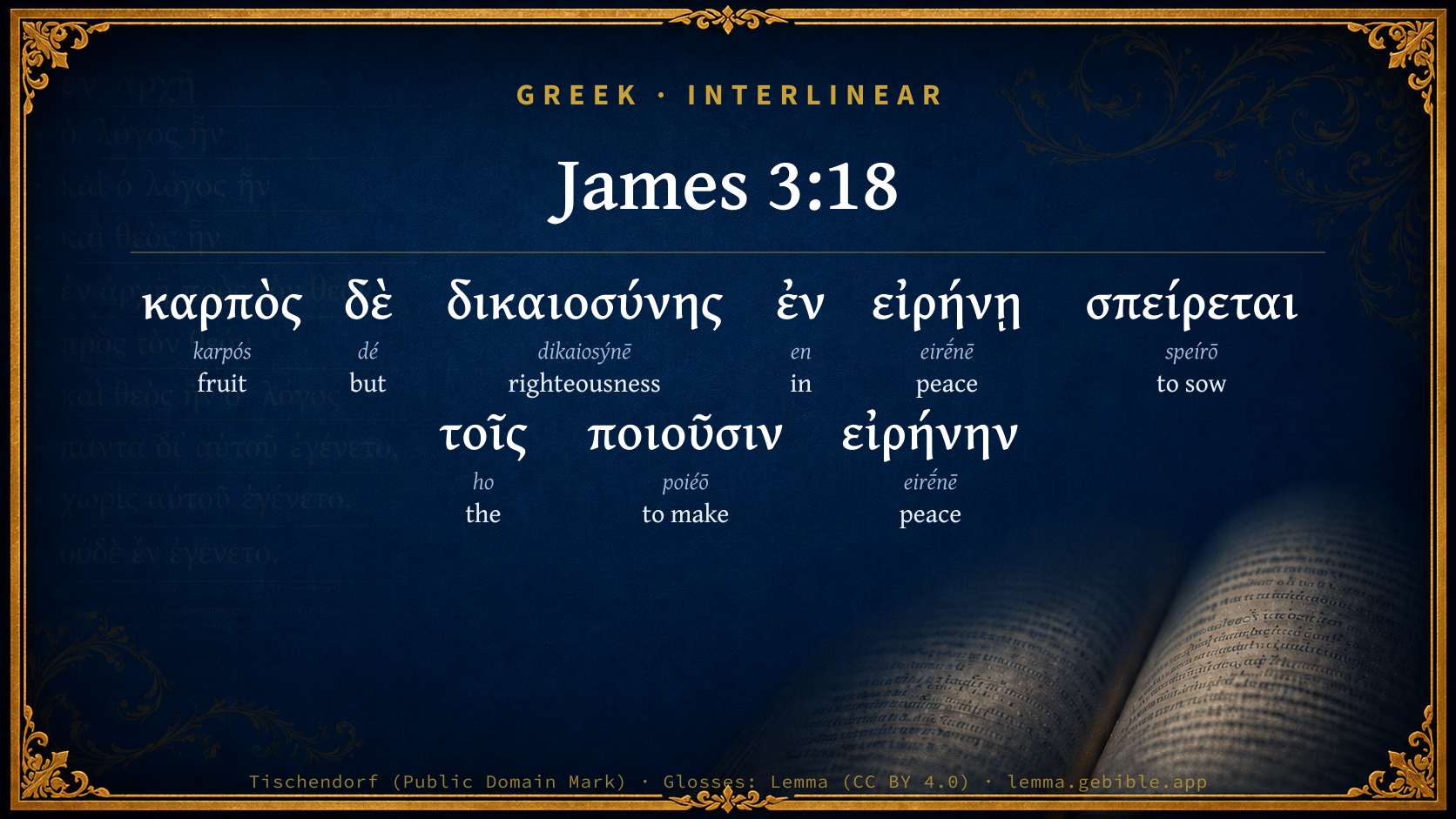
Greek (Tischendorf 8th ed.) James 3:18 appears in the Greek New Testament. The text above is from the Tischendorf 8th edition. Each word links to its Strong’s number and a concise gloss. Click any word for its full Thayer’s Greek Lexicon entry.
Download image
Cite this verse

James 3:18 (World English Bible). Public Domain. Lemma interlinear Bible study tool, https://lemma.gebible.app/v/james/3/18.

Show BibTeX & RIS
BibTeX
RIS
English Translation
Now the fruit of righteousness is sown in peace by those who make peace.
World English Bible · Public Domain
Download a study sheet

One document with this verse’s original text, its word-by-word gloss line, the meaning frame, cross-references with their text, attributed commentary, and full source and license credits — printable, and it pastes into notes with its structure intact.

This verse Autodidact and up

Study sheet (.html) Plain text (.txt)

A passage Seminary Student

Up to 50 verses in one chapter. A passage sheet keeps up to 6 commentary sources and 12 cross-references per verse, in the order this page ranks them, and says so on the sheet whenever that leaves anything out. Ask for a single verse and you get the Autodidact verse sheet above.

Everything on this page stays free to read, with no account — the sheet is a download of what is already on screen, not access to it.

Want to remove ads? Support Godless Engineer
Compare translations 3

The same verse in 3 English versions, stacked beneath the original-language interlinear above. Click any original word for its lexicon entry.

Each is an independent rendering of the whole verse — the interlinear is not word-aligned to these translations.

Highlighted words mark where these versions differ — a whole-verse word diff, not a word-by-word alignment.

  • World English Bible Public Domain
    Now the fruit of righteousness is sown in peace by those who make peace.
  • King James Version Public Domain
    And the fruit of righteousness is sown in peace of them that make peace.
  • unfoldingWord Literal Text CC BY-SA 4.0
    And the fruit of righteousness is sown in peace by those making peace.

unfoldingWord Literal Text — © unfoldingWord, licensed CC BY-SA 4.0. Word-aligned USFM3 via Door43 (git.door43.org/unfoldingWord/en_ult).

Versions to compare (up to 4)

3 of 4 selected

Show all 19 translations

Every available English version of this verse, each an independent rendering of the whole verse.

  • World English Bible Public Domain
    Now the fruit of righteousness is sown in peace by those who make peace.
  • Berean Standard Bible Public Domain
    Peacemakers who sow in peace reap the fruit of righteousness.
  • Majority Standard Bible Public Domain
    Peacemakers who sow in peace reap the fruit of righteousness.
  • King James Version Public Domain
    And the fruit of righteousness is sown in peace of them that make peace.
  • American Standard Version (1901) Public Domain
    And the fruit of righteousness is sown in peace for them that make peace.
  • Revised Version (1885) Public Domain
    And the fruit of righteousness is sown in peace for them that make peace.
  • Geneva Bible (1599) Public Domain
    And the fruite of righteousnesse is sowen in peace, of them that make peace.
  • Douay-Rheims (1899) Public Domain
    And the fruit of justice is sown in peace, to them that make peace.
  • Young's Literal Translation Public Domain
    and the fruit of the righteousness in peace is sown to those making peace.
  • Literal Standard Version CC BY-SA 4.0
    and the fruit of righteousness in peace is sown to those making peace.
  • Unlocked Literal Bible CC BY-SA 4.0
    The fruit of righteousness is sown in peace among those who make peace.
  • unfoldingWord Literal Text CC BY-SA 4.0
    And the fruit of righteousness is sown in peace by those making peace.
  • Darby Bible Public Domain
    But [the] fruit of righteousness in peace is sown for them that make peace.
  • World Messianic Bible Public Domain
    Now the fruit of righteousness is sown in peace by those who make peace.
  • Webster's Bible Public Domain
    And the fruit of righteousness is sown in peace by them that make peace.
  • Free Bible Version CC BY-SA 4.0
    Those who sow peace will harvest the peace of what is truly good and right.
  • Bible in Basic English Public Domain
    And the fruit of righteousness is planted in peace for those who make peace.
  • Text-Critical English NT CC BY 4.0
    And the fruit of righteousness is sown in peace by those who make peace.
  • Tyndale New Testament (1534) Public Domain
    yee and the frute of rightewesnes is sowen in peace of them that mayntene peace.

Literal Standard Version (2020), Covenant Press — licensed CC BY-SA 4.0. Text via the HelloAO Bible API (eBible.org). Unlocked Literal Bible (unfoldingWord) — licensed CC BY-SA 4.0. Text via the HelloAO Bible API (eBible.org). unfoldingWord Literal Text — © unfoldingWord, licensed CC BY-SA 4.0. Word-aligned USFM3 via Door43 (git.door43.org/unfoldingWord/en_ult). Free Bible Version, Dr. Jonathan Gallagher — licensed CC BY-SA 4.0. Text via the HelloAO Bible API (eBible.org).

Word by word

More ways to search: Search by grammar → Find every occurrence → Compare this word →

Practice this passage: Drill this verse → Learn its vocabulary →

About this verse

These counts appear in no published source. They are computed here, from the morphology-tagged text and Lemma’s own curated glosses. What Lemma adds →

9
words
8
distinct lemmas
General Epistles
section

Shared distinctive vocabulary

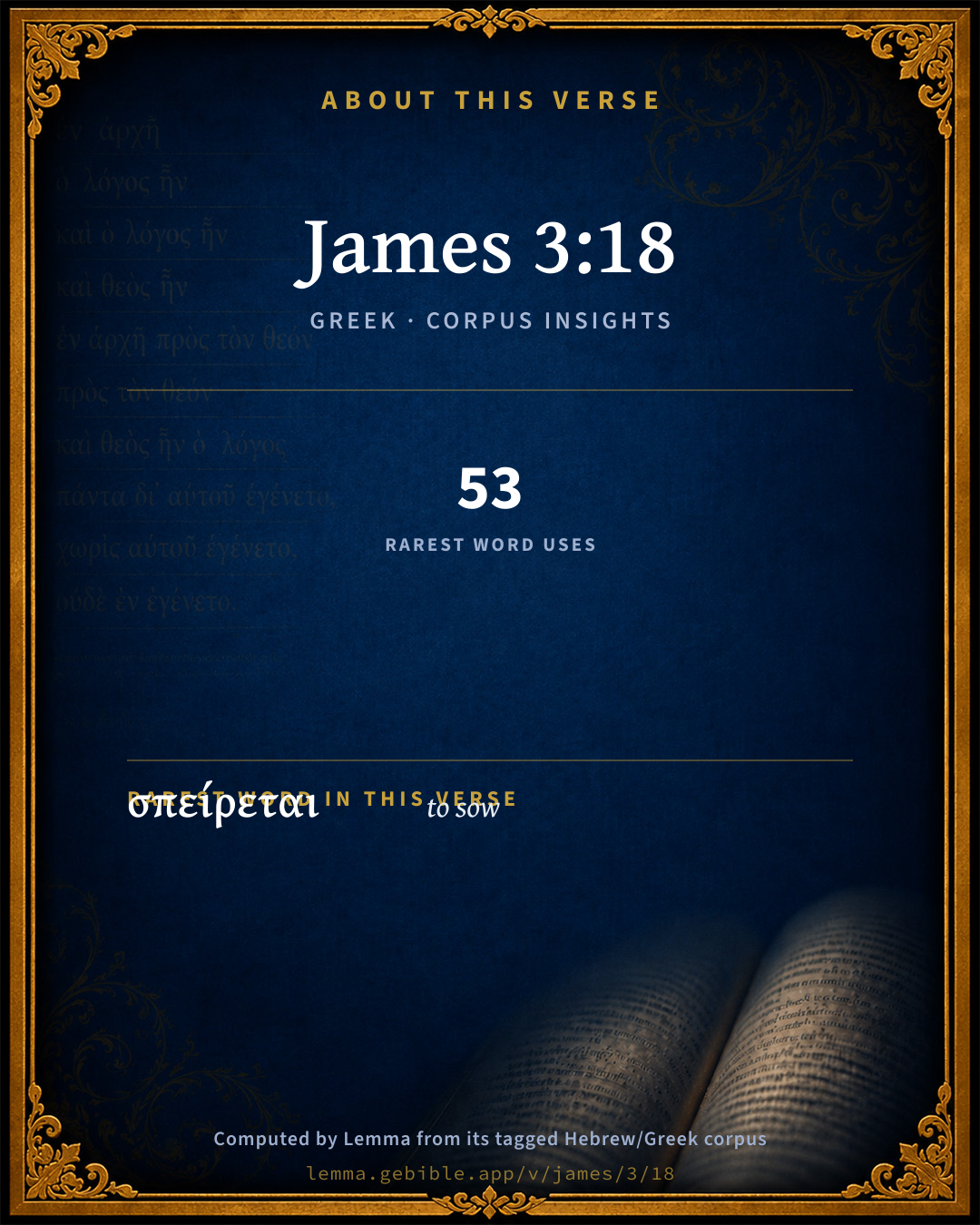
σπείρεται to sow G4687 occurs in 42 verses of the Greek New Testament. Also found in:

Repetition

A word recurs within this verse:

  • εἰρήνῃ peace G1515 ×2

Cross-references

12

Topical passages linked to James 3:18 in the Treasury of Scripture Knowledge — connected by theme and wording, ordered by reader-vote popularity; previews shown in the World English Bible.

  • Matthew 5:9 Blessed are the peacemakers, For they shall be called children of God.
  • Hosea 10:12 Sow to yourselves in righteousness, Reap according to kindness. Break up your fallow ground; For it is time to seek Yahweh, Until he comes and rains righteousness on you.
  • Philippians 1:11 being filled with the fruits of righteousness, which are through Jesus Christ, to the glory and praise of God.
  • Isaiah 32:16–17 Then justice shall dwell in the wilderness; and righteousness shall abide in the fruitful field.
  • Galatians 6:8 For he who sows to his own flesh will from the flesh reap corruption. But he who sows to the Spirit will from the Spirit reap eternal life.
  • Proverbs 11:30 The fruit of the righteous is a tree of life. He who is wise wins souls.
  • Proverbs 11:18 Wicked people earn deceitful wages, But one who sows righteousness reaps a sure reward.
  • John 4:36 He who reaps receives wages, and gathers fruit to eternal life; that both he who sows and he who reaps may rejoice together.
  • Hebrews 12:11 All chastening seems for the present to be not joyous but grievous; yet afterward it yields the peaceful fruit of righteousness to those who have been exercised thereby.
  • James 1:20 for the anger of man doesn't produce the righteousness of God.
  • Proverbs 11:28 He who trusts in his riches will fall, But the righteous shall flourish as the green leaf.
  • Amos 6:12 Do horses run on the rocky crags? Does one plow there with oxen? But you have turned justice into poison, And the fruit of righteousness into bitterness;

Cross-references courtesy of OpenBible.info (CC BY 4.0).

Commentary

Notes on James 3:18 from classic Christian and Jewish commentators (each source and its license shown beneath its notes). The classic Christian expositions comment on the surrounding passage and are grouped to its opening verse, so a note may address several verses; the Jewish commentaries on the Tanakh (Rashi and others) are per-verse, so they appear only where the commentator wrote on this verse.

Lemma curates 59 commentaries, every one of them public domain or Creative Commons licensed, each selected and text-cleaned for this edition rather than reprinted as found. About our sources →

Joseph Benson's Commentary

Jas 3:18. And the fruit of righteousness, &c. — The principle productive of this righteousness, is sown, like good seed, in the peace of a believer’s mind, and brings forth a plentiful harvest of happiness, (which is the proper fruit of righteousness,) for them that make peace — That labour to promote this pure and holy peace among all men. Or, the meaning may be, they that endeavour to make peace among men, (which is a fruit or work of righteousness,) do thereby sow to themselves in peace; that is, they take that course which will produce to them happiness in the end.

Joseph Benson's Commentary on the Old and New Testaments (1811–1818) — public domain. Text from a community e-Sword module.

Tyndale Open Study Notes

Tyndale Open Resources

3:18 James uses an agricultural image to emphasize the benefits of living by the wisdom from above: Those who plant seeds of peace in relationships will enjoy a luxuriant harvest of righteousness in those relationships (cp. Matt 5:9).

Tyndale Open Study Notes — © Tyndale Open Resources, licensed CC BY-SA 4.0. Text via the HelloAO Bible API.

Bengel's Gnomon

Johann Albrecht Bengel

Jas 3:18. Καρπὸς δὲ δικαιοσύνης ἐν εἰρήνῃ, but the fruit of righteousness [is] in peace) So Heb 12:11, note. The fruit of righteousness is most abundant; although that fruitfulness does not immediately appear at the beginning. Righteousness is peaceable; peace is fruitful.—ἐν εἰήνῃ σπείρεται, is sown in peace) The expression, is sown, is in accordance with the word, fruit. Peace is described, Jas 3:17. Respecting the sowing and the righteous, see Psa 97:11, in the Hebrew.—τοῖς ποιοῦσιν εἰρήνην, for them that make peace) The dative expressing an advantage, with the force of limitation. See the opposite, Jas 4:1-2.—ποιεῖν εἰρήνην, to put forth peace; as ποιῆσαι ὕδωρ, to send forth water; Jas 3:12.

Bengel's Gnomon of the New Testament — English translation (T&T Clark, Edinburgh, 1860) — public domain. Text from a community e-Sword module.

Meyer's Critical & Exegetical Commentary

Heinrich August Wilhelm Meyer

Jam_3:18. As in Jam_3:16 the fruit of ζῆλος, and thus of false wisdom on which it is founded, is named, so in this verse is the fruit of true wisdom, which is εἰρηνική.

καρπὸς δικαιοσύνης … σπείρεται is a pregnant expression for: the seed, which yields the fruit of righteousness, is sown (Weisinger, Bouman, Lange). δικαιοσύνη] is not justification (Gebser, Schneckenburger), but righteousness or uprightness. The genitive is that of apposition, and announces wherein the καρπός consists. This καρπός δικαιοσύνης forms the antithesis to ἀκαταστασία καὶ πᾶν φαῦλον πρᾶγμα, Jam_3:16. δικαιοσύνη is by various expositors incorrectly referred to the future life.

σπείρεται] is to be retained in its literal meaning, from which there is no reason to depart, when the pregnant form of the expression is kept in view. Brückner converts the idea without justification into that of dispersing, i.e. of profuse spending; Pott falsely explains σπείρεται by δεῖ σπείρεσθαι. The sower is not to be considered as God (Brückner), for from the whole context the discourse is not concerning the conduct of God, but of the Christian. The addition ἐν εἰρήνῃ is not to be combined with καρπὸς δικαιοσύνης (Rauch) or with δικαιοσύνης (Kern: righteousness before God, which manifests itself in peace with God) as one idea, but it belongs to the verb, and announces the condition by which only the seed sown yields the fruits of righteousness; it is in antithesis to ζῆλος καὶ ἐριθεία, Jam_3:16.

De Wette incorrectly takes ἐν εἰρήνῃ = εἰς εἰρήνην, in hope of peace.

τοῖς ποιοῦσιν εἰρήνην] (=εἰρηνοποιοῖς, Mat_5:9) is either the Dativus actionis (Wiesinger, de Wette, formerly in this commentary; Lange uncertainly) announcing who are the sowers, or Dativus commodi (Brückner, Bouman) announcing for whose use the καρπὸς δικ. is sown; in the latter case the ποιοῦντες εἰρήνην are likewise to be considered as sowers (de Wette considers it possible that the Dativus commodi may by its importance have supplanted ὑπὸ τῶν κ.τ.λ.). The latter explanation is more corresponding to the context, as it is already indicated in ἐν εἰρήνῃ σπείρεται that the sowing can only be by such as are in possession of σοφία εἰρηνική, and it was particularly brought forward that the righteousness springing from the seed is only imparted to those who make peace. Accordingly, the meaning of the sententious expression is: that the seed of righteousness sown in peace yields righteousness only to the peaceable. This explanation agrees in essentials with that of Wiesinger and Bouman, also of Lange, who, however, blends with it something foreign to it, and thinks on the future harvest of righteousness. Deviating from this, de Wette renders it: The fruit (conduct, moral action) of righteousness is in hope of peace, as the seed of the heavenly harvest sown by them who practise peace. Brückner: The fruit (the produce) of righteousness is in peace dispersed (namely, by God) for them who practise peace. Kern: That which springs up for the peaceable as the fruit of their sowing, that is, of their peaceful conduct, is righteousness before God, which manifests itself in peace with God.

Meyer — Critical and Exegetical Commentary on the New Testament — English translation by Peter Christie, edited by Frederick Crombie (T&T Clark, 1880) — public domain. Text from a community e-Sword module.

Expositor's Greek Testament

ed. W. Robertson Nicoll

Jas 3:18 . The keynote of this verse is peace , as contrasted with the jealousy, faction and confusion mentioned above; peace and righteousness belong together, they are the result of true wisdom, the wisdom that is from above; on the other hand, strife and “every vile deed” belong together, and they are the result of the wisdom that is “earthly, ψυχική , demoniacal”.

The Expositor's Greek Testament, edited by W. Robertson Nicoll (1897–1910) — public domain. Text from a community e-Sword module.

Geneva Bible (1599)

Geneva Bible translators

Because the world persuadeth itself that they are miserable which live peaceably and simply, on the contrary side the Apostle pronounceth that they shall at the length reap the harvest of peaceable righteousness.

Geneva Bible (1599) marginal notes — public domain. Text via Bolls.life.

Jamieson, Fausset & Brown

Robert Jamieson, A. R. Fausset & David Brown

"The peaceable fruit of righteousness." He says "righteousness"; because it is itself the true wisdom. As in the case of the earthly wisdom, after the characteristic description came its results; so in this verse, in the case of the heavenly wisdom. There the results were present; here, future.

fruit . . . sown--Compare Psa 97:11; Isa 61:3, "trees of righteousness." Anticipatory, that is, the seed whose "fruit," namely, "righteousness," shall be ultimately reaped, is now "sown in peace." "Righteousness," now in germ, when fully developed as "fruit" shall be itself the everlasting reward of the righteous. As "sowing in peace" (compare "sown in dishonor," Co1 15:43) produces the "fruit of righteousness," so conversely "the work" and "effect of righteousness" is "peace."

of them that make peace--"by (implying also that it is for them, and to their good) them that work peace." They, and they alone, are "blessed." "Peacemakers," not merely they who reconcile others, but who work peace. "Cultivate peace" [ESTIUS]. Those truly wise towards God, while peaceable and tolerant towards their neighbors, yet make it their chief concern to sow righteousness, not cloaking men's sins, but reproving them with such peaceable moderation as to be the physicians, rather than the executioners, of sinners [CALVIN].

Next: James Chapter 4

Jamieson, Fausset & Brown — Commentary Critical and Explanatory on the Whole Bible (1871) — public domain (CC PDM 1.0). Text via the HelloAO Bible API.

Adam Clarke's Commentary

Verse 18. And the fruit of righteousness is sown] The whole is the principle of righteousness in the soul, and all the above virtues are the fruits of that righteousness.

Is sown in peace] When the peace of God rules the heart, all these virtues and graces grow and flourish abundantly.

Of them that make peace.] The peace-makers are continually recommending this wisdom to others, and their own conduct is represented as a sowing of heavenly seed, which brings forth Divine fruit. Perhaps sowing in peace signifies sowing prosperously-being very successful. This is not only the proper disposition for every teacher of the Gospel, but for every professed follower of the Lord Jesus.

Some render this verse, which is confessedly obscure, thus: And the peaceable fruits of righteousness are sown for the practisers of peace. He who labours to live peaceably shall have peace for his reward.

1. ALMOST the whole of the preceding chapter is founded on maxims highly accredited in the rabbinical writings, and without a reference to those writings it would have been impossible, in some cases, to have understood St. James' meaning. There is one phrase, the rabbinical meaning and use of which I have reserved for this place, viz.. The wisdom that is from above. This is greatly celebrated among them by the terms חכמה עליונה chocmah elyonah, the supernal wisdom. This they seem to understand to be a peculiar inspiration of the Almighty, or a teaching communicated immediately by the angels of God. In Sohar, Yalcut Rubeni, fol. 19, Rabbi Chiya said: "The wisdom from above was in Adam more than in the supreme angels, and he knew all things."

In Sohar Chadash, fol. 35, it is said concerning Enoch, "That the angels were sent from heaven, and taught him the wisdom that is from above." Ibid. fol. 42, 4: "Solomon came, and he was perfect in all things, and strongly set forth the praises of the wisdom that is from above." See more in Schoettgen. St. James gives us the properties of this wisdom, which are not to be found in such detail in any of the rabbinical writers. It is another word for the life of God in the soul of man, or true religion; it is the teaching of God in the human heart, and he who has this not is not a child of God; for it is written, All thy children shall be taught of the Lord.

2. To enjoy the peace of God in the conscience, and to live to promote peace among men, is to answer the end of our creation, and to enjoy as much happiness ourselves as the present state of things can afford. They who are in continual broils live a wretched life; and they who love the life of the salamander must share no small portion of the demoniacal nature. In domestic society such persons are an evil disease; therefore a canker in the Church, and a pest in the state.

Adam Clarke's Commentary on the Bible (1810–1826) — public domain. Text from a community e-Sword/MySword module.

John Calvin's Commentaries

18 And the fruit of righteousness. This admits of two meanings, — that fruit is sown by the peaceable, which afterwards they gather, — or, that they themselves, though they meekly tolerate many things in their neighbors, do not yet cease to sow righteousness. It is, however, an anticipation of an objection; for they who are carried away to evil speaking by the lust of slandering, have always this excuse, “What! can we then remove evil by our courteousness?” Hence James says, that those who are wise according to God’s will, are so kind, meek, and merciful, as yet not to cover vices nor favor them; but on the contrary in such a way as to strive to correct them, and yet in a peaceable manner, that is, in moderation, so that union is preserved. And thus he testifies that what he had hitherto said tends in no degree to do away with calm reproofs; but that those who wish to be physicians to heal vices ought not to be executioners.

He therefore adds, by those who make peace; which ought to be thus explained: they who study peace, are nevertheless careful to sow righteousness; nor are they slothful or negligent in promoting and encouraging good works; but they moderate their zeal with the condiment of peace, while hypocrites throw all things into confusion by a blind and furious violence.

John Calvin's Commentaries (1540-1563) — public domain. Text from the Calvin Translation Society English edition (1840s-50s) via the Christian Classics Ethereal Library (ccel.org). Calvin's coverage is partial (roughly two-thirds of the Bible); uncommented books and verses are honest gaps, never fabricated. The 19th-century editor's footnotes and remarks are omitted so the notes are faithfully Calvin's own voice.

Ellicott's Commentary for English Readers

(18) And the fruit of righteousness . . .—Better thus slightly altered: And fruit of righteousness is sown in peace by them that make peace. They “shall be called the children of God” (Mat_5:9). Their fruit is hidden in the precious seed, but “the times of refreshing shall come,” and the glorious plant bring forth her flower, and bear the golden fruit for the blessed ones to eat in the fadeless paradise of God. As “whatsoever a man soweth that shall he also reap” (Gal_6:7)—here is a harvest laid up for the righteous to enjoy for ever; and (comp. Heb_12:11) God’s chastening of the truly penitent yields with it a like promise afterwards of “the peaceable fruit of righteousness”—so, in the tender mercy of our Saviour, “they that sow in tears shall reap in joy” (Psa_126:6). Thus, in some words which well might mark the close of one whose “quiet spirit slowly passeth by to some more perfect peace”—

“Peace comes at length, though life be full of pain;

Calm in the faith of Christ 1 lay me down;

Pain for His sake is peace, and loss is gain:

For all who bear the cross shall wear the crown.”

A Bible Commentary for English Readers, edited by Charles John Ellicott (1878–1897) — public domain. Text from a community e-Sword module.

The Cambridge Bible for Schools and Colleges

gen. ed. J. J. S. Perowne

18. And the fruit of righteousness is sown in peace …] It is commonly said that “the fruit of righteousness” means “the fruit which is righteousness.” The analogy of a like structure, however, in Luk_3:8 (“worthy fruits of repentance”), Eph_5:9 (“the fruit of the Spirit”), and other passages, is in favour of taking it as the fruit which righteousness produces. Every good deed is a fruit produced by the good seed sown in the good soil, and not choked by thorns. And every such deed is, in its turn, as the seed of a future fruit like in kind. It is “sown in peace” (we must remember all the fulness of meaning which the Hebrew mind attached to peace as the highest form of blessedness) either “by” or “for” (the former is, perhaps, meant, but the phrase may have been used to include both) those that make peace. We cannot fail to connect these words with the beatitude on the peace-makers in the Sermon on the Mount (Mat_5:9). We can as little fail to note the resemblance between this portraiture of the true wisdom and the picture which St Paul draws in 1 Corinthians 13 of the excellence of Charity or Love. Differing, as the two teachers did, in many ways, in their modes of thought and language, one fastening on the more practical, the other on the more spiritual, aspects of the Truth, there was an essential agreement in their standard of the highest form of the Christian character. A comparison of the two helps us to understand how the one teacher held out the right hand of fellowship to the other (Gal_2:9), and to hope for a like accord now among men who seem to differ in their conception of Christian Truth, if only they agree in their ultimate aim and standard, and feel, in the depth of their being, that Love is Wisdom, and that Wisdom is Love.

The Cambridge Bible for Schools and Colleges (gen. ed. J. J. S. Perowne; Cambridge University Press, 1878–1918) — public domain. Text from a community e-Sword module.

John Gill's Exposition

And the fruit of righteousness,.... Which is either eternal life, which is the fruit of Christ's righteousness, and shall be enjoyed by all those who are justified by it; and who, in consequence of it, through the grace of God, live soberly, righteously, and godly; see Rom 6:22 or else what is enjoyed in this life, as the fruit and effect of a righteous and holy conversation, which is peace of conscience; and may be truly called the peaceable fruit of righteousness; see Isa 32:17

is sown in peace of them that make peace; that is, either such as are possessed of that wisdom which is peaceable, and makes them so; that peace which they make, pursue after, exercise, and maintain, is a seed, which, being sown by them, will, in the issue, be followed with eternal happiness and felicity; see Mat 5:9 or such who live a godly life and conversation, and are filled with the fruits of righteousness, and, among the rest, with this of making and preserving peace among men, shall enjoy, as what will spring up from such good seed sown, much conscience peace and spiritual pleasure of mind: righteousness and peace promise a large and comfortable harvest both here and hereafter.

Next: James Chapter 4

John Gill's Exposition of the Whole Bible (1746–1763) — public domain (CC PDM 1.0). Text via the HelloAO Bible API.

Trapp's Complete Commentary

John Trapp

18 And the fruit of righteousness is sown in peace of them that make peace.

Ver. 18. Is sown in peace] Only we must not think to sow and reap all in a day. By the fruit of righteousness may be meant the crown of righteousness, 2Ti 4:8, which Christ (the Prince of peace) shall put upon all the sons of peace, Luk 10:6; as, in the mean time, they shall be called the sons of God, Mat 5:9, have not only the comfort, but the credit, the name and note of such.

John Trapp, A Commentary or Exposition upon All the Books of the Old and New Testament (1647–1656) — public domain. Text from a community e-Sword module.

Albert Barnes' Notes on the Bible

And the fruit of righteousness - That which the righteousness here referred to produces, or that which is the effect of true religion. The meaning is, that righteousness or true religion produces certain results on the life like the effects of seed sown in good ground. Righteousness or true religion as certainly produces such effects, as seed that is sown produces a harvest.

Is sown in peace - Is scattered over the world in a peaceful manner. That is, it is not done amidst contentions, and brawls, and strifes. The farmer sows his seed in peace. The fields are not sown amidst the tumults of a mob, or the excitements of a battle or a camp. Nothing is more calm, peaceful, quiet, and composed, than the farmer, as he walks with measured tread over his fields, scattering his seed. So it is in sowing the “seed of the kingdom,” in preparing for the great harvest of righteousness in the world. It is done by men of peace; it is done in peaceful scenes, and with a peaceful spirit; it is not in the tumult of war, or amidst the hoarse brawling of a mob. In a pure and holy life; in the peaceful scenes of the sanctuary and the Sabbath; by noiseless and unobtrusive laborers, the seed is scattered over the world, and the result is seen in an abundant harvest in producing peace and order.

Of them that make peace - By those who desire to produce peace, or who are of a peaceful temper and disposition. They are engaged everywhere in scattering these blessed seeds of peace, contentment, and order; and the result shall be a glorious harvest for themselves and for mankind - a harvest rich and abundant on earth and in heaven. The whole effect, therefore, of religion, is to produce peace. It is all peace - peace in its origin and in its results; in the heart of the individual, and in society; on earth, and in heaven. The idea with which the apostle commenced this chapter seems to have been that such persons only should be admitted to the office of public teachers. From that, the mind naturally turned to the effect of religion in general; and he states that in the ministry and out of it; in the heart of the individual and on society at large; here and hereafter, the effect of religion is to produce peace. Its nature is peaceful as it exists in the heart, and as it is developed in the world: and wherever and however it is manifested, it is like seed sown, not amid the storms of war and the contentions of battle, but in the fields of quiet husbandry, producing in rich abundance a harvest of peace. In its origin, and in all its results, it is productive only of contentment, sincerity, goodness, and peace. Happy he who has this religion in his heart; happy he who with liberal hand scatters its blessings broadcast over the world!

Albert Barnes' Notes on the Bible (1834–1885) — public domain. Text from a community e-Sword/MySword module.

Matthew Poole's English Annotations

And the fruit of righteousness; either the fruit we bring forth, which is righteousness itself, Luk 3:8,9; Ro 6:22; Phi 1:11; or the fruit we reap, which is the reward of righteousness, viz. eternal life.

Righteousness; metonymically here put for the heavenly wisdom before described, whereof it is the inseparable companion, or the effect, Job 28:28.

Is sown; either righteousness, as the good fruit, is wrought or exercised, Hos 10:12, (as wickedness is said to be sown when it is acted, Job 4:8), or it relates to the reward, which is the fruit, of which righteousness is the seed, Psa 97:11; and then it implies, either the sureness of that reward, that it is as certain as harvest after seed-time: or the non-enjoyment of it for the present, as they that sow their seed receive not the crop till long after.

In peace; either in a mild, peaceable, amicable way; or in peace is as much as with peace, viz. spiritual peace and comfort of conscience.

Of them that make peace; that follow after and are studious of peace; and so the words may have a two-fold sense: either the meaning is:

1. That they that exercise righteousnes must do it in a sweet and peaceable way: in particular, men may reprehend others, so they do it with moderation and gentleness, not as executioners, to torment them, but as physicians, to heal them; as, on the other side, they that are most peaceably disposed, yet must not make peace without sowing righteousness with it, which includes just reprehension, whereby righteousness is promoted. Or:

2. That they who sow righteousness in peace, i.e. join righteousness with their endeavours after peace, shall reap the reward, not only in comfort here, but in glory hereafter.

Matthew Poole's English Annotations on the Holy Bible (1683–1685) — public domain. Text from a community e-Sword/MySword module.

Whedon's Commentary on the Bible

Daniel D. Whedon

18. Fruit… is sown—By fruit is meant the harvest, crop, or product; and this is virtually sown in the seed that produces it. Fruit, consisting in righteousness, not fruit produced by righteousness. And this fruit, namely, righteousness, springs from a seed-sowing in the soil of peace by them that make or enact peace. The man of holy peace sows that seed in peace which brings forth righteousness. Thus in holy eloquence does St. James appeal to his fellows of the twelve tribes, both Christians and those who should be Christians, among whom strifes of tongue arising from bitterness of heart were producing sin and ruin, to seek for righteousness in the paths of holy quietude and peace. In an angry age his warnings were slighted, and the ruin resulted in the destruction of their capital and the overthrow of their State.

Daniel D. Whedon (gen. ed.), Commentary on the Old and New Testaments (1874–1909) — public domain. Text from a community e-Sword module.

John Wesley's Explanatory Notes

And the principle productive of this righteousness is sown, like good seed, in the peace of a believer's mind, and brings forth a plentiful harvest of happiness, (which is the proper fruit of righteousness,) for them that make peace - That labour to promote this pure and holy peace among all men.

John Wesley, Explanatory Notes Upon the Whole Bible (1754–1765) — public domain. Text via the GEBible commentary corpus.

Scofield Reference Notes

C. I. Scofield

righteousness

(See Scofield "1Jn 3:7").

The Scofield Reference Bible (1917 edition), notes by C. I. Scofield — public domain. Text from a community e-Sword module.

Burkitt's Expository Notes on the New Testament

William Burkitt

Our apostle here concludes his discourse, by shewing the happiness of those who are possessed of that wisdom from above, which is pure and peaceable, &c. They sow a seed which will yield them present fruit, and bring sheaves of joy and comfort into their bosoms, and also entitle them to an everlasting reward in that kingdom wherein dwelleth righteousness.

Learn hence, 1. That all the actions of this life are as seed sown for the life to come; and every one’s harvest hereafter will be according to his seed-time here; our rewards shall be according to our works.

Learn, 2. That the rewards of righteousness and peaceableness are reaped and received here initially, and shall be ere long enjoyed perfectly: The fruit of righteousness is sown in peace of them that love peace.

Learn, 3. That true lovers of righteousness ought to be lovers of peace, and peaceable persons lovers of righteousness; mercy and truth must meet together, righteousness and peace must kiss each other. Peace without righteousness is but a sordid compliance; righteousness without peace is but a rough austerity; our duty is to couple a sweet goodness with a severe righteousness.

William Burkitt's Expository Notes on the New Testament (1700–1703) — public domain. Text from a community e-Sword module.

The People's New Testament

B. W. Johnson

18. The fruit of righteousness. This wisdom not only bears righteousness as a fruit but sows this fruit as seed to produce peace. Them that make peace. These sowers are peacemakers. See Matt. 5:9. Sowing righteousness makes peace, because wrong is the fruitful mother of strife.

B. W. Johnson's The People's New Testament with Notes (1889–1891) — public domain. Electronic text from the Christian Classics Ethereal Library (CCEL) ThML edition.

Cambridge Greek Testament for Schools and Colleges

18. καρπὸς δὲ δικαιοσύνης κ.τ.λ. δικαιοσύνης gen. of apposition, the fruit which consists of righteousness. The connecting thought between this and the preceding paragraph centres in δικαιοσύνη, which is regarded as the supreme aim and crown of the Christian life: comp. 2Ti 4:8 ὁ τῆς δικαιοσύνης στέφανος, and Mat 5:6, where δικαιοσύνη occupies the central and culminating point of the beatitudes. In 4Ma 1:18 δικαιοσύνη is noted as one of the ὀδέαι of σοφία. Bitter zeal and heavenly wisdom were alike sowing seed and the harvest was drawing on. But only for those who are now making peace (comp. μακάριοι οἱ εἰρηνοποιοί Mat 5:9) is the fruit of righteousness being sown in peace. For the zealots whose policy was resistance and war there would be a harvest of contention and hatred. Here too wisdom was justified by its results (ἀπὸ τῶν ἔργων αὐτῆς). Zeal came to a bitter end at the siege of Jerusalem, while the true faith of Christ won its victory of peace.

τοῖς ποιοῦσιν, a dativus commodi.

Cambridge Greek Testament for Schools and Colleges (Cambridge University Press, 1896; 21 vols, various authors incl. Carr, Maclear, Plummer, Farrar, Lumby, Moule, M. R. James, Simcox) — public domain. Text from a community e-Sword module.

Alford’s Greek Testament

Henry Alford

18.] Character and praise of heavenly wisdom.

18.] Before, in ver. 16, after the characterization came the statement of the result: and so now here. That result was designated as a present one, ἀκαταστασία κ. πᾶν φαῦλον πρᾶγμα: this is a future one, but beautifully anticipated by the pregnant expression καρπὸς σπείρεται: see below. But (δέ passes from the subjective character to the objective result) fruit (or, the fruit, καρπός being in the emphatic place and therefore losing its article) of righteousness (genitive of apposition: that fruit which is righteousness: see ref. Heb. and cf. Isa 32:17: righteousness in its wider sense: in themselves and in others; in practice and in reward; in time and in eternity) is sown (in saying καρπὸς σπείρεται the Apostle uses a prolepsis, as if a husbandman should this autumn be said to sow next year’s bread) in peace (not as De W., for εἰς εἰρήνην, but betokening the spirit and mode in which the sowing takes place, as opposed to ὅπου ζῆλος κ. ἐριθεία) by them who work (better than “make,” which seems to confine the meaning to the reconciling persons at variance. So also in ref. Matt. The dative participle is not a ‘dativus commodi,’ but the dat. of the agent: the former view would leave out of the proposition that which is in fact its necessary and most important feature, viz. that the peace-workers themselves are the sowers of the fruit) peace.

Henry Alford, The Greek Testament (1849–1861) — public domain. Text from a community e-Sword module.

International Critical Commentary

18. καρπὸς δικαιοσύνης, “the fruit of righteousness,” i. e. the reward which righteous conduct brings, cf. Heb 12:11 καρπὸν εἰρηνικὸν δικαιοσύνης, Php 1:11 πεπληρωμένοι καρπὸν δικαιοσύνης.

That the expression “fruit of righteousness” has the sense “product of righteousness” is shown by those O. T. passages which seem to have given it its currency, and in which it is used with a variety of applications. Cf. Pro 3:9(LXX), 11:30 ἐκ καρποῦ δικαιοσύνης φύσεται δένδρον ζωῆς, i. e. “righteousness brings long life,” 13:2 (LXX), Amo 6:12. In all these cases δικαιοσύνης indicates the source of the “fruit.” Similarly Isa 32:17: “And the work of righteousness (τὰ ἔργα τῆς δικαιοσύνης) shall be peace; and the effect of righteousness quietness and confidence forever.” For the figure of sowing, cf. Pro 11:21 (LXX), ὁ δὲ σπείρων δικαιοσύνην λήμψεται μισθόν, Hos 10:12, Job 4:8, Test. XII Patr. Levi, 13:6, etc.

ἐν εἰρήνῃ σπείρεται, “sown in peace,” and in peace only; i. e. a righteousness capable of gaining its due reward must be peaceable; cf. 1:20. The sower is, of course, the righteous man.

For the slightly inaccurate expression “sow the fruit, or crop” (instead of the seed), cf. Apoc. Bar. 32:1, “Sow the fruits of the law,” Plutarch, De vitando œre alieno, 4 σπείροντες οὐχ ἥμερον καρπόν, Antiphanes, Fab. inc. iv, 4 σπείρειν καρπὸν χάριτος.

τοῖς ποιοῦσιν εἰρήνην.

To “do peace” (cf. Eph 2:15, Col 1:20 εἰρηνοποιέω; Mat 5:9 εἰρηνοποιός) means not merely to conciliate opponents, but to act peaceably. It is the complete opposite of ζῆλος and ἐριθία.

The interpretation of v. 18 here given may be paraphrased, with a change of figure, thus: “The foundation which righteousness lays for eternal life can be laid only in peace and by those who practise peace.” This is equivalent to saying that righteousness includes peaceableness.

Another common interpretation takes καρπὸς δικαιοσύνης as meaning “the fruit which consists in righteousness.” The source will then be the true wisdom, of which righteousness is the product. The evidence for this would be Heb 12:11, where righteousness seems to be itself the fruit, and the parallelism of Jas 3:16, where the product of ζῆλος and ἐριθία is said to be ἀκαταστασία and πᾶν φαῦλον πρᾶγμα. Php 1:11, to which appeal is often made, is ambiguous, and cannot be taken as meaning that righteousness is the fruit except by giving to δικαιοσύνη its peculiar Pauline sense.

But the O. T. passages referred to above create a strong presumption against this interpretation; the simple meaning of the phrase speaks against it; and, further, righteousness is more naturally thought of (apart from Pauline theology) as the condition of receiving divine reward, not as the reward itself. The general drift of the verse would be the same under either interpretation.

Lex. J. H. Thayer, A Greek-English Lexicon of the New Testament, 1886.

Mayor J. B. Mayor, The Epistle of St. James, 1892, 21897, 31910.

Winer G. B. Winer, A Grammar of the Idiom of the New Testament, Thayer’s translation, 21873.

J. H. Moulton, A Grammar of New Testament Greek. Vol I. Prolegomena, 1906, 31908.

L. and S. H. G. Liddell and R. Scott, A Greek-English Lexicon, 71883.

Vg Vulgate.

Heisen H. Heisen, Novae hypotheses interpretandae epistolae Jacobi, Bremen, 1739.

Pott D. J. Pott, in Novum Testamentum Grœce, editio Koppiana, Göttingen, 31816.

* See Stephanus, Thesaurus, or Liddell and Scott, s. v. κύκλος.

† Of a different order is the mechanical conception of the revolving universe, used with great ingenuity by Plato, e. g. Polit. 12-14, pp. 269-271; Leg. 10, 8, p. 898.

* See also, for similar phrases, the index to Proclus Diadochus, In Platonis Timœum comm. ed. Diehl, 1906, s. v. κύκλος.

† This has gone into Cramer’s Catena, pp. 20 f.

‡ See E. Rohde, Psyche3, 1903, ii, pp. 121-131, 133-136, 165, note 2, 217-219 f.; Jane E. Harrison, Prolegomena (as cited below); Lobeck, Aglaophamus, 1829, ii, pp. 795-806.

* The verse is from the Compagno tablet, Kaibel, Inscr. Ital. et Sicil. 641, p. 158. See Jane E. Harrison, Prolegomena to the Study of Greek Religion, Cambridge, 1903, pp. 586, 589-594, 668-671; and note the similar use of στέφανος in other verses of the same inscription.

† Simplicius, In Arist. de cœlo comm. ii, p. 168 b (ed. Heiberg, p. 377).

‡ Proclus, In Plat. Tim. comm. v, p. 330 A; cf. also Orphica, fragmm. 222, 223, 225, ed. Abel, 1885, pp. 244-246.

§ Diogenes Laert. viii, 14, Vita Pythag. πρῶτόν φασι τοῦτον [Pythagoras] ἀποφῆναι τὴν ψυχὴν κύκλον ἀνάγκης ἀμείβουσαν ἄλλοτε ἄλλοις ἐνδεῖσθαι ζώοις.

||

See A. Dieterich, Nekyia, Leipzig, 1893, p. 141.

In any case a mere accidental coincidence seems to be involved in the fact that Simplicius’s “wheel of fate and birth” is an allegorical interpretation of Ixion’s wheel, and that Ixion’s wheel was sometimes represented as fiery. As a rationalising interpretation of James’s language, parallel to this, may be mentioned the idea of a wheel catching fire from a “hot box” at the axle, which is seriously offered by many commentaries!

HDB J. Hastings, A Dictionary of the Bible, 1898-1902.

Blass F. Blass, Grammatik des Neutestamentlichen Griechisch, 21902.

Schürer, E. Schürer, Geschichte des jüdischen Volkes im Zeitalter Jesu Christi, 41901-1909.

Bultmann R. Bultmann, Der Stil der Paulinischen Predigt und die kynisch-stoische Diatribe (Forschungen zur Religion und Literatur des Alten und Neuen Testaments, xiii), 1910.

Buttmann A. Buttmann, A Grammar of the New Testament Greek, Thayer’s translation, 1876.

Trench, R. C. Trench, Synonyms of the New Testament, 121894.

GnK Geschichte des Neutestamentlichen Kanons, 1888-1892.

Hatch, Edwin Hatch, Essays in Biblical Greek, 1889.

International Critical Commentary — older volumes (1896–1929), various authors — public domain. Text from a community e-Sword module.

Lesson kit

Teaching starters — assembled from the data on this page, not authored interpretation. Every prompt links to the verse data it draws on. Edit before teaching.

James, in the General Epistles, opens this verse with 9 words (8 distinct Greek lemmas). Its most distinctive word is speírō (“to sow”). A historical commentator’s framing appears above. Read the whole chapter for the surrounding context.

Discussion questions

  1. How does “to sow” (speírō) shape what this verse is saying?
  2. Matthew 6:26 shares the word «to sow» with this verse. How do the two illuminate each other?
  3. “peace” occurs 2× in this one verse. What is the effect of the repetition?
  4. These translations render this verse differently; the difference is in the English rendering, not the original. What questions does that raise?
  5. Reading how Joseph Benson's Commentary and Tyndale Open Study Notes read this verse, where do the two commentators agree and where do they part?

Things to notice

  • These translations choose different wording for 4 words in this verse.
  • “peace” occurs 2× in this single verse.
  • 8 distinct Greek lemmas span 9 words in this verse.

Reading settings

Reading text

Shown beneath each verse's original-language words.

Old Testament
Old Testament edition

Read the OT as the Masoretic Hebrew (MT) or the Greek Septuagint (LXX).

English shown for the Greek Septuagint (in the Hebrew ↔ Greek comparison).

Comparing translations? Open the Compare panel on any verse page to stack up to four side by side.