James 1:9

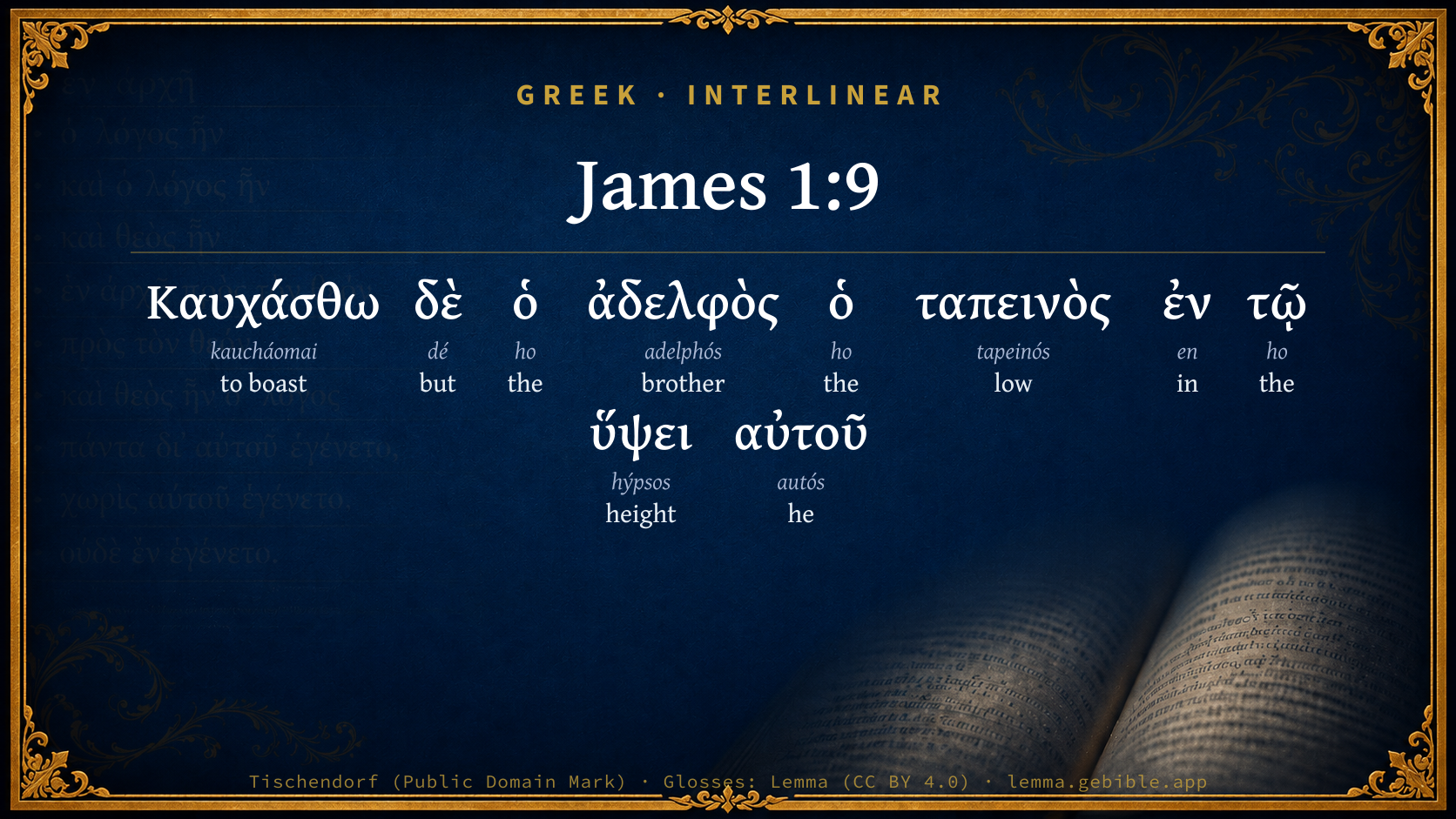
Greek (Tischendorf 8th ed.) James 1:9 appears in the Greek New Testament. The text above is from the Tischendorf 8th edition. Each word links to its Strong’s number and a concise gloss. Click any word for its full Thayer’s Greek Lexicon entry.
Download image
Cite this verse

James 1:9 (World English Bible). Public Domain. Lemma interlinear Bible study tool, https://lemma.gebible.app/v/james/1/9.

Show BibTeX & RIS
BibTeX
RIS
English Translation
But let the brother in humble circumstances glory in his high position;
World English Bible · Public Domain
Download a study sheet

One document with this verse’s original text, its word-by-word gloss line, the meaning frame, cross-references with their text, attributed commentary, and full source and license credits — printable, and it pastes into notes with its structure intact.

This verse Autodidact and up

Study sheet (.html) Plain text (.txt)

A passage Seminary Student

Up to 50 verses in one chapter. A passage sheet keeps up to 6 commentary sources and 12 cross-references per verse, in the order this page ranks them, and says so on the sheet whenever that leaves anything out. Ask for a single verse and you get the Autodidact verse sheet above.

Everything on this page stays free to read, with no account — the sheet is a download of what is already on screen, not access to it.

Want to remove ads? Support Godless Engineer
Compare translations 3

The same verse in 3 English versions, stacked beneath the original-language interlinear above. Click any original word for its lexicon entry.

Each is an independent rendering of the whole verse — the interlinear is not word-aligned to these translations.

Highlighted words mark where these versions differ — a whole-verse word diff, not a word-by-word alignment.

  • World English Bible Public Domain
    But let the brother in humble circumstances glory in his high position;
  • King James Version Public Domain
    Let the brother of low degree rejoice in that he is exalted:
  • unfoldingWord Literal Text CC BY-SA 4.0
    Now let the lowly brother boast in his exaltation,

unfoldingWord Literal Text — © unfoldingWord, licensed CC BY-SA 4.0. Word-aligned USFM3 via Door43 (git.door43.org/unfoldingWord/en_ult).

Versions to compare (up to 4)

3 of 4 selected

Show all 19 translations

Every available English version of this verse, each an independent rendering of the whole verse.

  • World English Bible Public Domain
    But let the brother in humble circumstances glory in his high position;
  • Berean Standard Bible Public Domain
    The brother in humble circumstances should exult in his high position.
  • Majority Standard Bible Public Domain
    The brother in humble circumstances should exult in his high position.
  • King James Version Public Domain
    Let the brother of low degree rejoice in that he is exalted:
  • American Standard Version (1901) Public Domain
    But let the brother of low degree glory in his high estate:
  • Revised Version (1885) Public Domain
    But let the brother of low degree glory in his high estate:
  • Geneva Bible (1599) Public Domain
    Let the brother of lowe degree reioyce in that he is exalted:
  • Douay-Rheims (1899) Public Domain
    But let the brother of low condition glory in his exaltation:
  • Young's Literal Translation Public Domain
    And let the brother who is low rejoice in his exaltation,
  • Literal Standard Version CC BY-SA 4.0
    And let the brother who is low rejoice in his exaltation,
  • Unlocked Literal Bible CC BY-SA 4.0
    Let the poor brother boast of his high position,
  • unfoldingWord Literal Text CC BY-SA 4.0
    Now let the lowly brother boast in his exaltation,
  • Darby Bible Public Domain
    But let the brother of low degree glory in his elevation,
  • World Messianic Bible Public Domain
    Let the brother in humble circumstances glory in his high position;
  • Webster's Bible Public Domain
    Let the brother of low degree rejoice in that he is exalted:
  • Free Bible Version CC BY-SA 4.0
    Believers who are born poor should take pride in the high position they've been given,
  • Bible in Basic English Public Domain
    But let the brother of low position be glad that he is lifted up;
  • Text-Critical English NT CC BY 4.0
    The lowly brother should rejoice in being exalted,
  • Tyndale New Testament (1534) Public Domain
    Let the brother of lowe degre reioyce in that he is exalted

Literal Standard Version (2020), Covenant Press — licensed CC BY-SA 4.0. Text via the HelloAO Bible API (eBible.org). Unlocked Literal Bible (unfoldingWord) — licensed CC BY-SA 4.0. Text via the HelloAO Bible API (eBible.org). unfoldingWord Literal Text — © unfoldingWord, licensed CC BY-SA 4.0. Word-aligned USFM3 via Door43 (git.door43.org/unfoldingWord/en_ult). Free Bible Version, Dr. Jonathan Gallagher — licensed CC BY-SA 4.0. Text via the HelloAO Bible API (eBible.org).

Word by word

More ways to search: Search by grammar → Find every occurrence → Compare this word →

Practice this passage: Drill this verse → Learn its vocabulary →

About this verse

These counts appear in no published source. They are computed here, from the morphology-tagged text and Lemma’s own curated glosses. What Lemma adds →

10
words
8
distinct lemmas
General Epistles
section

Notable vocabulary

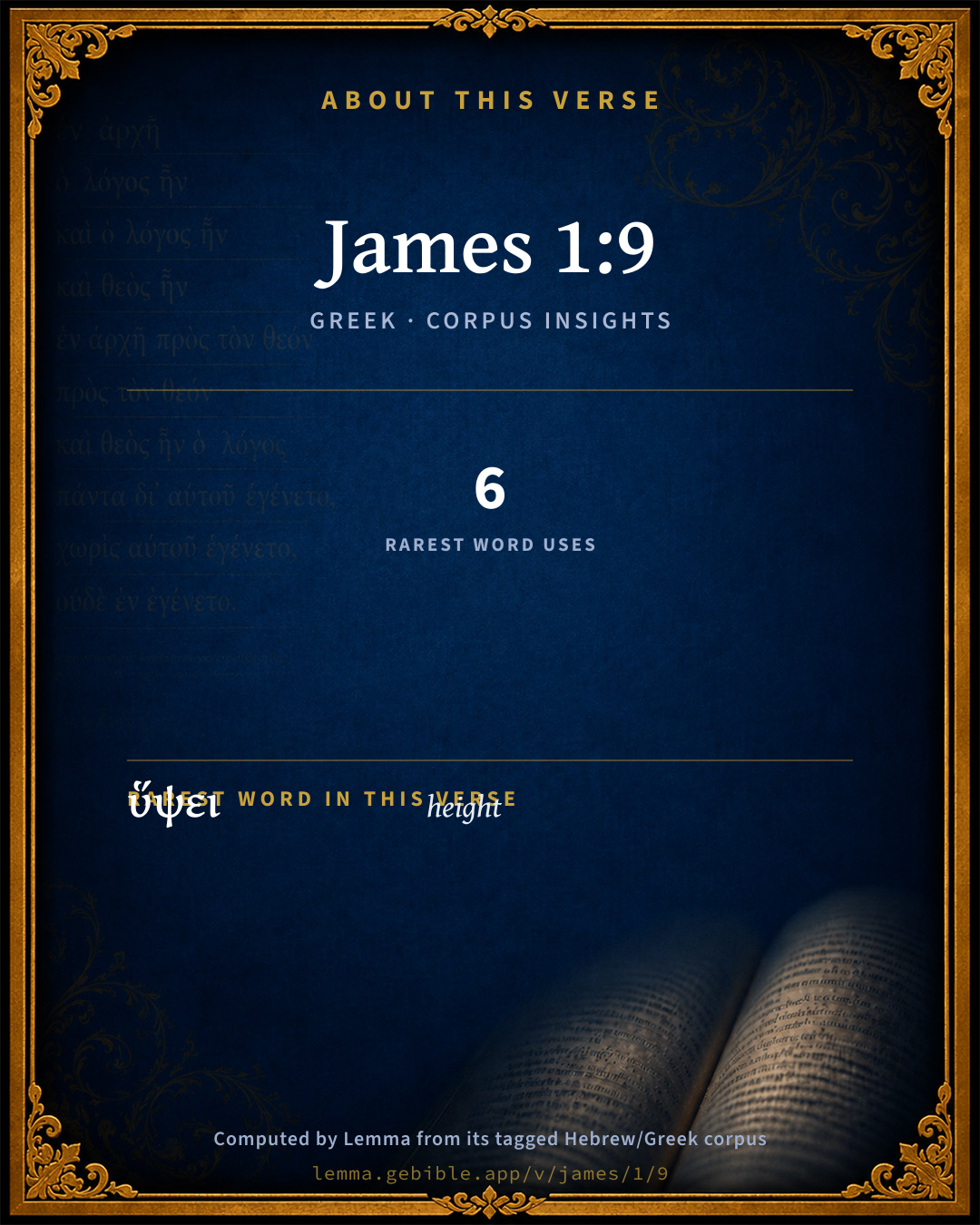
The rarest word here is ὕψει height G5311 — appearing just 6 times in the whole Greek New Testament.

Shared distinctive vocabulary

ὕψει height G5311 occurs in 6 verses of the Greek New Testament. Also found in:

Repetition

A word recurs within this verse:

Cross-references

20

Topical passages linked to James 1:9 in the Treasury of Scripture Knowledge — connected by theme and wording, ordered by reader-vote popularity; previews shown in the World English Bible.

  • Jeremiah 9:23–24 Thus says Yahweh, Don't let the wise man glory in his wisdom, neither let the mighty man glory in his might, don't let the rich man glory in his riches;
  • Proverbs 19:1 Better is the poor who walks in his integrity Than he who is perverse in his lips and is a fool.
  • James 2:5–6 Listen, my beloved brothers. Didn't God choose those who are poor in this world to be rich in faith, and heirs of the Kingdom which he promised to those who love him?
  • 2 Corinthians 6:10 as sorrowful, yet always rejoicing; as poor, yet making many rich; as having nothing, and yet possessing all things.
  • Psalms 113:7–8 He raises up the poor out of the dust. Lifts up the needy from the ash heap;
  • Psalms 62:9 Surely men of low degree are just a breath, And men of high degree are a lie. In the balances they will go up. They are together lighter than a breath.
  • Revelation 2:9 "I know your works, oppression, and your poverty (but you are rich), and the blasphemy of those who say they are Jews, and they are not, but are a synagogue of Satan.
  • Luke 1:52 He has put down princes from their thrones. And has exalted the lowly.
  • Proverbs 17:5 Whoever mocks the poor reproaches his Maker. He who is glad at calamity shall not be unpunished.
  • Romans 5:2–3 through whom we also have our access by faith into this grace in which we stand. We rejoice in hope of the glory of God.
  • Deuteronomy 15:11 For the poor will never cease out of the land: therefore I command you, saying, You shall surely open your hand to your brother, to your needy, and to your poor, in your land.
  • 1 Samuel 2:8 He raises up the poor out of the dust, He lifts up the needy from the dunghill, To make them sit with princes, Inherit the throne of glory: For the pillars of the earth are Yahweh's, He has set the world on them.
  • Luke 9:48 and said to them, "Whoever receives this little child in my name receives me. Whoever receives me receives him who sent me. For whoever is least among you all, this one will be great."
  • Luke 10:20 Nevertheless, don't rejoice in this, that the spirits are subject to you, but rejoice that your names are written in heaven."
  • Romans 8:17 and if children, then heirs; heirs of God, and joint-heirs with Christ; if indeed we suffer with him, that we may also be glorified with him.
  • Philippians 3:14 I press on toward the goal for the prize of the high calling of God in Christ Jesus.
  • 1 John 3:1–3 Behold, how great a love the Father has bestowed on us, that we should be called children of God! For this cause the world doesn't know us, because it didn't know him.
  • Deuteronomy 15:7 If there be with you a poor man, one of your brothers, within any of your gates in your land which Yahweh your God gives you, you shall not harden your heart, nor shut your hand from your poor brother;
  • Deuteronomy 15:9 Beware that there not be a base thought in your heart, saying, The seventh year, the year of release, is at hand; and your eye be evil against your poor brother, and you give him nothing; and he cry to Yahweh against you, and it be sin to you.
  • Revelation 5:9–10 They sang a new song, saying, "You are worthy to take the book, And to open its seals: For you were killed, And bought us for God with your blood, Out of every tribe, language, people, and nation,

Cross-references courtesy of OpenBible.info (CC BY 4.0).

Commentary

Notes on James 1:9 from classic Christian and Jewish commentators (each source and its license shown beneath its notes). The classic Christian expositions comment on the surrounding passage and are grouped to its opening verse, so a note may address several verses; the Jewish commentaries on the Tanakh (Rashi and others) are per-verse, so they appear only where the commentator wrote on this verse.

Lemma curates 59 commentaries, every one of them public domain or Creative Commons licensed, each selected and text-cleaned for this edition rather than reprinted as found. About our sources →

The Biblical Illustrator

Joseph S. Exell

Jam_1:9-11

Let the brother of low degree rejoice

Humiliation and exaltation

I.

LET THE BROTHER OF LOW DEGREE REJOICE IN THAT HE IS EXALTED. When called to rejoice we expect a reason. Good cause may exist for joy; but unless we know it we cannot be affected by it. But in the injunction before us there is no want of true sympathy. A reason is assigned, Let the brother of low degree rejoice in that he is exalted. The first thing here to be noticed is, that the humiliation and the exaltation cannot be of the same description. The one is temporal, the other spiritual--temporal depression, spiritual elevation. Their abasement as the children of earth and mortality is set in contrast with their exaltation as the children of God, and heaven, and eternity.

1. The poor of Christs people are exalted as to birth. The poorest believer is a child of God, by the redeeming purchase of Christs blood, and the regenerating power of His Spirit.

2. He is exalted as to character. This is inseparably associated with the former dignity. That birth itself is a change of character. It is a birth into a new life: a life of new principles, affections, desires, and a new course of conduct; and it is true exaltation--from the debasement of sin to the beauty of holiness--from the image of Satan to the image of God.

3. The brother of low degree is exalted in regard to his society. The poor Christian frequents no palaces; graces no parties of aristocratic fashion. But he has society which the world knoweth not of; society far higher than the highest to which this world, in its best estate, could introduce him. It is a society, indeed, which the world does not acknowledge, but it is honoured of God. They are the excellent of the earth, in whom is all His delight; and of whom He hath said, I will dwell among them, and walk among them, and I will be their God, and they shall be My people.

4. The brother of low degree is exalted in power; in dominion; in honour. It is a spiritual power; not a power of spiritual oppression, but of self-subjugation and self-control; and the power that proves victorious over the mightiest of the enemies of mankind--the world, the flesh, and the devil.

5. Let the brother of low degree rejoice in that he is exalted in riches. The poorest believer is rich--rich in the present possession of all spiritual blessings, in heavenly places, in Christ Jesus; rich in the future hope of the inheritance that is incorruptible, undefiled, and that fadeth not away; and, in one all-comprehensive word, rich in having God Himself as the portion of his inheritance and cup.

6. The brother of low degree may rejoice in being exalted, when he surveys his prospects. These are transcendently glorious. They surpass all our feeble conceptions.

II. Pass we now to the CONTRAST. It is contrast only as to this world and to time; for the spiritual blessings and hopes of poor and rich in the Church of God are the same: But the rich, in that he is made low: because as the flower of the grass he shall pass away (Jam_1:10). Now, according to the testimony of the Bible--confirmed by a sad amount of experience--riches, operating upon the corruption of the human heart, are ever apt to produce in their possessor the spirit of pride and vanity; of self-confidence and self-elation. Even when the tendency does not, in any remarkable degree, manifest itself in the behaviour and bearing of the rich toward their fellow-men, it appears in a spirit of independence--of trust in their wealth, and boasting themselves of the multitude of their riches, and of a forgetfulness of God. Instead of being led by the gifts to the Giver, they forget the Giver in the gifts; and, in the use of them, place self before God. If such be the strength of this tendency, has not the Christian whom God, in His providence, has blessed with a large amount of this worlds good cause to be thankful when in spite of it he has, by the influence of the Divine Spirit, been made low? when, by that Divine influence, he has been made an exception to the atheistical tendencies of his riches, and kept in the spirit of humility and in the spiritual-mindedness of devotion to God?

The lowliness here made the ground of grateful joy consists essentially in two things, which ever accompany each other, and in their elementary nature may be regarded as one--namely, a sense of entire dependence on the God of providence for every temporal good, and a sense of equal dependence on the God of grace for all spiritual and eternal blessings.

III. Notice now the GROUNDS on which the rich brother is called to rejoice in his being made low. They are such as these--

1. The transitory nature of all the riches and honours of this world. Had the rich man not been made low, he might have drawn upon himself the temporary admiration of his fellow-men; and that would have been all: he should have passed away, and been no more seen; all his honours dying with him. He would thus, like other rich men, have had his portion in this life--a pitiful portion for an immortal creature!--and then have gone destitute into another world. Well for him, then, that he has been made low, for--

2. By this he has been brought into possession even here of better blessings than the world can furnish. His very humility is, as a creature and a sinner, his true honour; as it is the honour of the first archangel before the throne. In that humility, too, Jehovah has complacency. He obtains the smile and the blessing of Jehovah, and all the present joy, and all the soul-satisfying hope which that smile and that blessing impart. Which leads me to notice--

3. That the rich man who is thus made low, besides true honour and blessing from God in this world, becomes an heir of a richer heritage than any which he could ever attain to here, where all is corruptible and fading. It is by his having been made low that he has been , made meet to be a partaker of that inheritance. But for this he might have continued to enjoy his earthly riches and honours--clothed in purple and fine linen, and faring sumptuously every day -but he must have forfeited the inheritance above--the better country, even the heavenly. (R. Wardlaw, D. D.)

Poor and rich believers

I. THE TWO CLASSES OF PERSONS ADDRESSED.

1. Poor Christians. He calls the party addressed a brother, that is obviously a brother in the faith of the gospel, a member of the same spiritual family. It was thus Christians then spoke of, and to each other. They realised the endearing relationship which subsisted between them--a bond not of a merely figurative or formal nature, but most intimate. He is not simply a brother, but one of low degree--that is, in humble circumstances. James had called on them generally, irrespective of any distinctions among them, to count it joy when they fell into divers temptations, and now he specially presses this on the class here addressed. The brother of low degree, without wealth, without rank, without influence, without any of the coveted possessions or advantages of earth, is exhorted to exult.

2. Rich believers. Here he says simply, the rich, and as the other party was the man poor temporally, so this doubtless, and still more evidently, is the man rich temporally. And the person thus singled out represents not this class of people generally, but those of them who belong to the household of faith. It is still a brother whom he addresses. Both had reason to rejoice, notwithstanding the wide separation between them in all outward respects. The lowest and the, highest alike had matter of exultation. The gospel placed them on the same platform of spiritual privilege. In Jesus all classes meet add have a common heritage of blessing.

II. THE TWO GROUNDS OF BOASTING RECOMMENDED.

1. In the case of the poor brother, it is his exaltation. He is to rise above his outward poverty and the depression connected with it, and to glory in the elevation to which he has been raised, the treasures of which he has become possessed, as one of Gods people. Taken from the dunghill, he sits among the princes; and, high as he is already, he is advancing towards a height of glory, transcending not only his attainments, but even his conceptions. He is the heir of a portion, in comparison with which all the estates and dignities of earth are not worthy to be named. Well may the poor man lose sight of his low degree, rise far above all its privations, and exult in his being thus spiritually exalted. So far we have viewed the exhortation generally; but doubtless it carries a special reference to the temptations treated of both in the preceding and succeeding verses. The exaltation was closely connected with them; it resulted in no small degree from the suffering they involved. Such dispensations seem fitted only to reduce to a low degree. But they do the very reverse. They cast down, but they also raise up; they empty, but only in order to fill us with something far better. If they abase with one hand, they elevate with the other. For consider how they link us with, and assimilate us to the Lord Jesus. These trials purify and ennoble the character. Even Jesus was thus perfected.

2. In the case of the rich brother, it is his humiliation. But the rich, in that he is made low. The Christian is net to glory in his worldly elevation. That had been forbidden long before (Jer_9:23). It is not his being lifted high, but his being brought down, which is to constitute his ground of boasting. As the poor believer was to rejoice in his exaltation, the wealthy one is to rejoice in his humiliation. As the former of these terms must be understood spiritually, so must the latter; for it is only thus there can be a proper contrast, as is evidently intended. The natural tendency of wealth is to fill Inert with pride, self-confidence, vainglory. There is no more formidable barrier in the way of that poverty of spirit which is a fundamental characteristic of all Christs disciples. When, then, the affluent are delivered from this snare; when they are enabled to see the emptiness of all their treasures, and the danger which the possession of them involves; when they are made willing to take their places in the dust as sinners--to abase themselves before God, and walk without high looks and haughty bearing among men--they have good reason to rejoice, exult, glory. In this humiliation lies their defence against evils of terrible power and endless duration. This being made low is, not less than the other, the fruit of temptations and trials. These are often the means of bringing down those whose looks are high, and laying them in the dust of selfabasement. It is thus that many enter the kingdom. God employs painful dispensations of providence to awaken them out of their security, and to prepare them for submission to the doctrines of the gospel. James enforces the exhortation by the consideration that earthly riches are perishable, transitory in their nature, and that all who trust in them, identify themselves with them, are doomed to speedy destruction. (John Adam.)

Christian brotherhood

I. THEIR CIRCUMSTANCES ARE DIFFERENT.

1. Circumstances are no test of character.

2. Christians should be contented with their lot.

3. There are opportunities for the exercise of brotherly benevolence.

II. THEIR CAUSE FOR JOY IS THE SAME.

1. Not in external circumstances.

2. In spiritual triumph over circumstances. (U. R. Thomas.)

Discipline of change

I. CHANGE IS NEEDFUL FOR THE DEVELOPMENT OF THE NOBLER FACULTIES OF MANS NATURE. It keeps alive those faculties of mind and heart that are already active; rouses into activity those that are lying dormant; and hinders us from falling into mere routine and mental and moral barrenness.

II. CHANCE IS NEEDFUL TO KEEP US FROM FORGETTING GOD AND RELAPSING INTO CALLOUS SELF-CONFIDENCE. There is a painful truth in what David says--in our prosperity we think we shall never be moved. And we become self-indulgent, self-sufficient, and forgetful of God, and are only reminded of our duty to Him, and our dependence upon Him, when He hides His face, and breaks in upon our prosperity; when storm waves threaten to engulf us, we cry, Lord, save, or I perish.

III. CHANGES ARE NEEDFUL FOR THE FOSTERING OF SPIRITUAL LIFE AND GROWTH. If there are no changes in our religious life, or in the discharge of our religious duties, religion not infrequently relapses into mere formalism, machine work. To prevent this, and to rouse the soul to greater activity, God sends us changes. He stops the orderly machine--throws it out of gear, compels us to pause awhile and examine the various parts, and adjust them and start afresh.

IV. CHANGES ARE NEEDFUL TO SLACKEN OUR HOLD ON EARTH, AND STRENGTHEN OUR HOLD ON HEAVEN. By a thousand alternating lights and shades the mind has forced upon it the fact of the instability of terrestrial things, and the folly of setting our affections too firmly upon them; while at the same time, it is made to feel the need of some centre of stability where change is not, some rock of strength on which it may build without fear of coming storms. (W. Fox.)

Grave reverses a decisive test of character

Read fairly the words of St. James cannot fail to carry this plain sense to our minds: that the Christian brother who is poor in this worlds goods is to be glad when he gets rich in this worlds goods; and that the Christian brother who is rich in these goods is to be glad when God takes them away from him, since God will only take them away when it is for his good. And if we sincerely believe, as we profess to believe, spiritual good to be better than temporal good, and spiritual wealth to be far more precious than temporal wealth, I am persuaded that we should never think of taking these words in any other sense. For St. James is the most prosaic, the least mystical, of the New Testament writers. It is almost impossible to misunderstand him except by thrusting meanings into his words which never entered into his mind. But the verses do not stand alone. They are intimately connected both with the verses which go before and the verses which follow them. Directly he has uttered his opening salutation, the apostle strikes his key-note. In the salutation he had wished the Christians of the Hebrew dispersion joy--Joy to you. But what a wish was that for men whom their heathen neighbours hated because they were Jews, and their Jewish neighbour hated because they were Christians! How could men so miserable hope for joy? St. James teaches them: Count it all joy, &c. But what was this strange art of extracting joy from sorrow, honour from shame, gain from loss? St. James teaches them this also. Trials beget that patient and constant temper which makes a man mature, complete in character, so that he lacks nothing. If, then, they made perfection of Christian character their first aim, preferring it before all happy outward conditions, they would rejoice in any change of condition which put their character to the test and helped to make it perfect. So that these verses, taken quite literally, fall in with the whole scope of the apostles argument. With that argument in view it becomes impossible to take them in any other than this plain sense. The poor man is to be glad when he is tried by riches, remembering, however, that for him they are a trial; and the rich man is to be glad when he is tried by poverty, and to take comfort in the conviction that it is a trial by which God is seeking to make a man of him, rounded and complete in character, lacking nothing that he ought to have. The ruling thought of these verses is, then, that great reverses of fortune are a test of Christian character, and a means of Christian perfection; and that we ought not simply to bear them patiently, but to rejoice in them because they so test our character as to mature and perfect it. Yet no one will deny that the reverses by which such a character is formed are very searching trials, very hard to meet in a manly, still harder to meet in a Christian, spirit. When you see a poor good man suddenly made rich, are you not a little afraid for him, though, perhaps, in the same circumstances, you would have no fear for yourself? Do you not fear that he may lose in humility, in sobriety, in spirituality; that he will pamper his senses with unaccustomed luxuries; that his devotion to Christ and the Church may grow weaker? On the other hand, when you see a rich brother, who has been successful in business, and for many years has lived in luxury and ease, suddenly reduced to comparative penury: if he has to begin life again when the strength and sanguine hopefulness of youth are past, do you not fear for him? Do you not fear that his piety may prove to have been a mere adjunct of his prosperity; that his patience may fail him; that he may grow sour, irritable, suspicious; that he may fail to get any good from the evil which has befallen him; that he may confound misfortune with disgrace, lose his self-respect, and conclude that he has forfeited the respect of men because it has pleased God to bring him low? The shoe does not always pinch where our neighbours think it does. The most searching test in these great reverses is often, not in their direct, but in their indirect, consequences. A man, without being a hero, may have so much of goodness and of good sense as that a sudden access of fortune would make little difference to him, none in him, if he stood alone in the world: and yet it may pierce him and try him to the heart because others share it with him. He may have a vulgar wife, fond of show, or children who will give themselves airs, or friends who flatter him, or servants whose solemn, formal deference gives him a sense of importance; and by all these indirect influences his own standard of thought and duty may be insensibly changed and lowered. And the other man, the rich man who has been smitten with poverty, may be affected in a similar manner. To a sensible good man outward changes are of little moment save as they affect character and usefulness. How many a good fellow have we all known to whom the hard work and comparative penury of a reduced income has been a positive relief, and who would have snapped his fingers at Fortune and her wheel had he had no one to care for but himself, or had those for whom he was bound to care been likeminded with himself! But if he has a wife who frets or storms, or children who sulk or wrangle; if those immediately dependent upon him are too stuck up to work for their bread, and yet cannot eat their bread without a good deal of the best butter--then his trial may become very penetrating and severe. Are we to rejoice in such trials as these? Yes, even in these; for these, too, test our character and may help to make us perfect. St. James, indeed, speaks only of poverty and riches; but of course he includes under these terms whatever other changes or reverses they involve. And if a man finds his kind, pleasant wife changed into a fine lady by prosperity, or into a shrew by adversity; if a woman finds her once kind and manly husband turned into a fretful poltroon by misfortune, or into a lazy sensualist by wealth, these sorrowful changes are part of the reverses which have come upon them; they are among the consequences of having been lifted up or brought low; and in these also the apostle bids us rejoice. Before we can honestly give, or take, the apostles comfort, we must occupy his position, we must hold his convictions, we must rise to the full stature of men in Christ Jesus. St. James held that this world would soon pass away, and that we should still sooner pass out of it; but that there is another world in which we shall live for ever, and in which our conditions will be shaped by our character. In his view, therefore, the chief aim of every man was, or should be, to form in himself a character which would best fit him both for the life that now is, and for that which is to come. It mattered very little whether he was rich or poor in things which he must soon leave behind him: what did matter was that by the enjoyment or by the loss of these things he should be qualifying himself for, should be laying hold of, the life which is eternal. Whatever changes, whatever reverses, contributed to elevate, purify, complete the power and quality of his life, and stamp on it the characters of immortality, should therefore be welcome to him. (S. Cox, D. D.)

Human exaltation and humiliation

I. CHRISTIANITY TEACHES THAT MAN, HOWEVER LOW IN DEGREE, IS MAN STILL. The millions are not aware of the greatness of their nature. Spite of the fall, man still possesses intelligence, conscience, moral sensibility, and power to will. Redemption comes to him as an angel of light, and proposes to take the wanderer by the hand, and conduct him to the great Father--to glory and perfection.

II. CHRISTIANITY TEACHES THAT MAN, HOWEVER EXALTED IN POSITION, IS BUT MAN. It is as great an error in the rich to think too highly of themselves as it is for the poor to think too meanly of themselves. The spirit of many is, that pence make shillings, shillings make pounds, and pounds make men. How common, but how erroneous this! Christianity gives us the true idea of humanity. Only let its light enter the mind--then the poor, the degraded, the rude barbarian, the privileged Jew, the philosophic Greek, and the cultivated European, will feel that they are men, and but men. The one is exalted, the Other is made low.

III. CHRISTIANITY TEACHES THAT ALL MEN, INDEPENDENT OF CIRCUMSTANCES, ARE EQUAL. The brother of low degree and the rich are one in everything which constitutes man.

1. Physically (Gen_3:20; Gen_10:32; Act_17:26).

2. Morally. Our common depravity proves the oneness of the race.

IV. CHRISTIANITY TEACHES THAT MAN IS THE SUBJECT OF GREAT VICISSITUDES.

1. Riches are not of human, but of Divine disposal.

2. Riches and poverty are no proof of Divine pleasure and displeasure.

3. The only test of Divine approval or disapproval is moral character.

V. CHRISTIANITY TEACHES THAT THE EXALTATION OF THE POOR AND THE HUMILIATION OF THE RICH ARE SOURCES OF REJOICING. They now see their nature in the light of Christianity. Their errors are corrected; they now think of themselves as they ought to think; they now behold their equality with each other. Between them there is no feeling of superiority and inferiority. They rejoice in their common brotherhood and oneness. (J. Briggs.)

The true Christian temper

1. The people of God are brethren. They are begotten by the same Spirit, by the same immortal seed of the Word. They have many engagements upon them to all social and brotherly affection. Ah! then live and love as brethren. Averseness of heart and carriage will not stand with this sweet relation.

2. He saith of low degree, and yet brother. Meanness doth not take away Church relations. Christian respects are not to be measured by these outward things; a man is not to be measured by them, therefore certainly not a Christian. We choose a horse by his strength and swiftness, not the gaudiness of his trappings; that which Christians should look at is not these outward additaments, but the eminency of grace (Jam_2:1).

3. Not a man of low degree, but a brother. It is not poverty, but poor Christianity that occasioneth joy and comfort.

4. From the word τάπεινος--it signifieth both humble, and of low degree--observe, that the meanest have the greatest reason to be humble; their condition always maketh the grace in season--poverty and pride are most unsuitable. It was one of Solomons odd sights, to see servants on horseback, and princes going on foot (Ecc_10:7). A poor proud man is a prodigy of pride; he hath less temptation to be proud, he hath more reason to be humble.

5. God may set His people in the lowest rank of men. A brother may be τάπεινος, base and abject, in regard of his outward condition. The Captain of salvation, the Son of God Himself, was despised and rejected of men (Isa_53:3); in the original, the leaving-off of men; implying that He appeared in such a form and rank that He could scarce be said to be man, but as if He were to be reckoned among some baser kind of creatures; as Psa_22:6.

6. From that let the brother of low degree glory. That the most abject condition will not excuse us from murmuring: though you be abase, yet you may rejoice and glory in the Lord. A man cannot sink so low as to be past the help of spiritual comforts. Though the worst thing were happened to you, poverty, loss of goods, exile, yet in all this there is no ground of impatience: the brother of low degree may pitch upon something in which he may glory. Well, then, do not excuse passion by misery, and blame your condition when you should blame yourselves: it is not your misery, but your passions, that occasion sin; wormwood is not poison.

7. From that rejoice, or glory, or boast. There is a concession of some kind of boasting to a Christian: he may glory in his privileges. To state this matter, I shall show you--

(1) How he may not boast.

(a) Not to set off self, self-worth, self-merits; so the apostles reproof is just (1Co_4:7).

(b) Not to vaunt it over others (Isa_65:5).

(2) How he may boast.

(a) If it he for the glory of God, to exalt God, not ourselves (Psa_34:2).

(b) To set out the worth of your privileges (Rom_5:3).

8. From that he is exalted. That grace is a preferment and exaltation; even those of low degree may be thus exalted. All the comforts of Christianity are such as are riddles and contradictions to the flesh: poverty is preferment; servants are freemen, the Lords freemen (1Co_7:22). The privileges of Christianity take off all the ignominy of the world.

9. The greatest abasures and sufferings for Christ are an honour to us Act_5:41). (T. Manrope.)

Rejoicing in God

If any object here that St. James willeth the brother of low degree to rejoice when he is exalted, and the rich man when he is made low, which seemeth contrary to other Scriptures, where we are exhorted to rejoice only in God, as Jer_9:23-24; Php_4:4, hereunto the answer is easy. First, if we acknowledge whatsoever happeneth unto us to be from God, who both casteth down and lifteth up, then either in our low degree being exalted, or in our riches being humbled, to rejoice is to rejoice in that God sendeth, and so to rejoice in the Lord. Secondly, if again we look into our own wretched condition, who of ourselves have nothing, but whatsoever we have we have received it, then in the things which we have received moderately to rejoice is also to rejoice in the Lord, who is the Fountain of all graces and blessings. Finally, if we hold this as a ground and foundation that all good gifts flowing unto man grow of His mere favour and mercy, and not from any merit or desert of ours, then in the good blessings of God, of exaltation, advancement, glory, or other whatsoever, to rejoice is godly, Christian, and dutiful; and thus men rejoicing rejoice in the Lord. The Apostle James, then, in exhorting the brother of low degree to rejoice when he is exalted, and the rich in like manner when he is made low, is in all points answerable unto other Scriptures, wherein we are required to rejoice in the Lord, for thus for Gods sake, and in obedience of His commandments to rejoice, is to rejoice in the Lord also. (R. Turnbull.)

Chastening and reward

In the Old Testament worldly wealth is set forth as the reward of righteousness; in the New Testament poverty is commended and riches contemned. When mankind were in their infancy God rewarded them as infants; but on their attaining to years of discretion He sets before them worthier treasures than those things that perish in the using. When, therefore, Christians look on wealth as the reward of righteousness, they are as grown-up sons mistaking nursery toys for their inheritance. God has, as it were, opened our nursery door, and shown to us the splendid domain to which we are heirs, and bus bid us go forth and fit ourselves for the larger life. When, then, He puts away our toys, and sends us to school to learn the duties of the life before us, shall we, as silly children, sit down and cry over our banished plaything rather than submit to the discipline wherein we may learn how to acquit ourselves as men? Do we wish to go into the next stage of being mere milksops, having all to learn which we ought to have learned here? Earthly wealth is a thing of sight, and just in so far as it is loved and leaned on is it a hindrance to the development of faith. If we have grown accustomed to measure lifes enjoyment and lifes success by the money we possess, shall we notbe at a great disadvantage when we enter a sphere where money is unknown? Christians have been so swept along by the rush of the world after pleasures that wealth procures, that they are little aware of their unfitness for higher joys. (The Christian World Pulpit.)

Exaltation and humiliation

What is the meaning of the high estate (ὕψος) in which the brother of low degree is to glory, and of the being made low (ταπείυωσις), in which the rich man is to do the same? At first sight one is disposed to say that the one is the heavenly birthright, and the other the Divine humiliation, in which every one shares who becomes a member of Christ; in fact, that they are the same thing looked at from different points of view; for what to the Christian is promotion, to the world seems degradation. If this were correct, then we should have an antithesis analogous to that in 1Co_7:22. But on further consideration this attractive explanation is found not to suit the context. What analogy is there between the humiliation in which every Christian glories in Christ and the withering of herbage under a scorching wind? Even if we could allow that this metaphor refers to the fugitive character of earthly possessions, what has that to do with Christian humiliation, which does not depend upon either the presence or the absence of wealth? Moreover, St. James says nothing about the fugitiveness of riches: it is the rich man himself, and not his wealth, that is said to pass away, and to fade away in his goings. It is a baseless assumption to suppose that the rich man here spoken of is a Christian at all. The brother of low degree is contrasted, not with the brother who is rich, but with the rich man, whose miserable destiny shows that he is not a brother, i.e., not a believer. The latter is the wealthy Jew who rejects Christ. Throughout this Epistle Jam_2:6-7; Jam_5:1-6) rich is a term of reproach. This is what is meant by the Ebionite tone of the Epistle; for poverty is the condition which Ebionism delights to honour. In this St. James seems to be reproducing the thoughts both of Jesus Christ and of Jesus the son of Sirach (Luk_6:25-26; cf. Mat_19:23-25; Sir_13:3; Sir_13:20). But when we have arrived at the conclusion that the being made low does not refer to the humiliation of the Christian, and that the rich man here threatened with a miserable end is not a believer, a new difficulty arises. What is the meaning of the wealthy unbeliever being told to glory in the degradation which is to prove so calamitous to him? In the exhortation to the rich man St. James speaks in severe irony: Let the brother of low degree glory in his high estate; and the rich man--what is he to glory in?--let him glory in the only thing upon which he can count with certainty, viz., his being brought low; because as the flower of the grass he shall pass away. Whether or no this interpretation be accepted it must be clearly borne in mind that no explanation can be correct which does not preserve the connection between the humiliation of the rich man and his passing away as the flower of the grass. This fading away is his humiliation, is the thing in which he is to glory, if he glories in anything at all. The inexorable because must not be ignored or explained away by making the wealth of the rich man shrivel up, when St. James twice over says that it is the rich man himself who fades away. (A. Plummer, D. D.)

The gospel exalting the humble Christian and abasing the rich

I. THE UNEQUAL DISTRIBUTION OF THE GOOD THINGS OF THIS LIFE IS A FACT WHICH HAS OFTEN PROVED A STUMBLING-BLOCK TO PROUD UNBELIEVERS.

1. The poor Christian is here called a brother: and this title at once marks his real dignity. He has been adopted into the family of Heaven. He is a child of God, a brother of Christ, an heir of glory.

2. It is not only by the nobleness of their future and eternal prospects that the gospel exalts the poor: it equally exalts them as to their present condition and enjoyments. See how it raises them above all those little envyings and grudgings which are too often found in their station of life. It sets before them the true riches, and thus makes them indifferent about the things of this present evil world.

3. It exalts them above many of the cares of life. While others are running here and there for meat, etc.

incessantly crying, Who will show us any good? and suffering from continual fears of not being provided for--the Christian looks up to that bountiful Hand which has never failed him yet, and which, he knows, never will.

4. The gospel exalts the brother of low degree, even in his mind and ideas. Worldly learning has indeed its use; and it is a gift of God, for which those who possess it should be thankful; yet is it good for nothing to the owner, if he be at the same time destitute of that wisdom which cometh from above. It is recorded of a certain great scholar that he exclaimed on his deathbed, Alas! I have wasted my life in laborious trifling.

5. We might proceed to show, in several other instances, how the gospel, when received into the heart, improves and exalts the poor of this world--how it creates in them habits of industry, cleanliness, regularity, temperance, domestic affection, liberality, brotherly kindness, and every social virtue.

II. THE RICHER CLASS OF CHRISTIANS HAVE ABUNDANT CAUSE TO REJOICE IN THAT ABASEMENT WHICH THE GOSPEL BRINGS WITH IT.

1. Riches themselves are a dreadful clog upon the soul.

2. It is not riches alone that are hurtful to the soul; it is what accompanies wealth, or the higher stations of life, that is so dangerous.

3. Look, again, at the mode of life which prevails among the better classes of society, and there see what dangers surround them on every side. The leisure which the better classes enjoy gives the tempter many a fatal opportunity against them. This leisure must be filled up: for the human mind has an insatiable appetite; and while Satan does everything in his power to keep it from its proper nourishment, the bread of life, he always takes care, in the meanwhile, to supply it abundantly with the poisonous husks of worldly pleasure-in the shape of trifling and seductive books, fashionable parties, public amusements, &c.

If, therefore, at any time the grace of God touches the heart of one who is surrounded by these temptations--humbling him in true repentance, and bringing him to a genuine and active faith in Christ--how clearly do we then perceive the motive for the apostles exhortation.

1. Let him rejoice that he is made low in the spirit of his mind, and in his estimate of his own state and character.

2. In his estimate of the world, and his expectations from 2:3. Should God lay His chastening hand heavily upon the rich brother--to reduce him from affluence to poverty--to bereave him of the dear objects of his affection--to visit him with bodily pain and sickness--or even to bring upon him all these calamities together; yet, even then, he would have cause to rejoice--yes, to rejoice in that he is thus made low; for affliction is the peculiar mark of the Lords children; and sanctified affliction is one of the best and most profitable gifts His fatherly wisdom ever bestows on them. (W. Hancock, B. D.)

The rich in that he is made low

The rich brother

I. WEALTH IS COMPATIBLE WITH PERSONAL RELIGION. Some, in successive ages of the world, have been arrested by Divine grace amidst the splendour of high estate, and, feeling that these are but a paltry portion for a spirit fallen by sin and doomed to immortality, have sought a richer boon--a nobler birthright. Many, too, who were brought to Christ when moving in a humble sphere have, by diligence, honesty, and temperance, become the possessors of a considerable amount of worldly riches. And fearful though it be for a man to be rich before he is converted, and necessary as vigilance ever is, as to others, so not least to the rich believer, piety may flourish as truly in the sumptuous hall as at the cottage-hearth.

II. THE RICH BROTHER IS LOWLY. He knows the grandeur and purity of God, and he knows the weakness and corruption of his own soul. He feels how unsatisfactory earthly possessions are. He realises that decisive event which is sure to scatter mans accumulated treasures to the winds, and to lay all earthly honours in the dust. And as for the faith which brought peace and safety to his soul, and the piety that holds its dwelling in his heart, he is ready to exclaim (1Co_15:10).

III. THE RICH BROTHER IS HERE CALLED TO TRIUMPH IN HIS LOWLINESS. Christian humility, on the part of the wealthy believer, is a favourable symptom of his state. It is, according to an oft-repeated principle of Scripture, a prelude of future advancement in the scale of dignity and blessedness. It is an important qualification for a considerate distribution of wealth among the destitute. And finally, it is what the unsatisfactoriness, and transitoriness of earthly riches, and the weakness, as well as sinfulness, of their possessor, may well inspire. (A. S. Patterson, D. D.)

Riches

1. Riches are not altogether inconsistent with Christianity. Usually they are a great snare. The moon never suffers eclipse but when it is at the full; and usually in our fulness we miscarry (Mat_19:24). Plato, a heathen, saith the same almost with Christ, that it is impossible for a man to be eminently rich and eminently good. But you will say, What will you have Christians to do then--in a lavish luxury to throw away their estates? or in an excess of charity to make others full, when themselves are empty? No (see Mat_19:26; Mar_10:23-24). Riches in the having, in the bare possession, are not a hindrance to Christianity, but in our abuse of them. Your possessions will not be your ruin till your corruptions mingle with them. Under the law the poor and rich were to pay the same ransom Exo_30:15), intimating they may have interest in the same Christ. Riches in themselves are Gods blessings that come within a promise. Yea, riches with a blessing are so far from being a hindrance to grace, that they are an ornament to it (Pro_14:24).

2. A. rich mans humility is his glory. Your excellency cloth not lie in the splendour of your condition, but in the meekness of your hearts. Humility is not only a clothing--Put on humbleness of mind (Col_3:12)--but an ornament. Be decked with humility (1Pe_5:5). A high mind and a low condition are all one to the Lord, only poverty hath the advantage, because it is usually gracious. If any may glory, they may glory that have most arguments of Gods love. Now a lowly mind is a far better testimony of it than a high estate. And so before men, as Augustine said, he is a great man that is not lifted up because of his greatness. You are not better than others by your estate, but your meekness. The apostles possessed all things though they had nothing. They have more than you if they have a humble heart.

3. The way to be humble is to count the worlds advantages our abasement. The poor man must glory in that he is exalted, but the rich in that he is made low. Honours and riches do but set us beneath other men, rather than above them, and do rather abate from than add anything to you; and it may be you have less of the Spirit because you have more of the world.

4. If we would be made low in the midst of worldly enjoyments, we should consider the uncertainty of them. Outward riches are so far from being the best things, that they rather are not anything at all. Solomon calleth them that which is not; and who ever loved nothing, and would be proud of that which is not?

5. The uncertainty of worldly enjoyments may be well resembled by a flower--beautiful, but fading.

(1) Though the things of the world are specious, yet they should not allure us, because they are fading. Flowers are sweet, and affect the eye, but their beauty is soon scorched; the soul is for an eternal good, that it may have a happiness suitable to its own duration. An immortal soul cannot have full contentment in that which is fading. When the creatures tempt you, be not enticed by the beauty of them, so as to forget their vanity. Say, Here is a flower, glorious, but fading; glass that is bright, but brittle.

(2) The fairest things are most fading. Creatures, when they come to their excellency, then they decay, as herbs, when they come to flower, they begin to wither; or, as the sun when it cometh to the zenith, then it declineth. Man at his best estate is altogether vanity (Psa_39:5); not at his worst only, when the feebleness and inconveniences of old age have surprised him. So the prophet speaketh of a grasshopper in the beginning of the shooting up of the latter growth (Amo_7:1). As soon as the ground recovered any verdure and greenness, presently there came a grasshopper to devour the herbage: the meaning is, a new affliction as soon as they began to flourish. Well, then, suspect these outward things when you most abound in them. (T. Manton.)

Improved by adversity

Many Christian people are like some evening primroses, for whose opening we watched with some friends the other evening. It was a common-looking plant, and the buds were tightly wrapped up so long as the sun shone, and gave but faint promise of the coming beauty. But the moment the sun disappeared, and the gloom of the coming night was threatened in the darkening twilight, they suddenly burst their bonds, displaying sweet blossoms that crowned the homely stock with golden glory. So there are many men and women whose lives are homely and hard and selfish, until their sun of prosperity sets, and the gloom of coming sorrow overshadows them, when, unexpectedly, under that touch of trouble, a hidden bud blossoms in beauty and a sweetness of spirit and character that crowns the whole stock of their lives with goodness and glory.

As the flower of the grass he shall pass away

The blade of grass

St. James plays the fabulist, or historian here, and narrates the sad end of a certain blade of grass. In whose field, then, did this grass grow? All the commentators reply, In that of the prophet Isaiah. St. James is here falling back on Old Testament words which would be familiar to the Jews for whom he wrote--words which his story would be sure to recall to their minds.

I. THE STORY OF THE BLADE OF GRASS (Isa_40:6-8). As we listen to the prophet, imagination stirs and works; we see the broad, pleasant field bathed in sunlight, fanned with sweet airs, thick with verdant grass, gay with the purely tinted, fragrant wild flowers which clothe the grass as with the robes of a king; and then we feel the fierce, hot blast sweep across the field, under whose breath the grass withers, the bright flowers fade, and all that teeming life, all that exquisite and varied beauty, is swallowed up of death. Who does not feel at times that that is a true picture of human life? And remembering how, in this field, every separate blade of grass and every fragile flower has its own little world of hopes and fears, joys and pains, who can fail to be saddened as he beholds them withered by a breath, their early promise unfulfilled, their goodliness not ripening to its maturity? All flesh is grass--all the great heathen races; but also this people is grass--a grass which withers like the rest. Like their neighbours, the Jews were in a constant flux, vexed by constant change. One generation came, and another went. The life, vexed with perpetual changes while it lasted, never continuing in one stay, was soon over and gone. Their only hope lay in obedience to the Divine Word, in appropriating that Word, in steeping their life in it till it became enduring as the Word itself.

II. THE MORAL OF THIS STORY. St. James is not content with a lesson so large and general as had contented Isaiah. He has a special purpose in view in telling the story which called up memories, prophetic and historic, from the past. As he had taken a single blade of grass out of Isaiahs broad field, so he selects one man, or one class of men, for special warning. The blade of grass reminds us that human life soon withers, that human fortune often withers even before the man dies. Yes; but it also reminds us that some men wither even while they retain the full vigour of their life, and their good fortune abides. The rich man withers in his ways, in his goings to and fro along the lines of his traffic, before his health is touched, before his wealth is touched. And therefore, argues St. James, the rich man should rejoice when his riches use their wings and fly away. The alternative the apostle places before him is this: Let the wealth wither that the man may live, or let the man wither amid the abundance of his wealth. It is a hard saying I but, before we reject it as too hard for practical use, let us clearly understand what it means. James had just said, Let the brother of low degree rejoice in that he is lifted up, but the rich in that he is brought low. Now, however much we may dislike the injunction, or part of it, can we deny that it is based on a true, on a Christian, view of human life? Are not sudden and large reverses of condition severe and searching tests of character? Does it not take a very good poor man to ride straight to God when he is set on horseback, and a very good rich man not to break down when he is brought low? Great reverses of fortune are very searching and conclusive tests of character. And can we expect a Christian teacher to bid us grieve over any reverse by which our character is tested, matured, perfected? The wealth and the poverty will soon pass, but the character will remain, and will determine our destiny. Does any one object, It may be easy enough for a poor man to be glad when he gets rich; but how is a rich man to rejoice when he becomes poor? You ask too much of us, more than it is in man to give. I reply: You are not speaking, and you know that you are not speaking, from the Christian point of view, in the spirit of Him who, when He was rich, for our sakes became poor. You are putting circumstances before character, transitory gains and pleasures before abiding and eternal realities. St. James himself felt that the latter half of his injunction was hard to flesh and blood; in demanding that the rich man should rejoice whenever he is brought low, he felt that he was imposing a very severe test on character, a very heavy strain on virtue. And that, I suppose, is why he told his story of the blade of grass, to which at last we come back. What he meant was, I think, to this effect: You remember the prophet Isaiahs field of grass, and how it withered beneath the scorching heat, so that the flower thereof fell off, and the grace of its form perished. The rich man is often like a blade of that grass. The sun of prosperity shines on him more hotly than he can bear; all the promise and beauty of his nature fade beneath the scorching heat; he withers in his ways, in the multitude and perplexity of his schemes and pursuits: his fortune grows, but the man decays, dies before his time, dies even long before he ceases to breathe and traffic. Douglas Jerrold, one of our keenest wits and satirists, has depicted a man made of money. He had only to put his hand into his breast to find it full of banknotes; but as he draws away note after note, he drains away his vitality; he dwindles and pines amid his vast schemes and luxuries month by month, till he wastes into a mere shadow, till the very shadow disappears. The picture is hardly a satire, it is so mere a comonplace. Every day we live we may see men dying of wealth, all that is manly, all that is fine and pure and noble in character, perishing as their fortunes grow. The warning comes home to us in this age as in few previous eras of the world; for our whole life is so rapid and intense, our business is such a strenuous and exhausting competition, we are solicited by so many schemes for our own advancement, or for the good of the town in which we dwell, or for the benefit of the commonwealth of which we form part, that it is almost impossible to make leisure for thought, for a quiet enjoyment of what we have gained, or for those religious meditations and exercises on which our spiritual health in large measure depends. We are literally withering away in our ways, so many are the paths we have to tread, so rapid the pace we have to maintain, so scorching and tainted the atmosphere we breathe. And hence, whether we are rich, or seeking riches, or are labouring with anxious and fretting care for a bare competence, we all need to take heed to the warning which speaks to us as to men; i.e., as to spiritual and immortal creatures, children of God and heirs of eternity. If we would not Suffer this world, which holds us by ties so many, so strong, and so exacting, to crush all high spiritual manhood out of us, we must set ourselves to be in this world as Christ was in the world. Let the mind that was in Christ be in us also; let us cultivate His preference of duty to pleasure, of service to gain, of doing good to getting good; and instead of withering away in our ways, we shall find every path in which we walk a path of life, a path that leads us home. (S. Cox, D. D.)

The metaphors of St. James

The metaphor here used of the rich man is common enough in the Old Testament. Man cometh forth like a flower, and is cut down, says Job, in his complaint (Job_14:2); and, As for man, his days are as grass, etc., says the Psalmist (Psa_103:15-16). But elsewhere, with a closer similarity to the present passage, we have this transitory character specially attributed to the ungodly (Psa_37:2). None of these passages, however, are so clearly in St. Jamess mind as the words of Isaiah (Isa_40:6-7). Here the words of St. James are almost identical with those of the Septuagint. Grass throughout is a comprehensive term for herbage, and the flower of grass does not mean the bloom or blossom of grass in the narrower sense, but the wild flowers, specially abundant and brilliant in the Holy Land, which grow among the grass. The scorching wind (ὁ καύσων) is one of the features of the Epistle which harmonise well with the fact that the writer was an inhabitant of Palestine. It is the furnacelike blast from the arid wilderness to the east of the Jordan. The fig-tree, olives, and vine (Jam_3:12) are the chief fruit-trees of Palestine; and the early and latter rain (Jam_5:7) points still more clearly to the same district. It has been remarked with justice that whereas St. Paul for the most part draws his metaphors from the scenes of human activity--building, husbandry, athletic contests, and warfare--St. James prefers to take his metaphors from the scenes of nature. In this chapter we have the surge of the sea (verse 6) and the flower of the grass (verse 10). In the third chapter we have the rough winds driving the ships, the wood kindled by a small fire, the wheel of nature, every kind of beasts and birds, of creeping things, and things in the sea, the fountain sending forth sweet water, the fig-tree and vine (verses 4-7, 11, 12). In the fourth chapter human life is a vapour, that appeareth for a little time, and then vanisheth away (verse 14). And in the last chapter, besides the moth and the rust, we have the fruit of the earth, and the early and latter rain (verses 2, 3, 7, 18). These instances are certainly very numerous, when the brevity of the Epistle is considered. The love of nature which breathes through them was no doubt learned and cherished in the village home at Nazareth, and it forms another link between St. James and his Divine Brother. Nearly every one of the natural phenomena to which St. James directs attention in this letter are used by Christ also in His teaching. In some cases the use made by St. James of these natural objects is very similar to that made by our Lord, and it may well be that what he writes is a reminiscence of what he had heard years before from Christs lips; but in other cases the use is quite different, and must be assigned to the love of nature, and the recognition of its fitness for teaching spiritual truths, which is common to the Lord and His brother. But there is this great difference between Christs teaching from nature and that of St. James: St. James recognises in the order and beauty of the universe a revelation of Divine truth, and makes use of the facts of the external world to teach spiritual lessons; the incarnate Word, in drawing spiritual lessons from the external world, could expound the meaning of a universe which He Himself had made. In the one case it is a disciple of nature who imparts to us the lore which he himself has learned; in the other it is the Master of nature, who points out to us the meaning of His own world, and interprets to us the voices of the winds and the waves, which obey him. (A. Plummer, D. D.)

So also shall the rich man fade away

Fading splendour

I. We delight in pictures and emblems, for then the soul, by the help of fancy, hath a double view of the object in the similitude, which is, as it were, a picture of it, and then the thing itself. This was Gods ancient way to teach His people by types; still He teacheth us by similitudes taken from common objects, that when we are cast upon them, spiritual thoughts may be awakened; and so every ordinary object is, as it were, consecrated to a heavenly purpose. Well, then, let this be your field meditation; when you see them decked with a great deal of bravery, remember all this is gone in an instant when the burning heat ariseth.

2. Our comforts are perishing in themselves, but especially when the hand of Providence is stretched out against them. The flower fadeth of itself, but chiefly when it is scorched by the glowing, burning east wind. Our hearts should be loose at all times from outward things, but especially in times of public desolation; it is a sin against Providence to effect great things; when God is overturning all, then there is a burning heat upon the flowers, and God is gone forth to blast worldly glory (Jer_45:4-5).

There are three sins especially by which you make Providence your enemy, and so the creatures more vain.

1. When you abuse them to serve your lusts. Where there is pride and wantonness, you may look for a burning; certainly your flowers will be scorched and dried up.

2. When you make them objects of trust. God can brook no rivals; trust being the fairest and best respect of the creatures, it must not be intercepted, but ascend to God.

3. Worldly men pursue wealth with great care and industry. The rich turneth hither and thither, he hath several ways whereby to accomplish his ends. What pains do men take for things that perish! Do but observe their incessant care and unwearied industry, and say, how well would this suit with the heavenly treasure! It is a pity a plant that would thrive so well in Canaan should still grow in the soil of Egypt; that the zealous earnestness of the soul should be misplaced, and we should take more pains to be rich unto the world than to be rich towards God (Luk_12:21). Shall a lust have more power upon them than the love of God upon me? And when we see men cumber themselves with much serving, and bustling up and down in the world, and all for riches that take themselves wings and fly away, we may be ashamed that we do so little for Christ, and they do so much for wealth.

4. Lastly, again, from that ἐν ταῖς πορείαις in his ways, or journeys. All our endeavours will be fruitless if Gods hand be against us. As the flower to the burning heat, so is the rich man in his ways; that is, notwithstanding all his industry and care, God may soon blast him: they earned wages, but put it in a bag with holes (Hag_1:6), that is, their gains did not thrive with them. Peter toiled all night but caught nothing, till he took Christ into the boat (Luk_5:5). So you will catch nothing, nothing with comfort and profit, till you take God along with you Psa_127:2). (T. Manton.)

Delusive nature of riches

There is a fable of a covetous man who chanced to find his way, one moonlight night, into a fairys palace. There he saw bars, apparently of solid gold, strewn on every side; and he was permitted to take away as many as he could carry. In the morning, when the sun rose on his imaginary treasure, borne home with so much toil, behold I there was only a bundle of sticks; and invisible beings filled the air around him with scornful laughter. Such shall be the confusion of many a man that died in this world worth his thousands, and woke up in the next world not only miserable, and poor, and blind, and naked (Rev_3:17), but in presence of a heap of fuel stored up against the great day of burning (Rom_2:5).

How to be rich

Do all rich men know how to be rich? He does not know how to do anything who does that thing so that he brings it to its worst and not its best results. Is that not true? A man does not know how to sail a ship who steers it so that when it ought to go to Liverpool he brings it into Madagascar. Where is the ship of wealth then meant to sail? Her port is clear and certain--to generosity and sympathy, and fineness of nature, and healthy use of powers. What shall we say, then, of the man whose money makes him selfish and cruel, and coarse and idle, or any one of these bad things? There are many hard names which we may call him by, but the real philosophy of the whole matter, the comprehensive definition of it all, is this--he does not know how to be rich! He is a blunderer in a great art. Look at his opposite. Look at the man who takes money into the easy mastery of his character, appropriates it. He makes it part of him. The richer that he grows the more generous and sympathetic and fine and active he becomes. What can you say of him but that he does know how to be rich. I say of a man that he knows how to travel when he makes each new country, as be enters it, open its secrets and render up to him new interest and knowledge. I say of a man that he does not know how to swim when the water takes possession of him and drowns him in itself. So I say that a man does not know how to be rich when his money makes him its slave, and turns him into a coarseness like itself instead of being elevated and refined by the commanding spirituality of his human soul. (Bp. Phillips Brooks.)

Dying rich

What an awful thing it is to die rich! Imagine the Master auditing the account of a servant who has left behind a million! If that poor wretch who had but one talent was cast into outer darkness because he laid it up instead of using it in his Masters service, what will be the doom of those who, with their half millions and millions (while giving, it may be, a few thousands for decencys sake), have, year after year, hoarded up countless treasures which they could never use? Think of the poor saints pinched with cold and hunger! Think of the Redeemers cause languishing for the want of that filthy lucre which they hold with close-fisted selfishness! Yet listen to their talk! I am but a steward. I am not my own. Every believer in Jesus is my brother or sister. What a mockery! Will not this be the Masters language to many a professor: Out of thine own mouth will I condemn thee?

The Biblical Illustrator, edited by Joseph S. Exell (c. 1880s–1900s) — public domain. Text from a community e-Sword module.

Joseph Benson's Commentary

Jas 1:9-11. Let the brother — St. James does not give this appellation to the rich; of low degree — Poor and tempted, or brought low by his sufferings for Christ, and humbled in spirit thereby; rejoice that he is exalted — To be a child of God, and an heir of eternal glory; let him think of his dignity as a Christian, and entirely acquiesce in his low station in life, which will continue only for a short season, and which God has wisely appointed for his eternal good. Or, let him rejoice that he is thought worthy to be called to suffer for Christ, Act 5:41; Php 1:29. But the rich — Let the rich rejoice in that he is made low — Is humbled by a deep sense of his true condition, and brought to have low thoughts of all worldly excellences, and to be prepared for sufferings. The Greek is, εν τη ταπεινωσει αυτου, in his humiliation, as the word is rendered Act 8:33; where it is used to express the humiliation of Christ by his various sufferings. And as it is here opposed to υψει, exaltation, in the preceding verse, it may signify the humiliation of the rich man, by his being stripped of his riches and possessions, of his liberty, and his being made liable to lose his life on account of the gospel. Here, therefore, the apostle advises the rich to glory when they lose the uncertain riches of this life, and are exposed to other sufferings, for the sake of truth and a good conscience, with the favour and approbation of God. For the sun, &c. — Literally, For the sun arose with a burning heat, and withered the grass, and the flower fell off, and the beauty of its form perished. There is an unspeakable beauty and elegance, both in the comparison itself and the very manner of expressing it; intimating both the certainly and the suddenness of the event. So shall the rich man fade away in his ways — In the midst of his various pleasures and enjoyments.

Joseph Benson's Commentary on the Old and New Testaments (1811–1818) — public domain. Text from a community e-Sword module.

The Preacher's Complete Homiletical Commentary

Joseph S. Exell (gen. ed.)

CRITICAL AND EXEGETICAL NOTES

Jas_1:9. He is exalted.—Or, “in his exaltation”; “in his high estate.” Low degree does not suggest caste, but poverty involving humiliation.

Jas_1:10. Made low.—Or, “in his humiliation.” These experiences being especially adapted to each, can be rejoiced in as disciplinary.

Jas_1:11.—The verbs are in the past tense; therefore translate, “The sun arose with the burning heat, and dried up the grass; and the flower thereof fell away, and the grace of its fashion perished” (Isa_40:6-8).

MAIN HOMILETICS OF THE PARAGRAPH.—Jas_1:9-11

Discipline comes out of Changed Circumstances.—It was a time in which there were frequent sudden changes in social and business circumstances. In a commercial age some rapidly acquire riches; in an age of national unsettledness and religious persecution some as rapidly lose their all. It is often said that “the hardest thing in life is to come down gracefully.” It would show a worthier estimate of human nature if we were to say, “The hardest thing in life is to go up gracefully.” Many more cases of moral ruin attend the sudden increase of riches, and elevation of station, than attend the loss of wealth and place. Nevertheless, men are always willing to stand the moral risk of going up, and never willing to choose the moral blessings that may attend coming down. St. James impresses that both changes are moral testings. The man who is low may look upon his elevation as a testing of his moral character, out of which increased virtue should come. The man who is high should look upon his misfortunes as Divine discipline, having in it a mission of moral blessing for him. So he who goes up may sincerely rejoice in the going up, and he who comes down may rejoice in coming down, since God is so evidently adapting His gracious discipline to each one. It is an advanced Christian thought to which every one cannot hope to attain.

I. The caste principle is found in all society.—It may take exaggerated forms in India, and exclusive trade forms in countries such as China, but it is an essential feature of the aggregating, nationalising, and civilising of men. By various affinities men are drawn together into sets, and find their spheres and pleasures in their sets. Every man is born into a class, and fits to his class. Within his class he gets his own particular level by his ability or his means. The caste principle must never be thought of as only evil. It is mingled good and evil, and may be good in an important sense when the members of the various classes are swayed by altruistic principles, and accept the duty of serving one another. Our Lord said, “Ye have the poor always with you”; and He might also have said, “Ye have the rich also with you.”

II. The caste conditions of society are subject to change.—The rich are brought low, and the poor are exalted. Proof and illustration are abundant in history, and obvious to experience and observation. It may suffice to show

(1) that the accidents of life are constantly changing class conditions;

(2) the rewards of human enterprise are constantly changing class conditions; and

(3) Divinely ordered providences are also constantly changing class conditions. Poor Joseph becomes rich. Rich Job becomes poor. These are types with great followings.

III. The changed caste conditions of society are disciplinary agencies.—And the discipline comes to both those who go up and those who come down, because

(1) in either case new associations have to be made, and to them the new life has to be fitted; and

(2) because the old life may be so seriously out of harmony with the new, that the work of fitting to the new may cost severe strain. It may mean earnest self-culture—“cutting off right hand, plucking out right eye.” But discipline through Divine providences has this consolation in it—it is meant to secure for us the highest good. It can only be our own fault if we miss that highest good.

The Crown of Life.—This is a figure for the results accomplished in character, by the resolute, persistent, and heroic endeavour to live wisely and worthily and well. Such efforts are crowned with

(1) a spirit of firm endurance;

(2) an unshakeable steadfastness;

(3) a great tenacity of purpose; and

(4) a quenchless enthusiasm for the right, the true, the pure, and the good. Established and confirmed principles of character are the “crown of life,”—the crown which God gives, though it seems to come in a natural way; the crown which is His recognition and reward.

SUGGESTIVE NOTES AND SERMON SKETCHES

Jas_1:9. Pride in Disguise.—There is no praise from the plain St. James for the pride which apes humility, nor for the affectation which loves to be despised.

The Anxiety of Riches.—The rich man is in no sense to be envied, i.e. the man who trusts in his riches. He is a heavily burdened man. His anxiety concerns—

1. The retention of his riches. His fear is seen in exaggerated form in the miser. The rich farmer was worried to know “where to bestow all his fruits and his goods.” The rich man is perplexed in these times to know how to put out his money safely, and has to be satisfied with small interest.

2. The use or misuse of his money. He may easily spend it in self-indulgences that bring ruin on himself, body and soul. He may easily neglect to help others with his wealth, and so bring down on himself the curse of the poor and the judgment of God.

3. The future, into which he can neither carry his riches, nor anything that his riches have obtained for him. In view of the worries that riches bring, we may wisely pray the prayer of Agur, “Give me neither poverty nor riches.”

Riches a Natural Acquisition.—Man was born to be rich, or inevitably grows rich by the use of his faculties, by the union of thought with nature. Property is an intellectual production. The game requires coolness, right-reasoning, promptness, and patience in the players. Cultivated labour drives out brute labour.—Emerson.

Jas_1:9-11. Exaltings and Humblings.

I. The reasons for the rejoicing of the poor.—I.e. of the pious poor. They are exalted—

1. Inwardly, by the renewal of their nature.

2. Outwardly, by dominion over self.

3. In rank, by high dignity.

4. By communion with the best intelligences.

5. By the endowment of the best influences.

6. By raising them above the temptations of their condition.

7. By enabling them to adorn all the relationships of life.

8. By raising them to the most sublime felicity.

9. By inspiring them with bright hopes of immortality.

II. The reasons for the rejoicing of the rich.—I.e. of the pious rich. 1. They are delivered from proud self-exaltation.

2. From the fictitiousness of worldly distinctions.

3. They are conformed to the image of Christ.

4. Able to realise heaven’s honours.

5. They have treasures laid up for them for eternity.

6. They are weaned from the world.

7. They are ascending by the cross to eternal bliss.—Dr. J. Burns.

Jas_1:10. The Emblem of the Grass.—Describe the peculiarities of the grass in hot Eastern lands.

1. It shows well.

2. It fades suddenly—under scorching wind and sun.

3. It is lost utterly—at least for the season, and until God sends the reviving rains.

Jas_1:11. Rich Commercial Jews.—“In his ways”; R.V. “goings.” There seems, moreover, looking closely at the text, a special fitness in its exact words; for they mean that the rich shall perish in their journeyings for the sake of gain; and to no people could the rebuke apply more sharply than to the Jews, the lenders “unto many nations” (Deu_15:6), the merchants and bankers of the world.

The Preacher's Complete Homiletical Commentary (gen. ed. Joseph S. Exell; Funk & Wagnalls, c. 1892) — public domain (pre-1929). A full-Bible homiletical/sermon-outline anthology covering 65 of 66 books (2 John is absent from the source module). Text from a community e-Sword module.

The Expositor's Bible

Chapter 7

THE EXALTATION OF THE LOWLY AND THE FADING AWAY OF THE RICH-THE METAPHORS OF ST. JAMES AND THE PARABLES OF CHRIST.

Jam_1:9-11

IN this section St. James returns to what is the main thought of the first chapter, and one of the main thoughts of the whole Epistle, viz., the blessedness of enduring temptations, and especially such temptations as are caused by external trials and adversity. He adds another thought which may help to console and strengthen the oppressed Christian.

The Revisers have quite rightly restored the "But" (δε) at the beginning of this section. There seems to be absolutely no authority for its omission; and we may conjecture that the earlier English translators ignored it, because it seemed to them to be superfluous, or even disturbing. The Rhenish Version, made from the Vulgate (Glorietur autem), is the only English Version which preserves it; and Luther (Ein Bruder aber) preserves it also. The force of the conjunction is to connect the advice in this section with the items of advice already given. They form a connected series. "Count it all joy, when ye fall into manifold temptations But (δε) let patience have its perfect work But (δε) if any lacketh wisdom, let him ask of God…But (δε) let him ask in faith…But (δε) let the brother of low degree glory in his high estate: and the rich in that he is made low."

The meaning of this last item in the series is by no means clear. Various interpretations have been suggested, and it is difficult or even impossible to arrive at a conclusive decision as to which of them is the right one. But we may clear the ground by setting aside all explanations which would make the brother of low degree (ο ταπεινος) to mean the Christian who is lowly in heart, {Mat_11:29} and "the rich" (ο πλουσιος) the Christian who is rich in faith {Jam_2:5} and in good works. {1Ti_6:18} Both words are to be understood literally. The lowly man is the man of humble position, oppressed by poverty, and perhaps by unscrupulous neighbors, {Jam_2:3} and the rich man, here, as elsewhere in this Epistle, is the man of wealth who very often oppresses the poorer brethren. {Jam_1:11; Jam_2:6; Jam_5:1}

What, then, is the meaning of the "high estate" (υψοη) in which the brother of low degree is to glory, and of the "being made low" (ταπεινωσις) in which the rich man is to do the same? At first sight one is disposed to say that the one is the heavenly birthright, and the other the Divine humiliation, in which every one shares who becomes a member of Christ; in fact, that they are the same thing looked at from different points of view; for what to the Christian is promotion, to the world seems degradation. If this were correct, then we should have an antithesis analogous to that which is drawn out by St. Paul, when he says, "He that was called in the Lord, being a bond-servant, is the Lords freeman: likewise he that was called, being free, is Christs bond-servant". {1Co_7:22} But on further consideration thins attractive explanation is found not to suit the context. What analogy is there between the humiliation in which every Christian glories in Christ and the withering of herbage under a scorching wind? Even if we could allow that this metaphor refers to the fugitive character of earthly possessions, what has that to do with Christian humiliation, which does not depend upon either the presence or the absence of wealth? Moreover, St. James says nothing about the fugitiveness of riches: it is the rich man himself, and not his wealth, that is said to "pass away," and to "fade away in his goings." Twice over St. James declares this to be the destiny of the rich man; and the wording is such as to show that when the writer says that "the rich man shall fade away in his goings" he means the man, and not his riches. "His goings," or "journeys," very likely refers to his "going into this city to spend a year there, and trade, and get gain"; {Jam_4:13} i.e., he wastes himself away in the pursuit of wealth. But what could be the meaning of wealth "fading away in its journeys"? Evidently, we must not transfer what is said of the rich man himself to his possessions. It is a baseless assumption to suppose that the rich man here spoken of is a Christian at all. "The brother of low degree" is contrasted, not with the brother who is rich, but with the rich man, whose miserable destiny shows that he is not "a brother," i.e., not a believer. The latter is the wealthy Jew who rejects Christ. Throughout this Epistle {Jam_2:6-7:5:1-6} "rich" is a term of reproach. This is what is meant by the Ebionite tone of the Epistle; for poverty is the condition which Ebionism delights to honor. In this St. James seems to be reproducing the thoughts both of Jesus Christ and of Jesus the Son of Sirach. "Woe unto you that are rich! for ye have received your consolation. Woe unto you, ye that are full now! for ye shall hunger." {Luk_6:25-26. Comp. Mat_19:23-25} "The rich man hath done wrong, and is very wroth besides: the poor man is wronged, and he must entreat also An abomination to the proud is lowliness; so the poor are abomination to the rich" (Ecclus. 13:3, 20).

But when we have arrived at the conclusion that the "being made low" does not refer to the humiliation of the Christian, and that the rich man here threatened with a miserable end is not a believer, a new difficulty arises. What is the meaning of the wealthy unbeliever being told to glory in the degradation which is to prove so calamitous to him? In order to avoid this difficulty various expedients have been suggested. Some propose a rather violent change of mood-from the imperative to the indicative. No verb is expressed, and it is said that instead of repeating "let him glory" from the previous clause, we may supply "he glories," as a statement of fact rather than an exhortation. The sentence will then run, "But let the brother of low degree glory in his high estate; but (δε) the rich glorieth in his being made low"; i.e., he glories in what degrades him and ought to inspire him with shame and grief. Others propose a still more violent change, viz., of verb; they would keep the imperative, but supply a word of opposite meaning: "so let the rich man be ashamed of his being made low." Neither of these expedients seems to be necessary, or indeed to be a fair treatment of the text. It is quite possible to make good sense of the exhortation, without any violent change either of mood or of verb. In the exhortation to the rich man St. James speaks in severe irony: "Let the brother of low degree glory in his high estate; and the rich man-what is he to glory in?-let him glory in the only thing upon which he can count with certainty, viz., his being brought low; because as the flower of the grass he shall pass away." Such irony is not uncommon in Scripture. Our blessed Lord Himself makes use of it sometimes, as when He says of the hypocrites that they have their reward, and have it in full. {απεχουσι: Mat_6:2; Mat_6:5; Mat_6:16}

Whether or no this interpretation be accepted-and no interpretation of this passage has as yet been suggested which is free from difficulty-it must be clearly borne in mind that no explanation can be correct which does not preserve the connection between the humiliation of the rich man and his passing away as the flower of the grass. This fading away is his humiliation, is the thing in which he is to glory, if he glories in anything at all. The inexorable "because" must not be ignored or explained away by making the wealth of the rich man shrivel up, when St. James twice over says that it is the rich man himself who fades away.

The metaphor here used of the rich man is common enough in the Old Testament. Man "cometh forth like a flower, and is cut down" (ωσπερ ανθος ανθησαν εξεπεσεν: LXX), says Job, in his complaint; {Job_14:2} and, "As for man, his days are as grass; as a flower of the field, so he flourisheth. For the wind passeth over it, and it is gone; and the place thereof shall know it no more," says the Psalmist. {Psa_103:15-16} But elsewhere, with a closer similarity to the present passage, we have this transitory character specially attributed to the ungodly, who "shall soon be cut down like the grass, and wither as the green herb." {Psa_37:2} None of these passages, however, are so clearly in St. Jamess mind as the words of Isaiah: "All flesh is grass, and all the goodliness thereof is as the flower of the field: the grass withereth, the flower fadeth; because the breath of the Lord bloweth upon it: surely the people is grass. The grass withereth, the flower fadeth; but the word of our God shall stand forever." {Isa_41:6-7} Here the words of St. James are almost identical with those of the Septuagint (ως ανθος χορτου εξηρανθη ο χιρτος και τοπεσεν εξηρανθη χορτος εξεπεσεντο αιθος); and, as has been already pointed out, this is one of the quotations which our 1Pe_1:24.

"Grass" throughout is a comprehensive term for herbage, and the "flower of grass" does not mean the bloom or blossom of grass in the narrower sense, but the wild flowers, specially abundant and brilliant in the Holy Land, which grow among the grass. Thus, in the Sermon on the Mount, what are first called "the lilies (τανα) of the field" are immediately afterwards called "the grass (το χόρτον) of the field". {Mat_6:28; Mat_6:30}

"The scorching wind" (ο καυσων) is one of the features in the Epistle which harmonize well with the fact that the writer was an inhabitant of Palestine. It is the furnace-like blast from the arid wilderness to the east of the Jordan. "Yea, behold, being planted, shall it prosper? Shall it not utterly wither when the east wind toucheth it? It shall wither in the beds where it" Eze_17:10. "God prepared a sultry east wind; and the sun beat upon the head of Jonah, that he fainted". {Jon_4:8} The fig-tree, olives, and vine {Jam_3:12} are the chief fruit-trees of Palestine; and "the early and latter rain" {Jam_5:7} points still more clearly, to the same district.

It has been remarked with justice that whereas St. Paul for the most part draws his metaphors from the scenes of human activity-building, husbandry, athletic contests, and warfare-St. James prefers to take his metaphors from the scenes of nature. In this chapter we have "the surge of the sea" (Jam_1:6) and "the flower of the grass" (Jam_1:10). In the third chapter we have the "rough winds" driving the ships, the "wood kindled by a small fire," "the wheel of nature," "every kind of beasts and birds, of creeping things, and things in the sea," "the fountain sending forth sweet water," "the fig-tree and vine" (Jas_3:4-7, Jas_3:11-12). In the fourth chapter human life is "a vapor, that appeareth for a little time, and then vanisheth away" (Jam_4:14). And in the last chapter, besides the moth and the rust, we have "the fruit of the earth," and "the early and latter rain" (Jam_5:2-3; Jam_5:7; Jam_5:18).

These instances are certainly very numerous, when the brevity of the Epistle is considered. The love of nature which breathes through them was no doubt learned and cherished in the village home at Nazareth, and it forms another link between St. James and his Divine Brother. Nearly every one of the natural phenomena to which St James directs attention in this letter are used by Christ also in His teaching. The surging of the sea, {Luk_21:25} the flowers of the field, {Mat_6:28} the burning of wood, {Joh_15:6} the birds of the air, {Mat_6:26; Mat_8:20; Mat_13:4; Mat_13:32} the fountain of sweet water, {Joh_4:10-14; Joh_7:38} the fig-tree, {Mat_7:16; Mat_21:19; Mat_24:32} the vine, {Joh_15:1-5} the moth, {Mat_6:19} the rust, {Mat_6:19} and the rain. {Mat_5:45; Mat_7:25} In some cases the use made by St. James of these natural objects is very similar to that made by our Lord, and it may well be that what he writes is a reminiscence of what he had heard years before from Christs lips; but in other cases the use is quite different, and must be assigned to the love of nature, and the recognition of its fitness for teaching spiritual truths, which is common to the Lord and His brother. Thus, when St. James asks, "Can a fig-tree, my brethren, yield olives, or a vine figs?" we seem to have an echo of the question in the Sermon on the Mount, "Do men gather grapes of thorns, or figs of thistles?" And when St. James tells the rich oppressors that their "garments are moth-eaten; their gold and their silver are rusted," is he not remembering Christs charge, "Lay not up for yourselves treasures upon the earth, where moth and rust do consume, and where thieves break through and steal"? But in most of the other cases there is little or no resemblance between the similes of Christ and the figurative use of the same natural phenomena made by St. James. Thus, while Jesus uses the flowers of the field to illustrate Gods care for every object in the universe, and the superiority of the glory which He bestows over that with which man adorns himself, St. James teaches thereby the transitory character of the glory which comes of riches; and while Christ points to the rain as illustrating Gods bounty to good and bad alike, St. James takes it as an illustration of His goodness in answer to patient and trusting prayer.

It is manifest that in this matter St. James is partly following a great example, but partly also following the bent of his own mind. The first, without the second, would hardly have given us so many examples of this kind of teaching in so small a space. St. John had equal opportunities with St. James of learning this method of teaching from Christ, and yet there are scarcely any examples of it in his Epistles. Possibly his opportunities were even greater than those of St. James; for although he was at most the cousin of the Lord, whereas St. James was His brother, yet he was present during the whole of Christs ministry, whereas St. James was not converted until after the Resurrection. But there is this great difference between Christs teaching from nature and that of St. James: St. James recognizes in the order and beauty of the universe a revelation of Divine truth, and makes use of the facts of the external world to teach spiritual lessons; the incarnate Word, in drawing spiritual lessons from the external world, could expound the meaning of a universe which He Himself had made. In the one case it is a disciple of nature who imparts to us the lore which he himself has learned; in the other it is the Master of nature, who points out to us the meaning of His own world, and interprets to us the voices of the winds and the waves, which obey Him.

William Robertson Nicoll, ed., The Expositor's Bible (London: Hodder & Stoughton, 1887–1910) — public domain. 65 of 66 books (1 Corinthians is not separately keyed, as that volume carries no machine-parseable verse references); section-level commentary keyed to the opening verse. Introductory and overview sections not keyed to a specific passage are excluded.

Tyndale Open Study Notes

Tyndale Open Resources

1:9-11 Poverty and wealth are a recurring theme (cp. ch 2; 4:13–5:11). James does not promise material wealth to the righteous poor but announces a future reversal in heaven.

1:9 something to boast about: In the New Testament, boasting is usually viewed negatively (3:14; 4:16; Eph 2:9), but here it means boasting about what God has done (Jas 2:5; Rom 15:18; 1 Cor 1:31; Gal 6:14).

Tyndale Open Study Notes — © Tyndale Open Resources, licensed CC BY-SA 4.0. Text via the HelloAO Bible API.

Bengel's Gnomon

Johann Albrecht Bengel

Jas 1:9. Καυχάσθω δὲ, but let him glory) The best remedy against double-mindedness (διψυχίαν) or a divided soul. The word “glorying” occurs also, ch. Jas 2:13, Jas 3:14, Jas 4:16.—ὁ ἀδελφὸς, the brother) James thinks it befitting to apply this title to the lowly rather than the rich.—ὁ ταπεινὸς, of low degree) poor and tempted.—ὕψει, in his exaltation) The apostle proposes to speak of the lowly and the rich: he shortly afterwards treats of the rich, Jas 1:11; and then of the lowly, Jas 1:12: being about to treat of each subject more fully in ch. 5. The design of the whole Epistle is, to reduce all things to an equable footing. Comp. ch. Jas 2:1, Jas 5:13. Ὕψος, blessedness, the crown of life, that fadeth not away.

Bengel's Gnomon of the New Testament — English translation (T&T Clark, Edinburgh, 1860) — public domain. Text from a community e-Sword module.

Meyer's Critical & Exegetical Commentary

Heinrich August Wilhelm Meyer

Jam_1:9-10. James subjoins to the idea that the doubter should not think that he should receive anything, the exhortation to the lowly brother; δέ non solum apponendo, sed opponendo gravius hortatur (Theile). At first view the natural sense is, with de Wette, Wiesinger, and most expositors, to take ὁ ἀδελφός as the general idea, which is specified by ὁ ταπεινός and ὁ πλούσιος. According to this view, ταπεινός is not equivalent to ταπεινὸς τῇ καρδίᾳ, Mat_11:29, but, in opposition to πλούσιος, must be taken in its proper sense: afflictus, particularly poor; on the other hand, ὁ πλούσιος is the earthly rich, equivalent to opulentus, fortunatus, affluens rebus externis. The exaltation (τὸ ὕψος), in which the brother of low degree is to glory, can naturally only be the heavenly dignity, which the Christian by his faith in Christ possesses, and whose future completion is guaranteed to him by the promise of the Lord; and, corresponding to this, by ταπείνωσις is to be understood the lowliness, which belongs to the rich man as a Christian through Christ (Wiesinger), which is essentially the same with his exaltation. There is nothing against this idea in itself; the same oxymoron would be contained in the expression, were we to say, according to 1Co_7:22 : the δοῦλος rejoices in his ἐλευθερία, and the ἐλεύθερος in his δουλεία. But the context is against this explanation: not only because the distinction of Christians into rich and poor would be here introduced quite unexpectedly, but also because Jam_1:2; Jam_1:12 show that the connection of the ideas in this section is the reference to the πειρασμοί which Christians have to endure. Several expositors have assumed this reference in the idea ταπεινός; thus, among moderns, Theile, whilst to the explanation of Morus: carens fortunis externis omninoque calamitosus, he adds: πειρασμῶν περιπεσών, Jam_1:2; δεδιωγμένος ἕνεκεν δικαιοσύνης, Mat_5:10; πάσχων διὰ δικαιοσύνης, 1Pe_3:14; but by this the simple contrast between ταπεινός and πλούσιος is destroyed; for then ὁ πλούσιος must be taken as the rich Christian who had not suffered persecution, which would be evidently meaningless. If, on the other hand, the rich man who shares the lot of persecution with the poor is to be understood (as Laurentius explains it: dives, sc. frater, qui ipse erat una cum paupere fratre in dispersione, direptionem bonorum suorum propter Christi evangelium passus; similarly Erasmus, Hornejus, and others), such a reference is not to be found in the idea ταπεινός in itself; if one puts it into the idea ταπείνωσις, so that by this is to be understood the suffering condition of persecution, in which the πλούσιος is placed, or by which he is threatened (Gebser: he rejoices in his lowliness, into which he may be brought by persecution), then there is no reason to find in ταπεινός the idea of poverty expressed. Thus, then, in this view the train of thought, referring it to πειρασμοί, becomes indistinct and confused; and yet this reference is required by the context. But also what directly follows is against the idea of considering the πλούσιος as well as the ταπεινός as a Christian (ἀδελφός); for, apart from the fact that such a rich man would require no such pressing intimation of the perishableness of riches as is contained in the following clauses, it is carefully to be observed that in the words ὅτι … παρελεύσεται, and in Jam_1:11 : οὕτω καὶ κ.τ.λ., the subject is ὁ πλούσιος and not ὁ πλούτος, as that explanation would render necessary; Winer: dives non habet, quo glorietur, nisi ab humilitate sua, nam divitiae mox periturae sunt; so also de Wette, Theile, Wiesinger, and others. This change of the subject is evidently unjustifiable. James says, not of riches, but of the rich man, παρελεύσεται, μαρανθήσεται, which evidently is only valid of the rich man who forms a contrast to ταπεινὸς ἐν Χριστῷ Ἰησοῦ. Brückner, in order to avoid the change of subject, explains it of the rich man according to his external relations; but this reference is not only arbitrarily introduced, but it weakens the train of thought. That such a bad sense should be given by the author to the idea ὁ πλούσιος, is evident both from chap. Jam_2:6-7, where he represents the πλούσιοι as the persecutors of the Christians, and from chap. Jam_5:1-6, where they are threatened with condemnation; besides, the word is elsewhere used in the sacred Scriptures in a bad sense; comp. Luk_6:24-26; Isa_53:9, where עָשִׂיר is parallel with רשׁעִים; Sir_13:3 : πλούσιος ἠδίκησε … πτωχὸς ἠδίκηται; Sir_17:18 : τί κοινωνήσει λύκος ἀμνῷ; οὕτως ἁμαρτωλὸς πρὸς εὐσεβῆ … τίς εἰρήνη πλουσίῳ πρὸς πένητα. If ὁ πλούσιος stands in relation of contrast to ὁ ἀδελφὸς ὁ ταπεινός, then the Christian condition cannot be understood by ταπείνωσις, or scarcely with Bouman: animi, nihil sibi arrogantis, modestia; but only the destruction described in the following words: ὄτι κ.τ.λ., into which the rich man on account of his pride has fallen; comp. Luk_6:24-26.[56] The verb to be supplied is neither αἰσχυνέσθω (Oecumenius, Estius, and others) nor ταπεινούσθω, but καυχάσθω (comp. Winer, p. 548 [E. T. 777]). This certainly does not appear suitable, but the expression of James has its peculiar pointedness in this, that the ταπείνωσις, to which the rich man is devoted, is indicated as the only object of his boasting.[57] To this irony (if it be called so)which already the author of the commentary on the Lamentations in Jeromes works, and after him Lyra, Thomas, Beza, and others have recognised in our passageless objection is to be taken, as this was so natural to the deeply moral spirit of James, in opposition to the haughty self-confidence of the rich man opposed to the lowly Christian.

For a more exact explanation of these two verses, the following remarks may suffice. The connection of Jam_1:9 with the preceding is as follows: let the brother of low degree glory amid his temptations in his exaltation (Gunkel). The idea καυχᾶσθαι is neither exhausted by laetari, Ἀ̓ΓΑΛΛΙᾶΣΘΑΙ, 1Pe_1:6, Mat_5:12 (Gebser), nor by commemorare, praedicare (Carpzov); it indicates rather glorying, proceeding from the confident assurance of superiority; Theile: notio gloriandi involvit notas 1 gaudendi, 2 confidentiae, 3 externe expressi.

Ὁ ἈΔΕΛΦΌς, according to the above explanation, refers only to Ὁ ΤΑΠΕΙΝΌς, not to Ὁ ΠΛΟΎΣΙΟς, which rather forms the contrast set over against that idea. By Ὁ ΤΑΠΕΙΝΌς is not indicated a kind of ἈΔΕΛΦΟΊ, but is the characteristic mark of true Christians. It is incorrect to take ΤΑΠΕΙΝΌς here as entirely equivalent to ΠΤῶΧΟς; it goes beyond the idea of ΠΤῶΧΟς, indicating the Christian according to his entire lowly condition in the world, which also is not inapplicable to him who is perhaps rich in worldly wealth, especially as these riches have no true value for him. Comp. moreover, 1Co_1:26 : Οὐ ΠΟΛΛΟῚ ΔΥΝΑΤΟΊ, Οὐ ΠΟΛΛΟῚ ΕὐΓΕΝΕῖς. ΤΑΠΕΙΝΌς is the Christian, in so far as he is despised and persecuted by the world (ΤΕΤΑΠΕΙΝΩΜΈΝΟς ΚΑῚ ΚΑΤΗΣΧΥΜΜΈΝΟς, Psa_74:21, comp. 1Co_1:27), is inwardly distressed (ἘΝ ΠΑΝΤῚ ΘΛΙΒΌΜΕΝΟς, ἜΞΩΘΕΝ ΜΑΧΑΊ, ἜΣΩΘΕΝ ΦΌΒΟΙ, 2Co_7:5), and walks in humility before God; the opposite of all this is comprehended in ΠΛΟΎΣΙΟς. On ὝΨΟς, Theile rightly remarks: sublimitas … non solum jam praesens sed etiam adhuc futura cogitari potest = ΖΩΉ illa, quae in coelis perficienda in terris jam est. Incorrectly, de Wette understands by this present exaltation; as little also does ὝΨΟς indicate only the stedfast courage of the Christian (Augusti); and still less is it equivalent to divitiae, as Pott thinks, who finds only the thought here expressed: Ὁ ΤΑΠΕΙΝΌς dives sibi videatur.

By ἘΝ is not to be understood the condition in which (Schneckenburger), but, according to the prevailing linguistic usage of the N. T., the object upon which the glorying is to take place; comp. Rom_5:3.

The words ὅτι ὡς ἄνθας χόρτου παρελεύσεται announce wherein the ΤΑΠΕΊΝΩΣΙς of the rich consists. As regards the construction, it forms one simple sentence. Baumgarten incorrectly construes ΠΑΡΕΛΕΎΣΕΤΑΙ with Ὁ ΠΛΟΎΣΙΟς, and considers ὍΤΙ Ὡς ἌΝΘΟς ΧΌΡΤΟΥ, sc. ἐστι, as a parenthesis, by which an epigrammatic sharpness is conveyed to the preceding sentence. The figure, which is further drawn out in Jam_1:11, is of frequent occurrence in the O. T., whilst with the quickly fading grass and its flower is not only man generally (comp. Job_14:2 : ὭΣΠΕΡ ἌΝΘΟς ἈΝΘῆΣΑΝ ἘΞΈΠΕΣΕΝ; Psa_103:15 : ἌΝΘΡΩΠΟς ὩΣΕῚ ΧΌΡΤΟς … ὩΣΕῚ ἌΝΘΟς ΤΟῦ ἈΓΡΟῦ ΟὝΤΩς ἘΞΑΝΘΉΣΕΙ; Isa_40:6-7 : ΠᾶΣΑ ΣᾺΡΞ ΧΌΡΤΟς, ΚΑῚ ΠᾶΣΑ ΔΌΞΑ ἈΝΘΡΏΠΩΝ Ὡς ἌΝΘΟς ΧΌΡΤΟΥ· ἘΞΗΡΆΝΘΗ Ὁ ΧΌΡΤΟς ΚΑῚ ΤῸ ἌΝΘΟς ἘΞΈΠΕΣΕ; comp. 1Pe_1:24), but also specially, as here the ungodly[58] (comp. Psa_37:2 : ὩΣΕῚ ΧΌΡΤΟς ΤΑΧῪ ἈΠΟΞΗΡΑΝΘΉΣΟΝΤΑΙ, ΚΑῚ ὩΣΕῚ ΛΆΧΑΝΑ ΧΛΌΗς ΤΑΧῪ ἈΠΟΠΕΣΟῦΝΤΑΙ; see also Psa_90:6), compared.

ἌΝΘΟς is here, not as in Isa_11:1, LXX. translation of נֵצֶּר = germen, surculus (Hottinger), but the flower; however, the combination צִיץ חָצִיֹר is not found in Hebrew; in Isa_40:7 it is צִיץ הַשָׂדֶה. Παρέρχεσθαι, in the meaning of destruction, often occurs in the N. T. (so also in the Hebrew עָבַר); also in the classics: Soph. Trach. 69: ΤῸΝ ΠΑΡΕΛΘΌΝΤʼ ἌΡΟΤΟΝ.

[56] According to Lange, the expressions ὁ ταπεινός and ὁ πλούσιος are to be taken in a prophetico-symbolical sense, so that the first designates the Jewish Christian and the Jew absolutely in their low oppressed theocratic condition as contrasted with the heathen world and the secular power, or still more exactly the theocrat, inasmuch as he deeply feels his condition; the second, again, designates the Jew and the Jewish Christian, inasmuch as he sees the hopeless situation of the Jewish people in a brilliant light, inasmuch as he is not only rich in the consciousness of his Jewish prerogatives, but also in chiliastic and visionary expectation, etc. This interpretation requires no refutation.

[57] A similar connection is found in Php_3:19 : ἡ δόξα ἐν τῇ αἰσχύνῃ αὐτῶν.

[58] Lange observes: This is not here the image of the ungodly, but is to be understood as a historical figure with reference to the decay of the O. T. glory!

Meyer — Critical and Exegetical Commentary on the New Testament — English translation by Peter Christie, edited by Frederick Crombie (T&T Clark, 1880) — public domain. Text from a community e-Sword module.

Expositor's Greek Testament

ed. W. Robertson Nicoll

Jas 1:9-11 . An entirely new subject is now started, which has no connection with what has preceded; such a connection can only be maintained by supplying mental links artificially, for which the text gives no warrant. Jas 1:9-11 deal with the subject of rich and poor; they may be interpreted in two ways; on the one hand, one may paraphrase thus: Let the brother who is “humble,” i.e. , belonging to the lower classes and therefore of necessity (in those days) poor, glory in the exaltation which as a Christian he partakes of; but let him who was rich glory in the fact that, owing to his having embraced Christianity, he is humiliated ( cf. 1Co 4:10-13 ), “let the rich brother glory in his humiliation as a Christian” (Mayor) taking ταπείνωσις , however, as having the sense of self-abasement which the rich man feels on becoming a Christian. This interpretation has its difficulties, for it is the rich man, not merely his riches, who “passes away”; so, too, in Jas 1:11 ; moreover, if it is a question of Christianity, ὕψει and ταπεινώσει cannot well both refer to it, since they are placed in contrast; this seems to have been felt by an ancient scribe who altered ταπεινώσει to πίστει in the cursive 137 (see critical note above), thinking, no doubt, of Jas 2:5 , οὐχ ὁ θεὸς ἐξελέξατο τοὺς πτωχοὺς τῷ κόσμῳ πλουσίους ἐν πίστει … It seems wiser to take the words as they stand, and to seek to interpret them without reading in something that is not there, especially as the writer (or writers) of this Epistle is not as a rule ambiguous in what he says; in fact, one of the characteristics of the Epistle is the straightforward, transparent way in which things are put. Regarded from this point of view, these verses simply contain a wholesome piece of advice to men to do their duty in that state of life unto which it shall please God to call them; if the poor man becomes wealthy, there is nothing to be ashamed of, he is to be congratulated; if the rich man loses his wealth, he needs comfort, after all, there is something to be thankful for in escaping the temptations and dangers to which the rich are subject; and, as the writer points out later on in Jas 2:1 ff., the rich are oppressors and cruel, a fact which (it is well worth remembering) was far more true in those days than in these.

Jas 1:9 . καυχάσθω : it is noticeable that this word is only used in the Pauline Epistles, with the exception in this verse and in Jas 3:14 , Jas 4:16 ; it is used, generally, in a good sense, as here and Jas 3:14 , though not in Jas 4:16 . ὁ ἀδελφός : see note on Jas 1:2 . ταπεινός : cf. Luk 1:52 , refers to the outward condition of a man, and corresponds to the Hebrew דַּל and עָנִי , which like ταπεινός , can refer both to outward condition and character; the latter is the meaning attaching to ταπ . in Jas 4:6 . In Sir 11:1 we read: σοφία ταπεινοῦ ἀνύψωσεν κεφαλήν , καὶ ἐν μέσῳ μεγιστάνων καθίσει αὐτόν . Cf. Sir 10:31 (Hebrew).

The Expositor's Greek Testament, edited by W. Robertson Nicoll (1897–1910) — public domain. Text from a community e-Sword module.

Geneva Bible (1599)

Geneva Bible translators

Who is afflicted with poverty, or contempt, or with any kind of calamity.

He returneth to his purpose, repeating the proposition, which is, that we must rejoice in the cross, for it doth not press us down, but exalt us.

Geneva Bible (1599) marginal notes — public domain. Text via Bolls.life.

Jamieson, Fausset & Brown

Robert Jamieson, A. R. Fausset & David Brown

Translate, "But let the brother," &c. that is, the best remedy against double-mindedness is that Christian simplicity of spirit whereby the "brother," low in outward circumstances, may "rejoice" (answering to Jam 1:2) "in that he is exalted," namely, by being accounted a son and heir of God, his very sufferings being a pledge of his coming glory and crown (Jam 1:12), and the rich may rejoice "in that he is made low," by being stripped of his goods for Christ's sake [MENOCHIUS]; or in that he is made, by sanctified trials, lowly in spirit, which is true matter for rejoicing [GOMARUS]. The design of the Epistle is to reduce all things to an equable footing (Jam 2:1; Jam 5:13). The "low," rather than the "rich," is here called "the brother" [BENGEL].

Jamieson, Fausset & Brown — Commentary Critical and Explanatory on the Whole Bible (1871) — public domain (CC PDM 1.0). Text via the HelloAO Bible API.

Adam Clarke's Commentary

Verse 9. Let the brother of low degree] The poor, destitute Christian may glory in the cross of Christ, and the blessed hope laid up for him in heaven; for, being a child of God, he is an heir of God, and a joint heir with Christ.

Adam Clarke's Commentary on the Bible (1810–1826) — public domain. Text from a community e-Sword/MySword module.

John Calvin's Commentaries

9 Let the brother of low degree. As Paul, exhorting servants submissively to bear their lot, sets before them this consolation, that they were the free-men of God, having been set free by his grace from the most miserable bondage of Satan, and reminds them, though free, yet to remember that they were the servants of God; so here James in the same manner bids the lowly to glory in this, that they had been adopted by the Lord as his children; and the rich, because they had been brought down into the same condition, the world’s vanity having been made evident to them. Thus the first thing he would have to do is to be content with their humble and low state; and he forbids the rich to be proud. Since it is incomparably the greatest dignity to be introduced into the company of angels, nay, to be made the associates of Christ, he who estimates this favor of God aright, will regard all other things as worthless. Then neither poverty, nor contempt, nor nakedness, nor famine nor thirst, will make his mind so anxious, but that he will sustain himself with this consolation. “Since the Lord has conferred on me the principal thing, it behooves me patiently to bear the loss of other things, which are inferior.”

Behold, how a lowly brother ought to glory in his elevation or exaltation; for if he be accepted of God, he has sufficient consolation in his adoption alone, so as not to grieve unduly for a less prosperous state of life.

John Calvin's Commentaries (1540-1563) — public domain. Text from the Calvin Translation Society English edition (1840s-50s) via the Christian Classics Ethereal Library (ccel.org). Calvin's coverage is partial (roughly two-thirds of the Bible); uncommented books and verses are honest gaps, never fabricated. The 19th-century editor's footnotes and remarks are omitted so the notes are faithfully Calvin's own voice.

Ellicott's Commentary for English Readers

(9) Let the brother of low degree rejoice in that he is exalted (or, better, in his exaltation).—There is no praise from the plain St. James for the pride which apes humility, nor the affectation which loves to be despised. If it please God to “exalt,” as of old, “the humble and meek,” then anew should be sung a magnificat to Him. The lowly-minded doubt of the Virgin Mary, “How shall this be?” (Luk_1:24), was not reproved by the angel; while the question of blunt incredulity on the part of Zacharias was severely punished (Luk_1:20), and this diverse treatment thus experienced was deserved in either case. Both doubted, yet quite differently, and she of the lower degree rejoiced most in God her Saviour for regarding the lowliness of His handmaiden (Luk_1:47-48). Willingness thus for Christ’s service, whether it be great or little, is the right condition of mind for all disciples, and specially the young, with readiness, nay gladness, for “duty in that state of life unto which it shall please God to call them.” Pleasure will be naturally felt by most at the prospect of a rise in the world; but there are some finer spirits who fain would shrink from anything like exaltation; and to these the kindly Apostle writes that they may take heart, and not fear the greater dangers which of necessity accompany a higher call.

(9-11) Lowly-mindedness is the subject of the next paragraph. There is wide misapprehension of our state of trial: the poor and humble are apt to forget the honour thus vouchsafed to them, worthier in truth than the wealth of this world, which quickly fades away; and the rich and noble are often unmindful of the true source of their dignity, and that “unto whomsoever much is given, of him shall be much required” (Luk_12:48).

A Bible Commentary for English Readers, edited by Charles John Ellicott (1878–1897) — public domain. Text from a community e-Sword module.

The Cambridge Bible for Schools and Colleges

gen. ed. J. J. S. Perowne

9–11. Riches, and their perishableness

9. Let the brother of low degree] The Greek joins the sentence on to the preceding with the conjunction which may be either “and,” or “but,” implying that there is a sequence of ideas of some kind. The train of thought would seem to lie in the fact, as shewn in our Lord’s words (Mat_6:24) that the love of mammon is the most common source of the “double-mindedness” which St James condemns, both in the poor and in the rich. The “brother” is used, as commonly in the New Testament as meaning one of the brotherhood of Christ. The word Christian had probably not as yet come into use in the Churches of Judæa, and was, at any rate, used of the disciples by others rather than by themselves. “Of low degree” is, perhaps, somewhat too narrow a rendering. Better, he that is lowly or more simply “he that is low.” The contrast with the rich man shews that “poverty” is the chief feature in the low estate spoken of.

rejoice] Better as elsewhere, glory, or exult.

in that he is exalted] Better, in his exaltation. His lowliness instead of being a thing to be ashamed of, was his true title to honour. Christ had marked him out as an heir of the Kingdom (Luk_6:20; see ch. Jas_2:5). Man’s estimate of honour and dishonour is reversed by God.

The Cambridge Bible for Schools and Colleges (gen. ed. J. J. S. Perowne; Cambridge University Press, 1878–1918) — public domain. Text from a community e-Sword module.

John Gill's Exposition

Let the brother of low degree,.... By "the brother" is meant, not one in a natural, but in a spiritual relation; one of Christ's brethren, and who is of that family that is named of him; of the household of faith, and is in church communion: and whereas he is said to be of "low degree", or "humble", this regards not the affection of his mind, or his conduct and deportment, he being meek and lowly, and clothed with humility, as every brother is, or ought to be; but his outward state and condition, being, as to the things of this world, poor, and mean in his outward circumstances, and so humbled and afflicted. This appears from the rich man, who, in the next verse, is opposed unto him, and distinguished from him; see Psa 62:9 such an one is advised to

rejoice in that he is exalted; or to "glory in his exaltation"; in that high estate, to which he is advanced; for a person may be very low and mean, as to his worldly circumstances, and yet be very high, and greatly exalted in a spiritual sense: and this height of honour and grandeur, of which he may boast and glory, amidst his outward poverty, lies in his high birth and descent, being born from above, and of God, and belonging to his family; in being an adopted Son of God, and so an heir of God, and a joint-heir with Christ, and of the heavenly inheritance and kingdom; in the present riches of grace he is possessed of, as justifying, pardoning, and sanctifying grace; and in the high titles he bears, as besides the new name, the name better than that of sons and daughters of the greatest potentate, even that of a Son of the Lord God Almighty, his being a King, and a priest unto God, and for whom a kingdom, crown, and throne are prepared; and also in the company he daily keeps, and is admitted to, as of God, and Christ, and the holy angels: and this height of honour have all the saints, be they ever so poor in this world, who can vie with the greatest of princes for sublimity and grandeur.

John Gill's Exposition of the Whole Bible (1746–1763) — public domain (CC PDM 1.0). Text via the HelloAO Bible API.

Trapp's Complete Commentary

John Trapp

9 Let the brother of low degree rejoice in that he is exalted:

Ver. 9. Rejoice in that he is exalted] Gr. εν τω υψει αυτου, in his sublimity, in that high honour of his, Joh 1:12. This should make him hold up his head, but not too high; be cheerful, but not withal scornful. Laeti simus, sed non securi, gaudentes in Domino, sed caventes a recidivo. (Bern.)

John Trapp, A Commentary or Exposition upon All the Books of the Old and New Testament (1647–1656) — public domain. Text from a community e-Sword module.

Albert Barnes' Notes on the Bible

Let the brother of low degree - This verse seems to introduce a new topic, which has no other connection with what precedes than that the apostle is discussing the general subject of trials. Compare Jam 1:2. Turning from the consideration of trials in general, he passes to the consideration of a particular kind of trials, that which results from a change of circumstances in life, from poverty to affluence, and from affluence to poverty. The idea which seems to have been in the mind of the apostle is, that there is a great and important trial of faith in any reverse of circumstances; a trial in being elevated from poverty to riches, or in being depressed from a state of affluence to want. Wherever change occurs in the external circumstances of life, there a man’s religion is put to the test, and there he should feel that God is trying the reality of his faith. The phrase “of low degree” (ταπεινὸς tapeinos) means one in humble circumstances; one of lowly rank or employment; one in a condition of dependence or poverty. It stands here particularly opposed to one who is rich; and the apostle doubtless had his eye, in the use of this word, on those who had been poor.

Rejoice - Margin, “glory.” Not because, being made rich, he has the means of sensual gratification and indulgence; not because he will now be regarded as a rich man, and will feel that he is above want; not even because he will have the means of doing good to others. Neither of these was the idea in the mind of the apostle; but it was, that the poor man that is made rich should rejoice because his faith and the reality of his religion are now tried; because a test is furnished which will show, in the new circumstances in which he is placed, whether his piety is genuine. In fact, there is almost no trial of religion which is more certain and decisive than that furnished by a sudden transition from poverty to affluence from adversity to prosperity, from sickness to health. There is much religion in the world that will bear the ills of poverty, sickness, and persecution, or that will bear the temptations arising from prosperity, and even affluence, which will not bear the transition from one to the other; as there is many a human frame that could become accustomed to bear either the steady heat of the equator, or the intense cold of the north, that could not bear a rapid transition from the one to the other. See this thought illustrated in the notes at Phi 4:12.

In that he is exalted - A good man might rejoice in such a transition, because it would furnish him the means of being more extensively useful; most persons would rejoice because such a condition is that for which men commonly aim, and because it would furnish them the means of display, of sensual gratification, or of ease; but neither of these is the idea of the apostle. The thing in which we are to rejoice in the transitions of life is, that a test is furnished of our piety; that a trial is applied to it which enables us to determine whether it is genuine. The most important thing conceivable for us is to know whether we are true Christians, and we should rejoice in everything that will enable us to settle this point.

(Yet it seems not at all likely that an Apostle would exhort a poor man to rejoice in his exaltation to wealth. An exhortation to fear and trembling appears more suitable. Wealth brings along with it so many dangerous temptations, that a man must have greater confidence in his faith and stability than he ought to have, who can rejoice in its acquisition, simply as furnishing occasion to try him: the same may be said of poverty, or of the transition front riches to poverty. The spirit of Agar is more suitable to the humility of piety, “Give me neither poverty nor riches; feed me with food convenient for me, lest I be full and deny thee, and say, Who is the Lord? or lest I be poor, and steal, and take the name of my God in vain, “Pro 30:8-9. Besides, there is no necessity for resorting to this interpretation. The words will, without any straining, bear another sense, which is both excellent in itself, and suitable in its connection. The poor man, or man in humble life, may well rejoice “in that he is exalted” to the dignity of a child of God, and heir of glory.

If he be depressed with his humble rank in this life, let him but think of his spiritual elevation, of his relation to God and Christ, and he shall have an antidote for his dejection. What is the world’s dignity in comparison of his! The rich man, or the man of rank, on the other hand, has reason to rejoice “in that he is made low” through the possession of a meek and humble spirit which his affluence illustrates, but neither destroys nor impairs. It would be matter of grief were he otherwise minded; since all his adventitious splendor is as evanescent as the flower which, forming for a time the crown of the green stalk on which it hangs, perishes before it. This falls admirably in with the design of the Apostle, which was to fortify Christians against trial. Every condition in life had its own trials. The two great conditions of poverty and wealth had theirs; but Christianity guards against the danger, both of the one state and of the other. It elevates the poor under his depression, and humbles the rich in his elevation, and bids both rejoice in its power to shield and bless them. The passage in this view is conceived in the same spirit with one of Paul, in which he beautifully balances the respective conditions of slaves and freemen, by honoring the former with the appellation of the Lord’s freemen, and imposing on the latter that of Christ’s servants, 1Co 7:22.)

Albert Barnes' Notes on the Bible (1834–1885) — public domain. Text from a community e-Sword/MySword module.

Haydock's Catholic Bible Commentary

The brother of low condition. Literally, humble.[3] See Luke i. 48. The sense is, that a Christian, of never so low and poor a condition, may glory, and rejoice even in his poverty, that he is not only the servant, but even the adoptive son of God. But the rich, in his being low. Some word must be here understood to make the sense complete. If we understand, let the rich man glory, it must be expounded by irony, by what follows, of his passing away like a flower. But others rather understand some other word of a different signification; as, let the rich man lament the low condition that he must come to; for he must quickly fade away like grass. --- The beauty of the shape thereof [4] perished. So the Hebrews say, the face of the heavens, the face of the earth, &c. (Witham)

===============================

[BIBLIOGRAPHY]

Humilis, and in humilitate, Greek: tapeinos, tapeinosei. See Luke i. 48.

George Leo Haydock (1774–1849), Haydock's Catholic Family Bible and Commentary, 1859 edition — public domain. Excludes Psalms (Douay-Rheims chapter numbering differs from Protestant) and Deuterocanonical books (Catholic canon only).

Matthew Poole's English Annotations

Let the brother; i.e. the believer, (for to such he writes), all believers, or saints, being brethren in Christ, 1Co 16:20; 1Th 5:26; 1Ti 6:2.

Of low degree; the Greek word signifies both lowliness of mind and lowness of condition, (as the Hebrew word doth, to which it answers), but here is to be understood of the latter, {as Luk 1:48} but especially of such a low estate as a man is brought into for Christ’s sake and the gospel’s.

Rojoice in that he is exalted; either exalted to be a brother, a member of Christ, a child of God, and heir of glory, which is the greatest preferment; or exalted to the honour of suffering for Christ: see Act 5:41; Rom 5:3.

Matthew Poole's English Annotations on the Holy Bible (1683–1685) — public domain. Text from a community e-Sword/MySword module.

Whedon's Commentary on the Bible

Daniel D. Whedon

9. This doublemindedness may arise, oppositely, either from one’s poverty or from one’s wealth. The poor man is averse from the gospel he approves from discontent, the rich from his pride. St. James sets the two face to face, and gives to each his due counsel.

Low degree—A poor man, a labourer, or a slave.

Exalted—As a child of God, heir of immortal hopes.

Made low—As the poor in this world’s goods finds in the gospel an exaltation, raising his thoughts above his poverty with its discontent, so the rich may find in this same gospel a humbling power, (as well as a humbling association with humble people,) enabling him to feel how transitory is all wealth, how really poor he is without a better foundation.

In this lowliness he may rejoice, or glory, for it gives him an abiding riches infinitely more valuable than this world’s fading wealth. He shall (will) pass away—That is, without the blessed being made low by the gospel.

His earthly wealth is vanishing as a fading flower under the sun-stroke. But his being made low by the gospel has brought him an immortal life, and an inheritance of an eternal patrimony. The humble poor being thus exalted, and the proud rich being humbled, both stand upon the same blessed gospel level upon which they may pray for the wisdom by which perfection may be attained. We prefer this view to the interpretation of Huther and Alford, according to which there is a contrast between the humble Christian and the wicked and withering rich man. The made low of this rich man is certainly a gospel humbleness into which the rich man is brought and may glory, as a salvation from the fate pictured in the words that follow. Even in our Saviour’s day there was a rich man to entomb him. And the other view pushes our apostle into an apparent Ebionism by which the being a rich man is in itself a sin. Note on Luk_16:19.

Daniel D. Whedon (gen. ed.), Commentary on the Old and New Testaments (1874–1909) — public domain. Text from a community e-Sword module.

The Pulpit Commentary

Vers. 9-11. A very difficult passage, three interpretations of which are given, none of them entirely satisfactory or free from difficulties.

(1) "But let the brother of low degree glory in his high estate i.e. his Christian dignity; but let the rich brother glory in his humiliation" (i.e. in being poor of spirit,. (Mat_5:3)

(2) "But let the brother," etc. (as before); "but the rich man rejoices in his humiliation" (i.e. in what is really his degradation; cf. "whose glory is in their shame,". (Php_3:19)

(3) "But let the brother, but let the rich grieve in his humiliation." The ellipse of tapeinousqw in this last is very harsh and unexampled, so that the choice really lies between (1) and (2). And against (1) it may be urged

(a) that the "rich" are never elsewhere spoken of as "brothers" in this Epistle. See Jam_2:6 Jam_5:1, and cf. the way in which they are spoken of in other parts of the New Testament (e.g. Luk_6:24; Rev_6:15) and in Ecc 13:3;

(b) that in ver. 11 the thought is, not of riches which make to themselves wings and fly away, but of the rich man himself, who fades away;

(c) that tapeinwsiv is elsewhere always used for external lowness of condition, not for the Christian virtue of humility. (see Luk_1:48; Act_8:33; Php_3:21) On the whole, therefore, it is best to adopt (2) and to supply the indicative: "but the rich man not " brother" glories in his humiliation;" i.e. he glories in what is really lowering. Because as the flower, etc. A clear reference to Isa_40:6, which is also quoted in 1Pe_1:24.

Vers. 9-12.

The only true ground for boasting.

High and low, rich and poor, can glory in their Christian exaltation. "God forbid that I should glory, save in the cross of our Lord Jesus Christ," said St. Paul; and, referring to that same cross, the Savior said, "I, if I he lifted up, will draw all men unto me." Thus the cross forms part of the "lifting up," the "exaltation" in which the Christian is to glory. Per crucem ad lucem." Our Christian privileges cannot be separated from our Christian sufferings. In both alike we are to rejoice and glory.

Vers. 9-11.

The poor and the rich brother.

The counsels contained in these verses spring out of the general exhortation of ver. 2. Riches and poverty are among the "manifold trials" which the subjects of them are to "count all joy." This passage has also a real connection with ver. 8, as the introductory conjunction in the original shows. The connection may be either in the thought that the love of money is a prevailing source of" double-mindedness;" or, that the comparison of one"s own outward circumstances with those of one"s neighbor may tend, apart from grace, towards spiritual unsteadiness rather than Christian simplicity.

I TWO SPECIAL FORMS OF TRIAL. (Vers. 9, 10.) There are found together in the Church, as well as in the world outside," the rich brother" and "the brother of low degree." Everywhere inequalities obtain among men, which are of the Lord"s appointing. He gives to one man larger intellectual possibilities than to another. In his providence he places one man in a more favorable position than another for the development of his energies. Fortunes vary according to abilities and opportunities, as well as in connection with causes which entail personal responsibility. Now, "the brother of low degree" finds his poverty a trial. It tries his body, by exhausting it with labor. It tries his mind, by placing obstacles in the way of his acquiring knowledge. It tries his heart, by limiting narrowly his enjoyment of the luxury of giving. It tries his temper, by wearing out his patience and inclining him to be fretful and satirical. But "the rich brother" has his trials also, arising out of his riches. The temptations of wealth are more serious, because more subtle, than those of poverty. The rich man"s mind is often distracted with care; he finds that "a great fortune is a great slavery." Or, he may suffer the weariness and misery of ennui. Especially is he in danger of allowing his spiritual life to become corrupted by his abundance. A wealthy man is prone to grow high-minded and self-sufficient. He has to contend against the inveterate tendency of our fallen nature to abuse prosperity. When Jeshurun the upright "waxes fat," he is apt to "kick," i.e. to become self-willed, petulant, insolent, and neglectful of God. A rich man needs special grace to make and keep him a Christian.

II How TO TRIUMPH OVER THE TRIAL OF POVERTY. (Ver. 9.) The apostle, in using here the term "brother," supplies a hint as to the secret of patience and joy under this form of trial. A Christian man may be "of low degree," but he is all the same a "brother." Straitened resources are no barrier, but the reverse, to the love and sympathy of the Lord Jesus; and they should be no barrier to that of his people. Well, the Christian who is in humble life is to "glory in his high estate." He is to accustom his mind to the thought of his exaltation as a believer. He has a real dignity: he is rich toward God. He belongs to the Divine family. "His elder Brother is a King, and hath a kingdom bought for him." He moves already in the best and blessedest society; and he is an heir of the heavenly inheritance. Angel-guardians minister to him, and use the very trial of poverty as a means of investing him with the true riches. What a blessed antidote is there in these things to the ills of penury!

III How TO TRIUMPH OVER THE TRIAL OF RICHES. (Ver. 10.) The "rich" man here means a wealthy man who is a Christian "brother." There were a very few such persons in the membership of the early Church. Now, to the Christian who is wealthy, his very wealth is a God-sent trial. He is apt to make his material resources a ground of glorying or boasting. But James says here that the rich believer ought to boast "in that he is made low." Although a rich man, let him strive to be "poor in spirit." It is not necessary, at least in ordinary circumstances, that he divest himself of all his goods for Christ"s sake. Rather is it desirable that the capital which drives the wheels of our commerce should be in the hands of Christian men, provided they use it aright. But the rich believer should give very liberally out of his profits. He should be a servant of servants to his brethren. He should constantly remember the Divine Giver of his prosperity; and, finding that it is hard to carry the full cup steadily, he should pour it out before the Lord. The greatest honor that can attach to the rich man is that he be a humble Christian. Humility is in his case particularly beautiful and becoming. In spiritual things he is a pensioner upon the charity of Heaven equally with other men. When he realizes his own guilt and sin, he ought to feel the more humbled that Providence is filling his lap out of the horn of plenty. Let him exult in the grace of Christ which has enabled him to pass through "the needle"s eye." And let him realize how transient and perishable all earthly riches are. "As the flower of the grass he shall pass away." Some providence may suddenly strip him bare of all his wealth. And at least he will not be able to carry it with him into the next world. Therefore, let him not glory in his outward possessions. The rich Christian brother will triumph over the trial of material prosperity by glorying is his humiliation as sharing with the lowliest the true riches.

IV THE DOOM OF THE UNGODLY RICH. (Vers. 10, 11.) Although these verses speak directly of the blight which may fall upon the wealth of a Christian man, yet this other thought is suggested none the less. A believer may so use his wealth as to help him towards heaven; (Luk_16:9) but an evil rich man will do the very reverse. Material possessions are uncertain and perishable; and the man who joins on his life to them, and identifies his being with them, must inevitably perish, as they do. The sirocco-blast of the eternal storm shall wither up both the "grass" and the "flower." The rich man shall fade away in his goings," i.e. when engrossed with his commercial journeys and purposes. The wealthy farmer shall be summoned from the world when he is drawing out the plans of his enlarged premises. He shall stumble out into eternity a fool. (Luk_12:20) "He is like the beasts that perish". (Ps 49)

Learn from this subject that neither poverty nor wealth is anything more than a circumstance in a man"s life. Each of these conditions brings its blessings and its burdens. Each "doth place us proximate to sin, to suffer the contagion." But a man may through grace rise to equally great attainments in spiritual culture and in purity of life, whether he be very poor or very rich, or possessed of that moderate competency less perilous than either extreme for which Agur prayed C.J.. (Pro_30:8)

Vers. 9-11.

The glory of manhood in Christ.

Diversities of condition among men the millionaire and the pauper, the autocrat and the slave. The cry for a leveling communism, socialism, nihilism. So other differences of station, of education, and even of natural gifts. But, after all, what are these differences in comparison with that which is common to all the royal humanity which each one has received from God? For take the highest, the most cultured, the best endowed, and again a poor peasant man or woman, and let some crisis of joy or of sorrow sound the depths of their common nature, and how utterly do the surface differences disappear in presence of the deep stirrings of the common manhood or womanhood! Yes, when the great deeps are broken up, we take little account of the surface waves. This, then, the great truth, in presence of which all bickerings amongst men well might disappear. "Speak to my brother, that he divide the inheritance with me"? Nay; "a man"s life consisteth not in the abundance of the things which he possesseth". (see Luk_12:13-15) A man"s manhood is more than everything. But this is only true in all its truth when manhood becomes really manhood. What are we now? The wreck of a splendid ship; the ruins of a glorious temple; discrowned kings. Oh, let our manhood be re-made, let the crown of true royalty be placed on the brow, let Christ dwell in our hearts by faith, and then how little and paltry will seem either the possession or lack of the things which in their folly men call great! This is the exact thought which James urges in the text: "Let the brother of low degree glory in his high estate as being a man in Christ; "and the rich, in that he is made low in the stripping off of his adventitious greatness, by the estimate of Christianity, that his true greatness may be realized. We have to consider the exaltation of the poor, the humiliation of the rich.

I THE EXALTATION OF THE POOR. To Christianity belongs the unique glory of having recognized the worth of man as man, whether with or without the extraneous advantages on which other systems have laid such stress. How was it in cultivated heathendom? The foreigner was a barbarian," forsooth; and the slave? In some cases worse than the brute beasts! Judaism, too, had become exclusive nay, worse than exclusive, proudly bigoted in its relation to other people; and even amongst the Jews themselves there was the same contemptible pride. (Luk_18:11; Joh_7:49) But it remained for Christianity to show that, however bemired and befouled, a human soul is a jewel of the rarest worth. Listen: "The Spirit of the Lord is upon me, because he hath anointed me to preach the gospel to the poor"; (Luk_4:18) and, "Go and show John those things which ye do hear and see: the poor have the gospel preached to them"; (Mat_11:4, Mat_11:5) and again, Blessed be ye poor: for yours is the kingdom of God". (Luk_6:20) Now, this is the exaltation of the brother of low degree of which James speaks; the recognition of his "high estate" as possessing a God-made manhood a manhood endowed with all the privileges and blessings of the salvation of Christ.

1. "In our image, after our likeness". (Gen_1:26) That the inalienable dignity of "man"! Man"s range of swift-winged thought, man"s wealth of tender affection, man"s intrepidity of heroic purpose; man"s discernment of the eternal law of holiness, and power of freely choosing the good which he discerns; and man"s immortality; all these are flashes from the very life of God himself, communicated to man, and constituting man by native right God"s child. Man has fallen? Yes, truly. But the very depth of the fall betokens the loftiness of the primal calling; the very degradation tells of the intended dignity.

2. And man"s redemption? Oh, words can never tell the worth of the human soul in the sight of God, as evidenced by so wonderful a redemption of the soul of man from the degradation and death of sin. This truly is the sign-manual of the worth of man, as well as of the love of God: "Ye were redeemed with the precious blood of Christ". (1Pe_1:18, 1Pe_1:19) And the salvation itself? "Heirs of God, and joint-heirs with Christ:" ye see your calling, brethren! Well may "the brother of low degree glory in his high estate," so created, so redeemed!

II THE HUMILIATION OF THE RICH. The antithesis is only one of outward seeming, for the rich is really endowed with all the glory of redeemed manhood equally with the poor, if he would but recognize and realize his endowment. But he is tempted to exalt himself by what is really a self-humiliation, and make his manhood depend upon his appendages and trappings. And therefore his real exaltation can only be by what might seem to the world as a self-humiliation. Let him throw off his regard for this vain show, and prize that wealth of human privilege and Divine blessing which are his in common with his "brother of low degree. " Let go the shadow and grasp the substance; for these things are yours too, if you will have them, and they are the true riches. This needs no arguing, but it may need enforcing.

1. The false glorying of the world glitter, pride, and power. The supercilious scorn of the "high," as speaking of the "masses," and of them as the "vulgar," the "ignorant," the plebeian. " The essential vulgarity and ignorance is in the people who so speak; their words recoil upon themselves. Again, the false ambition of the "low;" they covet those things that are above their reach, and so deserve most strongly the stigma of vulgarity. Yes, the vulgar man is he who cares inordinately about either the possession or the lack of these things; the true patrician is the man who values his manhood infinitely above them all. For these things? "As the flower of the grass" they "pass away." The great statesman and the mighty author they die like common men. They are one with the grass of the field.

2. A false glorying in the Church. This which James hinted at; this which he directly rebukes in James it. Let us beware. Pride on one side, envy on the other. Both alike betray an utterly false estimate of worldly things in comparison with the "common salvation" of the grace of God. Ah yes! it is the "grace" of the common salvation that abides, and is alike our glory in life and our support in death. The humblest Christian upon whom Christ"s Name is truly named ranks as high in the sight of God as the Christian millionaire or prince; and, when death comes, the man of consecrated wealth and the preacher of consecrated gifts die, like the poorest Christian peasant, clinging to the Name of Christ. Therefore, let "the rich" rejoice "in that he is made low;" for what seems his self-humiliation in the eyes of a false world, viz. his light esteeming of things that are but paltry and vain, this is his true exaltation, "which is in the sight of God of great price". (1Pe_3:3, 1Pe_3:4)

May it be ours to possess, and duly to prize, "the exceeding riches of his grace, through Christ Jesus"! (Eph_2:7) Amen. T.F.L.

The Pulpit Commentary (1880–1919), ed. H.D.M. Spence-Jones & Joseph S. Exell — public domain. Text from a community e-Sword module.

John Wesley's Explanatory Notes

Let the brother--St James does not give this appellation to the rich. Of low degree - Poor and tempted. Rejoice - The most effectual remedy against doublemindedness. In that he is exalted - To be a child of God, and an heir of glory.

John Wesley, Explanatory Notes Upon the Whole Bible (1754–1765) — public domain. Text via the GEBible commentary corpus.

Burkitt's Expository Notes on the New Testament

William Burkitt

Our apostle having finished his necessary digression concerning prayer, in the foregoing verses, returns now to his former argument, concerning bearing affliction with joy; and urges a strong reason here to enforce the duty, Let the brother of low degree; that is, such a Christian as is brought low by persecution and sufferings for Christ, let him rejoice that God has exalted him, and made him rich in faith, and an heir of the kingdom: nothing is more certain, than that the greatest abuses and sufferings for Christ, are an honour and exaltation to us; he adds, But let the rich rejoice in that he is made low, that is, when he loses any thing for Christ; as if the apostle had said, "Let the poor Christian rejoice, in that he is spiritually exalted, and the rich man rejoice, in that he is spiritually humbled; a rich man’s humility is his glory."

Observe next, the apostle rendereth a reason why the rich man should have a lowly mind, in the midst of his flourishing conditon, because all the pomp and grandeur of riches fades like a flower; and he himself also is beautiful, but fading; fair, but vanishing: and he pursues this similitude of a flower in the eleventh verse, shewing, that as the flower fadeth presently before the heat of the scorching sun, so the rich man fades, and all his riches are both transitory and passing.

Learn hence, that it ought to comfort a Christian that suffers loss for Christ by persecution, to consider, that the things which he loseth for the sake of Christ, are things of a fading nature, which could not have been kept long by him, had they not been rent from him; by parting with that which he could not keep, he makes sure of that which he can never lose; well therefore may the rich man rejoice in his humiliation; Let the brother of low degree rejoice in that he is exalted, and the rich that he is made low.

William Burkitt's Expository Notes on the New Testament (1700–1703) — public domain. Text from a community e-Sword module.

The People's New Testament

B. W. Johnson

9–11. Let the brother of low degree. In the humble walks of life. Exalted. To be a child of God, a brother of Jesus Christ.

B. W. Johnson's The People's New Testament with Notes (1889–1891) — public domain. Electronic text from the Christian Classics Ethereal Library (CCEL) ThML edition.

unfoldingWord translationNotes

Door43 World Missions Community

the poor brother

"the believer who does not have much money"

boast of his high position

Someone whom God has honored is spoken of as if he were standing in a high place. (See: Metaphor)

but the rich man of his low position

The words "let boast" are understood from the previous phrase. AT: "but let the rich man boast of his low position" (See: Ellipsis)

but the rich man

"but the man who has a lot of money." Possible meanings are 1) the rich man is a believer or 2) the rich man is an unbeliever.

of his low position

A rich believer should be happy if God causes him to suffer. AT: "should be happy that God has given him difficulties" (See: Ellipsis)

he will pass away as a wild flower in the grass

Rich people are spoken of as being similar to wild flowers, which are alive for only a short time. (See: Simile)

its beauty perishes

A flower no longer being beautiful is spoken of as if its beauty dies. AT: "and it is no longer beautiful" (See: Metaphor)

the rich man will fade away in the middle of his journey

Here the flower simile is probably continued. As flowers do not die suddenly but instead fade away over a short time, so also the rich people may not die suddenly but instead take a little time to disappear. (See: Simile)

in the middle of his journey

A rich man's activities in daily life are spoken of as if they are a journey that he is making. This metaphor implies that he is giving no thought to his coming death, and that it will takes him by surprise. (See: Metaphor)

translationWords

brother

unfoldingWord translationNotes — © Distant Shores Media and the Door43 World Missions Community, licensed CC BY-SA 4.0. Source: git.door43.org/Door43/en_tn.

Cambridge Greek Testament for Schools and Colleges

9. Καυχάσθω δὲ ὁ ἀδελφὸς ὁ ταπεινὸς κ.τ.λ. The transition to the contrast between rich and poor is quite natural here. For the problem of the prosperity of the wicked and the suffering of the righteous is one with which the Wisdom literature occupied itself more anxiously than with any other. It is, for instance, the theme of the Book of Job.

The rejoicing in τετείνοσες is parallel in spirit to the rejoicing ἐν πειρασροις. The τεπείνενσις of the rich (his becoming poor) will save him from the fate of the rich. Comp. 1Sa 2:10, LXX. (a passage not found in the Hebrew), μὴ καυχάσθω ὁ φρόνιμος ἐν τῇ φρονήσει αὐτοῦ, καὶ μὴ καυχάσθω ὁ δυνατὸς ἐν τῇ δυνάμει αὐτοῦ, καὶ μὴ καυχάσθω ὁ πλούσιος ἐν τῷ πλούτῳ αὐτοῦ.

Cambridge Greek Testament for Schools and Colleges (Cambridge University Press, 1896; 21 vols, various authors incl. Carr, Maclear, Plummer, Farrar, Lumby, Moule, M. R. James, Simcox) — public domain. Text from a community e-Sword module.

Alford’s Greek Testament

Henry Alford

9.] The connexion appears to be this: we must not pray before God, we must not be before God, double-minded; in our trials, we shall get no heavenly wisdom, if this is so. This double-mindedness, one soul drawn upwards to God, the other drawn downwards to the world, causes nothing but instability, and cannot result in that joy which is to be our attitude in trial. And it arises from misapprehension of our appointed state in trial: the poor and humble forget the exceeding honour thus done to them, which ought to be to them ground of boasting, far more worthy than (see below) the rich in this world have in their riches which shall so soon fade away: whereas (ver. 12) he that is tried shall receive a crown of life from the Lord. But (contrasted with the διψυχια above) let the brother (the Christian believer) who is low (poor and afflicted; not merely, low in station: this explanation goes with the view that ὁ δὲ πλούσιος below is Christian also) glory in his exaltation (which he has obtained by being admitted into the fellowship of Christ’s sufferings, and which he has further in reversion in the glorious crown of life hereafter, ver. 12):

Henry Alford, The Greek Testament (1849–1861) — public domain. Text from a community e-Sword module.

International Critical Commentary

9-11. Poverty no evil and wealth no advantage

The writer returns to the πειρασμοί of v. 2. That these fall heavily on the poor man is not an evil for him but an elevation, of which he should boast as a privilege. Likewise let the rich man boast when brought low by adversity; for riches are transitory things, and he should be only glad to lose them in a way which conduces to his moral welfare, cf. Luk 6:20-26.

9. καυχάσθω, “boast,” over a privilege or a possession, corresponding to χαρὰν ἡγήσασθε. The word is used in the O. T. of “any proud and exulting joy,” and so here (in secular Greek it did not have this development), cf. Ecclus. 10:21, 39:8, Jer 9:23 f. τάδε λέγει κύριος· μὴ καυχάσθω ὁ σοφὸς ἐν τῇ σοφίᾳ αὐτοῦ, καὶ μὴ καυχάσθω ὁ ἰσχυρὸς ἐν τῇ ἰσχύι αὐτοῦ, καὶ μὴ καυχάσθω ὁ πλούσιος ἐν τῷ πλούτῳ αὐτοῦ, ἀλλ̔ ἢ ἐν τούτῳ καυχάσθω ὁ καυχώμενος, συνίειν καὶ γινώσκειν ὅτι ἐγώ εἰμι κύριος ὁ ποιῶν ἔλεος καὶ κρίμα καὶ δικαιοσύνην ἐπὶ τῆς γῆς, ὅτι ἐν τούτοις τὸ θέλημά μου, λέγει κύριος, Psa 32:11, Psa 32:2 Cor. 11:30, cf. 23-29, 12:9.

ὁ ἀδελφός, cf. v. 2, ἀδελφοί and note.

ὁ ταπεινός, “humble,” “lowly,” of outward condition, not (as 4:6) inner spirit. Cf. Ecclus. 11:1, 29:8, 1 Macc. 14:14, Ps. 9:39 (10:18), 82 (81):3 ταπεινὸν καὶ πένητα, Pro 30:14 (24:37), Ecc 10:6, Isa 11:4, Dan. 3:37, Job 5:11 τὸν ποιοῦντα ταπεινοὺς εἰς ὕψος, Luk 1:52. See Trench, Synonyms, § xlii.

ἐν τῷ ὕψει.

The lowly should find the elevation he so much craves in the moral gain achieved through trials, cf. 1Co 7:22.

Others make ὕψος refer to the heavenly reward of the pious. This is, of course, included in the advantage of the lowly, but it is not said here that the elevation is only future.

The actual moral dangers of wealth in the early church are well illustrated by Hermas, Vis. iii, 6.

The exaltation of the humble was the promise of the prophets (e. g. Isa 54:11 f.) and the hope of Israel, Pro 3:34, Psa 18:27, 138:6; cf. Luk 14:11 ὅτι πᾶς ὁ ὑψῶν ἑαυτὸν ταπεινωθήσεται καὶ ὁ ταπεινῶν ἑαυτὸν ὑψωθήσεται. These are now realised. But note the moralistic turn given to apocalyptic ideas; in 1Pe 1:3 the eschatological framework of Jewish and Christian thought is far nearer the surface of the writer’s consciousness.

International Critical Commentary — older volumes (1896–1929), various authors — public domain. Text from a community e-Sword module.

Vincent's Word Studies in the New Testament

Marvin R. Vincent

But. Omitted in A. V. Introducing a contrast with the double - minded. The brother of low degree [ο αδελφος ο ταπεινος] . Lit., the brother, the lowly one. Not in the higher Christian sense of tapeinov (see on Mt 11:29), but, rather, poor and afflicted, as contrasted with rich. Rejoice [ανθος] . Not strong enough. It is, rather, boast. So Rev., glory. Compare Rom 5:3; Phi 3:3.

In that he is exalted [εν τω υψει αυτου] . Lit., in his exaltation. Rev., in his high estate.

Marvin R. Vincent, Word Studies in the New Testament (1887–1900) — public domain. Text from a community e-Sword/MySword module.

Lesson kit

Teaching starters — assembled from the data on this page, not authored interpretation. Every prompt links to the verse data it draws on. Edit before teaching.

James, in the General Epistles, opens this verse with 10 words (8 distinct Greek lemmas). Its most distinctive word is hýpsos (“height”). A historical commentator’s framing appears above. Read the whole chapter for the surrounding context.

Discussion questions

  1. The word hýpsos carries the sense “height.” How does it shape the verse?
  2. Luke 1:78 shares the word «height» with this verse. How do the two illuminate each other?
  3. “the” occurs 3× in this one verse. What is the effect of the repetition?
  4. The translations on this page render this verse differently — a whole-verse word diff, not a word-by-word alignment. What might account for the different wordings?
  5. Reading how The Biblical Illustrator and Joseph Benson's Commentary read this verse, where do the two commentators agree and where do they part?

Things to notice

Reading settings

Reading text

Shown beneath each verse's original-language words.

Old Testament
Old Testament edition

Read the OT as the Masoretic Hebrew (MT) or the Greek Septuagint (LXX).

English shown for the Greek Septuagint (in the Hebrew ↔ Greek comparison).

Comparing translations? Open the Compare panel on any verse page to stack up to four side by side.