
James 4:11

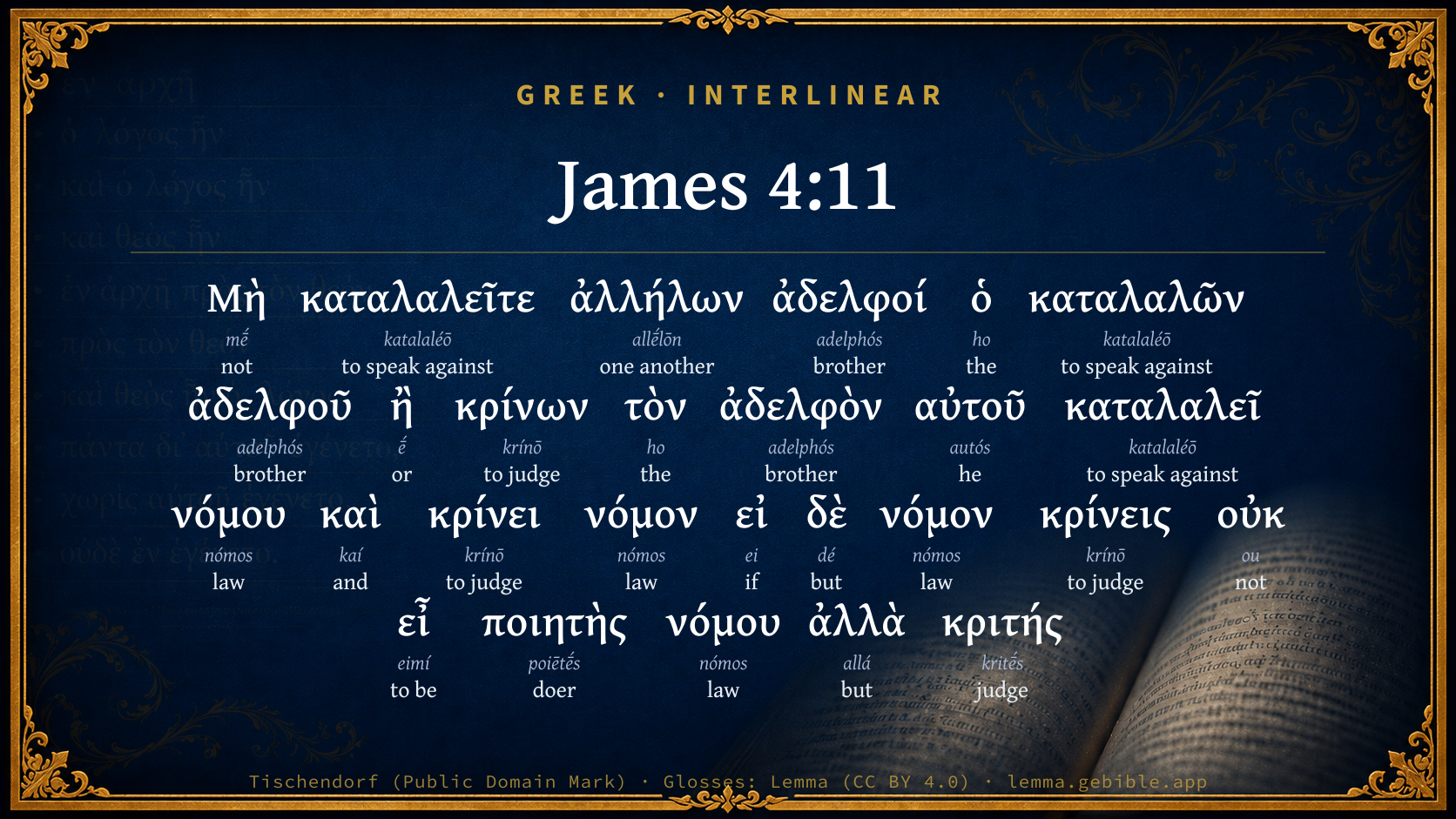
Greek (Tischendorf 8th ed.) James 4:11 appears in the Greek New Testament. The text above is from the Tischendorf 8th edition. Each word links to its Strong’s number and a concise gloss. Click any word for its full Thayer’s Greek Lexicon entry.
Download image
Cite this verse

James 4:11 (World English Bible). Public Domain. Lemma interlinear Bible study tool, https://lemma.gebible.app/v/james/4/11.

Show BibTeX & RIS
BibTeX
RIS
English Translation
Don't speak against one another, brothers. He who speaks against a brother and judges his brother, speaks against the law and judges the law. But if you judge the law, you are not a doer of the law, but a judge.
World English Bible · Public Domain
Highlights
  • 1 first appearance in the Greek New Testament
Full analysis ↓
Download a study sheet

One document with this verse’s original text, its word-by-word gloss line, the meaning frame, cross-references with their text, attributed commentary, and full source and license credits — printable, and it pastes into notes with its structure intact.

This verse Autodidact and up

Study sheet (.html) Plain text (.txt)

A passage Seminary Student

Up to 50 verses in one chapter. A passage sheet keeps up to 6 commentary sources and 12 cross-references per verse, in the order this page ranks them, and says so on the sheet whenever that leaves anything out. Ask for a single verse and you get the Autodidact verse sheet above.

Everything on this page stays free to read, with no account — the sheet is a download of what is already on screen, not access to it.

Want to remove ads? Support Godless Engineer
Compare translations 3

The same verse in 3 English versions, stacked beneath the original-language interlinear above. Click any original word for its lexicon entry.

Each is an independent rendering of the whole verse — the interlinear is not word-aligned to these translations.

Highlighted words mark where these versions differ — a whole-verse word diff, not a word-by-word alignment.

  • World English Bible Public Domain
    Don't speak against one another, brothers. He who speaks against a brother and judges his brother, speaks against the law and judges the law. But if you judge the law, you are not a doer of the law, but a judge.
  • King James Version Public Domain
    Speak not evil one of another, brethren. He that speaketh evil of his brother, and judgeth his brother, speaketh evil of the law, and judgeth the law: but if thou judge the law, thou art not a doer of the law, but a judge.
  • unfoldingWord Literal Text CC BY-SA 4.0
    Do not speak against one another, brothers. The one speaking against a brother or judging his brother speaks against the law and judges the law. But if you judge the law, you are not a doer of the law, but a judge.

unfoldingWord Literal Text — © unfoldingWord, licensed CC BY-SA 4.0. Word-aligned USFM3 via Door43 (git.door43.org/unfoldingWord/en_ult).

Versions to compare (up to 4)

3 of 4 selected

Show all 19 translations

Every available English version of this verse, each an independent rendering of the whole verse.

  • World English Bible Public Domain
    Don't speak against one another, brothers. He who speaks against a brother and judges his brother, speaks against the law and judges the law. But if you judge the law, you are not a doer of the law, but a judge.
  • Berean Standard Bible Public Domain
    Brothers, do not slander one another. Anyone who speaks against his brother or judges him speaks against the law and judges it. And if you judge the law, you are not a practitioner of the law, but a judge of it.
  • Majority Standard Bible Public Domain
    Brothers, do not slander one another. Anyone who speaks against his brother and judges him speaks against the law and judges it. And if you judge the law, you are not a practitioner of the law, but a judge of it.
  • King James Version Public Domain
    Speak not evil one of another, brethren. He that speaketh evil of his brother, and judgeth his brother, speaketh evil of the law, and judgeth the law: but if thou judge the law, thou art not a doer of the law, but a judge.
  • American Standard Version (1901) Public Domain
    Speak not one against another, brethren. He that speaketh against a brother, or judgeth his brother, speaketh against the law, and judgeth the law: but if thou judgest the law, thou art not a doer of the law, but a judge.
  • Revised Version (1885) Public Domain
    Speak not one against another, brethren. He that speaketh against a brother, or judgeth his brother, speaketh against the law, and judgeth the law: but if thou judgest the law, thou art not a doer of the law, but a judge.
  • Geneva Bible (1599) Public Domain
    Speake not euill one of another, brethren. He that speaketh euill of his brother, or he that condemneth his brother, speaketh euill of ye Law, and condemneth the Lawe: and if thou condemnest the Lawe, thou art not an obseruer of the Lawe, but a iudge.
  • Douay-Rheims (1899) Public Domain
    Detract not one another, my brethren. He that detracteth his brother, or he that judgeth his brother, detracteth the law, and judgeth the law. But if thou judge the law, thou art not a doer of the law, but a judge.
  • Young's Literal Translation Public Domain
    Speak not one against another, brethren; he who is speaking against a brother, and is judging his brother, doth speak against law, and doth judge law, and if law thou dost judge, thou art not a doer of law but a judge;
  • Literal Standard Version CC BY-SA 4.0
    Do not speak against one another, brothers; he who is speaking against a brother, and is judging his brother, speaks against law, and judges law, and if you judge law, you are not a doer of law but a judge.
  • Unlocked Literal Bible CC BY-SA 4.0
    Do not speak against one another, brothers. The person who speaks against a brother or judges his brother speaks against the law and judges the law. If you judge the law, you are not a doer of the law, but a judge.
  • unfoldingWord Literal Text CC BY-SA 4.0
    Do not speak against one another, brothers. The one speaking against a brother or judging his brother speaks against the law and judges the law. But if you judge the law, you are not a doer of the law, but a judge.
  • Darby Bible Public Domain
    Speak not against one another, brethren. He that speaks against [his] brother, or judges his brother, speaks against [the] law and judges [the] law. But if thou judgest [the] law, thou art not doer of [the] law, but judge.
  • World Messianic Bible Public Domain
    Don’t speak against one another, brothers. He who speaks against a brother and judges his brother, speaks against the law and judges the law. But if you judge the law, you are not a doer of the law but a judge.
  • Webster's Bible Public Domain
    Speak not evil one of another, brethren. He that speaketh evil of his brother, and judgeth his brother, speaketh evil of the law, and judgeth the law: but if thou judgest the law, thou art not a doer of the law, but a judge.
  • Free Bible Version CC BY-SA 4.0
    Friends, don't speak badly of one another. Anyone who criticizes a fellow-believer and condemns them, criticizes and condemns the law. If you condemn the law you're not someone who keeps the law, because you're sitting in judgment of it.
  • Bible in Basic English Public Domain
    Do not say evil against one another, my brothers. He who says evil against his brother or makes himself his brother's judge, says evil against the law and is judging the law: and in judging the law you become, not a doer of the law but a judge.
  • Text-Critical English NT CC BY 4.0
    Do not speak evil against one another, brothers. He who speaks evil against a brother and judges his brother, speaks evil against the law and judges the law. Now if yoʋ judge the law, yoʋ are not a doer of the law but a judge.
  • Tyndale New Testament (1534) Public Domain
    Backbyte not one another brethren. He that backbyteh hys brother and he that iudgeth his brother backbyteth the lawe and iudgeth the lawe. But and yf thou iudge the lawe thou art not an observer of the lawe: but a iudge.

Literal Standard Version (2020), Covenant Press — licensed CC BY-SA 4.0. Text via the HelloAO Bible API (eBible.org). Unlocked Literal Bible (unfoldingWord) — licensed CC BY-SA 4.0. Text via the HelloAO Bible API (eBible.org). unfoldingWord Literal Text — © unfoldingWord, licensed CC BY-SA 4.0. Word-aligned USFM3 via Door43 (git.door43.org/unfoldingWord/en_ult). Free Bible Version, Dr. Jonathan Gallagher — licensed CC BY-SA 4.0. Text via the HelloAO Bible API (eBible.org).

Word by word

More ways to search: Search by grammar → Find every occurrence → Compare this word →

Practice this passage: Drill this verse → Learn its vocabulary →

καταλαλεῖτε
katalaléō
G2635
“to speak against”
Verb, Present, Active, Imperative, 2nd person, Plural
Part of Speech
Verb
Tense
Present
Voice
Active
Mood
Imperative
Person
2nd person
Number
Plural
Full Thayer's Definition

Origin: from G2637

TDNT: 04:03,5

1. to speak against one, to criminate, traduce
  1. Μὴ mḗ G3361 “not” Particle, Negative
  2. ἀλλήλων allḗlōn G240 “one another” Reciprocal pronoun, Genitive, Plural, Masculine
  3. ἀδελφοί adelphós G80 “brother” Noun, Vocative, Plural, Masculine
  4. ὁ ho G3588 “the” Article, Nominative, Singular, Masculine
  5. καταλαλῶν katalaléō G2635 “to speak against” Verb, Present, Active, Participle, Nominative, Singular, Masculine
  6. ἀδελφοῦ adelphós G80 “brother” Noun, Genitive, Singular, Masculine
  7. ἢ ḗ G2228 “or” Particle
  8. κρίνων krínō G2919 “to judge” Verb, Present, Active, Participle, Nominative, Singular, Masculine
  9. τὸν ho G3588 “the” Article, Accusative, Singular, Masculine
  10. ἀδελφὸν adelphós G80 “brother” Noun, Accusative, Singular, Masculine
  11. αὐτοῦ autós G846 “he” Personal pronoun, Genitive, Singular, Masculine
  12. καταλαλεῖ katalaléō G2635 “to speak against” Verb, Present, Active, Indicative, 3rd person, Singular
  13. νόμου nómos G3551 “law” Noun, Genitive, Singular, Masculine
  14. καὶ kaí G2532 “and” Conjunction
  15. κρίνει krínō G2919 “to judge” Verb, Present, Active, Indicative, 3rd person, Singular
  16. νόμον nómos G3551 “law” Noun, Accusative, Singular, Masculine
  17. εἰ ei G1487 “if” Conditional
  18. δὲ dé G1161 “but” Conjunction
  19. νόμον nómos G3551 “law” Noun, Accusative, Singular, Masculine
  20. κρίνεις krínō G2919 “to judge” Verb, Present, Active, Indicative, 2nd person, Singular
  21. οὐκ ou G3756 “not” Particle, Negative
  22. εἶ eimí G1510 “to be” Verb, Present, Active, Indicative, 2nd person, Singular
  23. ποιητὴς poiētḗs G4163 “doer” Noun, Nominative, Singular, Masculine
  24. νόμου nómos G3551 “law” Noun, Genitive, Singular, Masculine
  25. ἀλλὰ allá G235 “but” Conjunction
  26. κριτής kritḗs G2923 “judge” Noun, Nominative, Singular, Masculine

About this verse

These counts appear in no published source. They are computed here, from the morphology-tagged text and Lemma’s own curated glosses. What Lemma adds →

27
words
17
distinct lemmas
General Epistles
section

Notable vocabulary

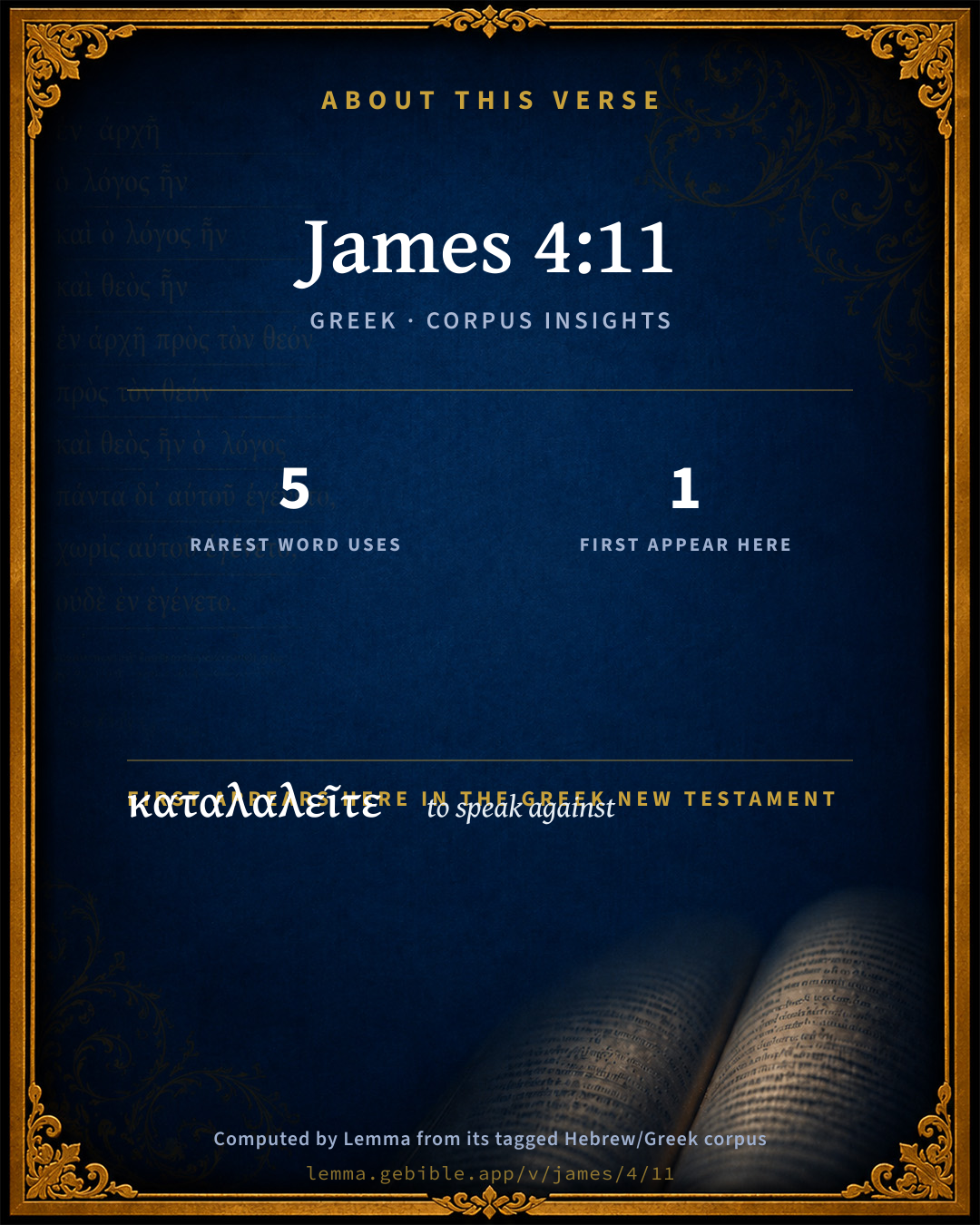
The rarest word here is καταλαλεῖτε to speak against G2635 — appearing just 5 times in the whole Greek New Testament.

First appearance in Scripture

This word makes its first canonical appearance in the Greek New Testament here:

  • καταλαλεῖτε to speak against G2635

Shared distinctive vocabulary

καταλαλεῖτε to speak against G2635 occurs in 3 verses of the Greek New Testament. Also found in:
Repetition

Words recur within this verse:

  • νόμου law G3551 ×4
  • καταλαλεῖτε to speak against G2635 ×3
  • ἀδελφοί brother G80 ×3
  • κρίνων to judge G2919 ×3
  • ὁ the G3588 ×2

Cross-references

19

Topical passages linked to James 4:11 in the Treasury of Scripture Knowledge — connected by theme and wording, ordered by reader-vote popularity; previews shown in the World English Bible.

  • 1 Peter 2:1 Putting away therefore all wickedness, all deceit, hypocrisies, envies, and all evil speaking,
  • Romans 2:1 Therefore you are without excuse, O man, whoever you are who judge. For in that which you judge another, you condemn yourself. For you who judge practice the same things.
  • James 5:9 Don't grumble, brothers, against one another, so that you won't be judged. Behold, the judge stands at the door.
  • Luke 6:37 Don't judge, And you won't be judged. Don't condemn, And you won't be condemned. Set free, And you will be set free.
  • Psalms 140:11 An evil speaker won't be established in the earth. Evil will hunt the violent man to overthrow him.
  • Matthew 7:1–2 "Don't judge, so that you won't be judged.
  • Romans 14:10–12 But you, why do you judge your brother? Or you again, why do you despise your brother? For we will all stand before the judgment seat of Christ.
  • 1 Corinthians 4:5 Therefore judge nothing before the time, until the Lord comes, who will both bring to light the hidden things of darkness, and reveal the counsels of the hearts. Then each man will get his praise from God.
  • Ephesians 4:31 Let all bitterness, wrath, anger, outcry, and slander, be put away from you, with all malice.
  • 2 Corinthians 12:20 For I am afraid that by any means, when I come, I might find you not the way I want to, and that I might be found by you as you don't desire; that by any means there would be strife, jealousy, outbursts of anger, factions, slander, whisperings, proud thoughts, riots;
  • Romans 7:12–13 Therefore the law indeed is holy, and the commandment holy, and righteous, and good.
  • 2 Timothy 3:3 without natural affection, unforgiving, slanderers, without self-control, fierce, no lovers of good,
  • 1 Timothy 3:11 Their wives in the same way must be reverent, not slanderers, temperate, faithful in all things.
  • Romans 2:13 For it isn't the hearers of the law who are righteous before God, but the doers of the law will be justified
  • Romans 7:7 What shall we say then? Is the law sin? May it never be! However, I wouldn't have known sin, except through the law. For I wouldn't have known coveting, unless the law had said, "You shall not covet."
  • Romans 14:3–4 Don't let him who eats despise him who doesn't eat. Don't let him who doesn't eat judge him who eats, for God has received him.
  • Titus 2:3 and that older women likewise be reverent in behavior, not slanderers nor enslaved to much wine, teachers of that which is good;
  • James 1:22–23 But be doers of the word, and not only hearers, deluding your own selves.
  • James 1:25 But he who looks into the perfect law, the law of freedom, and continues, not being a hearer who forgets but a doer of the work, this man will be blessed in what he does.

Cross-references courtesy of OpenBible.info (CC BY 4.0).

Commentary

Notes on James 4:11 from classic Christian and Jewish commentators (each source and its license shown beneath its notes). The classic Christian expositions comment on the surrounding passage and are grouped to its opening verse, so a note may address several verses; the Jewish commentaries on the Tanakh (Rashi and others) are per-verse, so they appear only where the commentator wrote on this verse.

Lemma curates 59 commentaries, every one of them public domain or Creative Commons licensed, each selected and text-cleaned for this edition rather than reprinted as found. About our sources →

Matthew Henry's Commentary

In this part of the chapter,

I. We are cautioned against the sin of evil-speaking: Speak not evil one of another, brethren, Jam 4:11. The Greek word, katalaleite, signifies speaking any thing that may hurt or injure another; we must not speak evil things of others, though they be true, unless we be called to it, and there be some necessary occasion for the; much less must we report evil things when they are false, or, for aught we know, may be so. Our lips must be guided by the law of kindness, as well as truth and justice. This, which Solomon makes a necessary part of the character of his virtuous woman, that she openeth her mouth with wisdom, and in her tongue is the law of kindness (Pro 31:26), must needs be a part of the character of every true Christian. Speak not evil one of another, 1. Because you are brethren. The compellation, as used by the apostle here, carries an argument along with it. Since Christians are brethren, they should not defile nor defame one another. It is required of us that we be tender of the good name of our brethren; where we cannot speak well, we had better say nothing than speak evil; we must not take pleasure in making known the faults of others, divulging things that are secret, merely to expose them, nor in making more of their known faults than really they deserve, and, least of all, in making false stories, and spreading things concerning them of which they are altogether innocent. What is this but to raise the hatred and encourage the persecutions of the world, against those who are engaged in the same interests with ourselves, and therefore with whom we ourselves must stand or fall? "Consider, you are brethren." 2. Because this is to judge the law: He that speaketh evil of his brother, and judgeth his brother, speaketh evil of the law, and judgeth the law. The law of Moses says, Thou shalt not go up and down as a tale-bearer among thy people, Lev 19:16. The law of Christ is, Judge not, that you be not judged, Mat 7:1. The sum and substance of both is that men should love one another. A detracting tongue therefore condemns the law of God, and the commandment of Christ, when it is defaming its neighbour. To break God's commandments is in effect to speak evil of them, and to judge them, as if they were too strict, and laid too great a restraint upon us. The Christians to whom James wrote were apt to speak very hard things of one another, because of their differences about indifferent things (such as the observance of meats and days, as appears from Rom. 14): "Now," says the apostle, "he who censures and condemns his brother for not agreeing with him in those things which the law of God has left indifferent thereby censures and condemns the law, as if it had done ill in leaving them indifferent. He who quarrels with his brother, and condemns him for the sake of any thing not determined in the word of God, does thereby reflect on that word of God, as if it were not a perfect rule. Let us take heed of judging the law, for the law of the Lord is perfect; if men break the law, leave that to judge them; if they do not break it, let us not judge them." This is a heinous evil, because it is to forget our place, that we ought to be doers of the law, and it is to set up ourselves above it, as if we were to be judges of it. He who is guilty of the sin here cautioned against is not a doer of the law, but a judge; he assumes an office and a place that do not belong to him, and he will be sure to suffer for his presumption in the end. Those who are most ready to set up for judges of the law generally fail most in their obedience to it. 3. Because God, the Lawgiver, has reserved the power of passing the final sentence on men wholly to himself: There is one Lawgiver, who is able to save, and to destroy: who art thou that judgest another? Jam 4:12. Princes and states are not excluded, by what is here said, from making laws; nor are subjects at all encouraged to disobey human laws; but God is still to be acknowledged as the supreme Lawgiver, who only can give law to the conscience, and who alone is to be absolutely obeyed. His right to enact laws is incontestable, because he has such a power to enforce them. He is able to save, and to destroy, so as no other can. He has power fully to reward the observance of his laws, and to punish all disobedience; he can save the soul, and make it happy for ever, or he can, after he has killed, cast into hell; and therefore should be feared and obeyed as the great Lawgiver, and all judgment should be committed to him. Since there is one Lawgiver, we may infer that it is not for any man or company of men in the world to pretend to give laws immediately to bind conscience; for that is God's prerogative, which must not be invaded. As the apostle had before warned against being many masters, so here he cautions against being many judges. Let us not prescribe to our brethren, let us not censure and condemn them; it is sufficient that we have the law of God, which is a rule to us all; and therefore we should not set up other rules. Let us not presume to set up our own particular notions and opinions as a rule to all about us; for there is one Lawgiver.

II. We are cautioned against a presumptuous confidence of the continuance of our lives, and against forming projects thereupon with assurance of success, Jam 4:13, Jam 4:14. The apostle, having reproved those who were judges and condemners of the law, now reproves such as were disregardful of Providence: Go to now, and old way of speaking, designed to engage attention; the Greek word may be rendered, Behold now, or "See, and consider, you that say, Today or tomorrow we will go into such a city, and continue there a year, and buy and sell, and get gain. Reflect a little on this way of thinking and talking; call yourselves to account for it." Serious reflection on our words and ways would show us many evils that we are apt, through inadvertency, to run into and continue in. There were some who said of old, as too many say still, We will go to such a city, and do this or that, for such a term of time, while all serious regards to the disposals of Providence were neglected. Observe here, 1. How apt worldly and projecting men are to leave God out of their schemes. Where any are set upon earthly things, these have a strange power of engrossing the thoughts of the heart. WE should therefore have a care of growing intent or eager in our pursuits after any thing here below. 2. How much of worldly happiness lies in the promises men make to themselves beforehand. Their heads are full of fine visions, as to what they shall do, and be, and enjoy, in some future time, when they can neither be sure of time nor of any of the advantages they promise themselves; therefore observe, 3. How vain a thing it is to look for any thing good in futurity, without the concurrence of Providence. We will go to such a city (say they), perhaps to Antioch, or Damascus, or Alexandria, which were then the great places for traffic; but how could they be sure, when they set out, that they should reach any of these cities? Something might possibly stop their way, or call them elsewhere, or cut the thread of life. Many who have set out on a journey have gone to their long home, and never reached their journey's end. But, suppose they should reach the city they designed, how did they know they should continue there? Something might happen to send them back, or to call them thence, and to shorten their stay. Or suppose they should stay the full time they proposed, yet they could not be certain that they should buy and sell there; perhaps they might lie sick there, or they might not meet with those to trade with them that they expected. Yea, suppose they should go to that city, and continue there a year, and should buy and sell, yet they might not get gain; getting of gain in this world is at best but an uncertain thing, and they might probably make more losing bargains than gainful ones. And then, as to all these particulars, the frailty, shortness, and uncertainty of life, ought to check the vanity and presumptuous confidence of such projectors for futurity: What is your life? It is even a vapour that appeareth for a little time, and then vanisheth away, Jam 4:14. God that wisely left us in the dark concerning future events, and even concerning the duration of life itself. We know not what shall be on the morrow; we may know what we intend to do and to be, but a thousand things may happen to prevent us. We are not sure of life itself, since it is but as a vapour, something in appearance, but nothing solid nor certain, easily scattered and gone. We can fix the hour and minute of the sun's rising and setting tomorrow, but we cannot fix the certain time of a vapour's being scattered; such is our life: it appears but for a little time, and then vanisheth away; it vanisheth as to this world, but there is a life that will continue in the other world; and, since this life is so uncertain, it concerns us all to prepare and lay up in store for that to come.

III. We are taught to keep up a constant sense of our dependence on the will of God for life, and all the actions and enjoyments of it: You ought to say, If the Lord will, we shall live, and do this, or that, Jam 4:15. The apostle, having reproved them for what was amiss, now directs them how to be and do better: "You ought to say it in your hearts at all times, and with your tongues upon proper occasions, especially in your constant prayers and devotions, that if the Lord will give leave, and if he will own and bless you, you have such and such designs to accomplish." This must be said, not in a slight, formal, and customary way, but so as to think what we say, and so as to be reverent and serious in what we say. It is good to express ourselves thus when we have to do with others, but it is indispensably requisite that we should say this to ourselves in all that we go about. Sun Theō - with the leave and blessing of God, was used by the Greeks in the beginning of every undertaking. 1. If the Lord will, we shall live. We must remember that our times are not in our own hands, but at the disposal of God; we live as long as God appoints, and in the circumstances God appoints, and therefore must be submissive to him, even as to life itself; and then, 2. If the Lord will, we shall do this or that. All our actions and designs are under the control of Heaven. Our heads may be filled with cares and contrivances. This and the other thing we may propose to do for ourselves, or our families, or our friends; but Providence sometimes breaks all our measures, and throws our schemes into confusion. Therefore both our counsels for action and our conduct in action should be entirely referred to God; all we design and all we do should be with a submissive dependence on God.

IV. We are directed to avoid vain boasting, and to look upon it not only as a weak, but a very evil thing. You rejoice in your boastings; all such rejoicing is evil, Jam 4:16. They promised themselves life and prosperity, and great things in the world, without any just regard to God; and then they boasted of these things. Such is the joy of worldly people, to boast of all their successes, yea, often to boast of their very projects before they know what success they shall have. How common is it for men to boast of things which they have no other title to than what arises from their own vanity and presumption! Such rejoicing (says the apostle) is evil; it is foolish and it is hurtful. For men to boast of worldly things, and of their aspiring projects, when they should be attending to the humbling duties before laid down (in Jam 4:8-10), is a very evil thing. It is a great sin in God's account, it will bring great disappointment upon themselves, and it will prove their destruction in the end. If we rejoice in God that our times are in his hand, that all events are at his disposal, and that he is our God in covenant, this rejoicing is good; the wisdom, power, and providence of God, are then concerned to make all things work together for our good: but, if we rejoice in our own vain confidences and presumptuous boasts, this is evil; it is an evil carefully to be avoided by all wise and good men.

V. We are taught, in the whole of our conduct, to act up to our own convictions, and, whether we have to do with God or men, to see that we never go contrary to our own knowledge (Jam 4:17): To him that knoweth to do good, and doeth it not, to him it is sin; it is aggravated sin; it is sinning with a witness; and it is to have the worst witness against his own conscience. Observe, 1. This stands immediately connected with the plain lesson of saying, If the Lord will, we shall do this or that; they might be ready to say, "This is a very obvious thing; who knows not that we all depend upon almighty God for life, and breath, and all things?" Remember then, if you do know this, whenever you act unsuitably to such a dependence, that to him that knows to do good, and does it not, to him it is sin, the greater sin. 2. Omissions are sins which will come into judgment, as well as commissions. He that does not the good he knows should be done, as well as he who does the evil he knows should not be done, will be condemned. Let us therefore take care that conscience be rightly informed, and then that it be faithfully and constantly obeyed; for, if our own hearts condemn us not, then have we confidence towards God; but if we say, We see, and do not act suitably to our sight, then our sin remaineth, Joh 9:41.

Matthew Henry's Commentary on the Whole Bible (1708–1710) — public domain (CC PDM 1.0). Text via the HelloAO Bible API.

The Biblical Illustrator

Joseph S. Exell

Jam_4:11-12

Speak not evil one of another

Evil speaking

1.

Wilful false accusation. This may be held as the very worst form of it. It involves two evils--one of heart and one of conduct--malice and falsehood.

2. The exaggeration of faults that are real. Few things are more common than this. It springs from the same odious principle of malice.

3. The needless repetition of real faults. The principle of this is still the same.

4. The whispering of slander, with the simulation of regret. Oh, there is nothing so nauseous as this. The whisperer must first be sure that doors are all close, and no one within hearing. He is so sorry to have anything to say such as he is about to disclose: begs it may be held confidential, and go no further, while he himself carries it further, the very next person he meets.

5. There is often in the representations given a colouring--in which there is no direct falsehood, but such an artful leaving out of one circumstance, and qualifying another, and giving prominence to a third, as to amount to a thorough misrepresentation of the sentiments or the actions reported, and to convey quite a different impression of them from the reality. Just as two painters may produce two pictures, each containing the very same objects, which shall yet, by the different arrangement of these objects, in foreground and background positions, and various lights and shades, be so thoroughly different, that the sameness of the objects contained in them shall never be observed.

6. Lastly, as connecting the subject with what immediately follows, harsh uncharitable judging of the conduct of others: He that speaketh evil of his brother, and judgeth his brother. What means this judging? We may first reply, negatively, that it does not mean our simply forming an opinion of the conduct of others by the standard of Gods law. This we cannot but do.

(1) But first: we must not judge beyond the law, pronouncing sentence on our brother in matters which the Divine law does not embrace in its prohibitions or its requirements; in matters which it leaves indifferent. When we do this we are presumptuous. We go quite out of our province.

(2) Then, secondly: we must not judge without sufficient evidence. We must not pronounce our sentences on suspicion, or surmise, or vague and unexamined rumour.

(3) Further, we ought not to judge with undue severity, giving sentence with a rigour beyond the real desert of the offence; excluding from our judgment all alleviating circumstances.

(4) We must not judge motives, the secret principles of action. These are beyond the range of our cognisance. The general interdiction of evil-speaking and judging is here enforced by a special consideration--He that speaketh evil of his brother, and judgeth his brother, speaketh evil of the law, and judgeth the law.

How is this?

1. The law itself prohibits such evil-speaking and judging. If, then, in despite and defiance of such intimations of Gods will, we persist in speaking evil of our brother, and judging our brother, we are, in the very fact, speaking evil of the law and judging the law. We are speaking evil of it, as an over-stringent law, laying an interdict on what we see no harm in indulging. We judge it as being too severe and rigid in its judgments. In doing what it condemns, we condemn it.

2. When, on the other hand, we go beyond the law--judging our brother in matters which the law has left open--matters in which neither doing nor refraining to do is any violation of law; as in the case of meats and drinks and days--we then speak evil of the law, and judge the law on a ground the very opposite of the former. We condemn it as not being sufficiently stringent; as leaving things indifferent, which ought not to be so left.

3. The remarks apply, in their full force, to the great general law of love. To that law the apostle had before adverted--If ye fulfil the royal law according to the Scripture, Thou shalt love thy neighbour as thyself, ye do well. Of this law the practical counterpart, in the terms of our Divine Master Himself, is--Therefore, whatsoever ye would that men should do to you, do ye even so to them for this is the law and the prophets. Now it is plain that to the spirit and the letter of this law all evil-speaking and all such judging as has been described is utterly opposed. When, therefore, we indulge in such evil speaking, we condemn, as laying too stringent a restraint upon us, even this Divinely excellent and self-recommending law, in which the elements of equity and love are so admirably combined. We in effect judge and censure this law, as laying unbearably stern restrictions upon the evil propensities of our nature. (R. Wardlaw, D. D.)

Judging our brethren

I. WHAT IS HERE FORBIDDEN. It is speaking evil of, and judging our brethren. It is bringing charges against, and passing sentences on, our fellow-men, and especially our fellow-Christians, for they are the brethren here referred to by the apostle. It is depreciating and denouncing them--their actions, motives, designs, characters.

1. As to speaking. Speak not evil one of another, that is, from a spirit of enmity or envy, from the lusts warring in the members, do it not except under necessity, with some such sanction as we have referred to; in which case it is but uttering the truth, bearing a faithful testimony, not speaking evil in the ordinary and bad sense of that expression.

2. As to judging. We are repeatedly warned against such judging Mat_7:1-2; Rom_14:3-4; 1Co_4:5). We must often pronounce on conduct, and the Scripture has laid down the rule according to which we are to decide. When it is applied, certain inferences as to character and state are legitimate, inevitable. But here we are to proceed with the greatest caution. Are the actions such as they are represented, or appear to us as being? Are we not regarding them with prejudiced minds, with jaundiced eyes, under some perverting or obscuring influence? Are we not mistaken? do we know all the circumstances? Then, though they may be wrong, are they not partially explained by the peculiar position, temperament, and temptations of the parties? Can they not be accounted for without supposing a radical want of sound principle, of Christian spirit? Then let us never forget our own feeble powers and narrow views, our tendency to limit the range of Christian faith and practice; to make a great deal of some elements, and little or nothing of others, which yet may be as prominent, or even more so, in Scriptural representation and requirement. Let us also remember that there is a region which we cannot enter, and where much may be concealed of which we can take no cognisance--a region where all the springs of action, the principles of conduct lie, that of motive. We are not to ascend the throne, we are not to usurp the Divine prerogative of judgment.

II. WHY IT IS FORBIDDEN.

1. Because it involves a condemnation of the Divine law. The law here is the moral law as animated, unfolded, regulated by the gospel. Now, speaking evil of a brother is speaking evil of the law, for the brother may be all the while keeping it, and the conduct condemned may be exactly that which it demands, dictates. When the charges made are false--as in such cases they so often are--when the dispositions or actions found fault with are not wrong but right, when they are prompted and regulated by the very law itself, then abuse of the one is abuse of the other.

2. Because it amounts to a usurpation of the office of the only Lawgiver. One acting thus does not apply it to himself, and regulate by it his own speech and behaviour. He withdraws from its control, he goes directly and flagrantly in opposition to its authority; for it forbids and condemns this way of dealing with our brother. (John Adam.)

Detraction

1. A detractor is wont to represent persons and actions under the most disadvantageous circumstances he can, setting out those which may cause them to appear odious or despicable, slipping over those which may commend or excuse them.

2. He is wont to misconstrue ambiguous words, or to misinterpret doubtful appearances of things.

3. He is wont to misname the qualities of persons or things, assigning bad appellations or epithets to good or indifferent qualities.

4. He doth imperfectly characterise persons, so as studiously to veil or faintly to disclose their virtues and good qualities, but carefully to expose, and fully to aggravate or amplify any defects or failings in them.

5. He is wont not to commend or allow anything absolutely and clearly, but always interposing some exception to which he would have it seem liable.

6. He is ready to suggest ill causes and principles, latent in the heart, of practices apparently good; ascribing what is well done to bad disposition, or bad purpose.

7. He derogateth from good actions by pretending to correct them, or to show better that might have been done in their room: it is, said he, done in some respects well, or tolerably; but it might have been done better, with as small trouble and cost: lie was overseen in choosing this way, or proceeding in this manner.

8. A detractor not regarding the general course and constant tenor of a mans conversation, which is conspicuously and clearly good, will attack some part of it, the goodness whereof is less discernible, or more subject to contest and blame.

9. The detractor injecteth suggestions of everything anywise plausible or possible, that can serve to diminish the worth of a person, or value of an action, which he would discountenance.

I. THE CAUSES OF DETRACTION.

1. Ill nature and bad humour: as good nature and ingenuous disposition incline men to observe, like, and command what appeareth best in our neighbour; so malignity of temper and heart prompteth to espy and catch at the worst.

2. Pride, ambition, and inordinate self-love.

3. Envy.

4. Malicious revenge and spite.

5. Sense of weakness, want of courage, or despondency of his own ability.

6. Evil conscience.

7. Bad, selfish design.

II. IT DOTH INVOLVE THESE KINDS OF IRREGULARITY AND DEPRAVITY.

1. Injustice: a detractor careth not how he dealeth with his neighbour, what wrong he doeth him.

2. Uncharitableness: it is evident that the detractor doth net love his neighbour, for charity maketh the best of everything; charity believeth everything, hopeth everything to the advantage of its object.

3. Impiety: he that loveth and reverenceth God will acknowledge and approve His goodness, in bestowing excellent gifts and graces to his brethren.

4. Detraction involveth degenerous baseness, meanness of spirit, and want of good manners.

5. In consequence to these things, detraction includeth folly; for every unjust, every uncharitable, every impious, every base person is, as such, a fool; none of those qualities are consistent with wisdom.

III. THE FOLLY OF it will particularly appear, together with its depravity, by THE BAD AND HURTFUL EFFECTS which it produceth, both in regard to others and to him that practiseth it.

1. The practice thereof is a great discouragement and obstruction to the common practice of goodness; for many, seeing the best men thus disparaged, and the best actions vilified, are disheartened and deterred from practising virtue, especially in a conspicuous and eminent degree.

2. Hence detraction is very noxious and baneful to all society; for all society is maintained in welfare by encouragement of honesty and industry.

3. Detraction worketh real damage and mischief to our neighbour.

4. The detractor abuseth those into whose ears he instilleth his poisonous suggestions, engaging them to partake in the injuries done to worth and virtue, causing them to entertain unjust and uncharitable conceits, to practise unseemly and unworthy behaviour toward good men.

5. The detractor produceth great inconveniences and mischiefs to himself. He raiseth against himself fierce animosity--hence are they stirred to boil with passion, and to discharge revenge on the detractor.

6. The detractor yieldeth occasion to others, and a kind of right to return the same measure on him.

7. Again the detractor, esteeming things according to moral possibility, will assuredly be defeated in his aims; his detraction in the close will avail nothing, but to bring trouble and shame on himself; for God hath a particular care over innocence and goodness, so as not to let them finally to suffer. (I. Barrow, D. D.)

Evil-speaking

The original of this evil is from Satan, and the pedigree of evil speech is to be derived from the devil, the great dragon, the old serpent. This is he that begetteth all slanderous persons; he it is who raiseth these motions in our hearts, and bloweth the fame of these affections in the minds of the wicked. This is that poison of Apis, the venomous serpent which lurketh under the lips of the reproachful slanderer. These wound and slay at hand, and far off, at home and abroad, the quick and the dead; these spare neither prince nor people, neither priest nor prelate, neither friend or foe, rich nor poor, base nor honourable, man nor woman, one nor other, these destroy whole houses and families. Now the common causes for which men speak evil of one another are chiefly these five:

1. Men slander and speak evil of--thereby to be revenged of--such as either have done them hurt, or else are thought to have done them injury. Thus men and women, not able with violence to make their part a good, use their slanderous tongues as instruments and weapons of their revenge.

2. As desire to be avenged pricketh men forward to this mischief, so also desire of gain moveth men thereunto, for we see sometimes that the bringing of others by slander into contempt may breed our commodity wherewith all we moved, give over our tongues as weapons and instruments of slander.

3. Neither for these causes only do we speak evil of our brethren, but also stirred up by envy; for the graces and benefits of God poured in plentiful manner upon our neighbours, whereat we being moved through envy, we speak evil of them as unworthy of those graces and benefits received.

4. And as for these causes men are moved to slander, so through desire that men have to please others they give themselves to slander. Now it is the nature of many men to delight in hearing others slandered, whose humour flatterers following do therefore often slander their brethren.

5. Finally, and that which properly concerneth this place, our evil speaking proceedeth of pride, and therefore as a mischief and effect of pride it is here condemned. For as the ape and raven think their own young ones fairest and best favoured, yet is there not a more deformed thing almost among beasts than the ape, neither a fouler among the birds than the young raven; so men like their own doings, be they never so bad, and condemn all others in comparison of themselves.

This mischief is manifold, and sundry ways are men said to speak evil one of another.

1. When men misreport of us, and charge us with that which is not true, then speak they evil of us.

2. Neither thus only speak men evil one of another, but also when they amplify, exaggerate, aggravate, and make the infirmities and faults of men far greater by their reports than indeed they be, to make them odious in the sight of men; as when our neighbor is something choleric and hasty to report him to be so mad, furious and headstrong, that norm can abide it.

3. Besides this, men speak evil of their brethren when they blaze abroad the secret sins and infirmities of their brethren--when they should have covered them in love--only to discredit and defame the offenders.

4. Again, men sin by speaking evil of their brethren when they deprave the good deeds and well-doings of them, when they extenuate and make less than indeed they be.

5. Not thus only, but also when men excel in learning, be singular for virtue, renowned for faith, or any such gift and grace of Gods Spirit. To diminish and extenuate these things and make them, by our envious reports, far less than indeed they are; what is this then but evil speech here condemned? Wherefore as to exaggerate and amplify the vices so to extenuate the virtues and good gifts in the saints is and to be accounted a kind of slander and evil speech also.

6. Moreover, men speak evil, though they speak that which is true, touching the sins and infirmities of their brethren, when they speak those things, not for love of the truth, but for the slandering of the person which hath offended.

7. Finally, this evil is committed when in the pride of our hearts we would have all men live according to our pleasures and wills, which, when they do not, we arrogantly condemn them, we slanderously report of them, we maliciously censure them, we rashly judge them.

And this evil he dissuadeth by four reasons.

1. From the violating Gods law, which is broken and violated of us when in the pride of our minds we condemn and speak evil of our brethren. How doth the law sustain injury in thus injuring of our brethren! How is it violated, how is it evil spoken of and condemned when our brethren are evil spoken of and condemned by us! Gods law teacheth us not to condemn nor to speak evil of the brethren. When, notwithstanding this law, we do and will speak evil and condemn our brethren then we speak evil of the law and condemn it in effect. Because we will not be bridled thereby. Now, whoso speaketh evil of and condemneth any law, speaketh evil of and condemneth him whose law it is; proud and wicked men then speaking evil of the law of God, and condemning it, speak thereby evil of God and condemn Him by whose finger this law was written. And thus blasphemously speak we evil of God and presumptuously also prefer we our wits and wills before Gods, and as wiser than God, we in all impiety condemn Him of folly. And to find fault with the wisdom of God, and to speak evil of His eternal Spirit and the unsearchable counsels of His heart, to take upon us to control and correct His laws, statutes and ordinances, what intolerable impiety, what desperate iniquity, what singular ungodliness were it!

2. A second reason why we should not speak evil of, or condemn the brethren, is drawn from the duty of the saints, it is the duty of Gods children to do the law, not to judge or condemn it. We may not speak evil of the brethren, because in so doing we are not doers of the law which duty requireth, but judges, which becometh not the saints.

3. A third reason why men may not proudly condemn and arrogantly judge their brethren is drawn from the usurping of the office of God and of Christ.

4. The fourth reason why we should not speak evil, or rashly condemn our brethren, is from the frailty of our own common state and condition. There is no better bridle to the heady and hasty judging of other men than to be plucked back by the reins and bit of our own frailty, and view of our own infirmities, which thing greatly abateth our pride, assuageth our hatred, cooleth our courage, and tempereth the hastiness of our judgments against our brethren. When the peacock beholdeth his tail, beset with such varieties of beautiful colours, then he swelleth in pride, contemning and condemning all other birds in comparison of himself; but when he looseth upon his black feet and vieweth the deformity thereof, his comb is something cut and his courage abated. So when we lift up our eyes to the graces and gifts which God bestowed upon us, then we wax proud and insolent; but when we cast our eyes down upon the manifold infirmities whereunto we are subject, then is our pride abated and our insolency of spirit diminished, and we made more moderate and temperate in judging of our Christian brethren. (R. Turnbull.)

Evil speaking

I. Is WHAT WAYS THIS EVIL MAY BE COMMITTED.

II. SOME OF THE DETESTABLE QUALITIES AND BAD CONSEQUENCES WHICH ATTEND THIS PRACTICE.

1. It spends much precious time in a very unprofitable and sinful manner.

2. It is a practice which leads people to form false judgments of one another, and is apt to expose those who do so to danger or contempt.

3. This practice necessarily causes the worthy or the innocent to suffer.

4. It is a practice which, in all its parts, tends to sow enmity among men.

5. It is a practice which causes much uneasiness to those who engage in it.

6. It is often the cause of the greatest cruelty and injustice to innocent persons.

7. This practice is one of the most mean and disgraceful possible. (The Christian Magazine.)

Evil speaking

I. AS TO ITS ORIGIN. Calumny, like every other evil that embitters the happiness or tarnishes the present good name of mankind, may finally be traced to the original corruption of human nature and to the want of that abiding principle of true religion which alone can ensure the mastery over every evil propensity and fit all, individually, to comport themselves aright in the ever-varying and multifarious relations of social life. Of the secondary and more immediate causes, however, of this baneful and prevailing vice, idleness, envy, revenge, malice, and spiritual pride may perhaps, without much uncharitableness in the supposition, be naturally assigned as the chief and most common sources from whence it flows. It has often been said that when the devil finds a man idle he generally sets him to work; for as the mired of man is essentially active, and cannot long bear the languor and irksomeness of mere idleness, so when he is not habitually employed in the acquisition of learning and knowledge, the pursuits of science, the cultivation of the fine arts, or engaged in one or other of the more common yet not less useful occupations of humble life, he will most likely soon become busied in pursuits of an opposite kind! And hence mere idleness is not only a useless, but even a highly dangerous state of existence--an inlet to every evil which can either disgrace or embitter the life of man; and to none does it afford a more ready and direct access than to that of calumny. But to a habit of idleness may be mentioned also envy as not an unfrequent cause of evil speaking among mankind. Fallen perhaps, through habits of idleness and dissipation, from that rank in society which greater prudence and exertion might have enabled him to maintain, or, finding himself outstripped in the journey of life by those who were but his equals or even inferiors in the outset, and whom, but for his own misguided conduct, he might still have equalled or surpassed, the man in whose bosom is fanned the spark of envy sickens at the sight of that prosperity which he cannot reach vilifies as crooked and suspicious that line of conduct by which it has been obtained; affects to undervalue that happiness which worldly success seems to confer; ascribes to penuriousness of disposition or to an unaccountable flow of good luck whatever a more amiable or generous mind would naturally be disposed to set down to the credit of commendable economy united to a system of virtuous and undeviating industry. But, farther, revenge also not unfrequently prompts men to the indulgence of evil speaking. Few modes of attack seem to unite so completely safety to the assailant and injury to the person assailed as that which is presented through the medium of calumny; and hence it is so frequently adopted by the cold-blooded, cowardly, malicious, and revengeful! No matter how innocent and unoffending, how distinguished and exemplary, may be the object of their hatred, to have incurred their displeasure, however unwittingly, is cause sufficient for Jetting loose all the envenomed shafts of slander! But yet farther. There are some who appear to indulge in a habit of evil speaking for whose conduct no possible reason can be assigned but the innate malice of their hearts or the secret desire of mischief. Such are those who, without any personal provocation or the least shadow of excuse, wantonly attack without discrimination the characters of all around them. Human only in appearance, they are in heart and dispositions but demons in disguise. But yet farther again. The only remaining topic, to which we here claim your attention, as one of the many sources from which a habit of evil speaking may sometimes proceed, is that of spiritual pride. Nothing has a stronger tendency to render a man arrogant and contemptuous in his conduct towards others than a false idea of his own superior attainments in knowledge and in religion; while, at the same time, not a surer evidence can well be given of the presence of ignorance and of the want of the true spirit of the gospel.

II. And hence we would remind you that calumny or evil speaking Is A MEAN AND COWARDLY VICE. If you would blush to have yoUr names associated with the thief and the robber, can you for a moment think it less mean or less criminal to assassinate the character of your neighbour, which to every good man is dearer than life? To filch from him that which constitutes his most valued possession, which, to many, is all they have whereon to depend for the support of themselves and family, and to all is absolutely necessary to the true enjoyment of the good things of this life with which Providence may have blessed their condition? But we would have you to recollect, farther, that evil speaking is not only mean and cowardly in the extreme, but is also characterised by the blackest injustice. Is it justice, though he may in some instances have failed in duty towards us, to represent him as deficient in all, to go about privily slandering him in his absence, fabricating stories to his hurt, without once, perhaps, having acquainted him with the cause of our displeasure; to condemn him, in short, without a hearing in his defence, and for that, too, of which perhaps the cause lies chiefly with ourselves?

III. Let us now ADDUCE A FEW CONSIDERATIONS WHICH NATURALLY, AS WELL AS POWERFULLY, OUGHT TO LEAD ALL MEN TO GUARD AGAINST OR TO FORSAKE A HABIT SO ODIOUS AND UNCHRISTIAN. And these are chiefly suggested to us by the concluding word of our text, namely, that we are brethren.

1. We are brethren by creation. To indulge, therefore, in calumny and malignant sarcasm against our fellow creatures is a gross and unnatural perversion of all those exalted faculties by which our race has been distinguished--a habit which at once degrades us beneath the rank of the lower animals, and insults the wisdom and majesty of God the Creator, by thus vilifying the noblest of His works.

2. We are brethren in the original corruption of our nature.

3. We are brethren by one common faith in Christ Jesus. Therefore, if we are really Christians, one temper, one spirit of peace, must pervade the whole. Seeing also that we look for the coming of Christ and the glorious fulfilment of His promises, let us therefore fear lest a promise being left us of entering into His rest, any of us should seem to come short of it through lack of brotherly love. (Chas. Hope.)

On evil speaking

I. THE EXTENT OF THIS PRECEPT.

1. This precept does not extend so far as to hinder us from telling another man his faults with a view to his amendment.

2. It is no crime to descant upon the faults of our neighbour which are public and notorious; for where can be the harm for any man to talk of what every one knows?

3. Though nothing can justify ill-grounded uncharitable opinions, yet in cases where we have sufficient information a wide difference is to be made between what we say in a mixed company and what we disclose to a particular friend, who is virtually under a covenant with us not to betray our private conversation.

4. Nor do we act contrary to this precept when we are called upon by lawful authority to speak what we know against a criminal.

5. We are so far from acting against the precept of my text, that it is an act of charity as well as justice to strip the wolf of his sheeps clothing, which he has put on to make a prey of the innocent and unsuspecting.

6. Though it is our duty not to speak ill of any man, without some of the above reasons, yet it does not follow that we ought to speak well of everybody promiscuously and in general, because we ought to make a distinction where there is a difference.

II. THE CAUSES OF EVIL SPEAKING,

1. An affectation of wit.

2. Hastiness or precipitancy in judging before we know the whole of the case.

3. Malice.

4. Envy.

5. Little personal animosities.

6. An ill life in general. Those who know a great deal of ill of themselves are apt to suspect ill of everybody else.

7. Talkativeness.

III. THE UNREASONABLENESS OF EVIL SPEAKING, (J. Seed, M. A.)

The love of censuring others

Speak not against one another, brethren. The context shows what kind of adverse speaking is meant. It is not so much abusive or calumnious language that is condemned as the love of finding fault. The censorious temper is utterly unchristian. It means that we have been paying aa amount of attention to the conduct of others which would have been better bestowed upon our own. It means also that we have been paying this attention, not in order to help, but in order to criticise, and criticise unfavourably. Bat over and above all this, censoriousness is an invasion of the Divine prerogatives. He that speaketh against a brother, or judgeth a brother, speaketh against the law and judgeth the law. St. James is probably not referring to Christs command in the Sermon on the Mount--Judge not, that ye be not judged. For with what judgment ye judge, ye shall be judged (Mat_7:1-2). It is a law of far wider scope that is in his mind, the same as that of which he has already spoken, the perfect law, the law of liberty (Jam_1:25); the royal law according to the Scriptures, Thou shalt love thy neighbour as thyself (Jam_2:8). No one who knows this law, and has at all grasped its meaning and scope, can suppose that observance of it is compatible with habitual criticism of the conduct of others and frequent utterance of unfavourable judgments respecting them. No man, however willing he may be to have his conduct laid open to criticism, is fond of being constantly subjected to it. Still less can any one be fond of being made the object of slighting and condemnatory remarks. Every mans personal experience has taught him that; and if he loves his neighbour as himself, he will take care to inflict on him as little pain of this kind as possible. In judging and condemning his brother he is judging and condemning the law; and he who condemns a law assumes that he is in possession of some higher principle by which he tests it and finds it wanting. What is the higher principle by which the censorious person justifies his contempt for the law of love? He has nothing to show us but his own arrogance and self-confidence. This proneness to judge and condemn others is further proof of that want of humility about which so much was said in the previous section. Pride, the most subtle of sins, has very many forms, and one of them is the love of finding fault; that is, the love of assuming an attitude of superiority, not only towards other persons, but towards the law of charity and Him who is the Author of it. Censoriousness brings yet another evil in its train. Indulgence in the habit of prying into the acts and motives of others leaves us little time and less liking for searching carefully into our own acts and motives. The two things act and react upon one another by a natural law. He who constantly expresses his detestation of evil by denouncing the evil doings of his brethren is not the man most likely to express his detestation of it by the holiness of his own life; and the man whose whole life is a protest against sin is not the man most given to protesting against sinners. One only is Lawgiver and Judge, even He who is able to save and to destroy. There is one, and only one, Source of all law and authority, and that Source is God Himself. And this sole Fount of authority, this one only Lawgiver and Judge, has no need of assessors. While He delegates some portions of His power to human representatives, He requires no man, He allows no man, to share His judgment-seat or to cancel or modify His laws. It is one of those cases in which the possession of power is proof of the possession of right. He who is able to save and to destroy, who has the power to execute sentences respecting the weal and woe of immortal souls, has the right to pronounce such sentences, Man has no right to frame and utter such judgments, because he has no power to put them into execution; and the practice of uttering them is a perpetual usurpation of Divine prerogatives. Is not the sin of a censorious temper in a very real sense diabolical? It is Satans special delight to be the accuser of the brethren Rev_12:10). It is of the essence of censoriousness that its activity is displayed with a sinister motive. But who art thou, that judgest thy neighbour? St. James concludes this brief section against the sin of censoriousness by a telling argumentum ad hominem. Granted that there are grave evils in some of the brethren among whom and with whom you live, granted that it is quite necessary that these evils should be noticed and condemned, are you precisely the persons that are best qualified to do it? Putting aside the question of authority, what are your personal qualifications for the office of a censor and a judge? Is there that blamelessness of life, that gravity of behaviour, that purity of motive, that severe control of tongue, that freedom from contamination from the world, that overflowing charity which marks the man of pure religion? To such a man finding fault with his brethren is real pain; and therefore to be fond of finding fault is strong evidence that these necessary qualities are not possessed. Least of all is such an one fond of disclosing to others the sins which he has discovered in an erring brother. Indeed, there is scarcely a better way of detecting our own secret; faults than that of noticing what blemishes we are most prone to suspect and denounce in the lives of our neighbours. It is often our own personal acquaintance with iniquity that makes us suppose that others must be like ourselves. (A. Plummer, D. D.)

Evil speaking

It is not good to speak evil of all whom we know bad; it is worse to judge evil of any who may prove good. To speak ill upon knowledge shows a want of charity; to speak ill upon suspicion shows a want of honesty. I will not speak so bad as I know of many; I will not speak worse than I know of any. To know evil by others, and not speak it, is sometimes discretion; to speak evil by others and not know it, is always dishonesty. He may be evil himself who speaks good of others upon knowledge, but he can never be good himself who speaks evil of others upon suspicion. (A. Warwick.)

Uncharitable speech in the light of death

One day the conversation at dinner, in a family well known to the writer, turned upon a lady who was so unfortunate as to have incurred the dislike of certain members of the household because of some little peculiarities. After several had expressed their views in no gentle terms, the married sister added, I cant endure her; and I believe I will not return her call if she comes here again. Her husband, who had hitherto remained silent, replied, She will not trouble you again, my dear, as she died an hour ago. You do not mean it? Surely you are only teasing us for our uncharitableness? She is really dead. I learned it on my way home to dinner. Overwhelmed with shame, the little group realised for the first time the solemnity of such sinful conversation. Let us take warning, and speak of those about us as we shall wish we had done when they are taken from us. (Advocate and Guardian.)

Habit of censure

It is reported of vultures that they will fly over a garden of sweet flowers and not so much as eye them; but they will seize upon a stinking carrion at the first sight. Thus many there are that will take no notice of the commendable parts and good qualities of others; but, if the least imperfection appear, there they will fasten. (J. Spencer.)

Look for good in others

There is an old legend that our Lord was once walking through a market-place, when He saw a crowd of people gathered together, looking at something on the ground, and He drew near to see what it was. It was a dead dog with a halter round its neck, by which it seemed to have been dragged through the mire, and it certainly was a most disagreeable sight. Everybody around it had something to say against it. How horrible it looks, said one, with its ears all draggled and torn l How soon will it be taken away out of our sight? said another. No doubt it has been hanged for thieving, said a third. And Jesus heard them, and looking down compassionately on the dead creature, He said, Pearls cannot equal the whiteness of its teeth. Then the people turned towards Him with amazement, and said among themselves, This must be Jesus of Nazareth, for only He could find something to approve even in a dead dog. This is a beautiful old legend, and the lesson it teaches us is that there is always something good to be found in everybody if only we would take the trouble to look for it.

Evil speaking rebuked

Is she a Christian? asked a celebrated missionary in the East of one of the converts who was speaking unkindly of a third party. Yes, I think she is, was the reply. Well, then, since Jesus loves her in spite of all her faults, why is it that you cant?

There is one Lawgiver

The Supreme Lawgiver

1. Absolute supremacy becometh none but him that hath absolute power.

2. God hath an absolute and supreme power on man, and can dispose of them according to His will and pleasure; and therefore we must--

(1) Keep close to His laws with more fear and trembling. There is no escaping this Judge (1Co_10:22). Eternal life and eternal death are in His disposal (Mat_10:28).

(2) Observe them with more encouragement; live according to Christs laws, and He is able to protect you (Psa_68:20). He can save His people, and He hath many ways to bring His enemies to ruin. Your Friend is the most dreadful Enemy; He hath the keys of death and hell Rev_1:18).

(3) Be the more humbled in case of breach of His laws. Wool overcometh the strokes of iron by yielding to them. There is no way left but submission and humble addresses. He may be overcome by faith, but not by power Isa_27:5). (T. Manton.)

The Lawgiver

I. HIS PRE-EMINENCE.

1. His authority is underived. All other legislators act on trust; they are responsible to some one, He to none.

2. His laws are constitutional; they are written in the very nature of the subject. Hence--

(1) They are unalterable.

(2) They involve their own sanction.

(3) They are the ultimate standards of conduct.

II. His PREROGATIVE. He is able to save and to destroy. There are three classes of moral beings in the universe.

1. Those that He can destroy, but never will--unfallen angels and sainted men.

2. Those that He could save, but never will--the population of the nether world.

3. Those that He can either save or destroy--men on earth. If a human sovereign possess the prerogative to save a condemned criminal, and he nevertheless perish, it must be for one of three reasons-either that he is indisposed to use it, or that it is not expedient for him to use it, or that the criminal spurns it. Neither of the first two will apply to God. The Bible declares His willingness, and the Atonement makes it expedient. (D. Thomas.)

Conscience subject to God alone

To offer to domineer over the conscience is to assault the citadel of heaven. (Emperor Maximilian.)

Rights of conscience

Nobly did Napoleon Bonaparte, in the year 1804, maintain the rights of conscience, in his reply to M. Martin, President of the Consistory of Geneva, in words worthy to be held in everlasting remembrance--I wish it to be understood that my intention and my firm determination are to maintain liberty of worship. The empire of the law ends where the empire of the conscience begins. Neither the law nor the prince must infringe upon this empire. (H. C. Fish, D. D.)

Who art thou that judgest another?--

Of judging our neighbour

I. First, let us inquire WITH WHAT LIMITATIONS WE ARE TO UNDERSTAND THIS PROHIBITION IN MY TEXT, OR WHAT THAT JUDGING IS WHICH IS HERE FORBIDDEN. For it is plain that it cannot be understood in an absolute sense, as if all judging were forbidden; but only in certain eases, and with some restrictions. As, first, we must not so understand these words as if they interfered with the magistrates office, or forbade those in authority to judge and punish crimes. This is so far from being forbidden, that it is everywhere allowed, approved, and authorised in Holy Scripture. The judging here forbidden can be only meant of that liberty which private Christians take to judge and censure the conduct of one another. And this appears plain from the verse before my text, where it is joined with the vice of evil-speaking. But still it may be asked, Is all judging or censuring, then, forbidden to Christians? Or how far may we be allowed to judge and speak concerning the faults of other people? To this I answer, briefly, as far as truth and charity will give us leave, and no farther. Where a mans faults, indeed, are public and notorious, there every man may be allowed to pass a judgment on them, nay, and to express his detestation of the thing, if it be really detestable, as long as he bears no malice or hatred to the person. We are not allowed to call evil good, or good evil, but must give everything its proper name; and public infamy or shame is but the just reward of bold and open wickedness. But then it is not every idle rumour, every ignorant or malicious whisper, that will bear a man out in presently censuring and condemning of his neighbour; much less in spreading ill reports concerning him, or saying what may tend to lessen or defame him. A mans general character should always be considered, in the first place, before we lightly entertain an ill opinion of him; and, moreover, the fact well proved, before we take upon us to pronounce, or even to think him guilty. But, where a mans faults are evident to all the world, there every man may be allowed to express his dislike; and happy were it if the public censure might bring him to himself at last, and reclaim him from his evil courses. If this should happen, indeed, and a person who has been openly bad should nevertheless repent sincerely and become a new man, here the law of charity will oblige us to regard him in a different light--to forget his former faults, if possible, or at least never to mention them by way of reproach. But, further yet, I must observe, that the words of the apostle are not to be understood in that strict sense as if they forbad us to speak of the faults of others to themselves, by way of charitable admonition or reproof. For that observation of the wise man will be found, in most cases, to hold good--that better is open rebuke than secret (or silent) love (Pro_27:5).

II. THE JUDGING HERE FORBIDDEN BY THE APOSTLE IS ALL FALSE, AND RASH, AND NEEDLESS, AND UNCHARITABLE, JUDGING OR CENSURING THE CHARACTERS AND CONDUCT OF OTHER PEOPLE.

1. You must beware that your censures be not false or groundless: for whenever this happens, you are guilty of injustice to your neighbour, though you should only harbour such an ill opinion of him in your own thoughts; but much more if you give vent to it, and help to propagate the slander amongst others.

2. But beware of being rash and precipitate in judging: for there are so many things that are apt to deceive and mislead us, that, if we proceed hastily in this matter, it is ten to one but we make a wrong and a mistaken judgment.

3. As you are to avoid all rash judgments, so must you likewise all needless ones--all that censuring and judging our brother which there is no occasion for.

4. You must beware of all uncharitable judgments and censures of others: you must be ready to put the best constructions that you can upon the words and actions of other people--avoiding that too common, but ill-natured practice of turning things to the worst sense, and suspecting ill of everything that has but the least doubtful aspect. There is another thing which men ought carefully to avoid in their judgments and censures of other people, not to intrench upon the prerogative of God by pretending to discern mens hearts, or the secret springs upon which they act, and which can be known only to God and their own consciences, any further than as their words and actions plainly speak them.

III. THE REASONS HERE USED BY THE APOSTLE TO DISSUADE US FROM THIS SIN OF RASH JUDGING AND CENSURING.

1. We should be cautious how we judge our brethren, because we must all of us give account of ourselves to God, that great Lawgiver, who is alone able to save and to destroy. The great Judge of heaven and earth, who sees mens actions in their very birth, and is perfectly acquainted with even the smallest circumstance of them, yet does not ordinarily judge men so as to reward or punish them in this life, but has reserved the great decision to the future general judgment; and shall we, then, weak and ignorant and shortsighted creatures, presume to prevent the great and infallible Judge, and hastily to pronounce upon the characters and conduct of men, before the time which God Himself hath fixed to bring these hidden things to light? Again, since we must all of us give account to God, the great Lawgiver and Judge, we should consider that our proper business is to look well into ourselves, and to examine diligently our own conduct, that so we may be able to stand the trial of that great day. This is our great concern, and, if we do this with diligence and impartiality, we shall neither have the heart nor leisure to inquire much into the bad conduct and failings of other people. I shall observe one thing more, viz.,--That, as the consideration of a future judgment should make us cautious how we judge and censure others, so will it afford just ground of comfort and support to those who labour under the weight of an undeserved reproach.

2. The other argument is this--that we are, for the most part, very unfit and improper judges of the characters and conduct of one another: Who art thou that judgest another? Whereby the apostle would intimate to us, either that we have no authority so to do, or else that we are very unfit and unqualified for the office. And, indeed, it may be justly questioned by what authority we set ourselves up as judges of the conduct of other people. The office of a judge is what no man takes upon himself without a commission from his superiors, or else by a reference from the parties themselves who submit to be judged by him; and, if we do it without one or other of these to war, ant us, we intrude into an office to which we have no right. And, if our authority to judge our brother may be justly questioned, it is certain that our ability for it, in many cases, is as justly questionable; and, perhaps, there is scarcely anything wherein we are more liable to error and mistake. If we judge from the reports of others, how often is it that prejudice, malice, or envy, or ill-nature, or sometimes, perhaps, a mere mistake and oversight, has had the greatest share in kindling these reports! And if we judge from these, therefore, we are in great danger of being deceived and misled. If we set aside the reports of others, and trust to our own sagacity in judging; yet here too we shall be liable to great mistakes, unless we proceed with care and circumspection. And that on account of the difficulty that there is to see into the true characters of men and things; and next, with respect to ourselves, and the many prejudices we labour under, which are apt to bias and corrupt our judgment. A friendship for one man shall make us blind to all his faults; and some little difference with another shall give us a disgust, perhaps, even of his virtues. In general, men are more inclined to judge by humour and affection than by any fixed and stated rules. And hence it is that the most trifling things are sometimes apt to possess them with an ill opinion of a person. The very make of a mans face, that has had something in it disagreeable to the humour of another, has oftentimes possessed him with such a prejudice against him, at first sight, as nothing had been able to remove, till a better acquaintance has at length convinced him of his folly, that he was too rash and precipitate in his judgment. And so, likewise, a mere absurdity of behaviour, or some little weakness and indiscretion, shall, by hasty and severe judges, be interpreted as something highly criminal, and oftentimes throw a blot upon a character which it no way deserved. So easy is it for us to be mistaken in our judgment and opinions of other people. But the greatest prejudice of all, and that which will infallibly corrupt mens judgments in this as well as other cases, is that of a depraved and wicked heart. For he that is a slave to any vice himself is a very improper person to judge of the characters and conduct of other men. The reason is this, because he will be apt to judge of others by what he finds and feels within himself. And as his own inclination to his favourite vice is strong, he will suspect the same of all men, and so proceed to censure and condemn without reserve. (Chas. Peters, M. A.)

Be merciful in your judgment of others

One of the legends of Ballycastle preserves a touching story. It is of a holy nun whose frail sister had repented of her evil ways and sought sanctuary at the convent. It was winter. The shelter she claimed was granted; but the holy sister refused to remain under the same roof with the repentant sinner. She left the threshold, and proceeded to pray in the open air; but, looking towards the convent, she was startled by perceiving a brilliant light proceeding from one of the cells, where she knew that neither taper nor fire could be burning. She went back to her sisters room--for it was there the light was shining--just in time to receive her last sigh of repentance. The light had vanished, but the recluse interpreted it as a sign from heaven that the offender had been pardoned, and learned thenceforward to be more merciful in judging and more Christlike in forgiving.

The Biblical Illustrator, edited by Joseph S. Exell (c. 1880s–1900s) — public domain. Text from a community e-Sword module.

Joseph Benson's Commentary

Jas 4:11-12. Speak not evil one of another — See on Tit 3:2. Evil- speaking is a grand hinderance of peace and comfort; yea, and of holiness. O who is sufficiently aware of the evil of that sin? He that speaketh evil of his brother — Of his fellow-Christian or fellow-creature; and judgeth his brother — For such things as the word of God allows, or does not condemn, does, in effect, speak evil of the law — Both of Moses and of Christ, which forbids that kind of speaking; and judgeth the law — Condemns it, as if it were an imperfect rule. In doing which, thou art not a doer of the law — Dost not yield due obedience to it; but a judge of it — Settest thyself above it, and showest, if thou wert able, thou wouldest abrogate it. There is one lawgiver — By whose judgment and final sentence thou must stand or fall hereafter; for he is able to execute the sentence he denounces, and save with a perfect and everlasting salvation, and to destroy with an utter and endless destruction; who art thou — A poor, weak, dying worm; that judgest another — And thereby assumest the prerogative of Christ?

Joseph Benson's Commentary on the Old and New Testaments (1811–1818) — public domain. Text from a community e-Sword module.

Whedon's Commentary on the Bible

Daniel D. Whedon

2. Christian avoidance of even bitter and hostile speech, Jas_4:11-12.

11. Brethren—It did not need this tender word to show us that a different class is now addressed from the sinners of the last terrible paragraph. If they were the same, we do not well see how the brethren could speak evil of each other any more keenly than he speaks of them.

Of his brother— One who, it may be assumed, tries to be, and believes he is, right.

Judgeth his brother—Arraigns him and pronounces sentence upon him, like an authoritative superior.

Judge the law—Decides upon the exact nature and force of the law, and its absolute bearing on the particular case of the brother. We may have our opinion, and the brother may have his; what is condemned is our overriding his judgment, as if he were a culprit who had no right to an opinion.

Not a doer… but a judge—You leave your proper position on the common level with your brother, of obedience to the law, and mount a tribunal in which you pronounce upon both the law and the brother. This does not forbid just criticism, but does forbid a reckless overbearing towards one whom we have reason to believe conscientious, in which our own pride of decision is involved.

Daniel D. Whedon (gen. ed.), Commentary on the Old and New Testaments (1874–1909) — public domain. Text from a community e-Sword module.

The Preacher's Complete Homiletical Commentary

Joseph S. Exell (gen. ed.)

CRITICAL AND EXEGETICAL NOTES

Jas_4:11. Speak not evil.—Backbite (Rom_1:30; 2Co_12:20). Omit “and” before “judgeth.”

Jas_4:12.—Read, “There is one lawgiver and judge.”

MAIN HOMILETICS OF THE PARAGRAPH.—Jas_4:11-12

Criticising Persons.—Again and again we are reminded how thoroughly St. James was imbued with the spirit and the teachings of our Lord’s Sermon on the Mount. This paragraph presents a fresh instance. It is an evident echo of our Lord’s familiar words, “Judge not, that ye be not judged. For with what judgment ye judge, ye shall be judged; and with what measure ye mete, it shall be measured unto you.” St. James does not, however, take precisely the same point of view. To him the habit of thinking and speaking evil of brethren is a sign of triumphant self-conceit, which sets a man above everybody else, and even above the law.

I. Criticism is a power of human nature with a mission of blessing.—If everybody was merely receptive, the world would make no progress, and evil would have unchecked facilities. There must be those among us who can see the other side, take things to pieces, discover and show up faults. They may not be pleasant people; but they are most necessary ones. Art, science, and religion would fare ill without them.

II. Criticism can be exercised rightly about things, and about the actions of persons.—We can criticise a picture, a statue, an animal. And we may criticise the actions of corporate bodies, societies, churches, nations. It may even come to be our immediate duty to criticise the actions of individuals, and to say stern and severe things about them. And when it is our duty, we may not, under any plea, hesitate to say the seemingly evil things that have to be said.

III. Criticism must be put into the strictest limitations when it is exercised about persons.—And especially about fellow-Christians, over whose reputations we ought ever to be most jealous. The distinction between criticising the actions of persons and criticising persons is not usually set forth. It may be right to say, “The man has done a wrong thing”; but we have no right to say, “The man is a bad man.” It is that evil-speaking of persons that both our Lord and St. James reprove. Judging persons is God’s reserved and exclusive right. It is breaking the law to exercise a power which we are forbidden to exercise.

SUGGESTIVE NOTES AND SERMON SKETCHES

Jas_4:11. The Mischief wrought by Evil-speaking.—“Speak not one against another, brethren.” One of the most painful signs of human depravity is the almost universal disposition to think evil and to speak evil of others. There is indeed something worse than that—we actually find pleasure in thinking and speaking the evil. It is often a most humbling self-revelation to find ourselves actually pleased at hearing something to the detriment of another. The bad spirit in us is sadly nourished by the daily reading in the newspapers of men’s wrong-doings. Our minds are degraded by being constantly filled with stories of the vices and crimes of men. We become interested in evil rather than in good.

I. Mischief is wrought by evil-speaking in the evil-speaker.—Our Lord put this among the things that coming out of a man defile the man. It is always a moral mischief to allow an evil disposition to gain expression. It strengthens itself by expression. What we have to do with all sinful motions in our members, and all evil tendencies, is to stifle and silence them. This is emphatically the case with the disposition to see evil in our brother, and to speak of the evil. It is far better to say nothing about our brother if we cannot say something good. The habit of seeing and dwelling on the evil so grows on a man that by-and-by he gets a jaundiced vision, and can see nothing but the evil; and then he finds his spirit soured, and his power of enjoying human friendship taken away. Nobody wants the disagreeable man, for he sees good in nobody.

II. Mischief is wrought by evil-speaking for those evil spoken of.—Here the way in which the ill word starts reports that grow into ruinous slanders needs to be considered. But this is very familiar. It is fresher to trace the mischief done to the heart of the man who is spoken evil of. If the evil is true, reporting it only hardens the man, and puts hindrances in the way of his recovery. If the evil is untrue, the man is embittered by the sense of injury done to him, and broken off from helpful human fellowships. It may be added that too often an evil report has actually ruined a man’s life-prospects.

The Preacher's Complete Homiletical Commentary (gen. ed. Joseph S. Exell; Funk & Wagnalls, c. 1892) — public domain (pre-1929). A full-Bible homiletical/sermon-outline anthology covering 65 of 66 books (2 John is absent from the source module). Text from a community e-Sword module.

The Expositor's Bible

Chapter 21

SELF-ASSURANCE AND INVASION OF DIVINE PREROGATIVES INVOLVED IN THE LOVE OF CENSURING OTHERS.

Jam_4:11-12

FROM sins which are the result of a want of love to God St. James passes on, and abruptly, to some which are the result of a want of love for ones neighbor. But in thus passing on he is really returning to his, main subject, for the central portion of the Epistle is chiefly taken up with ones duty towards ones neighbor. And of this duty he again singles out for special notice the necessity for putting a bridle on ones tongue. {Jam_1:26; Jam_3:1-12}. Some have supposed that he is addressing a new class of readers; but the much gentler address, "brethren," as compared with "ye adulteresses" {Jam_4:4}, "ye sinners," "ye double-minded" {Jam_4:8}, does not at all compel us to suppose that. After a paragraph of exceptional sternness, he returns to his usual manner of addressing his readers, {Jam_1:2; Jam_1:16; Jam_1:19; Jam_2:1; Jam_2:5; Jam_2:14; Jam_3:1; Jam_3:10; Jam_3:12; Jam_5:7; Jam_5:9-10; Jam_5:12; Jam_5:19} and with all the more fitness because the address "brethren" is in itself an indirect reproof for unbrotherly conduct. It implies what Moses expressed when he said, "Sirs, ye are brethren; why do ye wrong one to another?". {Act_7:26}

"Speak not against one another, brethren." The context shows what kind of adverse speaking is meant. It is not so much abusive or calumnious language that is condemned, as the love of finding fault. The censorious temper is utterly unchristian. It means that we have been paying an amount of attention to the conduct of others which would have been better bestowed upon our own. It means also that we have been paying this attention, not in order to help, but in order to criticise, and criticise unfavourably. It shows, moreover, that we have a very inadequate estimate of our own frailty and shortcomings. If we knew how worthy of blame we ourselves are, we should be much less ready to deal out blame to others. But over and above all this, censoriousness is an invasion of the Divine prerogatives. It is not merely a transgression of the royal law of love, but a setting oneself above the law, as if it were a mistake, or did not apply to oneself. It is a climbing up on to that judgment-seat on which God alone has the right to sit, and a publishing of judgments upon others which He alone has the right to pronounce. This is the aspect of it on which St. James lays most stress.

"He that speaketh against a brother, or judgeth a brother, speaketh against the law and judgeth the law." St. James is probably not referring to Christs command in the Sermon on the Mount. "Judge not, that ye be not judged. For with what judgment ye judge, ye shall be judged". {Mat_7:1-2} It is a law of far wider scope that is in his mind, the same as that of which he has already spoken, "the perfect law, the law of liberty"; "the {Jam_1:25} royal law, according to the Scripture, Thou shalt love thy neighbor as thyself". {Jam_2:8} No one who knows this law, and has at all grasped its meaning and scope, can suppose that observance of it is compatible with habitual criticism of the conduct of others, and frequent utterance of un-favorable judgments respecting them. No man, however willing he may be to have his conduct laid open to criticism, is fond of being constantly subjected to it. Still less can any one be fond of being made the object of slighting and condemnatory remarks. Every mans personal experience has taught him that; and if he loves his neighbor as himself, he will take care to inflict on him as little pain of this kind as possible. If, with full knowledge of the royal law of charity, and with full experience of the vexation which adverse criticism causes, he still persists in framing and expressing unfriendly opinions respecting other people, then he is setting himself up as superior, not only to those whom he presumes to judge, but to the law itself. He is, by his conduct, condemning the law of love as a bad law, or at least as so defective that a superior person like himself may without scruple disregard it. In judging and condemning his brother he is judging and condemning the law; and he who condemns a law assumes that he is in possession of some higher principle by which he tests it and finds it wanting. What is the higher principle by which the censorious person justifies his contempt for the law of love? He has nothing to show us but his own arrogance and self-confidence. He knows what the duty of other persons is, and how signally they fall short of it. To talk of "hoping all things, and enduring all things," and of "taking not account of evil," may be all very well theoretically of an ideal state of society; but in the very far from ideal world in which we have to live it is necessary to keep ones eye open to the conduct of other people, and to keep them up to the mark by letting them and their acquaintances know what we think of them. It is no use mincing matters or being mealy-mouthed; wherever abuses are found, or even suspected, they must be denounced. And if other persons neglect their duty in this particular, the censorious man is not going to share such responsibility. This is the kind of reasoning by which flagrant violations of the law of love are frequently justified. And such reasoning, as St. James plainly shows, amounts really to this, that those who employ it know better than the Divine Lawgiver the principles by which human society ought to be governed. He has clearly promulgated a law; and they ascend His judgment-seat, and intimate that very serious exceptions and modifications are necessary; indeed, that in some cases the law must be entirely superseded. They, at any rate, are not bound by it.

This proneness to judge and condemn others is further proof of that want of humility about which so much was said in the previous section. Pride, the most subtle of sins, has very many forms, and one of them is the love of finding fault; that is, the love of assuming an attitude of superiority, not only towards other persons, but towards the law of charity and Him who is the Author of it. To a truly humble man this is impossible. He is accustomed to contrast the outcome of his own life with the requirements of Gods law, and to know how awful is the gulf which separates the one from the other. He knows too much against himself to take delight in censuring the faults of others. Censoriousness is a sure sign that he who is addicted to it is ignorant of the immensity of his own shortcomings. No man who habitually considers his own transgressions will be eager to be severe upon the transgressions of others, or to usurp functions which require full authority and perfect knowledge for their equitable and adequate performance.

Censoriousness brings yet another evil in its train. Indulgence in the habit of prying into the acts and motives of others leaves us little time and less liking for searching carefully into our own acts and motives. The two things act and react upon one another by a natural law. The more seriously and frequently we examine ourselves, the less prone we shall be to criticize others; and the more pertinaciously we busy ourselves about the supposed shortcomings and delinquencies of our neighbors, the less we are likely to investigate and realize our own grievous sins. All the more will this be the case if we are in the habit of giving utterance to the uncharitable judgments which we love to frame. He who constantly expresses his detestation of evil by denouncing the evil doings of his brethren is not the man most likely to express his detestation of it by the holiness of his own life; and the man whose whole life is a protest against sin is not the man most given to protesting against sinners. To be constantly speculating, to be frequently deciding, to be ready to make known our decisions, as to whether this man is "awakened" or not, whether he is "converted" or not, whether he is a "Catholic" or not, whether he is a "sound Churchman" or not-what is this but to climb up into the White Throne, and with human ignorance and prejudice anticipate the judgments of Divine Omniscience and Justice, as to who are on the right hand, and who on the left?

"One only is Lawgiver and Judge, even He who is able to save and to destroy." There is one and only one Source of all law and authority, and that Source is God Himself. Jesus Christ affirmed the same doctrine when He consented to plead, as a prisoner charged with many crimes, before the judgment-seat of His own creature, Pontius Pilate. "Thou wouldest have no power against Me, except it were given thee from above". {Joh_19:11} It was Christs last word to the Roman Procurator, a declaration of the supremacy of God in the government of the world, and a protest against the claim insinuated in "I have power to release Thee, and I have power to crucify Thee," to be possessed of an authority that was irresponsible. Jesus declared that Pilates power over Himself was the result of a Divine commission; for the possession and exercise of all authority are the gift of God, and can have no other origin. And this sole Fount of authority, this one only Lawgiver and Judge, has no need of assessors. While He delegates some portions of His power to human representatives, He requires no man. He allows no man, to share his judgment-seat, or to cancel or modify His laws. It is one of those cases in which the possession of power is proof of the possession of right. "He who is able to save and to destroy," who has the power to execute sentences respecting the weal and woe of immortal souls, has the right to pronounce such sentences. Man has no right to frame and utter such judgments, because he has no power to put them into execution; and the practice of uttering them is a perpetual usurpation of Divine prerogatives. It is an approach to that sin which brought about the fall of the angels.

Is not the sin of a censorious temper in a very real sense diabolical? It is Satans special delight to be "the accuser of the brethren". {Rev_12:10} His names, Satan ("adversary") and devil (διαβολος = "malicious accuser"), bear witness to this characteristic, which is brought prominently forward in the opening chapters of the Book of Job. It is of the essence of censoriousness that its activity is displayed with a sinister motive. The charges are commonly uttered, not to the person who is blamed, but to others, who will thereby be prejudiced against him; or if they are made to the mans own face, it is with the object of inflicting pain, rather than with the hope of thereby inducing him to amend. It is no "speaking truth in" Eph_4:15, but reckless or malevolent speaking evil, without much caring whether it be true or false. It is the poisoning of the wells out of which respect and affection for our fellow-men flow. Thus the presumption which grasps at functions that belong to God alone leads to a fall and a course of action which is indeed Satanical.

"One only is the Lawgiver and the Judge, even He who is able to save and to destroy." St. Peter and St. Paul teach the same doctrine in those Epistles which (as has been already pointed out) it is possible that the writer of this Epistle may have seen. "Be subject to every ordiniance of man for the Lords sake; whether it be to the king, as supreme (i.e., to the Roman Emperor); or unto governors, as sent by him". {1Pe_2:13} However much of human origination (κτισις ανθρωπινη) there may be about civil government, yet its sanctions are Divine. And St. Paul affirms that its real origin is Divine also: "There is no power but of God; and the powers that be are ordained of God". {Rom_13:1} The ultimate sanction of even Pilates misused jurisdiction was "from above"; and it was to inhabitants of Rome, appalled by the frantic atrocities of Nero, that St. Paul declared that the authority of their Emperor existed by "the ordinance of God." If to resist this delegated authority be a serious matter, how much more to attempt to anticipate or to contradict the judgments of Him from whom it springs!

"But who art thou, that judgest thy neighbor?" St. James concludes this brief section against the sin of censoriousness by a telling argumentum ad hominem. Granted that there are grave evils in some of the brethren among whom and with whom you live; granted that it is quite necessary that these evils should be noticed and condemned; are you precisely the persons that are best qualified to do it? Putting aside the question of authority, what are your personal qualifications for the office of a censor and a judge? Is there that blamelessness of life, that gravity of behavior, that purity of motive, that severe control of tongue, that freedom from contamination from the world, that overflowing charity which marks the man of pure religion? To such a man finding fault with his brethren is real pain; and therefore to be fond of finding fault is strong evidence that these necessary qualities are not possessed. Least of all is such a one fond of disclosing to others the sins which he has discovered in an erring brother. Indeed, there is scarcely a better way of detecting our own "secret faults" than that of noticing what blemishes we are most prone to suspect and denounce in the lives of our neighbors. It is often our own personal acquaintance with iniquity that makes us suppose that others must be like ourselves. It is our own meanness, dishonesty, pride, or impurity that we see reflected on what is perhaps only the surface of a life whose secret springs and motives lie in a sphere quite beyond our groveling comprehension. Here, again, St. James is quite in harmony with St. Paul, who asks the same question: "Who art thou that judgest the servant of another? to his own lord he standeth or falleth…But thou, why dost thou judge thy brother? or thou again, why dost thou set at naught thy brother? For we shall all stand before the judgment-seat of God?". {Rom_14:4; Rom_14:10}

But are not St. James and St. Paul requiring of us what is impossible? Is it not beyond our power to avoid forming judgments about our brethren? Certainly this is beyond our power, and we are not required to do anything so unreasonable as to attempt to avoid such inevitable judgments. Whenever the conduct of others comes under our notice we necessarily form some kind of an opinion of it, and it is out of these opinions and judgments, of which we form many in the course of a day, that our own characters are to a large extent slowly built up; for the way in which we regard the conduct of others has a great influence upon our own conduct. But it is not this necessary judging that is condemned. What is condemned is the inquisitorial examination of our neighbors views and actions, undertaken without authority and without love. Such judging is sinister in its purpose, and is disappointed if it can find nothing to blame. It is eager, rather than unwilling, to think evil, its prejudices being against, rather than in favor of, those whom it criticizes. To discover some grievous form of wrong-doing is not a sorrow, but a delight.

But what both St. James and St. Paul condemn, even more than the habit of forming these unfavorable judgments about our neighbors, is the giving effect to them. "Speak not one against another." "Why dost thou set at naught thy brother?" This at any rate we all can avoid. However difficult, or impossible, it may be to avoid forming unfavorable opinions of other people, we can at any rate abstain from publishing such opinions to the world. The temper which delights in communicating suspicions and criticisms is even more fatal than the habit of forming and cherishing them; it is the difference between a disease which is infectious, and one which is not. The bitterness and misery which are caused by the love of evil speaking is incalculable. It is one enormous item in that tragic sum of human suffering which is entirely preventable. Much of human suffering is inevitable and incurable; it may be compensated or consoled, but it can be neither escaped nor remedied. There is much, however, that need never be incurred at all, that is utterly wanton and gratuitous. And this pathetic burden of utterly needless misery in great measure consists of that which we heedlessly or maliciously inflict upon one another by making known, with quite inadequate reason, our knowledge or suspicion of the misconduct of other people. Experience seems to do little towards curing us of this fault. Over and over again we have discovered, after having communicated suspicions, that they are baseless. Over and over again we have found out that to disclose what we know to the discredit of a neighbor does more harm than good. And not infrequently we have ourselves had abundant reason to wish that we had never spoken; for curses are not the only kind of evil speaking that is wont to "come home to roost." And yet, each time that the temptation occurs again, we persuade ourselves that it is our duty to speak out, to put others on their guard, to denounce an unquestionable abuse, and so forth. And forthwith we set the whisper in motion, or we write a letter to the papers, and the supposed delinquent is "shown up." An honest answer to the questions, "Should I say this of him if he were present? Why do I not speak to him about it, instead of to others? Am I sorry or glad to make this known?" would at once make us pause, and perhaps abstain. It would lead us to see that we are not undertaking a painful duty, but needlessly indulging in unchristian censoriousness, and thereby inflicting needless pain. It is not given to many of us to do a great deal towards making other persons holier; but it is within the power of all of us to do a very great deal towards making others happier; and one of the simplest methods of diminishing the miseries and increasing the joys of society is to maintain a firm control over our tempers and our tongues, and to observe to the utmost St. Jamess pregnant rule, "Speak not one against another, brethren."

William Robertson Nicoll, ed., The Expositor's Bible (London: Hodder & Stoughton, 1887–1910) — public domain. 65 of 66 books (1 Corinthians is not separately keyed, as that volume carries no machine-parseable verse references); section-level commentary keyed to the opening verse. Introductory and overview sections not keyed to a specific passage are excluded.

Tyndale Open Study Notes

Tyndale Open Resources

4:11-12 These verses reflect on Matt 7:1 and Luke 6:37 (see study note on Jas 1:22-23).

4:11 Don’t speak evil against each other: This exhortation for peace in the Christian community requires that Christians not slander each other. Slandering one’s neighbor is the same as slandering God’s law, because the law prohibits slander and demands love for one’s neighbor (2:8; Lev 19:16-18; Matt 7:1-5).

Tyndale Open Study Notes — © Tyndale Open Resources, licensed CC BY-SA 4.0. Text via the HelloAO Bible API.

Bengel's Gnomon

Johann Albrecht Bengel

Jas 4:11. Μὴ καταλαλεῖτε, speak not evil) He now notices other excesses of a restless soul; having in ch. 3 spoken of rest, and in the beginning of ch. 4 of confusion.—τὸν ἀδελφὸν, his brother) The article is here used, though not with ἀδελφοῦ. The equality of brothers is violated by evil-speaking, but more so by judging.—κρίνει νόμον, judges the law) For he acts, just as though the law itself could not perform that office, which a man of this kind pounces (flies) upon.—εἰ δὲ, but if) If you judge, you are a judge. The figure Ploce.[52]—ΝΌΜΟΥ, of the law) After this passage, the Law is not expressly mentioned in the volume of the New Testament, since it does not occur in the Epistles of Peter, John, and Jude, or in the Apocalypse.

[52] The figure Ploce is, when a word is used twice, so that in one place the word itself is meant, and in the other its property or attribute. See Append.

Bengel's Gnomon of the New Testament — English translation (T&T Clark, Edinburgh, 1860) — public domain. Text from a community e-Sword module.

Meyer's Critical & Exegetical Commentary

Heinrich August Wilhelm Meyer

Jam_4:11. Without any indication of a connection with the preceding, James passes to a new exhortation, which, however, is so far closely attached to the preceding, inasmuch as humiliation before God carries with itself humility toward our brethren. From the fact that this exhortation, although decidedly earnest, has yet undeniably a milder character than the former, and that James uses here the address ἀδελφοί, whereas before it was μοιχαλίδες, ἁμαρτωλοί, δίψυχοι,[201] it is to be inferred that James now addresses, at least primarily, those who by the worldly ways of others felt induced to do those things against which he here exhorts them.

μὴ καταλαλεῖτε ἀλλήλων] καταλαλεῖν only here and in 1Pe_2:12; 1Pe_3:16 (the substantive in 2Co_12:20; the adjective in Rom_1:30; 1Pe_2:1), to speak in a hostile manner against one; Luther, to slander: ἀλλήλων] against each other. Estius, Semler, Pott, Gebser, Hottinger incorrectly restrict the exhortation to teachers.[202]

ὁ καταλαλῶν κ.τ.λ. assigns the reason of the exhortation. The two ideas καταλαλῶν and κρίνων are indeed closely connected, but are not equivalent, since καταλαλεῖν presupposes κρίνειν; they are here indicated as distinct ideas by ἤ.

By the addition ἀδελφοῦ not only is the reprehensibleness of καταλαλεῖν emphasized (Schneckenburger: jam hoc vocabulo, quantum peccatur καταλαλιαῖς, submonet), but also the reason is given for the sentiment here expressed καταλαλεῖ νόμου. By αὐτοῦ added to τὸν ἀδελφόν this is brought out more strongly, whilst also the brotherly union is more distinctly marked than by the simple ἀδελφοῦ; incorrectly Bengel: fraterna aequalitas laeditur obtrectando; sed magis judicando.

καταλαλεῖ νόμου καὶ κρίνει νόμον] By νόμος the same law is here meant as in chap. Jam_1:25, Jam_2:9, etc.: the law of Christian life, which according to its contents is none other than the law of love, to which ἀδελφοῦ and τὸν ἀδελφὸν αὐτοῦ already point. By reviling and condemning ones brother, the law of love itself is reviled and condemned, whilst it is thereby disclaimed as not lawfully existing, and, as may be added, its tendency to save and not to destroy is condemned (Lange). The explanation of de Wette, that there is here a kind of play of words, in which is contained only the idea of contempt and disregard of the law, is unsatisfactory.[203] Grotius, Baumgarten, Hottinger quite erroneously understand by νόμος the Christian doctrine, and find therein expressed the sentiment, that whosoever imposes upon his neighbour arbitrary commandments designates the Christian doctrine as defective, and in so far sets himself up as its judge.[204]

With the following words: εἰ δὲ νόμον κρίνεις κ.τ.λ., the further consequence is added: but if thou judgest the law, thou art not a doer of the law, out a judge.

The particle δέ serves to carry on the thought: ΟὐΚ ΕἾ ΠΟΙΗΤῊς ΝΌΜΟΥ, i.e. thou thereby departest from the attitude which becomes thee; for the law is given to man that he might do it, but whosoever thinks he has right against the law, cannot be a doer of it, and consequently assumes a position which does not belong to him (Wiesinger), which position is, as the sequel says, ἀλλὰ κριτής. Baumgarten, Gebser, Neander, Wiesinger, Lange, and others supply the genitive ΝΌΜΟΥ to ΚΡΙΤΉς; incorrectly, for (1) this would make this sentence and the one preceding it tautological; (2) it dilutes the idea ΚΡΙΤΉς in its contrast to ΠΟΙΗΤῊς ΝΌΜΟΥ; and (3) the sequel which is added to this idea ΚΡΊΤΗς, adverts not to the judging of the law, but to the judging of the man. The meaning is: Whosoever judges the law constitutes himself a judge, giving a law according to which he judges or pronounces sentence upon his neighbour. But this is not the province of man. The following verse tells the reason why it is not so.

[201] Lange incorrectly observes that there is no reason to see here a transition from one class to another. But it is not here maintained that James has in view a sharply exclusive distinction of different classes of his readers.

[202] Wiesinger correctly says that we are not here to think of a contest between Jewish and Gentile Christians; Lange incorrectly asserts that the primary reference here is to the internal divisions of Judaism.

[203] The opinion of Stier is mistaken: Whoever improperly and officiously notes and deals with the sins of other men, throws blame thereby upon the law of God, as if it were not sufficient; for he acts as if he supposed it necessary to come to the help of the law.

[204] Lange, in accordance with his view, supposes the reference to be to the Jewish ceremonial law, although he does not explain νόμος as equivalent to doctrine. Also Bouman thinks that James has here in view the judicia de aliena conscientia; but James does not indicate that among his readers disputes took place de sabbati veneratione, de licito vel illicito ciborum usu, etc. Augustine here arbitrarily assumes an attack upon the Gentile Christians. Correctly Laurentius: Is qui detrahit proximo, detrahit legi, quia lex prohibet omnem detractionem, sed et judicat idem legem, quia hoc ipso quod contra prohibitionem legis detrahit, judicat quasi, legem non recte prohibuisse.

Meyer — Critical and Exegetical Commentary on the New Testament — English translation by Peter Christie, edited by Frederick Crombie (T&T Clark, 1880) — public domain. Text from a community e-Sword module.

Expositor's Greek Testament

ed. W. Robertson Nicoll

Jas 4:11-12 . The subject of these verses, speaking against and judging others, is the same as that of the section Jas 2:1-13 ; they follow on quite naturally after Jas 4:12-13 of that chapter, while they have nothing to do with the context in which they now stand. They constitute a weaving together of several quotations, much after the style of the section which precedes.

Jas 4:11 . Μὴ καταλαλεῖτε ἀλλήλων , ἀδελφοί , etc.: this speaking against one another must be taken together with the judging of one another; it is a question of deciding who is and who is not observing the Torah ; some of the brethren were evidently arrogating to themselves the right of settling what did and what did not constitute obedience to the Torah , and those who, according to the idea of the former, were not keeping the Torah , were denounced and spoken against. Difficulties of this kind were bound to be constantly arising in a community of Jewish-Christians; if unnumbered differences of opinion with regard to legal observances was characteristic, as we know it to have been, of Rabbinism, it was the most natural thing in the world for Jewish-Christians to differ upon the extent to which they held the Torah to be binding. The writer of the Epistle is finding fault on two counts; firstly, the fact of the brethren speaking against one another at all, and secondly, their presuming to decide what was and what was not Torah -observance. καταλαλεῖ νόμου καὶ κρίνει νόμον : the reason why speaking against and judging a brother is equivalent to doing the same to the Law is because the Law has been misinterpreted and misapplied; the Law had, in fact, been maligned; it had been made out to be something that it was not. It is not a general principle, therefore, which is being laid down here, viz .: that speaking against a brother or judging a brother is always necessarily speaking against and judging the Law; these things are breaches of the Law, but not necessarily for that reason denunciation of it; the point here, as already remarked, is a maligning of the Law by making it out to be something that it was not. It is not a general principle, but a specific case, which is referred to here. εἰ δὲ νόμον κρίνεις , οὐκ εἶ ποιητὴς … κριτής : here again it is a specific case which is referred to; as a general principle the statement would be contrary to fact, for it is possible to give a judgment upon the Law, in the sense of criticising it, or even to denounce it, and yet obey it; the Rabbis were constantly discussing and giving their judgments on points of the Law, and were nevertheless earnest observers of its precepts. When a man misinterpreted the Law, and then acted upon that misinterpretation, and denounced others who did not do likewise, then he was truly not a doer of the Law, but a judge, and a very bad one too.

The Expositor's Greek Testament, edited by W. Robertson Nicoll (1897–1910) — public domain. Text from a community e-Sword module.

Geneva Bible (1599)

Geneva Bible translators

He reprehended most sharply another double mischief of pride: the one is in that the proud and arrogant will have other men to live according to their will and pleasure and therefore they do most arrogantly condemn whatsoever pleaseth them not: which thing cannot be done without great injury to our only Lawmaker, for by this means his Laws are found fault withal, as not circumspectly enough written, and men challenge that unto themselves which properly belongeth to God alone, in that they lay a Law upon men’s consciences.

Geneva Bible (1599) marginal notes — public domain. Text via Bolls.life.

Jamieson, Fausset & Brown

Robert Jamieson, A. R. Fausset & David Brown

Having mentioned sins of the tongue (Jam 3:5-12), he shows here that evil-speaking flows from the same spirit of exalting self at the expense of one's neighbor as caused the "fightings" reprobated in this chapter (Jam 4:1).

Speak not evil--literally, "Speak not against" one another.

brethren--implying the inconsistency of such depreciatory speaking of one another in brethren.

speaketh evil of the law--for the law in commanding, "Love thy neighbor as thyself" (Jam 2:8), virtually condemns evil-speaking and judging [ESTIUS]. Those who superciliously condemn the acts and words of others which do not please themselves, thus aiming at the reputation of sanctity, put their own moroseness in the place of the law, and claim to themselves a power of censuring above the law of God, condemning what the law permits [CALVIN]. Such a one acts as though the law could not perform its own office of judging, but he must fly upon the office [BENGEL]. This is the last mention of the law in the New Testament. ALFORD rightly takes the "law" to be the old moral law applied in its comprehensive spiritual fulness by Christ: "the law of liberty."

if thou judge the law, thou art not a doer . . . but a judge--Setting aside the Christian brotherhood as all alike called to be doers of the law, in subjection to it, such a one arrogates the office of a judge.

Jamieson, Fausset & Brown — Commentary Critical and Explanatory on the Whole Bible (1871) — public domain (CC PDM 1.0). Text via the HelloAO Bible API.

Adam Clarke's Commentary

Verse 11. Speak not evil one of another] Perhaps this exhortation refers to evil speaking, slander, and backbiting in general, the writer having no particular persons in view. It may, however, refer to the contentions among the zealots, and different factions then prevailing among this wretched people, or to their calumnies against those of their brethren who had embraced the Christian faith.

He that speaketh evil of his brother] It was an avowed and very general maxim among the rabbins, that "no one could speak evil of his brother without denying God, and becoming an atheist." They consider detraction as the devil's crime originally: he calumniated God Almighty in the words, "He doth know that in the day in which ye eat of it, your eyes shall be opened, and ye shall be like God, knowing good and evil;" and therefore insinuated that it was through envy God had prohibited the tree of knowledge.

Speaketh evil of the law] The law condemns all evil speaking and detraction. He who is guilty of these, and allows himself in these vices, in effect judges and condemns the law; i.e. he considers it unworthy to be kept, and that it is no sin to break it.

Thou art not a doer of the law, but a judge.] Thou rejectest the law of God, and settest up thy own mischievous conduct as a rule of life; or, by allowing this evil speaking and detraction, dost intimate that the law that condemns them is improper, imperfect, or unjust.

Adam Clarke's Commentary on the Bible (1810–1826) — public domain. Text from a community e-Sword/MySword module.

John Calvin's Commentaries

11 Speak not evil, or, defame not. We see how much labor James takes in correcting the lust for slandering. For hypocrisy is always presumptuous, and we are by nature hypocrites, fondly exalting ourselves by calumniating others. There is also another disease innate in human nature, that every one would have all others to live according to his own will or fancy. This presumption James suitably condemns in this passage, that is, because we dare to impose on our brethren our rule of life. He then takes detraction as including all the calumnies and suspicious works which flow from a malignant and perverted judgment. The evil of slandering takes a wide range; but here he properly refers to that kind of slandering which I have mentioned, that is, when we superciliously determine respecting the deeds and sayings of others, as though our own morosity were the law, when we confidently condemn whatever does not please us.

That such presumption is here reproved is evident from the reason that is immediately added, He that speaketh evil of, or defames his brother, speaketh evil of, or defames the law. He intimates, that so much is taken away from the law as one claims of authority over his brethren. Detraction, then, against the law is opposed to that reverence with which it behooves us to regard it.

Paul handles nearly the same argument in Romans 14, though on a different occasion. For when superstition in the choice of meats possessed some, what they thought unlawful for themselves, they condemned also in others. He then reminded them, that there is but one Lord, according to whose will all must stand or fall, and at whose tribunal we must all appear. Hence he concludes that he who judges his brethren according to his own view of things, assumes to himself what peculiarly belongs to God. But James reproves here those who under the pretense of sanctity condemned their brethren, and therefore set up their own morosity in the place of the divine law. He, however, employs the same reason with Paul, that is, that we act presumptuously when we assume authority over our brethren, while the law of God subordinates us all to itself without exception. Let us then learn that we are not to judge but according to God’s law.

Thou art not a doer of the law, but a judge. This sentence ought to be thus explained: “When thou claimest for thyself a power to censure above the law of God thou exemptest thyself from the duty of obeying the law.” He then who rashly judges his brother; shakes off the yoke of God, for he submits not to the common rule of life. It is then an argument from what is contrary; because the keeping of the law is wholly different from this arrogance, when men ascribe to their conceit the power and authority of the law. It hence follows, that we then only keep the law, when we wholly depend on its teaching alone and do not otherwise distinguish between good and evil; for all the deeds and words of men ought to be regulated by it.

Were any one to object and say, that still the saints will be the judges of the world, (1 Corinthians 6:2,) the answer is obvious, that this honor does not belong to them according to their own right, but inasmuch as they are the members of Christ; and that they now judge according to the law, so that they are not to be deemed judges because they only obediently assent to God as their own judge and the judge of all. With regard to God he is not to be deemed the doer of the law, because his righteousness is prior to the law; for the law has flown from the eternal and infinite righteousness of God as a river from its fountain.

John Calvin's Commentaries (1540-1563) — public domain. Text from the Calvin Translation Society English edition (1840s-50s) via the Christian Classics Ethereal Library (ccel.org). Calvin's coverage is partial (roughly two-thirds of the Bible); uncommented books and verses are honest gaps, never fabricated. The 19th-century editor's footnotes and remarks are omitted so the notes are faithfully Calvin's own voice.

Ellicott's Commentary for English Readers

(11) Speak not evil . . .—Do not “back-bite,” as the same word is translated in Rom_1:30, and 2Co_12:20. The good reason why not is given in the graceful interjection “brothers.” Omit the conjunction in the next phrase, and read as follows:—

He that speaketh evil . . .—Punctuate thus: He that speaketh evil of his brother, judgeth his brother; speaketh evil of the law, and judgeth the law. In this way the cumulative force of St. James’s remarks is best preserved. Hearken to the echo of his Master’s words. “Judge not, that ye be not judged” (Mat_7:1). But the apostolic condemnation is in no way meant to condone a vicious life, and leave it unalarmed and self-contented; for boldness in rebuke thereof we have the example of John the Baptist. All that he reproves is the setting up of our own tribunals, in which we are at once prosecutor, witness, law, lawgiver, and judge; not to say executioner as well. Prœjudicium was a merciful provision under Roman law, and often spared the innocent a lengthier after trial; but prejudice—our word taken from it—is its most unhappy opposite. Many worthy people have much sympathy with David, in their effort to hold their tongue and keep “silence, yea even from good words;” truly it is “pain and grief” to them (Psa_39:3). But “to take the law into one’s own hands” is to break it, and administer inequitably.

A Bible Commentary for English Readers, edited by Charles John Ellicott (1878–1897) — public domain. Text from a community e-Sword module.

The Cambridge Bible for Schools and Colleges

gen. ed. J. J. S. Perowne

11, 12. Rebuke of Evil-speaking

11. Speak not evil one of another, brethren] The last word indicates the commencement of a new section. It scarcely, however, introduces a new topic. The writer dwells with an iteration, needful for others, and not grievous to himself, (Php_3:1) on the ever-besetting sin of his time and people, against which he had warned his readers in Ch. Jas_1:19-20; Jas_1:26, and throughout Ch. 3.

speaketh evil of the law, and judgeth the law …] The logical train of thought seems to run thus. To speak against a brother is to condemn him; to condemn, when no duty calls us to it, is to usurp the function of a judge. One who so usurps becomes ipso facto a transgressor of the law, the royal law, of Christ, which forbids judging (Mat_7:1-5). The “brother” who is judged is not necessarily such as a member of the Christian society. The superscription of the Epistle includes under that title every one of the family of Abraham, perhaps, every child of Adam.

The Cambridge Bible for Schools and Colleges (gen. ed. J. J. S. Perowne; Cambridge University Press, 1878–1918) — public domain. Text from a community e-Sword module.

John Gill's Exposition

Speak not evil one of another, brethren,.... The apostle here returns to his former subject, concerning the vices of the tongue, he had been upon in the preceding chapter, Jam 3:6, and here mentions one, which professors of religion were too much guilty of, and that is, speaking evil one of another; which is done either by raising false reports, and bringing false charges; or by aggravating failings and infirmities; or by lessening and depreciating characters, and endeavouring to bring others into discredit and disesteem among men: this is a very great evil, and what the men of the world do, and from them it is expected; but for the saints to speak evil one of another, to sit and speak against a brother, and slander an own mother's son, is barbarous and unnatural.

He that speaketh evil of his brother, and judgeth his brother, speaketh evil of the law, and judgeth the law; he that is a talebearer and backbites his brother, his fellow member, and detracts from his good name and character, and takes upon him to judge his heart, and his state, as well as, to condemn his actions, he speaks evil of the law; and judges and condemns that, as if that forbid a thing that was lawful, even tale bearing and detraction, Lev 19:16, or by speaking evil of him for a good thing he does, he blames and condemns the law, as though it commanded a thing that was evil; and by passing sentence upon his brother, he takes upon him the province of the law, which is to accuse, charge, convince, pronounce guilty, and condemn:

but if thou judge the law, thou art not a doer of the law; as is a duty, and would best become:

but a judge; and so such a person not only infringes the right of the law, but assumes the place of the Judge and lawgiver himself; whereas, as follows,

John Gill's Exposition of the Whole Bible (1746–1763) — public domain (CC PDM 1.0). Text via the HelloAO Bible API.

Trapp's Complete Commentary

John Trapp

11 Speak not evil one of another, brethren. He that speaketh evil of his brother, and judgeth his brother, speaketh evil of the law, and judgeth the law: but if thou judge the law, thou art not a doer of the law, but a judge.

Ver. 11. Speak not evil, &c.] As Ezekiel’s hearers did of him "by the walls, and in the doors of the houses," Eze 33:30, and as too many of ours do; for the which they will be full dearly accountable. The tale bearer hath the devil in his tongue, the tale hearer in his ear.

Speaketh evil of the law] Which flatly forbiddeth detraction. And as the strokes given upon the left side are felt upon the right, so it is here. The law is evil spoken of when a brother is evil spoken of.

And judgeth the law] As not severe enough, or as overly strait. Plato commendeth that law of the Lydians, that punisheth detractors like as they did murderers. There is a murder of the tongue also, Eze 22:9.

John Trapp, A Commentary or Exposition upon All the Books of the Old and New Testament (1647–1656) — public domain. Text from a community e-Sword module.

Albert Barnes' Notes on the Bible

Speak not evil one of another, brethren - It is not known to whom the apostle here particularly refers, nor is it necessary to know. It is probable that among those whom he addressed there were some who were less circumspect in regard to speaking of others than they should be, and perhaps this evil prevailed. There are few communities where such an injunction would not be proper at any time, and few churches where some might not be found to whom the exhortation would be appropriate. Compare the Eph 4:31 note; 1Pe 2:1 note. The evil here referred to is that of talking against others - against their actions, their motives, their manner of living, their families, etc. Few things are more common in the world; nothing is more decidedly against the true spirit of religion.

He that speaketh evil of his brother - Referring here probably to Christian brother, or to a fellow Christian. The word may however be used in a larger sense to denote anyone - a brother of the human race. Religion forbids both, and would restrain us from all evil speaking against any human being.

And judgeth his brother - His motives, or his conduct. See the notes at Mat 7:1.

Speaketh evil of the law, and judgeth the law - Instead of manifesting the feelings of a brother he sets himself up as judge, and not only a judge of his brother, but a judge of the law. The law here referred to is probably the law of Christ, or the rule which all Christians profess to obey. It is that which James elsewhere calls the “law of liberty,” (Notes, Jam 1:25) the law which released men from the servitude of the Jewish rites, and gave them liberty to worship God without the restraint and bondage Act 15:10; Gal 4:21-31 implied in that ancient system of worship; and the law by which it was contemplated that they should be free from sin. It is not absolutely certain to what the apostle refers here, but it would seem probable that it is to some course of conduct which one portion of the church felt they were at liberty to follow, but which another portion regarded as wrong, and for which they censured them.

The explanation which will best suit the expressions here used, is that which supposes that it refers to some difference of opinion which existed among Christians, especially among those of Jewish origin, about the binding nature of the Jewish laws, in regard to circumcision, to holy days, to ceremonial observances, to the distinctions of meats, etc. A part regarded the law on these subjects as still binding, another portion supposed that the obligation in regard to these matters had ceased by the introduction of the gospel. Those who regarded the obligation of the Mosaic law as still binding, would of course judge their brethren, and regard them as guilty of a disregard of the law of God by their conduct. We know that differences of opinion on these points gave rise to contentions, and to the formation of parties in the church, and that it required all the wisdom of Paul and of the other apostles to hush the contending elements to peace.

Compare the notes at Col 2:16-18. To some such source of contention the apostle doubtless refers here; and the meaning probably is, that they who held the opinion that all the Jewish ceremonial laws were still binding on Christians, and who judged and condemned their brethren who did not observe them, by such a course judged and condemned “the law of liberty” under which they acted - the law of Christianity that had abolished the ceremonial observances, and released men from their obligation. The judgment which they passed, therefore, was not only on their brethren, but was on that law of Christianity which had given greater liberty of conscience, and which was intended to abolish the obligation of the Jewish ritual. The same thing now occurs when we judge others for a course which their consciences approve, because they do not deem it necessary to comply with all the rules which we think to be binding.

Not a few of the harsh judgments which one class of religionists pronounce on others, are in fact judgments on the laws of Christ. We set up our own standards, or our own interpretations, and then we judge others for not complying with them, when in fact they may be acting only as the law of Christianity, properly understood, would allow them to do. They who set up a claim to a right to judge the conduct of others, should be certain that they understand the nature of religion themselves. It may be presumed, unless there is evidence to the contrary, that others are as conscientious as we are; and it may commonly be supposed that they who differ from us have some reason for what they do, and may be desirous of glorifying their Lord and Master, and that they may possibly be right. It is commonly not safe to judge hastily of a man who has turned his attention to a particular subject, or to suppose that he has no reasons to allege for his opinions or conduct.

But if thou judge the law, thou art not a doer of the law, but a judge - It is implied here that it is the simple duty of every Christian to obey the law. He is not to assume the office of a judge about its propriety or fitness; but he is to do what he supposes the law to require of him, and is to allow others to do the same. Our business in religion is not to make laws, or to declare what they should have been, or to amend those that are made; it is simply to obey those which are appointed, and to allow others to do the same, as they understand them. It would be well for all individual Christians, and Christian denominations, to learn this, and to imbibe the spirit of charity to which it would prompt.

Albert Barnes' Notes on the Bible (1834–1885) — public domain. Text from a community e-Sword/MySword module.

Haydock's Catholic Bible Commentary

Detract not one another, (nor judge rashly) brethren. Though he spoke so much against the evils of the tongue, he give them a special admonition against the vice of detraction, so common in the world, as also against rash judgments, which happen so frequently where there are dissensions and divisions. He that detracteth, judgeth, and rashly condemneth his brother, may be said to detract and judge the law, inasmuch as he seem to contemn and condemn the law, by which these sins are forbidden; when, instead of obeying and complying with the law, he rather takes upon himself to act as a judge,[5] without fear of the law and of God, the only lawgiver, who is to judge all our actions, and who alone is able to destroy, or to free us and deliver us from the punishments we have deserved. (Witham)

===============================

[BIBLIOGRAPHY]

Parens....exterminabitur, Greek: phainomene, aphanizomene.

====================

George Leo Haydock (1774–1849), Haydock's Catholic Family Bible and Commentary, 1859 edition — public domain. Excludes Psalms (Douay-Rheims chapter numbering differs from Protestant) and Deuterocanonical books (Catholic canon only).

Matthew Poole's English Annotations

Speak not evil one of another; viz. unless in the way of an ordinance, by reproof, admonition, &c., Lev 5:1; 1Co 1:11; 11:18; 2Co 11:13; 2Ti 4:14,15.

He forbids all detraction, rigid censuring, and rash judging the hearts and lives of others, when men condemn whatever doth not suit with their notions or humours, and make their own moroseness the rule of other men’s manners.

Judgeth his brother; finds fault with and condemns him for those things which the law doth not condemn in him, or forbid to him, Rom 14:3,4.

Judgeth the law; viz. either:

1. By his practising and approving what the law condemns, i.e. this very censoriousness and detraction: or:

2. By condemning that which the law allows; he condemns the law for allowing it, taxing it as too short and imperfect.

But if thou judge the law, thou art not a doer of the law, but a judge; if thou not only judgest thy brother, and therein invadest the law’s office, (whose part it is to judge him), but judgest him for what the law doth not forbid him, and therein judgest the law itself, as insufficient, and not strict enough; thou dost cast off the law’s government, disown its superiority, exempt thyself from any subjection to it, and make thyself merely a judge of it.

Matthew Poole's English Annotations on the Holy Bible (1683–1685) — public domain. Text from a community e-Sword/MySword module.

The Pulpit Commentary

Vers. 11, 12. Warning against censorious depreciation of others.

Speak not evil. Katalalein: only here and (1Pe_2:12 1Pe_3:16. Vulgate, detrahere. But the context shows that the writer is thinking rather of harsh censorious judging. R.V, "Speak not one against another." And judgeth; rather, or judgeth; h) (a, A, B, Vulgate, Syriac, Coptic) for kai of the Textus Receptus. Speaketh evil of the law. What law? According to Dean Plumptre, "the royal law of Christ, which forbids judging (. (Mat_7:1-5) Alford: "The law of Christian life: the old moral Law, glorified and amplified by Christ: the nomov basilikov ofmov Jam_2:8; no thv ejleuqeriav of Jam_1:25." Huther: the law of Christian life which, according to its contents, is none other than the law of love.

Vers. 11, 12.

The sin of detraction.

Observe how this differs from slander. Slander involves an imputation of falsehood. Detraction may be couched in truth and clothed in fair language. It is that tendency to disparage good actions, to look for blemishes and defects in them, using care and artifice to pervert or misrepresent things for that purpose. It is a poison often infused in sweet liquor and administered in a golden cup. On the nature and character of this sin, see a good sermon by Isaac Barrow (from which the above is taken), "Works," vol. 2. sermon 19. By the addition of the word "brethren not evil of oneanother, brethren St. James enforces the precept by a strong argument; for brethren, who are members one of another, are bound to love each other, and should be the last to deny the merit or destroy the reputation of each other.

Vers. 11, 12.

Evil-speaking and evil-judging,

Here James still continues his warning against the spirit of selfishness and worldliness. In these two verses he issues a solemn interdict against the habit of calumny and unjust censure of brethren. For evil-speaking is one of the most familiar manifestations of that spirit of strife which he has already rebuked.

I THE PROHIBITION. (Ver. 11.)

1. Fundamentally it is directed against evil-judging. The apostle"s words are to be interpreted according to their spirit. He does not condemn all judging. God has implanted within us the critical faculty, the judgment; and we cannot avoid using it. Indeed, it is a Christian duty to pronounce upon conduct and character. We require to do so within our own breasts for our own moral guidance; while to judge publicly is a function of the civil magistrate and of Church rulers. What James condemns here is evil-judging all judging that is censorious or calumnious. We are not to judge rashly,harshly, uncharitably. Even good Christians are tempted to transgress in this matter in many ways: e.g. from listening to mere rumor, from trusting to our own first impressions, from narrow-mindedness, from self-conceit, from mistaken views of the sufferings of others, from forgetting that we cannot look into our neighbors" hearts. In forming our judgments of conduct and character we should have regard to such principles as these:

(1) We have no right to come to an unfavorable conclusion unless we possess full knowledge of all the facts.

(2) We ought to guard against undue severity of judgment.

(3) We must not allow bad motives to warp our decisions.

(4) When acts are capable either of a favorable or an unfavorable construction, we are bound in charity to take the favorable view.

2. But the prohibition refers also to the expression of our judgments. It forbids evil, speaking. The vilest form of this sin consists in the willful creation of false reports against brethren. To originate such is literally diabolical. True Christians may seldom fall into this lowest and guiltiest form of calumny; but how readily do some of us yield ourselves to the circulation of slanders which have been poured into our ears! How frequently do we "take up a reproach against our neighbor" ! (Psa_15:3) We find it lying in our way, and we pick it up and pass it on, whereas we ought to allow it to remain where it is. Alas! even in Christian circles a small and slight rumor will sometimes expand speedily into a huge inflated calumny, which will scatter mischief and misery along its path. And even mere idle speaking degenerates into evil-speaking. Gossip soon becomes backbiting; scandal grows out of tittle-tattle. It is so much easier to talk of persons than of principles, that our dinner and tea parties, instead of being occupied with profitable subjects of conversation, are sometimes largely given over to the retail of scandal. We should ever bear in mind such principles as the following for our guidance in the expression of our judgments concerning others:

(1) The end of speech is to bless and serve God, while evil-speaking is work done for Satan.

(2) We should direct attention to the excellences rather than to the defects of our neighbor"s character.

(3) When we require in private life to use the language of condemnation, we ought to condemn principles rather than persons.

(4) We should tell his fault to the erring brother himself rather than to others.

II THE GROUNDS OF THE PROHIBITION. One strong argument is introduced incidentally, in the use of the words "brethren" and "brother." Depreciatory and calumnious language towards one another is subversive of the whole idea of brotherhood. It is inconsistent with the recognition of the common brotherhood of the race, and tenfold more so in relation to the special spiritual brotherhood of believers. The apostle, however, submits expressly two grounds for his condemnation. To judge and speak evil is:

1. To condemn the Divine Law. (Ver. 11.) "The law" refers to the moral code which was given by Moses, and fulfilled and made honorable by Jesus Christ. It is the same which James has spoken of in James 1. as "the law of liberty." Of this law the second great commandment is, "Thou shalt love

2. thy neighbor as thyself a precept which embraces within it the "judge not" of the Lord Jesus. (Mat_7:1) But the man who speaks evil of his brother virtually condemns the New Testament ethics as unsound, and pronounces the moral law to be unworthy of obedience.

3. To usurp the functions of the Divine Judge. (Vers. 11, 12.) Our proper place and work as Christians is that of humble submission to the authority of the law. If, however, we speak evil regarding our fellows, we in so doing withdraw altogether from the attitude of subjection. In "judging our brother" we climb up to the judicial bench; we usurp the seat of him who administers the law, and who is not himself under it. But how frightful the impiety that is involved in such usurpation! "One only is the Lawgiver and Judge;" he alone pronounces infallible judgments, and possesses power to execute them. His sentences are spoken for doom; yet he loves to "save," and it gives him" no pleasure" to "destroy.

LESSONS.

1. The presumptuousness of evil-judging. "Who art thou that judgest thy neighbor?" Man lacks the requisite knowledge and wisdom and purity.

2. The duty of cultivating love of the brethren.

3. The importance of copying in our lives the perfect character of the godly man, as mirrored in Psa_15:4. The reasonableness of fearing God, as the one true and final Judge. C.J.

Vers. 11, 12.

Judgment, human and Divine.

The besetting sin of the Jews; the besetting sin of man: evil-speaking. But to speak evil, is to judge; and who are we, that we should judge? One is the Judge, even God.

I THE JUDGMENT OF MAN. In some cases, where great public ends are to be served, man seems to be justified in exercising a power of delegated judgment; so the magistrate, the minister, the historian. But even here the power is qualified; the judgment of motives is not absolute. The besetting sin, however, is to judge of motives where only the act is known; and, which generally accompanies the former, to conjecture the act where little is definitely known. So in the world; so, alas, in the Church! But why is this judgment, why is this evil-speaking, wrong? There is a law against which it sins the law of love. Indicated in "the Law"; (Gal_6:2) also in the word "brother." Yes, a law which has said, "Judge not" (Mat_7:1) But such judgment has a more uniquely evil relation to law than this.

1. False relation to law: Speaketh against the law, judgeth the law." What a subtle hypocrisy is this! When we think we are championing the law by our censorious speaking, we are in reality blaming it, condemning it; for we are virtually denying its right to teach us charity! So do we sit in judgment, forsooth, on the law itself.

2. True relation to law. "A doer." By charity, we recognize the validity and rectitude of the great law of charity, and ourselves obey its precepts. This law, let us remember, is impersonated in Christ. If, then, we do not bow to its sway, we do not receive Christ; and, not receiving Christ, we have no salvation.

II THE JUDGMENT OF GOD. The great principle is here stated that, ultimately and absolutely, there is one Lawgiver, one Judge.

1. The legislative authority of God: rooted in his very nature, as God. And the special law of love rooted in this, that "God is love.

2. The judicial authority of God. He discerns infallibly the sin of the creature.

(1) As being himself perfectly good: an essential requisite. The mirror and the breath. So that infinite holiness!

(2) As being the One to whom all sin is adversely related. Whatever its exact bearings directly, it is essentially hostile to God. And as in him we live and move and have our being, its hostility is immediately known by God.

3. The executive authority of God. "Able to save, and to destroy.

(1) To save: taking into blessed fellowship with himself, as having affinity.

(2) To destroy: casting off from himself, as being alien (see. (2Th_1:9) Be there is nothing arbitrary in the judgment of God, from first to last. The legislative, the judicial, the executive functions are all rooted in his nature, and in the essential relation of that nature to us. Who," then, "art thou that judgest thy neighbor?" Actually judging, not thy neighbor, but the law; nay, not the law, but the great God from whom all law springs, and to whom it all returns! May God save us from this! T.F.L.

The Pulpit Commentary (1880–1919), ed. H.D.M. Spence-Jones & Joseph S. Exell — public domain. Text from a community e-Sword module.

John Wesley's Explanatory Notes

Speak not evil one of another - This is a grand hindrance of peace. O who is sufficiently aware of it! He that speaketh evil of another does in effect speak evil of the law, which so strongly prohibits it. Thou art not a doer of the law, but a judge - Of it; thou settest thyself above, and as it were condemnest, it.

John Wesley, Explanatory Notes Upon the Whole Bible (1754–1765) — public domain. Text via the GEBible commentary corpus.

Kretzmann's Popular Commentary

Paul E. Kretzmann

Against uncharitable judging:

v. 11. Speak not evil one of another, brethren. He that speaketh evil of his brother, and judgeth his brother, speaketh evil of the Law, and judgeth the Law; but if thou judge the Law, thou art not a doer of the Law, but a judge.

v. 12. There is one Lawgiver, who is able to save and to destroy; who art thou that judgest another?

The humility which is required of Christians will show itself not only in their behavior toward God, but also toward their neighbor. Against the commonest form of transgression in this respect the apostle writes: Do not speak against one another, brethren. The fact that the Christians are brethren is in itself a reason why they should not indulge in uncharitable criticism. For, as James explains: He that speaks against his brother, or judges his brother, speaks against the Law and judges the Law; but if thou judgest the Law, thou art not a doer of the Law, but a judge. To speak evil of a brother, to criticize and condemn one’s brother in an uncharitable manner is against the will of God, against His holy Law, against the Eighth Commandment. A person, therefore, that becomes guilty of such behavior against his brother becomes guilty of a transgression of the Law. To say that the Law did not cover this case meant to misinterpret the Law, and this action, in turn, was equivalent to criticizing and condemning the Law. Surely, then, a person who presumed upon such conduct was not a doer of the Law, but a judge of the Law, and a poor one at that.

People that indulge in this pastime should remember: One it is who is Lawgiver and Judge, who is able to save and to destroy; but who art thou that judgest thy neighbor? Here the arrogant impertinence of one that judges his neighbor in an uncharitable manner is set forth. For he is presuming to discharge the functions of an office which belongs to God alone, since He it is that gave the Law, and He it is that will condemn the transgressors and punish the guilty. The passage reminds one strongly of Mat 7:1-5; Luk 6:37; Rom 2:1. For a mere man to criticize and condemn his neighbor, except in cases where the Lord Himself has charged the congregation with carrying out His condemnation, is altogether unwarranted, and is resented by God as an interference with His authority. The passage contains a warning which cannot be repeated too often.

Paul E. Kretzmann, Popular Commentary of the Bible (1921–1924) — public domain. Text from a community e-Sword module.

Burkitt's Expository Notes on the New Testament

William Burkitt

These words, as generally delivered by our apostle, are a disuasive from the sin of detraction, or speaking evil of one another, either by secret whispering, or open backbiting; a very common but most unbecoming sin amongst Christians. What pleasure do some persons take in divulging the faults of others, in aggravating their faults, in defrauding them of their necessary excuse and mitigation, though at the same time they are conscious of it, by lessening their good actions through the suppostion of their false aims and ends? It is an injurious and unworthy jealousy, when a person’s actions are fair, to suspect his intentions, by mentioning his failings, but suppressing his worth and excellencies. It becomes Christians neither to give way to this growing evil themselves, nor give ear to it in others.

But there seems to be something special and particular in these words, which respects the Jews, to whom this epistle is directed; as if the apostle had said, "Give over your reproach and censoriousness against the Gentile Christians, who do not observe your ceremonial law, your feasts, your sabbath, your circumcision; for both the law of Christ, and the law of Moses, which you profess to own, do bind you to love your neighbour as yourself, and forbids such uncharitalbe censures; So that by condemning your brethren, you condemn the law, and set yourselves above it; and all this in contempt of the law, and the lawgiver, who is one, and is able both to save and to destroy."

There are some that are neither able to save nor to destroy; there are others able to destroy, but cannot save. Satan is a destroyer, but he cannot save any, nor can he destroy all; if he could, none should be saved. But there is a lawgiver, who can save and destroy, who can give life, and take it away, and both as often as he will. He can save those that obey his laws, and destroy all those that transgress them: therefore, seeing Christ and none but Christ, has authority to five laws, it is not for you to impose ceremonial observances upon your brethren, and to censure and judge them for not observing them, when Christ has set them at liberty from the observation of them.

William Burkitt's Expository Notes on the New Testament (1700–1703) — public domain. Text from a community e-Sword module.

Godbey's Commentary on the New Testament

William B. Godbey

ARGUMENT 11

CALUMNIATION

11. “Speak not against one another my brethren.” This paragraph warns us against all sorts of unbrotherly criticism, depreciating the gifts and graces, and in the end contravening the efficiency and antagonizing the usefulness of a brother or sister. “He that speaketh against a brother or condemneth his brother, speaketh against the law and condemns the law.” This follows as a logical sequence from the commandment of the royal law, “Thou shalt love thy neighbor as thyself.” Faithful obedience to this royal commandment would forever paralyze all criticism. We can not overestimate the importance of this argument. Evil speaking is the bane of religion, drying it up in the heart, exterminating it in the life and sweeping like a withering scourge over whole communities. It is both the Scylla and Charbydis in camp-meetings and annual conferences, disseminating blight and desolation.

12... “Who art thou who judgest thy neighbor?” Every human being is your neighbor. Judgment here is in the sense of condemnation. The people of this world do not belong to us but to God, hence they are in no way responsible to us for their behavior, but to God alone, who will certainly deal justly with every human being. Hence we are happily relieved of the arduous responsibility of punishing people for their maltreatment of us or others. It is God’s prerogative. He will certainly attend to them. So rest in perfect peace, turning over all your enemies eternally to Him who says, “Vengeance is mine, and I will repay.” Lord, save us all from criticism, controversy, fault-finding, calumniation and litigation.

William B. Godbey, Commentary on the New Testament (1896–1900) — public domain. Text from a community e-Sword module.

The People's New Testament

B. W. Johnson

11, 12. Speak not evil one of another. The subject of the tongue is resumed. To speak evil is to make harsh, censorious judgments. Speaketh evil of the law. The “royal law” requires love of a brother, and when this law is thus violated by a harsh judgment the law itself is condemned. But when a man sets himself up as a judge of the law he is no longer an humble and faithful doer of the law.

B. W. Johnson's The People's New Testament with Notes (1889–1891) — public domain. Electronic text from the Christian Classics Ethereal Library (CCEL) ThML edition.

unfoldingWord translationNotes

Door43 World Missions Community

General Information:

The words "you" and "your" in this section refer to the believers to whom James writes.

speak against

"speak badly about" or "oppose"

brothers

James speaks of the believers as if they are biological brothers. The term here includes women as well as men. AT: "fellow believers" (See: Metonymy and When Masculine Words Include Women)

but a judge

"but you are acting like the person who gives the law"

Only one is the lawgiver and judge

This refers to God. "God is the only one who gives laws and judges people"

Who are you, you who judge your neighbor?

This is a rhetorical question James uses to scold his audience. This can be expressed as a statement. AT: "You are just a human and cannot judge another human." (See: Rhetorical Question)

translationWords

brother

judge

law

judge, judges

neighbor

unfoldingWord translationNotes — © Distant Shores Media and the Door43 World Missions Community, licensed CC BY-SA 4.0. Source: git.door43.org/Door43/en_tn.

Cambridge Greek Testament for Schools and Colleges

11. μὴ καταλαλεῖτε ἀλλήλων. The argument reverts to the main subject. It is a last thought on the evils of the tongue. It is a warning against evil speaking and slandering. The mention of the law however points to a particular kind of evil-speaking. This law is, according to Beyschlag and others, the law of love, the νόμος βασιλικός mentioned above ch. Jas 2:8. But then the question arises how does a man speaking against his brother speak against the law, or judge the law? Certainly if he is guilty of slander he transgresses the law. But how does he become a νομοθέτης and a κρίτης? It is said indeed that in slandering a brother a man’s conduct becomes a practical criticism and condemnation of the law of love. He enacts as it were a law opposed to the law of love; whereas his duty is simply to obey the law of love and to abstain from evil-speaking and slander. This explanation however is not wholly satisfactory.

But if the law be understood of the Mosaic law a more natural explanation suggests itself. It is probable that the question of the observance of the Mosaic law had already been mooted in the brotherhood. The earliest rule in the primitive Church was observance of the law as St James himself and even St Paul observed it. But some Jewish Christians had from the first foreseen the transitory character of the law. And among these some, we may imagine, inspired by the thought of Christian liberty, would press their views with needless zeal, speaking against their brethren whose conscience led them to observe the law. These would be rightly regarded as judging the law; just as one who censures a statesman censures his policy.

To such as these St James now addresses himself. He is not as yet prepared for this great revolution. If the law is to be changed, it is for the one only Lawgiver and Judge to change it. It is not for the individual Christian to anticipate the change which time would bring.

Cambridge Greek Testament for Schools and Colleges (Cambridge University Press, 1896; 21 vols, various authors incl. Carr, Maclear, Plummer, Farrar, Lumby, Moule, M. R. James, Simcox) — public domain. Text from a community e-Sword module.

Alford’s Greek Testament

Henry Alford

11.] Do not speak against one another (it is evident what sort of καταλαλεῖν he means, by the junction of κρίνειν with it below: it is that kind which follows upon unfavourable judgment: depreciation of character and motive), brethren (ἀδελφοί prepares the way for the frequent mention of ἀδελφός below): he that speaketh against a brother (but not necessarily indefinite: the relations of life, πατήρ, μήτηρ, ἀδελφός &c. frequently lose their articles even when put definitely), and judgeth his brother (the expression of αὐτοῦ in this second case brings out more strongly the community under the νόμος, which such an one violates), speaketh against the law (of Christian life: the old moral law glorified and amplified by Christ: the νόμος βασιλικός, ch. 2:8; νόμος τῆς ἐλευθερίας, 1:25), and judgeth the law (viz. by setting himself up over that law, as pronouncing upon its observance or non-observance by another. This is far better, than with Grot., al., “Doctrinam evangelicam homo talis spernit et damnat ut imperfectam: Christus enim tales non damnat:” or than Laurentius, cited with approbation by Huther, “Is qui detrahit proximo, detrahit legi, quia lex prohibet omnem detractionem: sed et judicat idem legem, quia hoc ipso quod contra prohibitionem legis detrahit, judicat quasi, legem non recte prohibuisse.” This is condemned by the word quasi: for such an argument might be used of every transgressor. See below): but if (as thou dost) thou judgest the law, thou art not a doer of the law, but a judge (seeing that he who judges, judges not only the man before him, but the law also: for he pronounces not only on the fact, but on that fact being, or not being, a breach of the law. So that thus to bring men’s actions under the cognizance of the law, is the office of a judge. There is no need to supply νόμου after κριτής: indeed it destroys the sense by removing the point of the assertion. That the evil speaker judges the law, was before asserted; now, he is stated to be thereby removed from the Christian brotherhood of doers of the law, and become categorically a judge. And then in the next verse, the inconsistency and absurdity of his placing himself in that category is shewn).

Henry Alford, The Greek Testament (1849–1861) — public domain. Text from a community e-Sword module.

International Critical Commentary

11-12. “Do not talk harshly of one another. He who judges his brother, sets himself above the law of love, and infringes on the prerogative of God, who alone is lawgiver and judge.”

Vv.11 and 12 come in as a sort of appendix, much as 5:12-20 is attached as an appendix after the whole epistle has received a fitting conclusion in 5:11. The thought of the writer reverts (cf. 1:26, 3:1-10) to those facts of life which had given him the text for his far-reaching discussion and exhortation (4:1-10), and before passing to other matters he offers an example of how one particular form of μάχη is at variance with a proper attitude to God. The writer still has fully in mind the great opposition of the world and God, and hence probably arises the somewhat strained form in which the rebuke of vv. 11-12 is couched.

Criticism of others is often occasioned by a supposed moral lapse, and it may well be, as Schneckenburger suggests, that this was what James had here specially in mind. If that were the case these verses would be a very neat turning of the tables, quite in the style of this epistle (cf. 2:25), and the peculiar form of the rebuke, and its attachment as an appendix, would also be partly accounted for. To this would correspond the address ἀδελφοί, v. 11, to which μοιχαλίδες, v. 4, ἁμαρτωλοί, δίψυχοι, v. 8, present a marked contrast but no real contradiction. This passage in James would then correspond closely with the mode of thought of Rom 14:10, where the καταλαλιά rebuked is occasioned by laxity and by intolerance, and where, as here, the reader is told that such judgment may safely be left to God the Judge.

11. καταλαλεῖτε, “talk against,” “defame,” “speak evil” (A.V.), usually applied to harsh words about the absent.

On the present imperative, cf. Winer, § 43, 3, § 56, I, b; Buttmann, § 139, 6; Gildersleeve, Syntax, § 415. Contrast the aorists of vv. 7-10. The present is here appropriate in the sense “desist from.” καταλαλιά is habitual and should be stopped.

The word is used in this sense in writers of the Koine (Polyb. Diod. C. I. G. 1770; see L. and S.) and in the Greek O. T.; cf. Psa 101:5, where τὸν καταλαλοῦντα λάθρα τὸν πλησίον αὐτοῦ evidently refers to a generally recognised type of evil-doer, also Psa 50:20. Cf. 2Co 12:20 ἐριθίαι, καταλαλιαί, ψιθυρισμοί, 1Pe 2:1, Rom 1:30.

See Clem. Rom. 30:1, 3, 35:5, etc., 2 Clem. Rom 4:3, Hermas, Sim. vi, 5:5, viii, 7:2, ix, 26:7; Mand. ii, 2; Barn. 20; Test. XII Patr. Gad 3:3, 5:4.

What is meant here is indulgence in unkind talk. Nothing indicates that anything more is intended than the harsh criticism common in ancient and modern daily life. It is not directed especially against the mutual backbiting of the teachers (4:14 ff.). For such a view as, e. g. Pfleiderer’s, that this is a polemic against Marcion’s attitude of superiority to the Jewish law, there is no more reason (note the address ἀδελφοί) than for the idea (Schneckenburger) of a rebuke of those who tore Paul’s character to pieces behind his back.

ἀδελφοί marks a transition, but here, as in 1:19, 2:5, a minor one.

ἀδελφοῦ, τὸν ἀδελφὸν αὐτοῦ, with a certain pathetic emphasis. So in 1Jn 2:9, 1Jn 4:20.

κρίνων, Cf. Mat 7:1, and note that this is interpreted in the parallel Luk 6:37 by the substitution of καταδικάζειν, “condemn, ” cf. Rom 2:1. For similar cases of two participles under one article, cf. 1:25, Joh 5:24.

καταλαλεῖ νόμου καὶ κρίνει νόμον, i. e. in so far as he thereby violates the royal law of love (2:8, note the context preceding the precept in Lev 19:18), and so sets himself up as superior to it. Speaking against the law involves judging the law.

νόμου, i. e. the whole code of morals accepted by the readers, as 1:25, 2:9. νόμος without the article does not here differ from ὁ νόμος. The particular clause in question is evidently the “second great commandment,” cf. the phrase τὸν πλησίον, v. 12.

ποιητὴς νόμου, cf. 1:22 f. (and note), Rom 2:13, Rom 2:1 Macc. 2:67. These are the only cases in the Bible of this phrase, which in secular Greek means “lawgiver,” not “doer of the law.”

κριτής, thus claiming a superiority to the law such as belongs to God alone. The judge is here thought of, not as himself acting under law, but more as the royal judge, the fountain of right, i. e. such a judge as God is—an idea of κριτής which includes νομοθέτης.

κριτής is not to be expanded into κριτὴς νόμου, “critic of the law” (cf. νόμον κρίνεις), as is done by many commentators, for that idea has already been fully expressed, while in κριτής we have evidently a new idea and a step forward in the argument.

V. 11 bears a close relation to the thought of Rom 2:1, Rom 14:4, but the resemblance does not imply literary dependence.

International Critical Commentary — older volumes (1896–1929), various authors — public domain. Text from a community e-Sword module.

Lesson kit

Teaching starters — assembled from the data on this page, not authored interpretation. Every prompt links to the verse data it draws on. Edit before teaching.

James, in the General Epistles, opens this verse with 27 words (17 distinct Greek lemmas). Its most distinctive word is katalaléō (“to speak against”). A historical commentator’s framing appears above. Read the whole chapter for the surrounding context.

Discussion questions

  1. What does “to speak against” (katalaléō) contribute to the verse as a whole?
  2. The word “to speak against” first appears here in Scripture. What is being introduced at this debut?
  3. 1 Peter 2:12 shares the word «to speak against» with this verse. How do the two illuminate each other?
  4. “law” occurs 4× in this one verse. What is the effect of the repetition?
  5. These translations render this verse differently. What is at stake in choosing one wording over another?
  6. Reading how Matthew Henry's Commentary and The Biblical Illustrator read this verse, where do the two commentators agree and where do they part?

Things to notice

  • 1 word makes its first canonical appearance in Scripture here.
  • These translations choose different wording for 14 words in this verse.
  • “law” occurs 4× in this single verse.
  • 17 distinct Greek lemmas span 27 words in this verse.

Reading settings

Reading text

Shown beneath each verse's original-language words.

Old Testament
Old Testament edition

Read the OT as the Masoretic Hebrew (MT) or the Greek Septuagint (LXX).

English shown for the Greek Septuagint (in the Hebrew ↔ Greek comparison).

Comparing translations? Open the Compare panel on any verse page to stack up to four side by side.