
James 4:9

Greek (Tischendorf 8th ed.) James 4:9 appears in the Greek New Testament. The text above is from the Tischendorf 8th edition. Each word links to its Strong’s number and a concise gloss. Click any word for its full Thayer’s Greek Lexicon entry.
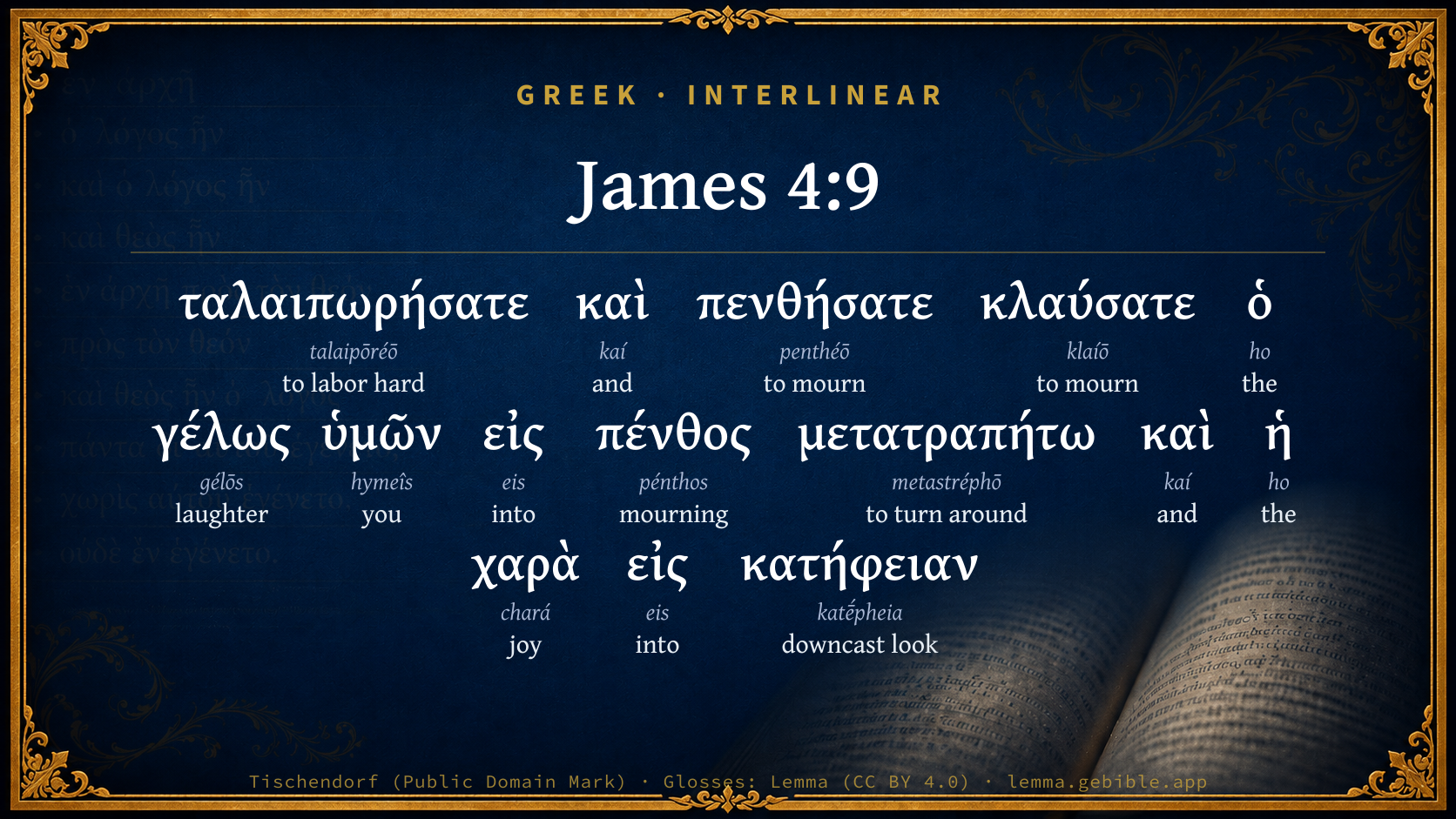
Download image
Cite this verse

James 4:9 (World English Bible). Public Domain. Lemma interlinear Bible study tool, https://lemma.gebible.app/v/james/4/9.

Show BibTeX & RIS
BibTeX
RIS
English Translation
Lament, mourn, and weep. Let your laughter be turned to mourning, and your joy to gloom.
World English Bible · Public Domain
Highlights
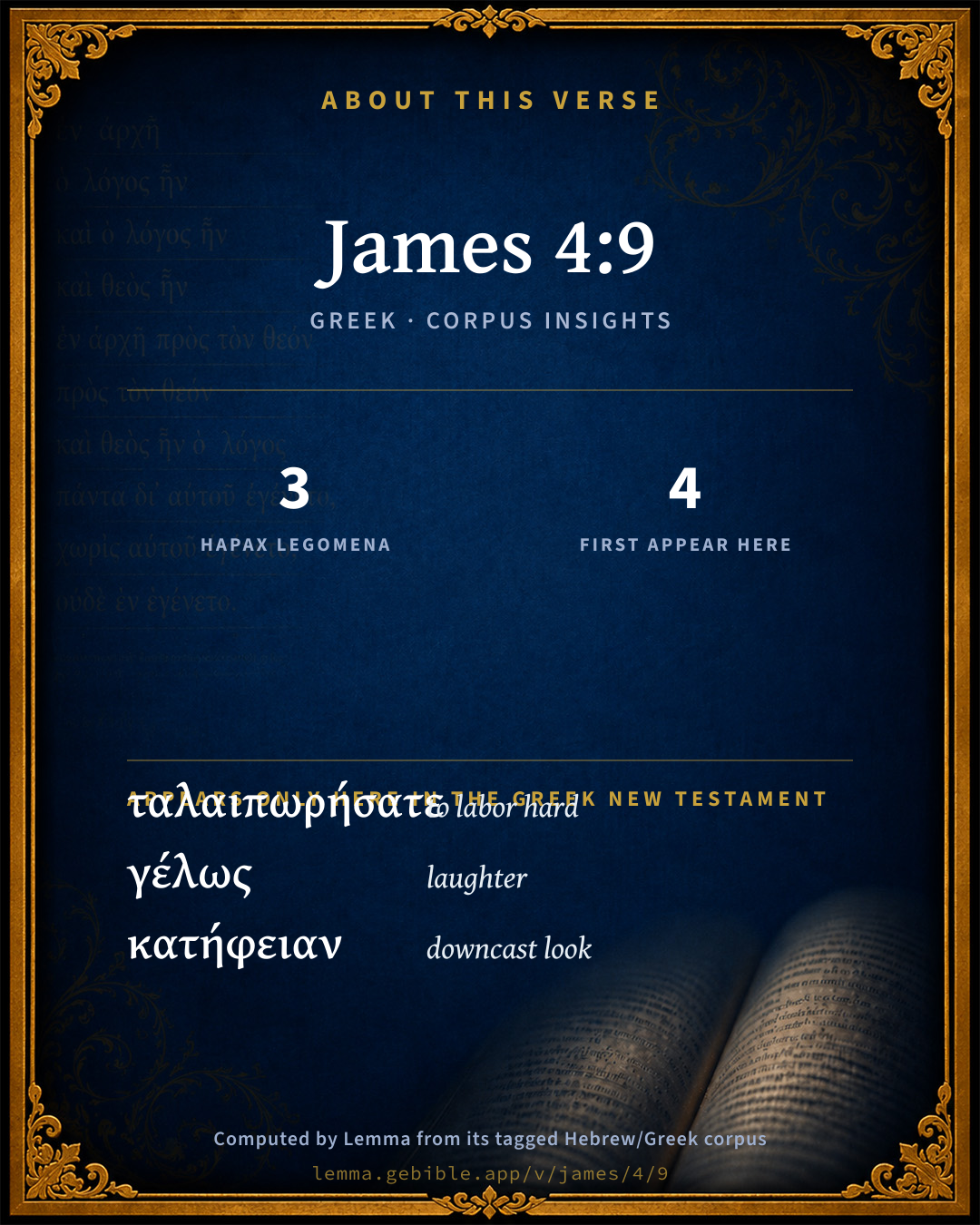
  • 3 hapax legomena — only here in the Greek New Testament
  • 4 first appearances in the Greek New Testament
Full analysis ↓
Download a study sheet

One document with this verse’s original text, its word-by-word gloss line, the meaning frame, cross-references with their text, attributed commentary, and full source and license credits — printable, and it pastes into notes with its structure intact.

This verse Autodidact and up

Study sheet (.html) Plain text (.txt)

A passage Seminary Student

Up to 50 verses in one chapter. A passage sheet keeps up to 6 commentary sources and 12 cross-references per verse, in the order this page ranks them, and says so on the sheet whenever that leaves anything out. Ask for a single verse and you get the Autodidact verse sheet above.

Everything on this page stays free to read, with no account — the sheet is a download of what is already on screen, not access to it.

Want to remove ads? Support Godless Engineer
Compare translations 3

The same verse in 3 English versions, stacked beneath the original-language interlinear above. Click any original word for its lexicon entry.

Each is an independent rendering of the whole verse — the interlinear is not word-aligned to these translations.

Highlighted words mark where these versions differ — a whole-verse word diff, not a word-by-word alignment.

  • World English Bible Public Domain
    Lament, mourn, and weep. Let your laughter be turned to mourning, and your joy to gloom.
  • King James Version Public Domain
    Be afflicted, and mourn, and weep: let your laughter be turned to mourning, and your joy to heaviness.
  • unfoldingWord Literal Text CC BY-SA 4.0
    Be miserable and mourn and weep! Let your laughter be changed into mourning, and your joy into gloom.

unfoldingWord Literal Text — © unfoldingWord, licensed CC BY-SA 4.0. Word-aligned USFM3 via Door43 (git.door43.org/unfoldingWord/en_ult).

Versions to compare (up to 4)

3 of 4 selected

Show all 19 translations

Every available English version of this verse, each an independent rendering of the whole verse.

  • World English Bible Public Domain
    Lament, mourn, and weep. Let your laughter be turned to mourning, and your joy to gloom.
  • Berean Standard Bible Public Domain
    Grieve, mourn, and weep. Turn your laughter to mourning, and your joy to gloom.
  • Majority Standard Bible Public Domain
    Grieve, mourn, and weep. Turn your laughter to mourning, and your joy to gloom.
  • King James Version Public Domain
    Be afflicted, and mourn, and weep: let your laughter be turned to mourning, and your joy to heaviness.
  • American Standard Version (1901) Public Domain
    Be afflicted, and mourn, and weep: let your laughter be turned to mourning, and your joy to heaviness.
  • Revised Version (1885) Public Domain
    Be afflicted, and mourn, and weep: let your laughter be turned to mourning, and your joy to heaviness.
  • Geneva Bible (1599) Public Domain
    Suffer afflictions, and sorrowe ye, and weepe: let your laughter be turned into mourning, and your ioy into heauinesse.
  • Douay-Rheims (1899) Public Domain
    Be afflicted, and mourn, and weep: let your laughter be turned into mourning, and your joy into sorrow.
  • Young's Literal Translation Public Domain
    be exceeding afflicted, and mourn, and weep, let your laughter to mourning be turned, and the joy to heaviness;
  • Literal Standard Version CC BY-SA 4.0
    Be exceedingly afflicted, and mourn, and weep, let your laughter be turned to mourning, and the joy to heaviness;
  • Unlocked Literal Bible CC BY-SA 4.0
    Grieve, mourn, and cry! Let your laughter turn into sadness and your joy into gloom.
  • unfoldingWord Literal Text CC BY-SA 4.0
    Be miserable and mourn and weep! Let your laughter be changed into mourning, and your joy into gloom.
  • Darby Bible Public Domain
    Be wretched, and mourn, and weep: let your laughter be turned to mourning, and [your] joy to heaviness.
  • World Messianic Bible Public Domain
    Lament, mourn, and weep. Let your laughter be turned to mourning and your joy to gloom.
  • Webster's Bible Public Domain
    Be afflicted, and mourn, and weep: let your laughter be turned to mourning, and your joy to heaviness.
  • Free Bible Version CC BY-SA 4.0
    Show some remorse, cry and weep! Turn your laughter into mourning, and your joy to sadness.
  • Bible in Basic English Public Domain
    Be troubled, with sorrow and weeping; let your laughing be turned to sorrow and your joy to grief.
  • Text-Critical English NT CC BY 4.0
    Grieve, mourn, and weep. Turn your laughter into mourning and your joy into gloom.
  • Tyndale New Testament (1534) Public Domain
    Suffre affliccions: sorowe ye and wepe. Let youre laughter be turned to mornynge and youre ioye to hevynes.

Literal Standard Version (2020), Covenant Press — licensed CC BY-SA 4.0. Text via the HelloAO Bible API (eBible.org). Unlocked Literal Bible (unfoldingWord) — licensed CC BY-SA 4.0. Text via the HelloAO Bible API (eBible.org). unfoldingWord Literal Text — © unfoldingWord, licensed CC BY-SA 4.0. Word-aligned USFM3 via Door43 (git.door43.org/unfoldingWord/en_ult). Free Bible Version, Dr. Jonathan Gallagher — licensed CC BY-SA 4.0. Text via the HelloAO Bible API (eBible.org).

Word by word

More ways to search: Search by grammar → Find every occurrence → Compare this word →

Practice this passage: Drill this verse → Learn its vocabulary →

ταλαιπωρήσατε
talaipōréō
G5003
“to labor hard”
Verb, Aorist, Active, Imperative, 2nd person, Plural
Part of Speech
Verb
Tense
Aorist
Voice
Active
Mood
Imperative
Person
2nd person
Number
Plural
Full Thayer's Definition

Origin: from G5005

TDNT: None

1. to toil heavily, to endure labours and hardships 2. to be afflicted 3. to feel afflicted and miserable 4. to afflict
  1. καὶ kaí G2532 “and” Conjunction
  2. πενθήσατε penthéō G3996 “to mourn” Verb, Aorist, Active, Imperative, 2nd person, Plural
  3. κλαύσατε klaíō G2799 “to mourn” Verb, Aorist, Active, Imperative, 2nd person, Plural
  4. ὁ ho G3588 “the” Article, Nominative, Singular, Masculine
  5. γέλως gélōs G1071 “laughter” Noun, Nominative, Singular, Masculine
  6. ὑμῶν hymeîs G5210 “you” Personal pronoun, 2nd person, Genitive, Plural
  7. εἰς eis G1519 “into” Preposition
  8. πένθος pénthos G3997 “mourning” Noun, Accusative, Singular, Neuter
  9. μετατραπήτω metastréphō G3344 “to turn around” Verb, Aorist, Passive, Imperative, 3rd person, Singular
  10. καὶ kaí G2532 “and” Conjunction
  11. ἡ ho G3588 “the” Article, Nominative, Singular, Feminine
  12. χαρὰ chará G5479 “joy” Noun, Nominative, Singular, Feminine
  13. εἰς eis G1519 “into” Preposition
  14. κατήφειαν katḗpheia G2726 “downcast look” Noun, Accusative, Singular, Feminine

About this verse

These counts appear in no published source. They are computed here, from the morphology-tagged text and Lemma’s own curated glosses. What Lemma adds →

15
words
12
distinct lemmas
General Epistles
section

Notable vocabulary

3 hapax legomena — words that appear only here in the entire Greek New Testament:

  • ταλαιπωρήσατε to labor hard G5003
  • γέλως laughter G1071
  • κατήφειαν downcast look G2726

First appearance in Scripture

These words make their first canonical appearance in the Greek New Testament here:

  • ταλαιπωρήσατε to labor hard G5003
  • γέλως laughter G1071
  • πένθος mourning G3997
  • κατήφειαν downcast look G2726

Shared distinctive vocabulary

μετατραπήτω to turn around G3344 occurs in 3 verses of the Greek New Testament. Also found in:
Repetition

Words recur within this verse:

Cross-references

23

Topical passages linked to James 4:9 in the Treasury of Scripture Knowledge — connected by theme and wording, ordered by reader-vote popularity; previews shown in the World English Bible.

  • Matthew 5:4 Blessed are those who mourn, For they shall be comforted.
  • 2 Corinthians 7:10–11 For godly sorrow works repentance to salvation, which brings no regret. But the sorrow of the world works death.
  • Luke 6:25 Woe to you, you who are full now! For you will be hungry. Woe to you who laugh now! For you will mourn and weep.
  • Proverbs 14:13 Even in laughter the heart may be sorrowful, And mirth may end in heaviness.
  • James 5:1–2 Come now, you rich, weep and howl for your miseries that are coming on you.
  • Psalms 119:67 Before I was afflicted, I went astray; But now I observe your word.
  • Ecclesiastes 7:2–6 It is better to go to the house of mourning than to go to the house of feasting: for that is the end of all men, and the living should take this to heart.
  • Jeremiah 31:18–20 I have surely heard Ephraim bemoaning himself [thus], You have chastised me, and I was chastised, as a calf unaccustomed [to the yoke]: turn you me, and I shall be turned; for you are Yahweh my God.
  • Ezekiel 16:63 that you may remember, and be confounded, and never open your mouth any more, because of your shame, when I have forgiven you all that you have done, says the Lord Yahweh.
  • Revelation 18:7–8 However much she glorified herself, and grew wanton, so much give her of torment and mourning. For she says in her heart, 'I sit a queen, and am no widow, and will in no way see mourning.'
  • Ezekiel 7:16 But those of those who escape shall escape, and shall be on the mountains like doves of the valleys, all of them moaning, every one in his iniquity.
  • Job 30:31 Therefore is my harp turned to mourning, And my pipe into the voice of those who weep.
  • Psalms 126:5–6 Those who sow in tears will reap in joy.
  • Isaiah 22:12–13 In that day did the Lord, Yahweh of Hosts, call to weeping, and to mourning, and to baldness, and to girding with sackcloth:
  • Lamentations 5:15 The joy of our heart is ceased; Our dance is turned into mourning.
  • Zechariah 12:10–14 I will pour on the house of David, and on the inhabitants of Jerusalem, the spirit of grace and of supplication; and they will look to me whom they have pierced; and they shall mourn for him, as one mourns for his only son, and will grieve bitterly for him, as one grieves for his firstborn.
  • Luke 16:25 "But Abraham said, 'Son, remember that you, in your lifetime, received your good things, and Lazarus, in like manner, bad things. But now here he is comforted and you are in anguish.
  • Psalms 119:71 It is good for me that I have been afflicted, That I may learn your statutes.
  • Ecclesiastes 2:2 I said of laughter, "It is foolishness;" and of mirth, "What does it accomplish?"
  • Jeremiah 31:9 They shall come with weeping; and with petitions will I lead them: I will cause them to walk by rivers of waters, in a straight way in which they shall not stumble; for I am a father to Israel, and Ephraim is my firstborn.
  • Jeremiah 31:13 Then shall the virgin rejoice in the dance, and the young men and the old together; for I will turn their mourning into joy, and will comfort them, and make them rejoice from their sorrow.
  • Luke 6:21 Blessed are you who hunger now, For you will be filled. Blessed are you who weep now, For you will laugh.
  • Psalms 119:136 Streams of tears run down my eyes, Because they don't observe your law.

Cross-references courtesy of OpenBible.info (CC BY 4.0).

Commentary

Notes on James 4:9 from classic Christian and Jewish commentators (each source and its license shown beneath its notes). The classic Christian expositions comment on the surrounding passage and are grouped to its opening verse, so a note may address several verses; the Jewish commentaries on the Tanakh (Rashi and others) are per-verse, so they appear only where the commentator wrote on this verse.

Lemma curates 59 commentaries, every one of them public domain or Creative Commons licensed, each selected and text-cleaned for this edition rather than reprinted as found. About our sources →

Bengel's Gnomon

Johann Albrecht Bengel

Jas 4:9. Ταλαιπωρήσατε, be afflicted) that ye may be weaned and estranged from the world. This is a blessed affliction. He does not here add, howl, as ch. Jas 5:1.[51]

[51] εἰς κατήφειαν, into heaviness [falling] of countenance) The same phrase as the German Kopfhängen. Comp. 1Ki 21:29; Isa 58:5; Mic 6:8. They who carp at others on this ground, are generally themselves such as have need above other men to let fall the countenance.—V. g.

Bengel's Gnomon of the New Testament — English translation (T&T Clark, Edinburgh, 1860) — public domain. Text from a community e-Sword module.

Meyer's Critical & Exegetical Commentary

Heinrich August Wilhelm Meyer

Jam_4:9. The μετάνοια required in Jam_4:8 does not take place without grief and mourning for guilt. The consciousness of the latter is the road to the former; therefore the summons now to this mourning: ταλαιπωρήσατε καὶ πενθήσατε καὶ κλαύσατε. The repetition of καί is an expression of emotion; ταλαιπωρεῖν] in the N. T. ἅπ. λεγ. (the adjective in Rom_7:24; Rev_3:17; the substantive in chap. Jam_5:1; Rom_3:16), literally, to suffer external hardships, as in Mic_2:4, is here used of the internal condition: to feel unhappy, wretched, as the adjective in Rom_7:24. Estius, Gagnejus, Grotius erroneously refer it to bodily castigations: affligite vosmet ipsos jejuniis et aliis corporis σκληραγωγίαις (Grotius); similarly Hottinger: sensum miseriae claris indiciis prodite; falsely also Beza: reprehendit ἀναλγησίαν in adversis.

πενθήσατε καὶ κλαύσατε] the same combination in Neh_8:9; 2Sa_19:1; and in the N. T. Mar_16:10; Luk_6:25; Rev_18:15; Rev_18:19 : wail and weep. Grotius incorrectly explains πενθήσατε = lugubrem habitum induite, saccum et cilicia; there is not the slightest indication that James had in view the external signs of mourning in dress and the like. If the foregoing exhortations point to a change of the lusts and joy of worldly life into godly mourning (τὴν κατὰ Θεὸν λύπην, 2Co_7:10), this is still more definitely expressed in what follows, by which James passes from the outward manifestation (γέλως … πένθος) to the internal state (χαρὰ … κατήφεια).

κατήφεια] ἅπ. λεγ. (the adj., Wis_17:4), literally, the casting down of the eyes, here indicates internal shame; in Plutarch, Them. 9, it is used synonymously with δυσθυμία. Compare with this the picture of the publican in Luk_18:13.

Meyer — Critical and Exegetical Commentary on the New Testament — English translation by Peter Christie, edited by Frederick Crombie (T&T Clark, 1880) — public domain. Text from a community e-Sword module.

Expositor's Greek Testament

ed. W. Robertson Nicoll

Jas 4:9 . ταλαιπωρήσατε : ἅπ . λεγ . in N.T. cf. Mic 2:4 ; Jer 4:13 ; “undergo hardship”; it was a recognised tenet in Jewish theology that self-inflicted punishment of any kind was a means of reconciliation, e.g. , in Mechilta , 76 a , the words of Psa 89:32 (33 in Heb.), I will visit their transgression with the rod, and their iniquity with stripes , are interpreted to mean that the pain suffered under liberal chastisement is one of the means of reconciliation with God; for instances of how chastisement has reconciled men to God, see Baba mezia , 84 a b . πενθήσατε καὶ κλαύσατε : these words are found together in 2 Esdras 18:9 (= Neh 8:9 ); and in Luk 6:25 we have, οὐαὶ ὑμῖν οἱ γελῶντες νῦν , ὅτι πενθήσετε καὶ κλαύσετε . Repentance ( תשׁובה ) was, according to Jewish teaching, also in itself another of the means of reconciliation. ὁ γέλως ὑμῶν εἰς πένθος μετατραπήτω : μετατραπ . ἅπ . λεγ . in. N.T.; cf. Amo 8:10 , καὶ μεταστρέψω τὰς ἑορτὰς ὑμῶν εἰς πένθος . καὶ ἡ χαρὰ εἰς κατήφειαν : Cf. Jer 16:9 ; Pro 14:13 ; the words express the contrast between the loud unseemly gaiety of the pleasure-seeker, and the subdued mien and downcast look of the penitent. κατήφειαν occurs only here in the N.T.; it is often found in Philo.

Jas 4:10 . ταπεινώθητε ἐνώπιον Κυρίου καὶ ὑψώσει ὑμᾶς : Cf. Sir 2:17 , οἱ φοβούμενοι Κύριον ἑτοιμάσουσι καρδίας αὐτῶν καὶ ἐνώπιον αὐτοῦ ταπεινώσουσι τὰς ψυχὰς αὐτῶν , and cf. Jas 3:18 ; in the Test. of the Twelve Patriarchs , Jos. xviii. 1, we read, “If ye also, therefore, walk in the commandments of the Lord, my children, He will exalt you there ( i.e. , on high), and will bless you with good things for ever and ever”. Although the actual word is not mentioned in these Jas 4:7-10 , it is obvious that they constitute a call to repentance. Both as establishing a proper relationship towards God, and as a means of bringing about that relationship, the need of repentance had always been greatly insisted on by Jewish teachers; in Pirqe Aboth, e.g. , iv. 15, it is said, “Repentance and good works are as a shield against punishment”; and Taylor quotes Berachoth , 17 a , “It was a commonplace in the mouth of Raba that, The perfection of wisdom is repentance,” cf. Bereshith Rabba , lxv.; Nedarim , 32 b , etc., etc.

The Expositor's Greek Testament, edited by W. Robertson Nicoll (1897–1910) — public domain. Text from a community e-Sword module.

Geneva Bible (1599)

Geneva Bible translators

By this word the Greeks meant an heaviness joined with shamefastness, which is to be seen in a cast down countenance, and settled as it were upon the ground.

He goeth on in the same comparison of contraries, and setteth against those profane joys with an earnest sorrow of mind, and against pride and arrogance, holy modesty.

Geneva Bible (1599) marginal notes — public domain. Text via Bolls.life.

Jamieson, Fausset & Brown

Robert Jamieson, A. R. Fausset & David Brown

Be afflicted--literally, "Endure misery," that is, mourn over your wretchedness through sin. Repent with deep sorrow instead of your present laughter. A blessed mourning. Contrast Isa 22:12-13; Luk 6:25. James does not add here, as in Jam 5:1, "howl," where he foretells the doom of the impenitent at the coming destruction of Jerusalem.

heaviness--literally, "falling of the countenance," casting down of the eyes.

Jamieson, Fausset & Brown — Commentary Critical and Explanatory on the Whole Bible (1871) — public domain (CC PDM 1.0). Text via the HelloAO Bible API.

Adam Clarke's Commentary

Verse 9. Be afflicted, and mourn] Without true and deep repentance ye cannot expect the mercy of God.

Let your laughter be turned to mourning] It appears most evidently that many of those to whom St. James addressed this epistle had lived a very irregular and dissolute life. He had already spoken of their lust, and pleasures, and he had called them adulterers and adulteresses; and perhaps they were so in the grossest sense of the words. He speaks here of their laughter and their joy; and all the terms taken together show that a dissolute life is intended. What a strange view must he have of the nature of primitive Christianity, who can suppose that these words can possibly have been addressed to people professing the Gospel of Jesus Christ, who were few in number, without wealth or consequence, and were persecuted and oppressed both by their brethren the Jews and by the Romans!

Adam Clarke's Commentary on the Bible (1810–1826) — public domain. Text from a community e-Sword/MySword module.

John Calvin's Commentaries

9 Be afflicted and mourn. Christ denounces mourning on those who laugh, as a curse, (Luke 6:25;) and James, in what shortly follows, alluding to the same words, threatens the rich with mourning. But here he speaks of that salutary mourning or sorrow which leads us to repentance. He addresses those who, being inebriated in their minds, did not perceive God’s judgment. Thus it happened that they flattered themselves in their vices. That he might shake off from them this deadly torpor, he admonishes them to learn to mourn, that being touched with sorrow of conscience they might cease to flatter themselves and to exult on the verge of destruction. Then laughter is to be taken as signifying the flattering with which the ungodly deceive themselves, while they are infatuated by the sweetness of their sins and forget the judgment of God.

John Calvin's Commentaries (1540-1563) — public domain. Text from the Calvin Translation Society English edition (1840s-50s) via the Christian Classics Ethereal Library (ccel.org). Calvin's coverage is partial (roughly two-thirds of the Bible); uncommented books and verses are honest gaps, never fabricated. The 19th-century editor's footnotes and remarks are omitted so the notes are faithfully Calvin's own voice.

Ellicott's Commentary for English Readers

(9) Be afflicted, and mourn, and weep.—For wretchedness, sorrow, and tears are the three steps of the homeward way to peace and God. And in proof of real conversion there must be the outward lamentation, as well as the inward contrition. Grieve, therefore, with a “godly sorrow not to be repented of” (2Co_7:10)—the remorseful anguish of a Peter, and not a Judas. Let the foolish laughter at sin, which was “as the crackling of thorns” before the avenging fire (Ecc_7:6), be turned to mourning; banish the joyous smile for the face cast down to heaviness, and so await the blessedness of those that mourn (Matt. v, 4), even the promised comfort of God.

A Bible Commentary for English Readers, edited by Charles John Ellicott (1878–1897) — public domain. Text from a community e-Sword module.

The Cambridge Bible for Schools and Colleges

gen. ed. J. J. S. Perowne

9. Be afflicted, and mourn, and weep …] The words are nearly synonymous, the first pointing to the sense of misery (as in “O wretched man that I am” in Rom_7:24), the second to its general effect on demeanour, the last to its special outflow in tears. The two last verbs are frequently joined together, as in Mar_16:10; Luk_6:25; Rev_18:15. The words are an emphatic call to repentance, and the blessedness which follows on repentance. Here, as so often in the Epistle, we trace the direct influence of the teaching of the Sermon on the Mount (Mat_5:4). The contrast between the “laughter” and the “mourning” in the clause that follows, makes the connexion all but absolutely certain. The “laughter” is that of the careless, selfish, luxurious rejoicing of the world, the “sport” of the fool in Pro_10:23.

your joy to heaviness] The Greek for the latter word expresses literally the downcast look of sorrow, and is as old in this sense as Homer,

“Joy to thy foes, but heavy shame to thee.”

Iliad iii. 51.

It exactly describes the attitude of the publican, who would not “lift up so much as his eyes unto heaven” (Luk_18:13).

The Cambridge Bible for Schools and Colleges (gen. ed. J. J. S. Perowne; Cambridge University Press, 1878–1918) — public domain. Text from a community e-Sword module.

John Gill's Exposition

Be afflicted, and mourn, and weep,.... Not in a bare external way; not by afflicting the body with fastings and scourgings, by renting of garments, and clothing with sackcloth, and putting ashes on the head, and other such outward methods of humiliation; but afflicting the soul is meant, an inward mourning and weeping over the plague of the heart, the impurity of nature, and the various sins of life; after a godly sort, and because contrary to a God of infinite love and grace; in an evangelical way, looking to Jesus, and being affected with the pardoning grace and love of God in Christ.

Let your laughter be turned to mourning, and your joy to heaviness; meaning their carnal joy, on account of their friendship with the world, and their enjoyment of the things of it, since they consumed them on their lusts, and which betrayed enmity to God.

John Gill's Exposition of the Whole Bible (1746–1763) — public domain (CC PDM 1.0). Text via the HelloAO Bible API.

Trapp's Complete Commentary

John Trapp

9 Be afflicted, and mourn, and weep: let your laughter be turned to mourning, and your joy to heaviness.

Ver. 9. Be afflicted] ταλαιπωρησατε. or, Be miserable; ye are so, but see yourselves to be so. Or, afflict yourselves, viz. with voluntary sorrows for your sins. See that ye be active here.

And mourn] Savourly and soakingly, with a deep and downright sorrow, so as a man would do in the death of his dearest friend. The Greek word, πενθησατε, imports a funeral grief.

And weep] In judgment at least, and then, dry sorrow may go as far as wet, where tears will not come. But if it be possible, look not upon sin with dry eyes; point every sin with a tear.

Let your laughter be turned] Turn all the streams into this one channel, that may drive the mill, that may grind the heart. Meal was offered of old, and not whole corn.

And your joy to heaviness] κατηφεια, {a} such as makes a man hang down his head, and go heavily through grief and shame.

{a} Tristitia cum vultus demissione. Budaeus.

John Trapp, A Commentary or Exposition upon All the Books of the Old and New Testament (1647–1656) — public domain. Text from a community e-Sword module.

Albert Barnes' Notes on the Bible

Be afflicted, and mourn, and weep - That is, evidently, on account of your sins. The sins to which the apostle refers are those which he had specified in the previous part of the chapter, and which he had spoken of as so evil in their nature, and so dangerous in their tendency. The word rendered “be afflicted” means, properly, to endure toil or hardship; then to endure affliction or distress; and here means, that they were to afflict themselves - that is, they were to feel distressed and sad on account of their transgressions. Compare Ezr 8:21. The other words in this clause are those which are expressive of deep grief or sorrow. The language here used shows that the apostle supposed that it was possible that those who had done wrong should voluntarily feel sorrow for it, and that, therefore, it was proper to call upon them to do it.

(All who feel true sorrow for sin, do so voluntarily; but it is not intended by this assertion to insinuate that repentance is not the work of the Spirit. He operates on men without destroying their freedom, or doing violence to their will: “in the day of his power they are willing.” Nor is it improper to call on men to do that for which they require the Spirit’s aid. That aid is not withheld in the hour of need; and everywhere the Bible commands sinners to believe and repent.)

Let your laughter be turned to mourning - It would seem that the persons referred to, instead of suitable sorrow and humiliation on account of sin, gave themselves to joyousness, mirth, and revelry. See a similar instance in Isa 22:12-13. It is often the case, that those for whom the deep sorrows of repentance would be peculiarly appropriate, give themselves to mirth and vanity. The apostle here says that such mirth did not become them. Sorrow, deep and unfeigned, was appropriate on account of their sins, and the sound of laughter and of revelry should be changed to notes of lamentation. To how many of the assemblies of the vain, the gay, and the dissipated, might the exhortation in this passage with propriety be now addressed!

Your joy to heaviness - The word here rendered heaviness occurs nowhere else in the New Testament. It means dejection, sorrow. It is not gloom, melancholy, or moroseness, but it is sorrow on account of sin. God has so made us that we should feel sorrow when we are conscious that we have done wrong, and it is appropriate that we should do so.

Albert Barnes' Notes on the Bible (1834–1885) — public domain. Text from a community e-Sword/MySword module.

Haydock's Catholic Bible Commentary

Be afflicted [4] and mourn, and deplore your sins against his divine majesty; punish yourselves, and think not that a mere change of life is sufficient after so many sins committed. (Witham)

===============================

[BIBLIOGRAPHY]

Miseri estote, Greek: talaiporesate.

George Leo Haydock (1774–1849), Haydock's Catholic Family Bible and Commentary, 1859 edition — public domain. Excludes Psalms (Douay-Rheims chapter numbering differs from Protestant) and Deuterocanonical books (Catholic canon only).

Matthew Poole's English Annotations

Be afflicted; humble yourselves for your sins, before mentioned, and in the sense of wrath approaching, if ye do not.

And mourn, with inward sorrow of heart.

And weep; show your inward grief by weeping, the usual expression and sign of it.

Let your laughter; your carnal rejoicing in what you get by sinful courses, Jam 4:1,2, lusting, warring, fighting.

Be turned into mourning; exchange your carnal joy for godly sorrow.

And your joy; to the same purpose as laughter, before: by it he means their pleasing themselves in the success of their unrighteousness, the gain of their rapine and violence.

Into heaviness; the same as mourning, or an outward expression of it in the dejection of the countenance, which usually proceeds from shame or sorrow, (and the Greek word signifies both), whereas joy and confidence make men lift up their heads or faces, Ezr 9:6; Job 10:15; Job 11:15; 22:26; Luk 21:28.

Matthew Poole's English Annotations on the Holy Bible (1683–1685) — public domain. Text from a community e-Sword/MySword module.

Whedon's Commentary on the Bible

Daniel D. Whedon

9. Be afflicted—Penitence is the way to repentance and reformation; penitence in view of past sin and future judgment. The ring of revelry and laughter should give way to the voice of mourning.

Daniel D. Whedon (gen. ed.), Commentary on the Old and New Testaments (1874–1909) — public domain. Text from a community e-Sword module.

The Pulpit Commentary

St. James"s version of "Blessed are they that mourn: for they shall be comforted". (Mat_5:4) Be afflicted. Talaipwrhsate: only here in the New Testament, occasionally in the LXX Heaviness. Kathfeia: another apax legomenon, apparently never found in the LXX or in the apostolic Fathers; it is, however, used by Josephus andPhilo. It is equivalent to "dejection," and "exactly describes the attitude of the publican, who would not lift up so much as his eyes unto heaven,." Luk_18:13 (Plumptre)

The Pulpit Commentary (1880–1919), ed. H.D.M. Spence-Jones & Joseph S. Exell — public domain. Text from a community e-Sword module.

John Wesley's Explanatory Notes

Be afflicted - For your past unfaithfulness to God.

John Wesley, Explanatory Notes Upon the Whole Bible (1754–1765) — public domain. Text via the GEBible commentary corpus.

Burkitt's Expository Notes on the New Testament

William Burkitt

The next duty we are exhorted to by the apostle, is a deep humiliation, and a voluntary affliction of our souls before God for sin, and upon the account of any calamity, either on ourselves or others.

Learn hence, that as the afflicting hand of God does increase upon a person, a family, or a people, so ought the humiliation and mourning of that person, family, or people, to increase; we ought not only to be humbled when God afflicts, but also to be humbled in proportion to what God inflicts; great afflictions call for great humiliations; woe to that person, that family, or that people, who will not afflicted when God afflicts them, nor humble themselves, when God humbles them; who, when God casts them down, will hold up their heads in mirth and jollity: God loves to see us bear our cross, but he cannot endure to see us make sport with it, or slight of it. If God once perceives us driving away our sorrow with harp and viol, or drowning it with wine, he can quickly turn our wine into water, and our laughter into the voice of weeping.

Now is it not better to turn our mirth into mourning, than to have God turn it into mourning? They who turn their mirth into mourning, shall find comfort after their mourning; but they shall know nothing but mourning, whose mirth God turns into mourning: be afflicted, therefore, and mourn and weep.

Quest. But how comes the apostle to make use of so many words to one purpose, be afflicted, mourn, weep, humble yourselves, &c.?

Ans. All these heaps of expressions do import and imply,

1. The necessity of the duty.

2. The difficulty of the duty.

3. The continuance of the duty,

and accordingly much enforcement is necessary; flesh and blood loves pleasure, but declines sorrow and heaviness; nature loves no bitter draughts, though bitter things are sometimes the best things; therefore the apostle’s call to afflict our souls, and humble ourselves in the sight of God, is repeated; and mark the encouragement given thus to do, humble yourselves in the sight of God, and he shall lift you up:

Submission and humility is the true way to exaltation and glory; the way to rise is to fall: he that humbleth himself shall be exalted, Luk 14:11.

He shall lift thee up in due time, 1Pe 5:6. Wait God’s leisure, and the promise shall surely be fulfilled; the world looketh upon humility as the way to contempt, but God pronounces it the way to honour; before honour is humility.

William Burkitt's Expository Notes on the New Testament (1700–1703) — public domain. Text from a community e-Sword module.

The People's New Testament

B. W. Johnson

9. Be afflicted, and mourn. Mourn over your sins and sincerely repent of them.

B. W. Johnson's The People's New Testament with Notes (1889–1891) — public domain. Electronic text from the Christian Classics Ethereal Library (CCEL) ThML edition.

Cambridge Greek Testament for Schools and Colleges

9. εἰς κατήφειαν, ‘to heaviness,’ R.V., or dejection, κατήφεια, defined to be a mixture of shame and grief, lit. with downcast eye, perhaps from κατά and φάος, but deriv. uncertain. This is the natural expression of the painfulness of shame: “There is no outrage,” says Hawthorne, “more flagrant than to forbid the culprit to hide his face for shame, as it was the essence of this punishment (the pillory) to do.” It is a Homeric word: δυσμενέσιν μὲν χάρμα κατηφείην δέ σοι αὐτῷ, Il. III. 51, also Thuc. VII. 75 κατήφεια δέ τις ἅμα καὶ κατάμεμψις σφῶν αὐτῶν πολλὴ ἦν, Plut. Aemil. p. 267 A κατήφεια δὲ τὸ στρατόπεδον κατεῖχεν. For the thought comp. Pro 14:13 τελευταῖα δὲ χαρὰ (al. χαρᾶς) εἰς πένθος ἔρχεται, and Jer 16:9 καταλύω ἐκ τοῦ τόπου τούτου φωνὴν χαρᾶς καὶ φωνὴν εὐφροσύνης.

Cambridge Greek Testament for Schools and Colleges (Cambridge University Press, 1896; 21 vols, various authors incl. Carr, Maclear, Plummer, Farrar, Lumby, Moule, M. R. James, Simcox) — public domain. Text from a community e-Sword module.

Alford’s Greek Testament

Henry Alford

9.] This cannot be done without true and deep repentance, leading them through deep sorrow. Be wretched (in your minds, from a sense of your sinfulness. That such feeling will have its outward demonstrations is evident: but this word itself does not allude to them, as Grot., “Affligite vosmetipsos jejuniis et aliis corporis σκληραγωγίαις:” so likewise Est., al. Beza also misses the point of the exhortation, when he says, “ἀναλγησίαν primum reprehendit in adversis, deinde immoderatam in rebus prosperis exultationem.” “Vestram persentiscite miseriam,” of Theile, is nearest the mark) and mourn and weep (here again Grot. refers the exhortation to outward things—“Lugubrem habitum induite, saccum et cilicia.” These may follow on that which is here commanded, but are not the thing itself): let your laughter (“lautæ vitæ,” Theile) be turned into mourning (these more of the outward manifestations) and your joy into humiliation (κατήφεια, lit. casting down of the eyes: hence shame or humiliation, which produces such downcast looks: cf. Il. γ. 51, where Hector, addressing Paris, calls Helen πατρί τε σῷ μέγα πῆμα, πόληΐ τε παντί τε δήμῳ, Δυσμενέσιν μὲν χάρμα, κατηφείην δέ σοι αὐτῷ. These latter, more of the inner states of mind).

Henry Alford, The Greek Testament (1849–1861) — public domain. Text from a community e-Sword module.

International Critical Commentary

9. “Make yourselves wretched, mourn, lament; that is a state of mind more suited to a Christian than worldly gaiety and joy!”

This is primarily a call to repentance; but, more than that, it is a vehemently expressed recommendation of sober earnestness as the proper mood of a Christian, in contrast to a light and frivolous spirit. The writer was a sober man who felt the seriousness of living, and wished that others should feel and express it; in a word, a Puritan.

The force of James’s exhortation must not be reduced by interpretation, nor its range unduly limited. There is positive emphasis on the sadness, and even anguish, which is appropriate to the readers’ actual situation, and which they ought to seek, not try to avoid, cf. Mat 5:4. Yet neither must the words be misunderstood as representing that a cheerfulness founded on the joy of faith is wrong for a soul which knows itself at one with God (cf. 1:2f.). James is not giving a complete directory for conduct at all times, but is trying by the unexpected intensity of his language to startle half-hearted Christians into a searching of heart and a self-consecration which he believes essential to their eternal salvation.

For the same mood, due to a different cause, cf. Ecc 7:2-6, cf. also Ecclus. 21:20, 27:13.Jer 4:13 f. Jer 4:9:18 f. and some of the other prophetic parallels, such as Joe 1:10 ff., Mic 2:4, Zec 11:2, have some resemblance, but differ in that in those passages the impending punishment is made prominent. They are nearer to Jas 5:1 (cf. especially Zec 11:2).

ταλαιπωρήσατε “make yourselves wretched,” cf. 5:1.

The word ταλαίπωρος and derivatives are employed both in secular and Biblical use of misery and wretchedness, whether strictly physical or general, often representing some form of Hebrew שָׁדִד; cf. Tob. 13:10, 2 Macc. 4:47, 4 Macc. 16:7, Psa 12:5, Mic 2:4, Psa 38:7, Jer 12:12, Rom 7:24, Rev 3:17, Clem. Rom. 23:3 ταλαίπωροί εἰσιν οἱ δίψυχοι.

ταλαιπωρέω in itself is not limited to mental anguish, nor to repentance. It is here used in order to make a sharp contrast with the pleasures which the persons addressed are seeking. They had better, says James, make wretchedness their aim, and so humble themselves in penitence and obedience before God.

The paraphrase of Grotius, “affligite ipsos vosmet jejuniis et aliis corporis σκληραγωγίαις,” which corresponds to the view of the Roman Catholic commentators (e. g. Est: opera pænalia subite) goes further than the text.

πενθήσατε καὶ κλαύσατε, “mourn and lament.” Cf. 2Sa 19:1, Neh 8:9, Mat 5:4, Mar 16:10, Luk 6:25, Rev 18:11, Rev 18:15, Rev 18:19.

πενθεῖν “expresses a self-contained grief, never violent in its manifestations” (Lex.); see Trench, Synonyms, § lxv. But the two words are here used merely to secure a forcible fulness of expression.

There is no ground for taking πενθήσατε specifically of an outward garb of mourning.

πενθήσατε καὶ κλαύσατε] אA omit καὶ; perhaps by accidental confusion of KAI with KLA—. The omission would connect πενθήσατε with the preceding, and separate it from κλαύσατε in a very unnatural way.

ὁ γέλως ὑμῶν, pertaining to their present easy ways. This sentence makes the preceding words more intelligible.

εἰς πένθος, cf. Amo 8:10, Tob. 2:6, Pro 14:13, Pro 14:1 Macc. 1:39, 9:41.

μετατραπήτω, a poetical word which “seems not to have been used in Attic” (L. and S.). In the Greek O. T. it is used in 4 Macc. 6:5, and by Aquila in Eze 1:9, Symmachus in Eze 10:11.

μετατραπήτω] BR minn.

μεταστραφήτω]> אAKL minnpler. Apparently an emendation, substituting a more familiar verb.

κατήφειαν “dejection,” “gloominess,” from κατηφής, “of a downcast look.” In accordance with its origin the word refers primarily to the outward expression of a heavy heart, cf. the publican in Luk 18:13. The word (not found in LXX; nor elsewhere in N. T.) is frequently used of dejection due to shame, and this association may have governed the choice of it here. Cf. Lex., L. and S. Wetstein, for many examples; and see Field, Notes on the Translation of the N. T., p. 238.

International Critical Commentary — older volumes (1896–1929), various authors — public domain. Text from a community e-Sword module.

Vincent's Word Studies in the New Testament

Marvin R. Vincent

Be afflicted [ταλαιπωρησατε] . Only here in New Testament. The kindred noun talaipwria, misery, occurs ch. 5 1.

Mourn [πενθησατε] . Used of grief that is manifested. So mostly in New Testament, and very commonly joined, as here, with weep. So Mr 16:10; Luk 6:25, etc. In the next sentence occurs the kindred noun penqov mourning, into which laughter, also something manifest, is to be changed. Heaviness [κατηφειαν] . Properly, a casting down of the eyes. Compare Luk 18:13. Only here in New Testament.

Marvin R. Vincent, Word Studies in the New Testament (1887–1900) — public domain. Text from a community e-Sword/MySword module.

Lesson kit

Teaching starters — assembled from the data on this page, not authored interpretation. Every prompt links to the verse data it draws on. Edit before teaching.

James, in the General Epistles, opens this verse with 15 words (12 distinct Greek lemmas). Its most distinctive word is talaipōréō (“to labor hard”). A historical commentator’s framing appears above. Read the whole chapter for the surrounding context.

Discussion questions

  1. How does “to labor hard” (talaipōréō) shape what this verse is saying?
  2. 3 words here appear nowhere else in the Greek New Testament. Why might the author reach for such rare wording?
  3. 4 words make their first appearance in Scripture here. What does this debut establish?
  4. How does Acts 2:20, which shares the word «to turn around», read alongside this verse?
  5. What does the repetition of “into” (2× in this one verse) do in this verse?
  6. The translations on this page render this verse differently — a whole-verse word diff, not a word-by-word alignment. What might account for the different wordings?
  7. Compare how Bengel's Gnomon and Meyer's Critical & Exegetical Commentary read this verse. Where do they agree or differ?

Things to notice

  • 3 words in this verse appear nowhere else in the Greek New Testament.
  • 4 words make their first canonical appearance in Scripture here.
  • These translations choose different wording for 8 words in this verse.
  • “into” occurs 2× in this single verse.
  • 12 distinct Greek lemmas span 15 words in this verse.

Reading settings

Reading text

Shown beneath each verse's original-language words.

Old Testament
Old Testament edition

Read the OT as the Masoretic Hebrew (MT) or the Greek Septuagint (LXX).

English shown for the Greek Septuagint (in the Hebrew ↔ Greek comparison).

Comparing translations? Open the Compare panel on any verse page to stack up to four side by side.