James 1:10

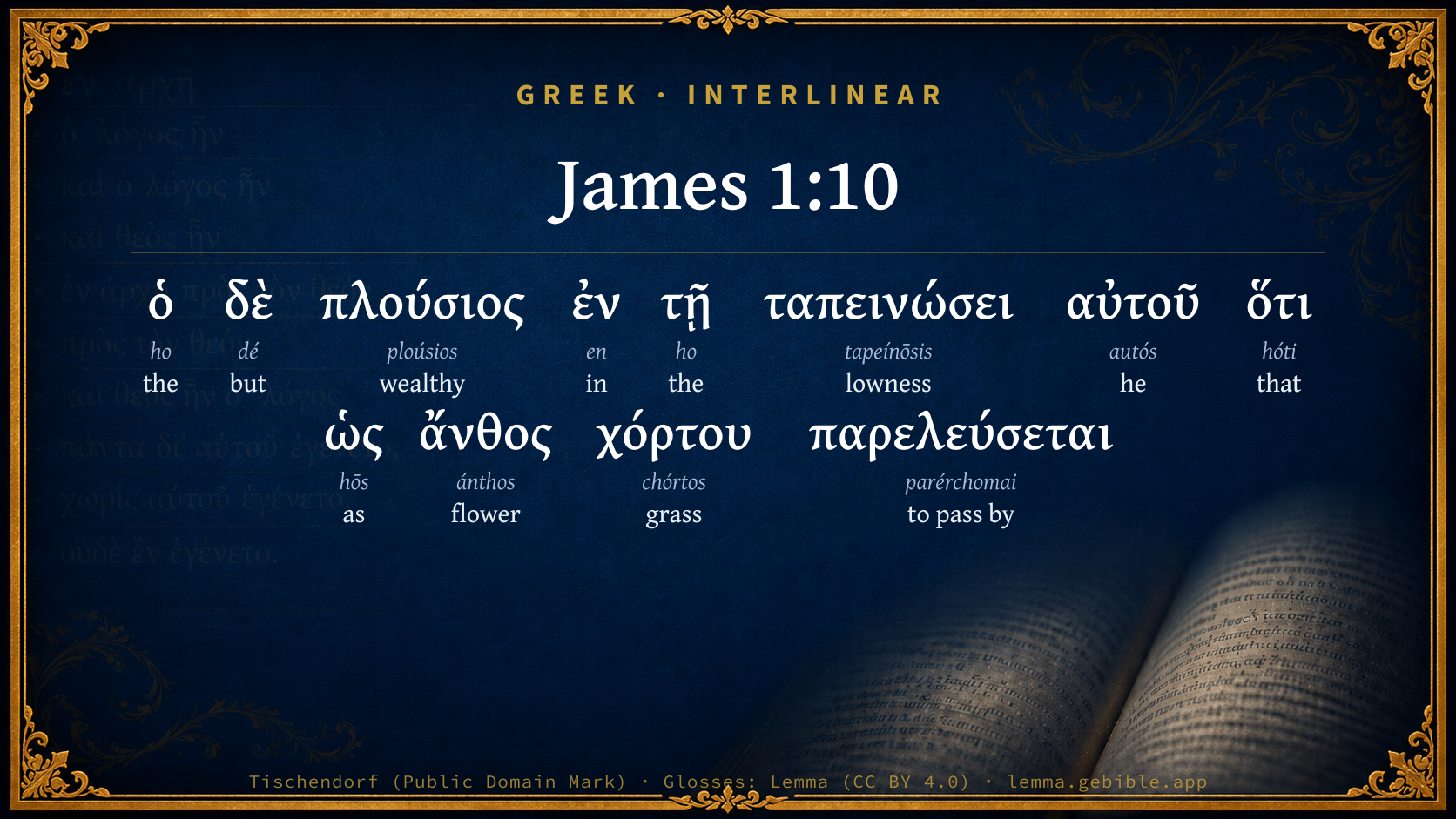
Greek (Tischendorf 8th ed.) James 1:10 appears in the Greek New Testament. The text above is from the Tischendorf 8th edition. Each word links to its Strong’s number and a concise gloss. Click any word for its full Thayer’s Greek Lexicon entry.
Download image
Cite this verse

James 1:10 (World English Bible). Public Domain. Lemma interlinear Bible study tool, https://lemma.gebible.app/v/james/1/10.

Show BibTeX & RIS
BibTeX
RIS
English Translation
and the rich, in that he is made humble, because like the flower in the grass, he will pass away.
World English Bible · Public Domain
Highlights
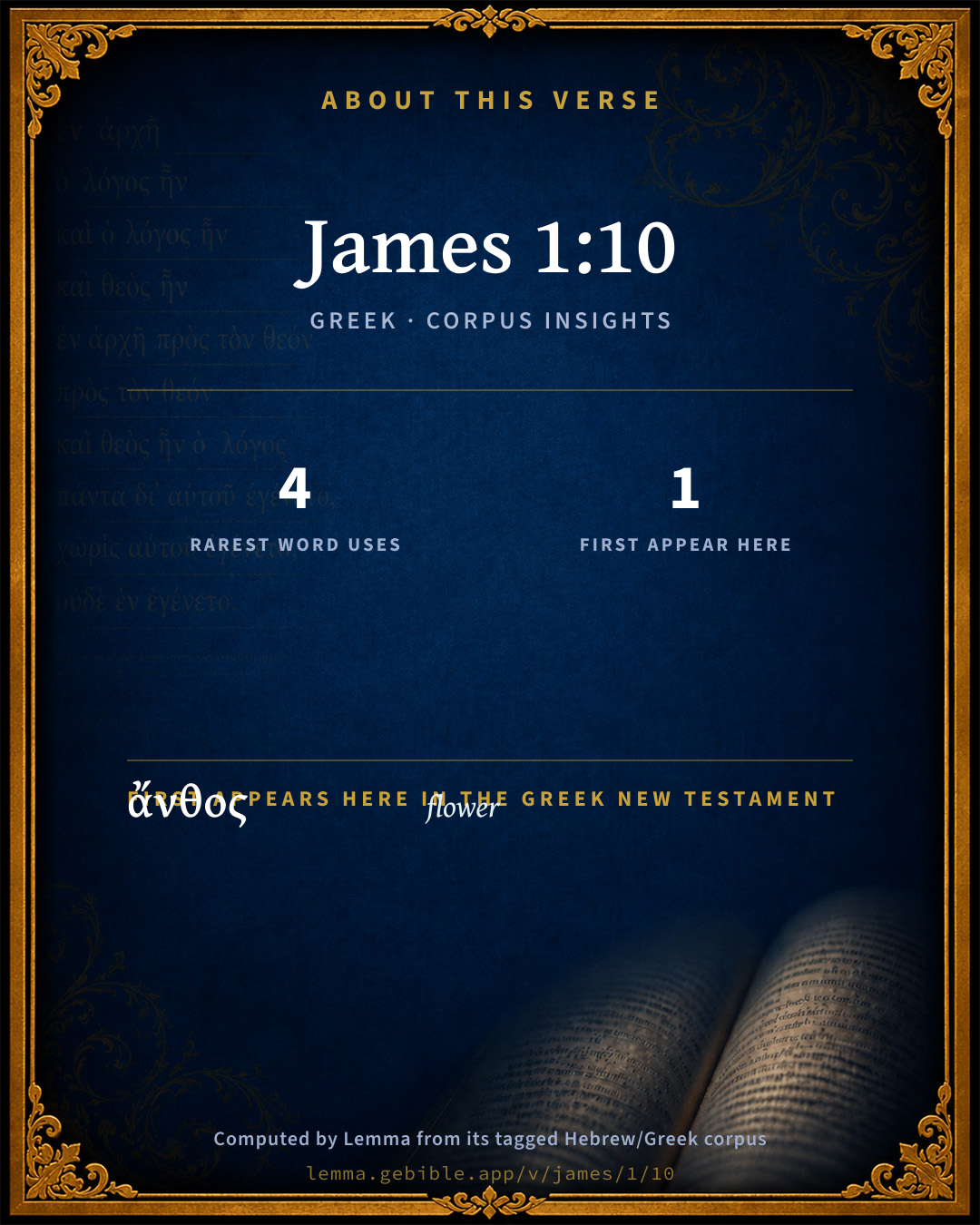
  • 1 first appearance in the Greek New Testament
Full analysis ↓
Download a study sheet

One document with this verse’s original text, its word-by-word gloss line, the meaning frame, cross-references with their text, attributed commentary, and full source and license credits — printable, and it pastes into notes with its structure intact.

This verse Autodidact and up

Study sheet (.html) Plain text (.txt)

A passage Seminary Student

Up to 50 verses in one chapter. A passage sheet keeps up to 6 commentary sources and 12 cross-references per verse, in the order this page ranks them, and says so on the sheet whenever that leaves anything out. Ask for a single verse and you get the Autodidact verse sheet above.

Everything on this page stays free to read, with no account — the sheet is a download of what is already on screen, not access to it.

Want to remove ads? Support Godless Engineer
Compare translations 3

The same verse in 3 English versions, stacked beneath the original-language interlinear above. Click any original word for its lexicon entry.

Each is an independent rendering of the whole verse — the interlinear is not word-aligned to these translations.

Highlighted words mark where these versions differ — a whole-verse word diff, not a word-by-word alignment.

  • World English Bible Public Domain
    and the rich, in that he is made humble, because like the flower in the grass, he will pass away.
  • King James Version Public Domain
    But the rich, in that he is made low: because as the flower of the grass he shall pass away.
  • unfoldingWord Literal Text CC BY-SA 4.0
    but the rich in his lowliness, because he will pass away like a flower of the grass.

unfoldingWord Literal Text — © unfoldingWord, licensed CC BY-SA 4.0. Word-aligned USFM3 via Door43 (git.door43.org/unfoldingWord/en_ult).

Versions to compare (up to 4)

3 of 4 selected

Show all 19 translations

Every available English version of this verse, each an independent rendering of the whole verse.

  • World English Bible Public Domain
    and the rich, in that he is made humble, because like the flower in the grass, he will pass away.
  • Berean Standard Bible Public Domain
    But the one who is rich should exult in his low position, because he will pass away like a flower of the field.
  • Majority Standard Bible Public Domain
    But the one who is rich should exult in his low position, because he will pass away like a flower of the field.
  • King James Version Public Domain
    But the rich, in that he is made low: because as the flower of the grass he shall pass away.
  • American Standard Version (1901) Public Domain
    and the rich, in that he is made low: because as the flower of the grass he shall pass away.
  • Revised Version (1885) Public Domain
    and the rich, in that he is made low: because as the flower of the grass he shall pass away.
  • Geneva Bible (1599) Public Domain
    Againe hee that is rich, in that hee is made lowe: for as the flower of the grasse, shall he vanish away.
  • Douay-Rheims (1899) Public Domain
    And the rich, in his being low; because as the flower of the grass shall he pass away.
  • Young's Literal Translation Public Domain
    and the rich in his becoming low, because as a flower of grass he shall pass away;
  • Literal Standard Version CC BY-SA 4.0
    but the rich in his becoming low, because he will pass away as a flower of grass;
  • Unlocked Literal Bible CC BY-SA 4.0
    but the rich man of his low position, because he will pass away as a wild flower in the grass.
  • unfoldingWord Literal Text CC BY-SA 4.0
    but the rich in his lowliness, because he will pass away like a flower of the grass.
  • Darby Bible Public Domain
    and the rich in his humiliation, because as [the] grass's flower he will pass away.
  • World Messianic Bible Public Domain
    and the rich, in that he is made humble, because like the flower in the grass, he will pass away.
  • Webster's Bible Public Domain
    But the rich, in that he is made low: because as the flower of the grass he shall pass away.
  • Free Bible Version CC BY-SA 4.0
    while the rich should “boast” in the humble position they now have, since they will fade away like flowers in the field.
  • Bible in Basic English Public Domain
    But the man of wealth, that he is made low; because like the flower of the grass he will come to his end.
  • Text-Critical English NT CC BY 4.0
    and the rich man should rejoice in being made low, because he will pass away like a flower of grass.
  • Tyndale New Testament (1534) Public Domain
    and the ryche in that he is made lowe. For even as the flower of the grasse shall he vanysshe awaye.

Literal Standard Version (2020), Covenant Press — licensed CC BY-SA 4.0. Text via the HelloAO Bible API (eBible.org). Unlocked Literal Bible (unfoldingWord) — licensed CC BY-SA 4.0. Text via the HelloAO Bible API (eBible.org). unfoldingWord Literal Text — © unfoldingWord, licensed CC BY-SA 4.0. Word-aligned USFM3 via Door43 (git.door43.org/unfoldingWord/en_ult). Free Bible Version, Dr. Jonathan Gallagher — licensed CC BY-SA 4.0. Text via the HelloAO Bible API (eBible.org).

Word by word

More ways to search: Search by grammar → Find every occurrence → Compare this word →

Practice this passage: Drill this verse → Learn its vocabulary →

About this verse

These counts appear in no published source. They are computed here, from the morphology-tagged text and Lemma’s own curated glosses. What Lemma adds →

12
words
11
distinct lemmas
General Epistles
section

Notable vocabulary

The rarest word here is ταπεινώσει lowness G5014 — appearing just 4 times in the whole Greek New Testament.

First appearance in Scripture

This word makes its first canonical appearance in the Greek New Testament here:

  • ἄνθος flower G438

Shared distinctive vocabulary

ταπεινώσει lowness G5014 occurs in 4 verses of the Greek New Testament. Also found in:

Repetition

A word recurs within this verse:

Cross-references

17

Topical passages linked to James 1:10 in the Treasury of Scripture Knowledge — connected by theme and wording, ordered by reader-vote popularity; previews shown in the World English Bible.

  • 1 Peter 1:24 For, "All flesh is like grass, And all of man's glory like the flower in the grass. The grass withers, and its flower falls;
  • 1 John 2:17 The world is passing away with its lusts, but he who does God's will remains forever.
  • Job 14:2 He comes forth like a flower, and is cut down. He also flees like a shadow, and doesn't continue.
  • Matthew 5:3 "Blessed are the poor in spirit, For theirs is the Kingdom of Heaven.
  • 1 Timothy 6:17 Charge those who are rich in this present world that they not be haughty, nor have their hope set on the uncertainty of riches, but on the living God, who richly provides us with everything to enjoy;
  • Psalms 103:15 As for man, his days are like grass. As a flower of the field, so he flourishes.
  • Psalms 90:5–6 You sweep them away as they sleep. In the morning they sprout like new grass.
  • Isaiah 40:6 The voice of one saying, Cry. One said, What shall I cry? All flesh is grass, and all the glory of it is as the flower of the field.
  • Matthew 6:30 But if God so clothes the grass of the field, which today exists, and tomorrow is thrown into the oven, won't he much more clothe you, you of little faith?
  • James 4:14 Whereas you don't know what your life will be like tomorrow. For what is your life? For you are a vapor, that appears for a little time, and then vanishes away.
  • Psalms 37:2 For they shall soon be cut down like the grass, And wither like the green herb.
  • Psalms 102:11 My days are like a long shadow. I have withered like grass.
  • 1 Corinthians 7:31 and those who use the world, as not using it to the fullest. For the mode of this world passes away.
  • Psalms 37:35–36 I have seen the wicked in great power, Spreading himself like a green tree in its native soil.
  • Isaiah 66:2 For all these things has my hand made, and [so] all these things came to be, says Yahweh: but to this man will I look, even to him who is poor and of a contrite spirit, and who trembles at my word.
  • Isaiah 57:15 For thus says the high and lofty One who inhabits eternity, whose name is Holy: I dwell in the high and holy place, with him also who is of a contrite and humble spirit, to revive the spirit of the humble, and to revive the heart of the contrite.
  • Philippians 3:8 Yes most assuredly, and I count all things to be loss for the excellency of the knowledge of Christ Jesus, my Lord, for whom I suffered the loss of all things, and count them nothing but refuse, that I may gain Christ

Cross-references courtesy of OpenBible.info (CC BY 4.0).

Commentary

Notes on James 1:10 from classic Christian and Jewish commentators (each source and its license shown beneath its notes). The classic Christian expositions comment on the surrounding passage and are grouped to its opening verse, so a note may address several verses; the Jewish commentaries on the Tanakh (Rashi and others) are per-verse, so they appear only where the commentator wrote on this verse.

Lemma curates 59 commentaries, every one of them public domain or Creative Commons licensed, each selected and text-cleaned for this edition rather than reprinted as found. About our sources →

Tyndale Open Study Notes

Tyndale Open Resources

1:10 those who are rich should boast: With irony, James is describing the dreadful fate of the ungodly rich who elevate themselves by oppressing poor and vulnerable people (see 2:6-8; 5:1-6).

Tyndale Open Study Notes — © Tyndale Open Resources, licensed CC BY-SA 4.0. Text via the HelloAO Bible API.

Bengel's Gnomon

Johann Albrecht Bengel

Jas 1:10. Πλούσιος, the rich) A Synecdoche for every one that is flourishing and gay.—ἐν τῇ ταπεινώσει, in that he is brought low) This is strictly construed with καυχάσθω, let the rich man rejoice. Compare 2Co 12:9; 2Sa 6:22. Ταπείνωσις does not denote the fading away of the rich man, but the lowliness of mind which arises from the sight of that fading away.—ὅτι ὡς, because as) “As the flower of the field—the fashion of it perisheth; the Protasis: “so shall the rich man fade away,” Jas 1:11; the Apodosis.—ἄνθος χόρτου, the flower of the grass) That part of the grass which is most pleasant to the sight, the flower, 1Pe 1:24.

Bengel's Gnomon of the New Testament — English translation (T&T Clark, Edinburgh, 1860) — public domain. Text from a community e-Sword module.

Expositor's Greek Testament

ed. W. Robertson Nicoll

Jas 1:10 . ὁ πλούσιος : equally a “brother”; cf. the whole section Jas 2:1-13 below. ὡς ἄνθος χόρτου …: these words, together with ἐξήρανεν τὸν χόρτον , etc., in the next verse, are adapted from the Sept. of Isa 40:5-8 , … καὶ εἶπα τί βοήσω ; Πᾶσα σὰρξ χόρτος , καὶ πᾶσα δόξα ἀνθρώπου ὡς ἀνθος χόρτου · ἐξηράνθη ὁ χόρτος καὶ ὁ ἄνθος ἐξέπεσεν , τὸ δὲ ῥῆμα τοῦ Θεοῦ ἡμῶν μένει εὶς τὸν αἰῶνα , which differs somewhat from the Hebrew. It is an interesting instance of the loose way in which scriptural texts were made use of without regard to their original meaning; the prophet refers to πᾶσα σάρξ , whereas in the verse before us the writer makes the words refer exclusively to the rich, cf. the words at the end of the next verse, οὕτως καὶ ὁ πλούσιος ἐν ταῖς πορείαις αὐτοῦ μαρανθήσεται . To the precise Western mind this rather free use of Scripture (many examples of it occur in the Gospels) is sometimes apt to cause surprise; but it is well to remember that this inexactness is characteristic of the oriental, and does not strike him as inexact; what he wants in these cases is a verbal point of attachment which will illustration the subject under discussion; what the words originally refer to is, to him, immaterial, as that does not come into consideration. χόρτος in its original sense means “an enclosure” in which cattle feed, then it came to mean the grass, etc., contained in the enclosure, cf. Mat 6:31 . παρελεύσεται : equally true of rich and poor, cf. Mar 13:31 for the transient character of all things, see also Jas 4:14 of this Epistle.

The Expositor's Greek Testament, edited by W. Robertson Nicoll (1897–1910) — public domain. Text from a community e-Sword module.

Geneva Bible (1599)

Geneva Bible translators

An argument taken of the very nature of the things themselves, for that they are most vain and uncertain.

Before he concludeth, he giveth a doctrine contrary to the former: to wit, how we ought to use prosperity, which is plenty of all things: to wit, so that no man therefore please himself, but be so much the more void of pride.

Who hath all things at his will.

Geneva Bible (1599) marginal notes — public domain. Text via Bolls.life.

Jamieson, Fausset & Brown

Robert Jamieson, A. R. Fausset & David Brown

So far as one is merely "rich" in worldly goods, "he shall pass away"; in so far as his predominant character is that of a "brother," he "abideth for ever" (Jo1 2:17). This view meets all ALFORD'S objections to regarding "the rich" here as a "brother" at all. To avoid making the rich a brother, he translates, "But the rich glories in his humiliation," namely, in that which is really his debasement (his rich state, Phi 3:19), just as the low is told to rejoice in what is really his exaltation (his lowly state).

Jamieson, Fausset & Brown — Commentary Critical and Explanatory on the Whole Bible (1871) — public domain (CC PDM 1.0). Text via the HelloAO Bible API.

Adam Clarke's Commentary

Verse 10. But the rich, in that he is made low] εν τη ταπεινωσει. In his humiliation - in his being brought to the foot of the cross to receive, as a poor and miserable sinner, redemption through the blood of the cross: and especially let him rejoice in this, because all outward glory is only as the flower of the field, and, like that, will wither and perish.

Adam Clarke's Commentary on the Bible (1810–1826) — public domain. Text from a community e-Sword/MySword module.

John Calvin's Commentaries

10 But the rich, in that he is made low, or, in his lowness. He has mentioned the particular for the general; for this admonition pertains to all those who excel in honor; or in dignity, or in any other external thing. He bids them to glory in their lowness or littleness, in order to repress the haughtiness of those who are usually inflated with prosperity. But he calls it lowness, because the manifested kingdom of God ought to lead us to despise the world, as we know that all the things we previously greatly admired, are either nothing or very little things. For Christ, who is not a teacher except of babes, checks by his doctrine all the haughtiness of the flesh. Lest, then, the vain joy of the world should captivate the rich, they ought to habituate themselves to glory in the casting down of their carnal excellency.

As the flower of the grass. Were any one to say that James alludes to the words of Isaiah, I would not much object; but I cannot allow that he quotes the testimony of the Prophet, who speaks not only of the things of this life and the fading character of the world, but of the whole man, both body and soul; [Isaiah 40:6-8;] but here what is spoken of is the pomp of wealth or of riches. And the meaning is, that glorying in riches is foolish and preposterous, because they pass away in a moment. The philosophers teach the same thing; but the song is sung to the deaf, until the ears are opened by the Lord to hear the truth concerning the eternity of the celestial kingdom. Hence he mentions brother; intimating that there is no place for this truth, until we are admitted into the order of God’s children.

John Calvin's Commentaries (1540-1563) — public domain. Text from the Calvin Translation Society English edition (1840s-50s) via the Christian Classics Ethereal Library (ccel.org). Calvin's coverage is partial (roughly two-thirds of the Bible); uncommented books and verses are honest gaps, never fabricated. The 19th-century editor's footnotes and remarks are omitted so the notes are faithfully Calvin's own voice.

Ellicott's Commentary for English Readers

(10) But the rich, in that he is made low (or, better, in his humiliation).—And, on the other hand, let a change of state be a cause of joy to the rich man, hard though the effort thereto must confessedly be.

There is an antithesis between his humiliation and the humility of “the brother of low degree:” “God putteth down one, and setteth up another” (Psa_75:7). Such seems to be the primary meaning of this passage, though, doubtless, there is a more spiritual significance underlying, which would teach the poorest that he may be “rich toward God,” and win from the most wealthy the acknowledgment of his deep poverty beside the Lord of all “good treasure” (Deu_28:12). “I know thy poverty,” said the Spirit unto the Church in Smyrna, “but thou art rich” (Rev_2:9); and to the Laodiceans, “Thou sayest, I am rich . . ., but thou art poor” (Rev_3:17).

Because as the flower of the grass he shall pass away.—No more simple and striking simile of human instability and vanity can be found than “the grass of the field, which to-day is, and to-morrow is cast into the oven” (Mat_6:30); and the thought suggests a picture to the mind of the writer, which he draws with strong and yet most tender lines. Our English version misses the setting of his graceful idyl, the exquisite beauty of which can hardly be transferred from the Greek; but the following attempt is at least nearer the original:—

A Bible Commentary for English Readers, edited by Charles John Ellicott (1878–1897) — public domain. Text from a community e-Sword module.

The Cambridge Bible for Schools and Colleges

gen. ed. J. J. S. Perowne

10. But the rich, in that he is made low] Better, in his humiliation or lowliness. The context implies that the rich man also is a “brother.” Such an one was tempted to exult in his wealth as that which raised him above his fellow-men. The view which Christ had taught him to take was, that it placed him on a level lower than that of the poor. His true ground for exultation would be to accept that lower position, to glory in it, as it were, as St Paul gloried in his infirmities (2Co_12:9), and to make himself, by the right use of his wealth, a servant of servants unto his brethren. The two other interpretations which have been given of the words, (1) that suggested by the English, that the rich man is to rejoice when he is brought low by adversity, and (2) that the sentence is to be filled up not by an imperative but an indicative, “but the rich man” (on this assumption, not a “brother”) “exults in what is indeed his degradation,” are, it is believed, less satisfying. Possibly, still keeping the imperative, the words may be taken as ironical “let him glory in his shame.” The whole passage, however interpreted, shews, like chap. Jas_4:11; 1Pe_5:6, the impression that had been made on the minds of the disciples by the teaching of their Master in Mat_23:12; Luk_14:11; Luk_18:14.

because as the flower of the grass he shall pass away] This, so the train of thought runs, is that which is most humbling to the man of wealth. His riches are transient. They vanish often during life. He can carry nothing with him when he dies. For the third time in this chapter we notice a close parallelism of thought and language with St Peter (1Pe_1:24), both drawing from Isa_40:6, as a common source.

The Cambridge Bible for Schools and Colleges (gen. ed. J. J. S. Perowne; Cambridge University Press, 1878–1918) — public domain. Text from a community e-Sword module.

John Gill's Exposition

But the rich, in that he is made low,.... That is, the rich brother; for there were rich men in the churches in those times, and which James often takes notice of in this epistle. Such an one should rejoice or glory in his lowness, or low estate; in the consideration of the low estate, out of which he was raised, by the good providence of God, and was not owing to any merit of his; and in the low estate into which he may be at present reduced, through the violence of persecution being stripped of all his riches for Christ's sake, of which he might make his boast, and count it his greatest glory; or in that low estate he may quickly expect he shall be brought into, either in the above manner, or by some calamity or another, and at least by death, which will put him upon a level with others: or this may have respect to the temper of his mind, which he has, through the grace of God, and the station he is in, in the church of God, being a brother, and no more than a brother, and upon an equal foot with the meanest member in it; and which yet is matter of rejoicing, that he is one, and that he is so blessed with the grace of humility, as not to lift up himself above others, not to mind high things, but to condescend to men of low estate; and such a deportment the apostle exhorts rich saints unto, from the consideration of the instability and inconstancy of worldly riches.

Because, as the flower of the grass he shall pass away; shortly, and suddenly; either he himself by death, or his riches at death, or before, and therefore are not to be gloried in; nor should the possessors of them be proud and haughty and elate themselves with them, but should behave humbly and modestly to their fellow creatures and Christians, as knowing that in a short time they will all be upon a par, or in an equal state; See Job 14:2. The metaphor here used is enlarged upon in the following verse, for the further illustration of the fickleness, perishing, and transitory nature of earthly enjoyments.

John Gill's Exposition of the Whole Bible (1746–1763) — public domain (CC PDM 1.0). Text via the HelloAO Bible API.

Trapp's Complete Commentary

John Trapp

10 But the rich, in that he is made low: because as the flower of the grass he shall pass away.

Ver. 10. In that he is made low] Drawn from that high esteem of outward excellencies. He is now made a greater man, because he seems too big for them; or low, that is, lowly.

John Trapp, A Commentary or Exposition upon All the Books of the Old and New Testament (1647–1656) — public domain. Text from a community e-Sword module.

Albert Barnes' Notes on the Bible

But the rich, in that he is made low - That is, because his property is taken away, and he is made poor. Such a transition is often the source of the deepest sorrow; but the apostle says that even in that a Christian may find occasion for thanksgiving. The reasons for rejoicing in this manner, which the apostle seems to have had in view, were these:

(1)Because it furnished a test of the reality of religion, by showing that it is adapted to sustain the soul in this great trial; that it can not only bear prosperity, but that it can bear the rapid transition from that state to one of poverty; and,

(2)Because it would furnish to the mind an impressive and salutary illustration of the fact that all earthly glory is soon to fade away.

I may remark here, that the transition from affluence to poverty is often borne by Christians with the manifestation of a most lovely spirit, and with an entire freedom from murmuring and complaining. Indeed, there are more Christians who could safely bear a transition from affluence to poverty, from prosperity to adversity, than there are who could bear a sudden transition from poverty to affluence. Some of the loveliest exhibitions of piety which I have ever witnessed have been in such transitions; nor have I seen occasion anywhere to love religion more than in the ease, and grace, and cheerfulness, with which it has enabled those accustomed long to more elevated walks, to descend to the comparatively humble lot where God places them. New grace is imparted for this new form of trial, and new traits of Christian character are developed in these rapid transitions, as some of the most beautiful exhibitions of the laws of matter are brought out in the rapid transitions in the laboratory of the chemist.

Because as the flower of the grass he shall pass away - That is, since it is a fact that he will thus pass away, he should rejoice that he is reminded of it. He should, therefore, esteem it a favor that this lesson is brought impressively before his mind. To learn this effectually, though by the loss of property, is of more value to him than all his wealth would be if he were forgetful of it. The comparison of worldly splendor with the fading flower of the field, is one that is common in Scripture. It is probable that James had his eye on the passage in Isa 40:6-8. See the notes at that passage. Compare the notes at 1Pe 1:24-25. See also Psa 103:15; Mat 6:28-30.

Albert Barnes' Notes on the Bible (1834–1885) — public domain. Text from a community e-Sword/MySword module.

Matthew Poole's English Annotations

But the rich; viz. broher, he that is in a high, honourable, or plentiful condition in the world.

In that he is made low; supply from the former verse, let him rejoice in that he is made low; not as to his outward state, (for he is supposed to be rich still), but his inward disposition and frame of mind, God having given him a lowly heart in a high condition, and thereby prepared him for the cross, though as yet he be not under it.

Because as the flower of the grass he shall pass away: the reason why the rich brother should be humble in his greatest abundance, viz. because of the uncertainty of his enjoying what at present he possesseth; he is neither secure of his life, nor his wealth; he and his enjoyments pass away, and his pomp vanisheth as easily as the flower of the grass, which fades as soon as it flourisheth.

Matthew Poole's English Annotations on the Holy Bible (1683–1685) — public domain. Text from a community e-Sword/MySword module.

John Wesley's Explanatory Notes

But the rich, in that he is made low - Is humbled by a deep sense of his true condition. Because as the flower - Beautiful, but transient. He shall pass away - Into eternity.

John Wesley, Explanatory Notes Upon the Whole Bible (1754–1765) — public domain. Text via the GEBible commentary corpus.

Burkitt's Expository Notes on the New Testament

William Burkitt

Here the apostle exhorts suffering Christians to patience, by the example of the Old-Testament saints, who were exceeding dear to God, employed in special services for God, yet exercised with long and sharp affliction for him. Now, their nature was as tender and as frail as ours, and we have the same blessed Spirit to comfort and assist us with them.

Note thence, 1. That the examples of excellent persons who have gone in the thorny path of affliction before us, and beaten it for us, are for excellent use to suppress our fears, to support our spirits under all our conflicts, and to rouse our courage in all our encounters.

Note, 2. That it is our great duty to eye the encourging examples of those that have trod the path of sufferings before us, and strive to imitate and follow such worthy patterns. The first sufferers had the hardest task; strange and untried torments are most terrible; they knew not the strength of their enemy which they were to engage, but we fight with an enemy which has been often beaten and triumphed over by our brethren that went before us; certainly we that live in these last times have the best helps ever any had to subdue our fears; Take we then the prophets, and primitive saints, for an example both of grievous sufferings and of great patience.

William Burkitt's Expository Notes on the New Testament (1700–1703) — public domain. Text from a community e-Sword module.

The People's New Testament

B. W. Johnson

10. The rich, in that he is made low. The one should rejoice in exaltation; the other in humiliation. He is taught that his riches have no power to save, and that his life is as uncertain as that of the grass of the field.

B. W. Johnson's The People's New Testament with Notes (1889–1891) — public domain. Electronic text from the Christian Classics Ethereal Library (CCEL) ThML edition.

Cambridge Greek Testament for Schools and Colleges

10. ὡς ἄνθος χόρτου. Comp. πᾶσα σὰρξ χόρτος, καὶ πᾶσα δόξα ἀνθρώπου ὡς ἄνθος χόρτου· ἐξηράνθη ὅ χὁρτος καὶ τὸ ἄνθος ἐξέπεσεν. Isa 40:7-8. ὥσπερ ἄνθες ἀνθῆσαν ἐξέπεσεν, Job 14:2. ἄνθρωπος ὡσεὶ χόρτος αἱ ἁμέραι αὐτοῦ, ὡσεὶ ἄνθος τοῦ ἀγροῦ οὕτως ἐξανθήσει, Psa 103:14. See also Psa 37:2. The whole Psalm is parallel in thought to this passage.

χόρτος. See note on St Mat 6:30 in this series. The first meaning of the word is (1) an enclosed place, especially for feeding cattle: αὐλῆς ἐν χόρτῳ Hom. Il. XI. 774. Hence (2) provender, hay, θηρῶν ὁρείων χόρτεν οὐχ ἵππων λέγεις Eur. Alc. 495. Then (3) vegetation generally, flowers and grass, and even brushwood, which when dried are used for fuel in the East. Mat 6:31. In this sense χόρτος is not classical. The derivation is from a root meaning ‘to seize,’ hence ‘to enclose’; it is cognate with χορός, ‘an enclosed place for dancing’; hortus, ‘garden,’ ‘yard,’ &c. Curtius, Gk Etym. § 200. Skeat, Etym. Dict., under ‘Yard.’

Cambridge Greek Testament for Schools and Colleges (Cambridge University Press, 1896; 21 vols, various authors incl. Carr, Maclear, Plummer, Farrar, Lumby, Moule, M. R. James, Simcox) — public domain. Text from a community e-Sword module.

Alford’s Greek Testament

Henry Alford

10.] but the rich (not ὁ ἀδελφὸς ὁ πλούσιος, nor is the πλούσιος to be understood any otherwise than in the rest of the Epistle, cf. ch. 2:6 f.; 5:1 ff. There are difficulties either way; but on mature consideration I find those on the usual hypothesis, of the πλούσιος being also a brother, insuperable. For in that case, 1. a most unnatural change in the sense is necessary at ὅτι: ‘Let the rich brother glory in his humiliation, for, or because, considered merely as a rich man,’ &c.: so that ὁ πλούσιος is a Christian brother at first, and then a mere rich man in the next clause: 2. such a meaning will not suit οὕτως καὶ ὁ πλούσιος ἐν ταῖς πορείαις αὐτοῦ μαρανθήσεται, which is simply predicated of ὁ πλούσιος, the subject enunciated in ὁ δὲ πλούσιος above, and cannot with any probability be supposed to be said of him merely quoad his riches. Whereas on the other view the difficulties are no more than arise from a confessedly elliptical parallelism. After ὁ δὲ πλούσιος we must supply, not necessarily καυχάσθω, but rather καυχᾶται: ‘Let the ταπεινός glory in his exaltation, whereas the rich man glories in his debasement,’ cf. Php 3:19, ὧν ἡ δόξα ἐν τῇ αἰσχύνῃ αὐτῶν. The above view, as far as πλούσιος is concerned, is adopted by the author of the Comm. on the Lamentations in Jerome’s works (“Quod autem dicit, filiam Edom gaudere et lætari quod pervenerit ad eam calix Domini, per ironiam legendum est, et est illud in epistola Jacobi apostoli.… ‘dives autem in humilitate sua,’ subauditur a superiore glorietur, quod non tamen ad gloriam, sed ad humilitatem ejus et damnationem pertinet”), Bede, Lyra, Thomas Aq., Beza, Wetst., Pott, Hottinger, Huther, al.: but impugned by De Wette, Wiesinger, Stier, al.) glories (see above) in his humiliation (cf. ref. Phil.: in that which is in reality his debasement, just as in the other case the lowly Christian is called on to boast in what is in reality his exaltation. Thus, and thus only, the parallelism coheres. On the ordinary view, the ὕψος of the ταπεινός brother is, that which is really but not apparently his exaltation, whereas the ταπείνωσις of the πλούσιος brother is that which is apparently but not really his debasement); because as a flower of the grass (reff.) he shall pass away.

Henry Alford, The Greek Testament (1849–1861) — public domain. Text from a community e-Sword module.

International Critical Commentary

10. The two interpretations of v. 10 divide on the question whether or not ἀδελφός is to be supplied with ὁ πλούσιος.

(1) It is more natural to supply it. In that case the rich man is a Christian, and ταπεινώσει refers to the external humiliation and loss brought him by the πειρασμοί of v. 1, which from the Christian point of view are a proper ground of boasting. τῷ ὕψει and τῇ ταπεινώσει both refer to the same or similar experiences, but are not quite parallel expressions, since ὕψος is used of a moral and spiritual exaltation, ταπείνωσις of external and material humiliation. Apart from this lack of parallelism the chief objections to this view, which is that of most commentators (to the names given by Beyschlag, add von Soden, Spitta, Scott, Zahn, Knowling, Hort), are (1) that elsewhere in the epistle the rich are spoken of (2:6-8, 5:1-6) as bad men outside the Christian society, and (2) that παρελεύσεται has to be taken as denoting “lose his wealth,” and v. 11 in a corresponding sense.

(2) According to the other interpretation, ἀδελφός is not to be supplied with ὁ πλούσιος. Then, since the verb to be supplied is surely καυχάσθω (although Alford proposed καυχᾶται, “Œcumenius” αἰσχυνέσθω, and Grotius ταπεινούσθω), that word must be taken ironically, and τῇ ταπεινώσει referred to the humiliation and shame of the Day of Judgment (cf. 5:1 ἐπὶ ταῖς ταλαιπωρίαις ταῖς ἐπερχομέναις) set forth plainly in παρελεύσεται and μαρανθήσεται—“let the rich man find his boast (if he can!) in his coming abasement from the lofty station he now occupies.”

This involves serious difficulties: (1) the unnatural refusal to supply ἀδελφός, (2) the excess of fierce irony in the use of the understood καυχάσθω, (3) the lack of adaptation of the thought in any way to the idea of πειρασμοί, which still seems to govern the context. On the other hand, this interpretation would be in accord with 5:1, and would in some respects well suit the following context, vv. 10-11.

This latter view is held by many older commentators, and by Huther, Alford, Weiss, Beyschlag, but seems on the whole to involve greater difficulties than those of the view first stated. The rich man here contemplated is, therefore, to be understood as a Christian.

τῇ ταπεινώσει. The bringing low of the rich through loss of property, standing, etc., cf. Luk 1:48, Php 3:21. This might be by reason of his Christian profession, for the rich man was peculiarly exposed to loss in time of persecution (cf. the result of anti-semitic persecution at Alexandria, as described by Philo, Leg. ad Gaium, 18); but it might well come about through other causes, and would always be a πειρασμός that would put a severe strain on faith in the goodness of God.

τῇ ταπεινώσει is taken by some as strictly parallel to τῷ ὕψει and so meaning Christian “humility.” “Let the rich man make his humble spirit, not his wealth, his boast,” cf. Ecclus. 3:18, 7:17, ταπείνωσον σφόδρα τὴν ψυχήν σου … ὅτι ἐκδίκησις ἀσεβοῦς πῦρ καὶ σκώληξ, and the saying of Hillel,* “My humility is my greatness and my greatness is my humility.” This is possible, but does not suit the connection with πειρασμοί quite so well, and one would expect ταπεινοφροσύνη (1Pe 5:5).

On the transitoriness of riches, cf. Job 24:24, Job 27:21, Psa 49:16-20, Wisd. 5:8 ff., Ecclus. 11:18 f., Mat 6:19, Luk 12:16-21, Luk 16:19-31, Philo, De sacrificantibus, 10 (M, ii, 258):

“God alone, it says (Deu 10:21), shall be thy boast (αὔχημα) and greatest glory. And pride thyself neither on wealth nor on glory nor high position nor beauty of person nor strength nor the like things over which the empty-minded are wont to be elated; reckoning that in the first place these things have no share in the nature of good, and that secondly they are subject to speedy change, fading (μαραινόμενα), as it were, before they have well blossomed (ἀνθῆσαι).” For other references, cf. Spitta, p. 26, note 3.

ὅτι ὡς ἄνθος χόρτου παρελεύσεται. Through the same interest in warning against high estimation of riches which appears in 2:1 ff. 6-8, 5:1-6, the writer is led on in this clause and v. 11 to describe the certainty of loss to the rich. The passage sets forth the sure fate of the typical rich man.

The passage is dependent on Isa 40:6 f. πᾶσα σὰρξ χόρτος καὶ πᾶσα δόξα ἀνθρώπου ὡς ἄνθος χόρτου. ἐξηράνθη ὁ χόρτος καὶ τὸ ἄνθος ἐξέπεσεν (also quoted 1Pe 1:24).

ἄνθος χόρτου is the LXX rendering of Hebrew צִיץ הַשָׂדֶה, “flower of the field.” In Psa 103 (102):15 the same Hebrew is rendered more correctly ἄνθος τοῦ ἀγροῦ. χόρτος is probably used here not only of grass proper, but of any green herbage (so of lilies, Mat 6:28, Mat 6:30, of grain, Mat 13:26), and the flower thought of is any flower growing in the field, just as in the Hebrew. The original comparison in Isa 40:6 f. relates to life in general, for which the spectacle familiar in the Orient of the grass and flowers suddenly withered by heat and drought is a common figure; thus Psa 90:5 f. 102:11 ὡσεὶ χόρτος, 103:15, Job 14:2 ὥσπερ ἄνθος, Isa 51:12; and (of the wicked) Psa 37:2, Job 15:30-33.

παρελεύσεται. The rich man “will pass away,” “disappear,” i. e. in any case his riches will pass away and he will cease to be a rich man. (This is merely elaborated in vv. 11 and 12.) Therefore he should congratulate himself on the opportunity of moral gain described in vv. 2-4 and on the ταπείνωσις which substitutes real values for transitory ones.

παρελεύσεται includes the consequences of death, but also the work of moth and rust (Mat 6:19, Mat 6:20). This is better than, with some interpreters, to take παρελεύσεται as meaning “die,” for the rich is no more sure to die than the poor. The rich needs to be reminded not of the certainty of death but of the transitoriness of wealth.

International Critical Commentary — older volumes (1896–1929), various authors — public domain. Text from a community e-Sword module.

Vincent's Word Studies in the New Testament

Marvin R. Vincent

In that he is made low [εν τη ταπεινωσει αυτου] . A form of expression similar to the preceding. Lit., in his humiliation. Both the A. V. and Rev. preserve the kinship between tapeinov and tapeinwsei, by the word low.

Flower [ανθος] . Only here, ver. 11, and 1Pe 1:24.

Marvin R. Vincent, Word Studies in the New Testament (1887–1900) — public domain. Text from a community e-Sword/MySword module.

Lesson kit

Teaching starters — assembled from the data on this page, not authored interpretation. Every prompt links to the verse data it draws on. Edit before teaching.

James, in the General Epistles, opens this verse with 12 words (11 distinct Greek lemmas). Its most distinctive word is tapeínōsis (“lowness”). A historical commentator’s framing appears above. Read the whole chapter for the surrounding context.

Discussion questions

  1. How does “lowness” (tapeínōsis) shape what this verse is saying?
  2. The word “flower” first appears here in Scripture. What is being introduced at this debut?
  3. Luke 1:48 shares the word «lowness» with this verse. How do the two illuminate each other?
  4. “the” occurs 2× in this one verse. What is the effect of the repetition?
  5. These translations render this verse differently. What is at stake in choosing one wording over another?
  6. Reading how Tyndale Open Study Notes and Bengel's Gnomon read this verse, where do the two commentators agree and where do they part?

Things to notice

  • 1 word makes its first canonical appearance in Scripture here.
  • These translations choose different wording for 7 words in this verse.
  • “the” occurs 2× in this single verse.
  • 11 distinct Greek lemmas span 12 words in this verse.

Reading settings

Reading text

Shown beneath each verse's original-language words.

Old Testament
Old Testament edition

Read the OT as the Masoretic Hebrew (MT) or the Greek Septuagint (LXX).

English shown for the Greek Septuagint (in the Hebrew ↔ Greek comparison).

Comparing translations? Open the Compare panel on any verse page to stack up to four side by side.