
James 3:6

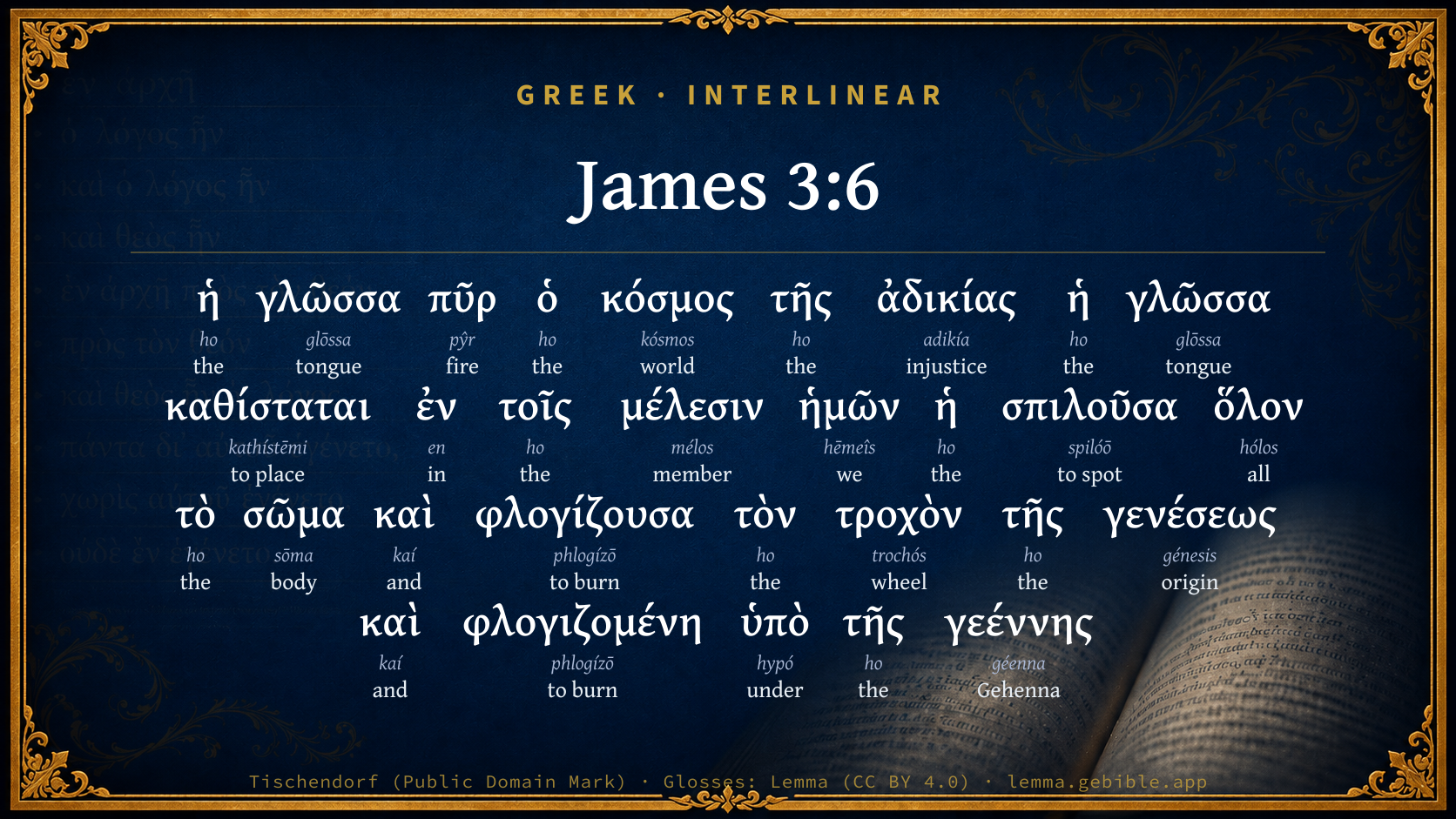
Greek (Tischendorf 8th ed.) James 3:6 appears in the Greek New Testament. The text above is from the Tischendorf 8th edition. Each word links to its Strong’s number and a concise gloss. Click any word for its full Thayer’s Greek Lexicon entry.
Download image
Cite this verse

James 3:6 (World English Bible). Public Domain. Lemma interlinear Bible study tool, https://lemma.gebible.app/v/james/3/6.

Show BibTeX & RIS
BibTeX
RIS
English Translation
And the tongue is a fire. The world of iniquity among our members is the tongue, which defiles the whole body, and sets on fire the course of nature, and is set on fire by Gehenna.
World English Bible · Public Domain
Highlights
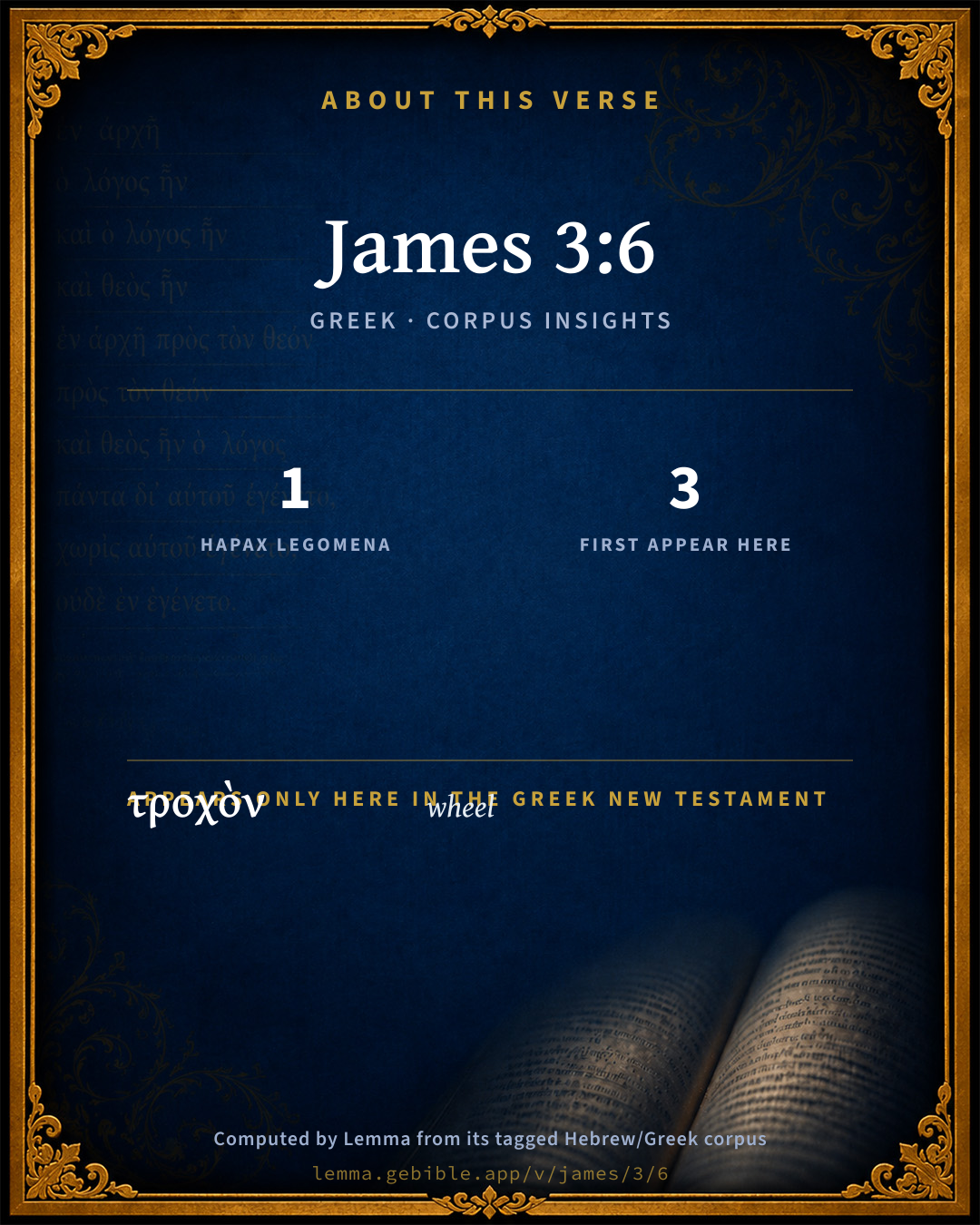
  • 1 hapax legomenon — only here in the Greek New Testament
  • 3 first appearances in the Greek New Testament
Full analysis ↓
Download a study sheet

One document with this verse’s original text, its word-by-word gloss line, the meaning frame, cross-references with their text, attributed commentary, and full source and license credits — printable, and it pastes into notes with its structure intact.

This verse Autodidact and up

Study sheet (.html) Plain text (.txt)

A passage Seminary Student

Up to 50 verses in one chapter. A passage sheet keeps up to 6 commentary sources and 12 cross-references per verse, in the order this page ranks them, and says so on the sheet whenever that leaves anything out. Ask for a single verse and you get the Autodidact verse sheet above.

Everything on this page stays free to read, with no account — the sheet is a download of what is already on screen, not access to it.

Want to remove ads? Support Godless Engineer
Compare translations 3

The same verse in 3 English versions, stacked beneath the original-language interlinear above. Click any original word for its lexicon entry.

Each is an independent rendering of the whole verse — the interlinear is not word-aligned to these translations.

Highlighted words mark where these versions differ — a whole-verse word diff, not a word-by-word alignment.

  • World English Bible Public Domain
    And the tongue is a fire. The world of iniquity among our members is the tongue, which defiles the whole body, and sets on fire the course of nature, and is set on fire by Gehenna.
  • King James Version Public Domain
    And the tongue is a fire, a world of iniquity: so is the tongue among our members, that it defileth the whole body, and setteth on fire the course of nature; and it is set on fire of hell.
  • unfoldingWord Literal Text CC BY-SA 4.0
    The tongue also a fire, the world of unrighteousness. The tongue is placed among our members, the thing staining the whole body and setting the course of existence on fire, and it is set on fire by Gehenna.

unfoldingWord Literal Text — © unfoldingWord, licensed CC BY-SA 4.0. Word-aligned USFM3 via Door43 (git.door43.org/unfoldingWord/en_ult).

Versions to compare (up to 4)

3 of 4 selected

Show all 19 translations

Every available English version of this verse, each an independent rendering of the whole verse.

  • World English Bible Public Domain
    And the tongue is a fire. The world of iniquity among our members is the tongue, which defiles the whole body, and sets on fire the course of nature, and is set on fire by Gehenna.
  • Berean Standard Bible Public Domain
    The tongue also is a fire, a world of wickedness among the parts of the body. It pollutes the whole person, sets the course of his life on fire, and is itself set on fire by hell.
  • Majority Standard Bible Public Domain
    The tongue also is a fire, a world of wickedness among the parts of the body. It pollutes the whole person, sets the course of his life on fire, and is itself set on fire by hell.
  • King James Version Public Domain
    And the tongue is a fire, a world of iniquity: so is the tongue among our members, that it defileth the whole body, and setteth on fire the course of nature; and it is set on fire of hell.
  • American Standard Version (1901) Public Domain
    And the tongue is a fire: the world of iniquity among our members is the tongue, which defileth the whole body, and setteth on fire the wheel of nature, and is set on fire by hell.
  • Revised Version (1885) Public Domain
    And the tongue is a fire: the world of iniquity among our members is the tongue, which defileth the whole body, and setteth on fire the wheel of nature, and is set on fire by hell.
  • Geneva Bible (1599) Public Domain
    And the tongue is fire, yea, a worlde of wickednesse: so is the tongue set among our members, that it defileth the whole body, and setteth on fire the course of nature, and it is set on fire of hell.
  • Douay-Rheims (1899) Public Domain
    And the tongue is a fire, a world of iniquity. The tongue is placed among our members, which defileth the whole body, and inflameth the wheel of our nativity, being set on fire by hell.
  • Young's Literal Translation Public Domain
    and the tongue `is' a fire, the world of the unrighteousness, so the tongue is set in our members, which is spotting our whole body, and is setting on fire the course of nature, and is set on fire by the gehenna.
  • Literal Standard Version CC BY-SA 4.0
    And the tongue [is] a fire, the world of the unrighteousness, so the tongue is set in our members, which is spotting our whole body, and is setting on fire the course of nature, and is set on fire by Gehenna.
  • Unlocked Literal Bible CC BY-SA 4.0
    The tongue is also a fire, a world of sinfulness set among our body parts. It stains the whole body and sets on fire the course of life. It is itself set on fire by hell.
  • unfoldingWord Literal Text CC BY-SA 4.0
    The tongue also a fire, the world of unrighteousness. The tongue is placed among our members, the thing staining the whole body and setting the course of existence on fire, and it is set on fire by Gehenna.
  • Darby Bible Public Domain
    and the tongue [is] fire, the world of unrighteousness; the tongue is set in our members, the defiler of the whole body, and which sets fire to the course of nature, and is set on fire of hell.
  • World Messianic Bible Public Domain
    And the tongue is a fire. The world of iniquity among our members is the tongue, which defiles the whole body, and sets on fire the course of nature, and is set on fire by Gehinnom.
  • Webster's Bible Public Domain
    And the tongue is a fire, a world of iniquity: so is the tongue among our members, that it defileth the whole body, and setteth on fire the course of nature; and it is set on fire from hell.
  • Free Bible Version CC BY-SA 4.0
    And the tongue is a fire! The tongue is a world of evil among the parts of the body. It disgraces all you are as a person, and can burn down the whole of your life, since it is set on fire by Gehenna.
  • Bible in Basic English Public Domain
    And the tongue is a fire; it is the power of evil placed in our bodies, making all the body unclean, putting the wheel of life on fire, and getting its fire from hell.
  • Text-Critical English NT CC BY 4.0
    And the tongue is a fire. The tongue is placed among our members as a world of unrighteousness, staining the entire body, setting the course of life on fire, and itself being set on fire by hell.
  • Tyndale New Testament (1534) Public Domain
    and the tonge is fyre and a worlde of wyckednes. So is the tonge set amonge oure members that it defileth the whole body and setteth a fyre all that we have of nature and is it selfe set a fyre even of hell.

Literal Standard Version (2020), Covenant Press — licensed CC BY-SA 4.0. Text via the HelloAO Bible API (eBible.org). Unlocked Literal Bible (unfoldingWord) — licensed CC BY-SA 4.0. Text via the HelloAO Bible API (eBible.org). unfoldingWord Literal Text — © unfoldingWord, licensed CC BY-SA 4.0. Word-aligned USFM3 via Door43 (git.door43.org/unfoldingWord/en_ult). Free Bible Version, Dr. Jonathan Gallagher — licensed CC BY-SA 4.0. Text via the HelloAO Bible API (eBible.org).

Word by word

More ways to search: Search by grammar → Find every occurrence → Compare this word →

Practice this passage: Drill this verse → Learn its vocabulary →

τροχὸν
trochós
G5164
“wheel”
Noun, Accusative, Singular, Masculine
Part of Speech
Noun
Case
Accusative
Number
Singular
Gender
Masculine
Full Thayer's Definition

Origin: from G5143

TDNT: None

1. a wheel
  1. ἡ ho G3588 “the” Article, Nominative, Singular, Feminine
  2. γλῶσσα glōssa G1100 “tongue” Noun, Nominative, Singular, Feminine
  3. πῦρ pŷr G4442 “fire” Noun, Nominative, Singular, Neuter
  4. ὁ ho G3588 “the” Article, Nominative, Singular, Masculine
  5. κόσμος kósmos G2889 “world” Noun, Nominative, Singular, Masculine
  6. τῆς ho G3588 “the” Article, Genitive, Singular, Feminine
  7. ἀδικίας adikía G93 “injustice” Noun, Genitive, Singular, Feminine
  8. ἡ ho G3588 “the” Article, Nominative, Singular, Feminine
  9. γλῶσσα glōssa G1100 “tongue” Noun, Nominative, Singular, Feminine
  10. καθίσταται kathístēmi G2525 “to place” Verb, Present, Passive, Indicative, 3rd person, Singular
  11. ἐν en G1722 “in” Preposition
  12. τοῖς ho G3588 “the” Article, Dative, Plural, Neuter
  13. μέλεσιν mélos G3196 “member” Noun, Dative, Plural, Neuter
  14. ἡμῶν hēmeîs G2249 “we” Personal pronoun, 1st person, Genitive, Plural
  15. ἡ ho G3588 “the” Article, Nominative, Singular, Feminine
  16. σπιλοῦσα spilóō G4695 “to spot” Verb, Present, Active, Participle, Nominative, Singular, Feminine
  17. ὅλον hólos G3650 “all” Adjective, Accusative, Singular, Neuter
  18. τὸ ho G3588 “the” Article, Accusative, Singular, Neuter
  19. σῶμα sōma G4983 “body” Noun, Accusative, Singular, Neuter
  20. καὶ kaí G2532 “and” Conjunction
  21. φλογίζουσα phlogízō G5394 “to burn” Verb, Present, Active, Participle, Nominative, Singular, Feminine
  22. τὸν ho G3588 “the” Article, Accusative, Singular, Masculine
  23. τῆς ho G3588 “the” Article, Genitive, Singular, Feminine
  24. γενέσεως génesis G1078 “origin” Noun, Genitive, Singular, Feminine
  25. καὶ kaí G2532 “and” Conjunction
  26. φλογιζομένη phlogízō G5394 “to burn” Verb, Present, Passive, Participle, Nominative, Singular, Feminine
  27. ὑπὸ hypó G5259 “under” Preposition
  28. τῆς ho G3588 “the” Article, Genitive, Singular, Feminine
  29. γεέννης géenna G1067 “Gehenna” Noun, Genitive, Singular, Feminine

About this verse

These counts appear in no published source. They are computed here, from the morphology-tagged text and Lemma’s own curated glosses. What Lemma adds →

30
words
18
distinct lemmas
General Epistles
section

Notable vocabulary

1 hapax legomenon — a word that appears only here in the entire Greek New Testament:

  • τροχὸν wheel G5164

First appearance in Scripture

These words make their first canonical appearance in the Greek New Testament here:

  • σπιλοῦσα to spot G4695
  • φλογίζουσα to burn G5394
  • τροχὸν wheel G5164

Shared distinctive vocabulary

σπιλοῦσα to spot G4695 occurs in 2 verses of the Greek New Testament. Also found in:
Repetition

Words recur within this verse:

  • γλῶσσα tongue G1100 ×2
  • φλογίζουσα to burn G5394 ×2
  • ἡ the G3588 ×10
  • καὶ and G2532 ×2

Cross-references

57

Topical passages linked to James 3:6 in the Treasury of Scripture Knowledge — connected by theme and wording, ordered by reader-vote popularity; previews shown in the World English Bible.

  • Psalms 120:2–3 Deliver my soul, Yahweh, from lying lips, From a deceitful tongue.
  • Proverbs 16:27 A worthless man devises mischief. His speech is like a scorching fire.
  • Mark 7:15 There is nothing from outside of the man, that going into him can defile him; but the things which proceed out of the man are those that defile the man.
  • Matthew 15:11–20 That which enters into the mouth doesn't defile the man; but that which proceeds out of the mouth, this defiles the man."
  • Proverbs 15:1 A gentle answer turns away wrath, But a harsh word stirs up anger.
  • Mark 7:20–22 He said, "That which proceeds out of the man, that defiles the man.
  • Luke 16:24 He cried and said, 'Father Abraham, have mercy on me, and send Lazarus, that he may dip the tip of his finger in water, and cool my tongue! For I am in anguish in this flame.'
  • Colossians 3:8–9 but now you also put them all away: anger, wrath, malice, slander, and shameful speaking out of your mouth.
  • Psalms 64:3 Who sharpen their tongue like a sword, And aim their arrows, deadly words,
  • Psalms 140:3 They have sharpened their tongues like a serpent. Viper's poison is under their lips. Selah.
  • Proverbs 6:19 A false witness who utters lies, And he who sows discord among brothers.
  • Matthew 12:32–36 Whoever speaks a word against the Son of Man, it will be forgiven him; but whoever speaks against the Holy Spirit, it will not be forgiven him, neither in this age, nor in that which is to come.
  • Proverbs 7:21–23 With persuasive words, she led him astray. With the flattering of her lips, she seduced him.
  • 2 Samuel 19:43–20:1 The men of Israel answered the men of Judah, and said, We have ten parts in the king, and we have also more [right] in David than you: why then did you despise us, that our advice should not be first had in bringing back our king? The words of the men of Judah were fiercer than the words of the men of Israel.
  • Proverbs 26:20–21 For lack of wood a fire goes out; Without gossip, a quarrel dies down.
  • Mark 14:55–57 Now the chief priests and the whole council sought witnesses against Jesus to put him to death, and found none.
  • Acts 5:3 But Peter said, "Ananias, why has Satan filled your heart to lie to the Holy Spirit, and to keep back part of the price of the land?
  • Acts 6:13 and set up false witnesses who said, "This man never stops speaking blasphemous words against this holy place and the law.
  • Romans 3:13–14 "Their throat is an open tomb. With their tongues they have used deceit." "The poison of vipers is under their lips;"
  • Romans 16:17–18 Now I beg you, brothers, look out for those who are causing the divisions and occasions of stumbling, contrary to the doctrine which you learned, and turn away from them.
  • 2 Thessalonians 2:9–12 even he whose coming is according to the working of Satan with all power and signs and lying wonders,
  • James 2:7 Don't they blaspheme the honorable name by which you are called?
  • 3 John 1:10 Therefore, if I come, I will call attention to his deeds which he does, unjustly accusing us with wicked words. Not content with this, neither does he himself receive the brothers, and those who would, he forbids and throws out of the assembly.
  • Jude 1:8–10 Yet in like manner these also in their dreaming defile the flesh, despise authority, and slander celestial beings.
  • Judges 16:15–20 She said to him, How can you say, I love you, when your heart is not with me? you have mocked me these three times, and have not told me in which your great strength lies.
  • Proverbs 1:10–14 My son, if sinners entice you, don't consent.
  • Isaiah 30:27 Behold, the name of Yahweh comes from far, burning with his anger, and in thick rising smoke: his lips are full of indignation, and his tongue is as a devouring fire;
  • Jeremiah 20:10 For I have heard the defaming of many, terror on every side. Denounce, and we will denounce him, [say] all my familiar friends, those who watch for my fall; peradventure he will be persuaded, and we shall prevail against him, and we shall take our revenge on him.
  • Matthew 5:22 But I tell you, that everyone who is angry with his brother without a cause shall be in danger of the judgment; and whoever shall say to his brother, 'Raca!' shall be in danger of the council; and whoever shall say, 'You fool!' shall be in danger of the fire of Gehenna.
  • Matthew 12:24 But when the Pharisees heard it, they said, "This man does not cast out demons, except by Beelzebul, the prince of the demons."
  • Acts 20:30 Men will arise from among your own selves, speaking perverse things, to draw away the disciples after them.
  • Ephesians 5:3–4 But sexual immorality, and all uncleanness, or covetousness, let it not even be mentioned among you, as becomes saints;
  • Titus 1:11 whose mouths must be stopped; men who overthrow whole houses, teaching things which they ought not, for dishonest gain's sake.
  • 2 Peter 2:1–2 But there also arose false prophets among the people, as among you also there will be false teachers, who will secretly bring in destructive heresies, denying even the Master who bought them, bringing on themselves swift destruction.
  • 2 Peter 3:3 knowing this first, that in the last days mockers will come, walking after their own lusts,
  • Jude 1:15–18 to execute judgment on all, and to convict all the ungodly of all their works of ungodliness which they have done in an ungodly way, and of all the hard things which ungodly sinners have spoken against him."
  • Revelation 2:14–15 But I have a few things against you, because you have there some who hold the teaching of Balaam, who taught Balak to throw a stumbling block before the children of Israel, to eat things sacrificed to idols, and to commit sexual immorality.
  • Revelation 13:1–5 Then I stood on the sand of the sea. I saw a beast coming up out of the sea, having ten horns and seven heads. On his horns were ten crowns, and on his heads, blasphemous names.
  • Revelation 13:14 He deceives my own people who dwell on the earth because of the signs he was granted to do in front of the beast; saying to those who dwell on the earth, that they should make an image to the beast who had the sword wound and lived.
  • Numbers 31:16 Behold, these caused the children of Israel, through the counsel of Balaam, to commit trespass against Yahweh in the matter of Peor, and so the plague was among the congregation of Yahweh.
  • 2 Samuel 13:26–29 Then said Absalom, If not, please let my brother Amnon go with us. The king said to him, Why should he go with you?
  • 2 Samuel 15:2–6 Absalom rose up early, and stood beside the way of the gate: and it was so, that when any man had a suit which should come to the king for judgment, then Absalom called to him, and said, Of what city are you? He said, Your servant is of one of the tribes of Israel.
  • 1 Kings 21:5–15 But Jezebel his wife came to him, and said to him, Why is your spirit so sad, that you eat no bread?
  • Jeremiah 28:16 Therefore thus says Yahweh, Behold, I will send you away from off the surface of the earth: this year you shall die, because you have spoken rebellion against Yahweh.
  • 2 Corinthians 11:13–15 For such men are false apostles, deceitful workers, masquerading as Christ's apostles.
  • Revelation 12:9 The great dragon was thrown down, the old serpent, he who is called the devil and Satan, the deceiver of the whole world. He was thrown down to the earth, and his angels were thrown down with him.
  • Revelation 18:23 The light of a lamp will shine no more at all in you. The voice of the bridegroom and of the bride will be heard no more at all in you; for your merchants were the princes of the earth; for with your sorcery all the nations were deceived.
  • Revelation 19:20 The beast was taken, and with him the false prophet who worked the signs in his sight, with which he deceived those who had received the mark of the beast and those who worshiped his image. These two were thrown alive into the lake of fire that burns with sulfur.
  • 2 Chronicles 13:17 Abijah and his people killed them with a great slaughter: so there fell down slain of Israel five hundred thousand chosen men.
  • Genesis 3:4–6 The serpent said to the woman, "You won't surely die,
  • Leviticus 24:11 The son of the Israelite woman blasphemed the Name, and cursed; and they brought him to Moses. His mother's name was Shelomith, the daughter of Dibri, of the tribe of Dan.
  • Deuteronomy 13:6 If your brother, the son of your mother, or your son, or your daughter, or the wife of your bosom, or your friend, who is as your own soul, entice you secretly, saying, Let us go and serve other gods, which you have not known, you, nor your fathers;
  • Judges 12:4–6 Then Jephthah gathered together all the men of Gilead, and fought with Ephraim; and the men of Gilead struck Ephraim, because they said, You are fugitives of Ephraim, you Gileadites, in the midst of Ephraim, [and] in the midst of Manasseh.
  • 1 Samuel 22:9–17 Then answered Doeg the Edomite, who stood by the servants of Saul, and said, I saw the son of Jesse coming to Nob, to Ahimelech the son of Ahitub.
  • 2 Samuel 16:20–17:2 Then said Absalom to Ahithophel, Give your counsel what we shall do.
  • 2 Chronicles 10:13–16 The king answered them roughly; and king Rehoboam forsook the counsel of the old men,
  • Proverbs 7:5 That they may keep you from the strange woman, From the foreigner who flatters with her words.

Cross-references courtesy of OpenBible.info (CC BY 4.0).

Commentary

Notes on James 3:6 from classic Christian and Jewish commentators (each source and its license shown beneath its notes). The classic Christian expositions comment on the surrounding passage and are grouped to its opening verse, so a note may address several verses; the Jewish commentaries on the Tanakh (Rashi and others) are per-verse, so they appear only where the commentator wrote on this verse.

Lemma curates 59 commentaries, every one of them public domain or Creative Commons licensed, each selected and text-cleaned for this edition rather than reprinted as found. About our sources →

Joseph Benson's Commentary

Jas 3:6. The tongue is a fire — Which often produces a great conflagration; a world of iniquity — This is a metaphor of the same kind with a sea of troubles, a deluge of wickedness. The meaning is, that a great collection of iniquity proceeds from the tongue. Indeed “there is no iniquity which an unbridled tongue is not capable of producing; either by itself, when it curses, rails, teaches false doctrine, and speaks evil of God and man; or by means of others, whom it entices, commands, terrifies, and persuades, to commit murders, adulteries, and every evil work.” So is the tongue — Such is the rank and place it holds among our members, that it defileth the whole body — The whole man, all our members, senses, and faculties. In this, and in what follows, the similitude of the fire and wood is carried on. For as the fire, put among the wood, first spotteth or blackeneth it with its smoke, and then setteth it on fire, so the tongue spotteth or blackeneth, and then setteth on fire the natural frame, termed here the course, τροχον, the wheel, of nature — “The wonderful mechanism of the human body, and its power of affecting and of being affected by the soul, is in this passage aptly represented by the wheels of a machine which act on each other. The pernicious influence of the tongue, in first spotting, and then destroying, both the bodies and the souls of men, arises from the language which it frames, whereby it inflames men’s passions to such a degree, that, being no longer under the direction of their reason, those passions push them on to such actions as are destructive both of their bodies and souls.” Some writers, by the natural wheel, or course of nature, understand the successive generations of men, one generation going, and another coming, without intermission; according to which interpretation the apostle’s meaning is, that the tongue hath set on fire our forefathers, it inflameth us, and will have the same influence on those who come after us. And it is set on fire of hell — Put here for the devil; as, by a like metonymy, heaven is put for God. Satan influences the heart, and its wickedness overflows by the tongue, and tends, by its fatal consequences, to produce a very hell upon earth. “The use we ought to make of the doctrine taught in this highly figurative passage is obvious. Being surrounded with such a mass of combustible matter, we should take great care not to send from our tongues the least spark by which it may be kindled, lest we ourselves, with those whom we set on fire, be consumed in the flames which we raise.” — Macknight.

Joseph Benson's Commentary on the Old and New Testaments (1811–1818) — public domain. Text from a community e-Sword module.

Tyndale Open Study Notes

Tyndale Open Resources

3:6 It is a whole world of wickedness: The tongue acts as an agent of the whole unrighteous world opposed to God (1:27; 4:4). • hell itself: Greek Gehenna, the place of eternal punishment (Matt 5:22, 30; 23:15), in contrast to Hades, the abode of the dead (Luke 16:23; Acts 2:31). The reference to hell is an allusion to the devil (Jas 4:7; Matt 5:22; John 8:44) as the ultimate source of evil speech.

Tyndale Open Study Notes — © Tyndale Open Resources, licensed CC BY-SA 4.0. Text via the HelloAO Bible API.

Bengel's Gnomon

Johann Albrecht Bengel

Jas 3:6. Ὁ κόσμος, the world) This is part of the subject, with the addition of the article (as ἡ σπιλοῦσα, which follows), showing why the tongue is called fire: namely, because it is a world (in the Vulgate universitas, a universe) of iniquity. The words, how great a matter, and the world, refer to each other. As the little world of man is an image of the universe,[35] so the tongue is an image of the little world of man, exciting it altogether. There is a frequent metaphor from the universe to the lesser world: Psa 139:15; Ecc 12:2; and not only to man: there is a reference to the whale, Jon 2:3; Jon 2:6-7. James employs this figure. The world has its higher and its lower parts: these are, in a better point of view, the heaven and the earth; in a worse, the earth and hell. And as in the world, heaven or hell is with reference to the earth; so in man, the heart, of which the tongue is the instrument, is with reference to the whole body or nature. For in the case of the good, heaven, and in the case of the wicked, hell, has its veins in the heart: from which source so many wonders are diffused to the course of nature (nativitatis). We may learn from Psa 77:18, what is meant by this course. Φωνὴ τῆς βροντῆς σου ἐν τῷ τροχῷ, ἔφαναν αἱ ἀστραπαί σου τῇ οἰκουμένῃ. The voice of Thy thunder teas in the heaven, Thy lightnings lightened the world: for as in that passage גלגל, ΤΡΟΧῸς, as opposed to חבל, Τῇ ΟἸΚΟΥΜΕΝῌ, denotes the celestial or aerial sphere, so in this place ΤΡΟΧῸς Τῆς ΓΕΝΈΣΕΩς, the course of nature, as opposed to τῇ γεέννῃ, hell, or the heart, denotes the higher parts of the earth, or the entire nature of man, which holds a middle place between heaven and hell; and thus it denotes the body with its entire temperament. Comp. Jas 3:15, from above, earthly, devilish.—ΓΈΝΕΣΙς, the natural constitution; Jas 1:23; and life; Jdt 12:18.—ΠΆΣΑς ΤᾺς ἩΜΈΡΑς Τῆς ΓΕΝΈΣΕΏς ΜΟΥ, all the days since I was born. The metaphor is taken from a round wheel, and is very appropriate: for as a wheel is turned about with great velocity; so it is with the sphere of heaven, and the nature of man; and this being set on fire while it revolves, soon breaks out into a blaze in every part, so that the fire seems not only to be borne in a circle, but also to be a circle. Respecting the flaming wheels of the Divine throne, see Dan 7:9.—οὕτως, so) This word not read in the African copies, has been introduced into this place from the beginning of the fifth verse.[36] If the apostle had intended to use it a second time in this comparison, he would have used it at the beginning, and not in the middle of the Apodosis, ΟὝΤΩ ΚΑῚ Ἡ ΓΛῶΣΣΑ ΠῦΡ. A few copies, but those of great authority, omit ΟὝΤΩς. Isidorus of Pelusinm in particular joining them. There are three comparisons beginning with ἼΔΕ, ἸΔΟῪ, ἸΔΟῪ (Jas 3:3-5). The third comparison has its Protasis in the middle of Jas 3:5: ἸΔΟῪ ὈΛΊΓΟΝ ΠῦΡ ἩΛΊΚΗΝ ὝΛΗΝ ἈΝΆΠΤΕΙ· the Apodosis begins at the beginning of Jas 3:6, and consists of two declarations, the former of which is as follows: ΚΑῚ Ἡ ΓΛῶΣΣΑ ΠῦΡ, Ὁ ΚΌΣΜΟς Τῆς ἈΔΙΚΊΑς (supply ἘΣΤΊΝ): the other is Ἡ ΓΛῶΣΣΑ ΚΑΘΊΣΤΑΤΑΙ ἘΝ ΤΟῖς ΜΈΛΕΣΙΝ ἩΜῶΝ Ἡ ΣΠΙΛΟῦΣΑ ὍΛΟΝ ΤῸ ΣῶΜΑ. In this second declaration Ἡ ΓΛῶΣΣΑ, the tongue, is as it were the Subject, and is repeated a second time by way of Anaphora[37] and emphasis, as far as the particle ΟὝΤΩς· the predicate is ΚΑΘΊΣΤΑΤΑΙ—ΤῸ ΣῶΜΑ, in this easy sense; the tongue is that which defiles the whole body. Between these two clauses οὕτως seems to be out of place; so far is the sense from being impaired by the removal of οὕτως. This is followed by the explanation, inasmuch as being that which both inflames and is itself inflamed, etc.; where, by a metaphor from the universe (the macrocosm) to man (the microcosm), the wheel, or higher sphere (comp. Psa 77:18), is man’s rational nature itself; but hell is the lower part, the heart. The tongue, situated in the middle, is inflamed by the lower parts, and inflames the higher, being itself a world, or orb of iniquity. Thus I hope that those things which Wolf has remarked on this passage, will be explained; and I am quite willing that the things which I have said should be compared with the interpretation of Baumgarten.—καθίσταται) The same word occurs ch. Jas 4:4.—ΣΠΙΛΟῦΣΑ, defiling) as fire, by smoke.—καὶ φλογίζουσα καὶ φλογιζομένη) inasmuch as being that which both inflames and is inflamed. The passive is put after the active form; for the man who sins with his tongue, departs more and more out of his own power.

[35] The term macrocosmus (macrocosm) is applied to the universe at large; and microcosmus (microcosm) to the little world of man. Thus Manilius:—

[36] ABC Vulg. both Syr. Versions, Memph. Theb. omit οὕτως before ἡ γλῶσσα καθίσταται. Rec. Text supports it without very old authority.—E.

[37] See Append. The frequent repetition of the same word in beginnings.

“Quid mirum, noscere mundum

Si possunt homines, quibus est et mundus in ipsis

Exemplumque Dei quisque est in imagine parvâ?”

And Shakespeare:—

Coriolanus.—“If you see this in the map of my microcosm.”—T.

Bengel's Gnomon of the New Testament — English translation (T&T Clark, Edinburgh, 1860) — public domain. Text from a community e-Sword module.

Meyer's Critical & Exegetical Commentary

Heinrich August Wilhelm Meyer

Jam_3:6. Application of the image: Also the tongue is a fire, the world of unrighteousness; the tongue sets itself among our members, as that which defileth the whole body and kindleth the wheel (of life) revolving from birth, and is kindled of hell. As a (little) fire setteth a forest in conflagration, so also the tongue kindleth the whole life of man. Such is the destructive power of the tongue, that whosoever knows how to bridle it may with truth be called a perfect man (Jam_3:2).

Several interpreters divide the first clause: καὶ ἡ γλῶσσα πῦρ, ὁ κόσμος τῆς ἀδικίας, into two corresponding parts, supplying the idea ὕλη to ὁ κόσμος τῆς ἀδικίας; thus Morus: igni respondet lingua, materiae seu silvae respondet mundus improbus. Manifestly wholly arbitrary; rather the words ὁ κόσμος τῆς ἀδικίας form an apposition to ἡ γλῶσσα, by which the power of the tongue similar to destructive fire is explained. κόσμος has here the same meaning as in LXX. Pro_17:6 : ὅλος κόσμος τῶν χρημάτων;[172] thus the multitude comprehending the individual: consequently Ὁ ΚΌΣΜΟς Τῆς ἈΔΙΚΊΑς is the fulness of unrighteousness. The tongue is so called because, as the organ of ὀργή, it includes a fulness (not exactly the sum-total) of unrighteousness which from it pervades the other members (ὅλον τὸ σῶμα). Calvin correctly, according to the sense: acsi vocaret mare vel abyssum (Luther inaccurately: a world full of wickedness). This is the explanation of most expositors. Bouman correctly explains the definite article: famosus iste mundus iniquitatis. The following are other explanations:(1) Oecumenius takes κόσμος = ornament, and explains: Ἡ ΓΛῶΣΣΑ ΚΟΣΜΕῖ ΤῊΝ ἈΔΙΚΊΑΝ ΔΙᾺ Τῆς ΤῶΝ ῬΗΤΌΡΩΝ ΕὐΓΛΏΤΤΟΥ ΔΕΙΝΌΤΗΤΟς; similarly Wetstein, Semler, Elsner, Rosenmüller, Storr, Lange[173] (Wahl is doubtful). But κόσμος never signifies in an active sense that which puts an ornament on another, but always the ornament itself, that wherewith a person adorns himself (or another). (2) Bretschneider likewise takes the word as equivalent to ornament, but supplies ὡς, and explains: ut ornatus (mulierum) inhonestus sc. inquinat mentes, sic lingua deprehenditur inter corporis membra id quod totum corpus inquinat; yet evidently more arbitrarily than the foregoing explanation. (3) Theile retains the usual meaning of the word world, and explains: lingua (est ignis), mundus (vero est) improbitatis i.e. improbitate plenus, nimirum ob illam ipsam linguae vim; but apart from the inadmissible supplements rendered necessary, and the harshness contained in this combination of the genitive, this explanation is to be rejected, because by it the words would contain an assertion on the nature of the world, instead of on the nature of the tongue. (4) Estius, indeed, is right in his comprehension of the idea, but he arbitrarily understands it as causative: quia (lingua) peccata omnigena parit; so also Herder: the mainspring and the cause of all unrighteousness. Gebser introduces something foreign into the explanation, taking κόσμος = the wicked world. Clericus, Hammond, Eichhorn, Kuinoel, and Hottinger, without any sufficient reason, think that the words are to be expunged from the text as spurious.

Whilst almost all expositors refer ὁ κόσμος τῆς ἀδικίας to what precedes (to which, according to the reading of the Rec. which has οὕτως before the following ἡ γλῶσσα, it necessarily belongs), Tischendorf has put a point after πῦρ but not after ἀδικίας;[174] and Neander translates: As a world full of unrighteousness, the tongue is among our members; so also Lange construes it. But this construction is not only difficult, but isolates too much the first thought ἡ γλῶσσα πῦρ, which only has a correct meaning when it is closely connected with what follows.

The new clause accordingly begins with ἡ γλῶσσα, and καθίσταται has its necessary supplement in what follows: ἡ σπιλοῦσα κ.τ.λ.

καθίσταται] can neither here nor in chap. Jam_4:4 mean it stands: the perfect only has this meaning, but not the present; it means: it sets itself, it appears (Wiesinger). Also the explanations are false: it is so placed (Pott); collocata est (Beza, Piscator, Schneckenburger); it becomes (such) (de Wette, appealing to Rom_5:19), and it rules (Lange, appealing to Heb_8:3). Theile arbitrarily completes the idea: hand raro. The words which follow mention how the tongue appears among the membersas that which defileth the whole body. The idea σπιλοῦν, to which certainly πῦρ is not suited, is suggested by the apposition ὁ κόσμος τῆς ἀδικίας. Only with the following participle does James carry on the image of fire; it is artificial to assume in σπιλοῦν a reference to it. Bengel: maculans, ut ignis per fumum; comp. on this passage Ecc_5:5. Neither the double καί (for how often the several καί succeed each other in a simple copulative sense!) nor the omission of the article before the two participles (comp. chap. Jam_4:11; Jam_4:14) proves that the participles which follow καὶ φλογίζουσα and καὶ φλογιζομένη are subordinated to σπιλοῦσα (Wiesinger). This construction could only be considered as correct if the two participles analyzed the idea σπιλοῦσα ὅλ. τ. σῶμα into its individual parts or confirmed it; but neither of these is the case here; they rather add to this idea two new points. The object τὸν τροχὸν τῆς γενέσεως, belonging to φλογίζουσα, has found very different explanations. The word τροχός, according to its etymology, denotes something running, and, although used of other rotatory orbs, as particularly of the potters wheel, it is especially used as a designation of a wheel, 1Ki_7:30 ff.; Eze_1:15; Eze_1:19-20. The word γένεσις can here be only in the same sense as in chap. Jam_1:23; the compound idea: the wheel of birth, i.e. the wheel revolving from birth, is a figurative designation of human life; comp. Anacreon, Od. iv. 7: τροχὸς ἅρματος γὰρ οἷα βίστος τρέχει κυλισθείς. Thus Gebser in particular correctly explains it: the wheel which is set in motion from our birth, i.e. a poetical description of life; so also Brückner and Bouman. The explanations of Oecumenius (τροχός· ὁ βίος ὡς εἰς ἑαυτὸν ἀνελιττόμενος), Calvin, Laurentius, Hornejus, Pott, Neander, amount to the same thing. Also Estius, Grotius, Carpzov, Michaelis understand life, only deriving this idea in a different manner. They explain τροχός (for which Grotius would read τρόχος) = cursus, γένεσις = natura, and cursus naturae = vita; by this explanation, however, the figurative nature of the expression suffers. Wiesinger (with whom Rauch agrees), deviating from this explanation, prefers to understand by it the whole body (ὅλον τὸ σῶμα), τροχός denoting either the wheel (by which, then, τροχὸς τ. γεν. would be the revolving wheel of existence, of life, namely, of that to which the tongue belongs), or (which Wiesinger prefers) the circumference (thus τροχ. τ. γεν. would be the circumference of being, i.e. the circumference belonging to the tongue from birth, native to it). But, on the one hand, it is not to be supposed that James, after using the ordinary expression ὅλον τὸ σῶμα, should express the same thing figuratively without the least indication of the identity of meaning; and, on the other hand, it is opposed to the first interpretation that the body is not to be represented as a wheel, and to the second that τροχός is taken in a sense which it never has, for it never means the circumference, but at the most the round border which incloses something. Other expositors go beyond the restriction of the expression to the life of the individual,which is evidently required by the foregoing ὅλον τὸ σῶμα,either, with Wolf, appealing to the Hebrew גִּלְגַּל תּוֹלְרוֹת, explaining it: indesinens successio hominum aliorum post alios nascentium (thus Lambert, Bos, Alberti, Augusti, Stäudlin),[175] or taking ΤΡΟΧΌς = ΚΎΚΛΟς, ΓΈΝΕΣΙς = ΚΤΊΣΙς, and accordingly ΤΡΟΧ. Τ. ΓΕΝΈΣΕΩς = the circle of creation; thus de Wette, and among the earlier interpreters Beza (in the edition of 1565), Crusius, Coccejus. All these ideas are foreign to the context. If the first explanation drags something foreign into it, the second bears besides a monstrous character (Wiesinger). Still less is the explanation of Lange to be justified: the wheel of the development of life, primarily of the Jewish nation, and then further of all mankind, since ΓΈΝΕΣΙς never denotes development of life.

[172] It is to be observed that the LXX. often translate the Hebrew צָבָא by κόσμος; see Gen_2:1; Deu_4:19; Deu_17:3; Isa_24:21; Isa_40:26.

[173] Lange, indeed, grants that κόσμος is not an active idea, but he yet thinks that we must return to the original signification of the word, and he then explains it: the tongue is the form of the world, worldliness, or worldly culture, because it is that which sophistically, etc., gives to unrighteousness its worldly … and even splendid form. But is not the idea so explained taken in an active sense?

[174] Lachmann and Buttmann have, by leaving out the punctuation, left the pointing to the expositor.

[175] Already the Syriac version translates: incendit proventus generationum nostrarum, quae currunt sicut rotae.

The following are other explanations which are refuted by their arbitrariness and rarity:(1) that of Semler, who explains it ordo generandi, according to the expression occurring in Plutarch: ποταμὸν τῆς γενέσεως ἐνδελεχῶς; (2) that of Bengel rota sive sphaera superior est ipsa natura humana rationalis; gehenna vero est pars profundior cor; lingua in medio ex inferioribus inflammatur et superiora inflammat; (3) that of Meyer (Observatt. ad ep. Jacobi), who takes the expression = sanguinis orbis seu circulato; lastly, (4) that of Kype, who assumes the rota poenalis is figuratively meant cujus radiis illigabantur rei, and accordingly φλογίζειν τὸν τροχ. τ. γενέσεως means: augere vitae hujus cruciatus.

The verb φλογίζειν is in the N. T. ἅπ. λεγ.; in the LXX. it is found in Exo_9:24; Num_21:14; Psa_97:3, and other places. The figurative expression, which refers back to πῦρ, indicates the fatal effect which the tongue, from which the pollution of the whole body proceeds, exercises on the life of man, whilst it pervades the same by its passionate heat. James so presents it, that being ὁ κόσμος τῆς ἀδικίας, and thus concentrating in itself (or in word) a fulness of unrighteousness, it forms, as it were, the axle round which the wheel of life moves, and by which it is set on fire. Morus incorrectly understands φλογίζειν de damnis, quae lingua dat; but the discourse is not concerning the injury which man suffers, but concerning his moral conduct; still less corresponding is the explanation of Michaelis, according to which φλογίζειν = to inflame, and that in the words of James the thought is contained: lingua saepe alii excitantur, ut insano studio mala ingrediantur. The representation that the tongue defiles the whole body and sets the life on fire is, as Wiesinger correctly remarks, not to be justified by the remark that all sins have their foundation in the sins of the tongue, but rests on the observation that ὀργή, before it manifests itself in other ways, first and foremost appears in word, and thus the tongue is its most direct organ.[176] The second participial sentence states whence the tongue receives this destructive power (ΦΛΟΓΊΖΕΙΝ), by which also the idea that it is ΚΌΣΜΟς Τῆς ἈΔΙΚΊΑς finds its justification. The participle ΦΛΟΓΙΖΟΜΈΝΗ is to be retained in the sense of the present; it has neither the meaning of the perfect, as if the tongue had been only once set on fire by γεέννα, nor is it, with Grotius, Mill, Benson, Semler, Storr, Rosenmüller, to be taken as future, and to be referred to future punishment. The expression γεέννα, except in the Synoptics, is only found here; in Mat_5:22; Mat_18:9, Mar_9:47, it is used for a more exact description of the genitive ΤΟῦ ΠΥΡΌς. The thought that the tongue is set on fire of hell is not to be explained away either by ex inferno being paraphrased by Theile by igne diabolico, and this by igne foedissimo ac funestissimo; or by being explained with Morus: tantus est ille ignis, ut ex geennae igne videatur esse incensus. James means that as ἐπιθυμία (or more precisely ὈΡΓΉ), whose most direct organ is the tongue, has its origin from the devil, it is thus from hell (see Jam_3:15). Also in the O. T. the injurious effects of the tongue are described; see Psa_52:4; Psa_120:3-4, Pro_26:27, and other passages (Sir_5:13 ff; Sir_28:11 ff.); yet in all these passages the discourse is only on the evil which is inflicted by it on others, or on the punishment which befalls the man who misuses it. This peculiar thought of James has its counterpart in no passage of the O. T.

[176] The view that James considered the tongue as the source of all sin is erroneous, since he, however prominently he brings forward the destructive power of the tongue, yet never asserts this. The restriction to ὀργή is justified by the Epistle itself. See Jam_1:19-20; Jam_1:26, Jam_2:9-10; Jam_2:13 (the opposite ἐν πραΰτητι σοφίας); 14, etc. According to this, in this edition the text in some places has been rectified.

Meyer — Critical and Exegetical Commentary on the New Testament — English translation by Peter Christie, edited by Frederick Crombie (T&T Clark, 1880) — public domain. Text from a community e-Sword module.

Expositor's Greek Testament

ed. W. Robertson Nicoll

Jas 3:6 . See critical note above for suggested differences in punctuation. καὶ ἡ γλῶσσα πῦρ : this metaphor was familiar to Jews, see Pro 16:27 , … And in his lips there is as a scorching fire ; the whole of the passage Sir 28:8-12 is very à propos , especially Jas 3:11 , ἔρις κατασπευδομένη ἐκκαίει πῦρ , καὶ μάχη κατασπεύδουσα ἐκχέει αἶμα . Knowling refers to Psalms of Sol. 12:2 4, where the same metaphor is graphically presented, but the reference is to slander, not to the fire engendered by public controversy; Jas 3:2 runs: “Very apt are the words of the tongue of a malicious man, like fire in a threshing-floor that burns up the straw” (the text in the second half of the verse is corrupt, but the general meaning is clear enough). καὶ ἡ γλῶσσα πῦρ , ὁ κόσμος τῆς ἀδικίας … τῆς γεέννης : Carr has a very helpful note on this difficult verse, he says: “a consideration of the structure of the sentence, the poetical form in which the thoughts are cast, also throws light on the meaning. From this it appears that the first thought is resumed and expounded in the last two lines, while the centre doublet contains a parallelism in itself. The effect is that of an underground flame concealed for a while, then breaking out afresh. Thus φλογίζουσα and φλογιζομένη refer to πῦρ , and σπιλοῦσα to κόσμος , though grammatically these participles are in agreement with γλῶσσα .” ὁ κόσμος τῆς ἀδικίας : This expression is an extremely difficult one, and a large variety of interpretations have been suggested; the real crux is, of course, the meaning of κόσμος . In this Epistle κόσμος is always used in a bad sense, Jas 1:27 , Jas 2:5 , Jas 4:4 . In the Septuagint ὁ κόσμος is several times the rendering of the Hebrew צבא , “host” (of heaven, i.e. , the stars, etc.), see Gen 2:1 ; Deu 4:19 ; Deu 17:3 ; there is no Hebrew word which corresponds to κόσμος , properly speaking; and it would therefore be no matter of surprise if a Jew with a knowledge of Hebrew should use κόσμος in a loose sense. In the N.T. αἰών is often used in the same sense as κόσμος , e.g. , Mat 12:32 ; Mar 4:19 ; Eph 1:21 , of this world; here again it is mostly in an evil sense in which it is referred to, whether as αἰών or κόσμος . It is, therefore, possible that κόσμος might be used in the sense of αἰών , by a Jew, but as referring to a sphere not on this earth. Schegg (quoted by Mayor) interprets the phrase, “the sphere or domain of iniquity,” and though this is not the natural meaning of κόσμος , this cannot be urged as an insuperable objection to his interpretation; we are dealing with the work of an Oriental, and a Jew, in an age long ago, and we must not therefore look for strict accuracy. If κόσμος may be regarded as being used in the sense of αἰών , which is applicable to this world or to the world to come, then Schegg’s “domain of iniquity” might refer to a sphere in the next world. When it is further noticed that the tongue is called “fire,” and that this fire has been kindled by ἡ γέεννα , the place of burning, it becomes possible to regard the words ὁ κόσμος τῆς ἀδικίας as a symbolic expression of Gehenna (see further below, under τῆς γεέννης ). καθίσταται : “is set,” i.e. , “is constituted”. Mayor says: “It is opposed to ὑπάρχω , because it implies a sort of adaptation or development as contrasted with the natural or original state; to γίγνομαι , because it implies something of fixity”. ἡ σπιλοῦσα : σπίλος means a “stain,” cf. Jud 1:23 . φλογίζουσα ; ἅπ . λεγ . in N.T., cf. Wisd. 3:28. τὸν τροχὸν τῆς γενέσεως . “the wheel of nature,” i.e. , the whole circle of innate passions; the meaning is that this wrong use of the tongue engenders jealousy, and faction, and every vile deed, cf. Jas 3:16 . For the different interpretations of the phrase see Mayor. φλογιζομένη ὑπὸ τῆς γεέννης : In Jewish theology two ideas regarding the fate of the wicked hereafter existed, at one time, concurrently; according to the one, Hades ( Sheol ) was the place to which the spirits of all men, good as well as bad, went after death; at the resurrection, the good men arose and dwelt in glory, while the wicked remained in Sheol. According to a more developed belief, the place of the departed was not the same for the good and the bad; the former went to a place of rest, and awaited the final resurrection, while the latter went to a place of torment; after the resurrection the good enter into eternal bliss, the wicked into eternal woe, but whether these latter continue in the same place in which they had hitherto been, or whether it is a different peace of torment, is not clear. A realistic conception of the place of torment arose when the “Valley of Hinnom” ( גי־הנם = ἡ γέεννα ), was pointed out as the place in which the spirits of the wicked suffered; but very soon this conception became spiritualised, and there arose the belief that the Valley of Hinnom was only the type of what actually existed in the next world. The fire which burned in the Valley of Hinnom was likewise transferred to the next worm; hence the phrases: γέεννα τοῦ πυρός , κάμινος τοῦ πυρός , etc. Cf. 4 Esdr. 7:36; Rev 9:1 , etc.

The Expositor's Greek Testament, edited by W. Robertson Nicoll (1897–1910) — public domain. Text from a community e-Sword module.

Geneva Bible (1599)

Geneva Bible translators

An heap of all mischiefs.

It is able to set the whole world on fire.

Geneva Bible (1599) marginal notes — public domain. Text via Bolls.life.

Jamieson, Fausset & Brown

Robert Jamieson, A. R. Fausset & David Brown

Translate, "The tongue, that world of iniquity, is a fire." As man's little world is an image of the greater world, the universe, so the tongue is an image of the former [BENGEL].

so--omitted in the oldest authorities.

is--literally, "is constituted." "The tongue is (constituted), among the members, the one which defileth," &c. (namely, as fire defiles with its smoke).

course of nature--"the orb (cycle) of creation."

setteth on fire . . . is set on fire--habitually and continually. While a man inflames others, he passes out of his own power, being consumed in the flame himself.

of hell--that is, of the devil. Greek, "Gehenna"; found here only and in Mat 5:22. James has much in common with the Sermon on the Mount (Pro 16:27).

Jamieson, Fausset & Brown — Commentary Critical and Explanatory on the Whole Bible (1871) — public domain (CC PDM 1.0). Text via the HelloAO Bible API.

Adam Clarke's Commentary

Verse 6. The tongue is a fire] It is often the instrument of producing the most desperate contentions and insurrections.

A world of iniquity] This is an unusual form of speech, but the meaning is plain enough; WORLD signifies here a mass, a great collection, an abundance. We use the term in the same sense-a world of troubles, a world of toil, a world of anxiety; for great troubles, oppressive toil, most distressing anxiety. And one of our lexicographers calls his work a world of words; i.e. a vast collection of words: so we also say, a deluge of wickedness, a sea of troubles; and the Latins, oceanus malorum, an ocean of evils. I do not recollect an example of this use of the word among the Greek writers; but in this sense it appears to be used by the Septuagint, Pr 17:6: Του πιστου ὁλος ὁ κοσμος των χρηματων, του δε απιστου ουδε οβολος, which may be translated, "The faithful has a world of riches, but the unfaithful not a penny." This clause has nothing answering to it in the Hebrew text. Some think that the word is thus used, 2Pe 2:5: And brought the flood, κοσμω ασεβων, on the multitude of the ungodly. Mr. Wakefield translates the clause thus: The tongue is the varnisher of injustice. We have seen that κοσμος signifies adorned, elegant, beautiful, c., but I can scarcely think that this is its sense in this place. The Syriac gives a curious turn to the expression: And the tongue is a fire and the world of iniquity is like a wood. Above, the same version has: A little fire burns great woods. So the world of iniquity is represented as inflamed by the wicked tongues of men; the world being fuel, and the tongue a fire.

So is the tongue among our members] I think St. James refers here to those well known speeches of the rabbins, Vayikra Rabba, sec. 16, fol. 159. "Rabbi Eleazar said, Man has one hundred and forty-eight members, some confined, others free. The tongue is placed between the jaws; and from under it proceeds a fountain of water, (the great sublingual salivary gland,) and it is folded with various foldings. Come and see what a flame the tongue kindles! Were it one of the unconfined members, what would it not do?" The same sentiment, with a little variation, may be found in Midrash, Yalcut Simeoni, par. 2, fol. 107; and in Erachin, fol. xv. 2, on Ps 120:3: What shall be given unto thee, or what shall be done unto thee, thou false tongue? "The holy blessed God said to the tongue: All the rest of the members of the body are erect, but thou liest down; all the rest are external, but thou art internal. Nor is this enough: I have built two walls about thee; the one bone, the other flesh: What shall be given unto thee, and what shall be done unto thee, O thou false tongue?"

Setteth on fire the course of nature] Φλογιζουσα τον τροχον της γενεσεως· And setteth on fire the wheel of life. I question much whether this verse be in general well understood. There are three different interpretations of it:

1. St. James does not intend to express the whole circle of human affairs, so much affected by the tongue of man; but rather the penal wheel of the Greeks, and not unknown to the Jews, on which they were accustomed to extend criminals, to induce them to confess, or to punish them for crimes; under which wheels, fire was often placed to add to their torments. In the book, De Maccabaeis, attributed to Josephus, and found in Haverkamp's edition, vol. ii., p. 497-520, where we have the account of the martyrdom of seven Hebrew brothers, in chap. ix, speaking of the death of the eldest, it is said: Ανεβαλον αυτον επι τον τροχοι - περι ὁν κατατεινομενος· "They cast him on the wheel, over which they extended him; πυρ ὑπεστρωσαν και διηρεθισαν τον τροχον προσεπικατατεινοντες· they put coals under it, and strongly agitated the wheel." And of the martyrdom of the sixth brother it is said, cap. 11: Παρηγον επι τον τροχον, εφ' οὑ κατατεινομενος εκμελως και εκσφονδυλιζομενος ὑπεκαιετο, και οβελισκους δε οξεις πυρωσαντες, τοις νοτοις προσεφερον, και τα πλευρα διαπειραντες αυτου, και τα σπλαγχνα διεκαιον· They brought him to the wheel, on which, having distended his limbs, and broken his joints, they scorched him with the fire placed underneath; and with sharp spits heated in the fire, they pierced his sides, and burned his bowels.

The fire and the wheel are mentioned by Achilles Tatius, lib. 7, p. 449. "Having stripped me of my garments, I was carried aloft, των μεν μαστιγας κομιζοντων, των δε πυρ και τροχον, some bringing scourges, others the fire and the wheel." Now as γενεσις often signifies life, then the wheel of life will signify the miseries and torments of life. To set on fire the wheel of life is to increase a man's torments; and to be set on fire from hell implies having these miseries rendered more active by diabolic agency; or, in other words, bad men, instigated by the devil, through their lies and calumnies, make life burdensome to the objects of their malicious tongues. The wheel and the fire, so pointedly mentioned by St. James, make it probable that this sort of punishment might have suggested the idea to him. See more in Kypke.

2. But is it not possible that by the wheel of life St. James may have the circulation of the blood in view? Angry or irritating language has an astonishing influence on the circulation of the blood: the heart beats high and frequent; the blood is hurried through the arteries to the veins, through the veins to the heart, and through the heart to the arteries again, and so on; an extraordinary degree of heat is at the same time engendered; the eyes become more prominent in their sockets; the capillary vessels suffused with blood; the face flushed; and, in short, the whole wheel of nature is set on fire of hell. No description can be more natural than this: but it may be objected that this intimates that the circulation of the blood was known to St. James. Now supposing it does, is the thing impossible? It is allowed by some of the most judicious medical writers, that Solomon refers to this in his celebrated portraiture of old age, particularly in Ec 12:6: "Or ever the silver cord be loosed, or the golden bowl be broken, or the pitcher be broken at the fountain, or the wheel broken at the cistern." Here is the very wheel of life from which St. James might have borrowed the idea; and the different times evidently refer to the circulation of the blood, which might be as well known to St. James as the doctrine of the parallax of the sun. See Clarke on Jas 1:17.

3. It is true, however, that the rabbins use the term גלגל תולדות gilgal toledoth, "the wheel of generations," to mark the successive generations of men: and it is possible that St. James might refer to this; as if he had said: "The tongue has been the instrument of confusion and misery through all the ages of the world." But the other interpretations are more likely.

Adam Clarke's Commentary on the Bible (1810–1826) — public domain. Text from a community e-Sword/MySword module.

John Calvin's Commentaries

He now explains the evils which proceed from the neglect of restraining the tongue, in order that we may know that the tongue may do much good or much evil, — that if it be modest and well regulated, it becomes a bridle to the whole life, but that if it be petulant and violent, like a fire it destroys all things.

He represents it as a small or little fire, to intimate that this smallness of the tongue will not be a hindrance that its power should not extend far and wide to do harm.

6. By adding that it is a world of iniquity, it is the same as though he had called it the sea or the abyss. And he suitably connects the smallness of the tongue with the vastness of the world; according to this meaning, A slender portion of flesh contains in it the whole world of iniquity.

So is the tongue. He explains what he meant by the term world, even because the contagion of the tongue spreads through every part of life; or rather he shews what he understood by the metaphor fire, even that the tongue pollutes the whole man. He however immediately returns to the fire, and says, that the whole course of nature is set on fire by the tongue. And he compares human life to a course or a wheel: and γένεσις, as before, he takes for nature, (James 1:23.)

The meaning is, that when other vices are corrected by age or by the succession of time, or when at least then do not possess the whole man, the vice of the tongue spreads and prevails over every part of life; except one prefers to take setting on fire as signifying a violent impulse, for we call that fervid which is accompanied with violence. And thus Horace speaks of wheels, for he calls chariots in battle fervid, on account of their rapidity. The meaning then would be, that the tongue is like untamed horses; for as these draw violently the chariots, so the tongue hurries a man headlong by its own wantonness.

When he says that it is set on fire by hell, it is the same as though he had said, that the outrageousness of the tongue is the flame of the infernal fire. For as heathen poets imagined that the wicked are tormented by the torches of the Furies; so it is true, that Satan by the fans of temptations kindles the fire of all evils in the world: but James means, that fire, sent by Satan, is most easily caught by the tongue, so that it immediately burns; in short, that it is a material fitted for receiving or fostering and increasing the fire of hell.

John Calvin's Commentaries (1540-1563) — public domain. Text from the Calvin Translation Society English edition (1840s-50s) via the Christian Classics Ethereal Library (ccel.org). Calvin's coverage is partial (roughly two-thirds of the Bible); uncommented books and verses are honest gaps, never fabricated. The 19th-century editor's footnotes and remarks are omitted so the notes are faithfully Calvin's own voice.

Ellicott's Commentary for English Readers

(6) And the tongue is a fire.—Better thus, The tongue—that world of iniquity—is a fire, to burn and destroy the fairest works of peace. The tongue is in our members that which defileth the whole body, and setteth the world aflame, and is set on fire itself of Gehenna. “The course of Nature” is literally the “wheel,” the “orb of creation.” The Jewish word for the place of torment, the accursed side of Hades, should be thus preserved: whence it was that the rich man of the parable prayed for water to cool his tongue (Luk_16:24).

“Speech is silver; silence, gold.” But even the Christian world will not endure overmuch the godly discipline of silence. Three temptations “to smite with the tongue” are specially powerful of evil: viz., as a relief from passion, as a gratification of spite, as revenge for wrong. The first is experienced by hot tempered folk; the second yielded to by the malicious; the third welcomed by the otherwise weak and defenceless; and all of us at times are in each of these divisions. Then, again, there are the “foolish talkings” (Eph_5:4), and worse, the jestings at holy things, and misquotations of Scripture: all to be avoided as not becoming saints. If then we would “walk in love” we must curb the tongue; but, better still, strive to cleanse the heart, and so be quite determined that nothing shall go forth but words of meekness and affection. Nay, if we be truly Christ’s, though “reviled” by the unruly tongues of others, we shall, like Him, “revile not again” (1Pe_2:23). And as the whole body is the Lord’s to be sanctified to Him (1Co_6:19 et seq.), so particularly must the tongue be kept from “evil-speaking, lying, and slandering,” and used rightly for the service of God. Thus may we truly offer “the calves of our lips” (Hos_14:2), more acceptable than the blood of victims slain on a thousand altars, “than all whole burnt-offerings and sacrifices” (Mar_12:23).

A Bible Commentary for English Readers, edited by Charles John Ellicott (1878–1897) — public domain. Text from a community e-Sword module.

The Cambridge Bible for Schools and Colleges

gen. ed. J. J. S. Perowne

6. And the tongue is a fire, a world of iniquity] The last words are in apposition with the subject, not the predicate, of the sentence. The tongue is described as emphatically that world—we should perhaps say, that microcosm—of unrighteousness. As uttering all evil thoughts and desires, no element of unrighteousness was absent from it, and that which includes all the elements of anything well deserves the name of being its Cosmos.

so is the tongue among our members] The particle of comparison is not found in the best MSS., but is clearly implied, and is therefore legitimately inserted in the translation, as it is in some later MSS. The sentence strictly runs, The tongue is set in our members, referring of course not to a Divine appointment, but to its actual position. It is, as a fact, that which “defiles”, better perhaps spots or stains, the whole body. Every evil word is thought of as leaving its impress, it may be an indelible impress, as a blot upon the whole character.

and setteth on fire the course of nature] The last words have no parallel in any Greek author, and are therefore naturally somewhat difficult. Literally, we might render, the wheel of nature or of birth, just as in ch. Jas_1:23 we found “the face of nature,” for the “natural face,” that with which we are born. The best interpretation seems to be that which sees in the phrase a figure for “the whole of life from birth;” the wheel which then begins to roll on its course, and continues rolling until death. The comparison of life to a race, or course of some kind, has been familiar to the poetry of all ages, and in a Latin poet, Silius Italicus (vi. 120), we have a phrase almost identical with St James’s,

“Talis lege Deûm clivoso tramite vitæ

Per varios præceps casus rota volvitur ævi.”

“So by the law of God, through chance and change,

The wheel of life rolls down the steep descent.”

What is meant, if we adopt this view, is that from the beginning of life to its close, the tongue is an ever-present inflammatory element of evil.

As an alternative explanation it is possible that there may be a reference to the potter’s wheel, as in Jer_18:3, and Sir_38:29, in the latter of which the same word for “wheel” is used. On this view the tongue would be represented as the flame that by its untempered heat mars the vessel in the hands of the potter. The frequent parallelisms between St James and the Wisdom of the Son of Sirach, are, as far as they go, in favour of this view, but the former seems to me, on the whole, preferable. A third view, that the words have the same kind of meaning as orbis terrarum, and mean, as in the English Version, the whole order or course of nature, i.e. of human history in the world at large, has, it is believed, less to recommend it.

and it is set on fire of hell] The Greek participle is in the present. The tongue that speaks evil is ever being set on fire of Gehenna. St James does not shrink from tracing sins of speech to their source. The fire of man’s wrath is kindled from beneath, as the fire that cleanses is kindled from above. Bearing in our minds the wonder of the day of Pentecost, it is hardly too bold to say that we have to choose whether our tongue shall be purified by the fire of the Holy Spirit or defiled by that of Gehenna. The latter word is that employed in the Gospels, as here, for “Hell”, wherever that word means, not simply the place of the dead, which is expressed in the Greek by Hades, the unseen world, but the place of torment. Primarily, the word is a Hebrew one, signifying the Valley of Hinnom. As that valley had been in the days of the idolatries of Judah the scene of the fires of Moloch worship (2Ki_23:10; Jer_7:31; Jer_19:5-6), and had in later times become the cloaca where the filth and offal of the city were consumed in fires kept continually burning (so it is commonly said, but the fact is not quite certain), it came to be among the later Rabbis what Tartarus was to the Greeks, the symbol of the dread penalties of evil. Comp. Mat_5:22, Mar_9:43.

The Cambridge Bible for Schools and Colleges (gen. ed. J. J. S. Perowne; Cambridge University Press, 1878–1918) — public domain. Text from a community e-Sword module.

John Gill's Exposition

And the tongue is a fire,.... It is like to fire, very useful in its place, to warm and comfort; so is the tongue in Christian conversation, and in the ministry of the word; the hearts of God's children burn within them, while they are talking together, and while the Scriptures of truth are opening to them; but as fire should be carefully watched, and kept, so should men take heed to their ways, that they sin not with their tongue, and keep their tongue from evil, and their lips from speaking guile; for as fire kindles and rises up into a flame, so unchaste, angry, and passionate words, stir up the flame of lust, anger, envy, and revenge; and as fire is of a spreading nature, so are lies, scandal, and evil reports vented by the tongue; and as fire devours all that comes in its way, such are the words of an evil tongue; and therefore are called devouring words, Psa 52:4 they devour the good names of men, and corrupt their good manners, and destroy those who make use of them; and what wood is to fire, and coals to burning coals, that are whisperers, tale bearers, backbiters, and contentious persons to strife, Pro 26:20

a world of iniquity; that is, as the world is full of things, and full of sin, for it lies in wickedness, so is the tongue full of iniquity; there is a world of it in it; it abounds with it; it cannot well be said how much sin is in it, and done, or occasioned by it; as blasphemy against God, Father, Son, and Spirit; cursing of men, imprecations on themselves, their souls, and bodies, and on others, with a multitude of profane and dreadful oaths; obscene, filthy, and unchaste words; angry, wrathful, and passionate ones; lies, flatteries, reproaches, backbitings, whisperings, tale bearings, &c. And the Jews say, that he that uses an evil tongue multiplies transgression, and that it is equal to idolatry, adultery, and murder (h), and the cause of all sin; and which they express by way of fable, in this manner (i):

"when Adam sinned, God laid hold on him, and slit his tongue into two parts, and said unto him, the wickedness which is, or shall be in the world, thou hast begun with an evil tongue; wherefore I will make all that come into the world know that thy tongue is the cause of all this.''

The Syriac version renders this clause thus, "and the world of iniquity is as wood"; or the branch of a tree; the tongue is fire, and a wicked world is fuel to it.

So is the tongue amongst our members, that it defileth the whole body: the body politic, a whole nation, filling it with contention, strife, division, and confusion; and the ecclesiastical body, the church, by sowing discord, fomenting animosities, making parties, and spreading errors and heresies, whereby the temple of God is defiled; and the natural body, and the several members of it, even the whole person of a man, soul and body, bringing upon him a blot of infamy and reproach never to be wiped off; as for instance, the vice of the tongue, lying, does; and oftentimes through the tongue, the actions done in the body, which seem good, are quite spoiled:

and setteth on fire the course of nature, or "wheel of nature": the natural body, as before, in which there is a continual rotation or circulation of the blood, by which it is supported; this is the wheel broken at the cistern at death, in Ecc 12:6 or the course of a man's life and actions, yea, of all generations, and the vicissitudes and changes which have happened in them, on which the tongue has a great influence; and so the Syriac version renders it, "and sets on fire the series of our genealogies, or our generations, which run like wheels": or it may intend the frame of nature, the whole fabric of the universe, and the general conflagration of it, which will be owing to the tongue; or because men's tongues are against the Lord, to provoke the eyes of his glory, because of the hard speeches which ungodly sinners have spoken against Christ and his people, of which they will be convinced by flames of fire about them:

and it is set on fire of hell; that is, by the devil; for as heaven sometimes is put for God, who dwells in heaven, Mat 21:25 so hell is put for the devil, whose habitation it is; see Mat 16:18, and the sense is, that the tongue is influenced, instigated, and stirred up by Satan, to speak many evil things, and it will be hereafter set on fire in hell, as the tongue of the rich man in Luk 16:24. To which purpose are those words of the Talmud (k);

"whoever uses an evil tongue, the holy blessed God says to hell, I concerning him above, and thou concerning him below, will judge him, as it is said, Psa 120:3. "What shall be done to thee, thou false tongue? sharp arrows of the mighty, with coals of juniper", there is no arrow but the tongue, according to Jer 9:8 and there is no mighty one but God, Isa 42:13 "coals of juniper", , these are hell.''

(h) T. Bab. Erachin, fol. 15. 2. Tzeror Hammor, fol. 100. 1. (i) Otiot R. Aquiba in Ketoreth Hassammim in Gen. fol. 12. 4. (k) T. Bab. Erachin, fol. 15. 2. Yalkut, par. 2. fol. 127. 2.

John Gill's Exposition of the Whole Bible (1746–1763) — public domain (CC PDM 1.0). Text via the HelloAO Bible API.

Trapp's Complete Commentary

John Trapp

6 And the tongue is a fire, a world of iniquity: so is the tongue among our members, that it defileth the whole body, and setteth on fire the course of nature; and it is set on fire of hell.

Ver. 6. A world of iniquity] A newly found world. Not a city or country only, but "a world of iniquity," a sink, a sea of sin, wherein there is not only that Leviathan, but creeping things innumerable, Psa 104:26.

So is the tongue among our members] For better purpose it was there set, sc. in the midst between the brain and the heart, that it might take the advice of both; and that we might verba prius ad limam revocare, quam ad linguam.

That it defileth the whole body] Leaving a stain upon the speaker, and setting a stain upon the hearer; even the guilt and filth of sin.

The course of nature] Gr. The wheel of our nativity. Their breath, as fire, devoureth, Isa 33:10; "The poison of asps is under their lips," Rom 3:13. The venomous heat of which deadly poison, like a fire in the flesh, killeth the wounded with torments, the likeliest hell of any other. In the holy tongue dabber signifieth a word, debher a pest; to show (saith one) that an evil tongue hath the pestilence in it.

And is set on fire of hell] That is, of the devil (called elsewhere the gates of hell), as the Holy Ghost (on the other side) set on fire the apostles’ tongues with zeal, that flame of God, Son 8:6; Act 2:3. Evil speech is the devil’s drivel; a slanderer carries the devil’s pack. He hath his name in Hebrew from footing it, trotting and tracing up and down to sow strife: Ragal, to defame or slander; regel, a foot. In Greek the same word signifieth a devil and a slanderer. The talebearer carrieth the devil in his tongue (saith one), the talehearer in his ear.

John Trapp, A Commentary or Exposition upon All the Books of the Old and New Testament (1647–1656) — public domain. Text from a community e-Sword module.

Albert Barnes' Notes on the Bible

And the tongue is a fire - In this sense, that it produces a “blaze,” or a great conflagration. It produces a disturbance and an agitation that may be compared with the conflagration often produced by a spark.

A world of iniquity - A little world of evil in itself. This is a very expressive phrase, and is similar to one which we often employ, as when we speak of a town as being a world in miniature. We mean by it that it is an epitome of the world; that all that there is in the world is represented there on a small scale. So when the tongue is spoken of as being “a world of iniquity,” it is meant that all kinds of evil that are in the world are exhibited there in miniature; it seems to concentrate all sorts of iniquity that exist on the earth. And what evil is there which may not be originated or fomented by the tongue? What else is there that might, with so much propriety, be represented as a little world of iniquity? With all the good which it does, who can estimate the amount of evil which it causes? Who can measure the evils which arise from scandal, and slander, and profaneness, and perjury, and falsehood, and blasphemy, and obscenity, and the inculcation of error, by the tongue? Who can gauge the amount of broils, and contentions, and strifes, and wars, and suspicions, and enmities, and alienations among friends and neighbors, which it produces? Who can number the evils produced by the “honeyed” words of the seducer; or by the tongue of the eloquent in the maintenance of error, and the defense of wrong? If all men were dumb, what a portion of the crimes of the world would soon cease! If all men would speak only that which ought to be spoken, what a change would come over the face of human affairs!

So is the tongue among our members, that it defileth the whole body - It stains or pollutes the whole body. It occupies a position and relation so important in respect to every part of our moral frame, that there is no portion which is not affected by it. Of the truth of this, no one can have any doubt. There is nothing else pertaining to us as moral and intellectual beings, which exerts such an influence over ourselves as the tongue. A man of pure conversation is understood and felt to be pure in every respect; but who has any confidence in the virtue of the blasphemer, or the man of obscene lips, or the calumniator and slanderer? We always regard such a man as corrupt to the core.

And setteth on fire the course of nature - The margin is “the wheel of nature.” The Greek word also (τροχός trochos) means “a wheel,” or any thing made for revolving and running. Then it means the course run by a wheel; a circular course or circuit. The word rendered “nature” (γένεσις genesis), means “procreation, birth, nativity;” and therefore the phrase means, literally, the wheel of birth - that is, the wheel which is set in motion at birth, and which runs on through life. - Rob. Lex. sub voce γένεσεως geneseōs. It may be a matter of doubt whether this refers to successive generations, or to the course of individual life. The more literal sense would be that which refers to an individual; but perhaps the apostle meant to speak in a popular sense, and thought of the affairs of the world as they roll on from age to age, as all enkindled by the tongue, keeping the world in a constant blaze of excitement. Whether applied to an individual life, or to the world at large, every one can see the justice of the comparison. One naturally thinks, when this expression is used, of a chariot driven on with so much speed that its wheels by their rapid motion become self-ignited, and the chariot moves on amidst flames.

And it is set on fire of hell - Hell, or Gehenna, is represented as a place where the fires continually burn. See the notes at Mat 5:22. The idea here is, that that which causes the tongue to do so much evil derives its origin from hell. Nothing could better characterize much of that which the tongues does, than to say that it has its origin in hell, and has the spirit which reigns there. The very spirit of that world of fire and wickedness - a spirit of falsehood, and slander, and blasphemy, and pollution - seems to inspire the tongue. The image which seems to have been before the mind of the apostle was that of a torch which enkindles and burns everything as it goes along - a torch itself lighted at the fires of hell. One of the most striking descriptions of the woes and curses which there may be in hell, would be to portray the sorrows caused on the earth by the tongue.

Albert Barnes' Notes on the Bible (1834–1885) — public domain. Text from a community e-Sword/MySword module.

Matthew Poole's English Annotations

The application of the similitude in the foregoing words.

The tongue is a fire, i.e. hath the force of fire, and resembles it in the mischief it doth.

A world of iniquity; a heap or aggregation of evils, (as the natural world is an aggregation of many several beings), as we say, an ocean, or a world, of troubles, meaning, a great multitude of them. And the words may be understood, earlier with an ellipsis of the word matter, expressed just before, and supplied here; and the pointing a little altered, they may be thus read, And the tongue is a fire, a world of iniquity (or an unrighteous world, viz. which lies in wickedness, 1Jo 5:19) is the matter, namely, which it inflames. A wicked world is fit fuel for a wicked tongue, and soon catcheth the fire which it kindles. Or rather, as they stand plainly, without any such defect: The tongue is a world of iniquity, i.e. a heap or mass of various sorts of sins; though it be but a little piece of flesh, yet it contains a whole world of wickedness in it, or is as full of evils as the world is of bodies.

It defileth the whole body; infecteth the whole man with sin, Ecc 5:6, as being the cause of sin committed by all the members of the body; for though sin begin in the soul, yet it is executed by the body, which therefore seems here put {as Jam 3:2} for the man.

And setteth on fire the course of nature; or, setteth on fire the wheel of geniture, or nativity, (in allusion to a wheel set on fire by a violent, rapid motion), meaning the course of nativity, i.e. the natural course of life, as the face of nativity or geniture, Jam 1:23, for the natural face: the sense is, it inflames with various lusts, wrath, malice, wantonness, pride, &c., the whole course of man’s life, so that there is no state nor age free from the evils of it. Whereas other vices either do not extend to the whole man, or are abated with age, or worn away with length of time; the vices of the tongue reach the whole man, and the whole time of his life.

And it is set on fire of hell; i.e. by the devil, the father of lies and slanders, and other tongue sins, Job 1:10; Joh 8:44; Rev 12:10; the tongue being the fire, the devil, by the bellows of temptations, inflames it yet more, and thereby kindles the fire of all mischiefs in the world.

Matthew Poole's English Annotations on the Holy Bible (1683–1685) — public domain. Text from a community e-Sword/MySword module.

Whedon's Commentary on the Bible

Daniel D. Whedon

6. The apostle catches at the thought of a fire, and expands it. Doubtless, many a synagogue had been set into wild conflagration by this fire… the tongue. Perhaps as fire here corresponds to setteth on fire, so world of iniquity may correspond to defileth the whole body. While world, then, is an image of filth and corruption, fire indicates inflammation and destruction. Is—Rather, is constituted or placed among the members.

Course of nature—Absurdly rendered by Alford “orb of creation!” with which the tongue has little to do. The words literally mean, the wheel of generation. But what does that mean? The expression is no way illustrated, as some commentators suppose, by the image of a wheel set on fire by its own rapidity, for here the setting on fire is done, not by the wheel itself, but by the tongue. Nor can there be any allusion to “the world in its various revolutions,” (as Wordsworth,) or to the cycle of animal creation, (as Alford,) for over neither of them has the human tongue any notable influence. The phrase is clearly a physiological one, suggested by the word body, referring to the evolutions that revolve within our bodily system.

The tongue defiles our body, and inflames all the natural functions evolved within it. The circulation of the blood was, indeed, unknown to our apostle, but that round of alimentary, sexual, and passional appetites and gratifications of which the blood-circle is the base, and through which our system whirls, is known to all philosophy. How the roll of this wheel, especially in its sexual department, may be affected by the tongue we all know. The phrase, of nature, is the same as is translated natural in Jas_1:23, where see note. The face there was the face derived from our generative origin; the wheel here is the internal system derived to us by generation, whose involution carries around the complex circle of our passional life. Our translators’ words, then, hit about the true idea. The tongue does set on fire the course of our inward passional nature, inflaming the whirl of sensuality, gluttony, drunkenness, rage, and fight. Huther’s and Alford’s objection, that the writer would not mention, literally, the whole body, and then “again express it in a figure,” is invalid. To mention first the whole external body literally, and then express in figure the interior blended functions, nervous and mental, is perfectly natural. The exterior body is named with literality because it is plainly visible; the interior functions, being conceptual, are best expressed in conceptual phrase. The mention of the body locates the described functions.

Set on fire of hell—First, our inward nature is set on fire by the tongue as by a torch, and the torch is set on fire by gehenna. The tongue catches from hell the fire with which it inflames our blood, and circulates the burning sensation through our system.

Daniel D. Whedon (gen. ed.), Commentary on the Old and New Testaments (1874–1909) — public domain. Text from a community e-Sword module.

The Pulpit Commentary

Application of illustration The translation is doubtful, outwv of the Received Text must certainly be deleted. It is wanting in a, A, B, C, K, Latt., Syriac. Three renderings are then possible.

(1) "And the tongue is a fire: the world of iniquity among our members is the tongue, which defileth the whole body and setteth on fire the wheel of nature.

(2) "And the tongue is a fire, that world of iniquity: the tongue is among our members that which defileth the whole body," etc.: so Vulgate.

(3) "And the tongue is a fire: that world of iniquity, the tongue, is among our members that which defileth the whole body," etc. Of these, the first, which is that of the Revisers, appears to be preferable. A fourth rendering, which is wholly untenable, deserves notice for its antiquity, viz. that of the Syriac, "The tongue is a fire: the world of iniquity (is the forest)." The world of iniquity (oJ kosmov thv ajdikiav). The tongue is thus characterized, because it leads to and embraces all kinds of wickednesses. As Bishop Wordsworth points out, it contains within itself the elements of all mischief. A somewhat similar use of kosmov is found in the LXX ofsmov Pro_17:6, Tou pistou olov oJ ko twn crhmatwn tou de ajpistou oujdev, "The whole world of wealth is for the faithful: for the faithless not a penny." Kaqistatai: "is set" or has its place," and so simply is. " The tongue

(1) defiles the whole body, and

(2) sets on fire ton trocosewv, "the wheel of birth" or "of nature a very strange expression, and one almost without parallel. (Trocov only here in the New Testament. There is, however, no doubt about its meaning "wheel." The A.V, which took it as trocov, equivalent to "course," is universally given up. (see Winer, "Gram. of N. T.," p. 62). For genesiv, comp. Jam_1:23. The Vulgate has retain nativitatis nostrae. ) Alford translates the phrase, "the orb of the creation," and in favor of this the use of the word trocov in Psalm 77. (76.) 19 may be appealed to. But more natural is the interpretation of Dean Plumptre, who takes it as "a figure for the whole of life from birth, the wheel which then begins to roll on its course and continues rolling until death." So Huther and Dean Scott in the "Speaker"s Commentary." This view has the support of the Syriac Version: "The course of our generations which run as a wheel;" and is implied in the (false) reading of a, thv genesewv hJmwn, (compare the Vulgate). It should also be noticed that life is compared to a wheel inv). (Ecc_12:6 (LXX, troco) And is set on fire. The tongue has already been called a fire. It is now shown how that fire is kindled kern beneath, kern Gehenna. A similar expression is found in the Targum on Psa_120:2, "Lingua dolosa ... cum carbonibus juniperi, qui incensi sunt in Gehenna interne." Gehenna, here personified, is mentioned also in Mat_5:22, Mat_5:29, 30 10:28 18:9 23:15, 33; Mar_9:43, 45, 47; ragx Luk_12:5. Thus the passage before us is the only one in the New Testament where the word is used except, by our Lord himself. The word itself is simply a Graecised form of yGe, valley of Hinnom," or fully, valley of the sons of Hinnom" (variously rendered by the LXX fa) Ennnom or uiJou Ennom or Gaienna. (Jos_18:16) This valley, from its associations, became a type of hell; and hence its name was taken by the Jews to denote the place of torment. In this sense it occurs in the New Testament, and frequently in Jewish writings (see Buxtorf, "Lexicon," sub verb. hig), and it is said that the later rabbis actually fixed upon this valley as the mouth of hell.

The Pulpit Commentary (1880–1919), ed. H.D.M. Spence-Jones & Joseph S. Exell — public domain. Text from a community e-Sword module.

John Wesley's Explanatory Notes

A world of iniquity - Containing an immense quantity of all manner of wickedness. It defileth - As fire by its smoke. The whole body - The whole man. And setteth on fire the course of nature - All the passions, every wheel of his soul.

John Wesley, Explanatory Notes Upon the Whole Bible (1754–1765) — public domain. Text via the GEBible commentary corpus.

Scofield Reference Notes

C. I. Scofield

hell

(See Scofield "Mat 5:22").

The Scofield Reference Bible (1917 edition), notes by C. I. Scofield — public domain. Text from a community e-Sword module.

The People's New Testament

B. W. Johnson

6–8. The tongue is a fire. It will kindle up anger. A word often causes a war. A world of iniquity. It can stir up a world of sinfulness. The tongue moves man and he makes the world a world of sin. It defileth the whole body. Leads all the body into sin. Setteth on fire the course of nature. Literally, “wheel of nature.” The idea is probably “putteth nature in a blaze,” referring to the wars and commotions due to its influence. Set on fire of hell. It is often inspired by hell itself. A bad tongue is the organ of the devil.

B. W. Johnson's The People's New Testament with Notes (1889–1891) — public domain. Electronic text from the Christian Classics Ethereal Library (CCEL) ThML edition.

Cambridge Greek Testament for Schools and Colleges

6. καὶ ἡ γλῶσσα: so אcABCKLP &c. Tischendorf omits καὶ on the authority of א*, and on the same unsupported authority reads καὶ σπιλοῦσα for ἡ σπιλοῦσα below.

6. καὶ ἡ γλῶσσα πῦρ. For the general sense of the difficult passage which follows, comp. Pro 16:24-30, especially the expressions: ἐπὶ δὲ τῶν ἑαυτοῦ χειλέων θησαυρίζει πῦρ, Pro 16:27; λαμπτῆρα δὸλου πυρσεύσει κακοῖς (not in Hebr.), Pro 16:28; κάμινός ἐστι κακίας (not in Hebr.), Pro 16:30: and Sir 28:10-26, especially ψίθυρον καὶ δίγλωσσον καταράσασθε, πολλοὺς γὰρ εἰρηνεύοντας ἀπώλεσαν. γλῶσσα τρητὴ πολλοὺς ἐσάλευσε καὶ διέστησεν αὐτοὺς ἀπὸ ἔθνους εἰς ἔθνος, καὶ πόλεις ὀχυρὰς καθεῖλε, καὶ οἰκίας μεγιστάνων κατέστρεψε, Jas 3:13-14.

A consideration of the structure of the sentence, the poetical form in which the thoughts are cast, also throws light on the meaning. From this it appears that the first thought is resumed and expounded in the last two lines, while the centre doublet contains a parallelism in itself. The effect is that of an underground flame concealed for a while, then breaking out afresh. Thus φλογίζουσα and φλογιζομένη refer to πῦρ, and σπιλοῦσα to κόσμος, though grammatically these participles are in agreement with γλῶσσα. A somewhat similar relation between the beginning and end of a clause may be noted in ch. Jas 2:5 ἀγαπητοί … τοῖς ἀγαπῶσιν αὐτόν. The subjoined arrangement of the words may assist the reader:

καὶ ἡ γλῶσσα πῦρ,

ὁ κόσμος τῆς ἀδικίας, ἡ γλῶσσα καθίσταται ἐν τοῖς μέλεσιν ἡμῶν,

ἡ σπιλοῦσα ὄλον τὸ σῶμα

καὶ φλογίζουσα τὸν τροχὸν τῆς γενέσεως

καὶ φλογιζομένη ὑπὸ τῆς γεέννης.

ὁ κόσμος τῆς ἀδικίας, universitas iniquitatis V., i.e. the sum total of iniquity. ‘The world of iniquity’ R.V., ‘that world …’ R.V. marg. This rendering, adopted by most editors ancient and modern, is open to question, (a) from the abruptness and difficulty of the expression itself, (b) from its want of relation to what follows, (c) from the presence of the article, (d) from the want of N.T. parallels for this signification. In the O.T., Pro 17:6 is cited as the only instance: τοῦ πιστοῦ ὄλος ὁ κόσμος χρημάτων. The expression occurs in the LXX. only, not in the Hebr. It is true that as Beyschlag remarks κόσμος is used to translate צָבָא; but in these passages it refers to the order of the heavenly host, not to the number or mass of it.

But ὁ κόσμος τῆς ἀδικίας may also be rendered ‘the adornment’ or ‘embellishment of iniquity,’ that which gives it its fair outward show and yet conceals its inner foulness, the tongue or speech “robed to allure and fanged to rend and slay” (W. Watson). Comp. “Vice no longer made repulsive by grossness, but toned down by superficial refinements and decked in the tinsel of false chivalry.” Bp Stubbs, Const. Hist. II. 336. In favour of this rendering it may be urged (a) that it offers no strain on the sense of this passage, but falls in naturally with the context: (b) that it is the prevailing meaning of κόσμος in the O.T. and is so used in 1Pe 3:3-4 ὁ ἔξωθεν ἐμπλοκῆς τριχῶν καὶ περιθέσεως χρυσίων ἢ ἐνδύσεως ἱματίων κόσμος: (c) that the guile and deceitfulness of the tongue, though the most obvious and dangerous evils of speech, if not included in this expression would be absent from St James’ description. This is indeed the predominant meaning of ‘to gloze’ and ‘gloss,’ words directly derived from γλῶσσα: “glozing the evil that is in the world” Jer. Taylor: “so glozed the tempter” Milton: “lay these glozes by” Shakspere: “a false glozing paradise” South. Comp. with this Eur. Troad. 981 μὴ ἀμαθεῖς ποίει θεὰς | τὸ σὸν κακὸν κοσμοῦσα: Med. 576 εὖ μὲν τούσδʼ ἐκόσμησας λόγους: Ion 834 οἱ συντιθέντες τἄδικʼ εἶτα μηχαναῖς | κοσμοῦσι. See also Cramer’s Catena ad loc. ὡσανεὶ ἔλεγεν, ὁ τῆς εὐγλωττίας πυρσός, ὅταν τοὺς μεγάλα πταίοντας κοσμεῖ, ἐγκαλλώπισμα δοκεῖ τῆς ἀδικίας. χρὴ τοιγαροῦν τῇ δεινότητι κεχρῆσθαι, οὐ πρὸς τὸ τὴν ἀδικίαν κοσμεῖν ἀλλὰ πρὸς τὸ τὴς ἀρετὴν σεμνύειν, τὴν καὶ χωρὶς λόγων ὑπέρλαμπρον. Comp. also 1Th 2:5 οὔτε γάρ ποτε ἐν λόγῳ κολοκίας ἐγενήθημεν, καθὼς οἴδατε, οὔτε προφάσει πλεονεξίας and in Latin: Aen. IV. 172 conjugium vocat, hoc praetexit nomine culpam; Ov. Met. VII. 69 speciosaque nomina culpae │ imponis. Comp. also Psa 5:9 (with this Mat 23:29), Psa 12:2, Psa 28:3, Psa 62:4; Isa 5:20; Jer 9:8. The sentence thus interpreted might have been written ἡ γλῶσσα … κοσμοῦσα τὴν ἀδικίαν καὶ σπιλοῦσα ὅλον τὸ σῶμα. The evil tongue adorns and embellishes iniquity and yet it denies and stains the whole body or personality of a man.

σπιλοῦν from the post-classical σπίλος, a stain, for which the classical word is κηλίς: Lob. Phryn. 28.

With φλογίζουσα there is a return to the metaphor of πῦρ. φλογίζουσα is ἄπ. λεγ. in N.T.

τὸν τροχὸν τῆς γενέσεως, rotam nativitatis V. τροχός, a wheel, is to be distinguished from τρόχος, a course. Comp. ἐκ τρόχων πεπαυμένοι Eur. Med. 46, and σύριγγες τʼ ἄνω τροχῶν ἐπήδων, Eur. Hipp. 1235. Here τὸν τροχὸν τῆς γενέσεως is the wheel or revolution of a man’s life to which he was destined from his γένεσις, that for which he was created in the image of God, the natural life in the highest sense, comp. Tennyson’s “I was born to other things,” In Mem. cxx. Or, in a wider sense, the world’s divinely appointed course. This ordered life of the individual or of society the tongue has often set aflame by speech that curses (see below Jas 3:9) or stirs passion or suggests evil or creates slander and suspicion. On such words and their results, tragedies like Othello and Romola are founded. The metaphor suggests fierce and violent disturbance and ruin, φλόξ being often used of fire in its destructive aspect: Ζηνὸς ἄγρυπνον βέλος | καταιβάτης κεραυνὸς ἐκπνέων φλόγα, Aesch. P. v. 359: ναυσὶν ἐμβαλεῖν φλόγα, Eur. Rh. 120: τὰν φόνιον ἔχετε φλόγα, Eur. Troad. 1318.

For this sense of τροχός comp. τροχὸς ἅρματος γὰρ οἶα βίοτος τρέχει κυλισθείς Anacreon, IV. 7.

Some have seen in this passage a reference to the astrological use of γένεσις. Comp. Lat, ‘nativitas’ and Eng. ‘nativity’ in such expressions as ‘to cast a man’s nativity’—his destined life. The Clementine Homilies shew how prevalent such thoughts were in early times.

φλογιζομένη ὑπὸ τῆς γεέννης. Gehenna, valley of Hinnom, or of the sons of Hinnom, a valley to the south of Jerusalem, where in the days of Ahaz children were made to pass through fire to Moloch. Hence in after times accursed and regarded as the earthly type of the place of torment for the ungodly. See Mat 5:22 τὴν γέενναν τοῦ πυρός. Comp. also Book of Enoch, ch. liii, ‘I beheld a deep valley burning with fire; to this valley they brought monarchs and the mighty.’

For the poetical form of the whole of this passage see Bishop Jebb’s Sacred Literature, § 14.

Cambridge Greek Testament for Schools and Colleges (Cambridge University Press, 1896; 21 vols, various authors incl. Carr, Maclear, Plummer, Farrar, Lumby, Moule, M. R. James, Simcox) — public domain. Text from a community e-Sword module.

Alford’s Greek Testament

Henry Alford

6.] Likewise the tongue is a fire, that world of iniquity (these latter words are still in apposition with ἡ γλῶσσα (and belong appositionally to the subject, not to πῦρ the predicate: as e. g. in Æsch. Choeph. 529 f., ἐν σπαργάνοισι παιδὸς ὁρμῆσαι δίκην, τινὸς βορᾶς χρῄζοντα, νεογενὲς δάκος); not, as many Commentators, an elliptical clause requiring ὕλη to complete it—“igni respondet lingua, materiæ seu silvæ respondet mundus improbus,” Morus, in Huther. But, when taken as a designation of ἡ γλῶσσα, the interpretations are various. 1. Œc. mentions as an alternative the signification “adornment” for κόσμος. After giving the ordinary interpretation, he says, ἢ κόσμος ἐστίν, ἤτοι κοσμοῦσα τὴν ἀνθρωπίνην φύσιν κ.τ.λ., and before, κοσμεῖ τὴν ἀδικίαν διὰ τῆς τῶν ῥητόρων εὐγλώττου δεινότητος. And so it is taken by Wetst., Elsner, Wahl, and others. But it is rightly objected by Huther, that κόσμος never signifies that which (actively) adorns, but that wherewith a thing or person is adorned, as in 1Pe 3:3: so that it would be here that wherewith, not that whereby, iniquity is adorned. 2. Estius makes the words mean, a world of iniquity, “quia (lingua) peccata omnigena parit.” 3. Le Clerc, Hammond, Kuinoel, al. hold the words to be spurious, and a gloss: but most absurdly. We have the similar use of ὁ κόσμος in ref. Prov., τοῦ πιστοῦ ὅλος ὁ κόσμος τῶν χρημάτων, τοῦ δὲ ἀπίστου οὐδὲ ὄβολος: and the Latins often use ‘abyssus,’ ‘mare,’ ‘oceanus,’ in the same sense [a complete repertory of all wickedness, as the world is of all things]. The use of the art. in titular appositional clauses of this kind is natural as designating the thing pointed at—‘mundus ille iniquitatis’): the tongue (we must not, although we omit οὕτως, follow Lachmann, and Tischdf. [edn. 7], in destroying the stop at ἀδικίας and carrying the sense on to this clause: for thus we make a very lame sentence, with the subject, ἡ γλῶσσα, twice repeated. The new sentence begins here) is (perhaps we cannot find in English a better word for καθίσταται, though it does not give the exact meaning, which is as in vulg., “constituitur.” Any rendering of this in English would be too forcible; as if some divine arrangement were spoken of: “collocata est” (Beza, Piscator, Schneckenburger, al.) is not exact. See reff.) among our members that one which (De Wette compares for the construction, Php 2:13, ὁ θεὸς … ἐστιν ὁ ἐνεργῶν) defileth (ref.) the whole body (thus justifying the title given to it of ὁ κόσμος τῆς ἀδικίας) and setteth on fire (the other clause, καὶ ἡ γλῶσσα πῦρ, is now taken up. By the construction, strictly considered, these two participles, φλογίζουσα and φλογιζομένη, are (as Wiesinger) subordinated to ἡ σπιλοῦσα, there being no articles before them. But forasmuch as thus we should find a difficulty in the sense, in that the action indicated by the first of these participles can hardly take place within our members, it is better, with Huther, to regard the participles as new particulars, and the construction as not a strictly exact one. Something of the same inaccuracy is found in ch. 4:11, but not in 4:14, as Huther also alleges) the orb of the creation (in interpreting the difficult words τὸν τροχὸν τῆς γενέσεως, one thing must especially be borne in mind: that like ὅλον τὸ σῶμα, they designate some material thing which agreeably to the figure used may be set on fire. This would at once set aside all figurative explanations, such as “rotam originis nostræ, quæ, simul atque nati sumus, cursum suum auspicatur,” Gebser, al.,—τὸν χρόνον, τὸν τροχοείδη δηλονότι, τῆς ζωῆς, lsidor.-pelus.,—founded on the parallel in Anacreon (iv. 7), τροχὸς ἅρματος γὰρ οἷα βίοτος τρέχει κυλισθείς. So likewise Œc., τροχός, ὁ βίος εἰς ἑαυτὸν ἀνελιττόμενος, illustrating it by the Psalmist speaking of ὁ στέφανος τοῦ ἐνιαυτοῦ: such again as that of Wolf, “indesinens successio hominum aliorum post alios nascentium,” after the Syr., “It turneth the course of our generations which run as a wheel,” In seeking then for some material interpretation, we come first to that of Wiesinger,—the whole body—the circumference of our corporeal being, the τροχὸς τῆς γενέσεως, as the πρόσωπον τῆς γενέσεως in ch. 1:23: the circumference (of the body) which is congenital with us. But, as Huther has observed, it would be in the highest degree unnatural, when the Writer has just expressed ὅλον τὸ σῶυα without a figure, that be should again express it in a figure, and that without the least indication of the identity of meaning. The same objection is fatal to Bengel’s view, who also understands it of the body, but gets this meaning by an allegorical method, “Rota sive sphæra superior est ipsa nature humana rationalis: gehenna vero est pars profundior, cor: lingua in medio ex inferioribus inflammatur et superiora inflammat.” More ingenious is the idea of Beza (ed. 1598), “Jacobus mihi videtur alludere ad rapiditatem circumactæ rotæ, suo motu flammam concipientis:” and this is followed by Benson, who says, “The present life of man is here compared to a wheel, which is put in motion at our birth, and runs swiftly till death puts a stop to it. By the rapidity of its (?) motion the tongue sets this wheel in a flame, which sometimes destroys the whole machine.” Cf. Hor. Od. i. 1. 3, “metaque fervidis evitata rotis:” but it seems to lie too far from the words for us to suppose that the Apostle can have thus intended to express it. And besides, the propriety of the comparison is not satisfied: for in the case of a wheel, it is set on fire by its own rapid motion, not by any thing without it. It appears then to me that we are driven to the rendering given above, on which Beza says (ed. 1565), “Mihi videtur minus dura explicatio, si τὸν τροχόν accipiamus ἀντὶ τοῦ κύκλου, et τῆς γενέσεως pro τῆς κτίσεως, ut significetur linguam posse vel totum orbem conditum accendere.” In favour of this, we have, that τροχός is used for “orbis” in Aristoph. Thesmoph. 17: for circular enclosures, Plato, Critias, p. 113 ff.; Soph. frag. 222 d; Schol. on Plato, Legg. iii. p. 451: see also Odyss. μ. 173; φ. 178, 183: and that γένεσις is used in the concrete sense of “creation” by Plato, Tim. p. 29 d, e (λέγωμεν δὴ διʼ ἥντινα αἰτίαν γένεσιν καὶ τὸ πᾶν τόδε ὁ ξυνιστὰς ξυνέστησεν), and by other writers. And it is remarkable also (De W.), that just below, when St. James would speak of men as created after God’s image, he uses not κτισθέντας but γεγονότας. Cf. also his use of τὸ πρόσωπον τῆς γενέσεως, before cited, in ch. 1:23, “the face wherewith he was created.” This sense, the whole orb or cycle of creation, is not, as Wiesinger affirms, “at least not favoured” by ver. 7, but on the contrary agrees exceedingly well with it. After the mention of the τροχὸς τῆς γενέσεως, it is natural that the Apostle should take up with the γάρ the details of creation, and assert that they might all be tamed by man, but that the tongue is untameable. Again, such sense is most agreeable to the similitude just used, of a small spark kindling a vast forest. This sense is found in Syr., æth., Crusius, Cocceius, and De Wette [the expression in E.V., the course of nature, is sufficiently near the meaning, and expresses it in better English, perhaps, than any other]), and itself set on fire (notice the present, indicating that it is habitually, continually, so set on fire: see below) by hell (which is itself γέεννα τοῦ πυρός, ref. and al. These words are not to be explained away, as Theile, “igne fœdissimo ac funestissimo:” such is not St. James’s teaching, cf. ch. 4:7, where the devil, as a tempter to evil, is personally contrasted with God: but are to be literally taken. It is the devil, for whom hell is prepared, that is the tempter and instigator of the habitual sins of the tongue. It is out of the question (see above) to regard φλογιζομένη as alluding to the original temptations of the fall: equally so, to suppose it to have a future reference, and to imply that the tongue shall be tormented in (ὑπο?) hell: as some in Œc., ἀλλὰ καὶ αὐτή φησι φλογίζεται ὑπὸ τῆς γεέννης, ὡς δῆλον ἀπὸ τοῦ τὴν γλώσσην ἀποτηγανιζομενου πλουσίου: so also Grot., Benson, Semler, Storr, Rosenmüller. I need hardly add, that the foolish conjectural emendation γέννης, “a (ὑπο?) nativitate,” insisted on with much confidence in a note to an anonymous version of St. James and St. Peter (Hatchard, 1842), is quite out of the realm of, as the construing proposed on its adoption is beneath, legitimate criticism [though it can claim the support of spec ‘a genitura’]. Wiesinger says, “This passage reminds us, in its general sense, of the O. T. sayings, Pro 16:27: Psa 120:2-4: Sir. 28:11 ff.” The last clause, καὶ φλογ. ὑπὸ τ. γ., is strikingly paralleled by the Targum on Psa 120:2, where the deceitful tongue is compared “cum carbonibus juniperi, qui incensi sunt in gehenna inferne.” But none of these passages treats of the destruction which the tongue brings on its own body (cf. Wiesinger’s interp. above)).

7,

Henry Alford, The Greek Testament (1849–1861) — public domain. Text from a community e-Sword module.

International Critical Commentary

6. καὶ ἡ γλῶσσα πῦρ sc. ἐστιν. This applies the comparison made in the preceding sentence.

ἡ γλῶσσα 2o] P minnpler syrhcl c. * prefix οὕτως καί; L min prefix οὕτως. Conformation to v. 5.

ὁ κόσμος τῆς ἀδικίας. As the text stands, no satisfactory interpretation is possible for this phrase in this context.

For the expression taken by itself “the iniquitous world” is the most probable sense. ἀδικίας is then genitive of quality, cf. 1:23, 25, 2:12, Luk 16:8, Luk 16:9, Luk 16:18:6, Enoch 48:7, “this world of iniquity.”

On κόσμος, cf. Jas 1:27, Jas 2:5, Jas 4:4, and see note on 1:27.

Other meanings have been suggested; on the history of the exegesis, see Huther’s and Mayor’s notes. Thus Vg translates “the whole of evil,” universitas iniquitatis. But the sense “the whole” for ὁ κόσμος is attested only Pro 17:6 ὅλος ὁ κόσμος τῶν χρημάτων; and, moreover, the meaning does not suit our passage well.

Another interpretation is “the ornament of iniquity.” This is capable in itself of an intelligible sense, as referring to the use of rhetorical arts by designing speakers (Wetstein: malas actiones et suadet et excusat), but that seems foreign to the circle of thought in which the writer is here moving. This sense was, however, a favourite one with Greek interpreters. From Isidore of Pelusium, Epist. iv, 10, who gives it as one possible meaning, it is taken into Cramer’s Catena, p. 21, and it is also found in “Œcumenius,” on vv. 2-4, and in Matthäi’s scholia (ἐπικοσμεῖ γὰρ ῤήμασιν ἐσθʼ ὅτε ἀδικίαν.)

As the text stands, κόσμος cannot easily be connected with what precedes, whether as appositive of πῦρ or as a second predicate, parallel to πῦρ and after ἐστιν understood, for neither of these constructions yields a recognisable sense. If connected with what follows, a colon being put after πῦρ instead of a comma, we get the best sense of which the passage seems capable, viz.: “The tongue stands as (i. e. represents) the unrighteous world among our members; it defiles the whole body, itself having direct connection with hell” (so E.V.). ὁ κόσμος is then taken as predicate after καθίσταται. So the free Latin version in the Speculum: ita et lingua ignis est: et mundus iniquitatis per linguam constat in membris nostris quae maculat totam corpus.

Even this interpretation, however, is awkward and unsatisfactory, and it is probable that the text is corrupt. The context calls for some word in place of ὁ κόσμος which should yield the meaning “productive of,” or “the tool of,” or “representative of” wickedness. The phrase would then aptly explain in what way the tongue is in fact a fire.

The Peshitto inserts ὕλη after ἀδικίας and thus makes of ὁ κόσμος τῆς ἀδικίας an independent sentence parallel to ἡ γλῶσσα πῦρ; “the wicked world is a forest.” This is a possible conjecture; it seems to rest on no Greek evidence. A simpler and better conjecture, often made, is to exclude ὁ κόσμος τῆς ἀδικίας from the text altogether as a gloss.

Spitta, following others, conjectures that ἡ γλῶσσα πῦρ ὁ κόσμος τῆς ἀδικίας is all a gloss. He holds that the words were written as the title of 3:1-4:12 (which form the Euthalian chapter), and then wrongly introduced from the margin into the text, while, as a result of this interpolation the words ἡ σπιλοῦσα ὅλον τὸ σῶμα were also added. These are appropriate to the idea of ὁ κόσμος (cf. 1:27), but not to that of a fire; and are not very naturally suggested by the idea of the tongue, breaking the forcible simplicity of the original context which Spitta thus reconstructs. Exegesis by leaving out hard phrases is an intoxicating experience.

καθίσταται, “presents itself”; see on 4:4.

ἡ σπιλοῦσα, “which defileth,” “staineth”; justifying the preceding statement. The tongue defiles the body by lending itself to be the organ of so many sins.

Cf. 1:27 ἄσπιλον ἀπὸ τοῦ κόσμου, Test. XII Patr. Aser 2:7 [ὁ πλεονεκτῶν] τὴν ψυχὴν σπιλοῖ καὶ τὸ σῶμα λαμπρύνει.

ἡ σπιλοῦσα] א boh read (by emendation) καὶ σπιλοῦσα.

ὅλον τὸ σῶμα, cf. v. 3, which is here in mind.

φλογίζουσα, “setting on fire,” “kindling”; cf. v. 5 ἀνάπτει.This returns to the figure of fire and completes the interrupted application of that comparison.

σπιλοῦν and φλογίζειν are each used a very few times in the Bible, and are not common (φλογίζειν being mainly poetical) in secular Greek.

τὸν τροχὸν τῆς γενέσεως, “the wheel of nature.”

τῆς γενέσεως] א minn vg syrpesh add ἡμῶν; probably emendation.

The grammarians distinguish between τρόχος, “course,” and τροχός, “wheel,” but in view of the derived senses of the latter word the distinction is unimportant.

γένεσις is here to be taken (cf. 1:23 and note) as substantially equivalent to κτίσις, “creation.” As a spark can set a great forest fire, so the tongue kindles the whole world into flame. The description of nature as a “wheel” is made comprehensible by some of the parallels given below under 2 (a). Here it is used to suggest the continuousness, and so the far-reaching vastness, of the damage done, but the whole phrase is native to other contexts, and the writer’s idea is not to be too precisely defined. Of course, what is actually enkindled by the tongue is mankind and human society, in which the evil results of wrong speech are manifest and universal; the actual phrase is more inclusive, but in such a rhetorical expression the exaggeration is pardonable.

For full accounts of the various commentators’ guesses at the exact meaning, see Heisen, Novae hypotheses, pp. 819-880 (with great collections of illustrative material, mostly not apt); D. J. Pott, Novum Test. grœce, editio Koppiana, Göttingen, 1810, vol. ix, pp. 317-329; Huther, ad loc. Much material is given in Mayor3, ad loc. pp. 114-116; Windisch, ad loc.; and Hort, St. James, pp. 72-74, 106 f. The only critical discussion of the evidence is that of Hort, whose own interpretation, however, is impossible to accept, being based on Eze 1:15-21.

The translations are as follows:

syr the successions of our generations, which run like wheels.

boh the wheel of the birth.

ff rotam nativitatis.

vg rotam nativitatis nostrae.

m rotam geniturae.

Cf. Priscillian, ed. Schepss, p. 26 (deus) sciens demutationem firmamenti et distruens rotam geniturae reparatione baptismatis diem nostrae nativitatis evicit. The phrase rota geniturae is here used in the sense of astrological fatalism, and is equivalent to ὁ τροχὸς τῆς ἀνάγκης. The relation of m to Priscillian’s text of James makes it probable that in this version of James rota geniturae was intended to have that sense, and hence geniturae substituted for an earlier nativitatis.

The interest of the phrase lies not so much in the determination of its exact meaning as in the fact that it cannot be accounted for from Jewish modes of expression and implies contact with (though not understanding of) Greek thought. It does not, however, betray knowledge of any particular system of thought (Orphic or other), or any closer contact with Hellenism on the part of the writer of the epistle than can be inferred from other ideas and expressions which he uses. This is true in spite of the occurrence in Greek writers of the exact phrase ὁ τροχὸς τῆς γενέσεως and its equivalent ὁ κύκλος τῆς γενέσεως.

The two characteristics of the wheel which mainly attracted the attention of the ancients were (1) its constant change of position and (2) its circular figure and motion. In tracing the meanings it should be noticed that “wheel” (τροχός) and “circle” (κύκλος) are frequently used with little or no distinction.

International Critical Commentary — older volumes (1896–1929), various authors — public domain. Text from a community e-Sword module.

Vincent's Word Studies in the New Testament

Marvin R. Vincent

World of iniquity [κοσμος της αδικιας] . Kosmov, primarily, means order, and is applied to the world or universe as an orderly system. A world of iniquity is an organism containing within itself all evil essence, which from it permeates the entire man. World is used in the same sense as in the latter part of Pro 17:6 (Sept.), which is not given in the A. V. "The trusty hath the whole world of things, but the faithless not a groat." Is the tongue [καθισταται] . This differs a little from the simple is, though it is not easy to render it accurately. The verb means to appoint, establish, institute, and is used of the tongue as having an appointed and definite place in a system (among our members). It might be rendered hath its place.

Defileth [σπιλουσα] . Lit., defiling. Only here and Jude 1:23. See on 2Pe 2:13.

Setteth on fire [φλογιζουσα] . Lit., setting on fire. Only in this verse in New Testament.

The course of nature [τροχον της γενεσεως] . A very obscure passage. Trocov (only here in New Testament), from trecw, to run, applies generally to anything round or circular which runs or rolls, as a wheel or sphere. Hence, often a wheel. Used of the circuit of fortifications and of circles or zones of land or sea. From the radical sense, to run, comes the meaning course, as the course of the sun; and from this a place for running, a race - course. Genesewv rendered nature, means origin, beginning, birth, manner of birth, production, and is used by Plato for the creation, or the sum of created things. It also means a race, and a generation or age. In the New Testament it occurs but twice outside of this epistle, viz., at Mt 1:1, "the book of the generation of Jesus Christ," where the meaning is origin or birth; the birth - book of Jesus Christ. The other passage is Mt 1:18, according to the best texts, also meaning birth. In Jas 1:23, as we have seen, proswpon thv genesewv is the face of his birth. We may then safely translate trocov by wheel; and as birth is the meaning of genesiv in every New Testament passage where it occurs, we may give it the preference here and render the wheel of birth - i e.., the wheel which is set in motion at birth and runs on to the close of life. It is thus a figurative description of human life. So Anacreon : "The chariot - wheel, like life, runs rolling round."

Tertullian says : "The whole revolving wheel of existence bears witness to the resurrection of the dead." The Rev., which gives nature, puts birth in margin. This revolving wheel is kindled by the tongue, and rolls on in destructive blaze. The image is justified by the fact. The tongue works the chief mischief, kindles the most baleful fires in the course of life.

Marvin R. Vincent, Word Studies in the New Testament (1887–1900) — public domain. Text from a community e-Sword/MySword module.

Lesson kit

Teaching starters — assembled from the data on this page, not authored interpretation. Every prompt links to the verse data it draws on. Edit before teaching.

James, in the General Epistles, opens this verse with 30 words (18 distinct Greek lemmas). Its most distinctive word is trochós (“wheel”). A historical commentator’s framing appears above. Read the whole chapter for the surrounding context.

Discussion questions

  1. How does “wheel” (trochós) shape what this verse is saying?
  2. 1 word here appears nowhere else in the Greek New Testament. Why might the author reach for such rare wording?
  3. 3 words make their first appearance in Scripture here. What does this debut establish?
  4. How does Jude 1:23, which shares the word «to spot», read alongside this verse?
  5. What does the repetition of “tongue” (2× in this one verse) do in this verse?
  6. The translations on this page render this verse differently — a whole-verse word diff, not a word-by-word alignment. What might account for the different wordings?
  7. Compare how Joseph Benson's Commentary and Tyndale Open Study Notes read this verse. Where do they agree or differ?

Things to notice

  • 1 word in this verse appears nowhere else in the Greek New Testament.
  • 3 words make their first canonical appearance in Scripture here.
  • These translations choose different wording for 16 words in this verse.
  • “tongue” occurs 2× in this single verse.
  • 18 distinct Greek lemmas span 30 words in this verse.

Reading settings

Reading text

Shown beneath each verse's original-language words.

Old Testament
Old Testament edition

Read the OT as the Masoretic Hebrew (MT) or the Greek Septuagint (LXX).

English shown for the Greek Septuagint (in the Hebrew ↔ Greek comparison).

Comparing translations? Open the Compare panel on any verse page to stack up to four side by side.