
James 2:15

Greek (Tischendorf 8th ed.) James 2:15 appears in the Greek New Testament. The text above is from the Tischendorf 8th edition. Each word links to its Strong’s number and a concise gloss. Click any word for its full Thayer’s Greek Lexicon entry.
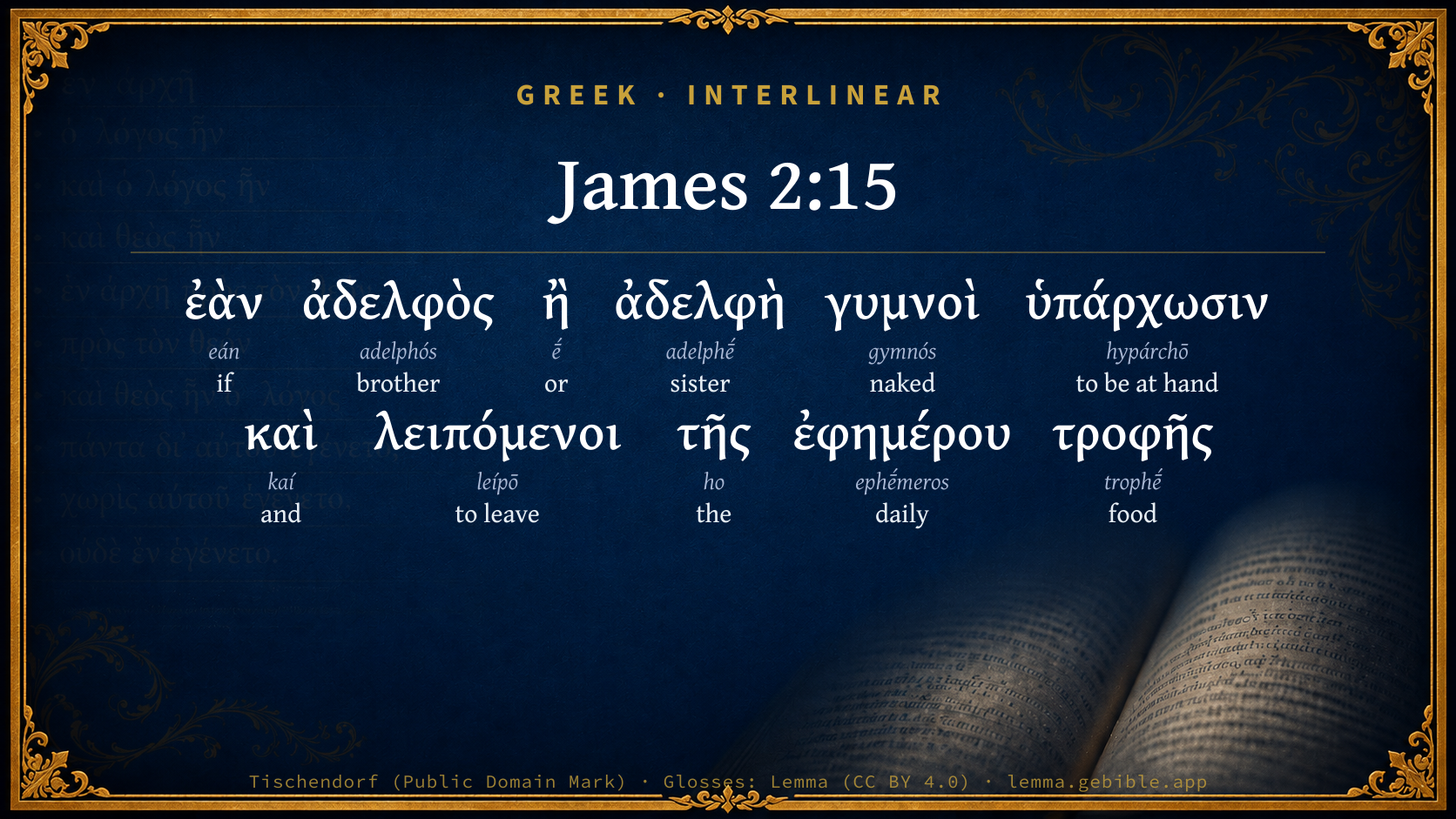
Download image
Cite this verse

James 2:15 (World English Bible). Public Domain. Lemma interlinear Bible study tool, https://lemma.gebible.app/v/james/2/15.

Show BibTeX & RIS
BibTeX
RIS
English Translation
And if a brother or sister is naked and in lack of daily food,
World English Bible · Public Domain
Highlights
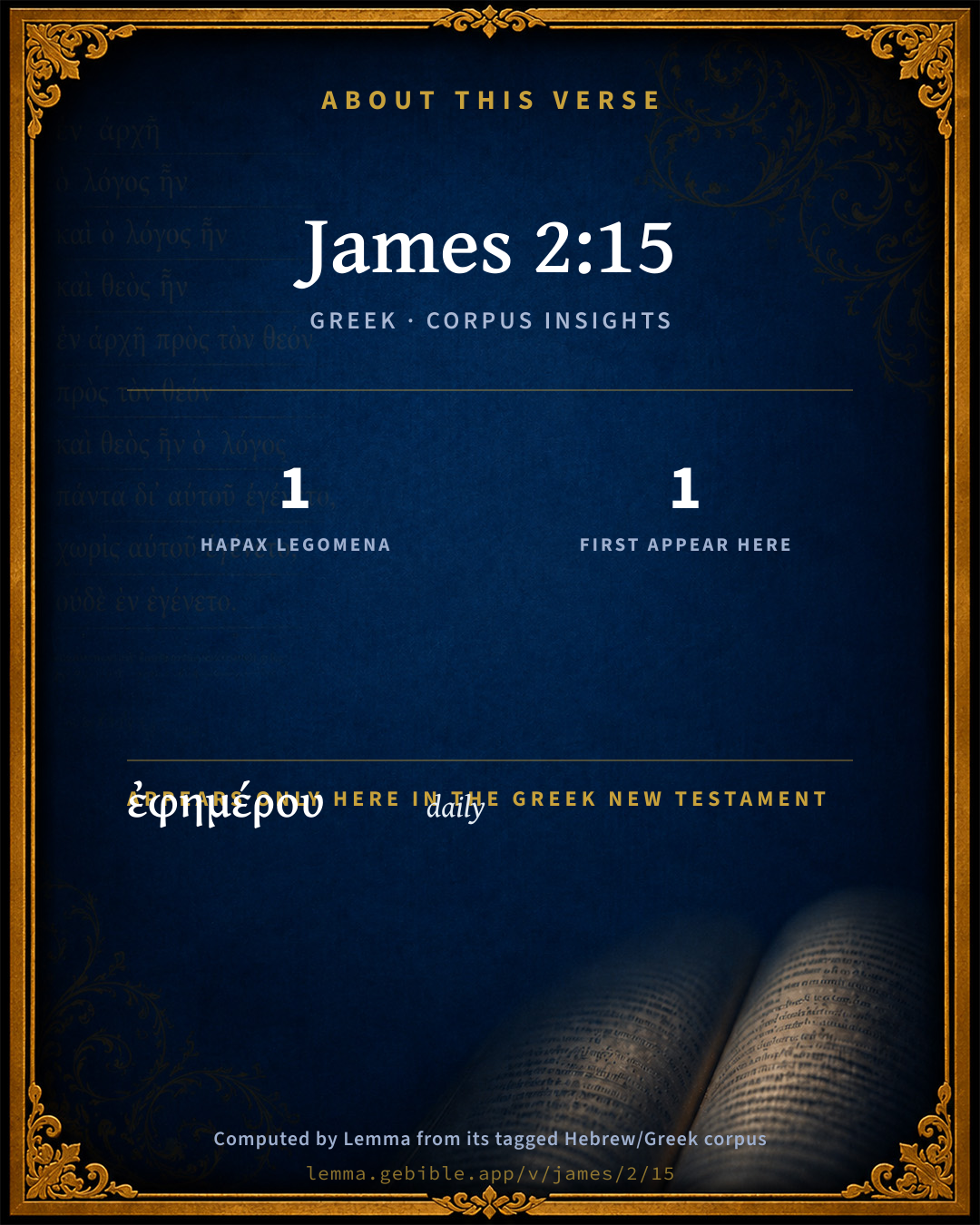
  • 1 hapax legomenon — only here in the Greek New Testament
  • 1 first appearance in the Greek New Testament
Full analysis ↓
Download a study sheet

One document with this verse’s original text, its word-by-word gloss line, the meaning frame, cross-references with their text, attributed commentary, and full source and license credits — printable, and it pastes into notes with its structure intact.

This verse Autodidact and up

Study sheet (.html) Plain text (.txt)

A passage Seminary Student

Up to 50 verses in one chapter. A passage sheet keeps up to 6 commentary sources and 12 cross-references per verse, in the order this page ranks them, and says so on the sheet whenever that leaves anything out. Ask for a single verse and you get the Autodidact verse sheet above.

Everything on this page stays free to read, with no account — the sheet is a download of what is already on screen, not access to it.

Want to remove ads? Support Godless Engineer
Compare translations 3

The same verse in 3 English versions, stacked beneath the original-language interlinear above. Click any original word for its lexicon entry.

Each is an independent rendering of the whole verse — the interlinear is not word-aligned to these translations.

Highlighted words mark where these versions differ — a whole-verse word diff, not a word-by-word alignment.

  • World English Bible Public Domain
    And if a brother or sister is naked and in lack of daily food,
  • King James Version Public Domain
    If a brother or sister be naked, and destitute of daily food,
  • unfoldingWord Literal Text CC BY-SA 4.0
    If a brother or sister were unclothed and lacking their daily food,

unfoldingWord Literal Text — © unfoldingWord, licensed CC BY-SA 4.0. Word-aligned USFM3 via Door43 (git.door43.org/unfoldingWord/en_ult).

Versions to compare (up to 4)

3 of 4 selected

Show all 19 translations

Every available English version of this verse, each an independent rendering of the whole verse.

  • World English Bible Public Domain
    And if a brother or sister is naked and in lack of daily food,
  • Berean Standard Bible Public Domain
    Suppose a brother or sister is without clothes and daily food.
  • Majority Standard Bible Public Domain
    Suppose a brother or sister is without clothes and daily food.
  • King James Version Public Domain
    If a brother or sister be naked, and destitute of daily food,
  • American Standard Version (1901) Public Domain
    If a brother or sister be naked and in lack of daily food,
  • Revised Version (1885) Public Domain
    If a brother or sister be naked, and in lack of daily food,
  • Geneva Bible (1599) Public Domain
    For if a brother or a sister bee naked and destitute of daily foode,
  • Douay-Rheims (1899) Public Domain
    And if a brother or sister be naked, and want daily food:
  • Young's Literal Translation Public Domain
    and if a brother or sister may be naked, and may be destitute of the daily food,
  • Literal Standard Version CC BY-SA 4.0
    And if a brother or sister may be naked, and may be destitute of daily food,
  • Unlocked Literal Bible CC BY-SA 4.0
    Suppose that a brother or sister is badly clothed and lacks food for the day.
  • unfoldingWord Literal Text CC BY-SA 4.0
    If a brother or sister were unclothed and lacking their daily food,
  • Darby Bible Public Domain
    Now if a brother or a sister is naked and destitute of daily food,
  • World Messianic Bible Public Domain
    And if a brother or sister is naked and in lack of daily food,
  • Webster's Bible Public Domain
    If a brother or sister is naked, and destitute of daily food,
  • Free Bible Version CC BY-SA 4.0
    If a brother or sister doesn't have clothes, or food for the day,
  • Bible in Basic English Public Domain
    If a brother or a sister is without clothing and in need of the day's food,
  • Text-Critical English NT CC BY 4.0
    If a brother or sister is poorly clothed and lacks daily food,
  • Tyndale New Testament (1534) Public Domain
    If a brother or a sister be naked or destitute of dayly fode

Literal Standard Version (2020), Covenant Press — licensed CC BY-SA 4.0. Text via the HelloAO Bible API (eBible.org). Unlocked Literal Bible (unfoldingWord) — licensed CC BY-SA 4.0. Text via the HelloAO Bible API (eBible.org). unfoldingWord Literal Text — © unfoldingWord, licensed CC BY-SA 4.0. Word-aligned USFM3 via Door43 (git.door43.org/unfoldingWord/en_ult). Free Bible Version, Dr. Jonathan Gallagher — licensed CC BY-SA 4.0. Text via the HelloAO Bible API (eBible.org).

Word by word

More ways to search: Search by grammar → Find every occurrence → Compare this word →

Practice this passage: Drill this verse → Learn its vocabulary →

About this verse

These counts appear in no published source. They are computed here, from the morphology-tagged text and Lemma’s own curated glosses. What Lemma adds →

11
words
11
distinct lemmas
General Epistles
section

Notable vocabulary

1 hapax legomenon — a word that appears only here in the entire Greek New Testament:

  • ἐφημέρου daily G2184

First appearance in Scripture

This word makes its first canonical appearance in the Greek New Testament here:

  • ἐφημέρου daily G2184

Shared distinctive vocabulary

λειπόμενοι to leave G3007 occurs in 6 verses of the Greek New Testament. Also found in:
Cross-references

8

Topical passages linked to James 2:15 in the Treasury of Scripture Knowledge — connected by theme and wording, ordered by reader-vote popularity; previews shown in the World English Bible.

  • Luke 3:11 He answered them, "He who has two coats, let him give to him who has none. He who has food, let him do likewise."
  • Matthew 25:35–40 for I was hungry, and you gave me food to eat; I was thirsty, and you gave me drink; I was a stranger, and you took me in;
  • Isaiah 58:7 Isn't it to deal your bread to the hungry, and that you bring the poor who are cast out to your house? when you see the naked, that you cover him; and that you not hide yourself from your own flesh?
  • Job 31:16–21 "If I have withheld the poor from their desire, Or have caused the eyes of the widow to fail,
  • Isaiah 58:10 and if you draw out your soul to the hungry, and satisfy the afflicted soul: then shall your light rise in darkness, and your obscurity be as the noonday;
  • James 2:5 Listen, my beloved brothers. Didn't God choose those who are poor in this world to be rich in faith, and heirs of the Kingdom which he promised to those who love him?
  • Mark 14:7 For you always have the poor with you, and whenever you want to, you can do them good; but you will not always have me.
  • Hebrews 11:37 They were stoned. They were sawn apart. They were tempted. They were slain with the sword. They went around in sheep skins and in goat skins; being destitute, afflicted, ill-treated

Cross-references courtesy of OpenBible.info (CC BY 4.0).

Commentary

Notes on James 2:15 from classic Christian and Jewish commentators (each source and its license shown beneath its notes). The classic Christian expositions comment on the surrounding passage and are grouped to its opening verse, so a note may address several verses; the Jewish commentaries on the Tanakh (Rashi and others) are per-verse, so they appear only where the commentator wrote on this verse.

Lemma curates 59 commentaries, every one of them public domain or Creative Commons licensed, each selected and text-cleaned for this edition rather than reprinted as found. About our sources →

Tyndale Open Study Notes

Tyndale Open Resources

2:15-16 Suppose you see: As in 2:2-4, James gives an illustration of “faith” that is useless. • no food or clothing: In first-century Palestine and the Roman world in general, many poverty-stricken persons lacked the bare necessities of life. • stay warm and eat well: This sentence probably expresses a presumption that God would provide the needs of the poor person. The speaker might suppose that what is needed is simply an expression of faith that it will happen. But without participation (action), it is an empty wish.

Tyndale Open Study Notes — © Tyndale Open Resources, licensed CC BY-SA 4.0. Text via the HelloAO Bible API.

Bengel's Gnomon

Johann Albrecht Bengel

Jas 2:15. Ἐὰν δὲ, but if) A comparison (the Protasis of which, even by itself, conveys a suitable admonition, and one not foreign to the subject): hence the Epanelepsis,[22] what doth it profit? Jas 2:14; Jas 2:16.

[22] The figure Epanalepsis is the putting of the same word, or words, at the beginning of a preceding clause and at the end of a subsequent clause or member of a sentence. Thus verse 14th begins, and verse 16th ends, with the same words, “What doth it profit?”

Bengel's Gnomon of the New Testament — English translation (T&T Clark, Edinburgh, 1860) — public domain. Text from a community e-Sword module.

Meyer's Critical & Exegetical Commentary

Heinrich August Wilhelm Meyer

Jam_2:15-16. James illustrates the idea that faith is dependent for its proof on works, otherwise if these are wanting it is dead and profits nothing, by an example of compassion, which also, if without the corresponding works, is dead and can profit nothing. The representation of this similitude has the same form as the description of the case mentioned in Jam_2:2-3 : first, the statement of the circumstances, and then of the conduct. The particle δέ (Lachmann, Tischendorf) is not merely transitional (metabasis, Wiesinger), but is to be explained from the fact that in this verse the argument against the opponent brought forward commences (Schneckenburger, de Wette).

Those requiring help are by the name ἀδελφὸς ἢ ἀδελφή characterized as members of the Christian community, in order to bring out more strongly the obligation to active assistance.

By the words γυμνοὶ … τροφῆς their destitute condition is described. There is no need to interpret γυμνός by male vestitus (Laurentius, Wolf, Baumgarten, Gebser, Hottinger, Schneckenburger, de Wette, Theile, Wiesinger); it is rather nudus, naked, but is certainly also so used when there is no absolute nakedness, but when the clothing can hardly be considered as clothing. On λειπόμενοι, see chap. Jam_1:4-5.

ἐφήμερος] in the N. T. ἅπ. λεγ., is neither = diurnus (Morus: quod in unum diem sufficit) nor = hodiernus (Hottinger); but ἡ ἐφήμερος τροφή is = ἡ καθʼ ἡμέραν ἀναγκαῖα τροφή (Pott, Gebser, Schneckenburger, Wiesinger).

Meyer — Critical and Exegetical Commentary on the New Testament — English translation by Peter Christie, edited by Frederick Crombie (T&T Clark, 1880) — public domain. Text from a community e-Sword module.

Expositor's Greek Testament

ed. W. Robertson Nicoll

Jas 2:15 . In accordance with the very practical nature of the writer, he now proceeds to give an illustration of his thesis which is bound to appeal; he must have been a telling preacher. ἐὰν : the addition of δέ is fairly well attested, but the reading of [56]

[57] where it is omitted is to be preferred. ἀδελφή : the specific mention of “sister” here is noteworthy; it is the one point in this passage which suggests distinctively Christian influence. This is apparently the only place in the Bible in which “sister” is mentioned in this special connection. γυμνοί : Cf. Test. of the Twelve Patriarchs , Zeb. xii. 1 3: “I saw a man in distress through nakedness in winter-time, and had compassion upon him, and stole away a garment secretly from my father’s house (another reading is ‘my house’), and gave it to him who was in distress. Do you, therefore, my children, from that which God bestoweth on you, show compassion and mercy without hesitation to all men, and give to every man with a good heart. And if you have not the wherewithal to give to him that needeth, have compassion for him in bowels of mercy” (Charles). Of course it is not literal nakedness that is meant in the passage before us; in the case of men the Hebrew ערום (= γυμνός ), while often used in a literal sense, is also frequently used in reference to one who was not wearing a כתנת (= χιτών ) and thus appeared only in סדינים , “under-garments,” see Amo 2:6 ; Isa 20:2 f.; Job 22:6 ; Job 24:7-10 . In the case of women, the reference is likewise to the כתנת , though in this case the garment was both longer and fuller than that of men; at the same time, it is improbable that the “sister” would have appeared without a veil, unless, indeed, we are dealing with a venue which is altogether more Western; this is a possibility which cannot be wholly excluded. λειπόμενοι : must be taken with ὑπάρχωσιν as the addition of ὦσιν is poorly attested. ἐφημέρου τροφῆς : “the food for the day”; the words express the dire necessity of those in want. Cf. Mat 6:11 , Τὸν ἄρτον ἡμῶν τὸν ἐπιούσιον δὸς ἡμῖν σήμερον , and Nestle’s note on ἐπιούσιος in Hastings’ D.C.G. , ii. 58 a . ἐφήμερος does not occur elsewhere in the N.T. or the Septuagint.

[56] Codex Vaticanus (sæc. iv.), published in photographic facsimile in 1889 under the care of the Abbate Cozza-Luzi.

[57] Codex Sinaiticus (sæc. iv.), now at St. Petersburg, published in facsimile type by its discoverer, Tischendorf, in 1862.

The Expositor's Greek Testament, edited by W. Robertson Nicoll (1897–1910) — public domain. Text from a community e-Sword module.

Geneva Bible (1599)

Geneva Bible translators

The first reason taken of a similitude: If a man say to one that is hungry, Fill thy belly, and yet giveth him nothing, this shall not be true charity: so if a man say he believeth, and bringeth forth no works of his faith, this shall not be a true faith, but a certain dead thing set out with the name of faith, whereof no man hath to brag, unless he will openly incur reprehension, seeing that the cause is understood by the effects.

Geneva Bible (1599) marginal notes — public domain. Text via Bolls.life.

Jamieson, Fausset & Brown

Robert Jamieson, A. R. Fausset & David Brown

The Greek is, "But if," &c.: the "But" taking up the argument against such a one as "said he had faith, and yet had not works," which are its fruits.

a brother, &c.--a fellow Christian, to whom we are specially bound to give help, independent of our general obligation to help all our fellow creatures.

be--The Greek implies, "be found, on your access to them."

Jamieson, Fausset & Brown — Commentary Critical and Explanatory on the Whole Bible (1871) — public domain (CC PDM 1.0). Text via the HelloAO Bible API.

Adam Clarke's Commentary

Verse 15. If a brother or sister be naked] That is, ill-clothed; for γυμνος, naked, has this meaning in several parts of the New Testament, signifying bad clothing, or the want of some particular article of dress. See Mt 25:36; Mt 25:38; Mt 25:43; Mt 25:44, and Joh 21:7. It has the same comparative signification in most languages.

Adam Clarke's Commentary on the Bible (1810–1826) — public domain. Text from a community e-Sword/MySword module.

John Calvin's Commentaries

15 If a brother, or, For if a brother. He takes an example from what was connected with his subject; for he had been exhorting them to exercise the duties of love. If any one, on the contrary, boasted that he was satisfied with faith without works, he compares this shadowy faith to the saying of one who bids a famished man to be filled without supplying him with the food of which he is destitute. As, then, he who sends away a poor man with words, and offers him no help, treats him with mockery, so they who devise for themselves faith without works, and without any of the duties of religion, trifle with God.

John Calvin's Commentaries (1540-1563) — public domain. Text from the Calvin Translation Society English edition (1840s-50s) via the Christian Classics Ethereal Library (ccel.org). Calvin's coverage is partial (roughly two-thirds of the Bible); uncommented books and verses are honest gaps, never fabricated. The 19th-century editor's footnotes and remarks are omitted so the notes are faithfully Calvin's own voice.

Ellicott's Commentary for English Readers

(15) But (the word should be added, for it continues an argument) if a brother or sister be naked, and destitute of daily food—i.e., the food for each day, not that which suffices for one, or for a present distress; the case is rather of worst and direst want, so that the heart untouched by the spectacle of such misery must be hard indeed.

A Bible Commentary for English Readers, edited by Charles John Ellicott (1878–1897) — public domain. Text from a community e-Sword module.

The Cambridge Bible for Schools and Colleges

gen. ed. J. J. S. Perowne

15. If a brother or sister …] The words are not necessarily used in the sense in which they imply the profession of faith in Christ as they are, e. g., in Act_10:23; Act_11:1; 1Co_5:11. Every Israelite was to see a brother in every child of Abraham (Mat_5:23; Act_2:29; Act_3:17). All that can be said is that where the reader of the Epistle was a Christian, he would feel that the words brought before him those who were of the same society or brotherhood.

naked, and destitute of daily food] The picture drawn is one of extremest destitution, and, like the teaching of the whole passage, reminds us of Mat_25:36; Mat_25:43. What was the faith worth which could witness that suffering and not be stirred to help? The words are applicable to all times and countries, but it gives them a special interest to remember that the Church over which St James presided had suffered, and was probably, at the very time he wrote, suffering, from the famine foretold by Agabus (Act_11:28-30). The Gentile disciples had, we read, done their best to alleviate the distress of the Churches of Judæa. St James’s language, addressed to the Jews and Jewish Christians of the dispersion, would seem to imply that they had shewn less forwardness, and had wrapt themselves up in the self-satisfaction of professing the orthodox faith of the sons of Abraham, while the Gentile converts whom they despised were setting an example of self-denying charity.

The Cambridge Bible for Schools and Colleges (gen. ed. J. J. S. Perowne; Cambridge University Press, 1878–1918) — public domain. Text from a community e-Sword module.

John Gill's Exposition

If a brother or sister,.... A Christian man or woman, a fellow member of a church of Christ; for this relation is to be understood in a spiritual sense, though it does not exclude such who are in this relation in a natural sense:

be naked; or clothed in rags, or in very mean and sordid apparel, such as will neither keep them warm, nor clean and decent; for they must not be supposed to be entirely naked, but to be in a very uncomfortable and indecent garb:

and destitute of daily food; have not food sufficient for the day; or aught to support nature with, and yield them proper refreshment and nourishment.

John Gill's Exposition of the Whole Bible (1746–1763) — public domain (CC PDM 1.0). Text via the HelloAO Bible API.

Trapp's Complete Commentary

John Trapp

15 If a brother or sister be naked, and destitute of daily food,

Ver. 15. If a brother or a sister] As it may befall the best to be, and they are not of the chameleon kind, to live (with Ephraim) upon wind, Hos 12:1, to be fed with fair words, or to be clothed with a suit of compliments. Sion should be taken by the hand, Isa 51:18. And Tyre converted, leaves hoarding and heaping up wealth, and falls to feeding and clothing God’s poor people, Isa 23:18.

John Trapp, A Commentary or Exposition upon All the Books of the Old and New Testament (1647–1656) — public domain. Text from a community e-Sword module.

Albert Barnes' Notes on the Bible

If a brother or sister be naked ... - The comparison in these verses is very obvious and striking. The sense is, that faith in itself, without the acts that correspond to it, and to which it would prompt, is as cold, and heartless, and unmeaning, and useless, as it would be to say to one who was destitute of the necessaries of life, depart in peace.” In itself considered, it might seem to have something that was good; but it would answer none of the purposes of faith unless it should prompt to action. In the case of one who was hungry or naked, what he wanted was not good wishes or kind words merely, but the acts to which good wishes and kind words prompt. And so in religion, what is wanted is not merely the abstract state of mind which would be indicated by faith, but the life of goodness to which it ought to lead. Good wishes and kind words, in order to make them what they should be for the welfare of the world, should be accompanied with corresponding action. So it is with faith. It is not enough for salvation without the benevolent and holy acts to which it would prompt, any more than the good wishes and kind words of the benevolent are enough to satisfy the wants of the hungry, and to clothe the naked, without correspondent action. Faith is not and cannot be shown to be genuine, unless it is accompanied with corresponding acts; as our good wishes for the poor and needy can be shown to be genuine, when we have the means of aiding them, only by actually ministering to their necessities. In the one case, our wishes would be shown to be unmeaning and heartless; in the other, our faith would be equally so. In regard to this passage, therefore, it may be observed:

(1) That in fact faith is of no more value, and has no more evidence of genuineness when it is unaccompanied with good works, than such empty wishes for the welfare of the poor would be when unaccompanied with the means of relieving their wants. Faith is designed to lead to good works. It is intended to produce a holy life; a life of activity in the service of the Saviour. This is its very essence; it is what it always produces when it is genuine. Religion is not designed to be a cold abstraction; it is to be a living and vivifying principle.

(2) There is a great deal of that kindness and charity in the world which is expressed by mere good wishes. If we really have not the means of relieving the poor and the needy, then the expression of a kind wish may be in itself an alleviation to their sorrows, for even sympathy in such a case is of value, and it is much to us to know that others feel for us; but if we have the means, and the object is a worthy one, then such expressions are mere mockery, and aggravate rather than soothe the feelings of the sufferer. Such wishes will neither clothe nor feed them; and they will only make deeper the sorrows which we ought to heal. But how much of this is there in the world, when the sufferer cannot but feel that all these wishes, however kindly expressed, are hollow and false, and when he cannot but feel that relief would be easy!

(3) In like manner there is much of this same kind of worthless faith in the world - faith that is dead; faith that produces no good works; faith that exerts no practical influence whatever on the life. The individual professes indeed to believe the truths of the gospel; he may be in the church of Christ; he would esteem it a gross calumny to be spoken of as an infidel; but as to any influence which his faith exerts over him, his life would be the same if he had never heard of the gospel. There is not one of the truths of religion which is bodied forth in his life; not a deed to which he is prompted by religion; not an act which could not be accounted for on the supposition that he has no true piety. In such a case, faith may with propriety be said to be dead.

Being alone - Margin, “by itself.” The sense is, “being by itself:” that is, destitute of any accompanying fruits or results, it shows that it is dead. That which is alive bodies itself forth, produces effects, makes itself visible; that which is dead produces no effect, and is as if it were not.

Albert Barnes' Notes on the Bible (1834–1885) — public domain. Text from a community e-Sword/MySword module.

Matthew Poole's English Annotations

If a brother or sister; a Christian man or woman, who are frequently thus called: see 1Co 7:12,15.

Be naked; badly clothed, or destitute of such clothing as is fit for them, Job 22:6; 1Co 4:11.

And destitute of daily food: see Mat 6:11; that which is necessary for the sustaining of life a day to an end. Under these two of nakedness and hunger, he comprehends all the calamities of human life, which may be relieved by the help of others; as food and raiment contain all the ordinary supports and comforts of life, Gen 28:20; Mat 6:25; 1Ti 6:8.

Matthew Poole's English Annotations on the Holy Bible (1683–1685) — public domain. Text from a community e-Sword/MySword module.

Whedon's Commentary on the Bible

Daniel D. Whedon

15. If—An illustrative case, in which a fellow Christian is to be supplied with necessaries of life. The firm faith that he will be supplied with food without accordant action will leave him to starvation. So a sentimental belief in all the charities, virtues, pieties, and moralities, will do no good to the world or to the believer until resolved into action.

Daniel D. Whedon (gen. ed.), Commentary on the Old and New Testaments (1874–1909) — public domain. Text from a community e-Sword module.

The Pulpit Commentary

Vers. 15, 16. Observe the practical character of the illustration chosen, from works of mercy. (cf. Jam_1:27) Wsi in ver. 15 should be deleted (omitted by B, C, K); also the disjunctive particle de at the commencement of the verse (with a, B).

The Pulpit Commentary (1880–1919), ed. H.D.M. Spence-Jones & Joseph S. Exell — public domain. Text from a community e-Sword module.

The People's New Testament

B. W. Johnson

15. If a brother. A practical application is now made of the royal law. Be naked. Insufficiently clothed.

B. W. Johnson's The People's New Testament with Notes (1889–1891) — public domain. Electronic text from the Christian Classics Ethereal Library (CCEL) ThML edition.

Cambridge Greek Testament for Schools and Colleges

15. ἀδελφὸς ἢ ἀδελφή, a recurring reminder of the relationship of the disciples to one another.

γυμνοὶ ὑπάρχωσιν κ.τ.λ., comp. Mat 25:35-36. In later Judaism the duty of almsgiving was vividly realised. This is one of the post-exile religious ideas which strongly influenced thought at this period. See Tob 4:8 ff. where the Hebr. text has: ‘Every one who occupieth himself in alms shall behold the face of God, as it is written, I will behold thy face by almsgiving,’ Psa 17:15, almsgiving being as elsewhere substituted for righteousness. So Khasidim, the pious, are those who exercise Khesed, mercy.

St James’s one injunction to St Paul when he recognised his mission to the Gentiles was ‘to remember the poor’: μόνον τῶν πτωχῶν ἵνα μνημονεύωμεν, Gal 2:9, and the Church over which he presided proved its first enthusiasm by acts of charity.

With the Stoics ἔλεος was reckoned among the defects or vices: it was a disturbing element that broke in on the philosophic calm: ὁ ἀπειθῶν τῇ θείᾳ διοικήσει ἔστω ταπεινός, ἔστω δοῦλος λυπείσθω, φθονείτου, ἐλεείτω, Epict. Diss. III. 24. 43. Comp. Virgil’s picture of the happy man; among his blessings is the absence of pity: neqne ille | aut doluit miserans inopem, Georg. II. 498.

τῆς ἐφημέρου τροφῆς, of the day’s supply of food, as distinguished from τῆς καθʼ ἡμέραν τροφῆς. Field, Otium Norv., ἀπῆλθεν ἐκ τῆς οἰκίας μόνος … ἄδουλος, ἄπορος, οὐδὲ τὴν ἐφήμερον ὁ δύστηνος ἐκ τῶν ἑαυτοῦ χρημάτων τροφὴν (ne unius quidem diet viaticum) ἐπαγόμενος, Dion. Hal. Ant. VIII. 41 (Wetstein).

Cambridge Greek Testament for Schools and Colleges (Cambridge University Press, 1896; 21 vols, various authors incl. Carr, Maclear, Plummer, Farrar, Lumby, Moule, M. R. James, Simcox) — public domain. Text from a community e-Sword module.

Alford’s Greek Testament

Henry Alford

15.] But (δέ takes up the argument against the person supposed, or against his fautors: and is not, as Wiesinger, merely transitional [it is best rendered in English by beginning the sentence abruptly, not giving any word for it]) if a brother or a sister (the case of a Christian brother or sister is supposed, to bring out more strongly the obligation to help, as a duty) be (found, on your access to them: see, on ὑπάρχω and εἰμί, reff.: and note, Act 16:20) naked (there is no need to interpret γυμνοί “male vestiti,” as so many Commentators: extreme destitution and nakedness in the literal, or almost literal sense, might well go together) and destitute of (reff.: Pind. Isthm. ii. 18, κτεάνων λειφθεὶς ἅμα καὶ φίλων: Soph. Trach. 932, οὔτʼ ὀδυρμάτων ἐλείπετʼ οὐδέν. The usage is confined to St. James in the N. T.) daily food (the food for each day, τῆς καθʼ ἡμέραν ἀναγκαίας τροφῆς: not “quod in unum diem sufficit,” as Morus, nor “for the current day,” as Hottinger),

Henry Alford, The Greek Testament (1849–1861) — public domain. Text from a community e-Sword module.

International Critical Commentary

15-17. Illustration from the emptiness of words of charity as a substitute for deeds

This is not, like the closely similar verses, 2:2 f., a concrete instance of James’s contention, but a little parable; for another parable to the same purport, cf: 2:26. The illustration is abruptly introduced, as in 3:11, 12.

The comparison has itself a moral significance, and the same thought is found in other literature, e.g. Plautus, Epid. 116 f. nam quid te igitur rettulit beneficum esse oratione si ad rem auxilium emortuomst?

15. ἐάν] Bא 33 69 minn ff m.

ἐὰν δέ] ACKL minnpler vg syrpesh. hel.

ἐὰν γάρ] sah.

γυμνοί, “naked,” in the sense of “insufficiently clad”; cf. Job 22:6 “stripped the naked of their clothing,” Isa 20:2, Isa 20:3, 58:7, Joh 21:7 (without the ἐπενδύτης), Mat 25:36 ff., Act 19:16; see references in L. and S.

The plural after singular subjects connected by ἤ is in accord with the occasional usage of good Greek writers. See Hadley-Allen, § 608; Blass-Debrunner, § 135. Buttmann and Blass ascribe the plural here to the fact that the two nouns are of different genders, but this is not the case in all the examples from secular Greek.

ἐφημέρου τροφῆς, “food for the day,” “the day’s supply of food.”

The word ἐφήμερος is not in the O. T., but this whole phrase is found in Diod. iii, 32; Dion. Hal. viii, 41; Aristides, xlix, ed. Dindorf, p. 537. It is an expression natural to secular Greek, and used here, much like the English “daily bread,” to describe the poor person’s need as urgent; cf. Philo, In Flacc. 17 πένητές ἐσμεν καὶ μόλις τὸ ἐφήμερον εἰς αὐτὰ τὰ ἀναγκαῖα πορίζειν δυνάμεθα, Ps.-Plutarch, An vitios. p. 499 C προσαίτησιν ἐφημέρου Other extracts may be found in Mayor3, p. 97, and Field, Notes on the Translation of the New Testament, 1899, pp. 236 f.

International Critical Commentary — older volumes (1896–1929), various authors — public domain. Text from a community e-Sword module.

Vincent's Word Studies in the New Testament

Marvin R. Vincent

Be [υπαρχωσιν] . The distinction between this word and the simple einai, to be, is very subtle. The verb uJparcw originally means to make a beginning; hence, to begin or to come into being; and, though used substantially as a synonym of einai, of a thing actually existing and at hand, it has a backward look to an antecedent condition which has been protracted into the present. Thus we might paraphrase here, "If a brother or sister, having been in a destitute condition, be found by you in that condition." Einai, on the other hand, would simply state the present fact of destitution. See on 2Pe 1:8.

Destitute [λειπομενοι] . Lit., left behind; and hence lacking, as Rev. Compare ch. 1 4, 5. This usage of the word occurs in James only.

Daily [εφημερου] . Only here in New Testament.

Marvin R. Vincent, Word Studies in the New Testament (1887–1900) — public domain. Text from a community e-Sword/MySword module.

Lesson kit

Teaching starters — assembled from the data on this page, not authored interpretation. Every prompt links to the verse data it draws on. Edit before teaching.

James, in the General Epistles, opens this verse with 11 words (11 distinct Greek lemmas). Its most distinctive word is ephḗmeros (“daily”). A historical commentator’s framing appears above. Read the whole chapter for the surrounding context.

Discussion questions

  1. The word ephḗmeros carries the sense “daily.” How does it shape the verse?
  2. This verse holds 1 word here found nowhere else in the Greek New Testament. What might the rare word draw attention to?
  3. The word “daily” first appears here in Scripture. What is being introduced at this debut?
  4. Luke 18:22 shares the word «to leave» with this verse. How do the two illuminate each other?
  5. The translations on this page render this verse differently — a whole-verse word diff, not a word-by-word alignment. What might account for the different wordings?
  6. Reading how Tyndale Open Study Notes and Bengel's Gnomon read this verse, where do the two commentators agree and where do they part?

Things to notice

  • 1 word in this verse appears nowhere else in the Greek New Testament.
  • 1 word makes its first canonical appearance in Scripture here.
  • These translations choose different wording for 5 words in this verse.
  • 11 distinct Greek lemmas span 11 words in this verse.

Reading settings

Reading text

Shown beneath each verse's original-language words.

Old Testament
Old Testament edition

Read the OT as the Masoretic Hebrew (MT) or the Greek Septuagint (LXX).

English shown for the Greek Septuagint (in the Hebrew ↔ Greek comparison).

Comparing translations? Open the Compare panel on any verse page to stack up to four side by side.