James 3:11

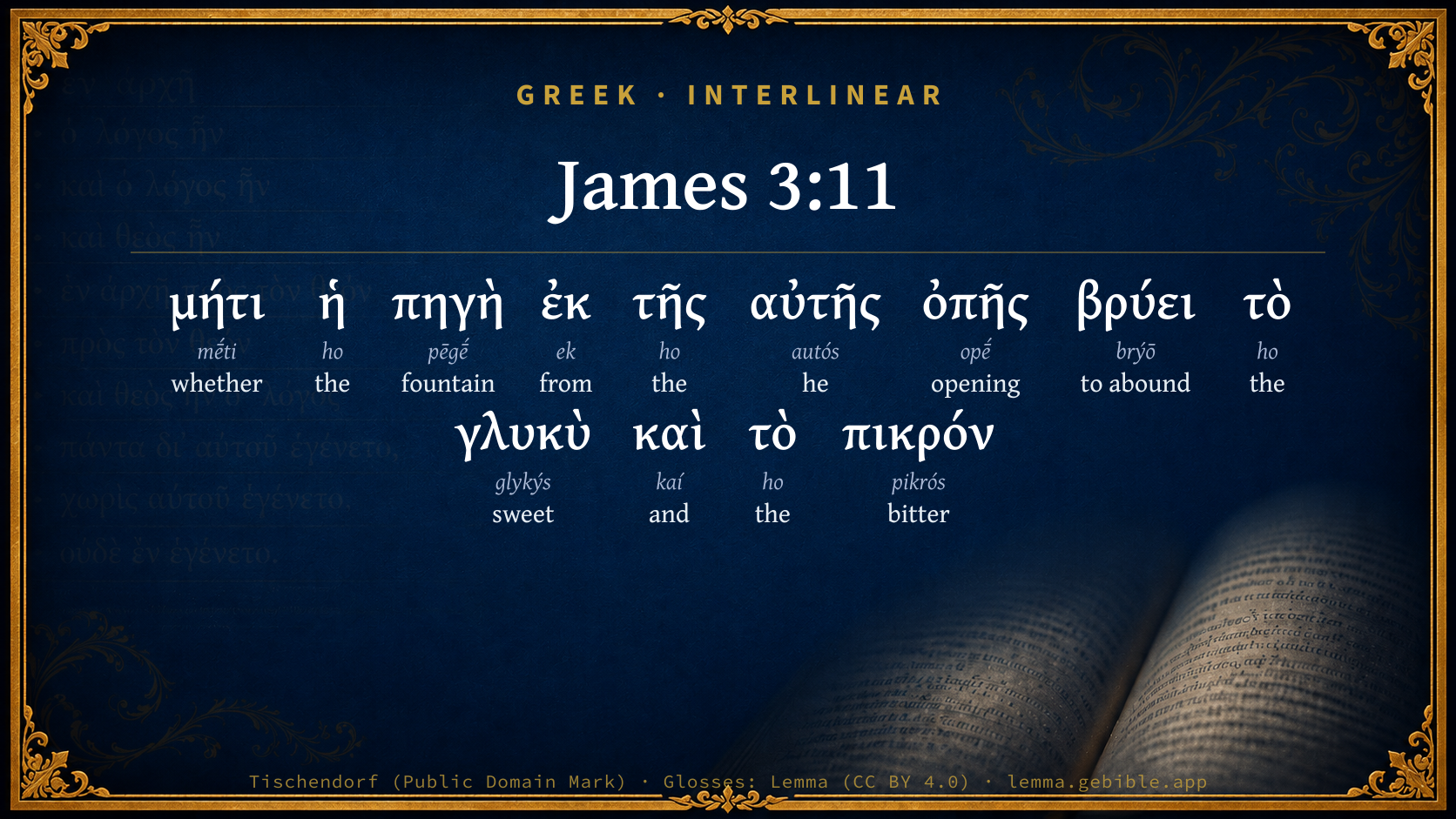
Greek (Tischendorf 8th ed.) James 3:11 appears in the Greek New Testament. The text above is from the Tischendorf 8th edition. Each word links to its Strong’s number and a concise gloss. Click any word for its full Thayer’s Greek Lexicon entry.
Download image
Cite this verse

James 3:11 (World English Bible). Public Domain. Lemma interlinear Bible study tool, https://lemma.gebible.app/v/james/3/11.

Show BibTeX & RIS
BibTeX
RIS
English Translation
Does a spring send out from the same opening fresh and bitter water?
World English Bible · Public Domain
Highlights
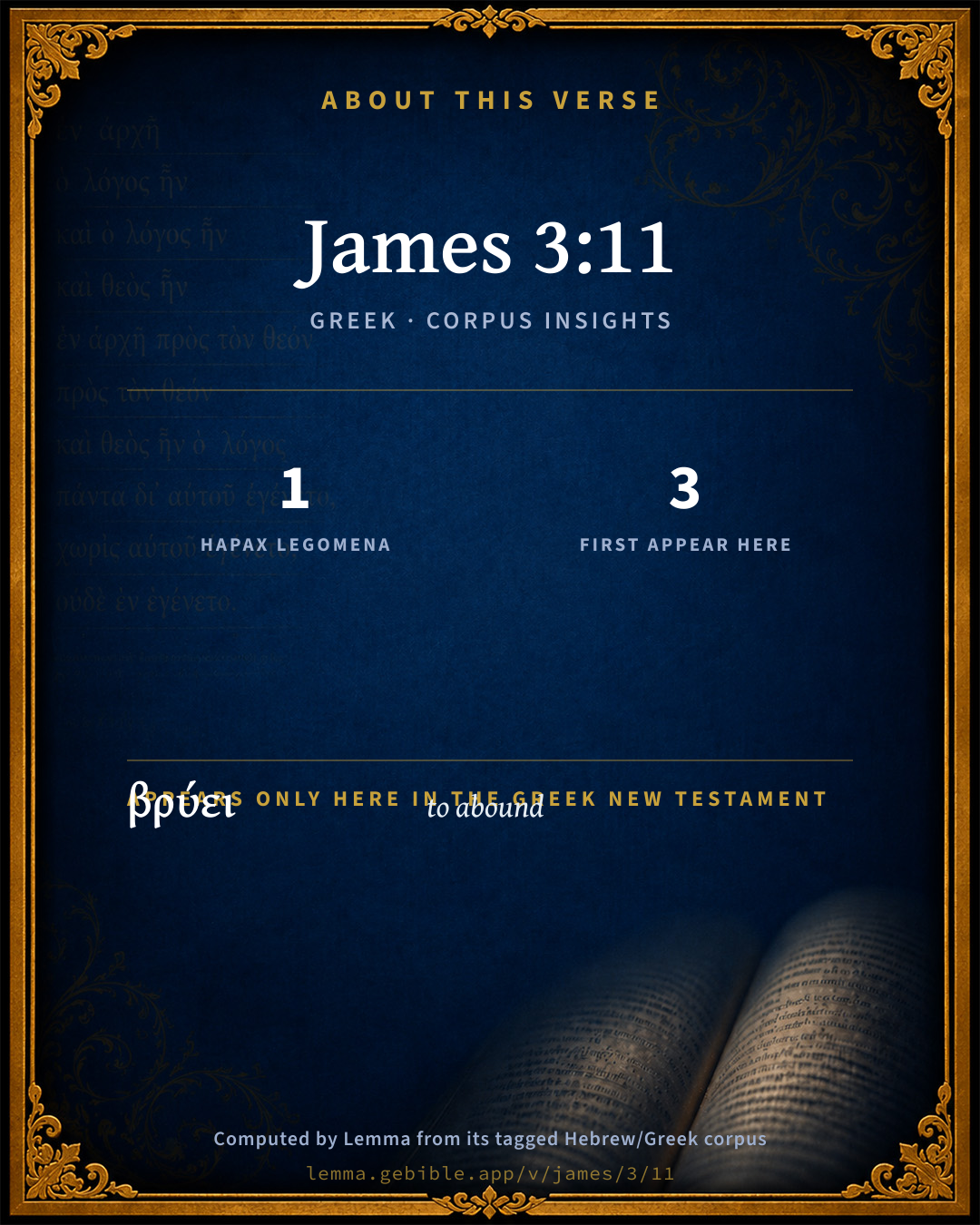
  • 1 hapax legomenon — only here in the Greek New Testament
  • 3 first appearances in the Greek New Testament
Full analysis ↓
Download a study sheet

One document with this verse’s original text, its word-by-word gloss line, the meaning frame, cross-references with their text, attributed commentary, and full source and license credits — printable, and it pastes into notes with its structure intact.

This verse Autodidact and up

Study sheet (.html) Plain text (.txt)

A passage Seminary Student

Up to 50 verses in one chapter. A passage sheet keeps up to 6 commentary sources and 12 cross-references per verse, in the order this page ranks them, and says so on the sheet whenever that leaves anything out. Ask for a single verse and you get the Autodidact verse sheet above.

Everything on this page stays free to read, with no account — the sheet is a download of what is already on screen, not access to it.

Want to remove ads? Support Godless Engineer
Compare translations 3

The same verse in 3 English versions, stacked beneath the original-language interlinear above. Click any original word for its lexicon entry.

Each is an independent rendering of the whole verse — the interlinear is not word-aligned to these translations.

Highlighted words mark where these versions differ — a whole-verse word diff, not a word-by-word alignment.

  • World English Bible Public Domain
    Does a spring send out from the same opening fresh and bitter water?
  • King James Version Public Domain
    Doth a fountain send forth at the same place sweet water and bitter?
  • unfoldingWord Literal Text CC BY-SA 4.0
    The spring does not gush the sweet and the bitter from the same opening, does it?

unfoldingWord Literal Text — © unfoldingWord, licensed CC BY-SA 4.0. Word-aligned USFM3 via Door43 (git.door43.org/unfoldingWord/en_ult).

Versions to compare (up to 4)

3 of 4 selected

Show all 19 translations

Every available English version of this verse, each an independent rendering of the whole verse.

  • World English Bible Public Domain
    Does a spring send out from the same opening fresh and bitter water?
  • Berean Standard Bible Public Domain
    Can both fresh water and salt water flow from the same spring?
  • Majority Standard Bible Public Domain
    Can both fresh water and salt water flow from the same spring?
  • King James Version Public Domain
    Doth a fountain send forth at the same place sweet water and bitter?
  • American Standard Version (1901) Public Domain
    Doth the fountain send forth from the same opening sweet `water' and bitter?
  • Revised Version (1885) Public Domain
    Doth the fountain send forth from the same opening sweet water and bitter?
  • Geneva Bible (1599) Public Domain
    Doeth a fountaine send forth at one place sweete water and bitter?
  • Douay-Rheims (1899) Public Domain
    Doth a fountain send forth, out of the same hole, sweet and bitter water?
  • Young's Literal Translation Public Domain
    doth the fountain out of the same opening pour forth the sweet and the bitter?
  • Literal Standard Version CC BY-SA 4.0
    does the fountain out of the same opening pour forth the sweet and the bitter?
  • Unlocked Literal Bible CC BY-SA 4.0
    Does a spring pour out from its opening both sweet and bitter water?
  • unfoldingWord Literal Text CC BY-SA 4.0
    The spring does not gush the sweet and the bitter from the same opening, does it?
  • Darby Bible Public Domain
    Does the fountain, out of the same opening, pour forth sweet and bitter?
  • World Messianic Bible Public Domain
    Does a spring send out from the same opening fresh and bitter water?
  • Webster's Bible Public Domain
    Doth a fountain send forth at the same place sweet water and bitter?
  • Free Bible Version CC BY-SA 4.0
    Does a spring send both sweet and bitter water out of the same opening?
  • Bible in Basic English Public Domain
    Does the fountain send from the same outlet sweet and bitter water?
  • Text-Critical English NT CC BY 4.0
    Does a spring pour out fresh water and bitter water from the same opening?
  • Tyndale New Testament (1534) Public Domain
    Doth a fountayne sende forth at one place swete water and bytter also?

Literal Standard Version (2020), Covenant Press — licensed CC BY-SA 4.0. Text via the HelloAO Bible API (eBible.org). Unlocked Literal Bible (unfoldingWord) — licensed CC BY-SA 4.0. Text via the HelloAO Bible API (eBible.org). unfoldingWord Literal Text — © unfoldingWord, licensed CC BY-SA 4.0. Word-aligned USFM3 via Door43 (git.door43.org/unfoldingWord/en_ult). Free Bible Version, Dr. Jonathan Gallagher — licensed CC BY-SA 4.0. Text via the HelloAO Bible API (eBible.org).

Word by word

More ways to search: Search by grammar → Find every occurrence → Compare this word →

Practice this passage: Drill this verse → Learn its vocabulary →

About this verse

These counts appear in no published source. They are computed here, from the morphology-tagged text and Lemma’s own curated glosses. What Lemma adds →

13
words
10
distinct lemmas
General Epistles
section

Notable vocabulary

1 hapax legomenon — a word that appears only here in the entire Greek New Testament:

  • βρύει to abound G1032

First appearance in Scripture

These words make their first canonical appearance in the Greek New Testament here:

  • βρύει to abound G1032
  • γλυκὺ sweet G1099
  • πικρόν bitter G4089

Shared distinctive vocabulary

ὀπῆς opening G3692 occurs in 2 verses of the Greek New Testament. Also found in:

Repetition

A word recurs within this verse:

Commentary

Notes on James 3:11 from classic Christian and Jewish commentators (each source and its license shown beneath its notes). The classic Christian expositions comment on the surrounding passage and are grouped to its opening verse, so a note may address several verses; the Jewish commentaries on the Tanakh (Rashi and others) are per-verse, so they appear only where the commentator wrote on this verse.

Lemma curates 59 commentaries, every one of them public domain or Creative Commons licensed, each selected and text-cleaned for this edition rather than reprinted as found. About our sources →

Joseph Benson's Commentary

Jas 3:11-12. Doth a fountain send forth at the same opening, alternately, and at different times, sweet water and bitter — As if he had said, No such inconsistency is found in the natural world, and nothing of the kind ought to be known in the moral world. Estius observes, “that the apostle’s design was to confirm his doctrine by four similitudes; the first taken from fountains, the second and third from fruit-trees, and the fourth from the sea, which being in its nature salt, does not produce fresh water.” He therefore approves of the reading of the Alexandrian MS., which is, So neither can salt water produce sweet. The Syriac version reads, Salt waters cannot be made sweet; and the Vulgate, So neither can salt water make fresh water. In like manner, we ought to maintain a consistency in our words or discourses; and if we profess religion and devotion, we should speak at all times as persons who are endeavouring to employ our tongues to the noble purposes for which the use of speech was granted to man.

Joseph Benson's Commentary on the Old and New Testaments (1811–1818) — public domain. Text from a community e-Sword module.

Tyndale Open Study Notes

Tyndale Open Resources

3:11 Some springs, especially in the upper sources of the Jordan River, did produce fresh water and bitter water; such brackish springs could not support a town. Similarly, if a person’s speech mixes foul with sweet, it will not build up the community.

Tyndale Open Study Notes — © Tyndale Open Resources, licensed CC BY-SA 4.0. Text via the HelloAO Bible API.

Bengel's Gnomon

Johann Albrecht Bengel

Jas 3:11. Πηγὴ, a fountain) The heart resembles this.—ὀπῆς, an aperture) the mouth resembles this.

Bengel's Gnomon of the New Testament — English translation (T&T Clark, Edinburgh, 1860) — public domain. Text from a community e-Sword module.

Meyer's Critical & Exegetical Commentary

Heinrich August Wilhelm Meyer

Jam_3:11. Illustration of the unnaturalness of the conduct mentioned by an image taken from nature: Does the fountain from the same hole send forth the sweet and the bitter?

ἡ πηγή] The article is not here for the sake of liveliness (Schneckenburger: articulus fontem quasi ante oculos pingit), but is used because πηγή is generically considered.

ἐκ τῆς αὐτῆς ὀπῆς] ὀπή, the hollow, Heb_11:38, Exo_33:22, Obad. Jam_3:3, is here the hole from which the water of the fountain streams forth. ἡ πηγή refers to man; ἡ ὀπή, to the mouth. The chief accent is on αὐτῆς, which points back to ἐκ τοῦ αὐτοῦ στόματος, Jam_3:10.

βρύειν] an ἅπ. λεγ., properly to sprout forth, then to overflow, is here used transitively, to cause to flow forth.

τὸ γλυκύ and τὸ πικρόν indicate, indeed, the two different kinds of water, yet linguistically τὸ ὕδωρ is not to be supplied; the former refers to εὐλογεῖν, and the latter to καταρᾶσθαι. With this verse James says only that happens not in nature, which occurs in the case of man, out of whose mouth proceed blessing and cursing. The following verse first expresses the impossibility.

Meyer — Critical and Exegetical Commentary on the New Testament — English translation by Peter Christie, edited by Frederick Crombie (T&T Clark, 1880) — public domain. Text from a community e-Sword module.

Expositor's Greek Testament

ed. W. Robertson Nicoll

Jas 3:11 . μήτι ἡ πηγὴ … τὸ πικρόν : these words show that the writer is thinking of the real source whence both good and evil words come; cf. Mat 12:34-35 : Ye offspring of vipers, how can ye, being evil, speak good things? for out of the abundance of the heart the mouth speaketh …; cf . ἐν τῇ καρδίᾳ ὑμῶν below; βρύει does not occur elsewhere in the N.T. or the Septuagint; and ὀπή is only found elsewhere in the N.T. in Heb 11:38 , cf. Exo 33:22 ; πικρόν is only used here and in Jas 3:14 in the N.T.; cf. Sir 4:6 , … καταρωμένου γάρ σε ἐν πικρίᾳ ψυχῆς αὐτοῦ .

The Expositor's Greek Testament, edited by W. Robertson Nicoll (1897–1910) — public domain. Text from a community e-Sword module.

Jamieson, Fausset & Brown

Robert Jamieson, A. R. Fausset & David Brown

fountain--an image of the heart: as the aperture (so the Greek for "place" is literally) of the fountain is an image of man's mouth. The image here is appropriate to the scene of the Epistle, Palestine, wherein salt and bitter springs are found. Though "sweet" springs are sometimes found near, yet "sweet and bitter" (water) do not flow "at the same place" (aperture). Grace can make the same mouth that "sent forth the bitter" once, send forth the sweet for the time to come: as the wood (typical of Christ's cross) changed Marah's bitter water into sweet.

Jamieson, Fausset & Brown — Commentary Critical and Explanatory on the Whole Bible (1871) — public domain (CC PDM 1.0). Text via the HelloAO Bible API.

Adam Clarke's Commentary

Verse 11. Doth a fountain send forth - sweet water and bitter?] In many things nature is a sure guide to man; but no such inconsistency is found in the natural world as this blessing and cursing in man. No fountain, at the same opening, sends forth sweet water and bitter; no fig tree can bear olive berries; no vine can bear figs; nor can the sea produce salt water and fresh from the same place. These are all contradictions, and indeed impossibilities, in nature. And it is depraved man alone that can act the monstrous part already referred to.

Adam Clarke's Commentary on the Bible (1810–1826) — public domain. Text from a community e-Sword/MySword module.

John Calvin's Commentaries

11 Doth a fountain. He adduces these comparisons in order to shew that a cursing tongue is something monstrous, contrary to all nature, and subverts the order everywhere established by God. For God hath so arranged things which are contrary, that inanimate things ought to deter us from a chaotic mixture, sure as is found in a double tongue.

John Calvin's Commentaries (1540-1563) — public domain. Text from the Calvin Translation Society English edition (1840s-50s) via the Christian Classics Ethereal Library (ccel.org). Calvin's coverage is partial (roughly two-thirds of the Bible); uncommented books and verses are honest gaps, never fabricated. The 19th-century editor's footnotes and remarks are omitted so the notes are faithfully Calvin's own voice.

Ellicott's Commentary for English Readers

(11) Doth a (or, the) fountain send forth (literally, spurt) at the same place (or, hole, see margin) sweet water and bitter (i.e., fresh water and salt)?—A vivid picture, probably, of the mineral springs abounding in the Jordan valley, near the Dead Sea; with which might be contrasted the clear and sparkling rivulets of the north, fed by the snows of Lebanon. Nature had no confusion in her plans; and thus to pour out curse and blessing from the same lips were unnatural indeed. Or, again—

A Bible Commentary for English Readers, edited by Charles John Ellicott (1878–1897) — public domain. Text from a community e-Sword module.

The Cambridge Bible for Schools and Colleges

gen. ed. J. J. S. Perowne

11. Doth a fountain] The Greek gives the article, the fountain, as more emphatically generalising the question.

send forth at the same place …] Both verb and noun in the Greek are more vivid. Our word spurt or gush, if it could be used transitively, would answer to the former; our mouth, or “source”, or “orifice”, to the latter. The comparison was a natural one in a country like Palestine, where springs more or less salt or sulphureous are not uncommon. Most of those on the eastern slope of the hill-country of Judah and Benjamin are indeed brackish. Comp. the sweetening of the spring which supplied the college of the Sons of the Prophets in 2 Kings, 2Ki_2:19, and the symbolic healing of the waters in Eze_47:9.

The Cambridge Bible for Schools and Colleges (gen. ed. J. J. S. Perowne; Cambridge University Press, 1878–1918) — public domain. Text from a community e-Sword module.

John Gill's Exposition

Doth a fountain send forth at the same place,.... "Or hole"; for at divers places, and at different times, as Pliny (m) observes, it may send forth

sweet water and bitter: and it is reported (n), there is a lake with the Trogloditae, a people in Ethiopia, which becomes thrice a day bitter, and then as often sweet; but then it does not yield sweet water and bitter at the same time: this simile is used to show how unnatural it is that blessing and cursing should proceed out of the same mouth.

(m) Nat. Hist. l. 2. c. 103. (n) Isodor. Hispal. Originum, l. 13. c. 13. p. 115.

John Gill's Exposition of the Whole Bible (1746–1763) — public domain (CC PDM 1.0). Text via the HelloAO Bible API.

Trapp's Complete Commentary

John Trapp

11 Doth a fountain send forth at the same place sweet water and bitter?

Ver. 11. Doth a fountain send forth] The fountain, or rather the botch, of sensual and sinful pleasures doth. Sin is a bitter sweet, γλυκυπικρον, the poison of asps, which first tickleth, and then killeth. All creature comforts are dulcis acerbitas, saith one. Amarissima volulptas, saith another, (Tertul.)

" Principium dulce est, at finis amoris amarus;

Laeta venire Venus, tristis abire solet."

John Trapp, A Commentary or Exposition upon All the Books of the Old and New Testament (1647–1656) — public domain. Text from a community e-Sword module.

Albert Barnes' Notes on the Bible

Doth a fountain send forth at the same place - Margin, “hole.” The Greek word means “opening, fissure,” such as there is in the earth, or in rocks from which a fountain gushes.

Sweet water and bitter - Fresh water and salt, Jam 3:12. Such things do not occur in the works of nature, and they should not be found in man.

Albert Barnes' Notes on the Bible (1834–1885) — public domain. Text from a community e-Sword/MySword module.

Matthew Poole's English Annotations

Ordinarily and naturally; if any such be, it is looked upon as uncouth and prodigious.

Matthew Poole's English Annotations on the Holy Bible (1683–1685) — public domain. Text from a community e-Sword/MySword module.

Whedon's Commentary on the Bible

Daniel D. Whedon

11. The moral impossibility of such opposite manifestations of character is illustrated by the products of nature. It is, in moral character, the opposition between incompatible qualities. If a man display one set of qualities he cannot possess the other, so as to be a wicked man and a holy man, an heir of heaven and a child of hell at the same time.

Place—Fissure from which the water jets forth.

Daniel D. Whedon (gen. ed.), Commentary on the Old and New Testaments (1874–1909) — public domain. Text from a community e-Sword module.

The Pulpit Commentary

Vers. 11, 12. Illustrations showing the absurdity of the conduct reprobated. From one principle opposite things cannot be produced. Nothing can bring forth that which is not corresponding to its nature.

(1) The same fountain cannot give both sweet and bitter water.

(2) A fig tree cannot yield olives, nor a vine figs.

(3) Salt water cannot yield sweet.

How, then, can the tongue yield both blessing and cursing? It will be seen that the thought in (2) is different from that into Mat_7:16, to which it bears a superficial resemblance. There the thought is that a good tree cannot yield bad fruit. Here it is that a tree must yield that which corresponds to its nature; a fig tree must yield figs and not olives, etc. So can no fountain both yield salt water and fresh. The Received Text, which the A.V follows, is wrong here. Read, ou) ajlukon gluku poihsai udwr (A, B, C, and a, except that it reads oujde), and translate, neither can salt water yield sweet; Vulgate, sic neque salsa dulcem potest facere aquam ; Syriac, "Thus also salt waters cannot be made sweet." The construction, it will be seen, is suddenly changed in the middle of the verse, and St. James ends as if the previous clause had been oute dunatai sukh ejlaiav, k.t.l. (cf. Winer, p. 619, Grimm"s "Lexicon of N. T. Greek," p. 324).

The Pulpit Commentary (1880–1919), ed. H.D.M. Spence-Jones & Joseph S. Exell — public domain. Text from a community e-Sword module.

The People's New Testament

B. W. Johnson

11. Doth a fountain. In nature such incongruity is not shown. A fountain does not give out two kinds of waters.

B. W. Johnson's The People's New Testament with Notes (1889–1891) — public domain. Electronic text from the Christian Classics Ethereal Library (CCEL) ThML edition.

unfoldingWord translationNotes

Door43 World Missions Community

Connecting Statement:

After James stresses that the words of believers should not both bless and curse, he gives examples from nature to teach his readers that people who honor God by worshiping him should also live in right ways.

Does a spring pour out from its opening both sweet and bitter water?

James uses a rhetorical question to remind believers about what happens in nature. This can be expressed as a sentence. AT: "You know that a spring does not pour out both sweet water and bitter water." (See: Rhetorical Question)

Does a fig tree, my brothers, make olives?

James uses another rhetorical question to remind the believers about what happens in nature. AT: "Brothers, you know that a fig tree cannot grow olives." (See: Rhetorical Question)

my brothers

"my fellow believers"

Or a grapevine, figs?

The word "make" is understood from the previous phrase. James uses another rhetorical question to remind the believers about what happens in nature. AT: "Or does a grapevine make figs?" or "And a grapevine cannot grow figs." (See: Ellipsis)

translationWords

fountain

fig

olive

unfoldingWord translationNotes — © Distant Shores Media and the Door43 World Missions Community, licensed CC BY-SA 4.0. Source: git.door43.org/Door43/en_tn.

Cambridge Greek Testament for Schools and Colleges

11. μήτι ἡ πηγὴ κ.τ.λ. An argument from natural analogy. This inconsistency of blessing and cursing with the same mouth is unnatural. We are reminded of Aristotle’s argument against usury—the unnaturalness of ‘barren metal’ bearing, having offspring (τόκος) as it were.

ἡ πηγή, the article generalises. Comp. Od. IV. 406 πικρὸν ἀποπνείουσαι ἁλὸς πολυβενθέος ὀδμήν: Herod. IV. 52 ἐκδιδοῖ γὰρ ἐς αὐτὸν κρήνη πικρή: Geor. II. 238 “salsa etiam tellus et quae perhibetur amara.”

Cambridge Greek Testament for Schools and Colleges (Cambridge University Press, 1896; 21 vols, various authors incl. Carr, Maclear, Plummer, Farrar, Lumby, Moule, M. R. James, Simcox) — public domain. Text from a community e-Sword module.

Alford’s Greek Testament

Henry Alford

11.] Illustration from nature, that such conduct is unnatural. Doth a fountain (the fountain, generically, as ὁ κόκκος τοῦ σίτου, Joh 12:24: ἐξῆλθεν ὁ σπείρων τοῦ σπεῖραι, Mat 13:3: τὰ κοινοῦντα τον ἄνθρωπον, ib. 15:19, 20 al. freq.) out of the same chink (hole, from which the water flows, in a rock, or in the earth. The word is probably connected with ὄψ, ὄπτομαι) send forth (βρύω, which is generally intransitive,—cf. Soph. Œd. Col. 16 f., χῶρος δʼ ὅδʼ ἱερός, ὡς σάφʼ εἰκάσαι, βρύων | δάφνης ἐλαίας ἀμπέλου,—is used transitively by Anacreon, 37. 2, ἴδε πῶς, ἔαρος φανέντος, χάριτες ῥόδα βρύουσιν) the sweet and the bitter (water, of course: but there is no need to supply any thing: the contrast is in the contrary nature of the two)?

Henry Alford, The Greek Testament (1849–1861) — public domain. Text from a community e-Sword module.

International Critical Commentary

11-12. The contrary example of springs and trees. What takes place with the tongue would be impossible in nature. For the same thought, cf. Enoch 2-5:4.

11. ἡ πηγή. πηγή has the article as the representative of its class; see Winer, § 18. 1.

βρύει, “gush.” “Send forth” (E.V.) is an exact, but prosaic, rendering of this mainly poetical word, which is not used elsewhere in O. T. or N. T. It means “teem,” “be full to bursting,” and is ordinarily used intransitively, with dative or genitive, of the swelling buds of plants and so, figuratively, of various kinds of fulness. Here the context shows that the thought is of the gushing forth of the water.

τὸ γλυκὺ καὶ τὸ πικρόν.

Cognate accusatives, as in Justin Martyr, Dial. 114 πέτρας … ζῶν ὕδωρ βρυούσης. Mayor gives many other references, in some of which, as here, the cognate accusative occurs. γλυκύ means “fresh,” πικρόν (cf. v. 12 ἁλυκόν), “brackish.” Cf. Exo 15:23-25 (πικρόν, ἐγλυκάνθη), Jer 23:15.

This occurrence is prophesied as a portent in 4 Ezr 5:9 in dulcibus aquis salsae invenientur. “Only in the times of the End, in the days of the sinners, when all nature reverses its order and shows itself ripe for destruction, does such a phenomenon appear” (Spitta, p. 104).

International Critical Commentary — older volumes (1896–1929), various authors — public domain. Text from a community e-Sword module.

Vincent's Word Studies in the New Testament

Marvin R. Vincent

Doth a fountain, etc. The interrogative particle, mhti, which begins the sentence, expects a negative answer. Fountain has the article, "the fountain," generic. See Introduction, on James' local allusions. The Land of Promise was pictured to the Hebrew as a land of springs (Deu 8:7, Deu 11:11). "Palestine," says Dean Stanley, "was the only country where an Eastern could have been familiar with the language of the Psalmist : 'He sendeth the springs into the valleys which run among the mountains. ' Those springs, too, however short - lived, are remarkable for their copiousness and beauty. Not only not in the East, but hardly in the West, can any fountains and sources of streams be seen, so clear, so full - grown even at their birth, as those which fall into the Jordan and its lakes throughout its whole course from north to south" (" Sinai and Palestine "). The Hebrew word for a fountain or spring is ayin, meaning an eye. "The spring," says the same author, "is the bright, open source, the eye of the landscape." 31 Send forth [βρυει] . An expressive word, found nowhere else in the New Testament, and denoting a full, copious discharge. Primarily it means to be full to bursting; and is used therefore, of budding plants, teeming soil, etc., as in the charming picture of the sacred grove at the opening of the "Oedipus Coloneus" of Sophocles : "full [βρυων] of bay, olive, and vine." Hence, to burst forth or gush. Though generally intransitive, it is used transitively here.

Place [οπης] . Rather, opening or hole in the earth or rock. Rev., opening. Compare caves, Heb 11:38. The word is pleasantly suggestive in connection with the image of the eye of the landscape. See above. Sweet water and bitter. The readers of the epistle would recall the bitter waters of Marah (Exo 14:23), and the unwholesome spring at Jericho (2Ki 2:19 - 21).

Marvin R. Vincent, Word Studies in the New Testament (1887–1900) — public domain. Text from a community e-Sword/MySword module.

Lesson kit

Teaching starters — assembled from the data on this page, not authored interpretation. Every prompt links to the verse data it draws on. Edit before teaching.

James, in the General Epistles, opens this verse with 13 words (10 distinct Greek lemmas). Its most distinctive word is brýō (“to abound”). A historical commentator’s framing appears above. Read the whole chapter for the surrounding context.

Discussion questions

  1. What does “to abound” (brýō) contribute to the verse as a whole?
  2. 1 word here appears nowhere else in the Greek New Testament. Why might the author reach for such rare wording?
  3. 3 words make their first appearance in Scripture here. What does this debut establish?
  4. How does Hebrews 11:38, which shares the word «opening», read alongside this verse?
  5. What does the repetition of “the” (4× in this one verse) do in this verse?
  6. The translations on this page render this verse differently — a whole-verse word diff, not a word-by-word alignment. What might account for the different wordings?
  7. Compare how Joseph Benson's Commentary and Tyndale Open Study Notes read this verse. Where do they agree or differ?

Things to notice

  • 1 word in this verse appears nowhere else in the Greek New Testament.
  • 3 words make their first canonical appearance in Scripture here.
  • These translations choose different wording for 12 words in this verse.
  • “the” occurs 4× in this single verse.
  • 10 distinct Greek lemmas span 13 words in this verse.

Reading settings

Reading text

Shown beneath each verse's original-language words.

Old Testament
Old Testament edition

Read the OT as the Masoretic Hebrew (MT) or the Greek Septuagint (LXX).

English shown for the Greek Septuagint (in the Hebrew ↔ Greek comparison).

Comparing translations? Open the Compare panel on any verse page to stack up to four side by side.