
James 1:8

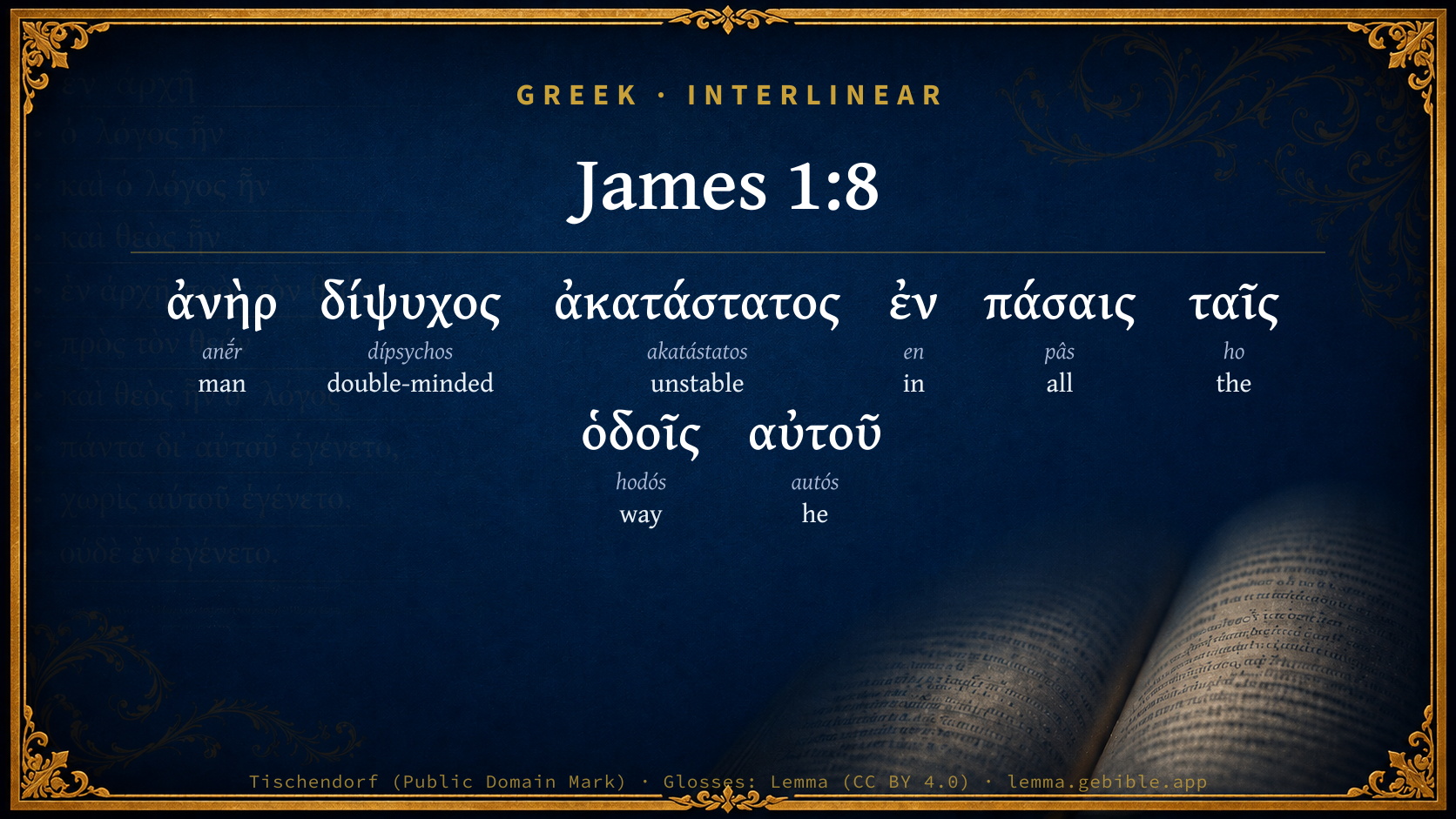
Greek (Tischendorf 8th ed.) James 1:8 appears in the Greek New Testament. The text above is from the Tischendorf 8th edition. Each word links to its Strong’s number and a concise gloss. Click any word for its full Thayer’s Greek Lexicon entry.
Download image
Cite this verse

James 1:8 (World English Bible). Public Domain. Lemma interlinear Bible study tool, https://lemma.gebible.app/v/james/1/8.

Show BibTeX & RIS
BibTeX
RIS
English Translation
He is a double-minded man, unstable in all his ways.
World English Bible · Public Domain
Highlights
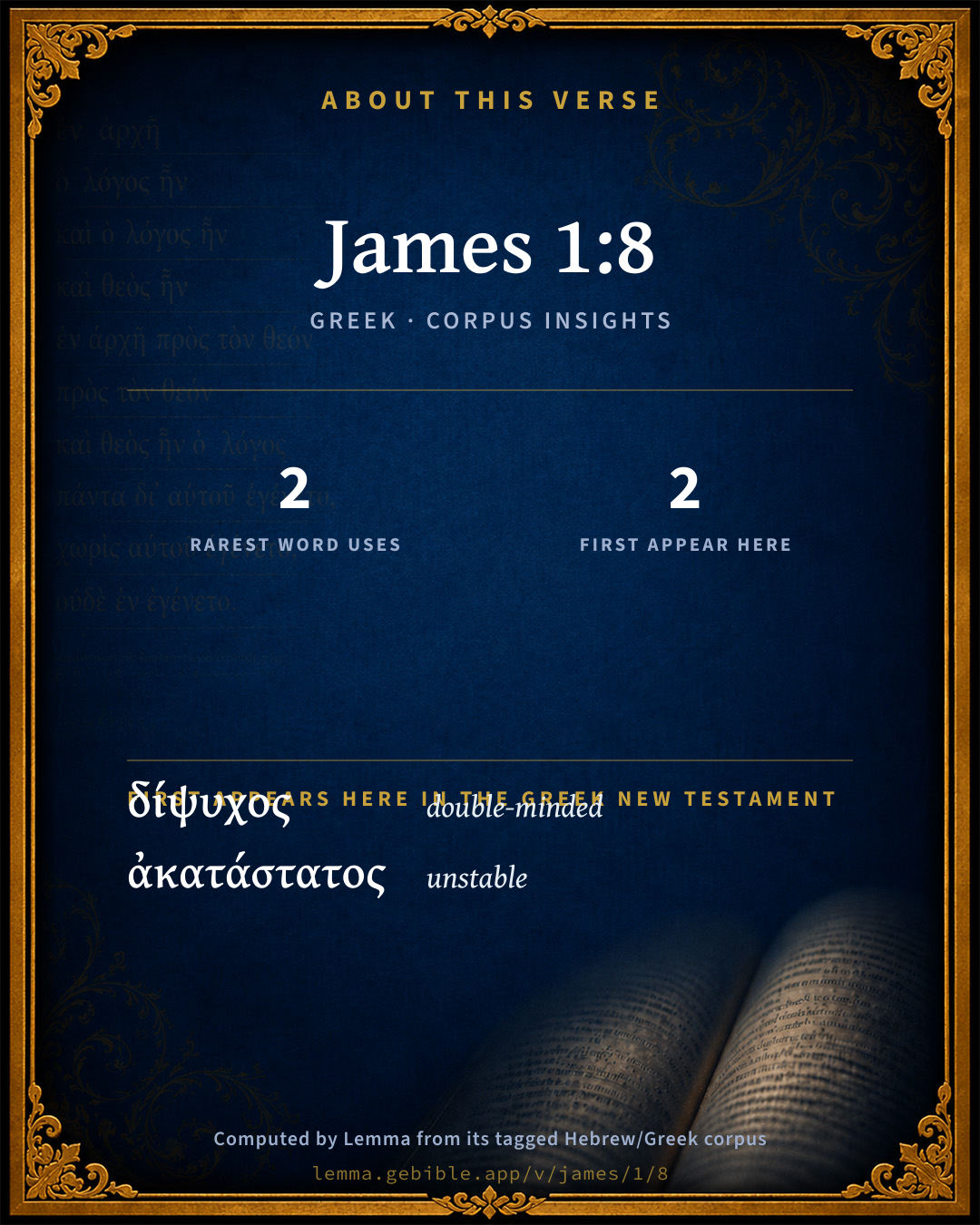
  • 2 first appearances in the Greek New Testament
Full analysis ↓
Download a study sheet

One document with this verse’s original text, its word-by-word gloss line, the meaning frame, cross-references with their text, attributed commentary, and full source and license credits — printable, and it pastes into notes with its structure intact.

This verse Autodidact and up

Study sheet (.html) Plain text (.txt)

A passage Seminary Student

Up to 50 verses in one chapter. A passage sheet keeps up to 6 commentary sources and 12 cross-references per verse, in the order this page ranks them, and says so on the sheet whenever that leaves anything out. Ask for a single verse and you get the Autodidact verse sheet above.

Everything on this page stays free to read, with no account — the sheet is a download of what is already on screen, not access to it.

Want to remove ads? Support Godless Engineer
Compare translations 3

The same verse in 3 English versions, stacked beneath the original-language interlinear above. Click any original word for its lexicon entry.

Each is an independent rendering of the whole verse — the interlinear is not word-aligned to these translations.

Highlighted words mark where these versions differ — a whole-verse word diff, not a word-by-word alignment.

  • World English Bible Public Domain
    He is a double-minded man, unstable in all his ways.
  • King James Version Public Domain
    A double minded man is unstable in all his ways.
  • unfoldingWord Literal Text CC BY-SA 4.0
    a double-minded man, unsettled in all his ways.

unfoldingWord Literal Text — © unfoldingWord, licensed CC BY-SA 4.0. Word-aligned USFM3 via Door43 (git.door43.org/unfoldingWord/en_ult).

Versions to compare (up to 4)

3 of 4 selected

Show all 19 translations

Every available English version of this verse, each an independent rendering of the whole verse.

  • World English Bible Public Domain
    He is a double-minded man, unstable in all his ways.
  • Berean Standard Bible Public Domain
    He is a double-minded man, unstable in all his ways.
  • Majority Standard Bible Public Domain
    He is a double-minded man, unstable in all his ways.
  • King James Version Public Domain
    A double minded man is unstable in all his ways.
  • American Standard Version (1901) Public Domain
    a doubleminded man, unstable in all his ways.
  • Revised Version (1885) Public Domain
    a doubleminded man, unstable in all his ways.
  • Geneva Bible (1599) Public Domain
    A double minded man is vnstable in all his waies.
  • Douay-Rheims (1899) Public Domain
    A double minded man is inconstant in all his ways.
  • Young's Literal Translation Public Domain
    a two-souled man `is' unstable in all his ways.
  • Literal Standard Version CC BY-SA 4.0
    a soul-split man [is] unstable in all his ways.
  • Unlocked Literal Bible CC BY-SA 4.0
    Such a person is double-minded, unstable in all his ways.
  • unfoldingWord Literal Text CC BY-SA 4.0
    a double-minded man, unsettled in all his ways.
  • Darby Bible Public Domain
    [he is] a double-minded man, unstable in all his ways.
  • World Messianic Bible Public Domain
    He is a double-minded man, unstable in all his ways.
  • Webster's Bible Public Domain
    A man unsettled in his opinions is unstable in all his ways.
  • Free Bible Version CC BY-SA 4.0
    their minds think every which way, and they're unstable in whatever they do.
  • Bible in Basic English Public Domain
    For there is a division in his mind, and he is uncertain in all his ways.
  • Text-Critical English NT CC BY 4.0
    A double-minded man is unstable in all his ways.
  • Tyndale New Testament (1534) Public Domain
    A waveringe mynded man is vnstable in all his wayes.

Literal Standard Version (2020), Covenant Press — licensed CC BY-SA 4.0. Text via the HelloAO Bible API (eBible.org). Unlocked Literal Bible (unfoldingWord) — licensed CC BY-SA 4.0. Text via the HelloAO Bible API (eBible.org). unfoldingWord Literal Text — © unfoldingWord, licensed CC BY-SA 4.0. Word-aligned USFM3 via Door43 (git.door43.org/unfoldingWord/en_ult). Free Bible Version, Dr. Jonathan Gallagher — licensed CC BY-SA 4.0. Text via the HelloAO Bible API (eBible.org).

Word by word

More ways to search: Search by grammar → Find every occurrence → Compare this word →

Practice this passage: Drill this verse → Learn its vocabulary →

About this verse

These counts appear in no published source. They are computed here, from the morphology-tagged text and Lemma’s own curated glosses. What Lemma adds →

8
words
8
distinct lemmas
General Epistles
section

Notable vocabulary

The rarest word here is δίψυχος double-minded G1374 — appearing just 2 times in the whole Greek New Testament.

First appearance in Scripture

These words make their first canonical appearance in the Greek New Testament here:

  • δίψυχος double-minded G1374
  • ἀκατάστατος unstable G182

Shared distinctive vocabulary

δίψυχος double-minded G1374 occurs in 2 verses of the Greek New Testament. Also found in:
Cross-references

9

Topical passages linked to James 1:8 in the Treasury of Scripture Knowledge — connected by theme and wording, ordered by reader-vote popularity; previews shown in the World English Bible.

  • 1 Kings 18:21 Elijah came near to all the people, and said, "How long will you waver between the two sides? If Yahweh is God, follow him; but if Baal, then follow him." The people answered him not a word.
  • Matthew 6:24 "No one can serve two masters, for either he will hate the one and love the other; or else he will be devoted to one and despise the other. You can't serve both God and Mammon.
  • James 4:8 Draw near to God, and he will draw near to you. Cleanse your hands, you sinners; and purify your hearts, you double-minded.
  • Isaiah 29:13 The Lord said, Because this people draw near [to me], and with their mouth and with their lips to honor me, but have removed their heart far from me, and their fear of me is a commandment of men which has been taught [them];
  • 2 Peter 2:14 having eyes full of adultery, and who can't cease from sin; enticing unsettled souls; having a heart trained in greed; children of cursing;
  • 2 Kings 17:41 So these nations feared Yahweh, and served their engraved images; their children likewise, and their children's children, as did their fathers, so do they to this day.
  • 2 Peter 3:16 as also in all of his letters, speaking in them of these things. In those are some things hard to be understood, which the ignorant and unsettled twist, as they also do to the other Scriptures, to their own destruction.
  • 2 Kings 17:33 They feared Yahweh, and served their own gods, after the manner of the nations from among whom they had been carried away.
  • Hosea 7:8–11 Ephraim, he mixes himself among the nations. Ephraim is a pancake not turned over.

Cross-references courtesy of OpenBible.info (CC BY 4.0).

Commentary

Notes on James 1:8 from classic Christian and Jewish commentators (each source and its license shown beneath its notes). The classic Christian expositions comment on the surrounding passage and are grouped to its opening verse, so a note may address several verses; the Jewish commentaries on the Tanakh (Rashi and others) are per-verse, so they appear only where the commentator wrote on this verse.

Lemma curates 59 commentaries, every one of them public domain or Creative Commons licensed, each selected and text-cleaned for this edition rather than reprinted as found. About our sources →

Jamieson, Fausset & Brown

Robert Jamieson, A. R. Fausset & David Brown

double-minded--literally, "double-souled," the one soul directed towards God, the other to something else. The Greek favors ALFORD'S translation, "He (the waverer, Jam 1:6) is a man double-minded, unstable," &c.; or better, BEZA'S. The words in this Jam 1:8 are in apposition with "that man," Jam 1:7; thus the "us," which is not in the original, will not need to be supplied, "A man double-minded, unstable in all his ways!" The word for "double-minded" is found here and in Jam 4:8, for the first time in Greek literature. It is not a hypocrite that is meant, but a fickle, "wavering" man, as the context shows. It is opposed to the single eye (Mat 6:22).

Jamieson, Fausset & Brown — Commentary Critical and Explanatory on the Whole Bible (1871) — public domain (CC PDM 1.0). Text via the HelloAO Bible API.

The Biblical Illustrator

Joseph S. Exell

Jam_1:8

A double-minded man is unstable

The instability of a double-minded man

I.

THE CHARACTER OF ONE WHO IS IRRESOLUTE AND UNFIXED IN HIS LEADING VIEWS AND DESIRES.

1. His understanding is various.

2. He acts as if he had two wills.

3. His affections are spiritual or carnal, serious or sensual, heavenly or worldly, just as the two contrary principles of flesh and spirit prevail in him, which alternately sway the mind, and of which alternate sway this variableness of temper is the certain effect.

II. THE EFFECT OF THIS UNHAPPY TEMPER.

1. The double-minded man is inconstant in his purposes and pursuits.

2. Another effect of such a divided heart is that it can seldom in good earnest fall in with the dictates of conscience in the plainest instances of duty.

3. The double-minded man is easily overcome in an hour of temptation.

Lessons:

1. There is no man but what hath, and must have, some leading views in life, some grand point at which he aims, and to which he makes almost all his other views subservient.

2. Common understanding and reason will lead a man to examine what this great end is that he drives at.

3. Every man, as a reasonable creature, endowed by his Maker with reflection and understanding, should take special care that his governing aims be right.

4. Before we can know what ought to be our great and governing views, we must know what we are and what we are designed for.

5. That to serve and please and fear that great God that gave us being is our great concern, and ought at all times to be our governing view, as reasonable creatures born for immortality. (John Mason, M. A.)

The double-minded man

If reason be compared to the helm of a ship, the passions are the sails. It was necessary that we should be impelled to act, as well as that our actions should be duly regulated: and that is the most perfect state of human nature in which the guidance of the enlightened judgment is seconded by a steady and generous ardour. The double-minded man may be considered as divided in his judgment, and divided in his inclination. Divided in judgment, having thought, but thought superficially, upon the concurrent evidences of religious truth, he is carried about with every wind of doctrine. Hence the light which guides him is not a single and steady, but a wandering and bewildering, light. Divided in inclination, not averse to receive good impressions, yet unapt to retain them. In consequence of these internal changes, the double-minded man is equally changeable in his outward conduct, unstable in all his ways; and as the good or evil principle prevails, he is either intent on repairing his faults and advancing towards perfection, or he becomes the slave of his sins, injurious to his fellow creatures and a rebel to his God. Such is the character of the double-minded man in the general view.

1. Let us examine it as it appears to others. To the eminently good he is an object of humiliating compassion; to the bad, of derision. Moreover, every change of conduct adds his own testimony to the suffrage of the world, either that his understanding is so weak as to be always wavering between truth and error; or that his resolution is so frail as to fluctuate incessantly between good and evil, clearly discerned and acknowledged by himself to be so. Like a child, playing on the brink of a precipice (overhung with fruits and flowers), now struck with the danger, now tempted by the beauty and the fragrance; trembling, yet lingering, whether he recede from or advance to his destruction; presenting an image of most pitiable imbecility. His mind is torn by struggling passions; his life, a scene of conflict, that one may compare to civil war, in which rival parties, alternately defeated and victorious, inflict and suffer reciprocal calamities; and whichsoever prevails, nothing is to be seen but the burning of towns, the laying waste of provinces, confusion and desolation on every side. Alas, when a man is conscious of breaking through the secret resolutions of his own mind, of violating injunctions to which he has been professing perpetual obedience, renewing transgressions which he has been lamenting in anguish, which will shortly make him abhor himself, which will possibly fill up the measure of his guilt and seal his doom--what a scene of internal misery to be conscious, while knowing his duty, of wanting spirit and resolution to perform it; to possess an understanding, yet violate its best dictates; to have a heart, yet transgress its purest sentiments; to hear the voice of conscience and of God recalling him from ruin, yet finding himself hurried on by the headstrong fury of his passions--what must be the feelings of this man, who has endured so lately the pangs of guilt, who has been in the very crisis of a blessed change, who had begun to taste the sweets of liberty, yet is ensnared again--what must his feelings be while renewing and perpetuating his ignominious bondage!

2. Thus unhappy is the double-minded man in his own eyes: we are now to consider him with respect to his moral worth--his character in the sight of God. It is not a wavering, divided temper and conduct which comes within the line of salvation marked out by the gospel: If ye continue in My Word (says Jesus Christ Himself), then are ye My disciples indeed; and again, No man having put his hand to the plough and looking back, is fit for the kingdom of God. As guilt is the poison of the soul, so repentance is its cure: the double-minded man betakes himself alternately to the poison and to the remedy. If such treatment would be fatal to the bodily constitution, how much more to the constitution of the mind, which, if it do not fix in virtue, must sink into the reverse, while the passions and appetites are rather inflamed than moderated by temporary and ineffectual restraints, and all those finer principles which should hold them in subjection are gradually impaired and become callous by frequent injuries--every virtuous effort grows weaker and weaker, till it yieldsmechanically to every impulse of desire, and the whole mind becomes at length blind to danger, deaf to counsel, and dead to the sense of goodness. In this melancholy state, what hope of moral recovery can remain? Those who have lost sight of reason in the career of passion, or who have even long slumbered in a course of stupid unthinking wickedness, may still be awakened; and strong motives, with the aid of strenuous exertion, may still open some glimmering prospect of recovery. But when reason, conscience, religion, have tried their utmost, but in vain, what more remains to be done? (P. Houghton.)

A double-minded man

The word signifies one that has two souls; and so it may imply--

1. A hypocrite (Jam_4:8). As Theophrastus saith of the partridges of Paphlagonia, that they had two hearts, so every hypocrite hath two souls. As I remember, I have read of a profane wretch that bragged he had two souls in one body, one for God and the other for anything.

2. It implieth one that is distracted and divided in his thoughts, floating between two different ways and opinions, as if he had two minds or two souls.

3. And, more expressly to the context, it may note those whose minds were tossed to and fro with various and uncertain motions; now lifted up with a billow of presumption, then cast down in a gulf of despair, being divided between hopes and fears concerning their acceptance with God.

1. That unbelieving hypocrites are men of a double mind; they want the conduct of the Spirit, and are led by their own affections, and therefore cannot be settled: fear, the love of the world, carnal hopes and interests, draw them hither and thither, for they have no certain guide and rule. This double mind in carnal men bewrayeth itself two ways--in their hopes and their opinions.

(1) In their hopes they are distracted between expectation and jealousy, doubts and fears; now full of confidence in their prayers, and anon breathing forth nothing but sorrow and despair; and possibly that may be one reason why the Psalmist compareth the wicked to chaff (Psa_1:4), because they have no firm stay and subsistence, but are driven to and fro by various and uncertain motions, leading their lives by guess, rather than any sure aim.

(2) In their opinions hypocrites usually waver and hang in suspense, being distracted between conscience and carnal affections; their affections carry them to Baal, their consciences to God.

2. That doubtfulness of mind is the cause of uncertainty in our lives and conversation. Their minds are double, and therefore their ways are unstable. For our actions do oft bear the resemblance of our thoughts, and the heart not being fixed, the life is very uncertain. The note holdeth good in two cases.

(1) In fixing the heart in the hopes of the gospel.

(2) In fixing the heart in the doctrine of the gospel; as faith sometimes implieth the doctrine which is believed, sometimes the grace by which we do believe.

A certain expectation of the hopes of the gospel produceth obedience, and a certain belief of the doctrine of the gospel produceth constancy.

1. None walk so evenly with God as they that are assured of the love of God. Faith is the mother of obedience, and sureness of trust maketh way for strictness of life.

2. None are so constant in the profession of any truth as they that are convinced and assured of the grounds of it. (T. Manton.)

Double-mindedness

I. WE HAVE TO OBSERVE ON THE MISERABLE DISADVANTAGE, INEFFICIENCY, AND, WE MAY SAY, WORTHLESSNESS, OF SUCH A STATE OF MIND FOR ANYTHING GREAT AND GOOD. Double-minded, unstable in all things. Now, connect this with the consideration of the feebleness of the human powers at the best. Let those powers be in their best order, and exerted in the most steady, constant, and consistent manner possible, and even then, how slow and toilsome is the progress to any good! The most vigorous have mourned and been mortified, to see how little they had done: the most determined servants of God have confessed that they were unprofitable servants. Again, connect the idea of this character with that of the shortness of life; short, in the most protracted instances, shorter still, in the far greater number. And how much of this inevitably consumed in little cares and occupations, and, in many instances, in grievances, pains, and languor! A man deliberating and perplexing and confounding his designs, and life still hastening on; prosecuting a purpose a little while, and then, hesitating, stopping, life still going on! abandoning his design--life all the while passing away. Think, again, what dishonour and ignominy it is, for a man to be thus, as it were, his own opponent and frustrator. There is enough to obstruct him, from without, were he ever so vigorously prepared for the great operations of duty. But he has within him the causes of defeat. He cannot put in order the active principles and powers within the citadel of his soul, to sally out in force against the external difficulties and opposition. He has there opinion dissenting from opinion, motive disagreeing with motive, passion conflicting with passion, purpose thwarting purpose. But to carry the view outward; this double-minded man, who has no simplicity and unity of purpose, think how unfortunate is his case, on account of the multiplicity of things there will be to distract his purposes, and frustrate his exertions. In this double condition of mind he is liable to be arrested by a great number of things on either side.

II. But we may previously observe that there are very many men exempt from this miserable weakness, BY BEING THE SUBJECTS OF SOMETHING STILL WORSE. There is many a sinner that betrays no double-mindedness. He is actuated wholly, steadily, constantly, by some one predominant evil. The man of all-grasping ambition, the complete sensualist, the insane lover of money. And these, in their way, are most worthy to be held up as examples to those who profess to be, or to wish to be, devoted to better things. Look at them, we would say to the unstable, double-minded man--look at them and be ashamed! In representing the character of our text, in some of its most usual forms, we may note that there is perhaps some difference between a double-mindedness of variableness, fluctuation, fickleness, and that of inconsistency or self-contradiction. But we would rather direct the attention to that doable-mindedness which endeavours, in the habitual course of life, to combine irreconcilable things. And how many exemplify this in the manner in which their minds are affected between the present and the future! A predominance of regard to the great and endless future is indispensable to the happy order of the human soul. But in some minds this concern rather harasses than predominates--it cannot govern, but will not depart. And as it will not, it is attempted to be brought into some kind of compromise with the prevailing interest about the present objects. There is the warning thought, These present objects will soon be no longer mine--I must leave them! and what will be the state of my soul elsewhere? And there is terrible authority in this thought. It forces its demand on the conscience of such a man. There are, therefore, some serious thoughts; some employments of a religious kind; some abstinences and self-denials; some prayers, however constrained. And this miserably embitters the interest of the present and temporal objects. Still the heart cannot, cannot let these objects sink down to the subordinate rank, and admit the predominance of the grand future ones. This miserable double-mindedness distracts the tenor of a mans life. He goes on hesitating, embarrassed, impeded, and only succeeds in going wrong 1 It is much the same thing, we have said already, when we exemplify the character, denominated in the text, in the case of a man who approves some great, general, good object, but is influenced by a selfish interest against it. This private interest rises up against all his convictions and better wishes and sympathies, and determines him to oppose the thing he pronounces so good. But yet, not without a painful consciousness of inconsistency, which his utmost efforts cannot reconcile, and which gives a wavering unstable character to his course of proceeding. See, again, the character in the text exemplified in the case of a man harassed between the dictates of his own judgment and conscience, on the one side, and the consideration of how he will be accounted of in the world, on the other side. The attempted combination of things which cannot truly agree is exemplified in some who wish to carry an appearance and a profession of belonging to the Christians, the people of God, and at the same time are very desirous of being on the most favourable terms with worldly and irreligious society. We will only add to the description one more particular, and that of a doctrinal reference. There seems to be in some persons a double-minded apprehension of the meritorious cause of human salvation--a notion of some kind of distributive partition of the merit, between the sinful being himself and Jesus Christ. Now this must produce a painful perplexity and instability in a mans experience, and in his religious exercises and efforts. For it can never be adjusted, on each side, how much. If the Redeemer will not, of mere free favour, furnish all for justification, where will He stop? If I am to contribute essentially, meritoriously, myself, what will suffice? by what rule is it to be estimated? Unstable, therefore, is such a man in his feelings, in his efforts, in his prayers.

III. WHAT IS THE REMEDY FOR ALL THIS? The great thing to quell all this mischief and conflict and wretchedness is to have one grand predominant sovereign purpose of life. And what can that be but to live for God and eternity? How gloriously this would crush the hateful strife! and bring us out free, in singleness of spirit, for the enterprise of immortality! The means conducive, under the Divine influence, to the establishment of this great predominant principle and power are most plain and obvious. Let the man who feels the plague of this internal dissension, let him look most deliberately, most resolutely, and, as in the sight of God, at the motives, the objects, the interests, which divide and baffle his spirit; and solemnly decide what it is that deserves to have the ascendency. And what he is losing all the while! losing the labour of his vital powers--spending his strength for nought; losing his time, the inestimable advantages for the attainment of the final good, the present happiness he might be enjoying, the benefits of the Redeemers work, the day of grace and salvation. By continuance, too, these worse contesting principles have habit on their side, the most infernal ally of evil principles, an angelic one of the good. And, lastly, as God is, if we may speak so, the supreme unity, simplicity, consistency, stability, in the universe, the soul must have a firm connection with Him, so as to be in a humble sense (what we should not venture to express, if His own Word had not) a partaker of the Divine nature, by His Spirit imparted, through the medium of the Redeemer. And then these opposing evil principles and powers in the soul will shrink in the strife, will no longer prevail, though they linger to struggle, will have received the touch of death, and will perish wholly and for ever when the spirit is at last set free from mortality and this infected world. (J. Foster.)

The double-minded man

He is one who is inconstant; he is changeable; he hath a mind to serve God and be saved, but he hath at the same time a mind also to satisfy his lusts; he would be eternally happy in the next world, but he would not quit the sensual pleasures of this; he is godly by fits and by intervals, but he is not so uniformly, and uninterruptedly; his religion hath its flows and its ebbs, its rises and its falls; now it grows, and presently again it decays. To give us a more lively image of this instability, which is the distinguishing mark of a double-minded man, our apostle paints him out to us by a familiar but elegant comparison, He that wavereth is like to a wave of the sea, driven by the wind and tossed. The ground of this instability is the diversity of those principles upon which he acts; his heart is not pure and free from mixture, and therefore his actions are thus repugnant. He hath a double mind, and therefore nothing that he doth can be simple and uniform. To remove this inconsistency and incongruity, which there is betwixt what he at several times doth, his heart must be purified from all secular and low aims, and entirely be fixed on the choice of one single end, and steadily apply itself to the use of such means, as all jointly conspire to the attainment of that end. When we make the glory of God and the salvation of our souls our last and chief end; when we form no other designs that come in competition with this; when all our actions are so ordered as to have a proper tendency to this end, and do all agree with each other by agreeing together in this tendency, then have we that purity of heart which our apostle here enjoins. (Bp. Smalridge.)

The folly of double-mindedness

Should we observe a person at the same time taking aim at two different marks placed at a considerable distance, and much more, if they were placed diametrically opposite to one another, we must be more than ordinarily serious if such a sight did not move our spleen and provoke our laughter. And yet every whit as ridiculous is that person who proposes to himself such designs as do plainly interfere with each other. For is it not the height of folly to aim at any end which we are sure never to accomplish? And must not he that pursues opposite ends necessarily fall short of one of them? For will not all those means that contribute to the gaining one, hinder the attainment of the other? If the pleasures of this world are more suited to our natures; if they are more agreeable to our rational faculties; if they are more durable; if they are more perfect whilst they last; let us pursue these steadily, without troubling ourselves for anything beyond them. Let us not rob ourselves of any of the present satisfactions of this life, in expectation of lesser joys at a greater distance. Or if the pleasures of this world, though they do not exceed, yet are truly equal to the pleasures of the next; if, having weighed them together in an even balance, we find that neither of them turns the scale; then let us live at all adventures: where there is no room for preference, let us take either side, as it happens. Let us set our affections on things above, or on things below; be godly or profane; sober or intemperate; righteous or unjust; merciful or uncharitable, according as we are in humour. Let us practise some duties to comply with the motions of the Spirit, and commit some sins to gratify the lusts of the flesh; and having no certain haven where we would be, let us suffer our inclinations to run afloat, and to be tossed about to any point of the compass by every blast of wind. But if neither of these be the true state of our case, as, if the Christian religion be true, we are sure neither is; if the advantages and pleasures of this present time are not worthy to be compared with the glory that shall be revealed; nay, farther, if the seeking of the things of this world, either more than the glories of the next, or equally with them, will shut us out of the kingdom of God; and if on the other side, to those who first seek the kingdom of God, and His righteousness, these things shall be added over and above; where there is such a vast disparity in the objects, where the dispute lies between the creature and the Creator, between finite and infinite, between momentary and eternal, there to be equally poised between such unequal objects; and, in short, for the want of a uniform pursuit of the better part, to lose both parts, is such a degree of folly as in speculation we could never have believed possible, had not the practice of men showed it to be very common. (Bp. Smalridge.)

The uneasiness of double-mindedness

When a mariner hath determined within himself what port to make to, and is secure that he is in the direct way which will bring him to that port, whatever ill accidents he meet with in his passage are in some measure made tolerable by the prospect he hath of arriving at the desired haven at last; but when he is tossed by contrary winds from one point to the other; when, in the words of the Psalmist, he reels to and fro, and staggers like a drunken man, and is at his wits end, because he knows not which way to steer his course, then must his soul needs be melted within him because of trouble. Now this is the unpleasant condition of a double-minded person: he is tossed to and fro, and carried about with every wind. Sometimes the pleasures of this world appear amiable in his eyes, and he pursues them with great eagerness of soul; but these have nothing in them which will satisfy his desires; these either flying from him whilst he follows them, or vanishing away in the fruition; he hopes to find more solid contentment of mind in the practise of virtue and the duties of religion; but having not a true relish for these more refined pleasures, finding some hardships in his first entrance upon a holy life, and wanting resolution of mind to overcome them by patience, he quickly relapses into) his former wicked courses, and tries again the more beaten paths of vice; but still he is as far removed as ever he was from the attainment of true happiness, because he does not move towards it in a direct line, but, by going sometimes forwards and sometimes backwards, is at an equal distance from his journeys end, after all his wearisome travel and pains, as he was when he at first set out. The heavenly minded person who pursues the paths of virtue with an even course finds in himself a fund of joy which is never to be exhausted, a spring of comfort and delight which never fails him (Psa_16:5). On the other side, the carnal-minded person who is uniform and consistent with himself in a constant course of sin; who hath got the conquest over his conscience, and is deaf to its loudest cries; who, finding the fetters of religion too burdensome, hath taken care to break these bonds asunder, and to cast away these cords from him, hath his share of pleasures, which he freely enjoys, without abatement or control. The double-minded person who pretends to be sometimes spiritual, and who at other times is carnal; who shares his affections betwixt the Creator and the creature; who sometimes obeys the laws of God to comply with the dictates of his conscience, and at other times disobeys Gods laws to gratify his sensual appetite, may perhaps propose to himself a double share of pleasure; and all that happiness which the spiritual and carnal person do separately divide between them, he may fondly hope to join together in one, and to enjoy at once. But whilst he aims at too much, he is in danger to lose all; whilst he claims more happiness than comes to his share, he forfeits what otherwise he might have fairly enjoyed; and, instead of uniting in one the different pleasures of a sensual and spiritual life, he will find by experience that he truly tastes neither. For the pleasures of sin are embittered by the remorses of conscience, whose checks he is not able wholly to silence; and, on the other side, that satisfaction of mind which he should reap from the consciousness of having done some things well is impaired by the sense of guilt which arises from his having done other things which he knows to be evil. There are several forbidden pleasures which a profligate, dissolute thorough-paced sinner, who hath no sense of shame, no fear of God, no strugglings of conscience to restrain him, doth without control freely indulge himself in; and these make up a great part of that happiness which he pitches upon as his portion. But the double-minded person who proposes to himself different ends, and pursues different courses, though he sometimes transgresses the lines of duty, dares not go great lengths in vice; he hath not so far got the mastery over his conscience but that there are several kinds and instances of sin at which he presently starts back and recoils; he is for keeping up an interest with two opposite parties, God and the world; and therefore is careful not to serve either, so far as to make the breach with the other utterly irreconcilable; and thus, for want of a perfect and uniform obedience, he loses those pleasures which the saints of God find in a religious life; and at the same time, for want of being thoroughly wicked, he debars himself from several sorts and degrees of pleasure which profligate sinners take very frequent and very large draughts of. And as through the restraint of conscience he dares not allow himself in several pleasures which notorious sinners liberally taste of, so in those which, through the prevalence of his lusts, he gives way to, he finds not all that relish which they do. For though he is so far wicked as not to resist a temptation when it is offered; yet he cloth not so much as the other entertain himself with the prospect of criminal pleasure before be enjoys it; his soul is not so wholly swallowed up with it whilst he enjoys it; and he doth not with so much contentment call it back and dwell upon it in his memory, and act it over again in his imagination after he has enjoyed it. (Bp. Smalridge.)

The sinfulness of double-mindedness

I. IT IS CONTRARY TO THAT LOVE OF GOD WHICH THE GOSPEL EXPRESSLY REQUIRES (Mat_22:35). Now, if the steadiness of our obedience depends upon the sincerity of our love of God; if nothing can seduce them from their duty, whose hearts are truly possessed with an ardent love of God; then will it follow, on the other side, that those whose obedience is partial and interrupted, who advance some steps in the paths of virtue, and after that depart back into sinful courses, are destitute of that superlative love of God which is the very basis of all religion, and the first and chief condition of our eternal salvation.

II. IT IS INCONSISTENT WITH THAT PERFECTION WHICH IS ANOTHER CONDITION OF THE GOSPEL COVENANT. Absolute perfection is not to be attained, and therefore repentance comes in to supply the want of it; but a sincere endeavour after perfection is possible; and he who sins with a resolution to repent is not sure that God will give him grace to repent in time of need. Now, if an endeavour after perfection, if doing the utmost we can do in all things to keep a conscience void of offence, is confessed on all hands to be the least that can be meant by that perfection which is the condition of our salvation, then must double-minded persons be in a very dangerous state who cannot pretend that they perform this condition. For can that person be said to use his utmost endeavours to be perfect who, though he resists some temptations, yet not only yields to but even invites others? Doth he do all he can do to approve himself to God who doth as many actions, which he knows to be displeasing to God, as he doth actions acceptable? Can he be thought in earnest to press forwards towards the mark whose retreats are equal to his advances? who is always in motion, but rids no ground; and who, after some years spent in a course of religion, is got no farther than when he at first set out? As well may he be thought a perfect scholar who, in that part of learning he professes, is ignorant of as many things as he knows; or that be deemed a perfect animal which, of those limbs it should have, wants as many as it hath, or which is destitute of as many organs of sense as it enjoys.

III. IT IS INCONSISTENT WITH THAT SINCERE FAITH UPON THE OBSERVANCE OF WHICH ON OUR PART WE EXPECT SALVATION, if we examine the faith of a double-minded person, if we try it by its works, we shall not find it thus general and impartial. He finds gracious promises the gospel annexed to the performance of some duties, and these he pretends to discharge on purpose that he may inherit those precious promises; but he finds also severe threats denounced against some sins; and, notwithstanding these threats, he goes on in a constant habitual commission of them. Now, how is his performance of these duties a better proof that he heartily believes those promises than his voluntary transgressions are, that in his heart he disbelieves those threats? (Bp. Smalridge.)

Instability of the double-souled

A two-souled man is unsettled; unstable in all ways. His opinions are fluctuating; and so are his sentiments. Sometimes he is repenting of his sins, and sometimes he is repenting of his repentance. Sometimes the importance of the future overwhelms him, and sometimes he feels theft nothing is worth thinking of but the present. Such instability of sentiment must unsettle the believer. The man is sometimes as serene as a May morning, and sometimes as sweeping as a cyclone. You can never know how he will receive you, or how he will behave under certain circumstances. His instability imparts its changefulness to his countenance; while he is looking one way, his soul has gone another. His speech is ambiguous, his tone of voice wavering, his utterance now very rapid and now very slow. Sometimes he answers offhand and without reflection, and then he requires so much time to consider that the opportunity for speech has passed. He is untrustworthy in every department of life. That man cannot receive anything of the Lord. He cannot hold his hand long enough to have anything placed therein. (C. F. Deems, D. D.)

The Biblical Illustrator, edited by Joseph S. Exell (c. 1880s–1900s) — public domain. Text from a community e-Sword module.

Joseph Benson's Commentary

Jas 1:8. A double-minded man — Ανηρ διψυχος, a man who has, as it were, two souls; whose heart is divided between God and the world, and is not simply given up to him, nor entirely confides in him for the direction, aid, and support which he stands in need of; is unstable in all his ways — Being without the true wisdom, he perpetually disagrees both with himself and others; and will be perpetually running into inconsistencies of conduct, while those imperfect impressions of religion which he feels will serve rather to perplex and torment than to guide and confirm him in the right way.

Joseph Benson's Commentary on the Old and New Testaments (1811–1818) — public domain. Text from a community e-Sword module.

Tyndale Open Study Notes

Tyndale Open Resources

1:8 Their loyalty is divided between God and the world (literally They are double-minded): James might have created the Greek word used here. He emphasizes the need for confidence in God alone.

Tyndale Open Study Notes — © Tyndale Open Resources, licensed CC BY-SA 4.0. Text via the HelloAO Bible API.

Bengel's Gnomon

Johann Albrecht Bengel

Jas 1:8. Ἀνὴρ δίψυχος, a double-minded man) The same word (δίψυχος) is applied, ch. Jas 4:8, to those who have not a heart pure and simply given up to God. The word does not occur elsewhere in the New Testament, or in the Septuagint. It may be translated “having two souls,” as we speak of “a double-tongued”[7] man. Hesychius, διψυχία ἀπορία, “a state of doubt or perplexity. It is therefore connected in meaning with the word οιακρινόμενος, “the wavering.” Such a man has, as it were, two souls, of which the one holds one opinion, the other holds another. Sir 2:12, ΟὐΑῚ ΚΑΡΔΊΑΙς ΔΕΙΛΑῖς, ΚΑῚ ΧΕΡΣῚ ΠΑΡΕΙΜΈΝΑΙς, ΚΑῚ ἉΜΑΡΤΩΛῷ ἘΠΙΒΑΊΝΟΝΤΙ ἘΠῚ ΔΎΟ ΤΡΊΒΟΥς: “Woe be to fearful hearts, and faint hands, and the sinner that goeth two ways!”—ἀκατάστατος, unstable) For he does not obtain Divine direction by prayer: and being destitute of wisdom, he is at variance with himself and with others. Comp. ch. Jas 3:16.

[7] Both these meanings are contained in the German falsch.

Bengel's Gnomon of the New Testament — English translation (T&T Clark, Edinburgh, 1860) — public domain. Text from a community e-Sword module.

Meyer's Critical & Exegetical Commentary

Heinrich August Wilhelm Meyer

Jam_1:8 contains neither the subject to λήμψεται (Baumgarten), nor is it to be understood as an exclamation = vae homini inconstanti (Pott). Many expositors consider ἀνὴρ δίψυχος as the subject and ἀκατάστατος the predicate, wanting the copula (Luther: a doubter is unstable; so Calvin, Schneckenburger, de Wette, Lange, and others); but according to this construction the idea δίψυχος falls too much into the background, and also the train of thought would be too unconnected. It is better to take both ἀνὴρ δίψυχος and ἀκατάστατος κ.τ.λ. as in apposition to ὁ ἄνθρωπος ἐκεῖνος. It is true that the character of the doubter has already been given in Jam_1:6 by ἔοικε κ.τ.λ., but, on the one hand, only figuratively, and, on the other hand, without giving prominence to his ethical character, which James now introduces in order strongly to confirm the thought expressed in Jam_1:7; which exposition is far from being a feeble tautology (Lange). Less stress is to be put on the want of the article (Schneckenburger, de Wette), as it would be here hardly suitable. Correctly Winer, p. 497 [E. T. 670]: he, a double-minded man; so also Wiesinger, Brückner, Bouman, and others. Only according to this construction is the full meaning given to the idea δίψυχος. The word is not to be taken merely as another expression for διακρινόμενος (Luther, Beza, Grotius, Cremer, and others; Luther directly renders it a doubter), but it characterizes the inward nature of the doubter. According to the mode in which δισώματος, δικάρδιος, δίγλωσσος, and similar words are formed, δίψυχος (which occurs neither in the classics nor in the LXX. and the Apocrypha, but besides here only in chap. Jam_4:8, and the Church Fathers) properly denotes having two souls; it thus describes the doubter as a man who has, as it were, two souls contending against each other: one of which is turned to God, and one of which is turned away from God (thus to the world); who, accordingly, will be at the same time φίλος τοῦ Θεοῦ and φίλος τοῦ κόσμου, although φιλία τοῦ κόσμου is ἔχθρα τοῦ Θεοῦ (chap. Jam_4:6).[54] This double-mindedness (or what is the same thing, division of soul) expresses the wavering to and fro, between ΠΊΣΤΙς and ἈΠΙΣΤΊΑ generally, so particularly also in prayer; therefore it is called, Constitut. Ap. vii. 11: μὴ γίνου δίψυχος ἐν προσευχῇ εἰ ἔσται, ἢ οὐ, and Clemens Romanus: ταλαίπωροι οἱ δίψυχοι, οἱ διστάζοντες τὴν ψυχήν; comp. Sir_1:28 : μὴ προσέλθῃς αὐτῷ (κυρίῳ) ἐκ καρδίᾳ δίσσῃ.

δίψυχον εἶναι is to be understood neither as the reason (Wiesinger) nor as the result (Lange), but as the characteristic nature of διακρίνεσθαι.

The word ἀνήρ is here as in Mat_7:24; Psa_32:2, LXX. Lange thinks that James used it because the dangers of which he warns them are more especially the dangers which threaten the men among the Jews.

As a second apposition James adds: ἈΚΑΤΆΣΤΑΤΟς ἘΝ ΠΑΣΑῖς ΤΑῖς ὍΔΟΙς ΑὙΤΟῦ] for where there is a want of unity in the internal life, it is also wanting in the external conduct. The ΔΊΨΥΧΟς, being actuated sometimes by one impulse and sometimes by another, is unsteady and inconstant in his intentions and actions (ἘΝ ΤΑῖς ὍΔΟΙς ΑὙΤΟῦ; comp. Psa_91:11; Jer_16:17; Pro_3:6, etc.); he walks not on one path, but as it is said in Sir_2:12 : ἐπιβαίνει ἐπὶ δύο τρίβους.[55] The word ἀκατάστατος is found only again in chap. Jam_3:8 and in the LXX. Isa_54:11 as the translation of סֹעֵר; the substantive ἀκαταστασία occurs in chap. Jam_3:16, besides in Luke and in the Epistles to the Corinthians.

The reason why the doubter is not heard is accordingly the disunion in which he is with himself, both in his internal and in his external life; God gives the heavenly gift of wisdom, which according to its nature is ἁγνή, only to him who ἐν ὅλῃ τῇ ψυχῇ (Mat_22:37), has given to God an undivided disposition.

[54] Oecumenius limits the idea too specifically to a care divided about the present and the future: δίψυχον ἄνδρα τὸν ἀνεπέρειστον, τὸν ἀστήρικτον λέγει, τὸν μήτε πρὸς τὰ μέλλοντα παγίως, μήτε πρὸς τὰ πάροντα ἀσφαλῶς ἡδρασμένον, ἀλλὰ τῇδε κακεῖσε ἀγόμενον καὶ περιφερόμενον, καὶ ποτὲ μὲν τῶν μελλόντων, ποτὲ δὲ τῶν παρόντων ἀντεχόμενον. In the classics related ideas are διάνδιχα μερμερίζειν, Hom. Il. i. 189, and frequently: διάνδιχα θυμὸν ἔχειν, Hesiod, O. 13; ψυχὴ ἀνάρμοστος, Phaed. 93 c (opp. ψυχὴ ὁμονοητική, Pl. Resp. viii. 554), etc. In the Hebrew, בְּלֵב וָלֵב, so in 1Ch_12:33, where בְּלֹא־לֵב וָלֵב is equivalent to בְּלֵבָב שָׁלֵם, ver. 38; that expression has another meaning in Psa_12:3.

[55] Schneckenburger incorrectly explains ἀποκατάστατος here of the fate of the doubter: parum constautiae experitur in omnibus, quae ipsi contingunt, sua culpa sorte varia conflictatur, and ὄδος = fortuna; also Heisen at least includes this idea: omnia vitae consilia ac facta quin et fata. This certainly is a possible explanation in itself, but it does not suit the context. The meaning attached to the word by Lange, seditious disturber, cannot be proved to be correct by Jam_3:16.

Meyer — Critical and Exegetical Commentary on the New Testament — English translation by Peter Christie, edited by Frederick Crombie (T&T Clark, 1880) — public domain. Text from a community e-Sword module.

Expositor's Greek Testament

ed. W. Robertson Nicoll

Jas 1:8 . δίψυχος : Although this word is not found in either the Septuagint or elsewhere in the N.T. (excepting in Jas 4:8 ) its occurrence is not rare otherwise; Clement of Rome, quoting what he calls ὁ προφητικὸς λόγος , says: ταλαίπωροί εἰσιν οἱ δίψυχοι , οἱ διστάζοντες τῇ καρδίᾳ … (Resch., Agrapha , p. 325 [2nd ed.]); the word occurs a number of times in Hermas, e.g., Mand. , ix. 1, 5, 6, 7; xi. 13; so too in Barn., xix. 5, and in Did., iv. 4, as well as in other ancient Christian writings and in Philo. The frame of mind of the ἀνὴρ δίψυχος is equivalent to a “double heart,” see Sir 1:25 , μὴ προσέλθῃς αὐτῷ ( i.e. , the fear of the Lord) ἐν καρδίᾳ δισσῇ ; this is precisely the equivalent of the Hebrew לֵב וָלֵב in Psa 12:3 , which the Septuagint unfortunately translates literally, ἐν καρδίᾳ καὶ ἐν καρδίᾳ . In Enoch xci. 4 we have: “Draw not nigh to uprightness with a double heart, and associate not with those of a double heart”; as the Greek version of this work is not extant it is impossible to say for certain how “double heart” was rendered. On the construction here see Mayor. ἀκατάστατος ἐν πάσαις ταῖς ὁδοῖς αὐτοῦ : this is severe, and reads as if the writer had some particular person in mind. The double-hearted man is certainly one who is quite unreliable. Ἀκατάστατος , which occurs only here and in Jas 3:8 (but see critical note) in the N.T., is found in the Septuagint, though very rarely; in Isa 54:11 we have Ταπεινὴ καὶ ἀκατάστατος οὐ παρεκλήθης , where the Hebrew for ἀκατάστ . ( סֹעֲרָה ) means “storm-tossed”. In the verse before us the word seems to mean unreliability, the man who does not trust God cannot be trusted by men; this probably is what must have been in the mind of the writer. ἐν πάσαις , etc.: a Hebrew expression for the course of a man’s life in the sense of his “manner of life” ( ἀναστροφή , see Jas 3:13 ) see Pro 3:1 , ἐν πάσαις ὁδοῖς σου γνώριζε αὐτήν (Hebrew αὐτόν ), ἵνα ὀρθοτομῇ τὰς ὁδούς σου . The sense of the expression is certainly different from ἐν ταῖς πορείαις αὐτοῦ in Jas 1:11 which refers to the days of a man’s life.

The Expositor's Greek Testament, edited by W. Robertson Nicoll (1897–1910) — public domain. Text from a community e-Sword module.

Geneva Bible (1599)

Geneva Bible translators

In all his thoughts and his deeds.

Geneva Bible (1599) marginal notes — public domain. Text via Bolls.life.

Adam Clarke's Commentary

Verse 8. A double-minded man] ανηρ διψυχος. The man of two souls, who has one for earth, and another for heaven; who wishes to secure both worlds; he will not give up earth, and he is loth to let heaven go. This was a usual term among the Jews, to express the man who attempted to worship God, and yet retained the love of the creature. Rabbi Tanchum, fol. 84, on De 26:17, said: "Behold, the Scripture exhorts the Israelites, and tells them when they pray, לא יהיה להם שתי לבבות lo yiyeh lahem shetey lebaboth, that they should not have two hearts, one for the holy blessed God, and one for something else." A man of this character is continually distracted; he will neither let earth nor heaven go, and yet he can have but one. Perhaps St. James refers to those Jews who were endeavoring to incorporate the law with the Gospel, who were divided in their minds and affections, not willing to give up the Levitical rites, and yet unwilling to renounce the Gospel. Such persons could make no progress in Divine things.

Adam Clarke's Commentary on the Bible (1810–1826) — public domain. Text from a community e-Sword/MySword module.

John Calvin's Commentaries

8 A double-minded man, or, a man of a double mind. This sentence may be read by itself, as he speaks generally of hypocrites. It seems, however, to me to be rather the conclusion of the preceding doctrine; and thus there is an implied contrast between the simplicity or liberality of God, mentioned before, and the double-mindedness of man; for as God gives to us with a stretched out hand, so it behooves us in our turn to open the bosom of our heart. He then says that the unbelieving, who have tortuous recesses, are unstable; because they are never firm or fixed, but at one time they swell with the confidence of the flesh, at another they sink into the depth of despair.

John Calvin's Commentaries (1540-1563) — public domain. Text from the Calvin Translation Society English edition (1840s-50s) via the Christian Classics Ethereal Library (ccel.org). Calvin's coverage is partial (roughly two-thirds of the Bible); uncommented books and verses are honest gaps, never fabricated. The 19th-century editor's footnotes and remarks are omitted so the notes are faithfully Calvin's own voice.

Ellicott's Commentary for English Readers

(8) The eighth verse had better be joined with the seventh, and punctuated thus:—Let not that man think he shall receive anything of the Lord:—double minded, unstable in all his ways. The reason why he can obtain nothing is because he is a man of two minds, and by consequence uncertain in his ways. The words, apparently are those of a proverb. It is useless to have, as it were, two hearts, one lifted up to God, the other turned away. “Come not unto Him with a double heart” (Sir_1:28; and comp. Mat_6:24).

A Bible Commentary for English Readers, edited by Charles John Ellicott (1878–1897) — public domain. Text from a community e-Sword module.

The Cambridge Bible for Schools and Colleges

gen. ed. J. J. S. Perowne

8. A double minded man …] The context shews that the man so described (the Greek word is not found in any earlier writer and may have been coined by St James) is not the fraudulent man but the waverer, trying to serve two masters (Mat_6:24), halting between two opinions (1Ki_18:21). It answers to the “double heart” (Heb. “a heart and a heart”) of Psa_12:2. In Sir_1:28 we find the same thought, though not the same word, “Come not unto the Lord with a double heart,” and again in Sir_2:12, where a woe is uttered against the “sinner that goeth two ways,” in company with “the fearful and faint-hearted.” Clement of Rome (i. 11) reproduces St James’s word. The construction of the sentence is doubtful, and may be taken either as in the English text, or, with “he that doubteth” as the subject and “double-minded, unstable” as predicates.

unstable] The Greek word is found in the LXX. of Isa_54:11, where the English version has “tossed with tempest.” It is not found elsewhere in the New Testament, except as a various reading in ch. Jas_3:8, but the corresponding noun is often used both literally and figuratively (Luk_21:9; 1Co_14:33; 2Co_6:5; 2Co_12:20; Jas_3:16 and the LXX. of Pro_26:28). There is a slight change of imagery, and the picture brought before us is that of a man who does not walk straight onward, but in “all his ways” goes to and fro, now on this side, now on that, staggering, like a drunken man.

The Cambridge Bible for Schools and Colleges (gen. ed. J. J. S. Perowne; Cambridge University Press, 1878–1918) — public domain. Text from a community e-Sword module.

John Gill's Exposition

A double minded man,.... A man of two souls, or of a double heart, that speaks and asks with an heart, and an heart, as in Psa 12:2 who halts between two opinions, and is at an uncertainty what to do or say, and is undetermined what to ask for; or who is not sincere and upright in his requests, who asks for one thing, and means another, and asks amiss, and with an ill design; does not call upon God in truth, and in the sincerity of his soul; draws nigh to him with his mouth, and honours him with his lips, but his heart is far from him. Such an one is

unstable in all his ways; he is confused in his mind; restless in his thoughts, unsettled in his designs and intentions; inconstant in his petitions; uncertain in his notions and opinion of things; and very variable in his actions, and especially in matters of religion; he is always changing, and never at a point, but at a continual uncertainty, both in a way of thinking and doing: he never continues long either in an opinion, or in a practice, but is ever shifting and moving.

John Gill's Exposition of the Whole Bible (1746–1763) — public domain (CC PDM 1.0). Text via the HelloAO Bible API.

Trapp's Complete Commentary

John Trapp

8 A double minded man is unstable in all his ways.

Ver. 8. Unstable in all his ways] As he is that stands on one leg, or as a bowl on a smooth table. Contrariwise, a believer is as a square stone set into the building, 1Pe 2:7; shaken he may be, but he is rooted as a tree; wag he may up and down as a ship at anchor, but yet he removes not.

John Trapp, A Commentary or Exposition upon All the Books of the Old and New Testament (1647–1656) — public domain. Text from a community e-Sword module.

Albert Barnes' Notes on the Bible

A double minded man - The word here used, δίψυχος dipsuchos occurs only here and in Jam 4:8. It means, properly, one who has two souls; then one who is wavering or inconstant. It is applicable to a man who has no settled principles; who is controlled by passion; who is influenced by popular feeling; who is now inclined to one opinion or course of conduct, and now to another.

Is unstable in all his ways - That is, not merely in regard to prayer, the point particularly under discussion, but in respect to everything. From the instability which the wavering must evince in regard to prayer, the apostle takes occasion to make the general remark concerning such a man, that stability and firmness could be expected on no subject. The hesitancy which manifested on that one subject would extend to all; and we might expect to find such a man irresolute and undetermined in all things. This is always true. If we find a man who takes hold of the promises of God with firmness; who feels the deepest assurance when he prays that God will hear prayer; who always goes to him without hesitation in his perplexities and trials, never wavering, we shall find one who is firm in his principles, steady in his integrity, settled in his determinations, and steadfast in his plans of life - a man whose character we shall feel that we understand, and in whom we can confide. Such a man eminently was Luther; and the spirit which is thus evinced by taking firmly hold of the promises of God is the best kind of religion.

Albert Barnes' Notes on the Bible (1834–1885) — public domain. Text from a community e-Sword/MySword module.

Haydock's Catholic Bible Commentary

Such a one, is as it were a double-minded man,[2] divided betwixt God and the world, halting betwixt two, and becomes inconstant in all his ways, always rising and falling, beginning and relapsing. (Witham)

===============================

[BIBLIOGRAPHY]

Duplex animo, Greek: aner dipsuchos, quasi habens duas animas, dubius, incertus, potius quam hypocrita.

George Leo Haydock (1774–1849), Haydock's Catholic Family Bible and Commentary, 1859 edition — public domain. Excludes Psalms (Douay-Rheims chapter numbering differs from Protestant) and Deuterocanonical books (Catholic canon only).

Matthew Poole's English Annotations

A double minded man; either;

1. A hypocrite, who is said to have a double heart, Psa 12:2. Or rather;

2. He that is of a doubtful mind, wavering, and fluctuating with contrary motions, sometimes of one mind, sometimes of another; sometimes hoping, sometimes desponding.

Is unstable; either unconstant, without any fixedness or consistency of spirit, as ready to depart from God as to cleave to him; or unquiet, troubled, full of inward tumults.

In all his ways; by a Hebraism, ways, for counsels, purposes, actions, &c.

Matthew Poole's English Annotations on the Holy Bible (1683–1685) — public domain. Text from a community e-Sword/MySword module.

Whedon's Commentary on the Bible

Daniel D. Whedon

8. A doubleminded man—Literally, a two-souled man. A piquant name for the waverer of Jas_1:6. To render the sarcasm with more point, some commentators, in view of the fact that is is wanting in the Greek, translate, A double-souled man, unstable in all his ways. The double-minded man is one who has two such opposite modes of thought and conduct alternately prevailing as to seem to be two different individuals at different times. He is “unlike himself.” So a young Persian explained to Cyrus his two opposite courses of conduct under different influences by saying, “I must have two souls.” The word two-souled was probably St. James’s invention, but it was so expressive as to be adopted by the early Christian writers. So the Apostolic Constitutions say, “Be not two-souled in thy prayer, as to whether it shall be fulfilled or not.” And Clement of Rome says, “Wretched are the double-souled, who divide their souls in two.”

Daniel D. Whedon (gen. ed.), Commentary on the Old and New Testaments (1874–1909) — public domain. Text from a community e-Sword module.

John Wesley's Explanatory Notes

A doubleminded man - Who has, as it were, two souls; whose heart is not simply given up to God. Is unstable - Being without the true wisdom; perpetually disagrees both with himself and others, chap. iii, 16.

John Wesley, Explanatory Notes Upon the Whole Bible (1754–1765) — public domain. Text via the GEBible commentary corpus.

Kretzmann's Popular Commentary

Paul E. Kretzmann

The need of humility:

v. 8. A double minded man is unstable in all his ways.

v. 9. Let the brother of low degree rejoice in that he is exalted;

v. 10. but the rich, in that he is made low; because as the flower of the grass he shall pass away.

v. 11. For the sun is no sooner risen with a burning heat, but it withereth the grass, and the flower thereof falleth, and the grace of the fashion of it perisheth; so also shall the rich man fade away in his ways.

In connection with the rebuke administered to the doubting heart and the characterization of its instability under the picture of the wave of the sea, the apostle adds the general truth: A double-minded man he is, unreliable in all his ways. His mind is never fully made up: Shall I trust the Lord, or is it not safe to do so? At one time he wants to trust in the Lord with all his heart, at another he places his trust in men. It follows, then, that not only his prayer is a matter of chance, but he is unreliable in everything he turns to; his Christianity is not a dependable fact, but an uncertain quantity, without value.

A further admonition concerns the various stations of Christians in this life: Let the brother of low position exult in his elevation, but the rich in his being lowered, because like the flower of the grass he passes away. These words teach the right attitude toward social standing in its relation to Christianity. If a Christian brother that occupies a low position in life is exalted by being made a partaker of the riches of God in the Gospel, that is a reason for rejoicing, because it shows that there is no respect of persons with God. The rich person, on the other hand, one that is blessed with the possession of many earthly goods and is therefore in danger of placing his trust in such paltry blessings, should feel happy and exult if the teachings of Christianity bring him to the realization of the temporary character of this world and all its goods. For it is only in the measure that he denies himself and all the wealth of this world that he will understand the riches of Christ’s blessings. For if he should put his trust in the things of this world, they could serve him at best only for a few years, since he is bound to pass away like the flowers of the grass) short-lived emblems of earthly glory.

This thought is carried out somewhat more fully: For the sun is no sooner risen with the east wind than it parches the grass, and its flower drops off, and the beauty of its appearance is ruined; so also the rich man in his counsels is consumed. See Isa 40:6-8. The east wind, which came up from the Syrian desert, was a hot and dry wind, parching the vegetation on the hills and in the valleys of Judea. With the sun assisting this wind on a day in midsummer, the very foliage of the trees was blighted, the flowers sank to the ground withered and bereft of all the beauty of their appearance. That is also the lot of the rich man, of the person blessed in an unusual degree in this world’s goods. Before he is aware of the fact, the hand of death cuts him off from the land of the living and lays him into the grave, where all the riches which he has accumulated will be of no benefit to him. All the more, therefore, is the necessity laid upon him to put his trust in the Lord alone and not in any of his possessions here on earth. Note that the apostle describes this fate, which really strikes all men, as coming upon the rich man only, in order to impress upon the latter the necessity of heeding the warning.

Paul E. Kretzmann, Popular Commentary of the Bible (1921–1924) — public domain. Text from a community e-Sword module.

Burkitt's Expository Notes on the New Testament

William Burkitt

By a double-minded man, we are to understand one that is divided in his own thoughts between two different ways and opinions, as if he had two minds, or two souls. Many such there were in the apostles’ days, judaizing brethren, that sometimes would sort with the Jews, sometimes with the Christians. Many such there are in our days, divided betwixt God and the world, between holiness and sin; like a needle between two load stones, always wavering to and again, pointing frequently to both, but never fixed to either. Such a man, says our apostle, is unstable in all his ways; that is, in all his actions.

Learn hence, that whilst men’s minds are divided between God and their lusts, they must necessarily lead very anxious, uncertain, and unstable lives, always fluctuating in great anxiety and uncertainty; for he is always at odds with himself, and in perpetual variance with his own reason. Where men’s minds are double, their ways must necessarily be unstable.

William Burkitt's Expository Notes on the New Testament (1700–1703) — public domain. Text from a community e-Sword module.

The People's New Testament

B. W. Johnson

8. A double minded man. A man of no fixed, decided purpose.

B. W. Johnson's The People's New Testament with Notes (1889–1891) — public domain. Electronic text from the Christian Classics Ethereal Library (CCEL) ThML edition.

Cambridge Greek Testament for Schools and Colleges

8. δίψυχος. Not classical, and here only in N.T.; it does not occur in LXX.; possibly a word coined by St James himself. (In Psa 119:113 the Hebr. for ‘them that are of a double mind’ is vaguely rendered παρανόμους in the LXX.) ψυχή is regarded as the seat of desires, volition; hence δίψυχος, one who is torn by conflicting desires. The word, elsewhere rare, is very frequent in Hermas’ Pastor, so much so that the treatise reads like an amplification of St James’ teaching. As one instance out of many bearing the impress of this passage, comp. ἆρον ἀπό σου τὴν διψυχίαν καὶ μηδὲν ὅλως διψυχήσῃς αἰτήσασθαι παρὰ τοῦ θεοῦ, Herm. Past. M. 9. It is difficult to decide whether ἀνὴρ δίψυχος is to be taken as a subject with ἀκατάστατος as a predicate, or whether both are in apposition to ὁ ἄνθρωπος ἐκεῖνος. On the whole the latter view seems preferable.

ἀκατάστατος. Here only in N.T. The noun ἀκαταστασία and the adjective are classical in the sense of political instability and confusion; in Polybius ἀκατάστατος is used of youthful fickleness: διά τε καὶ φύσει μὲν καὶ ἀκατάστατον ὑπάρχειν [τὸ μειράκιον] ἔτι δὲ μᾶλλον ὑπʼ ἐκείνων τότε μετεωρισθέν, VIII. 4. 6. In this sense also Luk 21:9. See also 1Co 14:33.

The separation between ὁ ἄνθρωπος ἐκεῖνος and ἀνὴρ δίψυχος gives emphasis to the words in apposition: comp. τὸ πάσχα ἡμῶν ἐτύθη Χριστός, 1Co 5:7; Rom 8:28; 2Co 7:6.

ἐν πάσαις ταῖς ὁδοῖς αὐτοῦ. Comp. infr. Jas 1:11 ἐν ταῖς πορείαις αὐτοῦ. The figure is so frequent in the O.T. as hardly to need illustration: διδάξει πραεῖς ὁδοὺς αὐτοῦ, Psa 25:9. νομοθέτησόν με, κύριε, ἐν τῇ ὁδῷ σου, Psa 27:11. οἱ ὀφθαλμοί μου ἐπὶ πάσας τὰς ὁδοὺς αὐτῶν, Jer 16:17. Hence Christianity or the Church is preeminently ἡ ὀδός, Act 19:9 κακολογοῦντες τῆν ὁδὸν and 23 τάραχος οὐκ ὀλίγος περὶ τῆς ὁδοῦ.

Cambridge Greek Testament for Schools and Colleges (Cambridge University Press, 1896; 21 vols, various authors incl. Carr, Maclear, Plummer, Farrar, Lumby, Moule, M. R. James, Simcox) — public domain. Text from a community e-Sword module.

Alford’s Greek Testament

Henry Alford

8.] He is a man with two minds, unstable (cf. Dio Chrys. above. Hippocrates uses it of fevers which observe no fixed periods: Demosth. p. 303, of the wind, ἀκατάστατον ὥσπερ ἐν θαλάττῃ πνεῦμα. We have, ἀκαταστασία ch. 3:16, and in Luk 21:9: 1Co 14:33: 2Co 6:5; 2Co 12:20) in all his ways (such is the best way of taking this sentence, making it all predicate and all to apply to ὁ ἄνθρωπος ἐκεῖνος as its subject. The common way, to take ἀνὴρ δίψυχος as a new subject, as E. V., “a double-minded man is unstable,” has this against it, that it makes the very unusual word δίψυχος, found here and in ch. 4:8 for the first time in Greek literature, to be a mere usual epithet and word of passage. Another way, taken by Beza, al., is to make ἀνὴρ δίψυχος, ἀκατάστ. κ.τ.λ., all subject, and in apposition with ὁ ἄνθρωπος ἐκεῖνος,—“ut qui sit animo duplici,” &c. There is no objection to this, but that it does not so well suit the abrupt and predicative style of St. James. How De Wette can say that it would require the article, I cannot imagine: the art. would be only admissible in two cases: 1. if (ὁ) ἀνήρ were subject, and δίψυχος, ἀκατάστ.… predicate; 2. on the rendering of the E. V., “The (a) double-minded man (generic) is,” &c. But then we should surely not have ἀνήρ, but ἄνθρωπος. From this passage the use of δίψυχος spread onwards in the Fathers: we have very early, in the Apostol. Constt. vii. 11, μὴ γίνου δίψυχος ἐν προσευχῇ εἰ ἔσται ἢ οὔ: in Clem.-rom. i. 23, p. 260, ταλαίπωροί εἰσιν οἱ δίψυχοι, οἱ διστάζοντες τὴν ψυχήν. The διακρίνεσθαι arises out of the διψυχία: this causes him, as Sir. 2:12, ἐπιβαίνειν ἐπὶ δύο τρίβους. Cf. also Sir. 1:27, μὴ ἀπειθήσῃς φόβῳ κυρίου, καὶ μὴ προσέλθῃς αὐτῷ ἐν καρδίᾳ δισσῇ, and Tanchuma Rabba in Deu 26:17, “Ne habeant (qui preces ad Deum facere velint) duo corda, unum ad Deum, aliud vero ad aliam rem directum”).

Henry Alford, The Greek Testament (1849–1861) — public domain. Text from a community e-Sword module.

International Critical Commentary

8. ἀνὴρ δίψυχος, either subject of λήμψεται, making the sentence a general statement (WH. text, R.V. mg.), or else in apposition with the unexpressed subject (WH. mg. R.V.), which it further describes. The latter construction has analogies, 3:2, 8, 4:12, and yields a much more forcible sense. It underlies the punctuation of Cod. B and the rendering of the Peshitto.

Hort argues for R.V. mg. on the ground that ἐκεῖνος naturally refers not to the waverer just mentioned, but to the more remote “man that lacketh wisdom.” But the phrase is highly effective with reference to the person just described elaborately, and on the other hand it is impossible to see why the warning that follows, which is of universal application, should be addressed with such special emphasis only to “the man that lacketh wisdom.”

The rendering of A.V. based on the late Vulgate text (not Codd. AF), vir duplex … inconstans est, is still less acceptable.

ἀνήρ gives more emphasis to the idea (notice the emphatic position) than would be given by δίψυχος alone. The change from ἄνθρωπος (v. 7) to ἀνήρ is probably merely for the sake of variety. Cf. Hermas, Mand. ix, 6 πᾶς γὰρ δίψυχος ἀνήρ.

δίψυχος, “double-minded,” “double-souled,” i. e. “with soul divided between faith and the world” (cf. 4:4 ἡ φιλία τοῦ κόσμου ἔχθρα τοῦ θεοῦ ἐστίν), “Mr. Facing-both-ways.”

The word is not found in secular literature nor in LXX or N. T. except here and Jas 4:8, but is correctly formed according to the analogy of διχόνους (Philo, De merc. meretr. 4, p. 269), δίγλωσσος (ibid.; Ecclus. 5:9), διγνωμος, δικάρδιος, δίλογος (1Ti 3:8), διπρόσωπος (Test. XII Patr. Aser 2, etc.), δίστομος, δισώματος, etc. It is not at all likely to be the coinage of this writer.

In early Christian writings δίψυχος and διψυχέω (see Goodspeed, Index) are frequent, occurring in Hermas about forty times, especially in Mand. 9; Clem. Rom 11:2 (of persons like Lot’s wife), 23:3 πόρρω γενέσθω ἀφʼ ἡμῶν ἡ γραφὴ αὕτη, ὅπου λέγει· Ταλαίπωροί εἰσιν οἱ δίψυχοι, οἱ διστάζοντες τὴν ψυχήν, οἱ λέγοντες· ταῦτα ἠκούσαμεν καὶ ἐπὶ τῶν πατέρων ἡμῶν, καὶ ἱδοῦ γεγηράκαμεν, καὶ οὐδὲν ἡμῖν τούτων συνβέβηκεν (cf. Lightfoot, ad loc.). In 2 Clem. Rom 11:2 the same quotation is given as from ὁ προφητικὸς λόγος, which Lightfoot conjectures to be “Eldad and Modad.” Cf. Didache 4, Barn. 19, 20 (διπλοκαρδία), 2 Clem. Rom. 19 (διψυχίαν); see Mayor for some later instances.

A. H. Clough’s poem, entitled Dipsychus, has brought the word into English.

The idea so neatly put by δίψυχος has similar expression in a series of phrases found in classical Greek, such as δίχα θυμὸν ἔχοντες (Homer), ἐγένοντο δίχα αἱ γνῶμαι (Herodotus), etc., all meaning “be at variance,” “be in doubt.”

Somewhat closer are the O. T. passages, Psa 12:2 (11:3) ἐν καρδίᾳ καὶ ἐν καρδίᾳ, “with a double heart,” 1Ch 12:33, Ecclus. 1:28 ἐν καρδίᾳ δισσῇ, 2:12-14 (where “go two ways,” and “lose ὑπομονή” are parallel, and are closely connected with οὐ πιστεύει), Hos 10:2. See also Enoch 91:4, Mat 6:24, and Tanchuma on Deu 26:16 (quoted by Schöttgen), ecce scriptura monet Israelitas et dicit ipsis quo tempore preces coram domino effundant ne habeant duo corda, unum ad deum s. b. alterum vero ad aliam rem. In Test. XII Patr. Aser 3, Benj. vi; a similar thought is associated with the idea of the good and the evil “root”; see Bousset, Religion des Judentums2, pp. 400 f. Classical references are given by Wetstein, Mayor, Heisen, p. 475. Singleness of soul was prized in the Gentile world (Plato, Epictetus), but the connection of single-mindedness and prayer seems characteristic of Jewish or Christian thought.

Cf. also the verb διστάζω (especially in Clem. Rom. 23:3, above).

ἀκατάστατος, “unstable,” “unsteady,” “fickle,” “inconstant,” a disparaging predicate applied to ὁ διακρινόμενος.

The word is found in N. T. only here and 3:8, in LXX once (Isa 54:11, as parallel to ταπεινή), Sym. three times; ἀκαταστασία is found twice in LXX, twice in Sym., and five times in N. T.

The adjective and noun are used to describe character in Polybius, vii, 4:6 (of a youth).

ἐν πάσαις ταῖς ὁδοῖς αὐτοῦ, i. e. his whole conduct is like his attitude toward faith. For the Hebraism “ways” in the sense of “habitual course of conduct,” see Psa 91:11, Psa 145:17, Pro 3:6 (πάσαις ὁδοῖς σου), and Prov. passim, Wisd. 2:16, Ecclus. 11:26, 17:15, 19, etc., Jer 16:17, Eze 7:8, Eze 7:9, Act 14:16, 1Co 4:17; cf. v. 11 below, ἐν ταῖς πορείαις αὐτοῦ.

The expression ἀκατάστατος ἐν πάσαις ταῖς ὁδοῖς αὐτοῦ might mean “unsettled (tempest-tossed) in all his experiences” with reference to the ill effects of such διψυχία in actual life. For ἀκατάστατος in this sense, cf. Isa 54:11, and for ὁδοί Psa 91:11, Rom 3:16 (where the quotation is taken as relating not to conduct but to experience). This is the view of many commentators, ancient and modern, but the sentence seems to call for a characterisation of the man rather than a prophecy of his fortunes.

International Critical Commentary — older volumes (1896–1929), various authors — public domain. Text from a community e-Sword module.

Vincent's Word Studies in the New Testament

Marvin R. Vincent

A double - minded man is unstable, etc. The A. V. puts this as an independent apophthegm, which is wrong. The sentence is a comment and enlargement upon that man. "Let not that man think," etc., "a doubleminded man, unstable in all his ways." So Rev.

Double - minded [διψυχος] . Peculiar to James, here and ch. 4 8. Not deceitful, but dubious and undecided.

Unstable [ακαταστατος] . Only here in New Testament. The kindred ajkatastasia, confusion, is found ch. 3 16, and elsewhere.

Marvin R. Vincent, Word Studies in the New Testament (1887–1900) — public domain. Text from a community e-Sword/MySword module.

Lesson kit

Teaching starters — assembled from the data on this page, not authored interpretation. Every prompt links to the verse data it draws on. Edit before teaching.

James, in the General Epistles, opens this verse with 8 words (8 distinct Greek lemmas). Its most distinctive word is dípsychos (“double-minded”). A historical commentator’s framing appears above. Read the whole chapter for the surrounding context.

Discussion questions

  1. What does “double-minded” (dípsychos) contribute to the verse as a whole?
  2. 2 words make their first appearance in Scripture here. What does this debut establish?
  3. How does James 4:8, which shares the word «double-minded», read alongside this verse?
  4. The translations on this page render this verse differently — a whole-verse word diff, not a word-by-word alignment. What might account for the different wordings?
  5. Compare how Jamieson, Fausset & Brown and The Biblical Illustrator read this verse. Where do they agree or differ?

Things to notice

  • 2 words make their first canonical appearance in Scripture here.
  • These translations choose different wording for 5 words in this verse.
  • 8 distinct Greek lemmas span 8 words in this verse.

Reading settings

Reading text

Shown beneath each verse's original-language words.

Old Testament
Old Testament edition

Read the OT as the Masoretic Hebrew (MT) or the Greek Septuagint (LXX).

English shown for the Greek Septuagint (in the Hebrew ↔ Greek comparison).

Comparing translations? Open the Compare panel on any verse page to stack up to four side by side.