James 5:6

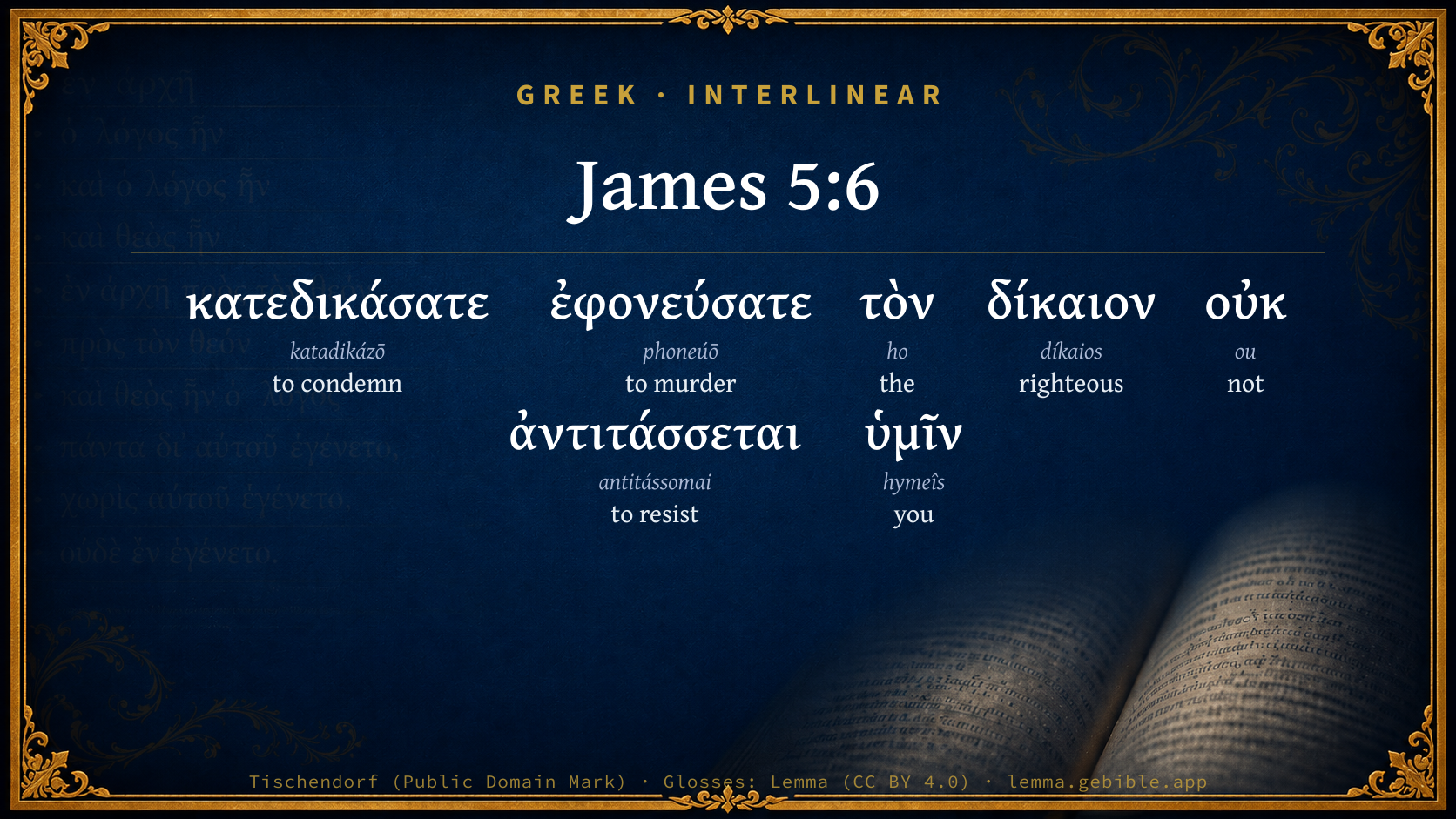
Greek (Tischendorf 8th ed.) James 5:6 appears in the Greek New Testament. The text above is from the Tischendorf 8th edition. Each word links to its Strong’s number and a concise gloss. Click any word for its full Thayer’s Greek Lexicon entry.
Download image
Cite this verse

James 5:6 (World English Bible). Public Domain. Lemma interlinear Bible study tool, https://lemma.gebible.app/v/james/5/6.

Show BibTeX & RIS
BibTeX
RIS
English Translation
You have condemned, you have murdered the righteous one. He doesn't resist you.
World English Bible · Public Domain
Download a study sheet

One document with this verse’s original text, its word-by-word gloss line, the meaning frame, cross-references with their text, attributed commentary, and full source and license credits — printable, and it pastes into notes with its structure intact.

This verse Autodidact and up

Study sheet (.html) Plain text (.txt)

A passage Seminary Student

Up to 50 verses in one chapter. A passage sheet keeps up to 6 commentary sources and 12 cross-references per verse, in the order this page ranks them, and says so on the sheet whenever that leaves anything out. Ask for a single verse and you get the Autodidact verse sheet above.

Everything on this page stays free to read, with no account — the sheet is a download of what is already on screen, not access to it.

Want to remove ads? Support Godless Engineer
Compare translations 3

The same verse in 3 English versions, stacked beneath the original-language interlinear above. Click any original word for its lexicon entry.

Each is an independent rendering of the whole verse — the interlinear is not word-aligned to these translations.

Highlighted words mark where these versions differ — a whole-verse word diff, not a word-by-word alignment.

  • World English Bible Public Domain
    You have condemned, you have murdered the righteous one. He doesn't resist you.
  • King James Version Public Domain
    Ye have condemned and killed the just; and he doth not resist you.
  • unfoldingWord Literal Text CC BY-SA 4.0
    You have condemned, you have killed the righteous. He does not resist you.

unfoldingWord Literal Text — © unfoldingWord, licensed CC BY-SA 4.0. Word-aligned USFM3 via Door43 (git.door43.org/unfoldingWord/en_ult).

Versions to compare (up to 4)

3 of 4 selected

Show all 19 translations

Every available English version of this verse, each an independent rendering of the whole verse.

  • World English Bible Public Domain
    You have condemned, you have murdered the righteous one. He doesn't resist you.
  • Berean Standard Bible Public Domain
    You have condemned and murdered the righteous, who did not resist you.
  • Majority Standard Bible Public Domain
    You have condemned and murdered the righteous, who did not resist you.
  • King James Version Public Domain
    Ye have condemned and killed the just; and he doth not resist you.
  • American Standard Version (1901) Public Domain
    Ye have condemned, ye have killed the righteous `one'; he doth not resist you.
  • Revised Version (1885) Public Domain
    Ye have condemned, ye have killed the righteous one; he doth not resist you.
  • Geneva Bible (1599) Public Domain
    Ye haue condemned and haue killed the iust, and he hath not resisted you.
  • Douay-Rheims (1899) Public Domain
    You have condemned and put to death the Just One, and he resisted you not.
  • Young's Literal Translation Public Domain
    ye did condemn -- ye did murder the righteous one, he doth not resist you.
  • Literal Standard Version CC BY-SA 4.0
    you condemned—you murdered the righteous; he does not resist you.
  • Unlocked Literal Bible CC BY-SA 4.0
    You have condemned and killed the righteous person. He does not resist you.
  • unfoldingWord Literal Text CC BY-SA 4.0
    You have condemned, you have killed the righteous. He does not resist you.
  • Darby Bible Public Domain
    ye have condemned, ye have killed the just; he does not resist you.
  • World Messianic Bible Public Domain
    You have condemned and you have murdered the righteous one. He doesn’t resist you.
  • Webster's Bible Public Domain
    Ye have condemned and killed the just; and he doth not resist you.
  • Free Bible Version CC BY-SA 4.0
    You have condemned and killed the innocent who didn't even resist you.
  • Bible in Basic English Public Domain
    You have given your decision against the upright man and have put him to death. He puts up no fight against you.
  • Text-Critical English NT CC BY 4.0
    You have condemned and murdered the righteous man; he does not resist you.
  • Tyndale New Testament (1534) Public Domain
    Ye have condempned and have killed the iust and he hath not resisted you.

Literal Standard Version (2020), Covenant Press — licensed CC BY-SA 4.0. Text via the HelloAO Bible API (eBible.org). Unlocked Literal Bible (unfoldingWord) — licensed CC BY-SA 4.0. Text via the HelloAO Bible API (eBible.org). unfoldingWord Literal Text — © unfoldingWord, licensed CC BY-SA 4.0. Word-aligned USFM3 via Door43 (git.door43.org/unfoldingWord/en_ult). Free Bible Version, Dr. Jonathan Gallagher — licensed CC BY-SA 4.0. Text via the HelloAO Bible API (eBible.org).

Word by word

More ways to search: Search by grammar → Find every occurrence → Compare this word →

Practice this passage: Drill this verse → Learn its vocabulary →

About this verse

These counts appear in no published source. They are computed here, from the morphology-tagged text and Lemma’s own curated glosses. What Lemma adds →

7
words
7
distinct lemmas
General Epistles
section

Notable vocabulary

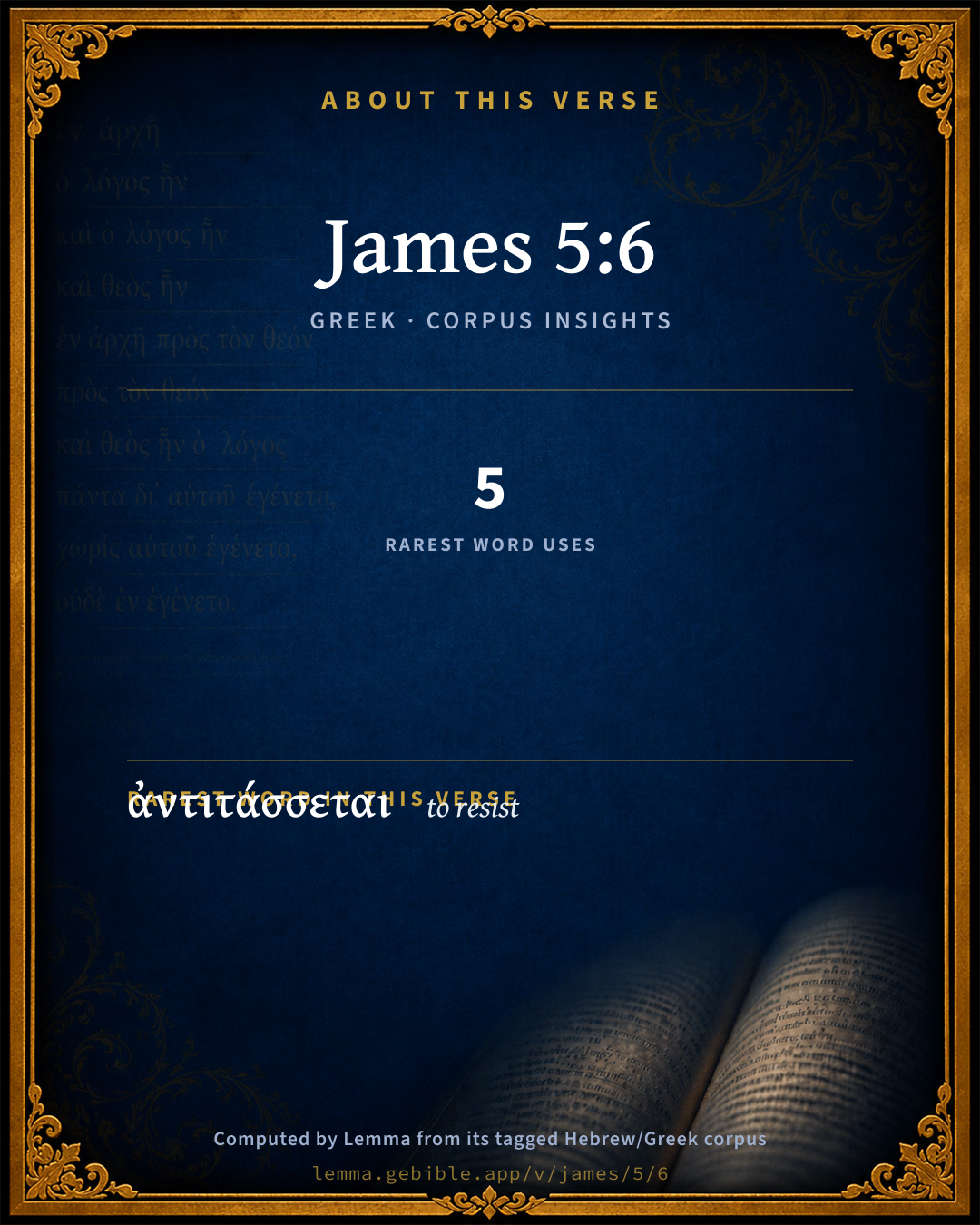
The rarest word here is ἀντιτάσσεται to resist G498 — appearing just 5 times in the whole Greek New Testament.

Shared distinctive vocabulary

ἀντιτάσσεται to resist G498 occurs in 5 verses of the Greek New Testament. Also found in:

Cross-references

22

Topical passages linked to James 5:6 in the Treasury of Scripture Knowledge — connected by theme and wording, ordered by reader-vote popularity; previews shown in the World English Bible.

  • 1 Peter 2:22–23 who did not sin, "neither was deceit found in his mouth."
  • Isaiah 53:7 He was oppressed, yet when he was afflicted he didn't open his mouth; as a lamb that is led to the slaughter, and as a sheep that before its shearers is mute, so he didn't open his mouth.
  • Matthew 5:39 But I tell you, don't resist him who is evil; but whoever strikes you on your right cheek, turn to him the other also.
  • Luke 22:51–53 But Jesus answered, "Let me at least do this"--and he touched his ear, and healed him.
  • John 19:9–11 He entered into the Praetorium again, and said to Jesus, "Where are you from?" But Jesus gave him no answer.
  • Acts 8:32 Now the passage of the Scripture which he was reading was this, "He was led as a sheep to the slaughter. As a lamb before his shearer is silent, So he doesn't open his mouth.
  • Matthew 23:34–35 Therefore, behold, I send to you prophets, wise men, and scribes. Some of them you will kill and crucify; and some of them you will scourge in your synagogues, and persecute from city to city;
  • Acts 2:22–23 "Men of Israel, hear these words! Jesus of Nazareth, a man approved by God to you by mighty works and wonders and signs which God did by him in the midst of you, even as you yourselves know,
  • Acts 3:14–15 But you denied the Holy and Righteous One, and asked for a murderer to be granted to you,
  • Acts 4:10–12 be it known to you all, and to all the people of Israel, that in the name of Jesus Christ of Nazareth, whom you crucified, whom God raised from the dead, in him does this man stand here before you whole.
  • Acts 22:14 He said, 'The God of our fathers has appointed you to know his will, and to see the Righteous One, and to hear a voice from his mouth.
  • 1 Thessalonians 2:15–16 who killed both the Lord Jesus and their own prophets, and drove us out, and didn't please God, and are contrary to all men;
  • Hebrews 10:38 But the righteous will live by faith. If he shrinks back, my soul has no pleasure in him."
  • James 4:2 You lust, and don't have. You kill, covet, and can't obtain. You fight and make war. You don't have, because you don't ask.
  • Matthew 21:38 But the farmers, when they saw the son, said among themselves, 'This is the heir. Come, let's kill him, and seize his inheritance.'
  • Matthew 26:53–54 Or do you think that I couldn't ask my Father, and he would even now send me more than twelve legions of angels?
  • Matthew 27:20 Now the chief priests and the elders persuaded the multitudes to ask for Barabbas, and destroy Jesus.
  • Matthew 27:24–25 So when Pilate saw that nothing was being gained, but rather that a disturbance was starting, he took water, and washed his hands before the multitude, saying, "I am innocent of the blood of this righteous person. You see to it."
  • John 16:2–3 They will put you out of the synagogues. Yes, the time comes that whoever kills you will think that he offers service to God.
  • Acts 7:52 Which of the prophets didn't your fathers persecute? They killed those who foretold the coming of the Righteous One, of whom you have now become betrayers and murderers.
  • Acts 13:27–28 For those who dwell in Jerusalem, and their rulers, because they didn't know him, nor the voices of the prophets which are read every Sabbath, fulfilled them by condemning him.
  • James 2:6 But you have dishonored the poor man. Don't the rich oppress you, and personally drag you before the courts?

Cross-references courtesy of OpenBible.info (CC BY 4.0).

Commentary

Notes on James 5:6 from classic Christian and Jewish commentators (each source and its license shown beneath its notes). The classic Christian expositions comment on the surrounding passage and are grouped to its opening verse, so a note may address several verses; the Jewish commentaries on the Tanakh (Rashi and others) are per-verse, so they appear only where the commentator wrote on this verse.

Lemma curates 59 commentaries, every one of them public domain or Creative Commons licensed, each selected and text-cleaned for this edition rather than reprinted as found. About our sources →

Tyndale Open Study Notes

Tyndale Open Resources

5:6 killed innocent people (or killed the Righteous One): In this context, the phrase most likely refers to innocent people such as the oppressed laborers in this paragraph rather than to Jesus (cp. Acts 3:14; 7:52).

Tyndale Open Study Notes — © Tyndale Open Resources, licensed CC BY-SA 4.0. Text via the HelloAO Bible API.

Bengel's Gnomon

Johann Albrecht Bengel

Jas 5:6. Κατεδικάσατε, ἐφονεύσατε, ye have condemned, ye have killed) The omission of the conjunction expresses haste.[68] Compare again App. Crit. Ed. ii. I feel grateful to Baumgarten; for while he brings forward no reading more worthy of remark, as omitted by me, he remarkably confirms the fulness of my choice.—τὸν δίκαιον, the Just) A distributive meaning in the singular number is admissible, denoting any just person, as the wicked get each into their power; but especially Christ Himself, the Just One, Act 3:14, who was slain by Jews and Gentiles; and afterwards James, the writer of this Epistle, who was surnamed by the Hebrews the Just, whose slaughter is here divinely foretold. The present tense is suitable, He doth not resist you; by which clause, following as it does without a conjunction, it is likewise intimated that by the very patience of the Just One the wicked goad themselves to slaughter. Comp. Wis 2:10-20.

[68] Cod. Amiat. of Vulg. puts an “et” before “non resistit.”—E.

Bengel's Gnomon of the New Testament — English translation (T&T Clark, Edinburgh, 1860) — public domain. Text from a community e-Sword module.

Meyer's Critical & Exegetical Commentary

Heinrich August Wilhelm Meyer

Jam_5:6. The third sin, the persecution of the just, by which the ungodliness of their disposition is most strongly indicated. By δίκαιος is not meant Christ (Oecumenius,[226] Bede, Grotius, Lange), for, on the one hand, there is nothing in the context to indicate this, and, on the other hand, the present ἈΝΤΙΤΆΣΣΕΤΑΙ, is opposed to it; also, if this were the case, the perfect must be put instead of the aorist, as here only one deed is mentioned, not, as before, a repetition of deeds. Wiesinger, in an unsatisfactory manner, explains ΤῸΝ ΔΊΚΑΙΟΝ by the innocent. Not merely the unjust conduct of the πλούσιοι founded on covetousness is here intended to be described, but the reason of persecution is implied in the expression ΤῸΝ ΔΊΚΑΙΟΝ itself; comp. Wisd. of Son_2:12-17; as also 1Jn_3:12. The singular is to be taken collectively, and the expression absolutely, as in Jam_5:16. Several expositors assume that the verbs ΚΑΤΕΔΙΚΆΣΑΤΕ, ἘΦΟΝΕΎΣΑΤΕ, are not meant in their literal sense; but evidently without reason. ΚΑΤΕΔΙΚΆΣΑΤΕ shows that here primarily judges are meant; yet the accusers, if these are to be distinguished from them, are not to be considered as excluded, since their accusation points to nothing else than to a sentence of condemnation.[227] The asyndeton sharpens the climax, which is contained in the addition of the second verb to the first. Bouman directs attention to the paronomasia between κατεδικάσατε and δίκαιον.

οὐκ ἀντιτάσσεται] opposes the calm patience of the just to the violence of the wicked: he doth not resist (comp. Act_18:6; Rom_13:4; Jam_4:6). Schneckenburger: οὐκ ἀντιτ. sine copula et pronomine ponderose additur. The present is explained from the fact that in what goes before not a single instance, but the continued conduct of the rich is described, and opposed to this is placed the similarly continued conduct of the δίκαιοι. Lange, by the reference of τὸν δίκαιον to Christ, misinterprets the force of the present, arbitrarily attributing to the verb the meaning: He stands no longer in your way; He does not stop you (in the way of death); He suffers you to fill up your measure.

It is unnecessary to supply in thought ὅς or γάρ; also οὐκ ἀντιτάσσεται is not to be converted into οὐ δύναται ἀντιτάσσεσθαι (Pott). For the correct construction there is no reason, with Bentley, for conjecturing ὁ κύριος instead of οὐ, or, with Benson, to take the sentence as interrogative, and to supply ὁ κύριος. The object of the addition of the clause is not so much the more strongly to mark the violent conduct of the rich, as rather by implication to point to the proximity of the vengeance of God, who interests Himself in the suffering just, as is definitely asserted in the previous verses. With this verse are to be compared, besides the already cited passage in Wis_2:12-17, particularly Amo_2:6-7; Amo_5:12 (καταπατοῦντες δίκαιον), Amo_8:4, which testify for the correctness of the explanation here given.

[226] Oecumenius, indeed, says: ἀναντιῤῥήτως τό, ἐφον. τ. δικ., ἑπὶ τὸν Χριστὸν ἀναφέρεται; but he thinks that James likewise understands by this: τοὺς ἄλλους τοὺς τὰ ὅμοια παρὰ τῶν Ἰοιδαίων παθόντας; and he closes with the remark: ἴσως δε καὶ προφητικῶς τὸ περὶ ἐαυτὸν ὑπεμφαίνει πάθος.

[227] Wiesinger correctly observes that φονεύειν is here not to be explained according to Sir_31:21 : φονεύων τον πλησιον ὁ ἀφαιρούμενος τὴν ἐμβίωσιν; but he maintains without reason that the death of the just is not to be considered as the direct design of the πλούσεοι, but only as the result of their oppressions. Also de Wette thinks that the killing is not to be understood literally, but of extreme violence, deprivation of liberty, and the like. This interpretation is, however, occasioned by the assumption that the rich are Christians.

Meyer — Critical and Exegetical Commentary on the New Testament — English translation by Peter Christie, edited by Frederick Crombie (T&T Clark, 1880) — public domain. Text from a community e-Sword module.

Expositor's Greek Testament

ed. W. Robertson Nicoll

Jas 5:6 . κατεδικάσατε , ἐφονεύσατε τὸν δίκαιον : this expresses what must often have taken place; the prophetical books often refer to like things; there is no reason for regarding this as some specific case of judicial murder. Cf. Amo 2:6-7 ; Amo 5:12 ; Wis 2:10 ff. The antithesis between the צדיק (“righteous”) and רשׁע (“wicked”) is a commonplace in Jewish theology. οὐκ ἀντιτάσσεται ὑμῖν : the statement of fact here, instead of the interrogative as read by some authorities, is more natural, and more in accordance with the prophetical style which is so characteristic of this whole passage. This picture of patient acquiescence in ill-treatment is really a very vivid touch, for it shows, on the one hand, that the down-trodden realised the futility of resistance; on the other, that their hopes were centred on the time to come.

With the whole of this section cf. the words in The first book of Clement, which is called The Testament of our Lord Jesus Christ , 12: “The harvest is come, that the guilty may be reaped and the Judge appear suddenly and confront them with their works”.

The Expositor's Greek Testament, edited by W. Robertson Nicoll (1897–1910) — public domain. Text from a community e-Sword module.

Jamieson, Fausset & Brown

Robert Jamieson, A. R. Fausset & David Brown

Ye have condemned . . . the just--The Greek aorist expresses, "Ye are accustomed to condemn . . . the just." Their condemnation of Christ, "the Just," is foremost in James' mind. But all the innocent blood shed, and to be shed, is included, the Holy Spirit comprehending James himself, called "the Just," who was slain in a tumult. See my Introduction. This gives a peculiar appropriateness to the expression in this verse, the same "as the righteous (just) man" (Jam 5:16). The justice or righteousness of Jesus and His people is what peculiarly provoked the ungodly great men of the world.

he doth not resist you--The very patience of the Just one is abused by the wicked as an incentive to boldness in violent persecution, as if they may do as they please with impunity. God doth "resist the proud" (Jam 4:6); but Jesus as man, "as a sheep is dumb before the shearers, so He opened not His mouth": so His people are meek under persecution. The day will come when God will resist (literally, "set Himself in array against") His foes and theirs.

Jamieson, Fausset & Brown — Commentary Critical and Explanatory on the Whole Bible (1871) — public domain (CC PDM 1.0). Text via the HelloAO Bible API.

Adam Clarke's Commentary

Verse 6. Ye have condemned and killed the just; and he doth not resist you.] Several by τονδικαιον, the just one, understand Jesus Christ, who is so called, Ac 3:14; Ac 7:52; Ac 22:14; but the structure of the sentence, and the connection in which it stands, seem to require that we should consider this as applying to the just or righteous in general, who were persecuted and murdered by those oppressive rich men; and their death was the consequence of their dragging them before the judgment seats, Jas 2:6, where, having no influence, and none to plead their cause, they were unjustly condemned and executed.

And he doth not resist you. - In this, as in τονδικαιον, the just, there is an enallege of the singular for the plural number. And in the word ουκ αντιτασσεται, he doth not resist, the idea is included of defence in a court of justice. These poor righteous people had none to plead their cause; and if they had it would have been useless, as their oppressors had all power and all influence, and those who sat on these judgment seats were lost to all sense of justice and right. Some think that he doth not resist you should be referred to GOD; as if he had said, God permits you to go on in this way at present, but he will shortly awake to judgment, and destroy you as enemies of truth and righteousness.

Adam Clarke's Commentary on the Bible (1810–1826) — public domain. Text from a community e-Sword/MySword module.

John Calvin's Commentaries

6 Ye have condemned. Here follows another kind of inhumanity, that the rich by their power oppressed and destroyed the poor and weak. He says by a metaphor that the just were condemned and killed; for when they did not kill them by their own hand, or condemn them as judges, they yet employed the authority which they had to do wrong, they corrupted judgments, and contrived various arts to destroy the innocent, that is, really to condemn and kill them.

By adding that the just did not resist them, he intimates that the audacity of the rich was greater; because those whom they oppressed were without any protection. He, however, reminds them that the more ready and prompt would be the vengeance of God, when the poor have no protection from men. But though the just did not resist, because he ought to have patiently endured wrongs, I yet think that their weakness is at the same time referred to, that is he did not resist, because he was unprotected and without any help from men.

John Calvin's Commentaries (1540-1563) — public domain. Text from the Calvin Translation Society English edition (1840s-50s) via the Christian Classics Ethereal Library (ccel.org). Calvin's coverage is partial (roughly two-thirds of the Bible); uncommented books and verses are honest gaps, never fabricated. The 19th-century editor's footnotes and remarks are omitted so the notes are faithfully Calvin's own voice.

Ellicott's Commentary for English Readers

(6) Ye have condemned and killed the just.—Better thus: Ye condemned, ye slew the just—as in the speech of Peter (Act_3:14-15), or that of Stephen (Act_7:52). Such a reference, however, has been disallowed by some commentators, as conveying too harsh an accusation against the whole Jewish people; and besides, it being unfair to forget that St. James was writing to Christian Jews, as well as to the anti-Christian. But, in a manner, all wrong and oppression tend towards the murder of the Just One, as every falsehood (see Note on Jas_3:13) is an attack on the Truth. And far beyond this, in the present case our Lord is rightly to be considered the victim of the Jews. His blood is on them and on their children (Mat_27:25); they filled up “the measure of their fathers” (Mat_23:32), that “the blood of all the righteous” might come upon them, from Abel to Zacharias (Mat_23:35): the one crowning sin made them guilty of all. And not only is this backward participation true, but there is a forward one as well. Christ Himself was persecuted by Saul in the afflictions of His servants (Act_9:4-5), and so onward ever till the martyr-roll be full.

It is of strange significance that in this verse—ye condemned, ye slew the just—James the Just prophetically described his own murderers. The last words, moreover, of the Scripture, simply record the behaviour of himself, as of every real witness for Christ: He doth not resist. No: “the servant of the Lord must not strive” (2Ti_2:24) even in death; and by such meekness and resignation is best seen the likeness to the divine Master, Who “was brought as a lamb to the slaughter” (Isa_53:7). Comp. Wis_2:10-20 for a striking parallel, on the oppression of the righteous, which would not inaptly describe the “just man,” the “Son of God.”

A Bible Commentary for English Readers, edited by Charles John Ellicott (1878–1897) — public domain. Text from a community e-Sword module.

The Cambridge Bible for Schools and Colleges

gen. ed. J. J. S. Perowne

6. Ye have condemned and killed the just] The words have been very generally understood as referring to the death of Christ, and on this view, the words “he doth not resist you” have been interpreted as meaning, “He no longer checks you in your career of guilt; He leaves you alone (comp. Hos_4:17) to fill up the measure of your sin.” St James, it has been inferred, uses the term “the Just One” as Stephen had done (Act_7:52), as pointing emphatically to “Jesus Christ the righteous” (1Jn_2:1). Fuller consideration, however, shews that such a meaning could hardly have come within the horizon of St James’s thoughts. (1) That single evil act of priests, and scribes, and the multitude of Jerusalem, could hardly have been thus spoken of in an Epistle addressed to the Twelve Tribes of the dispersion, without a more distinct indication of what was referred to. To see in them, as some have done, the statement that the Jews, wherever they were found, were guilty of that crime, as accepting and approving it, or as committing sins which made such an atonement necessary, is to read into them a non-natural meaning. (2) The whole context leads us to see in the words, a generic evil, a class sin, characteristic, like those of the previous verse, of the rich and powerful everywhere. (3) The meaning thus given to “he doth not resist you” seems, to say the least, strained and unnatural, especially as coming so soon after the teaching (ch. Jas_4:6) which had declared that “God does resist the proud.” (4) The true meaning of both clauses is found, it is believed, in taking “the just” as the representative of a class, probably of the class of those, who as disciples of Christ the Just One, were reproducing His pattern of righteousness. Such an one, like his Master, and like Stephen, St James adds, takes as his law (note the change of tense from past to present) the rule of not resisting. He submits patiently, certain that in the end he will be more than conqueror. It is not without interest to note that that title was afterwards applied to St James himself (Euseb. Hist. ii. 23). The name Justus, which appears three times in the New Testament (Act_1:23; Act_18:7; Col_4:11), was obviously the Latin equivalent of this epithet, and it probably answered to the Chasidim or Assideans (1Ma_2:42; 1Ma_7:13, 2Ma_14:6) of an earlier stage of Jewish religious history. It is as if a follower of George Fox had addressed the judges and clergy of Charles II.’s reign, and said to them, “Ye persecuted the Friend, and he does not resist you.” (5) It is in favour of this interpretation that it presents a striking parallel to a passage in the “Wisdom of Solomon,” with which this Epistle has so many affinities. There too the writer speaks of the wealthy and voluptuous as laying snares for “the just” who is also “poor,” who calls himself “the servant of the Lord,” and boasts of God as his Father (Wis_2:12-16). Comp. also the description of the ultimate triumph of the just man in. Wis_5:1-5.

The Cambridge Bible for Schools and Colleges (gen. ed. J. J. S. Perowne; Cambridge University Press, 1878–1918) — public domain. Text from a community e-Sword module.

John Gill's Exposition

Ye have condemned and killed the just,.... Meaning not Christ, the Just One, as some have thought; whom the Jewish sanhedrim condemned as guilty of death, and got the sentence passed upon him, and him to be crucified by Pontius Pilate, on the day of slaughter, at the time of the passover, as some connect the last clause of the preceding verse with this; since the apostle is not writing to the Jerusalem Jews, nor to unbelievers, but to professors of religion; though he might say they did it, because their nation did it: but rather this is to be understood of the poor saints, who were just, through the imputation of Christ's righteousness to them, and lived soberly, righteously, and godly, and were harmless and inoffensive in their conversation: who were evil spoken of, censured, and judged, and condemned in a rash and uncharitable manner by their brethren; or were drawn to the judgment seats by the rich, who obtained a judicial process against them, and procured a sentence of condemnation to pass upon them unrighteously; and who killed them, by taking away their good names from them, and by withholding from them their supplies of life, the fruit of their own labour, whereby their lives were embittered and made miserable:

and he doth not resist you; it being neither in his power, nor in his inclination; but takes it patiently, quietly submits, and makes no opposition: or God does not resist you, as yet; he will do it shortly.

John Gill's Exposition of the Whole Bible (1746–1763) — public domain (CC PDM 1.0). Text via the HelloAO Bible API.

Trapp's Complete Commentary

John Trapp

6 Ye have condemned and killed the just; and he doth not resist you.

Ver. 6. Ye have condemned and killed] Take it either properly, or metaphorically of usurers and extortioners, that not only rob, but ravish the poor that are fallen into their nets, Psa 10:9, that is, their bonds, debts, mortgages, as Chrysostom interpreteth it; there is neither equity nor mercy to be had at their hands; hence they are called meneaters, cannibals, &c. One saith there is more justice to be found in hell than here among men; for in hell no innocent person is oppressed.

And he doth not resist you] Meekness of spirit commonly draws on injuries and indignities from unreasonable men. A crow will stand upon a sheep’s back, pulling off wool from her side, she dare not do so to a wolf or a mastiff. {a} Veterem ferendo iniuriam invitas novam. Bearing old wrongs encourages new ones.

{a} A large, powerful dog with a large head, drooping ears and pendulous lips, valuable as a watch-dog. ŒD

John Trapp, A Commentary or Exposition upon All the Books of the Old and New Testament (1647–1656) — public domain. Text from a community e-Sword module.

Albert Barnes' Notes on the Bible

Ye have condemned and killed the just - τὸν δίκαιον ton dikaion - “the just one,” or “the just man” - for the word used is in the singular number. This may either refer to the condemnation and crucifixion of Christ - meaning that their conduct towards his people had been similar to the treatment of the Saviour, and was in fact a condemnation and crucifixion of him afresh; or, that by their rejection of him in order to live in sin, they in fact condemned him and his religion; or, that they had condemned and killed the just man - meaning that they had persecuted those who were Christians; or, that by their harsh treatment of others in withholding what was due to them, they had deprived them of the means of subsistence, and had, as it were, killed the righteous. Probably the true meaning is, that it was one of their characteristics that they had been guilty of wrong towards good men. Whether it refers, however, to any particular act of violence, or to such a course as would wear out their lives by a system of oppression, injustice, and fraud, cannot now be determined.

And he doth not resist you - Some have supposed that this refers to God, meaning that he did not oppose them; that is, that he bore with them patiently while they did it. Others suppose that it should be read a question - “and doth he not resist you?” meaning that God would oppose them, and punish them for their acts of oppression and wrong. But probably the true reference is to the “just man” whom they condemned and killed; meaning that they were so powerful that all attempts to resist them would be vain, and that the injured and oppressed could do nothing but submit patiently to their acts of injustice and violence. The sense may be either that they could not oppose them - the rich men being so powerful, and they who were oppressed so feeble; or that they bore their wrongs with meekness, and did not attempt it. The sins, therefore, condemned in these verses Jam 5:1-6, and for which it is said the divine vengeance would come upon those referred to, are these four:

(1)That of hoarding up money when it was unnecessary for their real support and comfort, and when they might do so much good with it, (compare Mat 6:19;)

(2)That of keeping back the wages which was due to those who cultivated their fields; that is, keeping back what would be a fair compensation for their toil - applicable alike to hired men and to slaves;

(3)That of giving themselves up to a life of ease, luxury, and sensual; indulgence; and,

(4)That of wronging and oppressing good and just men - men, perhaps in humble life, who were unable to vindicate their rights, and who had none to undertake their cause; men who were too feeble to offer successful resistance, or who were restrained by their principles from attempting it.

It is needless to say that there are multitudes of such persons now on the earth, and that they have the same reason to dread the divine vengeance which the same class had in the time of the apostle James.

Albert Barnes' Notes on the Bible (1834–1885) — public domain. Text from a community e-Sword/MySword module.

Matthew Poole's English Annotations

Ye have condemned and killed; i.e. procured by your wealth and power the passing unrighteous sentences, and thereby the destruction of the just.

The just; indefinitely and collectively, the just for any just man, viz. such as were innocent and just in comparison of their persecutors.

And he doth not resist you; this notes not only the patience of such in bearing injuries, but their weakness, and being destitute of human help against their adversaries’ power.

Matthew Poole's English Annotations on the Holy Bible (1683–1685) — public domain. Text from a community e-Sword/MySword module.

Whedon's Commentary on the Bible

Daniel D. Whedon

6. The just—True pre-eminently of their condemning and killing the just One, Jesus; and afterwards Stephen, and, finally, St. James himself.

Doth not—The continuous present, implying that the martyr is ever non-resistant.

The character of the rich men of St. James’s age may be understood by the following description from a chapter on “The Decline of the Roman Empire,” by the historian Bancroft, in his “Miscellanies:”

“The aristocracy owned the soil and its cultivators. The vast capacity for accumulation which the laws of society secure to capital in a greater degree than to personal exertion, displays itself nowhere so clearly as in slave-holding States, where the labouring class is but a portion of the capital of the opulent. As wealth consists chiefly in land and slaves, the rates of interest are, from universally operative causes always comparatively high, making the difficulty of advancing with borrowed capital proportionably great. The small landholder finds himself unable to compete with those who are possessed of whole cohorts of bondmen; his slaves, his lands, rapidly pass, in consequence of his debts, into the hands of the more opulent. The large plantations are constantly swallowing up the smaller ones; and land and slaves come to be engrossed by the few. Before Caesar passed the Rubicon this condition existed in the extreme in the Roman State. The rural indigent crept into the walls of Rome. A free labourer was hardly known. The large proprietors of slaves not only tilled their immense plantations, but also indulged their avarice in training their slaves to every species of labour, and letting them out, as horses from a livery stable, for the performance of every conceivable species of work. Four or five hundred men were not an uncommon number in one family; fifteen or twenty thousand sometimes belonged to one master. The immense wealth of Crassus consisted chiefly in lands and slaves: on the number of his slaves we hardly dare hazard a conjecture. Of joiners and masons he had over five hundred. Nor was this the whole evil. The nobles, having impoverished their lands, became usurers, and had their agents dispersed over all the provinces. The censor, Cato, closed his career by recommending usury as more productive than agriculture; and such was the prodigality of the Roman planters, that, to indulge their fondness for luxury, many of them mortgaged their estates to the moneylenders. Thus the lands of Italy, at best in the hands of a few proprietors, became virtually vested in a still smaller number of usurers. No man’s house, no man’s person, was secure.

“The captives in war were sold at auction. Cicero, during the little campaign in which he was commander, sold men enough to produce, at half price, about half a million of dollars.

“The second mode of supplying the slave market was by commerce; and this supply was so uniform and abundant that the price of an ordinary labourer hardly varied for centuries. The reason is obvious; where the slave merchant gets his cargoes from kidnappers the first cost is inconsiderable. The great centres of this traffic were in the countries bordering on the Euxine; and Scythians were often stolen. Caravans penetrated the deserts of Africa, and made regular hunts for slaves. Blacks were highly valued; they were rare, and, therefore, both male and female negroes were favourite articles of luxury among the opulent Romans. At one period Delos was most remarkable as the emporium for slaves. It had its harbours, chains, prisons, every thing so amply arranged to favour a brisk traffic that ten thousand slaves could change hands and be shipped in a single day, an operation which would have required thirty-three or thirty-four ships of the size of the vessel in which Paul the apostle was wrecked. There was hardly a port in the Roman empire, convenient for kidnapping foreigners, in which the slave trade was not prosecuted. In most heathen countries, also, men would sell their own children into bondage. The English continued to do so even after the introduction of Christianity. In modern times, when men incurred debts, they have mortgaged their own bodies; the ancients mortgaged their sons and daughters.

“It is a calumny to charge the devastation of Italy upon the barbarians. The large Roman plantations, tilled by slave labour, were its ruin. The careless system impoverished the soil, and wore out even the rich fields of Campania. Large districts were left waste; others had been turned into pastures, and grazing substituted for tillage.… When Alaric led the Goths into Italy he could not sustain his army in the beautiful but deserted territory.… Slavery had destroyed the democracy, had destroyed the aristocracy, had destroyed the empire.”

Daniel D. Whedon (gen. ed.), Commentary on the Old and New Testaments (1874–1909) — public domain. Text from a community e-Sword module.

The Pulpit Commentary

The climax of their sin. Ye have condemned, ye have killed the righteous one. Does this allude to the death of our Lord? At first sight it may well seem so. Compare St. Peter"s words inkaion);" Act_3:14, "Ye denied the Holy One and the Just (di) St. Stephen"s inou);" Act_7:52, "the coming of the Just One (tou dikai) and St. Paul"s in." Act_22:14, "to see the Just One (tokaion) But this view is dispelled when we remember how throughout this whole passage the ideas and expressions are borrowed from the Old Testament, and when we find that in Isa_3:10 (LXX) the wicked are represented as saying, Dhswmen tokaion oti duscrhstov hJmin ejsti a passage which lies at the root of the remarkable section in Wisd. 2., "Let us oppress the poor righteous man .... Let us condemn him with a shameful death." It is probable, then, that passages such as these were in St. James"s mind, and suggested the words, and thus that there is no direct allusion to the Crucifixion (which, indeed, could scarcely be laid to the charge of his readers), but that the singular tokaion is used to denote the class collectively. (cf. Amo_2:6 Amo_5:12) It is a remarkable coincidence, pointed out by most commentators, that he who wrote these verses, himself styled oJ Dikaiov by the Jews, suffered death at their hands a very few years afterwards. He doth not resist you. According to the view commonly adopted, St. James simply means to say that the righteous man suffered this evil at their hands without resistance. Another interpretation seems more possible, taking the clause as interrogative, "Does he not resist you?" the subject, implied but not expressed, being God; as if he would say, "Is not God against you? that God of whom it has already been said that he resists (ajntitassetai) the proud (comp. Hos_1:6, "I will no more have mercy upon the house of Israel, but I will utterly take them away (LXX, ajll h ajntitassomenov ajntitaxomai aujtoiv)")

The Pulpit Commentary (1880–1919), ed. H.D.M. Spence-Jones & Joseph S. Exell — public domain. Text from a community e-Sword module.

John Wesley's Explanatory Notes

Ye have killed the just - Many just men; in particular, "that Just One," Acts iii, 14. They afterwards killed James, surnamed the Just, the writer of this epistle. He doth not resist you - And therefore you are secure. But the Lord cometh quickly, ver. 8.

John Wesley, Explanatory Notes Upon the Whole Bible (1754–1765) — public domain. Text via the GEBible commentary corpus.

Burkitt's Expository Notes on the New Testament

William Burkitt

By the just, may be understood Jesus Christ, that just One whom the nation of the Jews condemned and killed; and also such of his members, orthodox Christians, who the judaizing Christians persecuted. By their condemning the just, understand how they proceeded against them under a pretence and colour of law; before they would actually kill, they pretended legally to condemn.

Learn then, that God takes notice not only of the open violences offered to his people, but also of all the injuries done unto them under the form of a legal procedure; it is a mighty provocation when public authority, which is the defense of innocency, is made the pretense of oppression.

It follows, ye have killed the just: This is added to let us know that oppression will preceed as far as death. Wickedness knoweth no bounds; good men are oft-times arraigned, condemned, and killed; they fall a sacrifice to the rage of their persecutors and oppressors.

It is added, He doth not resist you; which if applied to Christ, points at his meekness; he was slain without resistance: he came to suffer, therefore would not resist. If applied to the suffering Christians, it points at their weakness and inability to make resistance, as well as at their meekness and patience under sufferings: Ye have condemned and killed the just, and he doth not resist you.

William Burkitt's Expository Notes on the New Testament (1700–1703) — public domain. Text from a community e-Sword module.

The People's New Testament

B. W. Johnson

6. Ye have condemned and killed the just. The murder of the Just One, Jesus, was the crowning sin of Israel which brought upon them destruction. It was the rich and influential, not the poor, who sought his death. He doth not resist you. Compare Isaiah 53:7.

B. W. Johnson's The People's New Testament with Notes (1889–1891) — public domain. Electronic text from the Christian Classics Ethereal Library (CCEL) ThML edition.

Cambridge Greek Testament for Schools and Colleges

6. κατεδικάσατε, ye condemned. Another reference to the courts, κριτήρια ch. Jas 2:6, which were used as instruments of oppression.

ὀφονεύσατε τὸν δίκαιον, ye slew the just one. Either (a) some special case of martyrdom is referred to, or (b) τὸν δίκαιον points to a class, the article generalising. See Winer, p. 132 and comp. 2Co 12:12 τὰ σημεῖα τοῦ ἀποστόλου, Mat 12:35 ὁ ἀγαθὸς ἄνθρωπος … ἐκβάλλει ἀγαθά, or (c) by τὸν δίκαιον Jesus Christ is intended. Comp. Act 3:14 ὑμεῖς δὲ τὸν ἅγιον καὶ δίκαιον ἠρνήσασθε κ.τ.λ. Of these (a) appears to be the preferable interpretation. One actual instance of such cruelty and oppression best explains the vehement and indignant protest of the apostle. Such an incident may be explained by the motives named in Wisdom of Solomon Jas 2:10-20 καταδυναστεύσωμεν πένητα δίκαιον … ἐνεδρεύσωμεν τὸν δίκαιον ὅτι δύσχρηστος ἡμῖν ἐστι … καταδικάσωμεν αὐτόν, ἔσται γὰρ αὐτοῦ ἐπισκοπὴ ἐκ λόγων αὐτοῦ. The words found a striking parallel in the death of James himself: Eus. H. E. II. 23 καὶ ἔλεγον ἀλλήλοις· Λιθάσωμεν Ἰάκωβον τὸν δίκαιον. καὶ ἤρξαντο λιθάζειν αὐτόν, κ.τ.λ. Plato Rep. 362 A describes the fate of the man δοκῶν μὲν εἷναι ἄδικος διὰ βίου ὢν δὲ δίκαιος. In the end μαστιγώσεται, στρεβλώσεται … τελευτῶν πάντα κακὰ παθὼν ἀνασχινδυλευθήσεται.

οὐκ ἀντιτάσσεται ὑμῖν, he resists you not. The non-resistance of the innocent righteous is in the spirit of our Lord’s words, Mat 5:39 ff. ἐγὼ δὲ λέγω ὑμῖν μὴ ἀντιστῆναι τῷ πονηρῷ, κ.τ.λ. Comp. also the picture of the suffering servant of Jehovah, Isa 53:7 ff. ὡς πρόβατον ἐπὶ σφαγὴν ἤχθη, καὶ ὡς ἀμνὸς ἐνανίον τοῦ κείροντος ἀφωνος οὔτως οὐκ ἀνοίγει τὸ στόμα. Comp. Book of Enoch, ch. ciii., ‘to those who hate us have we humbled our neck; but they have shewn no compassion towards us.’ If the clause be pointed interrogatively the meaning would be either (a) Doth not the Lord (ὁ κύριος understood) oppose you? or (b) Doth not he oppose you by his testimony at the judgment seat of Christ?

Cambridge Greek Testament for Schools and Colleges (Cambridge University Press, 1896; 21 vols, various authors incl. Carr, Maclear, Plummer, Farrar, Lumby, Moule, M. R. James, Simcox) — public domain. Text from a community e-Sword module.

Alford’s Greek Testament

Henry Alford

6.] Third class of sins: condemning the innocent. Ye condemned, ye murdered the just man (these words are probably spoken generally, the singular being collective. τὸν δίκαιον, not merely τὸν ἀθῷον; it is his justice itself which provokes the enmity and cruelty of the πλούσιοι. It has been usual to refer these words to the condemnation and execution of Christ. So Œc., ἀναντιῤῥήτως τό, ἐφονεύσατε τὸν δίκαιον, ἐπὶ τὸν χριστὸν ἀναφέρεται. τῇ μέντοι ἐπιφορᾷ, τῇ, οὐκ ἀντιτάσσεται ὑμῖν, ἐκοίνωσε τὸν λόγον καὶ πρὸς τοὺς ἄλλους τοὺς τὰ ὅμοια παρὰ τῶν Ἰουδαίων παθόντας. ἴσως δὲ καὶ προφητικῶς τὸ περὶ ἑαυτὸν ὑπεμφαίνει πάθος. So Bede, at some length; Grot., al. But there is surely nothing in the context to indicate this, further than that such a particular case may be included in the general charge, as its most notorious example. I cannot see, with Huther, how the present ἀντιτάσσεται makes against this: for anyhow we must suppose a change of sense before the present can be introduced: and then it may as well be a description of Christ’s patient endurance, or of His present long-suffering, as of the present meekness of the (generic) δίκαιος. But I prefer the latter, and with it the other reference throughout): he (the δίκαιος; Bentley more ingeniously than happily conjectured ὁ κύριος, as an emendation for οὐκ) doth not resist you (the behaviour of the just under your persecutions is ever that of meekness and submission. “οὐκ ἀντιτάσσεται sine copula et pronomine ponderose additur.” Schneckenb.).

This last clause serves as a note of transition to what follows. So Herder remarks, as cited by Wiesinger: “And thus we have as it were standing before us the slain and unresisting righteous man, when lo the curtain falls: Be patient, brethren, wait!” See, on the whole sense, Amo 2:6, Amo 2:7; Amo 5:12; and the description in Wisd. 2:6-20.

Henry Alford, The Greek Testament (1849–1861) — public domain. Text from a community e-Sword module.

International Critical Commentary

6. By your oppression you are guilty of the blood of righteous men; do you not find them your enemies?

κατεδικάσατε, “condemned.” Cf. Mat 12:7, Mat 12:37, Luk 6:37. The rich are judges, or at any rate control the courts.

ἐφονεύσατε, “murdered.” Cf. 2:11, 4:2. Oppression which unjustly takes away the means of life is murder. Cf. Ecclus. 4:1, 31(34):25-27:

ἄρτος ἐπιδεομένων ζωὴ πτωχῶν,

ὁ ἀποστερῶν αὐτὴν ἄνθρωπος αἱμάτων·

φονεύων τὸν πλησίον ὁ ἀφαιρούμενος συμβίωσιν,

καὶ ἐκχέων αἷμα ὁ ἀποστερῶν μισθὸν μισθίου.

Here, however, every kind of cruel conduct leading to the death of the poor and righteous is doubtless meant, including in some cases actual murder—whether violent or judicial (e. g. the execution of Stephen).

Cf. Enoch 99:15, 100:7, 103:11-15, Wisd. 2:20, Psa 37:32, Isa 57:1, Mat 23:35.

τὸν δίκαιον, singular, representing the class.

Cf. Isa 3:10, Isa 3:11, 57:1 (note v. 4 ἐνετρυφήσατε), Wisd. 2:12, Enoch 95:7. The oppressed and the righteous are evidently the same persons. The rich here are not thought of as Christians. Cf. Amo 2:6, Amo 2:7, Amo 2:5:12, Amo 2:8:4, where the poor, the oppressed, and the righteous are the same.

In Luk 23:47, Act 3:14, Act 3:7:52, Act 3:22:14, 1Jn 2:1 (cf. 1Pe 3:18), ὁ δίκαιος is used of Christ, cf. Enoch 38:2, 53:6. It is not, however, likely that Christ would here be referred to so vaguely, although his death might naturally be included in the writer’s mind under ἐφονεύσατε. The attack is upon the rich as a class, and their misdeeds are thought of as characterising their whole history. Mat 23:35 is an excellent parallel; cf. also the reproaches in Act 7:51-53.

οὐκ ἀντιτάσσεται ὑμῖν; “does not he (sc. ὁ δίκαιος) resist you?”

ἀντιτάσσεται (cf. Jas 4:6, 1Pe 5:5, Rom 13:2, Act 18:6, Pro 3:34) evidently relates to a highly formidable resistance, and probably the witness of the poor at the Day of Judgment is meant. Cf. Enoch 91:12 (and Charles’s note) 98:12, 104:3.

In Hos 1:6 ἀντιτάσσεσθαι is contrasted with ἐλεεῖν, to “show mercy”; in Pro 3:34 with διδόναι χάριν, “be favourably inclined.” It seems to be used of active opposition or resistance, not of a merely hostile attitude. So Est 3:4, Pro 3:15, Pro 3:4 Macc. 16:23 (Cod. א).

Other interpretations of v. 6 are to be rejected:

(1) If, with many interpreters, οὐκ ἀντιτάσσεται is taken as a positive statement instead of a question, it must probably refer to the deliberate non-resistance of the righteous on principle, as in Isa 53:7, 1Pe 2:23. But (a) this sense is wholly unsuited to the context, (b) the asyndeton after δίκαιον then becomes well-nigh impossibly violent, and (c) to end this powerful passage of triumphant denunciation with a brief reference to the submissive non-resistance of the righteous would be strange indeed.

(2) For this last reason the view that the meaning is, “he offers you no effective resistance,” is almost equally unacceptable.

(3) Hofmann and others take ἀντιτάσσεται as impersonal passive, “no opposition is made,” cf. v. 15. But (Mayor) “it is the middle, not the active, which means to resist.”

(4) Some interpreters would supply ὁ θεός as the subject of ἀντιτάσσεται, taking the latter interrogatively. This would be in accord with the Jewish avoidance of the name of God wherever possible, and would form an allusion to 4:6; but it seems here unnecessary and unnatural.

In the interest of this last interpretation Bentley conjectured OK̄C̄ for ΟΥΚ; like most N. T. conjectures, it is unnecessary.

(5) By those who take τὸν δίκαιον to refer to Jesus Christ, οὐκ ἀντιτάσσεται is interpreted either interrogatively, as a warning of the Day of Judgment (cf. Mat 25:31 f.), or affirmatively, in the light of 1Pe 2:23.

International Critical Commentary — older volumes (1896–1929), various authors — public domain. Text from a community e-Sword module.

Lesson kit

Teaching starters — assembled from the data on this page, not authored interpretation. Every prompt links to the verse data it draws on. Edit before teaching.

James, in the General Epistles, opens this verse with 7 words (7 distinct Greek lemmas). Its most distinctive word is antitássomai (“to resist”). A historical commentator’s framing appears above. Read the whole chapter for the surrounding context.

Discussion questions

  1. How does “to resist” (antitássomai) shape what this verse is saying?
  2. How does Acts 18:6, which shares the word «to resist», read alongside this verse?
  3. These translations render this verse differently. What is at stake in choosing one wording over another?
  4. Compare how Tyndale Open Study Notes and Bengel's Gnomon read this verse. Where do they agree or differ?

Things to notice

Reading settings

Reading text

Shown beneath each verse's original-language words.

Old Testament
Old Testament edition

Read the OT as the Masoretic Hebrew (MT) or the Greek Septuagint (LXX).

English shown for the Greek Septuagint (in the Hebrew ↔ Greek comparison).

Comparing translations? Open the Compare panel on any verse page to stack up to four side by side.