
James 1:1

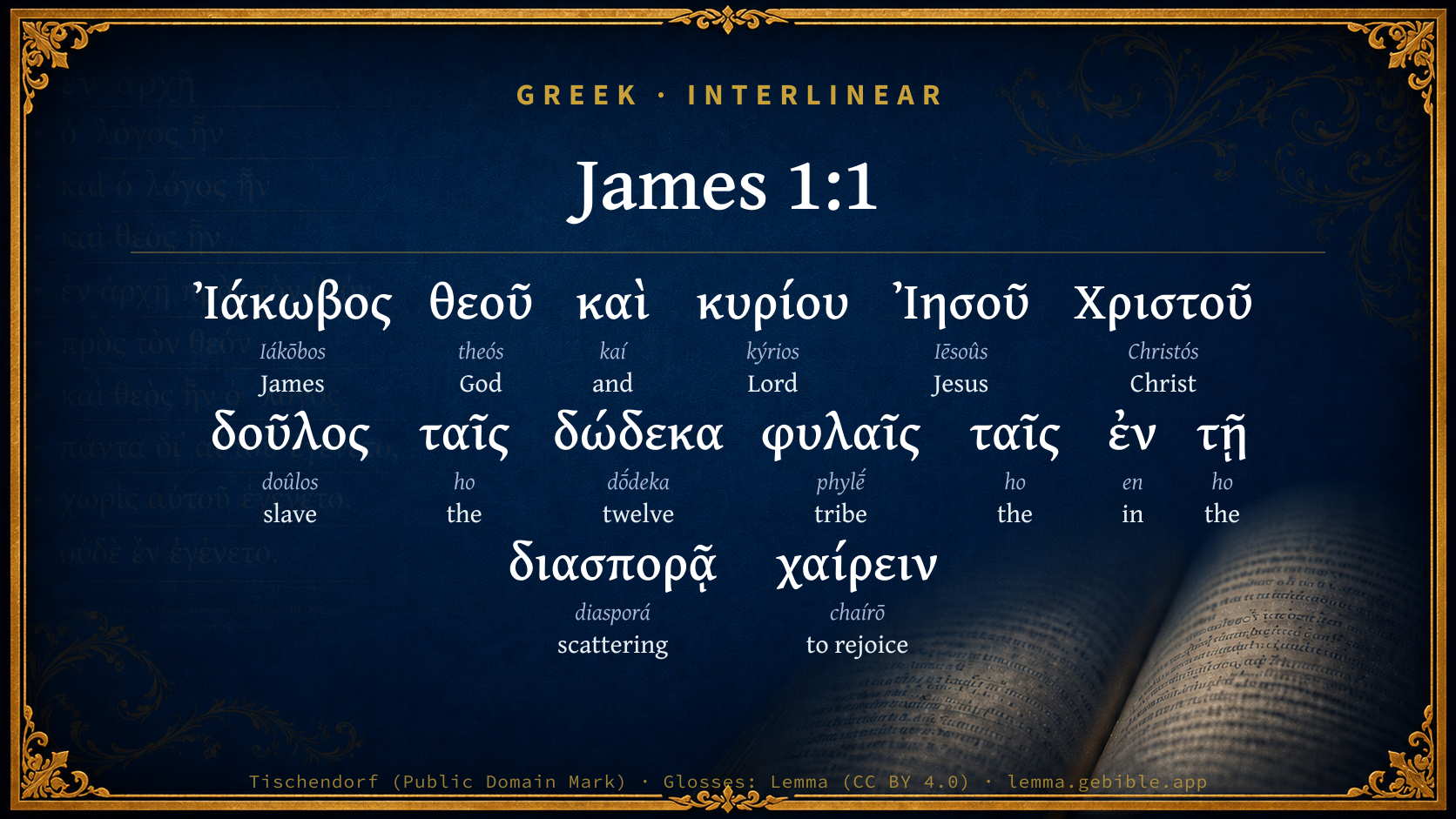
Greek (Tischendorf 8th ed.) James 1:1 appears in the Greek New Testament. The text above is from the Tischendorf 8th edition. Each word links to its Strong’s number and a concise gloss. Click any word for its full Thayer’s Greek Lexicon entry.
Download image
Cite this verse

James 1:1 (World English Bible). Public Domain. Lemma interlinear Bible study tool, https://lemma.gebible.app/v/james/1/1.

Show BibTeX & RIS
BibTeX
RIS
English Translation
James, a servant of God and of the Lord Jesus Christ, to the twelve tribes which are in the Dispersion: Greetings.
World English Bible · Public Domain
Download a study sheet

One document with this verse’s original text, its word-by-word gloss line, the meaning frame, cross-references with their text, attributed commentary, and full source and license credits — printable, and it pastes into notes with its structure intact.

This verse Autodidact and up

Study sheet (.html) Plain text (.txt)

A passage Seminary Student

Up to 50 verses in one chapter. A passage sheet keeps up to 6 commentary sources and 12 cross-references per verse, in the order this page ranks them, and says so on the sheet whenever that leaves anything out. Ask for a single verse and you get the Autodidact verse sheet above.

Everything on this page stays free to read, with no account — the sheet is a download of what is already on screen, not access to it.

Want to remove ads? Support Godless Engineer
Compare translations 3

The same verse in 3 English versions, stacked beneath the original-language interlinear above. Click any original word for its lexicon entry.

Each is an independent rendering of the whole verse — the interlinear is not word-aligned to these translations.

Highlighted words mark where these versions differ — a whole-verse word diff, not a word-by-word alignment.

  • World English Bible Public Domain
    James, a servant of God and of the Lord Jesus Christ, to the twelve tribes which are in the Dispersion: Greetings.
  • King James Version Public Domain
    James, a servant of God and of the Lord Jesus Christ, to the twelve tribes which are scattered abroad, greeting.
  • unfoldingWord Literal Text CC BY-SA 4.0
    James, a servant of God and of the Lord Jesus Christ, to the twelve tribes in the dispersion: Rejoice!

unfoldingWord Literal Text — © unfoldingWord, licensed CC BY-SA 4.0. Word-aligned USFM3 via Door43 (git.door43.org/unfoldingWord/en_ult).

Versions to compare (up to 4)

3 of 4 selected

Show all 19 translations

Every available English version of this verse, each an independent rendering of the whole verse.

  • World English Bible Public Domain
    James, a servant of God and of the Lord Jesus Christ, to the twelve tribes which are in the Dispersion: Greetings.
  • Berean Standard Bible Public Domain
    James, a servant of God and of the Lord Jesus Christ, To the twelve tribes of the Dispersion: Greetings.
  • Majority Standard Bible Public Domain
    James, a servant of God and of the Lord Jesus Christ, To the twelve tribes of the Dispersion: Greetings.
  • King James Version Public Domain
    James, a servant of God and of the Lord Jesus Christ, to the twelve tribes which are scattered abroad, greeting.
  • American Standard Version (1901) Public Domain
    James, a servant of God and of the Lord Jesus Christ, to the twelve tribes which are of the Dispersion, greeting.
  • Revised Version (1885) Public Domain
    James, a servant of God and of the Lord Jesus Christ, to the twelve tribes which are of the Dispersion, greeting.
  • Geneva Bible (1599) Public Domain
    Iames a seruant of God, and of the Lord Iesus Christ, to the twelue Tribes, which are scattered abroade, salutation.
  • Douay-Rheims (1899) Public Domain
    James the servant of God, and of our Lord Jesus Christ, to the twelve tribes which are scattered abroad, greeting.
  • Young's Literal Translation Public Domain
    James, of God and of the Lord Jesus Christ a servant, to the Twelve Tribes who are in the dispersion: Hail!
  • Literal Standard Version CC BY-SA 4.0
    James, a servant of God and of the Lord Jesus Christ, to the twelve tribes who are in the dispersion: Greetings!
  • Unlocked Literal Bible CC BY-SA 4.0
    James, a servant of God and of the Lord Jesus Christ, to the twelve tribes in the dispersion: Greetings!
  • unfoldingWord Literal Text CC BY-SA 4.0
    James, a servant of God and of the Lord Jesus Christ, to the twelve tribes in the dispersion: Rejoice!
  • Darby Bible Public Domain
    James, bondman of God and of [the] Lord Jesus Christ, to the twelve tribes which [are] in the dispersion, greeting.
  • World Messianic Bible Public Domain
    Jacob, a servant of God and of the Lord Yeshua the Messiah, to the twelve tribes which are in the Diaspora: Greetings.
  • Webster's Bible Public Domain
    James, a servant of God and of the Lord Jesus Christ, to the twelve tribes which are scattered abroad, greeting.
  • Free Bible Version CC BY-SA 4.0
    This letter comes from James, servant of God and of the Lord Jesus Christ. It is sent to the twelve tribes scattered abroad. Best wishes to you!
  • Bible in Basic English Public Domain
    James, a servant of God and of the Lord Jesus Christ, sends words of love to the twelve tribes of the Jews living in all parts of the earth.
  • Text-Critical English NT CC BY 4.0
    James, a servant of God and of the Lord Jesus Christ, to the twelve tribes who are scattered abroad: Greetings.
  • Tyndale New Testament (1534) Public Domain
    Iames the seruaut of God and of the Lorde Iesus Christ sendeth gretinge to thee.xii. trybes which are scattered here and there.

Literal Standard Version (2020), Covenant Press — licensed CC BY-SA 4.0. Text via the HelloAO Bible API (eBible.org). Unlocked Literal Bible (unfoldingWord) — licensed CC BY-SA 4.0. Text via the HelloAO Bible API (eBible.org). unfoldingWord Literal Text — © unfoldingWord, licensed CC BY-SA 4.0. Word-aligned USFM3 via Door43 (git.door43.org/unfoldingWord/en_ult). Free Bible Version, Dr. Jonathan Gallagher — licensed CC BY-SA 4.0. Text via the HelloAO Bible API (eBible.org).

Word by word

More ways to search: Search by grammar → Find every occurrence → Compare this word →

Practice this passage: Drill this verse → Learn its vocabulary →

διασπορᾷ
diasporá
G1290
“scattering”
Noun, Dative, Singular, Feminine
Part of Speech
Noun
Case
Dative
Number
Singular
Gender
Feminine
Full Thayer's Definition

Origin: from G1289

TDNT: 03:38,2

1. a scattering, dispersion a. of Israelites dispersed among foreign nations b. of the Christians scattered abroad among the Gentiles
  1. Ἰάκωβος Iákōbos G2385 “James” Noun, Nominative, Singular, Masculine
  2. θεοῦ theós G2316 “God” Noun, Genitive, Singular, Masculine
  3. καὶ kaí G2532 “and” Conjunction
  4. κυρίου kýrios G2962 “Lord” Noun, Genitive, Singular, Masculine
  5. Ἰησοῦ Iēsoûs G2424 “Jesus” Noun, Genitive, Singular, Masculine
  6. Χριστοῦ Christós G5547 “Christ” Noun, Genitive, Singular, Masculine
  7. δοῦλος doûlos G1401 “slave” Noun, Nominative, Singular, Masculine
  8. ταῖς ho G3588 “the” Article, Dative, Plural, Feminine
  9. δώδεκα dṓdeka G1427 “twelve” Adjective, Numeral (indeclinable)
  10. φυλαῖς phylḗ G5443 “tribe” Noun, Dative, Plural, Feminine
  11. ταῖς ho G3588 “the” Article, Dative, Plural, Feminine
  12. ἐν en G1722 “in” Preposition
  13. τῇ ho G3588 “the” Article, Dative, Singular, Feminine
  14. χαίρειν chaírō G5463 “to rejoice” Verb, Present, Active, Infinitive

About this verse

These counts appear in no published source. They are computed here, from the morphology-tagged text and Lemma’s own curated glosses. What Lemma adds →

15
words
13
distinct lemmas
General Epistles
section

Notable vocabulary

The rarest word here is διασπορᾷ scattering G1290 — appearing just 3 times in the whole Greek New Testament.

Shared distinctive vocabulary

διασπορᾷ scattering G1290 occurs in 3 verses of the Greek New Testament. Also found in:

Repetition

A word recurs within this verse:

  • ταῖς the G3588 ×3

Cross-references

37

Topical passages linked to James 1:1 in the Treasury of Scripture Knowledge — connected by theme and wording, ordered by reader-vote popularity; previews shown in the World English Bible.

  • Ezekiel 12:15 They shall know that I am Yahweh, when I shall disperse them among the nations, and scatter them through the countries.
  • 1 Peter 1:1 Peter, an apostle of Jesus Christ, to the chosen ones who are living as strangers in the Dispersion in Pontus, Galatia, Cappadocia, Asia, and Bithynia,
  • John 7:35 The Jews therefore said among themselves, "Where will this man go that we won't find him? Will he go to the Dispersion among the Greeks, and teach the Greeks?
  • Acts 8:1 Saul was consenting to his death. A great persecution arose against the assembly which was in Jerusalem in that day. They were all scattered abroad throughout the regions of Judea and Samaria, except for the apostles.
  • Acts 26:7 which our twelve tribes, earnestly serving night and day, hope to attain. Concerning this hope I am accused by the Jews, King Agrippa!
  • Deuteronomy 28:64 Yahweh will scatter you among all peoples, from the one end of the earth even to the other end of the earth; and there you shall serve other gods, which you have not known, you nor your fathers, even wood and stone.
  • Acts 15:13 After they were silent, James answered, "Brothers, listen to me.
  • Acts 15:23 They wrote these things by their hand: "The apostles, the elders, and the brothers, to the brothers who are of the Gentiles in Antioch, Syria, and Cilicia: greetings.
  • Galatians 2:9 and when they perceived the grace that was given to me, James and Cephas and John, they who were reputed to be pillars, gave to me and Barnabas the right hand of fellowship, that we should go to the Gentiles, and they to the circumcision.
  • Acts 21:18 The day following, Paul went in with us to James; and all the elders were present.
  • Romans 1:1 Paul, a servant of Jesus Christ, called to be an apostle, set apart for the Gospel of God,
  • Titus 1:1 Paul, a servant of God, and an apostle of Jesus Christ, according to the faith of God's chosen ones, and the knowledge of the truth which is according to godliness,
  • Matthew 13:55 Isn't this the carpenter's son? Isn't his mother called Mary, and his brothers, James, Joses, Simon, and Judas?
  • Matthew 19:28 Jesus said to them, "Most assuredly I tell you that you who have followed me, in the regeneration when the Son of Man will sit on the throne of his glory, you also will sit on twelve thrones, judging the twelve tribes of Israel.
  • Acts 1:13 When they had come in, they went up into the upper room, where they were staying; that is Peter, John, James, Andrew, Philip, Thomas, Bartholomew, Matthew, James the son of Alphaeus, Simon the Zealot, and Judas the son of James.
  • Galatians 1:19 But of the other apostles I saw no one, except James, the Lord's brother.
  • Galatians 2:12 For before some people came from James, he ate with the Gentiles. But when they came, he drew back and separated himself, fearing those who were of the circumcision.
  • 2 Peter 1:1 Simon Peter, a servant and apostle of Jesus Christ, to those who have obtained a like precious faith with us in the righteousness of our God and Savior, Jesus Christ:
  • Jude 1:1 Jude, a servant of Jesus Christ, and brother of James, to those who are called, sanctified by God the Father, and kept for Jesus Christ:
  • Exodus 24:4 Moses wrote all the words of Yahweh, and rose up early in the morning, and built an altar under the mountain, and twelve pillars for the twelve tribes of Israel.
  • Leviticus 26:33 I will scatter you among the nations, and I will draw out the sword after you: and your land will be a desolation, and your cities shall be a waste.
  • Deuteronomy 30:3 that then Yahweh your God will turn your captivity, and have compassion on you, and will return and gather you from all the peoples, where Yahweh your God has scattered you.
  • John 12:26 If anyone serves me, let him follow me. Where I am, there will my servant also be. If anyone serves me, the Father will honor him.
  • Acts 12:17 But he, beckoning to them with his hand to be silent, declared to them how the Lord had brought him out of the prison. He said, "Tell these things to James, and to the brothers." Then he departed, and went to another place.
  • Philippians 1:1 Paul and Timothy, servants of Jesus Christ; To all the saints in Christ Jesus who are at Philippi, with the overseers and deacons:
  • Deuteronomy 4:27 Yahweh will scatter you among the peoples, and you shall be left few in number among the nations, where Yahweh shall lead you away.
  • 1 Kings 18:31 Elijah took twelve stones, according to the number of the tribes of the sons of Jacob, to whom the word of Yahweh came, saying, Israel shall be your name.
  • Exodus 28:21 The stones shall be according to the names of the children of Israel, twelve, according to their names; like the engravings of a signet, everyone according to his name, they shall be for the twelve tribes.
  • Exodus 39:14 The stones were according to the names of the children of Israel, twelve, according to their names; like the engravings of a signet, everyone according to his name, for the twelve tribes.
  • Esther 3:8 Haman said to king Ahasuerus, There is a certain people scattered abroad and dispersed among the peoples in all the provinces of your kingdom; and their laws are diverse from [those of] every people; neither keep they the king's laws: therefore it is not for the king's profit to allow them.
  • Matthew 10:3 Philip; Bartholomew; Thomas; Matthew the tax collector; James the son of Alphaeus; and Lebbaeus, whose surname was Thaddaeus;
  • Luke 22:30 that you may eat and drink at my table in my Kingdom. You will sit on thrones, judging the twelve tribes of Israel."
  • Acts 15:21 For Moses from generations of old has in every city those who preach him, being read in the synagogues every Sabbath."
  • Revelation 7:4 I heard the number of those who were sealed, one hundred forty-four thousand, sealed out of every tribe of the children of Israel:
  • Ezra 6:17 They offered at the dedication of this house of God one hundred bulls, two hundred rams, four hundred lambs; and for a sin-offering for all Israel, twelve male goats, according to the number of the tribes of Israel.
  • Acts 2:5 Now there were dwelling in Jerusalem Jews, devout men, from every nation under the sky.
  • 2 Timothy 4:21 Be diligent to come before winter. Eubulus salutes you, as do Pudens, Linus, Claudia, and all the brothers.

Cross-references courtesy of OpenBible.info (CC BY 4.0).

Commentary

Notes on James 1:1 from classic Christian and Jewish commentators (each source and its license shown beneath its notes). The classic Christian expositions comment on the surrounding passage and are grouped to its opening verse, so a note may address several verses; the Jewish commentaries on the Tanakh (Rashi and others) are per-verse, so they appear only where the commentator wrote on this verse.

Lemma curates 59 commentaries, every one of them public domain or Creative Commons licensed, each selected and text-cleaned for this edition rather than reprinted as found. About our sources →

Ellicott's Commentary for English Readers

(1) James, a servant (or slave, or bond-servant) of God and of the Lord Jesus Christ.—Bound to Him, i.e., in devotion and love. In like manner, St. Paul (Rom_1:1, et seq.), St. Peter (2Pe_1:1), and St. Jude brother of James (Jas_1:1), begin their Letters. The writer of this has been identified (see Introduction, ante, p. 352) with James the Just, first bishop of Jerusalem, the brother of our Lord.

To the twelve tribes which are scattered abroad.—Or, to the twelve tribes in the dispersion. To these remnants of the house of Israel, whose “casting away” (Rom_11:15) was leading to the “reconciling of the world;” whose “fall” had been the cause of its “riches;” “and the diminishing of them the riches of the Gentiles” (Jas_1:12). Scattered abroad indeed they were, “a by-word among all nations” (Deu_28:37), “a curse and an astonishment” (Jer_29:18) wherever the Lord had driven them. But there is something figurative, and perhaps prophetic, in the number twelve. Strictly speaking, at the time this Epistle was written, Judah and Benjamin, in great measure, were returned to the Holy Land from their captivity, though numbers of both tribes were living in various parts of the world, chiefly engaged, as at the present day, in commerce. The remaining ten had lost their tribal distinctions, and have now perished from all historical record, though it is still one of the fancies of certain writers, rather pious than learned, to discover traces of them in the aborigines of America, Polynesia, and almost every where else; most ethnologically improbable of all, in the Teutonic nations, and our own families thereof. But long before the destruction of Jerusalem by Titus, and even the preaching of Christianity, Jewish colonists were found in Europe as well as Asia. “Even where they suffered most, through their own turbulent disposition, or the enmity of their neighbours, they sprang again from the same undying stock, however it might be hewn by the sword or seared by the fire. Massacre seemed to have no effect in thinning their ranks, and, like their forefathers in Egypt, they still multiplied under the most cruel oppression.” (See Milman’s History of the Jews, vol. i., p. 449, et seq.) While the Temple stood these scattered settlements were colonies of a nation, bound together by varied ties and sympathies, but ruled in the East by a Rabbi called the Prince of the Captivity, and in the West by the Patriarch of Tiberias, who, curiously, had his seat in that Gentile city of Palestine. The fall of Jerusalem, and the end therewith of national existence, rather added to than detracted from the authority of these strange governments; the latter ceased only in the reign of the Emperor Theodosius, while the former continued, it is said, in the royal line of David, until the close of the eleventh century, after which the dominion passed wholly into the hands of the Rabbinical aristocracy, from whom it has come down to the present day. The phrase “in the dispersion” was common in the time or our Lord; the Jews wondered whether He would “go unto the dispersion amongst the Gentiles” (Joh_7:35, and see Note there).

A Bible Commentary for English Readers, edited by Charles John Ellicott (1878–1897) — public domain. Text from a community e-Sword module.

The Cambridge Bible for Schools and Colleges

gen. ed. J. J. S. Perowne

1–4. Trials and their Purpose

1. a servant of God and of the Lord Jesus Christ] The description which the writer gives of himself throws no light on his identity. The term “servant,” better slave, as one who had been bought with a price (1Co_6:20; 1Co_7:23), was used of themselves by both St Peter (2Pe_1:1) and St Paul (Rom_1:15 Tit_1:1). It might be claimed by either of the Apostles who bore the name of James, or by the brother of our Lord, or indeed by any believer. (1Pe_2:16).

It may be noted that this and ch. Jas_2:1 are the only passages in which St James names our Lord, and that the form in which the Name appears is identical with that in the Epistle from the Apostles and Elders assembled under St James’s presidency, in Act_15:26.

to the twelve tribes which are scattered abroad] Literally, that are in the dispersion. The superscription is interesting as shewing that the ten tribes of the Kingdom of Israel, though they had been carried into a more distant exile than Judah and Benjamin, were thought of, not as lost and out of sight, but as still sharing the faith and hope of their fathers. So St Paul speaks of “the twelve-tribed nation” as “serving God day and night” (Act_26:7), and our Lord’s promise that His twelve disciples should sit on thrones judging the twelve tribes of Israel (Mat_19:28), and the Apocalyptic vision of the sealing of the tribes (Rev_7:5-8) imply the same belief. The legend as to the disappearance of the Ten Tribes, which has given rise to so many insane dreams as to their identification with the Red Indians of America or our Anglo-Saxon forefathers, appears for the first time in the Apocryphal 2 Esdras (13:39–47), a book probably of about the same date as the Revelation of St John.

The term, “the dispersion,” the abstract noun being used for the concrete, had come to be a technical term for the Hellenistic and other Jews who were to be found within, or beyond, the limits of the Roman Empire. So the Jews ask whether our Lord will go “to the dispersion of (i. e. among) the Greeks” (Joh_7:35). So St Peter writes to “the sojourners of the dispersion” in the provinces of Asia Minor (1Pe_1:1). The term had probably come into use from the LXX. of Deu_28:25 (“There shall be a dispersion in all the kingdoms of the world”). So in Jdt_5:19, Judah and Benjamin are said “to have come back from the dispersion,” and the prayer of Nehemiah in 2Ma_1:27 is that “God would gather together his dispersion,”

greeting] The salutation is the same as in the Epistle purporting to come from the Church over which St James presided, in Act_15:23. The literal meaning of the word is to rejoice, and the idiomatic use of the infinitive is a condensed expression of the full “I wish you joy.” It was primarily a formula of Greek letter-writers, but it had been used by the LXX. for the Hebrew “peace” in Isa_48:22; Isa_57:21, and appears in the superscription of the letters of Antiochus in 2Ma_9:19. It is the word used in the mock salutations of the soldiers in the history of the Passion, “Hail, King of the Jews” (Mat_26:49; Mat_27:29; Mat_28:9). In 2 John Jas_1:10-11 it is rendered by the colloquial English of “bidding God speed.” It is not used in any other of the Epistles of the New Testament, St Paul and St Peter using the formula “grace and peace.”

The Cambridge Bible for Schools and Colleges (gen. ed. J. J. S. Perowne; Cambridge University Press, 1878–1918) — public domain. Text from a community e-Sword module.

John Gill's Exposition

James, a servant of God,.... That is, of God the Father; not by creation only, as every man is; nor merely by calling grace, as is every regenerate person; but by office, as a preacher of the Gospel, being one that served God in the Gospel of his Son, and was an apostle of Christ; nor is this any sufficient objection to his being one, since others of the apostles so style themselves:

and of the Lord Jesus Christ; the Ethiopic version reads this in connection with the former clause, without the copulative "and", "James, the servant of God, our Lord Jesus Christ": and so some consider the copulative as explanative of who is meant by God, even the Lord Jesus Christ: but it seems best to understand them as distinct; and that this apostle was not only the servant of God the Father, but of his Son Jesus Christ, and that in the same sense, referring to his office as an apostle of Christ, and minister of the word:

to the twelve tribes which are scattered abroad; by whom are meant believing Jews, who were of the several tribes of Israel, and which were in number "twelve", according to the number and names of the twelve patriarchs, the sons of Jacob; and these were not the Christian Jews, who were scattered abroad upon the persecution raised at the death of Stephen, Act 8:1 but they were the posterity of those who had been dispersed in former captivities, by the Assyrians and others, and who remained in the several countries whither they were carried, and never returned. The Jews say (f), that the ten tribes will never return, and that they will have no part nor portion in the world to come; but these the Gospel met with in their dispersion, and by it they were effectually called and converted, and are the same that Peter writes to, Pe1 1:1 Pe2 1:1. And thus we read of an hundred and forty and four thousand sealed of all the tribes of Israel, Rev 7:4 and to these the apostle here sends greeting; that is, his Christian salutation, wishing them all happiness and prosperity, in soul and body, for time and eternity; and it includes all that grace, mercy, and peace, mentioned in the usual forms of salutation by the other apostles. The same form is used in Act 15:23 and since it was James that gave the advice there, which the rest of the apostles and elders came into, it is highly probable that the epistles sent to the Gentiles were dictated by him; and the likeness of the form of salutation may confirm his being the writer of this epistle.

(f) T. Bab. Sanhedrin, fol. 110. 2.

John Gill's Exposition of the Whole Bible (1746–1763) — public domain (CC PDM 1.0). Text via the HelloAO Bible API.

Trapp's Complete Commentary

John Trapp

1 James, a servant of God and of the Lord Jesus Christ, to the twelve tribes which are scattered abroad, greeting.

Ver. 1. To the twelve tribes] Once very devout, Act 26:7; still the most nimble and mercurial wits in the world, but light, aerial, and fanatical, apt to work themselves into the fool’s paradise of a sublime dotage.

Which are scattered abroad] Banished from Rome by the Emperor Claudius, Act 18:2; (Sueton. xxv.), and called by St Peter, "strangers of the dispersion," 1Pe 1:1. The Jews at this day are a disjected and despised people, according to Deu 28:64, having neither country nor resting place; even in Jerusalem there be not to be found at this day a hundred households of them. (Breerwood’s Inq.)

John Trapp, A Commentary or Exposition upon All the Books of the Old and New Testament (1647–1656) — public domain. Text from a community e-Sword module.

Albert Barnes' Notes on the Bible

James, a servant of God - On the meaning of the word “servant” in this connection, see the note at Rom 1:1. Compare the note at Phm 1:16. It is remarkable that James does not call himself an apostle; but this does not prove that the writer of the Epistle was not an apostle, for the same omission occurs in the Epistle of John, and in the Epistle of Paul to the Philippians, the Thessalonians, and to Philemon. It is remarkable, also, considering the relation which James is supposed to have borne to the Lord Jesus as his “brother” (Gal 1:19; Introduction, 1). That he did not refer to that as constituting a ground of claim to his right to address others; but this is only one instance out of many, in the New Testament, in which it is regarded as a higher honor to be the “servant of God,” and to belong to his family, than to sustain any relations of blood or kindred. Compare Mat 11:50. It may be observed also (Compare the introduction, Section 1), that this term is one which was especially appropriate to James, as a man eminent for his integrity. His claim to respect and deference was not primarily founded on any relationship which he sustained; any honor of birth or blood; or even any external office, but on the fact that he was a “servant of God.”

And of the Lord Jesus Christ - The “servant of the Lord Jesus,” is an appellation which is often given to Christians, and particularly to the ministers of religion. They are his servants, not in the sense that they are slaves, but in the sense that they voluntarily obey his will, and labor for him, and not for themselves.

To the twelve tribes which are scattered abroad - Greek “The twelve tribes which are in the dispersion,” or of the dispersion (ἐν τῇ διασπορᾷ en tē diaspora). This word occurs only here and in 1Pe 1:1, and Joh 7:35. It refers properly to those who lived out of Palestine, or who were scattered among the Gentiles. There were two great “dispersions;” the Eastern and the Western. The first had its origin about the time when the ten tribes were carried away to Assyria, and in the time of the Babylonian captivity. In consequence of these events, and of the fact that large numbers of the Jews went to Babylon, and other Eastern countries, for purposes of travel, commerce, etc., there were many Jews in the East in the times of the apostles. The other was the Western “dispersion,” which commenced about the time of Alexander the Great, and which was promoted by various causes, until there were large numbers of Jews in Egypt and along Northern Africa, in Asia Minor, in Greece proper, and even in Rome. To which of these classes this Epistle was directed is not known; but most probably the writer had particular reference to those in the East. See the introduction, Section 2. The phrase “the twelve tribes,” was the common term by which the Jewish people were designated, and was in use long after the ten tribes were carried away, leaving, in fact, only two of the twelve in Palestine. Compare the notes at Act 26:7. Many have supposed that James here addressed them as Jews, and that the Epistle was sent to them as such. But this opinion has no probability; because:

If this had been the case, he would not have been likely to begin his Epistle by saying that he was “a servant of Jesus Christ,” a name so odious to the Jews.

(2)And, if he had spoken of himself as a Christian, and had addressed his countrymen as himself a believer in Jesus as the Messiah, though regarding them as Jews, it is incredible that he did not make a more distinct reference to the principles of the Christian religion; that he used no arguments to convince them that Jesus was the Messiah; that he did not attempt to convert them to the Christian faith.

It should be added, that at first most converts were made from those who had been trained in the Jewish faith, and it is not improbable that one in Jerusalem, addressing those who were Christians out of Palestine, would naturally think of them as of Jewish origin, and would be likely to address them as appertaining to the “twelve tribes.” The phrase “the twelve tribes” became also a sort of technical expression to denote the people of God - the church.

Greeting - A customary form of salutation, meaning, in Greek, to joy, to rejoice; and implying that he wished their welfare. Compare Act 15:23.

Albert Barnes' Notes on the Bible (1834–1885) — public domain. Text from a community e-Sword/MySword module.

Matthew Poole's English Annotations

James, the son of Alpheus and brother of Jude, called likewise the brother of the Lord, Gal 1:19.

A servant; not only by creation, as all the creatures are, Psa 119:91, or by redemption, as all believers are, but by special commission in the office of an apostle; see Gal 1:10; Phi 1:1; 2Pe 1:1; compare likewise Rom 1:9.

Of God and of the Lord Jesus Christ: the members of this clause may be taken, either jointly, and then the conjunction and hath the power only of an explication, q.d. The servant of God, even the Lord Jesus Christ, as Tit 2:2 and the sense must be, the servant of Jesus Christ, who is God: or, separately, (which our translation seems to favour), to let his countrymen know, that in serving Christ he served the God of his fathers; and by the authority both of God and of Christ wrote this to them.

To the twelve tribes which are scattered abroad: being one of the apostles of the circumcision, Gal 2:9, he writes to all his believing countrymen wherever dispersed, as they were upon several occasions, and at several times, into divers countries, Act 2:9-11.

Greeting; a salutation usual, not only among the heathen, but the Jews, Mat 26:49; 27:29; and used by the Christians, Act 15:23. It seems to answer to the Hebrew salutation, peace, which was comprehensive of all happiness; and so is this here to be understood.

Matthew Poole's English Annotations on the Holy Bible (1683–1685) — public domain. Text from a community e-Sword/MySword module.

The Biblical Illustrator

Joseph S. Exell

Jam_1:1

James, a servant of God

St.

James and his Epistle

This Epistle, although Luther stigmatised it as an epistle of straw, has many claims on our regard. It is the first Christian document that was given to the world, the earliest of all the New Testament Scriptures: It is more like the writings of the Old Testament than any other contained, in the New, and forms a natural transition from the one to the other. To St. James the gospel of Christ was simply the true Judaism, Judaism fulfilled and transfigured. It was the law of Moses, which St. Paul called the law of bondage, transformed into the law of liberty. it was the beautiful consummate flower of which the old economy was the bud, the perfect day of which that was the dawn. The first special claim of the Epistle is, then, that it presents us with the earliest view of the truth as it is in Jesus which obtained in the Christian Church; and the second is, that it was written by that brother of the Lord who was the first bishop, i.e., the first chief pastor, of the first Christian Church, viz., the Church of Jerusalem. And this James the brother of the Lord had much, not of the mind only, but of the very manner of the Lord. The style of St. James is precisely that of his Divine Brother plain, simple, direct, pungent, and yet instinct with poetic imagination. The Epistle opens, as most of the apostolic letters open, by announcing the names of the writer and of the persons to whom it was addressed: James … to the Dispersion. This was the ancient epistolary style in private as well as in public correspondence. We have many instances of it in the New Testament, as, for instance, in Act_23:26, Claudius Lysias to the most excellent governor Felix. James had a history, and so had the Dispersion; and by his history he was marked out as the very man to write to the Jews who were scattered abroad. James was a Jew at heart to the day of his death, though he was also a Christian apostle. Who, then, so suitable as he to instruct men who, though Jews by birth and training and habit, had nevertheless embraced the Christian faith? After the death and resurrection of Christ he became the bishop and pillar of the Church in Jerusalem--a Church which was as much Hebrew as Christian; a Church which shook its head doubtfully when it heard that Gentiles also were being baptized; a Church from which there went forth the Judaisers who dogged St. Pauls steps wherever he went, hindered his work, and kindled a tumult of grief and indignation in his heart. And these Judaisers carried with them letters of commendation from St. James, and were for ever citing the authority of the Lords brethren against that of St. Paul. It may be doubted whether he ever really approved the generous course St. Paul took. It is quite certain that, to the end of his life, he was as sincerely a Jew as he was a Christian. Till he was put to death by them, the Jews, the very Pharisees of Jerusalem respected and honoured him, although they hunted many of the Christians, and especially their leaders, to prison and the grave. Writing soon after James had passed away, an ecclesiastical historian tells us that he was holy from his mothers womb. He drank no wine nor strong drink, and no razor ever came on his head. He alone was allowed to go into the holy place of the temple, the shrine sacred to the priests, he was so long and often on his knees that they grew hard like a camels. When a religious crisis arose, and the Pharisees heard that many were going astray after Jesus, they came to James of all men--the brother of Jesus and the bishop of the Church!--to beg that he would recall the people from their errors, so entirely did they regard him as one of themselves. On the feast-day they placed him on the front of the temple, and adjured him to tell the multitude, since many had gone astray after Jesus, what the true way of salvation was. They were thunderstruck when he gave testimony to the Son of Man as the Lord and Christ foretold by the prophets; but, as soon as they could believe for wonder, they rushed upon him, crying, Woe! woe! Even the Just One is deceived! They cast him down from the temple, and beat out his brains with a club. His testimony to Jesus as the Christ can hardly have been very zealous if the Pharisees regarded him as one of themselves, and put him forward to speak against the Son of Man. The fact seems to be that he never regarded Jesus as more than the Jewish Messiah, or the gospel as more than the fulfilling of the law. He did not see that, when a law is fulfilled, it gives place to a higher law. But whatever the defects we may discover in St. James, it is obvious that these very defects adapted him to be an apostle to the Jews. He may have quietly won many to the faith whom a man of a more catholic spirit would have alienated. At least he could help to make the men of Jerusalem better Jews; and that, after all, was the most likely way to make them Christians. But what sort of Jews were those to whom this letter was addressed--the Jews of the Dispersion?--and wherein did they differ from the Jews of Jerusalem? When the Jews returned from their captivity in Babylon they left behind them the great bulk of their race. Only a few poor thousands returned; hundreds of thousands preferred to remain in the lands in which they had been settled by their conquerors. As they multiplied and prospered they spread, until they were found in most of the great centres of commerce and learning in the ancient world. So, too, the Jews who had returned to Judaea also multiplied and grew, till the land became too strait for them. Their fathers had been farmers and wine-growers, each tilling his own acres or dressing his own vines. But the sons were compelled by their growing numbers to build cities and to embark in manufacture and traffic. Meanwhile the great heathen empires--Persian, Syrian, Egyptian, Greek, Roman--had thrown the whole world open to them; and of this opening they were quick to avail themselves. It was inevitable that travel and intercourse with many men of many races should widen their thoughts. They could not encounter so many new influences without being affected by them. The influence they most commonly met, and to which they yielded most, was that of Greek thought and culture. Though they retained the faith and the Scriptures of Moses, they read them in a more philosophical and cosmopolitan spirit. Now, if we picture these foreign Jews to ourselves--these twelve tribes in the Dispersion, as St. James calls them, just as we might speak of the greater Britain beyond the sea--if we picture to ourselves these men, far from the land of their fathers,dwelling in busy, populous cities, where they were compelled to hold daily intercourse with men of other creeds and customs than their own, where, so to speak, a larger, freer current of air tended to disperse the mists of local or racial prejudice, we shall readily understand that they were more accessible to new ideas, and especially to any new ideas which came to them from the land of their fathers, than their brethren who remained at home breathing the loaded atmosphere of their ancient city, into which the movements of the outside world could seldom penetrate. The Christian ideas, the good news that He was come for whom their fathers had looked, would be more impartially weighed by these Hellenised and foreign Jews than by the priests and Pharisees who dwelt under the shadow of the temple, and felt that, if Jesus should increase, they must decrease. Nor would the catholicity of the Christian faith, its appeal to men of every race, be so offensive to the tribes of the Dispersion as to the Jews of Judaea. (S. Cox, D. D.)

The ministry of James

I. A MINISTRY CONSCIOUSLY AUTHORISED BY GOD. The pledge of our soldiership, the credentials of our ambassage, are to be found chiefly within us, not without and around,

II. MINISTRY AFFECTIONATELY ADDRESSED TO ALL. The true ministry never seeks to limit its love to one Church, or to square its sympathies to one sect. No scattering, either of denomination or distance, hinders the desire that all may be taught, comforted, sanctified, saved.

III. A MINISTRY OCCASIONALLY WROUGHT BY WRITING. Some things are noticeable about the ministry of writing as compared with that of speech.

1. It is wider in its scope.

2. It is more permanent in its form.

3. It is frequently more easily discharged. Parents, friends, all who write to dear and most distant ones, can discharge a ministry thus. (U. R. Thomas.)

Service the true idea of a Christian life

The world is full of servants of one kind and another.

1. Many are servants through the force of their worldly position.

2. Through the weakness of their intellectual and moral natures.

3. Through the dominant force of an evil passion.

4. Through their effort to pursue a Christly method of life.

By striving to bring our daily life into conformity with the Saviours, by endeavouring to become pure in our nature, spiritual in our ideas, reverent in our dispositions, and unselfish in our activities, we enter upon the highest service of which a human soul is capable.

I. IT IS SERVICE DEDICATED TO THE SUPREME BEING OF THE UNIVERSE: James, a servant of God.

1. It is a service dedicated to God.

2. It is a service dedicated to the only Saviour of mankind: And of the Lord Jesus Christ.

3. This service requires the divinest attitudes and truest activities of our moral nature. It must be--

(1) Sincere in its motives.

(2) Pure in its effort.

(3) Willing in its obedience.

(4) Eternal in its duration. The moral relationships of the soul are deeper and more enduring than any other.

4. This service confers the highest dignity upon the moral nature of man.

5. This service presses itself upon our moral nature with the most emphatic claims.

(1) That God is our Creator.

(2) That Christ is our Saviour.

II. IT IS A SERVICE DIRECTED TO TSHE MORAL CONSOLATION AND INSTRUCTION OF THE SORROWFUL.

1. James recognises the sorrowful condition and painful circumstances of those to whom he wrote.

2. The service of James was rendered effective by the ministry of the pen,

III. IT IS A SERVICE INTENSE IN ITS CONVICTION AND PERSONAL IN ITS REALISATION: James.

IV. IT IS A SERVICE MOST JUBILANT IN ITS INSPIRATION: Greeting.

1. It is jubilant because united to the highest source of joy and hope.

2. Because it has to console the worlds sorrow.

3. Are we all engaged in this service? (Joseph S. Exell, M. A.)

Servants of God and Christ

Men are the servants of God either generally or particularly. Generally, they are all the servants of Jesus Christ whosoever profess His religion and promise their service unto Him in the general calling of a Christian. Specially, they are called the servants of God and of Christ who in some chief calling do homage unto God and promote His kingdom. So princes in commonwealths, preachers and ministers in the Church of Christ, are servants of God and of Christ in special service. It we were princes, prelates, angels, yet this is the height of all glory, to rejoice in the service of Christ. Who are we, and what are our fathers houses, who can imagine greater glory than to be servants unto Christ?

1. Now, this name of servant must teach us humility, that we submit ourselves to Christ, whose servants we are, and for His sake and by His example to serve one another, whereunto He exhorteth (Mat_20:25-27); whereunto His example in washing His disciples feet serveth Joh_13:4-7; Joh_13:10; Joh_13:17). Submit yourselves one to another, deck yourselves inwardly in lowliness of mind, for God resisteth the proud and giveth grace to the humble. Hereof our profession and calling putteth us in remembrance, who are servants by calling, to serve God in spirit and truth, and to serve one another in the fear of God.

2. By our service we are furthermore taught what we owe unto Christ Jesus our Lord, even all service, which is the end of our redemption and cleansing by Christ from our sins (Luk_1:74-75). Let us, then, in the fear of God, confess Him with our mouths, praise Him with our tongues, believe Him with our hearts, glorify Him in our works, and in all things serve Him as it becometh us; for--

(1) He hath made us, and not we ourselves;

(2) He hath redeemed us, not with corruptible things, as silver and gold, but by His own blood;

(3) He sayeth us from death and delivereth us from peril and trouble;

(4) He advanceth us to glory.

3. Servants ought to imitate such virtues as they find to shine in their masters. We are the servants of Christ; we are bound, therefore, to imitate His meekness, patience, humility, love, long-sufferance, liberality, kindness, forgiveness of offences, and the like virtues, which shone in the whole life of Jesus Christ.

4. Servants must attend upon their masters will, wait their leisures, rely upon their care for them, seek all necessaries at their hands; so we, the servants of Christ, must do His will in all things, wait His leisure patiently for our deliverance, depend upon His provided care, and in all our necessities have recourse to Him by prayer.

5. That St. James entitleth himself the servant of Christ, he doth not only intimate that he was the servant, the minister and ambassador of Jesus Christ, the Prince of all the princes of the earth, but also giveth us to understand how carefully he had executed that office unto him committed; and if we diligent]y peruse the writings of the apostles we shall find them no less, in consideration of their faithfulness, in performing their duties, than in regard of their high callings, to have termed themselves the servants of Christ.

6. In that he calleth himself the servant of Christ he teacheth us that as many as will be the true servants of Christ must addict themselves wholly unto His service, because no man can serve two masters, God and Mammon, Christ and Belial.

7. That he professeth in open writing that he was the servant of Jesus Christ, and that in those dangerous days when wickedness flourished and Christian religion was persecuted: it teacheth Gods saints that they must never be ashamed to confess Jesus Christ. (R. Turnbull.)

A servant of God and of Christ

James is not only Gods servant by the right of creation and providence, but Christs servant by the right of redemption; yea, especially deputed by Christ as Lord, that is, as mediator and head of the Church, to do Him service in the way of an apostle; and I suppose there is some special reason for this disjunction, a servant of God and of Christ, to show his countrymen that in serving Christ he served the God of his fathers, as Paul pleaded (Act_26:6-7), that in standing for Christ he did but stand for the hope of the promise made unto the fathers, unto which promise the twelve tribes, serving God day and night, hope to come. (T. Manton.)

Moral relationship better than carnal

James, the Lords kinsman, calls himself the Lords servant. Inward privileges are the best and most honourable, and spiritual kin is to be preferred before carnal. (T. Manton.)

Service

1. The truest relation to Christ is founded in grace, and we are far happier in receiving Him by faith than in touching Him by blood; and he that endeavours to do His will may be as sure of Christs love as if he were linked to Him by the nearest outward relations.

2. It is no dishonour to the highest to be Christs servant. James, whom Paul calls a pillar, calls himself a servant of Christ; and David, a king, Psa_84:10).

3. The highest in repute and office in the Church yet are still but servants.

4. In all services we must honour the Father and the Son also (Joh_5:23). Do duties so as you may honour Christ in them; and so--

(1) Look for their acceptance in Christ. Oh! it would be sad if we were only to look to God the Father in duties. But now it is said that in Christ we have access with boldness and confidence (Eph_3:12), for in Him those attributes which are in themselves terrible become comfortable; as water, which is salt in the ocean, being strained through the earth, becometh sweet in the rivers, that in God which, out of Christ, striketh terror into the soul, in Christ begets a confidence.

(2) Look for your assistance from Him. You serve God in Christ--

(a) When you serve God through Christ (Php_4:13).

(b) When you have an eye to the concernments of Christ in all your service of God (2Co_5:15).

(c) When all is done for Christs sake (2Co_5:14). (T. Manton.)

A servant

He makes no mention of his apostleship. The explanation may be that it was not called in question, and so did not require to be vindicated or asserted. This title may have been a kind of official designation, indicative, not only of his personal character, but also of his ministerial calling, or it may simply have been expressive of his devotion to the work and will of God in common with all His true people. In either case it was of a simple, unassuming description. He comes down to a level with the rest of his brethren. He claims no distinction but what the whole of them, in substance, possess (Psa_116:16). And yet, while in this respect low, in another how high the title here taken! We never can get beyond it; no, not in a state of glory--not when at the perfection of our being. No creature, not even the archangel nearest the throne, can climb higher; nor does he desire. It is said of the redeemed inhabitants of the new Jerusalem, His servants shall serve Him. And of the Lord Jesus Christ. Here comes in the distinctively Christian element. The Old Testament saints might be, and often were, honoured by being called the servants of God. James had much of the spirit which animated these ancestral worthies. In his character and habits he resembled one of the ancient priests or prophets. But by what he thus added he marked out himself and his fellow-disciples from all who preceded. The two parts were perfectly consistent, the two masters but one in reality. (John Adam.)

A servant of God, &c.

This title conveys more than the general notion of one who believes in and obeys God and the Lord Jesus Christ. The call he had received, the mission and special field of labour assigned him, are also embodied in the term. It is equivalent to the servant of the Lord of the Old Testament, a designation with which only a few of the members of the Hebrew Church were honoured, who were raised up by God for some specific work: the founding of a covenant, as in the case of Abraham and Moses: the inaugurating of some step in advance, or the introduction of some new phase or development of the system, as in the case of Joshua, David, and Zerubbabel. Thus St. James had a special service entrusted to him, which appears in this very Epistle to have been to make an appeal to a particular section of his brethren. (F. T. Basett, M. A.)

An argument for the Deity of Christ

If any modern teacher were to sign himself a servant of God and of Calvin, or of Arminius, should we not shrink as from a wanton blasphemy, and charge him with having spoken of a mere man as though he were the fellow of the Lord of hosts? Judge, then, what James meant when ha described himself as equally bound to the service of Jesus and of God. (S. Cox, D. D.)

Scattered abroad

The dispersion

What scattering or dispersion is here intended?

1. Either that which was occasioned by their ancient captivities, and the frequent changes of nations, for so there were some Jews that still lived abroad, supposed to be intended in that expression, Will he go to the dispersed among the Gentiles? (Joh_7:35). Or--

2. More lately by the persecution spoken of in the eighth of the Acts. Or--

3. By the hatred of Claudius, who commanded all the Jews to depart from Act_18:2). And it is probable that the like was done in other great cities. The Jews, and amongst them the Christians, being everywhere cast out, as John out of Ephesus, and others out of Alexandria. Or--

4. Some voluntary dispersion, the Hebrews living here and there among the Gentiles a little before the declension and ruin of their state, some in Cilicia, some in Pontus, &c. (T. Manton.)

God regards the afflicted

God looks after His afflicted servants: He moveth James to write to the scattered tribes: the care of heaven flourisheth towards you when you wither. (T. Manton.)

The dispersion

James had in view Jews, not simply as such, but as Christians; that is, believers of his own nation. They were his special charge; and that it was to them he now wrote, is evident from the nature and design of the Epistle. They were the true Israel. They were the seed of Abraham, not after the flesh only, but also after the Spirit. They were the proper representatives of the holy nation; and as such may have been indicated by the language here used. While they were directly addressed, the Gentile converts were not excluded, for they formed with them one Church and community. Nor did the apostle fail to make most pointed references to the state of things among their antichristian brethren--a state of things by which they were more or less injuriously affected. Their outward condition, as thus scattered abroad, was a kind of reflection of the spiritual condition of Gods people in all lands and ages. They are strangers and sojourners on the earth; they are wanderers, wayfarers, at a distance from home, and engaged in seeking a country. They are citizens of heaven; their Fathers house and native land are there; their inheritance and their hearts are not below, but above. Their present state is one of dispersion. (John Adam.)

The dispersion

The pilgrim troops of the law became caravans of the gospel. (C. Wordsworth.)

Greeting

Peace heightened into joy

When Hebrew met Hebrew, the one saluted the other with Peace to you; for they had learned that the real blessedness of life was to be at peace with all the world, themselves, and God. But when Greek met Greek, the one saluted the other with Joy to you, the Greeks being lovers of pleasure rather than lovers of peace. Of course, when they used this salutation, they did not always recognise its full meaning, any more than we, when we say, Good-bye, always remember that the word means, that it is a contraction of, God be with you But St. James both compels his readers to think of its meaning, by continuing, Count it all joy when ye fall into manifold trials, and at once proceeds to put a higher, a Christian, meaning into the heathen salutation. His joy, the joy he wishes them, is not that pleasant exhilaration which results from gratified senses or tastes of which the Greeks were conscious when things went to their mind; nor that heightened and happy consciousness of the sweetness of life which they held to be the supreme good. It was rather the peace for which the Hebrew sighed; but that peace intensified into a Divine gladness, elevated into a pure and sacred delight. It was the joy which springs from being restored to our true relations to God and man, from having all the conflicting passions, powers, and aims of the soul drawn into a happy accord. It was that fine spiritual essence which radiates new vigour and delight through all the faculties and affections of nature when we stay ourselves no longer on the changeful phenomena of time, but on the sacred and august realities of eternity. A peace all shot through and through with the rich exhilarating hues of gladness, this was the joy which St. James invoked on the twelve tribes of the Dispersion. (S. Cox, D. D.)

The Biblical Illustrator, edited by Joseph S. Exell (c. 1880s–1900s) — public domain. Text from a community e-Sword module.

Joseph Benson's Commentary

Jas 1:1. James, a servant of Jesus Christ — Whose name the apostle mentions but once more in the whole epistle, namely, Jas 2:1, and not at all in his whole discourse, Act 15:14, &c., or Act 21:20-25. It might have seemed, if he had mentioned him often, that he did it out of vanity, as being the brother, or near kinsman, of the Lord; to the twelve tribes — Of Israel; that is, to those of them that were converted to Christianity, and with an evident reference, in some parts of the epistle, to that part of them which was not converted; which are scattered abroad — In various countries; ten of the tribes were scattered ever since the reign of Hoshea, and a great part of the rest were now dispersed through the Roman empire, as was foretold Deu 28:25; Deu 30:4. That the twelve tribes were actually in existence when James wrote his epistle, will appear from the following facts. 1st, Notwithstanding Cyrus allowed all the Jews in his dominions to return to their own land, many of them did not return, but continued to live among the Gentiles, as appears from this, that in the days of Ahasuerus, one of the successors of Cyrus, who reigned from India to Ethiopia, over one hundred and twenty-seven provinces, (Est 3:8,) the Jews were dispersed among the people in all the provinces of his kingdom, and their laws were diverse from the laws of all other people; so that, by adhering to their own usages, they kept themselves distinct from all the nations among whom they lived. 2d, Josephus considered the twelve tribes as being in existence when the Old Testament Scriptures were translated into Greek, (namely, in the time of Ptolemy Philadelphus, about two hundred and fifty or two hundred and sixty years before Christ,) as he says that six persons were sent out of every tribe to assist in that work. 3d, On the day of pentecost, as mentioned Act 2:5; Act 2:9, there were dwelling at Jerusalem devout men out of every nation under heaven, Parthians, Medes, &c: so numerous were the Jews, and so widely dispersed through all the countries of the world. 4th, When Paul travelled through Asia and Europe, he found the Jews so numerous, that in all the noted cities of the Gentiles they had synagogues, in which they were assembled for the worship of God, and were joined by multitudes of proselytes from among the heathens. 5th, The same apostle, in his speech to Agrippa, affirmed that the twelve tribes were then existing, and that they served God day and night, in expectation of the promise made to the fathers, Act 26:6. 6th, Josephus (Antiq., 50. 14. c. 12) tells us, that in his time one region could not contain the Jews, but they dwelt in most of the flourishing cities of Asia and Europe, in the islands and continent, not much less in number than the heathen inhabitants. From all which it is evident that the Jews of the dispersion were more numerous than even the Jews in Judea; and that James very properly inscribed his letter to the twelve tribes which were in the dispersion, seeing the twelve tribes really existed then, and do still exist, although not distinguished by separate habitations, as they were anciently in their own land. Greeting — That is, wishing you all blessings, temporal, spiritual, and eternal.

Joseph Benson's Commentary on the Old and New Testaments (1811–1818) — public domain. Text from a community e-Sword module.

Whedon's Commentary on the Bible

Daniel D. Whedon

I. THE PRIMITIVE CHRISTIAN UNDER TRIALS, Jas_1:1-18.

1. Trials, as conducive to firmness, are a joy, Jas_1:1-4.

1. James—Jacobus, the name which our English language has made Jacob in the Old Testament it has capriciously shortened to James in the New.

Servant—Note on Rom_1:1.

The twelve tribes—See note on the Δωδεκαφυλον, or twelve-tribedom. Act_26:7.

Which are scattered abroad—Literally, which are in the dispersion. 1Pe_1:1. The dispersion was a customary term applied to that scattered condition of the twelve tribes arising from their repeated captivities. There were four chief dispersions—the Babylonian, the Egyptian, the Syrian, and the western in Greece and Italy. In Joh_7:35 is mentioned the dispersion of the Greeks; that is, of Jews among the Greeks, or Gentiles. Josephus says: “The race of the Jews has been plentifully dispersed among the inhabitants of the world, but the largest mingling has been in Syria.” Compare the beautiful greeting in 2Ma_1:1, from the Jews of Jerusalem to the Jews in Egypt: “The brethren, the Jews that be at Jerusalem and in the land of Judea, wish unto the brethren that are throughout Egypt, health and peace.” The infant Jesus was for a brief period among the dispersion of Egypt. The two epistles of Peter are also addressed to the “dispersion.”

Yet these epistles contain nothing implying that they do not suit also to the conditions of Palestine and Jerusalem, as partaking, like the rest, in the tribal disorganization arising from the captivities and the desolations. In modern times, the dispersion of Israel, by a memorable history, has been extended to almost every part of the world.

Yet it is plain that St. James specially addresses this epistle to the Christian Israel in Israel; the twelve-tribedom in the twelve-tribedom, who had accepted Jesus Christ. If the whole dispersion of Jews is nominally, and, in some parts, directly addressed, it is because to his strong Judaic feeling all nominally belong to the Messiah, and all ought to accept his epistle as to them. Compare our notes on Mat_10:5-6; Mat_19:28; Act_1:8.

Greeting—The word greeting is a single Greek word in the infinitive, signifying to rejoice, with the phrase bidding you to be supplied before it, making a salutation equivalent to our “wishing you joy.” The old Saxon word greeting signifies saluting, addressing in friendly and honorary style. See note, Act_15:23.

Daniel D. Whedon (gen. ed.), Commentary on the Old and New Testaments (1874–1909) — public domain. Text from a community e-Sword module.

The Pulpit Commentary

SALUTATION. James, a servant of God and of the Lord Jesus Christ. (On the person who thus describes himself, see the Introduction.) It is noteworthy that he keeps entirely out of sight his natural relationship to our Lord, and styles himself simply "a bond-servant of God and the Lord Jesus Christ." That, and that alone, gave him a right to speak and a claim to be heard. Doulov is similarly used by St. Paul in Rom_1:1; Php_1:1; Tit_1:1 by St. Peter in 2Pe_1:1; and by St. Jude ver. 1. It is clearly an official designation, implying that his office is one "in which, not his own will, not the will of other men, but only of God and of Christ, is to be performed" (Huther). To the twelve tribes , etc. Compare the salutation in Act_15:23, which was also probably written by St. James: "The apostles and the elder brethren unto the brethren which are of the Gentiles in Antioch, and Syria, and Cilicia, greeting.

(1) Cairein is common to both, and not found elsewhere in apostolic greet-tugs. (It is used by Ignatius in the opening of all his epistles except that to the Philadelphians.)

(2) The letter in the Acts is addressed to Gentile communities in definite regions; St. James"s Epistle, to Jews of the dispersion. So also his contemporary Gamaliel wrote "to the sons of the dispersion in Babylonia, and to our brethren in Media, and to all the dispersion of Israel" (Frankel, "Monatsschrift," 1853, p. 413). Taiv dwdeka fulaiv (cf. dwdekafulon in Act_26:7; Clem., "Rom," l, "Prefer. Jacob.," c.i.). Such expressions are important as tending to show that the Jews were regarded as representing, not simply the tribes of Benjamin and Judah, but the whole nation, including those so often spoken of as "the lost tribes". (cf. RAPC 1Est_7:8) Diaspora. The abstract put for the concrete. It is the word used by the LXX for the "dispersion" (RAPC 2Ma 1:27 Jud_1:5:19; cf., (Deu_28:25, etc.) i.e. the Jews "so scattered among the nations as to become the seed of a future harvest" (Westcott on Joh_7:35) (On the importance of the dispersion as preparing the way for Christianity, see the "Dictionary of the Bible," vol. 1. p. 44:1.) It was divided into three great sections:

(1) the Babylonian, i.e. the original dispersion;

(2) the Syrian, dating from the Greek conquests in Asia, Seleucus Nicator having transplanted largo bodies of Jews from Babylonia to the capitals of his Western provinces;

(3) the Egyptian, the Jewish settlements in Alexandria, established by Alexander and Ptolemy I, and thence spreading along the north coast of Africa. To these we should, perhaps, add a fourth

(4) the Roman, consequent upon the occupation of Jerusalem by Pompey, B.C. 63. All these four divisions were represented in Jerusalem on the dayof Pentecost. (see Act_2:8-11) a fact which will help to account for St. James"s letter. The whole expression, "the twelve tribes which are scattered abroad," makes it perfectly clear that St. James is writing

(1) to Jews, and

(2) to those beyond the borders of Palestine.

HOMILIES BY C. JERDAN. Vers. 1-4.

A joyful salutation for a time of adversity.

James, in the opening sentence of his letter, "wisheth joy" to the Christian Jews who were scattered over the Roman world (ver. 1). He knew that they were environed with adversity; they suffered from the persecution of the heathen, and from the upbraidings of their unbelieving countrymen. Yet his loving, sympathetic heart wishes them joy even in all time of their tribulation.

I THE CHRISTIAN SHOULD REJOICE AMIDST TRIALS. (Ver. 2.) It was natural that the readers of the Epistle, when they received this counsel, should ask how they could reasonably be expected to do so.

1. This is possible. Only, however, to the Christian. The worldly-minded man will regard such a suggestion as unnatural, and indeed unintelligible. The Stoic, when plunged into adversity, can at best only school himself to submit to inevitable fate. The Epicurean becomes quite helpless in presence of calamity. Only the man who holds the faith of the Lord Jesus Christ possesses the alchemy by which sorrow may be turned into joy.

2. It is dutiful. To rejoice amidst trials is in the line of all Christian knowledge and faith and hope. The believer knows that God is his Father, and that he "pitieth his children." He is sure that God"s arrangements for him must be absolutely the best. He is persuaded that, although God chastises his sons, he has still the heart of a Father. Not only do tribulation and distress not separate the believer from the Divine love; they work for him "more and more exceedingly an eternal weight of glory." So it belongs to the afflicted Christian to adorn in his own experience this paradox of the renewed life yet always rejoicing.

3. It is often exemplified. Only, however, in the most exalted ranks of the peerage of faith. Moses "accounted the reproach of Christ greater riches than the treasures of Egypt." Paul sang hymns to God in the prison of Philippi, although his feet were fast in the stocks. The apostles "rejoiced that they were counted worthy to suffer dishonor for Christ"s name." Latimer closed his brave career at the stake with the famous words, "Be of good comfort, Master Ridley." Bunyan lay for twelve years in an execrable prison, but he made his cell the vestibule of heaven. Dr. Arnold could say, between the paroxysms of angina pectoris, "Thank God for pain." And from thousands of death-beds, of which the world has never heard, there has gone forth the testimony of God"s hidden ones: "We glory in tribulations also.

II THE REASONS FOR SUCH REJOICING. These may be reckoned. Vers. 3 and 4 supply a basis of judgment.

1. Trial promotes self-knowledge. It is "the proof of your faith" (ver. 3). It tests the reality and the strength of character. The person who stands on the deck of a sinking ship will learn, if he did not know it before, whether he is a hero or a coward. Affliction shows a man "all that is in his heart." The strain caused by some unexpected calamity may reveal defects of character which he would not otherwise discover, or possibilities of holy attainment about which he might never have dreamed.

2. It develops patience. (Ver. 3.) James, throughout his Epistle, exalts and inculcates this grace. His word for it here means "persevering endurance." Christian patience is not the submission of indifference, or merely the determination of an obstinate will; it is inspired by living piety, and is therefore full of intelligence and manliness. Patience consists in the holding still of some parts of our nature in calm waiting upon the Divine will, in order that other parts may be exercised and educated. The apostle"s words show that he regards this grace of endurance as inexpressibly precious. He looks upon its possessor as in the truest sense a wise and wealthy man. The man who uses every fresh trial in such a way as only to increase his power of holy endurance is unspeakably a gainer by his calamities, and should receive the congratulations ("greeting") of his brethren rather than their sympathy.

3. It contributes to moral perfection. (Ver. 4.) This is the end which God has in view in all his dealings with his people. He wants them to be "perfect and entire;" that is, complete and all-accomplished in spiritual culture. Now, the habit of persevering and joyful endurance conduces to the maturity and the symmetry of the soul. Sanctified trial educates. Some of the most refined Christian virtues such, e.g. , as resignation and sympathy-can be acquired only in connection with affliction. A delicately balanced Christian spirit is not the outcome of a smooth and unruffled life. life character can approximate in finish to the ideal standard which does not "come out of the great tribulation," and which is not made "perfect through sufferings." This thought is emphasized everywhere in the New Testament, from the Gospels to the Apocalypse. It has interpenetrated all literature. Our life must be "battered with the shocks of doom, to shape and use." sorrow builds the shining ladder up," on which our souls climb nearer God.

Notice in conclusion:

1. While it is positively unchristian to murmur amid trials, the model Christian frame is not mere submission.

2. It is very comforting to the believer to know that his crosses are sent to promote his perfection.

3. The child of God has here a crucial test of the measure of his spiritual attainment. C.J.

HOMILIES BY T.F. LOCKYER Ver. 1.

The writer and his work.

Our business to identify writer, trace life and character, consider special aim in Epistle, and note its main characteristics. (See especially Plumptre.)

I IDENTIFY WRITER. Four men of this name come before us in New Testament:

(1) James son of Zebedee;

(2) James son of Alphaeus;

(3) James the Less, son of a certain Mary, the wife of Clopas; and

(4) James "the Lord"s brother.

So far as writer"s description of himself goes, he might have been any one of the four. Therefore evidence must be sought elsewhere. As to James the son of Zebedee, never seriously maintained till lately, and on grounds by no means conclusive. Never been attempted to ascribe it to James the son of Alphaeus, except on the supposition that he was the same as James the son of Clopas, and identical likewise with him who was called "the brother of the Lord." But neither of these identifications can be established. And therefore the ancient and general opinion, with which internal evidence agrees, remains as the most probable hypothesis, that the Epistle was written by "the Lord"s brother." In what sense this appellation given? See Lightfoot ("Galatians"), Plumptre, Smith"s "Bible Dictionary," Neander, and critical notes. Whether or not an actual son of Mary, in all probability a son in some sense, and therefore one of the household of Nazareth.

II LIFE AND CHARACTER. For early life, left to conjecture. One of the elder brothers, perhaps, in the Nazareth home, watching the unfolding of that young life. Trained devoutly by parents. Passing at father"s death into world, leaving the mother to be maintained by her Son Jesus, whom men thenceforward called "the carpenter." So till the preaching of the Baptist, when the brothers became baptized unto John"s baptism, and Jesus, no longer the carpenter, unfolded his mission as the Son of man. And now follows the offence. The reading at Nazareth, and avowal that the promises of the prophets were fulfilled in him. They were filled with wrath, and rose up, and thrust him out of the city, and led him unto the brow of the hill whereon their city was built, that they might cast him down headlong". (Lu 4) The brethren tremble for him, but are not prepared to believe in his mission. (Mar_6:4) The mission proceeds. Disciples gather, but plots thicken. Pharisees and Herodians combine to bring him to his death. Still he teaches and works. And his brethren and mother, anxious to save him, and thinking him beside himself, come to Capernaum seeking him, and bring upon them the rebuke of Mat_12:48-50. But still his heart yearns towards them. (Mat_13:54) But still they disbelieve. And even to the last. (Joh_7:5) Then the betrayal, the trial, the death. Their worst fears were realized; their misguided Brother had brought this doom upon himself. Ah, as yet their eyes were sealed! But soon would the unveiling come, and the giving of sight to the blind. The Crucified rose, and appeared to his disciples, and to James". (1Co_15:7) And now the true belief, the sincere discipleship, the steadfast witnessing and work, the martyr"s death. For this an outline of the subsequent history of James. But more fully. During the waiting in the upper room "these all continued in prayer with his brethren". (Act_1:14) They took part in the election of Matthias; they, with the rest, received the Holy Ghost. Natural prominence now among disciples. Paul, three years after his conversion, coming to Jerusalem, was received by Peter, and by James the Lord"s brother". (Gal_1:18, Gal_1:19) Then the death of James the son of Zebedee, (Ac 12) and probable election of namesake to the vacant place. And (Act_12:17) on Peter"s departure, probably left in charge of the Church at Jerusalem. And out of this new position probably originated the Epistle with which we have to do. Then the council, (Ac 15) James acting as president, and speaking with the authority of a recognized head. Gives Paul and Barnabas the right hand of fellowship, and publicly sanctions their work among the Gentiles. And he, at Paul"s last visit, recommends the presentation of himself in the temple, which led, unfortunately, to such ill results. (Ac 21) Here the New Testament record ends. Tradition tells us of his martyr"s death. (See account by Hegesippus, quoted by Plumptre from Eusebius.) Such, then, the life. And the character? It stands out from the life, strongly marked. Belief in Christ slow to form, but, once formed, formed forever. Attachment to the old religion in its outward expression, at least in part, as a national institution. Spotless integrity; James the Just. True charity of heart. Faithful unto death. With all this, as indicated by text, humility; "a servant of God and of the Lord Jesus Christ," sinking his relationship according to the flesh.

III AIM OF EPISTLE. Have considered its probable origin: his elevation to virtual apostleship, and superintendency of Churches of Judaea. An encyclical. Addressed primarily to Churches of Judaea themselves. References to persecution. And of these alone a personal knowledge. But the feasts brought to Jerusalem those of the dispersion, as in Acts it., with some of whom he would come into contact. From Parthia, Persia, and Media, the descendants of the ten tribes; from Mesopotamia, children of the Babylonian captivity; from Egypt and Ethiopia; and from every province of the Roman empire. His heart was drawn towards them. Fellow worshippers. In some sense holders of the truth. But greed, respect of persons, and bitter wrangling, as among his own countrymen. Their monotheism was the substitute for holiness: "The Name of God blasphemed among the Gentiles through them". (Rom_2:24) With this in view, his letter should be to them also, summoning them at least to live up to their ideal. But especially to Christian Jews. Their belief in Jesus Christ as much a mere dogma, in many cases, as monotheism of their brethren. And the fruits of faith must be set forth to them as necessary to the validity and life of the faith itself. So, then, to the Jews of the dispersion, to Christian Jews, and especially to Christian Jews of Judaea, his words were addressed. And the aim throughout was to bring the practice of religion up to its ideal, to urge the necessity of a true life as the outcome of a true faith.

IV CHARACTERISTICS. Little mention of distinctive doctrines of Christianity; remember aim, as above. Let the scattered Jews but be true, and they would then be likely to recognize him who was the Truth. Yet there is distinct and uncompromising mention of Christ as the Lord and Savior. Insistence upon necessity of works. Imagined antagonism between this and the teaching of Paul. But see sequel. One other noticeable feature prominence given to wisdom. The Christian life is not divided; it is one.But the same life takes on diverse forms. So, as Plumptre remarks, while faith is the special characteristic of Paul, hope of Peter, and love of John, wisdom was the special characteristic of James: "The wisdom that is from above first pure, then peaceable, gentle, easy to be entreated, full of mercy and good fruits, without variance, without hypocrisy.

And so, in conclusion, let us thank God that he has spoken his own truth to us, not only in human voices, but in diverse tones, that each one may hearken to the tone which most quickly touches a responsive chord in his own heart. And, entering upon the study of this book, let us remember that "every Scripture inspired of God is also profitable for teaching, for reproof, for correction, for instruction which is in righteousness: that the man of God may be complete, furnished completely unto every good work T.F.L.. (2Ti_3:16, 2Ti_3:17)

The Pulpit Commentary (1880–1919), ed. H.D.M. Spence-Jones & Joseph S. Exell — public domain. Text from a community e-Sword module.

The Preacher's Complete Homiletical Commentary

Joseph S. Exell (gen. ed.)

COUNSELS FOR THE TEMPTED AND TRIED

CRITICAL AND EXEGETICAL NOTES

Jas_1:1. Salutation. James.—Greek Ἰάκωβος, a familiar Jewish name. Two so named were in the apostolic company. James the son of Zebedee, and James the son of Alphæus. This is thought to be a third James, known as the “brother of the Lord,” and identified as James the Just, who in ecclesiastical history is stated to have been the first bishop of the Jewish Christian Church at Jerusalem. Servant.—δοῦλος. Strictly, “bond-servant.” The term is similarly used at the beginning of their letters by St. Paul, St. Peter, and St. Jude (Rom_1:1; Tit_1:1; 2Pe_1:1; Jud_1:1). And of the Lord.—Some would render, “even the Lord Jesus Christ”; but this puts the Deity of Christ into a more dogmatic form than was at that time attained. Twelve tribes.—The nation was still conceived and addressed as a whole. The idea of the “lost ten tribes” is evidently not apostolic. Scattered abroad.—ἐν τῇ διασπορᾷ; “in the dispersion.” Moved by commercial instincts, the Jews had found entrance into every part of the then civilised world. It is of importance to notice that James addresses only Jewish Christians, and Jews who were not Christians. He takes no notice whatever of Gentile Christians. This suggests an early date for James’s epistle.

MAIN HOMILETICS OF THE PARAGRAPH.—Jas_1:1

The Gospel according to James.—In what we now know as the truths of Christianity, there is the essential and invariable, and there is the non-essential and variable. And we may make grave mistake by unduly contending for the merely human shaping and setting of truth which, not being essential and invariable, has not taken precise revelational form. An essay was read at a ministers’ meeting with this suggestive title, The Minimum of the Evangelical Faith. The writer dealt with the limit of faith that suffices to ensure salvation. He should have dealt with the limits of the evangelical creed behind which we must entrench ourselves, as Wellington did at Torres Vedras. In these days, when everything is searchingly criticised, we are in danger of coming to feel that everything is uncertain; and we need to fix for ourselves some things which are unquestionable, axiomatic, beyond criticism. But there is an opposite evil into which we may fall. We may fit the evangelical truth into a creed, and then persist that every point and item of our creed-form must be contended for unto the death. “The faith once delivered unto the saints” should never be confused with the creed formulated and adopted by any particular Church. The New Testament gives us the Christian truth in very sharp, crisp, suggestive sentences. Of one such we may be reminded. “There is one God, one mediator also between God and men, Himself man, Christ Jesus, who gave Himself a ransom for all” (1Ti_2:5, R.V.). According to that verse the Christian truth contains five truths:

1. The unity of God.

2. The mediatorship of Christ.

3. The true humanity of Christ.

4. The self-sacrifice of Christ.

5. The vicariousness of Christ’s sacrifice. But the essential truth—the very gospel—is the place and power of the person Christ. This is the very heart of the gospel. Sincere belief in Christ brings a man into the power of Christ. St. Philip went down to Samaria and preached Christ unto them. And that was the gospel. This comes clearly into view when the gospel was first preached to the Jews, as it was on the Day of Pentecost. Doctrinal truths about Christ had not at that time been formulated. There could be only the faith in Christ which received Him as Messiah the Saviour. But that faith sufficed to altogether change a man’s life, and make him a new creature, living and breathing in a new atmosphere. When this is clear, we may be reminded—

1. That preaching Christ must have the individuality of the preacher stamped upon it. The two first gospel preachers were St. Peter and St. Stephen; but how different were their settings and points of view! And—

2. That the individuality of the preacher is always tempered by his efforts to adapt himself to his circumstances, and to his audiences. St. Paul adapts his settings of the one gospel to meet the case of ignorant heathen, cultivated Pagan, and covenant Jew. But will the essential, the saving, gospel truth bear these human settings and adjustments without injury? The answer is that it has done so through the long ages. Translations of the New Testament into the languages of mankind have been imperfect translations, constantly needing revisions; but the imperfect word has always been, and is to-day, God’s power unto salvation. The human caskets have sufficed for carrying to men the Divine jewel of saving truth. Moreover, the gospel did get a variety of settings from the great Teacher Himself. The Sermon on the Mount differs in a remarkable manner from the discourses on the good Shepherd and the living Bread. Suppose then that a Christian teacher should keep entirely in the line of the Sermon on the Mount, would he preach the gospel? There is one writer in the New Testament who has done this. The epistle of St. James has no formulated Christian doctrine in it. It deals with life, conduct, relations, duties, temptations; it is given by a “servant of Jesus Christ,” who wants to do his duty, to other servants of the Lord Jesus Christ, who want to know and do their duty. But is that the gospel? The one gospel of Christ’s life has gained four different settings. The four gospels are not alike. St. Peter, St. James, St. Paul, and St. John give us four epistles, bearing relation to Christian truth, but they are not alike. The gospel was first preached to Jews by St. James. Then the Gentiles were permitted to share with Jews in gospel privileges under the lead of St. Peter. And then the gospel was differentiated for Gentiles by St. Paul. St. James sees Christianity as completed Judaism, as providing for it just the element it lacked, and failed to meet man’s need because it lacked. St. Peter sees Christianity as a reformed, enlarged, and comprehensive Judaism, and never breaks away from his Jewish associations. St. Paul sees Christianity as the universal human religion, of which Judaism was the inspired and Divinely guided preparation. He therefore aroused the jealousy of the exclusive Jews, and was compelled to break with them. Look carefully at the gospel according to St. James, or at his setting of Christianity. His epistle seems strange to Christian readers because of what it does not contain. There is no doctrine of redemption in it. He was possibly the Lord’s brother (1Co_15:7; Gal_1:19), certainly he was a strict Jew, who kept his Jewish ideas along with his belief in Jesus as Messiah, and along with his personal loyalty and devotion to Him. But that must have been the first idea of a Christian. The Jews were divided into those to whom Jesus was an impostor, and those to whom Jesus was the Messiah; and St. James was the leader of these latter Jews. He wrote for men who knew themselves as the people of God, and whose one question was, What is righteousness? and how is it obtained? The Jew was familiar with the answer—Righteousness is keeping the law; then keep the law, and be righteous. But the Jew felt that he had no power to perform. St. James tells him that personal faith in Christ will bring the law in to him. It will give him power unto righteousness. That is the gospel according to St. James. It is precisely the setting of the gospel that we want who have believed. We want help toward working our belief out into our life. St. James had not to deal with the Jews’ standing before God. St. Paul had to deal with the Gentiles’ standing. St. James, as a Jew, neither questioned his own standing, nor theirs to whom he wrote. So St. Paul’s “justification by faith” did not come into his thoughts. St. James inculcates the gospel of right conduct to men who had accepted a new Master. He puts the Master’s principles and the Master’s spirit alongside their characteristic Jewish frailties. To him the gospel is a holy leaven. It is the person Christ, offered to faith as the Son of God and Saviour of the world. Put that faith into a man’s life, what will it do? St. James helps us to this answer. It will give a man mastery over his evils. It will make all things new. It will help him to win righteousness. It will sanctify. And we need that setting of the gospel.

Service dignified as the Life-service of the Lord Jesus.—Sometimes the writers of epistles speak of themselves as “apostles,” but apostles are only “sent servants.” St. James calls himself—

1. A servant. The word means a “bondservant”; but not one who is bound by force, against his will, but one who has bound himself, and made a loving surrender of his will, and finds service to be the truest liberty. Bond-service has always to be estimated in view of him to whom we are bound. If it be bond-service to Christ, that service is perfect freedom.

2. A servant of two Masters. “Of God, and of the Lord Jesus Christ.” The addition “of God” is made because St. James must make it quite clear that, in asking service for Christ, he did not take Jews away from their allegiance to the God of their fathers.

3. A servant of two Masters who are really one. For the deeper we get into the mystery of the Divine Being, the more satisfyingly we see that Jesus is but “God manifest in the flesh,” and that serving Him is serving God.

4. A servant to serve other servants of the same Master. “Twelve tribes which are of the dispersion.” Jews, who were servants of God. Jewish Christians, who were servants of God, and of the Lord Jesus. The servant may serve by direct attentions paid to the Master Himself. But he equally serves when he carries out the Master’s ministries among the other servants. “Inasmuch as ye have done it unto one of the least of these My brethren, ye have done it unto Me.”

5. A servant who serves both the Master and the other servants cheerfully. “Greeting”; margin, “wishing joy.” Sending greeting means that the sender cherishes happy, kindly, hopeful feeling, and is really glad to do some kindly service for those to whom he writes. It honours Christ for His servants to work at His work with uplifted heads and glad hearts.

SUGGESTIVE NOTES AND SERMON SKETCHES

Jas_1:1. Relation of Epistle to the Sermon on the Mount.—No student of the epistle has failed to notice the sturdy common sense of the writer, and his emphasis on practical Christianity. Yet it has not always been observed how fully he represents in this respect the teaching of Jesus, especially in the Sermon on the Mount. Even his language is strikingly similar to our Lord’s. Compare Jas_1:22 with Mat_7:24. In each case the thought is clinched by a picture or parable. The use of parables and proverbs by St. James suggests that, with all his common sense, he had a fine poetical vein in his nature. His imagination lends liveliness to his maxims. Dr. S. Cox says, “He is a born poet, though he writes no poetry.” As there is nothing more difficult than to cast stale or familiar maxims into fresh and attractive forms, St. James must have been a man of rare and high natural gifts. On the human side, the poetical trait in the Lord Jesus and in St. James (regarded as the Lord’s natural brother) may go back to the mother whose hymn of praise St. Luke has preserved for us.

Scattered Abroad.—

1. They were dispersed in mercy. For the diffusing of the light of revelation, which they had received.

2. They began now to be scattered in wrath. The Jewish nation was crumbling into parties and factions, and many were forced to leave their own country, as having now grown too hot for them.—Matthew Henry.

The Disappearance of the Ten Tribes.—The legend as to the disappearance of the ten tribes, which has given rise to so many insane dreams as to their identification with the Red Indians of America, or our Anglo-Saxon forefathers, appears for the first time in the apocryphal Second Esdras (13:39–47), a book probably of about the same date as the Revelation of St. John.—Plumptre.

The Ten Tribes not Lost.—The ten tribes of the kingdom of Israel, though they had been carried into a more distant exile than Judah and Benjamin, were thought of, not as lost and out of sight, but as still sharing the faith and hope of their fathers. See also Mat_19:28; Act_26:7; Rev_7:5-8.—Ibid.

ILLUSTRATIONS TO CHAPTER 1

Jas_1:1. The Jews of the Dispersion.—Long before the destruction of Jerusalem by Titus, and even the preaching of Christianity, Jewish colonists were found in Europe as well as Asia. Milman says: “Even where they suffered most, through their own turbulent disposition or the enmity of their neighbours, they sprang again from the same undying stock, however it might be hewn by the sword or seared by the fire. Massacre seemed to have no effect in thinning their ranks, and, like their forefathers in Egypt, they still multiplied under the most cruel oppression.” While the Temple stood these scattered settlements were colonies of a nation, bound together by varied ties and sympathies, but ruled in the East by a Rabbi called the Prince of the Captivity, and in the West by the Patriarch of Tiberias, who, curiously, had his seat in that Gentile city of Palestine. The fall of Jerusalem, and the end therewith of national existence, rather added to than detracted from the authority of these strange governments; the latter ceased only in the reign of the emperor Theodosius, while the former continued, it is said, in the royal line of David, until the close of the eleventh century, after which the dominion passed wholly into the hands of the Rabbinical aristocracy, from whom it has come down to the present day.—Ellicott’s Commentary.

A Kingdom become a Religion.—The Dispersion “showed to both Jew and Gentile alike that the barriers which had hedged in and isolated the hermit nation had broken down, and that what had ceased to be thus isolated had changed its character. A kingdom had become a religion. What henceforth distinguished the Jews in the eyes of all the world was not their country or their government, but their creed. “Through this they were henceforth to influence men as under the old conditions was impossible.” “They themselves also were forced to understand their own religion better. When the keeping of the letter of the law became an impossibility, they were compelled to penetrate into its spirit.” The universality of the services of the synagogue taught the Jew that God’s worship was not confined to Jerusalem, and their simplicity attracted proselytes. Even in matters of detail—the lessons, the singing, the ritual—the services of the synagogue prepared for the services of the Christian Church.—After Dr. Plummer.

The Preacher's Complete Homiletical Commentary (gen. ed. Joseph S. Exell; Funk & Wagnalls, c. 1892) — public domain (pre-1929). A full-Bible homiletical/sermon-outline anthology covering 65 of 66 books (2 John is absent from the source module). Text from a community e-Sword module.

Lange's Commentary on the Holy Scriptures

THE EPISTLE GENERAL OF JAMES 1

___________

I. INTRODUCTION

THE SALUTATION OF THE SERVANT OF GOD AND OF THE LORD JESUS CHRIST TO THE TWELVE TRIBES IN THE DISPERSION. REFERENCE TO THE VARIEGATED TEMPTATIONS TO WHICH THEY ARE EXPOSED, AND TO THE JOYFUL DESIGN OF THE SAME: THEIR CONSUMMATION

Jam_1:1-11

1James, a servant of God and of the Lord Jesus Christ, to the twelve tribes which are scattered abroad,2 greeting.3 2My brethren, count4 it all joy when ye fall into 3divers temptations.5 Knowing this, that the trying6 of your faith7 worketh patience.8 4But let patience9 have her perfect work,10 that ye may be perfect and entire, wanting 5nothing.11 If any of you lack Wisdom , 12 let him ask of God that giveth to all menliberally,13 and upbraideth14 not; and it shall be given him.15 6But let him ask in faith, nothing wavering:16 for he that wavereth is like a wave of the sea driven with the 7wind and tossed. 17 For18 let not that man think that he shall receive anything of 8the Lord. A doubleminded man19 is unstable in all his ways20 Let the brother of low 9degree21 rejoice22 in that he is exalted.23 But the rich,24 in that he is made low25: because10 as the26 flower of the grass he shall pass away. For the sun is no sooner risen27 11with a burning heat28 but it withereth the grass, and the flower thereof falleth, and the grace of the fashion of it perisheth: so also shall the rich man fade away in his ways.29 30

EXEGETICAL AND CRITICAL

1. Introduction. Analysis. The address and salutation; Jam_1:1.—Reference to temptation as a proof of endurance tending to joy: Jam_1:2-4.—The means of endurance, wisdom; hence deficiency in wisdom to be met by the prayer of undoubting faith; Jam_1:5-6.—Caution against instability; Jam_1:6-7.—Particular advice to the lowly and to the rich (in their own opinion); Jam_1:8-10.—The fate of the rich; Jam_1:11.

Jam_1:1. Address and Salutation. James, (on James, see Introduction above) servant of God, applied in the widest sense to Christians in general (1Pe_2:16; Eph_6:6), denotes in the narrower sense, in the official use of the word, apostolical men (Php_1:1); but here the word in its fullest weight signifies not only the head of the church at Jerusalem, but also the Apostle whose special work lay among the Jewish Christian and the Jewish Dispersion (of which Jerusalem was the centre). Rom_1:1; Tit_1:1. [Oecumenius: ὑπἑρ πᾶν δὲ κοσμικὸν ἀξίωμα οἱ τοῦ κυρίου ἀπόστολοι τὸ δοῦλοι εἶναι χριστοῦ καλλωπιζόμενοι, τοῦτο γνώρισμα ἑαυτῶν βούλονται ποιεῖσθαι,καὶ λέγοντεζ, καὶ ἐπιστέλλοντες καὶ διδάσκοντεςs.—M.].

Of God and of the Lord.—Of God not the attribute of Jesus Christ, as some expositors have rendered, but God the Father and the Lord Jesus Christ represented as wielding one dominion (cf. Joh_17:3); thereby James also wisely takes together the old Testament and the New. The Apostolical and Christian office is one service; however not service rendered to man but service rendered to God and Jesus Christ with undivided consciousness, obedience and operation. [Oec. “θεοῦ μέν,τοῦ πατρός. κυρίου δὲ,τοῦ υἱοῦ.” Bengel: “videri potuisset, si Jesum sæpe appellaret, id ex ambitione facere, cum esset frater Domini. Atque eo minus novit Christum secundum carnem.” It is certainly remarkable that James mentions Christ only here and in Jam_2:1, while in his speeches (Acts 15, 21) he does not name Him at all.—M.]

To the twelve tribes in the dispersion.—That is, in their Christian calling, and in being called to Christ. To Jewish Christians primarily (so Laurentius, Hottinger, Schneckenburger, Neander and others), but, secondarily also to the Jews, as far as their adoption of Christianity had not yet been given up (sofern sie noch nicht aufgegeben sind als werdende Christen). See Introduction. As yet all were treated as the theocratico-ideal unity of the people of Israel called to (the reception of) the faith. of course they are distinguished from the Gentile Christians (against Huther; see Wiesinger).

The twelve tribes (τὸ δωδεκάφυλον Act_26:7) Mat_19:28; Rev_7:4-8, etc. The dispersion, see Deu_30:3; Neh_1:9; Ps. 167:2; Joh_7:35, etc.

Greeting.—χαίρειν, the Greek form of salutation (χαίρειν sc. λέγει 1Ma_10:18; 2Ma_9:19); used also in the Apostolical decree Act_15:23 (to which Huther, following Kern, rightly calls attention). The Hebrew שָׁלוֹס Isa_48:22 etc. Cf. the forms of salutation used by the other Apostles; as here, they always correspond with the fundamental ideas of the several Epistles. James desires to preserve to his brethren the true joy and to become instrumental in their securing it. Hence χαίρειν of Jam_5:1 relates to χαρά Jam_5:2, which we seek to express in the translation, “Salutation of joy (Freudegruss).” [See above in Appar. Crit. Jam_5:1.—M.].

Jam_1:4. Reference to the temptation and its design. All joy.—πᾶσα χαρά, not as some of the older expositors render “the highest joy,” but all joy, joy throughout (ὅλως Carpzov., Huther; entire joy) unless indeed the joy, as an all-sided one, is to correspond with the ποικίλοις πειρασμοῖς [“all sorts of joy,” “all conceivable joy,” Alford; “rem revera omnique ex parte Iætam,” Theile.—M.]. But this ςαρά is not mere gaudendi materia (Huther): rather, they are to convert the objective substance of joy into subjective riches of joy. ἡγήσασθε is therefore emphatic. [The repetition at the beginning of a Verse or sentence, of the last word in the one preceding, called by grammarians duadiplosis is characteristic of the style of James; e.g. χαίρειν,χαράν Jam_1:1 and following; ὑπομονήν, Jam_1:3; λειπόμενοι, Jam_1:4; διακρινόμενος, Jam_1:6; compare also Jam_1:13; Jam_1:19; Jam_1:21-22; Jam_1:26.—M.].

My brethren.—Primarily used to denote community of faith, but here also community of theocratic nationality (see Jam_1:16; Jam_1:19; Jam_2:5; Jam_4:11; Jam_5:7; Jam_5:9; Jam_5:19). [Wordsworth remarks that “this address is very suitable in an Epistle like the present, characterized by the language of stern rebuke; inspired like the reproof of St. Stephen, by the Spirit of Love. James, ‘the Lord’s brother,’ having the Spirit of the Lord, addresses even them as ‘brothers.’ ”—M.].

When ye fall into divers temptations.—These πειρασμοί are the chief motive of the Epistle. And certainly they are not only in a general sense the θλίψεις which an unbelieving world prepares for believers (Luk_8:13; Mat_13:21 (Huther); nor are they parallel to 1Pe_1:6. Still less are they in essential antithesis to πειράζεσθαι Jam_5:13 (as Wiesinger thinks), the antithesis is at the most that of objective incitement and its corresponding subjective irritability. It is a very definite, concrete idea, the elements of which may be gathered in part from the circumstances of the time (see Introduction), and in part from the Epistle itself. The Jewish Christians were then tempted, on the one hand by the hatred of the pagans, on the other by the national fanaticism of the Jews (an alternate odium generis humani), and their ever-rising chiliastic desire of rebellion; they were tempted to participate in the antipathy to the pagans and to transfer it to the Gentile-Christians, to sympathize with the visionary Jewish national sentiment and thus to be again surprised by the old legal service. They were tempted to Ebionitism, which was already germinating (James 2), and beyond it to zealotry (James 3), to insurrection, (James 4), and to apostasy (James 5). The temptation came therefore from every side and took the most variegated shapes of alluring and threatening, while their hereditary Judaistic lust presented a counter-impulse (Jam_1:13). Thus the one great πειρασμός resolved itself into the πειρασμοὶ ποικίλοι. Now since the adjective ποικίλος denotes not only the diverse, but primarily the variegated, it probably contains an allusion to the manifold-dazzling glitter of colours in which the Jewish-Christian and Jewish temptations presented themselves and whereby they might even appear in the guise of Divine revelations and prophetical warnings urging them to be zealous for the honour of God. Into the midst of such temptations they had fallen; on all hands they were surrounded by them (on περιπίπιειν consult the Lexica and Huther), [περιπίπιειν to fall into the midst of anything, so as to be wholly surrounded by it. Luk_10:30; Act_27:41. So ὅστις ἄν τοιαύταις ξυμφοραῖς περιπέσῃ Plato, Legg. 9, 877. c; μεγάλοις ἀτυχήμασιν ὑπ’ Αἰτωλῶν, καὶ μεγάλαις συμφοραῖς περιπεσόντες Polyb. p. 402, Jam_1:5; πανικῷ περιπεσόντες, Ib. p. 670, l. 6; λῃστᾶις περιέπεσε Diog. Laert. 4, 50; κακοῖς, 2Ma_10:4, etc.—M.]. The design of every affliction of believers to turn by proof (δοκιμή) into spiritual joy (Act_4:23; Rom_5:3, etc.) was consequently in an eminent degree peculiar to this great temptation. But this temptation did doubtless bring many an inconstant Jewish-Christian to ruin before the Jewish war, as did that under Bar Cochba.

Jam_1:3. Since ye know that the proof of your faith worketh endurance.—The Participle γινώσκοντες explains ἡγήσασθε and indicates by way of encouragement the manner how they might turn the heart-grief of the proof into joy (hence neither “and know” (Luther), nor “for you know” Pott). Τὸ δοκίμιον (found only here and 1Pe_1:7) may mean the medium of proof (the proper signification of δοκιμεῖον, which occurs as a different reading of this passage, also as opposed to δόκιμον), but also proof (δοκιμή) as the result of the test. Huther following Oecumenius insists upon the latter sense, Wiesinger with Semler, Theile and others, the former. And rightly so, although in 1Pe_1:7 the word signifies proof; for this δοκίμιον is designed to effect the endurance consequent upon δοκιμή. Wiesinger rightly cites Rom_5:3-4, where θλίψις effects ὑπομονή, etc. Huther says that then we ought to have τοῦτο τὸ δοκίμιον. But the temptation and the proof are not purely identical. The tempting element of the proof emanates from the evil one, while the proving element of the proof comes from God. Temptation is proof under the aggravating coöperation of evil incitement to evil. This settles also the objection that temptations may result in failure (of proof); for temptation as a test ever contemplates proof on condition of good behaviour, It explains also, how in the concrete manner of the Scriptures proof may be described as temptation (but with reference to existing difficulties in the proof, Genesis 22), and temptation as proof. On κατεργάζεσθαι, to work, effect, see Rom_5:3 and other passages; ὑπομονή manifestly denotes here endurance.—Baumgarten, Theile, Wiesinger, Huther: The μένειν ὑπό standing one’s ground in temptation. Schneckenburger remarks that if ὑπό be emphasized we get the idea of patientia ac tolerantia malorum, if μένειν, that of constantia, firmitas, perseverantia.

Jam_1:4. But let endurance have a perfect work.—Wiesinger: The emphasis is on τέλειον. The majority of commentators understand the perfect work as the perfecting of ὑπομονή itself. So Huther, Wiesinger: the proof of ὑπομονή (cf. 1Th_1:3). Huther: ὑπομονή is not only passive but also active. This active ὑπομονή is not only to persevere unto the end (Luther: Let patience abide firm unto the end: similarly Calvin, Jerome and many others); ὑπομονή is to be deficient in nothing, neither in joy (Bengel) nor in any essential point; especially, wisdom, confidence, etc.—But James evidently contemplates not only inward demeanour but also and chiefly the outward exhibition of the same, which he deplored to see manifoldly omitted. Hence that interpretation is right, which distinguishes the perfect work, viz., the accomplishing of endurance, as the proof of endurance from endurance itself. So Erasmus, de Wette and others; but these commentators err in limiting this outward proof of endurance to something general, viz.: the exhibition of morality, etc. (see Huther). But James in his Epistle looks at a definite object. The ἔργον τέλειον by which the Jewish Christians were to verify their endurance consisted according to James 2 in the unreserved acknowledgment of their Gentile Christian brethren, and according to James 3, 4, 5 in their open rupture with judaistic faith-pride and fanaticism. Yes, James cherished the hope of gaining the Jewish Christians and along with them even the Jews themselves, to a greater or less extent, for this perfect work of submitting to the practical results of the Christian life. But if the more general sense is preferred, we have the meaning that Christian endurance must evidence itself in the full carrying out of the practical consequences of the Christian faith. An ἔργον τέλειον of the ὑπομονή in our day would consist in the thorough acknowledgment of Christian humanism and the thorough renunciation of the spirit of sectarianism and fanaticism. ̓Εχέτω is decidedly emphatic. To this endurance must hold, this it must receive, acquire and this it must have to show. It is therefore at once=κρατείτω (Schulthess) and παρεχέτω (Pott).

That ye may be perfect and entire;—ἵνα decidedly expresses the word [used in the telic sense.—M.], and is explained by Jam_2:22. Τέλειοι and ὁλόκληροι are not altogether synonymous (Huther), although the LXX. use both for תָּמִים. The former expression denotes perfection in the sense of completed development or vitality, the latter perfection in its completed manifestation. [Alford defines ὁλόκληρος as “that in which every part is present in its place,” and cites Plato, Tim., p. 44, c. and Corp. Inscrip. 353, 26.—M.]. But it denotes here specifically: If you want to become entire Jews and close the entire Jewish development, you must become entire Christians; but if you want to sustain the character of entire Christians you cannot dispense with the mark of perfect fraternization with the Christians, also with Gentile-Christians, and that of being opposed to the world, and also to the judaistic world. For the τέλειος is one who has reached his τέλος, the ὁλόκληρος one, cui totum est, quod sorte obtigit (Wahl=nulla parte mancus). The Jew was by origin a symbolic κλῆρος; as a Christian he was to become a real κλῆρος and thus ὁλόκληρος. The primary reference here is manifestly neither to moral perfection in general (Huther), nor to perfection hereafter, but to the rudimental [German: principiell] perfection of the faith of Christians as Christians; but the expression of James involves also the rule of absolute Christian perfection.

In nothing deficient;—λείπεσθαι means primarily to stay behind, to be inferior to another, but also to be wanting, deficient in a thing (Jam_1:5). The latter sense is advocated by Theile, de Wette, Wiesinger, Huther with reference to Jam_1:5 and 1Co_1:7, the former by Storr, Augusti and others, whose view we consider correct notwithstanding the modified sense of the word in Jam_1:5. For the opposite of having reached the end, or of being τέλειος is just the having stayed behind. The decay consequent upon quiescence and retrogression, the very characteristics of Ebionitism developed at a later period, and of Nazarite-Christianity, is the primary idea which corresponds with the connection of the. whole Epistle. The Jewish people itself became most emphatically the λειπόμενοι of the world’s history. James with a prophet’s eye foresaw all this growing (werdend) decay. It springs indeed from a guilty deficiency in spiritual things or at least from a deficiency that might have been avoided, a point to which James refers immediately after. The sequel moreover shows that he sees in a perfect outward proof of life the full expression of character.

VJames Jam_1:5-6. Wisdom a condition of endurance; prayer for wisdom in undoubting faith.

But if any of you;—εἰ δὲ points hypothetically, and with reference to individuals, to a manifold probable or rather perceptible deficiency in general. Deficiency of wisdom has the form of the Judaistic and Ebionite element.

Deficient in wisdom.—Σοφίας without the Article acknowledges in a forbearing manner this lack of wisdom, supposing the deficiency to exist only in part. Oecumenius defines wisdom as τὸ αἴτιον τοῦ τελείου ἔργου, Huther as the insight of the problem of life as a whole as well as in its particular phases, which incites us to work. The reference here is not only to the Proverbs of Solomon, the Wisdom of Solomon and Jesus the Son of Sirach. The New Testament stadium of theocratical insight was objectively wisdom manifested in person (Mat_11:19), and therefore subjectively the right perception of the signs of the time and the christological fulfilment of the theocracy in the Church as well as in the faith of individuals.31 The distinct relation of this want of wisdom to the temptations (Calvin) cannot be denied with Huther, although, wisdom, to be sure, must not be identified with endurance. As it is a fundamental condition of the same, so it is also one of the chief modes of its exhibition according to Jam_3:17.

Let him ask from the God.—See Mat_20:20; Act_3:2; 1Jn_5:15. The further definition shows how important it is that real prayer must be free from the admixture of any conception which obscures the holiness and goodness of God. The Judaizer did also pray, but his conception of the Deity was a Jewish God, partial, legal and measuring His blessings according to merit. The position of the words τοῦ διδόντος θεοῦ (Cod. A. τοῦ θεοῦ τοῦ διδόντος) gives prominence to the idea that God is a giving God (Huther). See Jam_1:17. Wiesinger: “Who is known to give.” The sense is: a giving comprehending every thing that is good, hence no object is indicated. (Gebser and al).

To all.—Huther with Calvin and others supply τοῖς αἰτοῦσιν; but God’s giving in the most general sense may not be measured by man’s asking, although He is wont according to the measure of asking and beyond asking to give good gifts and even the Holy Spirit. [Any and every qualification of πᾶσιν reflects on the graciousness of the Giver.—M.].

Sincerely.—ἁπλῶς occurs only here in the New Testament. Huther [and Alford—M.] renders simply and sees in it an exclusive reference to the gift (nothing else is added to it with reference to Wis_16:27), but the reference is not to the quality of the gift, but to the mode of giving; on this account the definition candide, sincere (Kerne, Theile and others), is preferable. Sincere (pure) giving is opposed to calculated giving which according to the view of the law, is at once suspicious and half compulsory. It refers indirectly to the source of benignitas (Bede and al.) and also to the liberality of giving (affluenter, Erasmus and al.) [Wordsworth explains: “who giveth ἁπλῶς, liberally, that is, sinu laxo, expanding the lap of his bounty and pouring forth its contents into your bosom. Cf. 2Co_8:2; 2Co_9:11 and the use of the word ἁπλοῦν, dilatare, by the LXX. in Isa_33:23; and therefore the word ἁπλῶς is rendered affluenter here by the Vulgate, and copiously by the Syriac version.”—M.].

And upbraideth not with it.—Negative explanation of the preceding or of that which is consequent upon God’s sincere giving. Wiesinger also explains μὴ ὀνειδίζοντος with Luther: “and upbraideth none with it” with reference to Sir. 41:28: μετὰ τὸ δοῦναι μὴ ονείδιζε; Sir_20:15; Sir_18:17 (see Huther’s note from Cicero). Huther disputes this exposition; Semler and al. interpret ὀνειδίζειν: qualemcunque reprehensionem. But then James would utter an untenable sentiment, because God notwithstanding those who ask, in various ways covers men with confusion. The expression also would be too brief in that sense; it is only intelligible if we take it with what goes before as one idea. But the exposition “to put those who ask to shame with a refusal” (Morus, Augusti and al.), is certainly unfounded; although it is less far-fetched than that of Huther; he who afterwards upbraids with his gifts is equally disposed to be hard beforehand and according to circumstances to send away the asker (without claims). “The side-look on the rich, Jam_1:10; Jam_5:9,” also, which Huther and Wiesinger detect here, cannot be sustained because it has first of all to be determined whom James means by the rich. The conception of a θεοῦ ὀνειδίζοντος would certainly agree with the religious views of said rich and then also indirectly with their behaviour.

And it (wisdom) shall be given to him.—There is not sufficient reason for taking δοθήσεται (with Huther and Wiesinger) impersonally: it will be given to him. See Mat_7:7-11; Luk_11:13; 1Ki_3:9-12.

Jam_1:6. But let him ask in faith.—James having objectively defined real prayer as the worship of the true God of revelation, now also defines it subjectively as prayer in faith. See Jam_5:15; Sir_7:10; Joh_16:23. It certainly follows (according to Wiesinger) from the appended negative definition that πίστις here designates first of all undivided confiding, full and firm heart-trust. Such trust is only possible as a looking up to the God of free grace according to revelation; Huther therefore rejects without reason the exposition of Calvin: “fides est quæ, del promissionibus freta, nos impetrandi, quod petimus, certos reddit,” as one which lacks sufficient intimations; even the still closer definition of some of the older expositors, “πίστις ̓Ιησοῦ Χριστοῦ” would seem to be included implicite. That is, while Wiesinger rightly observes that πίστις both with James and Paul denotes the mind’s moral attitude to God, yet with James this very attitude presupposes a looking up to “the giving God” according to revelation. Hence the μηδὲν διακρινόμενος excludes at once subjective wavering and doubting the certainties of evangelical salvation, because the attempt of fixing the heart outside of the sphere of revelation (in the case of Christians outside of the name of Jesus) would be pure fanaticism. A similar conjoining of “faith and not doubting” also in an objective sense, occurs in Rom_4:20; cf. Rom_14:23; Mat_21:21; Mar_11:24. James’ conception of faith as given here is consequently his full conception of faith; it is only in such an energy of praying and doing that faith is to him vital, but without it dead. Διακρίνεσθαι=being at discord with oneself, being divided in oneself, and hence doubting must be still further defined as inward false discriminating, judging and deciding, and in this root it is joined with false discriminating and judging, Jam_2:5. The hard and austere mind on the one hand produces a bard and austere conception of God, and on the other a hard and austere deportment. Huther: “While πίστις is ‘yes,’ and ἀπισττία ‘no,’ διακρίνεσθαι is the union of yes and no, yet so that the preponderance lies with ‘no.’ ” That is, where διακρίνεσθαι has become habitual, a governing trait of character; this is the force of the Participles. But Huther (after Calvin) also mentions the possibility of doubting alongside of honest, yet weak faith (see Note p. 48).

Caution against wavering. Jam_1:6-7.

Jam_1:6. For he that doubteth is like a wave of the sea.—̓́Εοικε occurs only here and Jam_1:24 in the New Testament. Huther sees in the γάρ of Jam_1:7 the repetition of the γάρ in Jam_1:6. That is, he thinks that James gives only one reason, not two and that the figurative description of him that doubteth Jam_1:6, is only intended to bring out a clearer exhibition of the fickle mental constitution of the doubter. But “this apparently helpless disunion” assumes another form if we take Jam_1:6 not only as a colouring but as a declaration that the doubter falls under foreign, anti-divine influences. The sea, according to the Old Testament, is the figure of the constrained (unfrei) life of nations, floating hither and thither in pathological sympathies (Ps. 46:93; Dan_7:3; Isa_57:20; Rev_13:1). James was doubtless conscious of this theocratic influence at a time, when “the waves of the sea” already began to roar. The symbolical figure of the wind (Eph_4:14; cf. Jam_2:2) however, must be put in the background, because it is only expressed in verbs. But even here we can hardly fail to recognize an allusion to a restless spiritual commotion (Geistesleben) tossing the sea of nations, especially because ἀνεμίζεσθαι is an ἅπαξ λεγ., not found elsewhere (in classical Greek we have ἀνεμοῦσθαι, to be moved by the wind), and ̔ριπίζεσθαι also occurs only here in the New Testament. On the different derivations of the word, see Huther, Note 2, p. 48; viz.: from ριπίς, a bellows or fan, or from ̔ριπή, rush (of the wind) or storm. The latter derivation seems to lie nearest. These expressions are therefore not altogether synonymous (Huther). Bengel makes the former to denote motion from without and the latter motion from within. But both, the wind and the storm come from without; the inner element is here expressed by the sea-nature of the wave. According to Theile, the former indicates the cause, the latter the effect. But the two denote two different relations of degree: the sea in waves, the sea in billows; the breeze, the storm, the excitement of spirits, the rebellious commotion (vide bellum Jud.). From these considerations it seems to follow that the first γάρ has a more limited signification; it pronounces the διακρινόμενος incompetent to pray aright, because he is governed by the evil influences of the world. The second γάρ, on the other hand, bears in a wider sense upon that man’s faithless relation to God. We cannot indeed conveniently render γάρ twice by for and repeat it therefore intensiter by ‘also.’ Calvin makes it=ergo, Huther=namely, that is to say (nämlich), Pott, a particle of transition. The lively figure is charged with prophetico-symbolical matter.

Jam_1:7. Also let not that man think [or as I should prefer to render “Nor let that man think.” Μὴ γάρ as an elliptic phrase denotes absolute denial and an Imper. or Optat. verb is then always supplied; here the context, on any interpretation that may be adopted, involves absolute denial and the nor has intensive force; the meaning is “let not that man by any means think” or “let that man by no means think.”—M.]. The second γάρ has particular reference to the doubter’s deficiency of faith in God, which is involved in his worldly dependence. Sure, he seeks to supply that deficiency of faith by superstitious or fanatical delusions, but he deceives himself with these delusions. He must become conscious of the nothingness of these delusions before matters can mend with him. The severe handling of false praying is a very ancient characteristic of exhortations to repentance according to Isa_1:15; Luk_18:11, this passage and the Reformation.

That man, the one who doubts and has fallen into human weakness. [Alford sees in these words a certain slight expression of contempt.—M.].

That he shall receive any thing.—He receives nothing; see Jam_4:3 where another reason is specified why he does not receive any thing. [The reference is to the things for which he prays; there are many things, temporal blessings, which he does receive.—M.].

From the Lord.—The reference is of course to God, as in Jam_1:12; Jam_4:10, etc., but there is a reason for the use of κύριος instead of θεός; James means Jehovah, the living covenant-God, who has now fully revealed himself in Christ. For details, see Wiesinger. [Alford quotes Hofmann, who remarks that where the Father is not expressly distinguished from the Son by the context, the Godhead in its unity is to be understood by ὁ θεός; and the same may be said of ὁ κύριος—M.].

Jam_1:8. A two-minded man.—The connection of this sentence with that which precedes it, is variously-explained. The expositions of Pott: “væ homini inconstanti,” and of Baumgarten who wants to join δίψυχος with λήμψεται may be passed over. Winer, Wiesinger and Huther [also Wordsworth—M.] take it in apposition with the former verse and as explanatory of the figure Jam_1:6, and render “he, a two-minded man.” But the explanation of a figure and especially of one so thoroughly self-explanatory would not suit the style of our Epistle. Although the necessity of the Article before ἀνήρ (Schnecken-burger), if the latter exposition is given, is unfounded, the exposition itself runs into a feeble tautology. Hence we agree with Luther and many expositors in taking ἀνὴρ δίψυχος as the subject and ἀκατάστατος as the predicate and the omission of the copula (is) as elevating the sententious weight of the proposition. Huther says that this would make the thought too abrupt. But in the masculine gender it is this formal abruptness which elevates the sentence, while in point of matter the connection is perfect. The doubter is delineated first as to how he stands to the world (a wave), then as to how he stands to God (a visionist, a man of conceits), and lastly as to how he stands to and by himself. And here it is noteworthy that James speaks of man in the masculine gender, probably not only on account of his proverbial character, but because the dangers against which James cautions his readers, are more especially dangers which threaten the Jewish male-world. The δίψυχος is not the same as the διακρινόμενος (so Luther and al.). According to Huther this word “characterizes the inward being of the doubter.” To be sure, the inward being, not however as the ground of doubting (Huther, Kern, Wiesinger), but as the result of doubting. For two-mindedness is forthwith mentioned as the ground in relation to the manner how the doubter proceeds. Two-mindedness indeed lies already germ-like in doubt itself, but it is doubtfulness which develops wavering and irresoluteness, wherein man has, as it were, two souls, the one touched by God, the other occupied by the world. He is false in both directions, false to God and false to the world by his double reservation, just as he is false to himself by the reservation of his egotism over against his piety and vice versa. But this makes him not forthwith a consummate liar and hypocrite; “he has not only, as it were, two souls in conflict with each other” (Huther), but as yet his enthusiasm glows psychically now for God and now for the world in two changing forms of the psychical life. The word δίψυχος is admirably formed after the analogy of δίγλεσσος and similar words; it appears to occur nowhere prior to this Epistle (see also Jam_4:8), but besides the analogies just mentioned, it has its type in the Hebrew בְּלֵב וָלֵב (see also Jesus Sir. I, 28), and has been adopted by Clemens Rom. and other church authors (see Huther p. 51). [Alford proposes to make the whole sentence predicate and all to apply to ὁ ἄνθρωπος ἐκεῖνος. On the whole, however, we give the preference (with Wiesinger, Huther and Wordsworth) to the certainly most grammatical construction of taking ἀνὴρ δίψυχος in opposition with Jam_1:6; not as an explanation but as an expansion of the figure in Jam_1:6. This construction is by no means in conflict with the abrupt and predicative style of James, for the transition from the figure of the wave of the sea to the two-minded man is certainly bold, if not abrupt, there is indeed a transition from a physical to a psychical illustration; the word δίψυχος, itself, used here for the first time in Greek literature, by its novelty would arrest attention and thus in the language of Lange, “elevate the sententious weight of the proposition.”—M.].

An (excited) seditious disturber of peace.—The ordinary rendering ‘unstable’ [E. V.] or inconstant (Luther and al.) does justice neither to the original nor to the connection. For firstly, the expression is already half settled by what precedes it as well as by the words “in all his ways;” for although the latter phrase may bear a good sense, it seems to be used here in a bad sense (Sir. II. 13 ἐπιβαίνει ἐπὶ δύο τρίβους). Secondly, the expression, as the representative of סעַֹר (Isa_54:11, LXX.), is too feeble in point of degree. And although, lastly, it may passively denote one driven about by the storm as well as actively a storming seditionary, Jam_3:16 (ἀκαταστασία) recommends here the use of the active signification. The wavering man, indeed, is exciting and seditious because he is ruffled and driven by the storm (of public excitement). The wave of the sea, related passively to the winds, strikes actively against “the rock.”

Particular advice to the lowly [in station—M.] and particular advice to the rich. Jam_1:9-10.

Jam_1:9. But let the brother, who is low, glory in his exaltation.—Δὲ indicates a contrast of proper behaviour with what has just been described (Theile), [i.e. with διψυχία—M.]. It directs the brother to turn the particular temptations to wavering into instruments of constancy. Commentators are divided with regard to ἀδελφύς. De Wette and Wiesinger apply the term both to the more remote πλούσιος and to the nearer ταπεινός. Then ταπεινός must not be taken spiritually according to Mat_11:29, but like πλούσιος with regard to outward circumstances, while the exaltation in which the lowly is to glory, would denote his heavenly dignity. But Huther, representing the opposite view, remarks that that exposition conflicts with the connection, which forbids such a distinction of Christians into poor and rich; that the reference is rather to the πειρασμοί; that a Christian, moreover, as a rich man would hardly have required so urgent a reminder of the transitory nature of things temporal. But three things are here overlooked. 1. That the πειρασμοί affect the rich in a higher degree than they do the poor; 2. That the Apostle, as we have seen in the Introduction, treats both of Jewish Christians (among whom were already rich men) and of Jews. Moreover he addresses, at the very beginning of the Epistle, the twelve tribes as his brethren. 3. The contrast between the poor and the rich had as yet not become prominent, but a contrast of those low in station [E. V. brethren of low degree—M.], and the rich. But that the low in station and the poor are, as brethren, nearer to James than the rich, becomes’ increasingly apparent as the Epistle runs on, especially in James 5. Primarily, the lowly and the rich are described as brothers, for James indicates also to the rich a means of deliverance. There is still a third view, represented by Morus and Theile, which comprises both ideas: those who are outwardly poor and persecuted for righteousness’ sake, Mat_5:19; 1Pe_3:14. Huther contests this union (p. 52), but afterward reaches about the same conclusion. We have first to remember, that the brother of low station is not identical with the poor in James 2. Glancing at the characteristics of that time, we find that it designates the Jewish Christian and the Jew absolutely in their low, oppressed theocratic condition as contrasted with the heathen world and the seculiar power; and still more particularly the theocrat, inasmuch as he deeply feels this condition. He is to glory in the dignity of his heavenly and royally-glorious vocation, i.e., to derive from it consolation and joy and to strengthen himself with it. But the rich, i.e., again the Jew and the Jewish Christian, inasmuch as he sees the hopeless situation of the Jewish people in a very different and brilliant light, inasmuch as he is not only rich in the consciousness of his Jewish prerogatives, but also rich in the chiliastic and visionary expectation of the Messianic or pseudo-Messianic restoration of his Jewish theocracy,—he is exhorted to glory in his humiliation, that is, to become reconciled with Christian or pious humility to all his theocratical humiliation, the full development of which in all its fearful magnitude is as yet impending (Jam_1:11), in order that he may find in this Divine judgment turned into deliverance, the source of rejoicing and exaltation and of real glorying.

And here a general explanation must suffice for our passing on to the general import of the double antithesis: the low–in–station and the rich; the poor and the rich. For we hold the opinion that, after the type of the Old Testament and the Gospels, these expressions are throughout prophetico-symbolical, and that the common literal acceptation of this antithesis has unspeakably flattened the Epistle, weakened its purport and obscured its interpretation. Is it possible to suppose that in the time of James, in all the Jewish Christian congregations among all the twelve tribes the rich were in the habit of slighting the poor and that the unbelieving Jews were everywhere the rich? And that James was so reliably informed on that point, as to feel constrained to call all the twelve tribes to account for it? Such conduct, I should think, could not be generally charged on the Jews proper. The rich among the Jews, as a rule have at all times exhibited much sympathy with and regard for their poor. And this very regard is supposed to have been wanting in such fearful generality in the Apostolic age, at a time where even in Gentile-Christian congregations collections were made for their Jewish Christian brethren! Nor was this the only point on which James felt bound to reprimand, but it is still further supposed that he had to denounce the sexton-rudeness of assigning good seats to the rich and of allowing the poor either to stand or to sit on the bare floor, which rudeness had become prevalent throughout all the twelve tribes! If James, “the good, pious man” had only received a little more credit [for capacity—M.], i.e., the Apostolical spirit united with prophetico–symbolical style, doubtless more would have been found in his Epistle.

The brother must therefore be taken in a general sense, like Jam_1:2. The low (in station) is the Jewish Christian or the Jew who as such (not primarily as a private individual) felt his theocratic humiliation; this intimates, of course, that he was the more humble just as a being pinched in private affairs might also further such consciousness; this is quite analogous to the Old Testament and the Gospels. (Psa_74:21; 1Co_1:27).

Glory.—The stronger rendering for Peter’s (1Pe_1:6) ἀγαλλιᾶσθαι, analogous to Paul’s expression in 2Co_12:9. A real glorying or a rendering prominent by glorying, inasmuch as such glorying is in contrast with egotistic selfglorying; or also the condition of Divine grace and assistance.

In his exaltation; ἐν denotes the object in which they shall glory, as a foundation of their well-being. It is the glory, given now already in the form and inwardly manifest (see 1 Peter 1), the process of its development being diametrically opposite to the rich man’s flower. ̔́Υψοςis therefore not=steadfast courage (Augusti), or only future exaltation (de Wette), but=sublimitas jam præsens, sed etiam adhuc futura (Theile, Huther).

Jam_1:10. But the rich in his humiliation. Here we must evidently repeat καυχάσθω. As to the irony contained in this clause (Thomas, Beza and al.), it is not much greater than that in the preceding sentence: let the lowly glory in his exaltation; for 1. such glorying emancipates from vain-glorying, 2. the rich also finds a source of comfort and praise in the full knowledge of his humiliation and its blessed import (see Mat_5:3).

Because as a flower of the grass.—An Old Testament figure applied to man in general, Job_14:2; Psa_103:15, to the ungodly with particular emphasis, Psa_37:2 (Psa_92:8). But here it is not to be explained with reference to the ungodly (so Huther), but as a historical figure with reference to the decay of the Old Testament glory, which in a surprising manner exhibits the realization of the law of the universal decay of human glory, even as foretold by Isa_40:6 etc. to which this passage doubtless has special reference. But in this decay there lay really concealed a consolation (just as in the universal decay of man), at which the thoughtful theocrat might well rejoice. The flower of the Old Testament glory was decaying, but the fruit-time of the Gospel of the New Testament had set in; “Comfort ye, comfort ye my people!” Hottinger has erroneously referred ἄνθος to Isa_11:1, where the LXX. render נֵצֶר by ἄνθος. The words “flower of the field” (Isa_40:6) are changed into “flower of the grass” with reference to Jam_1:7 “the grass withereth and the flower fadeth.” So in the parallel-passage 1Pe_1:23-24.—

The fate of the rich. Jam_1:11.

Jam_1:11. For the sun rose (already).—This again is not only the colouring of the preceding, but considering the reference to Isa_40:6 etc., this passage contains an application to Jewish history perfectly intelligible to an Israelite. What Isaiah had represented as having been done in the Spirit, was now fulfilled in reality; the old theocratic glory of Israel had passed away with the crucifixion of Christ. Hence the Aorists ἀνέτειλε. etc., as symbolical expressions, must retain their literal force and neither be construed as used for the Present (Grotius and al.), nor as the mere representation of whatever repeats itself in one past fact (Huther). This historical style serves, of course, the purpose furnishing us with a lively picture in the rapid succession of the separate stages of the process of decay (Winer).

The sun with the burning heat (wind).—Grotius, Pott and al. distinguish ὁ καύσων, the hot, burning wind which accompanies the rising sun (or the arid East wind, קָדִים which coming from the desert of Arabia scorches the plains of Palestine) from the sun itself, referring to Eze_17:10; Eze_19:12; Hos_13:15 etc. Huther, however, applies the expression to the scorching heat of the sun and cites Isa_49:10, Mat_20:12; Luk_12:55. But in Isa_49:10 the heat of the sun is expressly distinguished from the sun, as a higher degree of the ordinary sunshine which oppresses Orientals, and the reference is to the relation of this incumbrance to men, so also in Mat_20:12, while in Luk_12:55 the sun is not mentioned at all. The supposition that sunrise and the development of the sun’s heat are forthwith imperilling vegetation, would be almost too strong even to an Oriental imagination. To this must be added the presence of the Article before καύσων. But the view, that the sun with the development of its power frequently wakens the hot wind, as a kind of supplemental counterpart of its beneficent operation, is current in Holy Writ. So according to Malachi 4. the day of the Lord comes hot as a burning oven on all the proud, while the Sun of Righteousness rises with healing in His wings on all that fear the Lord. So Mat_13:6, the scorching heat is distinguished from the rising sun; in the interpretation of the parable Jam_1:21 it is called tribulation or persecution because of the word. Now, as we Occidentals make use of the well-known symbolical language, “the rising sun calls up vapor, fog, and thunder gusts,” so the Oriental is wont to say, “it wakens the hot wind.” Hence the application of this passage to Christ (Laurentius), was not far from its real meaning, but we do not press it; at all events the hot wind of the law, which scorched the glory of Israel, was developing with the sun of the finished revelation. And indirectly it was also the effect of the sun itself (“a stone of stumbling etc.”).

And the beauty of its appearance.—Huther connects the second αὐτοῦ not with τὸν χόρτον but with τὸ ἄνθος. But we cannot imagine that a fallen flower is still to lose its beauty; the flower is gone with the falling; the flower itself and not only its beauty. And thereby (by the falling of the flower) the grass or the plant itself lost all its beauty, the dress of its appearance, without, however, having wholly perished. And this was then precisely the case of Israel. Its flower had fallen away in the most significant manner; like grass, low on the ground, it continued vegetating in its cumbersome existence. The word εὐπρέπεια occurs only here in the New Testament: πρόσωπον often denotes outward appearance. Psa_104:30; Mat_16:3 etc.

Thus also shall the rich man, that is: the fate of the withered, stunted plant, or the general fate of the Jewish people will also be the fate of each individual Jew or Jewish Christian if he persists in the conceit of his riches, or refuses to learn to glory in his humiliation. οὕτως=so quickly, so thoroughly.” Wiesinger. “Μαραίνεσθαι, α ἅπαξ λεγ in the New Testament occurs in the LXX. as the translation of יָבֵשׁ Job_15:30, in the same sense, Wisd. of Son_2:8.” Huther.

In his journeyings.—Luther has “in his possession,” which rendering rests on the false reading πορία (=εὐπορία, good way, favour of fortune, wealth). Herder, following Laurentius and Piscator, “in his journeyings,” with reference to Jam_4:13. Huther, “in his ways” (=ὁδοῖς, Jam_1:8; cf. Pro_2:8). Wiesinger, “in his walk,” with reference to de Wette, “in his luxurious enjoyment of life.” The word denotes in classical language 1, a going, a journey; 2, walking along, course. In LXX, way, Nah_2:5; Jer_18:15; Jon_3:3-4; but also a journey, 2Ma_3:8; cf. Luk_13:22. From these passages it is evident, that πορεία is not used as much as ὁδός in a metaphorical sense. We avoid therefore this expression and render: in his journeyings (of fortune). Huther: “The prominent idea is, that the rich man, overtaken by judgment, perishes in the midst of his doings and pursuits as the flower in the midst of its blossoming falleth a victim to the scorching heat of the sun.”

DOCTRINAL AND ETHICAL

1. If the purely evangelical character of the Epistle of James has ever been impugned, its opening words may be referred to as furnishing proof that we are moving not on the ground of the Old Testament, but on that of the New. Joy as the burden of salutation is the watchword given to the first readers of the Epistle, who, however, were troubled by manifold temptations. Luk_2:10. The beginning of the Epistle of James sounds like an echo of Christ’s first sermon at Nazareth, which the Author had probably heard, Luk_4:18-19. This χαίρειν makes him homogeneous with Paul (Php_4:4) and Peter (1Pe_1:6), the beginning of whose Epistle exhibits a remarkable agreement with the beginning of that of James. James, like Elihu, knows a God “who giveth songs in the night.” Job_35:10.

2. The very beginning of the Epistle testifies of the truly Christian as well as of the morally exalted character of its Author. The demand “to count it all joy if one has fallen into manifold temptations,” has so lofty and bold a sound as to prompt the question whether such a demand is not beyond the reach of man’s ability. Cf. Heb_12:11. Such a demand must severely strike the natural man as a piece of consummate folly and scandalize him. For counting temptation all joy is infinitely more than to be silent in it and to pray, even more than to be grateful for it; it is not sufficient that we readily submit to temptation, but we must glory in it that it is so and not otherwise, and this not only in isolated temptations but in the many temptations which spring from the sufferings of earth. Cf. Rom_5:3. Such a demand makes the Festuses exclaim “James, thou art beside thyself.” Act_26:24. But the Christian, hearing this first word, feels and is conscious of the spirit of him who addresses him in that word. For how could flesh and blood have been able to reveal what is here so clearly and explicitly put on record, viz. the Christian’s deepest grief at once the source of his highest joy? No other religion, beside the Christian, had raised the suffering of earth to a new ground of gratitude. Bacon’s saying is well known: “Prosperity is the blessing of the Old Testament, adversity that of the New.” Compare the treatise, still worth reading, of F. V. Reinhard, de præstantia religionis Christianæ in consolandis miseris etc., and on the other hand the Diatribe de consolatione apud græcos, auctore A. C. van Heusde, Traj. ad Rhen. 1840.

3. Since ye know.—In order to make a joy like that which he had just recommended to them possible to their πίστις, James now points to the fruit of their γνῶσις. Faith also had a science of its own, but a science, different in kind although not inferior in value and reliability to the knowledge whose province is purely natural. On the one hand even Christians are constrained to acknowledge “we are but of yesterday and know nothing,” Job_8:9, but on the other, the things which were hidden from the wise and prudent are revealed to them, Mat_11:25-26. And this science is fully competent to enable him to secure the joy here recommended; he knows from whom the temptation comes, he knows the purpose temptation serves, viz. the proof of faith. This view alone is calculated to reconcile him to the sufferings he has to endure. It is not chance if the Christian, more than many others, falls into manifold temptations, as little chance as if the smelter, in order to refine gold or silver, heats the furnace to a certain degree. Still less is it a just punishment but rather a means of purification, improvement and education, without which it is impossible for us to attain any degree of greatness in the kingdom of God. Thus we have here also a confirmation of the words of Seneca: “Opus est ad notitiam sui experimento. Quod quisque possit, nisi tentando haud didicit.

4. Christian endurance is infinitely diverse from stoical indifference with its motto: “res mihi, non me rebus subjungere conor.” It has a more sublime origin, a milder character, a greater duration, a more glorious fruit.

5. It is remarkable that James insists in the very beginning of the Epistle upon Christian perfection, so that in Jam_1:4 the same word is twice used. So also the perfect law, Jam_1:25, the perfect man, Jam_3:2, etc. Cf. the beautiful essay of Ad. Monod in his Adieux, James 1856: “Tout dans l’ Ecriture est idéal.”

6. The exhortation in Jam_1:4 contains the profound hint that where endurance has its perfect work, the Christian, as to principle, is perfect and in nothing deficient. For where Christian endurance holds sway, there the power of sinful selfishness is broken, of selfishness which perchance would love to take a position either independent of God or higher than God, but in no event under God. For the heroism of faith is evinced in two ways, it is suffering or militant. The former is higher than the latter, because it demands the greatest self-denial, and he who really attains to it, by so doing carries also within himself the principle of Christian perfection.

7. The short Epistle of James treats relatively much of prayer, see Jam_1:5; Jam_4:2-3; Jam_4:8; Jam_5:13-18. Herein also the Apostle appears as the true servant of Him who not only did conduct His disciples to the school of prayer, but was to them in this respect also a pure and perfect pattern Luk_11:1. The manner in which James speaks of prayer shows clearly that he recognizes a direct connection between prayer and its answer, not only in the sense of modern unbelief that prayer can only psychologically exert a beneficial influence on the heart of the person praying, but also that prayer is the Divinely appointed means for the direct obtaining of our wants, which also without such prayer we should certainly not receive. If prayer were only psychologically operative on the person praying, it would be altogether inexplicable why James also so earnestly and emphatically enjoins prayer for others (intercession, Jam_5:13-18), as in the former case prayer could not possibly be of any use to them. Cf. this commentary on 1Ti_2:1-7.

8. The Christian never needs more wisdom than when in temptation everything depends upon his enduring it in the right manner and according to the will of God. We often speak of the wisdom which men need in prosperity lest they become ungrateful, haughty or arrogant and this assertion is correct. But in adversity also we need the Divine light not less if we would truly understand the lesson God is teaching us thereby and not be driven by our own excited feelings into lamentable error. This was duly understood and appreciated by the sacred bard, Psa_94:12. There never was a sinner converted by the highly praised benefit of tribulation alone, as long as the Lord Himself did not render the wholesome chastisement efficacious with the rod of His Word and the light of His Spirit. In the day of tribulation we probably need Divine wisdom even more than in the days of joy; wisdom in order that we really choose the true way without turning to the right or to the left; wisdom, in order that we may understand what God wants us to do when He denies us the realization of some cherished desire, or when He lays on us a heavy burden, etc.

9. What James says of the indispensable necessity of faith in prayer, is also taken from our Lord’s own teaching, Mat_21:21-22. His charming figure of the waves of the sea originated probably in his own recollection of the lake of Gennesareth. The striking truth of this figure is best understood, if we apply it to our inward experience of life. The soul is like the sea, but doubt blows over it like a tempest which upheaves the waters from their lowest depth; in such a condition, the heart of the δίψυχος is not susceptible of the enjoyment of answer to prayer. Cf. 1Ki_18:21, where the expression “to halt between two opinions” [German: “to halt on both sides.”—M.], indicates a similar inward breach, with a probable allusion to a bird limping from twig to twig without finding rest any where.

10. James seems to present us with a new paradox in the exhortation (Jam_1:9) “Let the brother, who is low, glory in his exaltation.” There is however an exaltation seen by God and the Lord, which does not depend upon earthly honour and perishable riches and is mostly to be found where superficiality would last and least look for it. To be humiliated can only be irritating and disagreeable to flesh and blood; but if it happens for the sake of Christ’s name, if the humiliation is borne with the eye turned to Christ and united to Christian nobility of soul, then it is not counted a disgrace, but borne as the highest honour. Cf. Mat_5:11-12; Act_5:41-42. Here we are involuntary reminded of Pascal’s beautiful saying concerning man: “Gloire et rebut de l’univers, s’il se vante, je l’abaisse; s’il s’abaisse‚ je le vante.”

11. The number of the rich who were able to glory in their humiliation has always been small. Cf. Mat_19:23-26. Still history here and there shows us individuals in the fire of the fiercest assault and temptation. Hear only e.g. the splendid language of Chrysostom in his speech after the fall of Eutropius, Opera, vol. 3, p. 586, ed. Montf. “Why did we not tremble? Because we do not fear any of the adversities of this life. What could inspire us with terror? Death? We run so much the sooner into the haven of repose. The loss of earthly riches? Naked I came out of my mother’s womb and naked I shall return into the mother-womb of the earth. Exile? The earth is the Lord’s and what therein is. False accusations? Rejoice and be exceeding glad when men shall say all manner of evil against you falsely, for great shall be your reward in heaven. I saw the swords above me and looked up to heaven. I expected death and thought of the resurrection. I looked at earthly adversities and counted up the blessings at the right hand of God. I looked upon the perils and my eye beheld in spirit the crown of glory. What I am constantly preaching in my sermons, was constantly preached by the deed in the market-place. The wind blows and scatters the leaves, the grass withers and the flower fades.” (The last sentence probably contains an indirect allusion to Jam_1:11.)

12. The crown of life, of which James here speaks, presents not only a contrast to the perishable laurel-crowns for which the Greeks contended in the games, but also to that fading flower to which James referred in the preceding verse (Jam_1:11). In the doctrine of the reward of grace accorded to persevering faith, James is in prefect agreement with our Lord and His other Apostles. Cf. Mat_19:28; 1Co_9:24-27; 1Pe_5:4; Rev_2:10; Rev_3:21. His mentioning the crown of life which is ready for all who love the Lord, affords a not indistinct view of “the election of grace.”

HOMILETICAL AND PRACTICAL

Jam_1:2-8. Epistle for 3d Sund. in Lent, Jam_1:9-12 Epistle for 22d Sund. after Trinity in the Grand Duchy of Hesse and elsewhere. [Jam_1:1-12 Epistle for St. Philip and St. James’s Day in the Church of England and the Prot. Epis. Church in the U. S.—M.].

How the vocation of being servants of Jesus Christ was especially committed to the authors of the New Testament and how it still is the prerogative of all believers.—The servant of Jesus Christ can do nothing better than to strengthen his brethren.—In Christ is joy for all people.—How Christianity renders possible what seems to be impossible.—The sufferings of this time the Christian’s proof of faith. It is this very fireproof [noun, to give the full force of German “Feuerprobe”] which establishes 1, the genuiness 2, the standard and 3, the intrinsic value of this gold of faith. Cf. 1Pe_1:7.—Endurance under all temptations the daughter of faith, the mother of all other virtues.—The Christian life a God-consecrated sacrifice which must be without spot or blemish. “Ask, what I shall give thee,” 1Ki_3:5.—The difference between Divine and human benevolence, cf. Sir_18:18. The great value of believing prayer and its indispensable necessity in times of great temptation. The curse of wavering; the value of Christian decision of character.—Riches and poverty viewed in the light of faith.—Abasement the way to exaltation, want the way to enjoyment, fighting the way to the crown.—The beatitude of the servant of Christ (Jam_1:12) compared with the beatitudes of the Master, Mat_5:3-12.

On the whole section Jam_1:1-12.—The Christian’s threefold duty in temptation: 1. Suffering (Jam_1:2-4), a. with grateful joy: b. with enduring patience; 2. Prayer (Jam_1:5-8), a. for a precious gift at the hands of a magnanimous giver; b. in simple faith without any doubt; 3. Glorying (Jam_1:9-12), a. in the present conflict; b. in the expectation of the future crown.

Tholuck (Sermons I. 5, 340) on Jam_1:2. “Why the Christian counts his temptation all joy.” 1. He knows whence it comes; 2. He knows whither it leads.

Staag:—The Christian’s behaviour in crosses and temptations: 1. The bliss of the cross; 2. the prayer of the cross; 3. the disposition of the cross; 4. the promise of the cross.

Beck: (Jam_1:5)—The true wisdom.

Klemm:—The prize in the arena of life.

Dräseke:—Humility the condition of all true moral greatness, for it Isaiah , 1. its beginning, 2. its food, 3. its support and 4. its crown.

Arndt:—Happy is the man who endures temptation.

Porubszky: (Jam_1:1-4).—The temptations of faith: 1. How they are occasioned. 2. How they effect endurance. 3. How they excite believing activity.—(Jam_1:5). Prayer the first act of faith.—(Jam_1:6-8). The doubter’s torment and deliverance.—(Jam_1:9-12). Through abasement to exaltation. I. The end: exaltation, 2. the means: abasement.

Starke:—To be the servant of God is to a believer a precious title of honour, in which he may always glory.

Cramer:—The Church of the New Testament is not confined to one locality as in the time of the Old Testament, “but in every nation he that feareth Him and worketh righteousness, is accepted with Him” Act_10:35.

Quesnel:—One of the chief cares of conscientious teachers is to comfort those who suffer for the Lord’s sake, 1Co_14:3.

Hedinger:—Great art! To laugh in weeping, to be glad in sadness. But there is still time to learn it; our strength is nothing, it is altogether God’s work and doing, Php_4:11-13.

Cramer:—Different medicines are required for different maladies, different chastisements for different sins, Tit_3:3.

Starke:—Sincere faith is not dead but alive and works all manner of good, 2Pe_1:5-6.—Crosses and suffering promote patience just as the wind strengthens the roots of the tree, Jam_5:2.—He that has begun well must persevere unto the end or all former labour is lost.—Patience in the first hour is not sufficient. The end brings the crown.—It is great wisdom to bear suffering aright, and that wisdom is of God’s supplying.

Hedinger:—A rich man who is charitable is a rare spectacle; to be giving and never tire of beggars is more than human; but to give above all that we can ask is Divine (Eph_3:20).

Osiander:—Because God does not angrily upbraid us with His benefits, therefore we should still less reproach our neighbour with the good we show him.

Langii Op.:—The highest honour which a creature can confer upon God is to trust Him in every thing by faith and to rely in the full assurance upon His promises, which is also the purest worship, Rom_4:20-21.

Quesnel.:—Faith is the fountain of Christian prayer; the stream does not flow, if the fountain is dried up, Rom_10:14.—True believers are not fickle and changeable, but constant and steadfast, Col_2:5.—Would you serve God, then let it be your serious endeavour not to tempt God.—A divided heart longs not for God, Mat_22:37.—A poor believer is as much a brother in Christ as a rich, Phm_1:16.—Humility and abasement have been made by Christ true exaltation, Job_22:29.

Hedinger:—Riches are not culpable in themselves, but they may easily make men haughty.

Cramer:—God willeth that the rich and the poor should dwell together.

Langii Op.:—The transitoriness of life and instability of outward prosperity are to be well considered.

Hedinger:—Rich and ungodly—a double hellrope. Take care that avarice put it not round your neck, 1Ti_6:9-10.

Langii Op.:—Believing Christians are not only the subjects but the sharers of Christ’s reign, as those who rule and govern with Him, 1Co_6:2-3.

Cramer:—What is marred by the crown of thorns, which we have to wear here on earth, will be amply compensated by the crown of life in heaven, 2Co_4:17-18.

Stier:—In order to do justice to the deep, rich meaning of every word and sentence of this Epistle, we have ever to begin with the beginning without ever exhausting its fulness. What a sermon might be preached on the single joy (χαίρειν) which sounds into our tribulation.—What a lofty saying is the verse connected with it—“Count it all joy if you fall into manifold temptations,” etc.

Heubner:—Proofs (trials) a Divine blessing.—To have a good beginning and to omit the prosecution is disgraceful.—Wisdom, that is not from God, is no wisdom.—Faith and prayer are mutual conditions.—Where the will is still wavering, there is no trust.—1Sa_2:30 holds good of belief and unbelief.—Christianity exalts a Christian above his station.—It is a touching spectacle, that commands respect, to see a Christian, whose position in the world is commanding, clothed with humility.

[Jam_1:1. It is the duty of the Church to send greetings of joy to the dispersed children of God and to use every means for turning the wilderness of the dispersion into the garden of the Lord. (Missionary Sermon)—Jam_1:2. The true Christian sees in temptation of every kind and of every degree cause for unmingled joy. Cf. Rom_5:3; 2Ti_2:12.—Jam_1:3. The Christian in the furnace: 1. Experiencing the heat of temptation, 2. Rejoicing in the watchful care of his superintending Master, 3. Jubilant at the result of the fiery process. Mal_3:3; 1Pe_1:7.

Jam_1:4-5. γοῶσις may be acquired in the schools, σοφία is the gift of God. Cf. Lactantius, “on true and false wisdom.”—True wisdom the gift of God to prayerful believers.—The characteristic of true wisdom—it makes wise unto salvation.—Jam_1:6. The doubter like a wave. a, in his conduct—driven hither and thither, by contrary winds or lashed into a billow by the tempest; b, in his end—touching the shores of safety but dissolving into spray and returning to the treacherous sea.—Jam_1:7. Instability the characteristic of schism.—Jam_1:8. The mountain is reached from the valley.—Jam_1:9. The riches of wealth—the riches of learning—the riches of station—the riches of earthly honour no grounds for glorying.—True riches are riches toward God.

Jam_1:10-11. The fate of earthly greatness symbolized in the fate of the flower. Jam_1:12. Earthly afflictions and trials destined to become amaranths in the crown of life.—On the whole section Jam_1:1-12 compare Joh_14:1-14.—M.].

[Bp. Conybeare: Jam_1:4.—Our very joys are broken and interrupted, and our distresses are so frequent and sharp, that we scarce know how to support ourselves under them: and yet borne that must be which cannot be avoided by us. The will of God must be submitted to by His creatures, both in the ordinary dispensations of Providence and in the more eminent exercise of its powers. Patience will then come in as a necessary duty in common life. We need it almost every day on some occasion or other; and therefore should arm ourselves with such principles as may enable us to go through with innocence.—M.].

[That ye may be perfect and entire. Probable allusion to the sacrificial victims which must be without blemish. The sacrifice of body, soul and spirit with all we have and hold, as a reasonable service rendered unto God by His faithful servants.—M.].

[Jam_1:5. Dr. Jortin:—The wisdom of resisting any sort of temptation may very well be extended so as to mean pious wisdom in general, or a practical knowledge of our duty and true interest, by which we shall overcome every thing that opposes and endangers our salvation.—M.].

[Bede:—This text contains a warning against the erroneous notion of Pelagianism, that men may obtain wisdom by their own free will, without Divine grace. Cf. Jam_5:16-17.—M.].

[Wordsworth:—The description of the Divine bounty is like a summary of our Lord’s words, exhorting to prayer. Mat_7:7-12.—M.].

[Bp. Andrewes:—This text presents the strongest motives to genuine liberality. See Wordsworth.—M. ].

[Jam_1:6. Bp. Sanderson:—A large and liberal promise; but yet a promise most certain and full of comfortable assurance, provided it be understood aright, viz., with these two necessary limitations: if God shall see it expedient, and if man pray for it as he ought. … To make all sure then here is our course. Wrestle with God by your fervent prayers: and wrestle with Him too by your faithful endeavours; and He will not for His goodness’ sake, and for His promise’ sake He cannot, dismiss you without a blessing. But omit either, and the other is lost labour. Prayer without study is presumption, and study without prayer is Atheism. Jam_1:8. Hermas says of the double-minded man: “Cast away from thyself double-mindedness; be not anywise two-minded in asking of God; say not, how can I ask of God and obtain it, when I have sinned so much against Him? Nay, but rather turn with thy whole heart to the Lord and ask of Him without hesitation and thou shalt feel the abundance of His mercy, for He is not like men, who remember injuries; but if thou doubtest in thy heart, thou wilt receive nothing from Him, for they who doubt concerning God, are the double-minded men and receive none of their requests.” Hermas, Pastor, Mandat. 9, p. 596 ed. Dressel. See also Wordsworth and Whitby, who produce other passages.—M.].

Footnotes:

[1] Title. Eusebius ends his account of James the Just thus: τοιαῦτα καὶ τὰ κατὰ Ἰάκωβον οὖ ἡ πρώτη τῶν ὀνομαζομένων καθολικῶν ἐπιστολῶν εἶναι λέγεται. Hist. Eccl. ii. 23. A. C. Sin. omit the title.—M.]

[2]Jam_1:1. ἐν τῇ διασπορᾷ. In the dispersion.—M.]

[3]Jam_1:1. χαίρειν. Lange “Freudengruss,” freude zum Gruss=Salutation of joy, joy the burden of his salutation; the English “greeting” is sometimes used in the same sense; so de Wette, van Ess etc.—M.]

[4][Jam_1:2. The Codex Colbertinus has ἡγεῖσθε. ποικίλοις, literally, versicoloured.—M.]

[5][Jam_1:2. The whole verse in Lange’s version, “Count it all joy, my brethren, when ye fall into divers (variegated) temptations.”—M.]

[6][Jam_1:3. γινώσκοντες=since ye know. δοκίμιον=proof.—M.]

[7]Jam_1:3. The omission of τῆς πίστεως according to Cod. B. has been dropped on good grounds by Tischendorf, according to the decided majority of MSS. A. C. G. etc. [It is inserted in A. B. C. K. L. Cod. Colb. Cod. Sin. Vulg. Syr. Copt. Aeth. Arm. etc.—M].

[8][Jam_1:3. ὑπομονήν=endurance. Lange’s version. “Since ye know that the proof of your faith worketh endurance.”—M.]

[9][Jam_1:4. ὑπομονή=endurance.—M.]

[10][Jam_1:4. ἔργον τέλειον=a perfect work.—M.]

[11][Jam_1:4. Lange’s version: “But let endurance have a perfect work (the perfect operation of Christliness) that ye may be perfect and entire people (Christians), in nothing deficient (verkuemmert, stunted).—M.]

[12][Jam_1:5. λείπεται σοφίας=falls short of wisdom.—M.]

[13][Jam_1:5. ἁπλῶς=a, liberally, b, sincerely.—M.]

[14][Jam_1:5. μὴ ὀνειδίζοντος=upbraideth not, i.e., who gives without exprobration.—M.]

[15][Jam_1:5. Lange’s version: “But if any of you is deficient in wisdom, let him ask it from the God who giveth to all men (also to the pagans) sincerely (without reservation and delusion) and upbraideth not with it (turns it not into the disgrace of the recipients, according to the notion of work-righteousness), and it shall be given to him.—M.]

[16][Jam_1:6. μηδὲν διακρινόμενος=nothing doubting, not in the least (Lange) doubting.—M.]

[17][Jam_1:6. Lange’s version: “But let him ask in faith, not in the least (faltering) doubting, for he that doubteth is like a wave of the sea, agitated by the wind and tossed hither and thither.”—M.]

[18][Jam_1:7. Lange renders γὰρ=also, but we prefer “nor let that man etc.”—M.]

[19][Jam_1:8. Lange’s version: “A double-minded (faltering) man: a seditious (excited) disturber of peace in all his ways.” But this rendering is too fanciful; we prefer therefore the strictly grammatical rendering: “A two-minded man, unstable in all his ways,” taking the verse in apposition with Jam_1:7.—M.]

[20][Jam_1:8. Lange’s version: “A double-minded (faltering) man: a seditious (excited) disturber of peace in all his ways.” But this rendering is too fanciful; we prefer therefore the strictly grammatical rendering: “A two-minded man, unstable in all his ways,” taking the verse in apposition with Jam_1:7.—M.]

[21][Jam_1:9. ὁ ἀδελφὸς ὁ ταπεινὸς=the brother who is low.—M.]

[22][Jam_1:9. καυχάσθω=glory.—M.]

[23][Jam_1:9. ἐν τῷ ὕψει αὐτοῦ=in his exaltation. “But let the brother who is low glory in his exaltation.”—M.]

[24][Jam_1:10. ό πλούσιος=the rich man.—M.]

[25][Jam_1:10. Lange understands a second “glory,” mates the passage ironical, and renders “but the rich in his humiliation.”—M.]

[26][Jam_1:10. ὡς ἄνθος χόρτου=as a flower of the grass.—M.]

[27][Jam_1:11. The Aorist with its narrative force should be retained.—M.]

[28][Jam_1:11. καύσων may mean the dry parching East wind, Kadim, but “the burning heat” of E. V. is very felicitous.—M.]

[29][Jam_1:11. πορείαις. A. and several lesser MSS. read πορίαις, an orthographical blunder, according to Schneckenburger, because there is no noun πορία with a fixed meaning, [πορείαις is stronger than ways; it denotes the eager pursuit of some business or pleasure.—M.]

[30][Jam_1:11. Render the whole verse, “For no sooner rose the sun with the burning heat (wind) and dried up the grass and the flower thereof fell away and the beauty of its appearance perished; thus also shall the rich man wither in his ways” (journeyings something like Lange’s “Glücksfahrten”).—M.]

[31]The Jews indeed had already before that time been deficient in the right comprehension of the Solomonic doctrine of wisdom, that is, of the universalism of the old Testament, and for this very reason they had misunderstood and misinterpreted the Davidic Messianism from a particularistic point of view; just as Evangelical theology for the same reason has fallen short of its task in consequence of not sufficiently appreciating Christian humanism.

Lange's Commentary on the Holy Scriptures (Critical, Doctrinal, and Homiletical), ed. John Peter Lange, English translation edited by Philip Schaff (1864–1880) — public domain. Text from a community e-Sword module.

The Annotated Bible

Arno C. Gaebelein

Analysis and Annotations

I. TRIALS AND THE EXERCISE OF FAITH

CHAPTER 1

1. Trials and the power of faith (Jas 1:1-4)

2. The resources of faith (Jas 1:5-8)

3. The realization of faith (Jas 1:9-11)

4. The conquest of faith (Jas 1:12-15)

5. The result of faith (Jas 1:16-27)

Jas 1:1-4

The first verse is the introduction. The writer is James, but he does not add, as he might have done, “the brother of the Lord.” It would have identified his person at once, and being the Lord’s brother, he had a perfect right to call himself thus. But he did not. His humility shines forth in this omission; others called him by that title, but he avoided it. He is “servant of God,” and he served God as “servant of the Lord Jesus Christ,” a godly believing Jew. He writes to the twelve tribes in the dispersion of like faith. But the beautiful words of greeting in other Epistles, “Grace and peace be unto you,” are not used by him. Greetings only are sent, and in this respect it is like the Apostolic document which was issued by the council in Jerusalem in Act 15:1-41. (See Act 15:23.)

The practical character of his letter is at once apparent. “Count it all joy when you fall in divers temptations.” They were all undergoing trials and tests as believing Jews, who had accepted the Lord Jesus Christ as the Messiah. The First Epistle of Peter, which is also addressed to believing Hebrews tells the same story. They were in heaviness through manifold temptations. Their faith was severely tried as with fire (1Pe 1:6-7). James exhorts these sufferers not to be grieved or disturbed over these trials, but rather to count it a joy. These trials were the evidences of their sonship and that their faith was real. Faith must be tried; the trial itself worketh patience, that is, endurance. This belongs to the practical experience of a believer. “For even hereunto were ye called; because Christ also suffered for us, leaving us an example, that ye should follow His steps” (1Pe 2:21). If endurance has its perfect work, if the believer continues steadfast and in patience he will be perfect and complete, lacking nothing. The word “perfect” has been misinterpreted by some as if it meant an assumed Christian perfection or sinlessness. It does not mean that, but it means the perfect work of patience, enduring to the end, when self will is subdued and the will of God is fully accepted. The result is that there is no deficiency in the practical life of the believer. The Lord Jesus is an example of it. He never did His own will, but patiently waited for the will of God and yielded a perfect obedience. Faith is power to suffer and to endure trials and testings.

Jas 1:5-8

Such endurance is impossible without prayer. In the midst of trials and hardships, the various perplexities which come upon the believer, they, as well as we, lack wisdom; we often do not know what to do. Wisdom is needed, not human wisdom, but that wisdom which is from above. This wisdom enables us to discern His will and to follow the right guidance. It is obtained by an utter dependence on God, and the expression of that dependence is prayer. He giveth to all liberally, nor does He upbraid. We can come to Him at all times, and habitually wait on Him for guidance and direction; and as we wait on Him thus and count on Him there will be no disappointment. Often believers think they have divine guidance, but it is but following some kind of an impression, certain impulses, which may come from ourselves, or from the enemy. But constant waiting on the Lord and trusting in Him, this is wisdom. All this necessitates childlike faith, which means counting on His faithfulness and on an answer from Him. If we doubt his faithfulness or question His answer we cannot receive anything from Him. Hesitance about God, a double-mindedness, depending upon something else besides God is in reality unbelief. “For he that wavereth (is not positive in his utter confidence and dependence) is like a wave of the sea driven with the wind and tossed. For let not that man think that he shall receive anything of the Lord. A double-minded man is unstable in all his ways.” If the believer is double-minded, looking to the Lord and at the same time looking elsewhere, he dishonors Him, and He cannot honor the believer and answer his prayer. How blessedly it was expressed by David, which perhaps was remembered by these believing Jews, when the inspired king wrote: “My soul, wait thou only upon God; for my expectation is from Him” (Psa 62:5).

Jas 1:9-11

Faith makes things real. It lifts above the circumstances of life. The brother of low degree in the midst of his trials can glory in realizing faith that he is exalted, while the rich believer can rejoice in faith in his trials, that he is made low, that he can suffer loss, and learn from his own poverty and lowness, realizing that all his riches are but for a moment, transitory “because as the flower of the grass he will pass away.” This is the realization of faith in the believer; the believer of low degree in the midst of trials realizes that he is exalted, he glories in that, while the rich learns his low estate, that riches will fade away, but that he possesses an inheritance that fadeth not away.

Jas 1:12-15

Here is a beatitude: “Blessed is the man that endureth temptation; for when he is proved, he shall receive the crown of life, which the Lord hath promised to them that love Him.” Overcoming faith will be rewarded. As the poor believer, or the rich believer, endures temptation, is proved and overcomes through faith, the Lord will give to him the promised crown of life.

The sources of temptations are mentioned in connection with this beatitude. There are two sources of temptations. There are temptations, the trial of faith which comes from God for our own good; there is a temptation of the flesh, of inward evil, which is not of God, but of the devil. Trial of faith God permits, but when it comes to temptations of evil, to do evil, to be tempted in this fashion, God never is the author of that. God cannot be tempted with evil, nor tempteth He any man.

This passage settles the question with which so many believers are troubled: “Could the Lord Jesus Christ sin?” They generally quote in connection with this Heb 4:15, that He was tempted in all points as we are. They claim that “all points” includes temptation to sin coming from within. Even excellent Christians are at sea about this question. Our Lord Jesus Christ is very God. Being manifested in the flesh does not mean that He laid aside His Deity. James says, “God cannot be tempted with evil,” for God is absolutely holy. Therefore our Lord could not be tempted with evil. He had nothing of fallen man in Him; the prince of this world (Satan) came and found nothing in Him. Furthermore, the correct translation of Heb 4:15 is as follows: But was in all points tempted like as we are, apart from sin. In all other points our blessed Lord was tempted, but never by indwelling sin, for He was absolutely holy in His human nature, given to Him by the Holy Spirit.

It is otherwise with man fallen, he is drawn away of his own lust and enticed. The working, as revealed in Jas 1:14-15, is illustrated in the case of David when lust brought forth sin and death (2Sa 11:1-27).

Jas 1:16-27. Evil has been traced to its source, and now we come to the other side. From God cometh every good and perfect gift and He is a God who does not change; with Him there is no variation, neither shadow that is cast by turning. The greatest good and the greatest gift from such a God is the gift of His Only Begotten Son. Those who believe Him that sent the Son of God into the world (Joh 5:24) are born again by the Word of Truth (Joh 3:5; 1Pe 1:23; Eph 1:13) to be a kind of first fruits of His creatures. His own holy nature is thus communicated to those who believe; it is the result of faith. Of that new nature, the divine nature, it is written in 1Jn 3:9: “He that is born of God doth not commit sin; for his seed remaineth in him; and he cannot sin, because he is born of God.” It means that there is no evil, in the new nature; it is a holy nature, it will never tempt to sin. But the believer has an old nature, and that is evil, nor can it ever be anything else, “for that which is born of the flesh is flesh.” Thus, begotten again by His own good and gracious will, we are the first fruits of that new creation which in God’s own time will be revealed.

This new nature must produce the fruits of righteousness, hence the practical exhortation. “Wherefore, my beloved brethren, let every man be swift to hear, slow to speak, slow to wrath. For the wrath of man worketh not the righteousness of God.” Hearing is the attitude of true faith, ever listening to that which God speaks in His Word; then slow to speak, because speech gives expression to what we are; and it needs caution not to let the old nature express itself; and slow to wrath, which is the flesh. Wrath does not work that practical righteousness which is pleasing to God. Then there is to be, as a result of true faith, a laying aside of all filthiness, all superfluity of naughtiness; this is the same putting off of which we read in the Pauline Epistles ( Col 3:1-25, etc). This putting off is not the working of the law, but it is the result of the implanted Word, which received in meekness, saves; it is both the means of true salvation and the working out of that salvation into results of righteousness. But it needs more than hearers of the Word; we must be doers of it.

“But whoso looketh into the perfect law of liberty, and continueth, he being not a forgetful hearer, but a doer that worketh, this man shall be blessed indeed.” What is the law of liberty? It is not the law of Moses as some have imagined. The perfect law of liberty is explained in the context. It is the Word of God by which the believer is begotten again, it is the implanted Word, which teaches, instructs, guides and directs; it is the life which flows from the new nature, subject to the Word of God. It has often been aptly described as a loving parent who tells his child that he must go here or there; that is, the very places which he knows perfectly the child would be gratified to visit. Such is the law of liberty; as if one said to the child: ‘Now, my child, you must go and do such and such a thing,’ all the while knowing you cannot confer a greater favor on the child. It has not at all the character of resisting the will of the child, but rather of directing his affection in the will of the object dearest to him. The child is regarded and led according to the love of the parent, who knows what the desire of the child is--a desire that has been, in virtue of a new nature, implanted by God Himself in the child. He has given him a life that loves His ways and His Word, that hates and revolts from evil, and is pained most of all by falling through unwatchfulness into sin, if it seemed ever so little. The law of liberty therefore consists not so much in a restraint of gratifying the old man, as in guiding and guarding the new; for the heart’s delight is in what is good and holy and true; the Word of God on the one hand exercises us in cleaving to that which is the joy of the Christian’s heart, and strengthens us in our detestation of all that we know to be offensive to the Lord” (Wm. Kelly).

This is the law of perfect liberty and in doing this there in blessedness. Then follows a definition of pure and undefiled religion before God and the Father. Religion does not mean here the inner life, but the outward manifestation of it. The fatherless and the widows are God’s special objects of love and care; to visit such in their affliction is Christlike, How often this is quoted by those who do not believe in the gospel of grace and in the cross of Christ, as if works of kindness were the true religion, by which man is saved and pleasing to God. The whole chapter shows how erroneous such an application is. And the other definition “to keep himself unspotted from the world,” a true life of self surrender and separation, is generally overlooked.

Arno C. Gaebelein, The Annotated Bible (1913–1922) — public domain. Text from a community e-Sword module.

F. W. Grant's Numerical Bible

Division 1. (Jas 1:1-27.)

The power of faith.

In the epistle to the twelve tribes it is remarkable, and cannot be without its meaning, that the writer should be James, or Jacob, as the word is. It is the letter of a New Testament Jacob, who has learned the lesson, in fact, which Jacob in his day was so slow to learn, but which was the lesson of his life -the lesson which turned him from a Jacob into Israel, "a prince with God." But what was that lesson? It was the lesson contained in the word "Bethel," "the house of God;" God seen in it in His desire to come near to man, yea, to have an abiding place with him. The door of the house is open to him in vision, and a ladder let down, upon which the angels ascend and descend in the exercise of gracious ministry. There is not, of course, the nearness which we apprehend in the house of God. It is but the rudimentary idea of it; and upon Jacob’s spirit there is the awe of it, rather than any sense of nearness; yet he says, "If God will be with me," and promises that he will set up God’s house for Him, which, in fact, however little the manner of it might be in Jacob’s thought, man was to do. But what Jacob has to realize is the ways that become this house. He is, alas, Jacob still. His footing with God he would fain put on the ground of a bargain, a coarse idea of what was to come afterwards for his descendants -the legal covenant. Yet the true thought of holiness such as becomes God’s house is scarcely in his mind at all. He is still Jacob "the supplanter," or "heel-catcher," one who lays hold with his hand for his own advantage, with small scruple. He has to suffer long the consequences of this. Even when he seeks God’s blessing, as we know he did seek, yet the grasp of the hand is seen. He cannot trust God to give. He bargains keenly with his careless brother, as afterwards he bargains with Laban also for his daughter, and gets overreached in it. When he comes back into th land, he is to meet the consequences of his early wrong-doing. He bows before his "lord Esau," whom he would conciliate with a gift. But for God to meet him, there must be, first of all, what we find in Peniel, where the wrestling is at last not on his side, but on God’s, although he can wrestle sufficiently in withstanding God to find himself, to his cost, with a dislocated thigh. Even so, it is a way of blessing. The wrestler can now only cling, but it is just as he learns how to cling and not to wrestle, -that is, the way of faith instead of the way of works, -his blessing comes.

James has learnt the lesson. It is faith that he upholds ever. He joys in that humiliation in which, whatever the trial of it, he is cast upon God and finds Him for his need. He has learnt that God "giveth to all liberally and upbraideth not," and thus to ask that it shall be given him. Is it not all through just the creature taking his true place with God; and therefore, because God is good, finding the blessing of it? Here faith is fruitful indeed, and finds its recompense.

1. James then writes as "the bondman of God and of the Lord Jesus Christ to the twelve tribes that are of the dispersion, greeting." It is the salutation which we find in the letter from Jerusalem with regard to the question of law to the Gentiles, and we have no wishing them grace and peace, according to the customary form with Paul, and also with Peter. Grace is indeed mentioned but twice in the epistle. It is practical conduct, evidently, that is in question all through, and not even the springs of conduct; for faith gives us hardly that. Faith is the channel, and not the spring. Grace is the spring, and only that. But he is writing to those who, as the twelve tribes of the dispersion, are showing how God has been wrestling with them, and He would show them now the way of blessing from it. They are to account it all joy when they fall into various temptations, knowing that the proving of their faith worketh patience. This is what it always means, this working of God with His own, which is but to bring out the faith in which He delights, and to produce in them that subjection to His hand and will which is all that is needed for blessing. "Let patience have its perfect work," then we are "perfect and complete, lacking in nothing." How blessed an assurance is this! and yet how hard we find it often -the exercise of this patience -which detects in us too that element of distrust which makes the hardness of it! Perfect apprehension of the Father’s cup will make us ask with the perfect Example, who needed no putting down for exaltation, "The cup which My Father hath given Me, shall I not drink it?" That question is unanswerable when once we know this Father, and that He is ours.

"Perfect and complete, lacking in nothing" -how wonderful an assurance it is, and how simple it seems, the way to it! It is simplicity itself; but the trouble is, we are not simple. How short a creed is involved in it! -nothing but the most simple and evident orthodoxy! God is almighty, all-wise, all-good; and God is for us. What must be the issue of that?

2. The blessedness of prayer comes in naturally as a corollary to this, and the thing that above all we lack, in that exercise of patience of which the apostle has just spoken, is evidently wisdom. If God’s will is all, the great point is to know His will. And for this we want, not simply knowledge as to this matter or that matter, but wisdom -the power to apply the truth we have, so as to see how God is working, to discern His ways. Little for us, indeed, is there to do when we are in the presence of God, although it may please Him in His grace to put something into our hands; and then, of course, it is a joy to have the privilege of serving Him in it. But the first thing for all this is guidance, that wisdom which is not always either the conscious application of this or that principle, but which becomes to one habituated to it almost an instinct, as we may say; although, indeed, it has a far higher character than this; and sometimes, too, the wisdom is really unconscious altogether. We do better than we know just because we are given up into the hands of this higher Wisdom to work through us. God would not make machinery of us. He uses heart, mind, everything for Himself -uses us according to our nature, never loses sight of that nature which He has given us; but then it pertains just to this wisdom to realize creature nothingness, and that God’s ways, after all, are not discerned everywhere -that they are too wonderful for us, and that the greatest possible wisdom is often that of just committing ourselves into His hands, assured that we have His guidance because we seek His guidance, and He cannot disappoint the faith that counts on Him.

This may have its counterfeit, it is true, and we must realize that. How easy it is just to get upon our knees and ask God to lead us, and then follow our hasty impulses after all! Who shall save us from the mistaking one of those things for the other? How can we give an answer to this? It is in the sanctuary that we must learn it. It is in drawing near to God, there, where the pride of man is humbled and the impulses of nature find complete control. There is no absolute rule by which we can discern what wisdom is. We are to ask God "who giveth to all liberally and upbraideth not, and it shall be given" us. In inspiration we cannot but remember how prophets spoke more wisely than they knew, so that they had to look at their own prophecies to find that which was in them, which they had not discovered; and such may be with us the far-reaching result of our actions that, if led of Him, we shall find that we have acted much better than we knew. He "giveth liberally." There is in such grace as this of which we are speaking a largeness and breadth which show it to be divine; and thus the simplest, poorest child of God, the one most consciously ignorant, just in the consciousness of that ignorance may both act and speak so of the ability that God giveth that the highest wisdom amongst men shall not come near it for the excellence that is in it; and true faith is just of this character, that it makes God all, and draws thus out of the full fountain, never seeking it in vain.

Thus the apostle insists upon it here that he who asks should "ask in faith, nothing doubting." Is it hard to do that? We are told immediately how it is that it is hard -whence the doubt comes. "He that doubteth is like a wave of the sea, driven of the wind and tossed" -open to the influences of things around, which the eye contemplates the moment God is not before it. The apostle is very emphatic here. Let not that man think that he shall receive anything from the Lord." But of what is he speaking? Not of the exercises that an honest soul may have in discerning what the way of the Lord is, but the instability which results from a double mind, the strife of our own wills with God’s will, the desire to have Him act according to our mind instead of desiring to act according to His mind. It is plain that we are not in the way to get wisdom so. Yet how much of our prayer is often just this kind of strife with God! and how often there is a thought that if we had only energy of faith in this way, we might really in some sense bend Him to our will! But that would be no blessedness. His will is that which is perfect. To call ours "imperfect" would be to put honor on it.

No doubt there are things which God is indeed ready to give, which yet He waits for us to have faith in Him about, and He may keep us waiting until we have more the faith that honors Him; but this is a different matter altogether. If we ask wisdom, how can He deny us? But if that means wisdom to carry out some self-devised way or plan, the wisdom that He gives, if we are in earnest, must be wisdom to abandon it. Thus it is as the Lord has said: "If ye abide in Me, and My words abide in you, ye shall ask what ye will, and it shall be done for you." There is where our will is such a grand success, when His words abide in us, when they mold and govern us, when they are that upon which we live, and thus become the very sap and substance of our thoughts. Then, indeed, shall we know what the power of prayer is; and Jacob’s power with the angel, when he prevailed, was the power he found after his own strength was broken down, and there was but the clinging to God for blessing -blessing in which He always delights, and which He cannot deny us.

3. Now we have the place in which this puts us morally. The brother of low degree glories in his exaltation. The gospel fills up the valleys as surely as it levels the mountains. This exaltation is not for a moment and to pass away, while the earthly things that exalt men necessarily pass. Thus the rich, if he be indeed the possessor of faith, glories in his humiliation -in that mercy of God which has made him conscious of the transitoriness of all here, so that in the very things he has he is but Another’s steward. For him, also, there has been a higher exaltation, which makes him content that the other should pass, as pass he knows it will. If the things do not die, we die out of them; and how quickly the comeliness passes even from that which still exists! There is but one unfading inheritance where all is eternally as fresh as at the beginning. This is faith’s realization, and for it that which passes has thus the stamp of vanity upon it at all times.

4. But there are trials that come from these various conditions of life through which we pass. The poor man may find his poverty a trial; and he has a nature still within him which may easily feel the solicitation of things around; but the temptation has its own part under the hand of God, in giving him, in his endurance of it, that "crown of life which the Lord hath promised to them that love Him." He may have lost his life, as the Lord expresses it, in this world, but he shall keep it unto life eternal, and find it there in what triumphant fashion -"shall reign in life," as the apostle has taught us to say!

But then, as to the solicitation, there is a careful guard here. When a man is tempted, he must not say, "I am tempted of God: for God cannot be tempted with evil things, and Himself tempteth no one with evil." The trial of faith is a very different thing. The devil solicits with evil; but then he finds in us that which he counts upon as being ready to yield to the temptation; and, in fact, any one is tempted when he is drawn away and enticed by his own lust. This is the only thing that can make him accessible. God is over all in the way of permitting the external solicitation, but the internal is of man himself. There, he is master of himself, and thus responsible for the issue ever being against him. Here, that which begins in pleasure ends naturally in death. "Lust, when it hath conceived, bringeth forth sin; and sin, when it is completed, bringeth forth death."*

{*There are two thoughts as to temptation, or trial, (for there is but one word in the Greek for both the English words): that which tries by suffering, and that which tries by allurement. Thus persecution and sinful pleasure are both trials, though we usually speak of the latter as "temptation." So long as it is without, it can be resisted; but if it meet with a response in the heart, it shows that sin is already there. In this sense our blessed Lord could not be tempted, for there was nothing in Him to entice Him away. The "divers temptations" of verse 3 are doubtless trials by suffering, though the test may come in the other way. -S.R.}

5. Now we are once more brought back to a realization of how, indeed, God is for us, and who He is that is thus for us. "Every good gift and every perfect gift" comes down from Him, and there is no possibility of change, no shadow of turning, with Him. Nothing that is from Him is other than a good gift if we will only use it and value it as such. He is "the Father of lights," Himself Light; the display of this light is seen in His ways with us -a wondrous spectrum indeed, in which the glory of the light is displayed in its many-colored rays! With these we are familiar as the jewels of the priest’s breastplate, the embodiment of the light in those gems upon which the names of the tribes were engravers. We have them again in the jewels of the eternal city, the perfect display of God’s attributes upon which all is founded there, and which, therefore, gives indeed an eternal foundation -God displayed in His own nature; -who can change this in any one respect? How blessed to be able in faith to trace Him in this way! -righteousness is now seen, in some sense, as distinct from love, so that we may even in our folly be questioning whether love be in it. But these different rays are but the various display of that which in itself is one -love in light and light in love, never divorced from one another. Can we be even righteous in that in which we show not love? or can that be love which has not righteousness in it? Here is the nature which we have received from "the Father of lights" Himself, for "according to His own will He begat us by the word of truth," and the children manifest the Father.* But what, then, must He be in all His dealings with these children that He has begotten? How can there be any contradiction, in any of His ways, to that love in which He has begotten them for Himself? And we are those, the apostle intimates, who are a kind of first-fruits of His creatures -those in whom His creative thought as to man has first come rightly to its bloom and manifestation. How wonderful a being is man in that respect, when we see him in the Man Christ Jesus, and realize this to have been God’s thought from the beginning: man, with whom God dwells forever, and in whom the divine heart can find response and hold communion!

{*Let us notice, again, as in 1Pe 1:23, that this begetting is "by the word of truth." It is sovereign, for it is "of His own will." But we must not forget that the sovereign grace operates through His word. We see this truth enlarged upon in 2Th 2:13-14, where divine election is linked with the sovereign call through the gospel. -S.R.}

Let us therefore answer to this, exhorts the apostle. "Let every one be swift to hear," ready to take the place of those who need instruction; "slow to speak," as conscious of infirmity; "slow to wrath," because of the weakness of an impulsive nature, the wrath of man working not the righteousness of God; thus, laying "aside all filthiness and overflow of wickedness," we are ready to "receive with meekness the engrafted Word which is able to save" our souls. The Word which we receive is the Word which characterizes our nature itself. It is the engrafted Word, that in which the old stock and the old fruits are judged, and which gives in its reception the competency for fruit which is to God’s taste. Thus the power of salvation -that is, of our deliverance from the various things which beset us by the way -is found in that word of God. which He has given us. By it the divine nature grows, and the soul is delivered from the power of things around by the blessing which is ministered to it. It is only as abiding in the good that we can resist the evil. It is only in the enjoyment of what is ours that we can be really weaned and separated from all that, while in us, is yet contrary to us.

But of this Word, then, we have to be "doers," and "not hearers only." It is impossible rightly to hear without there being effect of it; and how, one would think, could there be possibility of deceiving oneself after this fashion? Yet there is what answers to the figure here, a man beholding his natural face as in a mirror, and going away, straightway to forget what manner of man he is. But to him in whom the word of God, as that by which he has been begotten, has become his very nature, -an engrafted Word, it remains for him a law the most absolute that can be, -the law of his nature, thus a law of liberty; for there is no liberty like that of doing that which it is in our very nature to do. Thus there is abiding in it. The Word is that in which the soul finds its chosen portion and delight. It is a law without legality; it is a sweet attraction which wins, not drives. Such an one cannot be a forgetful hearer of that which so completely holds and captivates him. He is thus "a doer of the work;" for a man will do according to that which is in his heart, as "out of the heart," also, "the mouth speaketh." So out of the heart will come the work, and such an one shall be blessed indeed in his doing, happy in the activity itself, happy in the fruit of that activity. On the other hand, anything that counts for religion which does not reach to this is vain, if the tongue is not bridled by it, if there is no activity of love that goes out in a scene so calculated by its need to draw it out. "Pure and undefiled religion before God, even the Father," (how well the reminder of that name comes in here!) "is this, to visit the orphans and widows in their affliction, and to keep oneself unspotted from the world."*

{*James has much to say of the use of the tongue, the gateway of the heart, and the indicator of its state. The failure to control this shows a spirit unsubject to God. On the other hand, mere words without fruit is valueless. In striking contrast with both uses of the tongue is that pure and undefiled religion spoken of here. The reader need hardly be reminded that it is religion and not life -the fruits and not the roots -that is spoken of here. To fail to see this is to make the mistake of those who would find the way of salvation set forth in the sermon on the mount. There are two proofs of this religion, answering in general to the "love" and "light" of the nature of God: the outgoing of pity and care for those destitute of earthly support -suited objects of a Father’s love and that separation from the defilements of the world -all that is not of the Father (1Jn 2:1-29). Thus the reality of true religion is manifested both positively and negatively.}

F. W. Grant, The Numerical Bible (4th ed., 1903) — public domain. Text from a community e-Sword module.

Tyndale Open Study Notes

Tyndale Open Resources

1:1 James: See “James, Brother of Jesus” Profile. • By identifying his readers as the “twelve tribes,” James affirms Christianity’s continuity with Israel’s heritage. The Exile had dispersed the twelve tribes, but Jewish interpreters looked forward to God reuniting them (see Psalms of Solomon 17:26-28; Testament of Benjamin 9:2; cp. Ezek 37:15-28; Matt 19:28). Christ has spiritually brought an end to Israel’s exile and reunited the tribes. • Jews scattered abroad (Greek diaspora) were living outside Palestine (John 7:35; Acts 2:5; 8:1; 11:19). • Greetings! (Greek chairein): This greeting is typical in first-century Greek letters (Acts 15:23; 23:26) and interpersonally (Matt 26:49; Luke 1:28).

Tyndale Open Study Notes — © Tyndale Open Resources, licensed CC BY-SA 4.0. Text via the HelloAO Bible API.

Bengel's Gnomon

Johann Albrecht Bengel

Jas 1:1. Ἰάκωβος, James) Peter, John, and James were the apostles of the circumcision; Galatians 2. James was especially employed at Jerusalem and in Palestine and Syria; Peter, at Babylon and in other parts of the East; John, at Ephesus and in Asia. Of the twelve apostles, these and Jude have left us seven Epistles, which are called General Epistles, a title given to them all in ancient times, though not adapted to all alike, since some of them are addressed to individuals; they are also called the Seven Canonical Epistles, to distinguish them from the Canonical Epistles of St Paul. John wrote from Ephesus to the Parthians, as ancient tradition affirms; Peter, from Babylon to the dispersed Jews of Pontus, Galatia, Cappadocia, Asia, and Bithynia; Jude (from what place is unknown), to the same persons as his brother James; James wrote from Jerusalem to the twelve tribes scattered abroad. This James is an apostle: respecting him, see on Act 15:23.

The Epistle has three parts.

I. The Inscription, Jas 1:1.

II. An Exhortation,

1. To Patience, that the brethren endure outward, Jas 1:2-12 overcome inward temptations, Jas 1:13-15.

2. That, having regard to the goodness of God, Jas 1:16-18;

Every one be swift to HEAR, slow to SPEAK, slow to WRATH.

And these three subjects

a) Are proposed, Jas 1:19-21;

b) Are discussed:

I. That HEARING be joined with doing, Jas 1:22-25;

(And in particular with bridling the tongue, Jas 1:26;

With compassion and purity, Jas 1:27;

Without respect of persons, Jas 2:1-13.)

And, moreover, that faith be joined in all cases with works, Jas 2:14-26.

II. That the SPEECH be modest, Jas 3:1-12.

III. That WRATH, together with the other proud (inflated) passions, be restrained, Jas 3:13 to Jas 4:10; Jas 4:11-17.

3. A second exhortation to Patience, which

a) Derives weight from the COMING of the Judge, in which draws near—

I. The calamity of the wicked, Jas 5:1-6;

II. The deliverance of the righteous, Jas 5:7-12.

b) Is nourished by PRAYER, Jas 5:13-18.

III. The Conclusion, by Apodioxis,[1] Jas 5:19-20.

[1] See Append. on Apodioxis.

—Κυρίου Ἰησοῦ Χριστοῦ, of the Lord Jesus Christ) The apostle does not again introduce the name of Jesus Christ in this Epistle, except ch. Jas 2:1; nor at all in his speeches, Act 15:14-15; Act 21:20-21. If he had often used the name of Jesus, it might have been supposed that he was influenced by vanity, because he was the brother of the Lord; and therefore he less knew Christ after the flesh: 2Co 5:16. He makes no mention of Abraham, of Isaac (except incidentally, ch. Jas 2:21), of Jacob, or Moses; he says nothing about Judea, Jerusalem, and the temple. Christianity, so recently introduced, is the source from which the whole Epistle is derived.—δώδεκα φυλαῖς, to the twelve tribes) of Israel.—διασπορᾷ, in their dispersion) 1Pe 1:1; Act 8:1; (Septuagint) Deu 28:25; Deu 30:4.—χαίρειν, to rejoice) A word of frequent use in salutations, and especially adapted to this passage. Χαρὰν, “joy,” in the next verse. The design of the apostle is, amidst the distress of those times, to exhort to patience, (ὑπομονὴν), and to check their Jewish pride (inflation), which was aggravated by the abuse of Christian faith: in fewer words, to commend moderation, or, if the expression is preferred, a spiritual calmness of soul. See notes on Jas 1:19: comp. Heb 12:1. For in many particulars the Epistle of James corresponds with the Epistle to the Hebrews, and also with the First Epistle of Peter. We will point out the agreement at the passages in question. Oft-times have prophets and apostles, apart from each other, used the same sentiments and expressions, to confirm the minds of their hearers.[1]

[1] St James makes frequent use of the figure Anadiplosis, which properly signifies the use of the same word at the end of one sentence and at the beginning of the next. When used, as here, in a wider sense, it denotes the using of cognate words in the same way; for instance, χαίρειν at the end of this verse, and χαρὰν at the beginning of the next verse: and so in the word ὑπομονὴν, Jas 5:3-4; λειπόμενοι, Jas 5:4-5; διακρινόμενος, twice, Jas 5:6. Add Jas 5:13, etc., James 5:19, 20, 21, 22, 23, 26, 27.

Bengel's Gnomon of the New Testament — English translation (T&T Clark, Edinburgh, 1860) — public domain. Text from a community e-Sword module.

Meyer's Critical & Exegetical Commentary

Heinrich August Wilhelm Meyer

Jam_1:1. Address and greeting. James calls himself a servant of God, and of the Lord Jesus Christ. Oecumenius correctly: Θεοῦ μὲν τοῦ πατρὸς, κυρίου δὲ τοῦ υἱοῦ; some expositors have incorrectly taken Θεοῦ καὶ κυρίου together as applied to Ἰησ. Χρ. There is here no combination of the Old and New Testaments in this conjunction (against Lange). It is to be observed that in the apostolic addresses our Lords name is always given in full: Ἰησοῦς Χριστός.

Δοῦλος] is here an official appellation, which, however, belongs not only to the apostles, but to every possessor of an ecclesiastical office received from the Lord; comp. particularly Php_1:1 : Παῦλος καὶ Τιμόθεος, δοῦλοι Ἰησοῦ Χριστοῦ, and Jud_1:1. In this name the consciousness is expressed that the office is a service in which not our own will, nor the will of other men, but only of God or of Christ, is to be fulfilled. Oecumenius: ὑπὲρ πᾶν δὲ κοσμικὸν ἀξίωμα οἱ τοῦ κυρίου ἀπόστολοι τό δοῦλοι εἶναι Χριστοῦ καλλωπιζόμενοι, τοῦτο γνώρισμα ἑαυτῶν βούλονται ποιεῖσθαι, καὶ λέγοντες καὶ ἐπιστέλλοντες καὶ διδάσκοντες.

Ταῖς δώδεκα φυλαῖς ταῖς ἐν τῇ διασπορᾷ] A designation of the people of Israel living outside of Palestine, and dispersed among the Gentiles. On αἱ δώδεκα φυλαί it is to be observed, that although this appellation of the people of Israel after the exile does not occur in the Apocrypha, yet the people who returned were still regarded as the twelve tribes (1Es_7:8-9); as the people of the twelve tribes are the covenant people, to whom the promises given to the patriarchs refer; from which it is to be explained that in the N. T. the number twelve is particularly emphasized (Mat_19:28; Rev_7:4-8; Rev_21:12), and that James designates by this name the people to whom the promise was fulfilled. On τῇ διασπορᾷ, see Deu_30:4; Neh_1:9; Psa_147:2; 2Ma_1:27 (Jer_15:7); Joh_7:35; Winers Realwörterbuch, article Zerstreuung. Whether this designation is to be understood in a literal or symbolical sense, see Introduction, sec. 2. Laurentius, Hornejus, Hottinger, Pott, Gebser, Kern, Schneckenburger, Neander, Guericke, Schmid (bibl. Theol.), Wiesinger, and others correctly consider the Epistle as addressed to Jewish Christians; only it is to be observed that with the early composition of the Epistle these are not here to be considered as contrasted with the Gentile Christians. Had the author been conscious of such a contrast, it would have been elsewhere indicated in the Epistle itself.

χαίρειν] sc. λέγει; see 1Ma_10:18; 1Ma_10:25; 1Ma_15:16; 2Ma_1:1; and in the N. T. Act_15:23; Act_23:26 (2Jn_1:11). It is to be observed that this very form of greeting, elsewhere not used in the N. T. Epistles, occurs in the writing proceeding from James, Act_15:23 (Kern); the pure Greek form of greeting is more fully: χαίρειν καὶ ὑγιαίνειν καὶ εὖ πράττειν, 2Ma_9:19.

Meyer — Critical and Exegetical Commentary on the New Testament — English translation by Peter Christie, edited by Frederick Crombie (T&T Clark, 1880) — public domain. Text from a community e-Sword module.

Expositor's Greek Testament

ed. W. Robertson Nicoll

Jas 1:1 . Ἰάκωβος : A very common name among Palestinian Jews, though its occurrence does not seem to be so frequent in pre-Christian times. Some noted Jewish Rabbis of this name lived in the earliest centuries of Christianity, notably Jacob ben Ḳorshai, a “Tanna” ( i.e. , “teacher” of the Oral Law) of the second century. The English form of the name comes from the Italian Giacomo. θεοῦ καὶ Κυρίου Ἰησοῦ Χριστοῦ : Only Κυρίου here can refer to Christ; in Gal 1:1 the differentiation is made still more complete … διὰ Ἰησοῦ Χριστοῦ καὶ θεοῦ πατρὸς τοῦ ἐγείραντος αὐτὸν ἐκ νεκρῶν . On the other hand, in Joh 20:28 , we have ὁ Κύριός μου καὶ ὁ Θεός μου . But the disjunctive use of καὶ in the words before us does not imply a withholding of the divine title from our Lord, for the usage of Κύριος in the N.T., especially without the article, when connected with Χριστός , is in favour of its being regarded as a divine title, see e.g. , 1Co 1:1-3 , etc. Hellenistic Jews used Κύριος as a name for God; the non-use of the article gains in significance when it is remembered that ὁ Κύριος , “Dominus,” was a title given to the early Roman Emperors in order to express their deity, cf. Act 25:26 , where Festus refers to Nero as ὁ Κύριος . The Palestinian Syriac Lectionary (containing, as generally conceded, the dialect which our Lord spoke), as well as the Peshittâ, read “Our Lord,” the expression used in the Peshiṭta in Mat 8:25 , Κύριε , σῶσον , ἀπολλύμεθα , and in Mat 20:33 , Κύριε , ἵνα ἀνοιγνῶσιν οἱ ὀφθαλμοὶ ἡμῶν ; both instances of divine power being exercised. Χριστοῦ : the use of this title, applied to Jesus without further comment, speaks against an early date for the Epistle; in a letter written to Jews during the apostolic age it is inconceivable that the Messiah should be referred to in this connection without some justification; Jewish beliefs concerning the Messiah were such as to make it impossible for them to accept Jesus as the Messiah without some teaching on the subject; this would be the more required in the case of Jews of the Dispersion who could not have had the same opportunities of learning the truths of Christianity as Palestinian Jews. The way in which the title is here applied to our Lord implies that the truth taught was already generally accepted. The absence of the article also points to a late date. δοῦλος : Generally speaking, to the Jew δοῦλος ( עֶבֶד ), when used in reference to God, meant a worshipper , and when used with reference to men a slave ; as the latter sense is out of the question here, δοῦλος must be understood as meaning worshipper, in which case the deity of our Lord would appear to be distinctly implied. ταῖς δώδεκα φυλαῖς ἐν τῇ διασπορᾷ : the “twelve tribes” was merely a synonym for the Jewish race ( ἔθνος Ἰουδαίων ), but there was a real distinction between the Jews of the Dispersion and the Palestinian Jews. The latter were for the most part peasants or artisans, while the former, congregated almost wholly in cities, were practically all traders ( cf. Jas 4:13 ). In each case there was a restricted circle of the learned. The connection of the Diaspora-Jews with Palestine became less and less close, until at last it consisted of little more than the payment of the annual Temple dues; with very many one visit in a lifetime to Jerusalem sufficed, and this was of course entirely discontinued after the Destruction, when the head-quarters of Jewry became centred in the Rabbinical academy of Jabne. From the present point of view, it is very important to bear in mind, above all, two points of difference between Palestinian and Diaspora-Jews, (1) Language, (2) Religion. (1) Among the former, Aramaic had displaced Hebrew; Aramaic was the language of everyday life, as well as of religion (hence the need of the Methurgeman to translate the Hebrew Scriptures in the Synagogues); among the latter Greek was spoken. It is not necessary to insist upon the obvious fact that this difference of language brought with it a corresponding difference of mental atmosphere; the Jew remained a Jew, but his way of thinking became modified. (2) Their contact with other peoples brought to the Diaspora-Jews a larger outlook upon the world; at the same time, they could not fail to see the immeasurable superiority of their faith over the heathen cults practised by others. This resulted on their laying greater stress on the essentials of their faith; the ethical side of their religion received greater emphasis, the spirituality of belief became more realised, and it therefore followed of necessity that universalistic ideas grew, so that proselytism became, at one time, a great characteristic among the Diaspora-Jews; Judaism contained a message to all peoples, it was felt; and thus the particularistic character of Palestinian Judaism found no place among the Diaspora-Jews. But, at the same time, the Bible of these Jews, which exercised an immense influence upon their thought and literature, was Hebraic in essence though clothed in Greek garb; hence that extraordinarily interesting phenomenon, the Hellenistic Jew. In view of what has been said it is interesting to note that two outstanding characteristics of the Epistle before us are: Hebraic thought and diction expressed in Greek form, and the emphasis laid on ethics rather than on doctrine. The meaning of διασπορά is quite unambiguous, and there is no justification for restricting it to the Eastern Dispersion; it includes the Jews of Italy, Macedonia, Greece, Asia Minor and, above all, Egypt, as well as of Asia. For further details see Est 3:8 ; Est 8:9 ; Est 9:30 ; Est 10:1 ; Act 2:9-11 ; Syb. Orac. , iii. 271; Josephus, Antiq. XIV. , vii. 12; Contra Ap. , i. 22, etc., etc. χαίρειν : Cf. Act 15:23 ; Act 23:26 , the only other occurrences of this form of salutation in the N.T. “Historically there is probably no ellipsis even in the epistolary χαίρειν ” (Moulton, Grammar of N.T. Greek (1), p. 180). It is of interest to note that in the Epistle inspired by St. James (Act 15:23 ) this form of salutation is used; it would, however, be precarious to draw deductions as to authorship from this, for the use of the infinitive for the imperative is quite common in Hellenistic Greek; as Moulton says: “We have every reason to expect it in the N.T., and its rarity there is the only matter of surprise” ( Ibid .). The Peshiṭtâ and Syr lec have the Jewish form, Shalôm .

The Expositor's Greek Testament, edited by W. Robertson Nicoll (1897–1910) — public domain. Text from a community e-Sword module.

Cambridge Greek Testament for Schools and Colleges

CH. Jas 1:1. INTRODUCTORY ADDRESS

1. θεοῦ καὶ κυρίου Ἰησοῦ Χριστοῦ. καὶ is here disjunctive. James (or Jacob) is the δοῦλος of God and also of the Lord Jesus Christ. Grammatically it would be possible to regard θεοῦ καὶ κυρίου as a joint qualification of Ἰησοῦ Χριστοῦ, but the usage of the N.T. is against this: comp. Ἰησοῦ Χριστοῦ καὶ θεοῦ πατρὸς κ.τ.λ. (Gal 1:1). See, however, St Joh 20:28 ὁ κύριός μου καὶ ὁ θεός μου, where both terms are applied to Christ.

κύριος, frequent in LXX. as the Hellenistic equivalent for Jehovah, as well as in lower senses, is applied in N.T. as a title of reverence to Christ, ‘the Master,’ and is so used almost as a proper name, ‘the Lord’; hence the absence of the article as here and frequently, especially when κύριος is governed by a preposition, or when it is in the genitive case, or when it precedes Ἰησ. Χριστός. Winer, III. xix. 1, p. 154. Here it is correlative to δοῦλος. Therefore, although the use of κύριος here may not distinctly prove the truth of the Godhead of Christ, yet the associations of the word certainly tend to connect the Lord Christ of the N.T. with the Lord God of the O.T.

δοῦλος: (a) in reference to a king, a subject, all subjects of an Oriental monarch being slaves: καὶ ἰδοὺ οἱ δοῦλοί μου μετὰ τῶν δούλων σου, 1Ki 5:6: Ἰεροβοὰμ δοῦλος Σολομῶντος, 1Ki 11:26, and frequently. So in N.T. ὡμοιώθη ἡ βασιλεία τῶν οὐρανῶν ἀνθρώπῳ βασιλεῖ ὂς ἠθέλησεν συνᾶραι λόγον μετὰ τῶν δούλων αὐτοῦ, St Mat 18:23; where the δοῦλοι are satraps, or provincial governors. In Demosthenes the subjects of Philip are δοῦλοι, in contrast to the free Athenians: κἂν αὐτὸς μὴ παρῇ τοὺς δούλους ἀγωνοθετήσοντας πέμπει, Php 2:22: (b) in reference to a master, a slave; and in a special sense (c) a slave consecrated to a god, ἱερόδουλος, a term applied to the Nethinim, Joseph. Ant. XI. 5. 6: comp. εἴθʼ οὔτως ἀεὶ Φοίβῳ | λατρεύων μὴ παυσαίμην, ἢ | παυσαίμην ἀγαθᾷ μοίρᾳ Eur. Ion 151–153. All three are Christian thoughts: (a) connects δοῦλος with the conception of the βασιλεία τοῦ θεοῦ, (b) with the thought of personal service to a Master, (c) who is divine.

St Peter calls himself δοῦλος καὶ ἀπόστολος Ἰησ. Χριστοῦ, 2Pe 1:1. So St Paul, δοῦλος Ἰησ. Χριστοῦ, κλητὸς ἀπόστολος, Rom 1:1; and in conjunction with Timothy, Παῦλος καὶ Τιμόθεος δοῦλοι Χριστοῦ Ἰησοῦ, Php 1:1.

The simplicity of this self-designation and the absence of any authoritative title tend to prove the authenticity of the Epistle.

ταῖς δώδεκα φυλαῖς. This conception of the solidarity of Israel is a point in the enthusiasm of the Maccabean revival. Our Lord recognises it in the number of the Apostles and in their destination as judges of the twelve tribes of Israel. See Introduction, p. xxxii.

ἐν τῇ διασπορᾷ. Though the expression would include the vast area over which the Jews were scattered, when used without any qualifying words it had the special meaning of the Eastern dispersion in Syria, Mesopotamia, Media and Elam, and other districts in the region of the Tigris and Euphrates. See Edersheim, Life and Times of Jesus the Messiah, Vol. I. p. 6 ff., and Introduction, pp. xxix., xxx.

διασπορά, lit. a scattering of seed, is not classical but is frequent in LXX. in the sense of (a) scattering or dispersion, Deu 28:25; Jer 34:17: (b) collectively, the Israelites dispersed in different parts of the world, ‘the Dispersion.’ τὰς διασπορὰς τοῦ Ἰσραὴλ ἐπισυνάξει, Psa 146:2. τὴν διασπορὰν τοῦ Ἰσραὴλ ἐπιστρέψαι, Isa 49:6. μὴ εἰς τὴν διασπορὰν τῶν Ἑλλήνων μέλλει πορεύεσθαι; Joh 7:35. See also 1Pe 1:1.

There is no single fixed term in Hebrew for ‘the dispersion.’ Therefore in using the recognised expression ἡ διασπορά for a variety of Hebrew words the LXX. translators defined and specialised the meaning of the prophetic passage.

χαίρειν. Infinitive for imperative, where possibly λέγει or some similar word is to be supplied. Κλαύδιος Λυσίας τῷ κρατίστῳ ἡγεμόνι Φήλικι χαίρειν, Act 23:26. Sometimes χαίρειν λέγει is to be supplied, Παῦλος πᾶσιν τοῖς ἁγίοις … τοῖς οὖσιν ἐν Φιλίπποις, Php 1:1. Winer, III. 64:6, p. 735. Comp. also ὑμεῖς ἄλλοθεν ἄλλος ἐρητύειν ἐπέεσσι, Il. II. 75. Such uses however may be connected with the original use and derivation of the infinitive as a dative of purpose. See Monro, Hom. Gram. § 242.

The same simple salutation is used in the encyclical letter addressed to the Gentile brethren by St James and the Church in Jerusalem, Act 15:23. St Paul’s salutation is usually χάρις καὶ εἰρήνη, Rom 1:7; 1Co 1:3 and frequently.

Cambridge Greek Testament for Schools and Colleges (Cambridge University Press, 1896; 21 vols, various authors incl. Carr, Maclear, Plummer, Farrar, Lumby, Moule, M. R. James, Simcox) — public domain. Text from a community e-Sword module.

Alford’s Greek Testament

Henry Alford

ΙΑΚΩΒΟΥ ΕΠΙΣΤΟΛΗ

——————

Chap.

1:1.] Address and greeting. James (for all questions who the Author of this Epistle was, see the Prolegomena. I assume here that which I have there endeavoured to establish, that it is “James the Lord’s brother,” the first president or bishop of the church at Jerusalem, an Apostle, but not one of the Twelve), servant (not necessarily, as Huther, an official appellation; but implying, as he also confesses, devotion to God and His work alone, irrespectively of self-will or other men’s will. Œc. says, ὑπὲρ πᾶν δὲ κοσμικὸν ἀξίωμα οἱ τοῦ κυρίου ἀπόστολοι τὸ δοῦλοι εἶναι χριστοῦ καλλωπιζόμενοι, τοῦτο γνώρισμα ἑαυτῶν βούλονται ποιεῖσθαι, καὶ λέγοντες, καὶ ἐπιστέλλοντες καὶ διδάσκοντες. Similarly Didymus, and Incert. in Catena) of God, and of the Lord Jesus Christ (not ‘of the God and Lord, J. C.,’ but as Œc., θεοῦ μέν, τοῦ πατρός· κυρίου δέ, τοῦ υἱοῦ. Huther remarks, that in all the addresses of Epistles, the whole name Ἰησοῦς χριστός is given. St. James mentions our Lord only here and ch. 2:1 in this Epistle, and not at all in his speeches in Act_15 and 21 Bengel says, “Videri potuisset, si Jesum sæpe appellaret, id ex ambitione facere, cum esset frater Domini. Atque eo minus novit Christum secundum carnem”), to the twelve tribes (of Israel: nor can there be any reasonable doubt that this Epistle was addressed to Jewish Christians in the first place. Not however to them, as distinguished from Gentile Christians: for the two classes appear to have been not as yet distinct. If the later date of the Epistle be taken (see Prolegg), then the Jewish Christians are addressed as the nucleus and kernel of all Christendom. But to my mind, the former is more probable) which are in the dispersion (“Legimus, occiso a Judæis B. Stephano, quia facta est in illa die persecutio magna in ecclesia quæ erat Hierosolymis, et omnes dispersi sunt per regiones Judææ et Samariæ, præter Apostolos. His ergo dispersis qui persecutionem passi sunt propter justitiam, mittit Epistolam.” This is hardly correct; but more probable than De W.’s view that the words are used merely to describe the scattered and distressed state of the Christians, as διασπορά did of the Jews. The most likely reference of διασπορά is to the literal and actual Jewish dispersion, as in reff.: and the Epistle must be considered as addressed, from the head of the mother church in Jerusalem, to the Jewish believers, residing among the dispersed tribes of Israel), greeting (the formula χαίρειν is not found in the address of any other apostolical Epistle; but it occurs in the Epistle drawn up under the direction of James to the Gentile churches in Act 15:23).

Henry Alford, The Greek Testament (1849–1861) — public domain. Text from a community e-Sword module.

International Critical Commentary

COMMENTARY ON THE EPISTLE OF JAMES

————

CHAPTER 1

Epistolary Salutation (1:1)

1. θεοῦ καὶ κυρίου Ἰησοῦ Χριστοῦ, “of God and of the Lord Jesus Christ.” Cf. the similar language of 1Ti 1:2, 2Ti 1:2, Tit 1:4. In 2Pe 1:1, Tit 2:13 θεοῦ seems to refer to Christ, and this is possible in James, but is made unlikely by the absence of the article. Tit 1:1 δοῦλος θεοῦ ἀπόστολος δὲ Ἰησοῦ Χριστοῦ seems to be inspired by the same motive as Jas 1:1; both phrases call attention to the fact that the loyalty to Christ does not diminish the service due to God.

δοῦλος. In the O. T. “servant” (עֶבֶד, δοῦλος, θεράπων, παῖς) is regularly used for “worshipper” (e.g. Psa 34:22); and the corresponding verb is used also of the worship of heathen gods (e. g. 1Ki 9:6). Names compounded with ‘abd (“servant”) and the name of God, or of a god, are found in Hebrew, and were common among the Phœnicians, Aramæans, and Arabs (EB, art. “Names,” § 37). In particular the prophets are called Jahveh’s servants (e.g. Amo 3:7), and the term is applied as a title of distinction to such worthies as Moses (e.g. 1Ki 8:53), David (e.g. 2Sa 3:18), and many others. The “servant of Jahveh” of Is. 42-53 presents, however, a different problem, and is translated παῖς κυρίου.

In the N.T. δοῦλοι is used in the sense of “attached worshippers” in Luk 2:29, Act 4:29, Act 16:17, Rev 1:1. Paul describes himself as δοῦλος Ἰησοῦ Χριστοῦ in the address of Romans (Rom 1:1) and (with the inclusion of Timothy) in Philippians (Php 1:1 δοῦλοι Χ.Ἰ.), and a similar expression is found in Jude vs. 1 and 2Pe 1:1; cf. Tit 1:1 δοῦλος θεοῦ. It is not a term of special humility, nor is it to be understood as involving a claim to the rank of a prophet or distinguished leader. The writer simply declares himself to belong to Christ as his worshipper, and so commends himself to readers who are also Christians. Note that Paul uses this form of description in the address of Romans and Philippians only, two epistles in which he is consciously striving to avoid the assumption of personal authority and to emphasise the give and take of an equal comradeship in faith.

The immediate origin of this use of δοῦλος is Semitic. A few Greek analogies are collected in Elsner, Observationes sacrae, 1720, on Act 16:17; cf. Reitzenstein, Hellenist. Mysterienreligionen, 1910, pp. 66, 78. The use of δοῦλος has no bearing on the question of the identity of the author.

ταῖς δώδεκα φυλαῖς, the Christian church conceived as the true Israel, inheriting the rights of the ancient people of God.

The conception of the tribes of the Hebrew people as twelve in number, both at first in the nomadic and later in the settled condition, arose very early, but seems at all times to have been a theory rather than a fact of observation. It may have had an astronomical origin, like some other sacred uses of the number twelve. In Canaan the tribes came to indicate mainly a territorial division, although the theory of an original hereditary classification was maintained. In and after the exile much stress was laid on the idea of the twelve tribes, as is to be observed in the pictures of the past presented by the priest code and the writings of the chronicler, as well as in Ezekiel’s ideal state (e.g. Gen 35:22-26, Num_2, Ezr 6:17, Eze 48:1-7, Eze 48:23-35).

In later Jewish literature they are frequently referred to. Faithful Israelites within and without Palestine claimed and valued their membership in a tribe (Tobit, Tob. 1:1; Judith, Jud 1:8:2; Anna, Luk 2:36; Paul, Rom 11:1, Php 3:5; cf. Letter of Aristeas, §§ 32, 39, 46, 47-59, six scholars ἀφʼ ἑκάστης φυλῆς). The “twelve tribes” denoted the whole commonwealth of Israel, and a strong sentiment was associated with the phrase. Cf. Ecclus. 44:23; Ass. Mos. 2:4 f.; Apoc. Baruch 1:2, 62:5, 63:3, 64:3, 77:2, 78:4, 84:3; Act 26:7 τὸ δωδεκάφυλον ἡμῶν; on Test. XII Patr. Benj. 9:2, cf. Charles, in HDB, “Testaments of the XII Patriarchs”; the conception is implied in the plan of the Testaments. In Clem. Rom. 31:4, 55:6 the emphasis on the salvation of the whole Jewish nation resident in various parts of the dominions of Ahasuerus is unmistakable.

The reunion of the twelve tribes in Palestine was a part of the Jewish Messianic hope. See references in Schürer, GJV3, ii, pp. 537 f. This aspect of the hope is suggested in Orac. Sibyll. ii, 171 ἡνίκα δὴ δεκάφυλος ἀπʼ ἀνατολίης λαὸς ἥξει (of uncertain date and origin), cf. iii, 249, λαὸς ὁ δωδεκάφυλος. The expectation lies at the basis of Mat 19:28, and appears again in the eschatological sealing of twelve thousand from each tribe in Rev 7:4 ff., and in the twelve gates of the twelve tribes in Rev 21:12 ff., where, however, the conception and phraseology are derived from Eze 48:30-35.

The term “twelve tribes” thus stands for the integrity of the nation Israel, as it once actually existed, and as it still abides in idea and spiritual fellowship and common hope.

The precise designation “the twelve tribes,” αἱ δώδεκα φυλαί, is found only a few times in the O.T., Exo 24:4, 28:21, 39:14; Jos 4:5; cf. Ecclus. 44:23. More common, and with essentially the same meaning, are “the tribes,” αἱ φυλαί, and “all the tribes,” πᾶσαι αἱ φυλαί. To all these expressions, which give the sense of “all Israel,” πᾶς Ἰσραήλ (cf. Ezr 6:17), a limiting genitive is always added unless it is clearly implied in the immediate context. This is usually “of Israel” (Exo 24:4), but other genitives occur: “of the children of Israel” (Eze 47:13), “of Jacob” (Ecclus. 48:10), “thy” (Deu 18:5), “your” (Jos 23:4), “their” (Eze 45:8), “the Lord’s” (Psa 122:4), “of thine inheritance” (Isa 63:17).

The same rule, that a genitive of nearer definition is necessary, holds good in later usage. Thus Act 26:7 τὸ δωδεκάφυλον ὑμῶν, Rev 7:4 ἐκ πάσης φυλῆς υἱῶν Ἰσραήλ, 21:12, Clem. Rom. 55:6, Protevangelium Jacobi, 1:1, 3. Cf. the similar expressions resulting from the familiar barbarism of the LXX by which σκῆπτρον (שֶׁבֶט) is used for φυλή, Test. XII Patr. Nephth. 5 τὰ δώδεκα σκῆπτρα τοῦ Ἰσραήλ, Clem. Rom. 31:4 τὸ δωδεκάσχηπτρον τοῦ Ἰσραήλ.

The only known cases where an expression like αἱ δώδεκα φυλαί is used by itself of the nation Israel are the passages Orac. Sibyll. ii, 171 δεκάφυλος ἀπʼ ἀνατολίης λαός, and iii, 249 λαὸς ὁ δωδεκάφυλος. These are highly poetical allusions, and do not point to any common prose usage at variance with the rule. See Zahn, Einleitung, i, § 3, note 4.

The Christian church, according to the fundamental and universal N. T. view, stands as the successor of the Jewish ἐκκλησία.

Cf. Mat 16:18, where μου τὴν ἐκκλησίαν seems to be used in contrast with the ἐκκλησία (קָהָל) τοῦ Ἰσραήλ, Mat 21:43, 1Pe 2:9 ἒθνος ἅγιον, λαὸς εἱς περιποίησιν, Gal 3:7-9, Gal 3:29, Gal 3:6:16 τὸν Ἰσραὴλ τοῦ θεοῦ (in contrast to which cf. 1Co 10:18 τὸν Ἰσραὴλ κατὰ σάρκα), Php 3:3 ἡμεῖς γάρ ἐσμεν ἡ περιτομή (cf. Col 2:11 ἐν τῇ περιτομῇ τοῦ Χριστοῦ).

Hence the attributes of the nation Israel may be applied directly to the church. Cf. Gal 3:7-9, where descent from Abraham is so ascribed to all believers, Col 2:11, etc. This is one of the fundamental thoughts of Luke and Acts; as well as of the Epistle to the Hebrews, where everything pertaining to the old national religion is shown to belong also (only in the reality, not the shadow) to the new religion. So Barn. 4:6, 13 f., where the covenant is shown to belong to the new people. See Zahn, Einleitung, 1, § 3, note 9. The conception of the new Israel as made up of a symbolical twelve tribes is in accord with this underlying principle of the apostolic age and presents in itself no difficulty. Rev 21:12, where no thought of any Jewish-Christian particularism is present, approaches closely to such a use. The positive reasons for assuming this meaning are discussed below.

A symbolical use of δώδεκα φυλαί somewhat different from that of Jas 1:1 is found in Hermas, Sim. 9, 17, where of twelve mountains, from which come the stones used to build a tower (i. e. the church), it is said: δώδεκα φυλαί εἰσιν αἱ κατοικοῦσαι ὅλον τὸν κόσμον. To them the Son of God has been preached through the apostles, while these twelve tribes are themselves further explained as δώδεκα ἔθνη with highly diverse characteristics. Here the twelve tribes, or nations, plainly signify all the nations of the world. The unusual designation is doubtless chosen in order to indicate that as these have now become the field of God’s redemptive activity, they have come into the place of the twelve tribes of the children of Israel. The whole world is the new δωδεκάφυλον of the Christian dispensation.

ἐν τῇ διασπορᾷ. διασπορά means “scattering,” “dispersion” (either act or state); cf. Jer 15:7, Dan 12:2 (LXX), Test. XII Patr. Asher, 7, 1Pe 1:1. Hence, with the article, ἡ διασπορά is used concretely of the Jews so dispersed, or even of the districts in which they were dispersed. Thus Deu 30:4, Neh 1:9, Judith 5:19, Joh 7:35, of either the dispersed or the land of dispersion; Psa 147:2, Isa 49:6, Isa 49:2 Macc. 1:27, Ps. Sol. 8:34, of the dispersed. Here it is more naturally taken of the state of dispersion, although the other view is possible. With the article the expression means “in the well-known state of dispersion,” not merely “in dispersion” in the abstract sense. Cf. Psa 139, tit. (Cod. A) and in contrast Jer 15:7 διασπερῶ αὐτοὺς ἐν διασπορᾷ, Test. XII Patr. Asher, 7 ἔσεσθε ἐν διασπορᾷ, 1Pe 1:1 ἐκλεκτοῖς παρεπιδήμοις διασπορᾶς.

The noun διασπορά (Deu 28:25) is used but a few times in the O. T. It is not a regular representative of any one Hebrew word, and is never used to translate any of the derivatives of גָּלָה. The verb διασπείρω is more common (cf. also the simple σπείρω, Zec 10:9), especially in Isaiah, Jeremiah, Ezekiel; it represents a number of Hebrew verbs, most frequently some form of פּוּץ (30 times out of 58).

διασκορπίζω (in literary use chiefly late, see Lex.) is often used in much the same sense as διασπείρω to refer to the dispersion of Israel, but tends to denote more violent action, as the scattering of a discomfited foe (e. g. Psa 59:11, Jer 51:20-23). διασκορπισμός, found but five times, remained a descriptive word, and did not attain to the technical significance of διασπορά. σκορπίζω is less common and weaker; σκορπισμός is found but once (in Aq. Sym. Theod. Jer 25:34 [32:20]).

The more common noun to denote the Jewish exile is ἀποικία, in eight cases ἀποικεσία, a word peculiar to LXX (L. and S.), to which corresponds the factitive verb ἀποικίζειν. The noun means “emigration,” “colony,” “body of colonists,” with a range of meaning parallel to that of διασπορά; it is used as a technical term to denote the captivity or the captives, usually representing גּוֹלָה, “exile,” e. g. Ezr 4:1 υἱοὶ τῆς ἀποικίας, Jer 29:1, Jer 29:4, Jer 29:22, Jer 29:31. ἀποικία seems to be synonymous with μετοικία (μετοικεσία Mat 1:11), which is less common, but represents about the same group of Hebrew words.

παροικία, “sojourn,” “residence as a stranger,” is used a few times to represent גּוֹלָהֽ, Ezr 8:35 υἱοὶ τῆς παροικίας, 1 Ezr 5:7 ἐκ τῆς αἰχαλωσίας τῆς παροικίας, where the parallel translation of Ezr 2:1 has αποικίας. In Ecclesiasticus prol. τοῖς ἐν τῇ παροικίᾳ, it is used in the same sense. It refers to the “sojourn” from the point of view of the land of temporary residence, while ἀποικία refers to the same fact from the point of view of the home land from which those sojourning abroad are absent.

αἰχμαλωσία, “captivity,” represents in the main the group of words derived from שָׁבָה.

Of the words here considered, αἰχμαλωσία is obviously the most limited in application, referring to the captivity proper; ἀποικία and μετοικία are applicable to any portion, as well as to the whole, of the body of Jews residing in foreign parts; διασπορά can only be used with reference to the general scattering of Jews. Thus the αἰχμαλωσία was (e. g.) in Babylon; the Jews in any one place could be called ἀποικία (Jer 29:1, etc.); while ἡ διασπορά means the scattered state, or the scattered section, of the Jewish nation.

Thus διασπορά, always standing in contrast with the idea of visible unity of the nation, calls attention, usually with a certain pathos, to the absence of that unity, whereas ἀποικία might refer to a colonisation wholly free from such associations. This is especially marked in 2 Macc. 1:27 ἐπισυνάγαγε τὴν διασπορὰν ἡμῶν, ἐλευθέρωσον τοὺς δουλεύοντας ἐν τοῖς ἔθνεσιν. Here ἀποικία would have been weak. Accordingly διασπορά is the appropriate word in Jas 1:1.

The statement sometimes made (e. g. Carr, Camb. Gk. Test. pp. xxx, 10; less unguardedly Edersheim, Life and Times of Jesus of Nazareth, i, pp. 6 f. 9; Mayor3, p. 137) that ἡ διασπορά, “when used without any qualifying words,” means the Eastern Hebrew-speaking part of the dispersion, seems to be wholly without foundation.

The dispersion of the Jews over the world began through capture in war and emigration for trade as early as the ninth century b.c. (cf. 1Ki 20:34). The forced emigration of many thousands from both the northern and southern kingdom to Assyria and Babylonia, the voluntary settlement in the Greek period of large numbers of Jews in Alexandria and other Egyptian cities, and in Cyrenaica, the planting of Jewish communities of traders and peaceful residents in Antioch and other places of Syria, Asia Minor, and Greece, and the colony of Jews in Rome (partly owing its origin to the captives brought thither by Pompey in 63 b.c. and afterward liberated), as well as those in other cities of Italy, had created by the first century after Christ a vast Jewish population dispersed in all parts of the civilised world, and perhaps amounting to 3,000,000 or 4,000,000 souls.

For a representative list of diaspora Jews, cf. Act 2:9-11; see also Philo, In Flaccum, 7, and Legat. ad Caium, 36.

EB, art. “Dispersion” (H. Guthe); Schürer, GJV, § 31; Mommsen, Provinces of the Roman Empire, ch. II.

Although perhaps the majority of Jews in the diaspora had thus come to reside abroad through voluntary emigration undertaken out of motives of private interest, and although, apart from occasional disturbances with their neighbours and oppression from the governments, the situation of the Jews seems to have been one of privilege and prosperity, yet the dispersion is uniformly represented by Jewish writers as a grave misfortune destined to be ended by the divine intervention.

The cause of this was partly the fact that the first large emigration was the forced removal in the captivities, so that the tradition became established that exile was an evil, to be followed, when the punishment was over, by return (cf. Isa 40:1f.). This traditional feeling seems to be reflected in Ps. Sol. 9:2 ἐν παντὶ ἔθνει ἡ διασπορὰ τοῦ Ἰσραὴλ κατὰ τὸ ῥῆμα τοῦ θεοῦ· ἵνα δικαιωθῇς, ὁ θεός, ἐν τῇ δικαιοσύνῃ σου ἐν ταῖς ἀνομίαις ἡμῶν. But the view was confirmed by the attitude of Palestinian Judaism, as it came to lay increasing emphasis on a national ritual purity, which could not be preserved in unclean lands, and on a restoration of national glory in Palestine under the Messiah, in which all faithful Jews would share. The dispersion was an evil because it interfered with the consummation of τὰ ἀγαθὰ Ἰσραὴλ ἐν συναγωγῇ φυλῶν (Ps. Sol. 17:44). These ideal interests must have been powerfully reinforced by practical motives springing from the actual danger, observed ever since the beginning of the exile, that Jews exposed to the corrupting influences of foreign life would relax their strictness of morals, indulge in heathen abominations, and lose their religion—and their souls. (Eze 14:1-11, Dan 1:8; note the disappearance of the ten tribes in the Assyrian captivity, attested, e. g., by Jos. Ant. 11, 5:2).

In times of foreign oppression and distress the desire for restoration of the dispersed must have been strengthened by the sense of weakness felt by the pious community in Palestine (the “poor”), suffering the lack of the help, both moral and material, which might be afforded by the return of the Jews of the diaspora. It then seemed evident that the glory of Israel could be finally manifested only through the concentration in the Holy Land of the power and wealth of the sons of Israel, now scattered among the nations. So, e. g., Tob. 13:4 f.

ταῖς δώδεκα φυλαῖς ταῖς ἐν τῇ διασπορᾷ. For the whole phrase there are two possible interpretations:

(1) “To the dispersed People of God,” i. e. the Christian church at large;

(2) “To the Jews, residing in the dispersion.”

Many different applications of these two senses, separately or in combination, will be found in the commentaries. The second interpretation given above is almost always qualified by a limitation to Christian Jews. This suits the general character of the epistle, but is in no way suggested by the phrase itself, and cannot be regarded as legitimate.

In this phrase, ταῖς ἐν τῇ διασπορᾷ applies not to a part but to the whole of ταῖς δώδεκα φυλαῖς, and the only possible meaning is that all the twelve tribes are “in the dispersion.” It is not legitimate, although common in the commentaries, to take the phrase as meaning “those tribes (of the twelve) which are in the dispersion” (as if it read ταῖς ἐκ τῶν δώδεκα φυλῶν ταῖς ἐν τῇ διασπορᾷ), or “those persons from the twelve tribes who are residing in the dispersion” (as if τοῖς ἀπὸ τῶν δώδεκα φυλῶν διασπαρεῖσιν, so Ps.-Euthal. in his argumentum, Migne, Patrologia græca, vol. 85, col. 676).

The permissibility of the first interpretation has already been shown. According to it the Christian church is here not merely designated as the new Israel, but is further described by ἐν τῇ διασπορᾷ as now dispersed in an alien world. For the ideas on which this latter conception rests the N. T. furnishes abundant illustration. It includes, perhaps, the suggestion of a temporary state with the hope of a future reunion.

It is simpler to take ταῖς ἐν τῇ διασπορᾷ thus as a mere further description of the church than to suppose (with Zahn, Einleitung, i, p. 53, and § 3, note 6) that it is added in order specifically to distinguish the new twelve tribes (the Christians), which were all in the dispersion, from the old (the Jews), which were partly in the home land of Israel. Other characteristics would have lain far nearer to hand if this had been the direct purpose.

The new Israel has a heavenly metropolis (Gal 4:26 ἡ δὲ ἄνω Ἰερουσαλήμ … ἥτις ἐστὶν μήτηρ ἡμῶν, Heb 12:22 προσεληλύθατε Σιὼν ὄρει καὶ πόλει θεοῦ ζῶντος, Ἰερουσαλὴμ ἐπουρανίῳ), where is the seat of its commonwealth (Php 3:20). But for the present it sojourns in exile, 1Pe 1:1 ἐκλεκτοῖς παρεπιδήμοις διασπορᾶς, 1:17 τὸν τῆς παροικίας ὑμῶν χρόνον, 2:11 ὡς παροίκους καὶ παρεπιδήμους; cf. also Joh 17:14-18. The contrast with the old Israel is explicitly drawn out in Heb 13:14 οὐ γὰρ ἔχομεν ὧδε μένουσαν πόλιν, ἀλλὰ τὴν μέλλουσαν ἐπιζητοῦμεν.

The idea is intimately connected with the phraseology, though not with the real meaning, of certain O. T. passages, Psa 39:12, ὅτι πάροικος ἐγώ εἰμι ἐν τῆ γῆ καὶ παρεπίδημος καθὼς πάντες οἱ πατέρες μου, Psa 119:19, Lev 25:23, 1Ch 29:15, Gen 47:9.

The interpretation of the conception of men as strangers and sojourners, given by Philo, De cherub. 34, is not parallel to the Christian idea in James, but it shows how the O. T. passages attracted attention and could lend themselves to such use. The thought of Hermas, Sim. i, resembles Philo, not James.

In early Christian thought the idea gained great prominence. Cf. the classical expression in Ep. ad Diognetum 5 πατρίδας οἰκοῦσιν ἰδίας, ἀλλʼ ὡς πάροικοι. μετέχουσι πάντων ὡς πολῖται, καὶ πάνθʼ ὑπομένουσιν ὡς ξένοι. πᾶσα ξένη πατρίς ἐστιν αὐτῶν, καὶ πᾶσα πατρὶς ξένη; also 2 Clem. Rom 5:1, Rom 5:5, Rom 5:6; and note the usage by which the church, or the Christians, in any locality are said not to reside but to “sojourn” (παροικεῖν) there, Polyc. Phil. inscr. τῇ ἐκκλησίᾳ τοῦ θεοὕ τῇ παροικούσῃ Φιλίππους; Mart. Polyc. inscr.; Euseb. H. e. iv, 23; Ep. eccl. lugd. et vienn. in Euseb. H.e. v, 1:3.

The emphasis on this mode of thought in later times is familiar, and reaches its classical expression in the great poem of Bernhard of Cluny, De contemptu mundi.

From this usage seems to have arisen the ecclesiastical sense of the word παροικία, that is, “the body of (Christian) aliens” in any place, and so parochia, “parish.” The earliest cases of this use of the noun are Mart. Polyc. inscr., Irenæus in Eus. H. e. v, 24:15, and Apollonius in Eus. H. e. v, 18:9.

παροικία in the sense of the local body of Christians thus took a different turn of meaning from διασπορά, which in this Catholic epistle refers to the whole church; but the metaphor underlying the derived sense is the same in both cases, and up to a certain point the development was parallel. Each takes one side of the meaning of ἐκκλησία. See Lightfoot, note on Clem. Rom. inscr.

The words, then, mean: “To that body of Twelve Tribes, the new Israel, which has its centre in Heaven, and whose members, in whatever place on the earth they may be, are all equally away from home and in the dispersion!” This interpretation implies in the writer a mind capable of conceiving clearly and expressing tersely a strongly figurative expression, but that is not too much to ascribe to the author of this epistle. Cf. 1:17, 18, 23, 3:11, etc. It also assumes that the underlying conception was familiar to the readers.

Of this “symbolical”* interpretation of the address of the epistle important recent advocates have been Holtzmann, von Soden, Jülicher, and Zahn. The chief objection brought against it is that it is deemed inappropriate to the simple address of a letter. But, first, we have here not a real letter sent to a definite group of readers, but a literary form for a tract, or diatribe. And, secondly, even in a real letter the greeting (as distinguished from the outside address intended to guide the carrier) naturally contains not only expressions of affection but descriptive phrases intended to suggest the writer’s relations and attitude to the person addressed, and to some extent even the thoughts with which the letter was to be occupied. This may be seen in all the epistles of Paul, and in the epistles of Ignatius, Clement of Rome, and Polycarp. The same concern is not absent from the greetings and subscriptions of modern letters.

In opposition to the interpretation here defended, the view of the address most widely held adopts the second of the two interpretations referred to above, taking ταῖς δώδεκα φυλαις as if merely equivalent to τοῖς Ἰουδαίοις. The serious grammatical difficulties involved are usually ignored. The phrase is then (in part arbitrarily) limited so as to mean, “to extra-palestinian Jewish Christians” (Beyschlag). Inasmuch as the phrase itself is notably unlimited, this exegetical procedure seems too violent to be permissible. Moreover, if this were the meaning, we should expect to find, as we do not, in the epistle itself some specific allusion to the distinctive circumstances of readers so carefully limited in the address; in fact (see Introduction), the epistle best suits conditions in Palestine. This is felt by Beyschlag, who suggests, wholly without warrant, that διασπορά may refer to everything outside of Jerusalem.

The various forms of this view of the address, intended to obviate one or another of the difficulties under which it labours, require highly artificial and improbable hypotheses. No kind of early, or of ingenious, dating can bring us to a time when a writer addressing Jewish Christians in distinction from unbelieving Jews would have addressed them as “the twelve tribes,” if by the term he meant “the Jews”; and if the term is here used for “the People of God,” then the limitation to Jewish Christians is not contained in it.

To suppose, on the other hand, a time when Christian believers still regarded themselves as full members of the commonwealth of Israel, and had not yet broken their social and religious connection with it (so, e. g., B. Weiss, Einleitung2, p. 398) gives no aid whatever in understanding the phrase itself. No time after the crucifixion is known to us when a Christian teacher could expect a respectful hearing for a didactic tract from both converted and unconverted Jews in the dispersion at large, or would have felt such responsibility for the general moral instruction of all diaspora Jews alike as this writer shows. The promptness of the separation of Christians and Jews in the diaspora is illustrated by all the mission narratives of Acts. Nor can even the unsupported guess of a current limitation of the term ἡ διασπορά to Southern Syria or Babylonia or elsewhere overcome the difficulty that the epistle itself nowhere hints at conditions in any way peculiar to or characteristic of any such district.

On the view of Harnack, that the address was a later addition by a different hand, see Introduction, pp. 47 f. Under such a view the spurious address might have no definite meaning or might have the meaning advocated above. Spitta, who takes the phrase in the literal sense, “To the Jews in the dispersion,” avoids some of the difficulties by regarding the epistle as originally Jewish and not Christian, but he misses the grammatical structure explained above, and has likewise no reason to give for the inexplicable limitation to the diaspora. The “symbolical” interpretation alone will account for that.

χαίρειν scil. λέγει (cf. 2 John, vv. 10, 11); the ordinary opening salutation of a Greek letter, like Latin salutem, shown by the countless papyrus letters preserved to have been current in Greek letters of all periods; cf. Act 15:23, Act 23:26, and examples in Deissmann, Bibelstudien, pp. 209-216; Witkowski, Epistolae græcae privatae, 1907; J. A. Robinson, Ephesians, 1903, pp. 276 f.; Milligan, Thessalonians, 1908, pp. 127 f. See also G. A. Gerhard, “Untersuchungen zur Geschichte des griechischen Briefes,” in Philologus, lxiv, 1905, pp. 27-65; Dziatzko, “Brief,” in Pauly-Wissowa, RE; F. Ziemann, De epistularum græcarum formulis sollemnibus (Diss. phil. Halenses, xviii), 1911. It was in common use among Greek-speaking Jews; Esther 16:1 (= 8:13), 1 Ezr 6:7; Ezr 6:1 Macc. 10:25, 12:6, 2 Macc. 1:1, 10, 3 Macc. 7:1, Ep. Arist. 41 (ed. Thackeray), (other references in Spitta, ad loc.). The writer does not here show influence from Pauline epistolary forms.

The ordinary greeting of a Hebrew or Aramaic letter seems to have resembled, as among other peoples, the salutation of daily life. Thus (Aramaic) Dan 4:1 (3:98) שְׁלָמְכיׄן יִשְׂגֵּא εἰρήνη ὑμῖν πληθυνθείη, 6:25; Ezr 4:17, Ezr 5:7 שְׁלָמָא בֹלָּא εἰρήνη πᾶσα (cf. 1 Ezr 6:7 χαίρειν as a translation of the same original). The Peshitto has ܝܠܡܖ for χαίρειν in Jas 1:1. The same formulas appear in the three Aramaic circular letters of Rabban Gamaliel (first or second century after Christ; texts in G. Dalman, Aramäische Sprachproben, 1896; preserved in the Mishna, jer. Sanh. 18 d and elsewhere) שִׁלָמְבין יִשִׁגֵּא, and in the N. T. χάρις ὑμῖν καὶ εἰρήνη πληθυνθείη, 1Pe 1:2, 2Pe 1:2, Jud 1:2 ἔλεος ὑμῖν καὶ εἰρήνη καὶ ἀγάπη πληθυνθείη. In 2 Macc. 1:1 εἰρήνην ἀγαθήν and καὶρειν are combined, but the characteristic N. T. enlargements, e. g. χάρις ὑμῖν καὶ εἰρήνη ἀπὸ θεοῦ πατρὸς ἡμῶν καὶ κυρίουΙͅησοῦ Χριστοῦ, Php 1:2, 1Pe 1:2 are probably not due to a combination of the Greek and Hebrew greetings, but to the influence of the priestly benediction, Num 6:24-26; cf. J. C. T. Otto, “Ueber den apostolischen Segensgruss,” in Jb. f. deutsche Theol. 1867, pp. 678-697.

For similar (probably Jewish) expansion cf. the letter to the nine and one-half tribes in Apoc. Bar. 78:2: “Thus saith Baruch the son of Neriah to the brethren carried into captivity: mercy and peace” (cf. Gal 6:16). See Zahn, Einleitung, i, § 6, note 7.

In this general connection the following verses from the epitaph of Meleager, Anthol. græca, vii, 419 (Brunck, i, p. 37), are worth quoting:

ἀλλʼ εἰ μὲν Σύρος ἐσσί, Σαλάμ, εἰ δʼοὖν σύ γε Φοῖνιξ,

Αὔδονις, εἰ δʼ Ἔλλην, Χαῖρε, τὸ δʼαὐτὸ φρᾶσον.

I. ON CERTAIN RELIGIOUS REALITIES (1:2-2:26)

The paragraphs of chs. 1 and 2 are held together by the common underlying purpose of denouncing shams and emphasising various aspects of reality in religion. (See Introduction, supra, pp. 3-5). The first half of this division (1:2-18) treats of matters relating to the development of character, the second half (1:19-2:26) of topics pertaining to religious instruction and public worship.

International Critical Commentary — older volumes (1896–1929), various authors — public domain. Text from a community e-Sword module.

Vincent's Word Studies in the New Testament

Marvin R. Vincent

Jesus Christ. Only here and in ch. 2 1; nowhere in the speeches of James (Act 14:14, 15; Act 21:20 sq.). Had he used Jesus ' name it might have been supposed to arise from vanity, because he was the Lord 's brother. In all the addresses of epistles the full name, Jesus Christ, is given. Servant [δουλος] . Properly, hired servant. Compare Phi 1:1; Jude 1:1.

That are scattered abroad [εν τη διασπορα] . Lit., in the dispersion; on which see on 1 Pet Jude 1:1. Rev., which are of the dispersions.

Greeting [χαιρειν] . Lit., rejoice. The ordinary Greek salutation, hail! welcome! Also used at parting : joy be with you. Compare the same expression in the letter from the church at Jerusalem, Act 14:23; one of the very few peculiarities of style which connect this epistle with the James of the Acts. It does not occur in the address of any other of the Apostolic Epistles.

Marvin R. Vincent, Word Studies in the New Testament (1887–1900) — public domain. Text from a community e-Sword/MySword module.

Geneva Bible (1599)

Geneva Bible translators

That is, written to no one man, city or country, but to all the Jews generally, being now dispersed.

To all the believing Jews, of what Tribe soever they be, and are dispersed through the whole world.

Geneva Bible (1599) marginal notes — public domain. Text via Bolls.life.

Matthew Henry's Commentary

We have here the inscription of this epistle, which consists of three principal parts.

I. The character by which our author desires to be known: James, a servant of God, and of the Lord Jesus Christ. Though he was a prime-minister in Christ's kingdom, yet he styles himself only a servant. Note hence, Those who are highest in office or attainments in the church of Christ are but servants. They should not therefore act as masters, but as ministers. Further, Though James is called by the evangelist the brother of our Lord, yet it was his glory to serve Christ in the spirit, rather than to boast of his being akin according to the flesh. Hence let us learn to prize this title above all others in the world - the servants of God and of Christ. Again, it is to be observed that James professes himself a servant of God and of the Lord Jesus Christ; to teach us that in all services we should have an eye to the Son as well as the Father. We cannot acceptably serve the Father, unless we are also servants of the Son. God will have all men to honour the Son as they honour the Father (Joh 5:23), looking for acceptance in Christ and assistance from him, and yielding all obedience to him, thus confessing that Jesus Christ is Lord, to the glory of God the Father.

II. The apostle here mentions the condition of those to whom he writes: The twelve tribes which are scattered abroad. Some understand this of the dispersion upon the persecution of Stephen, Acts 8. But that only reached to Judea and Samaria. Others by the Jews of the dispersion understand those who were in Assyria, Babylon, Egypt, and other kingdoms into which their wars had driven them. The greatest part indeed of ten of the twelve tribes were lost in captivity; but yet some of every tribe were preserved and they are still honoured with the ancient style of twelve tribes. These however were scattered and dispersed. 1. They were dispersed in mercy. Having the scriptures of the Old Testament, the providence of God so ordered it that they were scattered in several countries for the diffusing of the light of divine revelation. 2. They began now to be scattered in wrath. The Jewish nation was crumbling into parties and factions, and many were forced to leave their own country, as having now grown too hot for them. Even good people among them shared in the common calamity. 3. These Jews of the dispersion were those who had embraced the Christian faith. They were persecuted and forced to seek for shelter in other countries, the Gentiles being kinder to Christians than the Jews were. Note here, It is often the lot even of God's own tribes to be scattered abroad. The gathering day is reserved for the end of time; when all the dispersed children of God shall be gathered together to Christ their head. In the mean time, while God's tribes are scattered abroad, he will send to look after them. Here is an apostle writing to the scattered; an epistle from God to them, when driven away from his temple, and seemingly neglected by him. Apply here that of the prophet Ezekiel, Thus saith the Lord God, Although I have cast them far off among the heathen, and although I have scattered them among the countries, yet will I be to them as a little sanctuary in the countries where they shall come, Eze 11:16. God has a particular care of his outcasts. Let my outcasts dwell with thee, Moab, Isa 16:3, Isa 16:4. God's tribes may be scattered; therefore we should not value ourselves too much on outward privileges. And, on the other hand, we should not despond and think ourselves rejected, under outward calamities, because God remembers and sends comfort to his scattered people.

III. James here shows the respect he had even for the dispersed: greeting, saluting them, wishing peace and salvation to them. True Christians should not be the less valued for their hardships. It was the desire of this apostle's heart that those who were scattered might be comforted - that they might do well and fare well, and be enabled to rejoice even in their distresses. God's people have reason to rejoice in all places, and at all times; as will abundantly appear from what follows.

Matthew Henry's Commentary on the Whole Bible (1708–1710) — public domain (CC PDM 1.0). Text via the HelloAO Bible API.

Adam Clarke's Commentary

THE GENERAL EPISTLE OF JAMES.

Chronological Notes relative to this Epistle.

-Year of the Constantinopolitan era of the world, or that used by the Byzantine historians, and other eastern writers, 5569.

-Year of the Alexandrian era of the world, 5563.

-Year of the Antiochian era of the world, 5553.

-Year of the world, according to Archbishop Usher, 4065.

-Year of the world, according to Eusebius, in his Chronicon, 4289.

-Year of the minor Jewish era of the world, or that in common use, 3821.

-Year of the Greater Rabbinical era of the world, 4420.

-Year from the Flood, according to Archbishop Usher, and the English Bible, 2409.

-Year of the Cali yuga, or Indian era of the Deluge, 3163.

-Year of the era of Iphitus, or since the first commencement of the Olympic games, 1001.

-Year of the era of Nabonassar, king of Babylon, 810.

-Year of the CCXth Olympiad, 1.

-Year from the building of Rome, according to Fabius Pictor, 808.

-Year from the building of Rome, according to Frontinus, 812.

-Year from the building of Rome, according to the Fasti Capitolini, 813.

-Year from the building of Rome, according to Varro, which was that most generally used, 814.

-Year of the era of the Seleucidae, 373.

-Year of the Caesarean era of Antioch, 109.

-Year of the Julian era, 106.

-Year of the Spanish era, 99.

-Year from the birth of Jesus Christ according to Archbishop Usher, 65.

-Year of the vulgar era of Christ's nativity, 61.

-Year of Porcius Festus, governor of the Jews, 1.

-Year of Vologesus, king of the Parthians, 12.

-Year of Domitius Corbulo, governor of Syria, 2.

-Jesus, high priest of the Jews.

-Year of the Dionysian period, or Easter Cycle, 62.

-Year of the Grecian Cycle of nineteen years, or Common Golden Number, 5; or the second embolismic.

-Year of the Jewish Cycle of nineteen years, 2, or the year before the first embolismic.

-Year of the Solar Cycle, 14.

-Dominical Letter, it being the first after the Bissextile, or Leap Year, D.

-Day of the Jewish Passover, according to the Roman computation of time, the XIth of the calends of April, or, in our common mode of reckoning, the twenty-second of March, which happened in this year on the day after the Jewish Sabbath.

-Easter Sunday, the IVth of the Calends of April, named by the Jews the 22d of Nisan or Abib; and by Europeans in general, the 29th of March.

-Epact, or age of the moon on the 22d of March, (the day of the earliest Easter Sunday possible,) 14.

-Epact, according to the present mode of computation, or the moon's age on New Year's day, or the Calends of January, 22.

-Monthly Epacts, or age of the moon on the Calends of each month respectively, (beginning with January,) 22, 24, 22, 23, 24, 25, 26, 27, 28, 28, 0, 0.

-Number of Direction, or the number of days from the twenty-first of March to the Jewish Passover, 1.

-Year of the reign of Caius Tiberius Claudius Nero Caesar, the fifth Roman monarch, computing from Octavianus, or Augustus Caesar, properly the first Roman emperor, 8.

-Roman Consuls, C. Caesonius Paetus and C. Petronius Turpilianus.

CHAPTER I.

He addresses the dispersed of the twelve tribes, 1.

Shows that they should rejoice under the cross, because of the

spiritual good which they may derive from it, especially in

the increase and perfecting of their patience, 2-4.

They are exhorted to ask wisdom of God, who gives liberally to

all, 5.

But they must ask in faith, and not with a doubting mind, 6-8.

Directions to the rich and the poor, 9-11.

The blessedness of the man that endures trials, 12.

How men are tempted and drawn away from God, 13-15.

God is the Father of lights, and all good proceeds from him,

16-18.

Cautions against hasty words and wrong tempers, 19-21.

We should be doers of the word, and not hearers merely, lest we

resemble those who, beholding their natural face in a glass,

when it is removed forget what manner of persons they were,

22-24.

We should look into the perfect law of liberty, and continue

therein, 25.

The nature and properties of pure religion, 26, 27.

NOTES ON CHAP. I.

Verse 1. James, a servant of God] For an account of this person, or rather for the conjectures concerning him, see the preface. He neither calls himself an apostle, nor does he say that he was the brother of Christ, or bishop of Jerusalem; whether he was James the elder, son of Zebedee, or James the less, called our Lord's brother, or some other person of the same name, we know not. The assertions of writers concerning these points are worthy of no regard. The Church has always received him as an apostle of Christ.

To the twelve tribes - scattered abroad] To the Jews, whether converted to Christianity or not, who lived out of Judea, and sojourned among the Gentiles for the purpose of trade or commerce. At this time there were Jews partly travelling, partly sojourning, and partly resident in most parts of the civilized world; particularly in Asia, Greece, Egypt, and Italy. I see no reason for restricting it to Jewish believers only; it was sent to all whom it might concern, but particularly to those who had received the faith of our Lord Jesus Christ; much less must we confine it to those who were scattered abroad at the persecution raised concerning Stephen, Ac 8:1, c. Ac 11:19, c. That the twelve tribes were in actual existence when James wrote this epistle, Dr. Macknight thinks evident from the following facts:

"1. Notwithstanding Cyrus allowed all the Jews in his dominions to return to their own land, many of them did not return. This happened agreeably to God's purpose, in permitting them to be carried captive into Assyria and Babylonia for he intended to make himself known among the heathens, by means of the knowledge of his being and perfections, which the Jews, in their dispersion, would communicate to them. This also was the reason that God determined that the ten tribes should never return to their own land, Ho 1:6; Ho 8:8; Ho 9:3; Ho 9:15-17.

2. That, comparatively speaking, few of the twelve tribes returned in consequence of Cyrus's decree, but continued to live among the Gentiles, appears from this: that in the days of Ahasuerus, one of the successors of Cyrus, who reigned from India to AEthiopia, over one hundred and twenty-seven provinces, Es 3:8, The Jews were dispersed among the people in all the provinces of his kingdom, and their laws were diverse from the laws of all other people, and they did not keep the king's laws; so that, by adhering to their own usages, they kept themselves distinct from all the nations among whom they lived.

3. On the day of pentecost, which happened next after our Lord's ascension, Ac 2:5; Ac 2:9, There were dwelling at Jerusalem Jews, devout men, out of every nation under heaven; Parthians, Medes, and Elamites, c. so numerous were the Jews, and so widely dispersed through all the countries of the world.

4. When Paul travelled through Asia and Europe, he found the Jews so numerous, that in all the noted cities of the Gentiles they had synagogues in which they assembled for the worship of God, and were joined by multitudes of proselytes from among the heathens, to whom likewise he preached the Gospel.

5. The same apostle, in his speech to King Agrippa, affirmed that the twelve tribes were then existing, and that they served God day and night, in expectation of the promise made to the fathers, Ac 26:6.

6. Josephus, Ant. i. 14, cap. 12, tells us that one region could not contain the Jews, but they dwelt in most of the flourishing cities of Asia and Europe, in the islands and continent, not much less in number than the heathen inhabitants. From all this it is evident that the Jews of the dispersion were more numerous than even the Jews in Judea, and that James very properly inscribed this letter to the twelve tribes which were in the dispersion, seeing the twelve tribes really existed then, and do still exist, although not distinguished by separate habitations, as they were anciently in their own land.

Greeting.] χαιρειν. Health; a mere expression of benevolence, a wish for their prosperity; a common form of salutation; see Ac 15:23; Ac 23:26; 2Jo 1:11.

Adam Clarke's Commentary on the Bible (1810–1826) — public domain. Text from a community e-Sword/MySword module.

John Calvin's Commentaries

It appears from the writings of Jerome and Eusebius, that this Epistle was not formerly received by many Churches without opposition. There are also at this day some who do not think it entitled to authority. I, however, am inclined to receive it without controversy, because I see no just cause for rejecting it. For what seems in the second chapter to be inconsistent with the doctrine of free justification, we shall easily explain in its own place. Though he seems more sparing in proclaiming the grace of Christ than it behooved an Apostle to be, it is not surely required of all to handle the same arguments. The writings of Solomon differ much from those of David; while the former was intent on forming the outward man and teaching the precepts of civil life, the latter spoke continually of the spiritual worship of God, peace of conscience, God’s mercy and gratuitous promise of salvation. But this diversity should not make us to approve of one, and to condemn the other. Besides, among the evangelists themselves there is so much difference in setting forth the power of Christ, that the other three, compared with John, have hardly sparks of that full brightness which appears so conspicuous in him, and yet we commend them all alike.

It is enough to make men to receive this Epistle, that it contains nothing unworthy of an Apostle of Christ. It is indeed full of instruction on various subjects, the benefit of which extends to every part of the Christian life; for there are here remarkable passages on patience, prayer to God, the excellency and fruit of heavenly truth, humility, holy duties, the restraining of the tongue, the cultivation of peace, the repressing of lusts, the contempt of the world, and the like things, which we shall separately discuss in their own places.

But as to the author, there is somewhat more reason for doubting. It is indeed certain that he was not the Son of Zebedee, for Herod killed him shortly after our Lord’s resurrection. The ancients are nearly unanimous in thinking that he was one of the disciples named Oblias and a relative of Christ, who was set over the Church at Jerusalem; and they supposed him to have been the person whom Paul mentioned with Peter and John, who he says were deemed pillars, (Galatians 2:9.) But that one of the disciples was mentioned as one of the three pillars, and thus exalted above the other Apostles, does not seem to me probable. I am therefore rather inclined to the conjecture, that he of whom Paul speaks was the son of Alpheus. I do not yet deny that another was the ruler of the Church at Jerusalem, and one indeed from the college of the disciples; for the Apostles were not tied to any particular place. But whether of the two was the writer of this Epistle, it is not for me to say. That Oblias was actually a man of great authority among the Jews, appears even from this, that as he had been cruelly put to death by the faction of an ungodly chief-priest, Josephus hesitated not to impute the destruction of the city in part to his death.

1 To the twelve tribes. When the ten tribes were banished, the Assyrian king placed them in different parts. Afterwards, as it usually happens in the revolutions of kingdoms (such as then took place,) it is very probable that they moved here and there in all directions. And the Jews had been scattered almost unto all quarters of the world. He then wrote and exhorted all those whom he could not personally address, because they had been scattered far and wide. But that he speaks not of the grace of Christ and of faith in him, the reason seems to be this, because he addressed those who had already been rightly taught by others; so that they had need, not so much of doctrine, as of the goads of exhortations.

John Calvin's Commentaries (1540-1563) — public domain. Text from the Calvin Translation Society English edition (1840s-50s) via the Christian Classics Ethereal Library (ccel.org). Calvin's coverage is partial (roughly two-thirds of the Bible); uncommented books and verses are honest gaps, never fabricated. The 19th-century editor's footnotes and remarks are omitted so the notes are faithfully Calvin's own voice.

Haydock's Catholic Bible Commentary

James, a servant of God, and of our Lord Jesus Christ. Some have doubted whether the author of this epistle was St. James, the apostle, because he does not call himself an apostle. By the same weak argument we might reject all the three epistles of St. John and his Apocalypse, and the epistle of St. Jude. Nor does St. Paul give himself this title in those to the Thessalonians, to the Philippians, to Philemon, or to the Hebrews. --- To the twelve tribes, which are dispersed. Literally, which are in the dispersion. That is, to the Jews converted in all nations. --- Greetings.[1] Literally, salvation. Which comprehendeth much the same as, when St. Paul says, grace, peace, mercy, &c. (Witham)

===============================

[BIBLIOGRAPHY]

Salutem, Greek: chairein, salvari, salvos esse.

George Leo Haydock (1774–1849), Haydock's Catholic Family Bible and Commentary, 1859 edition — public domain. Excludes Psalms (Douay-Rheims chapter numbering differs from Protestant) and Deuterocanonical books (Catholic canon only).

Dummelow's Commentary on the Holy Bible

J. R. Dummelow

The Power of Faith Under Temptation

1. Servant] better, 'slave.' The word does not suggest any degradation, but only absolute surrender to the Master. St. James's humility prevents the mention of the earthly relationship. Scattered abroad] RV 'of the Dispersion.' Jews were found (sometimes in great numbers) in all the cities of the Roman empire. They kept up their connexion with the mother-country by going up to the great Jewish feasts. Greeting] better, 'joy be with you.' This form of salutation is found elsewhere only in Act_15:23.

2. Temptations] better, 'trials' (from without). Trials, rightly borne, bring joy. The Christian is bidden to pray 'lead us not into temptation' (= trial); but for him, trial, when it comes, may be made to yield 'peaceable fruit' (Heb_12:11). Out of bitter may come sweet.

3. Trying] RV 'proof,' or 'process of testing.'

4. Perfect and entire] better, 'full grown' (Eph_4:13), and 'complete' (1Th_5:23).

6. Wavereth] RV' doubteth.' Wave] RV 'surge.' St. James is thinking of the sudden storms on the lake of Galilee. This is the first of the eleven metaphors drawn from the natural phenomena of Palestine which recall our Lord's earlier parables, and show St. James as a keen observer of nature.

8. A double-minded man is unstable] better, 'he is a double-minded man, unstable,' etc. 'Double-minded' is one of the key-words of the Epistle. It implies half-hearted allegiance—an attempt to combine the service of God with the service of self and the world (Mat_6:24).

9, Rejoice] better, 'exult.' Poverty is an instance of those trials which may become joys. The poor man is to exult in his high estate as a Christian: the rich man is to glory in the loss of those riches which are so dangerous and so fleeting.

11. Burning heat] better, 'sirocco,' the hot wind of Palestine which parches vegetation. Ways] better, 'goings'; perhaps used of the journeyings of rich merchants (Jam_4:13).

12. When he is tried] RV' when he hath been approved.' Crown] the wreath that crowns the victor (2Ti_4:8; Rev_2:10).

13-15. Trials from within (= temptations). The Jews seem to have sometimes believed (from a mistaken interpretation of passages like 2Sa_24:1) that God sent temptations, and that it was therefore impossible to resist them (Rom_9:19). This error was fatal alike to any true conception of God and to any realisation of human responsibility. It made the one God inconsistent with Himself. God is insusceptible to evil, and never tempts to sin, though He may permit temptation, in order that we may be made stronger by resisting it. Temptation comes from a man's own heart, with its evil desire, that draws him from the right path. Desire becomes the mother of sin. Sin grows up and has a child—death.

17. God is the source of good, and of good only. Every good gift and every perfect boon (not' gift,' as AV) comes from Him, who is the creator of the sun, moon, and stars. But, while they change and vary, and, as they revolve, are sometimes in shadow, He is always the same. Shadow of turning] RV 'shadow that is cast by turning.'

18. Begat] RV 'brought forth.' It seems at first sight natural to see in this v. a reference to the new birth of baptism, or to the regenerating power of the gospel (1Pe_1:23). But such ideas are foreign to the simplicity of St. James's theological thought. The word of truth is the divine word which brought about the creation of man in God's image (Gen_1:26). Firstfruits] see Num_15:21; Deu_18:3-4; Rom_11:16.

19. Wherefore] RV 'ye know this.'

20. The bitter words and angry passions of men will never bring about that righteousness—that entire and loving obedience to His divine will—which God requires from His children.

21. Superfluity of naughtiness] better, 'overflowing of malice.' The much-speaking of the Jews often ended in evil-speaking.

Engrafted] RV 'implanted.' The Word is like a seed lying in the heart, which, under favourable conditions, would grow and bear fruit in life.

22-25. Hearing without doing is useless. A mere hearer is like a man who glances at his natural face in a mirror (1Co_13:12), and then goes away and at once forgets what he looks like. But the man who practises as well as hears stoops down and gazes into the perfect Law of Christ, obedience to which is perfect freedom. He remembers the ideal of Christian manhood he sees there, and strives to realise it in life. Thus he wins blessing. See on Jam_2:12.

26. Religion] better, 'religious observance, the outward service of God.' In order that the service and worship of God may be acceptable, the man who offers it must (1) show practical love and sympathy, and (2) strive after personal holiness (Psa_40:6-8; Psa_51:16-17; Isa_1:10-20); otherwise he is inconsistent.

J. R. Dummelow, A Commentary on the Holy Bible (Macmillan, 1909) — public domain. Text from a community e-Sword module.

John Wesley's Explanatory Notes

A servant of Jesus Christ - Whose name the apostle mentions but once more in the whole epistle, chap. ii, 1. And not at all in his whole discourse, Acts xv, 14, &c.; or Acts xxi, 20-25. It might have seemed, if he mentioned him often, that he did it out of vanity, as being the brother of the Lord. To the twelve tribes - Of Israel; that is, those of them that believe. Which are scattered abroad - In various countries. Ten of the tribes were scattered ever since the reign of Hosea; and great part of the rest were now dispersed through the Roman empire: as was foretold, Deut. xxviii, 25, &c.xxx, 4. Greeting - That is, all blessings, temporal and eternal.

John Wesley, Explanatory Notes Upon the Whole Bible (1754–1765) — public domain. Text via the GEBible commentary corpus.

Kretzmann's Popular Commentary

Paul E. Kretzmann

Various Temptations and Their Endurance.

The address:

v. 1. James, a servant of God and of the Lord Jesus Christ, to the twelve tribes which are scattered abroad, greeting.

Unlike the salutations which characterize the opening of Paul’s letters, this address is very brief, exactly in the style which was employed in those days in writing letters. The Apostle James calls himself a servant, which includes the ideas of both worshiper and minister. Of God and of the Lord Jesus Christ he is a servant, the two persons of the Godhead being altogether on the same level in divinity and authority. To the twelve tribes this letter is addressed, the expression being a synonym, not only for the entire Jewish race, but also for the true Israel, the spiritual people of the Old Testament, the sum total of those that had expected the Messiah in firm faith and had now acknowledged Christ as the promised Messiah. These believers, these Christian Jews, were scattered abroad, were living in the Dispersion, in the countries outside of Palestine, and especially outside of Judea. In many cases they formed the majority of the congregation, and the entire policy of the congregation was guided by them. To all of these James sends his greeting in the customary form of salutation.

Paul E. Kretzmann, Popular Commentary of the Bible (1921–1924) — public domain. Text from a community e-Sword module.

The Sermon Bible

William Robertson Nicoll (ed.)

Jas 1:4

The Perfect Work of Patience.

I. We can all attain to a certain amount of proficiency at most things we attempt; but there are few who have patience to go on to perfection. In the lives of almost every one there has been at some time an attempt at welldoing. It may have been as the morning cloud, and as the dew that goeth early away, but there was at least a desire to do right, and good resolutions were formed. What was wanted? Staying power. "The gift of continuance," that is what so many of us want. If genius may be described as long patience or the art of taking pains, even so those who have done for a time the will of God have need of patience that they may receive the blessings promised to them who know how to wait. Saints are those who let patience have its perfect work, who by patient continuance in welldoing seek eternal life.

II. As a rule, the time required for the production of an effect measures the value of that effect. The things that can be developed quickly are of less value than those which require longer time. You can weed a garden or build a house in a much shorter time than you can educate a mind or build up a soul. The training of our reasoning faculties requires a much longer time than the training of our hands. And moral qualities, being higher than intellectual, make an even greater demand upon the patience of their cultivator.

III. Let us remember where it is that we are to get patience in the presence of temptations and sorrows. We must go in prayer, as our Master did in the garden of Gethsemane, to the source of all strength. If He would not go to His trial unprepared, it certainly is not safe for us to do so. By a stroke from the sword the warrior was knighted, small matter if the monarch’s hand was heavy. Even so God gives His servants blows of trial when He desires to advance them to a higher stage of spiritual life. Jacobs become prevailing princes, but not until they have wrestled with temptations and prevailed.

E. J. Hardy, Faint yet Pursuing, p. 47.

I. Her perfect work patience ever has. Have you ever thought how this is exemplified both in the Divine guidance of the world and in the Divine care under which we all pass in the earliest years of our life? Our young life was hid with God. Our earliest years were Divinely guided. The Lord’s protecting care encircled us. He watched over the throbbings of that new life which were the commencement of an immortality of existence. He in every way encircles the young life with Divine care, with a care which is inexpressibly loving and inexpressibly patient. And when the years of infancy have passed by, it may be said of the prattling, observant, eager-eyed, quick-eared little one that patience has done her perfect work.

II. All through the Christian centuries has patience been slowly doing her perfect work. Humanity has been slowly advancing under Divine guidance. Our attitude towards the past should be one of deepest reverence. We should look upon the whole field of past history as the sacred ground of humanity. God’s dealings with our forefathers ought to have an undying interest for us. In our inquiries into past history, we should be animated by a desire to discern the traces of God’s patience doing her perfect work. We find in reading the life of St. Bernard that he, though ofttimes passing through the midst of the grandest scenery of Europe, though he often passed by the side of that glorious water the lake of Geneva, has left no record of being at all influenced by what strikes the traveller now as being a succession of scenes of marvellous beauty. The Divine Inspirer of humanity with all that is good and noble was revealing to His servant Bernard truths upon which his thought-laden mind pondered as he moved through the heavenly beauty with which the earth is radiant to us. This beauty is discerned by us because God has opened our eyes to see it. This surely is an exemplification in the Divine education of the world of patience having her perfect work.

H. N. Grimley, Tremadoc Sermons, p. 254.

References: Jas 1:5.—J. Keble, Sermons from Advent to Christmas Eve, p. 321; Spurgeon, Sermons, vol. xiii., No. 735; Clergyman’s Magazine, vol. vi., p. 92. Jas 1:5-7.—T. Stephenson, Christian World Pulpit, vol. iv., p. 81. Jas 1:6.—Clergyman’s Magazine, vol. iii., p. 219. Jas 1:6, Jas 1:7.—Church of England Pulpit, vol. vi., p. 41. Jas 1:9, Jas 1:10.—Homilist, 2nd series, vol. ii., p. 150.

Jas 1:12

Temptation Treated as Opportunity.

I. The Bible teaches us, and as Christians we believe, that there is a regular course of temptations for us in this life; that there are a number of objects and wishes constantly presenting themselves to us in the natural course of things here that we should not give way to, but resist, although they do present themselves. We see a vast number in the world who seem practically to believe that there are no such things as temptations in the world at all. Scripture is sharp and mistrustful about everything which the world offers. Distrust everything, it would seem to say, till it is proved to be safe. Think everything dangerous and deceitful. The world within you and the world without are evil, and they are placed in you and near you in order that you may have nothing to do with them, in order that by having nothing to do with them, though they are so near, you may gain a more entire and remote distance from them.

II. On the whole it depends entirely on the principle we have in our minds to begin with whether we regard a number of impulses and incitements which surround us every day as calls to induce us or as temptations to try us. In one way of looking at our state here the world is full of temptations; in another it has none. Whether the temptation be to pleasure, or to money-getting, or to hasty speech, or to presumption, there are many who will never see it in any of these cases; that is to say, they see it, but they do not see it as a temptation, but as an opportunity. It never occurs to them to take the contradictory side in the course of things here. If there is anything certain in Scripture it is that we are here in a state of warfare, and we must act as if we were. We must take the severer view of the invitations which we meet with in our course. We must look hostilely upon them, and take them at once for what they are—our foes and opponents—and then we shall have that succour which God has promised.

J. B. Mozley, Parochial and Occasional Sermons, p. 14.

References: Jas 1:12.—Clergyman’s Magazine, vol. vi., p. 95; Spurgeon, Sermons, vol. xxxi., No. 1834; Homilist, 3rd series, vol. viii., p. 209. Jas 1:13, Jas 1:14.—Homiletic Quarterly, vol. vi., p. 102; Clergyman’s Magazine, vol. vi., p. 94; H. W. Beecher, Christian World Pulpit, vol. iv., p. 19. Jas 1:13-15.—Ibid., vol. xxx., p. 339; Clergyman’s Magazine, vol. ii., p. 156. Jas 1:15.—A. Mursell, Christian World Pulpit, vol. xiv., p. 104; J. G. Horder, Ibid., vol. xxx., p. 141. Jas 1:16, Jas 1:17.—C. Kingsley, Village Sermons, p. 25. Jas 1:16-19.—Preacher’s Monthly, vol. vii., p. 375.

Jas 1:17

The Uniformity of Nature.

I. The uniformity of nature rebukes man’s faint-heartedness. When we are crushed with many a bereavement, ought it to be a matter of complaint to us that nature, which has, perhaps, caused our transient anguish, should appear to treat us with total disregard? It is a salutary reminder that we make too much of our individual sorrows; that we are but parts of a vast whole; that our days on earth are but a setting forth and a beginning, not a finishing.

II. Uniformity rewards man’s efforts. If we could not absolutely rely on the steady unvarying laws of nature, no knowledge could be attained, no triumphs won. The world would have been not a cosmos, but a chaos. It would have been to mankind an intolerable source of terror to live under the reign of the exceptional. But as it is, nature seems to welcome those triumphs over her which are won by obedience to her laws. If man, to his own comfort and advantage, has gained from the universe an almost illimitable power, is not that power due simply and solely to the uniformity of law?

III. This steady uniformity is our pledge of the impartial fidelity of God. So far as the management of the material universe is concerned, God has declared unmistakably that He has no favourites. He has given to material forces a law which cannot be broken. We trust Him more because there is no devilish element in nature, no wild impulse rushing with eruptions of curse and blessing into space. We begin to see that nature is but a word, is but a figure of speech, is but a fiction of imagination, is nothing in the world but a reverent synonym for the sum total of the laws which God has impressed upon His universe.

F. W. Farrar, Christian World Pulpit, vol. xiii., p. 337.

Collect for the Seventh Sunday after Trinity.

God is pronounced in the collect to be the Author and Giver of all good things. Whether this was intended or not, the phrase is a most exact echo of the words of St. James in the text. There is a splendid movement in the preamble of the collect, where God is described not only as the Author and Giver of all good things, but the "Lord of all power and might." It is impossible not to feel how much we owe to Cranmer and his associates for this preamble. It is true that for this magnificent language there is a small Latin basis, but the change which has been made in it amounts to transformation.

I. What distinction can we properly draw between power and might? The terms are not really identical in meaning, and the distinction to be drawn between them is properly this, that power is the more abstract term, might or strength the more concrete. There may be power that is not excited. A man may have the power to speak, and yet may be silent. In the collect we attribute to God the perfection of power, in that He is almighty, and the perfection of might, because that omnipotence is ready to be used on our behalf without the risk of failure.

II. The name of God is His character as revealed to us. His name describes to us what He is. We have reason to pray that our nature may be so corrected that the revelation of the Deity above us may be welcome and dear. But implanting is not enough, whether it be of a seed or a graft. There must be growth. The word "increase" is familiar to us elsewhere in Scripture, as denoting an essential feature in the Christian life. Fostering care also is required, and provision for safety. We ask that we may be nourished with all goodness, and kept in the same. In reflecting on this part of the collect, the devout mind inevitably reverts to familiar passages of the Old Testament, and finds there abundant material for wholesome thought. When the Lord planted His vineyard with the choicest vine, He likewise fenced it. No one who has travelled in Palestine can have failed to observe the vast importance of the fence to the vineyard.

J. S. Howson, The Collects, Epistles, and Gospels, p. 98.

References: Jas 1:17.—H. J. Wilmot-Buxton, The Life of Duty, vol. i., p. 235; Homilist, vol. vii., p. 179; Preacher’s Monthly, vol. i., p. 356; Homiletic Quarterly, vol. ii., p. 532; Ibid., vol. vii., p. 215; Clergyman’s Magazine, vol. vi., p. 273.

Jas 1:18

The First-fruits of God’s Creatures.

I. "Of His own will," or because He willed it, is given as the reason why God bestowed on us a new life. We are to receive this assurance with the effort to profit by it, and to derive practical good from it, not with vain speculation as to the nature of God’s decrees, still less with any profane and worldly thought that He distributes His blessings, like a self-willed human ruler, in an arbitrary and capricious spirit, but with a devout acknowledgment that our baptism, our knowledge of Christianity, our education, our opportunities, any progress or improvement which we have made in holiness, are not the results of our own merit, but of God’s goodness. Our feeling should be one of humble gratitude, leading to more earnest efforts to deserve God’s favour and to fulfil the responsibilities which He has put upon us.

II. "Begat He us." Here again St. James, no less clearly than St. Paul or St. John or than He who was the common Teacher of them all, speaks to us of that radical change of heart and principle, that conversion to God, that resurrection to righteousness, which may well be called a new birth. And this great change is here declared to be the gift of God.

III. We were begotten by the word of truth, that is, by the Gospel. We learn from this that it is only through Christianity that we can escape from sin. In Christ, and Christ alone, we shall find the new life after which we were striving.

IV. "That we might be a kind of firstfruits of His creatures." Here St. James tells his readers of God’s purpose in thus calling them to a new life through the Gospel of His Son, that they might be the first-born of the great Christian household, consecrated to God. They were the beginning of the great spiritual harvest soon to be gathered in from the whitening fields, the elder brethren who were to be examples and patterns to those who were still to be born into God’s family.

G. E. L. Cotton, Expository Sermons on the Epistles, vol. ii., p. 15.

Reference: Jas 1:18.—J. Keble, Sermons for Saints’ Days, p. 224.

Jas 1:19

The Judicial Temper.

This is one of the wisest and most difficult sayings in Holy Scripture. It commends itself to our good sense, and yet it is one of the hardest to be observed, for in one line we are bidden to be both swift and slow. Some Christian precepts can be obeyed deliberately. The propriety of obedience to them is not only felt beforehand, but can be realised at leisure, as when we resolve to help a friend, or enter some course of procedure the entry into which is made without agitation. But in the command before us the call is likely to arrive when we are least in the mood to listen to it. Thus, however plain the precept is, it is one of the hardest to be kept. And yet it concerns all, and intimately affects the happiness and usefulness of each. Note two or three of the chief ways in which we are called to the observance of St. James’s command.

I. One is seen in the formation of opinions, specially in regard to religion and the spiritual condition of our neighbour. A common fault of religious people is impatience of instruction and a readiness to pass judgment upon others. When we think that we have got hold of great truths, we are tempted to assert ourselves confidently, to behave as if there were only insignificant details left for us to learn. We are apt to show indignation at what we believe to be human blindness or ignorance. We are tempted to reverse the order of Divine precept and to become slow to hear and swift to wrath. But in truth, as we are near God, so we realise our ignorance and His tolerance. Thus, instead of being eager to deliver our verdicts and to define His will, we hold back, lest our meddling interference and shortsighted decisions should mar the working of the Divine will, if not in larger ways, yet at least in our small circle and surroundings. We check our indignation in the presence of the great tide or stream of justice which is ever fulfilling itself.

II. St James’s words should be applied also in small things. We are often disturbed and upset by what we call "trifles." We equip ourselves carefully for the ascent of a mountain, and then slip upon the common stairs. We take off our heavy armour, and thinking to repose after the din of battle, are stung by a fly. But the grace of God is intended to be used in small things as well as great. So it is in what we call nature. The law of gravitation affects the apple which drops from the tree and the spheres which move on in their courses. The glory of God clothes the lily in the valley and the sun in the sky. Divine force is used equally in the construction of the mountain and that of the molehill. And so each of us has daily need for the application of the great power which rules the world.

H. Jones, Christian World Pulpit, vol. xxv., p. 359.

References: Jas 1:21.—J. Keble, Sermons from Easter to Ascension, p. 386. Jas 1:21, Jas 1:22.—Spurgeon, Sermons, vol. xxxi., No. 1847. Jas 1:21-27.—H. Allon, Christian World Pulpit, vol. xxx., p. 103. Jas 1:22.—H. Goodwin, Ibid., vol. xxxiii., p. 373; F. W. Farrar, Ibid., p. 289; Preacher’s Monthly, vol. vii., p. 294; Clergyman’s Magazine, vol. x., p. 81.

Jas 1:22-24

The Danger of mistaking Knowledge for Obedience.

I. Knowledge without obedience ends in nothing. It is, as St. James says, like a man who looks at his own face in a glass. For a time he has the clearest perception of his own countenance; every line and feature, even the lightest expression, is visible, and by the mysteriously retentive power of the mind he holds it for a while in what we call the mind’s eye; but when he has gone his way, the whole image fades, and the vividness of other objects overpowers it, so that he becomes habitually more familiar with the aspect of all other things than with his own natural face. Nothing can better express the shallowness and fleetingness of knowledge without obedience. For the time it is vivid and exact, but it passes off in nothing—no resolution recorded in the conscience, or if recorded, none maintained; no change of life, nothing done or left undone, for the sake of truth which is shadowed upon the understanding.

II. Knowing without obeying is worse than vain. It inflicts a deep and lasting injury upon the powers of our spiritual nature. Long familiarity with truth makes it all the harder to recognise, as the faces of those we most intimately know are often less distinct in our memory than those we have seen but seldom, and therefore noted all the more exactly.

III. But there is a yet further danger still; for knowledge without obedience is an arch-deceiver of mankind. The heart is a busy deceiver of the conscience; it borrows of the understanding and of the imagination visions and shadows of eternal truth, and it flatters the conscience into a pleasant belief that such are its own spontaneous dictates and intents: it cheats it into appropriating, as its own moral character, the mere shadows that lie on the surface of the intellect.

IV. This knowing and disobeying it is that make so heavy and awful the responsibilities of Christians. Steadily resolve, therefore, to live up to the light you possess. There is a unity, a sameness, and a strength about a consistent mind. The light you already have is great, and great therefore must be your obedience; and remember that to linger behind or to follow afar off is as if you should suffer your guide to outstrip you in the night season.

H. E. Manning, Sermons, vol. i., p. 117.

References: Jas 1:22-24.—R. Duckworth, Christian World Pulpit, vol. xxxvi., p. 177. Jas 1:22-25.—Spurgeon, Sermons, vol. xxv., No. 1467; vol. xxxi., No. 1848. Jas 1:24.—J. Exell, Christian World Pulpit, vol. vi., p. 365; R. S. Storrs, Ibid., vol. vii., p. 39.

Jas 1:25

The Perfect Law and its Doers.

I. The Perfect Law. Let me remind you how, in every revelation of Divine truth contained in the Gospel, there is a direct moral and practical bearing. No word of the New Testament is given us in order that we may know truth, but all in order that we may do it. Every part of it palpitates with life, and is meant to regulate conduct. There are plenty of truths of which it does not matter whether a man believes them or not in so far as his conduct is concerned. Mathematical truth or scientific truth leaves conduct unaffected. But no man can believe the principles that are laid down in the New Testament and the truths that are unveiled there without these laying a masterful grip upon his life and influencing all that he is. And let me remind you, too, how in the very central fact of the Gospel there lies the most stringent rule of life. Jesus Christ is the Pattern, and from those gentle lips which say, "If ye love Me, keep My commandments," law sounds more imperatively than from all the thunder and trumpets of Sinai. (1) This thought gives the necessary counterpoise to the tendency to substitute the mere intellectual grasp of Christian truth for the practical doing of it. There will be plenty of orthodox Christians and theological professors and students who will find themselves, to their very great surprise, among the goats at last. Not what we believe, but what we do, is our Christianity; only the doing must be. rooted in belief. (2) Take this vivid conception of the Gospel as a law, as a counterpoise to the tendency to place religion in mere emotion and feeling. Fire is very good, but its best purpose is to get up steam which will drive the wheels of the engine. Not what we feel, but what we do, is our Christianity. (3) Notice how this law is a perfect law. It is perfect because it is more than law, and transcends the simple function of command. It not only tells us what to do, but gives us the power to do it; and that is what men want.

II. Notice the doers of the perfect law. Several things are required as preliminary. (1) The first step is "looketh into the law." With fixed and steadfast gaze we must contemplate the perfect law of liberty, if we are ever to be doers of the same. (2) "And continueth." The gaze must be, not only concentrated, but constant, if anything is to come of it. Let me venture on three simple, practical exhortations: (a) Cultivate the habit of contemplating the central truths of the Gospel as the condition of receiving in vigour and fulness the life which obeys the commandment. (b) Cultivate the habit of reflective meditation upon the truths of the Gospel as giving you the pattern of duty in a concentrated and available form. (c) Cultivate the habit of meditating on the truths of the Gospel in order that the motives of conduct may be reinvigorated and strengthened.

III. Note the blessedness of the doers of the perfect law. There is no delight so deep and true as the delight of doing the will of Him whom we love. There is no blessedness like that of an increasing communion with God and of the clearer perception of His will and mind which follows obedience as surely as the shadow does the sunshine.

A. Maclaren, The God of the Amen, p. 237.

I. What is the Meaning of a Law of Liberty?

Men commonly look upon a law as something that restricts and confines their liberty. And they commonly think that to be at liberty signifies to be free from law and to do as they like. God trains us very much as we do our children. We begin by putting them under a rule; we send them to school; we require them to keep hours; we make them do exactly what we bid them; we do not allow them to loiter or be lazy over their work; we get them into the habit of work; we try, by putting them under a law of work, to get them to like work, to like to be busy, to feel idleness a burden, to wonder how people can like to be idle, to feel a real pleasure in having things to do and in doing them well and at proper times. See how we who are parents do naturally try to turn law into liberty, and, so far as we can, get our children to do freely and for choice what at first they do for duty and because they must.

II. Do we wish to find freedom, liberty, delight, in religion and the service of God? There is only one way to do so, and that way is by obeying the law of God, with our own hearty choice and firm and constant endeavour, until that which begins by being law ends in being perfect liberty. "Whose service is perfect freedom." Men are apt to think that these things are opposite to one another; that where there is service there cannot be freedom, and where there is freedom there is, of course, an end to service. But no; in the true service of God is the only real, perfect, happy freedom, just as in the obedience of the law of God is the only real and perfect liberty. The Prayer-book does but echo the words of St. James. It is all one whether the words be "God’s service is perfect freedom," or "God’s law is perfect liberty." Either way it is the same: no freedom without service; no liberty without law.

G. Moberly, Parochial Sermons, p. 111.

References: Jas 1:25.—Homilist, vol. iv., p. 37. Jas 1:25-27.—Clergyman’s Magazine, vol. vi., p. 275.

Jas 1:26

The Bridling of the Tongue.

Consider the large class of sins to which an unbridled tongue renders us liable.

I. One of the commonest employments of the human tongue is that of lying, and liars are among those to whom is specially reserved the blackness of darkness for ever; in fact, it is the devil’s own primeval sin. "He is a liar," said the Lord, "and the father of it." With certain qualifications, deceit is thought little of, and may therefore be easily indulged in without giving much cause of alarm to a man who seems to be religious, and who is yet, perhaps, deceiving his own heart. The tongues of all professing Christians are not so bridled as to guide them in the narrow path of sincerity; and though lying in its gross forms may be scouted from respectable society, yet pure, unadulterated truthfulness is not always left behind.

II. So in the case of blasphemy and profane swearing. These are also sins of the tongue, which in their coarser and most revolting forms are driven out of decent company; and yet there may be milder forms of the same kind of sin, which may be much more easily committed, and with respect to which the proper management of the tongue may be a matter well worthy of the consideration of many who might fancy that no such caution is needed by them. Slander is another sin which may be avoided by the bridling of the tongue. The management of the tongue is not, of course, the only Christian virtue, but it is a plain, manifest, practical duty, omission to perform which at once puts the stamp of spuriousness upon a man’s religion. An unruly tongue, an envious tongue, a lying tongue, are all indications of something being rotten in the heart of a man’s religious system; and until he has put a bridle upon his tongue and brought it into subjection to the law of Christ there can be no hope of that man’s religion being such as God can approve.

Harvey Goodwin, Parish Sermons, vol. iii., p. 319.

Reference: Jas 1:26.—J. Keble, Sermons from Easter to Ascension, p. 416.

Jas 1:27

The Christian Service of God.

I. The general meaning and intention of this passage is obvious. No doubt some of these early converts from Judaism, to whom the Epistle of St. James is addressed, found it very hard, trained as they had been in mere outward formalism, with no deep sense of personal responsibility, to form an adequate conception of the lofty moral purity involved in that perfect law of liberty which they had professed to accept as the law of their lives. It had not penetrated the will and become its ruling principle. They had not succeeded in freeing themselves from the bondage of the evil habits in which they had been trained; they had not learned that God as revealed to them in Christ must be worshipped with the service of a blameless life. St. James mentions a very obvious fault, that of an unbridled tongue, as an example of the habits which are inconsistent with this service. "By thy words thou shalt be justified, and by thy words thou shalt be condemned."

II. This, however, is a mere negative view of the subject; in this St. James only gives us an instance (one out of many) of a habit by which the religious service of God is violated. He goes on further to tell us in what that service consists. And he teaches us that its most obvious and indispensable features are two: (1) active benevolence, and (2) unworldliness.

III. The religion here spoken of is the outward service of God only, and must flow from a heart changed and purified by a living faith in Jesus Christ. It is from His Spirit that we must seek the power of rendering this religious service; and to obtain the aid and teaching of that Spirit is the first duty of our Christian calling.

G. E. L. Cotton, Expository Sermons on the Epistles, vol. ii., p. 28.

Christian Service of God.

I. It is clearly wrong so to interpret St. James as to make him say literally that the whole of religion consists in acts of charity and temperance. It is manifest that every idea of religion contains in it the idea of serving God. And it is equally clear that there can be no serving God without intending to serve Him—that is, without thinking Him to have a claim on our service. When, then, St. James calls the works of charity and temperance "pure and undefiled religion," or the service of God, it is plain, by the very force of the words, that he must mean such works of charity and temperance as are done in order to serve God—that is, such as are done in faith. For if they be done without any notion of God they cannot be called a pure service to God, for they are not a service to Him at all, except accidentally; they are no service so far as regards our intention.

II. What St. James means, then, is no more than this: The Christian who would truly serve God in Christ must serve Him not in word, but in deed; and he selects especially two classes of good deeds which form, as it were, the very essence of that service: those of charity and purity. And here the lesson of the text is one peculiarly applicable. It points out what are, and ever have been, the peculiar virtues of Christianity, what all parts of the New Testament alike insist on. And they are so insisted on, not only for their importance, but also for their difficulty, because they are at variance with some of our strongest inclinations and must be practised against the greatest temptations to the contrary, because, although we may find one of the two agreeable to us, it hardly ever happens that we find both to be so; but, on the contrary, men have endeavoured to make up for neglecting the one by their great attention to the other, as if benevolent persons might be excused for their worldly-mindedness or persons of strict and pure and quiet lives might be excused for their want of active charity.

T. Arnold, Sermons, vol. vi., p. 261.

Pure Religion and Undefiled.

What is the ground of the difference of tone observable in the inspired writers (and especially in St. Paul and St. James) on the subject of true religion, one giving the most emphatic prominence to faith, the other a prominence equally emphatic to works? The ground is to be sought—

I. Partly in the truth which they set forth. There are many analogies between objects contemplated by the eye and truths contemplated by the mind. We walk abroad, and some work of art—say a house—meets our eye. We place ourselves before it to survey its architecture. The front presents certain features: columns, doors, windows, balconies, verandahs. We move round it to another point of view. The picture is then changed. On this side possibly are trellis-work and creepers; no entrance is observable, and the outlook from the windows is upon wood instead of landscape. But we have yet two more sides to survey, which may very possibly present different features still, and after that we may mount a neighbouring eminence which commands the house, and obtain a view different entirely from all the preceding, the gables and chimneys seeming to emerge from a tuft of trees. Now, as it is with real objects, so it is with real truths. If they be indeed truths, they too are solid, and have more than one aspect.

II. In the difference of their own minds. If there be many aspects of Christ, there are several inspired minds which contemplate and set forth those aspects. True religion has a body, or substantial, and a spirit, or animating, part. The body of it is faith; the spirit of it is works. And because one definition of it may contemplate its body, and another may contemplate its spirit, both definitions may be equally true, and yet both utterly different. St. James is contemplating the vitality of religion, not its mere personal appearance. He says, "Rest not content with the outward framework." The production of the framework will not satisfy the great Judge at the last day. He will push His researches beyond that. He will inquire whether the framework has shown itself alive, whether it has breathed, and moved, and walked, and wrought, and given the other symptoms of life.

E. M. Goulburn, Occasional Sermons, p. 36.

References: Jas 1:27.—C. H. Gough, Christian World Pulpit, vol. i., p. 317; B. Wilberforce, Ibid., vol. xvi, p. 97; Preacher’s Monthly, vol. v., p. 242. Jas 2:1-9.—Homiletic Quarterly, vol. i., p. 460. Jas 2:8.—D. Jackson, Christian World Pulpit, vol. xxiv., p. 157. Jas 2:10.—J. H. Thorn, Laws of Life, 2nd series, p. 167. Jas 2:10, Jas 2:11.—H. W. Beecher, Christian World Pulpit, vol. xii., p. 107. Jas 2:10-26.—Homiletic Quarterly, vol. ii., p. 39.

The Sermon Bible, ed. William Robertson Nicoll (1888–1900) — public domain. Text from a community e-Sword module.

Burkitt's Expository Notes on the New Testament

William Burkitt

Observe here, 1. The author and penman of this epistle described by his name, James; by his office, a servant of God, and of the Lord Jesus Christ: that is, by special office, as a dispenser of his gospel. It is the highest honor that can be conferred upon the greatest person, to be the servant of Christ, especially in the quality of an ambassador.

Note also, how St. James stiles himself the servant of God, and of the Lord Jesus Christ. Some read the words conjoined, others disjoined: conjoined thus, James, a servant of Jesus Christ, who is God and Lord; and thus the fathers urged this text against the Arians, to prove the Divinity and Godhead of Christ; others read the words disjoined, thus James, a servant of God, and of our Lord Jesus Christ. This latter reading seems most natural, and less strained, and affords an argument for proving the Divinity of Christ no less weighty than the former; for as the Father is Lord as well as Jesus Christ, so Jesus Christ is God as well as the Father, and God will have all to honour the Son as they honour the Father.

Observe, 2. The persons to whom this epistle is directed, to the twelve tribes scattered abroad; that is, to such and so many of the Jews as were converted to Christianity, and were now dispersed and scattered into several countries and nations; to them is St. James excited and moved by God to write and direct this excellent epistle.

Here note, by the way, these three things: 1. That God’s own people in general may be dispersed and driven abroad from their own countries and habitations; it is no new thing to suffer in this kind, Heb 11:38 those, of whom the world was not worthy, wandered in deserts and mountains, woods and caves.

Note, 2. The severity of God towards this people of the Jews, in particular; they were a sinning people, a sinful people, weary of God, sick of his worship, severe to his Son; and God grows sick and weary of them, and according to his threatening, Deu 28:64 scattered them from one end of the earth unto the other, among all people.

Lord! how dangerous and unsafe it is to rest upon, and glory in our outward privileges! None had more, none had greater privileges than the Jews, yet for their sins the land spewed them out, and God dispersed them, yea, made them a hissing and a by-word among the nations.

Note, 3. The tenderness of God’s love and care towards the faithful amongst them in and under this dispersion, he stirreth up St. James to write to the scattered tribes, and to apply seasonable comforts to them, and to all Christians with them in a suffering state, which accordingly he does throughout this whole epistle.

William Burkitt's Expository Notes on the New Testament (1700–1703) — public domain. Text from a community e-Sword module.

Godbey's Commentary on the New Testament

William B. Godbey

1. “James the slave of God and Lord Jesus Christ.” In the Greek Testament we have two words translated “servant,” oiketees, a hired servant, and doulos, a slave. The New Testament is expository of the old. The Hebrew slaves all went free at Jubilee, every fifty years. However, the law of Moses provided for its indefinite perpetuity if the slave was unwilling to go free and preferred to remain with his master; but in that case, the master must draw him up to the door-post, drive a nail through his ear, by this painful tragedy, nailing him fast, thus indicating that he is to be his slave forever. Now let us see the verification of this grand symbolic truth in the Gospel economy. All sinners are the devil’s slaves. Sanctified Christians are God’s love slaves, while the unsanctified are His hired servants. This we see constantly evinced by their speech and deportment. Our Savior forbade His apostles to go and preach under the Gospel dispensation till they received the sanctifying fiery baptism of Pentecost. If the Church had remained true and obedient to this heavenly mandate, she would have escaped the withering and blighting curse of the hireling ministry. The Holiness Gospel blows the jubilee trumpet, which is the signal to all the hired servants in the Lord’s kingdom to go free, i.e., to go back into the devil’s country, whence they came, and be perfectly free to commit all manner of sin, or go forward into the experience of entire sanctification. The Jubilee proclaimed to all the Hebrew slaves a decisive emergency, i.e., they must either accept their freedom or have their ears bored and enter into perpetual slavery. Even so the sanctified Gospel brings to all the Christians who hear it an inevasible ordeal. They can not reject the call of the Holy Ghost to go forward into sanctification without forfeiting justification. If they stay with their good old Master, they must let the Holy Ghost, their Sanctifier, pull them up to the door-post, the cross of Calvary, and nail them fast. There Adam the first must bleed and die, thus consummating their love slavery forever. Sanctified people, like the Hebrew love slave, no longer serve God for a reward, but for love alone. They only regret that they can not do, bear and suffer enough for Christ’s sake. They are more than willing to give everything in their power, and wait till they enter the pearly portal for every iota of recompense. O, how happy this love slave, free from care and solicitude as an angel in heaven. All responsibility for soul, mind and body, in time and eternity, devolves on his Master. Now, contemplate the Divine ownership! Do you not see that a truly wise master will always conserve his own interest in the welfare of his slave? I belong to God unreservedly and eternally. I am perfectly becalmed in Him. I know He manages me all right, spiritually, providentially, physically, temporally and eternally. Hallelujah! I am lost in God’s will as free as Gabriel.

William B. Godbey, Commentary on the New Testament (1896–1900) — public domain. Text from a community e-Sword module.

Darby's Synopsis of the New Testament

John Nelson Darby

James Chapter 1

The Epistle of James is not addressed to the assembly, and does not take the ground of apostolic authority over the persons to whom it is sent. It is a practical exhortation which still recognises the twelve tribes and the connection of the Christian Jews with them, as John addressed the Gentiles, although the Jewish people had their place before God. Thus the Spirit of God still acknowledges here the relationship with Israel, as in the other case the relationship with Gentiles, and the rights of God which are unchangeable, whatever may be the special privileges granted to the assembly or to Israel respectively. We know that historically the Christian Jews remained Jews to the end of the New Testament history, and were even zealous for the law-to us a strange thing, but which God endured for a time.

The doctrine of Christianity is not the subject of this epistle. It gives God His place in the conscience, and with regard to all that surrounds us. It thus girds up the loins of the Christina, presenting also the near coming of the Lord and His present discipline-a discipline with respect to which the assembly of God ought to possess intelligence, and activity founded thereon. The world also, and all that makes an appearance in it, is judged from God’s point of view.

A few remarks on the position of Christians (that is, on the way in which this position is viewed with respect to Israel) will help us to understand this portion of the word.

Israel is still regarded as the people of God. To the faith of James the nation has still the relationship which God had given it towards Himself. The Christians in it are addressed as still forming part of a people whose links with God were not yet judicially broken: but it was only the Christians among them who possessed the faith which the Spirit gave in the true Messiah. These only among the people, with the writer, acknowledged Jesus as the Lord of glory. With the exception of verses 14,15, in chapter 5 (Jas 5:14-15), this epistle contains no exhortation which, in its spiritual height, goes beyond that which might be addressed to a godly Jew. It supposes indeed that the persons to whom it speaks have faith in the Lord Jesus; but it does not call them to that which is exclusively proper to Christianity and depends on its privileges. The exhortations flow from that higher source and breathe the more heavenly atmosphere, but the effect they aim at producing consists in real proofs of religion here below; they are such as might be heard in the professing church-a vast body like Israel, in the midst of which some Christians existed.

The epistle is not founded on Christian relationships here below. It acknowledges them; but only as one fact in the midst of others, which have rights over the conscience of the writer. It supposes those whom it addresses to be in a relationship with God, which is known, unquestioned, and of ancient date; in the midst of which Christianity has been introduced.

It is important to notice the moral measure of the life which this epistle presents. As soon as we apprehend the position in which it views believers, the discernment of the truth on this point is not difficult. It is the same as that which Christ presented when walking in the midst of Israel and setting before His disciples the light, and the relationships with God, which resulted to them from His presence. Now indeed He was absent; but that light and those relationships are retained as the measure of responsibility. And this the Lord’s return would vindicate by judgment on those who refused to accept and walk in it. Until that day the faithful were to be patient in the midst of the oppression they were suffering from on the part of the Jews, who still blasphemed the holy name by which they were called.

It is the converse of the Epistle to the Hebrews with regard to their relationship with the Jewish nation; not morally, but because of the nearness of the judgment when the Epistle to the Hebrews was written.

The fundamental principles of the position that we have been speaking of are as follows: the law in its spirituality and perfection, as stated and summed up by Christ; a life imparted, which has the moral principles of the law, itself a divine life; the revelation of the Father’s name. All this was true when the Lord was on the earth, and was the ground on which (however poorly they understood it) He then placed His disciples. He told them that they were to be witnesses of it, as of all He had said, after His death, distinguishing this testimony form that of the Holy Ghost.

It is this which James teaches here, with the addition of that which the Lord had also said-that He would come again. It is the doctrine of Christ with regard to walk in the midst of Israel, according to the light and the truths which He had introduced; and-seeing that He was still absent-an exhortation to perseverance and patience in that walk, waiting for the moment when, by judgment on those who oppressed them, He would vindicate the principles on which they walked.

Although the judgment executed on Jerusalem changed the position of the remnant of Israel in this respect, yet the life of Christ remains ever our model: and we have to wait with patience until the Lord come. We have not in this epistle the association of the Christian with Christ exalted on high, nor consequently the thought of going to meet Him in the air, as Paul taught. But that which it contains ever remains true; and he who says that he abides in Him (Christ) ought also to walk even as He walked. The judgment that was coming makes us understand the way in which James speaks of the world, of the rich who rejoice in their portion in the world, and the position of the believing remnant oppressed and suffering in the midst of the unbelieving nation; why he begins with the subject of the tribulations and so often recurs to it: why also he insists on practical evidences of faith. He still sees all Israel together; but some had received faith in the Lord of glory, and these were tempted to value the rich and the great in Israel. All being still Jews, we can easily understand that, while some truly believed and confessed their belief that Jesus was the Christ, yet, as these Christians followed the Jewish ordinances, mere professors might do as much without the least vital change being proved by their works. It is evident that a faith like this has no value whatever. It is precisely the faith of those who clamour for works in the present day-a mere dead profession of the truth of Christianity. To be begotten by the word of truth is as foreign and strange to them as to the Jews of whom James is speaking.

Believers being thus placed in the midst of Israel with some who merely professed faith, we can readily understand the apostle’s address to the mass as those who might share in the privileges that existed in their midst; his address to Christians as having a special place in their own; and his warning to those who called themselves believers in Christ. Most easy and perfectly clear is the practical application to all times, and in particular when a mass of persons assume a right by inheritance to thee privileges of the people of God. Besides this, the epistle has peculiar force for the individual conscience; it judges the position one is in, and the thoughts and intents of the heart.

The epistle then begins with an exhortation to rejoice in trial, as a means of producing patience. This subject in the main continues to the end of verse 20, where the idea turns towards the necessity of curbing everything that opposes itself to patience, and towards the true character of one who stands in the presence of God. This address, as a whole, ends with the 1st chapter. The connection of the reasoning is not always easy to find; the key to it is the moral condition with which the apostle’s mind is occupied. I will endeavour to make the connection more apparent.

The subject in the main is, that we ought to walk before God to shew the reality of our profession in contrast with union with the world-practical religion. Patience then must have its perfect work; thus self-will is subdued, and the whole of God’s will is accepted; consequently nothing is wanting to the practical life of the soul. The believer may suffer; but he patiently waits on the Lord. This Christ did; it was His perfection. He waited for the will of God, and never did His own will: thus obedience was perfect, man thoroughly tested. But in fact we often lack wisdom to know what we ought to do. Here it says the resource is evident: we are to ask wisdom form God. He gives to all liberally; only we must count upon His faithfulness and upon an answer to our prayers. Otherwise the heart is double; there is dependence elsewhere than on God; our desires have another object. If we only seek that which God wills and that which God does, we depend securely on Him to accomplish it; and as to the circumstances of this world, which might make one believe that it was useless to depend on God, they vanish away as the flower of the field. We ought to have the consciousness that our place according to God is not that which is of this world. He who is in a low station should rejoice that Christianity exalts him; the rich, that it humbles him. It is not in riches that we are to rejoice (they pass away), but in the exercises of heart of which the apostle had been speaking; for after having been tried we shall receive the crown of life.

The life of one who is thus tried, and in whom this life develops itself in obedience to the entire will of God, is well worth that of a man who indulges all the desires of his heart in luxury.

Now with regard to temptations of this last character, into which the lusts of the heart cause men to fall, it must not be said that these lusts come from God: the heart of man is their source-its lusts which lead through sin to death. Let no one deceive himself on this point. That which inwardly tempts the heart comes form oneself. All good and perfect gifts come from God, and He never changes, He does nothing but good. Accordingly He has given us a new nature, the fruit of His won will working in us by the word of truth, in order that we should be as it were firstfruits of His creatures. The Father of lights, that which is darkness does not come from Him.

By the word of truth He has begotten us to be the first and most excellent witnesses of that power of good which will shine forth hereafter in the new creation, of which we are the firstfruits. This is the opposite of being the source of corrupt desires. The word of truth is the good seed of life; self-will is the cradle of our lusts-its energy can never produce the fruits of divine nature; nor the wrath of man the righteousness of God. Therefore we are called to be docile, to be ready to hear, slow to speak slow to wrath, to lay aside all filthiness of the flesh, all energy of iniquity, and to receive the word with meekness-a word which, while it is the word of God, identifies itself with the new nature that is in us (it is planted in us) while forming and developing it according to its own perfection; because this nature itself has its origin from God through the word. It is not as a law which is outside us, and which, being opposed to our sinful nature, condemns us. This word saves the soul; it is living and quickening, and it works livingly in a nature that flows from it, and which it forms and enlightens.

But it is necessary to be doers of the word, not merely to hear it with the ear, but that it should produce the practical fruits which are the proof that it works really and vitally in the heart. Otherwise the word is only as a mirror in which we may perhaps see ourselves for a moment, and then forget what we have seen. He who looks into the perfect law, which is that of liberty, and continues in it, doing the work which it presents, shall be blessed in the real and obedient activity developed in him. The law is perfect; for the word of God, all that the Spirit of God has expressed , is the expression of the nature and the character of God, of that which He is and of that which He wills: for, when fully revealed (and till then man cannot fully know Him), He wills that which He is, and this necessarily.

This law is the law of liberty, because the same word which reveals what God is and what He wills has made us partakers by divine grace of the divine nature; so that not to walk according to that word would be not to walk according to our own new nature. Now to walk according to our own new nature, and that the nature of God, and guided by His word, is true liberty.

The law given on Sinai was the expression in man, written not on the heart but outside man, of what man’s conduct and heart ought to be according to the will of God. It represses and condemns all the motions of the natural man, and cannot allow him to have a will, for he ought to do the will of God. But he has another will, and therefore the law is bondage to him, a law of condemnation and death. Now, God having begotten us by the word of truth, the nature that we have, as thus born of God, possesses tastes and desires according to that word; it is of that very word. The word in its own perfection develops this nature, forms it, enlightens it, as we have said; but the nature itself has its liberty in following it. Thus it was with Christ; if His liberty could have been taken away (which was spiritually impossible), it would have been by preventing Him from doing the will of God the Father.

It is the same with the new man in us (which is Christ as life in us) which is created in us according to God in righteousness and true holiness, produced in us by the word, which is the perfect revelation of God-of the whole divine nature in man; of which Christ, the living Word, the image of the invisible God, is the manifestation and the pattern. The liberty of the new man is liberty to do the will of God, to imitate God in character, as being His dear child according as that character was presented in Christ. The law of liberty is this character, as it is revealed in the word, in which the new nature finds its joy and satisfaction; even as it drew its existence from the word which reveals Him, and from the God who is therein revealed.

Such is the “law of liberty”-the character of God Himself in us formed by the operation of a nature, begotten through the word which reveals Him, moulding itself upon the word.

The first and most sifting index of the inner man is the tongue. A man who appears to be in relationship with God and to honour Him, yet who cannot bridle his tongue, deceives himself , and his religion is vain.

Pure religion before God and the Father is to care for those who, reached in the tenderest relationships by the wages of sin, are deprived of their natural supports; and to keep oneself untainted by the world. Instead of striving to exalt oneself and gain reputation in a world of vanity, afar from God, our activities turn, as God does, to the sorrowful, who in their affliction, need succour; and we keep ourselves from a world in which everything is defiling, and contrary to the new nature which is our life, and to the character of God as we know it by the word.

John Nelson Darby — Synopsis of the Books of the Bible: the New Testament (c. 1857–1862) — public domain. Text from a community e-Sword module.

The People's New Testament

B. W. Johnson

1–4. James. See Introduction concerning the writer. He is called by Paul and by Josephus the brother of Jesus. Servant of God and of the Lord Jesus Christ. It seems probable from the title assumed that James was not an apostle. With only a few exceptions the Epistles begin with a reference to the apostleship of the writer. To the twelve tribes. The Jews are often so designated. See Acts 26:7. Scattered abroad. Rather “of the Dispersion,” a term applied to Jews outside of Judea.

B. W. Johnson's The People's New Testament with Notes (1889–1891) — public domain. Electronic text from the Christian Classics Ethereal Library (CCEL) ThML edition.

unfoldingWord translationNotes

Door43 World Missions Community

General Information:

The apostle James writes this letter to all the Christians. Many of them were Jews, and they lived in many different places.

James, a servant of God and of the Lord Jesus Christ

The phrase "this letter is from" is implied. AT: "This letter is from James, a servant of God and of the Lord Jesus Christ" (See: Assumed Knowledge and Implicit Information)

to the twelve tribes

Possible meanings are 1) this is a synecdoche for Jewish Christians, or 2) this is a metaphor for all Christians. AT: "to God's faithful people" (See: Synecdoche and Metaphor)

in the dispersion

The term "dispersion" normally referred to the Jews who were scattered in other countries, away from their homeland Israel. This abstract noun can be expressed with a phrase with the verb "scattered." AT: "who are scattered around the world" or "who live in other countries" (See: Abstract Nouns)

Greetings!

a basic greeting, such as "Hello!" or "Good day!"

Consider it all joy, my brothers, when you experience various troubles

"My fellow believers, think of all your different kinds of troubles as something to celebrate"

the testing of your faith produces endurance

The expressions "the testing," "your faith," and "endurance" are nouns that stand for actions. God does the testing, that is, he finds out how much the believers trust and obey him. Believers ("you") believe in him and endure suffering. AT: "when you suffer hardships, God is finding out how much you trust him. As a result, you will become able to endure even more hardships" (See: Abstract Nouns)

translationWords

James (brother of Jesus)

servant

God

lord

Jesus

twelve tribes of Israel

joy

brother

test

faith

endure

unfoldingWord translationNotes — © Distant Shores Media and the Door43 World Missions Community, licensed CC BY-SA 4.0. Source: git.door43.org/Door43/en_tn.

Lesson kit

Teaching starters — assembled from the data on this page, not authored interpretation. Every prompt links to the verse data it draws on. Edit before teaching.

James, in the General Epistles, opens this verse with 15 words (13 distinct Greek lemmas). Its most distinctive word is diasporá (“scattering”). A historical commentator’s framing appears above. Read the whole chapter for the surrounding context.

Discussion questions

  1. What does “scattering” (diasporá) contribute to the verse as a whole?
  2. John 7:35 shares the word «scattering» with this verse. How do the two illuminate each other?
  3. “the” occurs 3× in this one verse. What is the effect of the repetition?
  4. The translations on this page render this verse differently — a whole-verse word diff, not a word-by-word alignment. What might account for the different wordings?
  5. Reading how Ellicott's Commentary for English Readers and The Cambridge Bible for Schools and Colleges read this verse, where do the two commentators agree and where do they part?

Things to notice

Reading settings

Reading text

Shown beneath each verse's original-language words.

Old Testament
Old Testament edition

Read the OT as the Masoretic Hebrew (MT) or the Greek Septuagint (LXX).

English shown for the Greek Septuagint (in the Hebrew ↔ Greek comparison).

Comparing translations? Open the Compare panel on any verse page to stack up to four side by side.