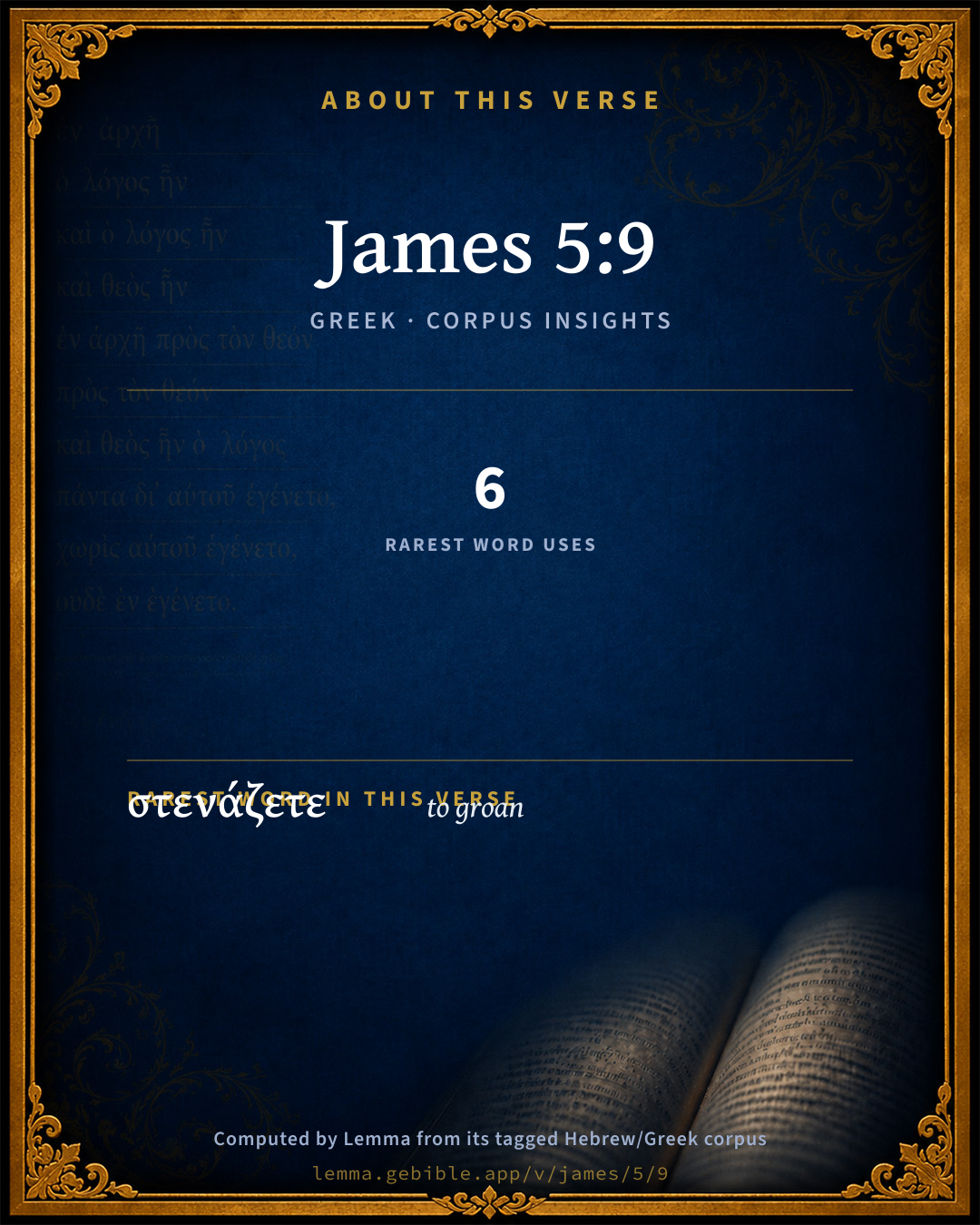
James 5:9

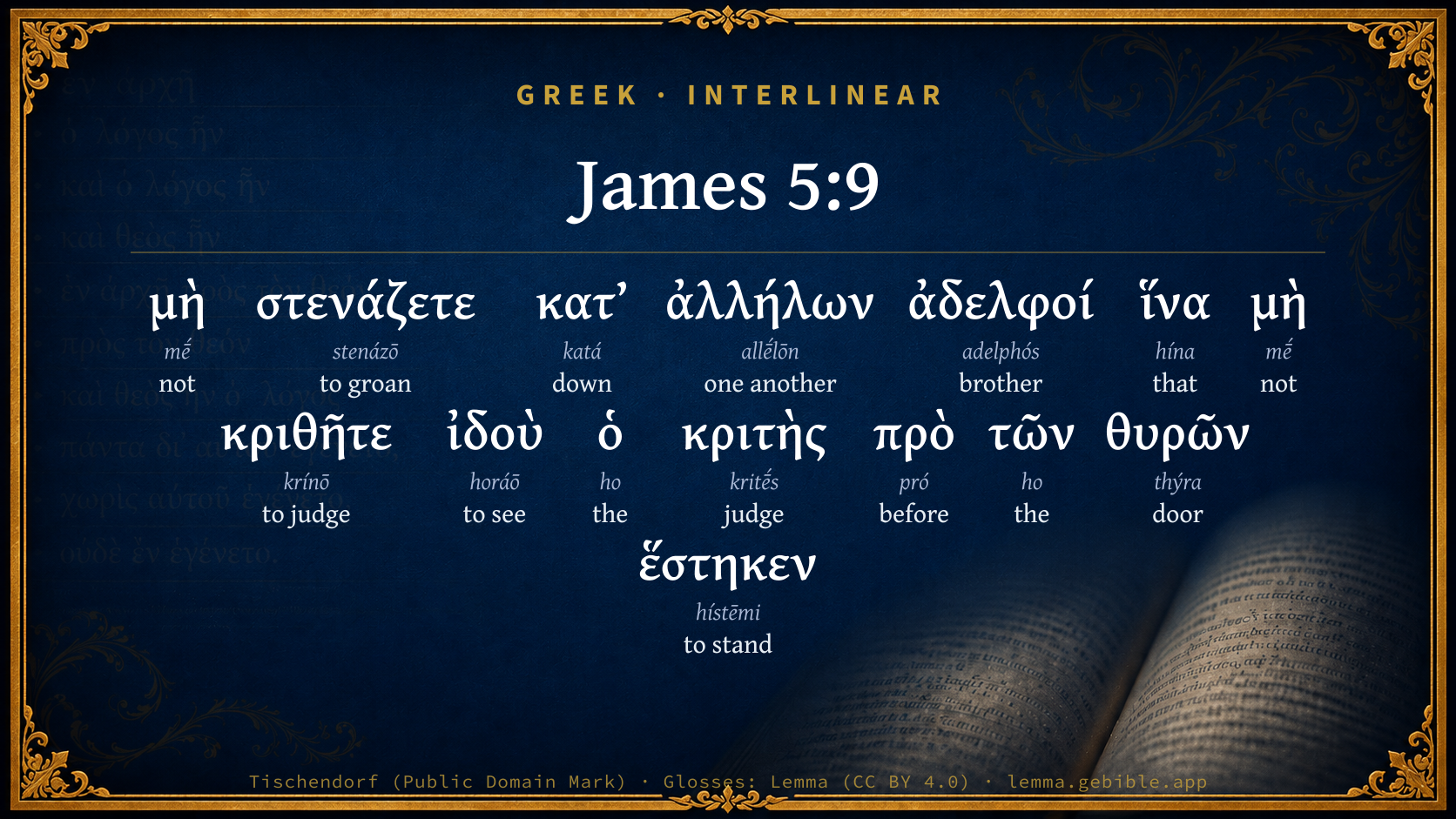
Greek (Tischendorf 8th ed.) James 5:9 appears in the Greek New Testament. The text above is from the Tischendorf 8th edition. Each word links to its Strong’s number and a concise gloss. Click any word for its full Thayer’s Greek Lexicon entry.
Download image
Cite this verse

James 5:9 (World English Bible). Public Domain. Lemma interlinear Bible study tool, https://lemma.gebible.app/v/james/5/9.

Show BibTeX & RIS
BibTeX
RIS
English Translation
Don't grumble, brothers, against one another, so that you won't be judged. Behold, the judge stands at the door.
World English Bible · Public Domain
Download a study sheet

One document with this verse’s original text, its word-by-word gloss line, the meaning frame, cross-references with their text, attributed commentary, and full source and license credits — printable, and it pastes into notes with its structure intact.

This verse Autodidact and up

Study sheet (.html) Plain text (.txt)

A passage Seminary Student

Up to 50 verses in one chapter. A passage sheet keeps up to 6 commentary sources and 12 cross-references per verse, in the order this page ranks them, and says so on the sheet whenever that leaves anything out. Ask for a single verse and you get the Autodidact verse sheet above.

Everything on this page stays free to read, with no account — the sheet is a download of what is already on screen, not access to it.

Want to remove ads? Support Godless Engineer
Compare translations 3

The same verse in 3 English versions, stacked beneath the original-language interlinear above. Click any original word for its lexicon entry.

Each is an independent rendering of the whole verse — the interlinear is not word-aligned to these translations.

Highlighted words mark where these versions differ — a whole-verse word diff, not a word-by-word alignment.

  • World English Bible Public Domain
    Don't grumble, brothers, against one another, so that you won't be judged. Behold, the judge stands at the door.
  • King James Version Public Domain
    Grudge not one against another, brethren, lest ye be condemned: behold, the judge standeth before the door.
  • unfoldingWord Literal Text CC BY-SA 4.0
    Do not complain, brothers, against one another, so that you may be not judged. Behold, the judge is standing at the door.

unfoldingWord Literal Text — © unfoldingWord, licensed CC BY-SA 4.0. Word-aligned USFM3 via Door43 (git.door43.org/unfoldingWord/en_ult).

Versions to compare (up to 4)

3 of 4 selected

Show all 19 translations

Every available English version of this verse, each an independent rendering of the whole verse.

  • World English Bible Public Domain
    Don't grumble, brothers, against one another, so that you won't be judged. Behold, the judge stands at the door.
  • Berean Standard Bible Public Domain
    Do not complain about one another, brothers, so that you will not be judged. Look, the Judge is standing at the door!
  • Majority Standard Bible Public Domain
    Do not complain about one another, brothers, so that you will not be judged. Look, the Judge is standing at the door!
  • King James Version Public Domain
    Grudge not one against another, brethren, lest ye be condemned: behold, the judge standeth before the door.
  • American Standard Version (1901) Public Domain
    Murmur not, brethren, one against another, that ye be not judged: behold, the judge standeth before the doors.
  • Revised Version (1885) Public Domain
    Murmur not, brethren, one against another, that ye be not judged: behold, the judge standeth before the doors.
  • Geneva Bible (1599) Public Domain
    Grudge not one against another, brethren, least ye be condemned: behold, the iudge standeth before the doore.
  • Douay-Rheims (1899) Public Domain
    Grudge not, brethren, one against another, that you may not be judged. Behold the judge standeth before the door.
  • Young's Literal Translation Public Domain
    murmur not against one another, brethren, that ye may not be condemned; lo, the Judge before the door hath stood.
  • Literal Standard Version CC BY-SA 4.0
    do not murmur against one another, brothers, that you may not be condemned; behold, the Judge has stood before the door.
  • Unlocked Literal Bible CC BY-SA 4.0
    Do not complain, brothers, against one another, so that you will be not judged. See, the judge is standing at the door.
  • unfoldingWord Literal Text CC BY-SA 4.0
    Do not complain, brothers, against one another, so that you may be not judged. Behold, the judge is standing at the door.
  • Darby Bible Public Domain
    Complain not one against another, brethren, that ye be not judged. Behold, the judge stands before the door.
  • World Messianic Bible Public Domain
    Don’t grumble, brothers, against one another, so that you won’t be judged. Behold, the judge stands at the door.
  • Webster's Bible Public Domain
    Grudge not one against another, brethren, lest ye be condemned: behold, the judge standeth before the door.
  • Free Bible Version CC BY-SA 4.0
    My friends, don't complain about each other, so you won't be judged. Look, the judge is standing right at the door!
  • Bible in Basic English Public Domain
    Say no hard things against one another, brothers, so that you will not be judged; see, the judge is waiting at the doors.
  • Text-Critical English NT CC BY 4.0
    Do not complain against one another, brothers, so that you will not be judged. Behold, the Judge is standing at the door.
  • Tyndale New Testament (1534) Public Domain
    Grodge not one agaynst another brethren lest ye be dampned. Beholde the iudge stondeth before the dore.

Literal Standard Version (2020), Covenant Press — licensed CC BY-SA 4.0. Text via the HelloAO Bible API (eBible.org). Unlocked Literal Bible (unfoldingWord) — licensed CC BY-SA 4.0. Text via the HelloAO Bible API (eBible.org). unfoldingWord Literal Text — © unfoldingWord, licensed CC BY-SA 4.0. Word-aligned USFM3 via Door43 (git.door43.org/unfoldingWord/en_ult). Free Bible Version, Dr. Jonathan Gallagher — licensed CC BY-SA 4.0. Text via the HelloAO Bible API (eBible.org).

Word by word

More ways to search: Search by grammar → Find every occurrence → Compare this word →

Practice this passage: Drill this verse → Learn its vocabulary →

στενάζετε
stenázō
G4727
“to groan”
Verb, Present, Active, Imperative, 2nd person, Plural
Part of Speech
Verb
Tense
Present
Voice
Active
Mood
Imperative
Person
2nd person
Number
Plural
Full Thayer's Definition

Origin: from G4728

TDNT: 17:00,1

1. a sigh, to groan
  1. μὴ mḗ G3361 “not” Particle, Negative
  2. κατ’ katá G2596 “down” Preposition
  3. ἀλλήλων allḗlōn G240 “one another” Reciprocal pronoun, Genitive, Plural, Masculine
  4. ἀδελφοί adelphós G80 “brother” Noun, Vocative, Plural, Masculine
  5. ἵνα hína G2443 “that” Conjunction
  6. μὴ mḗ G3361 “not” Particle, Negative
  7. κριθῆτε krínō G2919 “to judge” Verb, Aorist, Passive, Subjunctive, 2nd person, Plural
  8. ἰδοὺ horáō G3708 “to see” Verb, Aorist, Middle, Imperative, 2nd person, Singular
  9. ὁ ho G3588 “the” Article, Nominative, Singular, Masculine
  10. κριτὴς kritḗs G2923 “judge” Noun, Nominative, Singular, Masculine
  11. πρὸ pró G4253 “before” Preposition
  12. τῶν ho G3588 “the” Article, Genitive, Plural, Feminine
  13. θυρῶν thýra G2374 “door” Noun, Genitive, Plural, Feminine
  14. ἕστηκεν hístēmi G2476 “to stand” Verb, Perfect, Active, Indicative, 3rd person, Singular

About this verse

These counts appear in no published source. They are computed here, from the morphology-tagged text and Lemma’s own curated glosses. What Lemma adds →

15
words
13
distinct lemmas
General Epistles
section

Notable vocabulary

The rarest word here is στενάζετε to groan G4727 — appearing just 6 times in the whole Greek New Testament.

Shared distinctive vocabulary

στενάζετε to groan G4727 occurs in 6 verses of the Greek New Testament. Also found in:

Repetition

Words recur within this verse:

Cross-references

17

Topical passages linked to James 5:9 in the Treasury of Scripture Knowledge — connected by theme and wording, ordered by reader-vote popularity; previews shown in the World English Bible.

  • Leviticus 19:18 You shall not take vengeance, nor bear any grudge against the children of your people; but you shall love your neighbor as yourself. I am Yahweh.
  • 1 Corinthians 4:5 Therefore judge nothing before the time, until the Lord comes, who will both bring to light the hidden things of darkness, and reveal the counsels of the hearts. Then each man will get his praise from God.
  • James 4:11 Don't speak against one another, brothers. He who speaks against a brother and judges his brother, speaks against the law and judges the law. But if you judge the law, you are not a doer of the law, but a judge.
  • Matthew 24:33 Even so you also, when you see all these things, know that it is near, even at the doors.
  • Matthew 6:14–15 "For if you forgive men their trespasses, your heavenly Father will also forgive you.
  • Galatians 5:14 For the whole law is fulfilled in one word, in this: "You shall love your neighbor as yourself."
  • Genesis 4:7 If you do well, will it not be lifted up? If you don't do well, sin crouches at the door. Its desire is for you, but you are to rule over it."
  • Matthew 7:1–2 "Don't judge, so that you won't be judged.
  • 1 Peter 4:9 Be hospitable one to another without grumbling.
  • Mark 13:29 even so you also, when you see these things coming to pass, know that it is near, at the doors.
  • 1 Corinthians 10:11 Now all these things happened to them by way of example, and they were written for our admonition, on whom the ends of the ages have come.
  • 1 Peter 4:5 who will give account to him who is ready to judge the living and the dead.
  • Galatians 5:26 Let's not become conceited, provoking one another, and envying one another.
  • Psalms 59:15 They shall wander up and down for food, And wait all night if they aren't satisfied.
  • Mark 6:19 Herodias set herself against him, and desired to kill him, but she couldn't,
  • 2 Corinthians 9:7 Let each man give according as he has determined in his heart; not grudgingly, or under compulsion; for God loves a cheerful giver.
  • Revelation 3:20 Behold, I stand at the door and knock. If anyone hears my voice and opens the door, then I will come in to him, and will dine with him, and he with me.

Cross-references courtesy of OpenBible.info (CC BY 4.0).

Where the printed editions differ

1 variant

Places in this verse where the major printed Greek editions disagree on the wording in a way that affects the translation — a comparison of editions, not a manuscript-by-manuscript collation. The editions are the modern critical texts (Nestlé-Aland 28/27, SBL, Westcott-Hort, Tregelles, Tyndale House) and the traditional texts behind the KJV (the Textus Receptus and the Byzantine/Majority text). It is not a claim about which reading is original.

  1. Different wording
    κριθῆτε·

    “you may be judged;”

    In NA28NA27TynSBLWHTregByz Not in TR

    κατακριθῆτε (katakrithēte) 'you may be condemned' occurs in traditional manuscripts (TR) instead of κριθῆτε· (krithēte) 'you may be judged;' in older manuscripts (NA28+NA27+Tyn+SBL+WH+Treg+Byz)

Textual data: Translators Amalgamated Greek New Testament (STEPBible TAGNT) · CC BY 4.0.

Commentary

Notes on James 5:9 from classic Christian and Jewish commentators (each source and its license shown beneath its notes). The classic Christian expositions comment on the surrounding passage and are grouped to its opening verse, so a note may address several verses; the Jewish commentaries on the Tanakh (Rashi and others) are per-verse, so they appear only where the commentator wrote on this verse.

Lemma curates 59 commentaries, every one of them public domain or Creative Commons licensed, each selected and text-cleaned for this edition rather than reprinted as found. About our sources →

The Biblical Illustrator

Joseph S. Exell

Jam_5:9

Grudge not one against another

Discontent and envy

I.

EXPLAIN THE EXHORTATION.

1. The exhortation implies that we are apt to be secretly discontented with our condition and circumstances in the present life; that we are prone to become fretful when things do not correspond with our wishes.

2. It is implied that we are prone to envy, or to look upon the prosperity of others, either real or imaginary, with a spirit of secret discontent.

3. We are in danger of cherishing a spirit of resentment towards those who have injured us, whether intentionally or not, and so of having a grudge one against another.

II. ENFORCE THE EXHORTATION.

1. The disposition here forbidden is intrinsically evil, and is one of the corruptions of the human heart.

2. It is expressly contrary to Divine command, which requires us to esteem others better than ourselves, to rejoice in their prosperity, to participate of their sorrows, and to make their interest our own.

3. An envious and rancorous disposition is marked with folly, as well as stainedwith guilt. It argues an unacquaintedness with ourselves, who in every condition of life deserve to be in worse circumstances than we are; nor does such a disposition contribute in the least to our comfort and happiness. It cures not the wound, but makes it more painful and dangerous; does not lighten the burden, but renders it still more intolerable.

4. It is both injurious to ourselves and others, as well as sinful and unwise. Envy makes us our own tormentors; it robs us of that peace and satisfaction which we might otherwise enjoy. Wrath killeth the foolish man, and envy slayeth the silly one. It embitters his enjoyments and gives a keener edge to his afflictions. It is a sin which often leads to cruelty and injustice, and is seldom found to exist alone.

5. It is a sin which, if not repented of, will subject us to final condemnation. (B. Beddome, M. A.)

Grudging

Murmuring is not here generally taken for every grudging, either against God or man, as whereof in other places of Scripture is spoken, but particularly for that murmuring which is against men, therefore saith he, Grudge not one against another. This grudging and murmuring is either when we grieve that wicked rich men should so highly be exalted, and the poor, yet righteous, should by poverty be pressed down in the world; or else it is that murmuring whereby we take it in evil part that ourselves should be so tossed and turmoiled, and others should be dealt with more gently; thinking that we bear a greater burden and heavier cross from God than we have deserved, and that other men (as yet not touched) have deserved more. Or, finally, it is that grudging which is in our afflictions, whereby we are discontented that we should sigh so long under our afflictions, and the wicked which afflict us should so long escape unpunished, and so in our hearts, through impatience, complain hereof to God. This ought not to be in the saints of God, who ought to be renowned for their unspeakable patience; whose bounden duty it is to pray even for their enemies, to wish well to them which have done them injury, and to commit their cause to Him that judgeth righteously, which is God. And if this moderation and equity of our minds is to be showed towards our enemies, how much less ought we, then, to grudge against another Christian brother? If every one give some offence unto another, shall we complain to God in the bitterness of our hearts, shall we desire revenge from God against them? and shall we not all then perish? for no man liveth without some offence-giving. This grudging proceedeth from impatience, argueth discontentment of the mind, causeth mutual complaining unto God, and desireth revenge against such as have done us injury; which thing is far from the excellency or dignity of a Christian, whose patience should be such, as where others through impatience accuse one another, either to God or men, yet they should not so much as murmur in their minds, grudge to themselves, fret or grieve in their inward parts, much less complain indeed through discontentment and impatience, howbeit they had sustained injury. Finally, it bringeth condemnation upon us, who have lost patience, according to the denouncing of the Scripture: Woe be unto them that have lost patience. The reason why we should not murmur one against another is drawn from the presence of the Lord, who is at hand, as a just judge, to avenge us of our enemies, and to crown us for our patience or punish our murmuring. The Lord our God beholdeth our injuries with open eye, and seeth our oppressions by the wicked; He is pressed and at hand to rescue and deliver u s, as it shall seem best to His Divine Majesty; He marketh all our behaviour under the cross; let us not, therefore, be impatient, neither murmur, but therein show all Christian moderation as becometh saints. (R. Turnbull.)

The sin of grumbling

Do Christian people quite sufficiently consider the sin of grumbling, the sin of being discontented with the allotment of Providence, as to the time and place of their birth; as to the family in which they were born; as to their environment, as well as their heredity? What a strange sight a grumbling Christian is! He is a man who believes that God hath forgiven his sins, that Christ hath borne them all away, that his Lord has gone to prepare a place for him, that in a short time he will be where neither pain nor persecution can reach him, where the load of life will be laid down, where the wicked shall cease from troubling, and the weary shall be for ever at rest. And yet he allows small and transient things to keep him awake in the night, to worry him and make him peevish and fretful and cross through the day. He makes his own burdens more distressing by fretting under them, and thus increases the burdens which his friends have to bear. How many Christians fail to put their grumblings into the category of their sins. But Jamess admonition, that we should not grumble lest we be condemned, ought to arouse us to the duty of being patient, and to the fact that all really true Christian faith increases a mans manliness. (C. F. Deems, D. D.)

The carping spirit

A carping spirit rarely goes with a working spirit. It is easier to find fault with what some one else does than it is to do something oneself; hence a man who enjoys doing the easier thing is disinclined to do the harder one. As a rule men are divided into two classes, of those who growl and those who work; and each class is alike devoted to its own mission. But, when it comes to the relative worth in the community of the two classes, everybody can see the difference.

Grudge not

Murmur not (R.V.). The literal meaning of the Greek is Groan not; i.e. Grumble not. (A. Plummer, D. D.)

The Judge standeth before the door

The Judge before the door

This explains why conscience is always gloomy after sin; it is because He who is the eternal righteousness casts His shadow across the threshold of the soul. In some Eastern houses there are no windows, the doorway serving for lighting as well as for passage. A party of us lunching by invitation in a Druze house in the Lebanons had to drive away the curious villagers who looked in at us through the door, the only opening, because they made it so dark that we could not see the food. God fills the whole light-way of the soul when He looks in at us, and unless He shines on us with the light of His countenance, His stern righteousness makes the soul all dark within. (J. M. Ludlow, D. D.)

The magistrate present

If the magistrate be present we may not offend another to defend ourselves. (J. Trapp.)

The Biblical Illustrator, edited by Joseph S. Exell (c. 1880s–1900s) — public domain. Text from a community e-Sword module.

Tyndale Open Study Notes

Tyndale Open Resources

5:9 the Judge is standing at the door! The coming of Christ is imminent.

Tyndale Open Study Notes — © Tyndale Open Resources, licensed CC BY-SA 4.0. Text via the HelloAO Bible API.

Bengel's Gnomon

Johann Albrecht Bengel

Jas 5:9. Μὴ στενάζετε, do not groan) through impatience.—ἵνα μὴ κριθῆτε, that ye be not judged) by the Judge at His coming. Groans are in jurious, both to those by whom, and those against whom, they are uttered: see App. Crit. Ed. ii.[70]—ὁ Κριτὴς, the Judge) that is, Christ, whose office they usurp, who unbecomingly groan, and anticipate the time of judgment. If Baumgarten shall show by any mark that the article was not read by Stephanus, I shall affirm that the article did not fall out by accident at the beginning of the line.[71]—ΘΥΡῶΝ, the doors) A very close approach: Mat 24:33.—ἕστηκεν, has placed Himself) stands, always hearing everything.

[70] AB Vulg. and all the Versions read κριθῆτε; Rec. Text, with very inferior authority, κατακριθῆτε.—E.

[71] AB read the ὁ. But Stephens’ Rec. Text omits it, which perhaps was not “by accident,” as Beng. thinks, since some few cursive, and therefore inferior, MSS. omit it.—E.

Bengel's Gnomon of the New Testament — English translation (T&T Clark, Edinburgh, 1860) — public domain. Text from a community e-Sword module.

Meyer's Critical & Exegetical Commentary

Heinrich August Wilhelm Meyer

Jam_5:9. To the preceding exhortation a new one is added: μὴ στενάζετε, ἀδελφοί, κατʼ ἀλλήλων, since with impatience in affliction a sinful irritability of the sufferers toward each other is easily conjoined. στενάζειν κατά is to be understood neither of invidia alienis bonis ingemiscente (Grotius), nor of impatientia mutuis lamentationibus augenda; it rather denotes the gemitus accusatorius (Estius, Calvin, and others), without, however, necessarily supposing a provocatio ultionis divinae malorumque imprecatio (Theile, and similarly Calvin, Morus, Gebser, Hottinger, Lange, and others) united with it. Augusti incorrectly renders it: Give no occasion to one another for sighing.

From κατʼ ἀλλήλων it does not follow that the πλούσιοι (Jam_5:1 ff.) belong to the Christian church (against de Wette and Wiesinger); the reference here is rather to the conduct of Christians toward each other under the oppressions to which they were exposed by the πλούσιοι.[231]

Since στενάζειν κατά involves the judging of our brother, and is opposed to that love of which Paul says: μακροθυμεῖ, χρηστεύεται, … οὐ παροξύνεται, οὐ λογίζεται τὸ κακόν … πάντα ὑπομένει, James adds the admonition ἵνα μὴ κριθῆτε (comp. Mat_7:1), and then, for the purpose of strengthening the warning, points to the nearness of the Judge. The κριτής is none other than the Lord, whose παρουσία is at hand. As His nearness should comfort Christians in their distress, so it, should likewise restrain them from the renunciation of love to one another (comp. chap. Jam_2:13). Incorrectly Theile: non tam, qui impatientius ferentes certo puniat (quamquam nec hoc abesse potest), quam: qui vos ulciscatur, ut igitur ne opus quidem sit ista tam periculosa impatientia (so also de Wette); for ὁ κριτής evidently points back to ἵνα μὴ κριθῆτε.[232]

On πρὸ τῶν θυρῶν ἕστηκεν] i.e. he stands already before the door, on the point of entering, see Mat_24:33; Mar_13:29 (Act_5:23).

[231] Hornejus: Quos ad manifestas et gravissimas improborum injurias fortiter ferendas incitarat, eos nunc hortatur, ut etiam in minoribus illis offensis, quae inter pios ipsos saepe subnascuntur, vel condonandis vel dissimulandis promti sint. Contingit enim, ut qui hostium et improborum maximas saepe contumelias et injurias aequo animo tolerant, fratrum tamen offensas multo leviores non facile ferant.

[232] Wiesinger, indeed, recognises that the statement is added as a warning; but yet he thinks that the chief idea is: Ye may with perfect calmness leave the judgment to Him (so also Lange).

Meyer — Critical and Exegetical Commentary on the New Testament — English translation by Peter Christie, edited by Frederick Crombie (T&T Clark, 1880) — public domain. Text from a community e-Sword module.

Expositor's Greek Testament

ed. W. Robertson Nicoll

Jas 5:9 . μὴ στενάζετε : “A strengthened expression for μὴ καταλαλεῖτε Jas 4:11 ” (Carr); it refers to the inward feeling of grudge against another. The word shows that it is not only the righteous who are addressed in this section. ὁ κριτὴς πρὸ τῶν θυρῶν ἕστηκεν : Cf. Rev 3:20 . For the idea of the Judge standing at the door see Mat 24:33 , … γινώσκετε ὅτι ἐγγύς ἐστιν ἐπὶ θύραις , Mat 25:10 ff. (the parable of the Ten Virgins). In its origin the idea is antique; cf. the following from the Mishna ( Ab . iv. 16): “This world is as if it were a vestibule to the future world; prepare thyself in the vestibule, that thou mayest enter the reception-room”; this saying is one of Jacob of Korsha’s who lived in the second century A.D. ἕστηκεν : for the tense see above.

The Expositor's Greek Testament, edited by W. Robertson Nicoll (1897–1910) — public domain. Text from a community e-Sword module.

Geneva Bible (1599)

Geneva Bible translators

He commendeth Christian patience, so that whereas others through impatience use to accuse one another, the faithful on the contrary side complain not, although they receive injury.

By grudging, he meaneth a certain inward complaining which betokeneth impatience.

The conclusion: The Lord is at the door, who will defend his own, and revenge his enemies, and therefore we need not to trouble ourselves.

Geneva Bible (1599) marginal notes — public domain. Text via Bolls.life.

Jamieson, Fausset & Brown

Robert Jamieson, A. R. Fausset & David Brown

Grudge not--rather "Murmur not"; "grumble not." The Greek is literally, "groan": a half-suppressed murmur of impatience and harsh judgment, not uttered aloud or freely. Having exhorted them to patience in bearing wrongs from the wicked, he now exhorts them to a forbearing spirit as to the offenses given by brethren. Christians, who bear the former patiently, sometimes are impatient at the latter, though much less grievous.

lest . . . condemned--The best manuscript authorities read, "judged." James refers to Mat 7:1, "Judge not lest ye be judged." To "murmur against one another" is virtually to judge, and so to become liable to be judged.

judge . . . before the door--referring to Mat 24:33. The Greek is the same in both passages, and so ought to be translated here as there, "doors," plural. The phrase means "near at hand" (Gen 4:7), which in the oldest interpretations [Targums of Jonathan and Jerusalem] is explained, "thy sin is reserved unto the judgment of the world to come." Compare "the everlasting doors" (Psa 24:7, whence He shall come forth). The Lord's coming to destroy Jerusalem is primarily referred to; and ultimately, His coming again visibly to judgment.

Jamieson, Fausset & Brown — Commentary Critical and Explanatory on the Whole Bible (1871) — public domain (CC PDM 1.0). Text via the HelloAO Bible API.

Adam Clarke's Commentary

Verse 9. Grudge not] μη στεναζετε. Groan not; grumble not; do not murmur through impatience; and let not any ill treatment which you receive, induce you to vent your feelings in imprecations against your oppressors. Leave all this in the hands of God.

Lest ye be condemned] By giving way to a spirit of this kind, you will get under the condemnation of the wicked.

The judge standeth before the door.] His eye is upon every thing that is wrong in you, and every wrong that is done to you; and he is now entering into judgment with your oppressors.

Adam Clarke's Commentary on the Bible (1810–1826) — public domain. Text from a community e-Sword/MySword module.

John Calvin's Commentaries

9 Grudge not, or, groan not. As the complaints of many were heard, that they were more severely treated than others, this passage is so explained by some, as though James bade each to be contented with his own lot, not to envy others, nor grudge if the condition of others was more tolerable. But I take another view; for after having spoken of the unhappiness of those who distress good and quiet men by their tyranny, he now exhorts the faithful to be just towards one another and ready to pass by offenses. That this is the real meaning may be gathered from the reason that is added: Be not querulous one against another; lest ye be condemned. We may, indeed, groan, when any evil torments us; but he means an accusing groan, when one expostulates with the Lord against another. And he declares that thus they would all be condemned, because there is no one who does not offend his brethren, and afford them an occasion of groaning. Now, if everyone complained, they would all have accused one another; for no one was so innocent, that he did not do some harm to others.

God will be the common judge of all. What, then, will be the case, but that every one who seeks to bring judgment on others, must allow the same against himself; and thus all will be given up to the same ruin. Let no one, then, ask for vengeance on others, except he wishes to bring it on his own head. And lest they should be hasty in making complaints of this kind, he declares that the judge was at the door. For as our propensity is to profane the name of God, in the slightest offenses we appeal to his judgment. Nothing is a fitter bridle to check our rashness, than to consider that our imprecations vanish not into air, because God’s judgment is at hand.

John Calvin's Commentaries (1540-1563) — public domain. Text from the Calvin Translation Society English edition (1840s-50s) via the Christian Classics Ethereal Library (ccel.org). Calvin's coverage is partial (roughly two-thirds of the Bible); uncommented books and verses are honest gaps, never fabricated. The 19th-century editor's footnotes and remarks are omitted so the notes are faithfully Calvin's own voice.

Ellicott's Commentary for English Readers

(9) Grudge not.—Say in preference, Murmur not. “Grudge” has curiously changed its meaning from an outward murmur to an inward feeling. It has unfortunately been retained both here and in 1Pe_4:9. See also Psa_59:15, specially the Prayer Book version, “They will . . . grudge if they be not satisfied”—i.e., complain and murmur.

Lest ye . . .—It is not “lest ye be condemned,” but lest ye be judged, repeating the exact words of the original in Mat_7:1.

Behold, the judge standeth before the door.—Compare this scene with that depicted in Rev_3:20. In the one Christ lingers mercifully outside the door that “loves its hinge”; fain would He enter and abide. In the other He sounds a note of alarm; men are “waked in the night, not girding their loins for a journey, but in vague wonder at uncertain noise, who may turn again to their slumber,” or in wistful listening wait in vain for the voice of mercy which shall plead with them no more for ever (Ruskin).

One of the mocking questions put to St. James by his enemies, as they hurried him to death, was, “Which is the door of Jesus?” And failing to receive an answer to their mind, they said, “Let us stone this James the Just!” which they did, after they had cast him over the Temple wall.

A Bible Commentary for English Readers, edited by Charles John Ellicott (1878–1897) — public domain. Text from a community e-Sword module.

The Cambridge Bible for Schools and Colleges

gen. ed. J. J. S. Perowne

9. Grudge not one against another …] Better, perhaps, complain not. The primary meaning of the verb is “to groan.” To indulge in such complaints was to assume the office of the Judge, whose presence they ought to think of as not far off, even “at the door,” and so brought with it the condemnation which He himself had pronounced (Mat_7:1). The standing before the door presents a point of comparison with Rev_3:20.

The Cambridge Bible for Schools and Colleges (gen. ed. J. J. S. Perowne; Cambridge University Press, 1878–1918) — public domain. Text from a community e-Sword module.

John Gill's Exposition

Grudge not one against another, brethren,.... On account of any happiness, temporal or spiritual, which another enjoys; do not inwardly repine at it; or secretly sigh and groan in an envious manner at it, though nothing may be said, as the word used signifies; much less complain of, accuse, and condemn one another, or meditate and seek revenge:

lest ye be condemned; hereafter, at the bar of Christ, by the Judge of the whole earth, who is privy to the secret murmurings and grumblings, and the envious sighs and groans of men; see Mat 7:1

behold the judge standeth before the door; there is another that judgeth, who is the Lord, and he is at hand; he is just at the door; a little while and he will come, and not tarry; which may refer not to Christ's coming to destroy Jerusalem, but to his second coming to judgment, which will be quickly; for the Gospel times are the last times; there will be no other age; at the end of this, Christ will come.

John Gill's Exposition of the Whole Bible (1746–1763) — public domain (CC PDM 1.0). Text via the HelloAO Bible API.

Trapp's Complete Commentary

John Trapp

9 Grudge not one against another, brethren, lest ye be condemned: behold, the judge standeth before the door.

Ver. 9. Grudge not, &c.] μη στεναζετε, groan not, grumble not, grow not sour and sullen one to another.

Lest ye be condemned] As Sarah had been, if the Lord had come, as she desired him, to judge between her and her husband. The most guilty are commonly most querulous and complaining.

The judge standeth before the door] If the magistrate be present we may not offend another to defend ourselves. Ecce iudex pro foribus; therefore, Hold a blow, as we say.

John Trapp, A Commentary or Exposition upon All the Books of the Old and New Testament (1647–1656) — public domain. Text from a community e-Sword module.

Albert Barnes' Notes on the Bible

Grudge not one against another - Margin, “groan, grieve.” The Greek word (στενάζω stenazō) means, “to sigh, to groan,” as of persons in distress, Rom 8:23; and then to sigh or groan through impatience, fretfulness, ill-humor; and hence “to murmur, to find fault, to complain.” The exact idea here is, not that of grudging in the sense of dissatisfaction with what others possess, or of being envious; it is that of being fretful and impatient - or, to use a common word which more exactly expresses the sense that of grumbling. This may arise from many causes; either because others have advantages which we have not, and we are discontented and unhappy, as if it were wrong in them to have such enjoyments; or because we, without reason, suppose they intend to slight and neglect us; or because we are ready to take offence at any little thing, and to “pick a quarrel” with them. There are some persons who are always grumbling. They have a sour, dissatisfied, discontented temper; they see no excellence in other persons; they are displeased that others are more prospered, honored, and beloved than they are themselves; they are always complaining of what others do, not because they are injured, but because others seem to them to be weak and foolish; they seem to feel that it becomes them to complain if everything is not done precisely as in their estimation it should be. It is needless to say that this spirit - the offspring of pride - will make any man lead a wretched life; and equally needless to say that it is wholly contrary to the spirit of the gospel. Compare Luk 3:14; Phi 4:11; 1Ti 6:8; Heb 13:5.

Lest ye be condemned - That is, for judging others with this spirit - for this spirit is in fact judging them. Compare the notes at Mat 7:1.

Behold, the judge standeth before the door - The Lord Jesus, who is soon to come to judge the world. See Jam 5:8. He is, as it were, even now approaching the door - so near that he can hear all that you say.

Albert Barnes' Notes on the Bible (1834–1885) — public domain. Text from a community e-Sword/MySword module.

Matthew Poole's English Annotations

Grudge not; Greek: Groan not; the sense may be, either: Envy not one another, (or, as we translate it: Grudge not), it being the nature of envy to groan at other men’s good; or, Groan not by way of accusation or complaint to God against others, desiring him to avenge your quarrels, as if you were too good to suffer injuries, or God were unjnst or forgetful of righting you.

One against another; brother against brother, Christian against Christian: they were injured not only by rich worldlings and open oppressors, but by their fellow professors, and gave one another mutual cause of sighing and groaning.

Lest ye be condemned; lest God punish you all; there being none of you but have given others cause of grief and complaint, as well as others have given you, Mat 7:1.

Behold, the Judge standeth before the door; the Lord Jesus Christ, the Judge of you all, is at hand, {Phi 4:5} in a readiness either to bring those evils upon you which you wish may fall upon others, or to give you your reward, if through patient continuance in well doing you seek for it, Rom 2:7. The like phrase we have, Mat 24:33; Mar 13:29; or it may allude to Gen 4:7.

Matthew Poole's English Annotations on the Holy Bible (1683–1685) — public domain. Text from a community e-Sword/MySword module.

Whedon's Commentary on the Bible

Daniel D. Whedon

9. Grudge—Rather, murmur. A return to the caution against mutual evil speaking of Jas_4:11-12. Lessons of submission under persecution, of patience with each other, and waiting for their final reward, interchange with each other.

Standeth before the door—Not to be applied to the destruction of Jerusalem, but to the Parousia of Jas_5:8.

Daniel D. Whedon (gen. ed.), Commentary on the Old and New Testaments (1874–1909) — public domain. Text from a community e-Sword module.

The Pulpit Commentary

Grudge not, brethren; better, with R.V, murmur not a meaning which "grudge" had in the seventeenth century; cf. Psa_59:15 (Prayer-book version), "They will run here and there for meat, andgrudge if they be not satisfied." What is the connection of this verse with the preceding? "Murmuring" implies sitting in judgment upon others, which has been expressly forbidden by the Lord himself. It is also the opposite to that makroqumia to which St. James has been exhorting his readers. Lest ye be condemned; rather, that ye be not judged.

Ina mh kriqhte, as in Mat_7:1. Katakriqhte of the Received Text has absolutely no authority, nor has the omission of the article before krith) in the following clause. Behold, the Judge, etc. The nearness of the judgment is expressed by saying that the Judge is actually standing "before the doors (pro twn qurwn)." So also our Lord, in his great discourse on the judgment, says, (Mat_24:33) "When ye see all these things, know that he is nigh, even at the doors (ejgguv ejstin ejpiraiv);" and comp. Rev_3:20, where he says, "Behold, I stand at the door (esthka ejpi thran), and knock.

Vers. 9-11.

Bear and forbear.

Here we have another exhortation to patience, with other examples of its exercise. In vers. 7, 8, however, the apostle has had in view the persecutions which believers suffer at the hands of the ungodly; while he now refers to the trial of patience which arises from collision of feeling among Christian brethren themselves.

I A WARNING AGAINST IMPATIENCE WITH ONE ANOTHER. (Ver. 9.) "Murmur not, brethren," implies that believers are apt within their hearts, if not also openly, to complain of each other. Indeed, it sometimes requires greater patience to bear with composure the little frictions of feeling to which close contact with Christian brethren exposes, than to endure open and overt wrongs at the hands of persons who are not such. The warning has a lesson:

1. For the family circle. What a happy society is that of a well-ordered family, where love reigns between husband and wife, and where the parents enjoy the confidence and obedience of wisely trained children! But this fireside happiness can be enjoyed only in connection with constant mutual forbearance. How prone, sometimes, are even husband and wife to misunderstand each other! And how often are households made unhappy by envying and quarrelling among the children! Let us remember that the persons who live in the same house with us are in the very best position for appraising the value of our Christian profession. They know at least whether we are learning to bear kindly with the infirmities of our own relations, and to endure with patience petty discomforts in domestic life. The grace of God within the soul will enable us to "walk within our house with a perfect heart". (Psa_101:2)

2. For the business circle. How many offences arise among Christian men when engaged in the toil and strain of commercial competition! One brother grudges the worldly successes of his neighbor; and perhaps his heart harbors against him uncharitable accusations of dishonest dealing. But, as Abraham long ago was content that Lot should appropriate to himself the best of the land rather than that their herdmen should quarrel, so still it will do a Christian man less harm to make sometimes what is financially a bad bargain, than to soil his soul by cherishing evil thoughts regarding any brother believer.

3. For the Church circle. There is apt to be murmuring and grumbling in ecclesiastical life. Sometimes the spiritual office-bearers of a congregation get but little thanks for the work which they do. Sometimes, also, the people forget that they ought to have large mutual patience with one another. The liberal progress-loving member is apt to groan over the attitude of his conservative let-things-alone brother; and the educated and cultured Christian may fail at times to forbear with the man of narrow and exclusive views. The exemplary Church member, while ready at all times to maintain and defend his own opinions, is yet willing gracefully to yield (wherever conscience does not forbid) to what the majority decide upon, that thereby he may promote the general peace and edification.

II THE SANCTION BY WHICH THIS WARNING IS ENFORCED. (Ver. 9.) James employs a sweetly persuasive motive in the word "brethren." To complain of each other is to sin against the highest and most sacred brotherhood. This motive, however, is only lightly touched, in passing. The apostle backs up his warning with a solemn sanction. Echoing, as he does so often, his Master"s words in the Sermon on the, (Mat_7:1) he speaks of the bar of God, and of the Lord Christ the Judge. To refuse to forbear with brethren, he says, amounts virtually to an assumption of the judicial office, and will expose one"s self to be "judged." For what right have we to judge our brethren? We lack the necessary discrimination; our own hearts are impure; and we shall very soon have ourselves to appear before the judgment-bar. Already, indeed, "the Judge standeth before the doors." He is near at hand, to discharge perfectly those functions which we are so prone to usurp; and, in doing so, to condemn all who may have been guilty of such usurpation.

III THE ENCOURAGEMENT AFFORDED BY CERTAIN OLD TESTAMENT EXAMPLES. (Vers. 10, 11.) It should cheer us, under this and every other form of trial, to remember how the great seers and saints of old endured their afflictions.

1. The example of the prophets. (Ver. 10.) The Jewish Christians had a deep reverence for the memory of these noble men. The prophets had been the religious teachers of ancient Israel; through them the Divine Spirit himself had spoken. The influence which they exercised while they lived had sometimes been prodigious; indeed, their power was often greater than the power of the sovereign. Yet the lot of the prophets had been one of sore affliction. They were an example to the New Testament Church:

(1) Of suffering. Their trials came upon them as the result of the fidelity with which they "spake in the name of the Lord." It was so with Moses, Elijah, Micaiah, Isaiah, Jeremiah, Daniel. The Jews indeed were accustomed to confess that the prophets generally had been persecuted (Mat_23:30, Mat_23:37; Act_7:52; Heb_11:36-38) No wonder, then, since trouble fell on these great men, that it should fall on us. We may be well contented to follow in the faith that has been trodden by "the goodly fellowship.

(2) Of long-suffering. We are to think also of the meekness of the prophets when enduring their unparalleled afflictions. They were sorely tried by the murmurings of their "brethren," to whom they spoke the Word of God; yet how patiently they bore it all! They laid hold upon the Divine strength, and thus learned to bear and forbear. And so, despite their infirmities and occasional lapses from patience, of these men "the world was not worthy.

2. The example of Job. (Ver. 11.) Although the Book of Job is a poem, our apostle evidently believed it to have an underlying basis of veritable history. The man Job actually existed; and his proverbial patience is an example to the Church. Think of the dreadful distresses which came thick and fast upon him. By successive strokes he was deprived of property, family, health, reputation, and true sympathy. Yet Job left his sufferings with God. He learned to forbear with the bigotry and stupidity of his friends. He evinced at last, in spite of some serious failures, a spirit of perfect submission to the Divine will. He interceded for his misguided comforters; and God forgave them. Job"s case, however, is introduced here chiefly with the view of pointing to "the end" or conclusion which the Lord gave to him. (Job_42:12) His God, whom he feared, rewarded signally, even in this life, his wonderful patience. And the great lesson which we should learn from Job"s career is "that the Lord is full of pity, and merciful." He is so in the very sending of trial, in the measure of it, in the grace which he gives to bear it, in the unraveling of its merciful purpose, and in the happy issues with which he rewards his people, when they "have been approved". (Jam_1:12) Trial is a goodly discipline intended to prepare for the "goodly heritage;" and thus they will be "bleared" who shall have "endured. C.J.

The Pulpit Commentary (1880–1919), ed. H.D.M. Spence-Jones & Joseph S. Exell — public domain. Text from a community e-Sword module.

John Wesley's Explanatory Notes

Murmur not one against another - Have patience also with each other. The judge standeth before the door - Hearing every word, marking every thought.

John Wesley, Explanatory Notes Upon the Whole Bible (1754–1765) — public domain. Text via the GEBible commentary corpus.

Burkitt's Expository Notes on the New Testament

William Burkitt

Observe here, 1. A prohibiton, Grudge not one against another; that is, do not murmur or repine, groan or grieve, as impatient men use to do under their pressure; complain not of God, because the time of your deliverance is delayed: thirst not after revenge against your persecutors, and envy not those who are exercised with fewer troubles than yourselves: grudge not.

Observe, 2. The enforcement of this prohibition from the danger of the fact, lest ye be condemned. As if he had said, "Impatience and discontent, envy and distrust, will expose you to greater miseries than you complain of: Your sufferings here are but for your probation, but your grudging and repining will be your condemnation."

Observe, 3. The anticipation or forestalling of an objection, which some might make. What! must we suffer, and may we not complain? Must we, by tamely bearing many affronts, invite more, and revenge none?" Yes, says the apostle, be patient, and commit your cause to him that judegeth righteously; for Behold the Judge standeth before the door.

Where note, 1. A Judge, the supreme and universal Judge, Jesus Christ, who was here judged by his creatures, but now is coming to judge his judges.

2. His posture, He standeth, which is the Judge’s posture when he executes judgment. St. Stephen saw Christ standing, Act 7:55, at God’s right hand; not as an advocate to plead his cause, (Christ is said to sit at God’s right hand when he does that); but he stood now as a Judge, to take speedy vengeance on St. Stephen’s murderers for that bloody act.

Note, 3. The place where the Judge standeth before the door; that is, he is coming to judgment, and he is just at hand; he has put on his robes, and is ascending his tribunal.

Observe, lastly, the note of attention, Behold! this ushers in the whole, Behold the Judge standeth at the door.

Learn hence, that the consideration of Christ’s near approach to judgment should awe the consciences of men, and mould their conversations into a dutiful compliance with divine commands.

William Burkitt's Expository Notes on the New Testament (1700–1703) — public domain. Text from a community e-Sword module.

The People's New Testament

B. W. Johnson

9. Grudge not. Do not bear grudges against one another. The Lord will condemn this, and the judge standeth before the door, for the “coming of the Lord is nigh.”

B. W. Johnson's The People's New Testament with Notes (1889–1891) — public domain. Electronic text from the Christian Classics Ethereal Library (CCEL) ThML edition.

unfoldingWord translationNotes

Door43 World Missions Community

Do not complain, brothers ... you

James is writing to all the scattered Jewish believers.

against one another

"about each other"

you will be not judged

This can be stated in the active. AT: "Christ will not judge you" (See: Active or Passive)

See, the judge

"Pay attention, because what I am about to say is both true and important: the judge"

the judge is standing at the door

James compares Jesus, the judge, to a person about to walk through a door to emphasize how soon Jesus will return to judge the world. AT: "the judge is coming soon" (See: Metaphor)

the suffering and patience of the prophets, those who spoke in the name of the Lord

"how the prophets who spoke in the name of the Lord suffered persecution with patience"

spoke in the name of the Lord

"Name" here is a metonym for the person of the Lord. AT: "by the authority of the Lord" or "spoke for the Lord to the people" (See: Metonymy)

See, we regard

"Pay attention, because what I am about to say is both true and important: we regard"

those who endured

"those who continued obeying God even through hardship"

translationWords

brother

judge

judge, judges

suffer

prophet

lord

endure

bless

Job

compassion

mercy

unfoldingWord translationNotes — © Distant Shores Media and the Door43 World Missions Community, licensed CC BY-SA 4.0. Source: git.door43.org/Door43/en_tn.

Cambridge Greek Testament for Schools and Colleges

9. κριθῆτε with all the chief MSS. κατακριθῆτε has very slight support.

9. μἡ στενάζετε, a strengthened expression for μὴ καταλαλεῖτε, ch. Jas 4:11. Comp. Mat 7:1 μὴ κρίνετε ἵνα μὴ κριθῆτε: and see Php 4:5.

κριτής κ.τ.λ. Note the same close connexion between slander and the presence of the Judge, ch. Jas 4:11. For κριτής in connexion with the παρουσία see Act 10:42; 2Ti 4:8; Heb 12:23. For the effect of the παρουσία on conduct see Mat 24:46-51; Luk 12:40. With the phrase πρὸ τῶν θυρῶν comp. Mat 24:33 ἐγγύς ἐστιν ἐπὶ θύραις, Mar 13:29, Rev 3:20 ἔστηκα ἐπὶ τὴν θύραν.

Cambridge Greek Testament for Schools and Colleges (Cambridge University Press, 1896; 21 vols, various authors incl. Carr, Maclear, Plummer, Farrar, Lumby, Moule, M. R. James, Simcox) — public domain. Text from a community e-Sword module.

Alford’s Greek Testament

Henry Alford

9.] Exhortation to mutual forbearance. “Quos ad manifestas et gravissimas improborum injurias fortiter ferendas incitarat, eos nunc hortatur, ut etiam in minoribus illis offensis quæ inter pios ipsos sæpe subnascuntur, vel condonandis vel dissimulandis promti Sint. contingit enim ut qui hostium et improborum maximas sæpe contumelias et injurias æquo animo tolerant, fratrum tamen offensas multo leniores non facile ferant.” Horneius (in Huther). Murmur not, brethren, against one another (there is not any imprecation of Divine vengeance to be thought of, as Calvin, Theile, al.), that ye be not judged (seeing that murmuring against one another involves the violation of our Lord’s μὴ κρίνετε (ref. Matt.), he finishes with the following clause there, ἵνα μὴ κριθῆτε: the passive verb here, as there, being to be taken in a condemnatory sense, or at all events as assuming the condemnatory issue): behold, the Judge standeth before the door (reff. The Judge, viz. the Lord. These last words are added with a view to both portions of the sentence preceding, not to the latter one only as Huther: μὴ στεν. involving in itself μὴ κρίνετε: the near approach of the Judge is a motive for suspending our own judgment, as well as for deterring us from incurring that speedy judgment on ourselves which we shall incur if we do not suspend it).

10,

Henry Alford, The Greek Testament (1849–1861) — public domain. Text from a community e-Sword module.

International Critical Commentary

9. μὴ στενάζετε κατʼ ἀλλήλων, “do not groan against one another.” στενάζειν does not mean “murmur,” but “groan,” “complain of distress,” cf. Heb 13:17. It is frequently used in the LXX for the utterance of various kinds of pain and grief.

The more emphatic words here are κατʼ ἀλλήλων, and the sentence means: “Do not blame one another for the distress of the present soon-to-be-ended age.” This, it is pointed out, is both wicked (ἵνα μὴ κριθῆτε) and needless (ἱδοὺ ὁ κριτὴς πρὸ τῶν θυρῶν ἕστηκεν). We ought to cultivate patience in general, and we ought not to blame one another for our unmerited distress, for we should recognise that it is part of the inevitable and temporary evil of the present age.

The translation “grudge” (A.V.) means “complain”; cf. Psa 59:15 (A.V.), Shakespeare, 1. Henry VI, iii, 1, 176.

ἵνα μὴ κριθῆτε. They are themselves in danger of judgment, if they commit the sin of complaining of their brethren. Cf. 2:12 f. 4:12, 5:12, also Mat 7:1 (but there is here in James nothing of the idea that judging brings Judgment). As in 4:12, so probably here, God is the judge, and with the coming of the Lord (i. e. Christ), v. 7, God’s judgment appears; cf. Rom 2:16.

The sentence means hardly more than “for that is wrong,” cf. v. 12.

πρὸ τῶν θυρῶν, cf. Mar 13:29, Mat 24:33.

International Critical Commentary — older volumes (1896–1929), various authors — public domain. Text from a community e-Sword module.

Vincent's Word Studies in the New Testament

Marvin R. Vincent

Grudge not [μη στεναζετε] . Better, as Rev., murmur not. The verb means to sigh or groan.

Standeth before the doors. In the act of entering.

Marvin R. Vincent, Word Studies in the New Testament (1887–1900) — public domain. Text from a community e-Sword/MySword module.

Lesson kit

Teaching starters — assembled from the data on this page, not authored interpretation. Every prompt links to the verse data it draws on. Edit before teaching.

James, in the General Epistles, opens this verse with 15 words (13 distinct Greek lemmas). Its most distinctive word is stenázō (“to groan”). A historical commentator’s framing appears above. Read the whole chapter for the surrounding context.

Discussion questions

  1. What does “to groan” (stenázō) contribute to the verse as a whole?
  2. Mark 7:34 shares the word «to groan» with this verse. How do the two illuminate each other?
  3. “not” occurs 2× in this one verse. What is the effect of the repetition?
  4. These translations render this verse differently. What is at stake in choosing one wording over another?
  5. Reading how The Biblical Illustrator and Tyndale Open Study Notes read this verse, where do the two commentators agree and where do they part?

Things to notice

Reading settings

Reading text

Shown beneath each verse's original-language words.

Old Testament
Old Testament edition

Read the OT as the Masoretic Hebrew (MT) or the Greek Septuagint (LXX).

English shown for the Greek Septuagint (in the Hebrew ↔ Greek comparison).

Comparing translations? Open the Compare panel on any verse page to stack up to four side by side.