
James 1:14

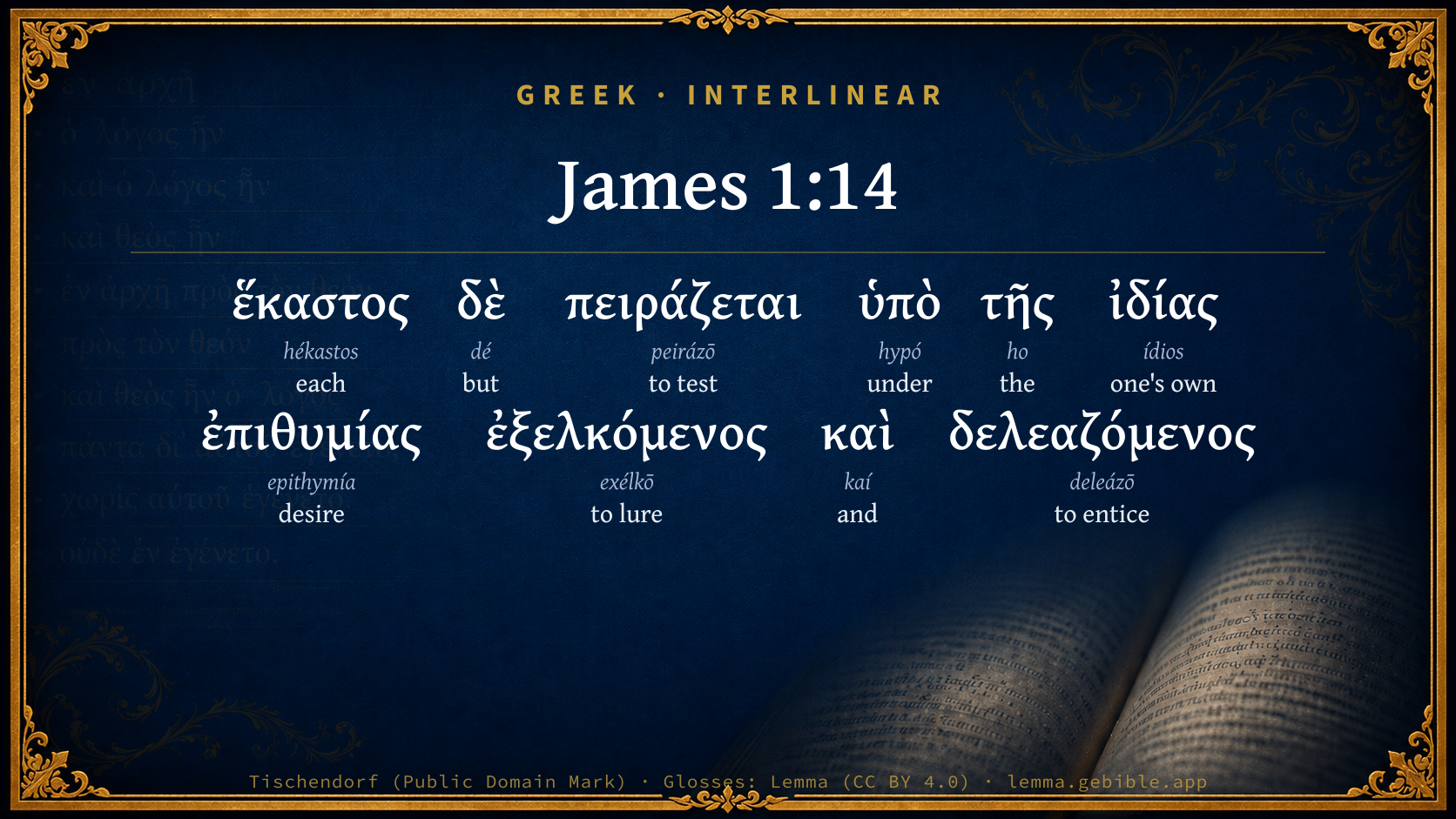
Greek (Tischendorf 8th ed.) James 1:14 appears in the Greek New Testament. The text above is from the Tischendorf 8th edition. Each word links to its Strong’s number and a concise gloss. Click any word for its full Thayer’s Greek Lexicon entry.
Download image
Cite this verse

James 1:14 (World English Bible). Public Domain. Lemma interlinear Bible study tool, https://lemma.gebible.app/v/james/1/14.

Show BibTeX & RIS
BibTeX
RIS
English Translation
But each one is tempted, when he is drawn away by his own lust, and enticed.
World English Bible · Public Domain
Highlights
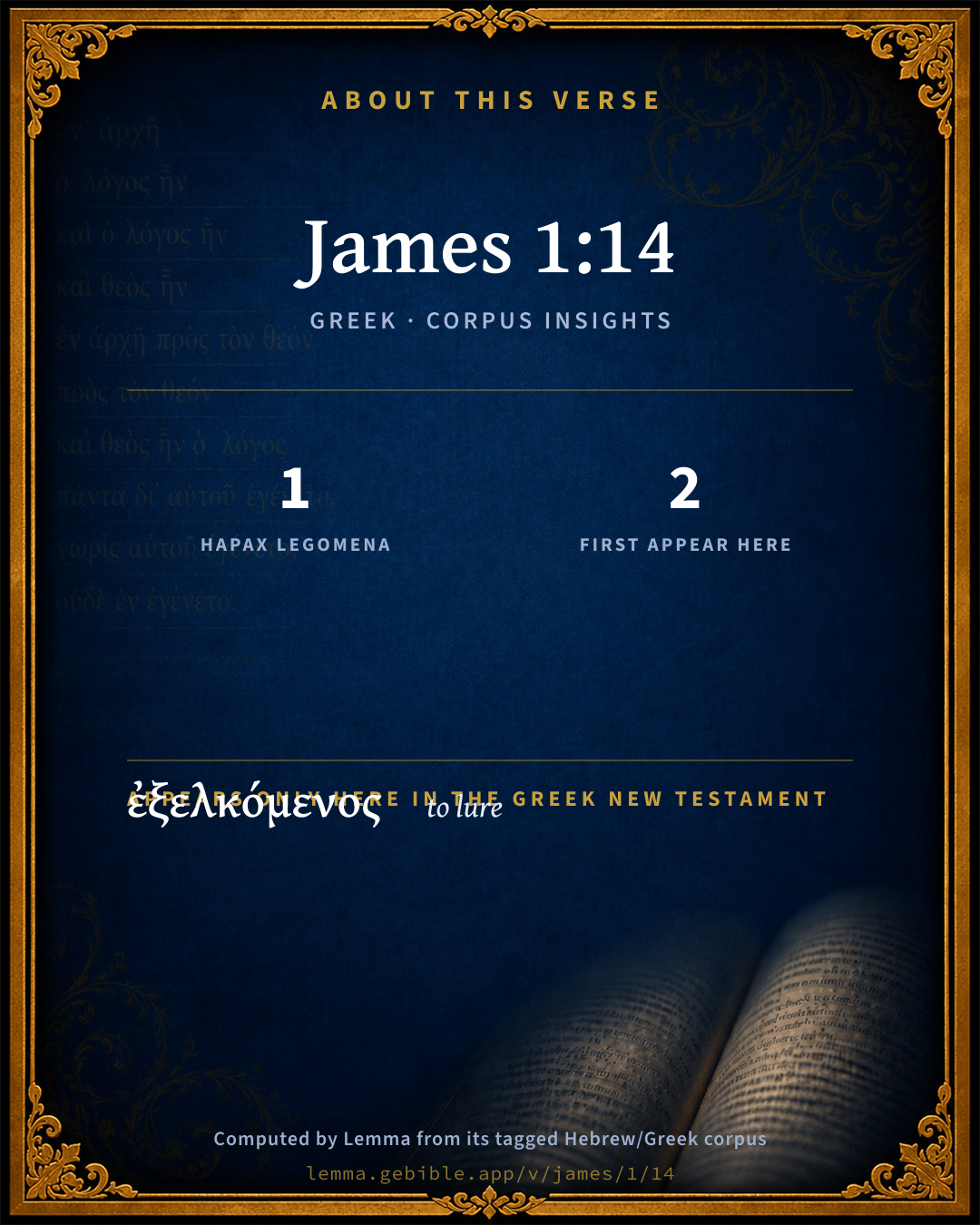
  • 1 hapax legomenon — only here in the Greek New Testament
  • 2 first appearances in the Greek New Testament
Full analysis ↓
Download a study sheet

One document with this verse’s original text, its word-by-word gloss line, the meaning frame, cross-references with their text, attributed commentary, and full source and license credits — printable, and it pastes into notes with its structure intact.

This verse Autodidact and up

Study sheet (.html) Plain text (.txt)

A passage Seminary Student

Up to 50 verses in one chapter. A passage sheet keeps up to 6 commentary sources and 12 cross-references per verse, in the order this page ranks them, and says so on the sheet whenever that leaves anything out. Ask for a single verse and you get the Autodidact verse sheet above.

Everything on this page stays free to read, with no account — the sheet is a download of what is already on screen, not access to it.

Want to remove ads? Support Godless Engineer
Compare translations 3

The same verse in 3 English versions, stacked beneath the original-language interlinear above. Click any original word for its lexicon entry.

Each is an independent rendering of the whole verse — the interlinear is not word-aligned to these translations.

Highlighted words mark where these versions differ — a whole-verse word diff, not a word-by-word alignment.

  • World English Bible Public Domain
    But each one is tempted, when he is drawn away by his own lust, and enticed.
  • King James Version Public Domain
    But every man is tempted, when he is drawn away of his own lust, and enticed.
  • unfoldingWord Literal Text CC BY-SA 4.0
    But each one is tempted by his own desire, dragged away and enticed.

unfoldingWord Literal Text — © unfoldingWord, licensed CC BY-SA 4.0. Word-aligned USFM3 via Door43 (git.door43.org/unfoldingWord/en_ult).

Versions to compare (up to 4)

3 of 4 selected

Show all 19 translations

Every available English version of this verse, each an independent rendering of the whole verse.

  • World English Bible Public Domain
    But each one is tempted, when he is drawn away by his own lust, and enticed.
  • Berean Standard Bible Public Domain
    But each one is tempted when by his own evil desires he is lured away and enticed.
  • Majority Standard Bible Public Domain
    But each one is tempted when by his own evil desires he is lured away and enticed.
  • King James Version Public Domain
    But every man is tempted, when he is drawn away of his own lust, and enticed.
  • American Standard Version (1901) Public Domain
    but each man is tempted, when he is drawn away by his own lust, and enticed.
  • Revised Version (1885) Public Domain
    but each man is tempted, when he is drawn away by his own lust, and enticed.
  • Geneva Bible (1599) Public Domain
    But euery man is tempted, when hee is drawen away by his owne concupiscence, and is entised.
  • Douay-Rheims (1899) Public Domain
    But every man is tempted by his own concupiscence, being drawn away and allured.
  • Young's Literal Translation Public Domain
    and each one is tempted, by his own desires being led away and enticed,
  • Literal Standard Version CC BY-SA 4.0
    but each one is tempted, being led away and enticed by his own desires;
  • Unlocked Literal Bible CC BY-SA 4.0
    But each person is tempted by his own desire, which drags him away and entices him.
  • unfoldingWord Literal Text CC BY-SA 4.0
    But each one is tempted by his own desire, dragged away and enticed.
  • Darby Bible Public Domain
    But every one is tempted, drawn away, and enticed by his own lust;
  • World Messianic Bible Public Domain
    But each one is tempted when he is drawn away by his own lust and enticed.
  • Webster's Bible Public Domain
    But every man is tempted, when he is drawn away by his own lust, and enticed.
  • Free Bible Version CC BY-SA 4.0
    Temptations come from our own evil desires that lead us astray and entrap us.
  • Bible in Basic English Public Domain
    But every man is tested when he is turned out of the right way by the attraction of his desire.
  • Text-Critical English NT CC BY 4.0
    But each person is tempted when he is drawn away and enticed by his own evil desires.
  • Tyndale New Testament (1534) Public Domain
    But every man is tepted drawne awaye and entysed of his awne concupiscece.

Literal Standard Version (2020), Covenant Press — licensed CC BY-SA 4.0. Text via the HelloAO Bible API (eBible.org). Unlocked Literal Bible (unfoldingWord) — licensed CC BY-SA 4.0. Text via the HelloAO Bible API (eBible.org). unfoldingWord Literal Text — © unfoldingWord, licensed CC BY-SA 4.0. Word-aligned USFM3 via Door43 (git.door43.org/unfoldingWord/en_ult). Free Bible Version, Dr. Jonathan Gallagher — licensed CC BY-SA 4.0. Text via the HelloAO Bible API (eBible.org).

Word by word

More ways to search: Search by grammar → Find every occurrence → Compare this word →

Practice this passage: Drill this verse → Learn its vocabulary →

ἐξελκόμενος
exélkō
G1828
“to lure”
Verb, Present, Passive, Participle, Nominative, Singular, Masculine
Part of Speech
Verb
Tense
Present
Voice
Passive
Mood
Participle
Case
Nominative
Number
Singular
Gender
Masculine
Full Thayer's Definition

Origin: from G1537 and G1670

TDNT: None

1. to draw out 2. metaph. lure forth: in hunting and fishing as game is lured from its hiding place, so man by lure is allured from the safety of self-restraint to sin. In Jas 1:14 , the language of the hunting is transferred to the seduction of a harlot.
  1. ἕκαστος hékastos G1538 “each” Adjective, Nominative, Singular, Masculine
  2. δὲ dé G1161 “but” Conjunction
  3. πειράζεται peirázō G3985 “to test” Verb, Present, Passive, Indicative, 3rd person, Singular
  4. ὑπὸ hypó G5259 “under” Preposition
  5. τῆς ho G3588 “the” Article, Genitive, Singular, Feminine
  6. ἰδίας ídios G2398 “one's own” Adjective, Genitive, Singular, Feminine
  7. ἐπιθυμίας epithymía G1939 “desire” Noun, Genitive, Singular, Feminine
  8. καὶ kaí G2532 “and” Conjunction
  9. δελεαζόμενος deleázō G1185 “to entice” Verb, Present, Passive, Participle, Nominative, Singular, Masculine

About this verse

These counts appear in no published source. They are computed here, from the morphology-tagged text and Lemma’s own curated glosses. What Lemma adds →

10
words
10
distinct lemmas
General Epistles
section

Notable vocabulary

1 hapax legomenon — a word that appears only here in the entire Greek New Testament:

  • ἐξελκόμενος to lure G1828

First appearance in Scripture

These words make their first canonical appearance in the Greek New Testament here:

  • ἐξελκόμενος to lure G1828
  • δελεαζόμενος to entice G1185

Shared distinctive vocabulary

δελεαζόμενος to entice G1185 occurs in 3 verses of the Greek New Testament. Also found in:
Cross-references

18

Topical passages linked to James 1:14 in the Treasury of Scripture Knowledge — connected by theme and wording, ordered by reader-vote popularity; previews shown in the World English Bible.

  • Mark 7:21–22 For from within, out of the hearts of men, proceed evil thoughts, adulteries, sexual sins, murders, thefts,
  • Ephesians 4:22 that you put away, as concerning your former way of life, the old man, that grows corrupt after the lusts of deceit;
  • Matthew 15:18 But the things which proceed out of the mouth come out of the heart, and they defile the man.
  • Hebrews 3:13 but exhort one another day by day, so long as it is called "today;" lest any one of you be hardened by the deceitfulness of sin.
  • Proverbs 4:23 Keep your heart with all diligence, For out of it is the wellspring of life.
  • Romans 7:13 Did then that which is good become death to me? May it never be! But sin, that it might be shown to be sin, by working death to me through that which is good; that through the commandment sin might become exceeding sinful.
  • Matthew 5:28 but I tell you that everyone who gazes at a woman to lust after her has committed adultery with her already in his heart.
  • James 4:1–2 Where do wars and fightings among you come from? Don't they come from your pleasures that war in your members?
  • Isaiah 44:20 He feeds on ashes; a deceived heart has turned him aside; and he can't deliver his soul, nor say, Is there not a lie in my right hand?
  • Genesis 6:5 Yahweh saw that the wickedness of man was great in the earth, and that every imagination of the thoughts of his heart was only evil continually.
  • Romans 7:11 for sin, finding occasion through the commandment, deceived me, and through it killed me.
  • Job 31:9 "If my heart has been enticed to a woman, And I have laid wait at my neighbor's door;
  • Job 31:27 And my heart has been secretly enticed, My hand threw a kiss from my mouth:
  • Joshua 7:21–24 when I saw among the spoil a goodly Babylonian mantle, and two hundred shekels of silver, and a wedge of gold of fifty shekels weight, then I coveted them, and took them; and, behold, they are hid in the earth in the midst of my tent, and the silver under it.
  • 2 Samuel 11:2–3 It happened at evening, that David arose from off his bed, and walked on the roof of the king's house: and from the roof he saw a woman bathing; and the woman was very beautiful to look on.
  • 1 Kings 21:2–4 Ahab spoke to Naboth, saying, Give me your vineyard, that I may have it for a garden of herbs, because it is near to my house; and I will give you for it a better vineyard than it: or, if it seem good to you, I will give you the worth of it in money.
  • Matthew 15:20 These are the things which defile the man; but to eat with unwashed hands doesn't defile the man."
  • Genesis 8:21 Yahweh smelled the sweet savor. Yahweh said in his heart, "I will not again curse the ground any more for man's sake, because the imagination of man's heart is evil from his youth; neither will I ever again strike everything living, as I have done.

Cross-references courtesy of OpenBible.info (CC BY 4.0).

Commentary

Notes on James 1:14 from classic Christian and Jewish commentators (each source and its license shown beneath its notes). The classic Christian expositions comment on the surrounding passage and are grouped to its opening verse, so a note may address several verses; the Jewish commentaries on the Tanakh (Rashi and others) are per-verse, so they appear only where the commentator wrote on this verse.

Lemma curates 59 commentaries, every one of them public domain or Creative Commons licensed, each selected and text-cleaned for this edition rather than reprinted as found. About our sources →

Joseph Benson's Commentary

Jas 1:14-15. But every man is tempted when — In the beginning of the temptation; he is drawn away of his own lust — Greek, υπο της ιδιας επιθυμιας εξελκομενος; literally, he is drawn out of God, his strong refuge, by his own desire; excited by some external object presenting itself; and enticed — Δελεαζομενος, caught with a bait. It is generally supposed that the allusion here is to the drawing of fish out of a river with a baited hook: a metaphor used by Plato, as quoted by Cicero, (De Senect., cap. 13,) “Divine enim Plato, escam malorum appellat voluptatem; quod ea videlicet homines capiantur ut hamo pisces.” Plato divinely calls pleasure a bait of evil things; namely, because by it men are taken as fishes by a hook. With regard to most temptations that draw men into sin, the case seems to be thus: 1st, An outward object presents itself, which appears to be desirable, either on account of the profit or pleasure it seems calculated to afford; 2d, Through an inordinate love of ease, honour, wealth, or pleasure, a desire of that object arises in a man’s corrupt heart; 3d, That desire is yielded to, instead of being resisted, and thereby he is drawn from that line of duty in which he before walked, and from that state of union and communion with God which he enjoyed, and is entangled in the guilt and misery of sin. We are therefore to look for the causes of every sin chiefly in ourselves; in our appetites, passions, and corrupt inclinations. Even the injections of the devil cannot hurt us, till we make them our own, by entertaining and yielding to them. Then, when lust, desire, hath conceived — By obtaining the consent of our will, that is, when it is yielded to; it bringeth forth actual sin — By a speedy birth, where, perhaps, the full indulgence of the desire was not at first intended. It does not follow from this, that the desire itself is not sin. He that begets a man is himself a man; and sin, when it is finished — Actually committed; bringeth forth death — Tends, in its consequences, to the final ruin of both soul and body, as naturally as the conception of an animal does to its birth. Indeed, sin is born big with death. Thus St. James “represents men’s lust as a harlot, which entices their understanding and will into its impure embraces, and from that conjunction conceives sin. And sin, being brought forth and nourished by frequent repetitions, in its turn begets death, which destroys the sinner. This is the true genealogy of sin and death. Lust is the mother of sin, and sin the mother of death; and the sinner the parent of both. Jas 1:18, the apostle gives the genealogy of righteousness. All the righteous deeds which men perform, and the holy designs and desires, intentions and affections, which are found in them, proceed from their renewed nature; and their nature is renewed by the power of truth and grace; and God is the prime mover in the whole.” — Macknight.

Joseph Benson's Commentary on the Old and New Testaments (1811–1818) — public domain. Text from a community e-Sword module.

Scofield Reference Notes

C. I. Scofield

tempted

"Temptation" is used in two senses:

(1) Solicitation to evil (e.g. Gen 3:1-6; Mat 4:1; 1Co 10:13; 2Co 11:3; 2Co 11:4; Jas 1:14).

(2) Testing under trial (eg) Gen 22:1; Luk 22:28 Cf Luk 4:2, Cf Mat 6:13 (solicitation to evil) and 1Pe 1:6 (testing under trial).

The Scofield Reference Bible (1917 edition), notes by C. I. Scofield — public domain. Text from a community e-Sword module.

Tyndale Open Study Notes

Tyndale Open Resources

1:14 Like hooks for fishing or traps for hunting, desires . . . entice us into sin and drag us away from faithfulness to God.

Tyndale Open Study Notes — © Tyndale Open Resources, licensed CC BY-SA 4.0. Text via the HelloAO Bible API.

Bengel's Gnomon

Johann Albrecht Bengel

Jas 1:14. Ἕκαστος, every man) Antithetical to οὐδένα, “no man,” Jas 1:13.—ὑπὸ, by) Lust is, as it were, the harlot; human nature, the man.—ἰδίας, his own) We ought therefore to seek the cause of sin in ourselves, and not without us. Even the suggestions of the devil do not occasion danger, before they are made our own (ἴδια). Every one has his own peculiar lust, arising from his own peculiar disposition, habit, and temperament.—ἐξελκόμενος, drawn away) in the beginning of the temptation, which draws him away from truth and virtue. A passive participle.—δελεαζόμενος, enticed) in its further progress, admitting the allurement to evil (allowing himself to be enticed). A middle participle.

Bengel's Gnomon of the New Testament — English translation (T&T Clark, Edinburgh, 1860) — public domain. Text from a community e-Sword module.

Meyer's Critical & Exegetical Commentary

Heinrich August Wilhelm Meyer

Jam_1:14. That πειράζεσθαι proceeds not from God, is the thought of Jam_1:13. Whence comes it then? The answer is given in this verse: Every man is tempted, when he is drawn out and allured by his own lust. The words ὑπὸ τῆς ἴδ. ἐπιθυμίας belong not to πειράζεται (Theile, Wiesinger), but to ἐξελκόμενος καὶ δελεαζόμενος (Luther, Baumgarten, Semler, Knapp, Grashof, Hottinger, de Wette, Brückner, Lange, and others), as otherwise these ideas would drag too much, and would receive their closer reference only by supplying something, as ὑπʼ αὐτῆς (Wiesinger). will describe πειράζεσθαι according to its process; he therefore places the idea first, and then gives in what follows how it occurs, consequently the construction πειράζεται … ἐξελκόμενος requires not to be altered into πειραζόμενος … ἐξελκύεται (Schneckenburger).

πειραζόμενος, as is evident from what goes before, is to be supplied to ἔκαστος; it corresponds to οὐδένα, Jam_1:13. The attribute ἰδίας is emphatic, expressing the contrast to αὐτός in Jam_1:13. It is brought prominently forward because ἐπιθυμία has its ground not in God, but belongs to man.

By ἐπιθυμία is not denoted innocent sensuousness, but it occurs here, as everywhere in the N. T. (except where its specific object is named, as in Luk_22:15; Php_1:23; 1Th_2:17), even without the addition of κακή, σαρκική, or some similar adjectives, in sensu malo; yet it is not to be understood as original sin: the sinful tendency, the same as Paul calls ἁμαρτία in Rom_7:7 (Hofmann, Schriftbew. I. p. 469; Wiesinger); rather ἐπιθυμία here is the same as in Rom_7:7, namely, lust for the forbidden action springing from original sin (which Paul designates as the ἁμαρτία which χωρὶς νόμου is νεκρά, but by the commandment revives, and πᾶσαν ἐπιθυμίαν κατεργάζεται). So also Brückner.[71]

James does not here speak of the origin and development of sin in general, but he wishes to mention, in contrast to ἀπὸ Θεοῦ πειράζομαι, by what sinful man is tempted to the definite act of sin, so that he had no occasion to refer to original sin.

With regard to the form of expression, Pott correctly says: ἘΠΙΘΥΜΊΑ, ἉΜΑΡΤΊΑ et ΘΆΝΑΤΟς personarum vim habent; imaginem meretricis suppeditant voces ΣΥΛΛΑΒΕῖΝ, ΤΊΚΤΕΙΝ, ἈΠΟΚΎΕΙΝ, nec non et ἘΞΈΛΚΕΙΝ atque ΔΕΛΕΆΖΕΙΝ. The two words ἘΞΈΛΚΕΙΝ and ΔΕΛΕΆΖΕΙΝ sind verba e re venatoria et piscatoria in rem amatoriam et inde in nostrum tropum translata (Schneckenburger); this at least is valid of ΔΕΛΕΆΖΕΙΝ. The meaning: protrahere in littus (Pott, and also de Wette), does not here lie at the root of the idea ἘΞΈΛΚΕΙΝ (ἍΠΑΞ ΛΕΓ. in N. T.), for then it would require to be placed after ΔΕΛΕΆΖΕΙΝ (as also Wieseler, Brückner, and Lange observe); Schulthess more correctly explains it: elicere bestias ex tuto ubi latent in locum hamis retibusque expositum; but it is probable that James had not the original figure so definitely before his eyes. Many interpreters (Menochius, Grotius, Laurentius, Pott, Hottinger, Baumgarten, Theile, and others) supply a bono to ἐξέλκ. and ad malum to δελεάζ., or something similar; yet incorrectly, as the idea is rather that ἘΠΙΘΥΜΊΑ as a harlot entices man, that is, his will, to herself; the ἐξ in ἘΞΈΛΚ. is thus to be explained, that man, enticed by the allurements of ἘΠΙΘΥΜΊΑ, is enticed to forsake his former position (as the place where he remained hitherto concealed); Schneckenburger: statu quasi suo et loco se extrahi et dimoveri ipse patitur. It is incorrect to explain ἘΞΈΛΚΕΙΝ as equivalent to ΠΡΟΣΈΛΚΕΙΝ, or as an intensified form instead of ἝΛΚΕΙΝ.[72] The being taken, captive by ἘΠΙΘΥΜΊΑ is indicated by ΔΕΛΕΑΖΌΜΕΝΟς.[73] δελεάζειν, in the N. T. used here only and in 2Pe_2:2; 2Pe_2:14; 2Pe_2:18, is also among classical writers used figuratively only in sensu malo; comp. particularly, Plato, Tim. lxix. 6: ἡδονὴ μεγίστων κακῶν δέλεαρ; Plut. de ser. Num. Vind.: τὸ γλυκὺ τῆς ἐπιθυμίας ὥσπερ δέλεαρ ἐξέλκειν (ἈΝΘΡΏΠΟΥς).

[71] According to Hofmanns explanation, the form of expression of James would be diametrically opposed to that of Paul; for what Paul calls ἁμαρτία, would call ἐπιθυμία; and what Paul calls ἐπιθυμία, would call ἁμαρτία! And how objectionable is it to say, with Wiesinger: ἐπιθυμία, when stirred up, produces those ἐπιθυμίας σαρκός in Gal_5:16; Gal_5:24, that ἐπιθυμεῖν and that ἐπιθυμία in Rom_7:7-8. It is also incorrect, with Lange, to understand by ἴδια ἐπιθ. original sin itself in its concrete activity, or the folly which the individual encounters externally, over against which the lust belonging to him is objectively placed, and to determine the same more definitely as the totality of those glittering, variegated, visionary expectations which seductively met both the Jews and the Jewish Christians, which had sprung from, the matter of the chiliastic, world-lusting, spiritual pride. James does not here speak of ἑπιθυμία as attacking an individual from outside, but only of that which is within him.

[72] See Athenaeus, i. 3, c. 8: διὰ τὴν ὁμιλίαν τοὺς ἐραστὰς προσελκυσασθαι. Ael. N. An. vi. 31: ὑπὸ τῆς ἡδονῆς ἑλκόμενος.

[73] Lange: To draw off and to allureGerman: Ablocken and Anlocken; the man is first drawn out from his inward self-control and fortress, and then attracted (drawn to) by the allurements of the harlot.

Meyer — Critical and Exegetical Commentary on the New Testament — English translation by Peter Christie, edited by Frederick Crombie (T&T Clark, 1880) — public domain. Text from a community e-Sword module.

Expositor's Greek Testament

ed. W. Robertson Nicoll

Jas 1:14 . ἕκαστος δὲ πειράζεται ὑπὸ τῆς ἰδίας ἐπιθυμίας : according to this the evil originates in man himself, which would be the case more especially with the sin of lust; with regard to temptation to sin of another character see 1Th 3:5 , … μή πως ἐπείρασεν ὑμᾶς ὁ πειράζων , who is doubtlessly to be identified with Satan. ἐξελκόμενος καὶ δελεαζόμενος : describes the method of the working of ἐπιθυμία , the first effect of which is “to draw the man out of his original repose, the second to allure him to a definite bait” (Mayor). ἐξελκ . is in its original meaning used of fishing, δελεαζ . of hunting, and then of the wiles of the harlot; both the participles might be transferred, from their literal use in application to hunting or fishing, to a metaphorical use of alluring to sensual sin, and thus desire entices the man from his self-restraint as with the wiles of a harlot, a metaphor maintained by the words which follow, ‘conceived,’ ‘beareth,’ ‘bringeth forth’; cf. 2Pe 2:14 ; 2Pe 2:18 , where the same verb is found, and Philo, Quod omn. prob lib. , 22, ‘driven by passion or enticed by pleasure’ ” (Knowling).

The Expositor's Greek Testament, edited by W. Robertson Nicoll (1897–1910) — public domain. Text from a community e-Sword module.

Jamieson, Fausset & Brown

Robert Jamieson, A. R. Fausset & David Brown

Every man, when tempted, is so through being drawn away of (again here, as in Jam 1:13, the Greek for "of" expresses the actual source, rather than the agent of temptation) his own lust. The cause of sin is in ourselves. Even Satan's suggestions do not endanger us before they are made our own. Each one has his own peculiar (so the Greek) lust, arising from his own temperament and habit. Lust flows from the original birth-sin in man, inherited from Adam.

drawn away--the beginning step in temptation: drawn away from truth and virtue.

enticed--literally, "taken with a bait," as fish are. The further progress: the man allowing himself (as the Greek middle voice implies) to be enticed to evil [BENGEL]. "Lust" is here personified as the harlot that allures the man.

Jamieson, Fausset & Brown — Commentary Critical and Explanatory on the Whole Bible (1871) — public domain (CC PDM 1.0). Text via the HelloAO Bible API.

Adam Clarke's Commentary

Verse 14. But every man is tempted] Successfully solicited to sin, when he is drawn away of his own lust-when, giving way to the evil propensity of his own heart, he does that to which he is solicited by the enemy of his soul.

Among the rabbins we find some fine sayings on this subject. In Midrash hanaalam, fol. 20, and Yalcut Rubeni, fol. 17, it is said: "This is the custom of evil concupiscence, יצר הרע yetser hara: To-day it saith, Do this; to-morrow, Worship an idol. The man goes and worships. Again it saith, Be angry."

"Evil concupiscence is, at the beginning, like the thread of a spider's web; afterwards it is like a cart rope." Sanhedrim, fol. 99.

In the words, drawn away by his own lust and enticed, ὑπο της ιδιας επιθυμιας εξελκομενος και δελεαζομενος, there is a double metaphor; the first referring to the dragging a fish out of the water by a hook which it had swallowed, because concealed by a bait; the second, to the enticements of impure women, who draw away the unwary into their snares, and involve them in their ruin. Illicit connections of this kind the writer has clearly in view; and every word that he uses refers to something of this nature, as the following verse shows.

Adam Clarke's Commentary on the Bible (1810–1826) — public domain. Text from a community e-Sword/MySword module.

John Calvin's Commentaries

14 When he is drawn away by his own lust. As the inclination and excitement to sin are inward, in vain does the sinner seek an cause from an external impulse. At the same time these two effects of lust ought to be noticed — that it ensnares us by its allurements, and that it does us away; each of which is sufficient to render us guilty.

John Calvin's Commentaries (1540-1563) — public domain. Text from the Calvin Translation Society English edition (1840s-50s) via the Christian Classics Ethereal Library (ccel.org). Calvin's coverage is partial (roughly two-thirds of the Bible); uncommented books and verses are honest gaps, never fabricated. The 19th-century editor's footnotes and remarks are omitted so the notes are faithfully Calvin's own voice.

Ellicott's Commentary for English Readers

(14) So far the inspired Apostle has spoken of the outward part of temptation; now he lays bare the inner—for we suffer the two-fold evil. From without come the whispers of Satan, by himself or his legionaries, skilled in all that may entice and delude the unwary soul. And if the doctrine be true that to every one a guardian angel is appointed, so also would seem to be the opposite idea, that each has some demon of the pit watching him incessantly, and commissioned specially for his utter destruction. How terrible must be the skill of such assailants, experienced in the arts which have deceived mankind since the first fatal day. But there is the limit of external power in this matter; the ablest and subtlest fiend can but guess what is passing in its victim’s mind, and shape its snares accordingly. God only is the discerner of hearts, and the “spirit of man which is in him” alone, with its Maker, “knoweth the things of a man” (1Co_2:11). The Holy Spirit “searcheth all things” (Jas_1:10), and all are manifest in His sight (Heb_4:13), but to no less than His own omniscience. Satan, therefore, can merely act on his general knowledge of human nature, aided by particular guesses at the individual before him, whom he fain would destroy. He has learned too well the deep corruption of the heart, and knows what gaudy bait will most attract the longing and licentious eyes.

Every man is tempted when he is drawn away of (or, by) his own lust, and enticed.—Evil humanity thrills responsive as a harp played by a cunning hand; but no power of hell can force its way through the barriers which God the Holy Ghost erects around the faithful and confiding soul: only by treason of the man himself can the great enemy enter in and reign.

A Bible Commentary for English Readers, edited by Charles John Ellicott (1878–1897) — public domain. Text from a community e-Sword module.

The Cambridge Bible for Schools and Colleges

gen. ed. J. J. S. Perowne

14. when he is drawn away of his own lust, and enticed] Both the participles are primarily used of the way in which animals are taken, the first of capture by the hook or noose, as with fish or the crocodile (Herod. 11. 70), the second of beasts or birds which are attracted by food set for them as a bait. Both words had come to be used figuratively of sensual passion, the latter twice by St Peter (2Pe_2:14; 2Pe_2:18), and the imagery that follows here suggests the thought that St James had the picture of the harlot of Pro_7:6-23 present to his thoughts. There the “young man void of understanding” yields to her allurements as “a bird hasteth to the snare.” “Lust,” or rather, desire, in its widest sense, including desire for safety, riches, ease, as well as sensual pleasure, is to man’s will as the harlot-temptress of that picture. The temptations of which the earlier verses of the Chapter had spoken are thus, though no longer prominent, not excluded. Adversity and persecution expose men to the evil solicitations of their lower nature, to love of ease and safety, no less than luxury and prosperity. In both “desire” tempts the will to depart from what it knows to be the will of God.

The Cambridge Bible for Schools and Colleges (gen. ed. J. J. S. Perowne; Cambridge University Press, 1878–1918) — public domain. Text from a community e-Sword module.

John Gill's Exposition

But every man is tempted,.... To sin, and he falls in with the temptation, and by it,

when he is drawn away of his own lust and enticed; the metaphor is taken either from fishes, who are enticed by the bait, and drawn out by the hook; or from a lascivious woman, who meeting with a young man, entices him, and draws him away after her to commit iniquity with her: by "lust" is meant the principle of corrupt nature, which has its residence in the heart of man; is natural and hereditary to him, and therefore is called his own; he is conceived and shapen in it; he brings it into the world with him, and it continues in him, and is called his own heart's lust, Rom 1:24. Now this meeting with some bait, which entices and draws it out, or with some external object, which promises pleasure or profit, a man is allured, and ensnared, and drawn away by it, and so the temptation begins: thus, for instance, covetousness was the predominant lust in Judas; this meeting with an external object, or objects, which promised him profit, he is at once enticed and drawn away to betray his Lord and master for the sake of it: so sin often promises pleasure, though it is but an imaginary, and a short lived one; which takes with a man's own lust, and corruption within him, and so he is allured and drawn aside; and to this, and not to God, should he attribute temptation to sin.

John Gill's Exposition of the Whole Bible (1746–1763) — public domain (CC PDM 1.0). Text via the HelloAO Bible API.

Trapp's Complete Commentary

John Trapp

14 But every man is tempted, when he is drawn away of his own lust, and enticed.

Ver. 14. Drawn away of his lust] Δελεαζομενος, Satan hath only a persuading sleight, not an enforcing might. Our own concupiscence carries the greatest stroke.

And enticed] As the silly fish is by the bait covering the hook, being first drawn aside into the clear water. {a} Or as the unwary younker, drawn to folly by some subtle she-sinner; who thereupon conceiveth, and bringeth forth a bastardly brood.

{a} Δελεαρ, quasi δολεαρ, a δολος.

John Trapp, A Commentary or Exposition upon All the Books of the Old and New Testament (1647–1656) — public domain. Text from a community e-Sword module.

Albert Barnes' Notes on the Bible

But every man is tempted, when he is drawn away of his own lust - That is, the fountain or source of all temptation is in man himself. It is true that external inducements to sin may be placed before him, but they would have no force if there was not something in himself to which they corresponded, and over which they might have power. There must be some “lust;” some desire; some inclination; something which is unsatisfied now, which is made the foundation of the temptation, and which gives it all its power. If there were no capacity for receiving food, or desire for it, objects placed before us appealing to the appetite could never be made a source of temptation; if there were nothing in the soul which could be regarded as the love of acquisition or possession, gold would furnish no temptation; if there were no sensual propensities, we should be in that quarter above the power of temptation.

In each case, and in every form, the power of the temptation is laid in some propensity of our nature, some desire of that which we do not now possess. The word rendered “lust” in this place (ἐπιθυμίας epithumias), is not employed here in the narrow sense in which it is now commonly used, as denoting libidinousness. It means desire in general; an earnest wish for anything. Notes, Eph 4:22. It seems here to be used with reference to the original propensities of our nature - the desires implanted in us, which are a stimulus to employment - as the desire of knowledge, of food, of power, of sensual gratifications; and the idea is, that a man may be drawn along by these beyond the prescribed limits of indulgence, and in the pursuit of objects that are forbidden. He does not stop at the point at which the law requires him to stop, and is therefore guilty of transgression. This is the source of all sin. The original propensity may not be wrong, but may be perfectly harmless - as in the case of the desire of food, etc. Nay, it may furnish a most desirable stimulus to action; for how could the human powers be called forth, if it were not for this? The error, the fault, the sin, is, not restraining the indulgence where we are commanded to do it, either in regard to the objects sought, or in regard to the degree of indulgence.

And enticed - Entrapped, caught; that is, he is seized by this power, and held fast; or he is led along and beguiled, until he falls into sin, as in a snare that springs suddenly upon him.

Επιθυμια Epithumia in the New Testament, is sometimes employed in a good sense, Luk 22:15; Phi 1:23; 1Th 2:17; often in a bad sense, as in Mar 4:19; Joh 8:44; Rom 1:24; Rom 6:12; Rom 7:7; 1Jo 2:16; but there is no difficulty in making the distinction; the context easily determining the matter. And this passage in James seems at once to fix down on επιθυμιας epithumias the sense of evil or corrupt desire. That it can mean a “harmless propensity;” or that it is a propensity on whose character the apostle does not at all pronounce, is incredible. It is said to “draw away a man and entice him;” to “conceive and bring forth sin:” and a principle from which such fruit springs cannot be very harmless. Without doubt, the apostle traces the whole evil of temptation, which some falsely ascribed to God, to the sinful desires of the human heart; and, as our author remarks, he seems to take the common sense view without entertaining any thought of nice philosophical distinction. We cannot for a moment suppose the apostle to say - “the evil is not to be traced to God, but to a harmless propensity.”

The whole passage, with the words and figures which are used, show that the idea in the apostle’s mind was that of an enticing harlot. The επιθυμια epithumia is personified. She persuades the understanding and will into her impure embrace. The result of this fatal union is the “conception” and ultimate “bringing forth” of actual sin, which again brings forth death. This is the true genealogy of sin (McKnight); and to say that the επιθυμια epithumia, or evil desire, of which the apostle says that it is the “origo mali,” is harmless, - is to contradict him, and Paul also, who in a parallel passage says that he had not known the επιθυμια epithumia, or inward desire after forbidden objects, to be sinful, unless the law had enlightened him and said “thou shalt not covet.” Mr. Scott has spoken in strong terms of the folly of some parties who understand επιθυμια epithumia. Here only of the desire of sensual gross indulgence, to the exclusion of other sinful desires; but the extreme of interpreting it as meaning nothing sinful at all, deserves equal reprehension. The reader, however, will notice that the author does not venture on this assertion. He says “it may be so,” and otherwise modifies his view.)

Albert Barnes' Notes on the Bible (1834–1885) — public domain. Text from a community e-Sword/MySword module.

Matthew Poole's English Annotations

He shows the great cause of sin; that lust hath a greater hand in it than either the devil or his instruments, who cannot make us sin without ourselves: they sometimes tempt, and do not prevail; but when lust tempts, it always prevails, either in whole or in part, it being a degree of sin to be our own tempters.

Drawn away; either this notes a degree of sin, the heart’s being drawn off from God; or the way whereby lust brings into sin, viz. the impetuousness and violence of its motions in us.

Of his own lust; original corruption in its whole latitude, though chiefly with respect to the appetitive faculties.

And enticed; either a further degree of sin, enticed by the pleasantness of the object, as represented by our own corruption; or another way of lust’s working in us to sin, viz. by the delightfulness and pleasure of its motions: in the former it works by a kind of force, in this by flattery and deceit. It is either a metaphor taken from a fish enticed by a bait, and drawn after it, or rather from a harlot drawing a young man out of the right way, and alluring him with the bait of pleasure to commit folly with her.

Matthew Poole's English Annotations on the Holy Bible (1683–1685) — public domain. Text from a community e-Sword/MySword module.

Whedon's Commentary on the Bible

Daniel D. Whedon

14. We are now told how temptation does come. St. James does not here affirm a devilish tempter, nor does he deny the existence of such. He only shows how the coming temptation reaches us through our susceptibilities.

Lust—The Greek word επιθυμια is often used in the New Testament in a good sense, and derives its evil meaning from the connexion. It means the predisposition, the susceptibility, to good or evil. In itself, as an undirected, unperverted susceptibility, it is innocent of sin.

Drawn away— Or, more properly, drawn out; when his susceptibility is drawn towards the wrong.

Enticed—As a fish by the bait. The yielding of the will to the incitement commences the sin. That is, when the incitement towards evil, which in English is truly called lust, induces the volitional consent, then responsibility for actual sin commences.

Daniel D. Whedon (gen. ed.), Commentary on the Old and New Testaments (1874–1909) — public domain. Text from a community e-Sword module.

The Pulpit Commentary

It states the true origin of temptation. While the occasion might be of God "in the order of his providence and of our spiritual training," the inclination is not of him. Compare with this verse the description of the harlot in Pro_7:6-27. Here lust is personified, and represented as a seducing harlot, to whose embraces man yields, and the result is the birth of sin, which in its turn gives birth to death.

The Pulpit Commentary (1880–1919), ed. H.D.M. Spence-Jones & Joseph S. Exell — public domain. Text from a community e-Sword module.

John Wesley's Explanatory Notes

Every man is tempted, when - In the beginning of the temptation. He is drawn away - Drawn out of God, his strong refuge. By his own desire - We are therefore to look for the cause of every sin, in, not out of ourselves. Even the injections of the devil cannot hurt before we make them our own. And every one has desires arising from his own constitution, tempers, habits, and way of life. And enticed - In the progress of the temptation, catching at the bait: so the original word signifies.

John Wesley, Explanatory Notes Upon the Whole Bible (1754–1765) — public domain. Text via the GEBible commentary corpus.

The People's New Testament

B. W. Johnson

14. But every man is tempted when he suffers his own lusts to lead and entice him. There can be no temptation unless something within us causes a sinful desire.

B. W. Johnson's The People's New Testament with Notes (1889–1891) — public domain. Electronic text from the Christian Classics Ethereal Library (CCEL) ThML edition.

unfoldingWord translationNotes

Door43 World Missions Community

each person is tempted by his own desire

A person's desire is spoken of as if it were someone else who was tempting him to sin. (See: Personification)

which drags him away and entices him

Evil desire continues to be spoken of as if it were a person who could drag away someone else. (See: Personification)

entices

attracts, persuades someone to do evil

Then after the desire conceives, it gives birth to sin, and after the sin is full grown, it gives birth to death

Desire continues to be spoken of as a person, this time clearly as a woman who becomes pregnant with a child. The child is identified as sin. Sin is another female baby that grows up, becomes pregnant, and gives birth to death. This chain of metaphors is a picture of someone who ends up dying both spiritually and physically because of his evil desires and his sin. (See: Personification and Metaphor)

Do not be deceived

"Do not let anyone deceive you" or "Stop deceiving yourselves"

translationWords

tempt

evil

sin

die

deceive

beloved

unfoldingWord translationNotes — © Distant Shores Media and the Door43 World Missions Community, licensed CC BY-SA 4.0. Source: git.door43.org/Door43/en_tn.

Cambridge Greek Testament for Schools and Colleges

14. A parable of sin and death. ὑπό implies direct personal agency. Man is regarded as tempted by his own lust or desire, here personified. The offspring of this union is sin; sin when mature becomes the mother of death. Comp. for the thought generally: τὰ γὰρ ὀψώνια τῆς ἁμαρτίας θάνατος, τὸ δὲ χάρισμα τοῦ θεοῦ ζωὴ αἰώνιος ἐν Χριστῷ Ἰησοῦ τῷ κυρίῳ ἡμῶν, Rom 6:23; τὸ γὰρ φρόνημα τῆς σαρκὸς θάνατος, Rom 8:6.

ἐξελκόμενος καὶ δελεαζόμενες. Either (1) with Bede, cited by Mayor: abstractus a recto itinere et illectus in malum; two processes in temptation are indicated: persuasion through some strong motive to leave the right path, allurement to sin: comp. ἐγκράτειαν οὕτω μάλιστʼ ἂν ᾤετο ἀσκεῖσθαι, εἰ αὐτὸς ἐπιδεικνύοι ἑαυτὸν μὴ ὑπὸ τῶν παραυτίκα ἡδονῶν ἑλκόμενον ἀπὸ τῶν ἀγαθῶν, Xen. Cyr. VIII. 1. 32; or (2) the figure is drawn from the capture of fishes. The words are here in the order of thought; in act δελεαζ. would precede. Comp. Moriamur et in media arma ruamus, Verg. Aen. II. 353; Castigatque auditque dolos, ib., VI. 567; ἐξελκ. here only in N.T. δελεαζ., comp. δελεάζοντες ψυχάς, 2Pe 2:14; δελεάζουσιν ἐν ἐπιθυμίαις, 2Pe 2:18; γαστρὶ δελεαζόμενα, Xen. Mem. II. 1. 4; ἡδονὴ κακοῦ δέλεαρ, Plat. Tim. 69 D.

Cambridge Greek Testament for Schools and Colleges (Cambridge University Press, 1896; 21 vols, various authors incl. Carr, Maclear, Plummer, Farrar, Lumby, Moule, M. R. James, Simcox) — public domain. Text from a community e-Sword module.

Alford’s Greek Testament

Henry Alford

14.] but each man is tempted, being (slightly causal, ‘in that he is’) drawn out and enticed by his own lust (the image, if we are justified in supposing that a fixed one was contemplated from the first, seems to be, as Pott observes (in Huther), “ἐπιθυμία, ἁμαρτία, et θάνατος personarum vim habent: imaginem meretricis suppeditant voces συλλαβεῖν, τίκτειν, ἀποκύειν, necnon et ἐξέλκειν atque δελεάζειν.” The participles ἐξελκόμενος and δελεαζόμενος are abundantly illustrated by the Commentators, e. g. in Wetst. by Xen. Mem. ii. 1. 4, τὰ … ζῶα.… τούτων γὰρ δήπου τὰ μὲν γαστρὶ δελεαζόμενα … τῇ ἐπιθυμίᾳ τοῦ φαγεῖν ἀγόμενα πρὸς τὸ δέλεαρ, ἁλίσκεται. And Herod. ii. 70, of taking the crocodile, ἐπεὰν νῶτον ὑὸς δελεάσῃ περὶ ἄγκιστρον κ.τ.λ.… ὁ κροκόδειλος … ἐπεὰν ἐξελκυσθῇ ἐς γῆν κ.τ.λ. Schneckenburger says, “ἐξέλκειν et δελεάζειν sunt verba e re venatoria et piscatoria in rem amatoriam et inde in nostrum tropum translata:” only we must not here interpret ἐξέλκειν which precedes δελεαζ., as in Herod. above, “to draw to land,” but rather as Schulthess, “elicere bestias ex tuto, ubi latent, in locum hamis retibusque expositum.” But, as Huther observes, it is hardly likely that the original reference of the words would be distinctly before the Apostle as he used them. Cf. Aristot. Polit. v. 10, παρὰ τῆς γυναικὸς ἐξελκυσθείς, “ab uxore sollicitatus.” In the Test. XII. Patrum, p. 702 (Kypke), Joseph says of Potiphar’s wife, εἰς πορνείαν με ἐφελκύσατο. And cf. Homer’s αὐτὸς γὰρ ἐφέλκεται ἄνδρα σίδηρος, Od. π. 294: and, which is the nearest correspondence of all, Plut. de Sera Numinis Vindicta (in Huther), τὸ γλυκὺ τῆς ἐπιθυμίας ὥσπερ δέλεαρ ἐξέλκειν (ἀνθρώπους). With regard to the matter treated, and the proper sense of ἐπιθυμία here, it seems to me that Huther is right in setting aside the difficulties which Hofmann (Schriftb. i. p. 415) and after him Wiesinger, have found in this passage as compared with Rom 7:7. St. James is not here speaking of the original source of sin in man, but of the actual source of temptation to sin, when it occurs. The ἁμαρτία of St. Paul, the sinful principle in man, is not here in question: we take up the matter, so to speak, lower down the stream: and the ἐπιθυμία here is the ἐπιθυμία there, itself the effect of sin (abstr.) in the members, and leading to sin (concrete) in the conduct):

Henry Alford, The Greek Testament (1849–1861) — public domain. Text from a community e-Sword module.

International Critical Commentary

14-15. The source of temptation is within the man; the process is from passion, through sin, to death.

It is highly significant that James’s mind naturally turns for the true explanation of temptation not to the Jewish thought of Satan (cf. the explanation of the origin of sin in the Book of Enoch 69:4 ff.), or of the “evil root,” but to a psychological analysis, strongly influenced by Greek conceptions of human nature.

14. ὑπὸ τῆς ἰδίας ἐπιθυμίας. Belongs primarily with πειράζεται, for otherwise the contrast of θεός and ἐπιθυμία is weakened; but it is, secondarily, the agent of the participles also.

ἐπιθυμία, a word in itself applicable to any desire, whether innocent or wrong, is here used of desire for something forbidden, “lust” (E.V.) in the broader sense of that word. The source of temptation is desire, and lies within, not without, the man. There is no emphasis here, as in Ecclus. 15:14-20, on free will; on the other hand, any conception of an outside, personified, Power, such as Paul employs in Rom 7:8, Rom 7:10, Rom 7:13, Rom 7:17, is foreign to this passage. The conception is far simpler and more naïve than either of these.

On ἐπιθυμία, see Trench, Synonyms, § lxxxviii, and cf. 4:1, 2Pe 1:4, 2Ti 3:6, Tit 3:3.

Ecclus. 18:30 f. 5:2, 4 Macc. 1:22 πρὸ μὲν οὖν τῆς ἡδονῆς ἐστιν ἐπιθυμία· μετὰ δὲ τὴν ἡδονὴν χαρά, 4 Macc. 1:31, 32, 2:1, 4, 6, 3:2, 11, 12, 5:23. In these passages the word is used with various shades of meaning. Cf. Philo, Quod omn. prob. liber, 22 εἰ μὲν γὰρ [ἡ ψυχὴ] πρὸς ἐπιθυμίας ἐλαύνεται ἢ ὑφʼ ἡδονῆς δελεάζεται. On the significance of ἐπιθυμία in Philo’s system, see J. Drummond, Philo Judæus, 1888, ii, pp. 302-306, and note especially De concup. 1 f., M. pp. 348-350; De sacerd. honor. 3, M. p. 235, where ἐπιθυμία is vividly set forth as the source of sin. The background of James’s use is current popularised conceptions of Hellenistic philosophy. The Stoic discussion of the word in Stobæus, 2, 7 (Wachsmuth’s ed. pp. 87-91) is instructive in this respect. See also on Jas 4:1 f.

There seems no sufficient reason for introducing the thought of the jeser ha-ra here, although the function is closely similar. See F. C. Porter, “The Yeçer Hara,” in Yale Biblical and Semitic Studies, 1902, pp. 91-158.

ἐξελκόμενος καὶ δελεαζόμενος, “when he is lured and enticed” (by it).

These words were applied to the hunter or, especially, the fisherman, who “lures” his prey from its retreat (ἐξέλκειν) and “entices” it (δελεάζειν) by bait (δέλεαρ) to his trap, hook, or net. The two words thus merely refer to different aspects of the same process. They are a natural figure of speech for the solicitation of illicit desire, and the combination of one or both with ἐπιθυμία or ἡδονή is repeatedly found in Philo and in Greek writers. Cf. the sentence from Philo quoted above and the many illustrative passages given by Mayor and Hort; also 2Pe 2:14, 2Pe 2:18.

The language thus has its analogies outside of the O. T., in Greek writers. This figure is not necessarily connected with that which is worked out in v. 15; and there is no evidence that the words ἐξελκόμενος καὶ δελεαζόμενος suggested in themselves the practises of the harlot, or that these are in mind in either verse.

International Critical Commentary — older volumes (1896–1929), various authors — public domain. Text from a community e-Sword module.

Vincent's Word Studies in the New Testament

Marvin R. Vincent

Drawn away [εξελκομενος] . Only here in New Testament. This and the following word are metaphors from hunting and fishing. Drawn away, as beasts are enticed from a safe covert into a place beset with snares. Note the present participle, as indicating the progress of the temptation : "is being drawn away."

Enticed [δελεαζομενος] . As a fish with bait. Also the present participle. See on 2Pe 2:14.

Marvin R. Vincent, Word Studies in the New Testament (1887–1900) — public domain. Text from a community e-Sword/MySword module.

Lesson kit

Teaching starters — assembled from the data on this page, not authored interpretation. Every prompt links to the verse data it draws on. Edit before teaching.

James, in the General Epistles, opens this verse with 10 words (10 distinct Greek lemmas). Its most distinctive word is exélkō (“to lure”). A historical commentator’s framing appears above. Read the whole chapter for the surrounding context.

Discussion questions

  1. What does “to lure” (exélkō) contribute to the verse as a whole?
  2. This verse holds 1 word here found nowhere else in the Greek New Testament. What might the rare word draw attention to?
  3. 2 words here appear for the first time in Scripture. What is being introduced at this debut?
  4. 2 Peter 2:14 shares the word «to entice» with this verse. How do the two illuminate each other?
  5. These translations render this verse differently; the difference is in the English rendering, not the original. What questions does that raise?
  6. Reading how Joseph Benson's Commentary and Scofield Reference Notes read this verse, where do the two commentators agree and where do they part?

Things to notice

  • 1 word in this verse appears nowhere else in the Greek New Testament.
  • 2 words make their first canonical appearance in Scripture here.
  • These translations choose different wording for 9 words in this verse.
  • 10 distinct Greek lemmas span 10 words in this verse.

Reading settings

Reading text

Shown beneath each verse's original-language words.

Old Testament
Old Testament edition

Read the OT as the Masoretic Hebrew (MT) or the Greek Septuagint (LXX).

English shown for the Greek Septuagint (in the Hebrew ↔ Greek comparison).

Comparing translations? Open the Compare panel on any verse page to stack up to four side by side.