
James 3:7

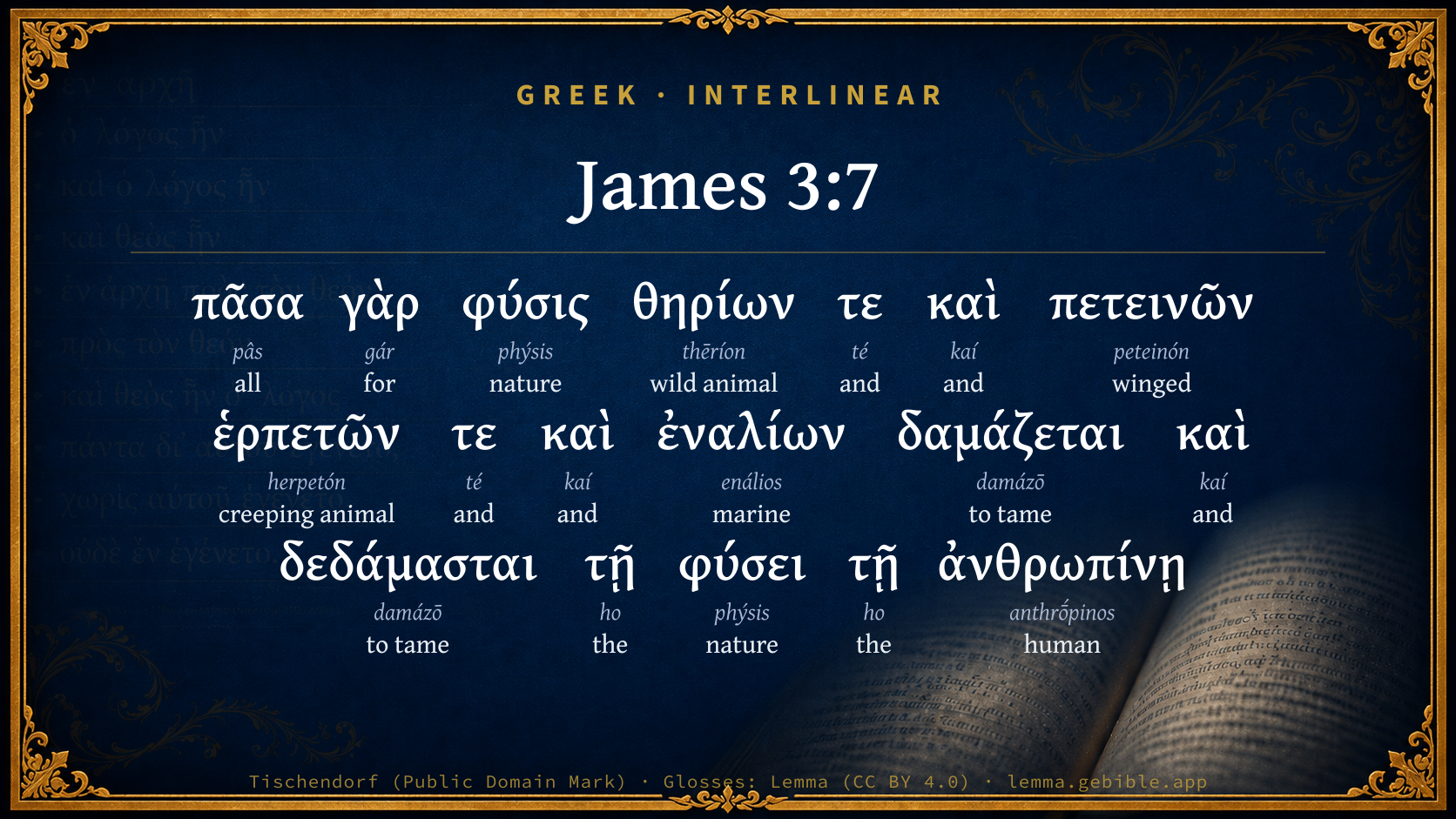
Greek (Tischendorf 8th ed.) James 3:7 appears in the Greek New Testament. The text above is from the Tischendorf 8th edition. Each word links to its Strong’s number and a concise gloss. Click any word for its full Thayer’s Greek Lexicon entry.
Download image
Cite this verse

James 3:7 (World English Bible). Public Domain. Lemma interlinear Bible study tool, https://lemma.gebible.app/v/james/3/7.

Show BibTeX & RIS
BibTeX
RIS
English Translation
For every kind of animal, bird, creeping thing, and thing in the sea, is tamed, and has been tamed by mankind.
World English Bible · Public Domain
Highlights
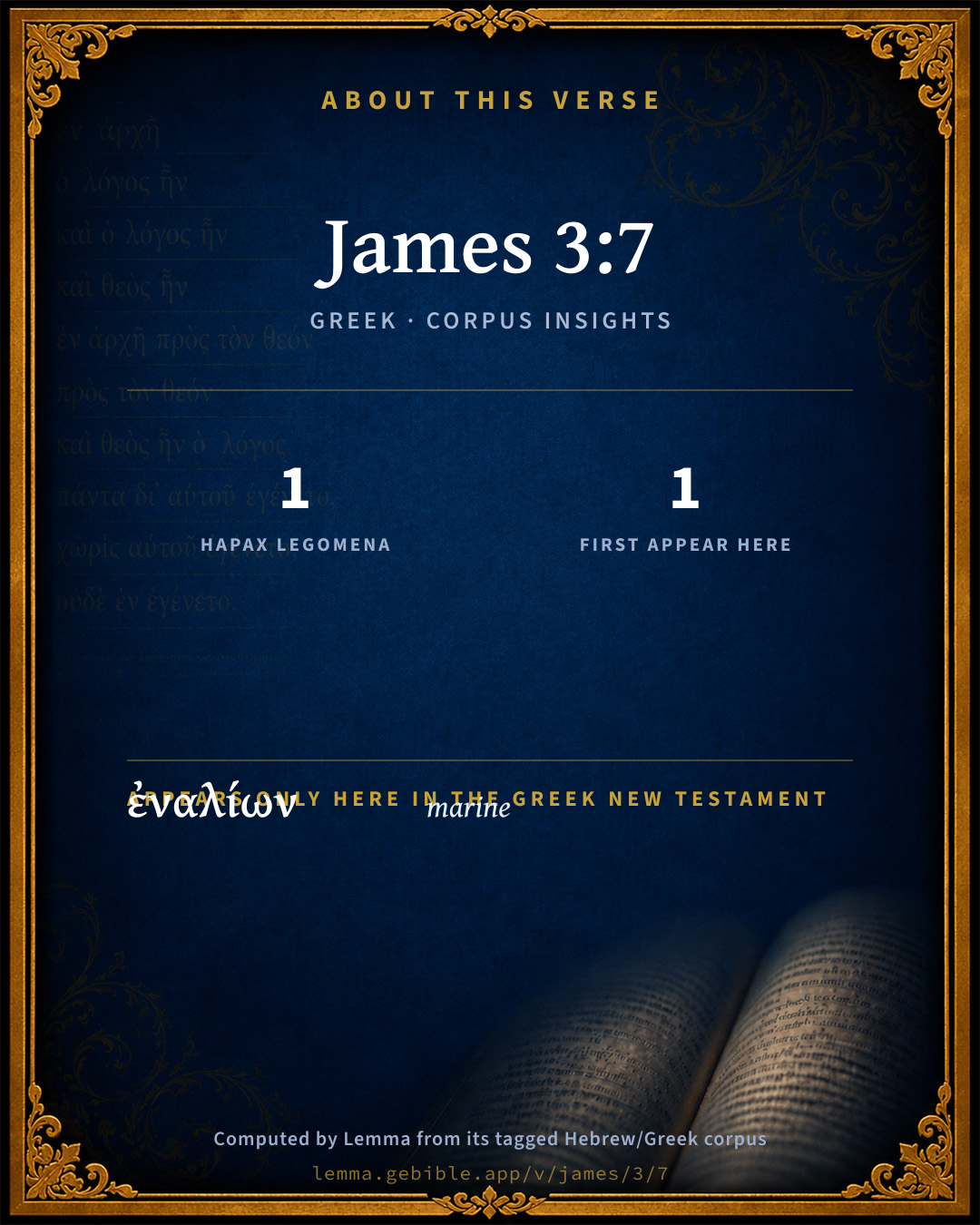
  • 1 hapax legomenon — only here in the Greek New Testament
  • 1 first appearance in the Greek New Testament
Full analysis ↓
Download a study sheet

One document with this verse’s original text, its word-by-word gloss line, the meaning frame, cross-references with their text, attributed commentary, and full source and license credits — printable, and it pastes into notes with its structure intact.

This verse Autodidact and up

Study sheet (.html) Plain text (.txt)

A passage Seminary Student

Up to 50 verses in one chapter. A passage sheet keeps up to 6 commentary sources and 12 cross-references per verse, in the order this page ranks them, and says so on the sheet whenever that leaves anything out. Ask for a single verse and you get the Autodidact verse sheet above.

Everything on this page stays free to read, with no account — the sheet is a download of what is already on screen, not access to it.

Want to remove ads? Support Godless Engineer
Compare translations 3

The same verse in 3 English versions, stacked beneath the original-language interlinear above. Click any original word for its lexicon entry.

Each is an independent rendering of the whole verse — the interlinear is not word-aligned to these translations.

Highlighted words mark where these versions differ — a whole-verse word diff, not a word-by-word alignment.

  • World English Bible Public Domain
    For every kind of animal, bird, creeping thing, and thing in the sea, is tamed, and has been tamed by mankind.
  • King James Version Public Domain
    For every kind of beasts, and of birds, and of serpents, and of things in the sea, is tamed, and hath been tamed of mankind:
  • unfoldingWord Literal Text CC BY-SA 4.0
    For every kind, both of beasts and birds, both of reptiles and marine animals, is being tamed and has been tamed by the human kind.

unfoldingWord Literal Text — © unfoldingWord, licensed CC BY-SA 4.0. Word-aligned USFM3 via Door43 (git.door43.org/unfoldingWord/en_ult).

Versions to compare (up to 4)

3 of 4 selected

Show all 19 translations

Every available English version of this verse, each an independent rendering of the whole verse.

  • World English Bible Public Domain
    For every kind of animal, bird, creeping thing, and thing in the sea, is tamed, and has been tamed by mankind.
  • Berean Standard Bible Public Domain
    All kinds of animals, birds, reptiles, and creatures of the sea are being tamed and have been tamed by man,
  • Majority Standard Bible Public Domain
    All kinds of animals, birds, reptiles, and creatures of the sea are being tamed and have been tamed by man,
  • King James Version Public Domain
    For every kind of beasts, and of birds, and of serpents, and of things in the sea, is tamed, and hath been tamed of mankind:
  • American Standard Version (1901) Public Domain
    For every kind of beasts and birds, of creeping things and things in the sea, is tamed, and hath been tamed by mankind.
  • Revised Version (1885) Public Domain
    For every kind of beasts and birds, of creeping things and things in the sea, is tamed, and hath been tamed by mankind:
  • Geneva Bible (1599) Public Domain
    For the whole nature of beasts, and of birds, and of creeping things, and things of the sea is tamed, and hath bene tamed of the nature of man.
  • Douay-Rheims (1899) Public Domain
    For every nature of beasts, and of birds, and of serpents, and of the rest, is tamed, and hath been tamed, by the nature of man:
  • Young's Literal Translation Public Domain
    For every nature, both of beasts and of fowls, both of creeping things and things of the sea, is subdued, and hath been subdued, by the human nature,
  • Literal Standard Version CC BY-SA 4.0
    For every nature, both of beasts and of birds, both of creeping things and things of the sea, is subdued, and has been subdued, by the human nature,
  • Unlocked Literal Bible CC BY-SA 4.0
    For every kind of wild animal, bird, reptile, and sea creature is being tamed and has been tamed by mankind.
  • unfoldingWord Literal Text CC BY-SA 4.0
    For every kind, both of beasts and birds, both of reptiles and marine animals, is being tamed and has been tamed by the human kind.
  • Darby Bible Public Domain
    For every species both of beasts and of birds, both of creeping things and of sea animals, is tamed and has been tamed by the human species;
  • World Messianic Bible Public Domain
    For every kind of animal, bird, creeping thing, and sea creature is tamed, and has been tamed by mankind;
  • Webster's Bible Public Domain
    For every kind of beasts, and of birds, and of serpents, and of animals in the sea, is tamed, and hath been tamed by mankind:
  • Free Bible Version CC BY-SA 4.0
    People have tamed all kinds of animals, birds, reptiles, and sea creatures,
  • Bible in Basic English Public Domain
    For every sort of beast and bird and every living thing on earth and in the sea has been controlled by man and is under his authority;
  • Text-Critical English NT CC BY 4.0
    Every species of beast, bird, reptile, and sea creature can be tamed and has been tamed by man,
  • Tyndale New Testament (1534) Public Domain
    All the natures of beastes and of byrdes and of serpentes and thinges of ye see are meked and tamed of the nature of man.

Literal Standard Version (2020), Covenant Press — licensed CC BY-SA 4.0. Text via the HelloAO Bible API (eBible.org). Unlocked Literal Bible (unfoldingWord) — licensed CC BY-SA 4.0. Text via the HelloAO Bible API (eBible.org). unfoldingWord Literal Text — © unfoldingWord, licensed CC BY-SA 4.0. Word-aligned USFM3 via Door43 (git.door43.org/unfoldingWord/en_ult). Free Bible Version, Dr. Jonathan Gallagher — licensed CC BY-SA 4.0. Text via the HelloAO Bible API (eBible.org).

Word by word

More ways to search: Search by grammar → Find every occurrence → Compare this word →

Practice this passage: Drill this verse → Learn its vocabulary →

ἐναλίων
enálios
G1724
“marine”
Adjective, Genitive, Plural, Neuter
Part of Speech
Adjective
Case
Genitive
Number
Plural
Gender
Neuter
Full Thayer's Definition

Origin: from G1722 and G251

TDNT: None

1. that which is in the sea, marine
  1. πᾶσα pâs G3956 “all” Adjective, Nominative, Singular, Feminine
  2. γὰρ gár G1063 “for” Conjunction
  3. φύσις phýsis G5449 “nature” Noun, Nominative, Singular, Feminine
  4. θηρίων thēríon G2342 “wild animal” Noun, Genitive, Plural, Neuter
  5. τε té G5037 “and” Particle
  6. καὶ kaí G2532 “and” Conjunction
  7. πετεινῶν peteinón G4071 “winged” Noun, Genitive, Plural, Neuter
  8. ἑρπετῶν herpetón G2062 “creeping animal” Noun, Genitive, Plural, Neuter
  9. τε té G5037 “and” Particle
  10. καὶ kaí G2532 “and” Conjunction
  11. δαμάζεται damázō G1150 “to tame” Verb, Present, Passive, Indicative, 3rd person, Singular
  12. καὶ kaí G2532 “and” Conjunction
  13. δεδάμασται damázō G1150 “to tame” Verb, Perfect, Passive, Indicative, 3rd person, Singular
  14. τῇ ho G3588 “the” Article, Dative, Singular, Feminine
  15. φύσει phýsis G5449 “nature” Noun, Dative, Singular, Feminine
  16. τῇ ho G3588 “the” Article, Dative, Singular, Feminine
  17. ἀνθρωπίνῃ anthrṓpinos G442 “human” Adjective, Dative, Singular, Feminine

About this verse

These counts appear in no published source. They are computed here, from the morphology-tagged text and Lemma’s own curated glosses. What Lemma adds →

18
words
12
distinct lemmas
General Epistles
section

Notable vocabulary

1 hapax legomenon — a word that appears only here in the entire Greek New Testament:

  • ἐναλίων marine G1724

First appearance in Scripture

This word makes its first canonical appearance in the Greek New Testament here:

  • ἐναλίων marine G1724

Shared distinctive vocabulary

ἑρπετῶν creeping animal G2062 occurs in 4 verses of the Greek New Testament. Also found in:
Repetition

Words recur within this verse:

  • φύσις nature G5449 ×2
  • δαμάζεται to tame G1150 ×2
  • καὶ and G2532 ×3
  • τε and G5037 ×2
  • τῇ the G3588 ×2

Commentary

Notes on James 3:7 from classic Christian and Jewish commentators (each source and its license shown beneath its notes). The classic Christian expositions comment on the surrounding passage and are grouped to its opening verse, so a note may address several verses; the Jewish commentaries on the Tanakh (Rashi and others) are per-verse, so they appear only where the commentator wrote on this verse.

Lemma curates 59 commentaries, every one of them public domain or Creative Commons licensed, each selected and text-cleaned for this edition rather than reprinted as found. About our sources →

The Biblical Illustrator

Joseph S. Exell

Jam_3:7-8

The tongue can no man tame

The taming of the tongue

The intense practicalness of James as a religious teacher leads him directly to this topic of the taming of the tongue.

Here he sees, what every man to whom behaviour is a chief concern must see, one of the pivotal points of character. The religion that does not rule the speech is a failure and a fraud. The tongue, in the figure of James, is a wild beast that needs taming--fierce, reasonless, uncontrollable. A good part of the evils of life arise from its depredations.

1. First, of course, is the lying tongue. Of all the evils of speech falsehood is central and seminal.

2. Next to the lying tongue we must put the reviling tongue.

3. After the reviling tongue the foul tongue must be reckoned--the tongue that is the channel through which the impurities of a bad heart discharge themselves; the tongue that deals in indecent speech.

4. Next we think of the passionate tongue; the tongue that hastens to give voice to the anger and the hate that arise within. Anger, the Latin poet said, is a brief insanity; and when it begins to rage within the breast it needs to be chained and kept under till its paroxysm is past. But the mischievous tongue sometimes sets it loose and becomes its servitor--to hurl missiles of hot and stinging words right and left, doing damage that it is hard to repair.

5. The sarcastic tongue is another kind that needs taming. Sarcasm has its uses, no doubt; in our warfare with incorrigible evil-doers we must sometimes resort to it; but in the common intercourse of life it is scarcely more legitimate than the cudgel or the rapier. The arrows of sarcasm are barbed with contempt; that is what makes them rankle so; and contempt is a feeling that a good man cannot afford to indulge.

6. The scolding tongue is another kind that calls for a curb. Reproofs must be spoken, but sometimes there are too many of them, and their tone is too impatient, or too harsh, or too loud. Reproof must sometimes be severe, but it may be severe without being petulant.

7. The flattering tongue is a tongue that needs the bit. Honest and hearty praise is not to be avoided; we do not have half enough of it. Many are toiling on, heartsick and hopeless, to whom such a word of recognition would be as cold water to a thirsty soul. But this is not flattery. Flattery is either false praise, or praise addressed, not to the quality of our actions so much as to our excellences of person or that which is external to us. To praise your childs looks, and so stimulate his vanity, that is flattery, a most nauseous exhibition of it; and the tongue that indulges in it ought to be bridled. But the worst kind of flattery is that which seeks to please, and so to entice, by artful and insincere praises. This is a species of lying, of course; but it is a species so mean and dangerous that it needs to be singled out and denounced.

8. The chattering tongue is another kind that needs restraint and discipline. A few people are too taciturn; a great many are too talkative. Such endless prattle is an encroachment on other peoples rights. How much time is consumed in attending to words that are utterly destitute of thought, that convey no ideas and impart no benefits! How many things we might have done that were worth doing, how many things we might have thought of that were worth thinking of, while we were listening! But what is worse, it is debilitating to the one who indulges in it. He talks so much that he has no time to think. Set a watch, C God, prayed the psalmist, before my mouth; keep the door of my lips. The trouble with some of these constant talkers-seems to be that there is no door to their lips, nothing but a doorway.

9. The last kind of tongue I shall mention that needs taming is the slanderous tongue. To speak evil of their neighbours is to some men and women a positive luxury. You would use harsh words about a man who got his living by retailing scandal, orally, for five cents a customer; what have you to say about the man who spices his newspaper with such items to make it sell? But the tongue can no man tame. So much the more need, then, that a power stronger than mans should be invoked to subdue its unruliness and mitigate its fierceness. Such a Divine power the fables of all the peoples have celebrated; the power that tames the wildest beasts, and makes the tiger as gentle and docile as a lamb. The mythic song of Amphion is but a prelude of the triumph of the Prince of Peace, under whose blessed reign all savage and noxious creatures shall learn obedience and service. He at whose word the demoniac ceased his ravings, and the savage seas hushed their tumult--He who has the power and the purpose to subdue all things unto Himself--can cause the lying tongue to speak verities, and the reviling tongue to praise and bless, and the passionate tongue to be silent when the anger rises, and the foul tongue to utter purity, and the sarcastic tongue to temper its severities, and the scolding tongue to learn gentleness, and the flattering tongue to speak with sincerity, and the chattering tongue to be more discreet, and the talebearing tongue to be still. (W. Gladden, D. D.)

Taming the tongue

1. The tractableness of the beasts to man, and the disobedience of man to Isa_1:3). Fallen man may go to school to the beasts to learn mildness and obedience; and yet God hath more power to subdue, and we have more reason to obey,

2. The greatness of mans folly and impotency in governing his own soul. Though he tameth other things, he doth not tame himself.

3. The deepness of mans misery. Our own art and skill is able to tame the fiercest beasts, and make them serviceable; beasts as strong as lions and elephants; fishes that do, as it were, inhabit another world; birds as swift almost as a thought; serpents hurtful and noxious. But, alas! there is more rebellion in our affections; sin is stronger, all our art will not tame it.

4. Art and skill to subdue creatures is a relic and argument of our old superiority. The heathens discerned we had once a dominion, and the Scriptures plainly assert it (Gen_1:26). (T. Manton.)

The taming of the tongue

Here is a single proposition, guarded with a double reason. The proposition is, No man can tame the tongue. The reasons--

1. It is unruly.

2. Full of deadly poison. As the proposition is backed with two reasons, so each reason hath a terrible second. The evil hath for its second unruliness; the poisonfulness being deadly.

It is evil, yea, unruly evil; it is poison, yea, deadly poison.

1. In the proposition we will observe--

(1) The nature of the thing to be tamed.

(2) The difficulty of accomplishing it.

2. The insubjectable subject is the tongue, which is--

(1) A member; and--

(2) An excellent, necessary, little, singular member.

1. It is a member. He that made all made the tongue; he that craves all must have the tongue. It is an instrument; let it give music to Him that made it. All creatures in their kind bless God (Psa_148:1-14). They that want tongues, as the heavens, sun, stars, meteors, orbs, elements, praise Him with such obedient testimonies as their insensible natures can afford. They that have tongues, though they want reason, praise Him with those natural organs. Man, then, that hath a tongue, and a reason to guide it, and more, a religion to direct his reason, should much more bless Him. Not that praise can add to Gods glory, nor blasphemies detract from it. As the sun is neither bettered by birds singing, nor battered by dogs barking. Yet we that cannot make His name greater can make it seem greater; and though we cannot enlarge His glory, we may enlarge the manifestation of His glory. This both in words praising and in works practising. They that before little regarded Him may thus be brought to esteem Him greatly; giving Him the honour due to His name, and glorifying Him, after our example. This is the tongues office. Every member, without arrogating any merit, or boasting the beholdenness of the rest unto it, is to do that duty which is assigned to it. The tongue is mans clapper, and is given him that he may sound out the praise of his Maker. Infinite causes draw deservingly from mans lips a devout acknowledgment of Gods praise.

2. It is a member you hear; we must take it with all its properties; excellent, necessary, little, singular.

(1) Excellent. First, for the majesty of it. It carries an imperious speech, wherein it hath the pre-eminence of all mortal creatures. Secondly, for the pleasantness of the tongue, No instruments are so ravishing, or prevail over mans heart with so powerful complacency, as the tongue and voice of man. If the tongue be so excellent, how, then, doth this text censure it for being so evil? I take the philosophers old and trite answer, Than a good tongue, there is nothing better; than an evil, nothing worse. It hath no mean; it is either exceedingly good or excessively evil. If it be good, it is a walking garden, that scatters in every place a sweet flower, an herb of grace to the hearers. If it be evil, it is a wild bedlam, full of madding mischiefs. So the tongue is every mans best or worst movable. A good tongue is a special dish for Gods public service. The best part of a man, and most worthy the honour of sacrifice. This only when it is well seasoned. Seasoned, I say, with salt, as the apostle admenisheth; not with Col_4:6). But an evil tongue is meat for the devil, according to the Italian proverb: The devil makes his Christmas pie of lewd tongues.

(2) It is necessary; so necessary that without a tongue I could not declare the necessity of it. It converseth with man, conveying to others by this organ that experimental knowledge which must else live and die in himself. It imparts secrets, communicates joys, which would be less happy suppressed than they are expressed. Lastly, it speaks our devotions to heaven, and hath the honour to confer with God. It is that instrument which the Holy Ghost useth in us to cry, Abba, Father. It is our spokesman; and he that can hear the heart without a tongue, regardeth the devotions of the heart better, when they are sent up by a diligent messenger, a faithful tongue.

(3) It is little. As man is a little world in the great, so is his tongue a great world in the little. It is a little member, saith the apostle (verse 5), yet it is a world; yea, a world of iniquity (verse 6). It is little in quantity, but great in iniquity. What it hath lost in the thickness it hath gotten in the quickness; and the defect of magnitude is recompensed in the agility. If it be a talking tongue it is a world of prating. If it be a wrangling tongue it is a world of babbling. If it be a learned tongue it is, as Erasmus said of Bishop Tonstal, a world of learning. If it be a petulant tongue it is a world of wantonness. If it be a poisonous tongue, saith our apostle, it defileth the whole body (verse 6). It is little. So little that it will scarce give a kite her breakfast, yet it can discourse of the sun and stars, of orbs and elements, of angels and devils, of nature and arts, and hath no straighter limits than the whole world to walk through. It is a little member, yet boasteth great things (verse 5). Though it be little, yet if good, it is of great use. A little bit guideth a great horse to the riders pleasure. A little helm ruleth a great vessel, though the winds blow and the floods oppose, yet the helm steers the ship. Though little, yet if evil, it is of great mischief. A little sickness distempereth the whole body. A little fire setteth a whole city on combustion. Behold how great a matter a little fire kindleth (verse 5). It is little in substance, yet great to provoke passion, to produce action. It either prevails to good, or perverts to evil; purifieth or putrefieth the whole carcase, the whole conscience. It betrayeth the heart when the heart would betray God; and the Lord lets it double treason on itself when it prevaricates with Him. It is a little leak that drowneth a ship, a little breach that loseth an army, a little spring that pours forth an ocean. Little; yet the lion is more troubled with the little wasp than with the great elephant. Many have dealt better with the greater members of the body than with this little one.

(4) It is a singular member. God hath given man two ears; one to hear instructions of human knowledge, the other to hearken to His Divine precepts; the former to conserve his body, the latter to save his soul. Two eyes, that with the one he might see to his own way, with the other pity and commiserate his distressed brethren. Two hands, that with the one he might work for his own living, with the other give and relieve his brothers wants. Two feet, one to walk on common days to his ordinary labour Psa_104:23); the other, on sacred days to visit and frequent the temple and the congregation of saints. But among all, He hath given him but one tongue, which may instruct him to hear twice so much as he speaks; to work and walk twice so much as he speaks (Psa_139:14). Stay and wonder at the wonderful wisdom of God! First, to create so little a piece of flesh, and to put such vigour into it; to give it neither bones nor nerves, yet to make it stronger than arms and legs, and those most able and serviceable parts of the body. Secondly, because it is so forcible, therefore hath the most wise God ordained that it shall be but little, that it shall be but one. That so the parvity and singularity may abate the vigour of it. Thirdly, because it is so unruly, the Lord hath hedged it in, as a man will not trust a wild horse in an open pasture, but prison him in a close pound. A double fence hath the Creator given to confine it, the lips and the teeth; that through these mounds it might not break. And hence a threefold instruction for the use of the tongue is insinuated to us. First, let us not dare to pull up Gods mounds; nor, like wild beasts, break through the circular limits wherein He hath cooped us. Weigh thy words in a balance, and make a door and bar for thy mouth. Let this be the possession thou so hedgest in, and thy precious gold thou so bindest up. Beware thou slide not by it, lest thou fall before him that lieth in wait. Commit not burglary by breaking the doors and pulling down the bars of thy mouth. Much more, when the Lord hath hung a lock on it, do not pick it with a false key. Rather pray with David (Psa_51:15). It is absurd in building to make the porch bigger than the house; it is as monstrous in nature when a mans words are too many, too mighty. Let thy words be few, true, weighty, that thou mayest not speak much, not falsely, not vainly. Remember the bounds, and keep the non ultra. Secondly, since God hath made the tongue one, have not thou a tongue and a tongue. It is made simple; let it; not be double. Thirdly, this convinceth them of preposterous folly, that put all their malice into their tongue, as the serpent all her poison in her tail; and as it were by a chemical power, attract all vigour thither, to the weakening and enervation of the other parts.

3. We see the nature of the thing to be tamed, the tongue; let us consider the difficulty of this enterprise. No man can do it. Which we shall best find if we compare it--

(1) With other members of the body.

(2) With other creatures of the world.

1. With other members of the body, which are various in their faculties and offices; none of them idle.

(1) The eye sees far, and beholdeth the creatures in the heavens--sun, and stars; on the earth--birds, beasts, plants, and minerals; in the sea--fishes and serpents. That it is an unruly member, let our grandmother speak, whose roving eye lost us all. Yet this eye, as unruly as it is, hath been tamed. Did not Job make a covenant with his eyes, that he would not look upon a maid (Job_31:1)? The eye hath been tamed, but the tongue can no man tame; it is an unruly evil.

(2) The ear yet hears more than ever the eye saw; and by reason of its patulous admission, derives that to the understanding whereof the sight never had a glance. It can listen to the whisperings of a Doeg, to the susurrations of a devil, to the noise of a Siren, to the voice of a Delilah. The ear hath been tamed, but the tongue can no man tame, &c.

(3) The foot is an unhappy member, and carries a man to much wickedness. It is often swift to the shedding of blood; and runneth away from God, Jonahs pace. There is a foot of pride (Psa_36:11), a saucy foot, that dares presumptuously enter upon Gods freehold. There is a foot of rebellion, that with an apostate malice kicks at God. There is a dancing foot, that paceth the measures of circular wickedness. Yet, as unruly as this foot is, it hath been tamed. David got the victory over it Psa_119:59). But the tongue can no man tame, &c.

(4) The hand rageth and rangeth with violence, to take the bread it never sweat for, to enclose fields, to depopulate towns, to lay waste whole countries. Yet it hath been tamed; not by washing it in Pilates basin, but in Davids holy water--innocence. I will wash my hands in innocency, and then, O Lord, will I compass Thine altar.

2. With other creatures of the world, whether we find them in the earth, air, or water.

(1) On the earth there is the man-hating tiger, yet man hath subdued him; and (they write) a little boy hath led him in a string. There is the flock-devouring wolf, that stands at grinning defiance with the shepherd; mad to have his prey, or lose himself; yet he hath been tamed. The roaring lion, whose voice is a terror to man, by man hath been subdued. Yea, serpents that have to their strength two shrewd additions, subtlety and malice; that carry venom in their mouths, or a sting in their tails, or are all over poisonous; the very basilisk, that kills with his eyes (as they write) three furlongs off. Yea, all these savage, furious, malicious natures have been tamed.

(2) In the sea there be great wonders (Psa_107:23-24). Yet those natural wonders have been tamed by our artificial wonders--ships.

(3) In the air, the birds fly high above our reach, yet we have gins to fetch them down. Snares, lime-twigs, nets, tame them all; even the pelican in the desert, and the eagle amongst the cedars. Thus far, then, St. Jamess proposition passeth without opposition. The tongue can no man tame; the tongue is too wild for any mans taming. It would be foolish to infer that, though no man can tame the tongue, yet a woman may. Woman, for the most part, hath the glibbest tongue; and if ever this impossibility preclude men, it shall much more annihilate the power of the weaker sex Pro_7:11; Pro_9:13). The tongue can no man tame. Let us listen to some weightier exceptions. The prophets spake the oracles of life, and the apostles the words of salvation; and many mens speech ministers grace to the hearers. Yield it; yet this general rule will have no exceptions: no man can tame it; man hath no stern for this ship, no bridle for this colt. How then? God tamed it. God must lay a coal of His own altar upon our tongues, or they cannot be tamed. And when they are tamed, yet they often have an unruly trick. Abraham lies; Moses murmurs. Peter forswears his Master, his Saviour. If the tongues of the just have thus tripped, how should the profane go upright? The tongue can no man tame. The instruction hence ariseth in full strength; that God only can tame mans tongue. First, to open our lips when they should speak is the sole work of Psa_51:15). God must open with His golden key of grace, or else our tongues will arrogate a licentious passage. We had better hold our peace, and let our tongues lie still, than set them a-running till God bids them go. Secondly, to shut our lips when they should not speak, is only the Lords work also. It is Christ that casts out the talking devil; He shuts the wicket of our mouth against unsavoury speeches. Thus all is from God. Man is but a lock; Gods Spirit the key that openeth, and no man shutteth; that shutteth, and no man openeth (Rev_3:7). Away, then, with arrogation of works, if not of words. When a man hath a good thought it is gratia infusa, when a good work it is gratia diffusa. If, then, man cannot produce words to praise God, much less can he procure his works to please God. If he cannot tune his tongue, he can never turn his heart. Two useful benefits may be made hereof. First, it is taught us, whither we have recourse to tame our tongues. He that gave man a tongue can tame the tongue. Let us move our tongues to entreat help for our tongues; and, according to their office, let us set them on work to speak for themselves. Secondly, we must not be idle ourselves; the difficulty must spur us to more earnest contention. As thou wouldest keep thy house from thieves, thy garments from moths, thy gold from rust, so carefully preserve thy tongue from unruliness. Look how far the heart is good, so far the tongue. If the heart believe, the tongue will confess; if the heart be meek, the tongue will be gentle; if the heart be angry, the tongue will be bitter.

The tongue is but the hand without, to show how the clock goes within.

1. It is an unruly evil. The difficulty of taming the tongue, one would think, were sufficiently expressed in the evil of it; but the apostle seconds it with another obstacle, signifying the wild nature of it--unruly. It is not only an evil, but an unruly evil.

(1) To ourselves; it is so placed among the members that it defileth all (verse 6). A wild cannibal in a prison may only exercise his savage cruelty upon the stone walls or iron grates. But the tongue is so placed that, being evil and unruly, it hurts all the members.

(2) To our neighbours. Some iniquities are swords to the country, as oppression, rapine, circumvention; some incendiaries to the whole land, as evil and unruly tongues.

(3) To the whole world. If the vast ruins of ancient monuments, if the depopulation of countries, if the consuming fires of contention, if the land manured with blood, had a tongue to speak, they would all accuse the tongue for the original cause of their woe. Slaughter is a lamp, and blood the oil; and this is set on fire by the tongue. You see the latitude and extension of this unruly evil, more unruly than the hand. Slaughters, massacres, oppressions, are done by the hand; the tongue doth more. The hand spares to hurt the absent, the tongue hurts all. One may avoid the sword by running from it; not the tongue, though he run to the Indies. The hand reacheth but a small compass; the tongue goes through the world. If a man wore coat of armour, or mail of brass, yet the darts of the tongue will pierce it. It is evil, and doth much harm; it is unruly, and doth sudden harm. Saint James here calls it fire. Now you know fire is an ill master; but this is unruly fire. Nay, he calls it the fire of hell, blown with the bellows of malice, kindled with the breath of the devil. Nay, Stella hath a conceit, that it is worse than the fire of hell; for that torments only the wicked; this all, both good and bad. Swearers, railers, scolds, have hell-fire in their tongues.

2. Full of deadly poison. Poison is loathsomely contrary to mans nature; but there is a poison not mortal, the venom whereof may be expelled; that is deadly poison. Yet if there was but a little of this resident in the wicked tongue, the danger were less; nay, it is full of it, full of deadly poison. It is observable that which way soever a wicked man useth his tongue, he cannot use it well. He bites by detraction, licks by flattery: and either of these touches rankle; he doth no less hurt by licking than by biting. All the parts of his mouth are instruments of wickedness. Logicians, in the difference betwixt vocem and sonum, say that a voice is made by the tips, teeth, throat, tongue. The lips are the porter, and that is fraud; the porch, the teeth, and there is malice; the entertainer, the tongue, and there is lying; the receiver, the throat, and there is devouring. I cannot omit the moral of that old fable. Three children call one man father, who brought them up. Dying, he bequeaths all his estate only to one of them, as his true natural son; but which that one was left uncertain. Hereupon every one claims it. The wise magistrate, for speedy decision of so great an ambiguity, causeth the dead father to be set up as a mark, promising the challengers that which of them could shoot next his heart, should enjoy the patrimony. The elder shoots, so doth the second; both hit. But when it came to the youngers turn, he utterly refused to shoot; good nature would not let him wound that man dead, that bred and fed him living. Therefore the judge gave all to this son, reputing the former bastards. The scope of it is plain, but significant. God will never give them the legacy of glory, given by His Sons will to children, that like bastards shoot through, and wound His blessed name. Think of this, ye swearing and cursing tongues! To conclude, God shall punish such tongues in their own kind; they were full of poison, and the poison of another stench shall swell them. They have been inflamed, and shall be tormented with the fire of hell. Burning shall be added to burning, save that the first was active, this passive. But blessed is the sanctified tongue. God doth now choose it as an instrument of music to sing His praise; He doth water it with the saving dews of His mercy, and will at last advance it to glory. (T. Adams.)

The tongue hardly tamed

1. The tongue is hardly tamed and subdued to any right use. No human art and power can ever find a remedy and curb for it.

(1) Come before God humbly; bewail the depravation of your nature, manifested in this untamed member.

(2) Come earnestly.

2. There is an unbridled license and violence in the tongue (Job_32:19). When the mind is big with the conception, the tongue is earnest to utter it Psa_39:3). Meeken the heart into a sweet submission, lest discontent seek the vent of murmuring.

3. A wicked tongue is venomous and hurtful; us Bernard observeth, it killeth three at once--him that is slandered, his fame by ill report; him to whom it is told, his belief with a lie; and himself with the sin of detraction. Bless God when you escape those deadly bites, the fangs of detraction. (T. Manton.)

All kinds of creatures tamed by man

The assertion may seem at first somewhat hyperbolical, but the well-known cases of tame rats and tame wasps, the lion of Androcles, and the white fawn of Sertorius, furnish what may well be termed crucial instances in support of it. The story related by Cassian, that St. John in his old age kept a tame partridge, makes it probable that St. James may have seen, among his fellow-teachers, such an instance of the power of man to tame the varied forms of animal life around him. (Dean Plumptre.)

The tongue untamable

Men have gained the ascendancy over many evils which it has pleased God should be intermingled with the course of earthly things; they have been able to encounter and overcome them. Many poisons in minerals, plants, or animals, have been rendered harmless, or turned to beneficial purposes. But to tame the tongue, this most unruly of all evils, to neutralise this deadliest of poisons, to regulate this most refractory agent, has surpassed the power of mortals. The laws of nature have been partially ascertained, and are becoming every day more fully known to us, in proportion as the human mind succeeds in diving into the depths of nature, and investigating her counsels and mysteries. Hence there is a gradual development of intelligence and power, of patient and persevering investigation; hence each generation avails itself of the experience of the preceding; one nation extends the hand of brotherly union to another, and even inquiries apparently unsuccessful at the time, have in the end led to beneficial results. Oh, why has the result been so very different when attempts have been made to gain the supremacy over sin, and to bring under the law of the Spirit only a single member of our frame, that has been under the domination of sin! Oh, here are more profound depths, more hidden mysteries, than in all the nature of beasts, and of birds, and of serpents. Here are greater wonders than in all the wonders of the deep! This baffles the most acute understanding, the most powerful will, the most determined industry of man! (B. Jacobi.)

A not-under-control signal

When anything goes wrong with a ship at sea which prevents her from being moved or answering the helm, she is bound to put up a signal, so that other ships may keep at a safe distance. This, which is called the not-under-control signal, consists of three iron balls. It would be well if some of us could put up not-under-control signals at times when our tempers are not what they should be. Indeed, we know of one man who used to do this. He was an eccentric author, and when, owing to preoccupation of mind, or any ether circumstance, he was likely to be peevish and snappish to his family, he would stick on his forehead a red wafer. This was a danger signal, telling every one to keep out of his way. (Quiver.)

The malignant propensity of the tongue

It is an untamable, venomous beast. It combines the ferocity of the tiger and the mockery of the ape with the subtlety and venom of the serpent. (A. Plummer, D. D.)

Scandal a poison

Scandal, hydra-headed, poison-ranged, lives on the garbage of the world, and slays even after it is seemingly killed. There is a story of a cobra which got into a West Indian church during service. Some one saw it, went quietly out, procured a weapon, and coming back, cut off the snakes head. After the service the people went to look at the animal, and a native touched the dead head with his foot. He drew it back with a cry of pain, and in an hour he was dead. The poison-fangs had power to kill, though their owner was dead. (Christian Age.)

An unruly evil

In the Shepherd of Hermas (ii. 2), calumny is described as a restless demon. (Cambridge Bible for Schools.)

The Biblical Illustrator, edited by Joseph S. Exell (c. 1880s–1900s) — public domain. Text from a community e-Sword module.

Joseph Benson's Commentary

Jas 3:7-8. For every kind of beasts — Πασα φυσις θηριων, every nature of wild beasts. The phrase signifies the strength and fierceness of wild beasts, the swiftness of birds, the poison of serpents, the exceeding great force of sea-monsters; is tamed — Δαμαζεται, is subdued, or is capable of being subdued; by mankind — Τη φυσει τη ανθρωπινη, by the human nature; every sort of these has been overcome by the art and ingenuity of man; so that they have been made subservient to his use and pleasure. The apostle cannot mean that such creatures as sharks and whales have been tamed, according to the general import of that term, or made harmless and familiar with man, as some beasts, naturally savage, have been; but of which large fishes are in their nature incapable. But even they have been conquered, and brought entirely under the power of man, so that he could use them as he would. But the tongue can no man tame — Namely, the tongue of another; no, nor his own, without peculiar help from God. Macknight reads, The tongue of men no one can subdue; observing, that this transaction arises from the right construction of the original, and that it gives a more just sense than the common translation. Some read the clause interrogatively, thus, And can no man subdue the tongue? It is an unruly evil, full of deadly poison — Mischievous wickedness.

Joseph Benson's Commentary on the Old and New Testaments (1811–1818) — public domain. Text from a community e-Sword module.

Bengel's Gnomon

Johann Albrecht Bengel

Jas 3:7. Γαρ, for) Nothing is more violent than fire.—φύσις θηρίων, the nature of beasts) A Periphrasis, for θήρια, beasts.—δαμάζεται καὶ δεδάμασται, is tamed, in a passive sense; and has been tamed [has suffered itself to be tamed], in a middle sense.—τῇ φυσει [in obedience] to the nature of man) The dative case denotes the obedience of those things which are tamed.

Bengel's Gnomon of the New Testament — English translation (T&T Clark, Edinburgh, 1860) — public domain. Text from a community e-Sword module.

Meyer's Critical & Exegetical Commentary

Heinrich August Wilhelm Meyer

Jam_3:7-8. In these verses the untameable power of the tongue is adduced. The particle γάρ here indicates neither simply the transition (Pott), nor is it to be referred to μεγαλαυχεῖ (Wiesinger), separated from it by Jam_3:5-6, nor only to the last thought, φλογιζομένη κ.τ.λ. (Lange); but it is used as a logical particle, whilst the truth expressed in these verses substantiates the judgment contained in Jam_3:5-6. The relation of these two verses to each other is, that Jam_3:8 contains the principal thought, and Jam_3:7, on the other hand, a thought subordinate to it, which is only added in order to make that thought more emphatic. The meaning is: Whereas man tames all animals, yet he cannot tame the tongue. By φύσις is to be understood not the genus (Augusti, Gebser, Bretschneider, Schneckenburger), but the qualitas naturalis, and in such a manner that James has in view not the relation of the individual man to the individual beast, but the relation of human nature to animal nature in general, however this may differ in the different kinds of animals. The totality of beasts is expressed by four classes, which are arranged in pairs, namely, quadrupeds and birds, creeping beasts and fishes.

θηρία] are not beasts generally (Pott), nor specially wild beasts (Erasmus, Vatablus, Piscator, Baumgarten, Theile, Bouman).

τὰ ἑρπετά] are neither terrestrial animals generally (Pott, Hottinger), nor only serpents (Luther, Calvin, Grotius, and others), but it is used here in the same meaning as in Gen_1:24-25 (LXX. ἑρπετά, as the translation of רֶמֶשׂ); see Act_10:12; Rom_1:23.

ἐνάλια] (ἅπ. λεγ.) denotes either fish simply, or likewise all worms living in the water; Luther incorrectly translates it sea wonders, and Stier sea monsters. There is here the same classification as in Gen_9:2 in the LXX. (which may have been before the mind of James): τὰ θηρία τῆς γῆς, τὰ πετεινὰ τοῦ οὐρανοῦ, τὰ κινούμενα ἐπὶ τῆς γῆς, οἱ ἰχθύεις τῆς θαλάσσης. The dominion of human nature over the brute creation is expressed by the verb δαμάζειν (i.e. so to subdue, that what is subdued submits to the will of the subduer), because it supposes the subjection of something resisting (see Mar_5:4). That James only thought on wild animals does not follow from this. The perfect δεδάμασται is added to the present δαμάζεται in order to represent the present taming as that which had already taken place in the past. It is incorrect to resolve δαμάζεται into δαμάζεσθαι δύναται (Hottinger, Schneckenburger), for it treats not only of the possibility, but of the actuality.

τῇ φύσει τ. ἀνθρ.] is not the dat. commodi, but the dative used with the passive, instead of the construction with ὑπό. φύσις has the same meaning as before; accordingly not ingenii solertia (Hornejus, Hottinger, Schneckenburger).

Meyer — Critical and Exegetical Commentary on the New Testament — English translation by Peter Christie, edited by Frederick Crombie (T&T Clark, 1880) — public domain. Text from a community e-Sword module.

Expositor's Greek Testament

ed. W. Robertson Nicoll

Jas 3:7-8 . These verses, are, of course, not to be taken literally; their exaggerative character rather reminds one of the orator carried away by his subject. But it must be remembered that to the Oriental the language of exaggeration is quite normal. Moreover, this enumeration of various classes of animals was familiar from the O.T., and would be uttered as stereotyped phrases often are, it being well understood that the words are not to be taken au pied de la lettre; e.g. , a very familiar passage from the Torah runs: καὶ ὁ τρόμος ὑμῶν καὶ ὁ φόβος ἔσται ἐπὶ πᾶσιν τοῖς θηρίοις τῆς γῆς καὶ ἐπὶ πάντα τὰ ὄρνεα τοῦ οὐρανοῦ καὶ ἐπὶ πάντα τὰ κινούμενα ἐπὶ τῆς γῆς καὶ πάντας τοὺς ἰχθύας τῆς θαλάσσης (Gen 9:2 ); and one who shows so much familiarity with the Wisdom literature would be well acquainted with what tradition had imputed to Solomon; ἐλάλησε περὶ τῶν κτηνῶν καὶ περὶ τῶν πετεινῶν καὶ περὶ τῶν ἑρπετῶν καὶ περὶ τῶν ἰχθύων (1Ki 4:33 ), cf. Gen 1:26 (Jas 1:27 is quoted in the next verse); Deu 4:17-18 ; Act 10:12 .

The Expositor's Greek Testament, edited by W. Robertson Nicoll (1897–1910) — public domain. Text from a community e-Sword module.

Cambridge Greek Testament for Schools and Colleges

7. γάρ introduces a further fact in illustration of the preceding thought—the indomitable character of the tongue. Jas 3:7 is subordinate to Jas 3:8, and might have been expressed by a concessive clause, ‘for though all creatures are subject to man, yet cannot he tame the tongue.’

ἑρπετῶν. Heb. רֶמֶשׂ Gen 1:24-25; Act 10:12; Rom 1:23.

δαμάζεται καὶ δεδάμασται. The act is characterised as not only present, but as past with abiding result.

τῇ φύσει τῇ ἀνθρωπίνῃ. The dative is here instrumental. Note how St James exalts the dignity of man’s nature. He recognises an original and inherent superiority in that nature over the lower animals.

Comp. Soph. Antig. 332 ff. πολλὰ τὰ δεινὰ κοὐδὲν ἀνθρώπου δεινότερον πέλει | … κουφονόων τε φῦλον ὀρνίθων ἀμφιβαλὼν ἄγει | καὶ θηρῶν ἀγρίων ἔθνη, πόντου τʼ εἰνλίαν φύσιν | σπείραισι δικτυοκλώστοις | περιφραδὴς ἀνήρ.

Cambridge Greek Testament for Schools and Colleges (Cambridge University Press, 1896; 21 vols, various authors incl. Carr, Maclear, Plummer, Farrar, Lumby, Moule, M. R. James, Simcox) — public domain. Text from a community e-Sword module.

Jamieson, Fausset & Brown

Robert Jamieson, A. R. Fausset & David Brown

every kind--rather, "every nature" (that is, natural disposition and characteristic power).

of beasts--that is, quadrupeds of every disposition; as distinguished from the three other classes of creation, "birds, creeping things (the Greek includes not merely 'serpents,' as English Version), and things in the sea."

is tamed, and hath been--is continually being tamed, and hath been so long ago.

of mankind--rather, "by the nature of man": man's characteristic power taming that of the inferior animals. The dative in the Greek may imply, "Hath suffered itself to be brought into tame subjection TO the nature of men." So it shall be in the millennial world; even now man, by gentle firmness, may tame the inferior animal, and even elevate its nature.

Jamieson, Fausset & Brown — Commentary Critical and Explanatory on the Whole Bible (1871) — public domain (CC PDM 1.0). Text via the HelloAO Bible API.

Adam Clarke's Commentary

Verse 7. Every kind of beasts] That is, every species of wild beasts, πασα φυσις θηριων, is tamed, i.e. brought under man's power and dominion. Beasts, birds, serpents, and some kinds of fishes have been tamed so as to be domesticated; but every kind, particularly των εναλιων, of sea monsters, has not been thus tamed; but all have been subjected to the power of man; both the shark and whale become an easy prey to the skill and influence of the human being. I have had the most credible information, when in the Zetland Isles, of the seals being domesticated, and of one that would pass part of his time on shore, receive his allowance of milk, &c., from the servants, go again to sea, and return, and so on.

Adam Clarke's Commentary on the Bible (1810–1826) — public domain. Text from a community e-Sword/MySword module.

John Calvin's Commentaries

7 For every kind of beasts. This is a confirmation of the last clause; for that Satan by the tongue rules most effectively he proves by this — that it can by no means be brought to due order; and he amplifies this by comparisons. For he says that there is no animal so savage or fierce, which is not tamed by the skill of man, — that fishes, which in a manner inhabit another world, — that birds, which are so quick and roving — and that serpents, which are so inimical to mankind, are sometimes tamed. Since then the tongue cannot be restrained, there must be some secret fire of hell hidden in it.

What he says of wild beasts, of serpents, and of other animals, is not to be understood of them all; it is enough that the skill of man should subdue and tame some of the most ferocious of them, and also that serpents are sometimes tamed. He refers to present and to past time: the present regards power and capacity, and the past, usage or experience. He hence justly concludes that the tongue is full of deadly poison.

Though all these things most suitably refer in the first place to the subject of this passage — that they claim an unreasonable command over others, who labor under a worse vice; yet a universal doctrine may be understood as taught here, — that if we desire to form our life aright, we must especially strive to restrain the tongue, for no part of man does more harm.

John Calvin's Commentaries (1540-1563) — public domain. Text from the Calvin Translation Society English edition (1840s-50s) via the Christian Classics Ethereal Library (ccel.org). Calvin's coverage is partial (roughly two-thirds of the Bible); uncommented books and verses are honest gaps, never fabricated. The 19th-century editor's footnotes and remarks are omitted so the notes are faithfully Calvin's own voice.

Ellicott's Commentary for English Readers

(7) For every kind of beasts . . .—Compare the margin, and read more exactly, thus: Every nature of beasts and birds, and creeping things, and things of the sea, is tamed, and hath been tamed, by the nature of man. All kinds have been mastered by mankind, as promised at creation (Gen_1:26-28). There lives no creature which may not be won by kindness and gratitude; and—

“He prayeth best who loveth best

All things both great and small;

For the dear God Who loveth us,

He made and loveth all.”

The four-fold division of animal life above is curiously like and unlike that in Act_10:17, where we read of “four-footed beasts of the earth, wild beasts, creeping things, and fowls of the air.”

A Bible Commentary for English Readers, edited by Charles John Ellicott (1878–1897) — public domain. Text from a community e-Sword module.

The Cambridge Bible for Schools and Colleges

gen. ed. J. J. S. Perowne

7. every kind of beasts] Better, Every nature. This was, probably, intended by the translators, as being the old meaning of the word “kind,” as in the “kindly fruits” (= “natural products”) of the Litany. So Chaucer, “A beautie that cometh not of kinde,” Rom. of Rose, 2288, i. e. that is not natural. It may be noted that the Authorised Version in this instance returns to Wycliffe, who used the word in its old sense, and that all the intermediate versions give “nature.” The fourfold classification is obviously intended to be exhaustive—and “beasts” must therefore be taken in its common familiar meaning of “quadruped.”

serpents] is too specific for the third word, and it would be better to give the rendering which it commonly has elsewhere, of “creeping things.”

is tamed, and hath been tamed of mankind] Better, the word being the same as in the first clause, “by the nature of man.” The tense of the first verb implies “is continually being tamed.” The assertion may seem at first somewhat hyperbolical, but the well-known cases of tame rats and tame wasps, the lion of Androcles and the white fawn of Sertorius, furnish what may well be termed “crucial instances” in support of it. The story related by Cassian (Coll. xxiv. 2), that St John in his old age kept a tame partridge, makes it probable that St James may have seen, among his fellow-teachers, such an instance of the power of man to tame the varied forms of animal life around him.

The Cambridge Bible for Schools and Colleges (gen. ed. J. J. S. Perowne; Cambridge University Press, 1878–1918) — public domain. Text from a community e-Sword module.

John Gill's Exposition

For every kind of beasts, and of birds,.... Or the "nature" of them, as it is in the Greek text; however fierce, as beasts of prey are, or shy, as the fowls of the air be:

and of serpents and things in the sea; the fishes there:

is tamed, and hath been tamed of mankind, or "by human nature": by the wit and industry of man; by the various ways, means, and methods devised by man. So Pliny (l) relates, that elephants lions and tigers among beasts, and the eagle among birds, and crocodiles, asps, and other serpents, and fishes of the sea, have been tamed: though some think this is only to be understood of their being mastered and subdued, by one means or another; or of their being despoiled of their power, or of their poison: and the Syriac and Ethiopic versions render it, "subjected to human nature".

(l) Nat. Hist. l. 8. c. 9. 16, 17. & 10. 5, 44.

John Gill's Exposition of the Whole Bible (1746–1763) — public domain (CC PDM 1.0). Text via the HelloAO Bible API.

Trapp's Complete Commentary

John Trapp

7 For every kind of beasts, and of birds, and of serpents, and of things in the sea, is tamed, and hath been tamed of mankind:

Ver. 7. For every kind of beasts, &c.] {See Trapp on "Heb 2:7"} Some creatures indeed may be taken, but not tamed, as the tiger, panther, monoceros, of which last it is testified, quod interimi potest, capi non potest; slain he may be, but not taken. Such unruly talkers and deceivers the Church is pestered with, Tit 1:10; 1Th 5:14; sons of Belial, untamable, untractable, untouchable, unteachable, 2Sa 23:6-7 1Sa 25:17.

John Trapp, A Commentary or Exposition upon All the Books of the Old and New Testament (1647–1656) — public domain. Text from a community e-Sword module.

Albert Barnes' Notes on the Bible

For every kind of beasts - The apostle proceeds to state another thing showing the power of the tongue, the fact that it is ungovernable, and that there is no power of man to keep it under control. Everything else but this has been tamed. It is unnecessary to refine on the expressions used here, by attempting to prove that it is literally true that every species of beasts, and birds, and fishes has been tamed. The apostle is to be understood as speaking in a general and popular sense, showing the remarkable power of man over those things which are by nature savage and wild. The power of man in taming wild beasts is wonderful. Indeed, it is to be remembered that nearly all those beasts which we now speak of as “domestic” animals, and which we are accustomed to see only when they are tame, were once fierce and savage races. This is the case with the horse, the ox, the ass, (see the notes at Job 11:12; Job 39:5), the swine, the dog, the cat, etc. The editor of the Pictorial Bible well remarks, “There is perhaps no kind of creature, to which man has access, which might not be tamed by him with proper perseverance. The ancients seem to have made more exertions to this end, and with much better success, than ourselves. The examples given by Pliny, of creatures tamed by men, relate to elephants, lions, and tigers, among beasts; to the eagle, among birds; to asps, and other serpents; and to crocodiles, and various fishes, among the inhabitants of the water. Natural History viii. 9, 16, 17; x. 5, 44. The lion was very commonly tamed by the ancient Egyptians, and trained to assist both in hunting and in war.” Notes in loc. The only animal which it has been supposed has defied the power of man to tame it, is the hyena, and even this, it is said, has been subdued, in modern times. There is a passage in Euripides which has a strong resemblance to this of James:

Βραχὺ τοι σθένος ἀνέρος

Ἀλλὰ ποικιλίαις πραπίδων

Δαμᾷ φῦλα πόντου,

Χθονίων τ ̓ ἀερίων τε παιδεύματα.

Brachu toi sthenos aneros

Alla poikiliais prapidōn

Dama phula pontou,

Chthoniōn t' aeriōn te paideumata.

“Small is the power which nature has given to man; but, by various acts of his superior understanding, he has subdued the tribes of the sea, the earth, and the air.” Compare on this subject, the passages quoted by Pricaeus in the Critici Sacri, in loc.

And of birds - It is a common thing to tame birds, and even the most wild are susceptible of being tamed. A portion of the leathered race, as the hen, the goose, the duck, is thoroughly domesticated. The pigeon, the martin, the hawk, the eagle, may be; and perhaps there are none of that race which might not be made subject to the will of man.

And of serpents - The ancients showed great skill in this art, in reference to asps and other venomous serpents, and it is common now in India. In many instances, indeed, it is known that the fangs of the serpents are extracted; but even when this is not done, they who practice the art learn to handle them with impunity.

And of things in the sea - As the crocodile mentioned by Pliny. It may be affirmed with confidence that there is no animal which might not, by proper skill and perseverance, be rendered tame, or made obedient to the will of man. It is not necessary, however, to understand the apostle as affirming that literally every animal has been tamed, or ever can be. He evidently speaks in a popular sense of the great power which man undeniably has over all kinds of wild animals - over the creation beneath him.

Albert Barnes' Notes on the Bible (1834–1885) — public domain. Text from a community e-Sword/MySword module.

Haydock's Catholic Bible Commentary

Is tamed, &c. The wildest beasts may be tamed, lions and tigers, and the rest,[4] and so managed as to do no harm. (Witham)

===============================

[BIBLIOGRAPHY]

Et cæterorum, by which the ancient interpreter had read Greek: ton allon, though in the present Greek copies we read, Greek: kai enalion, et Marinorum.

George Leo Haydock (1774–1849), Haydock's Catholic Family Bible and Commentary, 1859 edition — public domain. Excludes Psalms (Douay-Rheims chapter numbering differs from Protestant) and Deuterocanonical books (Catholic canon only).

Matthew Poole's English Annotations

Every kind; some of every kind.

Of beasts; wild beasts, such as are most fierce and untractable.

And of birds; though so movable and wandering, the very vagabonds of nature.

And of serpents; which are such enemies to mankind.

And of things in the sea; the inhabitants, as it were, of another world, really of another element.

Is tamed, and hath been tamed of mankind; either made gentle, or at least, brought into subjection to man by one means or other. He useth both tenses, the present and the past perfect, to note that such things not only have been, but still are; and that not as the effects of some miraculous providence, as in the case of Daniel, Dan 6:1-28, and Paul, Act 28:1-31, but as that which is usually experienced, and in man’s power still to do.

Matthew Poole's English Annotations on the Holy Bible (1683–1685) — public domain. Text from a community e-Sword/MySword module.

Whedon's Commentary on the Bible

Daniel D. Whedon

7. Every kind—Literally, every nature; where, as Huther well remarks, not the taming of individuals is meant, but of the brutal natures. The natures of the four great orders here enumerated have been brought under control by the nature and genius of man.

Daniel D. Whedon (gen. ed.), Commentary on the Old and New Testaments (1874–1909) — public domain. Text from a community e-Sword module.

The Pulpit Commentary

Fourth illustration, involving a proof of the terrible power of the tongue for evil. All kinds of wild animals, etc., can be tamed and have been tamed: the tongue cannot be. What a deadly power for evil must it therefore be! The famous chorus in Sophocles, "Antigone," 1. 332, s eq. , Polla ta deina koujdepou deinoteron pelei, is quoted by nearly all commentators, and affords a remarkable parallel to this passage. Every kind of beasts, etc.; literally, every nature (fusiv) of beasts hath been tamed by mans nature (th fusei th ajnqrwpinh); Vulgate, omnis enim natura bestiarum domita sunt a natura humana. (On the dative th fusei, see Winer, "Gram. of N. T.," p. 275.) With this fourfold enumeration of the brute creation ("beasts ... birds.., serpents things in the sea"), cf. ria) Gen_9:2, "The fear of you and the dread of you shall be upon all the beasts (qh) of the earth, upon all the fowls (peteina) of the heavens, and upon all that moveth upon the earth, and upon all the fishes of the sea." Serpents (ejrpeta) would be better rendered, as B.V, creeping things.

Vers. 7-12.

The tongue ungovernable and inconsistent.

At first the apostle had reminded his readers that speech may be made a great power for good (vers. 2-4). Then he went on to say that in actual fact it is employed by most men as an engine of evil (vers. 5, 6). He proceeds now to justify his strong language on this point.

I THE UNTAMABLENESS OF THE TONGUE. (Vers. 7, 8.) We have here a fourfold classification of the inferior creatures. God gave man dominion over them at the creation, and intimated his supremacy anew after the Flood. There is no variety of brute nature that has not yielded in the past, and that does not continue to yield, to the lordship of human nature. The horse, the dog, the elephant, the lion, the leopard, the tiger, the hyena; the partridge, the falcon, the eagle; the asp, the cobra; the crocodile; these names suggest ample evidence of man"s power to tame the mostdiverse species of wild animals. But, says James, there is one little creature which human nature, in its own strength, finds it impossible to domesticate. The tongue of man is fiercer than the most ferocious beast, The rebellion of our race against good is far more inveterate than any insubordination of the brutes. Indeed, the revolt of the lower creatures against the authority of man is only the shadow and symbol of man"s revolt against the authority of God. Year by year man is subduing the earth and extending his dominion over it; but his natural power to govern the tongue remains as feeble as it was in the days of Cain. This "little member" reveals the appalling depths of human corruption. "It is a restless evil;" unstable, fickle, versatile; ever stirring about from one form of unrighteousness to another; assuming Protean shapes and chameleon hues; its words sometimes filthy, sometimes slanderous, sometimes profane, sometimes angry, sometimes idle. And the untamed tongue "is full of deadly poison." It is a worse poison-bag than that of the most hurtful serpent. The words of a false tongue are fangs of moral venom, for which no human skill can supply an antidote. Is not calumny just a foul virus injected into the social body, which kills character, happiness, and sometimes even life? Its venom spreads far and wide, and man is powerless to destroy it.

II THE INCONSISTENCY OF THE TONGUE. (Vers. 9-12.) The same person may just now put the faculty of speech to its highest use; and, almost immediately afterwards, wickedly abuse it. The tongue has been given us that therewith we may "bless the Lord and Father;" and to utter the Divine praise is the most ennobling exercise of human speech. The Christian calls him "Lord," and adores him for his eternal Godhead; he also calls him "Father," and blesses him for his adopting grace. Then, with melancholy inconsistency, the same mouth which has been praising God may be heard invoking evil upon men. How often do those who profess godliness speak passionate and spiteful words! Do not Christians who belong to the same congregation sometimes backbite one another? Do not believers of different communions often, out of mere sectarian rivalry, denounce one another"s Churches? Even godly men sometimes cherish the spirit which would "forbid" others to work the work of the Lord, simply because these are not of their company. Now, such inconsistency is seen in all its aggravation when we consider the fact that truly to bless God forbids the cursing of any man. "The Lord" is the "Father" of all men, for men "are made after the likeness of God." In his princely intellect, and his hungering heart, and even in his uneasy conscience, man reflects the image of his Maker. God and he are so close of kin to each other by nature, and through Christ"s incarnation that real reverence for God requires that we "honor all men." How inconsistent, then, for the same mouth to bless the Father and to curse the children! The inconsistency appears on the very face of the English word "curse." To curse means primarily "to invoke evil upon one, by the sign of the cross. " The cross is the symbol of the highest blessing to the world; and yet those who enjoy the blessedness which it brings have used it as an instrument of cursing. We bless God for the cross; and then we curse men in the name of the cross. Such inconsistency, the apostle adds, is flagrantly unnatural (vers. 11, 12). None such is to be met with in the physical world. A spring of water cannot transgress the law of its nature. A fruit tree can only bear fruit according to its kind. How unnatural, then, that in the moral world the same fountain of speech should emit just now a rill of clear sweet praise, and soon afterwards a torrent of bitter slander, or a stream of brackish minced oaths! Where a true believer falls into this sinful inconsistency, it is because the fountain of the old nature within his heart has not yet been closed up. He needs to have the accursed tree on which Jesus died cast into the bitter stream within him, to sweeten it, and to make it a river of living water. In the case of a soul that has experienced the renewing grace of the Holy Spirit, this unnatural inconsistency of speech not only "ought not so to be," but does not need to be. C.J.

The Pulpit Commentary (1880–1919), ed. H.D.M. Spence-Jones & Joseph S. Exell — public domain. Text from a community e-Sword module.

John Wesley's Explanatory Notes

Every kind - The expression perhaps is not to be taken strictly. Reptiles - That is, creeping things.

John Wesley, Explanatory Notes Upon the Whole Bible (1754–1765) — public domain. Text via the GEBible commentary corpus.

Kretzmann's Popular Commentary

Paul E. Kretzmann

Warning against the abuse of the tongue:

v. 7. For every kind of beasts, and of birds, and of serpents, and of things in the sea is tamed and hath been tamed of mankind;

v. 8. but the tongue can no man tame; it is an unruly evil, full of deadly poison.

v. 9. Therewith bless we God, even the Father, and therewith curse we men, which are made after the similitude of God.

v. 10. Out of the same mouth proceedeth blessing and cursing. My brethren, these things ought not so to be

v. 11. Doth a fountain send forth at the same place sweet water and bitter?

v. 12. Can the fig-tree, my brethren, bear olive-berries? either a vine, figs? So can no fountain both yield salt water and fresh.

It may seem, perhaps, that the orator is here carried away by his subject; but any one that has observed the terrible effect of slandering and defaming which is done in our days, as it was hundreds of years ago, will say only that the apostle speaks by way of comparison. In holy indignation he cries out: For every kind of beast and bird, of reptiles and of marine animals, is tamed and has been tamed by mankind, but the tongue can no one of men tame; that restless evil, full of death-bringing poison. The patience and the ingenuity of man has worked effects approaching the miraculous in taming and in training animals of every description, mammals, birds, reptiles, and various animals that live in the sea. Though the divine promise of the dominion of man, Gen 1:28, has suffered somewhat in consequence of sin, yet the mastery of human beings over the animals cannot be questioned, the latter being kept in subjection both by subtlety and by force. But the tongue seems to be beyond the ability of man, to keep in subjection and to tame; all the immeasurable evil that it has caused since the fall of Adam, all the innumerable warnings that have been uttered by the servants of God since that time, have not yet succeeded in curbing its pernicious activity. An unruly, a restless evil, the apostle calls it, one that causes restlessness and disorder, that, upsets all established rules for its control. It is full of death-bringing poison, Rom 3:13; the evil which it causes has the same effect as the venom of asps, corroding and killing.

In what way this is true, the apostle shows by citing one single instance: With it we bless the Lord and Father, and with it we curse men who are made in the likeness of God; out of the same mouth comes forth blessing and cursing. Matters are here represented as they are found in the world and, sad to say, also in the midst of those that bear the name of Christ and confess His holy name. The tongue being the instrument of speech, it is used by believers and even by others for the praise of God, who is our Lord and Father in Christ Jesus. That is as it should be; for we can never adequately sing the praises of Him who has brought us out of the darkness of spiritual death into the marvelous light of His grace. But the sad side of the picture is this, that the same mouth is also used in personal abuse, in cursing a fellow-man, who was created originally in the likeness of God. For God made Adam in His image, and although the spiritual part of this likeness has been lost as a consequence of the Fall, certain external characteristics still proclaim that man is the crown of created beings. Thus the tongue is made an instrument of evil in calling down God’s wrath and punishment upon a fellow-man. There is no excuse for this, neither loss of temper nor heated controversy. It is a vile transgression, an evil habit, aggravated by the fact that blessing and cursing come forth out of the same mouth. Surely the contradiction should at once strike every man that is guilty of such behavior; he ought to feel that such a condition of affairs cannot possibly be reconciled even with common decency. Solemnly, therefore, the apostle adds: It should not be, my brethren, that these things happen; the mouth which blesses God in fervent prayer should not heap curses upon men at other times; such behavior cannot be reconciled with the Christian profession.

How utterly unreasonable and contradictory the attitude of men is that still are guilty in the manner described, the apostle shows by a few examples: Surely a spring out of the same opening does not send forth sweet and bitter water! A fig-tree, my brethren, surely cannot bring forth olives, or a grape-vine, figs! Neither can salt water yield fresh. Nature itself teaches that the behavior of men as just characterized by the apostle is unnatural, unreasonable. For the same fissure, the same opening of a spring or fountain, cannot bubble up sweet, fresh water, and bitter, brackish water at the same time. A fig-tree will not bear olives, nor a vine, figs, neither can a sweet-water fountain yield salt water and a saltwater spring, or the salty sea, sweet water. How much more does it behoove. Christians to watch over their tongues, lest the good and the evil, the wholesome and the foul, be poured forth from the same mouth!

Paul E. Kretzmann, Popular Commentary of the Bible (1921–1924) — public domain. Text from a community e-Sword module.

Burkitt's Expository Notes on the New Testament

William Burkitt

Our apostle here goes on in shewing how difficult it is to govern the tongue; it is wilder than the wildest beasts, they are more tractable, and may be sooner tamed than a tongue be governed: it is an unruly evil, that will not be held in.

Nature has set a double guard about the tongue, namely, the teeth and the lips, and grace has laid many restraints upon it, and yet it breaks out full of deadly poison, intimating, that the tongue is as deadly as a venomous beast.

In the wild desert there are lions, bears, and tigers, but they assault us but now and then, and can only rend the skin, but a contentious tongue is always troublesome to the soul and spirit: man tameth the beast, and God tameth man: and the apostle’s calling the tongue an unruly evil, full of deadly poison, plainly imports, that a wicked tongue is venomous and hurtful; a slanderous tongue is a deadly poison, nothing can secure against it but innocency and a good conscience; if we fall by it, let this comfort us, that there will be a resurrection of our names, as well as of our persons, let us always then keep in the way of our duty, and commit our good name to God’s care and keeping.

William Burkitt's Expository Notes on the New Testament (1700–1703) — public domain. Text from a community e-Sword module.

The People's New Testament

B. W. Johnson

7. Every kind of beasts. “Every nature of beasts,” literally. Four orders are named: beasts, or quadrupeds, birds, reptiles, in the Greek “creeping things,” and fishes, or “things in the sea.” All of these have been subjected and controlled.

B. W. Johnson's The People's New Testament with Notes (1889–1891) — public domain. Electronic text from the Christian Classics Ethereal Library (CCEL) ThML edition.

unfoldingWord translationNotes

Door43 World Missions Community

For every kind of ... mankind

The phrase "every kind" is a general statement referring to all or many kinds of wild animals. This can be stated in active form. AT: "People have learned to control many kinds of wild animals, birds, reptiles, and sea creatures" (See: Active or Passive)

reptile

This is an animal that crawls on the ground. (See: Translate Unknowns)

sea creature

an animal that lives in the sea

But no human being can tame the tongue

James speaks of the tongue as if it were a wild animal. Here "tongue" represents a person's desire to speak evil thoughts. (See: Metaphor and Metonymy)

It is a restless evil, full of deadly poison

James speaks of the harm that people can cause by what they say as if the tongue were an evil and poisonous creature that can kill people. AT: "It is like a restless and evil creature, full of deadly poison" or "It is like a restless and evil creature that can kill people with its venom" (See: Metaphor)

translationWords

evil

unfoldingWord translationNotes — © Distant Shores Media and the Door43 World Missions Community, licensed CC BY-SA 4.0. Source: git.door43.org/Door43/en_tn.

Alford’s Greek Testament

Henry Alford

7.] For (a fresh fact is adduced, substantiating the strong terms used of the mischief of the tongue) every nature (natural generic disposition and character; and so below, when joined to ἀνθρώπινος: not, “kind,” “genus,” as E. V. and many Commentators) of beasts (quadrupeds, see below) and winged things, of creeping things and things in the sea (creation is divided into four classes: θηρία, πετεινά, ἑρπετά, and ἐνάλια. The first then is not to be taken in its wide sense, as Act 28:4, Act 28:5, but as distinguished from the other three, i. e. as = quadrupeds, beasts of the earth, proper. The classification in Peter’s vision, ref. Acts, is different: τὰ τετράποδα τῆς γῆς καὶ τὰ θηρία κ. τὰ ἑρπετὰ κ. τὰ πετεινὰ τοῦ οὐρανοῦ, θηρία there at least including the fishes) is (habitually, pres.) tamed and hath been tamed (has long ago been reduced into subjection: such taming has become (perf.) an enduring fact in the world’s history, exemplified (pres.) every day) by (not, ‘to,’ as a ‘dativus commodi:’ it is the dat. of the agent, after a passive verb, = the construction with ὑπό and a gen., as is shewn by the following active construction with οὐδεὶς ἀνθρώπων) the nature (not, “ingenii sollertia,” as Schneckenb., al.; but φύσις as before, natural generic character) of man:

Henry Alford, The Greek Testament (1849–1861) — public domain. Text from a community e-Sword module.

International Critical Commentary

7-12. The tongue is untamable; its use in blessing God gives no security against its abuse later for cursing men; this is wrong and contrary to nature.

7. γάρ, explains how the extreme statement of v. 6 is justified. The dreadful character of the tongue comes from its untamableness.

θηρίων τε καὶ πετεινῶν ἑρπετῶν τε καὶ ἐναλίων, “beasts and birds, reptiles and fishes.” Cf. Deu 4:17, Deu 4:18, 1Ki 4:33, Act 10:12, Act 11:6, which all, like the present passage, have more or less direct reference to Gen 1:20, Gen 1:24, Gen 1:26.

ἐναλίων, i. e. fishes. This word is not found elsewhere in the Bible, but is common in secular Greek, both poetry and late prose.

δαμάζεται καὶ δεδάμασται, “is from time to time, and has actually been, tamed.” Cf. Schmid, Atticismus, ii, p. 276.

τῇ φύσει τῇ ἀνθρωπίνῃ. The dative is used in the sense of “in subjection to.” The term itself means “human kind” (cf. L. and S. s. v. and references in Wetstein), and is used here instead of the more natural τοῖς ἀνθρώποις in order to make a little play with πᾶσα φύσις.

The control of animals by man was a familiar Hebrew observation, cf. Gen 1:28, Gen 9:2, Psa 8:6-8, Ecclus. 17:4; it was also a common subject of Greek and Roman comment and moralising, see references in Mayor.

International Critical Commentary — older volumes (1896–1929), various authors — public domain. Text from a community e-Sword module.

Vincent's Word Studies in the New Testament

Marvin R. Vincent

Kind [φυσις] . Wrong. Jas. is not speaking of the relation between individual men and individual beasts, but of the relation between the nature of man and that of beasts, which may be different in different beasts. Hence, as Rev., in margin, nature.

Beasts [θηριων] . Quadrupeds. Not beasts generally, nor wild beasts only. In Act 28:4, 5, the word is used of the viper which fastened on Paul 's hand. In Peter's vision (Act 10:12; Act 11:6) there is a different classification from the one here; quadrupeds being denoted by a specific term, tetrapoda, four - footed creatures. There qhria includes fishes, which in this passage are classed as ejnaliwn, things in the sea.

By mankind [τη φυσει τη ανθρωπινη] . Rather, by the nature of man, fusiv, as before, denoting the generic character. Every nature of beasts is tamed by the nature of man. Compare the fine chorus in the "Antigone" of Sophocles, 343 - 352 :

"The thoughtless tribe of birds, The beasts that roam the fields, The brood in sea - depths born, He takes them all in nets, Knotted in snaring mesh, Man, wonderful in skill. And by his subtle arts He holds in sway the beasts That roam the fields or tread the mountain 's height; And brings the binding yoke Upon the neck of horse with shaggy mane, Or bull on mountain crest, Untamable in strength."

Marvin R. Vincent, Word Studies in the New Testament (1887–1900) — public domain. Text from a community e-Sword/MySword module.

Lesson kit

Teaching starters — assembled from the data on this page, not authored interpretation. Every prompt links to the verse data it draws on. Edit before teaching.

James, in the General Epistles, opens this verse with 18 words (12 distinct Greek lemmas). Its most distinctive word is enálios (“marine”). A historical commentator’s framing appears above. Read the whole chapter for the surrounding context.

Discussion questions

  1. How does “marine” (enálios) shape what this verse is saying?
  2. This verse holds 1 word here found nowhere else in the Greek New Testament. What might the rare word draw attention to?
  3. The word “marine” first appears here in Scripture. What is being introduced at this debut?
  4. Acts 10:12 shares the word «creeping animal» with this verse. How do the two illuminate each other?
  5. “nature” occurs 2× in this one verse. What is the effect of the repetition?
  6. These translations render this verse differently; the difference is in the English rendering, not the original. What questions does that raise?
  7. Reading how The Biblical Illustrator and Joseph Benson's Commentary read this verse, where do the two commentators agree and where do they part?

Things to notice

  • 1 word in this verse appears nowhere else in the Greek New Testament.
  • 1 word makes its first canonical appearance in Scripture here.
  • These translations choose different wording for 17 words in this verse.
  • “nature” occurs 2× in this single verse.
  • 12 distinct Greek lemmas span 18 words in this verse.

Reading settings

Reading text

Shown beneath each verse's original-language words.

Old Testament
Old Testament edition

Read the OT as the Masoretic Hebrew (MT) or the Greek Septuagint (LXX).

English shown for the Greek Septuagint (in the Hebrew ↔ Greek comparison).

Comparing translations? Open the Compare panel on any verse page to stack up to four side by side.