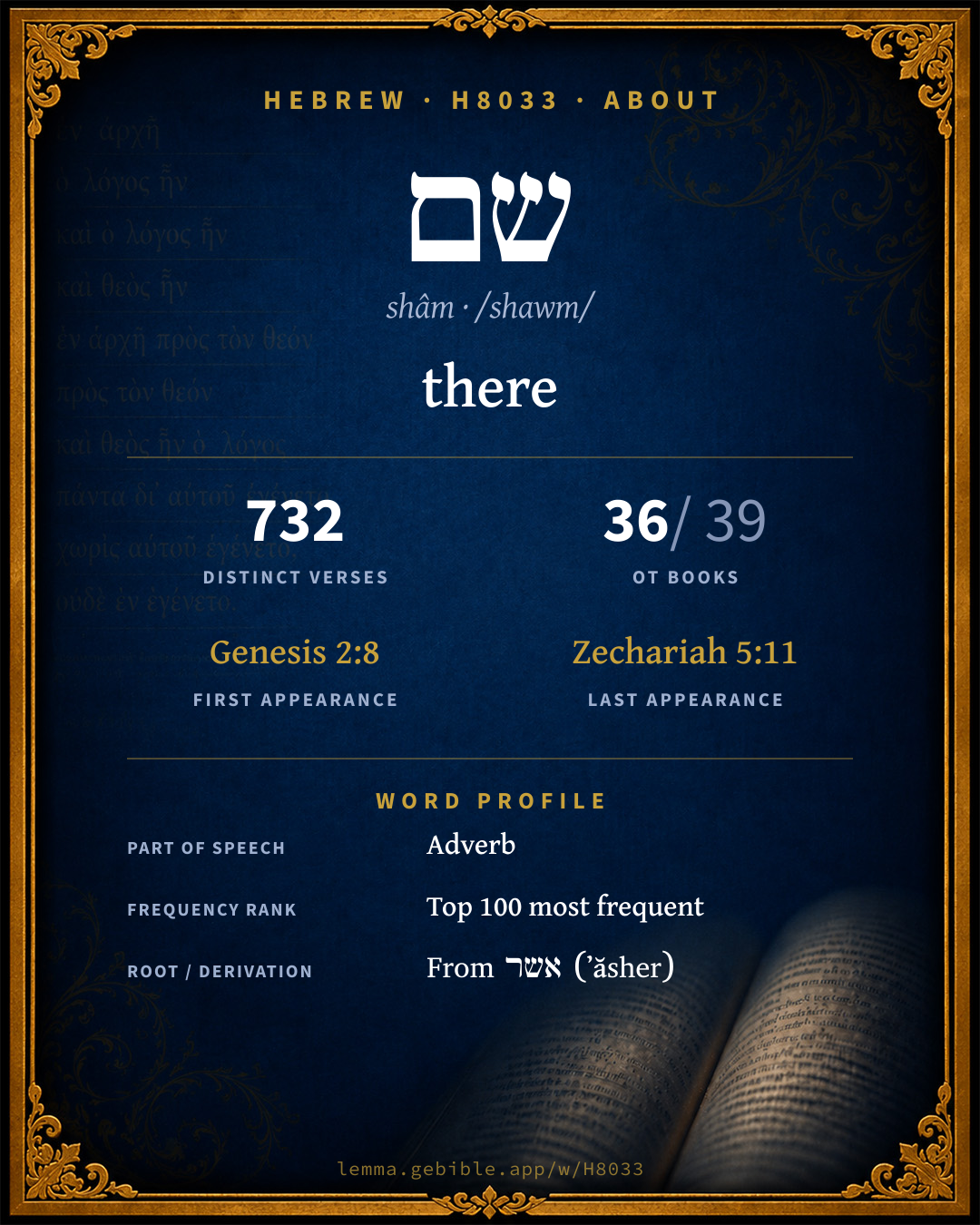
שָׁם
there
‘there’ is one of 5 main senses fuller range ↓
Full lexicon entry — Brown-Driver-Briggs (BDB)
From Brown-Driver-Briggs (BDB)
Where this word appears
Grammar key — what these labels mean
Part of speech
- Adverb
- A word that modifies a verb, adjective, or other adverb.
Every verse where H8033 appears in the Book of 2 Kings — 47 distinct verses. Click any verse to open its interlinear word-by-word view. Verse text shown in the World English Bible for context — . Each verse’s Hebrew form is shown with its reference; the English is not keyword-highlighted, since the data carries no word-level English alignment. Use “Compare translations” on any verse to read it across multiple English versions. This concordance covers the Hebrew Bible; Septuagint (Greek Old Testament) occurrences are not indexed here.
2 Kings
- 2 Kings 1:4 שָּׁ֛ם adv Now therefore thus says Yahweh, You shall not come down from the bed where you are gone up, but shall surely die. Elijah departed.
- 2 Kings 1:6 שָּׁ֛ם adv They said to him, There came up a man to meet us, and said to us, Go, turn again to the king who sent you, and tell him, Thus says Yahweh, Is it because there is no God in Israel, that you send to inquire of Baal Zebub, the god of Ekron? therefore you shall not come down from the bed where you are gone up, but shall surely die.
- 2 Kings 1:16 שָּׁ֛ם adv He said to him, Thus says Yahweh, Because you have sent messengers to inquire of Baal Zebub, the god of Ekron, is it because there is no God in Israel to inquire of his word? therefore you shall not come down from the bed where you are gone up, but shall surely die.
- 2 Kings 2:20 שָׁ֖ם adv He said, Bring me a new jar, and put salt therein. They brought it to him.
- 2 Kings 2:21 שָׁ֖ם מִ/שָּׁ֛ם adv prep + adv He went forth to the spring of the waters, and cast salt therein, and said, Thus says Yahweh, I have healed these waters; there shall not be from there any more death or miscarrying.
- 2 Kings 2:23 מִ/שָּׁ֖ם prep + adv He went up from there to Bethel; and as he was going up by the way, there came forth young lads out of the city, and mocked him, and said to him, Go up, you baldy; go up, you baldhead.
- 2 Kings 2:25 מִ/שָּׁ֖ם וּ/מִ/שָּׁ֖ם prep + adv conj + prep + adv He went from there to Mount Carmel, and from there he returned to Samaria.
- 2 Kings 4:8 וְ/שָׁם֙ שָׁ֖מָּ/ה conj + adv adv + sfx dem It fell on a day, that Elisha passed to Shunem, where was a great woman; and she constrained him to eat bread. So it was, that as often as he passed by, he turned in there to eat bread.
- 2 Kings 4:10 שָׁ֛ם שָֽׁמָּ/ה adv adv + sfx dem Let us make, Please, a little chamber on the wall; and let us set for him there a bed, and a table, and a seat, and a lamp stand: and it shall be, when he comes to us, that he shall turn in there.
- 2 Kings 4:11 שָׁ֑מָּ/ה שָֽׁמָּ/ה adv + sfx dem adv + sfx dem It fell on a day, that he came there, and he turned into the chamber and lay there.
- 2 Kings 5:18 שָׁ֜מָּ/ה adv + sfx dem In this thing Yahweh pardon your servant: when my master goes into the house of Rimmon to worship there, and he leans on my hand, and I bow myself in the house of Rimmon, when I bow myself in the house of Rimmon, Yahweh pardon your servant in this thing.
- 2 Kings 6:1 שָׁ֛ם adv The sons of the prophets said to Elisha, See now, the place where we dwell before you is too strait for us.
- 2 Kings 6:2 מִ/שָּׁם֙ שָׁ֛ם שָׁ֑ם prep + adv adv adv Let us go, we pray you, to the Jordan, and take there every man a beam, and let us make us a place there, where we may dwell. He answered, Go you.
- 2 Kings 6:6 שָׁ֔מָּ/ה adv + sfx dem The man of God said, Where fell it? He shown him the place. He cut down a stick, and cast it in there, and made the iron to swim.
- 2 Kings 6:9 שָׁ֖ם adv The man of God sent to the king of Israel, saying, Beware that you not pass such a place; for there the Syrians are coming down.
- 2 Kings 6:10 שָׁ֑ם adv The king of Israel sent to the place which the man of God told him and warned him of; and he saved himself there, not once nor twice.
- 2 Kings 6:14 שָׁ֛מָּ/ה adv + sfx dem Therefore sent he there horses, and chariots, and a great host: and they came by night, and surrounded the city.
- 2 Kings 7:2 וּ/מִ/שָּׁ֖ם conj + prep + adv Then the captain on whose hand the king leaned answered the man of God, and said, Behold, if Yahweh should make windows in heaven, might this thing be? He said, Behold, you shall see it with your eyes, but shall not eat of it.
- 2 Kings 7:4 שָׁ֔ם adv If we say, We will enter into the city, then the famine is in the city, and we shall die there; and if we sit still here, we die also. Now therefore come, and let us fall to the host of the Syrians: if they save us alive, we shall live; and if they kill us, we shall but die.
- 2 Kings 7:5 שָׁ֖ם adv They rose up in the twilight, to go to the camp of the Syrians; and when they were come to the outermost part of the camp of the Syrians, behold, there was no man there.
- 2 Kings 7:8 מִ/שָּׁ֗ם מִ/שָּׁ֔ם prep + adv prep + adv When these lepers came to the outermost part of the camp, they went into one tent, and ate and drink, and carried there silver, and gold, and clothing, and went and hid it; and they came back, and entered into another tent, and carried there also, and went and hid it.
- 2 Kings 7:10 שָׁ֛ם adv So they came and called to the porter of the city; and they told them, saying, We came to the camp of the Syrians, and, behold, there was no man there, neither voice of man, but the horses tied, and the donkeys tied, and the tents as they were.
- 2 Kings 7:19 וּ/מִ/שָּׁ֖ם conj + prep + adv and that captain answered the man of God, and said, Now, behold, if Yahweh should make windows in heaven, might such a thing be? and he said, Behold, you shall see it with your eyes, but shall not eat of it:
- 2 Kings 9:2 שָׁ֑מָּ/ה שָׁ֠ם adv + sfx dem adv When you come there, look out there Jehu the son of Jehoshaphat the son of Nimshi, and go in, and make him arise up from among his brothers, and carry him to an inner chamber.
- 2 Kings 9:16 שָׁ֑מָּ/ה adv + sfx dem So Jehu rode in a chariot, and went to Jezreel; for Joram lay there. Ahaziah king of Judah was come down to see Joram.
- 2 Kings 9:27 שָֽׁם adv But when Ahaziah the king of Judah saw this, he fled by the way of the garden-house. Jehu followed after him, and said, Smite him also in the chariot: [and they struck him] at the ascent of Gur, which is by Ibleam. He fled to Megiddo, and died there.
- 2 Kings 10:15 מִ/שָּׁ֡ם prep + adv When he was departed there, he lighted on Jehonadab the son of Rechab coming to meet him; and he greeted him, and said to him, Is your heart right, as my heart is with your heart? Jehonadab answered, It is. If it be, give me your hand. He gave him his hand; and he took him up to him into the chariot.
- 2 Kings 11:16 שָֽׁם adv So they made way for her; and she went by the way of the horses' entry to the king's house: and there was she slain.
- 2 Kings 12:5 שָׁ֖ם adv let the priests take it to them, every man from his acquaintance; and they shall repair the breaches of the house, wherever any breach shall be found.
- 2 Kings 12:9 שָׁ֤מָּ/ה adv + sfx dem But Jehoiada the priest took a chest, and bored a hole in the lid of it, and set it beside the altar, on the right side as one comes into the house of Yahweh: and the priests who kept the threshold put therein all the money that was brought into the house of Yahweh.
- 2 Kings 14:19 שָֽׁם adv They made a conspiracy against him in Jerusalem; and he fled to Lachish: but they sent after him to Lachish, and killed him there.
- 2 Kings 15:20 שָׁ֖ם adv Menahem exacted the money of Israel, even of all the mighty men of wealth, of each man fifty shekels of silver, to give to the king of Assyria. So the king of Assyria turned back, and didn't stay there in the land.
- 2 Kings 16:6 שָׁ֔ם adv At that time Rezin king of Syria recovered Elath to Syria, and drove the Jews from Elath; and the Syrians came to Elath, and lived there, to this day.
- 2 Kings 17:11 שָׁם֙ adv and there they burnt incense in all the high places, as did the nations whom Yahweh carried away before them; and they worked wicked things to provoke Yahweh to anger;
- 2 Kings 17:25 שָׁ֔ם adv So it was, at the beginning of their dwelling there, that they didn't fear Yahweh: therefore Yahweh sent lions among them, which killed some of them.
- 2 Kings 17:27 שָׁ֨מָּ/ה֙ מִ/שָּׁ֔ם שָׁ֑ם adv + sfx dem prep + adv adv Then the king of Assyria commanded, saying, Carry there one of the priests whom you brought from there; and let them go and dwell there, and let him teach them the law of the god of the land.
- 2 Kings 17:29 שָֽׁם adv However every nation made gods of their own, and put them in the houses of the high places which the Samaritans had made, every nation in their cities in which they lived.
- 2 Kings 17:33 מִ/שָּֽׁם prep + adv They feared Yahweh, and served their own gods, after the manner of the nations from among whom they had been carried away.
- 2 Kings 19:32 שָׁ֖ם adv Therefore thus says Yahweh concerning the king of Assyria, He shall not come to this city, nor shoot an arrow there, neither shall he come before it with shield, nor cast up a mound against it.
- 2 Kings 23:7 שָׁ֛ם adv He broke down the houses of the sodomites, that were in the house of Yahweh, where the women wove hangings for the Asherah.
- 2 Kings 23:8 שָׁ֨מָּ/ה֙ adv + sfx dem He brought all the priests out of the cities of Judah, and defiled the high places where the priests had burned incense, from Geba to Beersheba; and he broke down the high places of the gates that were at the entrance of the gate of Joshua the governor of the city, which were on a man's left hand at the gate of the city.
- 2 Kings 23:12 מִ/שָּׁ֔ם prep + adv The altars that were on the roof of the upper chamber of Ahaz, which the kings of Judah had made, and the altars which Manasseh had made in the two courts of the house of Yahweh, did the king break down, and beat [them] down from there, and cast the dust of them into the brook Kidron.
- 2 Kings 23:16 שָׁם֙ adv As Josiah turned himself, he spied the tombs that were there in the mountain; and he sent, and took the bones out of the tombs, and burned them on the altar, and defiled it, according to the word of Yahweh which the man of God proclaimed, who proclaimed these things.
- 2 Kings 23:20 שָׁם֙ adv He killed all the priests of the high places that were there, on the altars, and burned men's bones on them; and he returned to Jerusalem.
- 2 Kings 23:27 שָֽׁם adv Yahweh said, I will remove Judah also out of my sight, as I have removed Israel, and I will cast off this city which I have chosen, even Jerusalem, and the house of which I said, My name shall be there.
- 2 Kings 23:34 שָֽׁם adv Pharaoh Necoh made Eliakim the son of Josiah king in the room of Josiah his father, and changed his name to Jehoiakim: but he took Jehoahaz away; and he came to Egypt, and died there.
- 2 Kings 24:13 מִ/שָּׁ֗ם prep + adv He carried out there all the treasures of the house of Yahweh, and the treasures of the king's house, and cut in pieces all the vessels of gold, which Solomon king of Israel had made in the temple of Yahweh, as Yahweh had said.
About this entry
At a glance — auto-summarized from this page’s data, not written by a person. Every figure links to its source below. This summary describes the numbers; it doesn’t interpret them.
The Hebrew verb שם centers on the idea of “there.” Its meaning spans more than one sense — see its full sense range. It turns up in 732 verses across 36 books, one of the most common footprint. First canonically at Genesis 2:8, it enters the text early. It clusters with אשר, של and תם under a shared root. For the data behind this summary, explore the sense tree and the renderings breakdown below.
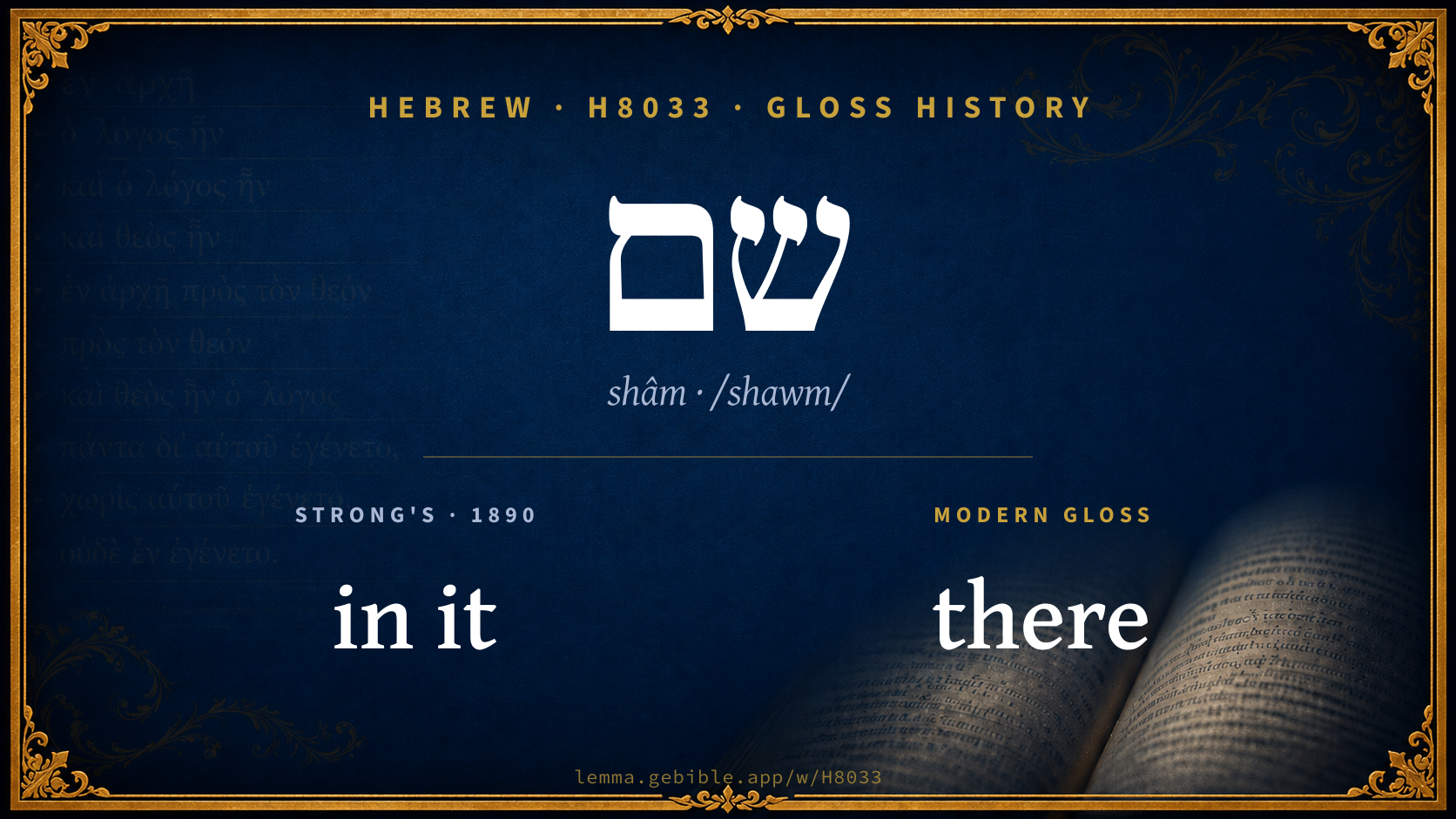
Gloss history
Strong's 1890 vs modern scholarship
About this word
Strong's H8033 catalogs a Hebrew word from the Hebrew Old Testament.
These counts are not copied from any lexicon or concordance. They are computed here, from the morphology-tagged Hebrew Old Testament. What Lemma adds →
- 732
- distinct verses
- The word appears in 732 distinct verses.
- 36 / 39
- OT books
- The word appears in 36 of 39 Old Testament books.
- #55
- by frequency
- Top 100 most frequent Hebrew words (rank 55 of 8,640 Hebrew words by occurrence).
View all 732 occurrences in the concordance →
Most concentrated in
- Genesis 86 verses 12%
- Deuteronomy 75 verses 10%
- Jeremiah 69 verses 9%
By section of the Old Testament
By traditional corpus
Conventional, traditional groupings — biblical authorship is debated, so this is a traditional corpus grouping, not an authorship claim. Each share is this word’s portion of its verses in that division of the Hebrew canon. Each figure is a share of the word’s 732 distinct verses.
- Prophets (Nevi'im) 400 verses · 55%
- Torah (Pentateuch) 231 verses · 32%
- Writings (Ketuvim) 101 verses · 14%
How translations render this word
Counts come from each version’s own published word-to-Strong’s tagging or interlinear alignment — an approximate guide to how each version renders this word, not a word-level alignment the data otherwise carries. Because each total is that version’s own tagged count, the per-version totals vary from one another and need not match the appearance or distinct-verse counts above. These counts may also differ from a printed concordance because Lemma counts each distinctly tagged rendering and does not collapse phrase taggings into a single head-word total. This is a fixed set of word-tagged versions (KJV, ASV, BSB, ULT) and does not change with the reading translation you choose elsewhere. Each version’s license is shown beside its name below (and on Sources).
- King James Version: There 2×, Whither 2×
- American Standard Version: There 3×, Thither 2×
- Berean Standard Bible: There 400×, Where 29×, It 16×
- unfoldingWord Literal Text: There 649×, To 12×, Was there 12×
King James Version Public Domain
Renders H8033 across 10 tagged occurrences — most commonly:
Plus 6 renderings that appear only once — usually multi-word phrases or single function words the recovered tagging swept in, not distinct renderings.
American Standard Version Public Domain
Renders H8033 across 10 tagged occurrences — most commonly:
Plus 5 renderings that appear only once — usually multi-word phrases or single function words the recovered tagging swept in, not distinct renderings.
Berean Standard Bible Public Domain
Renders H8033 across 551 tagged occurrences — most commonly:
Plus other, less common renderings. Plus 37 renderings that appear only once — usually multi-word phrases or single function words the recovered tagging swept in, not distinct renderings. Not rendered by a distinct English word in 281 further occurrences.
unfoldingWord Literal Text CC BY-SA 4.0
Renders H8033 across 793 tagged occurrences — most commonly:
Plus other, less common renderings. Plus 29 renderings that appear only once — usually multi-word phrases or single function words the recovered tagging swept in, not distinct renderings.
12 senses and sub-senses in the full BDB
What do BDB’s symbols mean?
BDB uses these scholarly abbreviations:
| Symbol | Meaning |
|---|---|
| 𝔊 | the Septuagint (the ancient Greek translation, LXX) |
| 𝔙 | the Vulgate (the Latin translation) |
| 𝔖 | the Syriac version (the Peshitta) |
| 𝔗 | the Targum (the Aramaic translation) |
| ψ | the Psalms |
| √ | root (the underlying root or stem) |
| ‖ | parallel passage (a synonymous or contrasted parallel) |
| † | the dagger: every passage where the word occurs is cited |
The 12 senses and sub-senses the full Brown-Driver-Briggs lexicon distinguishes for this word, in lexicon order (not ranked by frequency), with BDB’s own verbatim wording and sub-sense lettering. Shown in Hebrew script with BDB’s own scholarly abbreviations. The condensed entry is in the Lexicon Entry tab. See also the Forms in the corpus table below.
- 1.
- a. there Gn 2:8, 12; 11:2, 7, 31 + often; placed early in sentence for emph., Mi 4:10 שָׁם תִּנָּצֵ֑לִי, Na 3:15; Ez 32:22, 24 ψ 104:26 +, וְשָׁם … Gn 41:12; Ex 15:27; Nu 13:22, 33 +, שָׁם … וְשָׁם Ex 15:25; Dt 12:14; Is 27:10; Jb 3:17 +, וְהִנֵּה שָׁם … Gn 29:2, כִּי שָׁם … 11:9; 21:31; 35:7; 2 S 1:21; 15:21 +, אַךְ שָׁם … Is 34:14, 15, גַּם שָׁם … 23:12; 57:7 ψ 139:10; resuming a preceding ‘where,’ Jb 39:30 בַּאֲשֶׁר חֲלָלִים שָׁם הוּא, Ju 5:27; Je 22:12; Ec 11:3, cf. 1:7. Repeated, שָׁם … שָׁם here … there Is 28:10, 13. In poetry, pointing to a spot in which a scene is localized vividly in the imagination, ψ 14:5 שׁם פחדו פחד there feared they a fear! 36:13, cf. 48:7; 66:6; 132:17; Hos 6:7; Zp 1:14.—Hb 3:4 read probably (We Now) שָׂם the flashes at his side made he the hiding of his power; Ec 3:17 שָׁם = with God, in the Divine plan or scheme: but read perhaps שָׂם Hi De al. e.g. Genesis 2:8
- b. preceded by the rel., אֲשֶׁר שָׁם where, Gn 2:11; Ex 20:21; 1 S 9:10 +, usually with one or more words between, Gn 13:3, 14; 19:27; Ex 29:42; 2 S 11:16; 2 K 23:27 + often; after בַּאֲשֶׁר, בַּאֲשֶׁר הוּא שָׁם †Gn 21:17. With אשׁר omitted (the rel. being indic. by cstr., Ges§ 130 c, d) Ez 39:11 מְקוֹם שָׁם קֶבֶר בְּיִשְׂר׳ a place where a grave (may be) in Isr., but 𝔊 𝔙 Co Or al. read שֵׁם a place of renown. e.g. Genesis 2:11
- 2. thither, after vbs. of motion (= שָׁ֫מָּה, v. 3) Dt 1:37 לֹא תָבֹא שָׁם, Ju 19:15; 21:10; 1 S 2:14; 9:6 al, אֲשֶׁר … שָׁם whither, 1 K 18:10; 21:18; 2 K 1:4, 6, 16; Is 20:6, more often in Je Ez, as Je 8:3; 22:27; 23:3, 8; 45:5 +, Ez 4:13; 12:16; 36:20, 22 +; so שֶׁשָּׁם ψ 122:4. e.g. Deuteronomy 1:37
- 3. with ה loc., שָׁ֫מָּה (shā́mmāh):
- a. after vbs. of motion, thither, Gn 19:20 לָנוּס שָׁ֫מָּה to flee thither, v 22; 20:13; 24:6; 29:3; Dt 1:38 + often; = into it, therein (of a basket, pit, etc.), Ex 16:33 וְתֶן־שָׁ֫מָּה מְלֹא הָעֹמֶר, 21:33 וְנָפַל שָׁמָּה, 30:18; Ju 8:25; 2 K 12:10; pregnantly, after a verb implying motion, as to bury, Gn 23:13 וְאֶקְבְּרָה אֶת־מֵתִי שָׁ֫מָּה, 25:10; 49:31; 50:5 (all P), נוֹעַד to meet Ex 29:42, 43; 30:6, 36; Nu 17:19 (all P), Jos 2:16; 7:3; Je 13:7; Jo 4:7 (cf. b), Ct 8:5 (?c). e.g. Genesis 19:20
- b. אֲשֶׁר … שָׁ֫מָּה whither Gn 20:13; Nu 33:54; Dt 4:5, 14 + often; where 2 K 23:8; 1 Ch 4:41. e.g. Genesis 20:13
- c. more rarely, i. q. שָׁם there, Gn 43:30 וַיִּבְךְ שָׁ֫מָּה, Jos 2:1; Ju 16:27; 2 K 4:11; 9:16 Ho 2:17; Is 22:18; 34:15; 65:9; Je 18:2; 27:22; Ez 23:3; 32:29, 30 (v 22, 24, 26 שָׁם), 48:35 י׳ שָׁ֫מָּה, ψ 76:4; 122:5; Ec 3:16. e.g. Genesis 43:30
- 4. מִשָּׁם from there, thence:
- a. often after verbs of departing, taking, etc., Gn 2:10; 11:8, 9; 12:8; 18:16; 24:7; 42:2, etc., Nu 13:23; 21:12; 22:41 וַיַּרְא מִשָּׁם, Dt 4:29 וּבִקַּשְׁתֶּם מִשָּׁם, 30:4; Je 37:12; Ho 2:17; Am 9:2, 3, 4; Jb 39:29 +. Peculiarly, Gn 49:24 מִשָּׁם רֹעֶה אֶבֶן יִשְׂר׳ Ges De RVm from there [from heaven], (from) the Shepherd (י׳), the Stone (Rock) of Israel, Ew Di Sta from there (where is) the Shepherd of (רֹעֵה) the (Bethel-)stone of Israel; but both forced: text dubious; Gunk by the name (מִשֵּׁם; so 𝔖) of the Shepherd, etc. (as Ew Di). e.g. Genesis 2:10
- b. אֲשֶׁר … מִשָּׁם whence Gn 24:5; Nu 23:13 +. e.g. Genesis 24:5
- c. expressing origin, Gn 3:23 the ground אֲשֶׁר לֻקַּח מִשָּׁם, 10:14 whence (= from whom) came forth the Phil., Ju 19:18 מִשָּׁם אָנֹכִי, 1 S 10:12 אִישׁ מִשָּׁם, Is 65:20. e.g. Genesis 3:23
- d. of the mass, from which something is taken or made, Gn 27:9; 30:32 (of צֹאן), Lv 2:2 וְקָמַץ מִשָּׁם וגו׳ (from the meal, etc., of a מנחה), 1 K 17:13 אַךְ עֲשָׂי לִי מִשָּׁם עֻגָה קְטַנָּה i.e. from the meal and oil, 2 K 7:2, 19 וּמִשָּׁם לֹא תֹאכִֽל׃, Ez 5:3. e.g. Genesis 27:9
Senses from the full Brown-Driver-Briggs lexicon (Brown, Driver, Briggs; Oxford 1906 — public domain), digitized via Sefaria, supplemented by the OpenScriptures HebrewLexicon (CC BY 4.0). Full attribution on Sources.
Word origin
adv. there, thither (Arabic ثَمَّ there, cf. ثُمَّ then; Biblical Aramaic תַּמָּה, Egyptian Aramaic תמה S-CPap. A 4, J 6, 𝔗 תַּמָּן (with demonstr. n, cf. אֱדַיִן beside אֲזַי), Syriac ܬܰܡܳܢ; ZenjHad. 8 (Cooke159) שם);—
— Brown-Driver-Briggs (Oxford 1906, public domain), digitized via Sefaria, supplemented by the OpenScriptures HebrewLexicon (CC BY 4.0). See Sources.
Derived from אשר (ʼăsher) (H834) — which.
Jastrow Dictionary
A second Hebrew/Aramaic lexicon for comparison, covering Aramaic and post-biblical (Talmudic, Targumic, Midrashic) usage that the biblical-Hebrew BDB does not. Matched by lemma rather than by Strong’s number, so a lemma may carry more than one Jastrow headword (shown separately below), and the entries cover usage well beyond the Bible.
שָׁם
- (b. h.) there, thither. Macc. II, 7 אינו יוצא מִשָּׁם לעולם he dare not go away from there (the city of refuge) all his life time; שם תהא דירתו שם וכ׳ there he must live, there he must die &c.; Tosef. ib. III (II), 5. Macc. 4ᵃ שנפל שם which fell thereinto. Ber. V, 4 אם אין שם כהן וכ׳ if no priest besides him is present; a. v. fr.—Cant. R. to VIII, 9 שָׁמָּה, v. רגָּז.—לְשָׁם thither. Ex. R. s. 18; a. fr.
שֵׁם I
- (b. h.) pr. n. m. Shem, son of Noah. Meg. 9ᵇ (ref. to Gen. IX, 27) דבריו … באהלי שם let the speech of Japheth (Greek) dwell in the tents of Shem; v. יָפְיוּת. Gen. R. s. 63, v. עֵבֶר I. Snh. 69ᵇ. Ex. R. s. 18 the Lord said, חייב אני לשם אביהם וכ׳ I am indebted to their (the Assyrians’) father Shem, because he and Japheth took their cloaks and covered with it &c.; a. fr. e.g. Genesis 9:27
שֵׁם II
- v. שׁוּם a. mark, name, title, nature, denomination. Pes. III, 3 לא תקרא לה שם וכ׳ she must not name it (declare it to be Ḥallah) until it is baked. Ter. III, 5 האומר … קרא שם if one says, the priest’s portion of this pile is in it …, he has named it (designated it as T’rumah). Gen. R. s. 25 (ref. to Gen. V, 29) לא השם הוא המדרש … הוא השם וכ׳ the name (נח) and the interpretation (ינחמנו) do not correspond; it ought to be either &c. Ber. II, 8 ליטול … השם, v. נָטַל. Macc. I, 2 לא השם המביאו וכ׳ the title (the legal text) under which the false witness is doomed to lashes, is not the one under which he is bound to pay indemnity. Kinn. I, 3 משם אחד sacrificial birds of the same denomination (intended for the same class of cases), opp. משני שמות of different denominations. Sabb. XII, 3 משם אחד two letters of the alphabet of the same name (אא, בב &c.), opp. משתי שמות two different letters (אב &c.). Ib. שם קטן משם גדול וכ׳ a small name or word as a part (or abbreviation) of a larger one, as שם as a part of שמעון, of שמואל &c. Ib. 103ᵇ שתי אותיות והן שם אחד two identical letters which represent a word, (as שש, which may stand for שֵׁשׁ or שָׂשׂ) &c. Shebu. 3ᵇ, a. fr. לא מן השם הוא זה וכ׳ this comes not under this title (this is not the real reason), but it is because &c. Ker. III, 4 אינו מן השם the offence is not of the same class. Macc. 4ᵇ, a. fr. (על חבירו) מוציא שם רע who spreads an evil report about his neighbor (injures his reputation). Ber. 17ᵃ גדל בשם טוב וכ׳ who has grown up with a good name, and departed life with a good name; a. v. fr.—Esp. הַשֵּׁם or שֵׁם the Divine Name, the Tetragrammaton, contradist. to כינוי attribute; in gen. the Lord. Snh. VII, 5 המגדף … שיפרש השם the blasphemer is not punishable, unless he uses the Name explicitly. Ib. 8 המקלל … בַּשֵּׁם he that curses his father or his mother is not punishable, unless he curses them with the Name. Ib. 56ᵃ בידך את השם בכינוי (not בכינויים) if he curses God by using a divine attribute. Ib. עד שיברך שם בשם unless he curses God and pronounces the Name. Yoma III, 8; IV, 2; VI, 2 (בשם) אנא השם I pray, O Lord (pronouncing the Tetragrammaton). Ib. כשהיו שומעים שם המפורש שהוא יוצא וכ׳ when they heard the Tetragrammaton pronounced &c., v. פָּרַשׁ. Ib. IV, 1 אחד … לַשֵּׁם on one of the lots was written ‘unto the Lord’; של שם the lot bearing the inscription ‘unto the Lord’; a. v. fr.; v. שָׁמַיִם.—Especial uses: כְּשֵׁם שֶׁ־ the same as, as well as. Ber. IX, 5 חייב אדם … כשם שמברך וכ׳ a man is bound to bless God for what is evil as well as he blesses for what is good. Ib. 62ᵃ כשם שנפרעין וכ׳ as well as the dead are called to account &c., v. סַפְדָּן. Sot. V, 1 כשם שהמים … כך וכ׳ as the waters test her, so do they test him. Ib. כשם שאסורה וכ׳, v. בָּעַל; a. v. fr.—בְּשֵׁם, מִשֵּׁם in the name of, in behalf of. Meg. 15ᵃ כל האומר דכר בשם אומרו וכ׳ he who relates a thing in the name of him who said it (gives credit to authority), brings redemption into the world. Peah II, 4 מִשְּׁמוֹ in his own name (as his individual opinion). Y. Taan. I, 64ᵃ הלכה … שאמר משם וכ׳ the rule follows the opinion of …, who said in behalf of &c.; a. v. fr.—לְשֵׁם for the purpose of, for the sake of, as; with reference to. Gitt. 24ᵇ כתב רחמנא לה לִשְׁמָהּ the text (Deut. XXIV, 3) says, ‘unto her’, that means, that it must be written especially for her. Yeb. 47ᵇ, v. שׁוּם II.—Snh. 99ᵇ העוסק בתורה לשמה who studies the Law for its own sake (for no selfish ends). Pes. 50ᵇ לעולם יעסוק … אע"פ שלא לשמה … בא לשמה by all means let a man engage in the study of the Law and in good deeds, even if not for their own sake, for through the work for a selfish purpose he will arrive at the stage of doing good for its own sake. Ib. 13ᵇ, a. e. שחטן לִשְׁמָן וכ׳ if he slaughtered them as such (as festive sacrifices) &c.; זרק דמן שלא לשמן if he sprinkled their blood, having in mind another purpose (another class of sacrifices). Gen. R. s. 25 לשם קרבנו נקרא he was named (נח) with reference to his sacrifice (ניחח, Gen. VIII, 21); לשם נחת וכ׳ he was named (נח) with reference to the rest of the ark (ותנח, Gen. VIII, 4); Yalk. ib. 42 על שם וכ׳; a. v. fr.—עַל שֵׁם (abbrev. ע"ש) with reference to, because. Y. Taan. II, beg. 65ᵃ על שם ואנכי וכ׳ as a reference to (what Abraham said,) ‘and I am but dust and ashes’ (Gen. XVIII, 27). Gen. R. s. 23, v. טְבַרְיָא; a. fr.; v. שׁוּם II.—Pl. שֵׁמוֹת, constr. שְׁמוֹת. Kinn. l. c. Gen. R. s. 26 כל הש׳ הללו וכ׳ all these names indicate rebellion &c., v. מַרְדּוּת I. B. Mets. 114ᵇ עובר בכל הש׳ הללו is guilty under all these titles (texts). Shebu. 35ᵃ יש ש׳ שנמחקין ויש ש׳ וכ׳ there are divine names which may be erased, and such as may not be erased. Y. R. Hash. I, 56ᵈ bot. שְׁ׳ המלאכים, v. מַלְאָךְ; a. fr. e.g. Genesis 5:29
שֵׁם
- Targ. Y. II, Ex. XXXI, 2. Targ. Ps. CXLVII, 4. Targ. O. Gen. VI, 4; a. fr.—Sot. 49ᵃ יהא שְׁמֵיה רבא (abbrev. יה"ש"ר), v. אֲגַדְתָּא. Ab. I, 13, v. נְגַד. Yoma 83ᵇ, v. דּוּק. Ber. 7ᵇ, v. גְּרַם I. Sabb. 8ᵇ (in Hebr. dict.) שמיה הילוך comes under the category of ‘walking’; לא שמיה תשמיש does not come under the category of ‘use.’ Ḥull. 48ᵃ משמיה רר׳ וכ׳ in behalf of &c.; Y. Taan. I, 64ᵃ bot. מן שמיה. Sabb. 145ᵇ שְׁמָאִי my name, v. מָתָא; a. v. fr.—Y. Orl. I, 61ᵃ bot. אית בני נש שְׁמוֹן בריכה וכ׳ there are persons whose name is B’rikah (meaning blessing), as one says, come thou, blessed of the Lord.—Pl. שְׁמָהָן, שְׁמָהָתָא; שְׁמַיָּיא, שְׁמֵי. Targ. Gen. II, 20. Ib. XXVI, 18. Targ. O. Num. I, 5 שְׁמָהַת constr.; Y. שְׁמָהָיַית; a. fr.—Gitt. 11ᵇ שמהתא … בשְׁמָהָתַיְיהוּ other names which Jews frequently adopt for their own, v. נְסַק. Meg. 14ᵇ סניין שְׁמַיְיהוּ, v. סְנֵי; a. fr.
A Dictionary of the Targumim, the Talmud Babli and Yerushalmi, and the Midrashic Literature (Marcus Jastrow; London, Luzac, 1903) — Public Domain. Digitized via Sefaria. Digitized via Sefaria. Full attribution on Sources.
Forms in the corpus
The 84 distinct written forms H8033 takes in the Hebrew Bible, most frequent first — each parse links to that state’s occurrences in the concordance. Hebrew forms include their vowel points and cantillation, so a single lemma takes many written forms.
| Form | Parsing | Example | Uses |
|---|---|---|---|
| שָׁ֖ם | Adverb | Deuteronomy 12:14 | 103 |
| שָֽׁם | Adverb | Deuteronomy 1:28 | 79 |
| שָׁ֔ם | Adverb | Daniel 9:7 | 56 |
| שָׁ֑ם | Adverb | Deuteronomy 12:5 | 45 |
| שָׁם֙ | Adverb | Deuteronomy 17:12 | 45 |
| שָׁ֣ם | Adverb | Amos 7:12 | 44 |
| שָׁ֖מָּ/ה | Adverb | Deuteronomy 4:5 | 29 |
| שָֽׁמָּ/ה | Adverb | Deuteronomy 3:21 | 27 |
| שָׁ֛ם | Adverb | Deuteronomy 16:6 | 26 |
| שָׁ֤ם | Adverb | Exodus 17:3 | 23 |
| שָׁ֥ם | Adverb | Deuteronomy 21:4 | 23 |
| מִ/שָּׁ֖ם | Adverb | Amos 6:2 | 22 |
| מִ/שָּׁ֔ם | Adverb | Deuteronomy 5:15 | 16 |
| שָׁ֔מָּ/ה | Adverb | Deuteronomy 32:50 | 15 |
| שָׁ֑מָּ/ה | Adverb | Deuteronomy 1:38 | 14 |
| שָׁ֗ם | Adverb | Deuteronomy 12:7 | 14 |
| שָׁ֨מָּ/ה֙ | Adverb | Deuteronomy 11:10 | 13 |
| מִ/שָּׁם֙ | Adverb | Genesis 18:16 | 12 |
| מִ/שָּֽׁם | Adverb | Genesis 3:23 | 9 |
| וְ/שָׁ֖ם | Adverb | Amos 7:12 | 8 |
| מִ/שָּׁ֗ם | Adverb | Deuteronomy 30:4 | 8 |
| מִ/שָּׁ֛ם | Adverb | Amos 9:3 | 8 |
| שָׁ֣מָּ/ה | Adverb | Deuteronomy 12:11 | 8 |
| שָׁ֨ם | Adverb | Ezekiel 39:11 | 8 |
| שָׁם֒ | Adverb | Deuteronomy 12:21 | 8 |
| וְ/שָׁ֣ם | Adverb | Deuteronomy 12:14 | 7 |
| וְ/שָׁ֥ם | Adverb | Exodus 15:25 | 7 |
| מִ/שָּׁ֑ם | Adverb | Deuteronomy 6:23 | 7 |
| מִ/שָּׁ֥ם | Adverb | Amos 9:3 | 7 |
| שָׁ֜ם | Adverb | Deuteronomy 34:5 | 7 |
| שָׁ֞ם | Adverb | Ezekiel 42:13 | 7 |
| מִ/שָּׁ֜ם | Adverb | Genesis 12:8 | 6 |
| שָׁ֧ם | Adverb | Deuteronomy 28:68 | 6 |
| וְ/שָׁם֙ | Adverb | 1 Chronicles 11:4 | 5 |
| וּ/מִ/שָּׁ֖ם | Adverb | Deuteronomy 30:4 | 5 |
| שָׁ֛מָּ/ה | Adverb | Deuteronomy 12:29 | 5 |
| שָׁ֜מָּ/ה | Adverb | Deuteronomy 4:42 | 5 |
| שָּׁ֔ם | Adverb | 1 Kings 4:28 | 5 |
| שָּׁ֛ם | Adverb | Deuteronomy 28:36 | 5 |
| וְ/שָׁ֞ם | Adverb | Ezekiel 20:40 | 4 |
| מִ/שָּׁ֤ם | Adverb | Genesis 20:1 | 4 |
| שָׁ֗מָּ/ה | Adverb | Deuteronomy 12:6 | 4 |
| שָׁ֚ם | Adverb | Ezekiel 47:23 | 4 |
| שָׁ֥מָּ/ה | Adverb | Ecclesiastes 3:16 | 4 |
| שָּׁם֙ | Adverb | Deuteronomy 27:5 | 4 |
| וְ/שָׁ֨מָּ/ה֙ | Adverb | Deuteronomy 32:52 | 3 |
| שָׁ֚מָּ/ה | Adverb | Ezekiel 23:3 | 3 |
| שָׁ֝֗ם | Adverb | Job 34:22 | 3 |
| שָׁ֭ם | Adverb | Psalms 104:17 | 3 |
| שָּׁ֑ם | Adverb | Deuteronomy 27:7 | 3 |
| שָּׁ֖ם | Adverb | 1 Samuel 20:19 | 3 |
| שָּׁ֗ם | Adverb | Deuteronomy 14:26 | 3 |
| וְ/שָׁ֖מָּ/ה | Adverb | Deuteronomy 34:4 | 2 |
| וְ/שָׁ֗ם | Adverb | Exodus 15:27 | 2 |
| וְ/שָׁ֤ם | Adverb | Jeremiah 20:6 | 2 |
| וְ/שָׁ֨ם | Adverb | Genesis 41:12 | 2 |
| וּ/מִ/שָּׁם֙ | Adverb | Genesis 2:10 | 2 |
| מִ/שָּׁ֣ם | Adverb | Judges 19:18 | 2 |
| מִ֠/שָּׁם | Adverb | 1 Kings 17:13 | 2 |
| שָׁ֕ם | Adverb | Deuteronomy 26:5 | 2 |
The 60 most common forms are shown; 24 rarer forms follow in the full concordance.
Same root — word family
Other BDB entries built from the same root as H8033, grouped by Strong’s listed origin. These share a root / origin per the lexicon — not necessarily a shared meaning. Each links to that word’s own entry.
Derives from
Shares the same root
Derived from this word
Compare all same-root words → They share a root, not necessarily a meaning.
Septuagint verse parallels
This word appears in 698 verses that also exist in the Greek Old Testament (Septuagint), out of the 732 Hebrew verses it occurs in. You can read those verses in Greek by switching the Old Testament edition to the Septuagint.
Read these verses in the Septuagint
- Genesis 2:8
- Exodus 8:22
- Leviticus 2:2
- Numbers 9:17
- Deuteronomy 1:28
- Joshua 2:1
- Judges 1:7
- Ruth 1:2
- 1 Samuel 1:3
- 2 Samuel 1:21
- 1 Kings 1:14
- 2 Kings 1:4
This is a verse-level parallel only — the same verses exist in both the Hebrew and Greek Old Testaments. No word-level Hebrew↔Greek correspondence is claimed: the data carries no such alignment, so no Greek word is shown as this Hebrew word’s translation. Coverage is not total — the Septuagint omits the deuterocanon and renumbers the Psalms, so some Hebrew verses have no direct Greek parallel.