
2 Kings 2:20

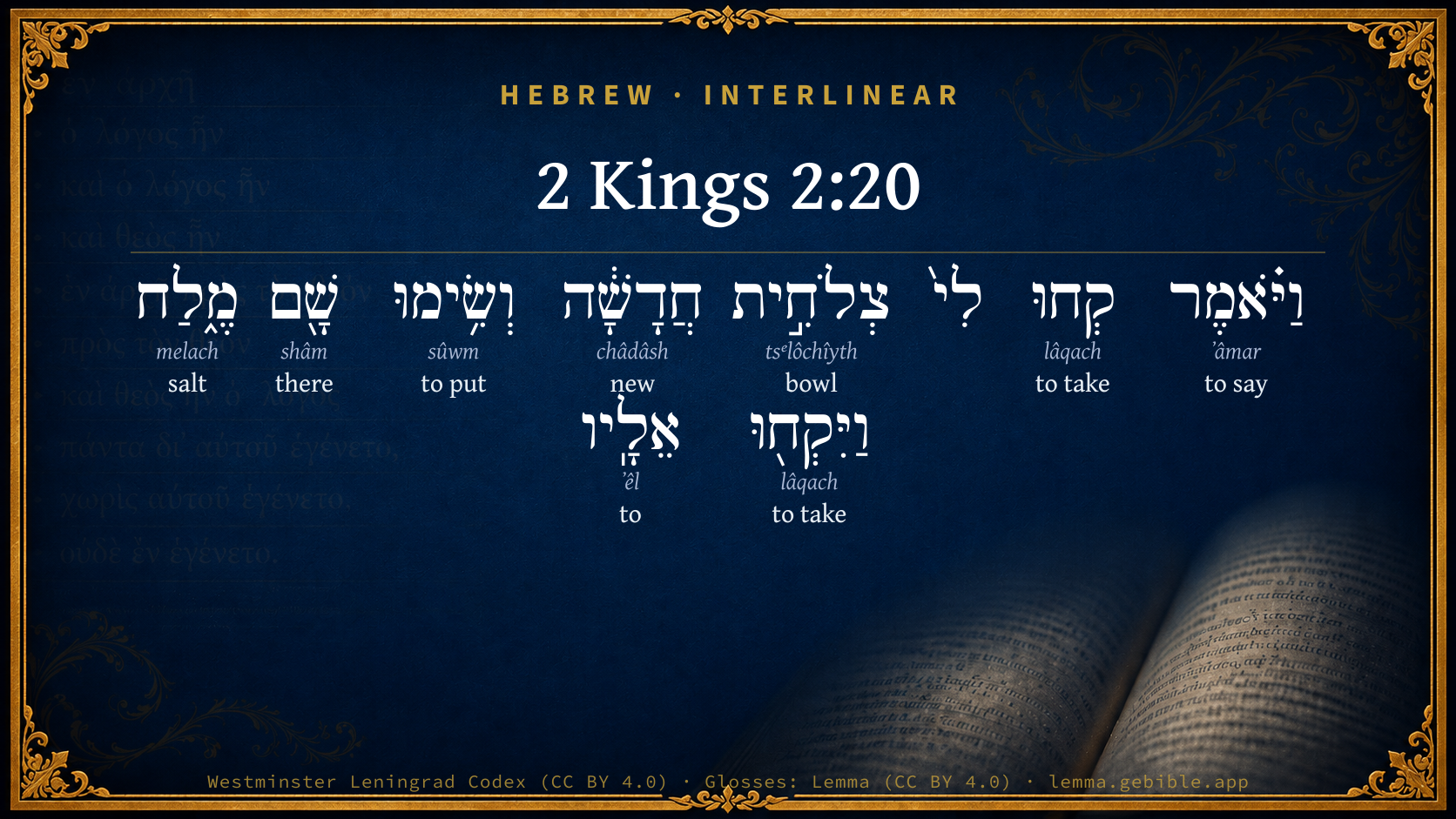
Hebrew (Westminster Leningrad Codex) 2 Kings 2:20 appears in the Hebrew Old Testament. The text above is from the Westminster Leningrad Codex. Each word links to its Strong’s number, a concise gloss, and parsing drawn from the Open Scriptures Hebrew Bible morphology. Click any word for its full Brown-Driver-Briggs (BDB) entry.
Download image
Cite this verse

2 Kings 2:20 (World English Bible). Public Domain. Lemma interlinear Bible study tool, https://lemma.gebible.app/v/2-kings/2/20.

Show BibTeX & RIS
BibTeX
RIS
English Translation
He said, Bring me a new jar, and put salt therein. They brought it to him.
World English Bible · Public Domain
Highlights
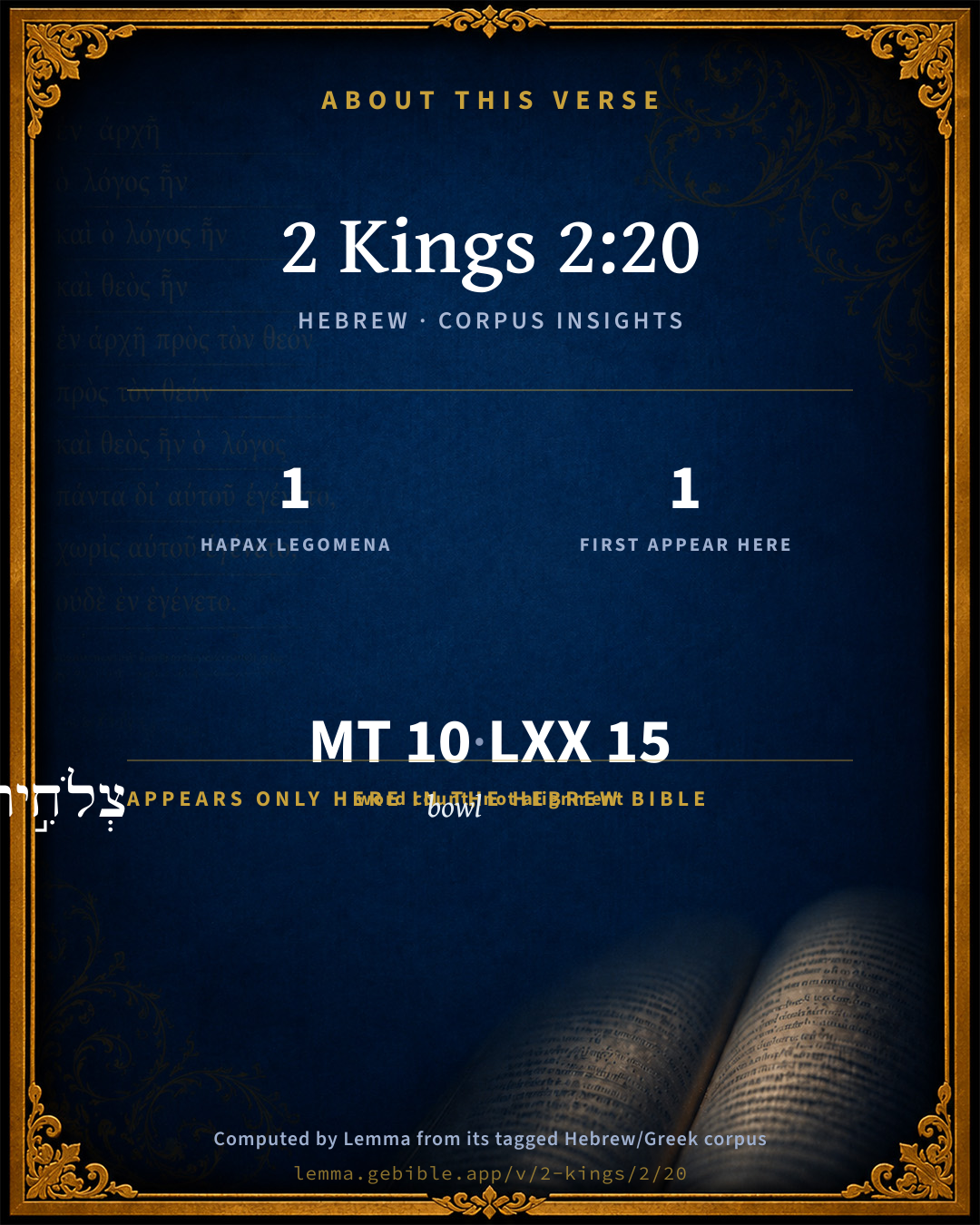
  • 1 hapax legomenon — only here in the Hebrew Bible
  • 1 first appearance in the Hebrew Bible
Full analysis ↓
Download a study sheet

One document with this verse’s original text, its word-by-word gloss line, the meaning frame, cross-references with their text, attributed commentary, and full source and license credits — printable, and it pastes into notes with its structure intact.

This verse Autodidact and up

Study sheet (.html) Plain text (.txt)

A passage Seminary Student

Up to 50 verses in one chapter. A passage sheet keeps up to 6 commentary sources and 12 cross-references per verse, in the order this page ranks them, and says so on the sheet whenever that leaves anything out. Ask for a single verse and you get the Autodidact verse sheet above.

Everything on this page stays free to read, with no account — the sheet is a download of what is already on screen, not access to it.

Want to remove ads? Support Godless Engineer
Compare translations 3

The same verse in 3 English versions, stacked beneath the original-language interlinear above. Click any original word for its lexicon entry.

Each is an independent rendering of the whole verse — the interlinear is not word-aligned to these translations.

Highlighted words mark where these versions differ — a whole-verse word diff, not a word-by-word alignment.

  • World English Bible Public Domain
    He said, Bring me a new jar, and put salt therein. They brought it to him.
  • King James Version Public Domain
    And he said, Bring me a new cruse, and put salt therein. And they brought it to him.
  • unfoldingWord Literal Text CC BY-SA 4.0
    And he said, “Bring to me a new bowl, and put salt there.” And they brought to him.

unfoldingWord Literal Text — © unfoldingWord, licensed CC BY-SA 4.0. Word-aligned USFM3 via Door43 (git.door43.org/unfoldingWord/en_ult).

Versions to compare (up to 4)

3 of 4 selected

Show all 18 translations

Every available English version of this verse, each an independent rendering of the whole verse.

  • World English Bible Public Domain
    He said, Bring me a new jar, and put salt therein. They brought it to him.
  • Berean Standard Bible Public Domain
    “Bring me a new bowl,” he replied, “and put some salt in it.” So they brought it to him,
  • Majority Standard Bible Public Domain
    “Bring me a new bowl,” he replied, “and put some salt in it.” So they brought it to him,
  • King James Version Public Domain
    And he said, Bring me a new cruse, and put salt therein. And they brought it to him.
  • American Standard Version (1901) Public Domain
    And he said, Bring me a new cruse, and put salt therein. And they brought it to him.
  • Revised Version (1885) Public Domain
    And he said, Bring me a new cruse, and put salt therein. And they brought it to him.
  • Geneva Bible (1599) Public Domain
    Then he saide, Bring me a newe cruse, and put salt therein. And they brought it to him.
  • Douay-Rheims (1899) Public Domain
    And he said: Bring me a new vessel, and put salt into it. And when they had brought it,
  • Young's Literal Translation Public Domain
    And he saith, `Bring to me a new dish, and place there salt;' and they bring `it' unto him,
  • Literal Standard Version CC BY-SA 4.0
    And he says, “Bring a new dish to me, and place salt there”; and they bring [it] to him,
  • Unlocked Literal Bible CC BY-SA 4.0
    Elisha replied, “Bring me a new bowl and put salt in it,” so they brought it to him.
  • unfoldingWord Literal Text CC BY-SA 4.0
    And he said, “Bring to me a new bowl, and put salt there.” And they brought to him.
  • Darby Bible Public Domain
    And he said, Bring me a new cruse, and put salt in it. And they brought it to him.
  • World Messianic Bible Public Domain
    He said, “Bring me a new jar, and put salt in it.” Then they brought it to him.
  • Webster's Bible Public Domain
    And he said, Bring me a new cruse, and put salt therein. And they brought it to him.
  • Free Bible Version CC BY-SA 4.0
    “Bring me a brand new bowl and put some salt in it,” he replied. So they brought it to him.
  • Bible in Basic English Public Domain
    So he said, Get me a new vessel, and put salt in it; and they took it to him.
  • JPS Tanakh (1917) Public Domain
    And he said: 'Bring me a new cruse, and put salt therein.' And they brought it to him.

Literal Standard Version (2020), Covenant Press — licensed CC BY-SA 4.0. Text via the HelloAO Bible API (eBible.org). Unlocked Literal Bible (unfoldingWord) — licensed CC BY-SA 4.0. Text via the HelloAO Bible API (eBible.org). unfoldingWord Literal Text — © unfoldingWord, licensed CC BY-SA 4.0. Word-aligned USFM3 via Door43 (git.door43.org/unfoldingWord/en_ult). Free Bible Version, Dr. Jonathan Gallagher — licensed CC BY-SA 4.0. Text via the HelloAO Bible API (eBible.org).

Word by word

More ways to search: Search by grammar → Find every occurrence → Compare this word →

Practice this passage: Drill this verse → Learn its vocabulary →

About this verse

These counts appear in no published source. They are computed here, from the morphology-tagged text and Lemma’s own curated glosses. What Lemma adds →

10
words
8
distinct lemmas
Historical
section

Notable vocabulary

1 hapax legomenon — a word that appears only here in the entire Hebrew Bible:

  • צְלֹחִ֣ית bowl H6746

First appearance in Scripture

This word makes its first canonical appearance in the Hebrew Bible here:

  • צְלֹחִ֣ית bowl H6746

Shared distinctive vocabulary

מֶ֑לַח salt H4417 occurs in 26 verses of the Hebrew Bible. Also found in:

Grammatical profile

  • 4 verbs
  • 2 nouns
  • 1 adjective
  • 2 prepositions
  • 1 adverb

Verb forms

  • וַיֹּ֗אמֶר Qal · Sequential Imperfect
  • קְחוּ Qal · Imperative
  • וְשִׂ֥ימוּ Qal · Imperative
  • וַיִּקְח֖וּ Qal · Sequential Imperfect

Repetition

A word recurs within this verse — often emphatic in Hebrew:

  • קְחוּ to take H3947 ×2

Hebrew & Septuagint length

In English translation the verse runs 16 words from the Hebrew and 22 from the Septuagint (LXX English) — closely comparable.

A rough comparison of the two English renderings, which tokenize alike — not a word-level alignment.

Word counts can differ between the Hebrew and the Greek without any difference in meaning — e.g. the Hebrew direct-object marker אֵת has no separate Greek word, and Greek often adds the article ὁ.

In the original languages it is 10 Hebrew tokens and 15 Greek tokens — but the two are counted differently (Hebrew bundles its prefixes and suffixes into one token; the Greek is in lemma form), so that isn’t a like-for-like length.

Cross-references

3

Topical passages linked to 2 Kings 2:20 in the Treasury of Scripture Knowledge — connected by theme and wording, ordered by reader-vote popularity; previews shown in the World English Bible.

  • Judges 9:45 Abimelech fought against the city all that day; and he took the city, and killed the people who were therein: and he beat down the city, and sowed it with salt.
  • Zephaniah 2:9 Therefore as I live, says Yahweh of Hosts, the God of Israel, surely Moab will be as Sodom, and the children of Ammon as Gomorrah, a possession of nettles, and salt pits, and a perpetual desolation. The remnant of my people will plunder them, and the survivors of my nation will inherit them.
  • Ezekiel 47:11 But the miry places of it, and the marshes of it, shall not be healed; they shall be given up to salt.

Cross-references courtesy of OpenBible.info (CC BY 4.0).

Hebrew and Greek witnesses Masoretic Hebrew ↔ Greek Septuagint

The same verse in the two great witnesses to the Old Testament, shown verse-for-verse.

These are two independent witnesses, not word-aligned to each other, and the Septuagint is shown in lemma (dictionary) form.

Hebrew 2 Kings 2:20 Masoretic · Westminster Leningrad Codex

וַיֹּ֗אמֶר קְחוּ לִי֙ צְלֹחִ֣ית חֲדָשָׁ֔ה וְשִׂ֥ימוּ שָׁ֖ם מֶ֑לַח וַיִּקְח֖וּ אֵלָֽיו

He said, Bring me a new jar, and put salt therein. They brought it to him.

World English Bible · Public Domain

Greek LXX 2 Kings 2:20 Septuagint · lemma form

καί εἶπον ελισαιε λαμβάνω ἐγώ ὑδρίσκη καινός καί τίθημι ἐκεῖ ἅλς καί λαμβάνω πρός αὐτός

And Elisaie said, Bring me a new pitcher, and put salt in it. And they took one, and brought it to him.

LXX2012 (modern English Septuagint) · Public Domain

Hebrew: Westminster Leningrad Codex (CC BY 4.0). Greek: Septuagint (public domain); English from LXX2012 (modern English Septuagint) (Public Domain). How the Septuagint differs from the Hebrew →

Targum (Aramaic paraphrase)

1

The Targum is the ancient Jewish Aramaic paraphrase of the Hebrew Scriptures — an interpretive translation, not the Hebrew text itself. Onkelos (literal) and Pseudo-Jonathan (expansive) render the Torah, and Jonathan the Prophets. Coverage is partial: where no permissively-licensed English translation exists for a verse, only the Aramaic is shown. This is verse-level text, not a word-by-word alignment to the Hebrew.

  1. Targum Jonathan Prophets (Joshua–Malachi)
    וַאֲמַר אַיְתוֹ לִי צְלוּחִיתָא חַדְתָּא וְשַׁווּ תַמָן מִלְחָא וְאַיְתִיאוּ לְוָתֵיהּ:

    (no public-domain English translation for this verse)

    Targum Jonathan — Aramaic: “Mikraot Gedolot” (public domain). English: “Sefaria Community Translation” (CC0 1.0 (public-domain dedication)); “London "Chaldee Paraphrase," 1871” (public domain). Text via Sefaria.

Commentary

Notes on 2 Kings 2:20 from classic Christian and Jewish commentators (each source and its license shown beneath its notes). The classic Christian expositions comment on the surrounding passage and are grouped to its opening verse, so a note may address several verses; the Jewish commentaries on the Tanakh (Rashi and others) are per-verse, so they appear only where the commentator wrote on this verse.

Lemma curates 59 commentaries, every one of them public domain or Creative Commons licensed, each selected and text-cleaned for this edition rather than reprinted as found. About our sources →

Trapp's Complete Commentary

John Trapp

2Ki 2:20 And he said, Bring me a new cruse, and put salt therein. And they brought [it] to him.

Ver. 20. And he said, Bring me, &c.] Jericho is now become a receptacle of prophets; it is reason that any place should fare the better for the presence of such.

A new cruse,] Whereby it might appear that the miracle was not wrought by virtue of anything that had been in it before.

And put salt therein.] Salt was more likely to make the waters brackish, than to sweeten them. Salsum in amarum was a strange way to heal. God oft worketh by contraries, that his power may the more appear.

John Trapp, A Commentary or Exposition upon All the Books of the Old and New Testament (1647–1656) — public domain. Text from a community e-Sword module.

Joseph Benson's Commentary

2Ki 2:20. And he said, Bring me a new cruise — He says new, partly that there might be no ground of suspicion that the cure was wrought by the natural virtue of any thing which was or had been in the cruise before, but only by God’s power; and partly that there might be no legal pollution in it which might offend God, and hinder his miraculous operation by it. And put salt therein — A most improper remedy; for salt naturally makes waters brackish, and lands barren, Hereby therefore he intended to show, that the change desired was to be effected, not by any natural means, but solely by the divine power, which could work either without means or against them. Thus Christ anointed the eyes of a blind man with clay, when he was going to restore him to sight, that he might show that no natural cause was concerned in his cure; clay, according to its natural effect, being more likely to injure his eyes than benefit them.

Joseph Benson's Commentary on the Old and New Testaments (1811–1818) — public domain. Text from a community e-Sword module.

Tyndale Open Study Notes

Tyndale Open Resources

2:20-22 Elisha used a new bowl (Deut 21:3) filled with salt (Lev 2:13; Ezek 43:24) to symbolize calling upon God to purify the people and the environment. Elisha made it clear that the Lord, not he or the salt, had purified this water.

Tyndale Open Study Notes — © Tyndale Open Resources, licensed CC BY-SA 4.0. Text via the HelloAO Bible API.

Jamieson, Fausset & Brown

Robert Jamieson, A. R. Fausset & David Brown

ELISHA HEALS THE WATERS. (Kg2 2:19-25)

Bring me a new cruse, and put salt therein--The noxious qualities of the water could not be corrected by the infusion of salt--for, supposing the salt was possessed of such a property, a whole spring could not be purified by a dishful for a day, much less in all future time. The pouring in of the salt was a symbolic act with which Elisha accompanied the word of the Lord, by which the spring was healed [KEIL].

Jamieson, Fausset & Brown — Commentary Critical and Explanatory on the Whole Bible (1871) — public domain (CC PDM 1.0). Text via the HelloAO Bible API.

Ellicott's Commentary for English Readers

(20) A new cruse.—Vessel; either dish, bowl, or cup (çĕlôhîth); only here. (Comp. çĕlâhôth, 2Ch_35:16 : and the Targum, (çĕlûhîthâ.) A new one, because the holy purpose demanded an instrument uncontaminated by use. (Comp. Num_19:2; 2Sa_6:3.)

Salt.—As an antiseptic, an appropriate sacramental medium of the Divine influence which was to expel the corruption of the spring.

A Bible Commentary for English Readers, edited by Charles John Ellicott (1878–1897) — public domain. Text from a community e-Sword module.

The Cambridge Bible for Schools and Colleges

gen. ed. J. J. S. Perowne

20. Bring me a new cruse, and put salt therein] The purity and freshness of the vessel were to typify the purification wrought upon the spring. Salt too is significant of preservation and purity. We are not however to think of this as the means whereby the healing was wrought, but only as an outward sign to point to the work which was supernaturally performed. The old word ‘cruse’ = a cup, is akin to the more modern ‘cruet’ and ‘crucible’, and occurs before in the A.V. (1Ki_14:3).

The Cambridge Bible for Schools and Colleges (gen. ed. J. J. S. Perowne; Cambridge University Press, 1878–1918) — public domain. Text from a community e-Sword module.

John Gill's Exposition

And he went forth unto the spring of the waters,.... The fountain from whence they flowed, the head of them:

and cast the salt in there; which was an unlikely means of making bad water good, since that makes it brackish, and not so drinkable, and what makes ground barren; but this method, contrary to nature, was taken, that the miracle might appear the greater; or, as the Jews express it, be a miracle within a miracle:

and said, thus saith the Lord, I have healed these waters; he did not pretend to heal them in his own name, and by his own power, but in the name and by the power of the Lord, to whom he would have it ascribed:

there shall not be from thence any more death, or barren land; or miscarrying; no more noxious and mortal diseases should be got by drinking them, nor any abortions occasioned by them in women, cattle, and fruit trees, as had been.

John Gill's Exposition of the Whole Bible (1746–1763) — public domain (CC PDM 1.0). Text via the HelloAO Bible API.

Albert Barnes' Notes on the Bible

The “new cruse” and the “salt” are evidently chosen from a regard to symbolizm. The foul stream represents sin, and to cleanse it emblems of purity must he taken. Hence, the clean “new” dish previously unused, and thus untainted; and the salt, a common Scriptural symbol of incorruption (see Lev 2:13; Eze 43:24; Mat 5:13, etc.).

Albert Barnes' Notes on the Bible (1834–1885) — public domain. Text from a community e-Sword/MySword module.

Haydock's Catholic Bible Commentary

Put salt. He removes ever suspicion of imposture: if the waters were already saline, the remedy would seem contrary to his design, but it would display the miracle in a stronger light; and if they were only fetid and muddy, (Calmet) though (Haydock) salt might rectify a small quantity, (Palladius tit. 9. Vales, &c.) it could never correct the bad qualities of such a fountain for a length of time, by the mere force of nature. (Haydock) --- Josephus (Jewish Wars iv. 8.) represents Eliseus acting like a magician, being desirous to please the pagan readers with various embellishments. (Calmet)

George Leo Haydock (1774–1849), Haydock's Catholic Family Bible and Commentary, 1859 edition — public domain. Excludes Psalms (Douay-Rheims chapter numbering differs from Protestant) and Deuterocanonical books (Catholic canon only).

Matthew Poole's English Annotations

A new cruse; partly that there might be no ground of suspicion that the cure was wrought by any natural virtue of any thing which was or had been in the cruse before, but only by God’s power; and partly that there might be no legal pollution in it which might offend God, and hinder his miraculous operation by it.

Put salt therein; a most improper remedy; for salt naturally makes waters brackish, and lands barren. Hereby therefore he would show that this was effected solely by the Divine power, which could work either without means, or against them.

Matthew Poole's English Annotations on the Holy Bible (1683–1685) — public domain. Text from a community e-Sword/MySword module.

Whedon's Commentary on the Bible

Daniel D. Whedon

20. A new cruse — Never used in any common or unholy service.

Put salt therein — Elisha, in working this miracle, would seem to make use of means just as did Jesus when he put spittle on the blind man’s eyes.

Joh_9:6; Mar_8:23. “The injurious property and effect was not taken from the water by the salt, poured in; for even if the salt actually possessed this power, a whole spring could not be corrected by a single dish of salt, even for one day, much less for a longer time, or forever. The pouring in of the salt was a symbolic act with which Elisha accompanied the word of the Lord, by which alone the spring was healed. Salt, on account of its power of preserving from putrescence and decay, is the symbol of incorruptibility, and of life removing death. The new dish was also a symbol of purity and inviolateness.” — Keil.

Daniel D. Whedon (gen. ed.), Commentary on the Old and New Testaments (1874–1909) — public domain. Text from a community e-Sword module.

The Pulpit Commentary

And he said, Bring me a new cruse. Impurity must be cleansed by means that are wholly clean and pure. The prophet called for an absolutely new cruse, one that had been put to no use at all, and therefore could not have been defiled. And put salt therein. Salt, which physically would be most unapt to heal an unwholesome stream already holding too much salt in solution, is selected doubtless as emblematic of purity, being that by which corruption is ordinarily prevented or stayed. Under the Law every offering was to be purified by salt. (Lev_2:13) The same symbolism is still employed under the gospel (see Mat_5:13; Mar_9:49; Luk_14:34) And they brought it to him.

The Pulpit Commentary (1880–1919), ed. H.D.M. Spence-Jones & Joseph S. Exell — public domain. Text from a community e-Sword module.

John Wesley's Explanatory Notes

A new cruse - That there might be no legal pollution in it which might offend God, and hinder his miraculous operation. Put salt - A most improper remedy; for salt naturally makes waters brackish, and lands barren. Hereby therefore he would shew, that this was effected solely by the Divine power, which could work either without means, or against them.

John Wesley, Explanatory Notes Upon the Whole Bible (1754–1765) — public domain. Text via the GEBible commentary corpus.

Lesson kit

Teaching starters — assembled from the data on this page, not authored interpretation. Every prompt links to the verse data it draws on. Edit before teaching.

2 Kings, in the Historical, opens this verse with 10 words (8 distinct Hebrew lemmas). Its most distinctive word is tsᵉlôchîyth (“bowl”). A historical commentator’s framing appears above. Read the whole chapter for the surrounding context.

Discussion questions

  1. How does “bowl” (tsᵉlôchîyth) shape what this verse is saying?
  2. This verse holds 1 word here found nowhere else in the Hebrew Bible. What might the rare word draw attention to?
  3. The word “bowl” first appears here in Scripture. What is being introduced at this debut?
  4. Genesis 14:3 shares the word «salt» with this verse. How do the two illuminate each other?
  5. “to take” occurs 2× in this one verse. What is the effect of the repetition?
  6. These translations render this verse differently; the difference is in the English rendering, not the original. What questions does that raise?
  7. The verb «וַיֹּ֗אמֶר» is Qal Sequential Imperfect. How does its form color the action?
  8. Reading how Trapp's Complete Commentary and Joseph Benson's Commentary read this verse, where do the two commentators agree and where do they part?

Things to notice

  • 1 word in this verse appears nowhere else in the Hebrew Bible.
  • 1 word makes its first canonical appearance in Scripture here.
  • This verse counts 10 Hebrew ↔ 15 Greek words.
  • These translations choose different wording for 5 words in this verse.
  • “to take” occurs 2× in this single verse.

Reading settings

Reading text

Shown beneath each verse's original-language words.

Old Testament
Old Testament edition

Read the OT as the Masoretic Hebrew (MT) or the Greek Septuagint (LXX).

English shown for the Greek Septuagint (in the Hebrew ↔ Greek comparison).

Comparing translations? Open the Compare panel on any verse page to stack up to four side by side.