2 Kings 7:5

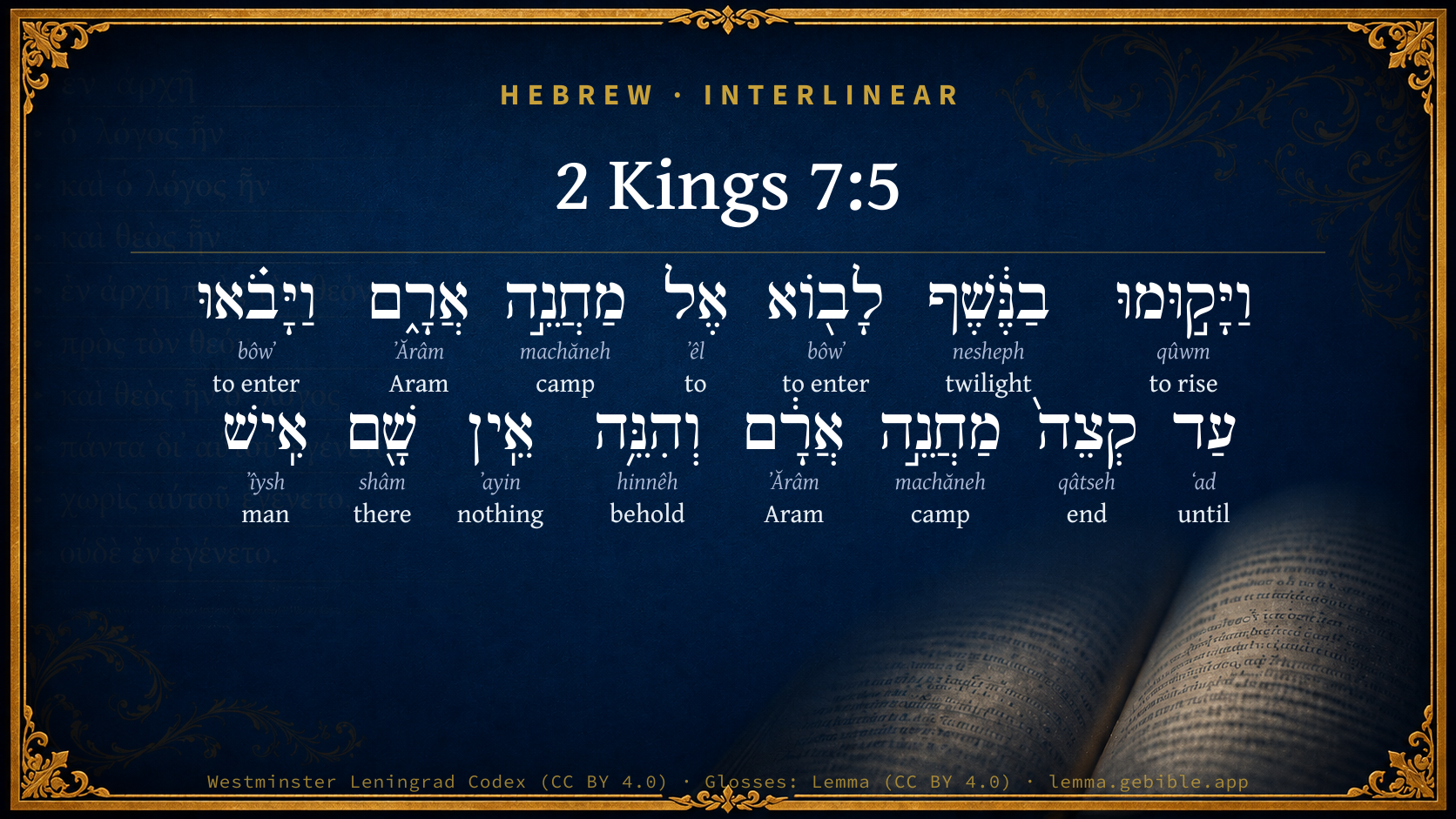
Hebrew (Westminster Leningrad Codex) 2 Kings 7:5 appears in the Hebrew Old Testament. The text above is from the Westminster Leningrad Codex. Each word links to its Strong’s number, a concise gloss, and parsing drawn from the Open Scriptures Hebrew Bible morphology. Click any word for its full Brown-Driver-Briggs (BDB) entry.
Download image
Cite this verse

2 Kings 7:5 (World English Bible). Public Domain. Lemma interlinear Bible study tool, https://lemma.gebible.app/v/2-kings/7/5.

Show BibTeX & RIS
BibTeX
RIS
English Translation
They rose up in the twilight, to go to the camp of the Syrians; and when they were come to the outermost part of the camp of the Syrians, behold, there was no man there.
World English Bible · Public Domain
Download a study sheet

One document with this verse’s original text, its word-by-word gloss line, the meaning frame, cross-references with their text, attributed commentary, and full source and license credits — printable, and it pastes into notes with its structure intact.

This verse Autodidact and up

Study sheet (.html) Plain text (.txt)

A passage Seminary Student

Up to 50 verses in one chapter. A passage sheet keeps up to 6 commentary sources and 12 cross-references per verse, in the order this page ranks them, and says so on the sheet whenever that leaves anything out. Ask for a single verse and you get the Autodidact verse sheet above.

Everything on this page stays free to read, with no account — the sheet is a download of what is already on screen, not access to it.

Want to remove ads? Support Godless Engineer
Compare translations 3

The same verse in 3 English versions, stacked beneath the original-language interlinear above. Click any original word for its lexicon entry.

Each is an independent rendering of the whole verse — the interlinear is not word-aligned to these translations.

Highlighted words mark where these versions differ — a whole-verse word diff, not a word-by-word alignment.

  • World English Bible Public Domain
    They rose up in the twilight, to go to the camp of the Syrians; and when they were come to the outermost part of the camp of the Syrians, behold, there was no man there.
  • King James Version Public Domain
    And they rose up in the twilight, to go unto the camp of the Syrians: and when they were come to the uttermost part of the camp of Syria, behold, there was no man there.
  • unfoldingWord Literal Text CC BY-SA 4.0
    So they arose in the twilight to go to the camp of Aram. And they came to the edge of the camp of Aram, and behold, not a man there.

unfoldingWord Literal Text — © unfoldingWord, licensed CC BY-SA 4.0. Word-aligned USFM3 via Door43 (git.door43.org/unfoldingWord/en_ult).

Versions to compare (up to 4)

3 of 4 selected

Show all 18 translations

Every available English version of this verse, each an independent rendering of the whole verse.

  • World English Bible Public Domain
    They rose up in the twilight, to go to the camp of the Syrians; and when they were come to the outermost part of the camp of the Syrians, behold, there was no man there.
  • Berean Standard Bible Public Domain
    So they arose at twilight and went to the camp of the Arameans. But when they came to the outskirts of the camp, there was not a man to be found.
  • Majority Standard Bible Public Domain
    So they arose at twilight and went to the camp of the Arameans. But when they came to the outskirts of the camp, there was not a man to be found.
  • King James Version Public Domain
    And they rose up in the twilight, to go unto the camp of the Syrians: and when they were come to the uttermost part of the camp of Syria, behold, there was no man there.
  • American Standard Version (1901) Public Domain
    And they rose up in the twilight, to go unto the camp of the Syrians; and when they were come to the outermost part of the camp of the Syrians, behold, there was no man there.
  • Revised Version (1885) Public Domain
    And they rose up in the twilight, to go unto the camp of the Syrians: and when they were come to the outermost part of the camp of the Syrians, behold, there was no man there.
  • Geneva Bible (1599) Public Domain
    So they rose vp in the twilight, to goe to the campe of the Aramites: and when they were come to the vtmost part of the campe of the Aramites, loe, there was no man there.
  • Douay-Rheims (1899) Public Domain
    So they arose in the evening, to go to the Syrian camp, And when they were come to the first part of the camp of the Syrians, they found no man there.
  • Young's Literal Translation Public Domain
    And they rise in the twilight, to go in unto the camp of Aram, and they come in unto the extremity of the camp of Aram, and lo, there is not a man there,
  • Literal Standard Version CC BY-SA 4.0
    And they rise in the twilight, to go to the camp of Aram, and they come to the extremity of the camp of Aram, and behold, there is not a man there,
  • Unlocked Literal Bible CC BY-SA 4.0
    So they rose up at twilight to go into the Aramean camp; when they arrived at the outermost part of the camp, there was no one there.
  • unfoldingWord Literal Text CC BY-SA 4.0
    So they arose in the twilight to go to the camp of Aram. And they came to the edge of the camp of Aram, and behold, not a man there.
  • Darby Bible Public Domain
    And they rose up in the dusk to go to the camp of the Syrians; and they came to the extremity of the camp of the Syrians; and behold, there was no man there.
  • World Messianic Bible Public Domain
    They rose up in the twilight to go to the camp of the Syrians. When they had come to the outermost part of the camp of the Syrians, behold, no man was there.
  • Webster's Bible Public Domain
    And they rose in the twilight to go to the camp of the Syrians: and when they had come to the uttermost part of the camp of Syria, behold, there was no man there.
  • Free Bible Version CC BY-SA 4.0
    So they set off when it was getting dark and went to the camp of the Arameans. But when they arrived at the edge of the camp, nobody was there!
  • Bible in Basic English Public Domain
    So in the half light they got up to go to the tents of Aram; but when they came to the outer line of tents, there was no one there.
  • JPS Tanakh (1917) Public Domain
    And they rose up in the twilight, to go unto the camp of the Arameans; and when they were come to the outermost part of the camp of the Arameans, behold, there was no man there.

Literal Standard Version (2020), Covenant Press — licensed CC BY-SA 4.0. Text via the HelloAO Bible API (eBible.org). Unlocked Literal Bible (unfoldingWord) — licensed CC BY-SA 4.0. Text via the HelloAO Bible API (eBible.org). unfoldingWord Literal Text — © unfoldingWord, licensed CC BY-SA 4.0. Word-aligned USFM3 via Door43 (git.door43.org/unfoldingWord/en_ult). Free Bible Version, Dr. Jonathan Gallagher — licensed CC BY-SA 4.0. Text via the HelloAO Bible API (eBible.org).

Word by word

More ways to search: Search by grammar → Find every occurrence → Compare this word →

Practice this passage: Drill this verse → Learn its vocabulary →

בַנֶּ֔שֶׁף
nesheph
H5399
“in/at the · twilight”
Preposition, Determined + Noun, Common, Masculine, Singular, Absolute
Part of Speech
Preposition + Noun
Type
Common
Gender
Masculine
Number
Singular
State
Absolute
Full BDB Definition

Origin: from H5398

TWOT: 1434a

twilight - evening twilight - morning twilight
  1. וַיָּק֣וּמוּ qûwm H6965 “and · to rise” Conjunction + Verb, Qal, Sequential Imperfect, 3rd Person, Masculine, Plural
  2. לָב֖וֹא bôwʼ H935 “to enter” Preposition + Verb, Qal, Infinitive Construct
  3. אֶל ʼêl H413 “to” Preposition
  4. מַחֲנֵ֣ה machăneh H4264 “camp of” Noun, Common, Both, Singular, Construct
  5. אֲרָ֑ם ʼĂrâm H758 “Aram” Noun, Proper
  6. וַיָּבֹ֗אוּ bôwʼ H935 “and · to enter” Conjunction + Verb, Qal, Sequential Imperfect, 3rd Person, Masculine, Plural
  7. עַד ʻad H5704 “until” Preposition
  8. קְצֵה֙ qâtseh H7097 “end of” Noun, Common, Both, Singular, Construct
  9. מַחֲנֵ֣ה machăneh H4264 “camp of” Noun, Common, Both, Singular, Construct
  10. אֲרָ֔ם ʼĂrâm H758 “Aram” Noun, Proper
  11. וְהִנֵּ֥ה hinnêh H2009 “and · behold” Conjunction + Particle, Demonstrative
  12. אֵֽין ʼayin H369 “nothing” Particle, Negative
  13. שָׁ֖ם shâm H8033 “there” Adverb
  14. אִֽישׁ ʼîysh H376 “man” Noun, Common, Masculine, Singular, Absolute

About this verse

These counts appear in no published source. They are computed here, from the morphology-tagged text and Lemma’s own curated glosses. What Lemma adds →

15
words
12
distinct lemmas
Historical
section

Notable vocabulary

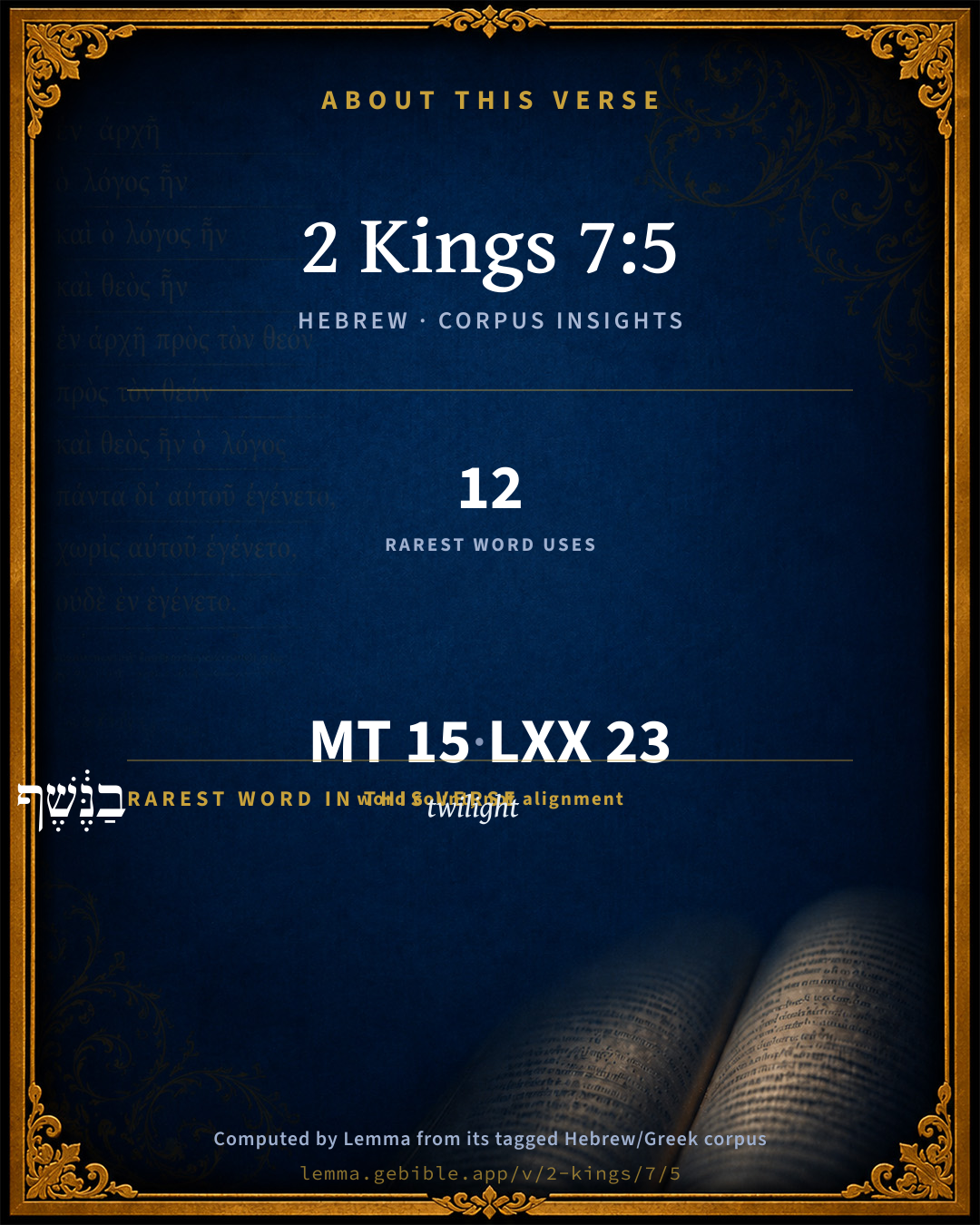
The rarest word here is בַנֶּ֔שֶׁף twilight H5399 — appearing just 12 times in the whole Hebrew Bible.

Shared distinctive vocabulary

בַנֶּ֔שֶׁף twilight H5399 occurs in 12 verses of the Hebrew Bible. Also found in:

Grammatical profile

  • 3 verbs
  • 7 nouns
  • 2 prepositions
  • 1 adverb
  • 2 particles

Verb forms

  • וַיָּק֣וּמוּ Qal · Sequential Imperfect
  • לָב֖וֹא Qal · Infinitive Construct
  • וַיָּבֹ֗אוּ Qal · Sequential Imperfect

Repetition

Words recur within this verse — often emphatic in Hebrew:

  • לָב֖וֹא to enter H935 ×2
  • מַחֲנֵ֣ה camp H4264 ×2
  • אֲרָ֑ם Aram H758 ×2

Hebrew & Septuagint length

In English translation the verse runs 35 words from the Hebrew and 34 from the Septuagint (LXX English) — closely comparable.

A rough comparison of the two English renderings, which tokenize alike — not a word-level alignment.

Word counts can differ between the Hebrew and the Greek without any difference in meaning — e.g. the Hebrew direct-object marker אֵת has no separate Greek word, and Greek often adds the article ὁ.

In the original languages it is 15 Hebrew tokens and 23 Greek tokens — but the two are counted differently (Hebrew bundles its prefixes and suffixes into one token; the Greek is in lemma form), so that isn’t a like-for-like length.

Cross-references

8

Topical passages linked to 2 Kings 7:5 in the Treasury of Scripture Knowledge — connected by theme and wording, ordered by reader-vote popularity; previews shown in the World English Bible.

  • Deuteronomy 28:7 Yahweh will cause your enemies who rise up against you to be struck before you: they shall come out against you one way, and shall flee before you seven ways.
  • Leviticus 27:8 But if he is poorer than your valuation, then he shall be set before the priest, and the priest shall value him; according to the ability of him who vowed shall the priest value him.
  • Leviticus 27:26 "'Only the firstborn among animals, which is made a firstborn to Yahweh, no man may dedicate it; whether an ox or sheep, it is Yahweh's.
  • Deuteronomy 32:25 Outside shall the sword bereave, In the chambers terror; [It shall destroy] both young man and virgin, The suckling with the man of gray hairs.
  • Deuteronomy 32:30 How should one chase a thousand, Two put ten thousand to flight, Except their Rock had sold them, Yahweh had delivered them up?
  • 1 Samuel 30:17 David struck them from the twilight even to the evening of the next day: and there not a man of them escaped, except four hundred young men, who rode on camels and fled.
  • Ezekiel 12:6–7 In their sight shall you bear it on your shoulder, and carry it forth in the dark; you shall cover your face, that you don't see the land: for I have set you for a sign to the house of Israel.
  • Ezekiel 12:12 The prince who is among them shall bear on his shoulder in the dark, and shall go forth: they shall dig through the wall to carry out thereby: he shall cover his face, because he shall not see the land with his eyes.

Cross-references courtesy of OpenBible.info (CC BY 4.0).

Hebrew and Greek witnesses Masoretic Hebrew ↔ Greek Septuagint

The same verse in the two great witnesses to the Old Testament, shown verse-for-verse.

These are two independent witnesses, not word-aligned to each other, and the Septuagint is shown in lemma (dictionary) form.

Hebrew 2 Kings 7:5 Masoretic · Westminster Leningrad Codex

וַיָּק֣וּמוּ בַנֶּ֔שֶׁף לָב֖וֹא אֶל מַחֲנֵ֣ה אֲרָ֑ם וַיָּבֹ֗אוּ עַד קְצֵה֙ מַחֲנֵ֣ה אֲרָ֔ם וְהִנֵּ֥ה אֵֽין שָׁ֖ם אִֽישׁ

They rose up in the twilight, to go to the camp of the Syrians; and when they were come to the outermost part of the camp of the Syrians, behold, there was no man there.

World English Bible · Public Domain

Greek LXX 2 Kings 7:5 Septuagint · lemma form

καί ἀναἵστημι ἐν ὁ σκότος εἰςἔρχομαι εἰς ὁ παρεμβολή συρία καί ἔρχομαι εἰς μέρος ὁ παρεμβολή συρία καί ἰδού οὐ εἰμί ἀνήρ ἐκεῖ

And they rose up while it was yet night, to go into the camp of Syria; and they came into a part of the camp of Syria, and behold, there was no man there.

LXX2012 (modern English Septuagint) · Public Domain

Hebrew: Westminster Leningrad Codex (CC BY 4.0). Greek: Septuagint (public domain); English from LXX2012 (modern English Septuagint) (Public Domain). How the Septuagint differs from the Hebrew →

Targum (Aramaic paraphrase)

1

The Targum is the ancient Jewish Aramaic paraphrase of the Hebrew Scriptures — an interpretive translation, not the Hebrew text itself. Onkelos (literal) and Pseudo-Jonathan (expansive) render the Torah, and Jonathan the Prophets. Coverage is partial: where no permissively-licensed English translation exists for a verse, only the Aramaic is shown. This is verse-level text, not a word-by-word alignment to the Hebrew.

  1. Targum Jonathan Prophets (Joshua–Malachi)
    וְקָמוּ בְקִבְלָא לְמֵיעַל לְמַשִׁרְיַת אֲרַם וַאֲתוֹ עַד סְיָפֵי מַשִׁרְיַת אֲרָם וְהָא לֵית תַּמָן אֱנָשׁ:

    (no public-domain English translation for this verse)

    Targum Jonathan — Aramaic: “Mikraot Gedolot” (public domain). English: “Sefaria Community Translation” (CC0 1.0 (public-domain dedication)); “London "Chaldee Paraphrase," 1871” (public domain). Text via Sefaria.

Commentary

Notes on 2 Kings 7:5 from classic Christian and Jewish commentators (each source and its license shown beneath its notes). The classic Christian expositions comment on the surrounding passage and are grouped to its opening verse, so a note may address several verses; the Jewish commentaries on the Tanakh (Rashi and others) are per-verse, so they appear only where the commentator wrote on this verse.

Lemma curates 59 commentaries, every one of them public domain or Creative Commons licensed, each selected and text-cleaned for this edition rather than reprinted as found. About our sources →

Trapp's Complete Commentary

John Trapp

2Ki 7:5 And they rose up in the twilight, to go unto the camp of the Syrians: and when they were come to the uttermost part of the camp of Syria, behold, [there was] no man there.

Ver. 5. And they rose up in the twilight.] In the evening twilight, {2Ki 7:9; 2Ki 7:12} the Syrians being fled but a little before. {2Ki 7:7}

John Trapp, A Commentary or Exposition upon All the Books of the Old and New Testament (1647–1656) — public domain. Text from a community e-Sword module.

Tyndale Open Study Notes

Tyndale Open Resources

7:5-7 The Hittites had settled in the areas just north of Aram and were often in conflict with the Arameans.

Tyndale Open Study Notes — © Tyndale Open Resources, licensed CC BY-SA 4.0. Text via the HelloAO Bible API.

Jamieson, Fausset & Brown

Robert Jamieson, A. R. Fausset & David Brown

they rose up in the twilight--that is, the evening twilight (Kg2 7:12).

the uttermost part of the camp of Syria--that is, the extremity nearest the city.

Jamieson, Fausset & Brown — Commentary Critical and Explanatory on the Whole Bible (1871) — public domain (CC PDM 1.0). Text via the HelloAO Bible API.

Adam Clarke's Commentary

Verse 5. The uttermost part of the camp] Where the Syrian advanced guards should have been.

Adam Clarke's Commentary on the Bible (1810–1826) — public domain. Text from a community e-Sword/MySword module.

Ellicott's Commentary for English Readers

(5) In the twilight—i.e., at nightfall. (See 2Ki_7:9; 2Ki_7:12.) They waited till then, that their departure might not be noticed from the walls.

The uttermost part—i.e., the outskirts or verge of the camp nearest to Samaria.

A Bible Commentary for English Readers, edited by Charles John Ellicott (1878–1897) — public domain. Text from a community e-Sword module.

The Cambridge Bible for Schools and Colleges

gen. ed. J. J. S. Perowne

5. in the twilight] This must be evening twilight. For in verse 9 they blame themselves for tarrying until morning light, and it was in the night (verse 12) that Jehoram was roused by the news that the Syrian camp was vacated.

to the uttermost [R.V. outermost] part of the camp of Syria] R.V. the Syrians. The portion meant is that which was nearest to them, but ‘uttermost’ has lost that sense now, and would be taken to signify the ‘farthest portion’. Hence the change here and in verse 8. The Hebrew word for Syria is Aram, which is used alike for the country and the people; and since it is rendered ‘Syrians’ in the first clause of this verse, and in other places of the chapter, there is no need why it should be otherwise translated here.

The Cambridge Bible for Schools and Colleges (gen. ed. J. J. S. Perowne; Cambridge University Press, 1878–1918) — public domain. Text from a community e-Sword module.

John Gill's Exposition

And they rose up in the twilight, to go unto the camp of the Syrians,...., The dusk of the evening, or the evening twilight, as appears from Kg2 7:9,

and when they were come to the uttermost part of the camp of Syria; not the further part of it, but the edge or border of it nearest to them:

behold, there was no man there; no sentinel or guard, which they expected, and to whom they would have surrendered themselves.

John Gill's Exposition of the Whole Bible (1746–1763) — public domain (CC PDM 1.0). Text via the HelloAO Bible API.

Albert Barnes' Notes on the Bible

The twilight - The evening twilight (see 2Ki 7:9).

The uttermost part of the camp - The extreme boundary of the camp toward the city, not its furthest or most distant portion. Compare 2Ki 7:8.

Albert Barnes' Notes on the Bible (1834–1885) — public domain. Text from a community e-Sword/MySword module.

Haydock's Catholic Bible Commentary

Evening. Hebrew, "twilight." --- First part, where the advanced guard should be, or the nearest tents.

George Leo Haydock (1774–1849), Haydock's Catholic Family Bible and Commentary, 1859 edition — public domain. Excludes Psalms (Douay-Rheims chapter numbering differs from Protestant) and Deuterocanonical books (Catholic canon only).

Matthew Poole's English Annotations

in the twilight; in the evening twilight, as appears from 2Ki 7:9,12.

Matthew Poole's English Annotations on the Holy Bible (1683–1685) — public domain. Text from a community e-Sword/MySword module.

The Pulpit Commentary

And they rose up in the twilight. Most certainly in the evening twilight, as soon as the sun was down (see ver. 9). Had they set off in the daytime, the garrison would have shot at them from the walls. To go unto the camp of the Syrians: and when they were come to the uttermost part i.e. the most advanced part, that which was nearest to Samariaof the camp of Syria, behold, there was no man there. The camp was empty, deserted. Not a soul was anywhere to be seen.

The Pulpit Commentary (1880–1919), ed. H.D.M. Spence-Jones & Joseph S. Exell — public domain. Text from a community e-Sword module.

unfoldingWord translationNotes

Door43 World Missions Community

at twilight

This refers to the early evening after the sun has set, but before it is dark.

the outermost part

"the edge"

the Aramean army hear a noise of chariots, and a noise of horses—the noise of another large army

The soldiers of the Aramean army heard noises that sounded like a large army approaching to battle them. This was not an actual army, but the Lord had made them hear these sounds.

they said to each other

"the Aramean soldiers said to each other"

the kings of the Hittites and Egyptians

Here the word "kings" represents the kings and their armies. AT: "the armies of the Hittites and the Egyptians" (See: Synecdoche)

to come against us

"to fight us" or "to attack us"

translationWords

lord

chariot

horse

kingdom of Israel

Hittite

Egypt

unfoldingWord translationNotes — © Distant Shores Media and the Door43 World Missions Community, licensed CC BY-SA 4.0. Source: git.door43.org/Door43/en_tn.

Lesson kit

Teaching starters — assembled from the data on this page, not authored interpretation. Every prompt links to the verse data it draws on. Edit before teaching.

2 Kings, in the Historical, opens this verse with 15 words (12 distinct Hebrew lemmas). Its most distinctive word is nesheph (“twilight”). A historical commentator’s framing appears above. Read the whole chapter for the surrounding context.

Discussion questions

  1. What does “twilight” (nesheph) contribute to the verse as a whole?
  2. 1 Samuel 30:17 shares the word «twilight» with this verse. How do the two illuminate each other?
  3. “to enter” occurs 2× in this one verse. What is the effect of the repetition?
  4. These translations render this verse differently; the difference is in the English rendering, not the original. What questions does that raise?
  5. The verb «וַיָּק֣וּמוּ» is Qal Sequential Imperfect. How does its form color the action?
  6. Reading how Trapp's Complete Commentary and Tyndale Open Study Notes read this verse, where do the two commentators agree and where do they part?

Things to notice

Reading settings

Reading text

Shown beneath each verse's original-language words.

Old Testament
Old Testament edition

Read the OT as the Masoretic Hebrew (MT) or the Greek Septuagint (LXX).

English shown for the Greek Septuagint (in the Hebrew ↔ Greek comparison).

Comparing translations? Open the Compare panel on any verse page to stack up to four side by side.