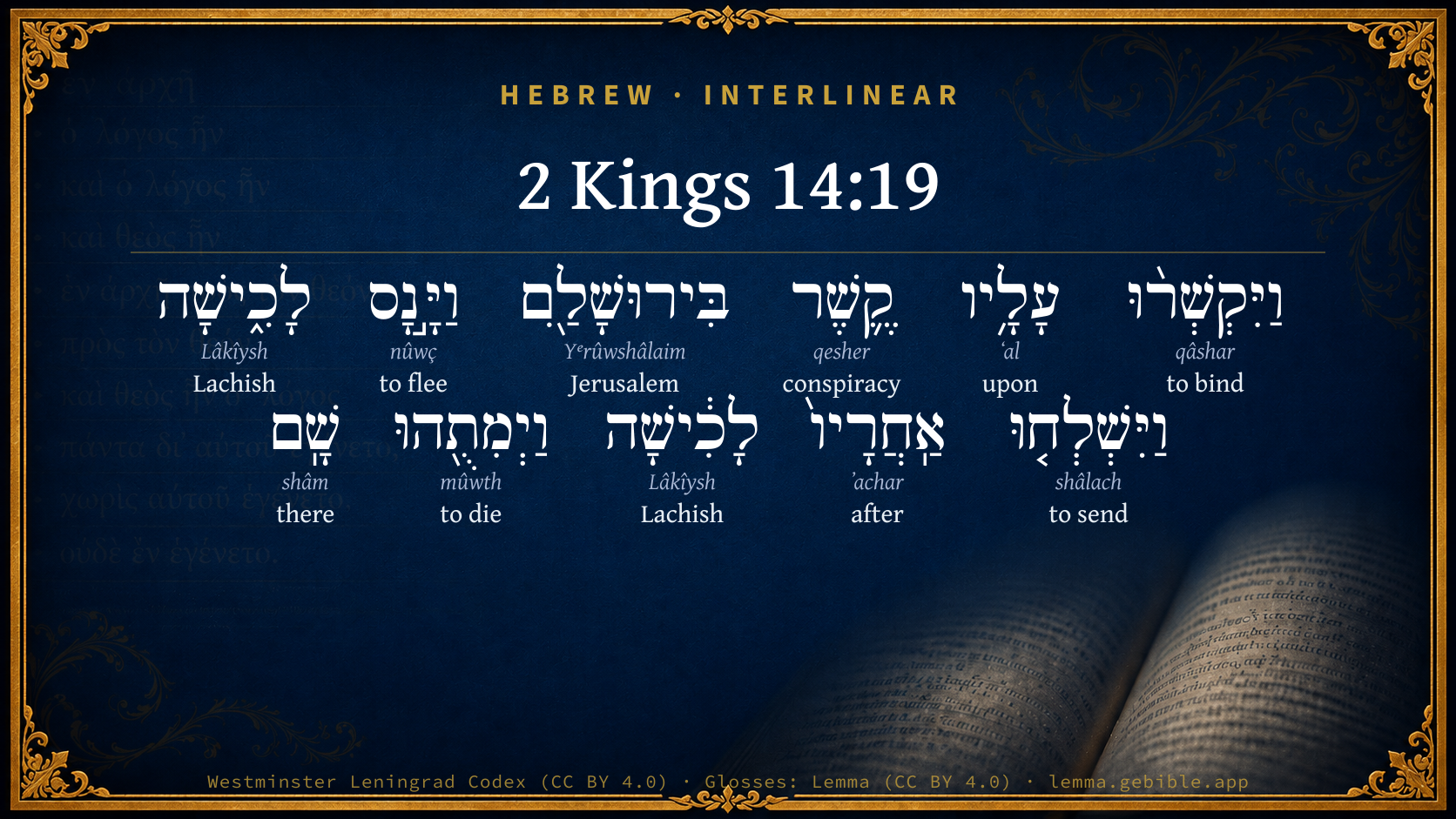
2 Kings 14:19

Hebrew (Westminster Leningrad Codex) 2 Kings 14:19 appears in the Hebrew Old Testament. The text above is from the Westminster Leningrad Codex. Each word links to its Strong’s number, a concise gloss, and parsing drawn from the Open Scriptures Hebrew Bible morphology. Click any word for its full Brown-Driver-Briggs (BDB) entry.
Download image
Cite this verse

2 Kings 14:19 (World English Bible). Public Domain. Lemma interlinear Bible study tool, https://lemma.gebible.app/v/2-kings/14/19.

Show BibTeX & RIS
BibTeX
RIS
English Translation
They made a conspiracy against him in Jerusalem; and he fled to Lachish: but they sent after him to Lachish, and killed him there.
World English Bible · Public Domain
Download a study sheet

One document with this verse’s original text, its word-by-word gloss line, the meaning frame, cross-references with their text, attributed commentary, and full source and license credits — printable, and it pastes into notes with its structure intact.

This verse Autodidact and up

Study sheet (.html) Plain text (.txt)

A passage Seminary Student

Up to 50 verses in one chapter. A passage sheet keeps up to 6 commentary sources and 12 cross-references per verse, in the order this page ranks them, and says so on the sheet whenever that leaves anything out. Ask for a single verse and you get the Autodidact verse sheet above.

Everything on this page stays free to read, with no account — the sheet is a download of what is already on screen, not access to it.

Want to remove ads? Support Godless Engineer
Compare translations 3

The same verse in 3 English versions, stacked beneath the original-language interlinear above. Click any original word for its lexicon entry.

Each is an independent rendering of the whole verse — the interlinear is not word-aligned to these translations.

Highlighted words mark where these versions differ — a whole-verse word diff, not a word-by-word alignment.

  • World English Bible Public Domain
    They made a conspiracy against him in Jerusalem; and he fled to Lachish: but they sent after him to Lachish, and killed him there.
  • King James Version Public Domain
    Now they made a conspiracy against him in Jerusalem: and he fled to Lachish; but they sent after him to Lachish, and slew him there.
  • unfoldingWord Literal Text CC BY-SA 4.0
    And they conspired a conspiracy against him in Jerusalem, and he fled to Lachish. But they sent after him to Lachish, and they killed him there.

unfoldingWord Literal Text — © unfoldingWord, licensed CC BY-SA 4.0. Word-aligned USFM3 via Door43 (git.door43.org/unfoldingWord/en_ult).

Versions to compare (up to 4)

3 of 4 selected

Show all 18 translations

Every available English version of this verse, each an independent rendering of the whole verse.

  • World English Bible Public Domain
    They made a conspiracy against him in Jerusalem; and he fled to Lachish: but they sent after him to Lachish, and killed him there.
  • Berean Standard Bible Public Domain
    And conspirators plotted against Amaziah in Jerusalem, and he fled to Lachish. But men were sent after him to Lachish, and they killed him there.
  • Majority Standard Bible Public Domain
    And conspirators plotted against Amaziah in Jerusalem, and he fled to Lachish. But men were sent after him to Lachish, and they killed him there.
  • King James Version Public Domain
    Now they made a conspiracy against him in Jerusalem: and he fled to Lachish; but they sent after him to Lachish, and slew him there.
  • American Standard Version (1901) Public Domain
    And they made a conspiracy against him in Jerusalem; and he fled to Lachish: but they sent after him to Lachish, and slew him there.
  • Revised Version (1885) Public Domain
    And they made a conspiracy against him in Jerusalem; and he fled to Lachish: but they sent after him to Lachish, and slew him there.
  • Geneva Bible (1599) Public Domain
    But they wrought treason against him in Ierusalem, and he fled to Lachish, but they sent after him to Lachish, and slewe him there.
  • Douay-Rheims (1899) Public Domain
    Now they made a conspiracy against him in Jerusalem: and he fled to Lachis. And they sent after him to Lachis, and killed him there.
  • Young's Literal Translation Public Domain
    And they make a conspiracy against him in Jerusalem, and he fleeth to Lachish, and they send after him to Lachish, and put him to death there,
  • Literal Standard Version CC BY-SA 4.0
    And they make a conspiracy against him in Jerusalem, and he flees to Lachish, and they send after him to Lachish, and put him to death there,
  • Unlocked Literal Bible CC BY-SA 4.0
    They made a conspiracy against Amaziah in Jerusalem, and he fled to Lachish. He fled to Lachish, but they sent men after him to Lachish and killed him there.
  • unfoldingWord Literal Text CC BY-SA 4.0
    And they conspired a conspiracy against him in Jerusalem, and he fled to Lachish. But they sent after him to Lachish, and they killed him there.
  • Darby Bible Public Domain
    And they made a conspiracy against him in Jerusalem; and he fled to Lachish; and they sent after him to Lachish, and slew him there.
  • World Messianic Bible Public Domain
    They made a conspiracy against him in Jerusalem, and he fled to Lachish; but they sent after him to Lachish and killed him there.
  • Webster's Bible Public Domain
    Now they made a conspiracy against him in Jerusalem: and he fled to Lachish; but they sent after him to Lachish, and slew him there.
  • Free Bible Version CC BY-SA 4.0
    A conspiracy against Amaziah took place in Jerusalem, and he ran away to Lachish. But men were sent after him and they murdered him there.
  • Bible in Basic English Public Domain
    Now they made a secret design against him in Jerusalem; and he went in flight to Lachish, but they sent after him to Lachish and put him to death there.
  • JPS Tanakh (1917) Public Domain
    And they made a conspiracy against him in Jerusalem; and he fled to Lachish; but they sent after him to Lachish, and slew him there.

Literal Standard Version (2020), Covenant Press — licensed CC BY-SA 4.0. Text via the HelloAO Bible API (eBible.org). Unlocked Literal Bible (unfoldingWord) — licensed CC BY-SA 4.0. Text via the HelloAO Bible API (eBible.org). unfoldingWord Literal Text — © unfoldingWord, licensed CC BY-SA 4.0. Word-aligned USFM3 via Door43 (git.door43.org/unfoldingWord/en_ult). Free Bible Version, Dr. Jonathan Gallagher — licensed CC BY-SA 4.0. Text via the HelloAO Bible API (eBible.org).

Word by word

More ways to search: Search by grammar → Find every occurrence → Compare this word →

Practice this passage: Drill this verse → Learn its vocabulary →

קֶ֛שֶׁר
qesher
H7195
“conspiracy”
Noun, Common, Masculine, Singular, Absolute
Part of Speech
Noun
Type
Common
Gender
Masculine
Number
Singular
State
Absolute
Full BDB Definition

Origin: from H7194

TWOT: 2090a

conspiracy, treason, (unlawful) alliance
  1. וַיִּקְשְׁר֨וּ qâshar H7194 “and · to bind” Conjunction + Verb, Qal, Sequential Imperfect, 3rd Person, Masculine, Plural
  2. עָלָ֥יו ʻal H5921 “upon · him” Preposition + Suffix, Personal, 3rd Person, Masculine, Singular
  3. בִּירוּשָׁלִַ֖ם Yᵉrûwshâlaim H3389 “in/at · Jerusalem” Preposition + Noun, Proper
  4. וַיָּ֣נָס nûwç H5127 “and · to flee” Conjunction + Verb, Qal, Sequential Imperfect, 3rd Person, Masculine, Singular
  5. לָכִ֑ישָׁה Lâkîysh H3923 “Lachish · toward” Noun, Proper + Suffix, Demonstrative
  6. וַיִּשְׁלְח֤וּ shâlach H7971 “and · to send” Conjunction + Verb, Qal, Sequential Imperfect, 3rd Person, Masculine, Plural
  7. אַֽחֲרָיו֙ ʼachar H310 “after · him” Preposition + Suffix, Personal, 3rd Person, Masculine, Singular
  8. לָכִ֔ישָׁה Lâkîysh H3923 “Lachish · toward” Noun, Proper + Suffix, Demonstrative
  9. וַיְמִתֻ֖הוּ mûwth H4191 “and · to die · him” Conjunction + Verb, Hiphil, Sequential Imperfect, 3rd Person, Masculine, Plural + Suffix, Personal, 3rd Person, Masculine, Singular
  10. שָֽׁם shâm H8033 “there” Adverb

About this verse

These counts appear in no published source. They are computed here, from the morphology-tagged text and Lemma’s own curated glosses. What Lemma adds →

11
words
10
distinct lemmas
Historical
section

Notable vocabulary

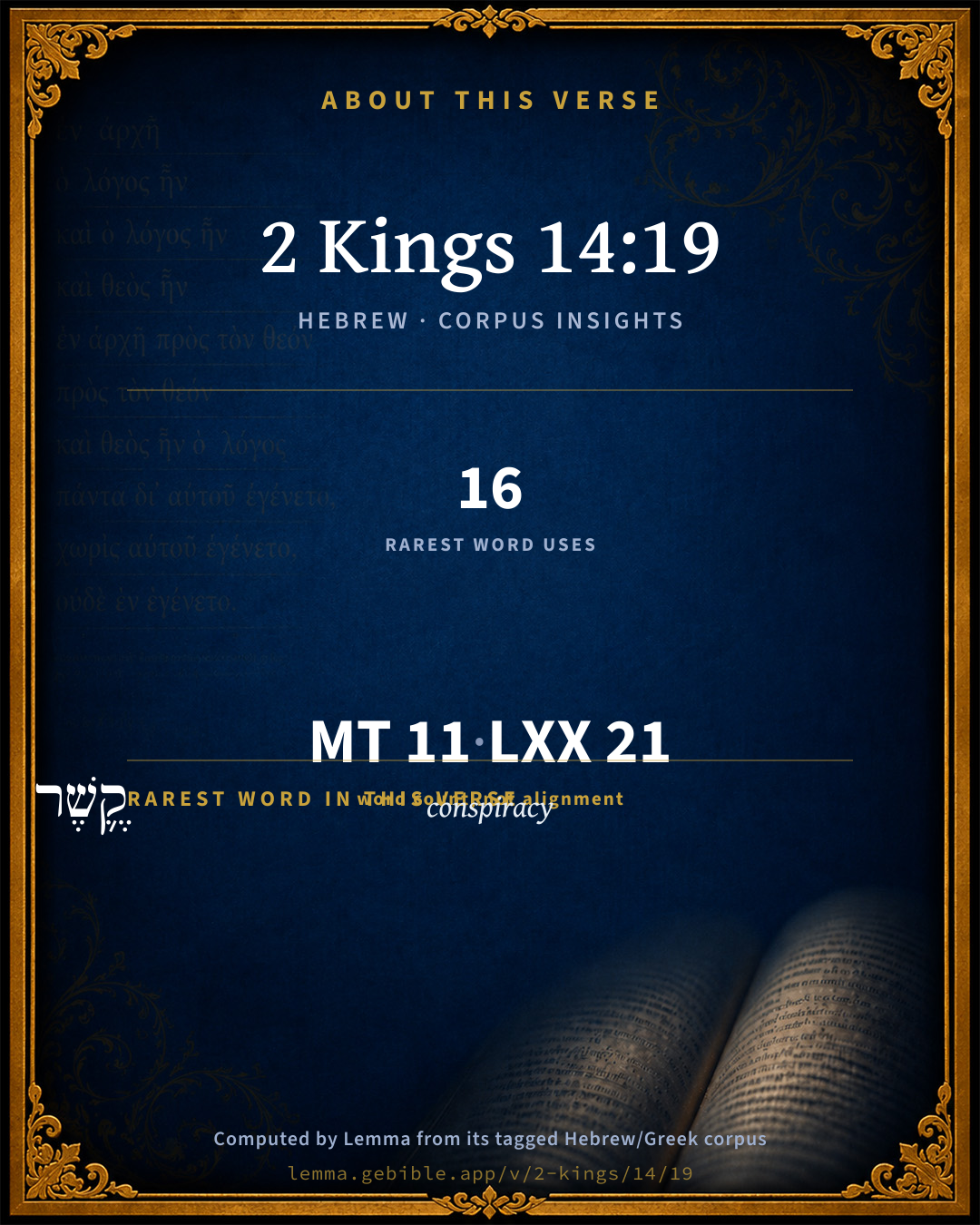
The rarest word here is קֶ֛שֶׁר conspiracy H7195 — appearing just 16 times in the whole Hebrew Bible.

Shared distinctive vocabulary

קֶ֛שֶׁר conspiracy H7195 occurs in 13 verses of the Hebrew Bible. Also found in:

Grammatical profile

  • 4 verbs
  • 4 nouns
  • 2 prepositions
  • 1 adverb

Verb forms

  • וַיִּקְשְׁר֨וּ Qal · Sequential Imperfect
  • וַיָּ֣נָס Qal · Sequential Imperfect
  • וַיִּשְׁלְח֤וּ Qal · Sequential Imperfect
  • וַיְמִתֻ֖הוּ Hiphil · Sequential Imperfect

Repetition

A word recurs within this verse — often emphatic in Hebrew:

  • לָכִ֑ישָׁה Lachish H3923 ×2

Hebrew & Septuagint length

In English translation the verse runs 24 words from the Hebrew and 25 from the Septuagint (LXX English) — closely comparable.

A rough comparison of the two English renderings, which tokenize alike — not a word-level alignment.

Word counts can differ between the Hebrew and the Greek without any difference in meaning — e.g. the Hebrew direct-object marker אֵת has no separate Greek word, and Greek often adds the article ὁ.

In the original languages it is 11 Hebrew tokens and 21 Greek tokens — but the two are counted differently (Hebrew bundles its prefixes and suffixes into one token; the Greek is in lemma form), so that isn’t a like-for-like length.

Cross-references

12

Topical passages linked to 2 Kings 14:19 in the Treasury of Scripture Knowledge — connected by theme and wording, ordered by reader-vote popularity; previews shown in the World English Bible.

  • Joshua 10:31 Joshua passed from Libnah, and all Israel with him, to Lachish, and encamped against it, and fought against it:
  • Joshua 10:3 Therefore Adoni-zedek king of Jerusalem sent to Hoham king of Hebron, and to Piram king of Jarmuth, and to Japhia king of Lachish, and to Debir king of Eglon, saying,
  • 2 Kings 12:20–21 His servants arose, and made a conspiracy, and struck Joash at the house of Millo, [on the way] that goes down to Silla.
  • 2 Kings 15:10 Shallum the son of Jabesh conspired against him, and struck him before the people, and killed him, and reigned in his place.
  • 2 Kings 15:14 Menahem the son of Gadi went up from Tirzah, and came to Samaria, and struck Shallum the son of Jabesh in Samaria, and killed him, and reigned in his place.
  • 2 Kings 15:25 Pekah the son of Remaliah, his captain, conspired against him, and struck him in Samaria, in the castle of the king's house, with Argob and Arieh; and with him were fifty men of the Gileadites: and he killed him, and reigned in his place.
  • 2 Kings 15:30 Hoshea the son of Elah made a conspiracy against Pekah the son of Remaliah, and struck him, and killed him, and reigned in his place, in the twentieth year of Jotham the son of Uzziah.
  • 2 Kings 18:14 Hezekiah king of Judah sent to the king of Assyria to Lachish, saying, I have offended; return from me: that which you put on me will I bear. The king of Assyria appointed to Hezekiah king of Judah three hundred talents of silver and thirty talents of gold.
  • 2 Kings 18:17 The king of Assyria sent Tartan and Rabsaris and Rabshakeh from Lachish to king Hezekiah with a great army to Jerusalem. They went up and came to Jerusalem. When they were come up, they came and stood by the conduit of the upper pool, which is in the highway of the fuller's field.
  • 2 Kings 21:23 The servants of Amon conspired against him, and put the king to death in his own house.
  • 2 Chronicles 25:27–28 Now from the time that Amaziah did turn away from following Yahweh they made a conspiracy against him in Jerusalem; and he fled to Lachish: but they sent after him to Lachish, and killed him there.
  • Micah 1:13 Harness the chariot to the swift steed, inhabitant of Lachish. She was the beginning of sin to the daughter of Zion; For the transgressions of Israel were found in you.

Cross-references courtesy of OpenBible.info (CC BY 4.0).

Hebrew and Greek witnesses Masoretic Hebrew ↔ Greek Septuagint

The same verse in the two great witnesses to the Old Testament, shown verse-for-verse.

These are two independent witnesses, not word-aligned to each other, and the Septuagint is shown in lemma (dictionary) form.

Hebrew 2 Kings 14:19 Masoretic · Westminster Leningrad Codex

וַיִּקְשְׁר֨וּ עָלָ֥יו קֶ֛שֶׁר בִּירוּשָׁלִַ֖ם וַיָּ֣נָס לָכִ֑ישָׁה וַיִּשְׁלְח֤וּ אַֽחֲרָיו֙ לָכִ֔ישָׁה וַיְמִתֻ֖הוּ שָֽׁם

They made a conspiracy against him in Jerusalem; and he fled to Lachish: but they sent after him to Lachish, and killed him there.

World English Bible · Public Domain

Greek LXX 2 Kings 14:19 Septuagint · lemma form

καί συνστρέφω ἐπί αὐτός σύστρεμμα ἐν ἰερουσαλήμ καί φεύγω εἰς λαχις καί ἀποστέλλω ὀπίσω αὐτός εἰς λαχις καί θανατόω αὐτός ἐκεῖ

And they formed a conspiracy against him in Jerusalem, and he fled to Lachis: and they sent after him to Lachis, and killed him there.

LXX2012 (modern English Septuagint) · Public Domain

Hebrew: Westminster Leningrad Codex (CC BY 4.0). Greek: Septuagint (public domain); English from LXX2012 (modern English Septuagint) (Public Domain). How the Septuagint differs from the Hebrew →

Targum (Aramaic paraphrase)

1

The Targum is the ancient Jewish Aramaic paraphrase of the Hebrew Scriptures — an interpretive translation, not the Hebrew text itself. Onkelos (literal) and Pseudo-Jonathan (expansive) render the Torah, and Jonathan the Prophets. Coverage is partial: where no permissively-licensed English translation exists for a verse, only the Aramaic is shown. This is verse-level text, not a word-by-word alignment to the Hebrew.

  1. Targum Jonathan Prophets (Joshua–Malachi)
    וּמְרָדוּ עֲלוֹהִי מֵירְדָא בִּירוּשְׁלֵם וְאַפֵיךְ לְלָכִישׁ וּשְׁלָחוּ בַּתְרוֹהִי לְלָכִישׁ וְקַטְלוֹהִי תַּמָן:

    (no public-domain English translation for this verse)

    Targum Jonathan — Aramaic: “Mikraot Gedolot” (public domain). English: “Sefaria Community Translation” (CC0 1.0 (public-domain dedication)); “London "Chaldee Paraphrase," 1871” (public domain). Text via Sefaria.

Commentary

Notes on 2 Kings 14:19 from classic Christian and Jewish commentators (each source and its license shown beneath its notes). The classic Christian expositions comment on the surrounding passage and are grouped to its opening verse, so a note may address several verses; the Jewish commentaries on the Tanakh (Rashi and others) are per-verse, so they appear only where the commentator wrote on this verse.

Lemma curates 59 commentaries, every one of them public domain or Creative Commons licensed, each selected and text-cleaned for this edition rather than reprinted as found. About our sources →

Trapp's Complete Commentary

John Trapp

2Ki 14:19 Now they made a conspiracy against him in Jerusalem: and he fled to Lachish; but they sent after him to Lachish, and slew him there.

Ver. 19. Now they made a conspiracy.] The people generally did, because he had, by challenging Jehoash, subjected them to so much misery, and did, after that overthrow, spend his time idly and basely, serving false gods, &c. That he repented, is very uncertain, and upon weak grounds concluded.

John Trapp, A Commentary or Exposition upon All the Books of the Old and New Testament (1647–1656) — public domain. Text from a community e-Sword module.

Joseph Benson's Commentary

2Ki 14:19-20. They made a conspiracy against him — That is, the people, and princes, and chief men among them did this; possibly those whose sons he had delivered up as hostages to Jehoash. It is likely this conspiracy was formed with the connivance, if not approbation, of the people, because the design was carried on openly, steadily, and irresistibly, as the following words show. “What provoked the people of Jerusalem, more than any other part of the nation, against their king, was the seeing their city spoiled of its best ornaments, exposed to reproach on account of the great breach made in their wall, and several of their children carried away as hostages for their good behaviour; all which they imputed to their king’s mal- administrations,” and hence they entered into this conspiracy against him. And he fled to Lachish — A strong city in Judah, toward the country of the Philistines. How long he continued concealed or sheltered there we are not told. Some commentators have conjectured, “that he lived in a state of exile in that city for twelve years, not bearing to continue in Jerusalem after the defeat which Jehoash had given him. But our learned Usher has placed this conspiracy in the last year of Amaziah’s reign; and Capellus supposes that it was set on foot by the great men of Jerusalem, on the specious pretence of being guardians to the young prince, and taking better care of him than his father was likely to do.” — Dodd. They — His rebellious subjects; sent after him to Lachish — Sent, some think, secret murderers, but, more probably, bands of soldiers, for this rebellion was carried on with a strong hand and open force. And they brought him on horses — Or, with horses, namely, in a chariot; and he was buried at Jerusalem — For the rage of the rebels was not extended beyond his death, nor did they deny him a burial with his ancestors.

Joseph Benson's Commentary on the Old and New Testaments (1811–1818) — public domain. Text from a community e-Sword module.

Tyndale Open Study Notes

Tyndale Open Resources

14:19-20 Like his father Joash (12:20-21), Amaziah was killed by assassins. The Chronicler blames his spiritual infidelity for the conspiracy against him (2 Chr 25:27). • Lachish, southwest of Jerusalem, was the site of an important victory by King Sennacherib of Assyria during his invasion of Judah in 701 BC (2 Kgs 18:14). It was also seized during Nebuchadnezzar II’s advance against Jerusalem in 588 BC (Jer 34:7).

Tyndale Open Study Notes — © Tyndale Open Resources, licensed CC BY-SA 4.0. Text via the HelloAO Bible API.

Geneva Bible (1599)

Geneva Bible translators

Which city Rehoboam built in Judah for a fortress, 2 Chron. 11:9.

Geneva Bible (1599) marginal notes — public domain. Text via Bolls.life.

Jamieson, Fausset & Brown

Robert Jamieson, A. R. Fausset & David Brown

HE IS SLAIN BY A CONSPIRACY. (Kg2 14:17-20)

they made a conspiracy against him in Jerusalem--Amaziah's apostasy (Ch2 25:27) was followed by a general maladministration, especially the disastrous issue of the war with Israel. The ruinous condition of Jerusalem, the plunder of the temple, and the loss of their children who were taken as hostages [Kg2 14:13-14], lost him the respect and attachment not of the grandees only, but of his subjects generally, who were in rebellion. The king fled in terror to Lachish, a frontier town of the Philistines, where, however, he was traced and murdered. His friends had his corpse brought without any pomp or ceremony, in a chariot to Jerusalem, where he was interred among his royal ancestors.

Jamieson, Fausset & Brown — Commentary Critical and Explanatory on the Whole Bible (1871) — public domain (CC PDM 1.0). Text via the HelloAO Bible API.

Adam Clarke's Commentary

Verse 19. They made a conspiracy against him] His defeat by Jehoash, and the consequent pillaging of the temple, and emptying the royal exchequer, and the dismantling of Jerusalem, had made him exceedingly unpopular; so that probably the whole of the last fifteen years of his life were a series of troubles and distresses.

Adam Clarke's Commentary on the Bible (1810–1826) — public domain. Text from a community e-Sword/MySword module.

Ellicott's Commentary for English Readers

(19) Now . . . but.—And . . . and.

They made a conspiracy.—The fact that no individual conspirators are mentioned appears to indicate that Amazialύ’s death was the result of a general disaffection; and this inference is strengthened by the other details of the record. Thenius supppses that he had incensed the army in particular by some special act. Probably his foolish and ill-fated enterprise against Israel had something to do with it.

Lachish.—Now Um Lâkis. Of old it was a strong fortress. (Comp. 2Ch_11:9; 2Ki_18:14; 2Ki_19:8.) Amaziah’s flight thither seems to indicate either a popular rising in Jerusalem, or a military revolt.

They sent after him to Lachish.—This, too, may point to a military outbreak.

A Bible Commentary for English Readers, edited by Charles John Ellicott (1878–1897) — public domain. Text from a community e-Sword module.

The Cambridge Bible for Schools and Colleges

gen. ed. J. J. S. Perowne

19. Now [R.V. And] they made a conspiracy] This was evidently the work of his own subjects. The Chronicler’s statement is that the conspiracy was commenced ‘after the time that Amaziah did turn away from following the Lord’. But this we see was immediately after the conquest of the Edomites, when the king ‘brought the gods of the children of Seir’ into the land. There must then have been a feeling of hostility to Amaziah among the right-minded of his own people, even before the battle of Beth-shemesh. We cannot tell whether the conspiracy came to a head in a short time, or only gained strength when the forces of Judah had been so thoroughly overcome by the northern army. But everything points to a desire on the part of the people of Judah to put down Amaziah on the first possible opportunity.

and he fled to Lachish] Lachish was considerably south of Jerusalem, and Amaziah probably thought that from it he could more easily escape to Edom, or elsewhere, out of harm’s way. The place must have been of the nature of a fortress. For when the Israelites entered Canaan it had a king of its own, who joined in the league for the chastisement of the Gibeonites. The king is described as belonging to the Amorites who dwell in the mountains, so that it must have been in a hilly country (Jos_10:6). We may note also that this city was made one of his fortresses by Rehoboam after the revolt of the ten tribes (2Ch_11:9). Hence Amaziah after he escaped thither may have remained in security and held this place against the conspirators for a considerable time, living indeed, but hardly to be said to be reigning.

they sent after him] But we may conclude that his pursuers were not allowed to seize him without some resistance, which may have lasted a considerable time.

The Cambridge Bible for Schools and Colleges (gen. ed. J. J. S. Perowne; Cambridge University Press, 1878–1918) — public domain. Text from a community e-Sword module.

John Gill's Exposition

He built Elath,.... A port which belonged to Edom, Deu 2:8 which very probably David took from them when he made them tributary, and which they retook when they revolted, and Amaziah got again when he defeated them; and this his son rebuilt and fortified:

and restored it to Judah; annexed it to the kingdom of Judah, as in the days of David and Solomon:

after that the king slept with his fathers; after the death of his father Amaziah.

John Gill's Exposition of the Whole Bible (1746–1763) — public domain (CC PDM 1.0). Text via the HelloAO Bible API.

Haydock's Catholic Bible Commentary

Lachis, in the tribe of Dan. Some say that the kings resided there twelve years, in a kind of exile. (Malvenda) --- But the conspiracy only took place in the last year of his reign. (Usher, the year of the world 3194.) --- Some powerful men rose up against him, and the people were displeased with his conduct. (Menochius) --- But the majority did not approve of his death, so that they granted him the funeral honours, and appointed his son to succeed. (Calmet)

George Leo Haydock (1774–1849), Haydock's Catholic Family Bible and Commentary, 1859 edition — public domain. Excludes Psalms (Douay-Rheims chapter numbering differs from Protestant) and Deuterocanonical books (Catholic canon only).

Matthew Poole's English Annotations

They, i.e. the people, or the princes and chief men among them, possibly those whose sons he had delivered up as hostages to Jehoash, with the connivance, if not approbation, of the people; as appears, because the design was carried on openly, and steadily, and irresistibly, as the following words show.

Lachish; a strong city in Judah, towards the Philistines; of which see Jos 10:31; 15:39; 2Ki 19:8.

They sent after him; either secret murderers; or rather, bands of soldiers; for this rebellion was carried on by strong hand and open force. Compare 2Ki 12:20; 15:10,15.

Matthew Poole's English Annotations on the Holy Bible (1683–1685) — public domain. Text from a community e-Sword/MySword module.

Whedon's Commentary on the Bible

Daniel D. Whedon

19. A conspiracy against him — His turning after the gods of Edom, (see 2Ch_25:27,) his defeat by Jehoash, the hostages taken of him, and the spoliation of the temple, all served to make the last half of his reign unpopular. The discontent of the kingdom culminated in conspiracy. So he perished like his father. 2Ki_12:20.

Lachish — Probably the modern Um Lakis, about thirty-five miles southwest of Jerusalem. See on Jos_10:3. It is chiefly noted in connexion with the siege of Sennacherib. See on 2Ki_18:14; 2Ki_19:8.

Daniel D. Whedon (gen. ed.), Commentary on the Old and New Testaments (1874–1909) — public domain. Text from a community e-Sword module.

The Pulpit Commentary

Now they made a conspiracy against him in Jerusalem. The author of Chronicles connects this conspiracy with the idolatry of which Amaziah was guilty; (2Ch_25:27) but, though his subjects may have been offended by his religions changes, and have become alienated from him in consequence, the actual conspiracy can scarcely have been prompted by an act which was fifteen, or at any rate thirteen, years old. It is more likely to have sprung out of dissatisfaction with Amaziah"s military inaction from and after his defeat by Joash. While Jeroboam H. was carrying all before him in the north, recovering his border, pushing it as far as Hamath, and even exercising a suzerainty over Damascus (vers. 25, 28), Amaziah remained passive, cowed by his one defeat, and took no advantage of the state of weakness to which he had reduced Edom, but sat with folded hands, doing nothing. The conspirators who removed Amaziah, and placed his son Azariah, or Uzziah, upon the throne, may be credited with the wish and intention to bring the period of inaction to an end, and to effect in the south what Jeroboam was effecting in the north. It is true that Azariah was but sixteen years of age; (ver. 21 2Ch_26:1) but he may have given indications of his ambition and capacity. Sixteen, moreover, is the time of manhood in the East, and the conspirators had probably waited until Azariah was sixteen in order that his competency to reign should not be disputed. As soon as he was on the throne he initiated the warlike policy which they desired (see ver. 22). And he fled to Lachish. Lachish, one of the south-western Judaean towns, (Jos_15:39) was at all times a fortress of importance. It resisted Joshua (10:3, 31), and was taken by storm. It was fortified by Jeroboam against the Egyptians. (2Ch_11:9) It was besieged and taken by Sennacherib. (2Ki_18:14; Layard, "Nineveh and Babylon," pp. 149-152) The position is marked by the modern Um-Lakis, on "a low round swell or knoll," between Gaza and Beit-Jibrin, about thirteen miles from Gaza and nearly thirty-five from Jerusalem. But they sent after him to Lackish, and slew him there. So the author of Chronicles (2Ch_25:27) and Josephus ("Ant. Jud:," 9:9. but details are wanting.

The Pulpit Commentary (1880–1919), ed. H.D.M. Spence-Jones & Joseph S. Exell — public domain. Text from a community e-Sword module.

Rashi

Rabbi Shlomo Yitzchaki (Rashi)

They conspired a revolt against him, etc. Because they heard what the prophet said, “that God has made a plan to destroy you.”

And he fled to Lakish. He was there for the entire fifteen years.

Rashi on the Tanakh — English translations: “The Judaica Press complete Tanach with Rashi, translated by A. J. Rosenberg” (CC BY 4.0); “Pentateuch with Rashi's commentary by M. Rosenbaum and A.M. Silbermann, 1929-1934” (public domain); “The Metsudah Tanach series, Lakewood, N.J” (CC BY 4.0); and “The Book of Joshua, Metsudah Publications, 1997” (CC BY 4.0). Text via Sefaria.

Lesson kit

Teaching starters — assembled from the data on this page, not authored interpretation. Every prompt links to the verse data it draws on. Edit before teaching.

2 Kings, in the Historical, opens this verse with 11 words (10 distinct Hebrew lemmas). Its most distinctive word is qesher (“conspiracy”). A historical commentator’s framing appears above. Read the whole chapter for the surrounding context.

Discussion questions

  1. What does “conspiracy” (qesher) contribute to the verse as a whole?
  2. How does 2 Samuel 15:12, which shares the word «conspiracy», read alongside this verse?
  3. What does the repetition of “Lachish” (2× in this one verse) do in this verse?
  4. These translations render this verse differently; the difference is in the English rendering, not the original. What questions does that raise?
  5. «וַיִּקְשְׁר֨וּ» is a Qal Sequential Imperfect verb. How does that grammatical form shape the action described?
  6. Compare how Trapp's Complete Commentary and Joseph Benson's Commentary read this verse. Where do they agree or differ?

Things to notice

Reading settings

Reading text

Shown beneath each verse's original-language words.

Old Testament
Old Testament edition

Read the OT as the Masoretic Hebrew (MT) or the Greek Septuagint (LXX).

English shown for the Greek Septuagint (in the Hebrew ↔ Greek comparison).

Comparing translations? Open the Compare panel on any verse page to stack up to four side by side.