2 Kings 23:20

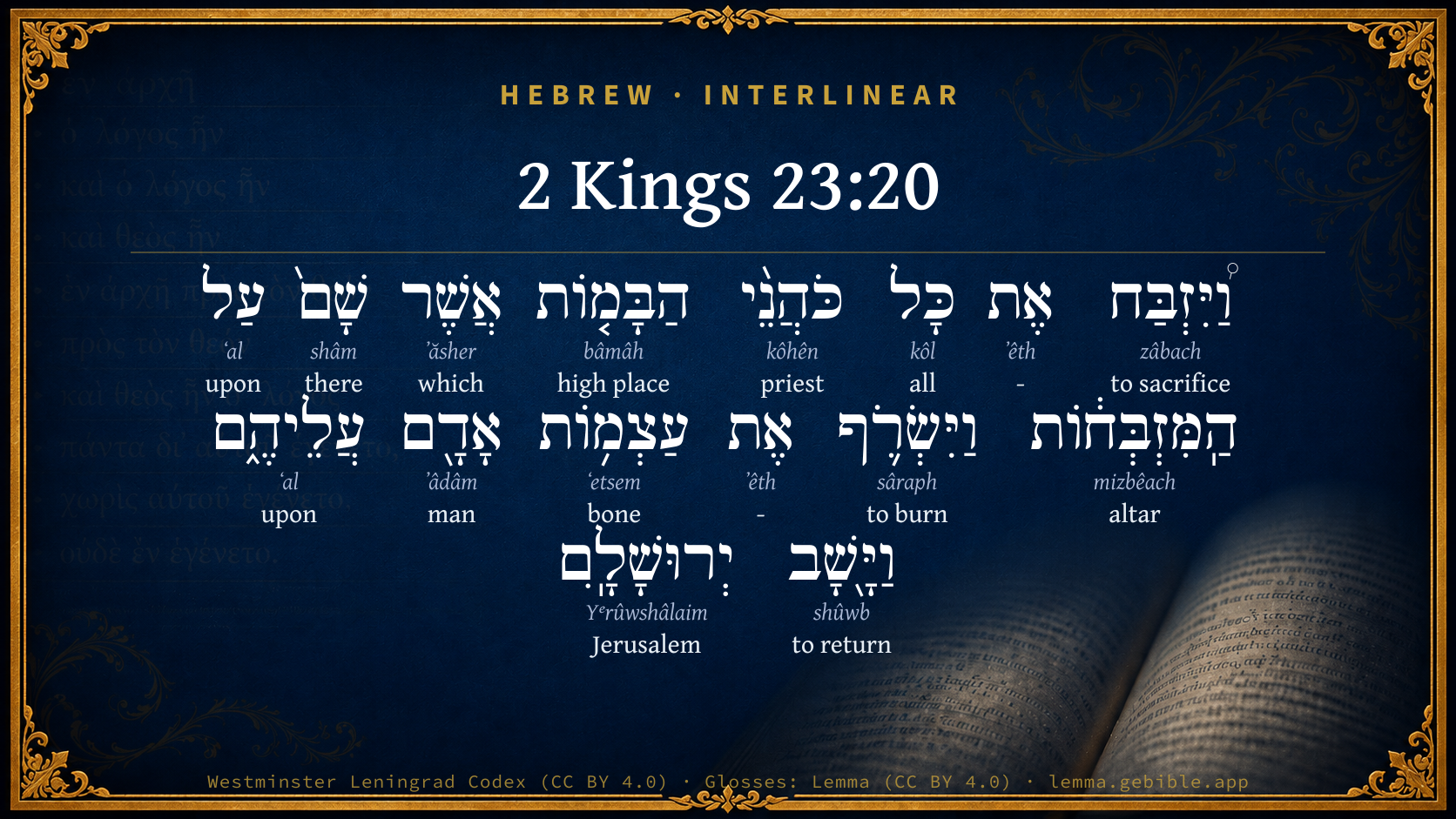
Hebrew (Westminster Leningrad Codex) 2 Kings 23:20 appears in the Hebrew Old Testament. The text above is from the Westminster Leningrad Codex. Each word links to its Strong’s number, a concise gloss, and parsing drawn from the Open Scriptures Hebrew Bible morphology. Click any word for its full Brown-Driver-Briggs (BDB) entry.
Download image
Cite this verse

2 Kings 23:20 (World English Bible). Public Domain. Lemma interlinear Bible study tool, https://lemma.gebible.app/v/2-kings/23/20.

Show BibTeX & RIS
BibTeX
RIS
English Translation
He killed all the priests of the high places that were there, on the altars, and burned men's bones on them; and he returned to Jerusalem.
World English Bible · Public Domain
Download a study sheet

One document with this verse’s original text, its word-by-word gloss line, the meaning frame, cross-references with their text, attributed commentary, and full source and license credits — printable, and it pastes into notes with its structure intact.

This verse Autodidact and up

Study sheet (.html) Plain text (.txt)

A passage Seminary Student

Up to 50 verses in one chapter. A passage sheet keeps up to 6 commentary sources and 12 cross-references per verse, in the order this page ranks them, and says so on the sheet whenever that leaves anything out. Ask for a single verse and you get the Autodidact verse sheet above.

Everything on this page stays free to read, with no account — the sheet is a download of what is already on screen, not access to it.

Want to remove ads? Support Godless Engineer
Compare translations 3

The same verse in 3 English versions, stacked beneath the original-language interlinear above. Click any original word for its lexicon entry.

Each is an independent rendering of the whole verse — the interlinear is not word-aligned to these translations.

Highlighted words mark where these versions differ — a whole-verse word diff, not a word-by-word alignment.

  • World English Bible Public Domain
    He killed all the priests of the high places that were there, on the altars, and burned men's bones on them; and he returned to Jerusalem.
  • King James Version Public Domain
    And he slew all the priests of the high places that were there upon the altars, and burned men's bones upon them, and returned to Jerusalem.
  • unfoldingWord Literal Text CC BY-SA 4.0
    And he sacrificed on the altars all of the priests of the high places who there, and he burned bones of man on them. Then he returned to Jerusalem.

unfoldingWord Literal Text — © unfoldingWord, licensed CC BY-SA 4.0. Word-aligned USFM3 via Door43 (git.door43.org/unfoldingWord/en_ult).

Versions to compare (up to 4)

3 of 4 selected

Show all 18 translations

Every available English version of this verse, each an independent rendering of the whole verse.

  • World English Bible Public Domain
    He killed all the priests of the high places that were there, on the altars, and burned men's bones on them; and he returned to Jerusalem.
  • Berean Standard Bible Public Domain
    On the altars he slaughtered all the priests of the high places, and he burned human bones on them. Then he returned to Jerusalem.
  • Majority Standard Bible Public Domain
    On the altars he slaughtered all the priests of the high places, and he burned human bones on them. Then he returned to Jerusalem.
  • King James Version Public Domain
    And he slew all the priests of the high places that were there upon the altars, and burned men's bones upon them, and returned to Jerusalem.
  • American Standard Version (1901) Public Domain
    And he slew all the priests of the high places that were there, upon the altars, and burned men's bones upon them; and he returned to Jerusalem.
  • Revised Version (1885) Public Domain
    And he slew all the priests of the high places that were there, upon the altars, and burned men’s bones upon them; and he returned to Jerusalem.
  • Geneva Bible (1599) Public Domain
    And he sacrificed all the Priests of the hie places, that were there vpon the altars, and burnt mens bones vpon them, and returned to Ierusalem.
  • Douay-Rheims (1899) Public Domain
    And he slew all the priests of the high places, that were there, upon the altars: and he burnt men's bones upon them: and returned to Jerusalem.
  • Young's Literal Translation Public Domain
    And he slayeth all the priests of the high places who `are' there by the altars, and burneth the bones of man upon them, and turneth back to Jerusalem.
  • Literal Standard Version CC BY-SA 4.0
    And he slays all the priests of the high places who [are] there by the altars, and burns the bones of man on them, and turns back to Jerusalem.
  • Unlocked Literal Bible CC BY-SA 4.0
    He slaughtered all the priests of the high places on the altars and he burned human bones on them. Then he returned to Jerusalem.
  • unfoldingWord Literal Text CC BY-SA 4.0
    And he sacrificed on the altars all of the priests of the high places who there, and he burned bones of man on them. Then he returned to Jerusalem.
  • Darby Bible Public Domain
    And he sacrificed upon the altars all the priests of the high places that were there, and burned men's bones upon them. And he returned to Jerusalem.
  • World Messianic Bible Public Domain
    He killed all the priests of the high places that were there, on the altars, and burned men’s bones on them; and he returned to Jerusalem.
  • Webster's Bible Public Domain
    And he slew all the priests of the high places, that were there upon the altars, and burnt men's bones upon them, and returned to Jerusalem.
  • Free Bible Version CC BY-SA 4.0
    Josiah slaughtered all the priests who were there at the high places on the altars, and burned human bones on them. Then he returned to Jerusalem.
  • Bible in Basic English Public Domain
    And all the priests of the high places there he put to death on the altars, burning the bones of the dead on them; and then he went back to Jerusalem.
  • JPS Tanakh (1917) Public Domain
    And he slew all the priests of the high places that were there, upon the altars, and burned men's bones upon them; and he returned to Jerusalem.

Literal Standard Version (2020), Covenant Press — licensed CC BY-SA 4.0. Text via the HelloAO Bible API (eBible.org). Unlocked Literal Bible (unfoldingWord) — licensed CC BY-SA 4.0. Text via the HelloAO Bible API (eBible.org). unfoldingWord Literal Text — © unfoldingWord, licensed CC BY-SA 4.0. Word-aligned USFM3 via Door43 (git.door43.org/unfoldingWord/en_ult). Free Bible Version, Dr. Jonathan Gallagher — licensed CC BY-SA 4.0. Text via the HelloAO Bible API (eBible.org).

Word by word

More ways to search: Search by grammar → Find every occurrence → Compare this word →

Practice this passage: Drill this verse → Learn its vocabulary →

הַבָּמ֤וֹת
bâmâh
H1116
“the · high places”
Particle, Definite Article + Noun, Common, Feminine, Plural, Absolute
Part of Speech
Particle + Noun
Type
Common
Gender
Feminine
Number
Plural
State
Absolute
Full BDB Definition

Origin: from an unused root (meaning to be high)

TWOT: 253

high place, ridge, height, bamah (technical name for cultic platform) - high place, mountain - high places, battlefields - high places (as places of worship) - funeral mound?
  1. וַ֠יִּזְבַּח zâbach H2076 “and · to sacrifice” Conjunction + Verb, Qal, Sequential Imperfect, 3rd Person, Masculine, Singular
  2. אֶת ʼêth H853 “-” Particle, Direct Object
  3. כָּל kôl H3605 “all of” Noun, Common, Masculine, Singular, Construct
  4. כֹּהֲנֵ֨י kôhên H3548 “priests of” Noun, Common, Masculine, Plural, Construct
  5. אֲשֶׁר ʼăsher H834 “which” Particle, Relative
  6. שָׁם֙ shâm H8033 “there” Adverb
  7. עַל ʻal H5921 “upon” Preposition
  8. הַֽמִּזְבְּח֔וֹת mizbêach H4196 “the · altars” Particle, Definite Article + Noun, Common, Masculine, Plural, Absolute
  9. וַיִּשְׂרֹ֛ף sâraph H8313 “and · to burn” Conjunction + Verb, Qal, Sequential Imperfect, 3rd Person, Masculine, Singular
  10. אֶת ʼêth H853 “-” Particle, Direct Object
  11. עַצְמ֥וֹת ʻetsem H6106 “bones of” Noun, Common, Feminine, Plural, Construct
  12. אָדָ֖ם ʼâdâm H120 “man” Noun, Common, Masculine, Singular, Absolute
  13. עֲלֵיהֶ֑ם ʻal H5921 “upon · them” Preposition + Suffix, Personal, 3rd Person, Masculine, Plural
  14. וַיָּ֖שָׁב shûwb H7725 “and · to return” Conjunction + Verb, Qal, Sequential Imperfect, 3rd Person, Masculine, Singular
  15. יְרוּשָׁלִָֽם Yᵉrûwshâlaim H3389 “Jerusalem” Noun, Proper

About this verse

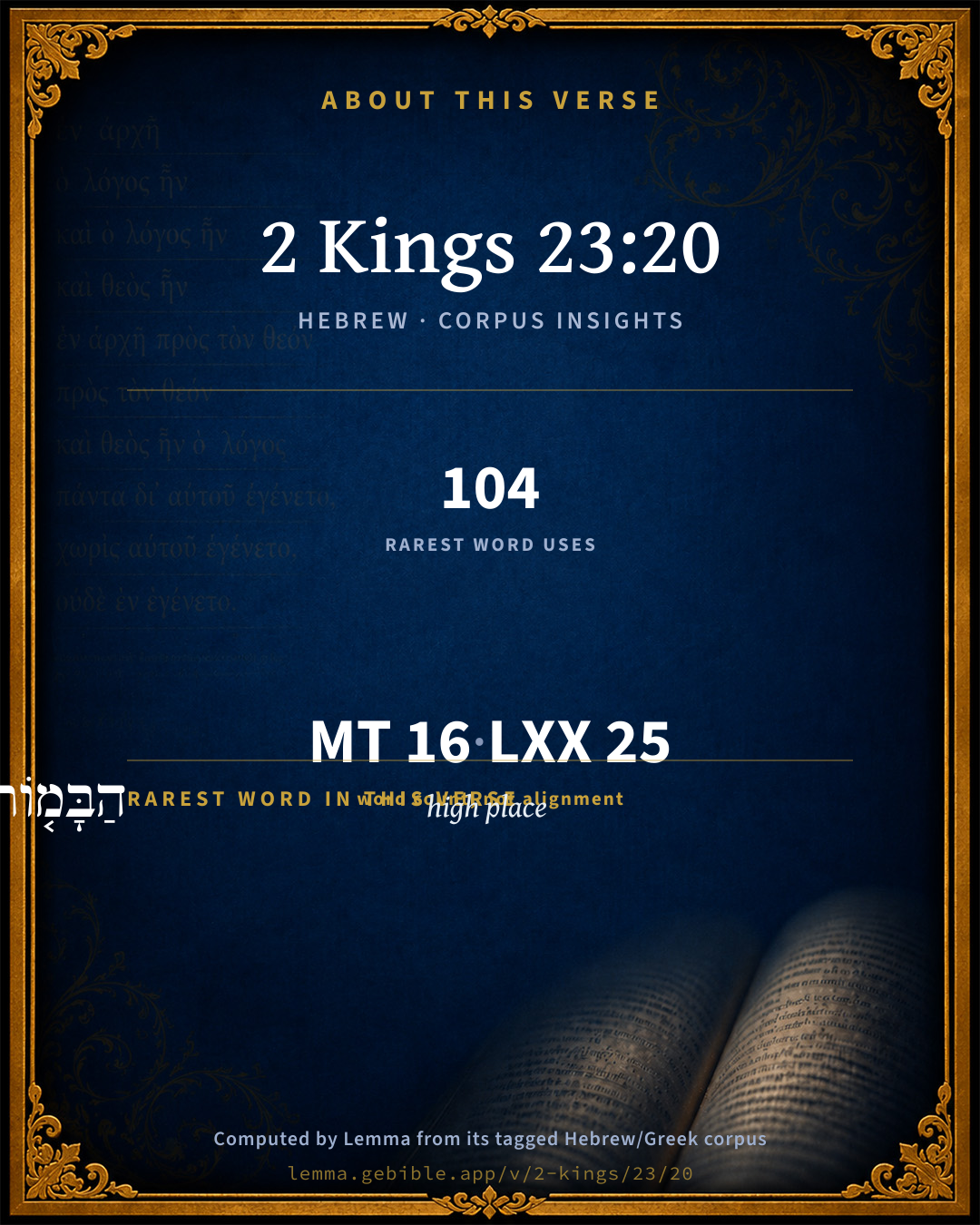
These counts appear in no published source. They are computed here, from the morphology-tagged text and Lemma’s own curated glosses. What Lemma adds →

16
words
14
distinct lemmas
Historical
section

Grammatical profile

  • 3 verbs
  • 7 nouns
  • 2 prepositions
  • 1 adverb
  • 3 particles

Verb forms

  • וַ֠יִּזְבַּח Qal · Sequential Imperfect
  • וַיִּשְׂרֹ֛ף Qal · Sequential Imperfect
  • וַיָּ֖שָׁב Qal · Sequential Imperfect

Repetition

A word recurs within this verse — often emphatic in Hebrew:

Hebrew & Septuagint length

In English translation the verse runs 26 words from the Hebrew and 28 from the Septuagint (LXX English) — closely comparable.

A rough comparison of the two English renderings, which tokenize alike — not a word-level alignment.

Word counts can differ between the Hebrew and the Greek without any difference in meaning — e.g. the Hebrew direct-object marker אֵת has no separate Greek word, and Greek often adds the article ὁ.

In the original languages it is 16 Hebrew tokens and 25 Greek tokens — but the two are counted differently (Hebrew bundles its prefixes and suffixes into one token; the Greek is in lemma form), so that isn’t a like-for-like length.

Cross-references

9

Topical passages linked to 2 Kings 23:20 in the Treasury of Scripture Knowledge — connected by theme and wording, ordered by reader-vote popularity; previews shown in the World English Bible.

  • 2 Kings 11:18 All the people of the land went to the house of Baal, and broke it down; his altars and his images broke they in pieces thoroughly, and killed Mattan the priest of Baal before the altars. The priest appointed officers over the house of Yahweh.
  • Exodus 22:20 "He who sacrifices to any god, except to Yahweh only, shall be utterly destroyed.
  • 2 Kings 10:25 It happened, as soon as he had made an end of offering the burnt offering, that Jehu said to the guard and to the captains, Go in, and kill them; let none come forth. They struck them with the edge of the sword; and the guard and the captains cast them out, and went to the city of the house of Baal.
  • 2 Chronicles 34:5 He burnt the bones of the priests on their altars, and purged Judah and Jerusalem.
  • 1 Kings 13:2 He cried against the altar by the word of Yahweh, and said, altar, altar, thus says Yahweh: Behold, a son shall be born to the house of David, Josiah by name; and on you shall he sacrifice the priests of the high places who burn incense on you, and men's bones shall they burn on you.
  • 1 Kings 18:40 and Elijah said to them, Take the prophets of Baal; don't let one of them escape. They took them; and Elijah brought them down to the brook Kishon, and killed them there.
  • Deuteronomy 13:5 That prophet, or that dreamer of dreams, shall be put to death, because he has spoken rebellion against Yahweh your God, who brought you out of the land of Egypt, and redeemed you out of the house of bondage, to draw you aside out of the way which Yahweh your God commanded you to walk in. So shall you put away the evil from the midst of you.
  • Isaiah 34:6 The sword of Yahweh is filled with blood, it is made fat with fatness, with the blood of lambs and goats, with the fat of the kidneys of rams; for Yahweh has a sacrifice in Bozrah, and a great slaughter in the land of Edom.
  • Zechariah 13:2–3 It will come to pass in that day, says Yahweh of Hosts, that I will cut off the names of the idols out of the land, and they will no more be remembered; and also I will cause the prophets and the spirit of impurity to pass out of the land.

Cross-references courtesy of OpenBible.info (CC BY 4.0).

Hebrew and Greek witnesses Masoretic Hebrew ↔ Greek Septuagint

The same verse in the two great witnesses to the Old Testament, shown verse-for-verse.

These are two independent witnesses, not word-aligned to each other, and the Septuagint is shown in lemma (dictionary) form.

Hebrew 2 Kings 23:20 Masoretic · Westminster Leningrad Codex

וַ֠יִּזְבַּח אֶת כָּל כֹּהֲנֵ֨י הַבָּמ֤וֹת אֲשֶׁר שָׁם֙ עַל הַֽמִּזְבְּח֔וֹת וַיִּשְׂרֹ֛ף אֶת עַצְמ֥וֹת אָדָ֖ם עֲלֵיהֶ֑ם וַיָּ֖שָׁב יְרוּשָׁלִָֽם

He killed all the priests of the high places that were there, on the altars, and burned men's bones on them; and he returned to Jerusalem.

World English Bible · Public Domain

Greek LXX 2 Kings 23:20 Septuagint · lemma form

καί θυσιάζω πᾶς ὁ ἱερεύς ὁ ὑψηλός ὁ εἰμί ἐκεῖ ἐπί ὁ θυσιαστήριον καί κατακαίω ὁ ὀστέον ὁ ἄνθρωπος ἐπί αὐτός καί ἐπιστρέφω εἰς ἰερουσαλήμ

And he sacrificed all the priests of the high places that were there on the altars, and burnt the bones of men upon them, and returned to Jerusalem.

LXX2012 (modern English Septuagint) · Public Domain

Hebrew: Westminster Leningrad Codex (CC BY 4.0). Greek: Septuagint (public domain); English from LXX2012 (modern English Septuagint) (Public Domain). How the Septuagint differs from the Hebrew →

Targum (Aramaic paraphrase)

1

The Targum is the ancient Jewish Aramaic paraphrase of the Hebrew Scriptures — an interpretive translation, not the Hebrew text itself. Onkelos (literal) and Pseudo-Jonathan (expansive) render the Torah, and Jonathan the Prophets. Coverage is partial: where no permissively-licensed English translation exists for a verse, only the Aramaic is shown. This is verse-level text, not a word-by-word alignment to the Hebrew.

  1. Targum Jonathan Prophets (Joshua–Malachi)
    וּנְכִיס יַת כָּל כּוּמְרֵי בָמָתָא דִי תַמָן עַל אֱגוֹרַיָא וְאוֹקִיד יַת גַרְמֵי אֱנָשָׁא עֲלֵיהוֹן וְתַב לִירוּשְׁלֵם:

    (no public-domain English translation for this verse)

    Targum Jonathan — Aramaic: “Mikraot Gedolot” (public domain). English: “Sefaria Community Translation” (CC0 1.0 (public-domain dedication)); “London "Chaldee Paraphrase," 1871” (public domain). Text via Sefaria.

Commentary

Notes on 2 Kings 23:20 from classic Christian and Jewish commentators (each source and its license shown beneath its notes). The classic Christian expositions comment on the surrounding passage and are grouped to its opening verse, so a note may address several verses; the Jewish commentaries on the Tanakh (Rashi and others) are per-verse, so they appear only where the commentator wrote on this verse.

Lemma curates 59 commentaries, every one of them public domain or Creative Commons licensed, each selected and text-cleaned for this edition rather than reprinted as found. About our sources →

Trapp's Complete Commentary

John Trapp

2Ki 23:20 And he slew all the priests of the high places that [were] there upon the altars, and burned men’s bones upon them, and returned to Jerusalem.

Ver. 20. And burnt men’s bones.] Hence Papists would prove the lawfulness of unburying dead heretics, as they call us, and burning their bones; as they dealt here by Grosthead, bishop of Lincoln, Paulus Phagius, Bucer’s wife, &c. But Josiah’s act is justified by the prophecy, whereby he was appointed so to do; and the Lord would have it so done, to show the abomination wherein he had idolaters, and for a demonstration of their damnation in hell.

John Trapp, A Commentary or Exposition upon All the Books of the Old and New Testament (1647–1656) — public domain. Text from a community e-Sword module.

Joseph Benson's Commentary

2Ki 23:20. He slew all the priests of the high places — By this relation it appears, that after the departure of the king of Assyria, divers of the Israelites, who had retired to other parts, and kept themselves out of the conqueror’s hands, returned together with their priests to their own land, and to their old trade, worshipping idols; to whom, peradventure, they ascribed this their deliverance from that judgment which Jehovah had brought upon them. And burned men’s bones upon them — According to that famous prophecy, 1Ki 13:1-2.

Joseph Benson's Commentary on the Old and New Testaments (1811–1818) — public domain. Text from a community e-Sword module.

Adam Clarke's Commentary

Verse 20. Slew all the priests] The lives of these, as corrupters of the people, were forfeited to the law.

Adam Clarke's Commentary on the Bible (1810–1826) — public domain. Text from a community e-Sword/MySword module.

Ellicott's Commentary for English Readers

(20) He slew.—He slaughtered. A contrast to his mild treatment of the priests of the Judæan high places (2Ki_23:8-9). They were Levites, and these heathenish priests. (Comp. Deu_17:2-5.) Thus was fulfilled the prophecy of 1Ki_13:2. (Thenius considers the event historical, because that prophecy “is undoubtedly modelled upon it.”)

A Bible Commentary for English Readers, edited by Charles John Ellicott (1878–1897) — public domain. Text from a community e-Sword module.

The Cambridge Bible for Schools and Colleges

gen. ed. J. J. S. Perowne

20. and burnt men’s bones upon them] To the heathen, as well as to the Jew, this would be a pollution that would make the place for ever unfit for worship.

The Cambridge Bible for Schools and Colleges (gen. ed. J. J. S. Perowne; Cambridge University Press, 1878–1918) — public domain. Text from a community e-Sword module.

John Gill's Exposition

And the king commanded all the people,.... Not at Jerusalem only, but throughout the whole kingdom: saying:

keep the passover unto the Lord your God, as it is written in this book of the covenant; which had been lately found and read, and they had agreed to observe, and in which this ordinance was strictly enjoined, and was a commemoration of their deliverance out of Egypt, and a direction of their faith to the Messiah, the antitype of the passover.

John Gill's Exposition of the Whole Bible (1746–1763) — public domain (CC PDM 1.0). Text via the HelloAO Bible API.

Haydock's Catholic Bible Commentary

CHAPTER XXIII.

Slew. Most of the Israelites who had been left, (Haydock) embraced the true religion, after the captivity of their brethren, (Calmet) and adhered to the kings of Juda, (ver. 15.; Haydock) who had taken possession of the whole country (Du Hamel) after the fall of the Assyrian empire; (Tirinus) unless the emperors of Chaldea had given it to them as to their vassels. See ver. 29. (Calmet)

George Leo Haydock (1774–1849), Haydock's Catholic Family Bible and Commentary, 1859 edition — public domain. Excludes Psalms (Douay-Rheims chapter numbering differs from Protestant) and Deuterocanonical books (Catholic canon only).

Matthew Poole's English Annotations

The priests of the high places; either,

1. The priests which Jeroboam had made of the meanest of the people, whom he slew, both for their presumptuous usurpation of that sacred office, which of itself was punishable with death by God’s law, Num 3:10, and for their idolatry. Or rather,

2. The priests of Baalim; by comparing this verse with the former, where speaking of the same high places, he doth not say, which Jeroboam made, as is usual when he speaks of the high places of the calves; but, which the other kings of Israel made, who were divers of them worshippers of Baal; and by considering the parallel place, 2Ch 34:4, where it is said, they brake down the altars of Baalim, &c. By this relation it appears, and from the nature of the thing, and common practice in like cases, it is more than probable, that after the departure of the king of Assyria, divers of the Israelites who had retired to other parts, and kept themselves out of the conqueror’s hands, returned together with their priests to their own land, and to their old trade of worshipping idols; to whom, peradventure, they ascribed this their deliverance from that judgment which Jehovah had brought upon them.

That were there upon the altars; according to that famous prophecy, 1Ki 13:1,2.

Matthew Poole's English Annotations on the Holy Bible (1683–1685) — public domain. Text from a community e-Sword/MySword module.

Whedon's Commentary on the Bible

Daniel D. Whedon

20. Slew all the priests — Literally, sacrificed them; and he did it upon the altars which these very priests had used for idolatrous purposes.

High places that were there — High places that were in the several cities of Samaria.

Daniel D. Whedon (gen. ed.), Commentary on the Old and New Testaments (1874–1909) — public domain. Text from a community e-Sword module.

The Pulpit Commentary

And he slew all the priests of the high places that were there upon the altars. It is not directly said that he had done this at Bethel, though it had been prophesied that he would do so. (1Ki_13:2) Possibly there were no priests at Bethel at the time, since the "calf" set up by Jeroboam had been carried off (Hos_10:6) by the Assyrians. The difference between the treatment of the high-place priests in Israel and in Judah (ver. 9) clearly implies that the former were attached to the worship of false gods, while the latter were priests of Jehovah who worshipped him with superstitious and unauthorized rites and ceremonies. And burned men"s bones upon them (comp. ver. 16), and returned to Jerusalem.

The Pulpit Commentary (1880–1919), ed. H.D.M. Spence-Jones & Joseph S. Exell — public domain. Text from a community e-Sword module.

John Wesley's Explanatory Notes

The priests - By this relation it appears, that after the departure of the king of Assyria, divers of the Israelites who had retired to other parts, and kept themselves out of the conqueror's hands, returned together with their priests to their own land, and to their old trade, worshipping idols; to whom, peradventure, they ascribed this their deliverance from that judgment which Jehovah had brought upon them. And burnt - According to that famous prophecy, 1 Kings xiii, 1, 2.

John Wesley, Explanatory Notes Upon the Whole Bible (1754–1765) — public domain. Text via the GEBible commentary corpus.

Lesson kit

Teaching starters — assembled from the data on this page, not authored interpretation. Every prompt links to the verse data it draws on. Edit before teaching.

2 Kings, in the Historical, opens this verse with 16 words (14 distinct Hebrew lemmas). Its most distinctive word is bâmâh (“high place”). A historical commentator’s framing appears above. Read the whole chapter for the surrounding context.

Discussion questions

  1. The word bâmâh carries the sense “high place.” How does it shape the verse?
  2. How does 2 Kings 11:18, which shares this passage’s theme, read alongside this verse?
  3. What does the repetition of “upon” (2× in this one verse) do in this verse?
  4. These translations render this verse differently; the difference is in the English rendering, not the original. What questions does that raise?
  5. «וַ֠יִּזְבַּח» is a Qal Sequential Imperfect verb. How does that grammatical form shape the action described?
  6. Compare how Trapp's Complete Commentary and Joseph Benson's Commentary read this verse. Where do they agree or differ?

Things to notice

Reading settings

Reading text

Shown beneath each verse's original-language words.

Old Testament
Old Testament edition

Read the OT as the Masoretic Hebrew (MT) or the Greek Septuagint (LXX).

English shown for the Greek Septuagint (in the Hebrew ↔ Greek comparison).

Comparing translations? Open the Compare panel on any verse page to stack up to four side by side.