
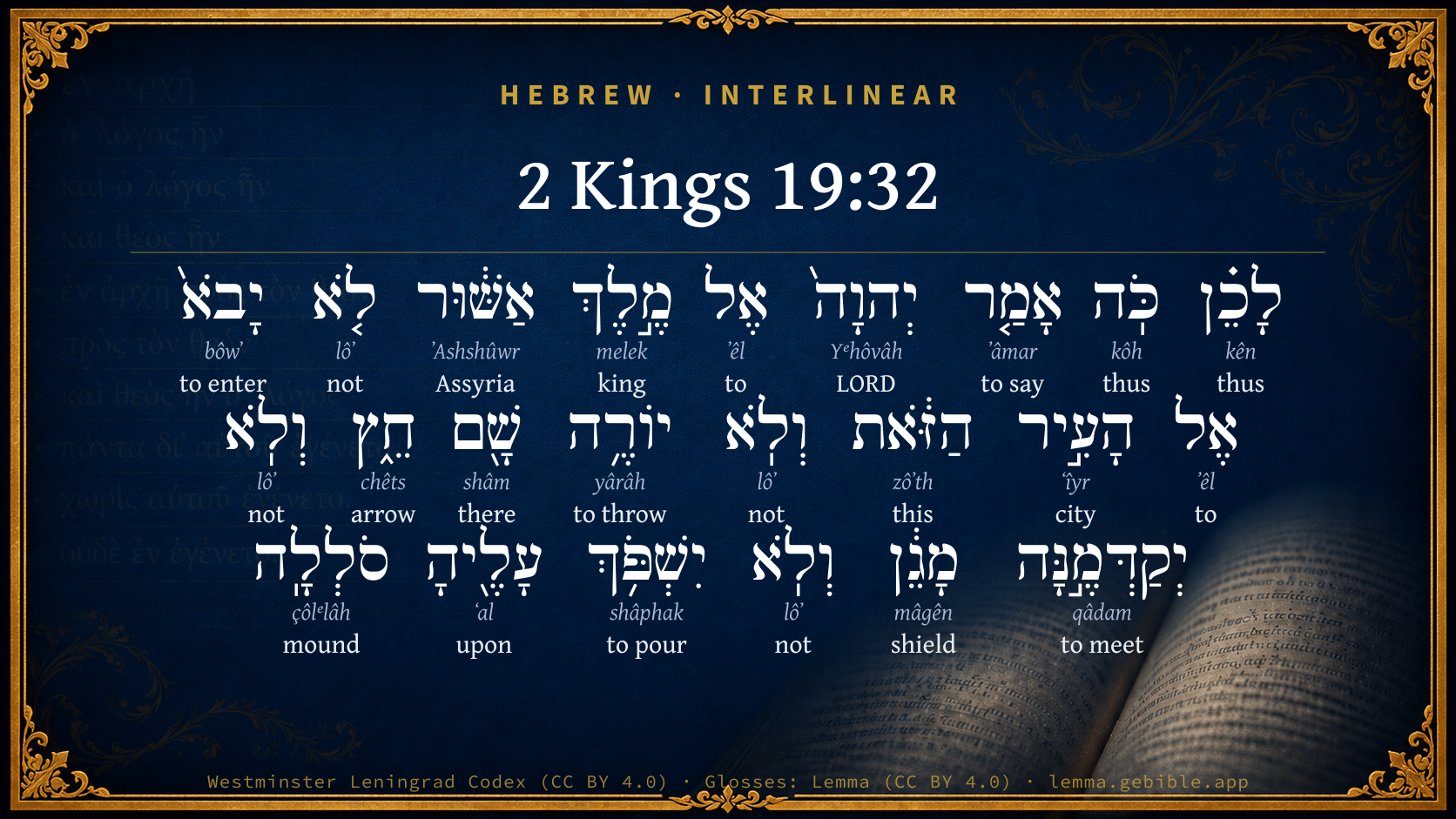
2 Kings 19:32

Hebrew (Westminster Leningrad Codex) 2 Kings 19:32 appears in the Hebrew Old Testament. The text above is from the Westminster Leningrad Codex. Each word links to its Strong’s number, a concise gloss, and parsing drawn from the Open Scriptures Hebrew Bible morphology. Click any word for its full Brown-Driver-Briggs (BDB) entry.
Download image
Cite this verse

2 Kings 19:32 (World English Bible). Public Domain. Lemma interlinear Bible study tool, https://lemma.gebible.app/v/2-kings/19/32.

Show BibTeX & RIS
BibTeX
RIS
English Translation
Therefore thus says Yahweh concerning the king of Assyria, He shall not come to this city, nor shoot an arrow there, neither shall he come before it with shield, nor cast up a mound against it.
World English Bible · Public Domain
Download a study sheet

One document with this verse’s original text, its word-by-word gloss line, the meaning frame, cross-references with their text, attributed commentary, and full source and license credits — printable, and it pastes into notes with its structure intact.

This verse Autodidact and up

Study sheet (.html) Plain text (.txt)

A passage Seminary Student

Up to 50 verses in one chapter. A passage sheet keeps up to 6 commentary sources and 12 cross-references per verse, in the order this page ranks them, and says so on the sheet whenever that leaves anything out. Ask for a single verse and you get the Autodidact verse sheet above.

Everything on this page stays free to read, with no account — the sheet is a download of what is already on screen, not access to it.

Want to remove ads? Support Godless Engineer
Compare translations 3

The same verse in 3 English versions, stacked beneath the original-language interlinear above. Click any original word for its lexicon entry.

Each is an independent rendering of the whole verse — the interlinear is not word-aligned to these translations.

Highlighted words mark where these versions differ — a whole-verse word diff, not a word-by-word alignment.

  • World English Bible Public Domain
    Therefore thus says Yahweh concerning the king of Assyria, He shall not come to this city, nor shoot an arrow there, neither shall he come before it with shield, nor cast up a mound against it.
  • King James Version Public Domain
    Therefore thus saith the LORD concerning the king of Assyria, He shall not come into this city, nor shoot an arrow there, nor come before it with shield, nor cast a bank against it.
  • unfoldingWord Literal Text CC BY-SA 4.0
    Therefore, thus says Yahweh about the king of Assyria: ‘He will not come to this city, and he will not shoot an arrow there, and he will not come before it a shield, and he will not pour out a mound against it.

unfoldingWord Literal Text — © unfoldingWord, licensed CC BY-SA 4.0. Word-aligned USFM3 via Door43 (git.door43.org/unfoldingWord/en_ult).

Versions to compare (up to 4)

3 of 4 selected

Show all 18 translations

Every available English version of this verse, each an independent rendering of the whole verse.

  • World English Bible Public Domain
    Therefore thus says Yahweh concerning the king of Assyria, He shall not come to this city, nor shoot an arrow there, neither shall he come before it with shield, nor cast up a mound against it.
  • Berean Standard Bible Public Domain
    So this is what the LORD says about the king of Assyria: ‘He will not enter this city or shoot an arrow into it. He will not come before it with a shield or build up a siege ramp against it.
  • Majority Standard Bible Public Domain
    So this is what the LORD says about the king of Assyria: ‘He will not enter this city or shoot an arrow into it. He will not come before it with a shield or build up a siege ramp against it.
  • King James Version Public Domain
    Therefore thus saith the LORD concerning the king of Assyria, He shall not come into this city, nor shoot an arrow there, nor come before it with shield, nor cast a bank against it.
  • American Standard Version (1901) Public Domain
    Therefore thus saith Jehovah concerning the king of Assyria, He shall not come unto this city, nor shoot an arrow there, neither shall he come before it with shield, nor cast up a mound against it.
  • Revised Version (1885) Public Domain
    Therefore thus saith the LORD concerning the king of Assyria, He shall not come unto this city, nor shoot an arrow there, neither shall he come before it with shield, nor cast a mount against it.
  • Geneva Bible (1599) Public Domain
    Wherefore thus saith the Lord, concerning the King of Asshur, He shall not enter into this citie, nor shoote an arrowe there, nor come before it with shield, nor cast a mount against it:
  • Douay-Rheims (1899) Public Domain
    Wherefore thus saith the Lord concerning the king of the Assyrians: He shall not come into this city, nor shoot an arrow into it, nor come before it with shield, nor cast a trench about it.
  • Young's Literal Translation Public Domain
    Therefore, thus said Jehovah, Concerning the king of Asshur: He doth not come in unto this city, Nor doth he shoot there an arrow, Nor doth he come before it with shield. Nor doth he pour out against it a mount.
  • Literal Standard Version CC BY-SA 4.0
    Therefore, thus said YHWH, || Concerning the king of Asshur: He does not come into this city, || Nor does he shoot an arrow there, || Nor does he come before it with shield, || Nor does he pour out a mound against it.
  • Unlocked Literal Bible CC BY-SA 4.0
    Therefore Yahweh says this about the king of Assyria: “He will not come into this city nor shoot an arrow here. Neither will he come before it with shield or build up a siege ramp against it.
  • unfoldingWord Literal Text CC BY-SA 4.0
    Therefore, thus says Yahweh about the king of Assyria: ‘He will not come to this city, and he will not shoot an arrow there, and he will not come before it a shield, and he will not pour out a mound against it.
  • Darby Bible Public Domain
    Therefore thus saith Jehovah concerning the king of Assyria: He shall not come into this city, Nor shoot an arrow there, Nor come before it with shield, Nor cast a bank against it.
  • World Messianic Bible Public Domain
    “Therefore the LORD says concerning the king of Assyria, ‘He will not come to this city, nor shoot an arrow there. He will not come before it with shield, nor cast up a mound against it.
  • Webster's Bible Public Domain
    Therefore thus saith the LORD concerning the king of Assyria, He shall not come into this city, nor shoot an arrow there, nor come before it with shield, nor cast a bank against it.
  • Free Bible Version CC BY-SA 4.0
    This is what the Lord says about the king of Assyria: He shall not enter this city or shoot an arrow at it. He shall not advance towards it with a shield, or build a siege ramp against it.
  • Bible in Basic English Public Domain
    For this cause the Lord says about the king of Assyria, He will not come into this town, or send an arrow against it; he will not come before it with arms, or put up an earthwork against it;
  • JPS Tanakh (1917) Public Domain
    Therefore thus saith the LORD concerning the king of Assyria: He shall not come unto this city, nor shoot an arrow there, neither shall he come before it with shield, nor cast a mound against it.

Literal Standard Version (2020), Covenant Press — licensed CC BY-SA 4.0. Text via the HelloAO Bible API (eBible.org). Unlocked Literal Bible (unfoldingWord) — licensed CC BY-SA 4.0. Text via the HelloAO Bible API (eBible.org). unfoldingWord Literal Text — © unfoldingWord, licensed CC BY-SA 4.0. Word-aligned USFM3 via Door43 (git.door43.org/unfoldingWord/en_ult). Free Bible Version, Dr. Jonathan Gallagher — licensed CC BY-SA 4.0. Text via the HelloAO Bible API (eBible.org).

Word by word

More ways to search: Search by grammar → Find every occurrence → Compare this word →

Practice this passage: Drill this verse → Learn its vocabulary →

סֹלְלָֽה
çôlᵉlâh
H5550
“mound”
Noun, Common, Feminine, Singular, Absolute
Part of Speech
Noun
Type
Common
Gender
Feminine
Number
Singular
State
Absolute
Full BDB Definition

Origin: from H5549 , but used passively

TWOT: 1506b

mound
  1. לָכֵ֗ן kên H3651 “to/for · thus” Preposition + Adverb
  2. כֹּֽה kôh H3541 “thus” Adverb
  3. אָמַ֤ר ʼâmar H559 “to say” Verb, Qal, Perfect, 3rd Person, Masculine, Singular
  4. יְהוָה֙ Yᵉhôvâh H3068 “LORD” Noun, Proper
  5. אֶל ʼêl H413 “to” Preposition
  6. מֶ֣לֶךְ melek H4428 “king of” Noun, Common, Masculine, Singular, Construct
  7. אַשּׁ֔וּר ʼAshshûwr H804 “Assyria” Noun, Proper
  8. לֹ֤א lôʼ H3808 “not” Particle, Negative
  9. יָבֹא֙ bôwʼ H935 “to enter” Verb, Qal, Imperfect, 3rd Person, Masculine, Singular
  10. אֶל ʼêl H413 “to” Preposition
  11. הָעִ֣יר ʻîyr H5892 “the · city” Particle, Definite Article + Noun, Common, Feminine, Singular, Absolute
  12. הַזֹּ֔את zôʼth H2063 “the · this” Particle, Definite Article + Pronoun, Demonstrative, Feminine, Singular
  13. וְלֹֽא lôʼ H3808 “and · not” Conjunction + Particle, Negative
  14. יוֹרֶ֥ה yârâh H3384 “to throw” Verb, Hiphil, Imperfect, 3rd Person, Masculine, Singular
  15. שָׁ֖ם shâm H8033 “there” Adverb
  16. חֵ֑ץ chêts H2671 “arrow” Noun, Common, Masculine, Singular, Absolute
  17. וְלֹֽא lôʼ H3808 “and · not” Conjunction + Particle, Negative
  18. יְקַדְּמֶ֣נָּה qâdam H6923 “to meet · her” Verb, Piel, Imperfect, 3rd Person, Masculine, Singular + Suffix, Personal, 3rd Person, Feminine, Singular
  19. מָגֵ֔ן mâgên H4043 “shield” Noun, Common, Both, Singular, Absolute
  20. וְלֹֽא lôʼ H3808 “and · not” Conjunction + Particle, Negative
  21. יִשְׁפֹּ֥ךְ shâphak H8210 “to pour” Verb, Qal, Imperfect, 3rd Person, Masculine, Singular
  22. עָלֶ֖יהָ ʻal H5921 “upon · her” Preposition + Suffix, Personal, 3rd Person, Feminine, Singular

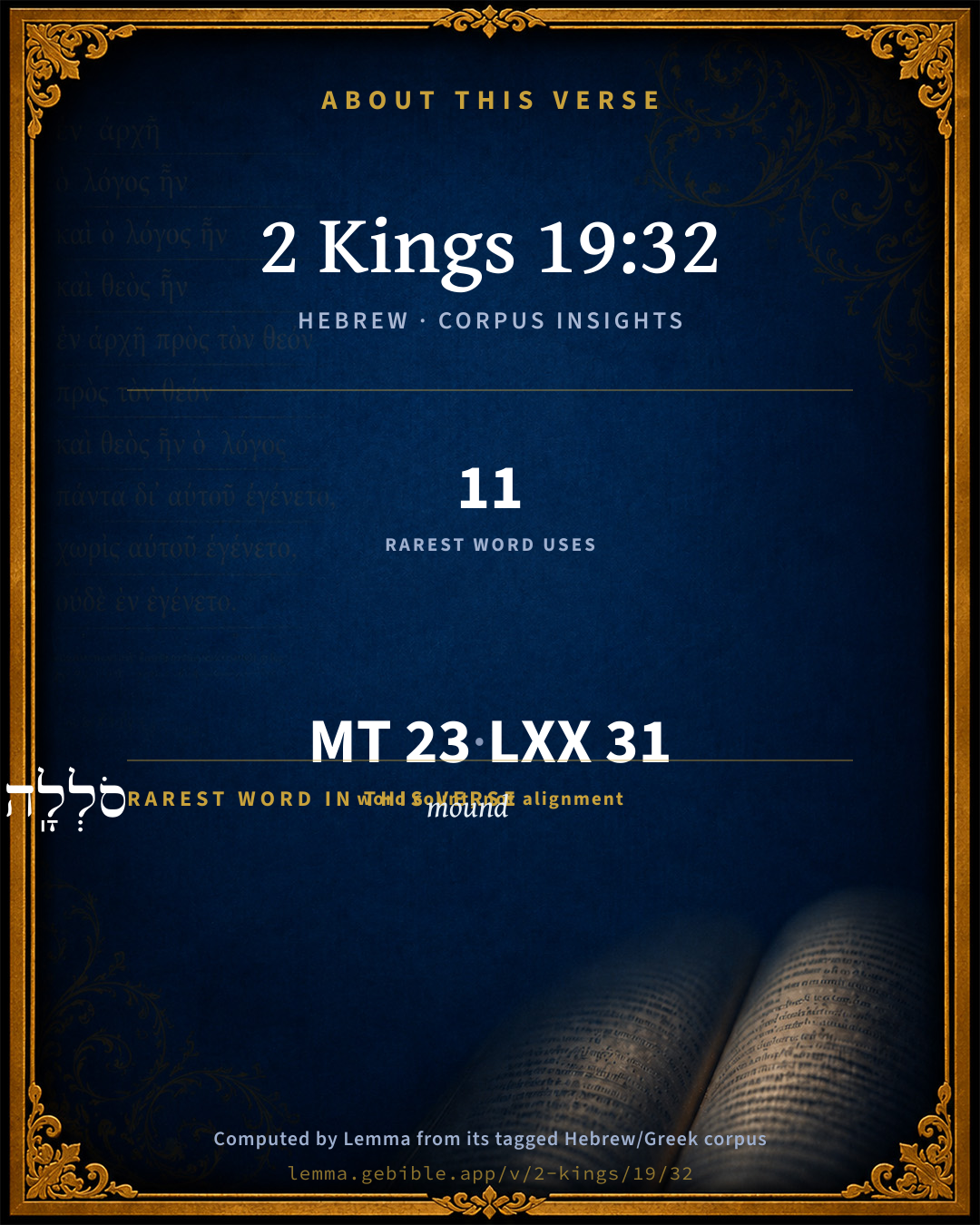
About this verse

These counts appear in no published source. They are computed here, from the morphology-tagged text and Lemma’s own curated glosses. What Lemma adds →

23
words
19
distinct lemmas
Historical
section

Notable vocabulary

The rarest word here is סֹלְלָֽה mound H5550 — appearing just 11 times in the whole Hebrew Bible.

Shared distinctive vocabulary

סֹלְלָֽה mound H5550 occurs in 11 verses of the Hebrew Bible. Also found in:

Grammatical profile

  • 5 verbs
  • 7 nouns
  • 1 pronoun
  • 3 prepositions
  • 3 adverbs
  • 4 particles

Verb forms

  • אָמַ֤ר Qal · Perfect
  • יָבֹא֙ Qal · Imperfect
  • יוֹרֶ֥ה Hiphil · Imperfect
  • יְקַדְּמֶ֣נָּה Piel · Imperfect
  • יִשְׁפֹּ֥ךְ Qal · Imperfect

Repetition

Words recur within this verse — often emphatic in Hebrew:

Hebrew & Septuagint length

In English translation the verse runs 36 words from the Hebrew and 44 from the Septuagint (LXX English) — closely comparable.

A rough comparison of the two English renderings, which tokenize alike — not a word-level alignment.

Word counts can differ between the Hebrew and the Greek without any difference in meaning — e.g. the Hebrew direct-object marker אֵת has no separate Greek word, and Greek often adds the article ὁ.

In the original languages it is 23 Hebrew tokens and 31 Greek tokens — but the two are counted differently (Hebrew bundles its prefixes and suffixes into one token; the Greek is in lemma form), so that isn’t a like-for-like length.

Cross-references

7

Topical passages linked to 2 Kings 19:32 in the Treasury of Scripture Knowledge — connected by theme and wording, ordered by reader-vote popularity; previews shown in the World English Bible.

  • 2 Samuel 20:15 They came and besieged him in Abel of Beth Maacah, and they cast up a mound against the city, and it stood against the rampart; and all the people who were with Joab battered the wall, to throw it down.
  • Isaiah 8:7–10 now therefore, behold, the Lord brings up on them the waters of the River, strong and many, [even] the king of Assyria and all his glory: and it shall come up over all its channels, and go over all its banks;
  • Isaiah 10:24–25 Therefore thus says the Lord, Yahweh of Hosts, my people who dwell in Zion, don't be afraid of the Assyrian, though he strike you with the rod, and lift up his staff against you, after the manner of Egypt.
  • Isaiah 10:28–32 He is come to Aiath, he is passed through Migron; at Michmash he lays up his baggage;
  • Isaiah 37:33–35 Therefore thus says Yahweh concerning the king of Assyria, He shall not come to this city, nor shoot an arrow there, neither shall he come before it with shield, nor cast up a mound against it.
  • Ezekiel 21:22 In his right hand was the divination [for] Jerusalem, to set battering rams, to open the mouth in the slaughter, to lift up the voice with shouting, to set battering rams against the gates, to cast up mounds, to build forts.
  • Luke 19:43–44 For the days will come on you, when your enemies will throw up a barricade against you, surround you, hem you in on every side,

Cross-references courtesy of OpenBible.info (CC BY 4.0).

Hebrew and Greek witnesses Masoretic Hebrew ↔ Greek Septuagint

The same verse in the two great witnesses to the Old Testament, shown verse-for-verse.

These are two independent witnesses, not word-aligned to each other, and the Septuagint is shown in lemma (dictionary) form.

Hebrew 2 Kings 19:32 Masoretic · Westminster Leningrad Codex

לָכֵ֗ן כֹּֽה אָמַ֤ר יְהוָה֙ אֶל מֶ֣לֶךְ אַשּׁ֔וּר לֹ֤א יָבֹא֙ אֶל הָעִ֣יר הַזֹּ֔את וְלֹֽא יוֹרֶ֥ה שָׁ֖ם חֵ֑ץ וְלֹֽא יְקַדְּמֶ֣נָּה מָגֵ֔ן וְלֹֽא יִשְׁפֹּ֥ךְ עָלֶ֖יהָ סֹלְלָֽה

Therefore thus says Yahweh concerning the king of Assyria, He shall not come to this city, nor shoot an arrow there, neither shall he come before it with shield, nor cast up a mound against it.

World English Bible · Public Domain

Greek LXX 2 Kings 19:32 Septuagint · lemma form

οὐ οὕτως ὅδε λέγω κύριος πρός βασιλεύς ἀσσύριος οὐ εἰςἔρχομαι εἰς ὁ πόλις οὗτος καί οὐ τοξεύω ἐκεῖ βέλος καί οὐ προφθάνω αὐτός θυρεός καί οὐ μή ἐκχέω πρός αὐτός πρόσχωμα

Is it not so? Thus says the Lord concerning the king of the Assyrians, He shall not enter into this city, and he shall not shoot an arrow there, neither shall a shield come against it, neither shall he heap a mound against it.

LXX2012 (modern English Septuagint) · Public Domain

On this verse, The Cambridge Bible for Schools and Colleges discusses the Septuagint’s reading. Read the note in Commentary ↓

Hebrew: Westminster Leningrad Codex (CC BY 4.0). Greek: Septuagint (public domain); English from LXX2012 (modern English Septuagint) (Public Domain). How the Septuagint differs from the Hebrew →

Targum (Aramaic paraphrase)

1

The Targum is the ancient Jewish Aramaic paraphrase of the Hebrew Scriptures — an interpretive translation, not the Hebrew text itself. Onkelos (literal) and Pseudo-Jonathan (expansive) render the Torah, and Jonathan the Prophets. Coverage is partial: where no permissively-licensed English translation exists for a verse, only the Aramaic is shown. This is verse-level text, not a word-by-word alignment to the Hebrew.

  1. Targum Jonathan Prophets (Joshua–Malachi)
    בְּכֵן כִּדְנַן אֲמַר יְיָ לְמַלְכָּא דְאַתּוּר לָא יֵעוֹל לְקַרְתָּא הָדָא וְלָא יַקְשִׁית תַּמָן גִיר וְלָא יְקַדְמִינָהּ בִּתְרֵיסִין וְלָא יַצְבֵּר עֲלָהּ מָלְיֵתָא:

    (no public-domain English translation for this verse)

    Targum Jonathan — Aramaic: “Mikraot Gedolot” (public domain). English: “Sefaria Community Translation” (CC0 1.0 (public-domain dedication)); “London "Chaldee Paraphrase," 1871” (public domain). Text via Sefaria.

Commentary

Notes on 2 Kings 19:32 from classic Christian and Jewish commentators (each source and its license shown beneath its notes). The classic Christian expositions comment on the surrounding passage and are grouped to its opening verse, so a note may address several verses; the Jewish commentaries on the Tanakh (Rashi and others) are per-verse, so they appear only where the commentator wrote on this verse.

Lemma curates 59 commentaries, every one of them public domain or Creative Commons licensed, each selected and text-cleaned for this edition rather than reprinted as found. About our sources →

Trapp's Complete Commentary

John Trapp

2Ki 19:32 Therefore thus saith the LORD concerning the king of Assyria, He shall not come into this city, nor shoot an arrow there, nor come before it with shield, nor cast a bank against it.

Ver. 32. He shall not come into this city.] Because dear to God, who had appointed salvation for walls and bulwarks. {Isa 26:1} Semblably, of all that huge fleet three years a-rigging and furnishing, not one Spaniard set foot on English ground, but under the notion of a prisoner. See on 2Ki 19:28.

Nor shoot an arrow there, &c.] See Psa 48:12. {See Trapp on "Psa 48:12"}

John Trapp, A Commentary or Exposition upon All the Books of the Old and New Testament (1647–1656) — public domain. Text from a community e-Sword module.

Joseph Benson's Commentary

2Ki 19:32. Thus saith the Lord, He shall not come to this city — The king of Assyria shall be so far from possessing himself of the city at this time, that he shall not shoot so much as an arrow into it, much less raise any bulwarks to besiege it. There is a gradation in the words, says Dr. Dodd, as is usual with Isaiah. The first declaration is, that Sennacherib, if he shall attempt to besiege the city, shall never be able to succeed; he shall not come into this city. The second is, that he shall not bring his army so near the city as to come before it with shields, wherewith to defend themselves from those on the wall, or raise a bank against it. The third, that he shall not even shoot an arrow into the city, which might be done from far. It seems the army sent with Rab-shakeh did not form a close siege against it, but only disposed themselves so as to block it up at some distance; possibly waiting till the king of Assyria had taken Libnah and Lachish, (which they presumed he would speedily do.)

Joseph Benson's Commentary on the Old and New Testaments (1811–1818) — public domain. Text from a community e-Sword module.

Tyndale Open Study Notes

Tyndale Open Resources

19:32-34 Sennacherib’s armies did not enter Jerusalem but returned home. In Sennacherib’s own account, he gave details of capturing and despoiling forty-six cities of Judah. He made no mention of the capture of Jerusalem but recorded only that he shut up Hezekiah “in Jerusalem . . . like a bird in a cage.” • For my own honor—in light of Sennacherib’s blasphemies and arrogance against God (18:25, 28-30; 19:10-13, 21, 27-28)—and for the sake of my servant David, to whom God had made his covenant promise (2 Sam 7:8-16) and whose faith Hezekiah had emulated (2 Kgs 18:3), the Lord would defend this city (see 20:6). The Lord decisively demonstrated that he alone is God and that he is faithful to his people who trust in him.

Tyndale Open Study Notes — © Tyndale Open Resources, licensed CC BY-SA 4.0. Text via the HelloAO Bible API.

Adam Clarke's Commentary

Verse 32. He shall not, c.] Here follow the fullest proofs that Jerusalem shall not be taken by the Assyrians.

1. He shall not come into this city

2. He shall not be able to get so near as to shoot an arrow into it;

3. He shall not be able to bring an army before it,

4. Nor shall he be able to raise any redoubt or mound against it;

5. No; not even an Assyrian shield shall be seen in the country; not even a foraging party shall come near the city.

Adam Clarke's Commentary on the Bible (1810–1826) — public domain. Text from a community e-Sword/MySword module.

Ellicott's Commentary for English Readers

(32) Into this city.—Or, unto this city. Sennacherib shall not come hither to make his intended attack.

Nor shoot an arrow there (at it).—In open assault.

Nor come before it with shield.—As a storming party advances to the walls under cover of their shields.

Nor cast a bank against it.—In regular siege. Comp. 2Sa_20:15; Hab_1:10). The incidents of warfare here specified may be seen represented on the Assyrian sculptures from Khorsâbad and elsewhere.

(32-34) This may be, as Mr. Cheyne supposes, an after addition to the original prophecy. Isaiah may have spoken it a little later, in which case it was quite natural for an editor to append it here, as belonging to the same crisis. But it seems better to see here a return to the subject of the king of Assyria, after the parenthetic address to Hezekiah. The repetition of 2Ki_19:28 in 2Ki_19:33 favours this view.

A Bible Commentary for English Readers, edited by Charles John Ellicott (1878–1897) — public domain. Text from a community e-Sword module.

The Cambridge Bible for Schools and Colleges

gen. ed. J. J. S. Perowne

32. Therefore] The LXX. makes the same error here with regard to the word ‘therefore’ as was noticed above on 2Ki_1:3, and renders the Hebrew by οὐχ οὑτῶς. See former note.

He shall not come into [R.V. unto] this city] The R.V. renders the preposition correctly, and makes the same change in the next verse. We have no mention of Sennacherib’s personal approach nearer than Libnah. (See above verse 8.)

Nor [R.V. neither shall he] come] The change relieves the verse from the monotony of several clauses commencing in exactly the same way.

nor cast a bank [R.V. mount] against it] ‘Mount’ is the correct term for an embankment thrown up for the purposes of a siege, and occurs in the A.V. of Jer_6:6; Jer_32:24; Jer_33:4; Eze_4:2; Eze_21:22.

The Cambridge Bible for Schools and Colleges (gen. ed. J. J. S. Perowne; Cambridge University Press, 1878–1918) — public domain. Text from a community e-Sword module.

Albert Barnes' Notes on the Bible

Nor come before it with shield - The “shields” of the Assyrians are very conspicuous in the sculptures, and were of great importance in a siege, since the assailing archers were in most instances defended, as they shot their weapons, by a comrade, who held before himself and his friend a shield of an enormous size. It was made of a framework of wood, filled in with wattling, and perhaps lined with skin; it was rested upon the ground, and it generally curved backward toward the top; ordinarily it somewhat exceeded the height of a man. From the safe covert afforded by these large defenses the archers were able to take deliberate aim, and deliver their volleys with effect.

Nor cast a bank against it - “Mounds” or “banks” were among the most common of the means used by the Assyrians against a besieged town. They were thrown up against the walls, and consisted of loose earth, trees, brushwood, stones, and rubbish. Sometimes the surface of the mound was regularly paved with several layers of stone or brick, which formed a solid road or causeway capable of bearing a great weight. The intention was not so much to bring the mounds to a level with the top of the walls, as to carry them to such a height as should enable the battering-ram to work effectively. Walls were made very solid toward their base, for the purpose of resisting the ram; halfway up their structure was comparatively weak and slight. The engines of the assailants, rams and catapults, where therefore far more serviceable if they could attack the upper and weaker portion of the defenses; and it was to enable them to reach these portions that the “mounds” were raised.

Albert Barnes' Notes on the Bible (1834–1885) — public domain. Text from a community e-Sword/MySword module.

Haydock's Catholic Bible Commentary

About it, as was then the custom in besieging cities. Josephus and others suppose that Sennacherib’s army was destroyed before Jerusalem. But it seems more probable it fell on the road to Egypt, ver. 7. The camp, which is still shewn, might be that of Rabsaces, chap. xviii. 17. (Calmet)

George Leo Haydock (1774–1849), Haydock's Catholic Family Bible and Commentary, 1859 edition — public domain. Excludes Psalms (Douay-Rheims chapter numbering differs from Protestant) and Deuterocanonical books (Catholic canon only).

Matthew Poole's English Annotations

Which was true, though he sent Rab-shakeh and others with a great host against Jerusalem, 2Ki 18:17; either because that host went away with Rab-shakeh to Libnah, above, 2Ki 19:8; or rather, because that army did not form a close siege against it, but only marched towards it, and disposed themselves so as to block it up at some distance; possibly waiting till the king of Assyria had taken Libnah and Lachish, (which they presumed he would speedily do,) and should come up with the rest of his forces, when they intended to fall more vigorously to their work.

Matthew Poole's English Annotations on the Holy Bible (1683–1685) — public domain. Text from a community e-Sword/MySword module.

Whedon's Commentary on the Bible

Daniel D. Whedon

32. Therefore — In view of this decreed permanency of Judah.

He shall not come — The different expressions here used indicate Sennacherib’s total failure to injure Jerusalem. “The four clauses,” says Keil, “stand in a graduated relation to one another — not to take, not even to shoot at and attack, yea, not even to besiege, the city, will he come.”

Daniel D. Whedon (gen. ed.), Commentary on the Old and New Testaments (1874–1909) — public domain. Text from a community e-Sword module.

The Pulpit Commentary

Therefore thus saith the Lord concerning the King of Assyria. The oracle concludes with a general announcement, addressed to all whom it may concern, not to any one individually, concerning the existing distress. First, it is laid down what shall not be the issue. Hei.e. Sennacheribshall not come into rather, untothis cityi.e. Jerusalemnor shoot an arrow therei.e. , he shall not begin the attack, as was usually done, with discharges of arrows, to clear the walls of their defenders, and make it safe for the sappers and miners and the siege artillery to draw nearnor come before it with shieldi.e. advance close, to raise the scaling-ladders, or mine the walls, or fire the gates, under the protection of huge shieldsnor east a bank against it. Much less shall he proceed to the last extremity of raising mounds against the walls, and planting upon them his balistae and his battering-rams, with the object of effecting a breach. Each of the successive stages of a siege is touched, and negatived. None of these things shall be done. There shall be no siege. (For representations of the Assyrian sieges, banks, and engines, see Layard, "Monuments of Nineveh," second series, plates 21, 31, 39, 43, etc.; and Rawlinson, "Ancient Monarchies," vol. 1. p. 303; vol. 2. p. 81.)

The Pulpit Commentary (1880–1919), ed. H.D.M. Spence-Jones & Joseph S. Exell — public domain. Text from a community e-Sword module.

John Wesley's Explanatory Notes

He shall not - The army sent with Rabshaketh did not form a close siege against it, but only disposed themselves so as to block it up at some distance; possibly waiting 'till the king of Assyria had taken Libnah and Lachish, (which they presumed he would speedily do.)

John Wesley, Explanatory Notes Upon the Whole Bible (1754–1765) — public domain. Text via the GEBible commentary corpus.

unfoldingWord translationNotes

Door43 World Missions Community

General Information:

This is the end of the message from Yahweh, spoken through the prophet Isaiah to King Hezekiah. It uses parallelism throughout. (See: Parallelism)

nor shoot an arrow here

"Arrow" is metonymy representing all tools of warfare and destruction. AT: "nor do any fighting here" (See: Metonymy)

or build up a siege ramp against it

"and they will not even build up high mounds of earth against the city wall to enable them to attack the city"

this is Yahweh's declaration

Yahweh speaks of himself by name to express the certainty of what he is declaring. AT: "this is what Yahweh has declared" or "this is what I, Yahweh, have declared" (See: First, Second, or Third Person)

for my own sake and for my servant David's sake

"for the sake of my own reputation and because of what I promised to King David, who served me well"

translationWords

Yahweh

king

Assyria

bow and arrow

declare

servant

David

unfoldingWord translationNotes — © Distant Shores Media and the Door43 World Missions Community, licensed CC BY-SA 4.0. Source: git.door43.org/Door43/en_tn.

Rashi

Rabbi Shlomo Yitzchaki (Rashi)

He will not advance upon it. He will not set a shield before it.

A ramp. A heap of earth to raise a mount upon which to stand to wage war against the city, and because one presses it down and beats it with sticks and sledge hammers, so that it becomes trodden and pressed down with strength, it is called סוללה, an expression of, “Beat down [=סולו], beat down [=סולו] the highway.”

Rashi on the Tanakh — English translations: “The Judaica Press complete Tanach with Rashi, translated by A. J. Rosenberg” (CC BY 4.0); “Pentateuch with Rashi's commentary by M. Rosenbaum and A.M. Silbermann, 1929-1934” (public domain); “The Metsudah Tanach series, Lakewood, N.J” (CC BY 4.0); and “The Book of Joshua, Metsudah Publications, 1997” (CC BY 4.0). Text via Sefaria.

Lesson kit

Teaching starters — assembled from the data on this page, not authored interpretation. Every prompt links to the verse data it draws on. Edit before teaching.

2 Kings, in the Historical, opens this verse with 23 words (19 distinct Hebrew lemmas). Its most distinctive word is çôlᵉlâh (“mound”). A historical commentator’s framing appears above. Read the whole chapter for the surrounding context.

Discussion questions

  1. How does “mound” (çôlᵉlâh) shape what this verse is saying?
  2. How does 2 Samuel 20:15, which shares the word «mound», read alongside this verse?
  3. What does the repetition of “not” (4× in this one verse) do in this verse?
  4. These translations render this verse differently; the difference is in the English rendering, not the original. What questions does that raise?
  5. «אָמַ֤ר» is a Qal Perfect verb. How does that grammatical form shape the action described?
  6. Compare how Trapp's Complete Commentary and Joseph Benson's Commentary read this verse. Where do they agree or differ?

Things to notice

Reading settings

Reading text

Shown beneath each verse's original-language words.

Old Testament
Old Testament edition

Read the OT as the Masoretic Hebrew (MT) or the Greek Septuagint (LXX).

English shown for the Greek Septuagint (in the Hebrew ↔ Greek comparison).

Comparing translations? Open the Compare panel on any verse page to stack up to four side by side.