2 Kings 6:10

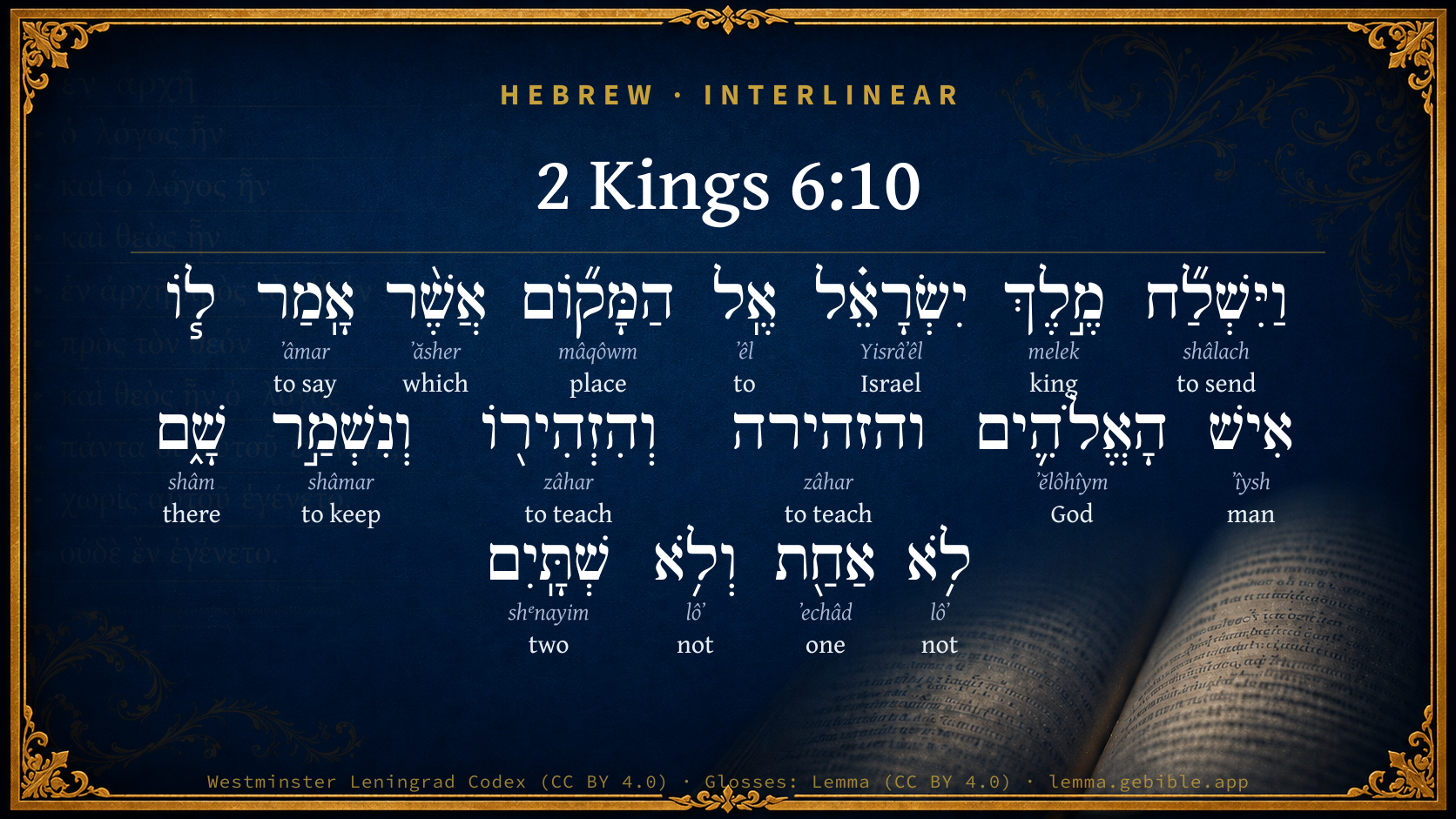
Hebrew (Westminster Leningrad Codex) 2 Kings 6:10 appears in the Hebrew Old Testament. The text above is from the Westminster Leningrad Codex. Each word links to its Strong’s number, a concise gloss, and parsing drawn from the Open Scriptures Hebrew Bible morphology. Click any word for its full Brown-Driver-Briggs (BDB) entry.
Download image
Cite this verse

2 Kings 6:10 (World English Bible). Public Domain. Lemma interlinear Bible study tool, https://lemma.gebible.app/v/2-kings/6/10.

Show BibTeX & RIS
BibTeX
RIS
English Translation
The king of Israel sent to the place which the man of God told him and warned him of; and he saved himself there, not once nor twice.
World English Bible · Public Domain
Download a study sheet

One document with this verse’s original text, its word-by-word gloss line, the meaning frame, cross-references with their text, attributed commentary, and full source and license credits — printable, and it pastes into notes with its structure intact.

This verse Autodidact and up

Study sheet (.html) Plain text (.txt)

A passage Seminary Student

Up to 50 verses in one chapter. A passage sheet keeps up to 6 commentary sources and 12 cross-references per verse, in the order this page ranks them, and says so on the sheet whenever that leaves anything out. Ask for a single verse and you get the Autodidact verse sheet above.

Everything on this page stays free to read, with no account — the sheet is a download of what is already on screen, not access to it.

Want to remove ads? Support Godless Engineer
Compare translations 3

The same verse in 3 English versions, stacked beneath the original-language interlinear above. Click any original word for its lexicon entry.

Each is an independent rendering of the whole verse — the interlinear is not word-aligned to these translations.

Highlighted words mark where these versions differ — a whole-verse word diff, not a word-by-word alignment.

  • World English Bible Public Domain
    The king of Israel sent to the place which the man of God told him and warned him of; and he saved himself there, not once nor twice.
  • King James Version Public Domain
    And the king of Israel sent to the place which the man of God told him and warned him of, and saved himself there, not once nor twice.
  • unfoldingWord Literal Text CC BY-SA 4.0
    And the king of Israel sent to the place that the man of God had said to him and warned him, and he guarded himself there, not once and not twice.

unfoldingWord Literal Text — © unfoldingWord, licensed CC BY-SA 4.0. Word-aligned USFM3 via Door43 (git.door43.org/unfoldingWord/en_ult).

Versions to compare (up to 4)

3 of 4 selected

Show all 18 translations

Every available English version of this verse, each an independent rendering of the whole verse.

  • World English Bible Public Domain
    The king of Israel sent to the place which the man of God told him and warned him of; and he saved himself there, not once nor twice.
  • Berean Standard Bible Public Domain
    So the king of Israel sent word to the place the man of God had pointed out. Time and again Elisha warned the king, so that he was on his guard in such places.
  • Majority Standard Bible Public Domain
    So the king of Israel sent word to the place the man of God had pointed out. Time and again Elisha warned the king, so that he was on his guard in such places.
  • King James Version Public Domain
    And the king of Israel sent to the place which the man of God told him and warned him of, and saved himself there, not once nor twice.
  • American Standard Version (1901) Public Domain
    And the king of Israel sent to the place which the man of God told him and warned him of; and he saved himself there, not once nor twice.
  • Revised Version (1885) Public Domain
    And the king of Israel sent to the place which the man of God told him and warned him of; and he saved himself there, not once nor twice.
  • Geneva Bible (1599) Public Domain
    So the King of Israel sent to the place which the man of God tolde him, and warned him of, and saued himselfe from thence, not once, nor twise.
  • Douay-Rheims (1899) Public Domain
    And the king of Israel sent to the place which the man of God had told him, and prevented him, and looked well to himself there not once nor twice.
  • Young's Literal Translation Public Domain
    and the king of Israel sendeth unto the place of which the man of God spake to him, and warned him, and he is preserved there not once nor twice.
  • Literal Standard Version CC BY-SA 4.0
    and the king of Israel sends to the place of which the man of God spoke to him, and warned him, and he is preserved there not [just] once and not [just] twice.
  • Unlocked Literal Bible CC BY-SA 4.0
    The king of Israel sent a message to the place about which the man of God had spoken and warned him. More than once or twice, when the king went there, he was on his guard.
  • unfoldingWord Literal Text CC BY-SA 4.0
    And the king of Israel sent to the place that the man of God had said to him and warned him, and he guarded himself there, not once and not twice.
  • Darby Bible Public Domain
    And the king of Israel sent to the place which the man of God told him and warned him of, and he was on his guard there. [That took place] not once, nor twice.
  • World Messianic Bible Public Domain
    The king of Israel sent to the place which the man of God told him and warned him of; and he saved himself there, not once or twice.
  • Webster's Bible Public Domain
    And the king of Israel sent to the place which the man of God told him and warned him of, and saved himself there, not once nor twice.
  • Free Bible Version CC BY-SA 4.0
    So the king of Israel sent a warning to the place the man of God had indicated. Elisha repeatedly warned the king, so that he was on the alert in those places.
  • Bible in Basic English Public Domain
    So the king of Israel sent to the place where the man of God had said there was danger, and kept clear of it more than once.
  • JPS Tanakh (1917) Public Domain
    And the king of Israel sent to the place which the man of God told him and warned him of; and he guarded himself there, not once nor twice.

Literal Standard Version (2020), Covenant Press — licensed CC BY-SA 4.0. Text via the HelloAO Bible API (eBible.org). Unlocked Literal Bible (unfoldingWord) — licensed CC BY-SA 4.0. Text via the HelloAO Bible API (eBible.org). unfoldingWord Literal Text — © unfoldingWord, licensed CC BY-SA 4.0. Word-aligned USFM3 via Door43 (git.door43.org/unfoldingWord/en_ult). Free Bible Version, Dr. Jonathan Gallagher — licensed CC BY-SA 4.0. Text via the HelloAO Bible API (eBible.org).

Word by word

More ways to search: Search by grammar → Find every occurrence → Compare this word →

Practice this passage: Drill this verse → Learn its vocabulary →

והזהירה
zâhar
H2094
“and · to teach · him”
Conjunction + Verb, Hiphil, Perfect, 3rd Person, Masculine, Singular + Suffix, Personal, 3rd Person, Masculine, Singular
Part of Speech
Conjunction + Verb
Stem
Hiphil
Form
Perfect
Person
3rd Person
Gender
Masculine
Number
Singular
Full BDB Definition

Origin: a primitive root

TWOT: 531 , 532

to admonish, warn, teach, shine, send out light, be light, be shining - (Niphal) to be taught, be admonished - (Hiphil) - to teach, warn - to shine, send out light (figuratively)
  1. וַיִּשְׁלַ֞ח shâlach H7971 “and · to send” Conjunction + Verb, Qal, Sequential Imperfect, 3rd Person, Masculine, Singular
  2. מֶ֣לֶךְ melek H4428 “king of” Noun, Common, Masculine, Singular, Construct
  3. יִשְׂרָאֵ֗ל Yisrâʼêl H3478 “Israel” Noun, Proper
  4. אֶֽל ʼêl H413 “to” Preposition
  5. הַמָּק֞וֹם mâqôwm H4725 “the · place” Particle, Definite Article + Noun, Common, Masculine, Singular, Absolute
  6. אֲשֶׁ֨ר ʼăsher H834 “which” Particle, Relative
  7. אָֽמַר ʼâmar H559 “to say” Verb, Qal, Perfect, 3rd Person, Masculine, Singular
  8. אִישׁ ʼîysh H376 “man of” Noun, Common, Masculine, Singular, Construct
  9. הָאֱלֹהִ֛ים ʼĕlôhîym H430 “the · God(s)” Particle, Definite Article + Noun, Common, Masculine, Plural, Absolute
  10. וְהִזְהִיר֖וֹ zâhar H2094 “and · to teach · him” Conjunction + Verb, Hiphil, Perfect, 3rd Person, Masculine, Singular + Suffix, Personal, 3rd Person, Masculine, Singular
  11. וְנִשְׁמַ֣ר shâmar H8104 “and · to keep” Conjunction + Verb, Niphal, Sequential Perfect, 3rd Person, Masculine, Singular
  12. שָׁ֑ם shâm H8033 “there” Adverb
  13. לֹ֥א lôʼ H3808 “not” Particle, Negative
  14. אַחַ֖ת ʼechâd H259 “one” Adjective, Cardinal number, Feminine, Singular, Absolute
  15. וְלֹ֥א lôʼ H3808 “and · not” Conjunction + Particle, Negative
  16. שְׁתָּֽיִם shᵉnayim H8147 “two” Adjective, Cardinal number, Feminine, Dual, Absolute

About this verse

These counts appear in no published source. They are computed here, from the morphology-tagged text and Lemma’s own curated glosses. What Lemma adds →

18
words
15
distinct lemmas
Historical
section

Notable vocabulary

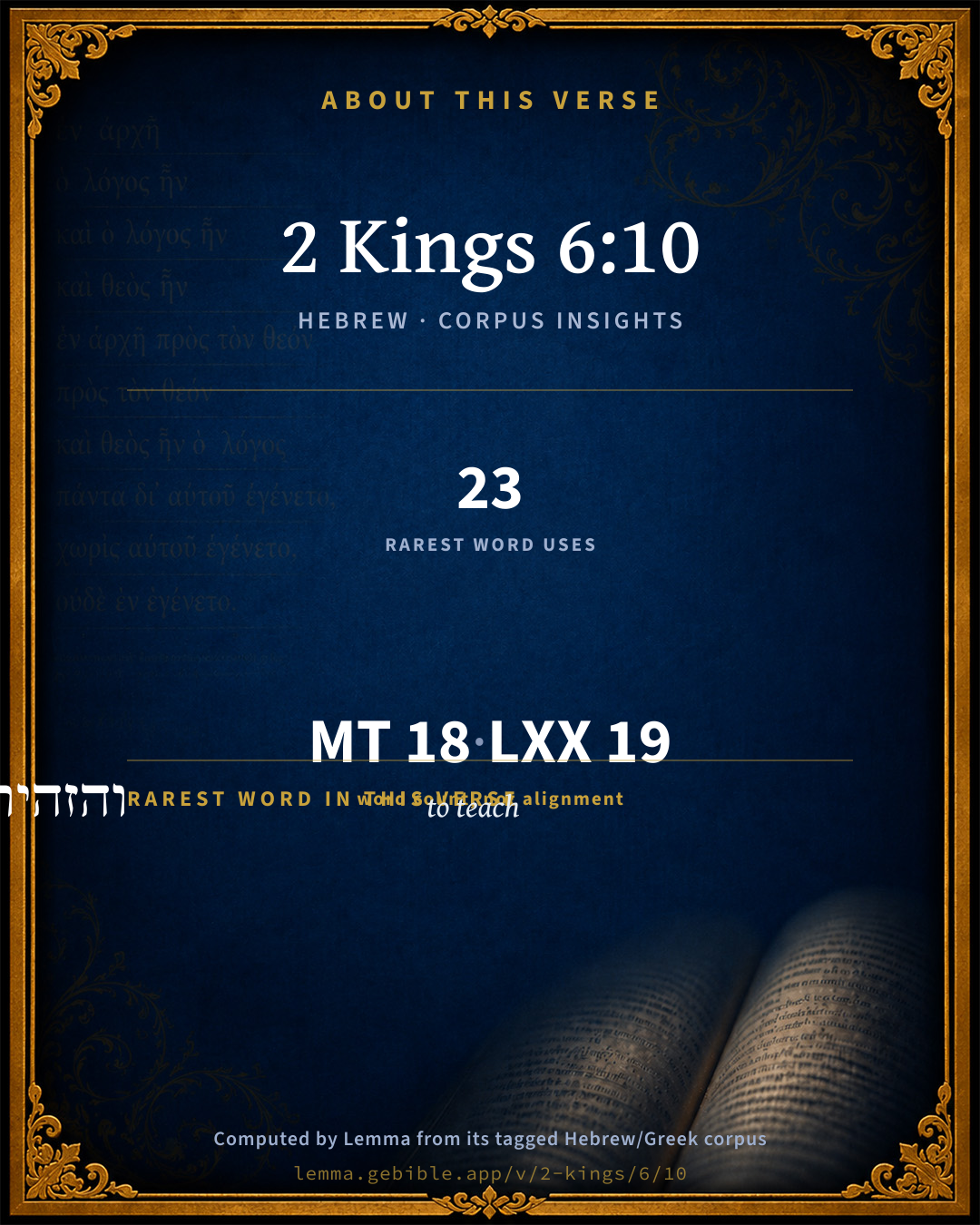
The rarest word here is והזהירה to teach H2094 — appearing just 23 times in the whole Hebrew Bible.

Shared distinctive vocabulary

והזהירה to teach H2094 occurs in 19 verses of the Hebrew Bible. Also found in:

Grammatical profile

  • 5 verbs
  • 5 nouns
  • 2 adjectives
  • 2 prepositions
  • 1 adverb
  • 3 particles

Verb forms

  • וַיִּשְׁלַ֞ח Qal · Sequential Imperfect
  • אָֽמַר Qal · Perfect
  • והזהירה Hiphil · Perfect
  • וְהִזְהִיר֖וֹ Hiphil · Perfect
  • וְנִשְׁמַ֣ר Niphal · Sequential Perfect

Repetition

Words recur within this verse — often emphatic in Hebrew:

  • והזהירה to teach H2094 ×2
  • לֹ֥א not H3808 ×2

Hebrew & Septuagint length

In English translation the verse runs 28 words from the Hebrew and 22 from the Septuagint (LXX English) — closely comparable.

A rough comparison of the two English renderings, which tokenize alike — not a word-level alignment.

Word counts can differ between the Hebrew and the Greek without any difference in meaning — e.g. the Hebrew direct-object marker אֵת has no separate Greek word, and Greek often adds the article ὁ.

In the original languages it is 18 Hebrew tokens and 19 Greek tokens — but the two are counted differently (Hebrew bundles its prefixes and suffixes into one token; the Greek is in lemma form), so that isn’t a like-for-like length.

Cross-references

14

Topical passages linked to 2 Kings 6:10 in the Treasury of Scripture Knowledge — connected by theme and wording, ordered by reader-vote popularity; previews shown in the World English Bible.

  • Exodus 9:20–21 Those who feared the word of Yahweh among the servants of Pharaoh made their servants and their cattle flee into the houses.
  • 1 Kings 20:15 Then he mustered the young men of the princes of the provinces, and they were two hundred and thirty-two: and after them he mustered all the people, even all the children of Israel, being seven thousand.
  • 2 Kings 2:12 Elisha saw it, and he cried, My father, my father, the chariots of Israel and the horsemen of it! He saw him no more: and he took hold of his own clothes, and tore them in two pieces.
  • 2 Kings 5:14 Then went he down, and dipped [himself] seven times in the Jordan, according to the saying of the man of God; and his flesh came again like the flesh of a little child, and he was clean.
  • 2 Kings 13:14 Now Elisha was fallen sick of his sickness of which he died: and Joash the king of Israel came down to him, and wept over him, and said, My father, my father, the chariots of Israel and the horsemen of it!
  • 2 Chronicles 20:20 They rose early in the morning, and went forth into the wilderness of Tekoa: and as they went forth, Jehoshaphat stood and said, Hear me, Judah, and you inhabitants of Jerusalem: believe in Yahweh your God, so shall you be established; believe his prophets, so shall you prosper.
  • Proverbs 27:12 A prudent man sees danger and takes refuge; But the simple pass on, and suffer for it:
  • Ezekiel 3:18–21 When I tell the wicked, You shall surely die; and you give him no warning, nor speak to warn the wicked from his wicked way, to save his life; the same wicked man shall die in his iniquity; but his blood will I require at your hand.
  • Amos 7:1–6 Thus the Lord Yahweh showed me: and, behold, he formed locusts in the beginning of the shooting up of the latter growth; and, behold, it was the latter growth after the king's harvest.
  • Matthew 2:12 Being warned in a dream that they shouldn't return to Herod, they went back to their own country another way.
  • Matthew 3:7 But when he saw many of the Pharisees and Sadducees coming for his baptism, he said to them, "You offspring of vipers, who warned you to flee from the wrath to come?
  • Matthew 24:15–17 "When, therefore, you see the abomination of desolation, which was spoken of through Daniel the prophet, standing in the holy place (let the reader understand),
  • Acts 27:24 saying, 'Don't be afraid, Paul. You must stand before Caesar. Behold, God has granted you all those who sail with you.'
  • Hebrews 11:7 By faith, Noah, being warned about things not yet seen, moved with godly fear, prepared an ark for the saving of his house, through which he condemned the world, and became heir of the righteousness which is according to faith.

Cross-references courtesy of OpenBible.info (CC BY 4.0).

Hebrew and Greek witnesses Masoretic Hebrew ↔ Greek Septuagint

The same verse in the two great witnesses to the Old Testament, shown verse-for-verse.

These are two independent witnesses, not word-aligned to each other, and the Septuagint is shown in lemma (dictionary) form.

Hebrew 2 Kings 6:10 Masoretic · Westminster Leningrad Codex

וַיִּשְׁלַ֞ח מֶ֣לֶךְ יִשְׂרָאֵ֗ל אֶֽל הַמָּק֞וֹם אֲשֶׁ֨ר אָֽמַר ל֧וֹ אִישׁ הָאֱלֹהִ֛ים והזהירה וְהִזְהִיר֖וֹ וְנִשְׁמַ֣ר שָׁ֑ם לֹ֥א אַחַ֖ת וְלֹ֥א שְׁתָּֽיִם

The king of Israel sent to the place which the man of God told him and warned him of; and he saved himself there, not once nor twice.

World English Bible · Public Domain

Greek LXX 2 Kings 6:10 Septuagint · lemma form

καί ἀποστέλλω ὁ βασιλεύς ἰσραήλ εἰς ὁ τόπος ὅς εἶπον αὐτός ελισαιε καί φυλάσσω ἐκεῖθεν οὐ εἷς οὐδέ δύο

And the king of Israel sent to the place which Elisaie mentioned to him, and saved himself thence not once or twice.

LXX2012 (modern English Septuagint) · Public Domain

Hebrew: Westminster Leningrad Codex (CC BY 4.0). Greek: Septuagint (public domain); English from LXX2012 (modern English Septuagint) (Public Domain). How the Septuagint differs from the Hebrew →

Targum (Aramaic paraphrase)

1

The Targum is the ancient Jewish Aramaic paraphrase of the Hebrew Scriptures — an interpretive translation, not the Hebrew text itself. Onkelos (literal) and Pseudo-Jonathan (expansive) render the Torah, and Jonathan the Prophets. Coverage is partial: where no permissively-licensed English translation exists for a verse, only the Aramaic is shown. This is verse-level text, not a word-by-word alignment to the Hebrew.

  1. Targum Jonathan Prophets (Joshua–Malachi)
    וּשְׁלַח מַלְכָּא דְיִשְׂרָאֵל לְאַתְרָא דִי אֲמַר לֵיהּ נְבִיָא דַייָ וְאַזְהָרֵיהּ וְאִסְתַּמָר תַּמָן לָא חֲדָא זִימְנָא וְלָא תַרְתֵּין זִמְנִין:

    (no public-domain English translation for this verse)

    Targum Jonathan — Aramaic: “Mikraot Gedolot” (public domain). English: “Sefaria Community Translation” (CC0 1.0 (public-domain dedication)); “London "Chaldee Paraphrase," 1871” (public domain). Text via Sefaria.

Commentary

Notes on 2 Kings 6:10 from classic Christian and Jewish commentators (each source and its license shown beneath its notes). The classic Christian expositions comment on the surrounding passage and are grouped to its opening verse, so a note may address several verses; the Jewish commentaries on the Tanakh (Rashi and others) are per-verse, so they appear only where the commentator wrote on this verse.

Lemma curates 59 commentaries, every one of them public domain or Creative Commons licensed, each selected and text-cleaned for this edition rather than reprinted as found. About our sources →

Trapp's Complete Commentary

John Trapp

2Ki 6:10 And the king of Israel sent to the place which the man of God told him and warned him of, and saved himself there, not once nor twice.

Ver. 10. And saved himself there.] It was the king himself whom they aimed at, as 1Ki 22:31; - and as that officer of the cuirassiers, {a} who, pistoling the late victorious king of Sweden, said, This is the right bird.

{a} A horse soldier wearing a cuirass. The proper name of a certain type of heavy cavalry in European armies.

John Trapp, A Commentary or Exposition upon All the Books of the Old and New Testament (1647–1656) — public domain. Text from a community e-Sword module.

Joseph Benson's Commentary

2Ki 6:10. The king of Israel sent to the place — Either spies, to know whether the information which the prophet had given him was true, or soldiers, to secure the place and passage designed. By this means he frequently saved himself or his people from falling into the hands of the Syrians, who lay in wait for them in places to which they would certainly have gone, if they had not been told of the danger.

Joseph Benson's Commentary on the Old and New Testaments (1811–1818) — public domain. Text from a community e-Sword module.

Geneva Bible (1599)

Geneva Bible translators

The wicked conspire nothing so craftily, but God can reveal it to his servants, and cause their counsel to be disclosed.

Geneva Bible (1599) marginal notes — public domain. Text via Bolls.life.

Adam Clarke's Commentary

Verse 10. Sent to the place] To see if it were so. But the Vulgate gives it quite a different turn: Misit rex Israel ad locum, et praeoccupavit eum. The king of Israel sent previously to the place, and took possession of it; and thus the Syrians were disappointed. This is very likely, though it is not expressed in the Hebrew text. The prophet knew the Syrians marked such a place; he told the king of Israel, and he hastened and sent a party of troops to pre-occupy it; and thus the Syrians found that their designs had been detected.

Adam Clarke's Commentary on the Bible (1810–1826) — public domain. Text from a community e-Sword/MySword module.

Ellicott's Commentary for English Readers

(10) Sent.—A sufficient force to hold the place, so that the Syrians had to return unsuccessful.

Warned.—Eze_3:19; 2Ch_19:10.

Saved himself.—Was wary; on his guard (2Ki_6:9).

Not once nor twice refers to the statement of the entire verse. On more than one occasion, and in regard to different inroads of the Syrians, Elisha gave the king forewarning.

A Bible Commentary for English Readers, edited by Charles John Ellicott (1878–1897) — public domain. Text from a community e-Sword module.

The Cambridge Bible for Schools and Colleges

gen. ed. J. J. S. Perowne

10. sent to the place] A single messenger, against whom the Syrians would do nothing, would be enough to find out whether the prophet’s warning were true.

not once nor twice] i.e. but several times.

The Cambridge Bible for Schools and Colleges (gen. ed. J. J. S. Perowne; Cambridge University Press, 1878–1918) — public domain. Text from a community e-Sword module.

John Gill's Exposition

Therefore the heart of the king of Syria was sore troubled for this thing,.... There was as it were a storm in his breast, as the word signifies; he was like a troubled sea, tossed with tempests, exceeding uneasy in his mind, fretting at the disappointment he met with time after time:

and he called his servants, and said unto them, will ye not show me which of us is for the king of Israel? he suspected that some one of his counsellors was in the interest of the king of Israel, and betrayed his secrets to him, which was the cause of his disappointments.

John Gill's Exposition of the Whole Bible (1746–1763) — public domain (CC PDM 1.0). Text via the HelloAO Bible API.

Albert Barnes' Notes on the Bible

Saved himself - Rather, he “was ware.” The verb used is the same which is translated “beware” in the preceding verse.

Albert Barnes' Notes on the Bible (1834–1885) — public domain. Text from a community e-Sword/MySword module.

Haydock's Catholic Bible Commentary

Twice, but very frequently: so that the Syrian feared some treachery. (Haydock)

George Leo Haydock (1774–1849), Haydock's Catholic Family Bible and Commentary, 1859 edition — public domain. Excludes Psalms (Douay-Rheims chapter numbering differs from Protestant) and Deuterocanonical books (Catholic canon only).

Matthew Poole's English Annotations

Sent to the place, either spies, to try whether the prophet spake truth; or rather, soldiers, to secure the place and passage designed.

Saved himself; either his person when he was to pass that way; or his people, or places of importance.

Not once nor twice, but much more frequently.

Matthew Poole's English Annotations on the Holy Bible (1683–1685) — public domain. Text from a community e-Sword/MySword module.

Whedon's Commentary on the Bible

Daniel D. Whedon

10. The king of Israel sent to the place — Sent spies to the place, in order to ascertain if Elisha had given correct information and wise counsel.

Saved himself there — Not by sending armed forces to rout the ambushed Syrians, or to pre-occupy the place before the Syrians came down to it, but by observing the counsel of the prophet, and not passing through that locality. Again and again was he thus made acquainted with the plans and movements of his enemy, and escaped the snares set for him.

Daniel D. Whedon (gen. ed.), Commentary on the Old and New Testaments (1874–1909) — public domain. Text from a community e-Sword module.

The Pulpit Commentary

And the King of Israel sent to the place. Recent commentators (Keil, Thenius, Bahr) mostly suppose this to mean that Jehoram sent troops to the place pointed out by the prophet, and anticipated the Syrians by occupying it. But it agrees better with the prophet"s injunction, "Beware that thou pass not such a place," to suppose that he merely sent out scouts to see if the place were occupied or no, and finding, in each ease, Elisha"s warning true, he avoided the locality. Which the man of God told him and warned him of, and saved himself there, not once nor twice; i.e. repeatedly; at least three several times, perhaps more.

The Pulpit Commentary (1880–1919), ed. H.D.M. Spence-Jones & Joseph S. Exell — public domain. Text from a community e-Sword module.

John Wesley's Explanatory Notes

Sent - Soldiers to secure the place and passage designed.

John Wesley, Explanatory Notes Upon the Whole Bible (1754–1765) — public domain. Text via the GEBible commentary corpus.

unfoldingWord translationNotes

Door43 World Missions Community

to the place about which the man of God had spoken and warned him

This refers to the place that Elisha had warned the king about in 2 Kings 6:9.

More than once or twice, when the king went there, he was on his guard

Elisha would warn the king of where the Aramean army would attack so that he could alert the people before the attack happened. AT: "Elisha warned the king of Israel in this way several times and the Israelites were able to stay safe" (See: Assumed Knowledge and Implicit Information)

Will you not tell me who among us is for the king of Israel?

The king of Aram assumes there is a traitor among his soldiers who is giving information to the Israelite king. He uses this rhetorical question to try to find out who that traitor is. This can be written as a statement. AT: "Tell me which of you is for the king of Israel!" or "Tell me which of you is revealing our plans to the king of Israel!" (See: Rhetorical Question)

is for the king of Israel

"To be for someone" means to be loyal to that person. In this case, it means that they would give information to help the king of Israel. AT: "is helping the king of Israel" or "is loyal to the king of Israel" (See: Idiom)

translationWords

save

mind

unfoldingWord translationNotes — © Distant Shores Media and the Door43 World Missions Community, licensed CC BY-SA 4.0. Source: git.door43.org/Door43/en_tn.

Rashi

Rabbi Shlomo Yitzchaki (Rashi)

The king of Yisroel dispatched [scouts]. He would send and see whether it was true.

And warned him. The man of God had warned him passing there.

Not once and not twice. Did he do so for him, but many times.

Rashi on the Tanakh — English translations: “The Judaica Press complete Tanach with Rashi, translated by A. J. Rosenberg” (CC BY 4.0); “Pentateuch with Rashi's commentary by M. Rosenbaum and A.M. Silbermann, 1929-1934” (public domain); “The Metsudah Tanach series, Lakewood, N.J” (CC BY 4.0); and “The Book of Joshua, Metsudah Publications, 1997” (CC BY 4.0). Text via Sefaria.

Lesson kit

Teaching starters — assembled from the data on this page, not authored interpretation. Every prompt links to the verse data it draws on. Edit before teaching.

2 Kings, in the Historical, opens this verse with 18 words (15 distinct Hebrew lemmas). Its most distinctive word is zâhar (“to teach”). A historical commentator’s framing appears above. Read the whole chapter for the surrounding context.

Discussion questions

  1. How does “to teach” (zâhar) shape what this verse is saying?
  2. How does Exodus 18:20, which shares the word «to teach», read alongside this verse?
  3. What does the repetition of “to teach” (2× in this one verse) do in this verse?
  4. The translations on this page render this verse differently — a whole-verse word diff, not a word-by-word alignment. What might account for the different wordings?
  5. «וַיִּשְׁלַ֞ח» is a Qal Sequential Imperfect verb. How does that grammatical form shape the action described?
  6. Compare how Trapp's Complete Commentary and Joseph Benson's Commentary read this verse. Where do they agree or differ?

Things to notice

Reading settings

Reading text

Shown beneath each verse's original-language words.

Old Testament
Old Testament edition

Read the OT as the Masoretic Hebrew (MT) or the Greek Septuagint (LXX).

English shown for the Greek Septuagint (in the Hebrew ↔ Greek comparison).

Comparing translations? Open the Compare panel on any verse page to stack up to four side by side.