1 Kings 1:14

Hebrew (Westminster Leningrad Codex) 1 Kings 1:14 appears in the Hebrew Old Testament. The text above is from the Westminster Leningrad Codex. Each word links to its Strong’s number, a concise gloss, and parsing drawn from the Open Scriptures Hebrew Bible morphology. Click any word for its full Brown-Driver-Briggs (BDB) entry.
Download image
Cite this verse

1 Kings 1:14 (World English Bible). Public Domain. Lemma interlinear Bible study tool, https://lemma.gebible.app/v/1-kings/1/14.

Show BibTeX & RIS
BibTeX
RIS
English Translation
Behold, while you yet talk there with the king, I also will come in after you, and confirm your words.
World English Bible · Public Domain
Download a study sheet

One document with this verse’s original text, its word-by-word gloss line, the meaning frame, cross-references with their text, attributed commentary, and full source and license credits — printable, and it pastes into notes with its structure intact.

This verse Autodidact and up

Study sheet (.html) Plain text (.txt)

A passage Seminary Student

Up to 50 verses in one chapter. A passage sheet keeps up to 6 commentary sources and 12 cross-references per verse, in the order this page ranks them, and says so on the sheet whenever that leaves anything out. Ask for a single verse and you get the Autodidact verse sheet above.

Everything on this page stays free to read, with no account — the sheet is a download of what is already on screen, not access to it.

Want to remove ads? Support Godless Engineer
Compare translations 3

The same verse in 3 English versions, stacked beneath the original-language interlinear above. Click any original word for its lexicon entry.

Each is an independent rendering of the whole verse — the interlinear is not word-aligned to these translations.

Highlighted words mark where these versions differ — a whole-verse word diff, not a word-by-word alignment.

  • World English Bible Public Domain
    Behold, while you yet talk there with the king, I also will come in after you, and confirm your words.
  • King James Version Public Domain
    Behold, while thou yet talkest there with the king, I also will come in after thee, and confirm thy words.
  • unfoldingWord Literal Text CC BY-SA 4.0
    Behold, you will still be speaking there with the king, and I, I will come after you, and I will fill your words.”

unfoldingWord Literal Text — © unfoldingWord, licensed CC BY-SA 4.0. Word-aligned USFM3 via Door43 (git.door43.org/unfoldingWord/en_ult).

Versions to compare (up to 4)

3 of 4 selected

Show all 18 translations

Every available English version of this verse, each an independent rendering of the whole verse.

  • World English Bible Public Domain
    Behold, while you yet talk there with the king, I also will come in after you, and confirm your words.
  • Berean Standard Bible Public Domain
    Then, while you are still there speaking with the king, I will come in after you and confirm your words.”
  • Majority Standard Bible Public Domain
    Then, while you are still there speaking with the king, I will come in after you and confirm your words.”
  • King James Version Public Domain
    Behold, while thou yet talkest there with the king, I also will come in after thee, and confirm thy words.
  • American Standard Version (1901) Public Domain
    Behold, while thou yet talkest there with the king, I also will come in after thee, and confirm thy words.
  • Revised Version (1885) Public Domain
    Behold, while thou yet talkest there with the king, I also will come in after thee, and confirm thy words.
  • Geneva Bible (1599) Public Domain
    Behold, while thou yet talkest there with the King, I also will come in after thee, and confirme thy wordes.
  • Douay-Rheims (1899) Public Domain
    And while thou art yet speaking there with the king, I will come in after thee, and will fill up thy words.
  • Young's Literal Translation Public Domain
    Lo, thou are yet speaking there with the king, and I come in after thee, and have completed thy words.'
  • Literal Standard Version CC BY-SA 4.0
    Behold, you are yet speaking there with the king, and I come in after you, and have completed your words.”
  • Unlocked Literal Bible CC BY-SA 4.0
    While you are there speaking with the king, I will come in after you and confirm your words.”
  • unfoldingWord Literal Text CC BY-SA 4.0
    Behold, you will still be speaking there with the king, and I, I will come after you, and I will fill your words.”
  • Darby Bible Public Domain
    Behold, while thou yet talkest there with the king, I also will come in after thee and confirm thy words.
  • World Messianic Bible Public Domain
    Behold, while you are still talking there with the king, I will also come in after you and confirm your words.”
  • Webster's Bible Public Domain
    Behold, while thou art yet talking there with the king, I will also come in after thee, and confirm thy words.
  • Free Bible Version CC BY-SA 4.0
    Then I'll come in while you're still there talking with the king and I'll confirm what you're saying.”
  • Bible in Basic English Public Domain
    And while you are still talking there with the king, see, I will come in after you and say that your story is true.
  • JPS Tanakh (1917) Public Domain
    Behold, while thou yet talkest there with the king, I also will come in after thee, and confirm thy words.'

Literal Standard Version (2020), Covenant Press — licensed CC BY-SA 4.0. Text via the HelloAO Bible API (eBible.org). Unlocked Literal Bible (unfoldingWord) — licensed CC BY-SA 4.0. Text via the HelloAO Bible API (eBible.org). unfoldingWord Literal Text — © unfoldingWord, licensed CC BY-SA 4.0. Word-aligned USFM3 via Door43 (git.door43.org/unfoldingWord/en_ult). Free Bible Version, Dr. Jonathan Gallagher — licensed CC BY-SA 4.0. Text via the HelloAO Bible API (eBible.org).

Word by word

More ways to search: Search by grammar → Find every occurrence → Compare this word →

Practice this passage: Drill this verse → Learn its vocabulary →

וּמִלֵּאתִ֖י
mâlêʼ
H4390
“and · to fill”
Conjunction + Verb, Piel, Sequential Perfect, 1st Person, Common, Singular
Part of Speech
Conjunction + Verb
Stem
Piel
Form
Sequential Perfect
Person
1st Person
Gender
Common
Number
Singular
Full BDB Definition

Origin: a primitive root

TWOT: 1195

to fill, be full - (Qal) - to be full - fulness, abundance (participle) - to be full, be accomplished, be ended - to consecrate, fill the hand - (Niphal) - to be filled, be armed, be satisfied - to be accomplished, be ended - (Piel) - to fill - to satisfy - to fulfil, accomplish, complete - to confirm - (Pual) to be filled - (Hithpael) to mass themselves against
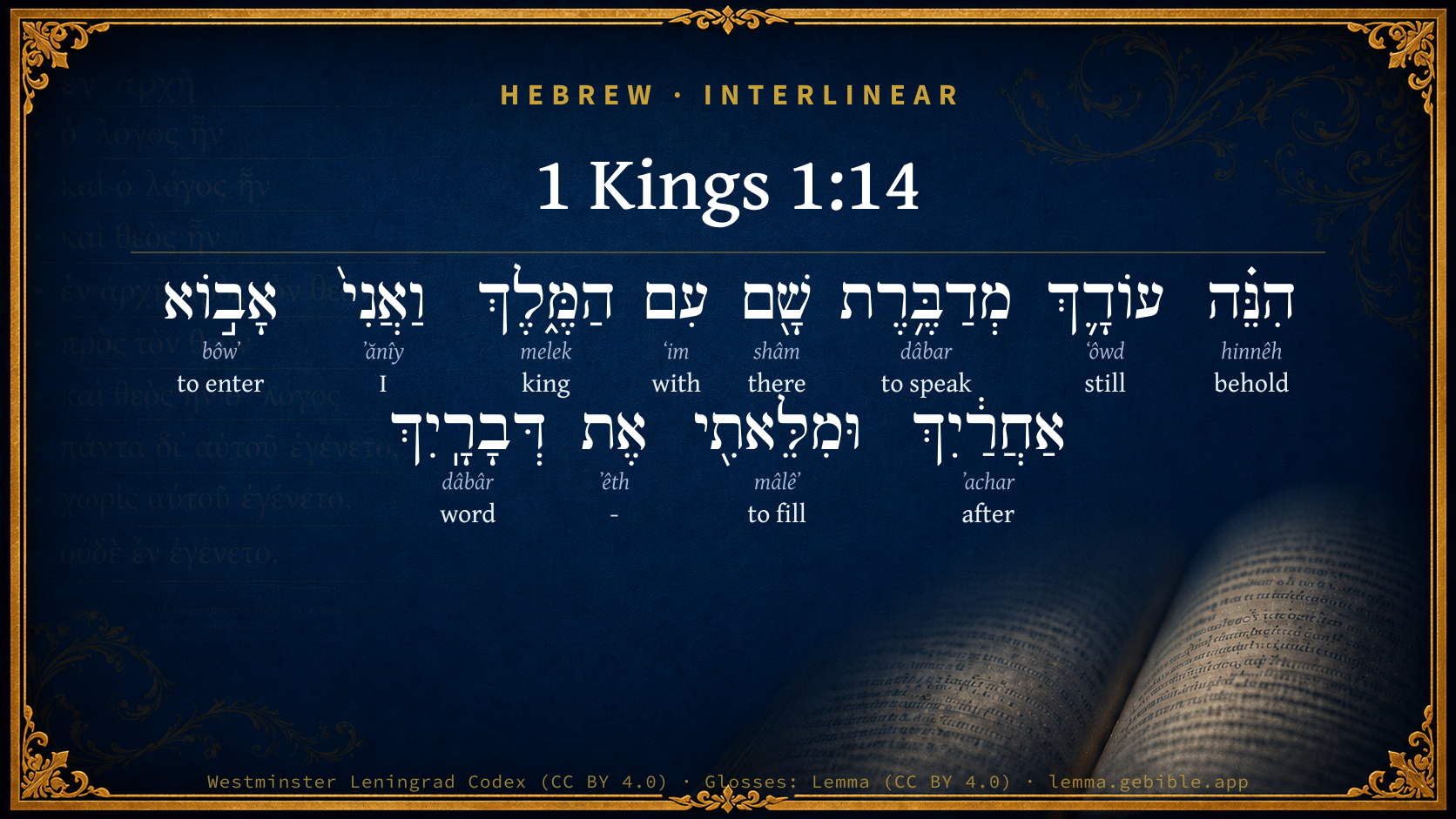
  1. הִנֵּ֗ה hinnêh H2009 “behold” Particle, Demonstrative
  2. עוֹדָ֛ךְ ʻôwd H5750 “still · your” Adverb + Suffix, Personal, 2nd Person, Feminine, Singular
  3. מְדַבֶּ֥רֶת dâbar H1696 “speaking” Verb, Piel, Participle Active, Feminine, Singular, Absolute
  4. שָׁ֖ם shâm H8033 “there” Adverb
  5. עִם ʻim H5973 “with” Preposition
  6. הַמֶּ֑לֶךְ melek H4428 “the · king” Particle, Definite Article + Noun, Common, Masculine, Singular, Absolute
  7. וַאֲנִי֙ ʼănîy H589 “and · I” Conjunction + Pronoun, Personal, 1st Person, Common, Singular
  8. אָב֣וֹא bôwʼ H935 “to enter” Verb, Qal, Imperfect, 1st Person, Common, Singular
  9. אַחֲרַ֔יִךְ ʼachar H310 “after · you” Preposition + Suffix, Personal, 2nd Person, Feminine, Singular
  10. אֶת ʼêth H853 “-” Particle, Direct Object
  11. דְּבָרָֽיִךְ dâbâr H1697 “words · your” Noun, Common, Masculine, Plural, Construct + Suffix, Personal, 2nd Person, Feminine, Singular

About this verse

These counts appear in no published source. They are computed here, from the morphology-tagged text and Lemma’s own curated glosses. What Lemma adds →

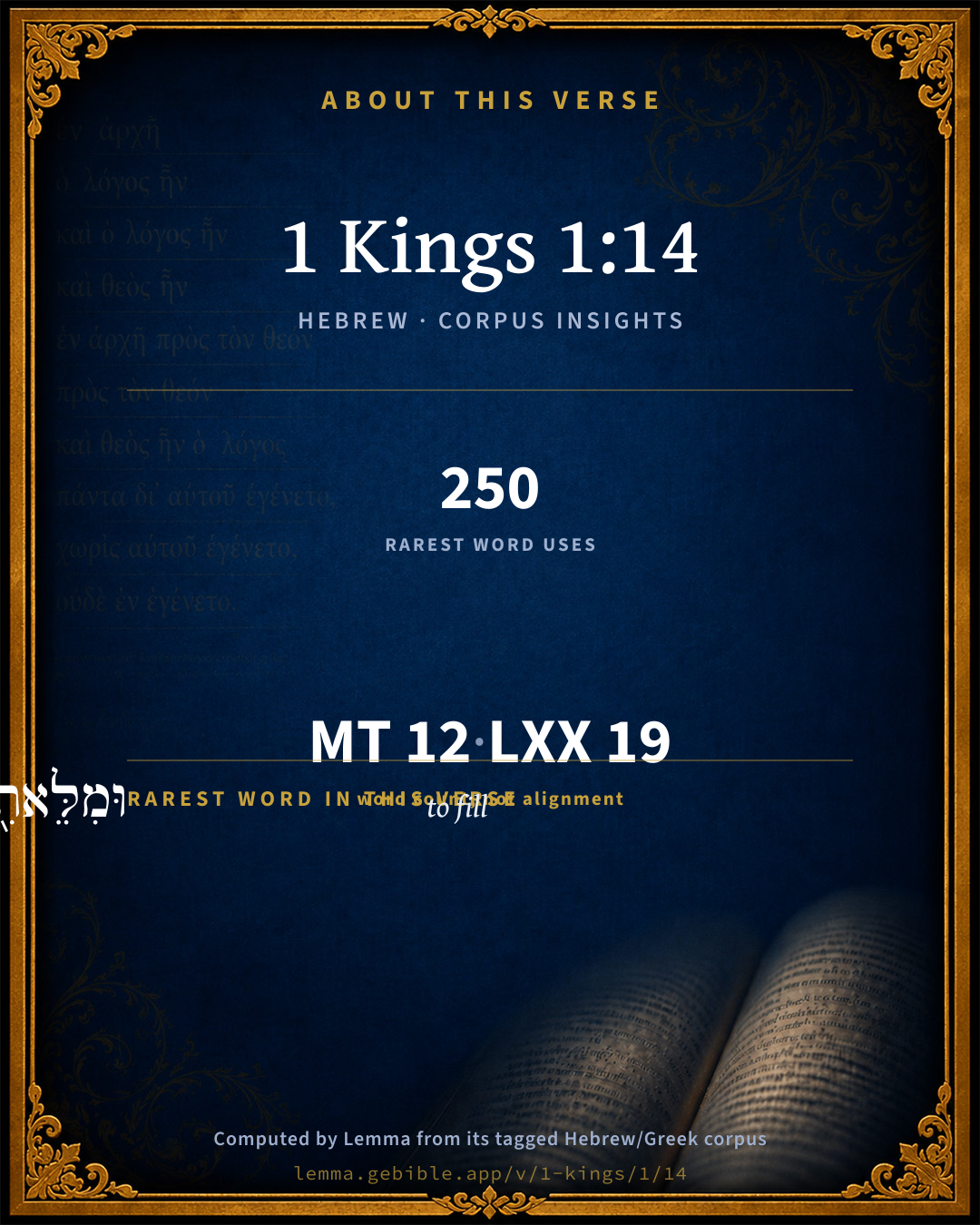
12
words
12
distinct lemmas
Historical
section

Grammatical profile

  • 3 verbs
  • 2 nouns
  • 1 pronoun
  • 2 prepositions
  • 2 adverbs
  • 2 particles

Verb forms

  • מְדַבֶּ֥רֶת Piel · Participle Active
  • אָב֣וֹא Qal · Imperfect
  • וּמִלֵּאתִ֖י Piel · Sequential Perfect

Hebrew & Septuagint length

In English translation the verse runs 20 words from the Hebrew and 23 from the Septuagint (LXX English) — closely comparable.

A rough comparison of the two English renderings, which tokenize alike — not a word-level alignment.

Word counts can differ between the Hebrew and the Greek without any difference in meaning — e.g. the Hebrew direct-object marker אֵת has no separate Greek word, and Greek often adds the article ὁ.

In the original languages it is 12 Hebrew tokens and 19 Greek tokens — but the two are counted differently (Hebrew bundles its prefixes and suffixes into one token; the Greek is in lemma form), so that isn’t a like-for-like length.

Cross-references

2

Topical passages linked to 1 Kings 1:14 in the Treasury of Scripture Knowledge — connected by theme and wording, ordered by reader-vote popularity; previews shown in the World English Bible.

  • 2 Corinthians 13:1 This is the third time I am coming to you. "At the mouth of two or three witnesses shall every word established."
  • 1 Kings 1:17–27 She said to him, My lord, you swore by Yahweh your God to your handmaid, [saying], Assuredly Solomon your son shall reign after me, and he shall sit on my throne.

Cross-references courtesy of OpenBible.info (CC BY 4.0).

Hebrew and Greek witnesses Masoretic Hebrew ↔ Greek Septuagint

The same verse in the two great witnesses to the Old Testament, shown verse-for-verse.

These are two independent witnesses, not word-aligned to each other, and the Septuagint is shown in lemma (dictionary) form.

Hebrew 1 Kings 1:14 Masoretic · Westminster Leningrad Codex

הִנֵּ֗ה עוֹדָ֛ךְ מְדַבֶּ֥רֶת שָׁ֖ם עִם הַמֶּ֑לֶךְ וַאֲנִי֙ אָב֣וֹא אַחֲרַ֔יִךְ וּמִלֵּאתִ֖י אֶת דְּבָרָֽיִךְ

Behold, while you yet talk there with the king, I also will come in after you, and confirm your words.

World English Bible · Public Domain

Greek LXX 1 Kings 1:14 Septuagint · lemma form

καί ἰδού ἔτι λαλέω σύ ἐκεῖ μετά ὁ βασιλεύς καί ἐγώ εἰςἔρχομαι ὀπίσω σύ καί πληρόω ὁ λόγος σύ

And behold, while you are still speaking there with the king, I also will come in after you, and will confirm your words.

LXX2012 (modern English Septuagint) · Public Domain

On this verse, The Pulpit Commentary discusses the Septuagint’s reading. Read the note in Commentary ↓

Hebrew: Westminster Leningrad Codex (CC BY 4.0). Greek: Septuagint (public domain); English from LXX2012 (modern English Septuagint) (Public Domain). How the Septuagint differs from the Hebrew →

Targum (Aramaic paraphrase)

1

The Targum is the ancient Jewish Aramaic paraphrase of the Hebrew Scriptures — an interpretive translation, not the Hebrew text itself. Onkelos (literal) and Pseudo-Jonathan (expansive) render the Torah, and Jonathan the Prophets. Coverage is partial: where no permissively-licensed English translation exists for a verse, only the Aramaic is shown. This is verse-level text, not a word-by-word alignment to the Hebrew.

  1. Targum Jonathan Prophets (Joshua–Malachi)
    וְהָא עַד דִי אַתְּ מְמַלְלָא תַמָן קֳדָם מַלְכָּא וַאֲנָא אֵיעוּל בַּתְרָךְ וַאֲקַיֵם יַת פִּתְגָמָיְכִי:

    (no public-domain English translation for this verse)

    Targum Jonathan — Aramaic: “Mikraot Gedolot” (public domain). English: “Sefaria Community Translation” (CC0 1.0 (public-domain dedication)); “London "Chaldee Paraphrase," 1871” (public domain). Text via Sefaria.

Commentary

Notes on 1 Kings 1:14 from classic Christian and Jewish commentators (each source and its license shown beneath its notes). The classic Christian expositions comment on the surrounding passage and are grouped to its opening verse, so a note may address several verses; the Jewish commentaries on the Tanakh (Rashi and others) are per-verse, so they appear only where the commentator wrote on this verse.

Lemma curates 59 commentaries, every one of them public domain or Creative Commons licensed, each selected and text-cleaned for this edition rather than reprinted as found. About our sources →

Trapp's Complete Commentary

John Trapp

1Ki 1:14 Behold, while thou yet talkest there with the king, I also will come in after thee, and confirm thy words.

Ver. 14. I will come in after thee, and confirm thy words,] {a} Heb., Fill up - that is, say the same, and more. There are some seeming contradictions in Scripture: and though they seem to be as the accusers of Christ, never a one speaking like the other, yet if we understand, we shall find them speaking like Nathan and Bathsheba, both speaking the same things.

{a} Pollicetur suam operam in praetexenda tela.

John Trapp, A Commentary or Exposition upon All the Books of the Old and New Testament (1647–1656) — public domain. Text from a community e-Sword module.

Geneva Bible (1599)

Geneva Bible translators

By declaring such things, as may further the same.

Geneva Bible (1599) marginal notes — public domain. Text via Bolls.life.

Ellicott's Commentary for English Readers

(14) While thou yet talkest.—The whole history seems to indicate a growth of royal state and Oriental reverence for the king’s person since the defeat of Absalom, contrasted with the comparative simplicity of intercourse with him in earlier days, and preparatory to the still greater development of majesty and despotism under Solomon. Bath-sheba’s entrance into the bedchamber seems to be looked upon as an intrusion, to be ventured upon only in the humble attitude of a suppliant. Nathan does not presume to approach the king with remonstrance, till the maternal anxiety of Bath-sheba has paved the way. (Comp, in Est_4:10-16, the picture of the still more unapproachable royalty of Persia.)

A Bible Commentary for English Readers, edited by Charles John Ellicott (1878–1897) — public domain. Text from a community e-Sword module.

The Cambridge Bible for Schools and Colleges

gen. ed. J. J. S. Perowne

14. and confirm thy words] Lit. ‘fill up’ thy words. This Nathan could most fitly do because he knew of the expressions of God’s will which had been communicated unto David. Thus he could dwell more fully than Bath-sheba on the king’s previous intentions, and knowing better than she what was going on around Adonijah could assure David that it was no imaginary alarm.

The Cambridge Bible for Schools and Colleges (gen. ed. J. J. S. Perowne; Cambridge University Press, 1878–1918) — public domain. Text from a community e-Sword module.

John Gill's Exposition

Behold, while thou yet talkest there with the king,.... Before, or by the time she could deliver the above words to him, or such as she should think fit to use, to awaken the king to a concern for the interest of her and her son:

I will also come in after thee; directly into the king's chamber:

and confirm thy words; as he could very well do, if he was present as a witness of the oath he had made to her, as well as he could confirm the truth of Adonijah's usurpation; nay, could plead the will and promises of God he had formerly notified to him: or, "fill up thy words" (f), make up what might be wanting in her address to him, in her account of things, or in the arguments used by her; he means, that he would second her in her motion in favour of Solomon, and press the king to take some steps for the security of the succession to him. Nathan knew it was the will of God that Solomon should succeed in the kingdom, he had promised it by him, see Sa2 7:12; yet, as a wise and good man, he thought it right to make use of all proper means to attain the end.

(f) "complebo", Pagninus, Montanus, Vatablus; "explebo", Ar.

John Gill's Exposition of the Whole Bible (1746–1763) — public domain (CC PDM 1.0). Text via the HelloAO Bible API.

Albert Barnes' Notes on the Bible

Confirm thy words - “Establish” them, by giving a second testimony. Nathan thinks it best to move David’s affections first through Bath-sheba, before he comes in to discuss the matter as one of state policy, and to take the king’s orders upon it.

Albert Barnes' Notes on the Bible (1834–1885) — public domain. Text from a community e-Sword/MySword module.

Haydock's Catholic Bible Commentary

Words, and confirm what thou hast said, (Menochius) reminding the king of God’s express declaration. (Haydock)

George Leo Haydock (1774–1849), Haydock's Catholic Family Bible and Commentary, 1859 edition — public domain. Excludes Psalms (Douay-Rheims chapter numbering differs from Protestant) and Deuterocanonical books (Catholic canon only).

Whedon's Commentary on the Bible

Daniel D. Whedon

14. Confirm thy words — Hebrew, as margin, fill up; that is, complete, in the same sense as fulfilling, and thereby confirming a prophecy.

Daniel D. Whedon (gen. ed.), Commentary on the Old and New Testaments (1874–1909) — public domain. Text from a community e-Sword module.

The Pulpit Commentary

Behold, while thou yet talkest there the original is more graphic, "thou art yet talking and I" with the king, I also win come after thee and confirm marg., "fill up," of. plhrwsw, LXX Still an idiom of the East. Roberts (quoted in the "Biblical Museum") cites many illustrations. The meaning is, not to add to, amplify, but to corroborate. 1Ki_2:27 1Ki_8:15, 24 thy words. And if thou wilt walk in my ways, to keep my statutes and my commandments, as thy father David did walk ver. 6; 15:4. This is the Divine confirmation of David"s words to his son (1Ki_2:3, 1Ki_2:4) and of the son"s description of his father"s piety (ver. 6 supra), then I will lengthen thy days Solomon"s days were not of an unusual length, as he can hardly have been more than sixty (if so much), although called qezi 1Ki_11:41 at the time of his decease. But he had not fulfilled the condition. (1Ki_11:9-12)

The Pulpit Commentary (1880–1919), ed. H.D.M. Spence-Jones & Joseph S. Exell — public domain. Text from a community e-Sword module.

Lesson kit

Teaching starters — assembled from the data on this page, not authored interpretation. Every prompt links to the verse data it draws on. Edit before teaching.

1 Kings, in the Historical, opens this verse with 12 words (12 distinct Hebrew lemmas). Its most distinctive word is mâlêʼ (“to fill”). A historical commentator’s framing appears above. Read the whole chapter for the surrounding context.

Discussion questions

  1. The word mâlêʼ carries the sense “to fill.” How does it shape the verse?
  2. How does 2 Corinthians 13:1, which shares this passage’s theme, read alongside this verse?
  3. The translations on this page render this verse differently — a whole-verse word diff, not a word-by-word alignment. What might account for the different wordings?
  4. «מְדַבֶּ֥רֶת» is a Piel Participle Active verb. How does that grammatical form shape the action described?
  5. Compare how Trapp's Complete Commentary and Geneva Bible (1599) read this verse. Where do they agree or differ?

Things to notice

Reading settings

Reading text

Shown beneath each verse's original-language words.

Old Testament
Old Testament edition

Read the OT as the Masoretic Hebrew (MT) or the Greek Septuagint (LXX).

English shown for the Greek Septuagint (in the Hebrew ↔ Greek comparison).

Comparing translations? Open the Compare panel on any verse page to stack up to four side by side.