2 Kings 6:9

Hebrew (Westminster Leningrad Codex) 2 Kings 6:9 appears in the Hebrew Old Testament. The text above is from the Westminster Leningrad Codex. Each word links to its Strong’s number, a concise gloss, and parsing drawn from the Open Scriptures Hebrew Bible morphology. Click any word for its full Brown-Driver-Briggs (BDB) entry.
Download image
Cite this verse

2 Kings 6:9 (World English Bible). Public Domain. Lemma interlinear Bible study tool, https://lemma.gebible.app/v/2-kings/6/9.

Show BibTeX & RIS
BibTeX
RIS
English Translation
The man of God sent to the king of Israel, saying, Beware that you not pass such a place; for there the Syrians are coming down.
World English Bible · Public Domain
Highlights
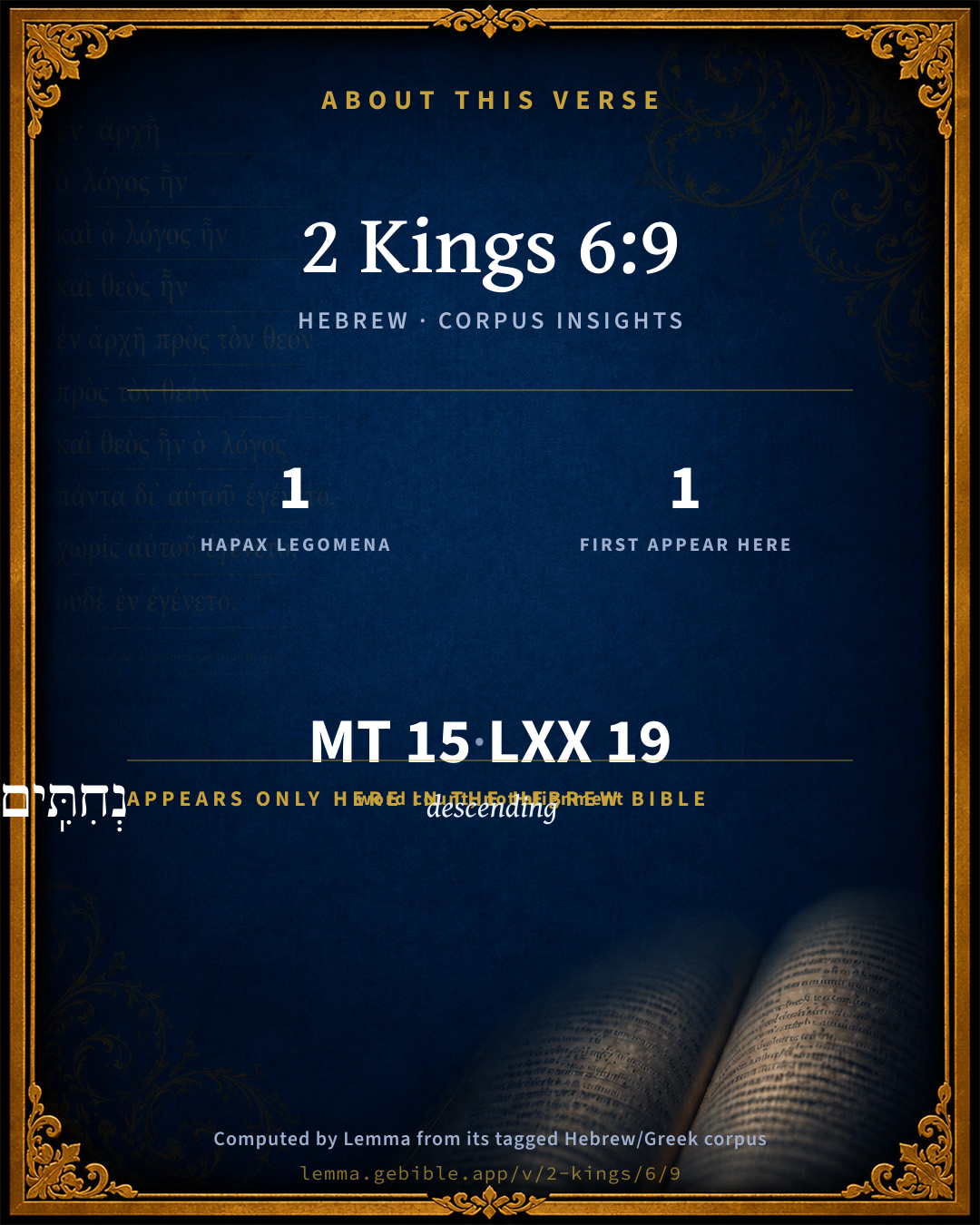
  • 1 hapax legomenon — only here in the Hebrew Bible
  • 1 first appearance in the Hebrew Bible
Full analysis ↓
Download a study sheet

One document with this verse’s original text, its word-by-word gloss line, the meaning frame, cross-references with their text, attributed commentary, and full source and license credits — printable, and it pastes into notes with its structure intact.

This verse Autodidact and up

Study sheet (.html) Plain text (.txt)

A passage Seminary Student

Up to 50 verses in one chapter. A passage sheet keeps up to 6 commentary sources and 12 cross-references per verse, in the order this page ranks them, and says so on the sheet whenever that leaves anything out. Ask for a single verse and you get the Autodidact verse sheet above.

Everything on this page stays free to read, with no account — the sheet is a download of what is already on screen, not access to it.

Want to remove ads? Support Godless Engineer
Compare translations 3

The same verse in 3 English versions, stacked beneath the original-language interlinear above. Click any original word for its lexicon entry.

Each is an independent rendering of the whole verse — the interlinear is not word-aligned to these translations.

Highlighted words mark where these versions differ — a whole-verse word diff, not a word-by-word alignment.

  • World English Bible Public Domain
    The man of God sent to the king of Israel, saying, Beware that you not pass such a place; for there the Syrians are coming down.
  • King James Version Public Domain
    And the man of God sent unto the king of Israel, saying, Beware that thou pass not such a place; for thither the Syrians are come down.
  • unfoldingWord Literal Text CC BY-SA 4.0
    And the man of God sent to the king of Israel saying, “Guard yourself from passing by that place, for Aram is coming down there.”

unfoldingWord Literal Text — © unfoldingWord, licensed CC BY-SA 4.0. Word-aligned USFM3 via Door43 (git.door43.org/unfoldingWord/en_ult).

Versions to compare (up to 4)

3 of 4 selected

Show all 18 translations

Every available English version of this verse, each an independent rendering of the whole verse.

  • World English Bible Public Domain
    The man of God sent to the king of Israel, saying, Beware that you not pass such a place; for there the Syrians are coming down.
  • Berean Standard Bible Public Domain
    Then the man of God sent word to the king of Israel: “Be careful passing by this place, for the Arameans are going down there.”
  • Majority Standard Bible Public Domain
    Then the man of God sent word to the king of Israel: “Be careful not to pass by this place, for the Arameans are going down there.”
  • King James Version Public Domain
    And the man of God sent unto the king of Israel, saying, Beware that thou pass not such a place; for thither the Syrians are come down.
  • American Standard Version (1901) Public Domain
    And the man of God sent unto the king of Israel, saying, Beware that thou pass not such a place; for thither the Syrians are coming down.
  • Revised Version (1885) Public Domain
    And the man of God sent unto the king of Israel, saying, Beware that thou pass not such a place; for thither the Syrians are coming down.
  • Geneva Bible (1599) Public Domain
    Therefore the man of God sent vnto the King of Israel, saying, Beware thou goe not ouer to such a place: for there the Aramites are come downe.
  • Douay-Rheims (1899) Public Domain
    And the man of God sent to the king of Israel, saying: Beware that thou pass not to such a place: for the Syrians are there in ambush.
  • Young's Literal Translation Public Domain
    And the man of God sendeth unto the king of Israel, saying, `Take heed of passing by this place, for thither are the Aramaeans coming down;
  • Literal Standard Version CC BY-SA 4.0
    And the man of God sends to the king of Israel, saying, “Take heed of passing by this place, for the Arameans are coming down there”;
  • Unlocked Literal Bible CC BY-SA 4.0
    So the man of God sent to the king of Israel, saying, “Be careful not to pass that place, for the Arameans are going down there.”
  • unfoldingWord Literal Text CC BY-SA 4.0
    And the man of God sent to the king of Israel saying, “Guard yourself from passing by that place, for Aram is coming down there.”
  • Darby Bible Public Domain
    And the man of God sent to the king of Israel, saying, Beware that thou pass not such a place, for thither the Syrians are come down.
  • World Messianic Bible Public Domain
    The man of God sent to the king of Israel, saying, “Beware that you not pass this place, for the Syrians are coming down there.”
  • Webster's Bible Public Domain
    And the man of God sent to the king of Israel, saying, Beware that thou pass not such a place; for thither the Syrians have come down.
  • Free Bible Version CC BY-SA 4.0
    Then the man of God sent a warning to the king of Israel: “Watch out if you go near this place, because the Arameans are going to be there.”
  • Bible in Basic English Public Domain
    And the man of God sent to the king of Israel, saying, Take care to keep away from that place, for the Aramaeans are waiting there in secret.
  • JPS Tanakh (1917) Public Domain
    And the man of God sent unto the king of Israel, saying: 'Beware that thou pass not such a place; for thither the Arameans are coming down.'

Literal Standard Version (2020), Covenant Press — licensed CC BY-SA 4.0. Text via the HelloAO Bible API (eBible.org). Unlocked Literal Bible (unfoldingWord) — licensed CC BY-SA 4.0. Text via the HelloAO Bible API (eBible.org). unfoldingWord Literal Text — © unfoldingWord, licensed CC BY-SA 4.0. Word-aligned USFM3 via Door43 (git.door43.org/unfoldingWord/en_ult). Free Bible Version, Dr. Jonathan Gallagher — licensed CC BY-SA 4.0. Text via the HelloAO Bible API (eBible.org).

Word by word

More ways to search: Search by grammar → Find every occurrence → Compare this word →

Practice this passage: Drill this verse → Learn its vocabulary →

נְחִתִּֽים
nâchêth
H5185
“descending”
Adjective, Adjective, Masculine, Plural, Absolute
Part of Speech
Adjective
Type
Adjective
Gender
Masculine
Number
Plural
State
Absolute
Full BDB Definition

Origin: from H5181

TWOT: 1351b

descending
  1. וַיִּשְׁלַ֞ח shâlach H7971 “and · to send” Conjunction + Verb, Qal, Sequential Imperfect, 3rd Person, Masculine, Singular
  2. אִ֣ישׁ ʼîysh H376 “man of” Noun, Common, Masculine, Singular, Construct
  3. הָאֱלֹהִ֗ים ʼĕlôhîym H430 “the · God(s)” Particle, Definite Article + Noun, Common, Masculine, Plural, Absolute
  4. אֶל ʼêl H413 “to” Preposition
  5. מֶ֤לֶךְ melek H4428 “king of” Noun, Common, Masculine, Singular, Construct
  6. יִשְׂרָאֵל֙ Yisrâʼêl H3478 “Israel” Noun, Proper
  7. לֵאמֹ֔ר ʼâmar H559 “to say” Preposition + Verb, Qal, Infinitive Construct
  8. הִשָּׁ֕מֶר shâmar H8104 “keep” Verb, Niphal, Imperative, 2nd Person, Masculine, Singular
  9. מֵעֲבֹ֖ר ʻâbar H5674 “from · to pass over” Preposition + Verb, Qal, Infinitive Construct
  10. הַמָּק֣וֹם mâqôwm H4725 “the · place” Particle, Definite Article + Noun, Common, Masculine, Singular, Absolute
  11. הַזֶּ֑ה zeh H2088 “the · this” Particle, Definite Article + Pronoun, Demonstrative, Masculine, Singular
  12. כִּֽי kîy H3588 “that” Conjunction
  13. שָׁ֖ם shâm H8033 “there” Adverb
  14. אֲרָ֥ם ʼĂrâm H758 “Aram” Noun, Proper

About this verse

These counts appear in no published source. They are computed here, from the morphology-tagged text and Lemma’s own curated glosses. What Lemma adds →

15
words
15
distinct lemmas
Historical
section

Notable vocabulary

1 hapax legomenon — a word that appears only here in the entire Hebrew Bible:

  • נְחִתִּֽים descending H5185

First appearance in Scripture

This word makes its first canonical appearance in the Hebrew Bible here:

  • נְחִתִּֽים descending H5185

Grammatical profile

  • 4 verbs
  • 6 nouns
  • 1 adjective
  • 1 pronoun
  • 1 preposition
  • 1 conjunction
  • 1 adverb

Verb forms

  • וַיִּשְׁלַ֞ח Qal · Sequential Imperfect
  • לֵאמֹ֔ר Qal · Infinitive Construct
  • הִשָּׁ֕מֶר Niphal · Imperative
  • מֵעֲבֹ֖ר Qal · Infinitive Construct

Hebrew & Septuagint length

In English translation the verse runs 26 words from the Hebrew and 24 from the Septuagint (LXX English) — closely comparable.

A rough comparison of the two English renderings, which tokenize alike — not a word-level alignment.

Word counts can differ between the Hebrew and the Greek without any difference in meaning — e.g. the Hebrew direct-object marker אֵת has no separate Greek word, and Greek often adds the article ὁ.

In the original languages it is 15 Hebrew tokens and 19 Greek tokens — but the two are counted differently (Hebrew bundles its prefixes and suffixes into one token; the Greek is in lemma form), so that isn’t a like-for-like length.

Cross-references

7

Topical passages linked to 2 Kings 6:9 in the Treasury of Scripture Knowledge — connected by theme and wording, ordered by reader-vote popularity; previews shown in the World English Bible.

  • Amos 3:7 Surely the Lord Yahweh will do nothing, Unless he reveals his secret to his servants the prophets.
  • 1 Kings 20:13 Behold, a prophet came near to Ahab king of Israel, and said, Thus says Yahweh, Have you seen all this great multitude? behold, I will deliver it into your hand this day; and you shall know that I am Yahweh.
  • 1 Kings 20:28 A man of God came near and spoke to the king of Israel, and said, Thus says Yahweh, Because the Syrians have said, Yahweh is a god of the hills, but he is not a god of the valleys; therefore will I deliver all this great multitude into your hand, and you shall know that I am Yahweh.
  • 2 Kings 3:17–19 For thus says Yahweh, You shall not see wind, neither shall you see rain; yet that valley shall be filled with water, and you shall drink, both you and your cattle and your animals.
  • 2 Kings 4:27 When she came to the man of God to the hill, she caught hold of his feet. Gehazi came near to thrust her away; but the man of God said, Let her alone: for her soul is vexed within her; and Yahweh has hid it from me, and has not told me.
  • 2 Kings 6:12 One of his servants said, No, my lord, O king; but Elisha, the prophet who is in Israel, tells the king of Israel the words that you speak in your bedchamber.
  • Revelation 1:1 This is the Revelation of Jesus Christ, which God gave him to show to his servants the things which must happen soon, which he sent and made known by his angel to his servant, John,

Cross-references courtesy of OpenBible.info (CC BY 4.0).

Hebrew and Greek witnesses Masoretic Hebrew ↔ Greek Septuagint

The same verse in the two great witnesses to the Old Testament, shown verse-for-verse.

These are two independent witnesses, not word-aligned to each other, and the Septuagint is shown in lemma (dictionary) form.

Hebrew 2 Kings 6:9 Masoretic · Westminster Leningrad Codex

וַיִּשְׁלַ֞ח אִ֣ישׁ הָאֱלֹהִ֗ים אֶל מֶ֤לֶךְ יִשְׂרָאֵל֙ לֵאמֹ֔ר הִשָּׁ֕מֶר מֵעֲבֹ֖ר הַמָּק֣וֹם הַזֶּ֑ה כִּֽי שָׁ֖ם אֲרָ֥ם נְחִתִּֽים

The man of God sent to the king of Israel, saying, Beware that you not pass such a place; for there the Syrians are coming down.

World English Bible · Public Domain

Greek LXX 2 Kings 6:9 Septuagint · lemma form

καί ἀποστέλλω ελισαιε πρός ὁ βασιλεύς ἰσραήλ λέγω φυλάσσω μή παραἔρχομαι ἐν ὁ τόπος οὗτος ὅτι ἐκεῖ συρία κρύπτω

And Elisaie sent to the king of Israel, saying, Take heed that you pass not by that place, for the Syrians are hidden there.

LXX2012 (modern English Septuagint) · Public Domain

On this verse, Ellicott's Commentary for English Readers discusses the Septuagint’s reading. Read the note in Commentary ↓

Hebrew: Westminster Leningrad Codex (CC BY 4.0). Greek: Septuagint (public domain); English from LXX2012 (modern English Septuagint) (Public Domain). How the Septuagint differs from the Hebrew →

Targum (Aramaic paraphrase)

1

The Targum is the ancient Jewish Aramaic paraphrase of the Hebrew Scriptures — an interpretive translation, not the Hebrew text itself. Onkelos (literal) and Pseudo-Jonathan (expansive) render the Torah, and Jonathan the Prophets. Coverage is partial: where no permissively-licensed English translation exists for a verse, only the Aramaic is shown. This is verse-level text, not a word-by-word alignment to the Hebrew.

  1. Targum Jonathan Prophets (Joshua–Malachi)
    וּשְׁלַח נְבִיָא דַייָ לְוַת מַלְכָּא דְיִשְׂרָאֵל לְמֵימַר אִסְתַּמַר מִלְמֶעְבַּר אַתְרָא הָדֵין אֲרֵי תַמָן אֱנַשׁ אֲרָם כְּסָן:

    (no public-domain English translation for this verse)

    Targum Jonathan — Aramaic: “Mikraot Gedolot” (public domain). English: “Sefaria Community Translation” (CC0 1.0 (public-domain dedication)); “London "Chaldee Paraphrase," 1871” (public domain). Text via Sefaria.

Commentary

Notes on 2 Kings 6:9 from classic Christian and Jewish commentators (each source and its license shown beneath its notes). The classic Christian expositions comment on the surrounding passage and are grouped to its opening verse, so a note may address several verses; the Jewish commentaries on the Tanakh (Rashi and others) are per-verse, so they appear only where the commentator wrote on this verse.

Lemma curates 59 commentaries, every one of them public domain or Creative Commons licensed, each selected and text-cleaned for this edition rather than reprinted as found. About our sources →

Trapp's Complete Commentary

John Trapp

2Ki 6:9 And the man of God sent unto the king of Israel, saying, Beware that thou pass not such a place; for thither the Syrians are come down.

Ver. 9. For thither the Syrians are come down.] To do mischief; where the holy penman maketh use of a Syrian word to set forth the Syrian doings. It signifieth demissi, prostrati, absconditi; there they lie couchant.

John Trapp, A Commentary or Exposition upon All the Books of the Old and New Testament (1647–1656) — public domain. Text from a community e-Sword module.

Adam Clarke's Commentary

Verse 9. Beware that thou pass not such a place] Elisha must have had this information by immediate revelation from heaven.

Adam Clarke's Commentary on the Bible (1810–1826) — public domain. Text from a community e-Sword/MySword module.

Ellicott's Commentary for English Readers

(9) Pass.—Pass over, across, or through.

Such a place.—This place.

Thither.—There.

Come down.—Coming down. Another anomalous Hebrew form (nĕhittîm). Some would recognise here again a corruption of the same verb as in 2Ki_6:8, and render, “for there the Syrians are about hiding” (nehbîm, i.e., nehbĕ’îm). This is supported by the LXX., “ὅτι ἐκεῖ Συρία κέκρυπται;” the Syriac and Arabic, “are lurking;” the Vulg., “in insidiis sunt;” and the Targum, “are hidden.” But the word (Heb.) is really an irregular participial formation from nahath, “to descend,” and the Authorised Version is therefore correct. The versions have deduced the idea of hiding from that of going down, as if crouching on the ground were meant.

A Bible Commentary for English Readers, edited by Charles John Ellicott (1878–1897) — public domain. Text from a community e-Sword module.

The Cambridge Bible for Schools and Colleges

gen. ed. J. J. S. Perowne

9. And the man of God sent unto the king of Israel] As against Syria, the power of Elisha would be most naturally exerted in favour of Israel. In spite of the strong language used against Jehoram (2Ki_3:13-14) and his family on account of their sins, God’s prophet had still much hope of the nation, and as we have seen in several instances, not without good reason. His action here saves not only the king, but the people also.

are come [R.V. coming] down] They were lying or intending to lie in ambush ready to spring upon and capture any that came in their way. Josephus says the king of Israel was starting on a hunting party when Elisha warned him.

The Cambridge Bible for Schools and Colleges (gen. ed. J. J. S. Perowne; Cambridge University Press, 1878–1918) — public domain. Text from a community e-Sword module.

John Gill's Exposition

And the king of Israel sent to the place which the man of God told him, and warned him of,.... Sent spies thither to see whether the Syrians were there or not, and whether it was truth the man of God told him; for he had no hearty respect for the prophet, though he had been so serviceable to him:

and saved himself there, not once, nor twice; escaped the snares the king of Syria laid for him, not once, nor twice only, but many times.

John Gill's Exposition of the Whole Bible (1746–1763) — public domain (CC PDM 1.0). Text via the HelloAO Bible API.

Whedon's Commentary on the Bible

Daniel D. Whedon

9. Beware that thou pass not such a place — That is, avoid leading or sending your forces into such a spot. This is a more natural explanation of these words than that of many interpreters, who explain them thus: Beware that thou do not overlook or fail to preoccupy and guard such a place. To pass over, in the sense of overlooking or failing to notice a place, is, to say the least, a very unusual meaning of עבר. Its common signification is, to pass through or over, in marching from one place to another; and the loyal Elisha, with true seer-like counsel, warns his king against leading his troops over the spots where bands of the enemy are lying in ambush to surprise him.

Thither the Syrians are come down — Into that spot the Syrian bands have already come down and put themselves in ambuscade.

Daniel D. Whedon (gen. ed.), Commentary on the Old and New Testaments (1874–1909) — public domain. Text from a community e-Sword module.

The Pulpit Commentary

And the man of Godi.e. Elisha, who at the time was the man of God" (kat ejxohn)sent unto the King of Israel Jehoram, undoubtedly (see ver. 32)saying, Beware that thou pass not such a place; for thither the Syrians are come down. Some translate, "Beware that thou neglect not such a place, for thither the Syrians are coming down;" but our version is probably correct, and is approved by Bahr and Thenius. Elisha did not suffer his hostile feeling towards Jehoram personally (2Ki_3:13 2Ki_5:8 2Ki_6:32) to interfere with his patriotism. When disaster threatened his country, he felt it incumbent on him to warn even an ungodly king.

The Pulpit Commentary (1880–1919), ed. H.D.M. Spence-Jones & Joseph S. Exell — public domain. Text from a community e-Sword module.

Rashi

Rabbi Shlomo Yitzchaki (Rashi)

Not to pass by this place. From going there.

Are encamped. Are encamped.

Rashi on the Tanakh — English translations: “The Judaica Press complete Tanach with Rashi, translated by A. J. Rosenberg” (CC BY 4.0); “Pentateuch with Rashi's commentary by M. Rosenbaum and A.M. Silbermann, 1929-1934” (public domain); “The Metsudah Tanach series, Lakewood, N.J” (CC BY 4.0); and “The Book of Joshua, Metsudah Publications, 1997” (CC BY 4.0). Text via Sefaria.

Lesson kit

Teaching starters — assembled from the data on this page, not authored interpretation. Every prompt links to the verse data it draws on. Edit before teaching.

2 Kings, in the Historical, opens this verse with 15 words (15 distinct Hebrew lemmas). Its most distinctive word is nâchêth (“descending”). A historical commentator’s framing appears above. Read the whole chapter for the surrounding context.

Discussion questions

  1. How does “descending” (nâchêth) shape what this verse is saying?
  2. 1 word here appears nowhere else in the Hebrew Bible. Why might the author reach for such rare wording?
  3. This is the first place “descending” appears in Scripture (first appears here). What does its debut here establish?
  4. How does Amos 3:7, which shares this passage’s theme, read alongside this verse?
  5. The translations on this page render this verse differently — a whole-verse word diff, not a word-by-word alignment. What might account for the different wordings?
  6. «וַיִּשְׁלַ֞ח» is a Qal Sequential Imperfect verb. How does that grammatical form shape the action described?
  7. Compare how Trapp's Complete Commentary and Adam Clarke's Commentary read this verse. Where do they agree or differ?

Things to notice

Reading settings

Reading text

Shown beneath each verse's original-language words.

Old Testament
Old Testament edition

Read the OT as the Masoretic Hebrew (MT) or the Greek Septuagint (LXX).

English shown for the Greek Septuagint (in the Hebrew ↔ Greek comparison).

Comparing translations? Open the Compare panel on any verse page to stack up to four side by side.