Amos 7:12

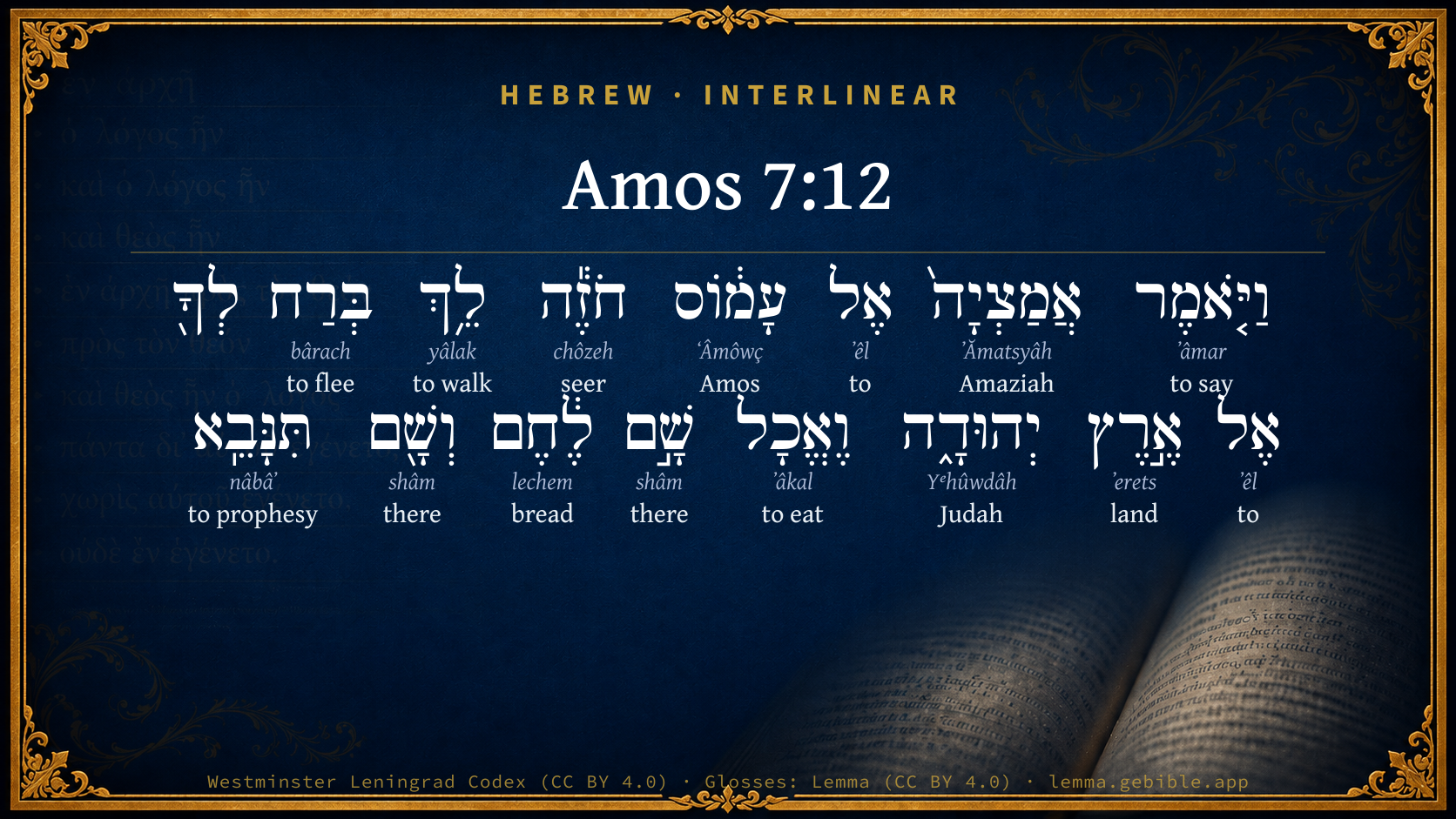
Hebrew (Westminster Leningrad Codex) Amos 7:12 appears in the Hebrew Old Testament. The text above is from the Westminster Leningrad Codex. Each word links to its Strong’s number, a concise gloss, and parsing drawn from the Open Scriptures Hebrew Bible morphology. Click any word for its full Brown-Driver-Briggs (BDB) entry.
Download image
Cite this verse

Amos 7:12 (World English Bible). Public Domain. Lemma interlinear Bible study tool, https://lemma.gebible.app/v/amos/7/12.

Show BibTeX & RIS
BibTeX
RIS
English Translation
Amaziah also said to Amos, "You seer, go, flee away into the land of Judah, and there eat bread, and prophesy there:
World English Bible · Public Domain
Download a study sheet

One document with this verse’s original text, its word-by-word gloss line, the meaning frame, cross-references with their text, attributed commentary, and full source and license credits — printable, and it pastes into notes with its structure intact.

This verse Autodidact and up

Study sheet (.html) Plain text (.txt)

A passage Seminary Student

Up to 50 verses in one chapter. A passage sheet keeps up to 6 commentary sources and 12 cross-references per verse, in the order this page ranks them, and says so on the sheet whenever that leaves anything out. Ask for a single verse and you get the Autodidact verse sheet above.

Everything on this page stays free to read, with no account — the sheet is a download of what is already on screen, not access to it.

Want to remove ads? Support Godless Engineer
Compare translations 3

The same verse in 3 English versions, stacked beneath the original-language interlinear above. Click any original word for its lexicon entry.

Each is an independent rendering of the whole verse — the interlinear is not word-aligned to these translations.

Highlighted words mark where these versions differ — a whole-verse word diff, not a word-by-word alignment.

  • World English Bible Public Domain
    Amaziah also said to Amos, "You seer, go, flee away into the land of Judah, and there eat bread, and prophesy there:
  • King James Version Public Domain
    Also Amaziah said unto Amos, O thou seer, go, flee thee away into the land of Judah, and there eat bread, and prophesy there:
  • unfoldingWord Literal Text CC BY-SA 4.0
    Amaziah said to Amos, “Seer, go, run yourself back to the land of Judah, and there eat bread and prophesy.

unfoldingWord Literal Text — © unfoldingWord, licensed CC BY-SA 4.0. Word-aligned USFM3 via Door43 (git.door43.org/unfoldingWord/en_ult).

Versions to compare (up to 4)

3 of 4 selected

Show all 18 translations

Every available English version of this verse, each an independent rendering of the whole verse.

  • World English Bible Public Domain
    Amaziah also said to Amos, "You seer, go, flee away into the land of Judah, and there eat bread, and prophesy there:
  • Berean Standard Bible Public Domain
    And Amaziah said to Amos, “Go away, you seer! Flee to the land of Judah; earn your bread there and do your prophesying there.
  • Majority Standard Bible Public Domain
    And Amaziah said to Amos, “Go away, you seer! Flee to the land of Judah; earn your bread there and do your prophesying there.
  • King James Version Public Domain
    Also Amaziah said unto Amos, O thou seer, go, flee thee away into the land of Judah, and there eat bread, and prophesy there:
  • American Standard Version (1901) Public Domain
    Also Amaziah said unto Amos, O thou seer, go, flee thou away into the land of Judah, and there eat bread, and prophesy there:
  • Revised Version (1885) Public Domain
    Also Amaziah said unto Amos, O thou seer, go, flee thee away into the land of Judah, and there eat bread, and prophesy there:
  • Geneva Bible (1599) Public Domain
    Also Amaziah sayde vnto Amos, O thou the Seer, goe, flee thou away into the land of Iudah, and there eate thy bread and prophecie there.
  • Douay-Rheims (1899) Public Domain
    And Amasias said to Amos: Thou seer, go, flee away into the land of Juda: and eat bread there, and prophesy there.
  • Young's Literal Translation Public Domain
    And Amaziah saith unto Amos, `Seer, go flee for thee unto the land of Judah, and eat there bread, and there thou dost prophesy;
  • Literal Standard Version CC BY-SA 4.0
    And Amaziah says to Amos, “Seer, go, flee to the land of Judah for yourself, and eat bread there, and there you prophesy;
  • Unlocked Literal Bible CC BY-SA 4.0
    Amaziah said to Amos, “Seer, go, run back to the land of Judah, and there eat bread and prophesy.
  • unfoldingWord Literal Text CC BY-SA 4.0
    Amaziah said to Amos, “Seer, go, run yourself back to the land of Judah, and there eat bread and prophesy.
  • Darby Bible Public Domain
    And Amaziah said unto Amos, [Thou] seer, go, flee away into the land of Judah, and eat bread there, and prophesy there.
  • World Messianic Bible Public Domain
    Amaziah also said to Amos, “You seer, go, flee away into the land of Judah, and there eat bread, and prophesy there,
  • Webster's Bible Public Domain
    Also Amaziah said to Amos, O thou seer, go flee thee away into the land of Judah, and there eat bread, and prophesy there:
  • Free Bible Version CC BY-SA 4.0
    Amaziah said to Amos, “Go away prophet! Run away to the land of Judah. Go and prophesy there to earn your bread.
  • Bible in Basic English Public Domain
    And Amaziah said to Amos, O seer, go in flight into the land of Judah, and there get your living by working as a prophet:
  • JPS Tanakh (1917) Public Domain
    Also Amaziah said unto Amos: 'O thou seer, go, flee thee away into the land of Judah, and there eat bread, and prophesy there;

Literal Standard Version (2020), Covenant Press — licensed CC BY-SA 4.0. Text via the HelloAO Bible API (eBible.org). Unlocked Literal Bible (unfoldingWord) — licensed CC BY-SA 4.0. Text via the HelloAO Bible API (eBible.org). unfoldingWord Literal Text — © unfoldingWord, licensed CC BY-SA 4.0. Word-aligned USFM3 via Door43 (git.door43.org/unfoldingWord/en_ult). Free Bible Version, Dr. Jonathan Gallagher — licensed CC BY-SA 4.0. Text via the HelloAO Bible API (eBible.org).

Word by word

More ways to search: Search by grammar → Find every occurrence → Compare this word →

Practice this passage: Drill this verse → Learn its vocabulary →

עָמ֔וֹס
ʻÂmôwç
H5986
“Amos”
Noun, Proper
Part of Speech
Noun
Type
Proper
Full BDB Definition

Origin: from H6006

TWOT: None

Amos = "burden" - a prophet of the Lord who prophesied in the northern kingdom; native of Tekoa in Judah near Bethlehem and a shepherd by trade; author of the prophetic book by his name
  1. וַיֹּ֤אמֶר ʼâmar H559 “and · to say” Conjunction + Verb, Qal, Sequential Imperfect, 3rd Person, Masculine, Singular
  2. אֲמַצְיָה֙ ʼĂmatsyâh H558 “Amaziah” Noun, Proper
  3. אֶל ʼêl H413 “to” Preposition
  4. חֹזֶ֕ה chôzeh H2374 “seer” Noun, Common, Masculine, Singular, Absolute
  5. לֵ֥ךְ yâlak H3212 “walk” Verb, Qal, Imperative, 2nd Person, Masculine, Singular
  6. בְּרַח bârach H1272 “flee” Verb, Qal, Imperative, 2nd Person, Masculine, Singular
  7. אֶל ʼêl H413 “to” Preposition
  8. אֶ֣רֶץ ʼerets H776 “land of” Noun, Common, Both, Singular, Construct
  9. יְהוּדָ֑ה Yᵉhûwdâh H3063 “Judah” Noun, Proper
  10. וֶאֱכָל ʼâkal H398 “and · eat” Conjunction + Verb, Qal, Imperative, 2nd Person, Masculine, Singular
  11. שָׁ֣ם shâm H8033 “there” Adverb
  12. לֶ֔חֶם lechem H3899 “bread” Noun, Common, Both, Singular, Absolute
  13. וְשָׁ֖ם shâm H8033 “and · there” Conjunction + Adverb
  14. תִּנָּבֵֽא nâbâʼ H5012 “to prophesy” Verb, Niphal, Imperfect, 2nd Person, Masculine, Singular

About this verse

These counts appear in no published source. They are computed here, from the morphology-tagged text and Lemma’s own curated glosses. What Lemma adds →

16
words
13
distinct lemmas
Prophets
section

Notable vocabulary

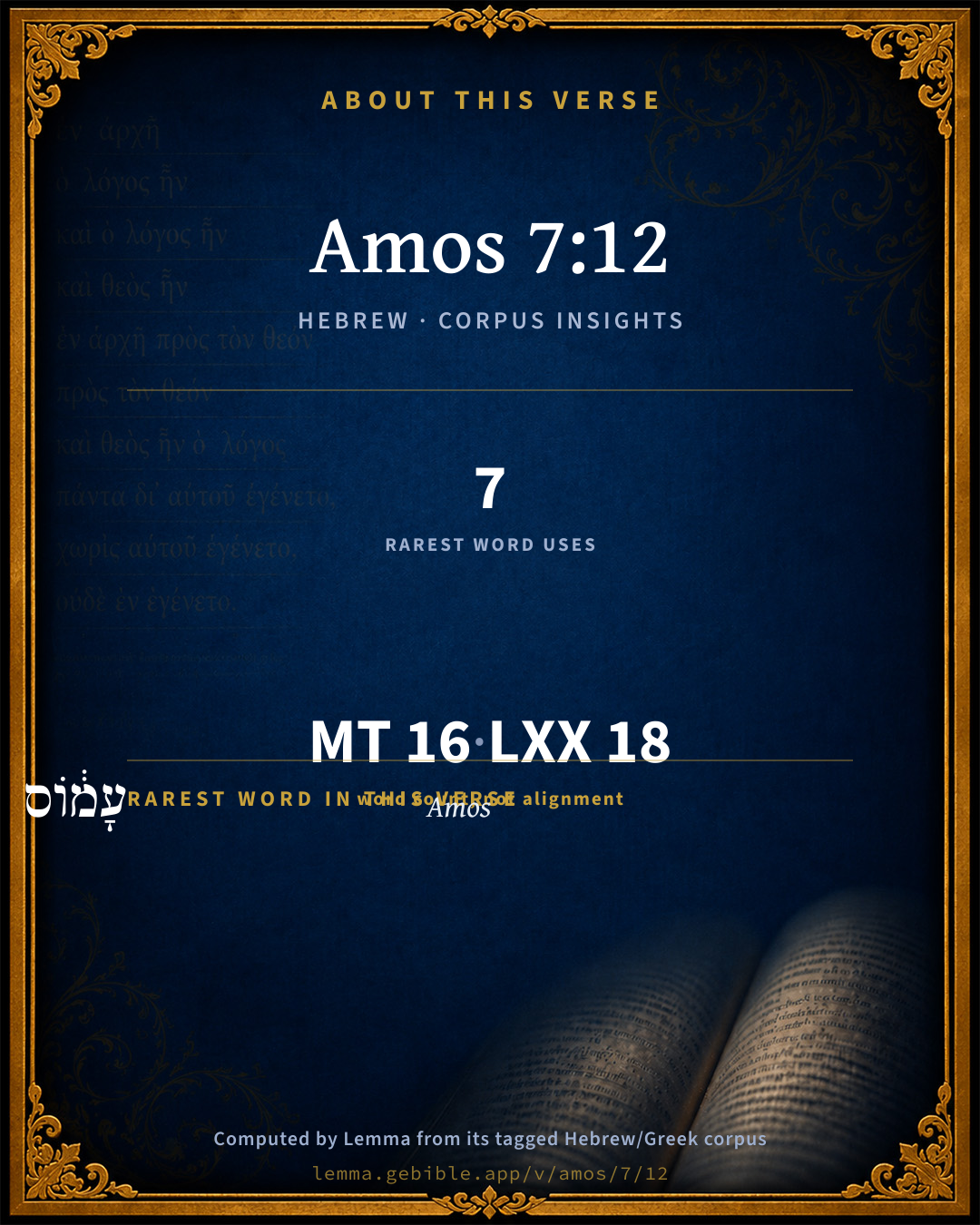
The rarest word here is עָמ֔וֹס Amos H5986 — appearing just 7 times in the whole Hebrew Bible.

Shared distinctive vocabulary

עָמ֔וֹס Amos H5986 occurs in 7 verses of the Hebrew Bible. Also found in:

Grammatical profile

  • 5 verbs
  • 6 nouns
  • 3 prepositions
  • 2 adverbs

Verb forms

  • וַיֹּ֤אמֶר Qal · Sequential Imperfect
  • לֵ֥ךְ Qal · Imperative
  • בְּרַח Qal · Imperative
  • וֶאֱכָל Qal · Imperative
  • תִּנָּבֵֽא Niphal · Imperfect

Repetition

Words recur within this verse — often emphatic in Hebrew:

  • שָׁ֣ם there H8033 ×2
  • אֶל to H413 ×2

Hebrew & Septuagint length

In English translation the verse runs 22 words from the Hebrew and 22 from the Septuagint (LXX English) — the same length.

A rough comparison of the two English renderings, which tokenize alike — not a word-level alignment.

Word counts can differ between the Hebrew and the Greek without any difference in meaning — e.g. the Hebrew direct-object marker אֵת has no separate Greek word, and Greek often adds the article ὁ.

In the original languages it is 16 Hebrew tokens and 18 Greek tokens — but the two are counted differently (Hebrew bundles its prefixes and suffixes into one token; the Greek is in lemma form), so that isn’t a like-for-like length.

Cross-references

15

Topical passages linked to Amos 7:12 in the Treasury of Scripture Knowledge — connected by theme and wording, ordered by reader-vote popularity; previews shown in the World English Bible.

  • Matthew 8:34 Behold, all the city came out to meet Jesus. When they saw him, they begged that he would depart from their borders.
  • 1 Corinthians 2:14 Now the natural man doesn't receive the things of God's Spirit, for they are foolishness to him, and he can't know them, because they are spiritually discerned.
  • 1 Samuel 9:9 (In earlier times in Israel, when a man went to inquire of God, thus he said, Come, and let us go to the seer; for he who is now called a Prophet was before called a Seer.)
  • Isaiah 30:10 who tell the seers, "Don't see;" and to the prophets, "Don't prophesy to us right things, speak to us smooth things, prophesy deceits,
  • Romans 16:18 For those who are such don't serve our Lord, Jesus Christ, but their own belly; and by their smooth and flattering speech, they deceive the hearts of the innocent.
  • 1 Samuel 2:36 It shall happen, that everyone who is left in your house shall come and bow down to him for a piece of silver and a loaf of bread, and shall say, Please put me into one of the priests' offices, that I may eat a morsel of bread.
  • 2 Chronicles 16:10 Then Asa was angry with the seer, and put him in the prison-house; for he was in a rage with him because of this thing. Asa oppressed some of the people at the same time.
  • Isaiah 56:11 Yes, the dogs are greedy, they can never have enough; and these are shepherds who can't understand: they have all turned to their own way, each one to his gain, from every quarter.
  • Ezekiel 13:19 You have profaned me among my people for handfuls of barley and for pieces of bread, to kill the souls who should not die, and to save the souls alive who should not live, by your lying to my people who listen to lies.
  • Amos 2:12 "But you gave the Nazirites wine to drink, And commanded the prophets, saying, 'Don't prophesy!'
  • Malachi 1:10 "Oh that there were one among you who would shut the doors, that you might not kindle fire on my altar in vain! I have no pleasure in you," says Yahweh of hosts, "neither will I accept an offering at your hand.
  • Luke 8:37–38 All the people of the surrounding country of the Gadarenes asked him to depart from them, for they were very much afraid. He entered into the boat, and returned.
  • Luke 13:31 On that same day, some Pharisees came, saying to him, "Get out of here, and go away, for Herod wants to kill you."
  • Acts 16:39 and they came and begged them. When they had brought them out, they asked them to depart from the city.
  • 1 Peter 5:2 Shepherd the flock of God which is among you, exercising the oversight, not under compulsion, but voluntarily, not for dishonest gain, but willingly;

Cross-references courtesy of OpenBible.info (CC BY 4.0).

Hebrew and Greek witnesses Masoretic Hebrew ↔ Greek Septuagint

The same verse in the two great witnesses to the Old Testament, shown verse-for-verse.

These are two independent witnesses, not word-aligned to each other, and the Septuagint is shown in lemma (dictionary) form.

Hebrew Amos 7:12 Masoretic · Westminster Leningrad Codex

וַיֹּ֤אמֶר אֲמַצְיָה֙ אֶל עָמ֔וֹס חֹזֶ֕ה לֵ֥ךְ בְּרַח לְךָ֖ אֶל אֶ֣רֶץ יְהוּדָ֑ה וֶאֱכָל שָׁ֣ם לֶ֔חֶם וְשָׁ֖ם תִּנָּבֵֽא

Amaziah also said to Amos, "You seer, go, flee away into the land of Judah, and there eat bread, and prophesy there:

World English Bible · Public Domain

Greek LXX Amos 7:12 Septuagint · lemma form

καί εἶπον αμασιας πρός αμως ὁ ὁράω βαδίζω ἐκχωρέω εἰς γῆ ιουδα καί ἐκεῖ καταβιόω καί ἐκεῖ προφητεύω

And Amasias said to Amos, Go, seer, remove you into the land of Juda, and live there, and you shall prophesy there:

LXX2012 (modern English Septuagint) · Public Domain

Hebrew: Westminster Leningrad Codex (CC BY 4.0). Greek: Septuagint (public domain); English from LXX2012 (modern English Septuagint) (Public Domain). How the Septuagint differs from the Hebrew →

Targum (Aramaic paraphrase)

1

The Targum is the ancient Jewish Aramaic paraphrase of the Hebrew Scriptures — an interpretive translation, not the Hebrew text itself. Onkelos (literal) and Pseudo-Jonathan (expansive) render the Torah, and Jonathan the Prophets. Coverage is partial: where no permissively-licensed English translation exists for a verse, only the Aramaic is shown. This is verse-level text, not a word-by-word alignment to the Hebrew.

  1. Targum Jonathan Prophets (Joshua–Malachi)
    וַאֲמַר אֲמַצְיָה לְעָמוֹס נְבִיָא אֲתָא אֱזֵל לָךְ לְאַרְעָא דְבֵית יְהוּדָה וֶאֱכוּל תַּמָן לַחְמָא וְתַמָן תִּתְנַבֵּי:

    (no public-domain English translation for this verse)

    Targum Jonathan — Aramaic: “Mikraot Gedolot” (public domain). English: “Sefaria Community Translation” (CC0 1.0 (public-domain dedication)); “London "Chaldee Paraphrase," 1871” (public domain). Text via Sefaria.

Commentary

Notes on Amos 7:12 from classic Christian and Jewish commentators (each source and its license shown beneath its notes). The classic Christian expositions comment on the surrounding passage and are grouped to its opening verse, so a note may address several verses; the Jewish commentaries on the Tanakh (Rashi and others) are per-verse, so they appear only where the commentator wrote on this verse.

Lemma curates 59 commentaries, every one of them public domain or Creative Commons licensed, each selected and text-cleaned for this edition rather than reprinted as found. About our sources →

Trapp's Complete Commentary

John Trapp

Amo 7:12 Also Amaziah said unto Amos, O thou seer, go, flee thee away into the land of Judah, and there eat bread, and prophesy there:

Ver. 12. Also Amaziah said unto Amos] After he had maliciously misinformed the king, but prevailed not; so God would have it, in whose heart is the king’s hand, and who rebuketh even kings for their sakes, saying, Do my prophets no harm.

O thou seer] Fair words; the better to insinuate.

“ Mel in ore, verba lactis:

Fel in corde, fraus in factis. ”

Some think he calleth the prophet thus by way of jeer, quasi fatidicum aut fanaticum, as a fortune teller or distracted. Others, that he giveth the prophet good words, and seemeth to give him good counsel, as fearing the people, with whom Amos was in some credit; and therefore the king was told of a conspiracy against him "in the midst of the house of Israel," Amo 7:10.

Flee thee away into the land of Judah] Age, fuge: as a friend wrote to Brentius, when he was in danger to be surprised by the emperor’s agent, Fuge, fuge, Brenti cito, citius, citissime, Fly for thy life, haste, haste, haste. So the Pharisees (for no great love, be sure, but only to be fairly rid of him) came and said to Christ, "Get thee out and depart hence; for Herod will kill thee," Luk 13:31.

Into the land of Judah] This he speaketh scornfully, q.d. we are not good enough for you; you are so strict, &c.

And there eat bread, and prophesy there] Invidiose omnia et contemptim dicit: If you stay here you may hap to starve for it. Away, therefore, into your own country; and there make thee a living by prophesying. He seems to measure Amos by himself; as if he were of those that prophesied for a handful of barley and a morsel of bread, Eze 13:19 Mic 3:11; and as a certain Popish priest confessed concerning himself and his symmists, We preach the gospel, said he, tantum ut nos pascat et vestiat, only to pick a living out of it.

John Trapp, A Commentary or Exposition upon All the Books of the Old and New Testament (1647–1656) — public domain. Text from a community e-Sword module.

Joseph Benson's Commentary

Amo 7:12-13. Amaziah said, O thou seer, go flee, &c. — Thou that sayest thou art a prophet, get thee hence, where thou signifiest that thou art so much displeased with the actions of the people, and go into the land of Judah — Where it is likely thou wilt be better entertained than thou art here. And there eat bread, &c. — There they will feed thee well, because thou pretendest to be a prophet. Prophesy not at Beth-el, for it is the king’s chapel, &c. — This is the place where the king performs his religious worship in person, and often resides here with his court, that he may the better attend upon the service performed at this place; (see 1Ki 13:1;) and therefore thou oughtest to reverence it, and not utter thy sham prophecies here.

Joseph Benson's Commentary on the Old and New Testaments (1811–1818) — public domain. Text from a community e-Sword module.

Tyndale Open Study Notes

Tyndale Open Resources

7:12 Go on back to . . . Judah, and earn your living by prophesying: Amaziah assumed that the supposedly backward people of Judah would appreciate Amos’s words, and that Amos was looking to be paid for his preaching.

Tyndale Open Study Notes — © Tyndale Open Resources, licensed CC BY-SA 4.0. Text via the HelloAO Bible API.

Geneva Bible (1599)

Geneva Bible translators

When this instrument of Satan was not able to compass his purpose by the king, he assayed by another practice, that was, to fear the Prophet, that he might depart, and not reprove their idolatry there openly, and so hinder his profit.

Geneva Bible (1599) marginal notes — public domain. Text via Bolls.life.

Jamieson, Fausset & Brown

Robert Jamieson, A. R. Fausset & David Brown

Also--Besides informing the king against Amos, lest that course should fail, as it did, Amaziah urges the troublesome prophet himself to go back to his own land Judah, pretending to advise him in friendliness.

seer--said contemptuously in reference to Amos visions which precede.

there eat bread--You can earn a livelihood there, whereas remaining here you will be ruined. He judges of Amos by his own selfishness, as if regard to one's own safety and livelihood are the paramount considerations. So the false prophets (Eze 13:19) were ready to say whatever pleased their hearers, however false, for "handfuls of barley and pieces of bread."

Jamieson, Fausset & Brown — Commentary Critical and Explanatory on the Whole Bible (1871) — public domain (CC PDM 1.0). Text via the HelloAO Bible API.

Adam Clarke's Commentary

Verse 12. O thou seer] He pretends kindness to the prophet, and counsels him to go into Judea, and prophesy there and be safe, even in the time that he had accused him of high treason against Jeroboam. Hireling priests of this kind have ever been the great enemies of the true prophets of God; and when they could bring no charge of false doctrine or immorality against them, have accused them of conspiring against the government; and because they have preached against sin, have held them up as exciting insurrection among the people.

Adam Clarke's Commentary on the Bible (1810–1826) — public domain. Text from a community e-Sword/MySword module.

John Calvin's Commentaries

Amaziah then said to Amos, — that is, after his first proceeding disappointed him; for he did not obtain from king Jeroboam what he expected, — then Amaziah said to Amos, Seer, go, flee to the land of Judah! By saying Go, he intimates that he was at liberty to depart, as though he said, “Why wouldest thou willfully perish among us?” At the same time, the two clauses ought to be joined together. He says first, Go, and then, flee When he says Go, he reminds him, as I have already said, that if he wished, he might go away, as no one prevented his departure: “Go, then, for the way is open to you.” But when he says, flee, he means that he could not long remain safe there: “Except thou provident for thy life, it is all over with you: flee then quickly away from us, else thou art lost.” We hence see how cunningly Amaziah assailed God’s Prophet. He proposed to him an easy way of saving his life; at the same time he urged him with the fear of danger, and declared that he could not remain safe, except he immediately fled. These then were the two reasons which he used as mighty engines to depress the heart of the holy Prophet.

He afterwards subjoins, And eat there thy bread This is the third argument. He might be allowed to live in his own country, and be supplied there with sustenance; for Amos was, as we have said, one of the shepherds of Tekoa. He must then have arisen from the tribe of Judah, and he had his habitation and his relations in that kingdom. Besides, Azariah was not an ungodly king: though not one of the most perfect, he yet respected and honored the servants of God. Hence, by saying, Eat there thy bread, Amaziah means that there was a safe residence for the Prophets in the kingdom of Judah, and that they were there esteemed both by the king and by the people, and that they might live there. This is the third argument.

Now follows the fourth: “If thou dost object to me, and say that thou art a Prophet, and that it is neither lawful nor right in thee to be silent, be a prophet there. Thou knowest that prophets are attended to in the kingdom of Judah; thou mayest then perform thine office there, and live at liberty, and without fear.” We hence see four of the reasons by which Amaziah attempted to persuade the Prophet Amos to leave the people of Israel, and to go to his own kindred.

But there follows a fifth reason: But in Bethel prophesy no more; for the sanctuary of the king it is, and his court. Here Amaziah annoys the Prophet by another pretense, or he tries, at least, to shake his courage, by intimating that it was unbecoming to raise commotions in the kingdom of Israel, and also that, by so doing, he offended God, because Jeroboam was a divinely appointed king, and endued with the chief authority. Since then the king could, by his own right, institute new modes of worship, Amaziah here argues that it is not in the power of any one who pleased to pull down those rites which had been universally received, and then confirmed by a royal edict, but that they ought to be received without any dispute. We then perceive now the import of the whole.

But it must be noticed in this place, that we must be watchful, not only against the open violence and cruelty of enemies, but also against their intrigues; for as Satan is a murderer, and has been so from the beginning, so he is also the father of lies. Whosoever then wishes strenuously and constantly to spend his labors for the Church and for God, must prepare himself for a contest with both: he must resist all fears and all intrigues. We see some not so fearful, though a hundred deaths were denounced upon them, who are yet not sufficiently cautious when enemies craftily insinuate themselves. I have not, therefore, said without reason, that God’s servants have need of being fortified against both; that they ought to be prepared against the fear of death, and remain intrepid, though they must die, and that they ought to lay down their necks, if needs be, while performing their office, and to seal their doctrine with their own blood; — and that, on the other hand, their ought to be prudent; for oftentimes the enemies of the truth assail them by flatteries; and the experience of our own times sufficiently proves this. More danger, I know, has ever been from this quarter; that is, when enemies attempt to terrify by such objections as these, “What is your purpose? See, the whole world must necessarily at length be consumed by calamities. What else do you seek, but that religion should everywhere flourish, that sound learning should be valued, that peace should prevail everywhere? But we see that the fiercest war is at hand: if once it should arise, all places would be full of calamities, savage barbarity, and cruelty, would follow, and religion would perish: all this ye will effect by your pertinacity.” These things have often been said to us. When therefore we read this passage, we ought to notice the arts by which Satan has been trying to undermine the efforts of the godly, and the constancy of God’s servants.

As to the first argument, there is no need much of dwelling longer upon it; for every one can of himself perceive the design of all this crafty proceeding. He says first, Seer, go. Amaziah addresses Amos in a respectful way: he does not reproachfully call him, either an exile, or a seditious man, or one unlearned, or a cowherd, or a person unworthy of his office. He does not use any such language, but calls him a seer; he concedes to him the honorable title of a Prophet; for by the word חזה, chese, he means this “I confess thee to be God’s Prophet: I grant that thou art a Prophet, but not our Prophet; Seer, then, go.” We hence see that he left to him untouched the honor of being a Prophet, that he might more easily creep into his favor, lest by raising a dispute at first, there should be between them a violent contest: he therefore avoided all occasions of contention.

It might however have been asked him, Why he was blind? For the office of a priest was to watch; and the Prophets were in such a manner joined to the priests, that when God substituted Prophets in their place, he indirectly charged them with idleness and indifference. For why were the priests appointed? That they might be the messengers of the Lord of hosts, as it is said by Malachi,

‘The people shall seek from the mouth of the priest my law, for he is the messenger of the Lord of hosts,’ (Malachai 2:7)

Amaziah then ought especially to have performed himself the Prophet’s office, for he was a priest. He was indeed, I allow, a spurious priest; but having claimed so honorable a name, he ought to have discharged its duties: this he did note and conceded that title to the Prophet. So now our milted bishops are very liberal in conceding titles, “O, Mr. Teacher, ye can indeed see and understand many things: but yet ye ought, at the same time, to consult the peace of the community.” They call those teachers who have been invested with no public office, but are yet under the necessity of undertaking the duties of others, for they see that these milted bishops are dumb dogs. In a like manner, also, did Amaziah act towards the Prophet Amos; for he was content with his own splendor and great pomp, and with his own riches; he lived sumptuously, and enjoyed a rich booty, and superstitions well warmed his kitchen. He therefore easily surrendered to others the title of a Prophet: in the meantime, he prided himself on his priesthood.

But as to the second argument, there was a sharper sting in it, Flee, he says. By flight he intimates, that it was necessary for the Prophet to depart, though he wished to remain. So this second reason was borrowed from necessity; for the Prophet could no longer be borne with, if he proceeded in the free discharge of his office. Flee then to the land of Judah, and there eat bread

With regard to this third reason, he seems to imply that the Prophet Amos would be too pertinacious and too much wedded to his own opinion, if he preferred not to live safely and quietly in his own country, rather than to endanger his life in another land. Go then. Where would he send him? To his own country. Why? “Thou art here a foreigner, and sees thyself to be hated; why then dost thou not rather return to thine own country, where thy religion prevails?” Amaziah did not indeed address the Prophet Amos, as man of profane men do at this day, who are less like Epicureans than they are to swine and filthy dogs; for they object and say, “Thou mayest return to thine own country; why hast thou come to us?” They send us away to our own country, when they know that there is there no safe place for us. But at that time pure religion flourished in the land of Judah: hence Amaziah says, “Why dost thou not live with thy own countrymen? for there are many there who will supply thee with sustenance; the king himself will be thy friend, and the whole people will also help thee.”

As to the fourth argument, we see what a crafty sophist is the devil, Be a Prophet there Who speaks? Amaziah, who perfectly hated the temple at Jerusalem, who would have gladly with his own hands set it on fire, who would have gladly put to death all the pious priests; and yet he allows to holy Amos a free liberty to prophesy, and he allows this, because he could not immediately in an open manner stop the holy Prophet in his course: he therefore sends him away to a distance. We hence see that Satan, by various arts and means, tempts the servants of God, and has wonderful turnings and windings, and sometimes transforms himself into an angel of light, as it is said by Paul, (2 Corinthians 11:14) and in this place we have a remarkable instance of this. Is not Amaziah an angel of light, when he advises the Prophet Amos to serve God freely in his own country, and to prophesy there, and to open his mouth in defense of God’s worship and of pure religion? provided he did not do all this in the land of Israel. We have then in this chapter, as I have said, a remarkable instance of the wiliness of Satan.

John Calvin's Commentaries (1540-1563) — public domain. Text from the Calvin Translation Society English edition (1840s-50s) via the Christian Classics Ethereal Library (ccel.org). Calvin's coverage is partial (roughly two-thirds of the Bible); uncommented books and verses are honest gaps, never fabricated. The 19th-century editor's footnotes and remarks are omitted so the notes are faithfully Calvin's own voice.

Ellicott's Commentary for English Readers

(12, 13) Jeroboam treated the charge made by Amaziah with indifference, or perhaps with awe: at least, with silence. And so the priest of Bethel takes upon himself to dismiss the prophet from the kingdom. The word for “seer” is here chozeh, one who has visions, a word not used in a contemptuous sense here or in the Old Testament generally. The expression “there eat bread and prophecy” is a hendiadys for “there live on your profession as a prophet,” not here. To this Amos replies that that was not his profession (Amo_7:14). Bethel is spoken of as the “holy place,” or sanctuary, and also as the “royal residence” (E.V., “king’s court”). Men blinded by prejudice, and bewildered by the light of our Lord’s holy presence, besought him to depart from them. The awful peril of imploring God’s messenger to withdraw is frequently referred to in Scripture. (Comp. Luk_10:10-12.)

A Bible Commentary for English Readers, edited by Charles John Ellicott (1878–1897) — public domain. Text from a community e-Sword module.

The Cambridge Bible for Schools and Colleges

gen. ed. J. J. S. Perowne

12–13. Jeroboam apparently took no account of the priest’s message. Accordingly Amaziah himself endeavours to induce Amos to leave the country.

O thou seer] or gazer (ḥôzeh, not rô’eh, ‘seer,’ 1Sa_9:9, though a synonym of it; see Isa_30:10, quoted on Amo_1:1). Rô’eh is used in 1Sa_9:9; 1Sa_9:11; 1Sa_9:18-19 of Samuel, and we are told in Amo_7:9 that it was the oldest designation of the prophet; but it occurs elsewhere only in 1Ch_9:22; 1Ch_26:28; 1Ch_29:29 (each time as an epithet of Samuel); 2Ch_16:7; 2Ch_16:10 (of Hanani); and in the plural, Isa_30:10. Ḥôzeh is used of Gad, 2Sa_24:11 = 1Ch_21:9 (‘David’s ḥôzeh’); 2Ch_29:25 (‘the king’s ḥôzeh’); Heman, 1Ch_25:5 (‘the king’s ḥôzeh’); Iddo, 2Ch_9:29; 2Ch_12:15; Jehu, son of Hanani, 2Ch_19:2; Asaph, 2Ch_29:30; Jeduthun, 2Ch_30:15; and in the plural, Isa_29:10 (|| prophets), 2Ch_30:10 (|| rô’îm); Mic_3:7 (|| diviners); 2Ch_33:18, and (prob.) 19. Both words are thus rare in the pre-exilic literature, rô’eh being applied as a title only to Samuel, and ḥôzeh only to Gad: their revival in the late Chronicles is remarkable. Here ḥôzeh is used probably on account of the visions, which Amos had just related, perhaps also with a touch of irony, as though implying that he was (as we might say) a “visionary,” and anticipated evils which were in reality imaginary.

into the land of Judah] Amos may be at liberty to say what he pleases in his own country: predictions of Israel’s fall might not be unacceptable there; let him not utter them in Jeroboam’s capital.

eat bread] i.e. make thy living. Amaziah implies that prophecy was a trade or profession. Already in early times we know that those who consulted a rô’eh paid a fee for his advice (1Sa_9:7-8); and in the middle period of the monarchy there are allusions to the fact that the prophets who echoed the sentiments of the people gained popularity, and were rewarded accordingly: see Isa_30:10 (Isaiah’s political teaching was obnoxious to the people, and they would not listen to him: they wished for ‘seers’ who would “see” for them “smooth things,” i.e. visions of material prosperity, the success of their own plans, &c.); Mic_3:5 (the prophets who “bite with their teeth, and cry, Peace; and whoso putteth not into their mouths, they prepare war against him”; i.e. who prophesy in accordance with the fee that they receive), 11 (“the prophets thereof divine for money”); Eze_13:19. Comp. also 1Ki_22:13; Jer_23:16-17; Jer_28:1-4; Jer_29:8 f. The genuine prophets were, of course, superior to all such considerations; they rebuked the people, when they deserved it, for their sins, and they uttered predictions which they felt to be true, heedless of the temper in which they might be received by those who heard them. But Amaziah insinuates that Amos is one of those prophets who lived upon popularity: he bids him, therefore, ironically, betake himself to Judah, where his words spoken against Ephraim will be listened to with satisfaction, and will not remain unrewarded. Baur quotes the German proverb, “Wess Brod ich ess’, dess Lied ich sing.”

The Cambridge Bible for Schools and Colleges (gen. ed. J. J. S. Perowne; Cambridge University Press, 1878–1918) — public domain. Text from a community e-Sword module.

John Gill's Exposition

Also Amaziah said unto Amos,.... Either at the same time; or, it may be, after he had waited for the king's answer, and received none; or what did not come up to his expectations and wishes. We have no account of any answer the king returned; who either gave no heed to the representations of the priest, or had a better opinion of, he prophet, and did not credit the things imputed to him; which the priest observing, took another way to get rid of the prophet, and that by flattery:

O thou seer; that seest visions, and foretells things to come. This title, which of right belonged to him, and is given to the true prophets of God sometimes, is here given to Amos, either seriously or ironically:

go, flee thee away into the land of Judah; to which he belonged, and where the temple stood, and the true worship of God was performed; and where the king, princes, and people, were on his side of the question; and where his prophecies would be received, and he caressed for them, being against the ten tribes, with whom they were at variance, and where also he would be safe; for he suggests, that, in giving this advice, he consulted his good and safety; for, if he stayed here long, King Jeroboam would certainly take away his life; and therefore he advised him to flee with all haste to his own country:

and there eat bread, and prophesy there: he took him for a mercenary man like himself, and that he prophesied for bread; which he intimates he would never be able to get in the land of Israel, but in all probability might in the land of Judea.

John Gill's Exposition of the Whole Bible (1746–1763) — public domain (CC PDM 1.0). Text via the HelloAO Bible API.

Albert Barnes' Notes on the Bible

Jeroboam apparently took no account of the false priest’s message. Perhaps the memory of the true prophecies of Elisha as to the successes of his father, and of Jonah as to his own, fulfilled in his own person and still recent, inspired him with a reverence for God’s prophets. To know his motive or motives, we must know his whole character, which we do not. Amaziah, failing of his purpose, uses his name as far as he dares. “Seer, go flee thee.” He probably uses the old title for a prophet, in reference to the visions which he had just related. Perhaps, he used it in irony also . “Thou who seest, as thou deemest, what others see not, “visionary! visionist!” flee thee,” that is, for thy good; (he acts the patron and the counselor;) “to the land of Judah, and there eat bread, and there prophesy.” Worldly people always think that those whose profession is religious make “a gain of godliness.” “He is paid for it,” they say. “Whose bread I eat, his song I sing.” Interested people cannot conceive of one disinterested; nor the worldly, of one unworldly; nor the insincere, of one sincere. Amaziah thought then that Amos, coming out of Judah, must he speaking in the interests of Judah; perhaps, that he was in the pay of her king. Anyhow, prophecies, such as his against Israel, would be acceptable there and be well paid. The words are courteous, like so much patronizing language now, as to God or His revelation, His prophets or His Apostles, or His divine word. The words are measured: the meaning blasphemy. Perhaps, like the Scribes and Pharisees afterward, “he feared the people” Mat 21:26; Act 5:26. : “Seeing that there were many among the people who beard him gladly, he dared not do him any open wrong, lest he should offend them.”

Albert Barnes' Notes on the Bible (1834–1885) — public domain. Text from a community e-Sword/MySword module.

Haydock's Catholic Bible Commentary

Seer. This was the ancient title of prophets; (1 Kings ix. 9.; Calmet) but it is here used contumeliously. (Haydock) --- We know not whether Amasias acted by the king’s order or not. He was less afraid of the predictions than of losing his employment. (Calmet)

George Leo Haydock (1774–1849), Haydock's Catholic Family Bible and Commentary, 1859 edition — public domain. Excludes Psalms (Douay-Rheims chapter numbering differs from Protestant) and Deuterocanonical books (Catholic canon only).

Matthew Poole's English Annotations

Also Amaziah said unto Amos: it is probable enough that this arch-priest of Beth-el did send this advice, or gave it to the prophet so soon as he had accused the prophet to Jeroboam; and perhaps he thus intended to insinuate a great good-will towards the prophet, presuming the prophet knew nothing that Amaziah had accused him.

O thou seer: whether this be spoken in scorn, or giving him the respect due to a prophet, I determine not.

Flee thee away into the land of Judah; be advised, stay not here, but with all speed flee out of the kingdom, get thee into Judah whence thou camest, there thou mayst be safe.

There eat bread: thou wilt never get thy bread here by this kind of preaching; in Judah it is likely thou mayst get thy livelihood by thy prophetic art; thither go,

and prophesy there; there thou mayst freely declaim against our vices, and predict our fall, which we do as little as thou dost much believe.

Matthew Poole's English Annotations on the Holy Bible (1683–1685) — public domain. Text from a community e-Sword/MySword module.

The Pulpit Commentary

Also Amaziah said. Jeroboam appears to have taken no steps in consequence of this accusation, either deeming that the words of a visionary were unworthy of serious consideration, or, like Herod, (Mat_14:5) fearing the people, who had been impressed by the prophet"s words and bold bearing. Therefore Amaziah endeavours by his own authority to make Amos leave the country, or else does not wait for the command of the king, who was probably at Samaria. O thou seer! Amaaiah calls Amos chozeh o orwn , (1Ch_21:9 1Ch_25:5) either with reference to the visions just given, or in derision of his claims as we might say, "visionary." Flee thee away; fly for thine own good to escape punishment, patronizing and counselling him. Go to the land of Judah; where doubtless your announcement of the ruin of the rival kingdom will be acceptable. Eat bread. Amaziah speaks, as if Amos was paid for his prophecies, made a gain of godliness. Prophesy there. "Vaticinare in terra Jude, ubi libenter audiuntur insani" (St. Jerome). The idolatrous priest has no conception of the inspiration under which the prophet speaks. He judges others by himself, attributing to Amos the sordid motives by which he himself was influenced.

The Pulpit Commentary (1880–1919), ed. H.D.M. Spence-Jones & Joseph S. Exell — public domain. Text from a community e-Sword module.

Keil & Delitzsch

C. F. Keil & F. Delitzsch

The king appears to have commenced no proceedings against the prophet in consequence of this denunciation, probably because he did not regard the affair as one of so much danger. Amaziah therefore endeavours to persuade the prophet to leave the country. "Seer, go, and flee into the land of Judah." בּרח־לך, i.e., withdraw thyself by flight from the punishment which threatens thee. "There eat thy bread, and there mayst thou prophesy:" i.e., in Judah thou mayst earn thy bread by prophesying without any interruption. It is evident from the answer given by Amos in Amo 7:14, that this is the meaning of the words: "But in Bethel thou shalt no longer prophesy, for it is a king's sanctuary (i.e., a sanctuary founded by the king; Kg1 12:28), and bēth mamlâkhâh," house of the kingdom, i.e., a royal capital (cf. Sa1 27:5), - namely, as being the principal seat of the worship which the king has established for his kingdom. There no one could be allowed to prophesy against the king.

Keil & Delitzsch — Biblical Commentary on the Old Testament (1861–1891) — public domain (CC PDM 1.0). Text via the HelloAO Bible API. (Old Testament only.)

unfoldingWord translationNotes

Door43 World Missions Community

there eat bread and prophesy

Here "eat bread" is an idiom that means to earn money or make a living for doing something. AT: "see if you can get the people there to pay you for prophesying" or "prophesy there and let them provide you with food" (See: Idiom)

for it is the king's sanctuary and a royal house

Here "king's sanctuary" and "royal house" refer to the same place. AT: "this is where the national temple is, the place where the king worships" (See: Doublet)

translationWords

prophet

run

Judah

bread

sanctuary

royal

unfoldingWord translationNotes — © Distant Shores Media and the Door43 World Missions Community, licensed CC BY-SA 4.0. Source: git.door43.org/Door43/en_tn.

Rashi

Rabbi Shlomo Yitzchaki (Rashi)

“Seer”—You, who prophesy the future.

go, run away to the land of Judah—for there is the sanctuary of the Holy One, blessed be He, in Whose Name you prophesy.

and eat bread there—This is an expression of derision. He said to him, “There they will give you crumbs of bread as pay for what you prophesy.”

Rashi on the Tanakh — English translations: “The Judaica Press complete Tanach with Rashi, translated by A. J. Rosenberg” (CC BY 4.0); “Pentateuch with Rashi's commentary by M. Rosenbaum and A.M. Silbermann, 1929-1934” (public domain); “The Metsudah Tanach series, Lakewood, N.J” (CC BY 4.0); and “The Book of Joshua, Metsudah Publications, 1997” (CC BY 4.0). Text via Sefaria.

Lesson kit

Teaching starters — assembled from the data on this page, not authored interpretation. Every prompt links to the verse data it draws on. Edit before teaching.

Amos, in the Prophets, opens this verse with 16 words (13 distinct Hebrew lemmas). Its most distinctive word is ʻÂmôwç (“Amos”). A historical commentator’s framing appears above. Read the whole chapter for the surrounding context.

Discussion questions

  1. How does “Amos” (ʻÂmôwç) shape what this verse is saying?
  2. Amos 1:1 shares the word «Amos» with this verse. How do the two illuminate each other?
  3. “there” occurs 2× in this one verse. What is the effect of the repetition?
  4. These translations render this verse differently. What is at stake in choosing one wording over another?
  5. The verb «וַיֹּ֤אמֶר» is Qal Sequential Imperfect. How does its form color the action?
  6. Reading how Trapp's Complete Commentary and Joseph Benson's Commentary read this verse, where do the two commentators agree and where do they part?

Things to notice

Reading settings

Reading text

Shown beneath each verse's original-language words.

Old Testament
Old Testament edition

Read the OT as the Masoretic Hebrew (MT) or the Greek Septuagint (LXX).

English shown for the Greek Septuagint (in the Hebrew ↔ Greek comparison).

Comparing translations? Open the Compare panel on any verse page to stack up to four side by side.