
2 Kings 9:27

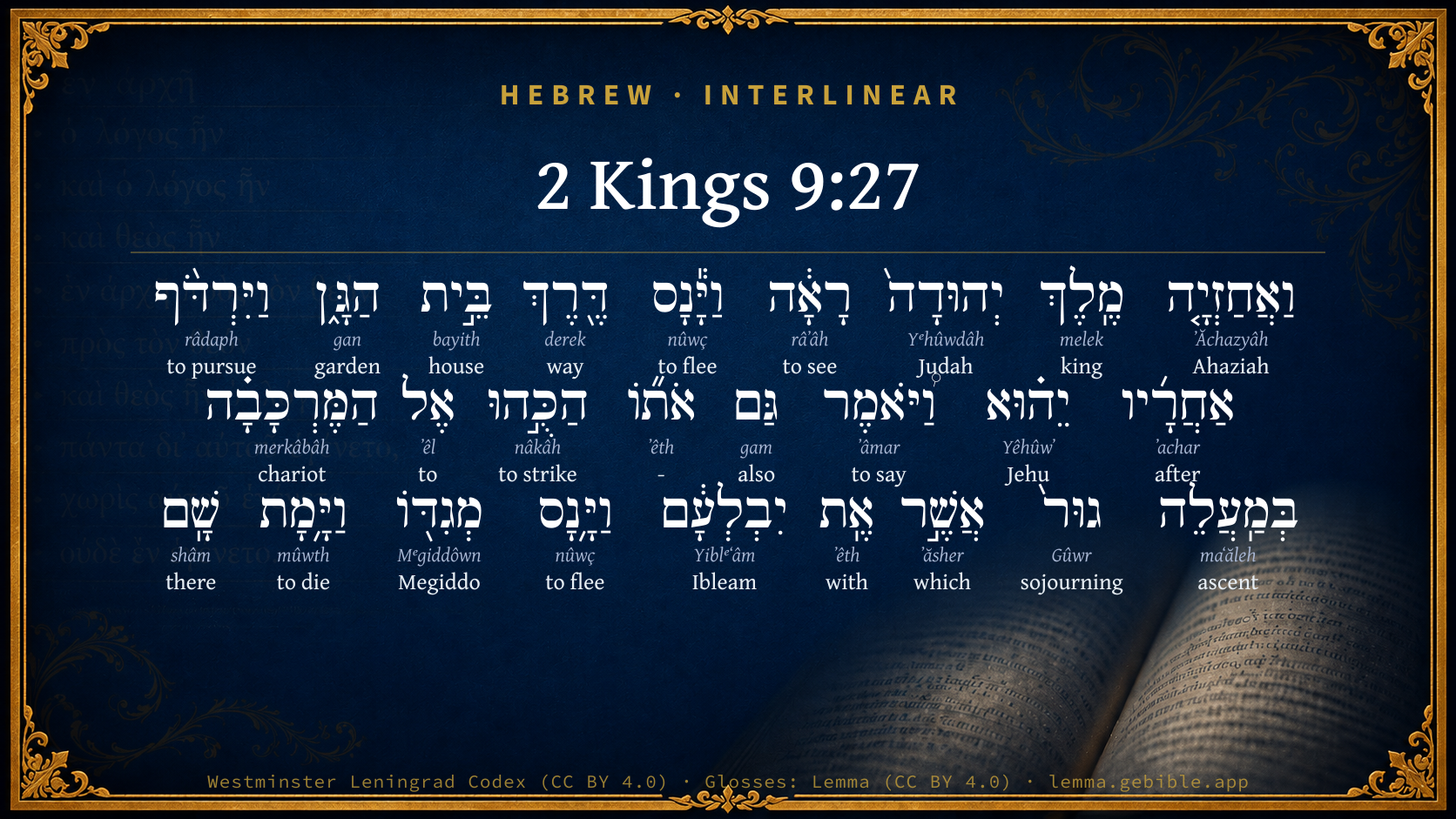
Hebrew (Westminster Leningrad Codex) 2 Kings 9:27 appears in the Hebrew Old Testament. The text above is from the Westminster Leningrad Codex. Each word links to its Strong’s number, a concise gloss, and parsing drawn from the Open Scriptures Hebrew Bible morphology. Click any word for its full Brown-Driver-Briggs (BDB) entry.
Download image
Cite this verse

2 Kings 9:27 (World English Bible). Public Domain. Lemma interlinear Bible study tool, https://lemma.gebible.app/v/2-kings/9/27.

Show BibTeX & RIS
BibTeX
RIS
English Translation
But when Ahaziah the king of Judah saw this, he fled by the way of the garden-house. Jehu followed after him, and said, Smite him also in the chariot: [and they struck him] at the ascent of Gur, which is by Ibleam. He fled to Megiddo, and died there.
World English Bible · Public Domain
Highlights
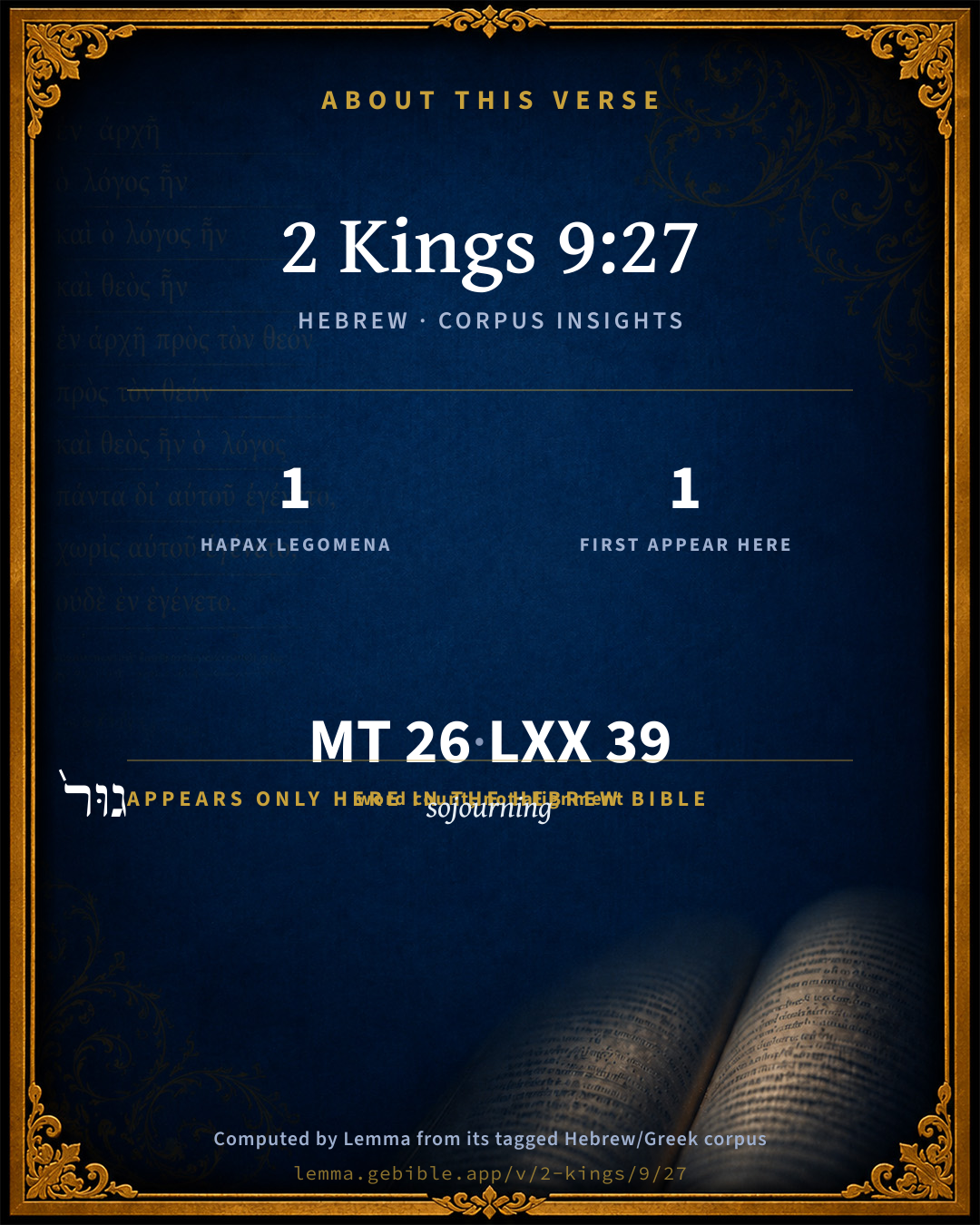
  • 1 hapax legomenon — only here in the Hebrew Bible
  • 1 first appearance in the Hebrew Bible
Full analysis ↓
Download a study sheet

One document with this verse’s original text, its word-by-word gloss line, the meaning frame, cross-references with their text, attributed commentary, and full source and license credits — printable, and it pastes into notes with its structure intact.

This verse Autodidact and up

Study sheet (.html) Plain text (.txt)

A passage Seminary Student

Up to 50 verses in one chapter. A passage sheet keeps up to 6 commentary sources and 12 cross-references per verse, in the order this page ranks them, and says so on the sheet whenever that leaves anything out. Ask for a single verse and you get the Autodidact verse sheet above.

Everything on this page stays free to read, with no account — the sheet is a download of what is already on screen, not access to it.

Want to remove ads? Support Godless Engineer
Compare translations 3

The same verse in 3 English versions, stacked beneath the original-language interlinear above. Click any original word for its lexicon entry.

Each is an independent rendering of the whole verse — the interlinear is not word-aligned to these translations.

Highlighted words mark where these versions differ — a whole-verse word diff, not a word-by-word alignment.

  • World English Bible Public Domain
    But when Ahaziah the king of Judah saw this, he fled by the way of the garden-house. Jehu followed after him, and said, Smite him also in the chariot: [and they struck him] at the ascent of Gur, which is by Ibleam. He fled to Megiddo, and died there.
  • King James Version Public Domain
    But when Ahaziah the king of Judah saw this, he fled by the way of the garden house. And Jehu followed after him, and said, Smite him also in the chariot. And they did so at the going up to Gur, which is by Ibleam. And he fled to Megiddo, and died there.
  • unfoldingWord Literal Text CC BY-SA 4.0
    And Ahaziah, the king of Judah, saw, and he fled the way of the house of the garden. And Jehu pursued after him, and he said, “Strike him too in the chariot!” At the ascent of Gur, which near Ibleam. And he fled Megiddo, and he died there.

unfoldingWord Literal Text — © unfoldingWord, licensed CC BY-SA 4.0. Word-aligned USFM3 via Door43 (git.door43.org/unfoldingWord/en_ult).

Versions to compare (up to 4)

3 of 4 selected

Show all 18 translations

Every available English version of this verse, each an independent rendering of the whole verse.

  • World English Bible Public Domain
    But when Ahaziah the king of Judah saw this, he fled by the way of the garden-house. Jehu followed after him, and said, Smite him also in the chariot: [and they struck him] at the ascent of Gur, which is by Ibleam. He fled to Megiddo, and died there.
  • Berean Standard Bible Public Domain
    When King Ahaziah of Judah saw this, he fled up the road toward Beth-haggan. And Jehu pursued him, shouting, “Shoot him too!” So they shot Ahaziah in his chariot on the Ascent of Gur, near Ibleam, and he fled to Megiddo and died there.
  • Majority Standard Bible Public Domain
    When King Ahaziah of Judah saw this, he fled up the road toward Beth-haggan. And Jehu pursued him, shouting, “Shoot him too!” So they shot Ahaziah in his chariot on the Ascent of Gur, near Ibleam, and he fled to Megiddo and died there.
  • King James Version Public Domain
    But when Ahaziah the king of Judah saw this, he fled by the way of the garden house. And Jehu followed after him, and said, Smite him also in the chariot. And they did so at the going up to Gur, which is by Ibleam. And he fled to Megiddo, and died there.
  • American Standard Version (1901) Public Domain
    But when Ahaziah the king of Judah saw this, he fled by the way of the garden-house. And Jehu followed after him, and said, Smite him also in the chariot: `and they smote him' at the ascent of Gur, which is by Ibleam. And he fled to Megiddo, and died there.
  • Revised Version (1885) Public Domain
    But when Ahaziah the king of Judah saw this, he fled by the way of the garden house. An Jehu followed after him, and said, Smite him also in the chariot: and they smote him at the ascent of Gur, which is by Ibleam. And he fled to Megiddo, and died there.
  • Geneva Bible (1599) Public Domain
    But when Ahaziah the King of Iudah saw this, he fled by the way of the garden house: And Iehu pursued after him, and sayd, Smite him also in the charet: and they smote him in the going vp to Gur, which is by Ibleam. And hee fled to Megiddo, and there dyed.
  • Douay-Rheims (1899) Public Domain
    But Ochozias king of Juda seeing this, fled by the way of the garden house: and Jehu pursued him, and said: Strike him also in his chariot. And they struck him in the going up to Gaver, which is by Jeblaam: and he fled into Mageddo, and died there.
  • Young's Literal Translation Public Domain
    And Ahaziah king of Judah hath seen, and fleeth the way of the garden-house, and Jehu pursueth after him, and saith, `Smite him -- also him -- in the chariot,' in the going up to Gur, that `is' Ibleam, and he fleeth to Megiddo, and dieth there,
  • Literal Standard Version CC BY-SA 4.0
    And Ahaziah king of Judah has seen, and flees the way of the garden-house, and Jehu pursues after him, and says, “Strike him—also him—in the chariot,” in the going up to Gur, that [is] Ibleam, and he flees to Megiddo, and dies there,
  • Unlocked Literal Bible CC BY-SA 4.0
    When Ahaziah the king of Judah saw this, he fled up the road to Beth Haggan. But Jehu followed him, and said, “Kill him also in the chariot,” and they shot him at the ascent of Gur, which is by Ibleam. Ahaziah fled to Megiddo and died there.
  • unfoldingWord Literal Text CC BY-SA 4.0
    And Ahaziah, the king of Judah, saw, and he fled the way of the house of the garden. And Jehu pursued after him, and he said, “Strike him too in the chariot!” At the ascent of Gur, which near Ibleam. And he fled Megiddo, and he died there.
  • Darby Bible Public Domain
    When Ahaziah king of Judah saw [that], he fled by the way of the garden-house. And Jehu followed after him, and said, Smite him also in his chariot. It was on the ascent of Gur, which is by Jibleam. And he fled to Megiddo, and died there.
  • World Messianic Bible Public Domain
    But when Ahaziah the king of Judah saw this, he fled by the way of the garden house. Jehu followed after him, and said, “Strike him also in the chariot!” They struck him at the ascent of Gur, which is by Ibleam. He fled to Megiddo, and died there.
  • Webster's Bible Public Domain
    But when Ahaziah the king of Judah saw this, he fled by the way of the garden house. And Jehu followed him, and said, Smite him also in the chariot. And they did so at the going up to Gur, which is by Ibleam. And he fled to Megiddo, and died there.
  • Free Bible Version CC BY-SA 4.0
    When Ahaziah, king of Judah, saw what happened, he raced up the road toward Beth-haggan. But Jehu chased after him, shouting, “Shoot him too!” So they shot Ahaziah in his chariot on the way up to Gur, near Ibleam. He managed to escape to Megiddo but he died there.
  • Bible in Basic English Public Domain
    Now when Ahaziah, king of Judah, saw this, he went in flight by the way of the garden house. And Jehu came after him and said, Put him to death in the same way; and they gave him a death-wound in his carriage, on the slope up to Gur, by Ibleam; and he went in flight to Megiddo, where death came to him.
  • JPS Tanakh (1917) Public Domain
    But when Ahaziah the king of Judah saw this, he fled by the way of the garden-house. And Jehu followed after him, and said: 'Smite him also in the chariot'; and they smote him at the ascent of Gur, which is by Ibleam. And he fled to Megiddo, and died there.

Literal Standard Version (2020), Covenant Press — licensed CC BY-SA 4.0. Text via the HelloAO Bible API (eBible.org). Unlocked Literal Bible (unfoldingWord) — licensed CC BY-SA 4.0. Text via the HelloAO Bible API (eBible.org). unfoldingWord Literal Text — © unfoldingWord, licensed CC BY-SA 4.0. Word-aligned USFM3 via Door43 (git.door43.org/unfoldingWord/en_ult). Free Bible Version, Dr. Jonathan Gallagher — licensed CC BY-SA 4.0. Text via the HelloAO Bible API (eBible.org).

Word by word

More ways to search: Search by grammar → Find every occurrence → Compare this word →

Practice this passage: Drill this verse → Learn its vocabulary →

גוּר֙
Gûwr
H1483
“sojourning”
Noun, Proper
Part of Speech
Noun
Type
Proper
Full BDB Definition

Origin: the same as H1482

TWOT: None

Gur = "sojourning" - the place Ahaziah was smitten
  1. וַאֲחַזְיָ֤ה ʼĂchazyâh H274 “and · Ahaziah” Conjunction + Noun, Proper
  2. מֶֽלֶךְ melek H4428 “king of” Noun, Common, Masculine, Singular, Construct
  3. יְהוּדָה֙ Yᵉhûwdâh H3063 “Judah” Noun, Proper
  4. רָאָ֔ה râʼâh H7200 “to see” Verb, Qal, Perfect, 3rd Person, Masculine, Singular
  5. וַיָּ֕נָס nûwç H5127 “and · to flee” Conjunction + Verb, Qal, Sequential Imperfect, 3rd Person, Masculine, Singular
  6. דֶּ֖רֶךְ derek H1870 “way of” Noun, Common, Both, Singular, Construct
  7. בֵּ֣ית bayith H1004 “house” Noun, Proper
  8. הַגָּ֑ן gan H1588 “garden” Noun, Proper
  9. וַיִּרְדֹּ֨ף râdaph H7291 “and · to pursue” Conjunction + Verb, Qal, Sequential Imperfect, 3rd Person, Masculine, Singular
  10. אַחֲרָ֜יו ʼachar H310 “after · him” Preposition + Suffix, Personal, 3rd Person, Masculine, Singular
  11. יֵה֗וּא Yêhûwʼ H3058 “Jehu” Noun, Proper
  12. וַ֠יֹּאמֶר ʼâmar H559 “and · to say” Conjunction + Verb, Qal, Sequential Imperfect, 3rd Person, Masculine, Singular
  13. גַּם gam H1571 “also” Particle, Accusative
  14. אֹת֞וֹ ʼêth H853 “- · him” Particle, Direct Object + Suffix, Personal, 3rd Person, Masculine, Singular
  15. הַכֻּ֣הוּ nâkâh H5221 “strike · him” Verb, Hiphil, Imperative, 2nd Person, Masculine, Plural + Suffix, Personal, 3rd Person, Masculine, Singular
  16. אֶל ʼêl H413 “to” Preposition
  17. הַמֶּרְכָּבָ֗ה merkâbâh H4818 “the · chariot” Particle, Definite Article + Noun, Common, Feminine, Singular, Absolute
  18. בְּמַֽעֲלֵה maʻăleh H4608 “in/at · ascent of” Preposition + Noun, Common, Masculine, Singular, Construct
  19. אֲשֶׁ֣ר ʼăsher H834 “which” Particle, Relative
  20. אֶֽת ʼêth H854 “with” Preposition
  21. יִבְלְעָ֔ם Yiblᵉʻâm H2991 “Ibleam” Noun, Proper
  22. וַיָּ֥נָס nûwç H5127 “and · to flee” Conjunction + Verb, Qal, Sequential Imperfect, 3rd Person, Masculine, Singular
  23. מְגִדּ֖וֹ Mᵉgiddôwn H4023 “Megiddo” Noun, Proper
  24. וַיָּ֥מָת mûwth H4191 “and · to die” Conjunction + Verb, Qal, Sequential Imperfect, 3rd Person, Masculine, Singular
  25. שָֽׁם shâm H8033 “there” Adverb

About this verse

These counts appear in no published source. They are computed here, from the morphology-tagged text and Lemma’s own curated glosses. What Lemma adds →

26
words
25
distinct lemmas
Historical
section

Notable vocabulary

1 hapax legomenon — a word that appears only here in the entire Hebrew Bible:

  • גוּר֙ sojourning H1483

First appearance in Scripture

This word makes its first canonical appearance in the Hebrew Bible here:

  • גוּר֙ sojourning H1483

Shared distinctive vocabulary

יִבְלְעָ֔ם Ibleam H2991 occurs in 3 verses of the Hebrew Bible. Also found in:

Grammatical profile

  • 7 verbs
  • 12 nouns
  • 3 prepositions
  • 1 adverb
  • 3 particles

Verb forms

  • רָאָ֔ה Qal · Perfect
  • וַיָּ֕נָס Qal · Sequential Imperfect
  • וַיִּרְדֹּ֨ף Qal · Sequential Imperfect
  • וַ֠יֹּאמֶר Qal · Sequential Imperfect
  • הַכֻּ֣הוּ Hiphil · Imperative
  • וַיָּ֥נָס Qal · Sequential Imperfect
  • וַיָּ֥מָת Qal · Sequential Imperfect

Repetition

A word recurs within this verse — often emphatic in Hebrew:

  • וַיָּ֕נָס to flee H5127 ×2

Hebrew & Septuagint length

In English translation the verse runs 49 words from the Hebrew and 48 from the Septuagint (LXX English) — closely comparable.

A rough comparison of the two English renderings, which tokenize alike — not a word-level alignment.

Word counts can differ between the Hebrew and the Greek without any difference in meaning — e.g. the Hebrew direct-object marker אֵת has no separate Greek word, and Greek often adds the article ὁ.

In the original languages it is 26 Hebrew tokens and 39 Greek tokens — but the two are counted differently (Hebrew bundles its prefixes and suffixes into one token; the Greek is in lemma form), so that isn’t a like-for-like length.

Cross-references

11

Topical passages linked to 2 Kings 9:27 in the Treasury of Scripture Knowledge — connected by theme and wording, ordered by reader-vote popularity; previews shown in the World English Bible.

  • Judges 1:27 Manasseh did not drive out [the inhabitants of] Beth-shean and its towns, nor [of] Taanach and its towns, nor the inhabitants of Dor and its towns, nor the inhabitants of Ibleam and its towns, nor the inhabitants of Megiddo and its towns; but the Canaanites would dwell in that land.
  • Joshua 17:11 Manasseh had in Issachar and in Asher Beth-shean and its towns, and Ibleam and its towns, and the inhabitants of Dor and its towns, and the inhabitants of En-dor and its towns, and the inhabitants of Taanach and its towns, and the inhabitants of Megiddo and its towns, even the three heights.
  • Numbers 16:26 He spoke to the congregation, saying, Depart, I pray you, from the tents of these wicked men, and touch nothing of theirs, lest you be consumed in all their sins.
  • Judges 5:19 The kings came and fought; Then fought the kings of Canaan. In Taanach by the waters of Megiddo: They took no gain of money.
  • 1 Kings 4:12 Baana the son of Ahilud, in Taanach and Megiddo, and all Beth-shean which is beside Zarethan, beneath Jezreel, from Beth-shean to Abel Meholah, as far as beyond Jokmeam;
  • 1 Kings 21:2 Ahab spoke to Naboth, saying, Give me your vineyard, that I may have it for a garden of herbs, because it is near to my house; and I will give you for it a better vineyard than it: or, if it seem good to you, I will give you the worth of it in money.
  • 2 Kings 8:29 King Joram returned to be healed in Jezreel of the wounds which the Syrians had given him at Ramah, when he fought against Hazael king of Syria. Ahaziah the son of Jehoram king of Judah went down to see Joram the son of Ahab in Jezreel, because he was sick.
  • 2 Kings 23:29–30 In his days Pharaoh Necoh king of Egypt went up against the king of Assyria to the river Euphrates: and king Josiah went against him; and [Pharaoh Necoh] killed him at Megiddo, when he had seen him.
  • 2 Chronicles 22:7–9 Now the destruction of Ahaziah was of God, in that he went to Joram: for when he was come, he went out with Jehoram against Jehu the son of Nimshi, whom Yahweh had anointed to cut off the house of Ahab.
  • Proverbs 13:20 One who walks with wise men grows wise, But a companion of fools suffers harm.
  • 2 Corinthians 6:17 Therefore, "'Come out from among them, And be separate,' says the Lord, 'Touch no unclean thing. I will receive you.

Cross-references courtesy of OpenBible.info (CC BY 4.0).

Hebrew and Greek witnesses Masoretic Hebrew ↔ Greek Septuagint

The same verse in the two great witnesses to the Old Testament, shown verse-for-verse.

These are two independent witnesses, not word-aligned to each other, and the Septuagint is shown in lemma (dictionary) form.

Hebrew 2 Kings 9:27 Masoretic · Westminster Leningrad Codex

וַאֲחַזְיָ֤ה מֶֽלֶךְ יְהוּדָה֙ רָאָ֔ה וַיָּ֕נָס דֶּ֖רֶךְ בֵּ֣ית הַגָּ֑ן וַיִּרְדֹּ֨ף אַחֲרָ֜יו יֵה֗וּא וַ֠יֹּאמֶר גַּם אֹת֞וֹ הַכֻּ֣הוּ אֶל הַמֶּרְכָּבָ֗ה בְּמַֽעֲלֵה גוּר֙ אֲשֶׁ֣ר אֶֽת יִבְלְעָ֔ם וַיָּ֥נָס מְגִדּ֖וֹ וַיָּ֥מָת שָֽׁם

But when Ahaziah the king of Judah saw this, he fled by the way of the garden-house. Jehu followed after him, and said, Smite him also in the chariot: [and they struck him] at the ascent of Gur, which is by Ibleam. He fled to Megiddo, and died there.

World English Bible · Public Domain

Greek LXX 2 Kings 9:27 Septuagint · lemma form

καί οχοζιας βασιλεύς ιουδα ὁράω καί φεύγω ὁδός βαιθαγγαν καί διώκω ὀπίσω αὐτός ιου καί εἶπον καί γέ αὐτός καί πατάσσω αὐτός ἐν ὁ ἅρμα ἐν ὁ ἀναβαίνω γαι ὅς εἰμί ιεβλααμ καί φεύγω εἰς μαγεδδων καί ἀποθνήσκω ἐκεῖ

And Ochozias king of Juda saw it, and fled by the way of Baethgan. And Ju pursued after him, and said, Slay him also. And one struck him in the chariot at the going up of Gai, which is Jeblaam: and he fled to Mageddo, and died there.

LXX2012 (modern English Septuagint) · Public Domain

On this verse, Whedon's Commentary on the Bible discusses the Septuagint’s reading. Read the note in Commentary ↓

Hebrew: Westminster Leningrad Codex (CC BY 4.0). Greek: Septuagint (public domain); English from LXX2012 (modern English Septuagint) (Public Domain). How the Septuagint differs from the Hebrew →

Targum (Aramaic paraphrase)

1

The Targum is the ancient Jewish Aramaic paraphrase of the Hebrew Scriptures — an interpretive translation, not the Hebrew text itself. Onkelos (literal) and Pseudo-Jonathan (expansive) render the Torah, and Jonathan the Prophets. Coverage is partial: where no permissively-licensed English translation exists for a verse, only the Aramaic is shown. This is verse-level text, not a word-by-word alignment to the Hebrew.

  1. Targum Jonathan Prophets (Joshua–Malachi)
    וַאֲחַזְיָה מַלְכָּא שִׁבְטָא דְבֵית יְהוּדָה חֲזָא וְאַפֵּךְ בְּאוֹרַח בֵּית גִנַיָא וּרְדַף בַּתְרוֹהִי יֵהוּא וַאֲמַר אַף יָתֵיהּ מְחוֹהִי בִּרְתִיכָא בְּמִסְקְנָא דְגוּר עִם יִבְלְעָם וְאַפַּךְ לִמְגִדוֹ וּמִית תַּמָן:

    (no public-domain English translation for this verse)

    Targum Jonathan — Aramaic: “Mikraot Gedolot” (public domain). English: “Sefaria Community Translation” (CC0 1.0 (public-domain dedication)); “London "Chaldee Paraphrase," 1871” (public domain). Text via Sefaria.

Commentary

Notes on 2 Kings 9:27 from classic Christian and Jewish commentators (each source and its license shown beneath its notes). The classic Christian expositions comment on the surrounding passage and are grouped to its opening verse, so a note may address several verses; the Jewish commentaries on the Tanakh (Rashi and others) are per-verse, so they appear only where the commentator wrote on this verse.

Lemma curates 59 commentaries, every one of them public domain or Creative Commons licensed, each selected and text-cleaned for this edition rather than reprinted as found. About our sources →

Jamieson, Fausset & Brown

Robert Jamieson, A. R. Fausset & David Brown

AHAZIAH IS SLAIN. (Kg2 9:27-35)

Ahaziah--was grandnephew to King Joram, and great-grandson to King Ahab.

Ibleam--near Megiddo, in the tribe of Issachar (Jos 17:11; Jdg 1:27); and Gur was an adjoining hill.

Jamieson, Fausset & Brown — Commentary Critical and Explanatory on the Whole Bible (1871) — public domain (CC PDM 1.0). Text via the HelloAO Bible API.

Trapp's Complete Commentary

John Trapp

2Ki 9:27 But when Ahaziah the king of Judah saw [this], he fled by the way of the garden house. And Jehu followed after him, and said, Smite him also in the chariot. [And they did so] at the going up to Gur, which [is] by Ibleam. And he fled to Megiddo, and died there.

Ver. 27. Smite him also in the chariot.] For he was of Ahab’s house, too, by marriage, and so within Jehu’s commission. So dangerous a thing it is to he imped in a wicked family.

John Trapp, A Commentary or Exposition upon All the Books of the Old and New Testament (1647–1656) — public domain. Text from a community e-Sword module.

Joseph Benson's Commentary

2Ki 9:27-28. He fled by the way of the garden-house — By some secret way, hoping to escape while they were busy about Joram. Jehu said, Smite him also — As you have done Joram, for he also is of the house of Ahab, chap. 2Ki 8:18. And they did so — They wounded him, but not mortally; being the more remiss in executing Jehu’s sentence against him, either because they were not so much concerned in his, as in Joram’s death; or because they had some regard for him for Jehoshaphat’s sake. He fled to Megiddo, and died there — The account of his death is briefly and imperfectly given here, and the defects are supplied in the book of Chronicles, (which was in a great part written to supply things omitted in the book of Kings,) and out of both, the history may be thus completed. He fled first to Megiddo, and thence to Samaria, where he was taken, and thence brought to Jehu, and by his sentence was put to death at Megiddo. And his servants carried him to Jerusalem, &c. — Which they did, by Jehu’s permission, out of respect to Jehoshaphat’s memory, 2Ch 22:9.

Joseph Benson's Commentary on the Old and New Testaments (1811–1818) — public domain. Text from a community e-Sword module.

Whedon's Commentary on the Bible

Daniel D. Whedon

DEATH OF AHAZIAH, 2Ki_9:27-29.

27. Fled by the way of the garden house — That is, according to some, the summerhouse, built for purposes of rest or shade in the royal garden into which Naboth’s vineyard had been converted. 1Ki_21:2. But house of the garden is a literal translation of the original word Beth-haggan, and it seems better, in view of what 2Ch_22:9 relates of the flight of Ahaziah to Samaria, to understand it, with the Septuagint, as the name of a place between Jezreel and Samaria. A few miles south of Jezreel is Engannim, the modern Jenin, with which Beth-haggan is probably to be identified. It is still a place of gardens and abundant water, whence, doubtless, it received its names.

Jehu followed after him — To this 2Ch_22:9, adds: “And he sought Ahaziah: and they caught him, for he was hid in Samaria, and brought him to Jehu: and when they had slain him, they buried him.” Here, it will be noticed, the author of Chronicles does not say where or how he was slain and buried, and this the book of Kings supplies. So we should understand that Ahaziah first fled by the way of Beth-haggan to Samaria, and there hid himself, but was followed by Jehu and his men, and discovered, and brought forth from his hiding-place into the presence of Jehu. It would seem that Jehu himself did not follow all the way to Samaria, but his men continued the pursuit, and when they had captured Ahaziah they brought him back to Jez-reel. Then Jehu said: Smite him also in the chariot at the going up to Gur, which is by Ibleam. These words should thus be connected together, and not separated, as in the English version, with the addition, and they did so. Ibleam was a town allotted to the tribe of Manasseh, (Jdg_1:27,) though it seems to have been located in the territory of Issachar or Asher. Jos_17:11. Its exact position is unknown, but it lay probably not far from Megiddo, and between it and Jezreel. The going up to Gur was some well-known eminence near by it, and it was perhaps from some evil association of Ahaziah or his kindred with that spot that Jehu wished him to be slain there.

Fled to Megiddo, and died there — The arrows of Jehu’s archers did not prove instantly fatal, and the wounded king seized an opportunity for escape, and fled in his chariot as far as Megiddo, where he expired. According to Josephus he left his chariot, and fled on horseback to Megiddo. Megiddo, the modern el-Lejjun, was about six miles west of Jezreel. See on Jos_12:21.

Daniel D. Whedon (gen. ed.), Commentary on the Old and New Testaments (1874–1909) — public domain. Text from a community e-Sword module.

Tyndale Open Study Notes

Tyndale Open Resources

9:27-28 The road to Beth-haggan led southward along the eastern edge of the Jezreel Valley, past Ibleam and on to Samaria. • Megiddo . . . he died there: King Ahaziah escaped to Samaria, where he was captured and brought to Jehu (2 Chr 22:8-9). The accounts in Chronicles and Kings might be combined to show that although Ahaziah was wounded at Gur, he managed to go on to Samaria. Later, Jehu’s men seized him and brought him to Jehu, where he was put to death. Since the Chronicler associates Ahaziah’s capture with Jehu’s slaying of Ahab’s descendants and some of Ahaziah’s relatives (see 2 Kgs 10:1-17), it appears that Ahaziah avoided his pursuers for a time. The account here is greatly compressed, with the writer recording Ahaziah’s death and burial before relating further events.

Tyndale Open Study Notes — © Tyndale Open Resources, licensed CC BY-SA 4.0. Text via the HelloAO Bible API.

Geneva Bible (1599)

Geneva Bible translators

After that he was wounded in Samaria, he fled to Megiddo, which was a city of Judah.

Geneva Bible (1599) marginal notes — public domain. Text via Bolls.life.

Adam Clarke's Commentary

Verse 27. Fled by the way of the garden] The account of the death of Ahaziah, as given in 2Ch 22:8-9, is very different from that given here: When Jehu was executing judgment upon the house of Ahab-he sought Ahaziah; and they caught him, (for he was hid in Samaria,) and brought him to Jehu; and when they had slain him, they buried him. "The current of the story at large is this," says Dr. Lightfoot: "Jehu slayeth Joram in the field of Jezreel, as Ahaziah and Joram were together; Ahaziah, seeing this, flees, and gets into Samaria, and hides himself there. Jehu marcheth to Jezreel, and makes Jezebel dogs' meat: from thence he sends to Samaria for the heads of Ahab's children and posterity: which are brought him by night, and showed to the people in the morning. Then he marcheth to Samaria, and by the way slayeth forty-two of Ahab's kinsmen; and findeth Jehonadab, the father of the Rechabites. Coming into Samaria, he maketh search for Ahaziah: they find him hid, bring him to Jehu, and he commands to carry him up towards Gur, by Ibleam, and there to slay him. It may be, his father Joram had slain his brethren there, as Ahab had done Naboth, in Jezreel. They do so; smite him there in his chariot; and his charioteer driveth away to Megiddo before he dies. The story in the book of Kings is short: but the book of Chronicles shows the order." Lightfoot's Works, vol. i., p. 88.

Adam Clarke's Commentary on the Bible (1810–1826) — public domain. Text from a community e-Sword/MySword module.

Ellicott's Commentary for English Readers

(27) But when . . . saw this.—Now Ahaziah . . . had seen it; and he fled, &c.

By the way of the garden house—i.e., in the direction of the garden house, which was probably a sort of arbour or drinking pavilion near the gates of the palace gardens, of which Naboth’s vineyard formed a part. Ahaziah wished to escape from the royal park as fast as he could.

Smite him also in the chariot.—The Hebrew is much more suited to the excitement of the occasion: Him too! shoot him in the chariot! (Here and in 2Ki_9:13, supra, ‘el, “into,” seems equivalent to ‘al, “upon.”)

And they did so.—Some such words as these may have fallen out of the Hebrew text. So the Syriac: “Him also! slay him! and they slew him in his chariot, on the ascent of Gur,” &c. But the rendering of the LXX. involves the least change, and is probably right: “Him too! And he smote him in the chariot, in the going up,” &c. This is more graphic. Jehu simply ejaculates,” Him too! “and, after a hot pursuit, shoots his second victim, at the ascent or declivity of Gur, where Ahaziah’s chariot would be forced to slacken speed.

The ascent of Gur is not mentioned elsewhere. Ibleam lay between Jezreel and Megiddo. (Comp. Jdg_1:27; Jos_17:11.)

And he fled to Megiddo, and died there.—See the Note on 2Ch_22:9, where a different tradition respecting the end of Ahaziah is recorded. The definite assignment of localities in the present account is a mark of greater trustworthiness. The way in which Rashi, whom Keil follows, attempts to combine the two accounts, is revolting to common sense. It would be better to assume a corruption of the text in one or the other narrative.

Megiddo.—Identified in the cuneiform inscriptions as Magidû or Magadû.

A Bible Commentary for English Readers, edited by Charles John Ellicott (1878–1897) — public domain. Text from a community e-Sword module.

The Cambridge Bible for Schools and Colleges

gen. ed. J. J. S. Perowne

27–29. Death of Ahaziah king of Judah (2Ch_22:7-9)

27. by the way of the garden house] The events took place close to the royal grounds, for Naboth’s vineyard lay in the neighbourhood. The garden house may have been some building at the extremity of the domain by which flight from the scene of destruction appeared easy to Ahaziah. The LXX. however treats it as a proper name, writing Βαιθγάν. This has been supposed to be the same as En-gannim = ‘the well of the gardens’ which is identified with the modern Jenin. This place lies south from Jezreel on the road to Samaria, and would be on the shortest route by which Ahaziah could make his way to Jerusalem.

And Jehu followed after him] i.e. In the person of his partizans and followers, to whom he gave the order ‘Smite him also’. Jehu wished to get into Jezreel as soon as possible, and left the fate of the king of Judah to others.

Smite him also in the chariot] In the original the command continues ‘at the going up to Gur’ (R.V. at the ascent of Gur), as though Jehu knowing the country specified to his men the place where they would be most likely to overtake Ahaziah, where the ground began to rise, and so would retard his flight. This seeming somewhat unnatural, the A.V. inserted ‘And they did so’, the R.V. ‘and they smote him’. Neither Gur nor Ibleam have been identified, and there is some difference between the statements here and the narrative in Chronicles. There we read (2Ch_22:9) that Jehu ‘sought Ahaziah, and they caught him (for he was hid in Samaria) and brought him to Jehu, and when they had slain him they buried him’. The LXX. in this passage has a rendering which suggests how the two accounts may be reconciled. There it is said that Ahaziah had gone to Samaria to be cured (ἰατρευόμενον). Suppose that in the pursuit Jehu’s command to smite him had been carried out, and the wounded king escaped to Samaria in which direction he was hurrying. If he remained there to have his wound attended to, the emissaries of Jehu might discover him, when the new king came to his capital to take possession, and Ahaziah might then be taken to Megiddo and slain. The Chronicler speaks more at length on the particulars of Ahaziah’s death, as the evil issue of an alliance between a king of Judah and the house of Ahab was the sort of lesson on which it suited his purpose to dwell.

And he fled to Megiddo] Megiddo was on the southern extremity of the plain of Esdraelon, and by its position was a place of much strategical importance. It had a king when the Israelites entered Canaan, and it was the scene of the battle against the Canaanites in the days of Deborah. It was a place of importance in the days of Solomon (1Ki_4:12) for he made it one of his commissariat stations. At a later period it was the scene of Josiah’s death (2Ki_23:29) when he had taken part with Assyria against Pharaoh-necho, king of Egypt. If we consider ‘Samaria’ in 2Ch_22:9 to mean ‘the land of Samaria’ and not the city, Megiddo was a part thereof, and in that way another method of reconciling the narratives in Kings and Chronicles would be found.

and died there] It was part of Jehu’s commission to have Ahaziah slain, for he was Ahab’s grandson.

The Cambridge Bible for Schools and Colleges (gen. ed. J. J. S. Perowne; Cambridge University Press, 1878–1918) — public domain. Text from a community e-Sword module.

John Gill's Exposition

And as Jehu entered in at the gate,.... Either of the city of Jezreel, or of the king's palace:

she said, had Zimri peace, who slew his master? Elah the son of Baasha king of Israel; no, he had not; he reigned but seven days, and, being besieged, burnt the king's house over him, and died, Kg1 16:10, suggesting that the like would be his fate, who had slain his master Joram; or the words may be rendered, "O Zimri, the slayer of his master"; calling Jehu so, because of his likeness to Zimri.

John Gill's Exposition of the Whole Bible (1746–1763) — public domain (CC PDM 1.0). Text via the HelloAO Bible API.

Albert Barnes' Notes on the Bible

By the way of the garden-house - Or “by the way of Beth-Gan,” which has been conjectured to be another name for En-Gannim, “the spring of the gardens.” Both are considered identical with Ginaea, the modern Jenin, which lies due south of Jezreeh The road from Jezreel (Zerin) to Jenin passes at first along the plain of Esdraelon, but after a while begins to rise over the Samaritan hills. Here probably was “the ascent of Gur, by Ibleam,” which may have occupied the site of the modern Jelama. Whether the soldiers attacked him there or not is uncertain. The words, “And they did so,” are not in the original.

Megiddo - On its situation, see Jos 12:21 note; and on the possible reconcilement of this passage with 2Ch 22:9, see the note there.

Albert Barnes' Notes on the Bible (1834–1885) — public domain. Text from a community e-Sword/MySword module.

Haydock's Catholic Bible Commentary

House. Septuagint retain "Baithgan," the original term, as if it were the name of that road. (Menochius) --- Ochozias wanted to reach the palace by the garden, which was the source of the miseries of Achab’s family. --- There. Being brought back from Samaria, 2 Paralipomenon xxii. 9., (Calmet) or lurking in that kingdom, (Menochius) and slain by Jehu as being the grandson of Jezabel. Great troubles took place in Juda, in consequence of his death. (Calmet)

George Leo Haydock (1774–1849), Haydock's Catholic Family Bible and Commentary, 1859 edition — public domain. Excludes Psalms (Douay-Rheims chapter numbering differs from Protestant) and Deuterocanonical books (Catholic canon only).

Matthew Poole's English Annotations

By the way of the garden-house; by some secret way, hoping to escape whilst they were busy about Joram.

Smite him also, as you have done Joram; for he also is of the house of Ahab, 2Ki 8:18.

They did so; they smote or wounded him, but not mortally; either supposing that the wound was mortal; or being more remiss in executing Jehu’s sentence against him, because they were not so much concerned in his as in Joram’s design; or because they had some kindness for him, either for his own or for Jehoshaphat’s sake.

He fled to Megiddo, and died there.

Quest. How doth this agree with 2Ch 22:9, He sought Ahaziah: and they caught him, for he was hid in Samaria, and brought him to Jehu: and when they had slain him, &c.

Answ. Either, first, Samaria is there to be understood, not of the city, but of the kingdom or territory so called, 1Ki 13:32, and elsewhere, in which Megiddo was; and so that may be noted to show that he could not flee into his own kingdom, where he might have been safe; but was forced to take up in another part of the kingdom of Israel, in the territory of Samaria, and there to hide himself. Or, secondly, If Samaria be the city, then the history is briefly and imperfectly described here, and the defects supplied there; (the Book of Chronicles being in great part written for that end, to supply things omitted in the Book of Kings;) and out of both the history may be thus completed: He fled first to Megiddo, and thence to Samaria, where he was caught, and thence brought to Jehu, and by his sentence was put to death at Megiddo, either because Jehu was there at that time upon some occasion, or for some other reason, which at this distance of time we cannot understand.

Matthew Poole's English Annotations on the Holy Bible (1683–1685) — public domain. Text from a community e-Sword/MySword module.

The Pulpit Commentary

Vers. 27-29. Murder of Ahaziah.

But when Ahaziah the king of Judah saw this, he fled by the way of the garden house. As soon as Ahaziah saw Jehu shoot his arrow, he too took to flight; not, however, in the same direction as Joram, but southwards, towards his own land. If "garden house" is the right translation of Gh tybe, we can say no more than that it was probably one of the lodges of the royal demesne, which lay south-east and south of Jezreel, whereof nothing more is known. But it is quite possible that we ought to translate, with the LXX, "by the way of Beth-Gan efugen oJdon. In this case "Beth-Gan" would be a village or town, probably identical with En-gannim, which lay at the foot of the hills bounding the Plain of Esdraelon, nearly due south of Jezreel (Zerin), and which is now known as Jenin (see the Map of Western Palestine, by Mr. Trelawney Saunders, compiled from the surveys of the Palestine Exploration Fund, where Ahaziah"s flight is well traced. And Jehu followed after him; and said, Smite him also in the chariot; rather, in his chariot, not in that of Jehoram, since the two kings rode respectively in their own chariots (ver. 21). It was a bold step in a pretender not yet settled upon the throne to provoke the hostility of a neighboring country by murdering its monarch; but Jehu probably thought he had more to fear from Ahaziah himself, who had been on such close terms of friendship with Jehoram, than from any probable successors. He, therefore, finding him in his power, pursued after him and slew him. From a religious point of view he could justify the act; since the commission given to him (ver. 7) was to smite all the house of Ahab, and Ahaziah was Ahab"s grandson. And they did so at the going up to Gur, which is by Ibleam. The "ascent of Gur," rWgAhle) was probably the rising ground between the southern edge of the Plain of Esdraslon and the place known as" Ibleam," or "Bileam", (1Ch_6:70) which is reasonably identified with the modern Bir-el-Belameh, two miles south of Jenin. Here the steep ascent necessarily delayed the chariot, and Ahaziah"s pursuers gained upon him, approached him, and wounded him. And he fled to Megiddo. Wounded at the ascent of Gur, and despairing of making his way through the rough mountainous country which lay between him and Jerusalem, Ahaziah suddenly changed his route, perhaps thereby baffling his pursuers, and, skirting the hills, had himself conveyed to Megiddo (Ledjun), where he died, either of his wounds, or through some fresh violence on the part of Jehu. (see 2Ch_12:8, 2Ch_12:9) The reconciliation of 2Ch_12:8, 9 with the present passage is difficult, but not wholly impossible. Perhaps the Chronicler means by "Samaria" the kingdom, not the town.

The Pulpit Commentary (1880–1919), ed. H.D.M. Spence-Jones & Joseph S. Exell — public domain. Text from a community e-Sword module.

John Wesley's Explanatory Notes

He died - The history is briefly and imperfectly described here, and the defects supplied in (the book of Chronicles, is great part written for that end, to supply things omitted in the book of Kings) out of both it may be thus compleated: he fled first to Megiddo, and thence to Samaria, where he was caught, and thence brought to Jehu, and by his sentence was put to death at Megiddo.

John Wesley, Explanatory Notes Upon the Whole Bible (1754–1765) — public domain. Text via the GEBible commentary corpus.

Kretzmann's Popular Commentary

Paul E. Kretzmann

Death of Ahaziah and Jezebel

v. 27. But when Ahaziah, the king of Judah, saw this, he fled by the way of the garden house, some structure in or near the palace grounds. And Jehu followed after him and said, Smite him also in the chariot. And they did so at the going up to Gur, which is by Ibleam, some miles to the west. And he fled to Megiddo and died there, on the slope of Mount Carmel. It seems, from 2Ch 22:9, that Ahaziah had first succeeded in reaching Samaria, but, having been found by Jehu’s men, tried to escape to the northwest, where he was killed, as here related. He who sides with the enemies of God must expect to share the lot of such enemies.

v. 28. And his servants carried him in a chariot to Jerusalem, and buried him in his sepulcher with his fathers in the city of David.

v. 29. And in the eleventh year of Joram, the son of Ahab, began Ahaziah to reign over Judah, the difference between this statement and that of 2Ki 8:25, being due to a difference in reckoning the first year of the reign of Joram.

v. 30. And when Jehu was come to Jezreel, Jezebel heard of it; and she painted her face, applying a special preparation to her eyebrows and eyelids, and tired her head, by putting on the head-band and crown which held her elaborate head-dress in place, and looked out at a window, arrogant, self-willed, and defiant to the last, hoping that the majesty of her position would save her.

v. 31. And as Jehu entered in at the gate, she said, Had Zimri peace, who slew his master? 1 Kings 16; 1 Kings 9-20, literally, "Is it peace, thou Zimri, murderer of his lord?" She wanted to terrify the rebel by reminding him of the tragic end of Zimri, whose rule lasted only seven days.

v. 32. And he lifted up his face to the window and said, Who is on my side, who? And there looked out to him, in answer to his call, two or three eunuchs, two servants of the palace at one window and three at another, signifying their intention to do his bidding.

v. 33. And he said, Throw her down. So they threw her down, dashing her from the window to the pavement below; and some of her blood was sprinkled on the wall and on the horses; and he trode her under foot, causing the wheels of his chariot to pass over her and to extinguish the last spark of life.

v. 34. And when he was come in, he did eat and drink, he first refreshed himself after his hard trip, and said, Go, see now this cursed woman and bury her; for she is a king’s daughter, a Phenician princess, 1Ki 16:31.

v. 35. And they went to bury her; but they found no more of her than the skull and the feet and the palms of her hands, the rest having been eaten or dragged away by the savage dogs common in the Orient.

v. 36. Wherefore they came again and told him. And he, who had not intended to refuse her burial or deliberately to fulfill the prediction in regard to her, said, This Is the word of the Lord which He spake by His servant Elijah the Tishbite, saying, In the portion of Jezreel shall dogs eat the flesh of Jezebel, 1Ki 21:23;

v. 37. and the carcass of Jezebel shall be as dung upon the face of the field in the portion of Jezreel, so that they shall not say, This is Jezebel; there was no definite spot to keep her memory alive. Thus are the wicked punished who have seduced others to sin and worked harm to their souls.

Paul E. Kretzmann, Popular Commentary of the Bible (1921–1924) — public domain. Text from a community e-Sword module.

unfoldingWord translationNotes

Door43 World Missions Community

General Information:

This is the account of what happened to Ahaziah, the king of Judah, after Jehu killed Joram.

saw this

"saw what happened to Joram"

Beth Haggan ... Gur ... Ibleam ... Megiddo

These are the names of places. (See: How to Translate Names)

at the ascent of Gur

The word "ascent" means that they were going up hill while travelling on the road to Gur. AT: "on the road leading up to Gur" (See: Active or Passive)

his fathers

"his ancestors"

translationWords

die

body

Jerusalem

bury

grave

ancestor

city of David

unfoldingWord translationNotes — © Distant Shores Media and the Door43 World Missions Community, licensed CC BY-SA 4.0. Source: git.door43.org/Door43/en_tn.

Rashi

Rabbi Shlomo Yitzchaki (Rashi)

“Strike him down in the chariot, etc.” And in Divrei Hayomim it states, “And he sought Achazyohu, and they captured him when he was hiding in Shomron, and they brought him to Yeihu. ” The verses can be reconciled as follows: “And [he] fled by way of the Beis-Hagan,” from Yizre’el to Shomron, and Yeihu pursued him. There is, however, a discrepancy in the matter, because Yeihu did not reign in Shomron until the following day, as it is explained in this account, “Yeihu wrote letters and sent them to Shomron, etc.” Our Rabbis explained in the Aggadah [entitled] “Cheilek,” “When he was hiding in Shomron,” that he would cut out the Divine Names and write [names of] pagan deities in their place. According to their opinion, one can say that his hiding was not because of Yeihu, rather the following is its explanation: “And he sought Achazyohu, and they captured him when he was escaping by way of the garden.” He had been acting wickedly from the beginning, for he would come to Shomron and hide from the officers of Yehudah, to commit this abomination, because the inhabitants of Shomron were idolaters. “And they brought him to Yeihu,” [i.e.,] Yeihu’s men, who had pursued him, [after which it states,] “And he said, ‘Strike him in the chariot.’”

On the way up to Gur. For they brought him [Achazyoh] there to him [Yeihu].

And he fled to Meggido. He was struck as a result of a conspiracy [=בְנִכְלִיּוּת].

Rashi on the Tanakh — English translations: “The Judaica Press complete Tanach with Rashi, translated by A. J. Rosenberg” (CC BY 4.0); “Pentateuch with Rashi's commentary by M. Rosenbaum and A.M. Silbermann, 1929-1934” (public domain); “The Metsudah Tanach series, Lakewood, N.J” (CC BY 4.0); and “The Book of Joshua, Metsudah Publications, 1997” (CC BY 4.0). Text via Sefaria.

Lesson kit

Teaching starters — assembled from the data on this page, not authored interpretation. Every prompt links to the verse data it draws on. Edit before teaching.

2 Kings, in the Historical, opens this verse with 26 words (25 distinct Hebrew lemmas). Its most distinctive word is Gûwr (“sojourning”). A historical commentator’s framing appears above. Read the whole chapter for the surrounding context.

Discussion questions

  1. The word Gûwr carries the sense “sojourning.” How does it shape the verse?
  2. This verse holds 1 word here found nowhere else in the Hebrew Bible. What might the rare word draw attention to?
  3. The word “sojourning” first appears here in Scripture. What is being introduced at this debut?
  4. Joshua 17:11 shares the word «Ibleam» with this verse. How do the two illuminate each other?
  5. “to flee” occurs 2× in this one verse. What is the effect of the repetition?
  6. The translations on this page render this verse differently — a whole-verse word diff, not a word-by-word alignment. What might account for the different wordings?
  7. The verb «רָאָ֔ה» is Qal Perfect. How does its form color the action?
  8. Reading how Jamieson, Fausset & Brown and Trapp's Complete Commentary read this verse, where do the two commentators agree and where do they part?

Things to notice

  • 1 word in this verse appears nowhere else in the Hebrew Bible.
  • 1 word makes its first canonical appearance in Scripture here.
  • This verse counts 26 Hebrew ↔ 39 Greek words.
  • These translations choose different wording for 16 words in this verse.
  • “to flee” occurs 2× in this single verse.

Reading settings

Reading text

Shown beneath each verse's original-language words.

Old Testament
Old Testament edition

Read the OT as the Masoretic Hebrew (MT) or the Greek Septuagint (LXX).

English shown for the Greek Septuagint (in the Hebrew ↔ Greek comparison).

Comparing translations? Open the Compare panel on any verse page to stack up to four side by side.