2 Kings 6:2

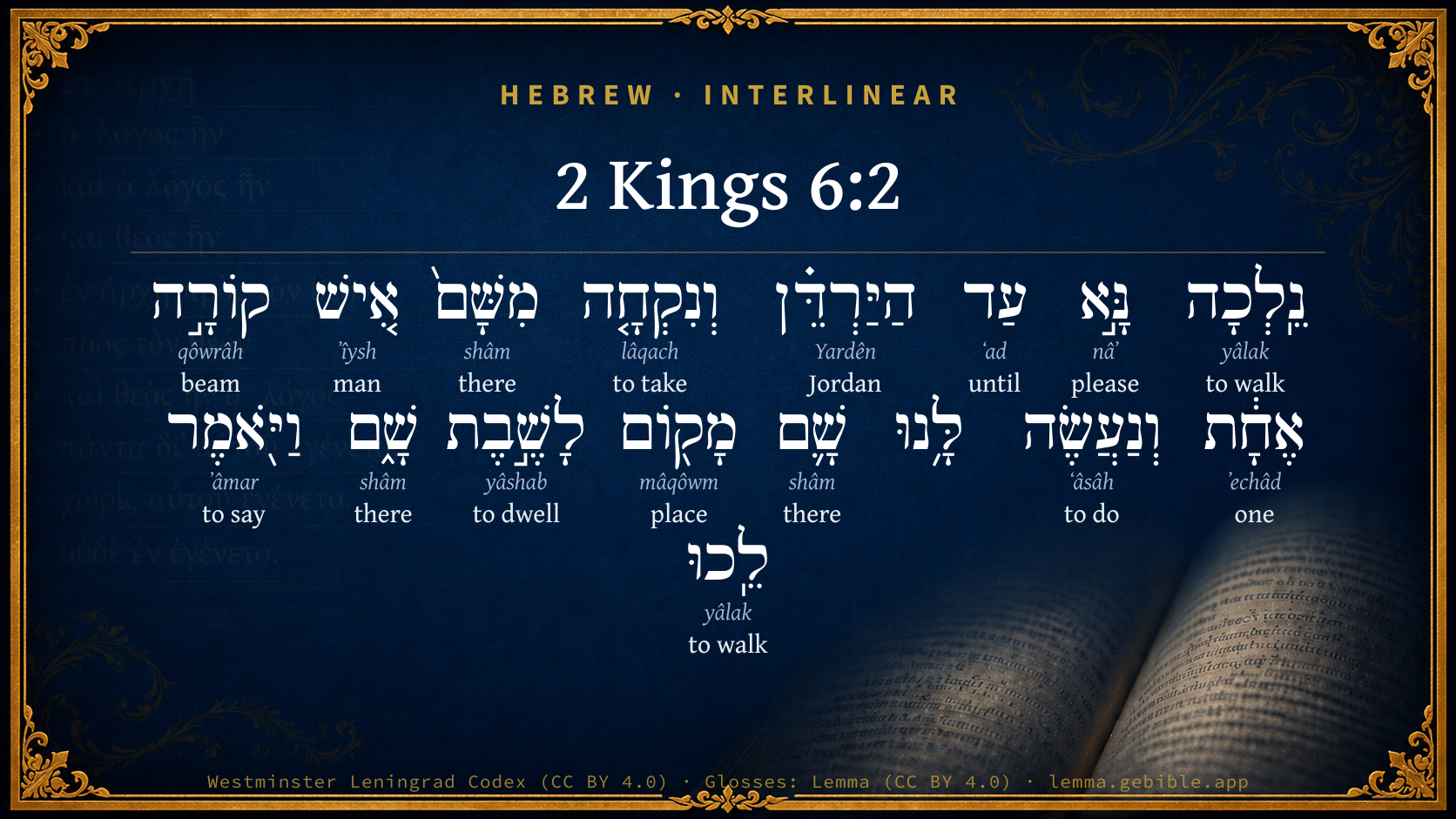
Hebrew (Westminster Leningrad Codex) 2 Kings 6:2 appears in the Hebrew Old Testament. The text above is from the Westminster Leningrad Codex. Each word links to its Strong’s number, a concise gloss, and parsing drawn from the Open Scriptures Hebrew Bible morphology. Click any word for its full Brown-Driver-Briggs (BDB) entry.
Download image
Cite this verse

2 Kings 6:2 (World English Bible). Public Domain. Lemma interlinear Bible study tool, https://lemma.gebible.app/v/2-kings/6/2.

Show BibTeX & RIS
BibTeX
RIS
English Translation
Let us go, we pray you, to the Jordan, and take there every man a beam, and let us make us a place there, where we may dwell. He answered, Go you.
World English Bible · Public Domain
Download a study sheet

One document with this verse’s original text, its word-by-word gloss line, the meaning frame, cross-references with their text, attributed commentary, and full source and license credits — printable, and it pastes into notes with its structure intact.

This verse Autodidact and up

Study sheet (.html) Plain text (.txt)

A passage Seminary Student

Up to 50 verses in one chapter. A passage sheet keeps up to 6 commentary sources and 12 cross-references per verse, in the order this page ranks them, and says so on the sheet whenever that leaves anything out. Ask for a single verse and you get the Autodidact verse sheet above.

Everything on this page stays free to read, with no account — the sheet is a download of what is already on screen, not access to it.

Want to remove ads? Support Godless Engineer
Compare translations 3

The same verse in 3 English versions, stacked beneath the original-language interlinear above. Click any original word for its lexicon entry.

Each is an independent rendering of the whole verse — the interlinear is not word-aligned to these translations.

Highlighted words mark where these versions differ — a whole-verse word diff, not a word-by-word alignment.

  • World English Bible Public Domain
    Let us go, we pray you, to the Jordan, and take there every man a beam, and let us make us a place there, where we may dwell. He answered, Go you.
  • King James Version Public Domain
    Let us go, we pray thee, unto Jordan, and take thence every man a beam, and let us make us a place there, where we may dwell. And he answered, Go ye.
  • unfoldingWord Literal Text CC BY-SA 4.0
    Please, let us go to the Jordan, and let us take from there, a man one beam, and let us make for ourselves there a place to sit there.” And he said, “Go.”

unfoldingWord Literal Text — © unfoldingWord, licensed CC BY-SA 4.0. Word-aligned USFM3 via Door43 (git.door43.org/unfoldingWord/en_ult).

Versions to compare (up to 4)

3 of 4 selected

Show all 18 translations

Every available English version of this verse, each an independent rendering of the whole verse.

  • World English Bible Public Domain
    Let us go, we pray you, to the Jordan, and take there every man a beam, and let us make us a place there, where we may dwell. He answered, Go you.
  • Berean Standard Bible Public Domain
    Please let us go to the Jordan, where each of us can get a log so we can build ourselves a place to live there.” “Go,” said Elisha.
  • Majority Standard Bible Public Domain
    Please let us go to the Jordan, where each of us can get a log so we can build ourselves a place to live there.” “Go,” said Elisha.
  • King James Version Public Domain
    Let us go, we pray thee, unto Jordan, and take thence every man a beam, and let us make us a place there, where we may dwell. And he answered, Go ye.
  • American Standard Version (1901) Public Domain
    Let us go, we pray thee, unto the Jordan, and take thence every man a beam, and let us make us a place there, where we may dwell. And he answered, Go ye.
  • Revised Version (1885) Public Domain
    Let us go, we pray thee, unto Jordan, and take thence every man a beam, and let us make us a place there, where we may dwell. And he answered, Go ye.
  • Geneva Bible (1599) Public Domain
    Let vs nowe goe to Iorden, that we may take thence euery man a beame, and make vs a place to dwell in. And he answered, Goe.
  • Douay-Rheims (1899) Public Domain
    Let us go as far as the Jordan and take out of the wood every man a piece of timber, that we may build us there a place to dwell in. And he said: Go.
  • Young's Literal Translation Public Domain
    let us go, we pray thee, unto the Jordan, and we take thence each one beam, and we make for ourselves there a place to dwell there;' and he saith, `Go.'
  • Literal Standard Version CC BY-SA 4.0
    please let us go to the Jordan, and we each take one beam from there, and we make a place there for ourselves to dwell there”; and he says, “Go.”
  • Unlocked Literal Bible CC BY-SA 4.0
    Please let us go to the Jordan, and let every man cut down a tree there, and let us build us a place there where we may live.” Elisha answered, “You may go ahead.”
  • unfoldingWord Literal Text CC BY-SA 4.0
    Please, let us go to the Jordan, and let us take from there, a man one beam, and let us make for ourselves there a place to sit there.” And he said, “Go.”
  • Darby Bible Public Domain
    Let us go, we pray thee, to the Jordan, and take thence every man a beam, and let us make us a place there, where we may dwell. And he said, Go.
  • World Messianic Bible Public Domain
    Please let us go to the Jordan, and each man take a beam from there, and let’s make us a place there, where we may live.” He answered, “Go!”
  • Webster's Bible Public Domain
    Let us go, we pray thee, to Jordan, and take thence every man a beam, and let us make us a place there, where we may dwell. And he answered, Go ye.
  • Free Bible Version CC BY-SA 4.0
    Let's go to the Jordan and each of us can carry one log back. We can build a new place there for us to meet.” “Go ahead,” said Elisha.
  • Bible in Basic English Public Domain
    So let us go to Jordan, and let everyone get to work cutting boards, and we will make a living-place for ourselves there. And he said to them, Go, then.
  • JPS Tanakh (1917) Public Domain
    Let us go, we pray thee, unto the Jordan, and take thence every man a beam, and let us make us a place there, where we may dwell.' And he answered: 'Go ye.'

Literal Standard Version (2020), Covenant Press — licensed CC BY-SA 4.0. Text via the HelloAO Bible API (eBible.org). Unlocked Literal Bible (unfoldingWord) — licensed CC BY-SA 4.0. Text via the HelloAO Bible API (eBible.org). unfoldingWord Literal Text — © unfoldingWord, licensed CC BY-SA 4.0. Word-aligned USFM3 via Door43 (git.door43.org/unfoldingWord/en_ult). Free Bible Version, Dr. Jonathan Gallagher — licensed CC BY-SA 4.0. Text via the HelloAO Bible API (eBible.org).

Word by word

More ways to search: Search by grammar → Find every occurrence → Compare this word →

Practice this passage: Drill this verse → Learn its vocabulary →

קוֹרָ֣ה
qôwrâh
H6982
“beam”
Noun, Common, Feminine, Singular, Absolute
Part of Speech
Noun
Type
Common
Gender
Feminine
Number
Singular
State
Absolute
Full BDB Definition

Origin: from H6979

TWOT: 2068d

rafter, beam
  1. נֵֽלְכָה yâlak H3212 “to walk” Verb, Qal, Cohortative, 1st Person, Common, Plural
  2. נָּ֣א nâʼ H4994 “please” Particle, Interjection
  3. עַד ʻad H5704 “until” Preposition
  4. הַיַּרְדֵּ֗ן Yardên H3383 “the · Jordan” Particle, Definite Article + Noun, Proper
  5. וְנִקְחָ֤ה lâqach H3947 “and · to take” Conjunction + Verb, Qal, Cohortative, 1st Person, Common, Plural
  6. מִשָּׁם֙ shâm H8033 “from · there” Preposition + Adverb
  7. אִ֚ישׁ ʼîysh H376 “man” Noun, Common, Masculine, Singular, Absolute
  8. אֶחָ֔ת ʼechâd H259 “one” Adjective, Cardinal number, Feminine, Singular, Absolute
  9. וְנַעֲשֶׂה ʻâsâh H6213 “and · to do” Conjunction + Verb, Qal, Cohortative, 1st Person, Common, Plural
  10. שָׁ֛ם shâm H8033 “there” Adverb
  11. מָק֖וֹם mâqôwm H4725 “place” Noun, Common, Masculine, Singular, Absolute
  12. לָשֶׁ֣בֶת yâshab H3427 “to dwell” Preposition + Verb, Qal, Infinitive Construct
  13. שָׁ֑ם shâm H8033 “there” Adverb
  14. וַיֹּ֖אמֶר ʼâmar H559 “and · to say” Conjunction + Verb, Qal, Sequential Imperfect, 3rd Person, Masculine, Singular
  15. לֵֽכוּ yâlak H3212 “walk” Verb, Qal, Imperative, 2nd Person, Masculine, Plural

About this verse

These counts appear in no published source. They are computed here, from the morphology-tagged text and Lemma’s own curated glosses. What Lemma adds →

17
words
13
distinct lemmas
Historical
section

Notable vocabulary

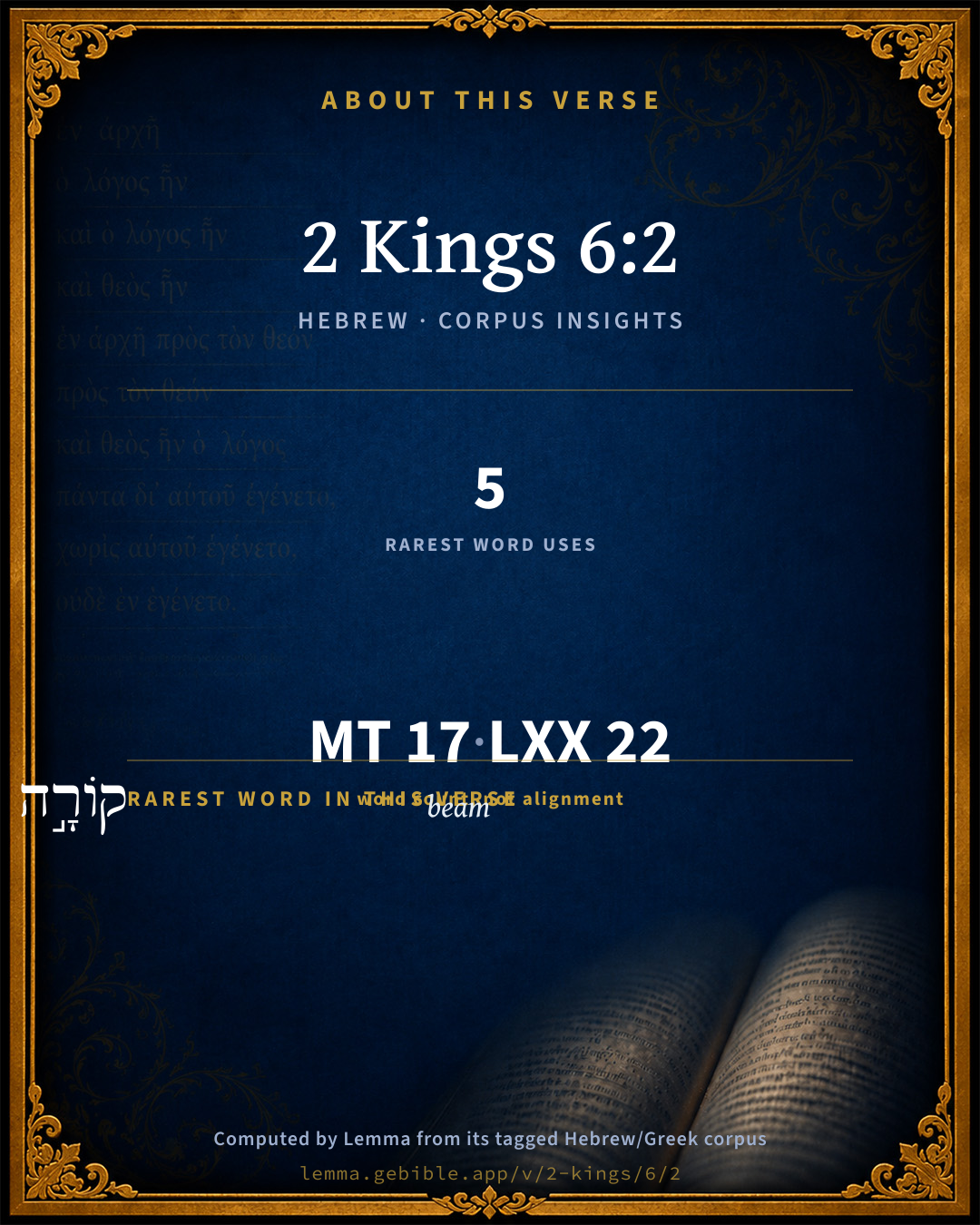
The rarest word here is קוֹרָ֣ה beam H6982 — appearing just 5 times in the whole Hebrew Bible.

Shared distinctive vocabulary

קוֹרָ֣ה beam H6982 occurs in 5 verses of the Hebrew Bible. Also found in:

Grammatical profile

  • 6 verbs
  • 4 nouns
  • 1 adjective
  • 2 prepositions
  • 3 adverbs
  • 1 particle

Verb forms

  • נֵֽלְכָה Qal · Cohortative
  • וְנִקְחָ֤ה Qal · Cohortative
  • וְנַעֲשֶׂה Qal · Cohortative
  • לָשֶׁ֣בֶת Qal · Infinitive Construct
  • וַיֹּ֖אמֶר Qal · Sequential Imperfect
  • לֵֽכוּ Qal · Imperative

Repetition

Words recur within this verse — often emphatic in Hebrew:

  • מִשָּׁם֙ there H8033 ×3
  • נֵֽלְכָה to walk H3212 ×2

Hebrew & Septuagint length

In English translation the verse runs 32 words from the Hebrew and 22 from the Septuagint (LXX English) — the Septuagint runs noticeably shorter here. See the side-by-side →

A rough comparison of the two English renderings, which tokenize alike — not a word-level alignment.

Word counts can differ between the Hebrew and the Greek without any difference in meaning — e.g. the Hebrew direct-object marker אֵת has no separate Greek word, and Greek often adds the article ὁ.

In the original languages it is 17 Hebrew tokens and 22 Greek tokens — but the two are counted differently (Hebrew bundles its prefixes and suffixes into one token; the Greek is in lemma form), so that isn’t a like-for-like length.

Cross-references

7

Topical passages linked to 2 Kings 6:2 in the Treasury of Scripture Knowledge — connected by theme and wording, ordered by reader-vote popularity; previews shown in the World English Bible.

  • John 21:3 Simon Peter said to them, "I'm going fishing." They told him, "We are also coming with you." They immediately went out, and entered into the boat. That night, they caught nothing.
  • Acts 18:3 and because he practiced the same trade, he lived with them and worked, for by trade they were tent makers.
  • Acts 20:34–35 You yourselves know that these hands ministered to my necessities, and to those who were with me.
  • 1 Corinthians 9:6 Or have only Barnabas and I no right to not work?
  • 1 Thessalonians 2:9 For you remember, brothers, our labor and travail; for working night and day, that we might not burden any of you, we preached to you the Gospel of God.
  • 2 Thessalonians 3:8 neither did we eat bread from anyone's hand without paying for it, but in labor and travail worked night and day, that we might not burden any of you;
  • 1 Timothy 6:6 But godliness with contentment is great gain.

Cross-references courtesy of OpenBible.info (CC BY 4.0).

Hebrew and Greek witnesses Masoretic Hebrew ↔ Greek Septuagint

The same verse in the two great witnesses to the Old Testament, shown verse-for-verse.

Here the Septuagint runs noticeably shorter than the Hebrew — LXX2012 (modern English Septuagint) 22 words vs World English Bible 32. A rough length comparison of the two English translations, not a word-level alignment — read both below.

These are two independent witnesses, not word-aligned to each other, and the Septuagint is shown in lemma (dictionary) form.

Hebrew 2 Kings 6:2 Masoretic · Westminster Leningrad Codex

נֵֽלְכָה נָּ֣א עַד הַיַּרְדֵּ֗ן וְנִקְחָ֤ה מִשָּׁם֙ אִ֚ישׁ קוֹרָ֣ה אֶחָ֔ת וְנַעֲשֶׂה לָּ֥נוּ שָׁ֛ם מָק֖וֹם לָשֶׁ֣בֶת שָׁ֑ם וַיֹּ֖אמֶר לֵֽכוּ

Let us go, we pray you, to the Jordan, and take there every man a beam, and let us make us a place there, where we may dwell. He answered, Go you.

World English Bible · Public Domain

Greek LXX 2 Kings 6:2 Septuagint · lemma form

πορεύομαι δή ἕως ὁ ἰορδάνης καί λαμβάνω ἐκεῖθεν ἀνήρ εἷς δοκός εἷς καί ποιέω ἑαυτοῦ ἐκεῖ ὁ οἰκέω ἐκεῖ καί εἶπον δεῦτε

Let us go, we pray you, to Jordan, and take thence every man a beam, and make for ourselves a habitation there.

LXX2012 (modern English Septuagint) · Public Domain

On this verse, Haydock's Catholic Bible Commentary discusses the Septuagint’s reading. Read the note in Commentary ↓

Hebrew: Westminster Leningrad Codex (CC BY 4.0). Greek: Septuagint (public domain); English from LXX2012 (modern English Septuagint) (Public Domain). How the Septuagint differs from the Hebrew →

Targum (Aramaic paraphrase)

1

The Targum is the ancient Jewish Aramaic paraphrase of the Hebrew Scriptures — an interpretive translation, not the Hebrew text itself. Onkelos (literal) and Pseudo-Jonathan (expansive) render the Torah, and Jonathan the Prophets. Coverage is partial: where no permissively-licensed English translation exists for a verse, only the Aramaic is shown. This is verse-level text, not a word-by-word alignment to the Hebrew.

  1. Targum Jonathan Prophets (Joshua–Malachi)
    נֵיזֵל כְּעַן עַד יַרְדְנָא וְנִסַב מִתַּמָן גְבַר כְּשׁוֹרָא חֲדָא וְנַעְבֵּיד לָנָא תַּמָן אַתְרָא לְמִתַב תַּמָן וַאֲמַר אֱזִילוּ:

    (no public-domain English translation for this verse)

    Targum Jonathan — Aramaic: “Mikraot Gedolot” (public domain). English: “Sefaria Community Translation” (CC0 1.0 (public-domain dedication)); “London "Chaldee Paraphrase," 1871” (public domain). Text via Sefaria.

Commentary

Notes on 2 Kings 6:2 from classic Christian and Jewish commentators (each source and its license shown beneath its notes). The classic Christian expositions comment on the surrounding passage and are grouped to its opening verse, so a note may address several verses; the Jewish commentaries on the Tanakh (Rashi and others) are per-verse, so they appear only where the commentator wrote on this verse.

Lemma curates 59 commentaries, every one of them public domain or Creative Commons licensed, each selected and text-cleaned for this edition rather than reprinted as found. About our sources →

Trapp's Complete Commentary

John Trapp

2Ki 6:2 Let us go, we pray thee, unto Jordan, and take thence every man a beam, and let us make us a place there, where we may dwell. And he answered, Go ye.

Ver. 2. Let us make us a place.] Though they were not worth their axes, yet they would be building: and here it is evident, saith an expositor, {a} that they affected neither pomp nor state, but were contented with a very homely dwelling, since themselves were to be the builders of it.

{a} Mr Jackson.

John Trapp, A Commentary or Exposition upon All the Books of the Old and New Testament (1647–1656) — public domain. Text from a community e-Sword module.

The Biblical Illustrator

Joseph S. Exell

2Ki_6:2

Take thence every man a beam.

Every man a beam

I. The sons of the prophets procured for themselves what they wanted. The college had become too small. There was not room enough for the increasing numbers who gathered to be instructed at the feet of Elisha. Now in their difficulty these young men might have reasoned something after this fashion. A college is for the good of the nation. The instruction we receive here is to be used by us hereafter in the religious service of the country. The country should, therefore, build us a larger and better house. They might have reasoned in this way and made an appeal to the religious public to help them. And so, instead of appealing to others, they resolved that as they wanted a larger building they would lay down their books, take up their axes, and go out and cut down the trees, building the place with their own hands. In this we have an illustration of an old maxim, that if you want anything done it is best to do it yourself. As regards the ordinary duties of life and the claims of business the preacher has little need to dwell upon this maxim. But we may be permitted to apply the maxim in the realm of church life and work. In every church there are men who are great talkers but little doers. They are ready enough to suggest improvements, to point out what others should do; but as to giving a helping hand themselves, nothing is further from their thoughts. Now I hold that no man has a right to suggest an improvement unless he is prepared to do his part in working it out. If every one who has a knowledge of music took an active part in the psalmody, and allowed his voice to be heard in the song of praise, how much better the worship would be. We are conscious of the need above all things of spiritual blessings, of conversions and spiritual revival in our churches. If every one so conscious would only express himself so in private and at the prayer-meeting, what hallowed prayer-meetings and what glorious revivals there would be among us! Some churches seem to live on the begging system.

II. Every man was prepared to do his share of the work. It was a serious matter even in these primitive times to build a house. The timber had to be felled and cut up into planks of convenient size. This called for the expenditure of strength and skill. By united effort and mutual assistance the arduous task was easily and quickly accomplished. And when there is unity among the members of a church, when every member is actuated by the same spirit of earnest desire for the prosperity of Gods cause, how powerful the church becomes, how manifold the organisations that gather around it, and how efficiently conducted. In a well-ordered church there should be a task for every member. All cannot carry the same beam. But every man should carry the load which his strength will allow, and render as much service as he is able. In ordinary churches a considerable sum of money is needed in the course of the year to carry on the ministry and maintain the schools and other societies. When every member conscientiously gives to the cause, not what others give, but what God enables him to give, there would never he crying out for lack of funds. If all who could teach would volunteer for the Sunday school, if all who could pray would show their faces at the prayer-meeting, it would be better for them and for our churches. (J. Menzies.)

Satisfaction of having done ones part of the work

Several years ago, when the great Cathedral of Cologne was finished, there was a great stir all over Europe. Four centuries had been occupied in the erection of this wonderful building, one of the most magnificent in all the world. People flocked from all directions to take part in the grand ceremonial of rejoicing. It was a large and brilliant and fashionable crowd. But right in the midst of the grandest people stood a humble workman, with torn clothing, a dilapidated hat, and shoes all out at the toes. As he stood there, with his eyes fairly glowing as they took in all the noble proportions of the buildings, he was heard to exclaim: Oh! yes, indeed, we have made a glorious building of it! Why, said a gentleman, who overheard the remark, what did you have to do with it? The workman turned to answer him, with his eyes still glowing. I mixed the mortar for a year, was the proud reply. That is it. We cannot all be builders. Sometimes we may not be able to place even one brick upon the structure. But we can each and every one help to mix the mortar for others to use, for certain it is that if the mortar be not mixed, the building itself cannot be built.

Purposeful activity

Everything depends on the spirit with which we work the labour of many people amounts to nothing because it means nothing to them. There is no definite grip of purpose in what they do. I saw a little boy take up a rake in a New Hampshire hayfield in July, and he went raking about, imitating the men, except that the teeth of the rake were turned up. The raking was easier that way, but he gathered no hay. I know some preachers and Sunday school teachers and Christian workers who do all their raking that way. They rake a great deal and go through lots of motions, but they rake with the teeth up, and never gather any hay. Good results are only obtained by people who set the teeth of their purpose deep into what they are doing and rake for results; such people bring things to pass. (L. A. Banks, D. D.)

The Biblical Illustrator, edited by Joseph S. Exell (c. 1880s–1900s) — public domain. Text from a community e-Sword module.

Geneva Bible (1599)

Geneva Bible translators

Or a piece of wood fit to build with.

Geneva Bible (1599) marginal notes — public domain. Text via Bolls.life.

Jamieson, Fausset & Brown

Robert Jamieson, A. R. Fausset & David Brown

Let us go, we pray thee, unto Jordan--whose wooded banks would furnish plenty of timber.

Jamieson, Fausset & Brown — Commentary Critical and Explanatory on the Whole Bible (1871) — public domain (CC PDM 1.0). Text via the HelloAO Bible API.

Adam Clarke's Commentary

Verse 2. Every man a beam] They made a sort of log-houses with their own hands.

Adam Clarke's Commentary on the Bible (1810–1826) — public domain. Text from a community e-Sword/MySword module.

Ellicott's Commentary for English Readers

(2) Take thence every man a beam.—The Jordan valley was well wooded. Its present bed is still “overarched by oleanders, acacias, thorns, and similar shrubbery.” If all were to take part in felling the trees, the work would soon be done.

Where we may dwell.—Literally, to sit (or, dwell) there. The reference seems still to be to sitting in the hall of instruction.

A Bible Commentary for English Readers, edited by Charles John Ellicott (1878–1897) — public domain. Text from a community e-Sword module.

The Cambridge Bible for Schools and Colleges

gen. ed. J. J. S. Perowne

2. take thence every man a beam] The Jordan valley was well timbered. We see from this, as from previous passages, that these men did for themselves such work as they required. Here they are ready to be their own carpenters. Naturally such a body would neither wish for, nor be able to erect, anything but a building of the simplest sort.

make us a place there] They propose to provide entirely new quarters in a new spot in the valley of the Jordan.

The Cambridge Bible for Schools and Colleges (gen. ed. J. J. S. Perowne; Cambridge University Press, 1878–1918) — public domain. Text from a community e-Sword module.

John Gill's Exposition

Let us go, we pray thee, unto Jordan,.... Which, according to Josephus (a), was fifty furlongs, or upwards of six miles, distant from Gilgal:

and take thence every man a beam; by cutting down the trees that grew there; for Mr. Maundrell says (b), the banks of Jordan are beset with bushes and trees, which are an harbour for wild beasts; and another traveller (c) observes, that it is shadowed on both sides with poplars, alders, &c. and who speaks of their cutting down boughs from the trees when there:

and let us make us a place there where we may dwell: near the banks of Jordan, which they might choose for the seclusion and pleasantness of the situation, or because Elijah was taken up to heaven near it, as Abarbinel thinks; from whence it appears that these scholars were far from living an idle life; for they were not only trained up in useful learning, but were employed in trades and manufactures, to which they had been brought up, and knew how to fell timber, and build houses:

and he answered, go ye; he gave them leave, without which they did not choose to do anything.

(a) Antiqu. l. 5. c. 1. sect. 4. (b) Journey from Aleppo, &c. p. 82, 83. (c) Sandys's Travels, l. 3. p. 110.

John Gill's Exposition of the Whole Bible (1746–1763) — public domain (CC PDM 1.0). Text via the HelloAO Bible API.

Albert Barnes' Notes on the Bible

Take every man a beam - Trees were rare in most parts of Palestine, but plentiful in the Jordan Valley. Jericho was known in early times as “the city of palms” Deu 34:3; Jdg 1:16.

Albert Barnes' Notes on the Bible (1834–1885) — public domain. Text from a community e-Sword/MySword module.

Haydock's Catholic Bible Commentary

Timber. Hebrew and Septuagint, "a beam." Salien supposes that these prophets resided at Galgal. (Menochius)

George Leo Haydock (1774–1849), Haydock's Catholic Family Bible and Commentary, 1859 edition — public domain. Excludes Psalms (Douay-Rheims chapter numbering differs from Protestant) and Deuterocanonical books (Catholic canon only).

Matthew Poole's English Annotations

Unto Jordan, i.e. to the woods near Jordan, which were near to them. See Poole "2Ki 6:1".

A beam, i.e. a piece of timber for the building. Hence it may be gathered, that although the sons of the prophets principally devoted themselves to religious exercises, such as prayer, and praising of God, and the studying of God’s word, and instructing of others, and waiting for Divine revelations; yet they did sometimes employ themselves about manual arts; which now they might be forced to, through the iniquity of the times.

Matthew Poole's English Annotations on the Holy Bible (1683–1685) — public domain. Text from a community e-Sword/MySword module.

The Pulpit Commentary

Let us go, we pray thee, unto Jordan. Jericho was situated at some little distance from the Jordan, on the banks of a small stream, which ran into it. Along the course of the Jordan trees and shrubs were abundant, chiefly willows, poplars, and tamarisks (see Josephus, "Bell. Jud:," 4:8. Strabo, 16:2. It would seem that the Jordan thickets were unappropriated, and that any one might cut timber in them. And take thence every man a beam. The meaning is, "Let us all join in the work, each cutting beams and carrying them; and the work will soon be accomplished." And let us make us a place there. They propose to build the new dwelling on the banks of Jordan, to save the trouble of conveying the materials any long distance. Where we may dwell. And he answered, Go ye. Elisha, i.e. , approved the proposal, gave it his sanction and encouragement.

The Pulpit Commentary (1880–1919), ed. H.D.M. Spence-Jones & Joseph S. Exell — public domain. Text from a community e-Sword module.

John Wesley's Explanatory Notes

Jordan - To the woods near Jordan. A beam - A piece of timber for the building. Hence it may be gathered, that although the sons of the prophets principally devoted themselves to religious exercises, yet they sometimes employed themselves about manual arts.

John Wesley, Explanatory Notes Upon the Whole Bible (1754–1765) — public domain. Text via the GEBible commentary corpus.

Lesson kit

Teaching starters — assembled from the data on this page, not authored interpretation. Every prompt links to the verse data it draws on. Edit before teaching.

2 Kings, in the Historical, opens this verse with 17 words (13 distinct Hebrew lemmas). Its most distinctive word is qôwrâh (“beam”). The Greek Septuagint runs shorter here. A historical commentator’s framing appears above. Read the whole chapter for the surrounding context.

Discussion questions

  1. The word qôwrâh carries the sense “beam.” How does it shape the verse?
  2. Genesis 19:8 shares the word «beam» with this verse. How do the two illuminate each other?
  3. “there” occurs 3× in this one verse. What is the effect of the repetition?
  4. Compared with the Hebrew, the Septuagint runs shorter here. What questions does that raise?
  5. These translations render this verse differently; the difference is in the English rendering, not the original. What questions does that raise?
  6. The verb «נֵֽלְכָה» is Qal Cohortative. How does its form color the action?
  7. Reading how Trapp's Complete Commentary and The Biblical Illustrator read this verse, where do the two commentators agree and where do they part?

Things to notice

Reading settings

Reading text

Shown beneath each verse's original-language words.

Old Testament
Old Testament edition

Read the OT as the Masoretic Hebrew (MT) or the Greek Septuagint (LXX).

English shown for the Greek Septuagint (in the Hebrew ↔ Greek comparison).

Comparing translations? Open the Compare panel on any verse page to stack up to four side by side.