2 Kings 23:7

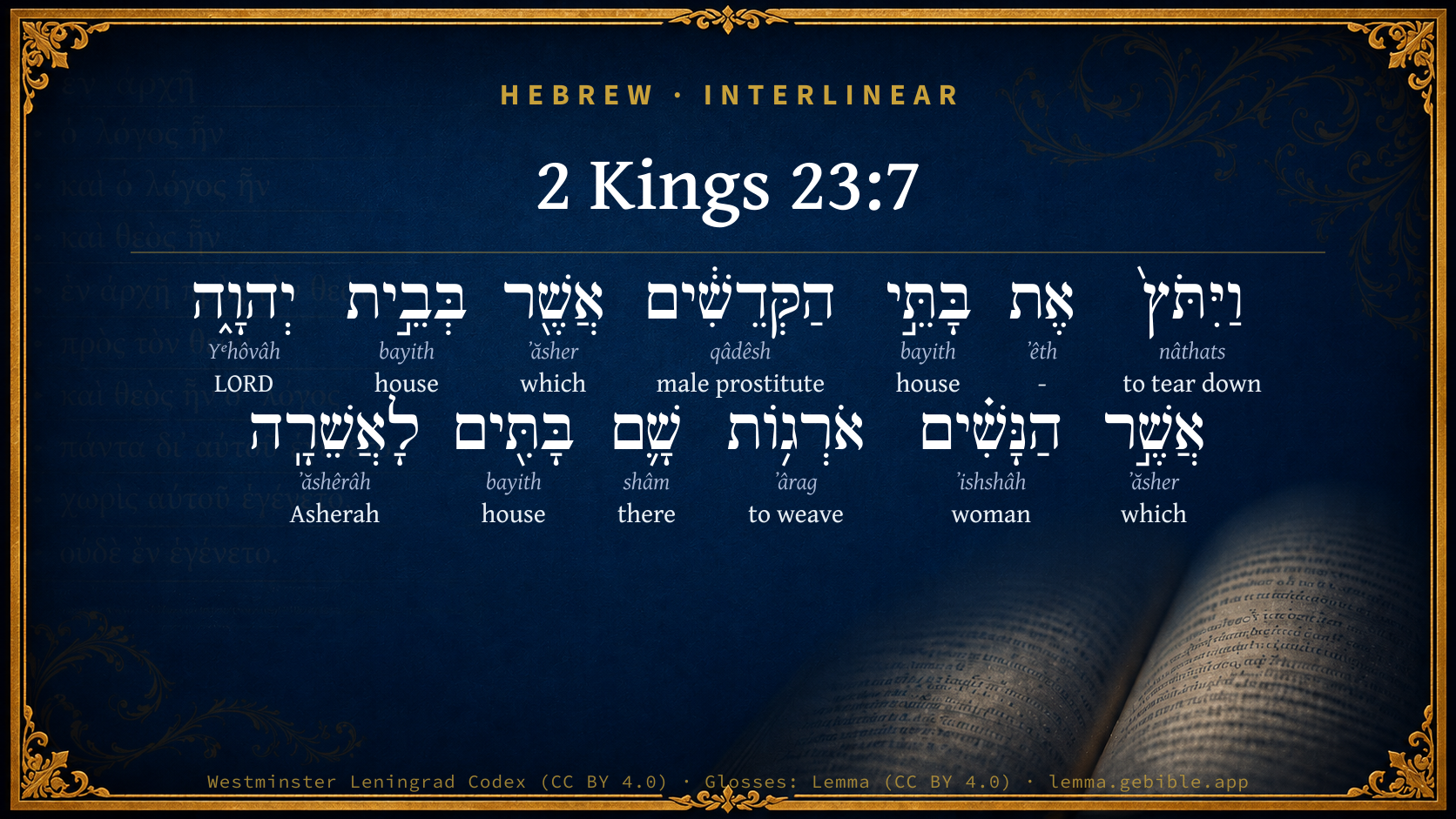
Hebrew (Westminster Leningrad Codex) 2 Kings 23:7 appears in the Hebrew Old Testament. The text above is from the Westminster Leningrad Codex. Each word links to its Strong’s number, a concise gloss, and parsing drawn from the Open Scriptures Hebrew Bible morphology. Click any word for its full Brown-Driver-Briggs (BDB) entry.
Download image
Cite this verse

2 Kings 23:7 (World English Bible). Public Domain. Lemma interlinear Bible study tool, https://lemma.gebible.app/v/2-kings/23/7.

Show BibTeX & RIS
BibTeX
RIS
English Translation
He broke down the houses of the sodomites, that were in the house of Yahweh, where the women wove hangings for the Asherah.
World English Bible · Public Domain
Download a study sheet

One document with this verse’s original text, its word-by-word gloss line, the meaning frame, cross-references with their text, attributed commentary, and full source and license credits — printable, and it pastes into notes with its structure intact.

This verse Autodidact and up

Study sheet (.html) Plain text (.txt)

A passage Seminary Student

Up to 50 verses in one chapter. A passage sheet keeps up to 6 commentary sources and 12 cross-references per verse, in the order this page ranks them, and says so on the sheet whenever that leaves anything out. Ask for a single verse and you get the Autodidact verse sheet above.

Everything on this page stays free to read, with no account — the sheet is a download of what is already on screen, not access to it.

Want to remove ads? Support Godless Engineer
Compare translations 3

The same verse in 3 English versions, stacked beneath the original-language interlinear above. Click any original word for its lexicon entry.

Each is an independent rendering of the whole verse — the interlinear is not word-aligned to these translations.

Highlighted words mark where these versions differ — a whole-verse word diff, not a word-by-word alignment.

  • World English Bible Public Domain
    He broke down the houses of the sodomites, that were in the house of Yahweh, where the women wove hangings for the Asherah.
  • King James Version Public Domain
    And he brake down the houses of the sodomites, that were by the house of the LORD, where the women wove hangings for the grove.
  • unfoldingWord Literal Text CC BY-SA 4.0
    And he tore down the houses of the cultic prostitutes that by the house of Yahweh, where women were weaving houses there for Asherah.

unfoldingWord Literal Text — © unfoldingWord, licensed CC BY-SA 4.0. Word-aligned USFM3 via Door43 (git.door43.org/unfoldingWord/en_ult).

Versions to compare (up to 4)

3 of 4 selected

Show all 18 translations

Every available English version of this verse, each an independent rendering of the whole verse.

  • World English Bible Public Domain
    He broke down the houses of the sodomites, that were in the house of Yahweh, where the women wove hangings for the Asherah.
  • Berean Standard Bible Public Domain
    He also tore down the quarters of the male shrine prostitutes that were in the house of the LORD, where the women had woven tapestries for Asherah.
  • Majority Standard Bible Public Domain
    He also tore down the quarters of the male shrine prostitutes that were in the house of the LORD, where the women had woven tapestries for Asherah.
  • King James Version Public Domain
    And he brake down the houses of the sodomites, that were by the house of the LORD, where the women wove hangings for the grove.
  • American Standard Version (1901) Public Domain
    And he brake down the houses of the sodomites, that were in the house of Jehovah, where the women wove hangings for the Asherah.
  • Revised Version (1885) Public Domain
    And he brake down the houses of the sodomites, that were in the house of the LORD, where the women wove hangings for the Asherah.
  • Geneva Bible (1599) Public Domain
    And hee brake downe the houses of the Sodomites, that were in the house of the Lord, where the women woue hangings for the groue.
  • Douay-Rheims (1899) Public Domain
    He destroyed also the pavilions of the effeminate, which were in the house of the Lord, for which the women wove as it were little dwellings for the grove.
  • Young's Literal Translation Public Domain
    And he breaketh down the houses of the whoremongers that `are' in the house of Jehovah, where the women are weaving houses for the shrine.
  • Literal Standard Version CC BY-SA 4.0
    And he breaks down the houses of the whoremongers that [are] in the house of YHWH, where the women are weaving houses for the Asherah.
  • Unlocked Literal Bible CC BY-SA 4.0
    He cleared out the rooms of the cultic prostitutes who were in the temple of Yahweh, where the women wove garments for Asherah.
  • unfoldingWord Literal Text CC BY-SA 4.0
    And he tore down the houses of the cultic prostitutes that by the house of Yahweh, where women were weaving houses there for Asherah.
  • Darby Bible Public Domain
    And he broke down the houses of the sodomites, which were in the house of Jehovah, where the women wove tents for the Asherah.
  • World Messianic Bible Public Domain
    He broke down the houses of the male shrine prostitutes that were in the LORD’s house, where the women wove hangings for the Asherah.
  • Webster's Bible Public Domain
    And he broke down the houses of the sodomites that were by the house of the LORD, where the women wove hangings for the grove.
  • Free Bible Version CC BY-SA 4.0
    He also demolished the quarters of the cult prostitutes that were in the Lord's Temple, where the women used to weave tapestries for the Asherah pole.
  • Bible in Basic English Public Domain
    And he had the houses pulled down of those who were used for sex purposes in the house of the Lord, where women were making robes for the Asherah.
  • JPS Tanakh (1917) Public Domain
    And he broke down the houses of the sodomites, that were in the house of the LORD, where the women wove coverings for the Asherah.

Literal Standard Version (2020), Covenant Press — licensed CC BY-SA 4.0. Text via the HelloAO Bible API (eBible.org). Unlocked Literal Bible (unfoldingWord) — licensed CC BY-SA 4.0. Text via the HelloAO Bible API (eBible.org). unfoldingWord Literal Text — © unfoldingWord, licensed CC BY-SA 4.0. Word-aligned USFM3 via Door43 (git.door43.org/unfoldingWord/en_ult). Free Bible Version, Dr. Jonathan Gallagher — licensed CC BY-SA 4.0. Text via the HelloAO Bible API (eBible.org).

Word by word

More ways to search: Search by grammar → Find every occurrence → Compare this word →

Practice this passage: Drill this verse → Learn its vocabulary →

הַקְּדֵשִׁ֔ים
qâdêsh
H6945
“the · male prostitute”
Particle, Definite Article + Adjective, Adjective, Masculine, Plural, Absolute
Part of Speech
Particle + Adjective
Type
Adjective
Gender
Masculine
Number
Plural
State
Absolute
Full BDB Definition

Origin: from H6942

TWOT: 1990c

male temple prostitute
  1. וַיִּתֹּץ֙ nâthats H5422 “and · to tear down” Conjunction + Verb, Qal, Sequential Imperfect, 3rd Person, Masculine, Singular
  2. אֶת ʼêth H853 “-” Particle, Direct Object
  3. בָּתֵּ֣י bayith H1004 “houses of” Noun, Common, Masculine, Plural, Construct
  4. אֲשֶׁ֖ר ʼăsher H834 “which” Particle, Relative
  5. בְּבֵ֣ית bayith H1004 “in/at · house of” Preposition + Noun, Common, Masculine, Singular, Construct
  6. יְהוָ֑ה Yᵉhôvâh H3068 “LORD” Noun, Proper
  7. אֲשֶׁ֣ר ʼăsher H834 “which” Particle, Relative
  8. הַנָּשִׁ֗ים ʼishshâh H802 “the · women” Particle, Definite Article + Noun, Common, Feminine, Plural, Absolute
  9. אֹרְג֥וֹת ʼârag H707 “weaving” Verb, Qal, Participle Active, Feminine, Plural, Absolute
  10. שָׁ֛ם shâm H8033 “there” Adverb
  11. בָּתִּ֖ים bayith H1004 “houses” Noun, Common, Masculine, Plural, Absolute
  12. לָאֲשֵׁרָֽה ʼăshêrâh H842 “to/for the · Asherah” Preposition, Determined + Noun, Proper

About this verse

These counts appear in no published source. They are computed here, from the morphology-tagged text and Lemma’s own curated glosses. What Lemma adds →

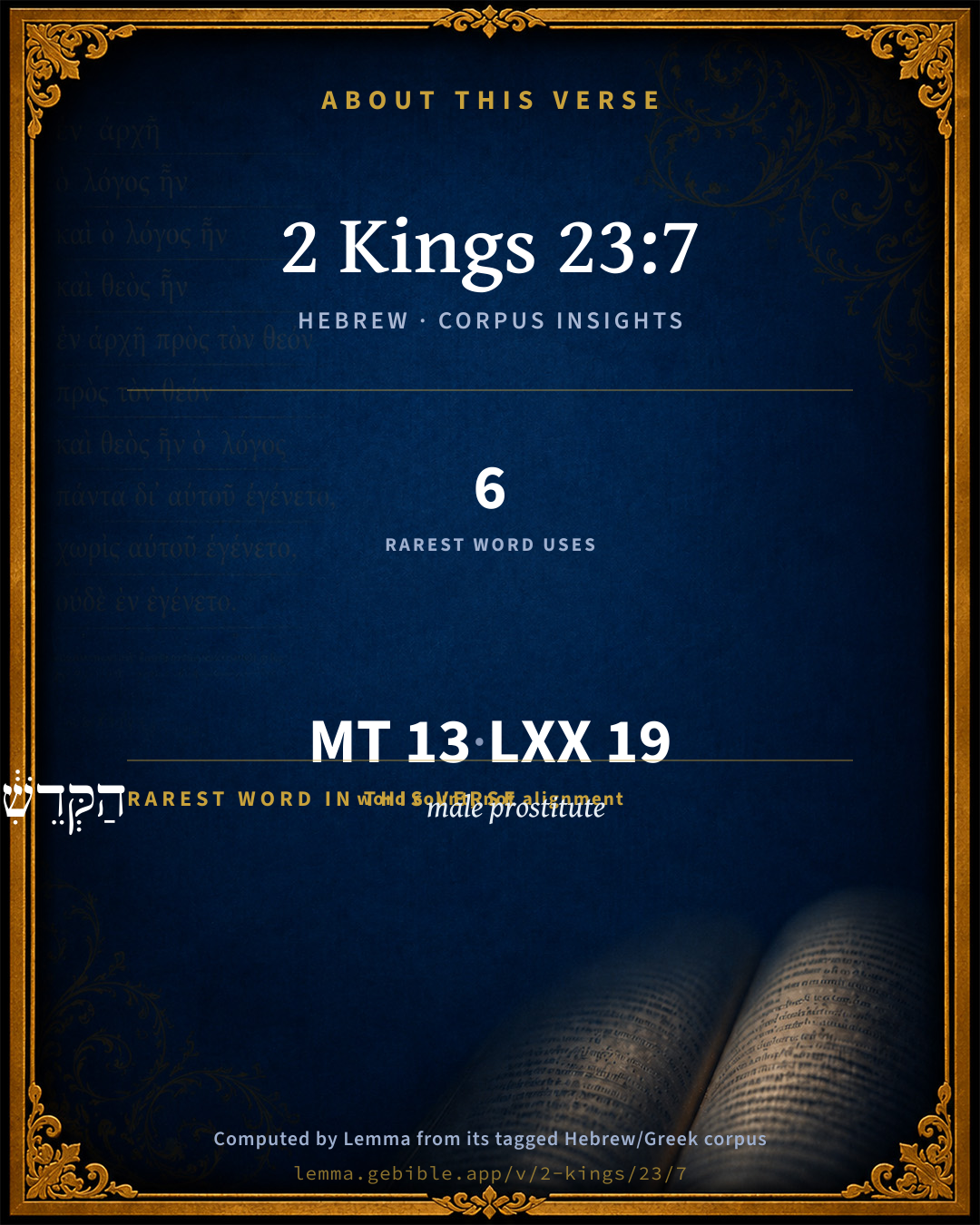
13
words
10
distinct lemmas
Historical
section

Notable vocabulary

The rarest word here is הַקְּדֵשִׁ֔ים male prostitute H6945 — appearing just 6 times in the whole Hebrew Bible.

Shared distinctive vocabulary

הַקְּדֵשִׁ֔ים male prostitute H6945 occurs in 6 verses of the Hebrew Bible. Also found in:

Grammatical profile

  • 2 verbs
  • 6 nouns
  • 1 adjective
  • 1 adverb
  • 3 particles

Verb forms

  • וַיִּתֹּץ֙ Qal · Sequential Imperfect
  • אֹרְג֥וֹת Qal · Participle Active

Repetition

Words recur within this verse — often emphatic in Hebrew:

  • בָּתֵּ֣י house H1004 ×3
  • אֲשֶׁ֖ר which H834 ×2

Hebrew & Septuagint length

In English translation the verse runs 23 words from the Hebrew and 25 from the Septuagint (LXX English) — closely comparable.

A rough comparison of the two English renderings, which tokenize alike — not a word-level alignment.

Word counts can differ between the Hebrew and the Greek without any difference in meaning — e.g. the Hebrew direct-object marker אֵת has no separate Greek word, and Greek often adds the article ὁ.

In the original languages it is 13 Hebrew tokens and 19 Greek tokens — but the two are counted differently (Hebrew bundles its prefixes and suffixes into one token; the Greek is in lemma form), so that isn’t a like-for-like length.

Cross-references

10

Topical passages linked to 2 Kings 23:7 in the Treasury of Scripture Knowledge — connected by theme and wording, ordered by reader-vote popularity; previews shown in the World English Bible.

  • 1 Kings 15:12 He put away the sodomites out of the land, and removed all the idols that his fathers had made.
  • Ezekiel 16:16 You took of your garments, and made for yourselves high places decked with various colors, and played the prostitute on them: [the like things] shall not come, neither shall it be [so].
  • 1 Kings 14:24 and there were also sodomites in the land: they did according to all the abominations of the nations which Yahweh drove out before the children of Israel.
  • Exodus 35:25–26 All the women who were wise-hearted spun with their hands, and brought that which they had spun, the blue, the purple, the scarlet, and the fine linen.
  • Genesis 19:4–5 But before they lay down, the men of the city, the men of Sodom, surrounded the house, both young and old, all the people from every quarter.
  • 1 Kings 22:46 The remnant of the sodomites, that remained in the days of his father Asa, he put away out of the land.
  • 2 Chronicles 34:33 Josiah took away all the abominations out of all the countries that pertained to the children of Israel, and made all who were found in Israel to serve, even to serve Yahweh their God. All his days they didn't depart from following Yahweh, the God of their fathers.
  • Ezekiel 8:14 Then he brought me to the door of the gate of Yahweh's house which was toward the north; and see, there sat the women weeping for Tammuz.
  • Hosea 2:13 I will visit on her the days of the Baals, To which she burned incense, When she decked herself with her earrings and her jewels, And went after her lovers, And forgot me," says Yahweh.
  • Romans 1:26–27 For this reason, God gave them up to vile passions. For their women changed the natural function into that which is against nature.

Cross-references courtesy of OpenBible.info (CC BY 4.0).

Hebrew and Greek witnesses Masoretic Hebrew ↔ Greek Septuagint

The same verse in the two great witnesses to the Old Testament, shown verse-for-verse.

These are two independent witnesses, not word-aligned to each other, and the Septuagint is shown in lemma (dictionary) form.

Hebrew 2 Kings 23:7 Masoretic · Westminster Leningrad Codex

וַיִּתֹּץ֙ אֶת בָּתֵּ֣י הַקְּדֵשִׁ֔ים אֲשֶׁ֖ר בְּבֵ֣ית יְהוָ֑ה אֲשֶׁ֣ר הַנָּשִׁ֗ים אֹרְג֥וֹת שָׁ֛ם בָּתִּ֖ים לָאֲשֵׁרָֽה

He broke down the houses of the sodomites, that were in the house of Yahweh, where the women wove hangings for the Asherah.

World English Bible · Public Domain

Greek LXX 2 Kings 23:7 Septuagint · lemma form

καί κατααἱρέω ὁ οἶκος ὁ καδησιμ ὁ ἐν ὁ οἶκος κύριος ὅς ὁ γυνή ὑφαίνω ἐκεῖ χεττιιν ὁ ἄλσος

And he pulled down the house of the sodomites that were by the house of the Lord, where the women wove tents for the grove.

LXX2012 (modern English Septuagint) · Public Domain

On this verse, Haydock's Catholic Bible Commentary discusses the Septuagint’s reading. Read the note in Commentary ↓

Hebrew: Westminster Leningrad Codex (CC BY 4.0). Greek: Septuagint (public domain); English from LXX2012 (modern English Septuagint) (Public Domain). How the Septuagint differs from the Hebrew →

Targum (Aramaic paraphrase)

1

The Targum is the ancient Jewish Aramaic paraphrase of the Hebrew Scriptures — an interpretive translation, not the Hebrew text itself. Onkelos (literal) and Pseudo-Jonathan (expansive) render the Torah, and Jonathan the Prophets. Coverage is partial: where no permissively-licensed English translation exists for a verse, only the Aramaic is shown. This is verse-level text, not a word-by-word alignment to the Hebrew.

  1. Targum Jonathan Prophets (Joshua–Malachi)
    וְתָרַע יַת בָּתֵּי הֶקְדֵשׁ טַעֲוָתָא דִי בְבֵית מַקְדְשָׁא דַייָ דִי נְשַׁיָא מָחֲיָן תַּמָן מְכוֹלִין לַאֲשֵׁירָתָא:

    (no public-domain English translation for this verse)

    Targum Jonathan — Aramaic: “Mikraot Gedolot” (public domain). English: “Sefaria Community Translation” (CC0 1.0 (public-domain dedication)); “London "Chaldee Paraphrase," 1871” (public domain). Text via Sefaria.

Commentary

Notes on 2 Kings 23:7 from classic Christian and Jewish commentators (each source and its license shown beneath its notes). The classic Christian expositions comment on the surrounding passage and are grouped to its opening verse, so a note may address several verses; the Jewish commentaries on the Tanakh (Rashi and others) are per-verse, so they appear only where the commentator wrote on this verse.

Lemma curates 59 commentaries, every one of them public domain or Creative Commons licensed, each selected and text-cleaned for this edition rather than reprinted as found. About our sources →

Trapp's Complete Commentary

John Trapp

2Ki 23:7 And he brake down the houses of the sodomites, that [were] by the house of the LORD, where the women wove hangings for the grove.

Ver. 7. The houses of the sodomites.] Abominable brothel houses.

Where the women wove hangings.] Heb., Houses, aedicula, sacella textilia, as Act 19:24. There were at Ephesus that made templa portabilia, small portable temples, resembling that greater temple.

John Trapp, A Commentary or Exposition upon All the Books of the Old and New Testament (1647–1656) — public domain. Text from a community e-Sword module.

Joseph Benson's Commentary

2Ki 23:7. He brake down the houses of the sodomites — The name sometimes given to the most infamous of all prostitutes, who exposed their bodies to be abused contrary to nature, in honour of those filthy deities whom they worshipped. Their houses were near the temple, and the persons themselves were dedicated to impurity, and, that they might commit their abominations with the greater licentiousness, they had women appointed to make them tents, wherein they were wont to retire upon these detestable occasions. — Calmet. Thus corporal and spiritual whoredoms went together, and the vile affections to which they were given up were the punishment of their vain imaginations. They that dishonoured their God were justly left thus to dishonour themselves. Where the women wove hangings for the grove — For the idols worshipped in the grove, or rather for Asherah, or Ashtaroth, an idol so called, as observed before, and probably the same with the Grecian Venus. These hangings might possibly be curtains to draw before the idol, to preserve it from defilement, or to gain more reverence to it: or garments for it, or for the priests or priestesses belonging to it. But the Hebrew word בתים, bathim, here used, properly means houses; which, most likely, were either little chapels or shrines made of woven work, like those mentioned Act 19:24, which were made of silver, within which were representations of the idol; or they were tents, encompassing the image, where the worshippers committed all manner of lewdness, and that in or near the house of the Lord, in an impudent defiance of the holiness of God and his temple. Well might the apostle call these kinds of worship abominable idolatries! Can any wonder that wrath, not to be quenched, was kindled against this city and people?

Joseph Benson's Commentary on the Old and New Testaments (1811–1818) — public domain. Text from a community e-Sword module.

Jamieson, Fausset & Brown

Robert Jamieson, A. R. Fausset & David Brown

brake down the houses of the sodomites--not solid houses, but tents, called elsewhere [Kg2 17:30] Succoth-benoth, "the booths of the young women," who were devoted to the service of Asherah, for which they made embroidered hangings, and in which they gave themselves to unbridled revelry and lust. Or the hangings might be for Asherah itself, as it is a popular superstition in the East to hang pieces of cloth on trees.

Jamieson, Fausset & Brown — Commentary Critical and Explanatory on the Whole Bible (1871) — public domain (CC PDM 1.0). Text via the HelloAO Bible API.

Adam Clarke's Commentary

Verse 7. The houses of the sodomites] We have already often met with these קדשים kedeshim or consecrated persons. The word implies all kinds of prostitutes, as well as abusers of themselves with mankind.

Wove hangings for the grove.] For Asherah; curtains or tent coverings for the places where the rites of the impure goddess were performed. 2Kg 21:26.

Adam Clarke's Commentary on the Bible (1810–1826) — public domain. Text from a community e-Sword/MySword module.

Ellicott's Commentary for English Readers

(7) The houses . . . by the house.—The cabins of the Kedçshim . . . in the house. The Kedçshim were males, perhaps eunuchs, who prostituted themselves like women in honour of the Asherah. (See 1Ki_14:24; 1Ki_15:12; Hos_4:14.) The passage shows that the last infamy of Canaanite nature-worship had been established in the very sanctuary of Jehovah. The revolt of Judah could go no farther.

Where the women wove hangings for the grove.—Wherein the women used to weave tents for the Ashçrah. The word we have rendered cabins and tents is bâttîm, “houses.” What is meant in the latter case is not clear. Perhaps the female harlots attached to the Temple wove portable tabernacles or sanctuaries of the goddess for sale to the worshippers; or tents (screens) for their own foul rites may be meant.

A Bible Commentary for English Readers, edited by Charles John Ellicott (1878–1897) — public domain. Text from a community e-Sword module.

The Cambridge Bible for Schools and Colleges

gen. ed. J. J. S. Perowne

7. And he brake down] On like reforms cf. 1Ki_15:12; 1Ki_22:46.

by [R.V. in] the house of the Lord] The text says that these abominations were in the temple. There is no reason why the English should not represent it plainly.

the women wove hangings for the grove] R.V. the Asherah. It seems that at some of the shrines dedicated to the false gods, instead of more permanent erections, tents were put up, and it was for these that the women were employed in weaving curtains. The Hebrew word rendered ‘hangings’ is the same which is used in other passages for ‘houses’ of the high places. The Jewish tradition explains it by ‘curtains’. Some have thought that the ‘tabernacles’ alluded to in Amo_5:26 were of this character, tent-like erections which could be moved when not in use. Another allusion to such curtained structures for idolatrous worship is found in Eze_16:16. ‘Of thy garments thou didst take and deckedst thy high places with divers colours’.

The Cambridge Bible for Schools and Colleges (gen. ed. J. J. S. Perowne; Cambridge University Press, 1878–1918) — public domain. Text from a community e-Sword module.

John Gill's Exposition

And he brought all the priests out of the cities of Judah,.... Who were of the sons of Aaron, and had served in the high places there:

and defiled the high places where the priests had burnt incense; by casting dead carcasses, or the bones of dead men, or dung, or anything that was unclean, into them, by way of contempt:

from Geba to Beersheba; which were the northern and southern boundaries of the land of Judah:

and brake down the high places of the gates: of the cities where some think tutelar gods were placed to be worshipped by persons as they went in or out of them: and particularly that

which were in the entering in of the gate of Joshua the governor of the city, which were on a man's left hand at the gate of the city; of the city of Jerusalem, where this Joshua was chief magistrate under the king; at whose door stood an high place, which, Kimchi thinks, might he greater than the rest, and therefore mentioned alone, yet was not spared on account of its greatness, or of the person to whom it belonged.

John Gill's Exposition of the Whole Bible (1746–1763) — public domain (CC PDM 1.0). Text via the HelloAO Bible API.

Haydock's Catholic Bible Commentary

Effeminate. Hebrew, "consecrated" (Calmet) or "initiated" (Montanus) in the obscene mysteries of idols. See Deuteronomy xxiii. 18., and 3 Kings xv. 12., and 2 Machabees vi. 4. These men prostituted themselves (Menochius) even in that sacred place. (Calmet) --- Protestants, "he broke down the houses of the Sodomites, that were by the house of the Lord, where the women wove hangings for the grove." These hangings, tents, or dwellings, (Haydock) were destined for the idol; (Syriac, &c.) or they were intended to hid the abominations which were committed. They were called "tents of the daughters," chap. xvii. 30. (Calmet) --- For. Literally, "of the grove:" luci. But the other translation is conformable to the Septuagint. (Vatable, &c.) (Haydock)

George Leo Haydock (1774–1849), Haydock's Catholic Family Bible and Commentary, 1859 edition — public domain. Excludes Psalms (Douay-Rheims chapter numbering differs from Protestant) and Deuterocanonical books (Catholic canon only).

Matthew Poole's English Annotations

The houses of the sodomites; wherein some males prostituted their bodies to the lusts of others; which abominable practice was both a punishment of idolatry, Rom 1:23,24,27, and a part of idol worship, this being done to the honour of some of their idols, and by the appointment and instigation of those impure and diabolical spirits which were worshipped in their idols. See 1Ki 14:24; 15:12; 22:46.

Hangings, or curtains, either to draw before the idol or idols which were worshipped in the grove, to preserve them from defilement, or to gain more reverence for them; or which were set up in the grove, that the abominable filthiness last mentioned might be committed within them. Or, garments for the service of the grove, for the idols or the priests belonging to them. Heb. houses, i.e. either little chapels made of woven work, like those which were made of silver, Act 19:24; within which there were some representations of their grove idols; or rather, tents made of those curtains for the use above mentioned.

For the grove, or, for Asherah, an idol so called, as was noted before.

Matthew Poole's English Annotations on the Holy Bible (1683–1685) — public domain. Text from a community e-Sword/MySword module.

Whedon's Commentary on the Bible

Daniel D. Whedon

7. Sodomites — See note on 1Ki_14:24. These abominable prostitutes had grown so bold as to build their houses, or tents, by the house of the Lord, striking evidence of the fearful extent to which the nation had become corrupted.

The women — The female prostitutes, who were devoted to the lewd rites of Ashtoreth.

Wove hangings — Rather, wove little tents, or houses for Asherah. Keil calls them “tent-temples,” and quotes Movers, who conjectures “that the women of Jerusalem gave themselves up, in honour of the goddess, in the tents of the sodomites which were pitched in the temple circle, on which account the money received for prostitution went to the temple treasury.”

Daniel D. Whedon (gen. ed.), Commentary on the Old and New Testaments (1874–1909) — public domain. Text from a community e-Sword module.

The Pulpit Commentary

And he brake down the houses of the sodomites; literally, of the consecrated ones. (See the comment on 1Ki_14:24; and note that the male prostitutes, or Galli, who consecrated themselves to the Des Syra, formed an essential element in the Astarte-worship, and accompanied it wherever it was introduced.) Dollinger says ("Jew and Gentile," vol. 1. pp. 430, 431) of these wretched persons, "To the exciting din of drums, flutes, and inspired songs, the Galli cut themselves on the arms; and the effect of this act, and of the music accompanying it, was so strong upon mere spectators, that all their bodily and mental powers were thrown into a tumult of excitement, and they too, seized by the desire to lacerate themselves, deprived themselves of their manhood by means of potsherds lying ready for the purpose. Thereupon they ran with the mutilated part through the city, and received from the houses which they threw them into, a woman"s gear. Not chastity, but barrenness, was intended by the mutilation. In this the Galli only desired to be like their goddess. The relation of foul lust, which they thenceforward occupied towards women, was regarded as a holy thing, and was tolerated by husbands in their wives." That were by the house of the Lord. The near vicinity is an indication that the Galli took part in the foreign rites introduced into the temple by Manasseh and Amon. The awful profanation of the house of God by such orgies is too terrible to dwell on. Where the women wove hangings for the grove. "The women" are no doubt the priestesses of the Dea Syra, who are constantly mentioned with the Galli, and, indeed, lived with them. They employed themselves, among other occupations, in weaving "hangings" (literally, "houses," i.e. "coverings") for the Asherah. It may be gathered from Eze_16:16 that these "coverings" were dainty fabrics of many colors.

The Pulpit Commentary (1880–1919), ed. H.D.M. Spence-Jones & Joseph S. Exell — public domain. Text from a community e-Sword module.

John Wesley's Explanatory Notes

Sodomites - Sodomy was a part of idol-worship, being done to the honour of some of their idols, and by the appointment of those impure and diabolical spirits, which were worshipped in their idols. Hangings - Or, curtains, either to draw before the idols which were worshipped in the grove, to preserve them from defilement, or to gain more reverence for them: Or, garments for the service of the grove, for the idols or the priests belonging to them. Hebrew. houses, that is, either little chappels made of woven work, like those which were made of silver, Acts xix, 24, within which there were some representations of their grove-idols: or rather, tents made of those curtains for the use above- mentioned.

John Wesley, Explanatory Notes Upon the Whole Bible (1754–1765) — public domain. Text via the GEBible commentary corpus.

Scofield Reference Notes

C. I. Scofield

grove

(See Scofield Deu 16:21).

The Scofield Reference Bible (1917 edition), notes by C. I. Scofield — public domain. Text from a community e-Sword module.

Rashi

Rabbi Shlomo Yitzchaki (Rashi)

The houses devoted to pagan worship. The houses of lewdness. and lived in seclusion.—Metzudas Dovid

Would weave coverings Curtains..—Metzudas Dovid

Rashi on the Tanakh — English translations: “The Judaica Press complete Tanach with Rashi, translated by A. J. Rosenberg” (CC BY 4.0); “Pentateuch with Rashi's commentary by M. Rosenbaum and A.M. Silbermann, 1929-1934” (public domain); “The Metsudah Tanach series, Lakewood, N.J” (CC BY 4.0); and “The Book of Joshua, Metsudah Publications, 1997” (CC BY 4.0). Text via Sefaria.

Lesson kit

Teaching starters — assembled from the data on this page, not authored interpretation. Every prompt links to the verse data it draws on. Edit before teaching.

2 Kings, in the Historical, opens this verse with 13 words (10 distinct Hebrew lemmas). Its most distinctive word is qâdêsh (“male prostitute”). A historical commentator’s framing appears above. Read the whole chapter for the surrounding context.

Discussion questions

  1. How does “male prostitute” (qâdêsh) shape what this verse is saying?
  2. Deuteronomy 23:17 shares the word «male prostitute» with this verse. How do the two illuminate each other?
  3. “house” occurs 3× in this one verse. What is the effect of the repetition?
  4. The translations on this page render this verse differently — a whole-verse word diff, not a word-by-word alignment. What might account for the different wordings?
  5. The verb «וַיִּתֹּץ֙» is Qal Sequential Imperfect. How does its form color the action?
  6. Reading how Trapp's Complete Commentary and Joseph Benson's Commentary read this verse, where do the two commentators agree and where do they part?

Things to notice

Reading settings

Reading text

Shown beneath each verse's original-language words.

Old Testament
Old Testament edition

Read the OT as the Masoretic Hebrew (MT) or the Greek Septuagint (LXX).

English shown for the Greek Septuagint (in the Hebrew ↔ Greek comparison).

Comparing translations? Open the Compare panel on any verse page to stack up to four side by side.