
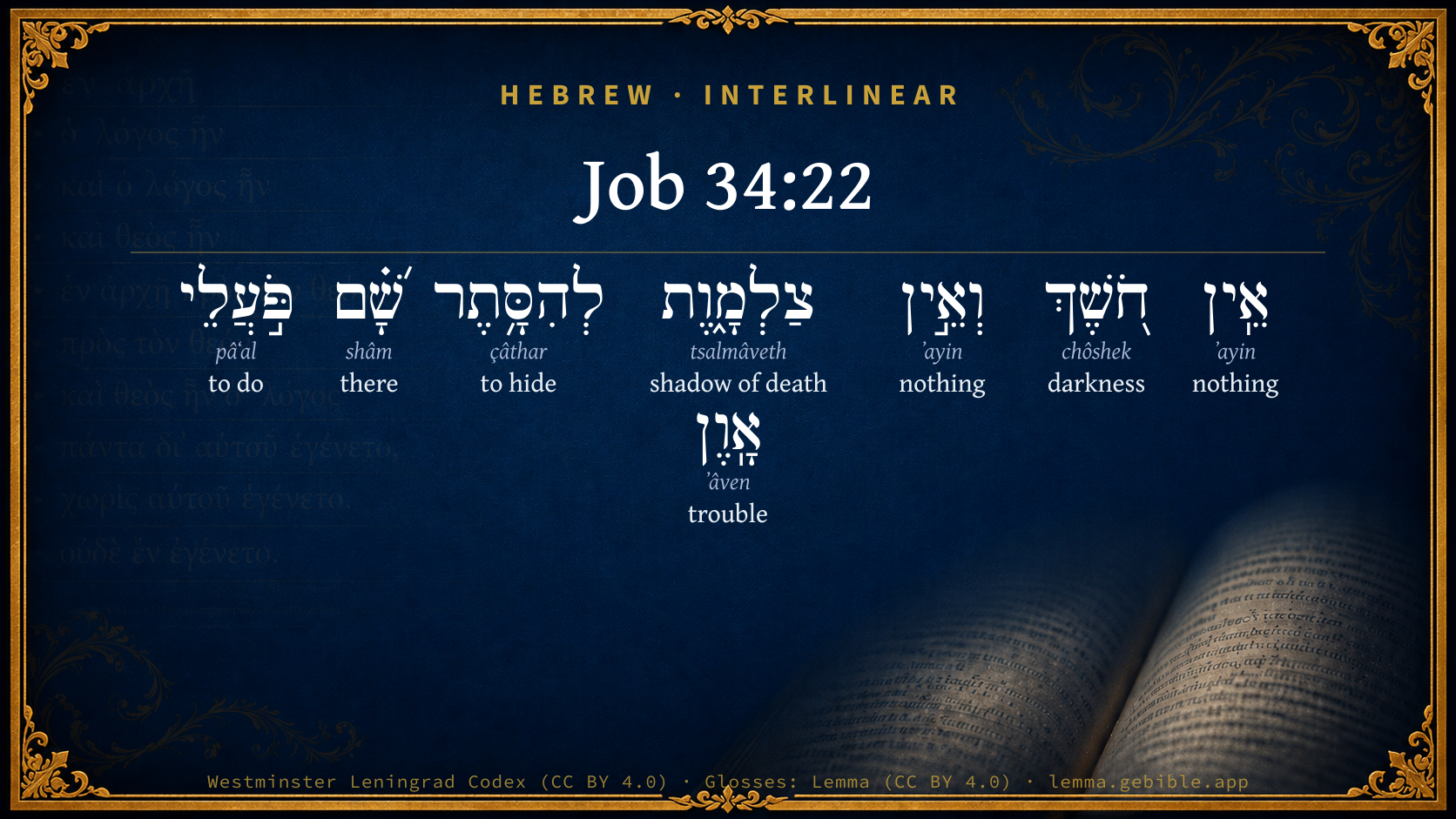
Job 34:22

Hebrew (Westminster Leningrad Codex) Job 34:22 appears in the Hebrew Old Testament. The text above is from the Westminster Leningrad Codex. Each word links to its Strong’s number, a concise gloss, and parsing drawn from the Open Scriptures Hebrew Bible morphology. Click any word for its full Brown-Driver-Briggs (BDB) entry.
Download image
Cite this verse

Job 34:22 (World English Bible). Public Domain. Lemma interlinear Bible study tool, https://lemma.gebible.app/v/job/34/22.

Show BibTeX & RIS
BibTeX
RIS
English Translation
There is no darkness, nor thick gloom, Where the workers of iniquity may hide themselves.
World English Bible · Public Domain
Download a study sheet

One document with this verse’s original text, its word-by-word gloss line, the meaning frame, cross-references with their text, attributed commentary, and full source and license credits — printable, and it pastes into notes with its structure intact.

This verse Autodidact and up

Study sheet (.html) Plain text (.txt)

A passage Seminary Student

Up to 50 verses in one chapter. A passage sheet keeps up to 6 commentary sources and 12 cross-references per verse, in the order this page ranks them, and says so on the sheet whenever that leaves anything out. Ask for a single verse and you get the Autodidact verse sheet above.

Everything on this page stays free to read, with no account — the sheet is a download of what is already on screen, not access to it.

Want to remove ads? Support Godless Engineer
Compare translations 3

The same verse in 3 English versions, stacked beneath the original-language interlinear above. Click any original word for its lexicon entry.

Each is an independent rendering of the whole verse — the interlinear is not word-aligned to these translations.

Highlighted words mark where these versions differ — a whole-verse word diff, not a word-by-word alignment.

  • World English Bible Public Domain
    There is no darkness, nor thick gloom, Where the workers of iniquity may hide themselves.
  • King James Version Public Domain
    There is no darkness, nor shadow of death, where the workers of iniquity may hide themselves.
  • unfoldingWord Literal Text CC BY-SA 4.0
    There is no darkness and there is no deep darkness for the doers of iniquity to be hidden there.

unfoldingWord Literal Text — © unfoldingWord, licensed CC BY-SA 4.0. Word-aligned USFM3 via Door43 (git.door43.org/unfoldingWord/en_ult).

Versions to compare (up to 4)

3 of 4 selected

Show all 18 translations

Every available English version of this verse, each an independent rendering of the whole verse.

  • World English Bible Public Domain
    There is no darkness, nor thick gloom, Where the workers of iniquity may hide themselves.
  • Berean Standard Bible Public Domain
    There is no darkness or deep shadow where the workers of iniquity can hide.
  • Majority Standard Bible Public Domain
    There is no darkness or deep shadow where the workers of iniquity can hide.
  • King James Version Public Domain
    There is no darkness, nor shadow of death, where the workers of iniquity may hide themselves.
  • American Standard Version (1901) Public Domain
    There is no darkness, nor thick gloom, Where the workers of iniquity may hide themselves.
  • Revised Version (1885) Public Domain
    There is no darkness, nor shadow of death, where the workers of iniquity may hide themselves.
  • Geneva Bible (1599) Public Domain
    There is no darkenesse nor shadowe of death, that the workers of iniquitie might be hid therein.
  • Douay-Rheims (1899) Public Domain
    There is no darkness, and there is no shadow of death, where they may be hid who work iniquity.
  • Young's Literal Translation Public Domain
    There is no darkness nor death-shade, For workers of iniquity to be hidden there;
  • Literal Standard Version CC BY-SA 4.0
    There is no darkness nor death-shade, || For workers of iniquity to be hidden there;
  • Unlocked Literal Bible CC BY-SA 4.0
    There is no darkness, no thick gloom where the doers of iniquity may hide themselves.
  • unfoldingWord Literal Text CC BY-SA 4.0
    There is no darkness and there is no deep darkness for the doers of iniquity to be hidden there.
  • Darby Bible Public Domain
    There is no darkness, nor shadow of death, where the workers of iniquity may hide themselves.
  • World Messianic Bible Public Domain
    There is no darkness, nor thick gloom, where the workers of iniquity may hide themselves.
  • Webster's Bible Public Domain
    There is no darkness, nor shadow of death, where the workers of iniquity may hide themselves.
  • Free Bible Version CC BY-SA 4.0
    There is no darkness so deep where people who do evil can hide themselves from him.
  • Bible in Basic English Public Domain
    There is no dark place, and no thick cloud, in which the workers of evil may take cover.
  • JPS Tanakh (1917) Public Domain
    There is no darkness, nor shadow of death, where the workers of iniquity may hide themselves.

Literal Standard Version (2020), Covenant Press — licensed CC BY-SA 4.0. Text via the HelloAO Bible API (eBible.org). Unlocked Literal Bible (unfoldingWord) — licensed CC BY-SA 4.0. Text via the HelloAO Bible API (eBible.org). unfoldingWord Literal Text — © unfoldingWord, licensed CC BY-SA 4.0. Word-aligned USFM3 via Door43 (git.door43.org/unfoldingWord/en_ult). Free Bible Version, Dr. Jonathan Gallagher — licensed CC BY-SA 4.0. Text via the HelloAO Bible API (eBible.org).

Word by word

More ways to search: Search by grammar → Find every occurrence → Compare this word →

Practice this passage: Drill this verse → Learn its vocabulary →

About this verse

These counts appear in no published source. They are computed here, from the morphology-tagged text and Lemma’s own curated glosses. What Lemma adds →

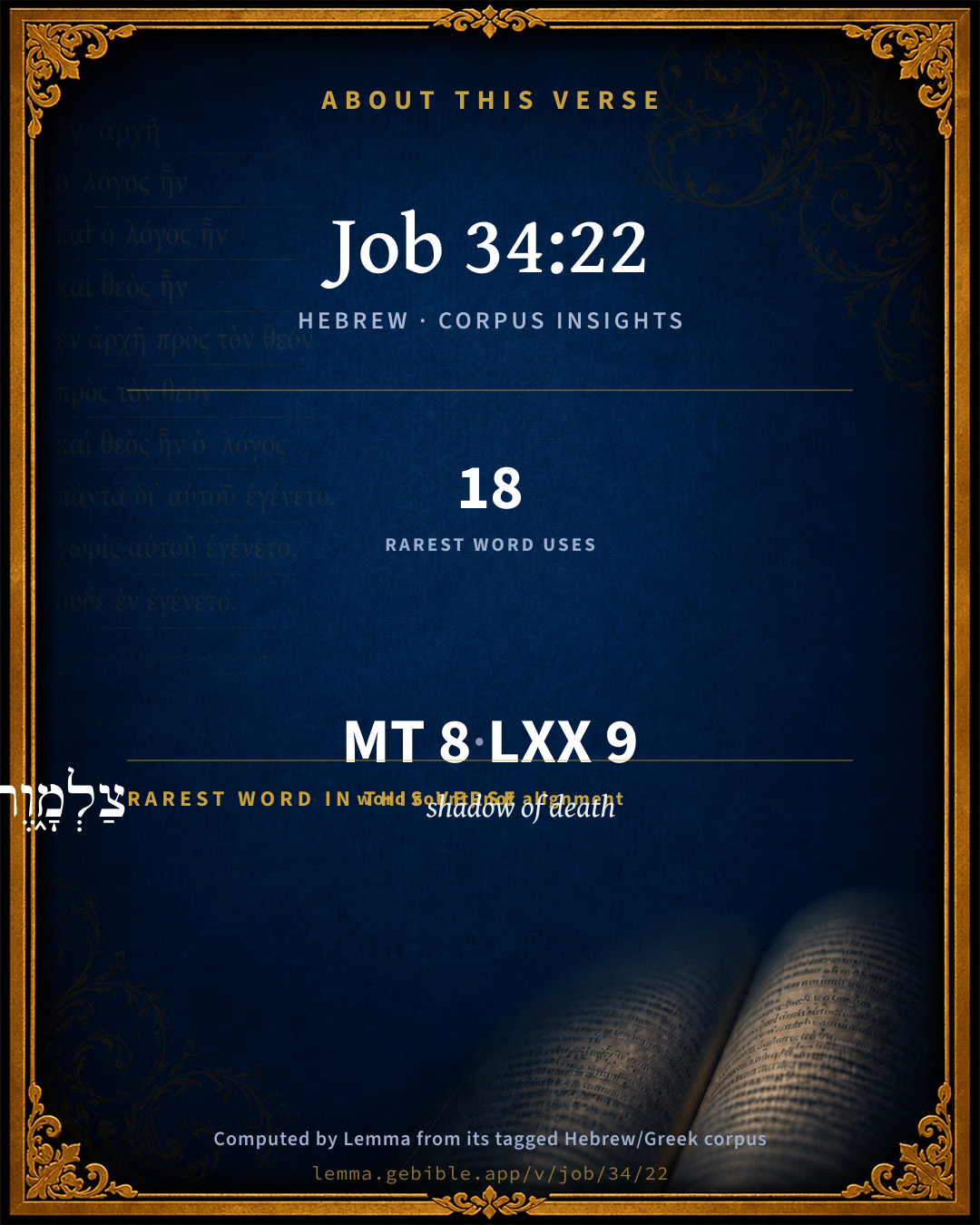
8
words
7
distinct lemmas
Wisdom
section

Notable vocabulary

The rarest word here is צַלְמָ֑וֶת shadow of death H6757 — appearing just 18 times in the whole Hebrew Bible.

Shared distinctive vocabulary

צַלְמָ֑וֶת shadow of death H6757 occurs in 17 verses of the Hebrew Bible. Also found in:

Grammatical profile

  • 2 verbs
  • 3 nouns
  • 1 adverb
  • 2 particles

Verb forms

  • לְהִסָּ֥תֶר Niphal · Infinitive Construct
  • פֹּ֣עֲלֵי Qal · Participle Active

Repetition

A word recurs within this verse — often emphatic in Hebrew:

  • אֵֽין nothing H369 ×2

Hebrew & Septuagint length

In English translation the verse runs 15 words from the Hebrew and 14 from the Septuagint (LXX English) — closely comparable.

A rough comparison of the two English renderings, which tokenize alike — not a word-level alignment.

Word counts can differ between the Hebrew and the Greek without any difference in meaning — e.g. the Hebrew direct-object marker אֵת has no separate Greek word, and Greek often adds the article ὁ.

In the original languages it is 8 Hebrew tokens and 9 Greek tokens — but the two are counted differently (Hebrew bundles its prefixes and suffixes into one token; the Greek is in lemma form), so that isn’t a like-for-like length.

Cross-references

15

Topical passages linked to Job 34:22 in the Treasury of Scripture Knowledge — connected by theme and wording, ordered by reader-vote popularity; previews shown in the World English Bible.

  • Hebrews 4:13 There is no creature that is hidden from his sight, but all things are naked and laid open before the eyes of him with whom we have to do.
  • Amos 9:2–3 Though they dig into Sheol, there my hand will take them; and though they climb up to heaven, there I will bring them down.
  • Proverbs 10:29 The way of Yahweh is a stronghold to the upright, But it is a destruction to the workers of iniquity.
  • Psalms 139:11–12 If I say, "Surely the darkness will overwhelm me; The light around me will be night;"
  • Jeremiah 23:24 Can any hide himself in secret places so that I shall not see him? says Yahweh. Don't I fill heaven and earth? says Yahweh.
  • Job 3:5 Let darkness and the shadow of death claim it for their own. Let a cloud dwell on it. Let all that makes black the day terrify it.
  • Job 24:17 For the morning is to all of them like thick darkness, For they know the terrors of the thick darkness.
  • Job 31:3 Is it not calamity to the unrighteous, And disaster to the workers of iniquity?
  • Psalms 5:5 The arrogant shall not stand in your sight. You hate all workers of iniquity.
  • Isaiah 9:2 The people who walked in darkness have seen a great light: those who lived in the land of the shadow of death, on them has the light shined.
  • Isaiah 29:15 Woe to those who hide deep their counsel from Yahweh, and whose works are in the dark, and who say, Who sees us? and who knows us?
  • Luke 13:27 He will say, 'I tell you, I don't know where you come from. Depart from me, all you workers of iniquity.'
  • 1 Corinthians 4:5 Therefore judge nothing before the time, until the Lord comes, who will both bring to light the hidden things of darkness, and reveal the counsels of the hearts. Then each man will get his praise from God.
  • Revelation 6:15–16 The kings of the earth, the princes, the commanding officers, the rich, the strong, and every slave and free person, hid themselves in the caves and in the rocks of the mountains.
  • Matthew 7:23 Then I will tell them, 'I never knew you. Depart from me, you who work iniquity.'

Cross-references courtesy of OpenBible.info (CC BY 4.0).

Hebrew and Greek witnesses Masoretic Hebrew ↔ Greek Septuagint

The same verse in the two great witnesses to the Old Testament, shown verse-for-verse.

These are two independent witnesses, not word-aligned to each other, and the Septuagint is shown in lemma (dictionary) form.

Hebrew Job 34:22 Masoretic · Westminster Leningrad Codex

אֵֽין חֹ֭שֶׁךְ וְאֵ֣ין צַלְמָ֑וֶת לְהִסָּ֥תֶר שָׁ֝֗ם פֹּ֣עֲלֵי אָֽוֶן

There is no darkness, nor thick gloom, Where the workers of iniquity may hide themselves.

World English Bible · Public Domain

Greek LXX Job 34:22 Septuagint · lemma form

οὐδέ εἰμί τόπος ὁ κρύπτω ὁ ποιέω ὁ ἄνομος

Neither shall there be a place for the workers of iniquity to hide themselves.

LXX2012 (modern English Septuagint) · Public Domain

Hebrew: Westminster Leningrad Codex (CC BY 4.0). Greek: Septuagint (public domain); English from LXX2012 (modern English Septuagint) (Public Domain). How the Septuagint differs from the Hebrew →

Commentary

Notes on Job 34:22 from classic Christian and Jewish commentators (each source and its license shown beneath its notes). The classic Christian expositions comment on the surrounding passage and are grouped to its opening verse, so a note may address several verses; the Jewish commentaries on the Tanakh (Rashi and others) are per-verse, so they appear only where the commentator wrote on this verse.

Lemma curates 59 commentaries, every one of them public domain or Creative Commons licensed, each selected and text-cleaned for this edition rather than reprinted as found. About our sources →

Trapp's Complete Commentary

John Trapp

Job 34:22 [There is] no darkness, nor shadow of death, where the workers of iniquity may hide themselves.

Ver. 22. There is no darkness, nor shadow of death, &c.] Sinners would fain shroud and secrete themselves from God’s all seeing eye; for which end they search all corners, with Adam, and hope that their evil pranks and practices shall never come to light; but that cannot be, for not only darkness and the shadow of death, but hell also, is naked before him, and destruction hath no covering, Job 26:6; {See Trapp on "Job 26:6"} See also Psa 139:12 Amo 9:2-3 Heb 4:13. {See Trapp on "Psa 139:12"} {See Trapp on "Amo 9:2"} {See Trapp on "Amo 9:3"} {See Trapp on "Heb 4:13"}

Where the workers of iniquity may hide themselves] Either from God’s all seeing eye, or punishing hand. Adam is pulled out of the thicket; Manasseh from among the thorns; Zedekiah and his family from between the two walls; many Jews out of the privies and other lurking holes where they lay hidden, at the last destruction of Jerusalem.

John Trapp, A Commentary or Exposition upon All the Books of the Old and New Testament (1647–1656) — public domain. Text from a community e-Sword module.

Joseph Benson's Commentary

Job 34:22-23. There is no darkness, &c. — The workers of iniquity may flatter themselves, or deceive others, by covering their wicked actions with plausible pretences and professions, but they cannot deceive God, nor conceal their ways or hearts from his inspection. He will not lay upon man more than right — More or heavier punishments than they deserve, or than are proportionable to their sins, which he accurately observes, and therefore can adapt punishments to them; that he should enter into judgment, &c. — Thereby to give him any pretence or occasion of entering into judgment with him, or of condemning his proceedings, for which there might seem to be some colour, if God did lay upon man more than is right.

Joseph Benson's Commentary on the Old and New Testaments (1811–1818) — public domain. Text from a community e-Sword module.

Tyndale Open Study Notes

Tyndale Open Resources

34:22 The wicked might try to hide in darkness (Jer 23:24), but they will fail (Ps 139:11-12; cp. Amos 9:2-3). God brings everything to light (1 Cor 4:5).

Tyndale Open Study Notes — © Tyndale Open Resources, licensed CC BY-SA 4.0. Text via the HelloAO Bible API.

Jamieson, Fausset & Brown

Robert Jamieson, A. R. Fausset & David Brown

shadow of death--thick darkness (Amo 9:2-3; Psa 139:12).

Jamieson, Fausset & Brown — Commentary Critical and Explanatory on the Whole Bible (1871) — public domain (CC PDM 1.0). Text via the HelloAO Bible API.

Adam Clarke's Commentary

Verse 22. There is no darkness] In this life; and no shadow of death in the other world-no annihilation in which the workers of iniquity may hide themselves, or take refuge.

Adam Clarke's Commentary on the Bible (1810–1826) — public domain. Text from a community e-Sword/MySword module.

Ellicott's Commentary for English Readers

(22) There is no darkness.—As Job had perhaps seemed to imply in Job_24:13-16.

A Bible Commentary for English Readers, edited by Charles John Ellicott (1878–1897) — public domain. Text from a community e-Sword module.

John Gill's Exposition

He shall break in pieces mighty men without number,.... Such as are mighty in bodily strength, as the giants of the old world, and such as were inhabitants of some parts of the land of Canaan; or mighty in power and authority, being kings, princes, rulers, and governors, over nations and cities; or mighty in wealth and riches, which give men power and strength; these God can and sometimes does break in pieces like potters' vessels, and even mighty kingdoms and nations themselves he will make like the chaff of the summer threshing floor: and even without number; or there have been and will be numberless instances of this kind; who can tell how many of these mighty men, men of gigantic stature, were drowned in the flood, or cut off by the sword of the Israelites in the land of Canaan? or "without search" (d) as it may be rendered; either on the part of God, who needs not any, with whom are unnecessary any formal inquiries into a cause, or examination of witnesses, in order to a judicial process against delinquents, all being naked and open before him at once; or on the part of man, with whom the ways and judgments of God are unsearchable and who ought not closely and curiously to inquire into any of his proceedings, and the causes and reasons of them, who does all things after the counsel of his own will. Mr. Broughton renders it "without end", for ever; with an everlasting destruction, an utter and irretrievable one; he so breaks them as that they never can be made whole again, like an earthen vessel that is broke to pieces and cannot be put together again;

and set others in their stead; God always provides for a succession in the world, that as when one generation goes off another comes on; when he destroyed the world with a flood, he preserved a family to replenish the earth; when the fathers of the Jewish nation, their carcasses fell in the wilderness, their children were raised up in their room to enter the good land and possess it; and particularly he provides for the civil government of the world and when he pulls down or removes one king he sets up another, and will not suffer kingdoms and states to fall into anarchy and confusion: and sometimes, when he casts down the mighty from their seats, he exalts men of low degree, as when he rejected Saul he took David from the sheepfold, Sa1 16:11; and makes such kings and kingdoms to "stand" (e) stable and firm, as the kingdom of David, and as the word here used signifies.

(d) "absque inquisitione", Beza, Mercerus; "sine investigatione", Michaelis; so Cocceius, Schultens. (e) "et stare faciet", Pagninus, Montanus, V. L. so Mercerus, Drusius, Cocceius, Schultens.

John Gill's Exposition of the Whole Bible (1746–1763) — public domain (CC PDM 1.0). Text via the HelloAO Bible API.

Albert Barnes' Notes on the Bible

There is no darkness - No dark cavern which can furnish a place of concealment. The guilty usually take refuge in some obscure place where people cannot detect them. But Elihu says that man has no power of concealing himself thus from God.

Nor shadow of death - A phrase here signifying deep darkness; see it explained in the notes at Job 3:5.

Where the workers of iniquity may hide themselves - That is, where they may conceal themselves so as not to be detected by God. They may conceal themselves from the notice of man; they may escape the most vigilant police; they may elude all the officers of justice on earth. But they cannot be hid from God. There is an eye that sees their lurking places, and there is a hand that will drag them forth to justice.

Albert Barnes' Notes on the Bible (1834–1885) — public domain. Text from a community e-Sword/MySword module.

Haydock's Catholic Bible Commentary

Death, or the most obscure recess. (Haydock)

George Leo Haydock (1774–1849), Haydock's Catholic Family Bible and Commentary, 1859 edition — public domain. Excludes Psalms (Douay-Rheims chapter numbering differs from Protestant) and Deuterocanonical books (Catholic canon only).

Matthew Poole's English Annotations

They may flatter themselves, or cheat others, by covering their wicked actions with plausible pretences and professions; but they cannot deceive God, nor keep their hearts and ways from his sight.

Matthew Poole's English Annotations on the Holy Bible (1683–1685) — public domain. Text from a community e-Sword/MySword module.

Whedon's Commentary on the Bible

Daniel D. Whedon

β The unerring righteouness of the divine government is made both possible and necessary by the OMNISCIENCE OF GOD. All men, with all their deeds, are naked and open before him, and he needs no inquisition in order to form and pronounce a righteous judgment, (Job_34:21-24.) “He cannot, therefore, through ignorance, punish the innocent nor the guilty beyond their true demerit.” — Scott.

22. Shadow of death — Used here, as elsewhere, in the same association with darkness, (Job_3:5; Job_10:21; Job_28:3,) for the darkness of sheol. In all God’s creation — even in sheol — there is no veil of darkness that can hide the sinner. Deeds of darkness, like the seed of certain plants, are by nature’s ordinance winged against concealment or final destruction. The wish on the part of the evil doer to hide sin involves an acknowledgment that there is justice over the creation, and points to an everlasting contest between the Supreme will to detect and the human interest to conceal, as John Foster shows in a thoughtful discourse on this text. (Broadmead Lec.1:167-175.)

Daniel D. Whedon (gen. ed.), Commentary on the Old and New Testaments (1874–1909) — public domain. Text from a community e-Sword module.

The Pulpit Commentary

There is no darkness, nor shadow of death, where the workers of iniquity may hide themselves. "All things are naked and opened unto the eyes of him with whom we have to do". (Heb_4:13) However careful wicked men may be to conceal their misdeeds by "waiting for the twilight", (Job_24:15) or doing them "in the dark", (Job_24:16) they will find it quite impossible to escape the all-seeing eye of the Almighty, which is as clear-sighted in the deepest darkness as in the brightest light ("Yea, the darkness is no darkness with thee, but the night is as clear as the day; the darkness and light to thee are both alike," Psa_139:11, Prayer-book Version).

The Pulpit Commentary (1880–1919), ed. H.D.M. Spence-Jones & Joseph S. Exell — public domain. Text from a community e-Sword module.

Lesson kit

Teaching starters — assembled from the data on this page, not authored interpretation. Every prompt links to the verse data it draws on. Edit before teaching.

Job, in the Wisdom, opens this verse with 8 words (7 distinct Hebrew lemmas). Its most distinctive word is tsalmâveth (“shadow of death”). A historical commentator’s framing appears above. Read the whole chapter for the surrounding context.

Discussion questions

  1. The word tsalmâveth carries the sense “shadow of death.” How does it shape the verse?
  2. Job 3:5 shares the word «shadow of death» with this verse. How do the two illuminate each other?
  3. “nothing” occurs 2× in this one verse. What is the effect of the repetition?
  4. The translations on this page render this verse differently — a whole-verse word diff, not a word-by-word alignment. What might account for the different wordings?
  5. The verb «לְהִסָּ֥תֶר» is Niphal Infinitive Construct. How does its form color the action?
  6. Reading how Trapp's Complete Commentary and Joseph Benson's Commentary read this verse, where do the two commentators agree and where do they part?

Things to notice

Reading settings

Reading text

Shown beneath each verse's original-language words.

Old Testament
Old Testament edition

Read the OT as the Masoretic Hebrew (MT) or the Greek Septuagint (LXX).

English shown for the Greek Septuagint (in the Hebrew ↔ Greek comparison).

Comparing translations? Open the Compare panel on any verse page to stack up to four side by side.