
Ezekiel 20:40

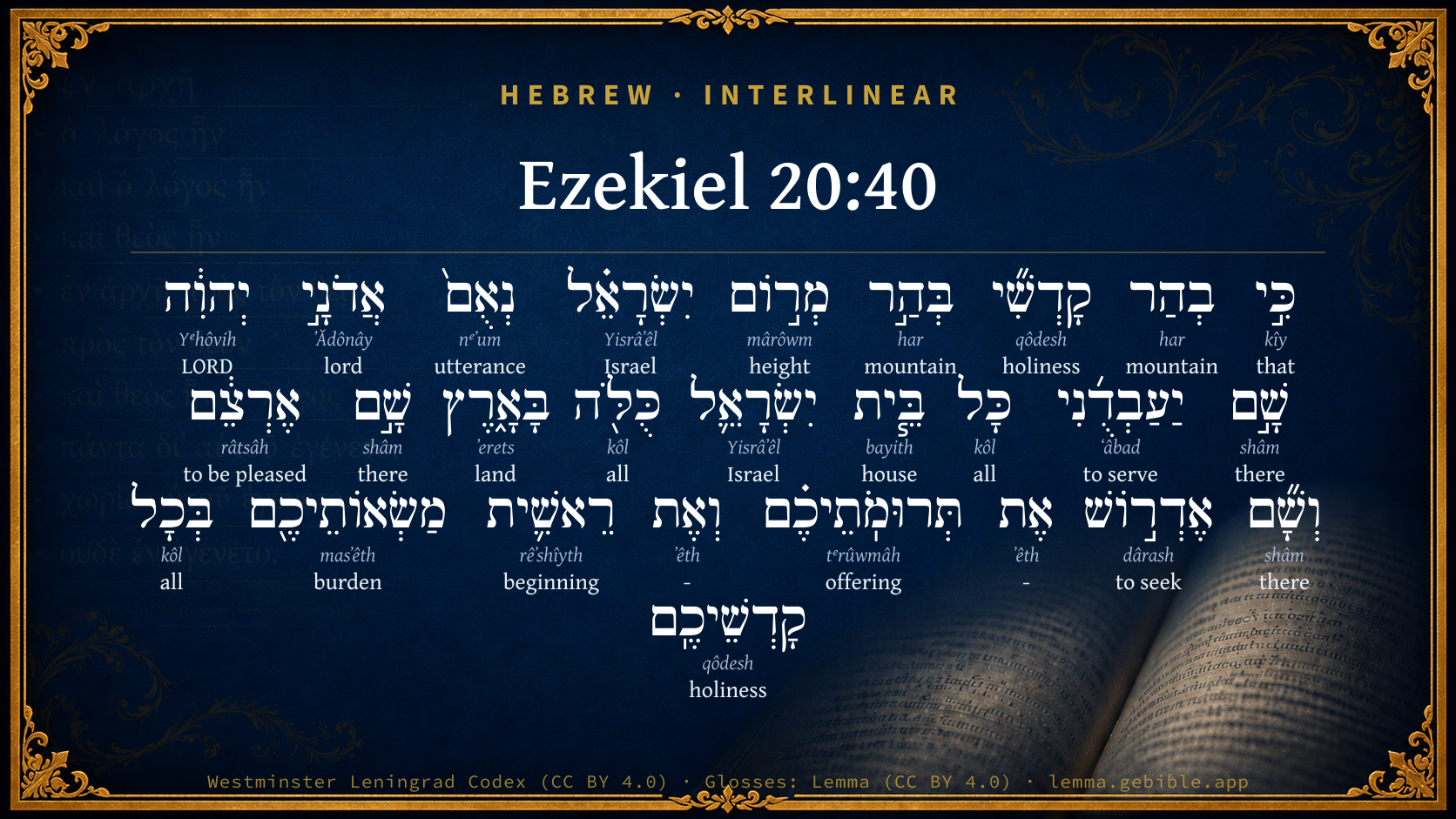
Hebrew (Westminster Leningrad Codex) Ezekiel 20:40 appears in the Hebrew Old Testament. The text above is from the Westminster Leningrad Codex. Each word links to its Strong’s number, a concise gloss, and parsing drawn from the Open Scriptures Hebrew Bible morphology. Click any word for its full Brown-Driver-Briggs (BDB) entry.
Download image
Cite this verse

Ezekiel 20:40 (World English Bible). Public Domain. Lemma interlinear Bible study tool, https://lemma.gebible.app/v/ezekiel/20/40.

Show BibTeX & RIS
BibTeX
RIS
English Translation
For in my holy mountain, in the mountain of the height of Israel, says the Lord Yahweh, there shall all the house of Israel, all of them, serve me in the land: there will I accept them, and there will I require your offerings, and the first fruits of your offerings, with all your holy things.
World English Bible · Public Domain
Download a study sheet

One document with this verse’s original text, its word-by-word gloss line, the meaning frame, cross-references with their text, attributed commentary, and full source and license credits — printable, and it pastes into notes with its structure intact.

This verse Autodidact and up

Study sheet (.html) Plain text (.txt)

A passage Seminary Student

Up to 50 verses in one chapter. A passage sheet keeps up to 6 commentary sources and 12 cross-references per verse, in the order this page ranks them, and says so on the sheet whenever that leaves anything out. Ask for a single verse and you get the Autodidact verse sheet above.

Everything on this page stays free to read, with no account — the sheet is a download of what is already on screen, not access to it.

Want to remove ads? Support Godless Engineer
Compare translations 3

The same verse in 3 English versions, stacked beneath the original-language interlinear above. Click any original word for its lexicon entry.

Each is an independent rendering of the whole verse — the interlinear is not word-aligned to these translations.

Highlighted words mark where these versions differ — a whole-verse word diff, not a word-by-word alignment.

  • World English Bible Public Domain
    For in my holy mountain, in the mountain of the height of Israel, says the Lord Yahweh, there shall all the house of Israel, all of them, serve me in the land: there will I accept them, and there will I require your offerings, and the first fruits of your offerings, with all your holy things.
  • King James Version Public Domain
    For in mine holy mountain, in the mountain of the height of Israel, saith the Lord GOD, there shall all the house of Israel, all of them in the land, serve me: there will I accept them, and there will I require your offerings, and the firstfruits of your oblations, with all your holy things.
  • unfoldingWord Literal Text CC BY-SA 4.0
    For on my holy mountain, on the mountain peak of Israel—this is the Lord Yahweh’s declaration—all of the house of Israel will worship me there in the land. I will be pleased to require your offerings there, and also the firstfruits of your tribute with all your holy things.

unfoldingWord Literal Text — © unfoldingWord, licensed CC BY-SA 4.0. Word-aligned USFM3 via Door43 (git.door43.org/unfoldingWord/en_ult).

Versions to compare (up to 4)

3 of 4 selected

Show all 18 translations

Every available English version of this verse, each an independent rendering of the whole verse.

  • World English Bible Public Domain
    For in my holy mountain, in the mountain of the height of Israel, says the Lord Yahweh, there shall all the house of Israel, all of them, serve me in the land: there will I accept them, and there will I require your offerings, and the first fruits of your offerings, with all your holy things.
  • Berean Standard Bible Public Domain
    For on My holy mountain, the high mountain of Israel, declares the Lord GOD, there the whole house of Israel, all of them, will serve Me in the land. There I will accept them and will require your offerings and choice gifts, along with all your holy sacrifices.
  • Majority Standard Bible Public Domain
    For on My holy mountain, the high mountain of Israel, declares the Lord GOD, there the whole house of Israel, all of them, will serve Me in the land. There I will accept them and will require your offerings and choice gifts, along with all your holy sacrifices.
  • King James Version Public Domain
    For in mine holy mountain, in the mountain of the height of Israel, saith the Lord GOD, there shall all the house of Israel, all of them in the land, serve me: there will I accept them, and there will I require your offerings, and the firstfruits of your oblations, with all your holy things.
  • American Standard Version (1901) Public Domain
    For in my holy mountain, in the mountain of the height of Israel, saith the Lord Jehovah, there shall all the house of Israel, all of them, serve me in the land: there will I accept them, and there will I require your offerings, and the first-fruits of your oblations, with all your holy things.
  • Revised Version (1885) Public Domain
    For in mine holy mountain, in the mountain of the height of Israel, saith the Lord GOD, there shall all the house of Israel, all of them, serve me in the land: there will I accept them, and there will I require your offerings, and the firstfruits of your oblations, with all your holy things.
  • Geneva Bible (1599) Public Domain
    For in mine holy mountaine, euen in the hie mountaine of Israel, saith the Lord God, there shall all the house of Israel, and all in the lande, serue me: there will I accept them, and there will I require your offrings and the first fruites of your oblations, with all your holy things.
  • Douay-Rheims (1899) Public Domain
    In my holy mountain, in the high mountain of Israel, saith the Lord God, there shall all the house of Israel serve me; all of them I say, in the land in which they shall please me, and there will I require your firstfruits, and the chief of your tithes with all your sanctifications.
  • Young's Literal Translation Public Domain
    For, in My holy mountain, In the mountain of the height of Israel, An affirmation of the Lord Jehovah, There serve Me do all the house of Israel, All of it, in the land -- there I accept them, And there I do seek your heave-offerings, And with the first-fruit of your gifts, With all your holy things.
  • Literal Standard Version CC BY-SA 4.0
    For on My holy mountain, || On the mountain of the height of Israel, || A declaration of Lord YHWH, || All the house of Israel serves Me there, || All of it, in the land—I accept them there, || And I seek your raised-offerings there, || And with the first-fruit of your gifts, || With all your holy things.
  • Unlocked Literal Bible CC BY-SA 4.0
    For on my holy mountain, on the mountain peak of Israel—this is the Lord Yahweh's declaration—all of the house of Israel will worship me there in the land. I will be pleased to require your offerings there, and also the firstfruits of your tribute with all your holy things.
  • unfoldingWord Literal Text CC BY-SA 4.0
    For on my holy mountain, on the mountain peak of Israel—this is the Lord Yahweh’s declaration—all of the house of Israel will worship me there in the land. I will be pleased to require your offerings there, and also the firstfruits of your tribute with all your holy things.
  • Darby Bible Public Domain
    For in my holy mountain, in the mountain of the height of Israel, saith the Lord Jehovah, there shall all the house of Israel serve me, the whole of it, in the land; there will I accept them, and there will I require your heave-offerings and the first-fruits of your offerings, with all your holy things.
  • World Messianic Bible Public Domain
    For in my holy mountain, in the mountain of the height of Israel,” says the Lord GOD, “there all the house of Israel, all of them, shall serve me in the land. There I will accept them, and there I will require your offerings and the first fruits of your offerings, with all your holy things.
  • Webster's Bible Public Domain
    For on my holy mountain, on the mountain of the hight of Israel, saith the Lord GOD, there shall all the house of Israel, all of them in the land, serve me: there will I accept them, and there will I require your offerings, and the first fruits of your oblations, with all your holy things.
  • Free Bible Version CC BY-SA 4.0
    For there on my holy mountain, Israel's high mountain, declares the Lord God, every single person in the whole country of Israel will worship me. That's where I'll accept them and will ask for your offerings and your best gifts, together with all your holy sacrifices.
  • Bible in Basic English Public Domain
    For in my holy mountain, in the high mountain of Israel, says the Lord, there all the children of Israel, all of them, will be my servants in the land; there I will take pleasure in them, and there I will be worshipped with your offerings and the first-fruits of the things you give, and with all your holy things.
  • JPS Tanakh (1917) Public Domain
    For in My holy mountain, in the mountain of the height of Israel, saith the Lord GOD, there shall all the house of Israel, all of them, serve Me in the land; there will I accept them, and there will I require your heave-offerings, and the first of your gifts, with all your holy things.

Literal Standard Version (2020), Covenant Press — licensed CC BY-SA 4.0. Text via the HelloAO Bible API (eBible.org). Unlocked Literal Bible (unfoldingWord) — licensed CC BY-SA 4.0. Text via the HelloAO Bible API (eBible.org). unfoldingWord Literal Text — © unfoldingWord, licensed CC BY-SA 4.0. Word-aligned USFM3 via Door43 (git.door43.org/unfoldingWord/en_ult). Free Bible Version, Dr. Jonathan Gallagher — licensed CC BY-SA 4.0. Text via the HelloAO Bible API (eBible.org).

Word by word

More ways to search: Search by grammar → Find every occurrence → Compare this word →

Practice this passage: Drill this verse → Learn its vocabulary →

מַשְׂאוֹתֵיכֶ֖ם
masʼêth
H4864
“burdens · your”
Noun, Common, Feminine, Plural, Construct + Suffix, Personal, 2nd Person, Masculine, Plural
Part of Speech
Noun
Type
Common
Gender
Feminine
Number
Plural
State
Construct
Full BDB Definition

Origin: from \H5375\\

TWOT: 1421h

uprising, utterance, burden, portion, uplifting - that which rises, uprising, uplifting, signal, rising - utterance, oracle - burden - portion, present, largesse, gift, contribution, offering, tribute
  1. כִּ֣י kîy H3588 “that” Conjunction
  2. בְהַר har H2022 “in/at · mountain of” Preposition + Noun, Common, Masculine, Singular, Construct
  3. קָדְשִׁ֞י qôdesh H6944 “holiness · my” Noun, Common, Masculine, Singular, Construct + Suffix, Personal, 1st Person, Common, Singular
  4. בְּהַ֣ר har H2022 “in/at · mountain of” Preposition + Noun, Common, Masculine, Singular, Construct
  5. מְר֣וֹם mârôwm H4791 “height of” Noun, Common, Masculine, Singular, Construct
  6. יִשְׂרָאֵ֗ל Yisrâʼêl H3478 “Israel” Noun, Proper
  7. נְאֻם֙ nᵉʼum H5002 “utterance of” Noun, Common, Masculine, Singular, Construct
  8. אֲדֹנָ֣י ʼĂdônây H136 “Lord · my” Noun, Common, Masculine, Plural, Construct + Suffix, Personal, 1st Person, Common, Singular
  9. יְהוִ֔ה Yᵉhôvih H3069 “LORD” Noun, Proper
  10. שָׁ֣ם shâm H8033 “there” Adverb
  11. יַעַבְדֻ֜נִי ʻâbad H5647 “to serve · me” Verb, Qal, Imperfect, 3rd Person, Masculine, Plural + Suffix, Personal, 1st Person, Common, Singular
  12. כָּל kôl H3605 “all of” Noun, Common, Masculine, Singular, Construct
  13. בֵּ֧ית bayith H1004 “house of” Noun, Common, Masculine, Singular, Construct
  14. יִשְׂרָאֵ֛ל Yisrâʼêl H3478 “Israel” Noun, Proper
  15. כֻּלֹּ֖ה kôl H3605 “all · her” Noun, Common, Masculine, Singular, Construct + Suffix, Personal, 3rd Person, Feminine, Singular
  16. בָּאָ֑רֶץ ʼerets H776 “in/at the · land” Preposition, Determined + Noun, Common, Both, Singular, Absolute
  17. שָׁ֣ם shâm H8033 “there” Adverb
  18. אֶרְצֵ֔ם râtsâh H7521 “to be pleased · them” Verb, Qal, Imperfect, 1st Person, Common, Singular + Suffix, Personal, 3rd Person, Masculine, Plural
  19. וְשָׁ֞ם shâm H8033 “and · there” Conjunction + Adverb
  20. אֶדְר֣וֹשׁ dârash H1875 “to seek” Verb, Qal, Imperfect, 1st Person, Common, Singular
  21. אֶת ʼêth H853 “-” Particle, Direct Object
  22. תְּרוּמֹֽתֵיכֶ֗ם tᵉrûwmâh H8641 “offerings · your” Noun, Common, Feminine, Plural, Construct + Suffix, Personal, 2nd Person, Masculine, Plural
  23. וְאֶת ʼêth H853 “and · -” Conjunction + Particle, Direct Object
  24. רֵאשִׁ֛ית rêʼshîyth H7225 “beginning of” Noun, Common, Feminine, Singular, Construct
  25. בְּכָל kôl H3605 “in/at · all of” Preposition + Noun, Common, Masculine, Singular, Construct
  26. קָדְשֵׁיכֶֽם qôdesh H6944 “holy things · your” Noun, Common, Masculine, Plural, Construct + Suffix, Personal, 2nd Person, Masculine, Plural

About this verse

These counts appear in no published source. They are computed here, from the morphology-tagged text and Lemma’s own curated glosses. What Lemma adds →

27
words
19
distinct lemmas
Prophets
section

Notable vocabulary

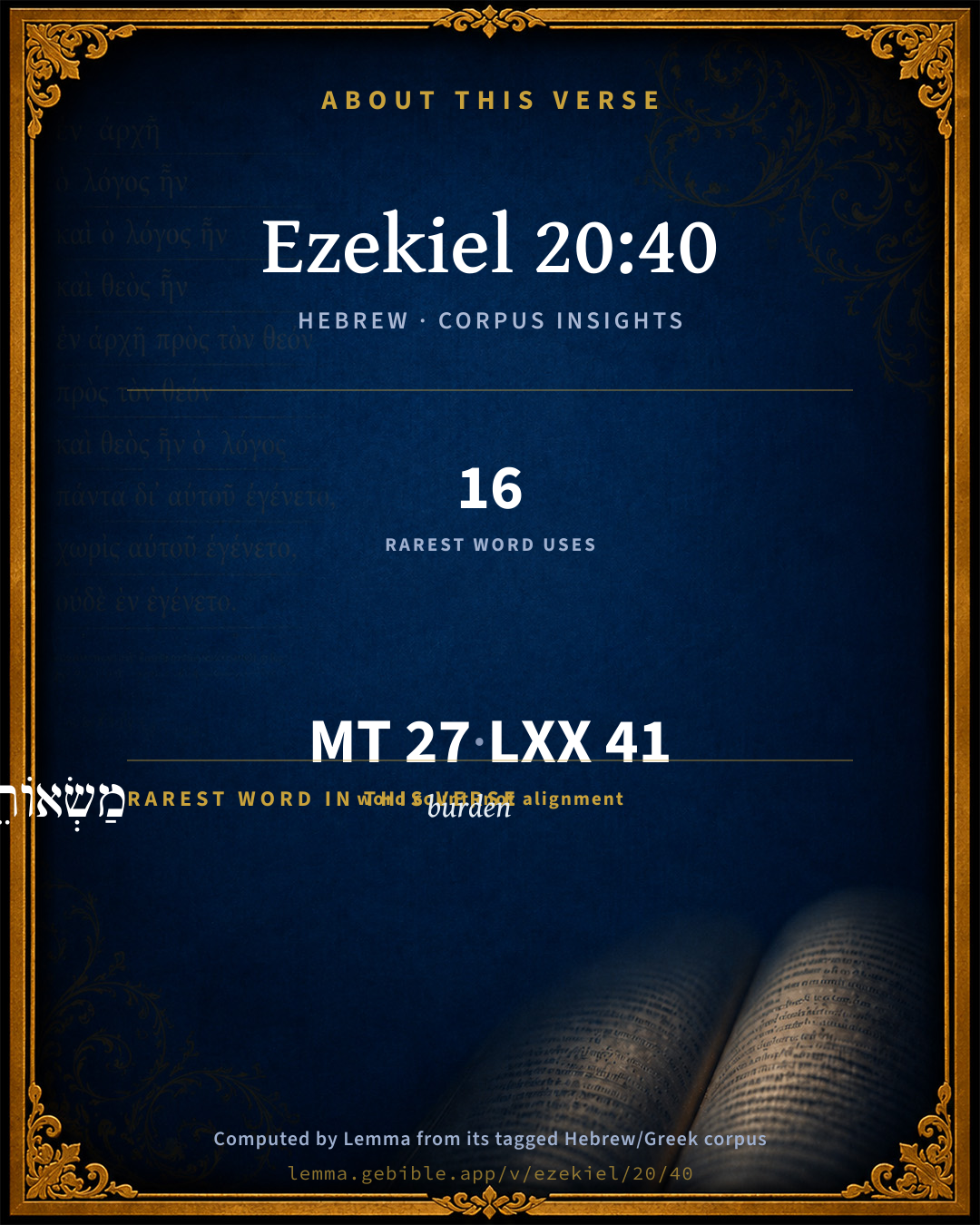
The rarest word here is מַשְׂאוֹתֵיכֶ֖ם burden H4864 — appearing just 16 times in the whole Hebrew Bible.

Shared distinctive vocabulary

מַשְׂאוֹתֵיכֶ֖ם burden H4864 occurs in 14 verses of the Hebrew Bible. Also found in:

Grammatical profile

  • 3 verbs
  • 18 nouns
  • 1 conjunction
  • 3 adverbs
  • 2 particles

Verb forms

  • יַעַבְדֻ֜נִי Qal · Imperfect
  • אֶרְצֵ֔ם Qal · Imperfect
  • אֶדְר֣וֹשׁ Qal · Imperfect

Repetition

Words recur within this verse — often emphatic in Hebrew:

  • שָׁ֣ם there H8033 ×3
  • כָּל all H3605 ×3
  • בְהַר mountain H2022 ×2
  • קָדְשִׁ֞י holiness H6944 ×2
  • יִשְׂרָאֵ֗ל Israel H3478 ×2

Hebrew & Septuagint length

In English translation the verse runs 56 words from the Hebrew and 54 from the Septuagint (LXX English) — closely comparable.

A rough comparison of the two English renderings, which tokenize alike — not a word-level alignment.

Word counts can differ between the Hebrew and the Greek without any difference in meaning — e.g. the Hebrew direct-object marker אֵת has no separate Greek word, and Greek often adds the article ὁ.

In the original languages it is 27 Hebrew tokens and 41 Greek tokens — but the two are counted differently (Hebrew bundles its prefixes and suffixes into one token; the Greek is in lemma form), so that isn’t a like-for-like length.

Cross-references

22

Topical passages linked to Ezekiel 20:40 in the Treasury of Scripture Knowledge — connected by theme and wording, ordered by reader-vote popularity; previews shown in the World English Bible.

  • Isaiah 56:7 even them will I bring to my holy mountain, and make them joyful in my house of prayer: their burnt offerings and their sacrifices shall be accepted on my altar; for my house shall be called a house of prayer for all peoples.
  • Isaiah 60:7 All the flocks of Kedar shall be gathered together to you, the rams of Nebaioth shall minister to you; they shall come up with acceptance on my altar; and I will glorify the house of my glory.
  • Malachi 3:4 Then the offering of Judah and Jerusalem will be pleasant to Yahweh, as in the days of old, and as in ancient years.
  • Isaiah 66:23 It shall happen, that from one new moon to another, and from one Sabbath to another, shall all flesh come to worship before me, says Yahweh.
  • Ezekiel 17:23 in the mountain of the height of Israel will I plant it; and it shall bring forth boughs, and bear fruit, and be a goodly cedar: and under it shall dwell all birds of every wing; in the shade of the branches of it shall they dwell.
  • Ezekiel 43:27 When they have accomplished the days, it shall be that on the eighth day, and forward, the priests shall make your burnt offerings on the altar, and your peace-offerings; and I will accept you, says the Lord Yahweh.
  • 1 Peter 2:5 You also, as living stones, are built up as a spiritual house, to be a holy priesthood, to offer up spiritual sacrifices, acceptable to God through Jesus Christ.
  • Psalms 2:6 "Yet I have set my king on my holy hill of Zion."
  • Psalms 68:15–16 The mountains of Bashan are majestic mountains. The mountains of Bashan are rugged.
  • Isaiah 2:2–3 It shall happen in the latter days, that the mountain of Yahweh's house shall be established on the top of the mountains, And shall be raised above the hills; And all nations shall flow to it.
  • Isaiah 66:20 They shall bring all your brothers out of all the nations for an offering to Yahweh, on horses, and in chariots, and in litters, and on mules, and on dromedaries, to my holy mountain Jerusalem, says Yahweh, as the children of Israel bring their offering in a clean vessel into the house of Yahweh.
  • Jeremiah 31:12 They shall come and sing in the height of Zion, and shall flow to the goodness of Yahweh, to the grain, and to the new wine, and to the oil, and to the young of the flock and of the herd: and their soul shall be as a watered garden; and they shall not sorrow any more at all.
  • Ezekiel 37:22–28 and I will make them one nation in the land, on the mountains of Israel; and one king shall be king to them all; and they shall be no more two nations, neither shall they be divided into two kingdoms any more at all;
  • Joel 3:17–18 "So you will know that I am Yahweh, your God, Dwelling in Zion, my holy mountain. Then Jerusalem will be holy, And no strangers will pass through her any more.
  • Obadiah 1:16 For as you have drunk on my holy mountain, so will all the nations drink continually. Yes, they will drink, swallow down, and will be as though they had not been.
  • Micah 4:1–2 But in the latter days, It will happen that the mountain of Yahweh's temple will be established on the top of the mountains, And it will be exalted above the hills; And peoples will stream to it.
  • Zechariah 8:20–23 Thus says Yahweh of Hosts: "Many peoples, and the inhabitants of many cities will yet come;
  • Malachi 1:11 For from the rising of the sun even to the going down of the same, my name is great among the nations, and in every place incense will be offered to my name, and a pure offering: for my name is great among the nations," says Yahweh of Hosts.
  • Hebrews 12:20–22 for they could not stand that which was commanded, "If even an animal touches the mountain, it shall be stoned;"
  • Hebrews 13:15 Through him, then, let us offer up a sacrifice of praise to God continually, that is, the fruit of lips which make confession to his name.
  • Revelation 12:1 A great sign was seen in heaven: a woman clothed with the sun, and the moon under her feet, and on her head a crown of twelve stars.
  • Revelation 21:10 He carried me away in the Spirit to a great and high mountain, and showed me the holy city, Jerusalem, coming down out of heaven from God,

Cross-references courtesy of OpenBible.info (CC BY 4.0).

Hebrew and Greek witnesses Masoretic Hebrew ↔ Greek Septuagint

The same verse in the two great witnesses to the Old Testament, shown verse-for-verse.

These are two independent witnesses, not word-aligned to each other, and the Septuagint is shown in lemma (dictionary) form.

Hebrew Ezekiel 20:40 Masoretic · Westminster Leningrad Codex

כִּ֣י בְהַר קָדְשִׁ֞י בְּהַ֣ר מְר֣וֹם יִשְׂרָאֵ֗ל נְאֻם֙ אֲדֹנָ֣י יְהוִ֔ה שָׁ֣ם יַעַבְדֻ֜נִי כָּל בֵּ֧ית יִשְׂרָאֵ֛ל כֻּלֹּ֖ה בָּאָ֑רֶץ שָׁ֣ם אֶרְצֵ֔ם וְשָׁ֞ם אֶדְר֣וֹשׁ אֶת תְּרוּמֹֽתֵיכֶ֗ם וְאֶת רֵאשִׁ֛ית מַשְׂאוֹתֵיכֶ֖ם בְּכָל קָדְשֵׁיכֶֽם

For in my holy mountain, in the mountain of the height of Israel, says the Lord Yahweh, there shall all the house of Israel, all of them, serve me in the land: there will I accept them, and there will I require your offerings, and the first fruits of your offerings, with all your holy things.

World English Bible · Public Domain

Greek LXX Ezekiel 20:40 Septuagint · lemma form

διότι ἐπί ὁ ὄρος ὁ ἅγιος ἐγώ ἐπί ὄρος ὑψηλός λέγω κύριος κύριος ἐκεῖ δουλεύω ἐγώ πᾶς οἶκος ἰσραήλ εἰς τέλος καί ἐκεῖ προςδέχομαι καί ἐκεῖ ἐπισκέπτομαι ὁ ἀπαρχή σύ καί ὁ ἀπαρχή ὁ ἀφορισμός σύ ἐν πᾶς ὁ ἁγίασμα σύ

For upon my holy mountain, on the high mountain, says the Lord, even the Lord, there shall all the house of Israel serve me for ever: and there will I accept you, and there will I have respect to your first fruits, and the first fruits of your offerings, in all your holy things.

LXX2012 (modern English Septuagint) · Public Domain

Hebrew: Westminster Leningrad Codex (CC BY 4.0). Greek: Septuagint (public domain); English from LXX2012 (modern English Septuagint) (Public Domain). How the Septuagint differs from the Hebrew →

Targum (Aramaic paraphrase)

1

The Targum is the ancient Jewish Aramaic paraphrase of the Hebrew Scriptures — an interpretive translation, not the Hebrew text itself. Onkelos (literal) and Pseudo-Jonathan (expansive) render the Torah, and Jonathan the Prophets. Coverage is partial: where no permissively-licensed English translation exists for a verse, only the Aramaic is shown. This is verse-level text, not a word-by-word alignment to the Hebrew.

  1. Targum Jonathan Prophets (Joshua–Malachi)
    אֲרֵי בְטוּר קוּדְשִׁי בְּטוּר קוּדְשָׁא דְיִשְׂרָאֵל אֲמַר יְיָ אֱלֹהִים תַּמָן יִפְלְחוּן קֳדָמַי כָּל בֵּית יִשְׂרָאֵל כּוּלְהוֹן בְּאַרְעָא חַיַיָא תַּמָן יִתְקַבֵּל קוּרְבָּנֵיהוֹן בִּפְרִיעַ וְתַמָן אֶתְבַּע יַת אַפְרָשׁוּתְכוֹן וְיַת רֵישׁ אַצְוָתְכוֹן בְּכָל קוּדְשֵׁיכוֹן:

    (no public-domain English translation for this verse)

    Targum Jonathan — Aramaic: “Mikraot Gedolot” (public domain). English: “Sefaria Community Translation” (CC0 1.0 (public-domain dedication)); “London "Chaldee Paraphrase," 1871” (public domain). Text via Sefaria.

Commentary

Notes on Ezekiel 20:40 from classic Christian and Jewish commentators (each source and its license shown beneath its notes). The classic Christian expositions comment on the surrounding passage and are grouped to its opening verse, so a note may address several verses; the Jewish commentaries on the Tanakh (Rashi and others) are per-verse, so they appear only where the commentator wrote on this verse.

Lemma curates 59 commentaries, every one of them public domain or Creative Commons licensed, each selected and text-cleaned for this edition rather than reprinted as found. About our sources →

Trapp's Complete Commentary

John Trapp

Eze 20:40 For in mine holy mountain, in the mountain of the height of Israel, saith the Lord GOD, there shall all the house of Israel, all of them in the land, serve me: there will I accept them, and there will I require your offerings, and the firstfruits of your oblations, with all your holy things.

Ver. 40. For in mine holy mountain.] In my Church, and among my faithful people, for to these he now speaketh comfort.

There will I accept them.] Ibi occurram eis, scil., quasi in amplexum sponsoe; so some render and sense the text; i.e., there I will meet them, and accept them with much sweetness.

And there will require your offerings.] Not forbid and refuse them, as I did theirs. {Eze 20:39}

John Trapp, A Commentary or Exposition upon All the Books of the Old and New Testament (1647–1656) — public domain. Text from a community e-Sword module.

Joseph Benson's Commentary

Eze 20:40-42. For in my holy mountain, &c. — The holy hill of Zion, holy through God’s appointing it for the place of his temple. The mountain of the height of Israel — See Eze 17:23; Mic 4:1. Though mount Zion was not one of the highest mountains of Israel, yet God manifesting his presence there in his temple, it was more honoured than any of their other mountains. Lowth, and several other commentators, think the Christian Church is here meant, and termed God’s holy mountain in allusion to the temple at Jerusalem, built upon mount Moriah, a part of mount Zion; (see notes on Eze 17:23, and Isa 2:2;) and that the prophet here foretels the conversion of the Jews to Christianity, and their union with the converted Gentiles in the church of God. At the same time, however, they suppose that, upon their conversion and return to their own country, certain privileges shall belong to the earthly Jerusalem, as the metropolis of that nation. There shall all the house of Israel, all of them, serve me — That is, all the house of Israel that are restored, shall serve me in Jerusalem. There shall be no more any such separation as when the ten tribes forsook the worship of God at Jerusalem. There will I accept them, and there will I require your offerings, &c. — Requiring signifies the same with accepting, by a metonymy of the cause for the effect; just as seeking is sometimes used for finding: see Isa 65:1. In the same sense, God is said not to require such instances of worship as he takes no delight in, Isa 1:11. Offerings signify in general every thing devoted to God’s service. Those who suppose that the prophet is here foretelling the conversion of the Jews to Christianity, consider him as “expressing the Christian worship by those religions oblations which were proper to his own time; as the other prophets frequently describe the state of the Christian Church, by representations taken from the Jewish temple and service.” — See Lowth. I will accept you with your sweet savour — This is mentioned in opposition to the sweet savour of their offerings to idols. The words may be rendered, I will be pleased with you, as with a sweet savour; or, as with the savour of an offering of atonement. When I bring you out — Or, as it may be better rendered, When I have brought you out from the people; that is, either, 1st, When I have brought you back out of captivity to your own land; or, 2d, When I have converted you to Christ, and united you to the Christian Church. And I will be sanctified in you before the heathen — I shall procure honour to my name by the wonderful works, whether of justice or mercy, which I will show toward you; and the nations shall consider me as a great and holy God, when they shall observe my deliverance of you, and your obedience to me. And ye shall know that I am the Lord — Or, Jehovah; that is, He who causeth that TO BE which he hath said SHALL BE, and who fulfilleth his promises. When I shall bring you into the country, &c. — Into the land which I sware to give to your fathers and their posterity: see Eze 20:5.

Joseph Benson's Commentary on the Old and New Testaments (1811–1818) — public domain. Text from a community e-Sword module.

Jamieson, Fausset & Brown

Robert Jamieson, A. R. Fausset & David Brown

For--Though ye, the rebellious portion, withdraw from My worship, others, even the believing remnant, will succeed after you perish, and will serve Me purely.

in mine holy mountain-- (Isa 2:2-3). Zion, or Moriah, "the height of Israel" (pre-eminent above all mountains because of the manifested presence of God there with Israel), as opposed to their "high places," the worship on which was an abomination to God.

all--not merely individuals, such as constitute the elect Church now; but the whole nation, to be followed by the conversion of the Gentile nations (Isa 2:2, "all nations;" Rom 11:26; Rev 11:15).

with--rather, "in all your holy things" [MAURER].

Jamieson, Fausset & Brown — Commentary Critical and Explanatory on the Whole Bible (1871) — public domain (CC PDM 1.0). Text via the HelloAO Bible API.

Adam Clarke's Commentary

Verse 40. For in mine holy mountain] The days shall come in which all true ISRAELITES shall receive HIM whom I have sent to be the true sacrifice for the life of the world; and shall bring to Jerusalem - the pure Christian Church, their offerings, which I will there accept, for they will give me thanks for my unspeakable gift.

Adam Clarke's Commentary on the Bible (1810–1826) — public domain. Text from a community e-Sword/MySword module.

John Calvin's Commentaries

God now directs his address to the elect, or the remnant in whom he wished his Church to survive. Thus far he has spoken of the whole body of the people: he says, although he should free them from the hand of the Gentiles, yet that redemption would be but partial, because they should perish in the desert, and never enjoy the promised land. On the whole, he shows that those to whom a free return to their own country was given were no less strangers than if they had been exiles at the time, and always remained outlaws, since their impiety prevented their restoration. God now addresses the true Israelites, who were not only naturally descended from their fathers, but were genuine and spiritual children, as Paul distinguishes between those sons of Abraham born according to the flesh and to promise. (Romans 9:7-9.) For this reason also it is said in Psalm 73. — And surely God is good to Israel — to those who are upright in heart for the Prophet here asserts that God is gracious towards the Israelites; but since many hypocrites boast themselves to be members of the Church, for the sake of correcting them, he restricts the sentence, and does not reckon any, as true Israelites except the upright in heart. So the same thing is repeated in Psalms 15 and Psalms 24. — Who shall ascend into the mount of the Lord? But the perfidious and the wicked did mingle themselves with the sincere worshipers; yet the Prophet excludes them from the list of the faithful, since he says that none should have a fixed station in God’s sanctuary unless the sound in heart and the clean in hand. In the same sense also the Prophet formerly taught, that although hypocrites proudly boasted themselves to be God’s people, yet their names were not written in the secret catalogue of the righteous. (Ezekiel 13:9.) We now see how well those things which seem inconsistent agree together, namely, that the Lord’s redeeming Israel from the tyranny of the Gentiles would not profit them, and yet, that they should come into the mountain of Israel and worship him sincerely. Israel is here placed before us in a twofold light: for many were Israelites in name; but here the Prophet is treating of the elect, whom Paul calls a remnant of grace. (Romans 11:5.)

In the mountain, says he, of my holiness, in the lofty mountain of Israel. He does not call the mountain high, because it was loftier than others, for we know that there were many lofty mountains in the land of Judea; and Zion was but a small hill; but we have elsewhere seen that it was preferred to lofty mountains, because it excelled in dignity. Here our Prophet does not regard the height of Mount Zion, but the singular glory with which it was adorned; as if he had said that God resided there, and his glory shone forth over all the loftiness of the world. Meanwhile I do not doubt that this epithet is obliquely opposed to the high places, which were consecrated everywhere, as we saw before. Since, therefore, the people had erected altars in all elevated places of all kinds, here God opposes one lofty mountain to all these, whose height had deceived those wretched men who thought themselves when there, nearer to heaven. This, therefore, is the reason why he calls it a high mountain. He says, there shall the whole house of Israel worship me, the whole, I say, in the land. It is not surprising that the whole house of Israel is placed here without exception, because, as I have said, the Prophet does not comprehend all those who boasted in that title, but he only means the pure worshipers of God, who were the spiritual children of Abraham. But here God describes the agreement in faith among all the faithful, as if he had said that the people would be fresh, and would not follow various speculations, as they formerly wandered, each after his own superstitions, but there should be one common rule for all. So we are taught by this passage that our worship does not please God except we are bent upon a simple agreement of faith, and the celebration of his name with our mouth. The impious often subscribe to different modes of belief, but they have no regard to God: but, here we must hold the principle, that God cannot be worshipped unless the doctrine of his law flourishes. The whole house of Israel, I say, in the land. He signifies by these words that the whole land of Israel, so long contaminated by much filth, should be so sacred that the pure and perfect worship of God should alone be beheld there. In the land, then, purged from all defilement’s by which it was before polluted, he adds a promise, there will I be propitious to you. We formerly saw that all the people’s sacrifices were rejected, and that for one reason, because they mixed them with their own inventions. Now, God pronounces that he would be propitious to them, because he will be purely worshipped, and his service shall no longer be vitiated by the perverse comments of men. We here see, therefore, that God’s complacency or favor is accompanied with a detestation of all superstitions, as we have often mentioned previously. As, therefore, God abominates whatever is added to the simple teaching of the law, so he asserts that he will be propitious where he is purely worshipped according to the law. He adds, and there will I require your oblations: the person is changed, but the sense flows on readily: he says, I will require your oblations: he puts one kind of oblation, but he includes them all, as will be seen at the end of the verse. Although I confess that two different kinds of offering are signified by the words, תרומה, theromeh, and, תנופה, thenopheh, yet they are often taken for any kind of offering when used separately, a part being put for the whole, as I have said. He says, then, that the offerings were grateful to him, and he implies that by the word requiring, because we have seen that the people’s gifts were refused when corrupted by foreign superstitions, and God is said to exact the gifts which he approves. And the first-fruits of your gifts, he says, that is, the flower or excellence of your gifts, in all your sanctifications, that is, in all my worship. It signifies, on the whole, when the Israelites betake themselves to the simple doctrine of the law, their obedience is so grateful to God, that their gifts please him, their offerings are taken into account, and their whole worship is accepted. It now follows —

John Calvin's Commentaries (1540-1563) — public domain. Text from the Calvin Translation Society English edition (1840s-50s) via the Christian Classics Ethereal Library (ccel.org). Calvin's coverage is partial (roughly two-thirds of the Bible); uncommented books and verses are honest gaps, never fabricated. The 19th-century editor's footnotes and remarks are omitted so the notes are faithfully Calvin's own voice.

Ellicott's Commentary for English Readers

(40) In mine holy mountain.—See note on Eze_17:23. The former prophecy was distinctly Messianic; in this, taken by itself, there is nothing which might not refer to the restoration from the exile. Yet in view of the parallelism and connection between the two, we can hardly avoid the supposition, that in predicting the restoration the prophetic eye looked beyond to the greater glory of the Christian dispensation, of which that restoration was a type. But, however this may be, it is not necessary to explain any of the expressions in this passage as looking for their direct and immediate fulfilment beyond the restoration under Zerubbabel.

All the house of Israel.—It has already been shown (see notes on Eze_2:3; Eze_4:3) that the existing nation is recognised as constituting “Israel,” except where special occasion arises for distinguishing between the ten tribes and the two. Here “Israel” is used throughout for the people whom the prophet is directed to address (Eze_20:39), as is further shown by the parallel, “all of them in the land.” Though the restored nation was made up chiefly of Judah and Benjamin, there were also among them considerable remnants of the other tribes; and it is declared that the offerings of them all shall be alike acceptable.

A Bible Commentary for English Readers, edited by Charles John Ellicott (1878–1897) — public domain. Text from a community e-Sword module.

The Cambridge Bible for Schools and Colleges

gen. ed. J. J. S. Perowne

40. Resumes Eze_20:34-38, and carries these verses a step further—to the restoration (Eze_20:41).

your offerings] Always rendered oblations in Ezek., except ch. Eze_48:8. The idea expressed by the word appears in ch. 45 and 48, where it is used of the portion of the land devoted to special and sacred uses. “Firstfruits,” marg. chief, i.e. the best of your offerings.

The Cambridge Bible for Schools and Colleges (gen. ed. J. J. S. Perowne; Cambridge University Press, 1878–1918) — public domain. Text from a community e-Sword module.

John Gill's Exposition

I will accept you with your sweet savour,.... Their sins being expiated by the sacrifice of Christ, which is unto God for a sweet smelling savour; and their persons being, clothed with the robe of his righteousness, and the garments of his salvation, all whose garments smell of myrrh, aloes, and cassia; the Gospel being the savour of life unto life unto them; and the savour of the knowledge of Christ being communicated to them by it; and also the savour of his good ointments, the graces of the Spirit, being imparted to them:

when I bring you out of the people, and gather you out of the countries wherein ye have been scattered; which will not only be locally and literally true of them, when the Jews are converted, that they shall be collected together out of all nations where they now are dispersed, and return to their land; but spiritually also, they being effectually called out from among the, men of the world, and to leave their former company, customs, and lusts:

and I will be sanctified in you before the Heathen; the Gentiles, Christian men; who will take notice of the power, and grace, and goodness of God, in the conversion and restoration of them, and praise and glorify him on account of it; and when he will be visibly feared, served, and worshipped, in the midst of them.

John Gill's Exposition of the Whole Bible (1746–1763) — public domain (CC PDM 1.0). Text via the HelloAO Bible API.

Haydock's Catholic Bible Commentary

Mountain. The foregoing verse, to make the sense complete, must be understood so as to condemn and reject that mixture of worship which the Jews then followed. In this verse God promises to the true Israelites, especially to those of the Christian Church, that they should serve him in another manner in his holy mountain, the spiritual Sion, and shall be accepted of by him. (Challoner)

George Leo Haydock (1774–1849), Haydock's Catholic Family Bible and Commentary, 1859 edition — public domain. Excludes Psalms (Douay-Rheims chapter numbering differs from Protestant) and Deuterocanonical books (Catholic canon only).

Matthew Poole's English Annotations

The gifts of idolaters, and all their painted stuff, God rejected in the former verse; now he encourageth the upright, those that feared, and obeyed, and waited on him. Mine holy mountain; Zion, holy hill, Psa 2:6; holy by designation, and God’s own appointing it for his temple and presence.

The height of Israel: the hypocrites, you have your high places, I abhor them; my church hath its high place, but it is the Mount Zion I have loved and chosen, called the height: it was the glory of Israel, and though lower than many other hills, yet it was above them all for God’s peculiar presence there.

All the house of Israel; redeemed by me, whom I have brought out of Babylon according to promise, the returned captivity.

All of them: it is doubled to insure them.

In the land; their own land, and their fathers’ land.

Serve me; not idols, but the God of their fathers.

Accept them; delight in them, and in their sacrifices.

Require your offerings: when I have brought you into, and blest you in, the land, then I will require your offerings as formerly; your first-fruits, your tithes, in a word, all your holy gifts: you shall see my temple built, Jerusalem filled with inhabitants, the land of Israel planted with seed of man and beast, my worship restored, and you shall go up with joy, carrying your holy things, and I will there accept them.

Matthew Poole's English Annotations on the Holy Bible (1683–1685) — public domain. Text from a community e-Sword/MySword module.

Whedon's Commentary on the Bible

Daniel D. Whedon

40. The first fruits of your oblations — The best; the chief offerings they can give.

Daniel D. Whedon (gen. ed.), Commentary on the Old and New Testaments (1874–1909) — public domain. Text from a community e-Sword module.

The Pulpit Commentary

From the earlier stage of the restoration the prophet passes on to its completion. The people have come to the mountain of the height of Israel. (Mic_4:1, Mic_4:2; Isa_2:2, Isa_2:3) Ezekiel sees an Israel that shall at last be worthy of its name, the worship of false gods rooted out forever. The all of them points to the breaking down of the old division between Israel and Judah. (Isa_11:13) Jehovah would accept the "heave offering" (same word as in Exo_24:2-7; Lev_7:14, et al.) and other oblations. The fact that Israel itself is said to be the "sweet savour" (Revised Version) which Jehovah accepts (comp. 2Co_2:15; Eph_5:2; Php_4:18) suggests a like spiritual interpretation of the other offerings, though the literal meaning was probably dominant in the prophet"s own thoughts. The nearest approach to a parallelism in a later age is that presented by Romans 9-11.; but it is noticeable how there St. Paul avoids any words that imply the perpetuation of the temple and its ritual, and confines himself to the spiritual restoration of his brethren according to the flesh. It was given to him to see, what the prophets did not see, that that perpetuation would frustrate the purpose of the restoration; that the temple and its ritual took their places among the things that "were decaying and waxing old," and were ready to vanish away. (Heb_8:13)

God"s holy mountain.

I THE SITE. God"s holy mountain is the site of the temple at Jerusalem. God promises his people that the exile will cease, that they shall return and worship him once more at the old sacred spot. Note the characteristics of it.

1. It is exalted. A mountain. Jerusalem is two thousand feet above the level of the Mediterranean Sea. The rock where the altar of burnt offering stood now covered by what is called the "Mosque of Omar is the highest part of Mount Morlah. We look up to heaven in worship.

1. It is conspicuous. A city that is set on a hill cannot be hid. Private worship should be unostentatious and secret; (Mat_6:6) but public worship should be open to all, and well known, that others may be invited, and that God may be glorified. Churches should be built in conspicuous places.

2. It is consecrated by old memories. There the fathers worshipped, and there also God came down and blessed his people in the olden time. Faith is strengthened, and worship stimulated by such memories.

II THE SERVICE.

1. The people are to serve. They will not be rescued only to be left to enjoy themselves in idleness. The restored exiles are redeemed for high service. Christians are not saved from ruin that they may slumber in listless indifference. Indeed, part of Christ"s salvation is deliverance from idleness, and the redemption of our powers that they may be turned to higher uses, i.e. to the service of God.

2. God is to be the one Lord served. In the old days of sin the people had attempted a divided allegiance. But this must now cease. The redeemed must live to the Lord. "Ye cannot serve God and mammon". (Mat_6:24)

III THE ACCEPTANCE. This is the heart of the whole promise, from which the glow and joy of it spring. God had rejected his people and their sacrifices, casting the men into exile and permitting the sacrifices to cease. Before that disaster, he had refused to accept the offerings of those who practised wickedness. (Isa_1:13) But now on their return to their old home as purged penitents, God will accept both the people and their gifts. All our labor is in vain unless it be accepted by him to whom it should be offered. God accepts his repentant and returning people

(1) on the ground of their repentance;

(2) in Christ, and on account of his merits;

(3) fundamentally, because of his own forgiving love.

IV THE SACRIFICES. The people, while they render service, do this especially by means of the offerings that they bring.

1. They express gratitude. Sacrifices for sin are excluded from this passage. Doubtless they will be required, for unhappily the people will sin again. But so sad a prospect is not to be contemplated as yet. The offerings now thought of are those of thanksgiving. They suggest the thought that God will give bountiful harvests. Here is a picture of joy in worship.

2. They were required by God. One would have thought that gratitude would have made the commandment superfluous. But Malachi shows that, as a matter of fact, the people were backward with their gifts. (Mal_3:8) "Where are the nine?". (Luk_17:17) Christ is our one Sacrifice for sin. Yet God still requires us to offer our bodies as living sacrifices for thank-offerings and self-dedication. (Rom_12:1)

Vers. 40-44. The glorious restoration.

It is difficult to believe that this language can refer to a local and temporal restoration and union. In this, as in other passages of his prophecy, Ezekiel seems to point on to the new, the Christian dispensation, into whose spiritual glory he seems to gain some glimpses neither dim nor uncertain.

I THE SCENE OF THE RESTORATION. God"s holy mountain, the mountain of the height of Israel, is the symbol of the Church of the Son of God.

II THE PARTICIPATORS IN THE RESTORATION. Those concerning whom the promise is spoken are those who have been scattered abroad, but are now brought home, and who constitute "the house of Israel," i.e. the true Israel, the Israel of God.

III THE SERVICES OF THE RESTORATION. By the services, the offerings, the firstfruits, the oblations, must be understood the spiritual sacrifices, especially of obedience and of praise, which the accepted of God delight to lay upon his altar.

IV THE MEMORIES OF THE RESTORATION. These are of two kinds. The restored have to recollect, and to recollect with loathing, their wanderings, their evil doings, their defilements. But they have also to remember the work which God has wrought for them, the way by which God has led them, and the mercy and loving kindness which God has shown to them. T.

The Pulpit Commentary (1880–1919), ed. H.D.M. Spence-Jones & Joseph S. Exell — public domain. Text from a community e-Sword module.

John Wesley's Explanatory Notes

Mine holy mountain - Sion, God's holy hill, Psalm ii, 6. Holy by designation, and God's own appointing it for his temple and presence. Of the height - Sion, tho' lower than many other hills, yet was above them all for God's peculiar presence. In the land - Their own land. Your offerings - When I have brought you into the land, then I will require your offerings as formerly: you shall see my temple built, Jerusalem filled with inhabitants, and my worship restored.

John Wesley, Explanatory Notes Upon the Whole Bible (1754–1765) — public domain. Text via the GEBible commentary corpus.

unfoldingWord translationNotes

Door43 World Missions Community

General Information:

Yahweh continues giving Ezekiel his message to the house of Israel.

this is the Lord Yahweh's declaration

Yahweh speaks of himself by name to express the certainty of what he is declaring. See how you translated this in Ezekiel 5:11. AT: "this is what the Lord Yahweh has declared" or "this is what I, the Lord Yahweh, have declared" (See: First, Second, or Third Person)

to require your offerings

"to require you to bring your offerings"

the firstfruits of your tribute

Yahweh speaks of the best things among all that they give to him as if they were "firstfruits." AT: "the best of your contributions" (See: Metaphor)

your holy things

"the offerings that you set aside to give to me"

I will accept you like fragrant incense

Yahweh speaks of his people worshiping him as they should as if the people themselves were the incense offering. (See: Metaphor)

bring you out from the peoples and gather you out of the countries

These two phrases mean the same thing and emphasize that Yahweh will bring his people back from all of the nations to which he had scattered them. See how you translated this in Ezekiel 20:34. (See: Parallelism)

where you have been scattered

This can be stated in active form. AT: "where I have scattered you" (See: Active or Passive)

translationWords

holy

declare

worship

sacrifice

firstfruits

tribute

incense

unfoldingWord translationNotes — © Distant Shores Media and the Door43 World Missions Community, licensed CC BY-SA 4.0. Source: git.door43.org/Door43/en_tn.

Rashi

Rabbi Shlomo Yitzchaki (Rashi)

and the first of your food Heb. מַשְׂאוֹתֵיכֶם, like מִשְׁאַרוֹתֵיכֶם your kneading troughs, an expression of food, like (Exod. 21:10): “her food (שְּׁאֵרָה), her clothing, or her conjugal rights shall not be diminished.” Menachem also (p. 168) associated it in this manner.

Rashi on the Tanakh — English translations: “The Judaica Press complete Tanach with Rashi, translated by A. J. Rosenberg” (CC BY 4.0); “Pentateuch with Rashi's commentary by M. Rosenbaum and A.M. Silbermann, 1929-1934” (public domain); “The Metsudah Tanach series, Lakewood, N.J” (CC BY 4.0); and “The Book of Joshua, Metsudah Publications, 1997” (CC BY 4.0). Text via Sefaria.

Lesson kit

Teaching starters — assembled from the data on this page, not authored interpretation. Every prompt links to the verse data it draws on. Edit before teaching.

Ezekiel, in the Prophets, opens this verse with 27 words (19 distinct Hebrew lemmas). Its most distinctive word is masʼêth (“burden”). A historical commentator’s framing appears above. Read the whole chapter for the surrounding context.

Discussion questions

  1. What does “burden” (masʼêth) contribute to the verse as a whole?
  2. How does Genesis 43:34, which shares the word «burden», read alongside this verse?
  3. What does the repetition of “there” (3× in this one verse) do in this verse?
  4. These translations render this verse differently; the difference is in the English rendering, not the original. What questions does that raise?
  5. «יַעַבְדֻ֜נִי» is a Qal Imperfect verb. How does that grammatical form shape the action described?
  6. Compare how Trapp's Complete Commentary and Joseph Benson's Commentary read this verse. Where do they agree or differ?

Things to notice

Reading settings

Reading text

Shown beneath each verse's original-language words.

Old Testament
Old Testament edition

Read the OT as the Masoretic Hebrew (MT) or the Greek Septuagint (LXX).

English shown for the Greek Septuagint (in the Hebrew ↔ Greek comparison).

Comparing translations? Open the Compare panel on any verse page to stack up to four side by side.