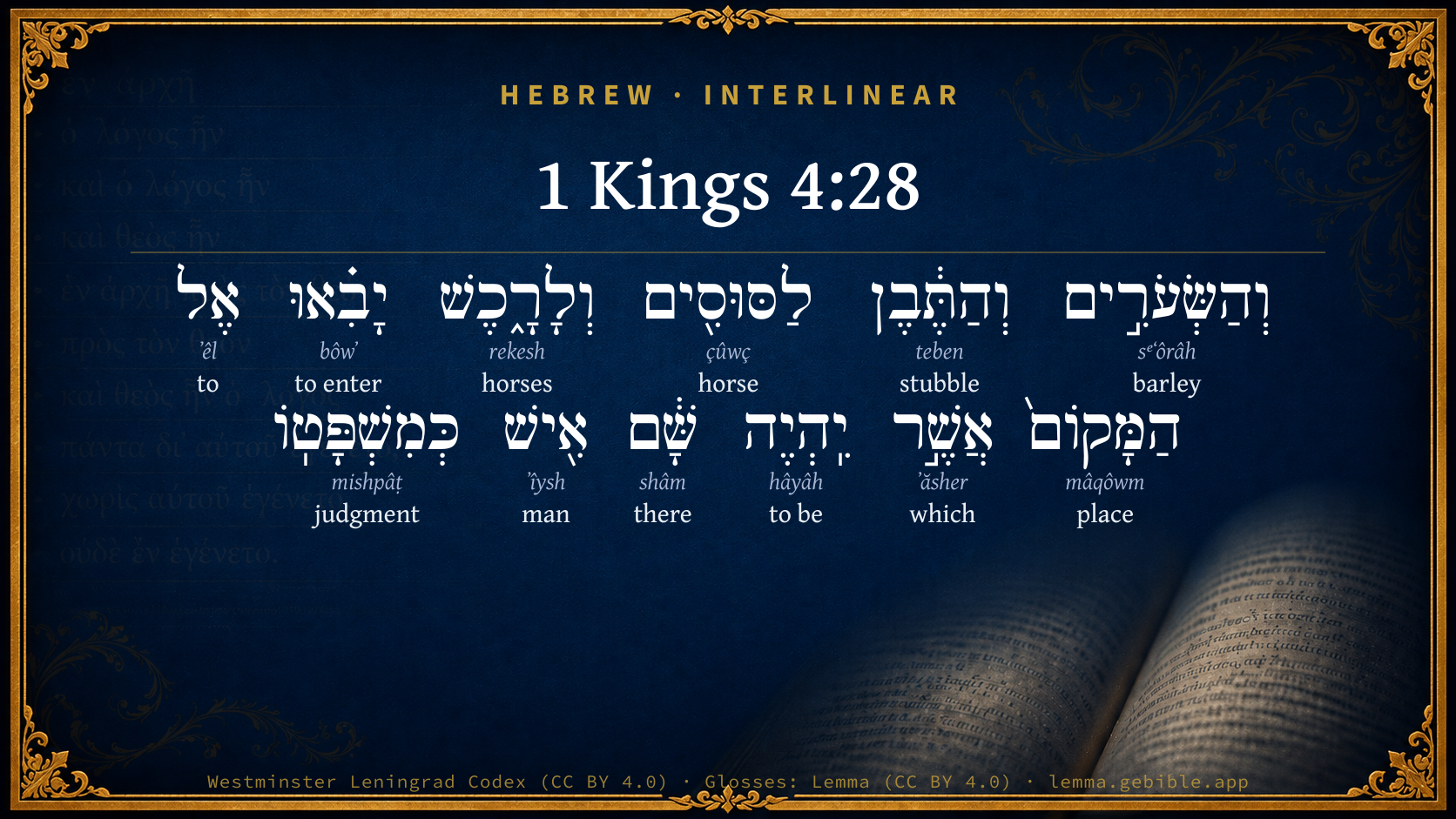
1 Kings 4:28

Hebrew (Westminster Leningrad Codex) 1 Kings 4:28 appears in the Hebrew Old Testament. The text above is from the Westminster Leningrad Codex. Each word links to its Strong’s number, a concise gloss, and parsing drawn from the Open Scriptures Hebrew Bible morphology. Click any word for its full Brown-Driver-Briggs (BDB) entry.
Download image
Cite this verse

1 Kings 4:28 (World English Bible). Public Domain. Lemma interlinear Bible study tool, https://lemma.gebible.app/v/1-kings/4/28.

Show BibTeX & RIS
BibTeX
RIS
English Translation
Barley also and straw for the horses and swift steeds brought they to the place where [the officers] were, every man according to his charge.
World English Bible · Public Domain
Highlights
  • 1 first appearance in the Hebrew Bible
Full analysis ↓
Download a study sheet

One document with this verse’s original text, its word-by-word gloss line, the meaning frame, cross-references with their text, attributed commentary, and full source and license credits — printable, and it pastes into notes with its structure intact.

This verse Autodidact and up

Study sheet (.html) Plain text (.txt)

A passage Seminary Student

Up to 50 verses in one chapter. A passage sheet keeps up to 6 commentary sources and 12 cross-references per verse, in the order this page ranks them, and says so on the sheet whenever that leaves anything out. Ask for a single verse and you get the Autodidact verse sheet above.

Everything on this page stays free to read, with no account — the sheet is a download of what is already on screen, not access to it.

Want to remove ads? Support Godless Engineer
Compare translations 3

The same verse in 3 English versions, stacked beneath the original-language interlinear above. Click any original word for its lexicon entry.

Each is an independent rendering of the whole verse — the interlinear is not word-aligned to these translations.

Highlighted words mark where these versions differ — a whole-verse word diff, not a word-by-word alignment.

  • World English Bible Public Domain
    Barley also and straw for the horses and swift steeds brought they to the place where [the officers] were, every man according to his charge.
  • King James Version Public Domain
    Barley also and straw for the horses and dromedaries brought they unto the place where the officers were, every man according to his charge.
  • unfoldingWord Literal Text CC BY-SA 4.0
    And they brought the barley and the straw for the horses and for the steed to the place where it should be there, a man according to his ordinance.

unfoldingWord Literal Text — © unfoldingWord, licensed CC BY-SA 4.0. Word-aligned USFM3 via Door43 (git.door43.org/unfoldingWord/en_ult).

Versions to compare (up to 4)

3 of 4 selected

Show all 18 translations

Every available English version of this verse, each an independent rendering of the whole verse.

  • World English Bible Public Domain
    Barley also and straw for the horses and swift steeds brought they to the place where [the officers] were, every man according to his charge.
  • Berean Standard Bible Public Domain
    Each one also brought to the required place their quotas of barley and straw for the chariot horses and other horses.
  • Majority Standard Bible Public Domain
    Each one also brought to the required place their quotas of barley and straw for the chariot horses and other horses.
  • King James Version Public Domain
    Barley also and straw for the horses and dromedaries brought they unto the place where the officers were, every man according to his charge.
  • American Standard Version (1901) Public Domain
    Barley also and straw for the horses and swift steeds brought they unto the place where `the officers' were, every man according to his charge.
  • Revised Version (1885) Public Domain
    Barley also and straw for the horses and swift steeds brought they unto the place where the officers were, every man according to his charge.
  • Geneva Bible (1599) Public Domain
    Barley also and strawe for the horses and mules brought they vnto the place where the officers were, euery man according to his charge.
  • Douay-Rheims (1899) Public Domain
    They brought barley also and straw for the horses, and beasts, to the place where the king was, according as it was appointed them.
  • Young's Literal Translation Public Domain
    And the barley and the straw, for horses and for dromedaries, they bring in unto the place where they are, each according to his ordinance.
  • Literal Standard Version CC BY-SA 4.0
    And the barley and the straw, for horses and for dromedaries, they bring to the place where they are, each according to his ordinance.
  • Unlocked Literal Bible CC BY-SA 4.0
    They also brought to the proper place barley and straw for the chariot horses and riding horses, each one bringing in what he was able.
  • unfoldingWord Literal Text CC BY-SA 4.0
    And they brought the barley and the straw for the horses and for the steed to the place where it should be there, a man according to his ordinance.
  • Darby Bible Public Domain
    And the barley, and the straw for the horses and coursers, they brought to the place where [the superintendents] were, every man according to his charge.
  • World Messianic Bible Public Domain
    They also brought barley and straw for the horses and swift steeds to the place where the officers were, each man according to his duty.
  • Webster's Bible Public Domain
    Barley also and straw for the horses and dromedaries they brought to the place where the officers were, every man according to his charge.
  • Free Bible Version CC BY-SA 4.0
    They also delivered barley and straw where they were needed for the chariot horses and cart horses.
  • Bible in Basic English Public Domain
    And they took grain and dry grass for the horses and the carriage-horses, to the right place, every man as he was ordered.
  • JPS Tanakh (1917) Public Domain
    (5-8) Barley also and straw for the horses and swift steeds brought they unto the place where it should be, every man according to his charge.

Literal Standard Version (2020), Covenant Press — licensed CC BY-SA 4.0. Text via the HelloAO Bible API (eBible.org). Unlocked Literal Bible (unfoldingWord) — licensed CC BY-SA 4.0. Text via the HelloAO Bible API (eBible.org). unfoldingWord Literal Text — © unfoldingWord, licensed CC BY-SA 4.0. Word-aligned USFM3 via Door43 (git.door43.org/unfoldingWord/en_ult). Free Bible Version, Dr. Jonathan Gallagher — licensed CC BY-SA 4.0. Text via the HelloAO Bible API (eBible.org).

Word by word

More ways to search: Search by grammar → Find every occurrence → Compare this word →

Practice this passage: Drill this verse → Learn its vocabulary →

וְלָרָ֑כֶשׁ
rekesh
H7409
“and · to/for the · horses”
Conjunction + Preposition, Determined + Noun, Common, Masculine, Singular, Absolute
Part of Speech
Conjunction + Preposition + Noun
Type
Common
Gender
Masculine
Number
Singular
State
Absolute
Full BDB Definition

Origin: from H7408

TWOT: 2167a

steeds, horses
  1. וְהַשְּׂעֹרִ֣ים sᵉʻôrâh H8184 “and · the · barley” Conjunction + Particle, Definite Article + Noun, Common, Feminine, Plural, Absolute
  2. וְהַתֶּ֔בֶן teben H8401 “and · the · stubble” Conjunction + Particle, Definite Article + Noun, Common, Masculine, Singular, Absolute
  3. לַסּוּסִ֖ים çûwç H5483 “to/for the · horses” Preposition, Determined + Noun, Common, Masculine, Plural, Absolute
  4. יָבִ֗אוּ bôwʼ H935 “to enter” Verb, Hiphil, Imperfect, 3rd Person, Masculine, Plural
  5. אֶל ʼêl H413 “to” Preposition
  6. הַמָּקוֹם֙ mâqôwm H4725 “the · place” Particle, Definite Article + Noun, Common, Masculine, Singular, Absolute
  7. אֲשֶׁ֣ר ʼăsher H834 “which” Particle, Relative
  8. יִֽהְיֶה hâyâh H1961 “to be” Verb, Qal, Imperfect, 3rd Person, Masculine, Singular
  9. שָּׁ֔ם shâm H8033 “there” Adverb
  10. אִ֖ישׁ ʼîysh H376 “man” Noun, Common, Masculine, Singular, Absolute
  11. כְּמִשְׁפָּטֽוֹ mishpâṭ H4941 “like/as · judgment · his” Preposition + Noun, Common, Masculine, Singular, Construct + Suffix, Personal, 3rd Person, Masculine, Singular

About this verse

These counts appear in no published source. They are computed here, from the morphology-tagged text and Lemma’s own curated glosses. What Lemma adds →

12
words
12
distinct lemmas
Historical
section

Notable vocabulary

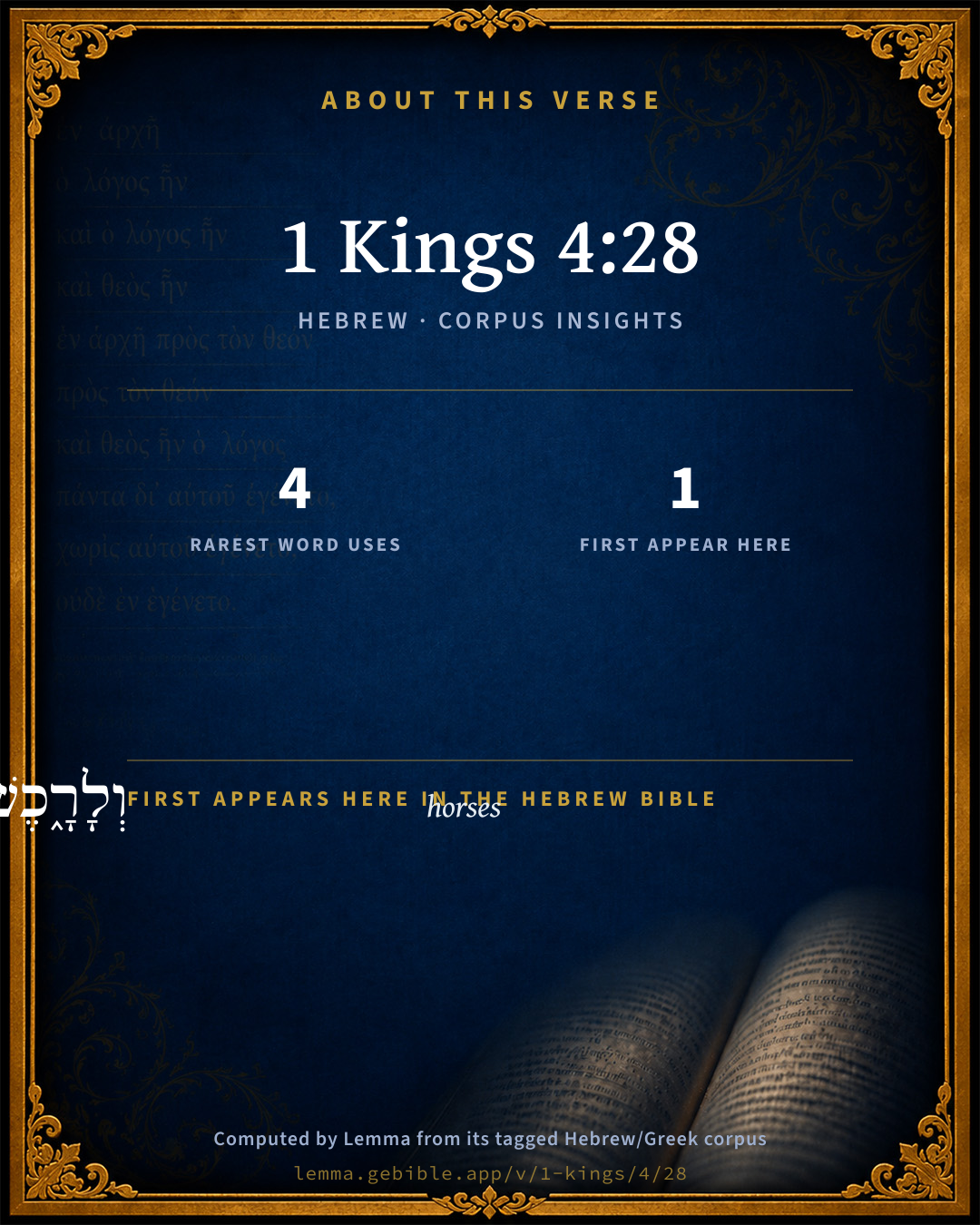
The rarest word here is וְלָרָ֑כֶשׁ horses H7409 — appearing just 4 times in the whole Hebrew Bible.

First appearance in Scripture

This word makes its first canonical appearance in the Hebrew Bible here:

  • וְלָרָ֑כֶשׁ horses H7409

Shared distinctive vocabulary

וְלָרָ֑כֶשׁ horses H7409 occurs in 4 verses of the Hebrew Bible. Also found in:

Grammatical profile

  • 2 verbs
  • 7 nouns
  • 1 preposition
  • 1 adverb
  • 1 particle

Verb forms

  • יָבִ֗אוּ Hiphil · Imperfect
  • יִֽהְיֶה Qal · Imperfect

Cross-references

3

Topical passages linked to 1 Kings 4:28 in the Treasury of Scripture Knowledge — connected by theme and wording, ordered by reader-vote popularity; previews shown in the World English Bible.

  • Esther 8:10 He wrote the name of king Ahasuerus, and sealed it with the king's ring, and sent letters by post on horseback, riding on swift steeds that were used in the king's service, bred of the stud:
  • Esther 8:14 So the posts who rode on swift steeds that were used in the king's service went out, being hurried and pressed on by the king's commandment; and the decree was given out in Shushan the palace.
  • Micah 1:13 Harness the chariot to the swift steed, inhabitant of Lachish. She was the beginning of sin to the daughter of Zion; For the transgressions of Israel were found in you.

Cross-references courtesy of OpenBible.info (CC BY 4.0).

Hebrew and Greek witnesses Masoretic Hebrew ↔ Greek Septuagint

The same verse in the two great witnesses to the Old Testament, shown verse-for-verse.

These are two independent witnesses, not word-aligned to each other, and the Septuagint is shown in lemma (dictionary) form.

Hebrew 1 Kings 4:28 Masoretic · Westminster Leningrad Codex

וְהַשְּׂעֹרִ֣ים וְהַתֶּ֔בֶן לַסּוּסִ֖ים וְלָרָ֑כֶשׁ יָבִ֗אוּ אֶל הַמָּקוֹם֙ אֲשֶׁ֣ר יִֽהְיֶה שָּׁ֔ם אִ֖ישׁ כְּמִשְׁפָּטֽוֹ

Barley also and straw for the horses and swift steeds brought they to the place where [the officers] were, every man according to his charge.

World English Bible · Public Domain

On this verse, Adam Clarke's Commentary discusses the Septuagint’s reading. Read the note in Commentary ↓

Hebrew: Westminster Leningrad Codex (CC BY 4.0). Greek: Septuagint (public domain); English from a public-domain English Septuagint. How the Septuagint differs from the Hebrew →

Commentary

Notes on 1 Kings 4:28 from classic Christian and Jewish commentators (each source and its license shown beneath its notes). The classic Christian expositions comment on the surrounding passage and are grouped to its opening verse, so a note may address several verses; the Jewish commentaries on the Tanakh (Rashi and others) are per-verse, so they appear only where the commentator wrote on this verse.

Lemma curates 59 commentaries, every one of them public domain or Creative Commons licensed, each selected and text-cleaned for this edition rather than reprinted as found. About our sources →

Trapp's Complete Commentary

John Trapp

1Ki 4:28 Barley also and straw for the horses and dromedaries brought they unto the place where [the officers] were, every man according to his charge.

Ver. 28. And dromedaries.] Which are animalia citissima, vecturae apta et equitatui, very swift creatures. It is therefore by antiphrasis that we call slow people dromedaries.

John Trapp, A Commentary or Exposition upon All the Books of the Old and New Testament (1647–1656) — public domain. Text from a community e-Sword module.

Jamieson, Fausset & Brown

Robert Jamieson, A. R. Fausset & David Brown

Barley . . . and straw--Straw is not used for litter, but barley mixed with chopped straw is the usual fodder of horses.

dromedaries--one-humped camels, distinguished for their great fleetness.

Jamieson, Fausset & Brown — Commentary Critical and Explanatory on the Whole Bible (1871) — public domain (CC PDM 1.0). Text via the HelloAO Bible API.

Adam Clarke's Commentary

Verse 28. And dromedaries] The word רכש rechesh, which we translate thus, is rendered beasts, or beasts of burden, by the Vulgate; mares by the Syriac and Arabic; chariots by the Septuagint; and race-horses by the Chaldee. The original word seems to signify a very swift kind of horse, and race-horse or post-horse is probably its true meaning. To communicate with so many distant provinces, Solomon had need of many animals of this kind.

Adam Clarke's Commentary on the Bible (1810–1826) — public domain. Text from a community e-Sword/MySword module.

Ellicott's Commentary for English Readers

(28) Dromedaries—properly (see Margin), swift beasts; probably the horses of the royal messengers, as distinguished from the war horses.

A Bible Commentary for English Readers, edited by Charles John Ellicott (1878–1897) — public domain. Text from a community e-Sword module.

The Cambridge Bible for Schools and Colleges

gen. ed. J. J. S. Perowne

28. unto the place where the officers were] As shewn by the italics of A. V. there is no word in the original for ‘the officers.’ The verb moreover is in the singular. It is better therefore to render with the margin of R.V. ‘where he (i.e. the king) was’ or ‘where it should be.’

The Cambridge Bible for Schools and Colleges (gen. ed. J. J. S. Perowne; Cambridge University Press, 1878–1918) — public domain. Text from a community e-Sword module.

John Gill's Exposition

For he was wiser than all men,.... Not only that lived in his time, but in ages past since the fall of Adam, and in times to come, especially in natural wisdom and knowledge, in all the branches of it; for though some men excel in some part of knowledge, yet not in all, as Solomon did:

than Ethan the Ezrahite, and Heman, and Chalcol, and Darda, the sons of Mahol; men of the same names are said to be sons of Zerah, grandson of Judah, Ch1 2:6; wherefore these are either other men, or their father had two names; or Mahol here may be an appellative, and describe the character of these then, and point at what they were famous for, as that they were sons of music, piping, and dancing, as Mahol may signify; the Jews have a tradition (o), that Ethan is Abraham, and Heman Moses, and Chalcol Joseph:

and his fame was in all nations round about; not for his riches and grandeur only, but chiefly for his wisdom.

(o) Hieron. Trad. Heb. in 2 Reg. fol. 80. 1.

John Gill's Exposition of the Whole Bible (1746–1763) — public domain (CC PDM 1.0). Text via the HelloAO Bible API.

Albert Barnes' Notes on the Bible

Barley is to this day in the East the common food of horses.

Dromedaries - Coursers. The animal intended is neither a camel nor a mule, but a swift horse.

The place where the officers were - Rather, “places where the horses and coursers were,” i. e., to the different cities where they were lodged.

Albert Barnes' Notes on the Bible (1834–1885) — public domain. Text from a community e-Sword/MySword module.

Haydock's Catholic Bible Commentary

Beasts. Racesh denotes horses of extraordinary swiftness, (Bochart) or dromedaries, &c. Junius translates, "post-horses." --- King: so also the Septuagint. Protestants, "the officers were, every man according to his charge." The twelve governors employed others to bring all necessary provisions, (Haydock) to the places where the king was travelling; (Calmet) or they took care not only of the king’s table, but they had also the general inspection over his stables. (Haydock) --- Few oats are grown in the East. They feed their horses on barley and straw. (Calmet)

George Leo Haydock (1774–1849), Haydock's Catholic Family Bible and Commentary, 1859 edition — public domain. Excludes Psalms (Douay-Rheims chapter numbering differs from Protestant) and Deuterocanonical books (Catholic canon only).

Matthew Poole's English Annotations

Dromedaries, or mules, by comparing this with 2Ch 9:24; or post horses, which are particularly mentioned and distinguished from the other horses, because they took a more exact and particular care about them. Howsoever, it is agreed that these were swift beasts, which is evident from Est 8:10,14; Mic 1:13.

Matthew Poole's English Annotations on the Holy Bible (1683–1685) — public domain. Text from a community e-Sword/MySword module.

Whedon's Commentary on the Bible

Daniel D. Whedon

28. Dromedaries — The dromedary differs from the camel in being of a finer and more elegant form, having one hump on the back instead of two, and in being trained for greater speed. But the Hebrew word רכשׁmeans a swift-courser, or race-horse, and in Mic_1:13, is rendered swift-beast, one that was used with the chariot, and so could hardly be the dromedary. In Est_8:10; Est_8:14, it is rendered mule, but swift-courser would be better.

Where the officers were — The Septuagint and Vulgate read, where the king was. But it is still better simply to supply they, referring to the horses and coursers. The barley and straw were brought where the horses were kept by those who had this matter in charge, every man according to his charge — כמשׁפשׂו, literally, according to his judgment; that is, according to the amount which it was decided each should bring.

Daniel D. Whedon (gen. ed.), Commentary on the Old and New Testaments (1874–1909) — public domain. Text from a community e-Sword module.

The Pulpit Commentary

Barley also the food of horses at the present day in the East, where oats are not grown. (Cf. Hom. II 5:196) and straw for the horses and dromedaries marg. mules or swift beasts. Coursers, or fleet horses of superior breed are intended. vkr= Germ. Renner. These coursers were for the use of the king"s messengers or posts. (See Est_8:10, Est_8:14) brought they unto the place where the officers were "officers" is not in the Hebrew. The LXX and Vulg. supply "king "(the verb is singular, "was"). But the true meaning is to be gathered from chap. 10:26. There we learn that the horses were distributed in different towns throughout the land. To these different depots, therefore, the purveyors must forward the provender, "unto the place where it should be" (hyhyi), not, as Rawlinson, "where the horses were." every man according to his charge.

The Pulpit Commentary (1880–1919), ed. H.D.M. Spence-Jones & Joseph S. Exell — public domain. Text from a community e-Sword module.

Lesson kit

Teaching starters — assembled from the data on this page, not authored interpretation. Every prompt links to the verse data it draws on. Edit before teaching.

1 Kings, in the Historical, opens this verse with 12 words (12 distinct Hebrew lemmas). Its most distinctive word is rekesh (“horses”). A historical commentator’s framing appears above. Read the whole chapter for the surrounding context.

Discussion questions

  1. How does “horses” (rekesh) shape what this verse is saying?
  2. This is the first place “horses” appears in Scripture (first appears here). What does its debut here establish?
  3. How does Esther 8:10, which shares the word «horses», read alongside this verse?
  4. These translations render this verse differently. What is at stake in choosing one wording over another?
  5. «יָבִ֗אוּ» is a Hiphil Imperfect verb. How does that grammatical form shape the action described?
  6. Compare how Trapp's Complete Commentary and Jamieson, Fausset & Brown read this verse. Where do they agree or differ?

Things to notice

Reading settings

Reading text

Shown beneath each verse's original-language words.

Old Testament
Old Testament edition

Read the OT as the Masoretic Hebrew (MT) or the Greek Septuagint (LXX).

English shown for the Greek Septuagint (in the Hebrew ↔ Greek comparison).

Comparing translations? Open the Compare panel on any verse page to stack up to four side by side.