
2 Kings 23:16

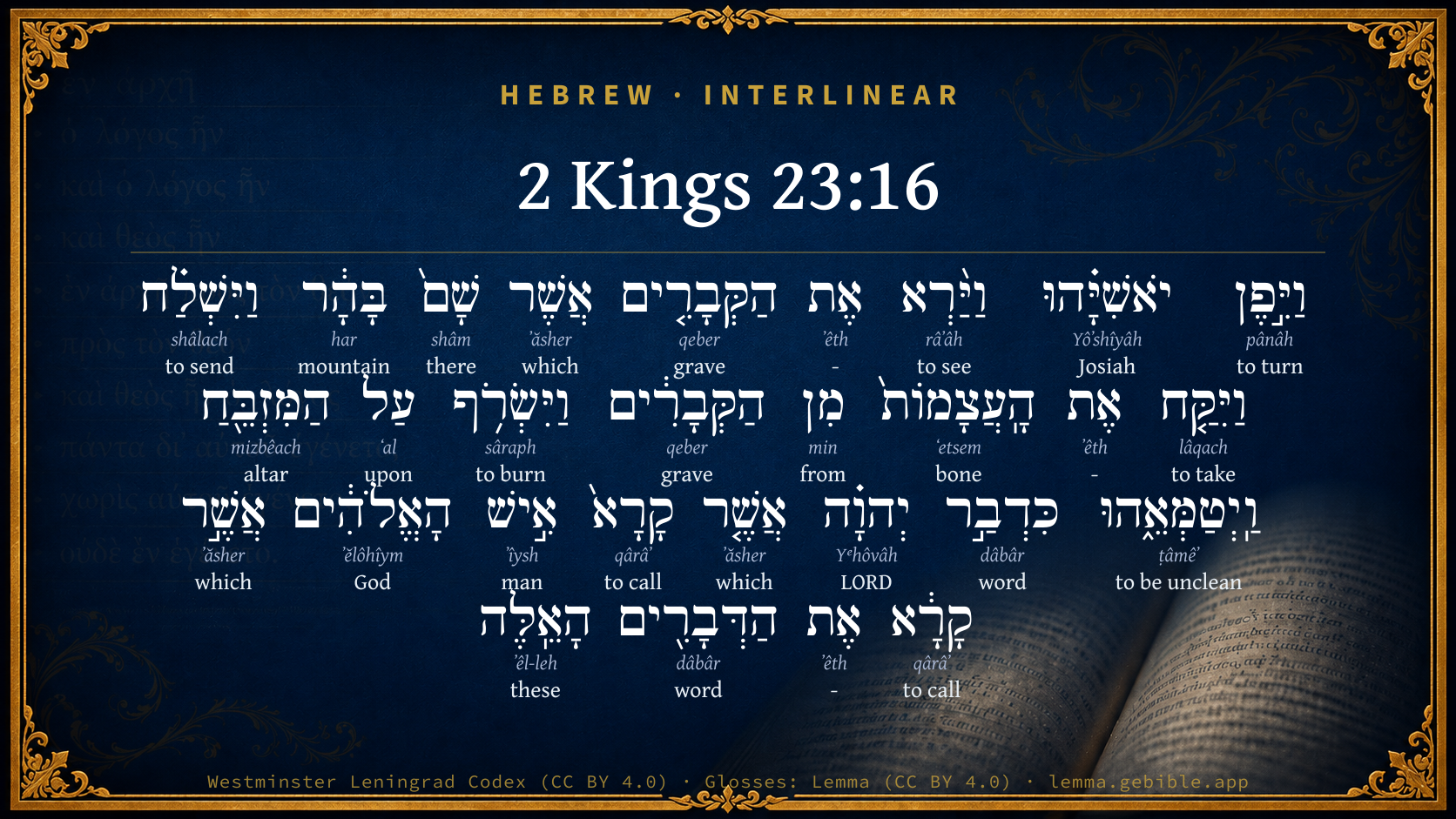
Hebrew (Westminster Leningrad Codex) 2 Kings 23:16 appears in the Hebrew Old Testament. The text above is from the Westminster Leningrad Codex. Each word links to its Strong’s number, a concise gloss, and parsing drawn from the Open Scriptures Hebrew Bible morphology. Click any word for its full Brown-Driver-Briggs (BDB) entry.
Download image
Cite this verse

2 Kings 23:16 (World English Bible). Public Domain. Lemma interlinear Bible study tool, https://lemma.gebible.app/v/2-kings/23/16.

Show BibTeX & RIS
BibTeX
RIS
English Translation
As Josiah turned himself, he spied the tombs that were there in the mountain; and he sent, and took the bones out of the tombs, and burned them on the altar, and defiled it, according to the word of Yahweh which the man of God proclaimed, who proclaimed these things.
World English Bible · Public Domain
Download a study sheet

One document with this verse’s original text, its word-by-word gloss line, the meaning frame, cross-references with their text, attributed commentary, and full source and license credits — printable, and it pastes into notes with its structure intact.

This verse Autodidact and up

Study sheet (.html) Plain text (.txt)

A passage Seminary Student

Up to 50 verses in one chapter. A passage sheet keeps up to 6 commentary sources and 12 cross-references per verse, in the order this page ranks them, and says so on the sheet whenever that leaves anything out. Ask for a single verse and you get the Autodidact verse sheet above.

Everything on this page stays free to read, with no account — the sheet is a download of what is already on screen, not access to it.

Want to remove ads? Support Godless Engineer
Compare translations 3

The same verse in 3 English versions, stacked beneath the original-language interlinear above. Click any original word for its lexicon entry.

Each is an independent rendering of the whole verse — the interlinear is not word-aligned to these translations.

Highlighted words mark where these versions differ — a whole-verse word diff, not a word-by-word alignment.

  • World English Bible Public Domain
    As Josiah turned himself, he spied the tombs that were there in the mountain; and he sent, and took the bones out of the tombs, and burned them on the altar, and defiled it, according to the word of Yahweh which the man of God proclaimed, who proclaimed these things.
  • King James Version Public Domain
    And as Josiah turned himself, he spied the sepulchres that were there in the mount, and sent, and took the bones out of the sepulchres, and burned them upon the altar, and polluted it, according to the word of the LORD which the man of God proclaimed, who proclaimed these words.
  • unfoldingWord Literal Text CC BY-SA 4.0
    And Josiah turned and saw the graves that there on the mountain, and he sent and took bones from the graves and burned on the altar. So he defiled it, according to the word of Yahweh that the man of God proclaimed who had proclaimed these things.

unfoldingWord Literal Text — © unfoldingWord, licensed CC BY-SA 4.0. Word-aligned USFM3 via Door43 (git.door43.org/unfoldingWord/en_ult).

Versions to compare (up to 4)

3 of 4 selected

Show all 18 translations

Every available English version of this verse, each an independent rendering of the whole verse.

  • World English Bible Public Domain
    As Josiah turned himself, he spied the tombs that were there in the mountain; and he sent, and took the bones out of the tombs, and burned them on the altar, and defiled it, according to the word of Yahweh which the man of God proclaimed, who proclaimed these things.
  • Berean Standard Bible Public Domain
    And as Josiah turned, he saw the tombs there on the hillside, and he sent someone to take the bones out of the tombs, and he burned them on the altar to defile it, according to the word of the LORD proclaimed by the man of God who had foretold these things.
  • Majority Standard Bible Public Domain
    And as Josiah turned, he saw the tombs there on the hillside, and he sent someone to take the bones out of the tombs, and he burned them on the altar to defile it, according to the word of the LORD proclaimed by the man of God who had foretold these things.
  • King James Version Public Domain
    And as Josiah turned himself, he spied the sepulchres that were there in the mount, and sent, and took the bones out of the sepulchres, and burned them upon the altar, and polluted it, according to the word of the LORD which the man of God proclaimed, who proclaimed these words.
  • American Standard Version (1901) Public Domain
    And as Josiah turned himself, he spied the sepulchres that were there in the mount; and he sent, and took the bones out of the sepulchres, and burned them upon the altar, and defiled it, according to the word of Jehovah which the man of God proclaimed, who proclaimed these things.
  • Revised Version (1885) Public Domain
    And as Josiah turned himself, he spied the sepulchres that were there in the mount; and he sent, and took the bones out of the sepulchres, and burned them upon the altar, and defiled it, according to the word of the LORD which the man of God proclaimed, who proclaimed these things.
  • Geneva Bible (1599) Public Domain
    And as Iosiah turned himselfe, he spied the graues, that were in the mount, and sent and tooke the bones out of the graues, and burnt them vpon the altar and polluted it, according to the word of the Lord, that the man of God proclaimed, which cryed the same wordes.
  • Douay-Rheims (1899) Public Domain
    And as Josias turned himself, he saw there the sepulchres that were in the mount: and he sent and took the bones out of the sepulchres, and burnt them upon the altar, and defiled it according to the word of the Lord, which the man of God spoke, who had foretold these things.
  • Young's Literal Translation Public Domain
    And Josiah turneth, and seeth the graves that `are' there in the mount, and sendeth and taketh the bones out of the graves, and burneth `them' on the altar, and defileth it, according to the word of Jehovah that the man of God proclaimed, who proclaimed these things.
  • Literal Standard Version CC BY-SA 4.0
    And Josiah turns, and sees the graves that [are] there on the mountain, and sends and takes the bones out of the graves, and burns [them] on the altar, and defiles it, according to the word of YHWH that the man of God proclaimed, who proclaimed these things.
  • Unlocked Literal Bible CC BY-SA 4.0
    As Josiah looked over the area, he noticed the graves that were on the hillside. He sent men to take the bones from the graves; then he burned them on the altar, which defiled it. This was according to the word of Yahweh which the man of God had spoken, the man who spoke of these things beforehand.
  • unfoldingWord Literal Text CC BY-SA 4.0
    And Josiah turned and saw the graves that there on the mountain, and he sent and took bones from the graves and burned on the altar. So he defiled it, according to the word of Yahweh that the man of God proclaimed who had proclaimed these things.
  • Darby Bible Public Domain
    And Josiah turned himself, and saw the sepulchres that were there on the mount; and he sent and took the bones out of the sepulchres, and burned [them] upon the altar, and defiled it, according to the word of Jehovah, that the man of God had proclaimed, who proclaimed these things.
  • World Messianic Bible Public Domain
    As Josiah turned himself, he spied the tombs that were there in the mountain; and he sent, and took the bones out of the tombs, and burned them on the altar, and defiled it, according to the LORD’s word which the man of God proclaimed, who proclaimed these things.
  • Webster's Bible Public Domain
    And as Josiah turned himself, he espied the sepulchers that were there on the mount, and sent, and took the bones out of the sepulchers, and burned them upon the altar, and polluted it, according to the word of the LORD which the man of God proclaimed, who proclaimed these words.
  • Free Bible Version CC BY-SA 4.0
    As Josiah looked around he saw some tombs there on the hill. He had the bones taken from the tombs, and he burned them on the altar to defile it, just as the Lord had said through the man of God who had prophesied these things.
  • Bible in Basic English Public Domain
    Then Josiah, turning round, saw on the mountain the places of the dead, and he sent and had the bones taken out of their places and burned on the altar, so making it unclean, as the Lord had said by the man of God when Jeroboam was in his place by the altar on that feast-day. And he, turning his eyes to the resting-place of the man of God who had given word of these things, said:
  • JPS Tanakh (1917) Public Domain
    And as Josiah turned himself, he spied the sepulchres that were there in the mount; and he sent, and took the bones out of the sepulchres, and burned them upon the altar, and defiled it, according to the word of the LORD which the man of God proclaimed, who proclaimed these things.

Literal Standard Version (2020), Covenant Press — licensed CC BY-SA 4.0. Text via the HelloAO Bible API (eBible.org). Unlocked Literal Bible (unfoldingWord) — licensed CC BY-SA 4.0. Text via the HelloAO Bible API (eBible.org). unfoldingWord Literal Text — © unfoldingWord, licensed CC BY-SA 4.0. Word-aligned USFM3 via Door43 (git.door43.org/unfoldingWord/en_ult). Free Bible Version, Dr. Jonathan Gallagher — licensed CC BY-SA 4.0. Text via the HelloAO Bible API (eBible.org).

Word by word

More ways to search: Search by grammar → Find every occurrence → Compare this word →

Practice this passage: Drill this verse → Learn its vocabulary →

יֹאשִׁיָּ֗הוּ
Yôʼshîyâh
H2977
“Josiah”
Noun, Proper
Part of Speech
Noun
Type
Proper
Full BDB Definition

Origin: from the same root as H803 and H3050

TWOT: None

Josiah = "whom Jehovah heals" - son of Amon by Jedidah who succeeded his father to the throne of Judah and reigned for 31 years; his reign is noteworthy for the great revivals back to the worship of Jehovah which he led - a returned exile and son of Zephaniah at whose house took place the solemn and symbolical crowning of Joshua the high priest in the time of Zechariah the prophet
  1. וַיִּ֣פֶן pânâh H6437 “and · to turn” Conjunction + Verb, Qal, Sequential Imperfect, 3rd Person, Masculine, Singular
  2. וַיַּ֨רְא râʼâh H7200 “and · to see” Conjunction + Verb, Qal, Sequential Imperfect, 3rd Person, Masculine, Singular
  3. אֶת ʼêth H853 “-” Particle, Direct Object
  4. הַקְּבָרִ֤ים qeber H6913 “the · graves” Particle, Definite Article + Noun, Common, Masculine, Plural, Absolute
  5. אֲשֶׁר ʼăsher H834 “which” Particle, Relative
  6. שָׁם֙ shâm H8033 “there” Adverb
  7. בָּהָ֔ר har H2022 “in/at the · mountain” Preposition, Determined + Noun, Common, Masculine, Singular, Absolute
  8. וַיִּשְׁלַ֗ח shâlach H7971 “and · to send” Conjunction + Verb, Qal, Sequential Imperfect, 3rd Person, Masculine, Singular
  9. וַיִּקַּ֤ח lâqach H3947 “and · to take” Conjunction + Verb, Qal, Sequential Imperfect, 3rd Person, Masculine, Singular
  10. אֶת ʼêth H853 “-” Particle, Direct Object
  11. הָֽעֲצָמוֹת֙ ʻetsem H6106 “the · bones” Particle, Definite Article + Noun, Common, Feminine, Plural, Absolute
  12. מִן min H4480 “from” Preposition
  13. הַקְּבָרִ֔ים qeber H6913 “the · graves” Particle, Definite Article + Noun, Common, Masculine, Plural, Absolute
  14. וַיִּשְׂרֹ֥ף sâraph H8313 “and · to burn” Conjunction + Verb, Qal, Sequential Imperfect, 3rd Person, Masculine, Singular
  15. עַל ʻal H5921 “upon” Preposition
  16. הַמִּזְבֵּ֖חַ mizbêach H4196 “the · altar” Particle, Definite Article + Noun, Common, Masculine, Singular, Absolute
  17. וַֽיְטַמְּאֵ֑הוּ ṭâmêʼ H2930 “and · to be unclean · him” Conjunction + Verb, Piel, Sequential Imperfect, 3rd Person, Masculine, Singular + Suffix, Personal, 3rd Person, Masculine, Singular
  18. כִּדְבַ֣ר dâbâr H1697 “like/as · word of” Preposition + Noun, Common, Masculine, Singular, Construct
  19. יְהוָ֗ה Yᵉhôvâh H3068 “LORD” Noun, Proper
  20. אֲשֶׁ֤ר ʼăsher H834 “which” Particle, Relative
  21. קָרָא֙ qârâʼ H7121 “to call” Verb, Qal, Perfect, 3rd Person, Masculine, Singular
  22. אִ֣ישׁ ʼîysh H376 “man of” Noun, Common, Masculine, Singular, Construct
  23. הָאֱלֹהִ֔ים ʼĕlôhîym H430 “the · God(s)” Particle, Definite Article + Noun, Common, Masculine, Plural, Absolute
  24. אֲשֶׁ֣ר ʼăsher H834 “which” Particle, Relative
  25. קָרָ֔א qârâʼ H7121 “to call” Verb, Qal, Perfect, 3rd Person, Masculine, Singular
  26. אֶת ʼêth H853 “-” Particle, Direct Object
  27. הַדְּבָרִ֖ים dâbâr H1697 “the · words” Particle, Definite Article + Noun, Common, Masculine, Plural, Absolute
  28. הָאֵֽלֶּה ʼêl-leh H428 “the · these” Particle, Definite Article + Pronoun, Demonstrative, Common, Plural

About this verse

These counts appear in no published source. They are computed here, from the morphology-tagged text and Lemma’s own curated glosses. What Lemma adds →

29
words
22
distinct lemmas
Historical
section

Shared distinctive vocabulary

יֹאשִׁיָּ֗הוּ Josiah H2977 occurs in 48 verses of the Hebrew Bible. Also found in:

Grammatical profile

  • 8 verbs
  • 11 nouns
  • 1 pronoun
  • 2 prepositions
  • 1 adverb
  • 6 particles

Verb forms

  • וַיִּ֣פֶן Qal · Sequential Imperfect
  • וַיַּ֨רְא Qal · Sequential Imperfect
  • וַיִּשְׁלַ֗ח Qal · Sequential Imperfect
  • וַיִּקַּ֤ח Qal · Sequential Imperfect
  • וַיִּשְׂרֹ֥ף Qal · Sequential Imperfect
  • וַֽיְטַמְּאֵ֑הוּ Piel · Sequential Imperfect
  • קָרָא֙ Qal · Perfect
  • קָרָ֔א Qal · Perfect

Repetition

Words recur within this verse — often emphatic in Hebrew:

  • הַקְּבָרִ֤ים grave H6913 ×2
  • כִּדְבַ֣ר word H1697 ×2
  • קָרָא֙ to call H7121 ×2
  • אֲשֶׁר which H834 ×3

Hebrew & Septuagint length

In English translation the verse runs 50 words from the Hebrew and 74 from the Septuagint (LXX English) — the Septuagint runs noticeably longer here. See the side-by-side →

A rough comparison of the two English renderings, which tokenize alike — not a word-level alignment.

Word counts can differ between the Hebrew and the Greek without any difference in meaning — e.g. the Hebrew direct-object marker אֵת has no separate Greek word, and Greek often adds the article ὁ.

Cross-references

4

Topical passages linked to 2 Kings 23:16 in the Treasury of Scripture Knowledge — connected by theme and wording, ordered by reader-vote popularity; previews shown in the World English Bible.

  • 1 Kings 13:1–2 Behold, there came a man of God out of Judah by the word of Yahweh to Beth El: and Jeroboam was standing by the altar to burn incense.
  • 1 Kings 13:32 For the saying which he cried by the word of Yahweh against the altar in Bethel, and against all the houses of the high places which are in the cities of Samaria, shall surely happen.
  • Matthew 24:35 Heaven and earth will pass away, but my words will not pass away.
  • John 10:35 If he called them gods, to whom the word of God came (and the Scripture can't be broken),

Cross-references courtesy of OpenBible.info (CC BY 4.0).

Hebrew and Greek witnesses Masoretic Hebrew ↔ Greek Septuagint

The same verse in the two great witnesses to the Old Testament, shown verse-for-verse.

Here the Septuagint runs noticeably longer than the Hebrew — LXX2012 (modern English Septuagint) 74 words vs World English Bible 50. A rough length comparison of the two English translations, not a word-level alignment — read both below.

These are two independent witnesses, not word-aligned to each other, and the Septuagint is shown in lemma (dictionary) form.

Hebrew 2 Kings 23:16 Masoretic · Westminster Leningrad Codex

וַיִּ֣פֶן יֹאשִׁיָּ֗הוּ וַיַּ֨רְא אֶת הַקְּבָרִ֤ים אֲשֶׁר שָׁם֙ בָּהָ֔ר וַיִּשְׁלַ֗ח וַיִּקַּ֤ח אֶת הָֽעֲצָמוֹת֙ מִן הַקְּבָרִ֔ים וַיִּשְׂרֹ֥ף עַל הַמִּזְבֵּ֖חַ וַֽיְטַמְּאֵ֑הוּ כִּדְבַ֣ר יְהוָ֗ה אֲשֶׁ֤ר קָרָא֙ אִ֣ישׁ הָאֱלֹהִ֔ים אֲשֶׁ֣ר קָרָ֔א אֶת הַדְּבָרִ֖ים הָאֵֽלֶּה

As Josiah turned himself, he spied the tombs that were there in the mountain; and he sent, and took the bones out of the tombs, and burned them on the altar, and defiled it, according to the word of Yahweh which the man of God proclaimed, who proclaimed these things.

World English Bible · Public Domain

Greek LXX 2 Kings 23:16 Septuagint · lemma form

καί ἐκνεύω ιωσιας καί ὁράω ὁ τάφος ὁ εἰμί ἐκεῖ ἐν ὁ πόλις καί ἀποστέλλω καί λαμβάνω ὁ ὀστέον ἐκ ὁ τάφος καί κατακαίω ἐπί ὁ θυσιαστήριον καί μιαίνω αὐτός κατά ὁ ῥῆμα κύριος ὅς λαλέω ὁ ἄνθρωπος ὁ θεός ἐν ὁ ἵστημι ιεροβοαμ ἐν ὁ ἑορτή ἐπί ὁ θυσιαστήριον καί ἐπιστρέφω αἴρω ὁ ὀφθαλμός αὐτός ἐπί ὁ τάφος ὁ ἄνθρωπος ὁ θεός ὁ λαλέω ὁ λόγος οὗτος

And Josias turned aside, and saw the tombs that were there in the city, and sent, and took the bones out of the tombs, and burnt them on the altar, and defiled it, according to the word of the Lord which the man of God spoke, when Jeroboam stood by the altar at the feast: and he turned and raised his eyes to the tomb of the man of God that spoke these words.

LXX2012 (modern English Septuagint) · Public Domain

On this verse, Ellicott's Commentary for English Readers discusses the Septuagint’s reading. Read the note in Commentary ↓

Hebrew: Westminster Leningrad Codex (CC BY 4.0). Greek: Septuagint (public domain); English from LXX2012 (modern English Septuagint) (Public Domain). How the Septuagint differs from the Hebrew →

Targum (Aramaic paraphrase)

1

The Targum is the ancient Jewish Aramaic paraphrase of the Hebrew Scriptures — an interpretive translation, not the Hebrew text itself. Onkelos (literal) and Pseudo-Jonathan (expansive) render the Torah, and Jonathan the Prophets. Coverage is partial: where no permissively-licensed English translation exists for a verse, only the Aramaic is shown. This is verse-level text, not a word-by-word alignment to the Hebrew.

  1. Targum Jonathan Prophets (Joshua–Malachi)
    וְאִתְפְּנֵי יֹאשִׁיָהוּ וַחֲזָא יַת קִבְרַיָא דְתַמָן בְּטוּרָא וּשְׁלַח וּנְסִיב יַת גַרְמַיָא מִן קִבְרַיָא וְאוֹקִיד עַל אֱגוֹרַיָא וְסַאֲבֵיהּ כְּפִתְגָמָא דַייָ דְמַלֵיל נְבִיָא דַייָ דְאִתְנַבֵּי יַת פִּתְגָמַיָא הָאִלֵין:

    (no public-domain English translation for this verse)

    Targum Jonathan — Aramaic: “Mikraot Gedolot” (public domain). English: “Sefaria Community Translation” (CC0 1.0 (public-domain dedication)); “London "Chaldee Paraphrase," 1871” (public domain). Text via Sefaria.

Commentary

Notes on 2 Kings 23:16 from classic Christian and Jewish commentators (each source and its license shown beneath its notes). The classic Christian expositions comment on the surrounding passage and are grouped to its opening verse, so a note may address several verses; the Jewish commentaries on the Tanakh (Rashi and others) are per-verse, so they appear only where the commentator wrote on this verse.

Lemma curates 59 commentaries, every one of them public domain or Creative Commons licensed, each selected and text-cleaned for this edition rather than reprinted as found. About our sources →

Ellicott's Commentary for English Readers

(16) Turned himself.—So that he caught sight of the tombs on the hill-side opposite—not on the hill where the high place was.

The man of God proclaimed.—Some words appear to have fallen out of the Hebrew text here, for the LXX. adds, “when Jeroboam stood in the feast at the altar. And he returned and lifted up his eyes upon the grave of the man of God.” (A transcriber’s eye wandered from one “man of God” to the other.) Josiah returned, when on the point of going away.

(16-18) These verses are supposed by Stähelin to be a fictitious addition of the compiler’s. Thenius does not go so far as this, but assumes that the proper sequel of 1Ki_13:1-32, has been transferred to this place. He argues that it must be an interpolation here, because (1) the “moreover” of 2Ki_23:15 (wìgam) corresponds to the “and . . . also” (wìgam) of 2Ki_23:19, which does not prove much; and because (2) Josiah could not pollute the altar (2Ki_23:16) after he had already shattered it in pieces (2Ki_23:15). This reasoning is not conclusive, because it is obvious that, as is so often the case, the writer has first told in brief what was done to the altar and high place at Bethel, and then related at length an interesting incident that occurred at the time. In short, the statement of 2Ki_23:15 is anticipatory.

A Bible Commentary for English Readers, edited by Charles John Ellicott (1878–1897) — public domain. Text from a community e-Sword module.

Trapp's Complete Commentary

John Trapp

2Ki 23:16 And as Josiah turned himself, he spied the sepulchres that [were] there in the mount, and sent, and took the bones out of the sepulchres, and burned [them] upon the altar, and polluted it, according to the word of the LORD which the man of God proclaimed, who proclaimed these words.

Ver. 16. He sent and took the bones.] That had been foreseen and foretold three hundred years at least before. {1Ki 13:2} Intervention ofttimes breaks no square in the divine decrees. Our blind eyes see nothing but that which toucheth their lids: the quick sight of God’s prescience sees that as present which is a world afar off.

John Trapp, A Commentary or Exposition upon All the Books of the Old and New Testament (1647–1656) — public domain. Text from a community e-Sword module.

Joseph Benson's Commentary

2Ki 23:16. As Josiah turned himself — His care and zeal were so great that he would not trust his officers with these things, but would see them done with his own eyes. He spied the sepulchres that were in the mount — It is not said whose sepulchres they were, but it is probable they were those of the idolatrous priests, (for, 2Ch 34:5, he is said to have burned their bones,) and of the false prophets and great men who had been instruments to promote Jeroboam’s idolatry, and who were so attached to their altar at Beth-el, that they were desirous to have their bones laid near it. And burned them, &c., according to the word which the man of God proclaimed — Who foretold, three hundred and sixty-two years before, that these very things should be done by a king called Josiah, 1Ki 13:2. God always foresees, and has sometimes foretold as certain, that which yet to us seems most contingent. Of this we have here a remarkable instance. No word of God shall fall to the ground!

Joseph Benson's Commentary on the Old and New Testaments (1811–1818) — public domain. Text from a community e-Sword module.

Geneva Bible (1599)

Geneva Bible translators

According to the prophecy of Iddo, 1 Kings 13:2.

Geneva Bible (1599) marginal notes — public domain. Text via Bolls.life.

Jamieson, Fausset & Brown

Robert Jamieson, A. R. Fausset & David Brown

according to the word of the Lord which the man of God proclaimed, &c.--In carrying on these proceedings, Josiah was prompted by his own intense hatred of idolatry. But it is remarkable that this act was predicted three hundred twenty-six years before his birth, and his name also was expressly mentioned, as well as the very place where it should be done (Kg1 13:2). This is one of the most most remarkable prophecies in the Bible.

Jamieson, Fausset & Brown — Commentary Critical and Explanatory on the Whole Bible (1871) — public domain (CC PDM 1.0). Text via the HelloAO Bible API.

Adam Clarke's Commentary

Verse 16. And as Josiah turned himself] This verse is much more complete in the Septuagint, and in the Hexaplar Syriac version at Paris. I shall give the whole, making a distinction where, in those versions, any thing is added: "And as Josiah turned himself, he spied the sepulchres that were there in the mount, and sent and took the bones out of the sepulchres, and burnt them upon the altar, and polluted it: according to the word of the Lord which the man of God proclaimed [when Jeroboam stood by the altar at the feast. And turning about, he cast his eyes on the sepulchre of the man of God] who proclaimed these words." See 1Kg 13:2, where these things were predicted, and see the notes there.

Adam Clarke's Commentary on the Bible (1810–1826) — public domain. Text from a community e-Sword/MySword module.

The Cambridge Bible for Schools and Colleges

gen. ed. J. J. S. Perowne

16. Josiah turned himself] i.e. To view the overthrow and to satisfy himself that all had been thoroughly destroyed. The king was zealous in the work, and personally superintended what he wished to have done.

he spied the sepulchres] Not close by where the altar and the high place had stood, but on some other hill, which was visible from where the king was standing.

burnt them upon the altar, and polluted [R.V. defiled] it] The change is for consistency. We have the verb translated ‘defile’ in verses 8, 10 and 13.

according to the word of the Lord] For the history here referred to see 1Ki_13:2.

these words] R.V. things. This is the translation in the very next verse.

The Cambridge Bible for Schools and Colleges (gen. ed. J. J. S. Perowne; Cambridge University Press, 1878–1918) — public domain. Text from a community e-Sword module.

John Gill's Exposition

Then he said, what title is that that I see?.... A high and large monument over a grave, with an inscription on it, more remarkable than any of the rest, which made Josiah take notice of it; and the Jews have a tradition, as Kimchi observes, that on one side of the grave grew nettles and thistles, and on the other side odoriferous herbs; which is not to be depended on; but what he further observes may be right, that the old prophet, as he gave orders to his sons to lay his body in the same grave with the man of God, believing his words would be fulfilled, so he likewise gave orders to have a distinguished monument or pillar erected over the grave; and which people in later times took care to support, in memory of the man of God, that thereby it might be known; by which means not only the bones of the man of God were preserved from being burnt, but those of the old prophet also, buried with him:

and the men of the city told him, it is the sepulchre of the man of God, which came from Judah, and proclaimed these things that thou hast done against the altar of Bethel; see Kg1 13:1.

John Gill's Exposition of the Whole Bible (1746–1763) — public domain (CC PDM 1.0). Text via the HelloAO Bible API.

Haydock's Catholic Bible Commentary

Spoke. Septuagint subjoin some words, which seem to be lost in the original: ["when Jeroboam was standing, on the festival day, upon the altar. And turning, he lifted up his eyes towards the tomb of the man of God,} who spoke these words." (Haydock) --- "The copies, from which this version was made, read differently from the modern copies," and often better. (Kennicott, diss. ii. p. 335.)

George Leo Haydock (1774–1849), Haydock's Catholic Family Bible and Commentary, 1859 edition — public domain. Excludes Psalms (Douay-Rheims chapter numbering differs from Protestant) and Deuterocanonical books (Catholic canon only).

Matthew Poole's English Annotations

As Josiah turned himself: Josiah’s care and zeal was so great, that he would not trust his officers with these things, but would see them done with his own eyes. Which the man of God proclaimed three hundred years before it was done.

Matthew Poole's English Annotations on the Holy Bible (1683–1685) — public domain. Text from a community e-Sword/MySword module.

Whedon's Commentary on the Bible

Daniel D. Whedon

16. The sepulchres… in the mount — Apparently in the same mount on which Beth-el was situated. During an evening which J.L. Porter spent at this place, he says, “I explored the rock sepulchres, too, which dot the sides of the mount, thinking that one or other of them might be that of the man of God from Judah, whose bones Josiah respected.”

Polluted it — The burning of human bones on an altar was regarded as utterly defiling the sacred place, and rendering it unfit for holy uses.

According to the word — See 1Ki_13:2.

Daniel D. Whedon (gen. ed.), Commentary on the Old and New Testaments (1874–1909) — public domain. Text from a community e-Sword module.

The Pulpit Commentary

And as Josiah turned himself, he spied the sepulchers that were there in the mount. The Israelite sepulchers, excavated in the reeky sides of hills, are everywhere conspicuous. Those of Bethel may have been in the low hill on which the town stands, or in the sides of the Wady Suweinit, a little further to the south. His accidentally spying the sepulchers" gave Josiah the thought of completing his desecration of Bethel by having bones brought from them and burnt upon the altar whereby he exactly accomplished the old prophecy, (1Ki_13:2) which was not at all in his mind. And sent, end took the bones out of the sepulchers, and burned them upon the altar, and polluted it (see the comment on ver. 14), according to the word of the Lord which the men of God proclaimed, who proclaimed these words; rather, who prophesied these things. The reference is to 1Ki_13:2, and the meaning is, not that Josiah acted as he did in order to fulfill the prophecy, but that in thus acting he unconsciously fulfilled it.

The Pulpit Commentary (1880–1919), ed. H.D.M. Spence-Jones & Joseph S. Exell — public domain. Text from a community e-Sword module.

John Wesley's Explanatory Notes

Himself - Josiah's care and zeal was so great, that he would not trust his officers with these things, but would see them done with his own eyes. These words - Three hundred years before it was done.

John Wesley, Explanatory Notes Upon the Whole Bible (1754–1765) — public domain. Text via the GEBible commentary corpus.

Lesson kit

Teaching starters — assembled from the data on this page, not authored interpretation. Every prompt links to the verse data it draws on. Edit before teaching.

2 Kings, in the Historical, opens this verse with 29 words (22 distinct Hebrew lemmas). Its most distinctive word is Yôʼshîyâh (“Josiah”). The Greek Septuagint runs longer here. A historical commentator’s framing appears above. Read the whole chapter for the surrounding context.

Discussion questions

  1. How does “Josiah” (Yôʼshîyâh) shape what this verse is saying?
  2. 1 Kings 13:2 shares the word «Josiah» with this verse. How do the two illuminate each other?
  3. “grave” occurs 2× in this one verse. What is the effect of the repetition?
  4. Compared with the Hebrew, the Septuagint runs longer here. What questions does that raise?
  5. The translations on this page render this verse differently — a whole-verse word diff, not a word-by-word alignment. What might account for the different wordings?
  6. The verb «וַיִּ֣פֶן» is Qal Sequential Imperfect. How does its form color the action?
  7. Reading how Ellicott's Commentary for English Readers and Trapp's Complete Commentary read this verse, where do the two commentators agree and where do they part?

Things to notice

Reading settings

Reading text

Shown beneath each verse's original-language words.

Old Testament
Old Testament edition

Read the OT as the Masoretic Hebrew (MT) or the Greek Septuagint (LXX).

English shown for the Greek Septuagint (in the Hebrew ↔ Greek comparison).

Comparing translations? Open the Compare panel on any verse page to stack up to four side by side.