
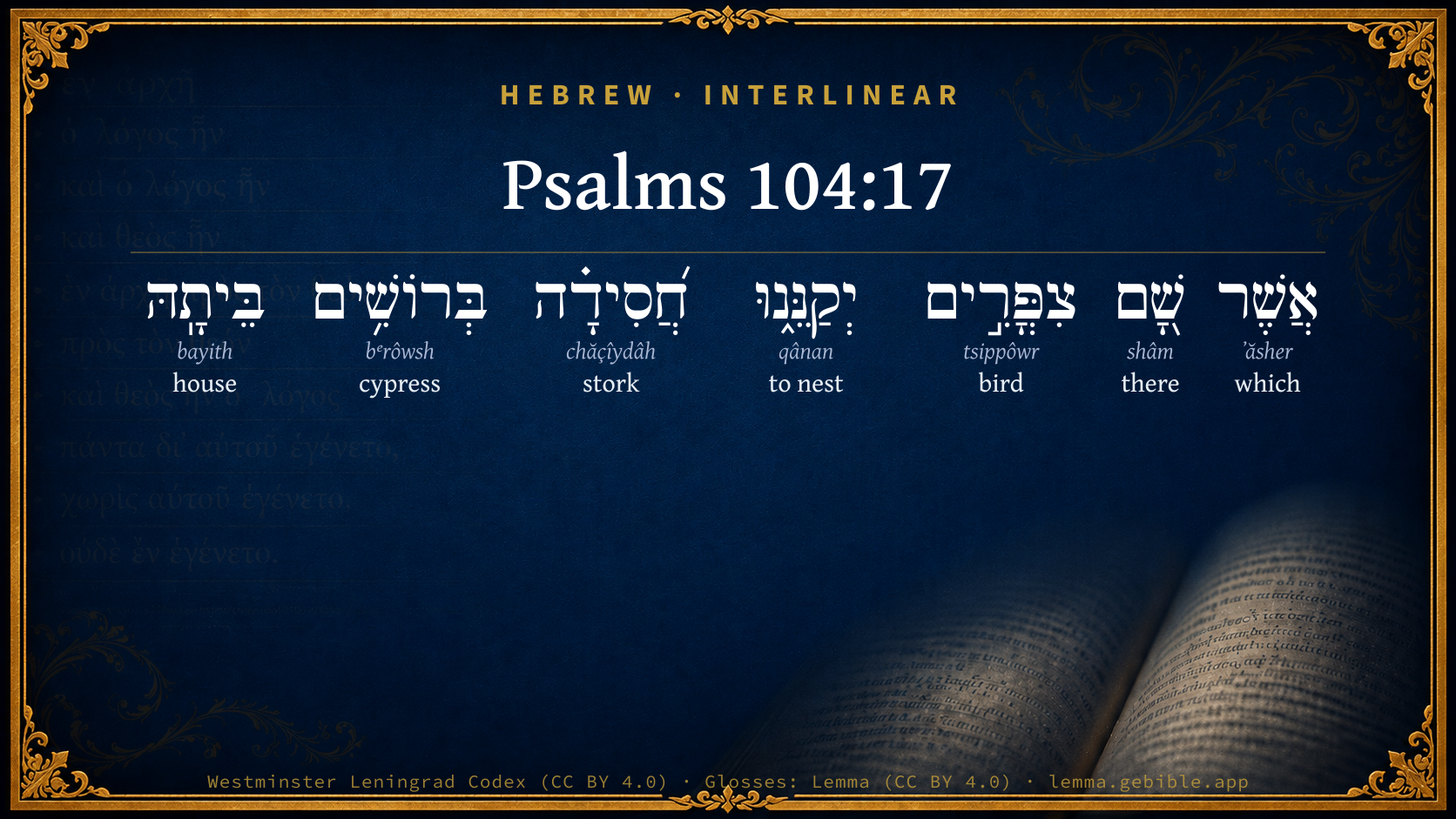
Psalms 104:17

Hebrew (Westminster Leningrad Codex) Psalms 104:17 appears in the Hebrew Old Testament. The text above is from the Westminster Leningrad Codex. Each word links to its Strong’s number, a concise gloss, and parsing drawn from the Open Scriptures Hebrew Bible morphology. Click any word for its full Brown-Driver-Briggs (BDB) entry.
Download image
Cite this verse

Psalms 104:17 (World English Bible). Public Domain. Lemma interlinear Bible study tool, https://lemma.gebible.app/v/psalms/104/17.

Show BibTeX & RIS
BibTeX
RIS
English Translation
Where the birds make their nests. The stork makes its home in the fir trees.
World English Bible · Public Domain
Highlights
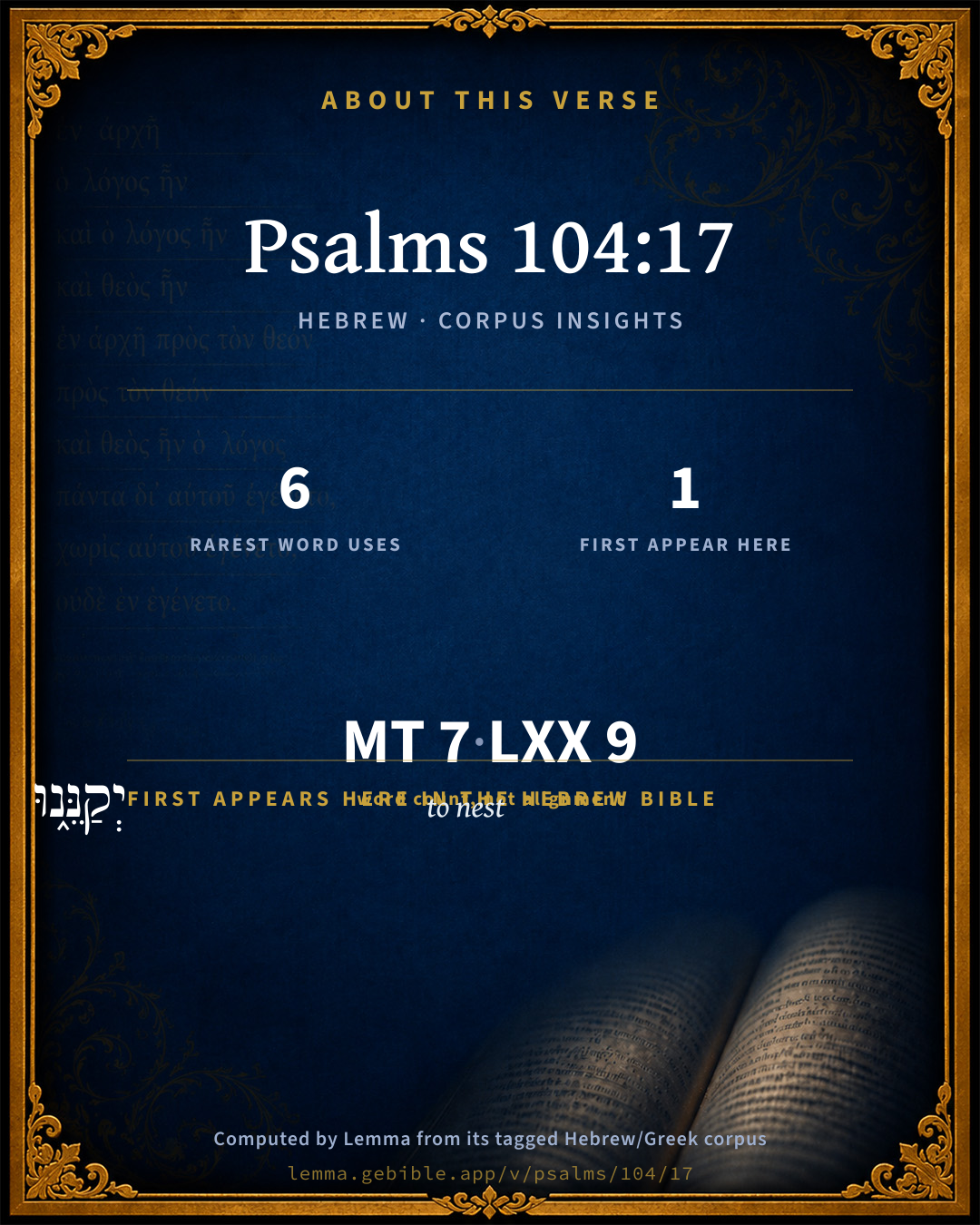
  • 1 first appearance in the Hebrew Bible
Full analysis ↓
Download a study sheet

One document with this verse’s original text, its word-by-word gloss line, the meaning frame, cross-references with their text, attributed commentary, and full source and license credits — printable, and it pastes into notes with its structure intact.

This verse Autodidact and up

Study sheet (.html) Plain text (.txt)

A passage Seminary Student

Up to 50 verses in one chapter. A passage sheet keeps up to 6 commentary sources and 12 cross-references per verse, in the order this page ranks them, and says so on the sheet whenever that leaves anything out. Ask for a single verse and you get the Autodidact verse sheet above.

Everything on this page stays free to read, with no account — the sheet is a download of what is already on screen, not access to it.

Want to remove ads? Support Godless Engineer
Compare translations 3

The same verse in 3 English versions, stacked beneath the original-language interlinear above. Click any original word for its lexicon entry.

Each is an independent rendering of the whole verse — the interlinear is not word-aligned to these translations.

Highlighted words mark where these versions differ — a whole-verse word diff, not a word-by-word alignment.

  • World English Bible Public Domain
    Where the birds make their nests. The stork makes its home in the fir trees.
  • King James Version Public Domain
    Where the birds make their nests: as for the stork, the fir trees are her house.
  • unfoldingWord Literal Text CC BY-SA 4.0
    where birds make their nests there, the stork, the cypress tree her home,

unfoldingWord Literal Text — © unfoldingWord, licensed CC BY-SA 4.0. Word-aligned USFM3 via Door43 (git.door43.org/unfoldingWord/en_ult).

Versions to compare (up to 4)

3 of 4 selected

Show all 18 translations

Every available English version of this verse, each an independent rendering of the whole verse.

  • World English Bible Public Domain
    Where the birds make their nests. The stork makes its home in the fir trees.
  • Berean Standard Bible Public Domain
    where the birds build their nests; the stork makes her home in the cypresses.
  • Majority Standard Bible Public Domain
    where the birds build their nests; the stork makes her home in the cypresses.
  • King James Version Public Domain
    Where the birds make their nests: as for the stork, the fir trees are her house.
  • American Standard Version (1901) Public Domain
    Where the birds make their nests: As for the stork, the fir-trees are her house.
  • Revised Version (1885) Public Domain
    Where the birds make their nests: as for the stork, the fir trees are her house.
  • Geneva Bible (1599) Public Domain
    That ye birdes may make their nestes there: the storke dwelleth in the firre trees.
  • Douay-Rheims (1899) Public Domain
    there the sparrows shall make their nests. The highest of them is the house of the heron.
  • Young's Literal Translation Public Domain
    Where birds do make nests, The stork -- the firs `are' her house.
  • Literal Standard Version CC BY-SA 4.0
    Where birds make nests, || The stork—the firs [are] her house.
  • Unlocked Literal Bible CC BY-SA 4.0
    There the birds make their nests. The stork makes the cypress tree her home.
  • unfoldingWord Literal Text CC BY-SA 4.0
    where birds make their nests there, the stork, the cypress tree her home,
  • Darby Bible Public Domain
    Where the birds make their nests; [as for] the stork, the fir trees are her house.
  • World Messianic Bible Public Domain
    where the birds make their nests. The stork makes its home in the cypress trees.
  • Webster's Bible Public Domain
    Where the birds make their nests: as for the stork, the fir-trees are her house.
  • Free Bible Version CC BY-SA 4.0
    Sparrows make their nests there; herons make their homes in the tall trees.
  • Bible in Basic English Public Domain
    Where the birds have their resting-places; as for the stork, the tall trees are her house.
  • JPS Tanakh (1917) Public Domain
    Wherein the birds make their nests; as for the stork, the fir-trees are her house.

Literal Standard Version (2020), Covenant Press — licensed CC BY-SA 4.0. Text via the HelloAO Bible API (eBible.org). Unlocked Literal Bible (unfoldingWord) — licensed CC BY-SA 4.0. Text via the HelloAO Bible API (eBible.org). unfoldingWord Literal Text — © unfoldingWord, licensed CC BY-SA 4.0. Word-aligned USFM3 via Door43 (git.door43.org/unfoldingWord/en_ult). Free Bible Version, Dr. Jonathan Gallagher — licensed CC BY-SA 4.0. Text via the HelloAO Bible API (eBible.org).

Word by word

More ways to search: Search by grammar → Find every occurrence → Compare this word →

Practice this passage: Drill this verse → Learn its vocabulary →

About this verse

These counts appear in no published source. They are computed here, from the morphology-tagged text and Lemma’s own curated glosses. What Lemma adds →

7
words
7
distinct lemmas
Wisdom
section

Notable vocabulary

The rarest word here is יְקַנֵּ֑נוּ to nest H7077 — appearing just 6 times in the whole Hebrew Bible.

First appearance in Scripture

This word makes its first canonical appearance in the Hebrew Bible here:

  • יְקַנֵּ֑נוּ to nest H7077

Shared distinctive vocabulary

יְקַנֵּ֑נוּ to nest H7077 occurs in 5 verses of the Hebrew Bible. Also found in:

Grammatical profile

  • 1 verb
  • 4 nouns
  • 1 adverb
  • 1 particle

Verb forms

  • יְקַנֵּ֑נוּ Piel · Imperfect

Hebrew & Septuagint length

In English translation the verse runs 15 words from the Hebrew and 18 from the Septuagint (LXX English) — closely comparable.

A rough comparison of the two English renderings, which tokenize alike — not a word-level alignment.

Word counts can differ between the Hebrew and the Greek without any difference in meaning — e.g. the Hebrew direct-object marker אֵת has no separate Greek word, and Greek often adds the article ὁ.

In the original languages it is 7 Hebrew tokens and 9 Greek tokens — but the two are counted differently (Hebrew bundles its prefixes and suffixes into one token; the Greek is in lemma form), so that isn’t a like-for-like length.

Cross-references

8

Topical passages linked to Psalms 104:17 in the Treasury of Scripture Knowledge — connected by theme and wording, ordered by reader-vote popularity; previews shown in the World English Bible.

  • Psalms 104:12 The birds of the sky nest by them. They sing among the branches.
  • Leviticus 11:19 the stork, any kind of heron, the hoopoe, and the bat.
  • Jeremiah 8:7 Yes, the stork in the sky knows her appointed times; and the turtle-dove and the swallow and the crane observe the time of their coming; but my people don't know Yahweh's law.
  • Jeremiah 22:23 Inhabitant of Lebanon, who makes your nest in the cedars, how greatly to be pitied shall you be when pangs come on you, the pain as of a woman in travail!
  • Ezekiel 31:6 All the birds of the sky made their nests in its boughs; and under its branches did all the animals of the field bring forth their young; and under its shadow lived all great nations.
  • Daniel 4:21 whose leaves were beautiful, and the fruit of it much, and in it was food for all; under which the animals of the field lived, and on whose branches the birds of the sky had their habitation:
  • Obadiah 1:4 Though you mount on high as the eagle, and though your nest is set among the stars, I will bring you down from there, says Yahweh.
  • Matthew 13:32 which indeed is smaller than all seeds. But when it is grown, it is greater than the herbs, and becomes a tree, so that the birds of the air come and lodge in its branches."

Cross-references courtesy of OpenBible.info (CC BY 4.0).

Hebrew and Greek witnesses Masoretic Hebrew ↔ Greek Septuagint

The same verse in the two great witnesses to the Old Testament, shown verse-for-verse.

You’re reading Greek Psalm 103 (Hebrew Psalm 104). The Septuagint counts the superscription, so verse numbers can differ from the Hebrew — chapter-level alignment, not verse-by-verse. Numbering follows Rahlfs.

These are two independent witnesses, not word-aligned to each other, and the Septuagint is shown in lemma (dictionary) form.

Hebrew Psalms 104:17 Masoretic · Westminster Leningrad Codex

אֲשֶׁר שָׁ֭ם צִפֳּרִ֣ים יְקַנֵּ֑נוּ חֲ֝סִידָ֗ה בְּרוֹשִׁ֥ים בֵּיתָֽהּ

Where the birds make their nests. The stork makes its home in the fir trees.

World English Bible · Public Domain

Greek LXX Greek Psalm 103:17 Septuagint · lemma form

ἐκεῖ στρουθίον ἐννοσσεύω ὁ ἐρωδιός ὁ οἰκία ἡγέομαι αὐτός

There the sparrows will build their nests; and the house of the heron takes the lead among them.

LXX2012 (modern English Septuagint) · Public Domain

On this verse, Ellicott's Commentary for English Readers discusses the Septuagint’s reading. Read the note in Commentary ↓

Hebrew: Westminster Leningrad Codex (CC BY 4.0). Greek: Septuagint (public domain); English from LXX2012 (modern English Septuagint) (Public Domain). How the Septuagint differs from the Hebrew →

Commentary

Notes on Psalms 104:17 from classic Christian and Jewish commentators (each source and its license shown beneath its notes). The classic Christian expositions comment on the surrounding passage and are grouped to its opening verse, so a note may address several verses; the Jewish commentaries on the Tanakh (Rashi and others) are per-verse, so they appear only where the commentator wrote on this verse.

Lemma curates 59 commentaries, every one of them public domain or Creative Commons licensed, each selected and text-cleaned for this edition rather than reprinted as found. About our sources →

Trapp's Complete Commentary

John Trapp

Psa 104:17 Where the birds make their nests: [as for] the stork, the fir trees [are] her house.

Ver. 17. Where the birds make their nests] Each, according to their natural instinct, with wonderful art.

As for the stork] That Pietaticultrix, as Petronius calleth her (and her name in Hebrew soundeth as much), because she nourisheth and cherisheth the old ones whereof she came; whence αντιπελαργειν, Genetricum senectam invicem educant (Plin.). Ciconiis pietas eximia inest (Solin.).

John Trapp, A Commentary or Exposition upon All the Books of the Old and New Testament (1647–1656) — public domain. Text from a community e-Sword module.

Joseph Benson's Commentary

Psa 104:17. Where the birds make their nests — Taught by the wisdom and understanding imparted to them by the great Creator, which is indeed most wonderful, enabling them “to distinguish times and seasons, choose the most proper places, construct their nests with an art and exactness unattainable by man, and secure and provide for their young.” “What master” (inquires Mr. Wesley in the fore-mentioned work, pp. 312 and 313) “has taught birds that they have need of nests? Who has warned them to prepare them in time, and not to suffer themselves to be prevented by necessity? Who hath shown them how to build? What mathematician has given the figure of them? What architect has taught them to choose a firm place, and to lay a solid foundation? What tender mother has advised them to cover the bottom with a soft and delicate substance, such as cotton or down; and when these fail, who has suggested to them that ingenious charity, to pluck off as many feathers from their own breasts as will prepare a soft cradle for their young? And what wisdom has pointed out to each kind a peculiar manner of building? Is it for the birds, O Lord, who have no knowledge thereof, that thou hast joined together so many miracles? Is it for the men, who give no attention to them? Is it for those who admire them, without thinking of thee? Rather, is it not thy design, by all these wonders, to call us to thyself? To make us sensible of thy wisdom, and fill us with confidence in thy bounty, who watchest so carefully over those inconsiderable creatures, two of which are sold for one farthing?”

Joseph Benson's Commentary on the Old and New Testaments (1811–1818) — public domain. Text from a community e-Sword module.

J. A. Alexander on Psalms

Joseph Addison Alexander

17. (Psa 104:17) Where the (small) birds nestle; (as to) the stork, the cypresses (are) her house. He again recurs to the provision made for birds which is here connected with the trees, as it is in ver. 12 (Psa 104:12). The word translated birds is not the one there used, but the same with that in Psa 84:3; Psa 102:7, where it is commonly translated sparrow, though supposed to be a general term for small birds, so called from their chirping, twittering noise. Here it may represent the smaller, and the stork the larger class of birds. The Hebrew name of the stork means merciful or pious, and is supposed to have reference to the natural kindness of that bird, both to its parents and its young. Nestle or build their nests. The choice between the old translation, fir-trees, and the new one, cypresses, is exegetically unimportant.

Joseph Addison Alexander, The Psalms Translated and Explained (1850) — public domain. Text from a community e-Sword module.

Tyndale Open Study Notes

Tyndale Open Resources

104:17-18 The storks migrated from northern Europe and resided in Palestine during the winter. • hyraxes: These animals are about the size of a rabbit and live in rocky places.

Tyndale Open Study Notes — © Tyndale Open Resources, licensed CC BY-SA 4.0. Text via the HelloAO Bible API.

Adam Clarke's Commentary

Verse 17. Where the birds make their nests] צפרים tsipporim signifies swallows, sparrows, and small birds in general; here opposed to the חסידה chasidah or stork. Perhaps the heron may be understood, which is said to be the first of all birds to build her nest, and she builds it on the very highest trees. The general meaning is, that God has provided shelter and support for the greatest and smallest birds; they are all objects of his providential regard.

Adam Clarke's Commentary on the Bible (1810–1826) — public domain. Text from a community e-Sword/MySword module.

Ellicott's Commentary for English Readers

(17) Stork.—The LXX. give “heron,” but Dr. Tristram has shown that there is no need to prefer “heron” here, on account of “the nesting in fir trees,” since if near its feeding-grounds the stork readily selects a fir as the tallest and most convenient tree for its nest (Nat. Hist. of the Bible, p. 244).

“The eagle and the stork

On cliffs and cedar-tops their eyries build.”—MILTON.

A Bible Commentary for English Readers, edited by Charles John Ellicott (1878–1897) — public domain. Text from a community e-Sword module.

The Cambridge Bible for Schools and Colleges

gen. ed. J. J. S. Perowne

17. the stork] Chãsîdâh, the Heb. name for the stork, is connected with chĕsĕd, “lovingkindness, and it was so called from its affection for its young, a trait often noticed by Greek and Latin writers. Thus it is called πτηνῶν εὐσεβέστατον ζῴων by Babrius (Fab. 13), and ‘avis pia’ or ‘pietaticultrix’ (Petron. 55. 6). Though in Western Europe the stork commonly builds its nest on houses, and in the East selects ruins where they are to be found, “where neither houses nor ruins occur, it selects any trees tall and strong enough to provide a platform for its huge nest, and for this purpose none are more convenient than the fir tree.” Tristram, Nat. Hist. of Bible, p. 248.

The Cambridge Bible for Schools and Colleges (gen. ed. J. J. S. Perowne; Cambridge University Press, 1878–1918) — public domain. Text from a community e-Sword module.

John Gill's Exposition

Where the birds make their nests,.... As they do in large, tall, spreading trees: not any particular "birds", as the sparrow, to which the Septuagint and Vulgate Latin versions, and Apollinarius, restrain it: but birds in general are intended; and especially such as build in large trees, as before and after mentioned. Jarchi applies it to the Israelites dwelling among the trees in the garden of Eden: and it may be much better applied to the saints dwelling in the churches, among the trees of righteousness, under the shadow of Gospel ordinances; see Eze 17:23.

As for the stork, the fir trees are her house; where she makes her nest, and brings up her young. Kimchi says it is a large bird, and builds its nest in high trees, as in cedars; but the bird which goes by the name of "pelargus" with the Greeks, and of "ciconia" with the Latins, and of "stork" with us, for the most part builds its nest on the tops of towers and temples (w), and the roofs of high houses, and seldom in trees; and when it does, it is in such that are not far from the habitations of men, which it loves to be near: perhaps the reason of its not building on houses in Palestine might be because their roofs were flat and frequented, and therefore built on high trees there, as fir trees and cedars. And Olympiodorus (x) says it does not lay its eggs on the ground, but on high trees; and Michaelis on the text attests, that he himself had seen, in many places in Germany, storks nests on very high and dry oaks. It has its name in Hebrew from a word (y) which signifies "holy", "merciful", and "beneficent"; because of the great care which it takes of its dam when grown old (z): and a like behaviour among men is called piety by the apostle, Ti1 5:4. But in the Chaldee tongue, and so in the Targum, it has its name from its whiteness; for though its wings are black, the feathers of its body are white: and so Virgil (a) describes it as a white bird, and as an enemy to serpents; for which reason the Thessalians forbad the killing them, on pain of banishment (b). It was an unclean bird, according to the ceremonial law, Lev 11:19. Good men are called by the same name, holy and beneficent; and though they are unclean by nature, yet Christ, the green fir tree, Hos 14:8 is the house of their habitation; in him they dwell by faith, who receives sinners, and eats with them, Luk 15:2. It is usual with the Latin poets to call the nests of birds their houses (c).

(w) Vid. Turnebi Adversar. l. 8. c. 18. & Praetorii Disp. Histor. Physic. de Crotalistria, c. 6. Heldelin. in ibid. c. 11. (x) Apud Bachart. Hierozoic. par. 2. l. 2. c. 29. col. 330. (y) a Buxtorf. Lexic. fol. 247. (z) Solinus, c. 53. Aelian. de Animal. l. 3. c. 23. (a) "Candida venit avis longis invisa colubris", Georgic. l. 2. (b) Plutarch. de Iside et Osir. prope finem. (c) "Frondiferasque domos avium", Lucret. l. 1. v. 19. "Antiquasque domos avium", Virgil. Georgic. l. 2. v. 209.

John Gill's Exposition of the Whole Bible (1746–1763) — public domain (CC PDM 1.0). Text via the HelloAO Bible API.

Albert Barnes' Notes on the Bible

Where the birds make their nests - Furnishing a home for the birds where they may breed their young. In Psa 104:12, the birds are introduced as singing among the foliage of trees and shrubs by the water-courses; here they are introduced as having their home in the lofty cedars in places which God had made for them. The word rendered “birds” here is the word which in Psa 84:3 is translated “sparrow,” and which is commonly used to denote “small birds.” Compare Lev 14:4 (margin), and Lev 14:5-7, Lev 14:49-53. It is used, however, to denote birds of any kind. See Gen 7:14; Psa 8:8; Psa 11:1; Psa 148:10.

As for the stork - See the notes at Job 39:13.

The fir trees are her house - Her retreat; her abode. The stork here is used to represent the larger class of birds. The meaning is, that they build their nests among the fir-trees or cypresses. See the notes at Isa 14:8; notes at Isa 41:19. So Milton says:

“The eagle and the stork

On cliffs and cedar-tops their eyries build.”

They build their nests, however, not only on fir and pine trees, but on houses and castles. Dr. Thomson (“Land and the Book,” vol. i. p. 504), says of them, “These singular birds do not breed in Syria, but pass over it to Asia Minor, and into Northwestern Europe, where they not only build in fir and pine trees upon the mountains, but also enter cities and villages, and make their nests on houses, castles, and minarets.”

Albert Barnes' Notes on the Bible (1834–1885) — public domain. Text from a community e-Sword/MySword module.

Matthew Poole's English Annotations

The stork; which make their nests not only in the tops of houses, but also in the field and in high trees, as Varro and others have noted.

The fir trees; which also are trees of great height and bigness; and which, being here said to afford the storks a house, are thereby supposed to be preserved and nourished by the rain water.

Matthew Poole's English Annotations on the Holy Bible (1683–1685) — public domain. Text from a community e-Sword/MySword module.

The Treasury of David

Charles H. Spurgeon

Ver. 17. Where the birds make their nests: as for the stork, the fir trees are her house. So far from being in need, these trees of God afford shelter to others, birds small and great make their nests in the branches. Thus what they receive from the great Lord they endeavour to return to his weaker creatures. How one thing fits into another in this fair creation, each link drawing on its fellow: the rains water the fir trees, and the fir trees become the happy home of birds; thus do the thunder clouds build the sparrow's house, and the descending rain sustains the basis of the stork's nest. Observe, also, how everything has its usethe boughs furnish a home for the birds; and every living thing has its accommodationthe stork finds a house in the pines. Her nest is called a house, because this bird exhibits domestic virtues and maternal love which make her young to be comparable to a family. No doubt this ancient writer had seen storks' nests in fir trees; they appear usually to build on houses and ruins, but there is also evidence that where there are forests they are content with pine trees. Has the reader ever walked through a forest of great trees and felt the awe which strikes the heart in nature's sublime cathedral? Then he will remember to have felt that each bird was holy, since it dwelt amid such sacred solitude. Those who cannot see or hear of God except in Gothic edifices, amid the swell of organs, and the voices of a surpliced choir, will not be able to enter into the feeling which makes the simple, unsophisticated soul hear "the voice of the Lord God walking among the trees."

Ver. 17. Birds. The word rendered "birds" here is the word which in Ps 84:3 is translated sparrow, and which is commonly used to denote small birds. Comp. Le 14:4 (margin), and Le 14:5-7 14: 49-53. It is used, however, to denote birds of any kind. See Ge 7:14 Ps 8:8 6:1 148:10. Albert Barnes.

Ver. 17. The stork is instanced as one of the largest of nest building birds, as the cedars of Lebanon were introduced in Ps 104:16 as being the largest of uncultivated trees. A.C. Jennings and W.H. Zowe, in "The Psalms, with Introductions and Critical Notes", 1875.

Ver. 17. The stork, the fir trees are her hoarse. In many cases the stork breeds among old ruins, and under such circumstances it is fond of building its nest on the tops of pillars or towers, the summits of arches, and similar localities. When it takes up its abode among mankind, it generally selects the breeding places which have been built for it by those who know its taste, but it frequently chooses the top of a chimney, or some such locality. When it is obliged to build in spots where it can find neither rocks nor buildings, it builds on trees, and, like the heron, is sociable in its nesting, a whole community residing in a clump of trees. It is not very particular about the kind of tree, provided that it be tolerably tall, and strong enough to bear the weight of its enormous nest; and the reader will at once see that the fir trees are peculiarly fitted to be the houses for the stork.

The particular species of fir tree to which the Psalmist alludes is probably the Aleppo pine (Pinus halepensis), which comes next to the great cedars of Lebanon in point of size. It was this tree that furnished the timber and planks for Solomon's temple and palace, a timber which was evidently held in the greatest estimation. This tree fulfils all the conditions which a stork would require in nest building. It is lofty, and its boughs are sufficiently horizontal to form a platform for the nest, and strong enough to sustain it. On account of its value and the reckless manner in which it has been cut down without new plantations being formed, the Aleppo pine has vanished from many parts of Palestine wherein it was formerly common, and would afford a dwelling place for the stork. There are, however, several other species of fir which are common in various parts of the country, each species flourishing in the soil best suited to it, so that the stork would never be at a loss to find a nesting place in a country which furnished so many trees suitable to its purposes. J.G. Wood, in "Bible Animals".

Ver. 17. The stork, the fir trees are her house. Well wooded districts are for the most part the favourite resorts of the storks, as they constantly select trees both for breeding purposes and as resting places for the night; some few species, however, prove exceptions to this rule, and make their nests on roofs, chimneys, or other elevated situations in the immediate vicinity of men. From "Cassell's Book of Birds." From the Text of Dr. Brehm. By T.R. Jones, F.R.S.

Ver. 17. The fir trees. The doors of the temple were made of the fir tree; even of that tree which was a type of the humanity of Jesus Christ. Consider Heb 2:14. The fir tree is also the house of the stork, that unclean bird, even as Christ is a harbour and shelter for sinners. "As for the stork", saith the text, "the fir trees are her house; "and Christ saith to the sinners that see their want of shelter, "Come unto me, and I will give you rest." He is a refuge for the oppressed, a refuge in time of trouble. He is, as the doors of fir of the temple, the inlet of God's house, to God's presence, and to a partaking of his glory. Thus God did of old, by similitudes teach his people his way. John Bunyan, in "Solomon's Temple Spiritualized."

Ver. 17.

The eagle and the stork

On cliffs and cedar-tops their eyries build. John Milton.

Ver. 17, 18. "Lessons from Nature." (See "Spurgeon's Sermons, " No. 1,005.)

1. For each place God has prepared a suitable form of life: for "the fir trees, ""the stork"; for "the high hills" "the wild goat, "etc. So, for all parts of the spiritual universe God has provided suitable forms of divine life.

(a) Each age has its saints.

(b) In every rank they are to be found. The Christian

religion is equally well adapted for all conditions.

(c) In every church spiritual life is to be found.

(d) God's people are to be found in every city.

2. Each creature has its appropriate place.

(a) Each man has by God a providential position

appointed to him.

(b) This is also true of our spiritual experience.

(c) The same holds good as to individuality of

character.

3. Every creature that God has made is provided with shelter.

4. For each creature the shelter is appropriate.

5. Each creature uses its shelter.

Psalms 104:18*

Charles H. Spurgeon's The Treasury of David (1869–1885) — public domain. Psalms only. Text from a community e-Sword/MySword module.

Whedon's Commentary on the Bible

Daniel D. Whedon

17. Birds make their nests—For which, as a subordinate reason, the “trees” (Psa_104:16) were prepared.

Stork—A large, wide-winged, (Zec_5:9,) migratory bird, of high flight, and noted for its

affection toward its young, its family life, and its sagacity in observing its time of passage. Jer_8:7.

Fir trees—Probably the Aleppo pine. “This tree fulfils all the conditions which a stork would require in nest building. It is lofty, and its boughs are sufficiently horizontal to form a platform for the nest, and strong enough to sustain it.”—Wood.

Daniel D. Whedon (gen. ed.), Commentary on the Old and New Testaments (1874–1909) — public domain. Text from a community e-Sword module.

The Pulpit Commentary

Wherein the birds make their nests (comp. above, ver. 10). As for the stork, the fir trees are her house. Again, God"s care for the animal creation is in the psalmist"s mind. As the grass is "caused to grow for the cattle" (ver. 14), so trees even the grandest are partly intended for the birds.

The Pulpit Commentary (1880–1919), ed. H.D.M. Spence-Jones & Joseph S. Exell — public domain. Text from a community e-Sword module.

Rashi

Rabbi Shlomo Yitzchaki (Rashi)

birds nest Israel will dwell there.

יְקַנֵנוּ is an expression of a bird’s nest (קן צפור).

Rashi on the Tanakh — English translations: “The Judaica Press complete Tanach with Rashi, translated by A. J. Rosenberg” (CC BY 4.0); “Pentateuch with Rashi's commentary by M. Rosenbaum and A.M. Silbermann, 1929-1934” (public domain); “The Metsudah Tanach series, Lakewood, N.J” (CC BY 4.0); and “The Book of Joshua, Metsudah Publications, 1997” (CC BY 4.0). Text via Sefaria.

Lesson kit

Teaching starters — assembled from the data on this page, not authored interpretation. Every prompt links to the verse data it draws on. Edit before teaching.

Psalms, in the Wisdom, opens this verse with 7 words (7 distinct Hebrew lemmas). Its most distinctive word is qânan (“to nest”). A historical commentator’s framing appears above. Read the whole chapter for the surrounding context.

Discussion questions

  1. How does “to nest” (qânan) shape what this verse is saying?
  2. This is the first place “to nest” appears in Scripture (first appears here). What does its debut here establish?
  3. How does Isaiah 34:15, which shares the word «to nest», read alongside this verse?
  4. These translations render this verse differently; the difference is in the English rendering, not the original. What questions does that raise?
  5. «יְקַנֵּ֑נוּ» is a Piel Imperfect verb. How does that grammatical form shape the action described?
  6. Compare how Trapp's Complete Commentary and Joseph Benson's Commentary read this verse. Where do they agree or differ?

Things to notice

Reading settings

Reading text

Shown beneath each verse's original-language words.

Old Testament
Old Testament edition

Read the OT as the Masoretic Hebrew (MT) or the Greek Septuagint (LXX).

English shown for the Greek Septuagint (in the Hebrew ↔ Greek comparison).

Comparing translations? Open the Compare panel on any verse page to stack up to four side by side.