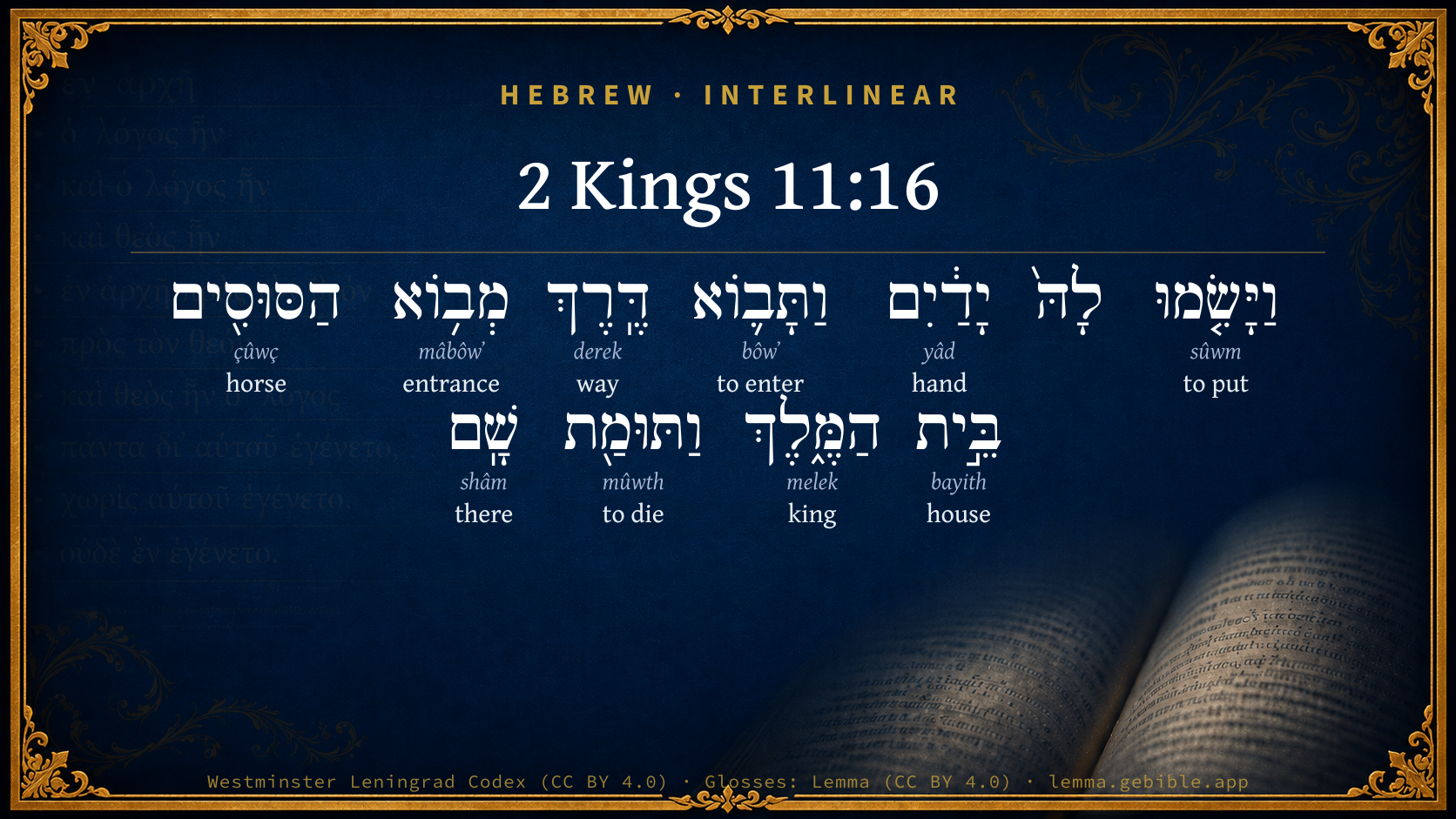
2 Kings 11:16

Hebrew (Westminster Leningrad Codex) 2 Kings 11:16 appears in the Hebrew Old Testament. The text above is from the Westminster Leningrad Codex. Each word links to its Strong’s number, a concise gloss, and parsing drawn from the Open Scriptures Hebrew Bible morphology. Click any word for its full Brown-Driver-Briggs (BDB) entry.
Download image
Cite this verse

2 Kings 11:16 (World English Bible). Public Domain. Lemma interlinear Bible study tool, https://lemma.gebible.app/v/2-kings/11/16.

Show BibTeX & RIS
BibTeX
RIS
English Translation
So they made way for her; and she went by the way of the horses' entry to the king's house: and there was she slain.
World English Bible · Public Domain
Download a study sheet

One document with this verse’s original text, its word-by-word gloss line, the meaning frame, cross-references with their text, attributed commentary, and full source and license credits — printable, and it pastes into notes with its structure intact.

This verse Autodidact and up

Study sheet (.html) Plain text (.txt)

A passage Seminary Student

Up to 50 verses in one chapter. A passage sheet keeps up to 6 commentary sources and 12 cross-references per verse, in the order this page ranks them, and says so on the sheet whenever that leaves anything out. Ask for a single verse and you get the Autodidact verse sheet above.

Everything on this page stays free to read, with no account — the sheet is a download of what is already on screen, not access to it.

Want to remove ads? Support Godless Engineer
Compare translations 3

The same verse in 3 English versions, stacked beneath the original-language interlinear above. Click any original word for its lexicon entry.

Each is an independent rendering of the whole verse — the interlinear is not word-aligned to these translations.

Highlighted words mark where these versions differ — a whole-verse word diff, not a word-by-word alignment.

  • World English Bible Public Domain
    So they made way for her; and she went by the way of the horses' entry to the king's house: and there was she slain.
  • King James Version Public Domain
    And they laid hands on her; and she went by the way by the which the horses came into the king's house: and there was she slain.
  • unfoldingWord Literal Text CC BY-SA 4.0
    And they put two hands to her, and she went the way of the entrance of horses the house of the king, and she was killed there.

unfoldingWord Literal Text — © unfoldingWord, licensed CC BY-SA 4.0. Word-aligned USFM3 via Door43 (git.door43.org/unfoldingWord/en_ult).

Versions to compare (up to 4)

3 of 4 selected

Show all 18 translations

Every available English version of this verse, each an independent rendering of the whole verse.

  • World English Bible Public Domain
    So they made way for her; and she went by the way of the horses' entry to the king's house: and there was she slain.
  • Berean Standard Bible Public Domain
    So they seized Athaliah as she reached the horses’ entrance to the palace grounds, and there she was put to death.
  • Majority Standard Bible Public Domain
    So they seized Athaliah as she reached the horses’ entrance to the palace grounds, and there she was put to death.
  • King James Version Public Domain
    And they laid hands on her; and she went by the way by the which the horses came into the king's house: and there was she slain.
  • American Standard Version (1901) Public Domain
    So they made way for her; and she went by the way of the horses' entry to the king's house: and there was she slain.
  • Revised Version (1885) Public Domain
    So they made way for her; and she went by the way of the horses’ entry to the king’s house: and there was she slain.
  • Geneva Bible (1599) Public Domain
    Then they laid hands on her, and she went by the way, by the which the horses goe to the house of the King, and there was she slaine.
  • Douay-Rheims (1899) Public Domain
    And they laid hands on her: and thrust her out by the way by which the horses go in, by the palace, and she was slain there.
  • Young's Literal Translation Public Domain
    And they make for her sides, and she entereth the way of the entering in of the horses to the house of the king, and is put to death there.
  • Literal Standard Version CC BY-SA 4.0
    And they make sides for her, and she enters the way of the entering in of the horses to the house of the king, and is put to death there.
  • Unlocked Literal Bible CC BY-SA 4.0
    So they seized her as she reached the place where the horses enter the palace grounds, and there she was killed.
  • unfoldingWord Literal Text CC BY-SA 4.0
    And they put two hands to her, and she went the way of the entrance of horses the house of the king, and she was killed there.
  • Darby Bible Public Domain
    And they made way for her, and she went by the way by which the horses entered the king's house, and there was she put to death.
  • World Messianic Bible Public Domain
    So they seized her; and she went by the way of the horses’ entry to the king’s house, and she was slain there.
  • Webster's Bible Public Domain
    And they laid hands on her; and she went by the way by which the horses came into the king's house: and there was she slain.
  • Free Bible Version CC BY-SA 4.0
    They grabbed hold of her, took her to where the horses enter the palace grounds and they killed her there.
  • Bible in Basic English Public Domain
    So they put their hands on her, and she went to the king's house by the doorway of the horses, and there she was put to death.
  • JPS Tanakh (1917) Public Domain
    So they made way for her; and she went by the way of the horses' entry to the king's house; and there was she slain.

Literal Standard Version (2020), Covenant Press — licensed CC BY-SA 4.0. Text via the HelloAO Bible API (eBible.org). Unlocked Literal Bible (unfoldingWord) — licensed CC BY-SA 4.0. Text via the HelloAO Bible API (eBible.org). unfoldingWord Literal Text — © unfoldingWord, licensed CC BY-SA 4.0. Word-aligned USFM3 via Door43 (git.door43.org/unfoldingWord/en_ult). Free Bible Version, Dr. Jonathan Gallagher — licensed CC BY-SA 4.0. Text via the HelloAO Bible API (eBible.org).

Word by word

More ways to search: Search by grammar → Find every occurrence → Compare this word →

Practice this passage: Drill this verse → Learn its vocabulary →

מְב֥וֹא
mâbôwʼ
H3996
“entrance of”
Noun, Common, Masculine, Singular, Construct
Part of Speech
Noun
Type
Common
Gender
Masculine
Number
Singular
State
Construct
Full BDB Definition

Origin: from H935

TWOT: 212b

entrance, a coming in, entering - sunset - sunset - sunset, west
  1. וַיָּשִׂ֤מוּ sûwm H7760 “and · to put” Conjunction + Verb, Qal, Sequential Imperfect, 3rd Person, Masculine, Plural
  2. יָדַ֔יִם yâd H3027 “hands” Noun, Common, Both, Dual, Absolute
  3. וַתָּב֛וֹא bôwʼ H935 “and · to enter” Conjunction + Verb, Qal, Sequential Imperfect, 3rd Person, Feminine, Singular
  4. דֶּֽרֶךְ derek H1870 “way of” Noun, Common, Both, Singular, Construct
  5. הַסּוּסִ֖ים çûwç H5483 “the · horses” Particle, Definite Article + Noun, Common, Masculine, Plural, Absolute
  6. בֵּ֣ית bayith H1004 “house of” Noun, Common, Masculine, Singular, Construct
  7. הַמֶּ֑לֶךְ melek H4428 “the · king” Particle, Definite Article + Noun, Common, Masculine, Singular, Absolute
  8. וַתּוּמַ֖ת mûwth H4191 “and · to die” Conjunction + Verb, Hophal, Sequential Imperfect, 3rd Person, Feminine, Singular
  9. שָֽׁם shâm H8033 “there” Adverb

About this verse

These counts appear in no published source. They are computed here, from the morphology-tagged text and Lemma’s own curated glosses. What Lemma adds →

11
words
10
distinct lemmas
Historical
section

Notable vocabulary

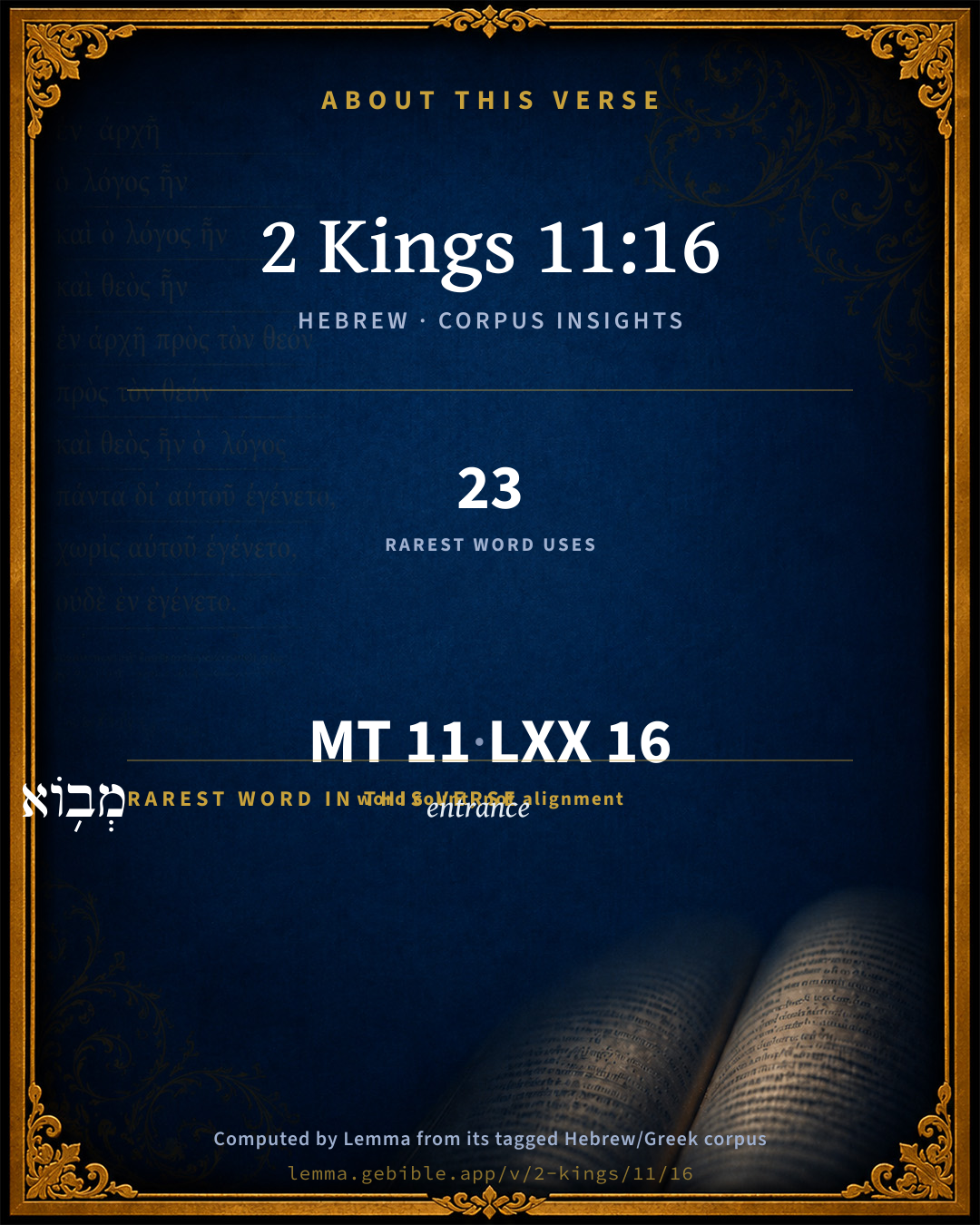
The rarest word here is מְב֥וֹא entrance H3996 — appearing just 23 times in the whole Hebrew Bible.

Shared distinctive vocabulary

מְב֥וֹא entrance H3996 occurs in 23 verses of the Hebrew Bible. Also found in:

Grammatical profile

  • 3 verbs
  • 6 nouns
  • 1 preposition
  • 1 adverb

Verb forms

  • וַיָּשִׂ֤מוּ Qal · Sequential Imperfect
  • וַתָּב֛וֹא Qal · Sequential Imperfect
  • וַתּוּמַ֖ת Hophal · Sequential Imperfect

Hebrew & Septuagint length

In English translation the verse runs 25 words from the Hebrew and 27 from the Septuagint (LXX English) — closely comparable.

A rough comparison of the two English renderings, which tokenize alike — not a word-level alignment.

Word counts can differ between the Hebrew and the Greek without any difference in meaning — e.g. the Hebrew direct-object marker אֵת has no separate Greek word, and Greek often adds the article ὁ.

In the original languages it is 11 Hebrew tokens and 16 Greek tokens — but the two are counted differently (Hebrew bundles its prefixes and suffixes into one token; the Greek is in lemma form), so that isn’t a like-for-like length.

Cross-references

6

Topical passages linked to 2 Kings 11:16 in the Treasury of Scripture Knowledge — connected by theme and wording, ordered by reader-vote popularity; previews shown in the World English Bible.

  • Genesis 9:6 Whoever sheds man's blood, by man will his blood be shed, for in the image of God made he man.
  • Judges 1:7 Adoni-bezek said, "Seventy kings, having their thumbs and their great toes cut off, gathered [their food] under my table: as I have done, so God has requited me." They brought him to Jerusalem, and he died there.
  • 2 Chronicles 23:15 So they made way for her; and she went to the entrance of the horse gate to the king's house: and they killed her there.
  • Matthew 7:2 For with whatever judgment you judge, you will be judged; and with whatever measure you measure, it will be measured to you.
  • James 2:13 For judgment is without mercy to him who has shown no mercy. Mercy triumphs over judgment.
  • Revelation 16:5–7 I heard the angel of the waters saying, "You are righteous, who are and who were, you Holy One, because you have judged these things.

Cross-references courtesy of OpenBible.info (CC BY 4.0).

Hebrew and Greek witnesses Masoretic Hebrew ↔ Greek Septuagint

The same verse in the two great witnesses to the Old Testament, shown verse-for-verse.

These are two independent witnesses, not word-aligned to each other, and the Septuagint is shown in lemma (dictionary) form.

Hebrew 2 Kings 11:16 Masoretic · Westminster Leningrad Codex

וַיָּשִׂ֤מוּ לָהּ֙ יָדַ֔יִם וַתָּב֛וֹא דֶּֽרֶךְ מְב֥וֹא הַסּוּסִ֖ים בֵּ֣ית הַמֶּ֑לֶךְ וַתּוּמַ֖ת שָֽׁם

So they made way for her; and she went by the way of the horses' entry to the king's house: and there was she slain.

World English Bible · Public Domain

Greek LXX 2 Kings 11:16 Septuagint · lemma form

καί ἐπιτίθημι αὐτός χείρ καί εἰςἔρχομαι ὁδός εἴσοδος ὁ ἵππος οἶκος ὁ βασιλεύς καί ἀποθνήσκω ἐκεῖ

And they laid hands upon her, and went in by the way of the horses' entrance into the house of the Lord, and she was slain there.

LXX2012 (modern English Septuagint) · Public Domain

On this verse, Ellicott's Commentary for English Readers discusses the Septuagint’s reading. Read the note in Commentary ↓

Hebrew: Westminster Leningrad Codex (CC BY 4.0). Greek: Septuagint (public domain); English from LXX2012 (modern English Septuagint) (Public Domain). How the Septuagint differs from the Hebrew →

Targum (Aramaic paraphrase)

1

The Targum is the ancient Jewish Aramaic paraphrase of the Hebrew Scriptures — an interpretive translation, not the Hebrew text itself. Onkelos (literal) and Pseudo-Jonathan (expansive) render the Torah, and Jonathan the Prophets. Coverage is partial: where no permissively-licensed English translation exists for a verse, only the Aramaic is shown. This is verse-level text, not a word-by-word alignment to the Hebrew.

  1. Targum Jonathan Prophets (Joshua–Malachi)
    וְשַׁוִיאוּ לָהּ אַתְרָא וְעָלַת בְּאוֹרַח מַעֲלָנָא דְסוּסַיָא לְבֵית מַלְכָּא וְאִתְקְטִלַת תַּמָן:

    (no public-domain English translation for this verse)

    Targum Jonathan — Aramaic: “Mikraot Gedolot” (public domain). English: “Sefaria Community Translation” (CC0 1.0 (public-domain dedication)); “London "Chaldee Paraphrase," 1871” (public domain). Text via Sefaria.

Commentary

Notes on 2 Kings 11:16 from classic Christian and Jewish commentators (each source and its license shown beneath its notes). The classic Christian expositions comment on the surrounding passage and are grouped to its opening verse, so a note may address several verses; the Jewish commentaries on the Tanakh (Rashi and others) are per-verse, so they appear only where the commentator wrote on this verse.

Lemma curates 59 commentaries, every one of them public domain or Creative Commons licensed, each selected and text-cleaned for this edition rather than reprinted as found. About our sources →

Trapp's Complete Commentary

John Trapp

2Ki 11:16 And they laid hands on her; and she went by the way by the which the horses came into the king’s house: and there was she slain.

Ver. 16. The way by the which the horses came.] So that she was trampled, haply, by the horses, as her mother had been; howsoever, she was slain among the stables and dunghills of the king’s house. Josephus saith that she was carried down to the town ditch, and there despatched.

John Trapp, A Commentary or Exposition upon All the Books of the Old and New Testament (1647–1656) — public domain. Text from a community e-Sword module.

Joseph Benson's Commentary

2Ki 11:16. They laid hands on her — The Hebrew, ישׁמו לה ידים, Jashimu lah jadaim, may be properly rendered, Then they gave her room, or left her a free passage to depart out of the temple. Thus Houbigant, after the Chaldee. And she went by the way, &c. — By the great public road, by which horses and chariots went to the palace. And there was she slain —

In an ignominious place and manner, as her mother Jezebel had been.

Joseph Benson's Commentary on the Old and New Testaments (1811–1818) — public domain. Text from a community e-Sword module.

Tyndale Open Study Notes

Tyndale Open Resources

11:16 Athaliah’s death at the gate where horses enter the palace grounds is reminiscent of her mother Jezebel’s death under the hooves of Jehu’s horses (9:33).

Tyndale Open Study Notes — © Tyndale Open Resources, licensed CC BY-SA 4.0. Text via the HelloAO Bible API.

Adam Clarke's Commentary

Verse 16. By the way - which the horses came] They probably brought her out near the king's stables. It has been supposed, from Eze 46:1-2, that the east gate of the inner court was that by which the king entered on the Sabbath day, whereas on all other days he entered by the south gate. And there was another gate, called the horse gate, in the wall of the city, (Jer 31:40,) for the king's horses to go out at from the stables at Millo, which is therefore called, 2Ch 23:15, the horse gate toward the king's house.

Adam Clarke's Commentary on the Bible (1810–1826) — public domain. Text from a community e-Sword/MySword module.

Ellicott's Commentary for English Readers

(16) They laid hands on her.—So the LXX. and Vulg. The Hebrew phrase means: and they made room for her on both sides—i.e., the crowd fell back, and a lane was formed for her exit (so the Targum and Rashi).

She went . . . king’s house.—She entered the palace by way of the entry of the horses. Athaliah was conducted to the royal stables which adjoined the palace, and there put to death.

A Bible Commentary for English Readers, edited by Charles John Ellicott (1878–1897) — public domain. Text from a community e-Sword module.

The Cambridge Bible for Schools and Colleges

gen. ed. J. J. S. Perowne

16. And they laid hands on her] R.V. So they made way for her. The rendering of the A.V. agrees with the LXX. and the Vulgate. But the verb here used is not that employed for such an act as the arrest here described would be. It is better therefore to adopt the translation of the Targum followed by Jewish and many modern commentators, ‘They gave room to her on both hands’. Literally the words mean, ‘they arranged for her two sides’, thus making a space between which she could walk.

by the way by the which the horses came into the king’s house] R.V. by the way of the horses’ entry to the king’s house. This is not to be confounded with the ‘horse gate’ of Jerusalem, spoken of Neh_3:28. That was a gate of the city, not of the king’s palace. The way here spoken of was a private road to the king’s house.

there was she slain] No doubt according to the orders of Jehoiada.

The Cambridge Bible for Schools and Colleges (gen. ed. J. J. S. Perowne; Cambridge University Press, 1878–1918) — public domain. Text from a community e-Sword module.

John Gill's Exposition

And Jehoiada made a covenant between the Lord and the king and the people, that they should be the Lord's people,.... Renewed the covenant between the Lord on the one part, and the king and the people on the other; assuring them, that as God had declared that he would be their God, he would yet be their God to bless and protect them, they continuing in obedience to him; and obliging them to promise that they would serve the Lord their God, and him only, and root out all idolatry from the land, and restore, and continue in, the pure worship of God:

between the king also and the people; he promising, on his part, that he would govern them according to the law of God, and protect them in their rights and properties, privileges and liberties; and they, on their part, that they would honour and obey him, and be his faithful subjects. In Ch2 23:16 Jehoiada is said to make this covenant between him, &c. which may be understood of the Lord; or if of himself, the meaning is, that it was made between him, the king and people, and the Lord.

John Gill's Exposition of the Whole Bible (1746–1763) — public domain (CC PDM 1.0). Text via the HelloAO Bible API.

Albert Barnes' Notes on the Bible

And they laid hands on her - Most modern critics render - “and they gave her space,” i. e., they cleared a way for her, and allowed her to walk out of the temple not only unharmed but untonched.

Albert Barnes' Notes on the Bible (1834–1885) — public domain. Text from a community e-Sword/MySword module.

Haydock's Catholic Bible Commentary

Thrust. Hebrew, "and she went by the way by which the horses enter the king’s house. When she was come within the horse-gate of the palace, they killed her there," 2 Paralipomenon xxiii. 15. Such was the ignominious end of this true daughter of Jezabel! (Haydock)

George Leo Haydock (1774–1849), Haydock's Catholic Family Bible and Commentary, 1859 edition — public domain. Excludes Psalms (Douay-Rheims chapter numbering differs from Protestant) and Deuterocanonical books (Catholic canon only).

Matthew Poole's English Annotations

They laid hands on her, or, they gave her space or room, to wit, to go out of the court of the temple, and did not keep her within it, as they could have done. Or, they appointed bands for her; they ordered two bands of the Levites to follow her, and kill her.

By the way by the which the horses came into the king’s house; by the great and public road in which horses and chariots went to the palace.

There was she slain; in an ignominious place and manner, as her mother Jezebel had been.

Matthew Poole's English Annotations on the Holy Bible (1683–1685) — public domain. Text from a community e-Sword/MySword module.

Whedon's Commentary on the Bible

Daniel D. Whedon

16. The way by the which the horses came into the king’s house — The Chronicles calls the place “the entering of the horse gate, by the king’s house.” Some have inclined to identify this with “the horse gate” of Neh_3:28, and Jer_31:40. Its location is unknown, but seems to have been somewhere near the palace. Perhaps the design of slaying her at the entrance to the royal stables was, that, like her mother Jezebel, she might be also trampled under foot by horses. Compare 2Ki_9:33.

Daniel D. Whedon (gen. ed.), Commentary on the Old and New Testaments (1874–1909) — public domain. Text from a community e-Sword module.

The Pulpit Commentary

And they laid hands on her. So the LXX (ejpeqhkan aujth ceirav), the Vulgate, Luther, and others; but most moderns understand that they formed in two lines, one on either side of her, and so let her pass out of the temple and proceed towards the palace untouched the divinity that hedged a queen preventing them from molesting her until the time came for her execution (see the Revised Version). And she went by the way by the which the horses came into the king"s house. Josephus makes Athaliah pass out of the temple by the east gate, and descend into the Kedron valley. He says she was put to death "at the gate of the king"s mules," but does not mark the locality. The gate intended can scarcely be the "horse gate" of Neh_3:28, which was in the eastern wall, and north of the temple. It was probably a gate on the western side of the Tyropoeon valley, giving entrance to the stables of the palace. (comp. 2Ch_23:15, and see below, ver. 20) And there was she slain; "with the sword" (ver. 20). A single blow from one of the guardsmen probably sufficed.

The Pulpit Commentary (1880–1919), ed. H.D.M. Spence-Jones & Joseph S. Exell — public domain. Text from a community e-Sword module.

Rashi

Rabbi Shlomo Yitzchaki (Rashi)

They made a place for her. A place, aisances, in O.F.

Rashi on the Tanakh — English translations: “The Judaica Press complete Tanach with Rashi, translated by A. J. Rosenberg” (CC BY 4.0); “Pentateuch with Rashi's commentary by M. Rosenbaum and A.M. Silbermann, 1929-1934” (public domain); “The Metsudah Tanach series, Lakewood, N.J” (CC BY 4.0); and “The Book of Joshua, Metsudah Publications, 1997” (CC BY 4.0). Text via Sefaria.

Lesson kit

Teaching starters — assembled from the data on this page, not authored interpretation. Every prompt links to the verse data it draws on. Edit before teaching.

2 Kings, in the Historical, opens this verse with 11 words (10 distinct Hebrew lemmas). Its most distinctive word is mâbôwʼ (“entrance”). A historical commentator’s framing appears above. Read the whole chapter for the surrounding context.

Discussion questions

  1. What does “entrance” (mâbôwʼ) contribute to the verse as a whole?
  2. How does Deuteronomy 11:30, which shares the word «entrance», read alongside this verse?
  3. These translations render this verse differently; the difference is in the English rendering, not the original. What questions does that raise?
  4. «וַיָּשִׂ֤מוּ» is a Qal Sequential Imperfect verb. How does that grammatical form shape the action described?
  5. Compare how Trapp's Complete Commentary and Joseph Benson's Commentary read this verse. Where do they agree or differ?

Things to notice

Reading settings

Reading text

Shown beneath each verse's original-language words.

Old Testament
Old Testament edition

Read the OT as the Masoretic Hebrew (MT) or the Greek Septuagint (LXX).

English shown for the Greek Septuagint (in the Hebrew ↔ Greek comparison).

Comparing translations? Open the Compare panel on any verse page to stack up to four side by side.