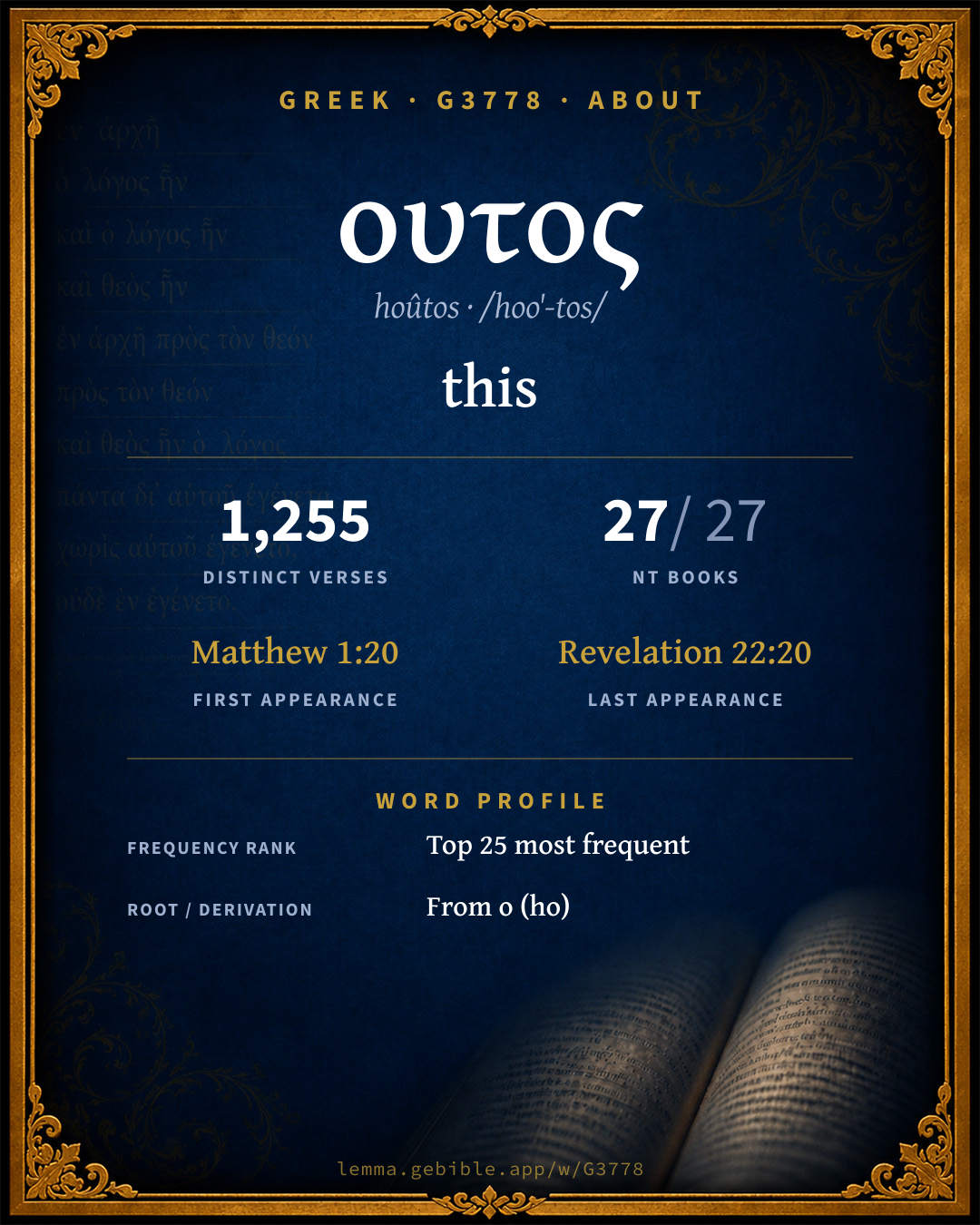
ουτος
this
Full lexicon entry — Thayer's Greek Lexicon
From Thayer's Greek Lexicon
Where this word appears
See every Accusative-case word in the Greek New Testament →
Grammar key — what these labels mean
Part of speech
- Demonstrative pronoun
- Points something out (“this,” “that”).
Case
- Accusative
- The case of the direct object and of extent.
- Nominative
- The case of the subject (and the predicate nominative).
- Dative
- The case of the indirect object, means, or location — “to / for / with / in.”
- Genitive
- The case of source, possession, or “of” — answers “whose / from what.”
Gender
- Neuter
- Grammatically neuter.
- Masculine
- Grammatically masculine.
- Feminine
- Grammatically feminine.
Number
- Singular
- One.
- Plural
- More than one.
72 verses where G3778 appears in the Nominative case in the Book of Acts. Filtered view — show all forms. Click any verse to open its interlinear word-by-word view. Verse text shown in the World English Bible for context — . Each verse’s Greek form is shown with its reference; the English is not keyword-highlighted, since the data carries no word-level English alignment. Use “Compare translations” on any verse to read it across multiple English versions. This concordance covers the Greek New Testament; Septuagint (Greek Old Testament) occurrences of this word are not indexed here.
Acts
- Acts 1:11 οὗτος dem.pron nom sg masc who also said, "You men of Galilee, why do you stand looking into the sky? This Jesus, who was received up from you into the sky will come back in the same way as you saw him going into the sky."
- Acts 1:14 οὗτοι dem.pron nom pl masc All these with one accord continued steadfastly in prayer and supplication, along with the women, and Mary the mother of Jesus, and with his brothers.
- Acts 1:18 οὗτος dem.pron nom sg masc Now this man obtained a field with the reward for his wickedness, and falling headlong, his body burst open, and all his intestines gushed out.
- Acts 1:19 τοῦτ’ dem.pron nom sg neut It became known to everyone who lived in Jerusalem that in their language that field was called 'Akeldama,' that is, 'The field of blood.'
- Acts 2:7 οὗτοί dem.pron nom pl masc They were all amazed and marveled, saying to one another, "Behold, aren't all these who speak Galileans?
- Acts 2:14 τοῦτο dem.pron nom sg neut But Peter, standing up with the eleven, lifted up his voice, and spoke out to them, "You men of Judea, and all you who dwell at Jerusalem, let this be known to you, and listen to my words.
- Acts 2:15 οὗτοι dem.pron nom pl masc For these aren't drunken, as you suppose, seeing it is only the third hour of the day.
- Acts 2:16 τοῦτό dem.pron nom sg neut But this is what has been spoken through the prophet Joel:
- Acts 4:9 οὗτος dem.pron nom sg masc if we are examined today concerning a good deed done to a crippled man, by what means this man has been healed,
- Acts 4:10 τούτῳ οὗτος dem.pron dat sg neut dem.pron nom sg masc be it known to you all, and to all the people of Israel, that in the name of Jesus Christ of Nazareth, whom you crucified, whom God raised from the dead, in him does this man stand here before you whole.
- Acts 4:11 οὗτός dem.pron nom sg masc He is 'the stone which was regarded as worthless by you, the builders, which has become the head of the corner.'
- Acts 4:22 τοῦτο dem.pron nom sg neut For the man on whom this miracle of healing was performed was more than forty years old.
- Acts 5:24 τούτους τοῦτο dem.pron acc pl masc dem.pron nom sg neut Now when the high priest, the captain of the temple, and the chief priests heard these words, they were very perplexed about them and what might become of this.
- Acts 5:38 τούτων αὕτη τοῦτο dem.pron gen pl masc dem.pron nom sg fem dem.pron nom sg neut Now I tell you, withdraw from these men, and leave them alone. For if this counsel or this work is of men, it will be overthrown.
- Acts 6:13 οὗτος dem.pron nom sg masc and set up false witnesses who said, "This man never stops speaking blasphemous words against this holy place and the law.
- Acts 6:14 οὗτος τοῦτον dem.pron nom sg masc dem.pron acc sg masc For we have heard him say that this Jesus of Nazareth will destroy this place, and will change the customs which Moses delivered to us."
- Acts 7:1 ταῦτα dem.pron nom pl neut The high priest said, "Are these things so?"
- Acts 7:19 οὗτος dem.pron nom sg masc The same took advantage of our race, and mistreated our fathers, and forced them to throw out their babies, so that they wouldn't stay alive.
- Acts 7:36 οὗτος dem.pron nom sg masc This man led them out, having worked wonders and signs in Egypt, in the Red Sea, and in the wilderness for forty years.
- Acts 7:37 οὗτός dem.pron nom sg masc This is that Moses, who said to the children of Israel, 'The Lord our God will raise up a prophet for you from among your brothers, like me.'
- Acts 7:38 οὗτός dem.pron nom sg masc This is he who was in the assembly in the wilderness with the angel that spoke to him on Mount Sinai, and with our fathers, who received living oracles to give to us,
- Acts 7:40 οὗτος dem.pron nom sg masc saying to Aaron, 'Make us gods that will go before us, for as for this Moses, who led us out of the land of Egypt, we don't know what has become of him.'
- Acts 8:10 οὗτός dem.pron nom sg masc to whom they all listened, from the least to the greatest, saying, "This man is that great power of God."
- Acts 8:26 αὕτη dem.pron nom sg fem But an angel of the Lord spoke to Philip, saying, "Arise, and go toward the south to the way that goes down from Jerusalem to Gaza. This is a desert."
- Acts 8:32 αὕτη dem.pron nom sg fem Now the passage of the Scripture which he was reading was this, "He was led as a sheep to the slaughter. As a lamb before his shearer is silent, So he doesn't open his mouth.
- Acts 9:15 οὗτος dem.pron nom sg masc But the Lord said to him, "Go your way, for he is my chosen vessel to bear my name before the nations and kings, and the children of Israel.
- Acts 9:20 οὗτός dem.pron nom sg masc Immediately in the synagogues he proclaimed the Christ, that he is the Son of God.
- Acts 9:21 οὗτός τοῦτο τοῦτο dem.pron nom sg masc dem.pron acc sg neut dem.pron acc sg neut All who heard him were amazed, and said, "Isn't this he who in Jerusalem made havoc of those who called on this name? And he had come here intending to bring them bound before the chief priests!"
- Acts 9:22 οὗτός dem.pron nom sg masc But Saul increased more in strength, and confounded the Jews who lived at Damascus, proving that this is the Christ.
- Acts 9:36 αὕτη dem.pron nom sg fem Now there was at Joppa a certain disciple named Tabitha, which when translated, means Dorcas. This woman was full of good works and acts of mercy which she did.
- Acts 10:6 οὗτος dem.pron nom sg masc He lodges with one Simon, a tanner, whose house is by the seaside."
- Acts 10:16 τοῦτο dem.pron nom sg neut This was done three times, and immediately the vessel was received up into heaven.
- Acts 10:32 οὗτος dem.pron nom sg masc Send therefore to Joppa, and summon Simon, who is surnamed Peter. He lodges in the house of Simon a tanner, by the seaside. When he comes, he will speak to you.'
- Acts 10:36 οὗτός dem.pron nom sg masc The word which he sent to the children of Israel, preaching good news of peace by Jesus Christ--he is Lord of all--
- Acts 11:10 τοῦτο dem.pron nom sg neut This was done three times, and all were drawn up again into heaven.
- Acts 11:12 οὗτοι dem.pron nom pl masc The Spirit told me to go with them, without discriminating. These six brothers also accompanied me, and we entered into the man's house.
- Acts 13:7 οὗτος dem.pron nom sg masc who was with the proconsul, Sergius Paulus, a man of understanding. This man summoned Barnabas and Saul, and sought to hear the word of God.
- Acts 14:9 οὗτος dem.pron nom sg masc He was listening to Paul speaking, who, fastening eyes on him, and seeing that he had faith to be made whole,
- Acts 16:17 αὕτη οὗτοι dem.pron nom sg fem dem.pron nom pl masc Following Paul and us, she cried out, "These men are servants of the Most High God, who proclaim to us the way of salvation!"
- Acts 16:20 οὗτοι dem.pron nom pl masc When they had brought them to the magistrates, they said, "These men, being Jews, are agitating our city,
- Acts 17:3 οὗτός dem.pron nom sg masc explaining and demonstrating that the Christ had to suffer and rise again from the dead, and saying, "This Jesus, whom I proclaim to you, is the Christ."
- Acts 17:6 οὗτοι dem.pron nom pl masc When they didn't find them, they dragged Jason and certain brothers before the rulers of the city, crying, "These who have turned the world upside down have come here also,
- Acts 17:7 οὗτοι dem.pron nom pl masc whom Jason has received. These all act contrary to the decrees of Caesar, saying that there is another king, Jesus!"
- Acts 17:11 οὗτοι ταῦτα dem.pron nom pl masc dem.pron nom pl neut Now these were more noble than those in Thessalonica, in that they received the word with all readiness of the mind, examining the Scriptures daily to see whether these things were so.
- Acts 17:18 οὗτος dem.pron nom sg masc Some of the Epicurean and Stoic philosophers also were conversing with him. Some said, "What does this babbler want to say?" Others said, "He seems to be advocating foreign deities," because he preached Jesus and the resurrection.
- Acts 17:19 αὕτη dem.pron nom sg fem They took hold of him, and brought him to the Areopagus, saying, "May we know what this new teaching is, which is spoken by you?
- Acts 17:20 ταῦτα dem.pron nom pl neut For you bring certain strange things to our ears. We want to know therefore what these things mean."
- Acts 17:24 οὗτος dem.pron nom sg masc The God who made the world and all things in it, he, being Lord of heaven and earth, doesn't dwell in temples made with hands,
- Acts 18:13 οὗτος dem.pron nom sg masc saying, "This man persuades men to worship God contrary to the law."
- Acts 18:25 οὗτος dem.pron nom sg masc This man had been instructed in the way of the Lord; and being fervent in spirit, he spoke and taught accurately the things concerning Jesus, although he knew only the baptism of John.
- Acts 18:26 οὗτός dem.pron nom sg masc He began to speak boldly in the synagogue. But when Priscilla and Aquila heard him, they took him aside, and explained to him the way of God more accurately.
- Acts 19:4 τοῦτ’ dem.pron nom sg neut Paul said, "John indeed baptized with the baptism of repentance, saying to the people that they should believe in the one who would come after him, that is, in Jesus."
- Acts 19:10 τοῦτο dem.pron nom sg neut This continued for two years, so that all those who lived in Asia heard the word of the Lord Jesus, both Jews and Greeks.
- Acts 19:17 τοῦτο dem.pron nom sg neut This became known to all, both Jews and Greeks, who lived at Ephesus. Fear fell on them all, and the name of the Lord Jesus was magnified.
- Acts 19:21 ταῦτα dem.pron nom pl neut Now after these things had ended, Paul determined in the spirit, when he had passed through Macedonia and Achaia, to go to Jerusalem, saying, "After I have been there, I must also see Rome."
- Acts 19:26 οὗτος dem.pron nom sg masc You see and hear, that not at Ephesus alone, but almost throughout all Asia, this Paul has persuaded and turned away many people, saying that they are no gods, that are made with hands.
- Acts 19:27 τοῦτο dem.pron nom sg neut Not only is there danger that this our trade come into disrepute, but also that the temple of the great goddess Artemis will be counted as nothing, and her majesty destroyed, whom all Asia and the world worships."
- Acts 20:5 οὗτοι dem.pron nom pl masc But these had gone ahead, and were waiting for us at Troas.
- Acts 20:34 αὗται dem.pron nom pl fem You yourselves know that these hands ministered to my necessities, and to those who were with me.
- Acts 21:11 αὕτη dem.pron nom sg fem Coming to us, and taking Paul's belt, he bound his own feet and hands, and said, "Thus says the Holy Spirit: 'So will the Jews at Jerusalem bind the man who owns this belt, and will deliver him into the hands of the Gentiles.'"
- Acts 21:28 οὗτός τούτου τοῦτον dem.pron nom sg masc dem.pron gen sg masc dem.pron acc sg masc crying out, "Men of Israel, help! This is the man who teaches all men everywhere against the people, and the law, and this place. Moreover, he also brought Greeks into the temple, and has defiled this holy place!"
- Acts 22:26 οὗτος dem.pron nom sg masc When the centurion heard it, he went to the commanding officer and told him, "Watch what you are about to do, for this man is a Roman!"
- Acts 24:15 οὗτοι dem.pron nom pl masc having hope toward God, which these also themselves look for, that there will be a resurrection of the dead, both of the just and unjust.
- Acts 24:20 οὗτοι dem.pron nom pl masc Or else let these men themselves say what injustice they found in me when I stood before the council,
- Acts 25:11 οὗτοι dem.pron nom pl masc For if I have done wrong, and have committed anything worthy of death, I don't refuse to die; but if none of those things is true that they accuse me of, no one can give me up to them. I appeal to Caesar!"
- Acts 26:26 τούτων τούτων τοῦτο dem.pron gen pl neut dem.pron gen pl neut dem.pron nom sg neut For the king knows of these things, to whom also I speak freely. For I am persuaded that none of these things is hidden from him, for this has not been done in a corner.
- Acts 26:31 οὗτος dem.pron nom sg masc When they had withdrawn, they spoke one to another, saying, "This man does nothing worthy of death or of bonds."
- Acts 26:32 οὗτος dem.pron nom sg masc Agrippa said to Festus, "This man might have been set free if he had not appealed to Caesar."
- Acts 27:31 οὗτοι dem.pron nom pl masc Paul said to the centurion and to the soldiers, "Unless these stay in the ship, you can't be saved."
- Acts 27:34 τοῦτο dem.pron nom sg neut Therefore I beg you to take some food, for this is for your safety; for not a hair will perish from any of your heads."
- Acts 28:4 οὗτος dem.pron nom sg masc When the natives saw the creature hanging from his hand, they said one to another, "No doubt this man is a murderer, whom, though he has escaped from the sea, yet Justice has not allowed to live."
- Acts 28:28 τοῦτο dem.pron nom sg neut "Be it known therefore to you, that the salvation of God is sent to the Gentiles. They will also listen."
About this entry
At a glance — auto-summarized from this page’s data, not written by a person. Every figure links to its source below. This summary describes the numbers; it doesn’t interpret them.
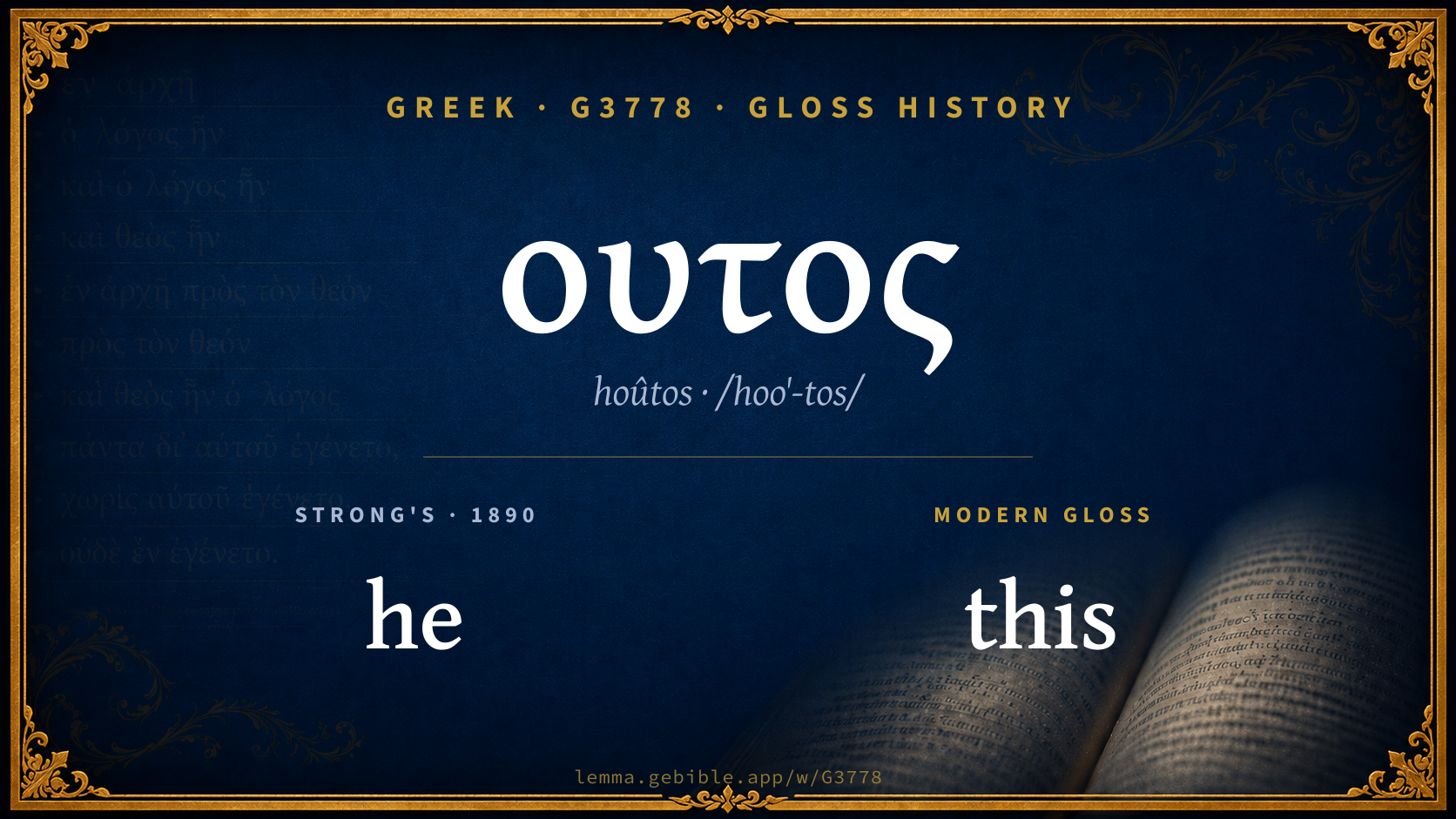
At its core, ουτος (hoûtos) means “this.” “same” is the historic King James Version rendering; modern versions use “this.” See the renderings breakdown. It turns up in 1,255 verses across 27 books, one of the most common footprint. It first appears in Matthew 1:20. It clusters with ο, τανυν and οδε under a shared root. Each statement above links to its evidence; the full detail follows below.
Gloss history
Strong's 1890 vs modern scholarship
About this word
Strong's G3778 catalogs a Greek word from the Greek New Testament.
These counts are not copied from any lexicon or concordance. They are computed here, from the morphology-tagged Greek New Testament. What Lemma adds →
- 1,255
- distinct verses
- The word appears in 1,255 distinct verses.
- 27 / 27
- NT books
- The word appears in 27 of 27 New Testament books.
- #13
- by frequency
- Top 25 most frequent Greek words (rank 13 of 5,347 Greek words by occurrence).
View all 1,255 occurrences in the concordance →
By section of the New Testament
By traditional corpus
Conventional, traditional groupings — biblical authorship is debated, so this is a traditional corpus grouping, not an authorship claim. Some books belong to more than one corpus (Luke is in both the Gospels and the Lukan corpus, and so on), so these shares overlap and need not total 100%. Each figure is a share of the word’s 1,255 distinct verses.
- Gospels 625 verses · 50%
- Lukan (Luke–Acts) 423 verses · 34%
- Johannine 300 verses · 24%
- Pauline corpus 242 verses · 19%
- General (Catholic) Epistles 92 verses · 7%
- Revelation 43 verses · 3%
- Hebrews 40 verses · 3%
How translations render this word
Counts come from each version’s own published word-to-Strong’s tagging or interlinear alignment — an approximate guide to how each version renders this word, not a word-level alignment the data otherwise carries. Because each total is that version’s own tagged count, the per-version totals vary from one another and need not match the appearance or distinct-verse counts above. These counts may also differ from a printed concordance because Lemma counts each distinctly tagged rendering and does not collapse phrase taggings into a single head-word total. This is a fixed set of word-tagged versions (KJV, ASV, BSB, ULT) and does not change with the reading translation you choose elsewhere. Each version’s license is shown beside its name below (and on Sources).
- King James Version: This 157×, These 62×, Same 34×
- American Standard Version: This 245×, These 81×, Same 28×
- Berean Standard Bible: This 572×, These 138×, Things 103×
- unfoldingWord Literal Text: This 745×, Things 237×, These 194×
King James Version Public Domain
Renders G3778 across 347 tagged occurrences — most commonly:
Plus 15 renderings that appear only once — usually multi-word phrases or single function words the recovered tagging swept in, not distinct renderings. Not rendered by a distinct English word in 9 further occurrences.
American Standard Version Public Domain
Renders G3778 across 470 tagged occurrences — most commonly:
Plus other, less common renderings. Plus 42 renderings that appear only once — usually multi-word phrases or single function words the recovered tagging swept in, not distinct renderings.
Berean Standard Bible Public Domain
Renders G3778 across 1,042 tagged occurrences — most commonly:
Plus other, less common renderings. Plus 49 renderings that appear only once — usually multi-word phrases or single function words the recovered tagging swept in, not distinct renderings. Not rendered by a distinct English word in 327 further occurrences.
unfoldingWord Literal Text CC BY-SA 4.0
Renders G3778 across 1,466 tagged occurrences — most commonly:
Plus other, less common renderings. Plus 16 renderings that appear only once — usually multi-word phrases or single function words the recovered tagging swept in, not distinct renderings.
Senses in Thayer's
The 1 sense Thayer's distinguishes for this word, in lexicon order (not ranked by frequency or importance). The full entry — with sub-senses — is in the Lexicon Entry tab.
- this, these, etc.
Word origin
Derived from ο (ho) (G3588).
Including the nominative masculine plural (second form) nominative feminine signular (third form) and the nominate feminine plural (fourth form). From the article G3588 and G846 ; the he ( she or it) that is this or that (often with the article repeated): - he (it was that) hereof it she such as the same these they this (man same woman) which who.
— Strong’s Exhaustive Concordance (1890), public domain.
Forms in the corpus
The 35 distinct written forms G3778 takes in the Greek New Testament, most frequent first — each parse links to that case’s occurrences in the concordance.
Same root — word family
Other Thayer's entries built from the same root as G3778, grouped by Strong’s listed origin. These share a root / origin per the lexicon — not necessarily a shared meaning. Each links to that word’s own entry.
Derives from
Shares the same root
- τανυν tanŷn G3569 present
- οδε hóde G3592 this
- οιος hoîos G3634 what sort of
- ος hós G3739 who
- σημερον sḗmeron G4594 this day
- ταυτα tautá G5024 thus
- τηλικουτος tēlikoûtos G5082 of such size
- τοι toí G5104 truly
- τοσουτος tosoûtos G5118 so great
- τοτε tóte G5119 then
- του toû G5120 his
- τουναντιον tounantíon G5121 on the contrary
- τουνομα toúnoma G5122 by name
Derived from this word
- ουτω hoútō G3779 thus
- ταυτα taûta G5023 these
- ταυταις taútais G5025 these
- ταυτη taútēi G5026 this
- τουτο toûto G5124 that thing
- τουτοις toútois G5125 these
- τουτον toûton G5126 this
- τουτου toútou G5127 of this
- τουτους toútous G5128 these
- τουτω toútōi G5129 to this
- τουτων toútōn G5130 of these
Proper names from this root
People and places named from this root — a name, not an additional meaning of the word.
- θεος theós G2316 God
- ο ων και ο ην και ο ερχομενος ho ṑn kaí ho ēn kaí ho erchómenos G3801 He who is
- Χαλδαιος Chaldaîos G5466 Chaldean
Compare all same-root words → Showing 4 of 29 — not the complete family. 3 of the same-root words are proper names (people or places). They share a root, not necessarily a meaning.
Septuagint usage
The same Greek word ουτος appears 3,488 times in the Greek Old Testament (Septuagint), across 3,014 verses in 38 books.
- 3,488
- LXX occurrences
- Tagged occurrences of this Greek word in the Septuagint.
- 3,014
- verses
- Distinct Septuagint verses containing this word.
- 38 / 39
- OT books
- The word appears in 38 of the 39 Old Testament books.
Sample Septuagint occurrences
- Genesis 2:4 οὗτος
- Exodus 1:1 οὗτος
- Leviticus 2:8 οὗτος
- Numbers 1:5 οὗτος
- Deuteronomy 1:1 οὗτος
- Joshua 1:2 οὗτος
- Judges 1:9 οὗτος
- Ruth 1:19 οὗτος
- 1 Samuel 1:2 οὗτος
- 2 Samuel 1:4 οὗτος
- 1 Kings 1:27 οὗτος
- 2 Kings 1:2 οὗτος
Septuagint occurrences (same lexeme)
Every verse where the same Strong’s number (G3778) appears in the Greek Septuagint — showing the first 50 of 3,014. Verse text shown in the World English Bible for context; the Greek form is the matched word — the English is not keyword-highlighted.
- Genesis 2:4 οὗτος This is the history of the generations of the heavens and of the earth when they were created, in the day that Yahweh God made earth and the heavens.
- Genesis 2:11 οὗτος The name of the first is Pishon: this is the one which flows through the whole land of Havilah, where there is gold;
- Genesis 2:13 οὗτος The name of the second river is Gihon: the same river that flows through the whole land of Cush.
- Genesis 2:14 οὗτος The name of the third river is Hiddekel: this is the one which flows in front of Assyria. The fourth river is the Euphrates.
- Genesis 2:19 οὗτος Out of the ground Yahweh God formed every animal of the field, and every bird of the sky, and brought them to the man to see what he would call them. Whatever the man called every living creature, that was its name.
- Genesis 2:23 οὗτος The man said, "This is now bone of my bones, and flesh of my flesh. She will be called Woman, because she was taken out of Man."
- Genesis 2:24 οὗτος Therefore a man will leave his father and his mother, and will join with his wife, and they will be one flesh.
- Genesis 3:11 οὗτος God said, "Who told you that you were naked? Have you eaten from the tree that I commanded you not to eat from?"
- Genesis 3:12 οὗτος The man said, "The woman whom you gave to be with me, she gave me of the tree, and I ate."
- Genesis 3:13 οὗτος Yahweh God said to the woman, "What is this you have done?" The woman said, "The serpent deceived me, and I ate."
- Genesis 3:14 οὗτος Yahweh God said to the serpent, "Because you have done this, cursed are you above all cattle, and above every animal of the field. On your belly shall you go, and you shall eat dust all the days of your life.
- Genesis 3:17 οὗτος To Adam he said, "Because you have listened to your wife's voice, and have eaten of the tree, of which I commanded you, saying, 'You shall not eat of it,' cursed is the ground for your sake. In toil you will eat of it all the days of your life.
- Genesis 3:20 οὗτος The man called his wife Eve, because she was the mother of all living.
- Genesis 4:20 οὗτος Adah gave birth to Jabal, who was the father of those who dwell in tents and have cattle.
- Genesis 4:21 οὗτος His brother's name was Jubal, who was the father of all who handle the harp and pipe.
- Genesis 4:26 οὗτος There was also born a son to Seth, and he named him Enosh. Then men began to call on Yahweh's name.
- Genesis 5:1 οὗτος This is the book of the generations of Adam. In the day that God created man, he made him in God's likeness.
- Genesis 5:29 οὗτος and he named him Noah, saying, "This same will comfort us in our work and in the toil of our hands, because of the ground which Yahweh has cursed."
- Genesis 6:3 οὗτος Yahweh said, "My Spirit will not strive with man forever, because he also is flesh; yet will his days be one hundred twenty years."
- Genesis 6:9 οὗτος This is the history of the generations of Noah. Noah was a righteous man, blameless among the people of his time. Noah walked with God.
- Genesis 7:1 οὗτος Yahweh said to Noah, "Come with all of your household into the ark, for I have seen your righteousness before me in this generation.
- Genesis 7:11 οὗτος In the six hundredth year of Noah's life, in the second month, on the seventeenth day of the month, on the same day all the fountains of the great deep were burst open, and the sky's windows were opened.
- Genesis 7:13 οὗτος In the same day Noah, and Shem, Ham, and Japheth, the sons of Noah, and Noah's wife, and the three wives of his sons with them, entered into the ark;
- Genesis 9:12 οὗτος God said, "This is the token of the covenant which I make between me and you and every living creature that is with you, for perpetual generations:
- Genesis 9:17 οὗτος God said to Noah, "This is the token of the covenant which I have established between me and all flesh that is on the earth."
- Genesis 9:19 οὗτος These three were the sons of Noah, and from these, the whole earth was populated.
- Genesis 10:1 οὗτος Now this is the history of the generations of the sons of Noah and of Shem, Ham, and Japheth. Sons were born to them after the flood.
- Genesis 10:5 οὗτος Of these were the isles of the nations divided in their lands, everyone after his language, after their families, in their nations.
- Genesis 10:8 οὗτος Cush became the father of Nimrod: he began to be a mighty one in the earth.
- Genesis 10:9 οὗτος He was a mighty hunter before Yahweh. Therefore it is said, "Like Nimrod, a mighty hunter before Yahweh."
- Genesis 10:12 οὗτος and Resen between Nineveh and Calah (the same is the great city).
- Genesis 10:18 οὗτος the Arvadite, the Zemarite, and the Hamathite. Afterward the families of the Canaanites were spread abroad.
- Genesis 10:20 οὗτος These are the sons of Ham, after their families, after their languages, in their lands, in their nations.
- Genesis 10:29 οὗτος Ophir, Havilah, and Jobab. All these were the sons of Joktan.
- Genesis 10:31 οὗτος These are the sons of Shem, after their families, after their languages, in their lands, after their nations.
- Genesis 10:32 οὗτος These are the families of the sons of Noah, after their generations, in their nations. Of these were the nations divided in the earth after the flood.
- Genesis 11:6 οὗτος Yahweh said, "Behold, they are one people, and they have all one language; and this is what they begin to do. Now nothing will be withheld from them, which they intend to do.
- Genesis 11:9 οὗτος Therefore the name of it was called Babel, because Yahweh confused the language of all the earth, there. From there, Yahweh scattered them abroad on the surface of all the earth.
- Genesis 11:10 οὗτος This is the history of the generations of Shem. Shem was one hundred years old, and became the father of Arpachshad two years after the flood.
- Genesis 11:27 οὗτος Now this is the history of the generations of Terah. Terah became the father of Abram, Nahor, and Haran. Haran became the father of Lot.
- Genesis 12:7 οὗτος Yahweh appeared to Abram, and said, "I will give this land to your seed." He built an altar there to Yahweh, who appeared to him.
- Genesis 12:12 οὗτος It will happen, when the Egyptians will see you, that they will say, 'This is his wife.' They will kill me, but they will save you alive.
- Genesis 12:18 οὗτος Pharaoh called Abram, and said, "What is this that you have done to me? Why didn't you tell me that she was your wife?
- Genesis 14:2 οὗτος that they made war with Bera, king of Sodom, and with Birsha, king of Gomorrah, Shinab, king of Admah, and Shemeber, king of Zeboiim, and the king of Bela (the same is Zoar).
- Genesis 14:3 οὗτος All these joined together in the valley of Siddim (the same is the Salt Sea).
- Genesis 14:7 οὗτος They returned, and came to En-mishpat (the same is Kadesh), and struck all the country of the Amalekites, and also the Amorites, that lived in Hazazon Tamar.
- Genesis 14:8 οὗτος There went out the king of Sodom, and the king of Gomorrah, and the king of Admah, and the king of Zeboiim, and the king of Bela (the same is Zoar); and they set the battle in array against them in the valley of Siddim;
- Genesis 14:17 οὗτος The king of Sodom went out to meet him, after his return from the slaughter of Chedorlaomer and the kings who were with him, at the valley of Shaveh (the same is the King's Valley).
- Genesis 14:24 οὗτος Except only that which the young men have eaten, and the portion of the men who went with me, Aner, Eshcol, and Mamre: let them take their portion."
- Genesis 15:1 οὗτος After these things the word of Yahweh came to Abram in a vision, saying, "Don't be afraid, Abram. I am your shield, your exceedingly great reward."
These are occurrences of the same Greek lexeme (G3778) in the Septuagint — not a translation of any one Hebrew word. The store carries no word-level Hebrew↔Greek alignment, so no Hebrew original is asserted here. Counts come from the recovered LXX Strong's tagging — high-frequency vocabulary is well covered, while rare or late forms may be untagged — so they reflect tagged occurrences and may slightly undercount.