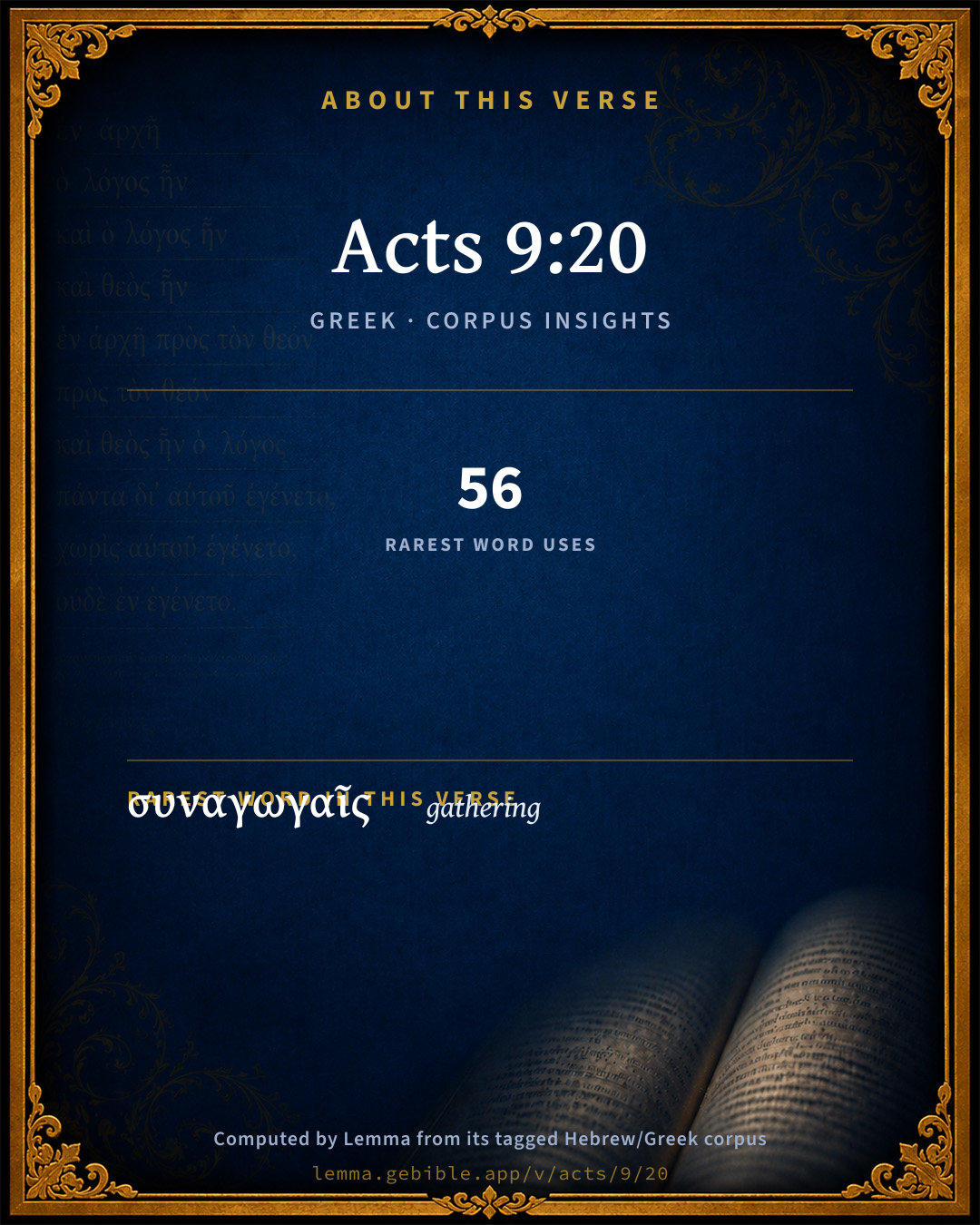
Acts 9:20

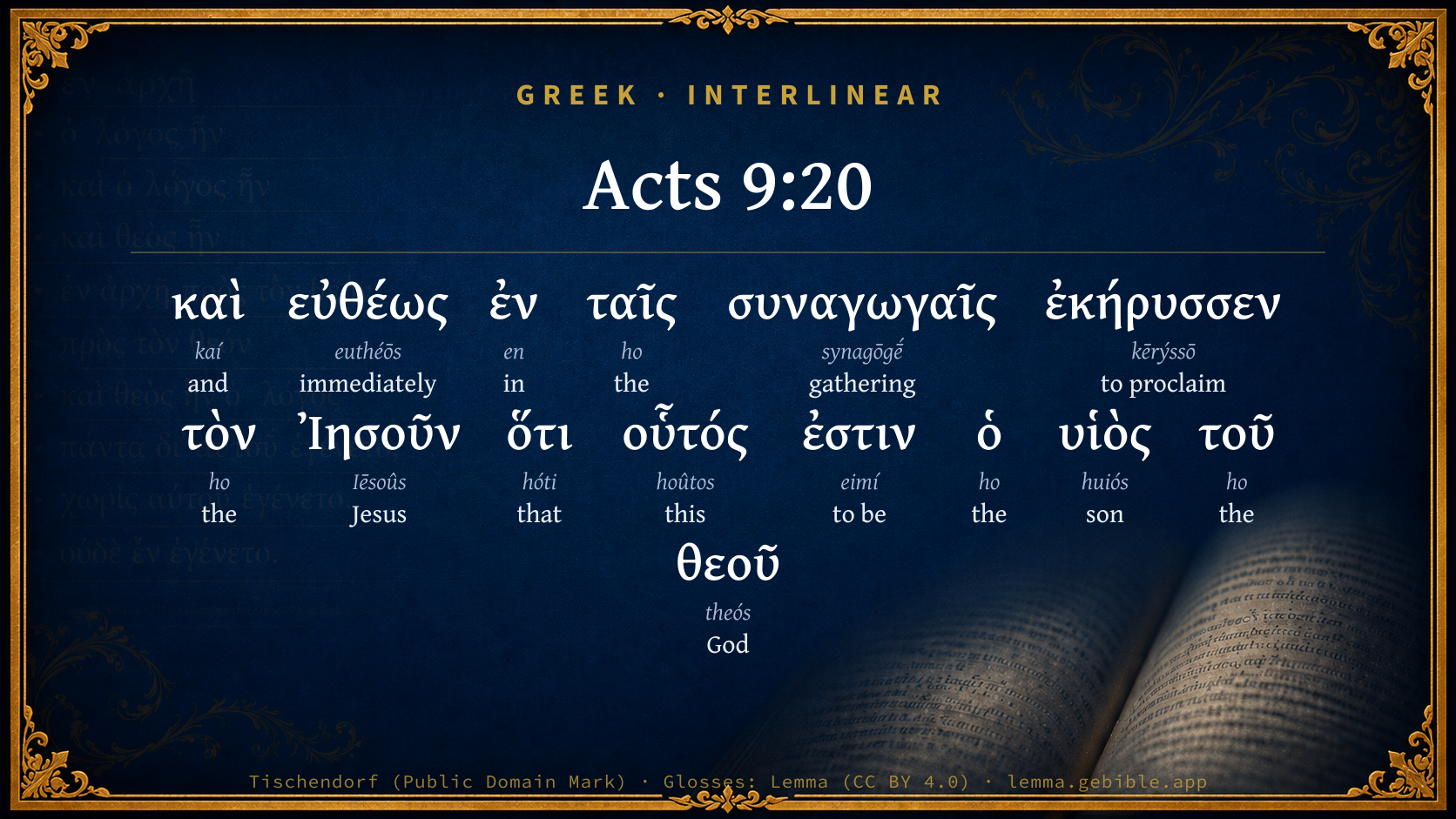
Greek (Tischendorf 8th ed.) Acts 9:20 appears in the Greek New Testament. The text above is from the Tischendorf 8th edition. Each word links to its Strong’s number and a concise gloss. Click any word for its full Thayer’s Greek Lexicon entry.
Download image
Cite this verse

Acts 9:20 (World English Bible). Public Domain. Lemma interlinear Bible study tool, https://lemma.gebible.app/v/acts/9/20.

Show BibTeX & RIS
BibTeX
RIS
English Translation
Immediately in the synagogues he proclaimed the Christ, that he is the Son of God.
World English Bible · Public Domain
Download a study sheet

One document with this verse’s original text, its word-by-word gloss line, the meaning frame, cross-references with their text, attributed commentary, and full source and license credits — printable, and it pastes into notes with its structure intact.

This verse Autodidact and up

Study sheet (.html) Plain text (.txt)

A passage Seminary Student

Up to 50 verses in one chapter. A passage sheet keeps up to 6 commentary sources and 12 cross-references per verse, in the order this page ranks them, and says so on the sheet whenever that leaves anything out. Ask for a single verse and you get the Autodidact verse sheet above.

Everything on this page stays free to read, with no account — the sheet is a download of what is already on screen, not access to it.

Want to remove ads? Support Godless Engineer
Compare translations 3

The same verse in 3 English versions, stacked beneath the original-language interlinear above. Click any original word for its lexicon entry.

Each is an independent rendering of the whole verse — the interlinear is not word-aligned to these translations.

Highlighted words mark where these versions differ — a whole-verse word diff, not a word-by-word alignment.

  • World English Bible Public Domain
    Immediately in the synagogues he proclaimed the Christ, that he is the Son of God.
  • King James Version Public Domain
    And straightway he preached Christ in the synagogues, that he is the Son of God.
  • unfoldingWord Literal Text CC BY-SA 4.0
    And immediately in the synagogues he proclaimed Jesus, that this is the Son of God.

unfoldingWord Literal Text — © unfoldingWord, licensed CC BY-SA 4.0. Word-aligned USFM3 via Door43 (git.door43.org/unfoldingWord/en_ult).

Versions to compare (up to 4)

3 of 4 selected

Show all 19 translations

Every available English version of this verse, each an independent rendering of the whole verse.

  • World English Bible Public Domain
    Immediately in the synagogues he proclaimed the Christ, that he is the Son of God.
  • Berean Standard Bible Public Domain
    Saul promptly began to proclaim Jesus in the synagogues, declaring, “He is the Son of God.”
  • Majority Standard Bible Public Domain
    Saul promptly began to proclaim Christ in the synagogues, declaring, “He is the Son of God.”
  • King James Version Public Domain
    And straightway he preached Christ in the synagogues, that he is the Son of God.
  • American Standard Version (1901) Public Domain
    And straightway in the synagogues he proclaimed Jesus, that he is the Son of God.
  • Revised Version (1885) Public Domain
    And straightway in the synagogues he proclaimed Jesus, that he is the Son of God.
  • Geneva Bible (1599) Public Domain
    And straightway hee preached Christ in the Synagogues, that he was that Sonne of God,
  • Douay-Rheims (1899) Public Domain
    And immediately he preached Jesus in the synagogues, that he is the Son of God.
  • Young's Literal Translation Public Domain
    and immediately in the synagogues he was preaching the Christ, that he is the Son of God.
  • Literal Standard Version CC BY-SA 4.0
    and immediately he was preaching the Christ in the synagogues, that He is the Son of God.
  • Unlocked Literal Bible CC BY-SA 4.0
    Right away he proclaimed Jesus in the synagogues, saying that he is the Son of God.
  • unfoldingWord Literal Text CC BY-SA 4.0
    And immediately in the synagogues he proclaimed Jesus, that this is the Son of God.
  • Darby Bible Public Domain
    And straightway in the synagogues he preached Jesus that *he* is the Son of God.
  • World Messianic Bible Public Domain
    Immediately in the synagogues he proclaimed the Messiah, that he is the Son of God.
  • Webster's Bible Public Domain
    And immediately he preached Christ in the synagogues, that he is the Son of God.
  • Free Bible Version CC BY-SA 4.0
    He immediately started speaking in the synagogues, saying, “Jesus is the Son of God.”
  • Bible in Basic English Public Domain
    And straight away, in the Synagogues, he was preaching Jesus as the Son of God.
  • Text-Critical English NT CC BY 4.0
    Immediately he began preaching in the synagogues that the Christ is the Son of God.
  • Tyndale New Testament (1534) Public Domain
    And streyght waye he preached Christ in the synagoges how that he was the sonne of God.

Literal Standard Version (2020), Covenant Press — licensed CC BY-SA 4.0. Text via the HelloAO Bible API (eBible.org). Unlocked Literal Bible (unfoldingWord) — licensed CC BY-SA 4.0. Text via the HelloAO Bible API (eBible.org). unfoldingWord Literal Text — © unfoldingWord, licensed CC BY-SA 4.0. Word-aligned USFM3 via Door43 (git.door43.org/unfoldingWord/en_ult). Free Bible Version, Dr. Jonathan Gallagher — licensed CC BY-SA 4.0. Text via the HelloAO Bible API (eBible.org).

Word by word

More ways to search: Search by grammar → Find every occurrence → Compare this word →

Practice this passage: Drill this verse → Learn its vocabulary →

συναγωγαῖς
synagōgḗ
G4864
“gathering”
Noun, Dative, Plural, Feminine
Part of Speech
Noun
Case
Dative
Number
Plural
Gender
Feminine
Full Thayer's Definition

Origin: from (the reduplicated form of) G4863

TDNT: 20:18,1

1. a bringing together, gathering (as of fruits), a contracting 2. in the NT, an assembling together of men, an assembly of men 3. a synagogue a. an assembly of Jews formally gathered together to offer prayers and listen to the reading and expositions of the scriptures; assemblies of that sort were held every sabbath and feast day, afterwards also on the second and fifth days of every week; name transferred to an assembly of Christians formally gathered together for religious purposes b. the buildings where those solemn Jewish assemblies are held. Synagogues seem to date their origin from the Babylonian exile. In the times of Jesus and the apostles every town, not only in Palestine, but also among the Gentiles if it contained a considerable number of Jewish inhabitants, had at least one synagogue, the larger towns several or even many. These were also used for trials and inflicting punishment.
  1. καὶ kaí G2532 “and” Conjunction
  2. εὐθέως euthéōs G2112 “immediately” Adverb
  3. ἐν en G1722 “in” Preposition
  4. ταῖς ho G3588 “the” Article, Dative, Plural, Feminine
  5. ἐκήρυσσεν kērýssō G2784 “to proclaim” Verb, Imperfect, Active, Indicative, 3rd person, Singular
  6. τὸν ho G3588 “the” Article, Accusative, Singular, Masculine
  7. Ἰησοῦν Iēsoûs G2424 “Jesus” Noun, Accusative, Singular, Masculine
  8. ὅτι hóti G3754 “that” Conjunction
  9. οὗτός hoûtos G3778 “this” Demonstrative pronoun, Nominative, Singular, Masculine
  10. ἐστιν eimí G1510 “to be” Verb, Present, Active, Indicative, 3rd person, Singular
  11. ὁ ho G3588 “the” Article, Nominative, Singular, Masculine
  12. υἱὸς huiós G5207 “son” Noun, Nominative, Singular, Masculine
  13. τοῦ ho G3588 “the” Article, Genitive, Singular, Masculine
  14. θεοῦ theós G2316 “God” Noun, Genitive, Singular, Masculine

About this verse

These counts appear in no published source. They are computed here, from the morphology-tagged text and Lemma’s own curated glosses. What Lemma adds →

15
words
12
distinct lemmas
Acts
section

Shared distinctive vocabulary

συναγωγαῖς gathering G4864 occurs in 56 verses of the Greek New Testament. Also found in:

Repetition

A word recurs within this verse:

  • ταῖς the G3588 ×4

Cross-references

20

Topical passages linked to Acts 9:20 in the Treasury of Scripture Knowledge — connected by theme and wording, ordered by reader-vote popularity; previews shown in the World English Bible.

  • John 20:28 Thomas answered him, "My Lord and my God!"
  • Galatians 1:23–24 but they only heard: "He who once persecuted us now preaches the faith that he once tried to destroy."
  • Galatians 2:20 I have been crucified with Christ, and it is no longer I that live, but Christ living in me. That life which I now live in the flesh, I live by faith in the Son of God, who loved me, and gave himself up for me.
  • 1 John 4:14–15 We have seen and testify that the Father has sent the Son as the Savior of the world.
  • Psalms 2:7 I will tell of the decree. Yahweh said to me, "You are my son. Today I have become your father.
  • Psalms 2:12 Kiss the son, lest he be angry, and you perish in the way, For his wrath will soon be kindled. Blessed are all those who take refuge in him.
  • Matthew 4:3 The tempter came and said to him, "If you are the Son of God, command that these stones become bread."
  • Matthew 26:63–66 But Jesus held his peace. The high priest answered him, "I adjure you by the living God, that you tell us whether you are the Christ, the Son of God."
  • Matthew 27:43 He trusts in God. Let God deliver him now, if he wants him; for he said, 'I am the Son of God.'"
  • John 1:49 Nathanael answered him, "Rabbi, you are the Son of God! You are King of Israel!"
  • John 20:31 but these are written, that you may believe that Jesus is the Christ, the Son of God, and that believing you may have life in his name.
  • Acts 9:22 But Saul increased more in strength, and confounded the Jews who lived at Damascus, proving that this is the Christ.
  • Acts 9:27–28 But Barnabas took him, and brought him to the apostles, and declared to them how he had seen the Lord in the way, and that he had spoken to him, and how at Damascus he had preached boldly in the name of Jesus.
  • Romans 1:4 who was declared to be the Son of God with power, according to the Spirit of holiness, by the resurrection from the dead, Jesus Christ our Lord,
  • John 19:7 The Jews answered him, "We have a law, and by our law he ought to die, because he made himself the Son of God."
  • Acts 8:36 As they went on the way, they came to some water, and the eunuch said, "Behold, here is water. What is keeping me from being baptized?"
  • Acts 13:5 When they were at Salamis, they proclaimed the word of God in the synagogues of the Jews. They had also John as their attendant.
  • Acts 13:14 But they, passing on from Perga, came to Antioch of Pisidia. They went into the synagogue on the Sabbath day, and sat down.
  • Revelation 2:18 "To the angel of the assembly in Thyatira write: "The Son of God, who has his eyes like a flame of fire, and his feet are like burnished brass, says these things:
  • Matthew 27:54 Now the centurion, and those who were with him watching Jesus, when they saw the earthquake, and the things that were done, feared exceedingly, saying, "Truly this was the Son of God."

Cross-references courtesy of OpenBible.info (CC BY 4.0).

Where the printed editions differ

1 variant

Places in this verse where the major printed Greek editions disagree on the wording in a way that affects the translation — a comparison of editions, not a manuscript-by-manuscript collation. The editions are the modern critical texts (Nestlé-Aland 28/27, SBL, Westcott-Hort, Tregelles, Tyndale House) and the traditional texts behind the KJV (the Textus Receptus and the Byzantine/Majority text). It is not a claim about which reading is original.

  1. Different wording
    Ἰησοῦν,

    “Jesus,”

    In NA28NA27TynSBLWHTreg Not in TRByz

    χριστόν (christon) 'Christ' occurs in traditional manuscripts (TR+Byz) instead of Ἰησοῦν, (Iēsoun) 'Jesus,' in older manuscripts (NA28+NA27+Tyn+SBL+WH+Treg)

Textual data: Translators Amalgamated Greek New Testament (STEPBible TAGNT) · CC BY 4.0.

Commentary

Notes on Acts 9:20 from classic Christian and Jewish commentators (each source and its license shown beneath its notes). The classic Christian expositions comment on the surrounding passage and are grouped to its opening verse, so a note may address several verses; the Jewish commentaries on the Tanakh (Rashi and others) are per-verse, so they appear only where the commentator wrote on this verse.

Lemma curates 59 commentaries, every one of them public domain or Creative Commons licensed, each selected and text-cleaned for this edition rather than reprinted as found. About our sources →

Joseph Benson's Commentary

Act 9:20-22. And straightway — That is, immediately after his conversion; he preached Christ in the synagogues — Some writers have given it as their opinion, (see Dr. Wells on the place, and Script. Geog., vol. 3. p. 375,) that as soon as Saul had strength to go anywhere abroad, he retired into the desert of Arabia, and there was favoured with a full revelation of Christianity, and spent some considerable time in devotion; and that after this he returned to Damascus and preached, which they argue from Gal 1:16-17. But this opinion seems inconsistent with what is here said of his preaching, ευθεως, immediately. It seems, therefore, probable, that by his going into Arabia, to which Damascus now belonged, we are to understand his making excursions from that city into the neighbouring parts of that country, which he might do, perhaps, between the time in which he began to preach in Damascus, and his quitting it, after repeated labours there, to go to Jerusalem. That he is the Son of God — Foretold Psalms 2.; which he knew and proved Christ to be by incontestable arguments. But all that heard him were amazed — As well they might be; and said, Is not this he that destroyed them which called on this name — And now doth he call on this name himself, and persuade others to call upon it, and strengthen the hands of those that do! Nay, and did he not come hither for that intent — To seize all the Christians he could find; and bring them bound to the chief priests? — Who would have thought then that he should preach Christ as he doth? No doubt this was looked upon by many to be, what indeed it was, a great confirmation of the truth of Christianity, that a person who had been such a notorious persecutor of it, should come on a sudden to be such an intelligent and strenuous preacher of it. This miracle upon the mind of such a man outshone the miracles upon men’s bodies, and the giving Saul such another heart was more than giving men to speak with other tongues. But Saul increased the more in strength — Became more intimately acquainted with the gospel of Christ, and his pious affections became more strong, his faith and hope firm, and his love to Christ and his disciples, and to all mankind, more fervent. He also became more bold and resolute in the defence of the gospel: and confounded the unbelieving Jews, proving that this Jesus of Nazareth is the very Christ — The true Messiah, the Son of God. He answered their objections to the satisfaction of all indifferent persons, and pressed them with arguments to which they could make no reply. And we can have no reason to doubt that he was instrumental in converting many to the faith of Christ, and therefore of building up the church at Damascus, which he had come thither to destroy.

Joseph Benson's Commentary on the Old and New Testaments (1811–1818) — public domain. Text from a community e-Sword module.

Tyndale Open Study Notes

Tyndale Open Resources

9:20-21 immediately he began preaching about Jesus: The genuineness of Saul’s encounter with the risen Christ is attested by the enthusiasm and boldness of his preaching. Saul’s outspoken declaration provoked astonishment, for he was the very man who had created such devastation among Jesus’ followers in Jerusalem.

Tyndale Open Study Notes — © Tyndale Open Resources, licensed CC BY-SA 4.0. Text via the HelloAO Bible API.

Bengel's Gnomon

Johann Albrecht Bengel

Act 9:20. Εὐθέως, straightway) Some after conversion are as rivers, immediately from the source (head), broad and deep: others after a longer course. Saul, becoming immediately an apostle, had made as much progress in three days, as others do not make in many years. [By the most thorough humiliation which had preceded, he was fortified beforehand against the danger that otherwise threatens neophytes or novices (1Ti 3:6).—V. g.]

Bengel's Gnomon of the New Testament — English translation (T&T Clark, Edinburgh, 1860) — public domain. Text from a community e-Sword module.

Expositor's Greek Testament

ed. W. Robertson Nicoll

Act 9:20 . ἐν ταῖς συναγωγαῖς publicly in the Jewish Assemblies: οὐκ ᾐσχύνετο (Chrys.). ὁ υἱὸς τοῦ Θεοῦ : only here in Acts. As the preaching was in the synagogue the term would be used in its Messianic sense ( cf. Joh 1:49 ), according to the early Messianic interpretation of Psa 2:7 ; cf. Act 13:33 and St. Paul’s reference to the Psalm in another address to Jews, in the Pisidian Antioch. For the use of the term as applied to the Messiah by the Jews see further Book of Enoch , cv., 2, and Dr. Charles’ note.

The Expositor's Greek Testament, edited by W. Robertson Nicoll (1897–1910) — public domain. Text from a community e-Sword module.

Geneva Bible (1599)

Geneva Bible translators

Paul beginneth straightways to execute the office which was enjoined him, never consulting with flesh and blood.

Geneva Bible (1599) marginal notes — public domain. Text via Bolls.life.

Jamieson, Fausset & Brown

Robert Jamieson, A. R. Fausset & David Brown

preached Christ . . . that he is the Son of God--rather, "preached Jesus," according to all the most ancient manuscripts and versions of the New Testament (so Act 9:21, "all that call on this name," that is, Jesus; and Act 9:22, "proving that this Jesus is very Christ").

Jamieson, Fausset & Brown — Commentary Critical and Explanatory on the Whole Bible (1871) — public domain (CC PDM 1.0). Text via the HelloAO Bible API.

Adam Clarke's Commentary

Verse 20. Preached Christ in the synagogues] Instead of χριστον, Christ, ιησουν, Jesus, is the reading of ABCE, several others of high importance, together with the Syriac, Coptic, AEthiopic, Armenian, Slavonic, and Vulgate.

The great question to be determined, for the conviction of the Jews, was that JESUS was the Son of God. That the Christ, or Messiah, was to be the Son of God, they all believed. Saul was now convinced that Jesus, whom they had crucified, and who had appeared to him on the way, was the Son of God, or Messiah; and therefore as such he proclaimed him. The word Christ should be changed for Jesus, as the latter is, without doubt, the genuine reading.

The first offers of the grace of the Gospel were uniformly made to the Jews. Saul did not at first offer Jesus to the heathens at Damascus; but to the synagogues of the Jews.

Adam Clarke's Commentary on the Bible (1810–1826) — public domain. Text from a community e-Sword/MySword module.

John Calvin's Commentaries

20. Luke declareth now how fruitful Paul’s conversion was, to wit, that he came abroad by and by, and did not only profess that he was a disciple of Christ, but did also set himself against the fury and hatred of the enemies, by defending the gospel stoutly. Therefore, he who of late ran headlong against Christ with furious force, doth now not only submit himself meekly unto his will and pleasure but like a stout standard-bearer fighteth even unto the utmost danger to maintain his glory. Certain it is that he was not so quickly framed by Ananias’ industry, but that so soon as he had learned the first principles by man’s mouth, he was extolled by God unto higher things afterward. He comprehendeth the sum of his preaching briefly, when he saith that Christ was the Son of God. In the same sense, he saith shortly after that he saw Christ. And understand thus much, that when Paul intreated out of the law and the prophets of the true office of the Messiah, he taught also that all whatsoever was promised of, and was to be hoped for, at the hands of the Messiah, was revealed and given in Christ. For the words signify thus much, when he saith that he preached that Christ is the Son of God. That was undoubtedly a principle amongst the Jews, that there should a Redeemer come from God, who should restore all things to a happy estate. Paul teacheth that Jesus of Nazareth is he, which he cannot do, unless he shake off those gross errors which he had conceived of the earthly kingdom of the Messiah. Certain it is that Paul declared how Christ was promised in the law, and to what end; but because all tended to this end, that he might prove that the son of Mary was he of whom the law and the prophets bare witness, therefore Luke is content with this one word only.

John Calvin's Commentaries (1540-1563) — public domain. Text from the Calvin Translation Society English edition (1840s-50s) via the Christian Classics Ethereal Library (ccel.org). Calvin's coverage is partial (roughly two-thirds of the Bible); uncommented books and verses are honest gaps, never fabricated. The 19th-century editor's footnotes and remarks are omitted so the notes are faithfully Calvin's own voice.

Ellicott's Commentary for English Readers

(20) And straightway he preached Christ in the synagogues.—The “straightway” as interpreted by the inference drawn in the previous Note, must be taken to refer to the Apostle’s first public appearance in the synagogues of Damascus after his return from Arabia. The tense of the verb implies that the work was continued for some length of time. What he had to proclaim was, first, that the Christ was actually and verily the Son of God no less than the Son of David; and, secondly, that Jesus of Nazareth had been shown to be the Christ. The better MSS., however, give the reading, preached Jesus. The line of reasoning we may assume to have been identical with that of Act_13:16-41. It is not without interest to remember here also that the Samaritans had a synagogue of their own at Damascus, and that he may thus have preached to them, so following in the footprints of Philip and taking his first step in the great work of breaking down the barriers that divided Israel from the world.

A Bible Commentary for English Readers, edited by Charles John Ellicott (1878–1897) — public domain. Text from a community e-Sword module.

The Cambridge Bible for Schools and Colleges

gen. ed. J. J. S. Perowne

20. And straightway he preached Christ [proclaimed Jesus] in the synagogues, that he is the Son of God] The best MSS. read Jesus in this verse, and this naturally is correct. The preaching which was to be to the Jews a stumbling-block was that Jesus of Nazareth was the Christ, their long-expected Messiah.

He went, as was Christ’s custom also, into the synagogues as the most likely places where to find an audience who would listen to his proclamation. His letters to the synagogues (Act_9:2) were not delivered, but he came as the herald of one of higher authority than the chief priests. For St Paul’s constant practice of teaching in the Jewish synagogues, see Act_13:5, Act_14:1, Act_17:1; Act_17:10, Act_18:4; Act_18:19, Act_19:8.

The Cambridge Bible for Schools and Colleges (gen. ed. J. J. S. Perowne; Cambridge University Press, 1878–1918) — public domain. Text from a community e-Sword module.

John Gill's Exposition

And straightway he preached Christ in the synagogues,.... The Syriac version adds, "of the Jews"; that is, which were in Damascus, Act 9:2 from whence it appears, that he was immediately, as soon as converted, qualified for the work of preaching the Gospel: nor did he confer with flesh and blood, or stand disputing and debating with himself and carnal reason, what was best for him to do; but as soon as he knew Christ himself, he preached him to others, and whom he always made the subject of his ministry; and particularly,

that he is the Son of God; the only begotten of the Father, the eternal Son of God, truly and properly God, of the same nature and essence with God his Father, and equal to him. His design was to assert and maintain the dignity of his person, which is the foundation of his office, as Mediator, and of all the wonderful things he performed: had he meant no more than that he was the Messiah, the sense would only be, that he preached that Christ was the Christ; but the meaning is, that he preached that Jesus of Nazareth, the true Messiah, was not a mere man, but a divine person, even the Son of God: he set out in his ministry, with the principal and most fundamental article of the Christian religion, that which Christ asserted, and for which he suffered, and which all the apostles, and first Christians believed. The Alexandrian copy, the Vulgate Latin, Syriac, and Ethiopic versions read "Jesus", instead of "Christ".

John Gill's Exposition of the Whole Bible (1746–1763) — public domain (CC PDM 1.0). Text via the HelloAO Bible API.

Trapp's Complete Commentary

John Trapp

20 And straightway he preached Christ in the synagogues, that he is the Son of God.

Ver. 20. And straightway he preached] He conferred not with flesh and blood, Gal 1:16, but fell presently to work, and followed it close, as afraid to be taken with his task undone. Chrysostom saith of Paul, that he was insatiabilis Dei cultor, an insatiable server of God.

John Trapp, A Commentary or Exposition upon All the Books of the Old and New Testament (1647–1656) — public domain. Text from a community e-Sword module.

Albert Barnes' Notes on the Bible

And straightway - Immediately. It was an evidence of the genuineness of his conversion that he was willing at once to avow himself to be the friend of the Lord Jesus.

He preached Christ - He proclaimed that Jesus was the Christ. See Act 9:22. Many manuscripts read here Jesus instead of Christ. Griesbach has adopted this reading. Such is also the Syriac, the Vulgate, and the Ethiopic. The reading accords much better with the subject than the common reading. That Christ, or the Messiah, was the Son of God, all admitted. In the New Testament the names Christ and Son of God are used as synonymous. But the question was whether Jesus was the Christ, and was therefore the Son of God, and this Paul showed to the Jews. Paul continued the practice of attending the synagogues; and in the synagogues anyone had a right to speak who was invited by the officiating minister. See Act 13:15.

That he is the Son of God - That he is the Messiah.

Albert Barnes' Notes on the Bible (1834–1885) — public domain. Text from a community e-Sword/MySword module.

Matthew Poole's English Annotations

He preahced Christ in the synagogues; the apostles spake unto the Jews first, either that they might convert them, or at least take away all excuse from them.

That he is the Son of God; which doubtless he spake largely unto, though it be not here expressed; but he had an abundance in his heart, having tasted the power of the grace of God in Christ, and out of his heart his mouth spake.

Matthew Poole's English Annotations on the Holy Bible (1683–1685) — public domain. Text from a community e-Sword/MySword module.

Whedon's Commentary on the Bible

Daniel D. Whedon

20. Straightway—Saul is prompt to appear forthwith in public, both to testify what Jesus had done for him, and to demonstrate that he boasts rather than blushes at the change he had made.

Daniel D. Whedon (gen. ed.), Commentary on the Old and New Testaments (1874–1909) — public domain. Text from a community e-Sword module.

The Pulpit Commentary

In the synagogues he proclaimed Jesus for he preached Christ in the synagogues, A.V. and T.R. The preponderance of manuscript authority, and the onoma of ver. 21, and the oti outov ejstin oJ Cristov of ver. 22, seem conclusive in favor of Jesus rather than Christ. As regards the expression straightway, we must understand it as descriptive of Saul"s action upon his return from Arabia. Is it possible that St. Luke uses it with the same meaning as he may have heard St. Paul use it in when speaking of his Damascus preaching, in the same sense as St. Paul actually does speak Gal_1:17, viz. as expressing that he did not wait for authority from the apostles, but at once, fresh from the Divine call, and having a direct commission from Christ himself, entered upon his apostolic ministry? If the Epistle to the Galatians was written A.D. 58, it would be just about the time that St. Luke joined St. Paul, and might be commencing to collect materials for his history. So that the phrase in the Galatians and the phrase in this twentieth verse might really be the expression of one thought committed to paper by St. Paul on the one hand, and uttered in the ear of Luke on the other. It is a confirmation of this view that in 2 Corinthians, written about the same time, there is also an account of Saul"s escape from Damascus. In the synagogues; the very synagogues (ver. 2) to which the letters of the high priest were addressed, empowering him to arrest either man or woman who called upon the Name of Jesus, and bring them as prisoners to Jerusalem to be tried before the Sanhedrim. No wonder they were amazed.

Saul"s first sermons.

Revised Version, "And straightway in the synagogues he proclaimed Jesus, that he is the Son of God." "The point to which all the effort of the apostle was first directed was naturally the Messiahship of Jesus, and that in the higher view in which Christianity exhibits the Messiah, namely, as the Son of God" (Olshausen). Very different ideas are entertained as to the advisability of encouraging young converts to begin preaching at once. The difficulty arose in the China mission field, and the new convert earnestly pleaded to be allowed to tell the little he did know, and so grow to know more. This principle Saul followed, beginning at once to preach the faith which once he destroyed," and he made the opportunities just where he was, going into the synagogues, and using his privilege as a rabbi to read and expound the Scriptures. The text briefly indicates what truth Saul had gripped, and, taken with ver. 22, it shows how large his grip was, and that it concerned the very basis-truth of Christianity. He saw that

I THE CHRIST HAD COME. Explain that Christ" is the Greek equivalent of the Hebrew word Messiah," and would often be wisely changed for the Hebrew term. Deal with

(1) the foregoing prophecies of Messiah, showing how they had given tone to the national and religious sentiment;

(2) the actual expectation of the coming of Messiah about that time, which seems to have possessed both the Jews and the Gentiles. The practical question dividing public opinion at the time was the question which divides the Jew anti the Gentile up to this present hour; it was this Had Messiah come, or had he not come? Saul was now able to deal with this question, and he proclaimed openly that Messiah had come. Show the importance of this step, and how it narrowed the field of inquiry for all those pious souls who looked for redemption in Israel.

II THE CHRIST CAME IN THE PERSON OF JESUS OF NAZARETH. The better manuscripts give the reading, "preached Jesus." If Messiah had conic, had he been recognized, and acknowledged? Saul firmly answered," Yes; Messiah was Jesus of Nazareth, the Prophet, Teacher, Healer, holy Man, who was crucified, had risen from the dead, and was exalted to heaven." Surely this was a great theme for his preaching, one demanding explanation, argument, evidence, and the "accent of his own conviction." But Saul had seen more than even this, and so further proclaimed that

III JESUS THE CHRIST WAS THE SON OF GOD. Explain that term as

(1) compared with "Son of man;" and

(2) as gaining to the apostles its deeper and fuller meaning.

To Saul had evidently come an insight into the glorious mystery of the Incarnation. He realized

(1) that Jesus was the Christ in a high spiritual sense;

(2) that Jesus was entrusted with a present power to save and to sanctify;

(3) that Jesus had Divine rights, and made Divine claims to the immediate surrender to him of the heart and will and lives of men. So it is evident that Saul grasped at once the very essence of the gospel, and the very center of that doctrinal system which, urged by the necessities of the Churches, his genius developed. There is still no more searching test of our religious condition than can be found in the question, "What think ye of Christ? Whose Son is he?" If we feel that we must say, "He is the Son of God," then we are bound to bow our souls before him, seek his grace, accept his salvation, acknowledge his authority, and bind on our whole lives the livery of his service. R.T.

The Pulpit Commentary (1880–1919), ed. H.D.M. Spence-Jones & Joseph S. Exell — public domain. Text from a community e-Sword module.

Scofield Reference Notes

C. I. Scofield

that he is the Son of God

Cf. Act 2:36. Peter, while maintaining the deity of Jesus--"God hath made that same Jesus, whom ye have crucified, both Lord and Christ"--gives especial prominence to His Messiahship. Paul, fresh from the vision of the glory, puts the emphasis on His Deity. Peter’s charge was that the Jews had crucified the Son of David Act 2:25-30 Paul’s that they had crucified the Lord of glory 1Co 2:8. In the A.V. the sense is largely lost. The point was, not that the Christ was God, a truth plainly taught by Isaiah.; Isa 7:14; Isa 9:6; Isa 9:7 but that Jesus, the crucified Nazarene, was the Christ and therefore God the Son.

The Scofield Reference Bible (1917 edition), notes by C. I. Scofield — public domain. Text from a community e-Sword module.

Kretzmann's Popular Commentary

Paul E. Kretzmann

Saul preaches Christ:

v. 20. And straightway he preached Christ in the synagogues that He is the Son of God.

v. 21. But all that heard him were amazed and said, Is not this he that destroyed them which called on this name in Jerusalem, and came hither for that intent, that he might bring them bound unto the chief priests?

v. 22. But Saul increased the more in strength, and confounded the Jews which dwelt at Damascus, proving that this is very Christ.

Saul had, by the Word of the Lord through Ananias and probably also by direct command of God, received his commission as preacher and missionary. And he lost no time in entering upon his duties. Quickly, as soon as possible, he preached in the synagogues, heralding the message, proclaiming Jesus that He is the Son of God. He proved to the assembled Jews that the same Jesus that had been put to death by them could be none else than the promised Messiah, the very Son of God, concerning whom Psa 2:7 spoke. That is the great message of the New Testament, the sum and substance of all preaching of the person and office of the Savior. The result was that all those that heard Saul speak were stupefied with astonishment, which they voiced in the excited inquiry: Is not this the man that destroyed, laid waste, in Jerusalem those that called upon this name, and has come here for the purpose of leading them bound to the high priests? The mission of Saul had become known among the Jews, probably through his companions or by message from Jerusalem, and his former hatred had been a matter of general knowledge. His complete change, therefore, was altogether inexplicable to his former companions. Meanwhile Saul was growing in spiritual and religious strength day by day, in his understanding of Scriptures and of their great central theme, and in his power to apply the import of the wonderful news to the situation before him. Whenever he had the opportunity, he argued his inexhaustible topic and confounded the Jews, literally, poured them together, mired them up, making it impossible for them to stand up before his mighty exposition and demonstration that this man Jesus is the Christ. This truth he proved by demonstrating the agreement between the Messianic predictions and the historical facts in the life of Jesus, and he testified to it from the soundness and firmness of his conviction. The power of the Holy Spirit in his message, added to his confidence and joyfulness, could not fail to make a deep impression, even as it does to this day.

Paul E. Kretzmann, Popular Commentary of the Bible (1921–1924) — public domain. Text from a community e-Sword module.

Burkitt's Expository Notes on the New Testament

William Burkitt

Here we have an account of St. Paul’s entrance upon his ministerial office in preaching the gospel; Straightaway he preached Christ in the synagogues.

Where note, 1. The time of his preaching, Straightaway: he fell presently to his Master’s work, not consulting flesh and blood about the difficulties and dangers that might attend it; but performs his duty with such zeal and immediate application, as became a person of his holy character and profession.

Note, 2. The place where he preached, In the Jewish synagogues: He was afterwards indeed the apostle of the Gentiles, but according to Christ’s command, he first preached the word of life to the Jews, to convert some, and to leave others without excuse: After which he turned from them unto the Gentiles according to It was necessary that the word of God should first be spoken to you; but because you put it from you, and judge yourselves unworthy of everlasting life, lo, we turn to the Gentiles Act 13:46.

Note, 3. The doctrine he preached; That Jesus was the Son of God, the true, promised, and expected Messioas; and that all the prophecies and predictions of the prophets concerning the Messias, were exactly fulfilled in his person.

Note, 4. The effect of his preaching:

1. Some of his auditors were amazed, admiring that so pestilent a persecutor was become a powerful preacher, These glorified God in him.

2. Others were confuted, yea, confounded, being unable to withstand the force and dint of his argument, by which he proved, that this is the very Christ.

Note, 5. The hazard which tha apostle ran in preaching the gospel at Damascus; his enemies, who were not able to resist the wisdom and spirit by which he spake, took council day and night, there being in their apprehensions no possibility of his escaping.

Note, 6. The manner and means of his deliverance: some Christians who dwelt at Damascus let him down in a basket by the wall, and so he escaped the hands of his bloody enemies. The wisdom of God is never at a loss to find out ways and means, either ordinary or extraordinary, for the deliverance of his servants, when their deliverance makes most for hsi own glory, and the gospel’s advantage. God had much work for Paul to do; and till he had finished his work, his enemies could not take him off with all their combined power and malice.

William Burkitt's Expository Notes on the New Testament (1700–1703) — public domain. Text from a community e-Sword module.

Godbey's Commentary on the New Testament

William B. Godbey

PAUL’S SANCTIFICATION

20-25. (Gal 1:15-22 and Romans 7.) Saul had long been a preacher of no ordinary ability. Hence he was a fluent orator when thus powerfully converted under the impetus of a spiritual Niagara. He preached Jesus boldly in Damascus, to the unutterable surprise of all who had trembled with awe at the mention of his name. Luke’s scanning history is here elliptical, involving the conclusion of an inward conflict, accompanied by divine leadership off to Arabia, where God taught Moses forty years and sanctified him at the burning bush. John the Baptist was also taught in God’s theological school, i. e., the desert of Judea, preparatory for his wonderful ministry. So Saul must spend three years amid the wild beasts and Bedouins of the Arabian desert. Gal 1:16 :

“When God was pleased to reveal his Son in me, I conferred not with flesh and blood, but went away into Arabia.”

This is included in Luke’s narrative (Act 9:22), “And Saul continued to be more and more fi]led up with dynamite.” This is his Arabian experience of sanctification, testified in Rom 7:25, the preceding chapter describing his conflict with inbred sin, while in the justified state. On the Damascus Road the Holy Ghost revealed to him the Son of God, shining on him from without. In Arabia (Gal 1:15), He revealed to him Jesus within sitting on the throne of his heart. It is our privilege all to have Pauline experiences, in which Jesus first appears to us, shining on us from without in regeneration. Then it is our privilege to receive the Holy Ghost, our sanctification, who in that case always enthrones Jesus in the heart and gives you the blessed consciousness that Jesus henceforth sits on the throne of your heart, making your life a cloudless sunshine and lighting up your entire being with the glory of His presence. Be sure your experience is Pauline; first Jesus appearing to you and shining on you, and then revealed in you, sitting on the throne of your heart. Saul did not dare to go up to Jerusalem, appear before the apostles and claim his apostleship, to which Jesus called him when He met him, without receiving in addition to his conversion in the house of Judas a clear Pentecostal sanctification, thus rendering him experimentally homogeneous with the other apostles. Act 9:9: “And he mightily confounded the Jews, proving that He is the Christ.” This was after he returned from Arabia. He is now a cyclone of fire and logic irresistible.

William B. Godbey, Commentary on the New Testament (1896–1900) — public domain. Text from a community e-Sword module.

McGarvey & Pendleton's Commentaries

J. W. McGarvey

19-22. No sooner had Saul obeyed the gospel and obtained pardon, then he began to devote all his energies to building up what he had sought to destroy. (19) " Then Saul was some days with the disciples in Damascus, (20) and immediately he preached Christ in the synagogues, that this is the Son of God. (21) And all who heard him were astonished, and said, Is not this he who destroyed those in Jerusalem who called upon this name, and came hither for this purpose, that he might take them bound to the high priests? (22) But Saul increased the more in strength, and confounded the Jews who dwelt in Damascus, proving that this is the Christ. " The one great gospel proposition, that Jesus is the Christ and the Son of God, the belief of which had wrought in him all the wondrous change on the road to Damascus is now his constant theme. The synagogues being for a time open to him, and the curiosity of the people intensely exited, in reference to his change of conduct, it is probable that he had more ready access to the unbelieving Jews in Damascus than had been enjoyed by those who preceded him. Whatever opponents he encountered, were "confounded" by the proofs he presented.

In addition to proofs employed by the other apostles and teachers, Saul stood up in the synagogues as a new and independent witness of the resurrection, and glorification of Jesus. He had seen him alive, and arrayed in divine glory. He had conversed with him face to face. If any man doubted the truth of his statements in reference to the vision, his traveling companions, who saw the same light, and heard the same voice, could testify with him. If any man, still incredulous, ventured the supposition that all of them were deceived by an optical illusion, or by some human trickster, the actual blindness which remained after the vision had passed away, and was witnessed by both believers and unbelievers, proved, indisputably, that it was a reality. No illusion or deception could have produced this effect. If it were suspected that Saul and his companions had made up the story, in order to deceive, the suspicion was silenced by the fact that the blindness was real, and could not be feigned. Whether, therefore, they regarded him as honest and dishonest, such was the combination of facts that they could not find an excuse for doubting his testimony. No wonder that he " confounded the Jews who dwelt in Damascus."

Such was the force of Saul's testimony, as it was addressed to his cotemporaries in Damascus. To others, not eye-witnesses of his career, and to men of subsequent generations, it stands thus: If the vision which he claimed to have witnessed was a reality, then Jesus is the Christ, and his religion is divine. But if it was not a reality, then Saul was deceived, or was himself a deceiver. His blindness precludes the supposition that he could have been deceived. Was he, then, a deceiver? His whole subsequent career declares that he was not. All the motives, in reference to both time and eternity, which can prompt men to deception, were arrayed against the course he was pursuing. His reputation among men, his hopes of wealth and power, his love of friendship, and his personal safety, all demanded that he should adhere to his former religious position. In making the change, he sacrificed them all, and, if he was practicing deception, he exposed himself, also, to whatever punishment he might suppose the wicked to incur in eternity. It is possible to believe that a man might, through miscalculation as to the immediate results, begin to practice a deception which would involve such consequences; but it is entirely incredible that he should continue to do after his mistake was discovered, and persist in it through a long life of unparalleled sufferings. It is incredible, therefore, that Saul was a deceiver. And, as he was neither deceived himself, nor a deceiver of others, his vision must have been a reality, and Jesus is the Christ.

There is no way to evade the force of this argument, except by denying Luke's account of Saul's career, after his supposed conversion. But this would be to deny to Luke even the ordinary credibility attached to ancient history; for the argument depends not upon miracles, but upon the ordinary events of Saul's life, which are in themselves most credible. Supposing this much to be granted, as a basis for the argument (and it is granted by all who are acquainted with history,) the proof of the Messiahship of Jesus from the conversion of Saul is perfectly conclusive.

J. W. McGarvey (with Philip Y. Pendleton), Commentaries on the New Testament (The Fourfold Gospel, 1914; Acts; and the epistles) — public domain. Text from a community e-Sword/MySword module.

The People's New Testament

B. W. Johnson

20. Straightway. Following this he began to preach Christ in the synagogues. Jesus in the Revision. He preached that the Crucified Jesus is the Son of God.

B. W. Johnson's The People's New Testament with Notes (1889–1891) — public domain. Electronic text from the Christian Classics Ethereal Library (CCEL) ThML edition.

unfoldingWord translationNotes

Door43 World Missions Community

General Information:

Here only the second "he" refers to Jesus, the Son of God. The first "he" and the other ones refer to Saul.

Son of God

This is an important title for Jesus. (See: Translating Son and Father)

All who heard him

The word "All" is a generalization. AT: "Those who heard him" or "Many who heard him" (See: Hyperbole and Generalization)

Is not this the man who destroyed those in Jerusalem who called on this name?

This is a rhetorical and negative question that emphasizes that Saul was indeed the man who had persecuted the believers. AT: "This is the man who destroyed those in Jerusalem who called on this name Jesus!" (See: Rhetorical Question)

this name

Here "name" refers to Jesus. AT: "the name of Jesus" (See: Metonymy)

causing distress among the Jews

They were distressed in the sense that they could not find a way to refute Saul's arguments that Jesus was the Christ.

translationWords

preach

Jesus

synagogue

Son of God

amazed

Jerusalem

call

chief priests

power

Jew

Christ

unfoldingWord translationNotes — © Distant Shores Media and the Door43 World Missions Community, licensed CC BY-SA 4.0. Source: git.door43.org/Door43/en_tn.

Cambridge Greek Testament for Schools and Colleges

20. For Χριστόν read Ἰησοῦν with אABCE. Vulg. ‘Jesum.’

20. ἐκήρυσσεν τὸν Ἰησοῦν κ.τ.λ., he proclaimed Jesus that He is the Son of God. This is undoubtedly the correct reading. The preaching which was to be to the Jews a stumbling-block was that Jesus of Nazareth was the Christ, their long-expected Messiah.

Saul went, as was Christ’s custom also, into the synagogues as the most likely places where to find an audience who would listen to his proclamation. His letters to the synagogues (Act 9:2) were not delivered, but he came as the herald of one of higher authority than the chief priests. For St Paul’s constant practice of teaching in the Jewish synagogues see Act 13:5, Act 14:1, Act 17:1; Act 17:10, Act 18:4; Act 18:19, Act 19:8.

Chrysostom’s note on this practice from the first is ὄρα, εὐθέως διδάσκαλος ἦν ἐν ταῖς συναγωγαῖς· οὐκ ᾐσχύνετο τὴν μεταβολήν, οὐκ ἐδεδοίκει ἐν οἶς λαμπρὸς ἦν ταῦτα καταλύων· οὐχ ἁπλῶς ἦν διδάσκαλος ἀλλὰ ἐν ταῖς συναγωγαῖς.

The construction is not entirely simple, for a portion of the predicative clause has been attracted into the antecedent part of the sentence. The simpler order would have been ἐκήρυσσεν ὄτι Ἰησοῦς ὲστιν κ.τ.λ. But κηρύσσειν Ἰησοῦν (or Χριστίν) had a distinct sense on the lips of the early Christians (cf. Act 8:5; 1Co 1:23, &c.), which will account for the order of the words here.

Cambridge Greek Testament for Schools and Colleges (Cambridge University Press, 1896; 21 vols, various authors incl. Carr, Maclear, Plummer, Farrar, Lumby, Moule, M. R. James, Simcox) — public domain. Text from a community e-Sword module.

Alford’s Greek Testament

Henry Alford

20. Ἰησοῦν] The alteration to χριστόν has probably, as Meyer suggests, been made from doctrinal considerations, to fix on ὁ υἱὸς τοῦ θεοῦ the theological sense,—that Christ is the Son of God—instead of that which it now bears,—that Jesus is the Son of God, i.e. that Jesus of Nazareth as a matter of fact, is the Son of God, i.e. the Messiah expected under that appellation. Be this as it may, the following τὸ ὄνομα τοῦτο (ver. 21) is decisive for the reading Ἰησοῦν, and οὗτός ἐστιν ὁ χριστός ver. 22 still more so.

Henry Alford, The Greek Testament (1849–1861) — public domain. Text from a community e-Sword module.

Vincent's Word Studies in the New Testament

Marvin R. Vincent

Christ. The correct reading is Jesus, the individual or personal name of the Lord. Christ was not yet current as his personal name. Paul 's object was to establish the identity of Jesus the Nazarene with the Messiah.

Marvin R. Vincent, Word Studies in the New Testament (1887–1900) — public domain. Text from a community e-Sword/MySword module.

Lesson kit

Teaching starters — assembled from the data on this page, not authored interpretation. Every prompt links to the verse data it draws on. Edit before teaching.

Acts, in the Acts, opens this verse with 15 words (12 distinct Greek lemmas). Its most distinctive word is synagōgḗ (“gathering”). A historical commentator’s framing appears above. Read the whole chapter for the surrounding context.

Discussion questions

  1. How does “gathering” (synagōgḗ) shape what this verse is saying?
  2. Matthew 4:23 shares the word «gathering» with this verse. How do the two illuminate each other?
  3. “the” occurs 4× in this one verse. What is the effect of the repetition?
  4. These translations render this verse differently. What is at stake in choosing one wording over another?
  5. Reading how Joseph Benson's Commentary and Tyndale Open Study Notes read this verse, where do the two commentators agree and where do they part?

Things to notice

Reading settings

Reading text

Shown beneath each verse's original-language words.

Old Testament
Old Testament edition

Read the OT as the Masoretic Hebrew (MT) or the Greek Septuagint (LXX).

English shown for the Greek Septuagint (in the Hebrew ↔ Greek comparison).

Comparing translations? Open the Compare panel on any verse page to stack up to four side by side.