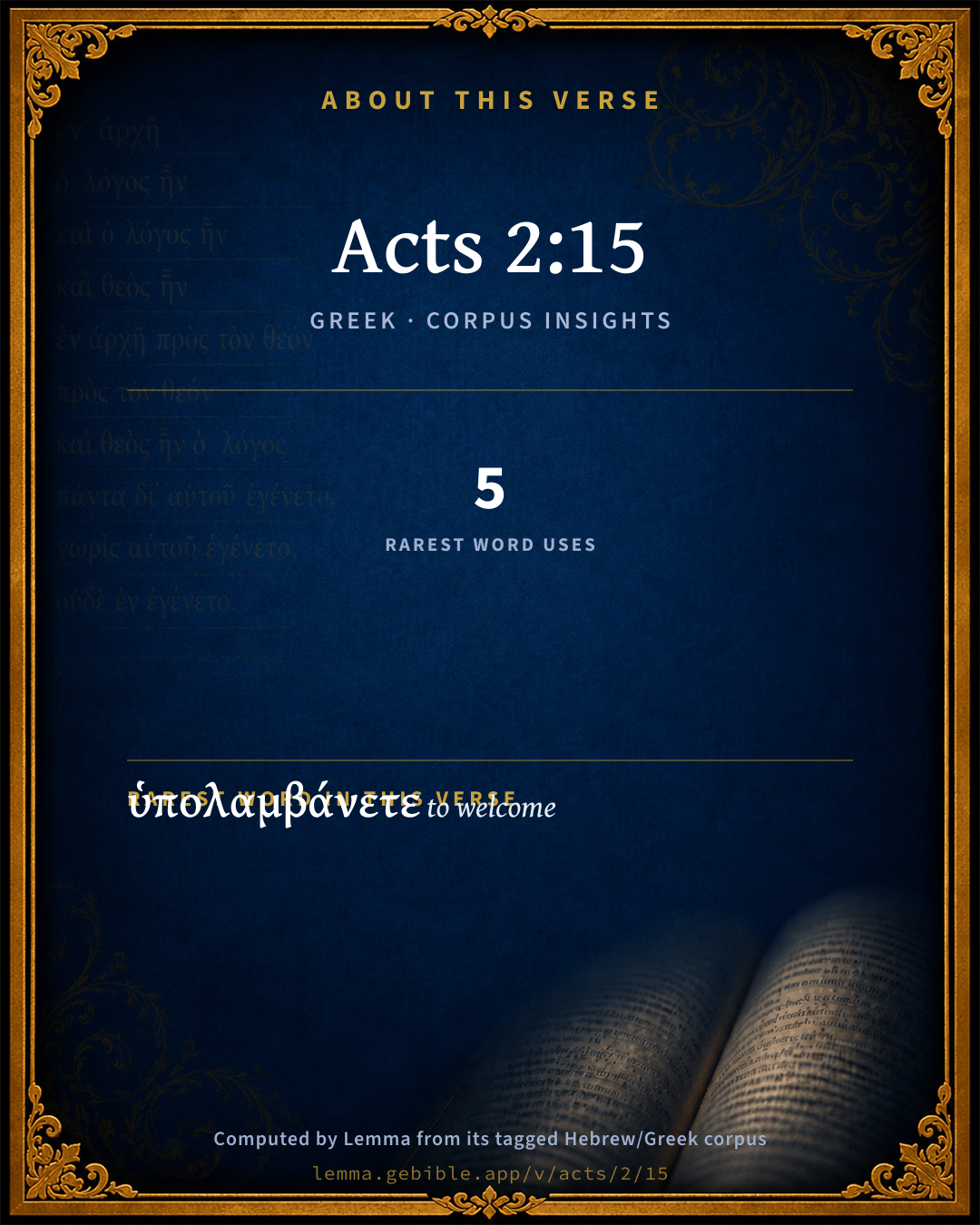
Acts 2:15

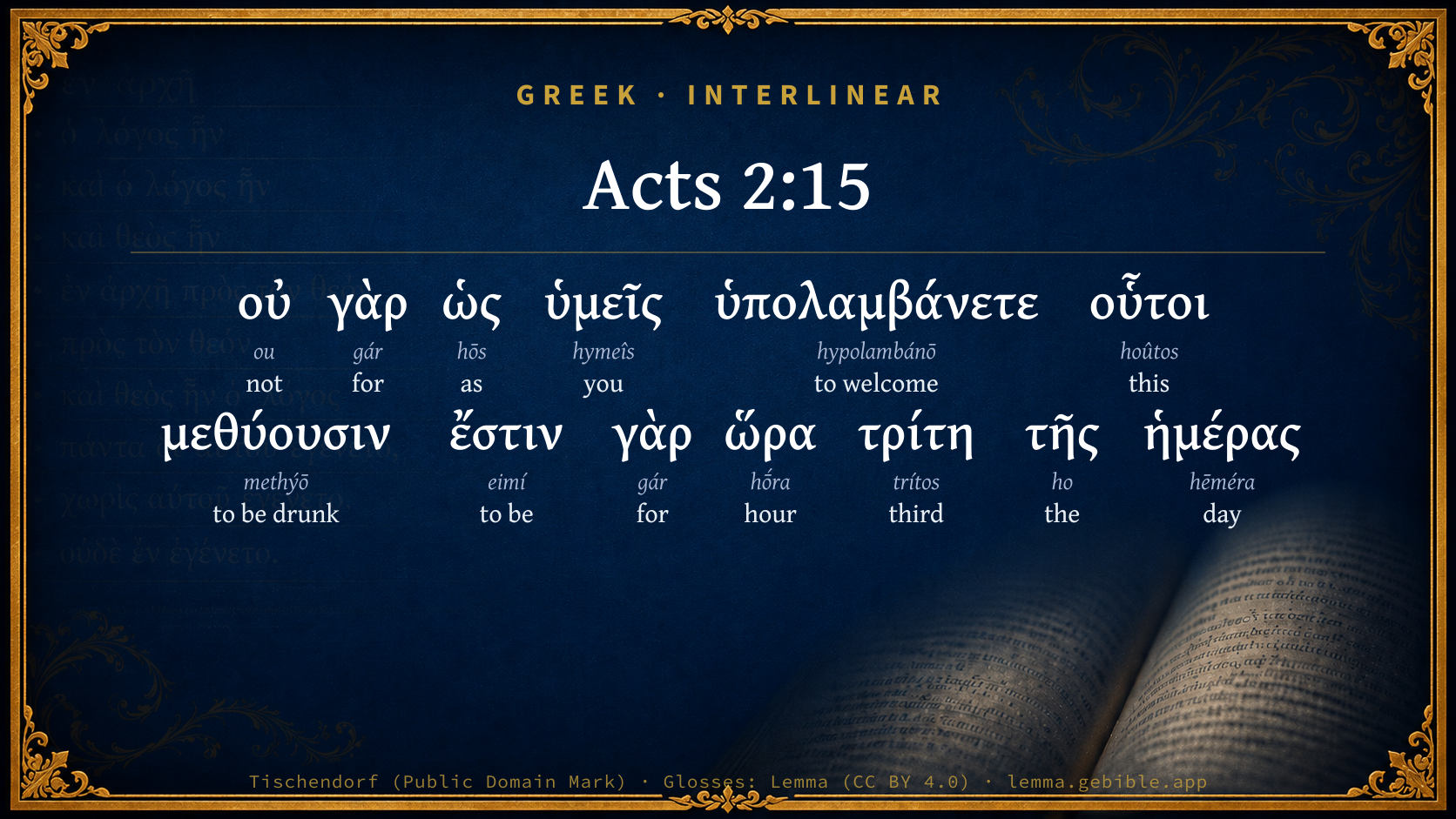
Greek (Tischendorf 8th ed.) Acts 2:15 appears in the Greek New Testament. The text above is from the Tischendorf 8th edition. Each word links to its Strong’s number and a concise gloss. Click any word for its full Thayer’s Greek Lexicon entry.
Download image
Cite this verse

Acts 2:15 (World English Bible). Public Domain. Lemma interlinear Bible study tool, https://lemma.gebible.app/v/acts/2/15.

Show BibTeX & RIS
BibTeX
RIS
English Translation
For these aren't drunken, as you suppose, seeing it is only the third hour of the day.
World English Bible · Public Domain
Download a study sheet

One document with this verse’s original text, its word-by-word gloss line, the meaning frame, cross-references with their text, attributed commentary, and full source and license credits — printable, and it pastes into notes with its structure intact.

This verse Autodidact and up

Study sheet (.html) Plain text (.txt)

A passage Seminary Student

Up to 50 verses in one chapter. A passage sheet keeps up to 6 commentary sources and 12 cross-references per verse, in the order this page ranks them, and says so on the sheet whenever that leaves anything out. Ask for a single verse and you get the Autodidact verse sheet above.

Everything on this page stays free to read, with no account — the sheet is a download of what is already on screen, not access to it.

Want to remove ads? Support Godless Engineer
Compare translations 3

The same verse in 3 English versions, stacked beneath the original-language interlinear above. Click any original word for its lexicon entry.

Each is an independent rendering of the whole verse — the interlinear is not word-aligned to these translations.

Highlighted words mark where these versions differ — a whole-verse word diff, not a word-by-word alignment.

  • World English Bible Public Domain
    For these aren't drunken, as you suppose, seeing it is only the third hour of the day.
  • King James Version Public Domain
    For these are not drunken, as ye suppose, seeing it is but the third hour of the day.
  • unfoldingWord Literal Text CC BY-SA 4.0
    For these are not drunk as you are assuming, for it is the third hour of the day.

unfoldingWord Literal Text — © unfoldingWord, licensed CC BY-SA 4.0. Word-aligned USFM3 via Door43 (git.door43.org/unfoldingWord/en_ult).

Versions to compare (up to 4)

3 of 4 selected

Show all 19 translations

Every available English version of this verse, each an independent rendering of the whole verse.

  • World English Bible Public Domain
    For these aren't drunken, as you suppose, seeing it is only the third hour of the day.
  • Berean Standard Bible Public Domain
    These men are not drunk, as you suppose. It is only the third hour of the day!
  • Majority Standard Bible Public Domain
    These men are not drunk, as you suppose. It is only the third hour of the day!
  • King James Version Public Domain
    For these are not drunken, as ye suppose, seeing it is but the third hour of the day.
  • American Standard Version (1901) Public Domain
    For these are not drunken, as ye suppose; seeing it is `but' the third hour of the day.
  • Revised Version (1885) Public Domain
    For these are not drunken, as ye suppose; seeing it is but the third hour of the day;
  • Geneva Bible (1599) Public Domain
    For these are not drunken, as yee suppose, since it is but the third houre of the day.
  • Douay-Rheims (1899) Public Domain
    For these are not drunk, as you suppose, seeing it is but the third hour of the day:
  • Young's Literal Translation Public Domain
    for these are not drunken, as ye take it up, for it is the third hour of the day.
  • Literal Standard Version CC BY-SA 4.0
    for these are not drunken, as you take it up, for it is the third hour of the day.
  • Unlocked Literal Bible CC BY-SA 4.0
    For these people are not drunk as you assume, for it is only the third hour of the day.
  • unfoldingWord Literal Text CC BY-SA 4.0
    For these are not drunk as you are assuming, for it is the third hour of the day.
  • Darby Bible Public Domain
    for these are not full of wine, as *ye* suppose, for it is the third hour of the day;
  • World Messianic Bible Public Domain
    For these aren’t drunken, as you suppose, seeing it is only the third hour of the day.
  • Webster's Bible Public Domain
    For these are not drunken, as ye suppose, seeing it is but the third hour of the day.
  • Free Bible Version CC BY-SA 4.0
    These men aren't drunk as you presume. It's only nine in the morning!
  • Bible in Basic English Public Domain
    For these men are not overcome with wine, as it seems to you, for it is only the third hour of the day;
  • Text-Critical English NT CC BY 4.0
    These men are not drunk, as you suppose, for it is only the third hour of the day.
  • Tyndale New Testament (1534) Public Domain
    These are not dronken as ye suppose: for it is yet but the thyrde houre of the daye.

Literal Standard Version (2020), Covenant Press — licensed CC BY-SA 4.0. Text via the HelloAO Bible API (eBible.org). Unlocked Literal Bible (unfoldingWord) — licensed CC BY-SA 4.0. Text via the HelloAO Bible API (eBible.org). unfoldingWord Literal Text — © unfoldingWord, licensed CC BY-SA 4.0. Word-aligned USFM3 via Door43 (git.door43.org/unfoldingWord/en_ult). Free Bible Version, Dr. Jonathan Gallagher — licensed CC BY-SA 4.0. Text via the HelloAO Bible API (eBible.org).

Word by word

More ways to search: Search by grammar → Find every occurrence → Compare this word →

Practice this passage: Drill this verse → Learn its vocabulary →

ὑπολαμβάνετε
hypolambánō
G5274
“to welcome”
Verb, Present, Active, Indicative, 2nd person, Plural
Part of Speech
Verb
Tense
Present
Voice
Active
Mood
Indicative
Person
2nd person
Number
Plural
Full Thayer's Definition

Origin: from G5259 and G2983

TDNT: 04:15,5

1. to take up in order to raise, to bear on high a. to take up and carry away 2. to receive hospitably, welcome 3. to take up a. follow in speech, in order either to reply to or controvert or supplement what another has said 4. to take up in the mind a. to assume, suppose
  1. οὐ ou G3756 “not” Particle, Negative
  2. γὰρ gár G1063 “for” Conjunction
  3. ὡς hōs G5613 “as” Adverb
  4. ὑμεῖς hymeîs G5210 “you” Personal pronoun, 2nd person, Nominative, Plural
  5. οὗτοι hoûtos G3778 “this” Demonstrative pronoun, Nominative, Plural, Masculine
  6. μεθύουσιν methýō G3184 “to be drunk” Verb, Present, Active, Indicative, 3rd person, Plural
  7. ἔστιν eimí G1510 “to be” Verb, Present, Active, Indicative, 3rd person, Singular
  8. γὰρ gár G1063 “for” Conjunction
  9. ὥρα hṓra G5610 “hour” Noun, Nominative, Singular, Feminine
  10. τρίτη trítos G5154 “third” Adjective, Nominative, Singular, Feminine
  11. τῆς ho G3588 “the” Article, Genitive, Singular, Feminine
  12. ἡμέρας hēméra G2250 “day” Noun, Genitive, Singular, Feminine

About this verse

These counts appear in no published source. They are computed here, from the morphology-tagged text and Lemma’s own curated glosses. What Lemma adds →

13
words
12
distinct lemmas
Acts
section

Notable vocabulary

The rarest word here is ὑπολαμβάνετε to welcome G5274 — appearing just 5 times in the whole Greek New Testament.

Shared distinctive vocabulary

ὑπολαμβάνετε to welcome G5274 occurs in 5 verses of the Greek New Testament. Also found in:

Repetition

A word recurs within this verse:

Cross-references

2

Topical passages linked to Acts 2:15 in the Treasury of Scripture Knowledge — connected by theme and wording, ordered by reader-vote popularity; previews shown in the World English Bible.

  • 1 Thessalonians 5:5–8 You are all children of light, and children of the day. We don't belong to the night, nor to darkness,
  • 1 Samuel 1:15 Hannah answered, No, my lord, I am a woman of a sorrowful spirit: I have drunk neither wine nor strong drink, but I poured out my soul before Yahweh.

Cross-references courtesy of OpenBible.info (CC BY 4.0).

Commentary

Notes on Acts 2:15 from classic Christian and Jewish commentators (each source and its license shown beneath its notes). The classic Christian expositions comment on the surrounding passage and are grouped to its opening verse, so a note may address several verses; the Jewish commentaries on the Tanakh (Rashi and others) are per-verse, so they appear only where the commentator wrote on this verse.

Lemma curates 59 commentaries, every one of them public domain or Creative Commons licensed, each selected and text-cleaned for this edition rather than reprinted as found. About our sources →

Bengel's Gnomon

Johann Albrecht Bengel

Act 2:15. Ὑπολαμβάνετε, ye suppose) He does not say, As some of you mockingly say. He speaks gently.—οὗτοι, these) He speaks in the third person, not excluding himself and the rest of the apostles. Even his speech was a sufficient defence of himself, the very act of standing was a defence to the rest of the apostles with him: and they, whom he is instructing, had used this expression, οὗτοι, these, Act 2:7.—τρίτη, third) A drunken man generally does not know the hour: nor is any one readily intoxicated in the morning, especially in a place where he is at home: 1Th 5:7, “They that be drunken are drunken in the night.” It was the feast-day of Pentecost; and on feast-days the Jews used to abstain from eating up to mid-day. See var. lect. of Petitus, ch. 15. [The third hour of the Jews is what nine o’clock in the forenoon is with us.—V. g.]

Bengel's Gnomon of the New Testament — English translation (T&T Clark, Edinburgh, 1860) — public domain. Text from a community e-Sword module.

Expositor's Greek Testament

ed. W. Robertson Nicoll

Act 2:15 . ὥρα τρίτη τῆς ἡμέρας : the words refer to the hour of early prayer, 9 A.M., the Jews previously did not partake of food, and on festal days they abstained from food and drink until the sixth hour (twelve o’clock). But if Schürer (see on Act 3:1 , and Blass, in loco ) is right in specifying other hours for prayer, the expression may mean that St. Peter appeals to the early period of the day as a proof that the charge of drunkenness was contrary to all reasonable probability.

The Expositor's Greek Testament, edited by W. Robertson Nicoll (1897–1910) — public domain. Text from a community e-Sword module.

Geneva Bible (1599)

Geneva Bible translators

After the sun rising, which may be about seven or eight of the clock with us.

Geneva Bible (1599) marginal notes — public domain. Text via Bolls.life.

Jamieson, Fausset & Brown

Robert Jamieson, A. R. Fausset & David Brown

these are not drunken--meaning, not the Eleven, but the body of the disciples.

but the third hour--nine A.M. (see Ecc 10:16; Isa 5:11; Th1 5:17).

Jamieson, Fausset & Brown — Commentary Critical and Explanatory on the Whole Bible (1871) — public domain (CC PDM 1.0). Text via the HelloAO Bible API.

Adam Clarke's Commentary

Verse 15. But the third hour of the day] That is, about nine o'clock in the morning, previously to which the Jews scarcely ever ate or drank, for that hour was the hour of prayer. This custom appears to have been so common that even the most intemperate among the Jews were not known to transgress it; Peter therefore spoke with confidence when he said, these are not drunken-seeing it is but the third hour of the day, previously to which even the intemperate did not use wine.

Adam Clarke's Commentary on the Bible (1810–1826) — public domain. Text from a community e-Sword/MySword module.

Ellicott's Commentary for English Readers

(15) Seeing it is but the third hour of the day.—The appeal is made to the common standard of right feeling. Drunkenness belonged to the night (1Th_5:7). It was a mark of extremest baseness for men to “rise up early in the morning that they may follow strong drink” (Isa_5:11; comp. also Ecc_10:16). “Were the disciples likely to be drunk at 9 a. m., and that on the morning of the Day of Pentecost, after a night spent in devotion, and when all decent Jews were fasting?

A Bible Commentary for English Readers, edited by Charles John Ellicott (1878–1897) — public domain. Text from a community e-Sword module.

The Cambridge Bible for Schools and Colleges

gen. ed. J. J. S. Perowne

15. are not drunken] Wine was drunk by the Jews with flesh only, and, founding the custom on Exo_16:8, they ate bread in the morning, and flesh in the evening, and so took no wine till late in the day. So Ecc_10:16-17, by the “princes who eat in the morning” are meant those who eat to the full of all sorts of food and so take wine, and their opposites are next described as those who eat in due season for strength and not for drunkenness.

The paraphrase of this passage given in the Targum is worth notice in illustration of the text of the Acts. It reads, “Woe to thee, O land of Israel, when there shall reign over thee Jeroboam the wicked, and shall exterminate from the midst of thee the offering of the morning sacrifice, and when thy lords shall eat bread before any man has offered the perpetual offering of the morning. Blessed art thou, land of Israel, at the time when Hezekiah the son of Ahaz (who is of the genealogy of the house of David) shall reign, who will be a mighty hero in the law, and fulfil all the duties of the commandments, and then thy princes shall only eat bread after the perpetual offering has been offered (i.e. their eating shall be) at the fourth hour, from the labour of their hands in the strength of the law, and not in faintness and blindness of the eyes.”

third hour of the day] Only one quarter of the day was yet over. The Jews divided the day and night each into twelve parts, which they called hours but which varied in length as the daylight was less or more. When the day was as long as the night the third hour would be nine o’clock in the morning.

The Cambridge Bible for Schools and Colleges (gen. ed. J. J. S. Perowne; Cambridge University Press, 1878–1918) — public domain. Text from a community e-Sword module.

John Gill's Exposition

For these are not drunken,.... Meaning not only the eleven apostles, but the rest of the hundred and twenty, on whom also the Spirit was poured forth, and who were endowed with his extraordinary gifts:

as ye suppose; and had given out that they were: and this shows the sense of being filled with new wine; that they meant that they were really drunk, and which they believed, or at least would have had others believe it; the unreasonableness of which supposition and suggestion the apostle argues from the time of day:

seeing it is but the third hour of the day; or nine of the clock in the morning: for till this time it was not usual with the Jews, if men of any sobriety or religion, so much as to taste anything: the rules are these (h),

"it is forbidden a man to taste anything, or do any work after break of day, until he has prayed the morning prayer.

Now

"the morning prayer, the precept concerning it is, that a man should begin to pray as soon as the sun shines out; and its time is until the end of the fourth hour, which is the third part of the day (i).

So that a man might not taste anything, either of eatables or drinkables, until the fourth hour, or ten o'clock in the morning: hence it is said (k), that "after they offered the daily sacrifice they ate bread, , "at the time of four hours":

or on the fourth hour, and sooner than this it was not lawful to eat, even ever so little; and whoever did, was not reckoned fit to be conversed with,

"Says R. Isaac (l), whoever eats a green or herb before the fourth hour, it is forbidden to converse with him; and the same says, it is unlawful to eat a raw herb before the fourth hour. Amemar, and Mar Zutra, and Rab Ashe were sitting, and they brought before them a raw herb before the fourth hour. Amemar and Rab Ashe ate, and Mar Zutra did not eat: they said to him, what is thy meaning? (he replied) that R. Isaac said, whoever eats a herb before the fourth hour, it is forbidden to converse with him.

The time for taking food by persons of different characters, is thus expressed by them:

"the first hour is the time of eating for the Lydians, the second for thieves, the third for heirs, the fourth for labourers, the fifth for every man; is it not so? Saith R. Papa, the fourth is the time of repast for every man; but (the truth is) the fourth is the time of eating for every man, the fifth for labourers, and the sixth for the disciples of the wise men (m).

Hence that advice (n),

""at the fourth hour", go into a cook's shop, (or tavern,) if thou seest a man drinking wine, and holding the cup in his hands, and slumbering, inquire about him, if he is one of the wise doctors, &c.

The "gloss" upon it is,

"at the fourth hour, for that is the time of eating, when all go into the shops (or taverns) to eat.

Now whereas they that are drunken are drunken in the night, and not in the day, and much less so soon in the day, when it was not usual, at least with religious men, to have tasted anything by this time; and whereas the apostles, and their company, were sober and religious men, and had never done thing to forfeit their character, it was unreasonable to suppose anything of this kind in them,

(h) Maimon. Hilch, Tophilla, c. 6. sect. 4. T. Bab. Beracot, fol. 28. 2. (i) lb. c. 3. sect. 1. Vid. T. Beracot, fol. 26. 2. (k) Targum in Eccl. x. 17. (l) T. Bab. Betacot, fol. 44. 2. (m) T. Bab. Sabbat, fol. 10. 1. (n) T. Bab. Bava Metzia, fol. 83. 2.

John Gill's Exposition of the Whole Bible (1746–1763) — public domain (CC PDM 1.0). Text via the HelloAO Bible API.

Trapp's Complete Commentary

John Trapp

15 For these are not drunken, as ye suppose, seeing it is but the third hour of the day.

Ver. 15. Seeing it is but the third hour] This was then an argument more than probable. Now men are grown such husbands, as that by that time they will return their stocks, and have their brains crowing before day.

John Trapp, A Commentary or Exposition upon All the Books of the Old and New Testament (1647–1656) — public domain. Text from a community e-Sword module.

Albert Barnes' Notes on the Bible

For these are not drunken ... - The word these here includes Peter himself, as well as the others. The charge doubtless extended to all.

The third hour of the day - The Jews divided their day into twelve equal parts, reckoning from sunrise to sunset. Of course the hours were longer in summer than in winter. The third hour would correspond to our nine o’clock in the morning. The reasons why it was so improbable that they would be drunk at that time were the following:

(1) It was the hour of morning worship, or sacrifice. It was highly improbable that, at an hour usually devoted to public worship, they would be intoxicated.

(2) It was not usual for even drunkards to become drunk in the daytime, 1Th 5:7, “They that be drunken are drunken in the night.”

(3) The charge was, that they had become drunk with wine. Ardent spirits, or alcohol, that curse of our times, was unknown. It was very improbable that so much of the weak wine commonly used in Judea should have been taken at that early hour as to produce intoxication.

(4) It was a regular practice with the Jews not to eat or drink anything until after the third hour of the day, especially on the Sabbath, and on all festival occasions. Sometimes this abstinence was maintained until noon. So universal was this custom, that the apostle could appeal to it with confidence, as a full refutation of the charge of drunkenness at that hour. Even the intemperate were not accustomed to drink before that hour. The following testimonies on this subject from Jewish writers are from Lightfoot: “This was the custom of pious people in ancient times, that each one should offer his morning prayers with additions in the synagogue, and then return home and take refreshment” (Maimonides, Shabb., chapter 30). “They remained in the synagogue until the sixth hour and a half, and then each one offered the prayer of the Minchah before he returned home, and then he ate.” “The fourth is the hour of repast, when all eat.” One of the Jewish writers says that the difference between thieves and honest men might be known by the fact that the former might be seen in the morning at the fourth hour eating and sleeping, and holding a cup in his hand. But for those who made pretensions to religion, as the apostles did, such a thing was altogether improbable.

Albert Barnes' Notes on the Bible (1834–1885) — public domain. Text from a community e-Sword/MySword module.

Haydock's Catholic Bible Commentary

About nine in the morning. On festival days, the Jews did not eat till the morning devotions were finished, about mid-day. (Bible de Vence)

George Leo Haydock (1774–1849), Haydock's Catholic Family Bible and Commentary, 1859 edition — public domain. Excludes Psalms (Douay-Rheims chapter numbering differs from Protestant) and Deuterocanonical books (Catholic canon only).

Matthew Poole's English Annotations

For these; this proves that the other apostles spake as well as Peter, and were vindicated by him.

Are not drunken; he mildly and solidly confutes their calumny.

The third hour of the day, which answers to our nine o’clock in the morning, and was the ordinary time for their morning sacrifice and prayer, before which time they did not eat or drink any thing; nay, it is thought on festival days it was usual with them not to eat or drink until the sixth hour, that is, noon time, that they might be more intent upon and fit for the service of the day. How little soever (to our shame) such an argument would be of proof now, it was in their more sober times very conclusive.

Matthew Poole's English Annotations on the Holy Bible (1683–1685) — public domain. Text from a community e-Sword/MySword module.

Whedon's Commentary on the Bible

Daniel D. Whedon

15. Not drunken—Base and preposterous as their ribaldry was, Peter replies with a most elevated calmness of denial.

The third hour—Eight or nine o’clock, the Jewish hour of morning prayer, when none but profligates, as no one supposed these to be, were drunken.

Daniel D. Whedon (gen. ed.), Commentary on the Old and New Testaments (1874–1909) — public domain. Text from a community e-Sword module.

John Wesley's Explanatory Notes

It is but the third hour of the day - That is, nine in the morning. And on the solemn festivals the Jews rarely ate or drank any thing till noon.

John Wesley, Explanatory Notes Upon the Whole Bible (1754–1765) — public domain. Text via the GEBible commentary corpus.

Godbey's Commentary on the New Testament

William B. Godbey

LAST DAYS

15-18. Peter proves by Joel the fulfillment of the latter-day prophecies on that notable occasion. The Edenic dispensation has come and gone, winding up with the terrible calamity of the Fall. The Antediluvian dispensation ran its race and went into the dark eclipse of Noah’s flood. The Patriarchal culminated in Egyptian slavery, the awful plagues and the destruction in the Red Sea. The Mosaic launched from Sinai is now tottering like a drunken man and hastening to its awful slaughter by the Roman armies. Even the dispensation of our Savior’s ministry, a wicked world and a fallen church united to obliterate in the bloody tragedy of Calvary. On this notable day, as Peter proves by Joel, the last dispensation is inaugurated. It is the climacteric glory of all, since the plan of salvation emanated from Eden under the preaching of Jehovah, i. e., the Excarnate Christ. The effulgent glory of this dispensation shines out in the faces of Spirit-filled saints. Man enjoyed the indwelling God before sin entered. Christ came to destroy the works of the devil (Joh 3:8). Hence, humanity must get back to the Edenic glory of the indwelling God. Christ must be incarnated an as expiatory Sufferer under the law, before the Holy Ghost can be incarnated as an indwelling Sanctifier. Hence the descension and incarnation of the Holy Ghost is confirmatory proof of the validity of Christ’s atonement, the perfect satisfaction of the violated law and the coronation of Christ, Mediatorial King in heaven. While in the former dispensation a prophet here and there succeeds in looking through the dim lights of type and prophecy, and by a mighty supernatural faith bounding forward into the anticipatory Pentecostal experience, now the types and symbols have all gone into the eclipse of glorious fulfillment. Not only our illiterate boys and girls, but even our servants, both male and female, are to receive the baptism with the Holy Ghost and fire, be filled with the Holy Ghost and thus become burning incarnations of the Holy Ghost, before whose martyr heroism and seraphic light, princes and potentates pale and retreat and platoons of devils stampede. Aunt Amanda Smith comes from Southern slavery, by way of the wash-tub, to the front of the gospel ministry, where the princes of America, Europe, Asia and Africa learn wisdom at her feet. Bob Burkes, without a knowledge of the alphabet, gets sanctified, and edifies the multitudes, preaching alternate sermons with Dr. Carradine. Here we see that the Lord still speaks to His saints in dreams and visions; but these simple media of communication are even more prominent than in the former dispensation. In the latter all barriers are swept away. It is the glorious privilege of all God’s children to become the incarnations of the Holy Ghost, thus spiritually entering the glorious millennial theocracy and living anticipatively in the triumphs of the coming kingdom. We are well assured that we are not only living in the last days, which began at Pentecost, but we are in the time of the end. John said he was in the last hour; then we must be in the last moment. Totton and Dimbleby, the greatest chronologists of the age, expire the “Gentile times” with the vernal equinox of 1898. According to Lunar Chronology, used by the Jews and Mohammedans, the “Gentile times” expired seven years ago. The Calendar Chronology, generally used in Europe, runs them out in thirty-five years, and the Solar Chronology, used generally in America, runs them out in seventy years. Daniel’s period of the Tribulation (last chapter) is forty-five years. The Rapture of the Bride takes place before the Tribulation. Hence you see three out of four of these chronologies give us the Rapture overdue. Besides, the world is literally flooded with fulfillments of the latter-day prophecies.

William B. Godbey, Commentary on the New Testament (1896–1900) — public domain. Text from a community e-Sword module.

McGarvey & Pendleton's Commentaries

J. W. McGarvey

See notes on verse 14

J. W. McGarvey (with Philip Y. Pendleton), Commentaries on the New Testament (The Fourfold Gospel, 1914; Acts; and the epistles) — public domain. Text from a community e-Sword/MySword module.

The People's New Testament

B. W. Johnson

15. These are not drunken. It was only the third hour, nine o'clock. The Jews at their festivals seldom ate before this hour, and as their drink was taken at a meal, could not be drunken.

B. W. Johnson's The People's New Testament with Notes (1889–1891) — public domain. Electronic text from the Christian Classics Ethereal Library (CCEL) ThML edition.

Cambridge Greek Testament for Schools and Colleges

15. μεθύουσιν. Wine was drunk by the Jews with flesh only, and, founding the custom on Exo 16:8, they ate bread in the morning, and flesh in the evening, and so took no wine till late in the day. So Ecc 10:16-17, by the ‘princes who eat in the morning’ are meant those who eat to the full of all sorts of food and so take wine, and their opposites are next described as those who eat in due season for strength and not for drunkenness.

The paraphrase of this passage given in the Targum is worth notice in illustration of the text of the Acts. It reads, ‘Woe to thee, O land of Israel, when there shall reign over thee Jeroboam the wicked, and shall exterminate from the midst of thee the offering of the morning sacrifice, and when thy lords shall eat bread before any man has offered the perpetual offering of the morning. Blessed art thou, land of Israel, at the time when Hezekiah the son of Ahaz (who is of the genealogy of the house of David) shall reign, who will be a mighty hero in the law, and fulfil all the duties of the commandments, and then thy princes shall only eat bread after the perpetual offering has been offered (i.e. their eating shall be) at the fourth hour, from the labour of their hands in the strength of the law, and not in faintness and blindness of the eyes.’

ὥρα τρίτη. Only one quarter of the day was over. The Jews divided the day and night each into twelve parts, calling them hours, though their length varied according as the daylight was less or more. When day and night were equal, the third hour would be nine o’clock in the morning.

Cambridge Greek Testament for Schools and Colleges (Cambridge University Press, 1896; 21 vols, various authors incl. Carr, Maclear, Plummer, Farrar, Lumby, Moule, M. R. James, Simcox) — public domain. Text from a community e-Sword module.

Alford’s Greek Testament

Henry Alford

15.] οὗτοι, see above.

ὥρα τρίτη] the first hour of prayer: before which no pious Jew might eat or drink: “Non licet homini gustare quidquam, antequam oraverit orationem suam.” Berachoth. f. 28. 2; Lightf., Wetst.

But perhaps we need not look further than the ordinary intent of such a defence—the improbability of intoxication at that hour of the morning. See Ecc 10:16; Isa 5:11; 1Th 5:7.

Henry Alford, The Greek Testament (1849–1861) — public domain. Text from a community e-Sword module.

Vincent's Word Studies in the New Testament

Marvin R. Vincent

Third hour. Nine in the morning : the hour of morning prayer.

Compare 1Th 5:7.

Marvin R. Vincent, Word Studies in the New Testament (1887–1900) — public domain. Text from a community e-Sword/MySword module.

Lesson kit

Teaching starters — assembled from the data on this page, not authored interpretation. Every prompt links to the verse data it draws on. Edit before teaching.

Acts, in the Acts, opens this verse with 13 words (12 distinct Greek lemmas). Its most distinctive word is hypolambánō (“to welcome”). A historical commentator’s framing appears above. Read the whole chapter for the surrounding context.

Discussion questions

  1. The word hypolambánō carries the sense “to welcome.” How does it shape the verse?
  2. How does Luke 7:43, which shares the word «to welcome», read alongside this verse?
  3. What does the repetition of “for” (2× in this one verse) do in this verse?
  4. These translations render this verse differently; the difference is in the English rendering, not the original. What questions does that raise?
  5. Compare how Bengel's Gnomon and Expositor's Greek Testament read this verse. Where do they agree or differ?

Things to notice

Reading settings

Reading text

Shown beneath each verse's original-language words.

Old Testament
Old Testament edition

Read the OT as the Masoretic Hebrew (MT) or the Greek Septuagint (LXX).

English shown for the Greek Septuagint (in the Hebrew ↔ Greek comparison).

Comparing translations? Open the Compare panel on any verse page to stack up to four side by side.