

2 Peter 1:16
Greek (Tischendorf 8th ed.) 2 Peter 1:16 appears in the Greek New Testament. The text above is from the Tischendorf 8th edition. Each word links to its Strong’s number and a concise gloss. Click any word for its full Thayer’s Greek Lexicon entry.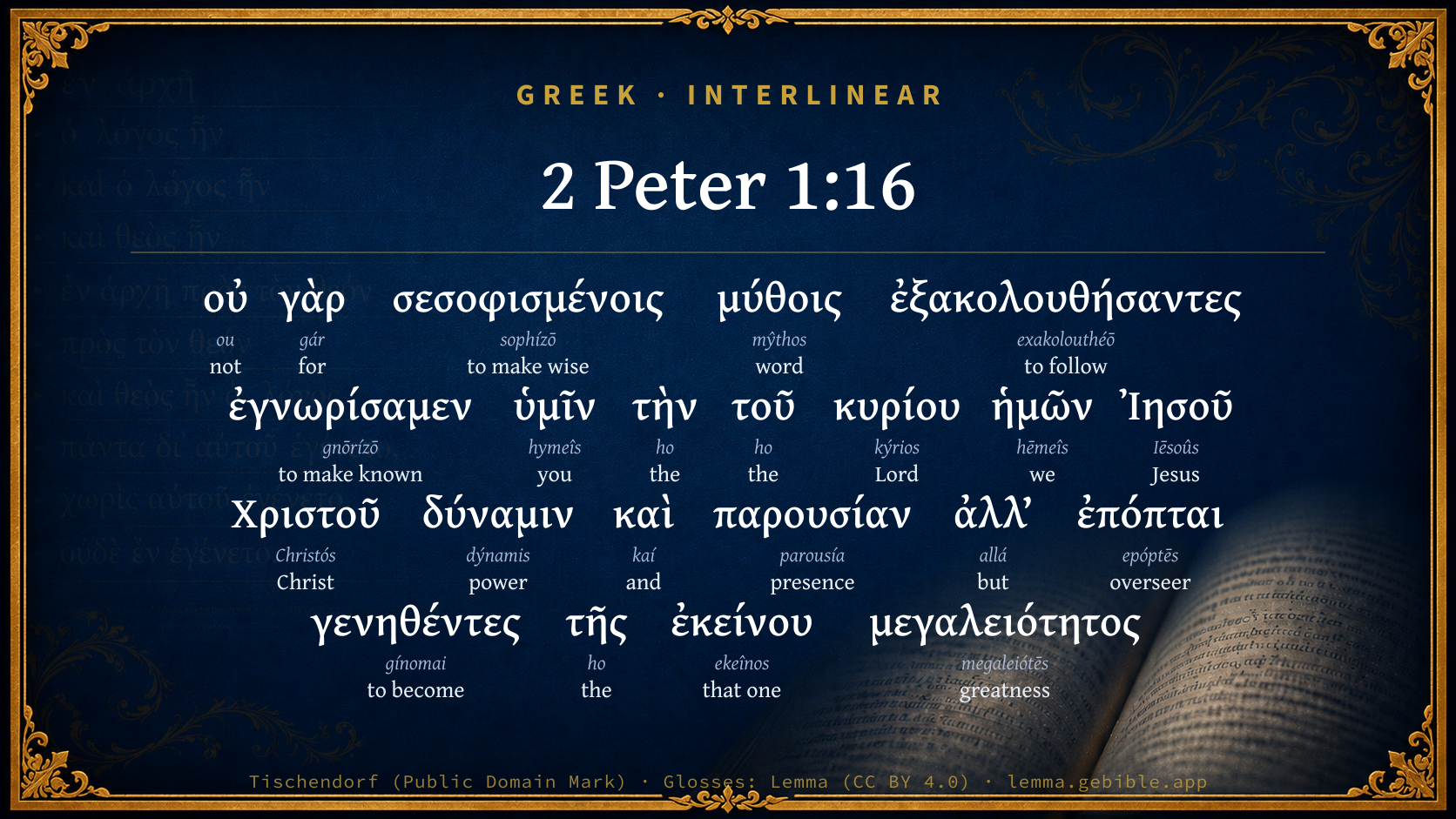
For we did not follow cunningly devised fables, when we made known to you the power and coming of our Lord Jesus Christ, but we were eyewitnesses of his majesty.
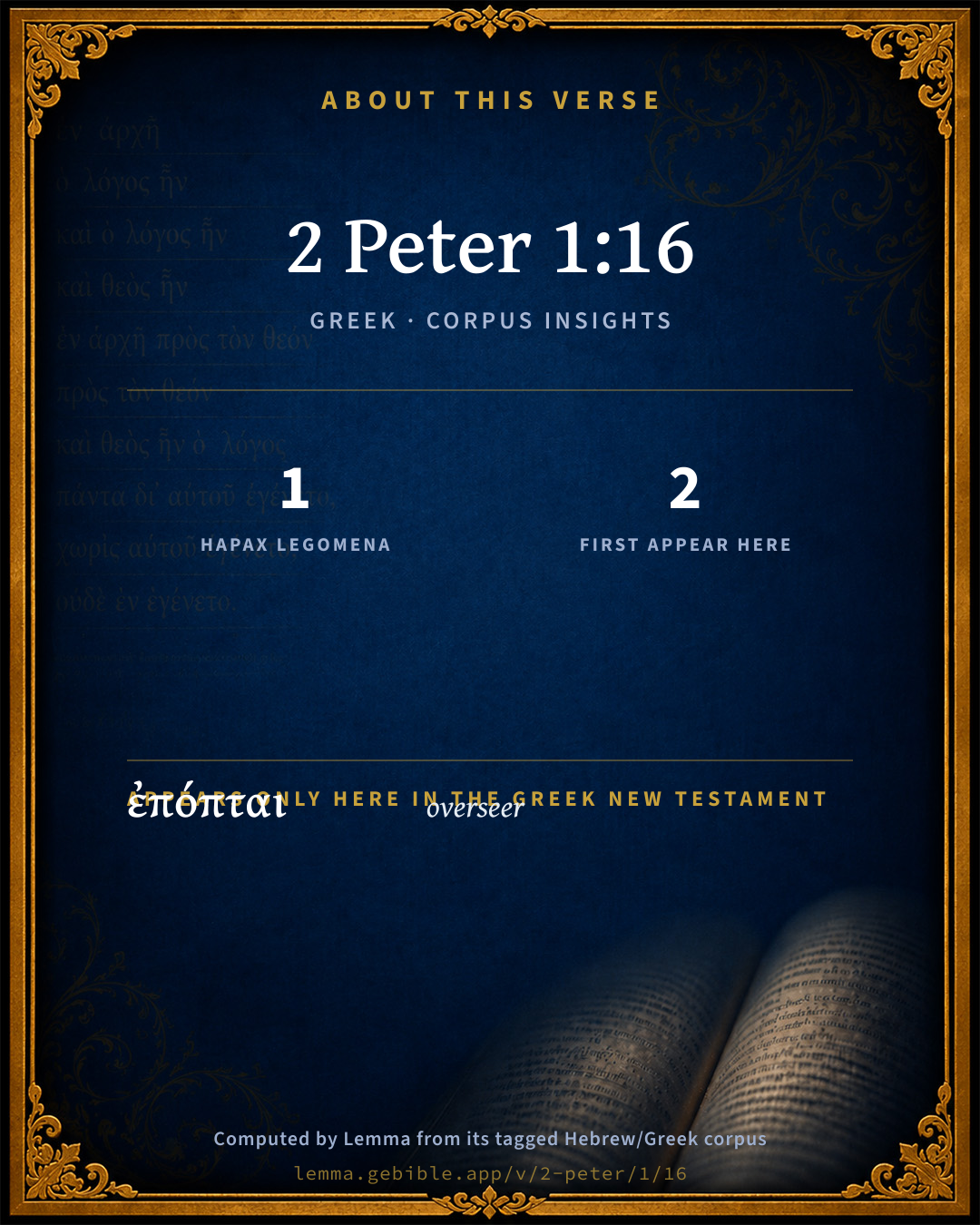
- 1 hapax legomenon — only here in the Greek New Testament
- 2 first appearances in the Greek New Testament
Download a study sheet
One document with this verse’s original text, its word-by-word gloss line, the meaning frame, cross-references with their text, attributed commentary, and full source and license credits — printable, and it pastes into notes with its structure intact.
This verse Autodidact and up
A passage Seminary Student
Up to 50 verses in one chapter. A passage sheet keeps up to 6 commentary sources and 12 cross-references per verse, in the order this page ranks them, and says so on the sheet whenever that leaves anything out. Ask for a single verse and you get the Autodidact verse sheet above.
Everything on this page stays free to read, with no account — the sheet is a download of what is already on screen, not access to it.
Compare translations 3
The same verse in 3 English versions, stacked beneath the original-language interlinear above. Click any original word for its lexicon entry.
Each is an independent rendering of the whole verse — the interlinear is not word-aligned to these translations.
Highlighted words mark where these versions differ — a whole-verse word diff, not a word-by-word alignment.
-
World English Bible Public Domain
For we did not follow cunningly devised fables, when we made known to you the power and coming of our Lord Jesus Christ, but we were eyewitnesses of his majesty.
-
King James Version Public Domain
For we have not followed cunningly devised fables, when we made known unto you the power and coming of our Lord Jesus Christ, but were eyewitnesses of his majesty.
-
unfoldingWord Literal Text CC BY-SA 4.0
For we did not make known to you the power and coming of our Lord Jesus Christ having followed cleverly invented myths, but having become eyewitnesses of the majesty of that one.
unfoldingWord Literal Text — © unfoldingWord, licensed CC BY-SA 4.0. Word-aligned USFM3 via Door43 (git.door43.org/unfoldingWord/en_ult).
Show all 19 translations
Every available English version of this verse, each an independent rendering of the whole verse.
-
World English Bible Public Domain
For we did not follow cunningly devised fables, when we made known to you the power and coming of our Lord Jesus Christ, but we were eyewitnesses of his majesty.
-
Berean Standard Bible Public Domain
For we did not follow cleverly devised fables when we made known to you the power and coming of our Lord Jesus Christ, but we were eyewitnesses of His majesty.
-
Majority Standard Bible Public Domain
For we did not follow cleverly devised fables when we made known to you the power and coming of our Lord Jesus Christ, but we were eyewitnesses of His majesty.
-
King James Version Public Domain
For we have not followed cunningly devised fables, when we made known unto you the power and coming of our Lord Jesus Christ, but were eyewitnesses of his majesty.
-
American Standard Version (1901) Public Domain
For we did not follow cunningly devised fables, when we made known unto you the power and coming of our Lord Jesus Christ, but we were eyewitnesses of his majesty.
-
Revised Version (1885) Public Domain
For we did not follow cunningly devised fables, when we made known unto you the power and coming of our Lord Jesus Christ, but we were eyewitnesses of his majesty.
-
Geneva Bible (1599) Public Domain
For we followed not deceiuable fables when we opened vnto you the power, and comming of our Lord Iesus Christ, but with our eyes we saw his maiestie:
-
Douay-Rheims (1899) Public Domain
For we have not by following artificial fables, made known to you the power, and presence of our Lord Jesus Christ; but we were eyewitnesses of his greatness.
-
Young's Literal Translation Public Domain
For, skilfully devised fables not having followed out, we did make known to you the power and presence of our Lord Jesus Christ, but eye-witnesses having become of his majesty --
-
Literal Standard Version CC BY-SA 4.0
For having not followed out skillfully devised fables, we made known to you the power and coming of our Lord Jesus Christ, but having become eyewitnesses of His majesty—
-
Unlocked Literal Bible CC BY-SA 4.0
For we did not follow cleverly invented myths when we made known to you the power and the coming of our Lord Jesus Christ, but we were eyewitnesses of his majesty.
-
unfoldingWord Literal Text CC BY-SA 4.0
For we did not make known to you the power and coming of our Lord Jesus Christ having followed cleverly invented myths, but having become eyewitnesses of the majesty of that one.
-
Darby Bible Public Domain
For we have not made known to you the power and coming of our Lord Jesus Christ, following cleverly imagined fables, but having been eyewitnesses of *his* majesty.
-
World Messianic Bible Public Domain
For we didn’t follow cunningly devised fables when we made known to you the power and coming of our Lord Yeshua the Messiah, but we were eyewitnesses of his majesty.
-
Webster's Bible Public Domain
For we have not followed cunningly devised fables, when we made known to you the power and coming of our Lord Jesus Christ, but were eye-witnesses of his majesty.
-
Free Bible Version CC BY-SA 4.0
We didn't follow made-up myths when we told you about the coming in power of our Lord Jesus Christ—we saw his majesty for ourselves.
-
Bible in Basic English Public Domain
For when we gave you news of the power and the coming of our Lord Jesus Christ, our teaching was not based on stories put together by art, but we were eye-witnesses of his glory.
-
Text-Critical English NT CC BY 4.0
For we did not follow cleverly devised myths when we made known to you the power and coming of our Lord Jesus Christ, but we were eyewitnesses of his majesty.
-
Tyndale New Testament (1534) Public Domain
For we folowed not decevable fables when we openned vnto you the power and commynge of oure lorde Iesus Christ but with oure eyes we sawe his maieste:
Literal Standard Version (2020), Covenant Press — licensed CC BY-SA 4.0. Text via the HelloAO Bible API (eBible.org). Unlocked Literal Bible (unfoldingWord) — licensed CC BY-SA 4.0. Text via the HelloAO Bible API (eBible.org). unfoldingWord Literal Text — © unfoldingWord, licensed CC BY-SA 4.0. Word-aligned USFM3 via Door43 (git.door43.org/unfoldingWord/en_ult). Free Bible Version, Dr. Jonathan Gallagher — licensed CC BY-SA 4.0. Text via the HelloAO Bible API (eBible.org).
Word by word
More ways to search: Search by grammar → Find every occurrence → Compare this word →
Practice this passage: Drill this verse → Learn its vocabulary →
- Appears 1× in the Greek New Testament
- First appears here
- Part of Speech
- Noun
- Case
- Nominative
- Number
- Plural
- Gender
- Masculine
Full Thayer's Definition
- οὐ ou G3756 “not” Particle, Negative
- γὰρ gár G1063 “for” Conjunction
- σεσοφισμένοις sophízō G4679 “to make wise” Verb, Perfect, Passive, Participle, Dative, Plural, Masculine
- μύθοις mŷthos G3454 “word” Noun, Dative, Plural, Masculine
- ἐξακολουθήσαντες exakolouthéō G1811 “to follow” Verb, Aorist, Active, Participle, Nominative, Plural, Masculine
- ἐγνωρίσαμεν gnōrízō G1107 “to make known” Verb, Aorist, Active, Indicative, 1st person, Plural
- ὑμῖν hymeîs G5210 “you” Personal pronoun, 2nd person, Dative, Plural
- τὴν ho G3588 “the” Article, Accusative, Singular, Feminine
- τοῦ ho G3588 “the” Article, Genitive, Singular, Masculine
- κυρίου kýrios G2962 “Lord” Noun, Genitive, Singular, Masculine
- ἡμῶν hēmeîs G2249 “we” Personal pronoun, 1st person, Genitive, Plural
- Ἰησοῦ Iēsoûs G2424 “Jesus” Noun, Genitive, Singular, Masculine
- Χριστοῦ Christós G5547 “Christ” Noun, Genitive, Singular, Masculine
- δύναμιν dýnamis G1411 “power” Noun, Accusative, Singular, Feminine
- καὶ kaí G2532 “and” Conjunction
- παρουσίαν parousía G3952 “presence” Noun, Accusative, Singular, Feminine
- ἀλλ’ allá G235 “but” Conjunction
- ἐπόπται epóptēs G2030 “overseer” Noun, Nominative, Plural, Masculine
- γενηθέντες gínomai G1096 “to become” Verb, Aorist, Passive deponent, Participle, Nominative, Plural, Masculine
- τῆς ho G3588 “the” Article, Genitive, Singular, Feminine
- ἐκείνου ekeînos G1565 “that one” Demonstrative pronoun, Genitive, Singular, Masculine
- μεγαλειότητος megaleiótēs G3168 “greatness” Noun, Genitive, Singular, Feminine
About this verse
These counts appear in no published source. They are computed here, from the morphology-tagged text and Lemma’s own curated glosses. What Lemma adds →
- 22
- words
- 20
- distinct lemmas
- General Epistles
- section
Notable vocabulary
1 hapax legomenon — a word that appears only here in the entire Greek New Testament:
- ἐπόπται overseer G2030
First appearance in Scripture
These words make their first canonical appearance in the Greek New Testament here:
Shared distinctive vocabulary
σεσοφισμένοις to make wise G4679 occurs in 2 verses of the Greek New Testament. Also found in:
Repetition
A word recurs within this verse:
- τὴν the G3588 ×3
Cross-references
32Topical passages linked to 2 Peter 1:16 in the Treasury of Scripture Knowledge — connected by theme and wording, ordered by reader-vote popularity; previews shown in the World English Bible.
- 1 John 4:14 We have seen and testify that the Father has sent the Son as the Savior of the world.
- John 1:14 The Word became flesh, and lived among us. We saw his glory, such glory as of the one and only Son of the Father, full of grace and truth.
- 1 Timothy 1:4 neither to pay attention to myths and endless genealogies, which cause disputes, rather than God's stewardship, which is in faith--
- 1 Corinthians 2:4 My speech and my preaching were not in persuasive words of human wisdom, but in demonstration of the Spirit and of power,
- 1 John 1:1–3 That which was from the beginning, that which we have heard, that which we have seen with our eyes, that which we saw, and our hands touched, concerning the Word of life
- Luke 9:28–32 It happened about eight days after these sayings, that he took with him Peter, John, and James, and went up onto the mountain to pray.
- Ephesians 4:14 that we may no longer be children, tossed back and forth and carried about with every wind of doctrine, by the trickery of men, in craftiness, after the wiles of error;
- 1 Timothy 4:7 But refuse profane and old wives' fables. Exercise yourself toward godliness.
- Mark 9:1–2 He said to them, "Most assuredly I tell you, there are some standing here who will in no way taste death until they see the Kingdom of God come with power."
- 1 Corinthians 1:17 For Christ sent me not to baptize, but to preach the Gospel--not in wisdom of words, so that the cross of Christ wouldn't be made void.
- Titus 1:14 not paying attention to Jewish fables and commandments of men who turn away from the truth.
- Revelation 1:7 Behold, he is coming with the clouds, and every eye will see him, including those who pierced him. All the tribes of the earth will mourn over him. Even so, Amen.
- 2 Peter 3:3–4 knowing this first, that in the last days mockers will come, walking after their own lusts,
- Malachi 3:2 "But who can endure the day of his coming? And who will stand when he appears? For he is like a refiner's fire, and like launderer's soap;
- Matthew 28:18 Jesus came to them and spoke to them, saying, "All authority has been given to me in heaven and on earth.
- 1 Corinthians 1:23 but we preach Christ crucified; a stumbling block to Jews, and foolishness to Greeks,
- 2 Corinthians 2:17 For we are not as so many, peddling the word of God. But as of sincerity, but as of God, in the sight of God, we speak in Christ.
- 2 Corinthians 4:2 But we have renounced the hidden things of shame, not walking in craftiness, nor handling the word of God deceitfully; but by the manifestation of the truth commending ourselves to every man's conscience in the sight of God.
- Jude 1:14 About these also Enoch, the seventh from Adam, prophesied, saying, "Behold, the Lord came with ten thousands of his holy ones,
- Malachi 4:5 Behold, I will send you Elijah the prophet before the great and terrible day of Yahweh comes.
- Matthew 16:28–17:8 Most assuredly I tell you, there are some standing here who will in no way taste of death, until they see the Son of Man coming in his Kingdom."
- Matthew 24:3 As he sat on the Mount of Olives, the disciples came to him privately, saying, "Tell us, when will these things be? What is the sign of your coming, and of the end of the age?"
- Matthew 24:27 For as the lightning comes forth from the east, and is seen even to the west, so will be the coming of the Son of Man.
- John 17:2 even as you gave him authority over all flesh, he will give eternal life to all whom you have given him.
- Romans 1:4 who was declared to be the Son of God with power, according to the Spirit of holiness, by the resurrection from the dead, Jesus Christ our Lord,
- 1 Corinthians 1:7 so that you come behind in no gift; waiting for the revelation of our Lord Jesus Christ;
- 1 Corinthians 2:1 When I came to you, brothers, I didn't come with excellence of speech or of wisdom, proclaiming to you the testimony of God.
- 1 Corinthians 5:4 In the name of our Lord Jesus Christ, you being gathered together, and my spirit, with the power of our Lord Jesus Christ,
- 2 Corinthians 12:16–17 But be it so, I did not myself burden you. But, being crafty, I caught you with deception.
- Philippians 3:21 who will change the body of our humiliation to be conformed to the body of his glory, according to the working by which he is able even to subject all things to himself.
- 1 Thessalonians 2:19 For what is our hope, or joy, or crown of rejoicing? Isn't it even you, before our Lord Jesus at his coming?
- 2 Thessalonians 2:9 even he whose coming is according to the working of Satan with all power and signs and lying wonders,
Cross-references courtesy of OpenBible.info (CC BY 4.0).
Lesson kit
Teaching starters — assembled from the data on this page, not authored interpretation. Every prompt links to the verse data it draws on. Edit before teaching.
2 Peter, in the General Epistles, opens this verse with 22 words (20 distinct Greek lemmas). Its most distinctive word is epóptēs (“overseer”). A historical commentator’s framing appears above. Read the whole chapter for the surrounding context.
Discussion questions
- What does “overseer” (epóptēs) contribute to the verse as a whole?
- This verse holds 1 word here found nowhere else in the Greek New Testament. What might the rare word draw attention to?
- 2 words here appear for the first time in Scripture. What is being introduced at this debut?
- 2 Timothy 3:15 shares the word «to make wise» with this verse. How do the two illuminate each other?
- “the” occurs 3× in this one verse. What is the effect of the repetition?
- The translations on this page render this verse differently — a whole-verse word diff, not a word-by-word alignment. What might account for the different wordings?
- Reading how The Biblical Illustrator and Joseph Benson's Commentary read this verse, where do the two commentators agree and where do they part?
Things to notice
- 1 word in this verse appears nowhere else in the Greek New Testament.
- 2 words make their first canonical appearance in Scripture here.
- These translations choose different wording for 16 words in this verse.
- “the” occurs 3× in this single verse.
- 20 distinct Greek lemmas span 22 words in this verse.
Commentary
Notes on 2 Peter 1:16 from classic Christian and Jewish commentators (each source and its license shown beneath its notes). The classic Christian expositions comment on the surrounding passage and are grouped to its opening verse, so a note may address several verses; the Jewish commentaries on the Tanakh (Rashi and others) are per-verse, so they appear only where the commentator wrote on this verse.
Lemma curates 59 commentaries, every one of them public domain or Creative Commons licensed, each selected and text-cleaned for this edition rather than reprinted as found. About our sources →
The Biblical Illustrator
Joseph S. Exell
The Biblical Illustrator, edited by Joseph S. Exell (c. 1880s–1900s) — public domain. Text from a community e-Sword module.
Joseph Benson's Commentary
Joseph Benson's Commentary on the Old and New Testaments (1811–1818) — public domain. Text from a community e-Sword module.
Whedon's Commentary on the Bible
Daniel D. Whedon
Daniel D. Whedon (gen. ed.), Commentary on the Old and New Testaments (1874–1909) — public domain. Text from a community e-Sword module.
The Preacher's Complete Homiletical Commentary
Joseph S. Exell (gen. ed.)
The Preacher's Complete Homiletical Commentary (gen. ed. Joseph S. Exell; Funk & Wagnalls, c. 1892) — public domain (pre-1929). A full-Bible homiletical/sermon-outline anthology covering 65 of 66 books (2 John is absent from the source module). Text from a community e-Sword module.
Tyndale Open Study Notes
Tyndale Open Resources
Tyndale Open Study Notes — © Tyndale Open Resources, licensed CC BY-SA 4.0. Text via the HelloAO Bible API.
Bengel's Gnomon
Johann Albrecht Bengel
Bengel's Gnomon of the New Testament — English translation (T&T Clark, Edinburgh, 1860) — public domain. Text from a community e-Sword module.
Meyer's Critical & Exegetical Commentary
Heinrich August Wilhelm Meyer
Meyer — Critical and Exegetical Commentary on the New Testament — English translation by Peter Christie, edited by Frederick Crombie (T&T Clark, 1880) — public domain. Text from a community e-Sword module.
Expositor's Greek Testament
ed. W. Robertson Nicoll
The Expositor's Greek Testament, edited by W. Robertson Nicoll (1897–1910) — public domain. Text from a community e-Sword module.
Geneva Bible (1599)
Geneva Bible translators
Geneva Bible (1599) marginal notes — public domain. Text via Bolls.life.
Matthew Henry's Commentary
Matthew Henry's Commentary on the Whole Bible (1708–1710) — public domain (CC PDM 1.0). Text via the HelloAO Bible API.
Jamieson, Fausset & Brown
Robert Jamieson, A. R. Fausset & David Brown
Jamieson, Fausset & Brown — Commentary Critical and Explanatory on the Whole Bible (1871) — public domain (CC PDM 1.0). Text via the HelloAO Bible API.
Adam Clarke's Commentary
Adam Clarke's Commentary on the Bible (1810–1826) — public domain. Text from a community e-Sword/MySword module.
John Calvin's Commentaries
John Calvin's Commentaries (1540-1563) — public domain. Text from the Calvin Translation Society English edition (1840s-50s) via the Christian Classics Ethereal Library (ccel.org). Calvin's coverage is partial (roughly two-thirds of the Bible); uncommented books and verses are honest gaps, never fabricated. The 19th-century editor's footnotes and remarks are omitted so the notes are faithfully Calvin's own voice.
Ellicott's Commentary for English Readers
A Bible Commentary for English Readers, edited by Charles John Ellicott (1878–1897) — public domain. Text from a community e-Sword module.
The Cambridge Bible for Schools and Colleges
gen. ed. J. J. S. Perowne
The Cambridge Bible for Schools and Colleges (gen. ed. J. J. S. Perowne; Cambridge University Press, 1878–1918) — public domain. Text from a community e-Sword module.
John Gill's Exposition
John Gill's Exposition of the Whole Bible (1746–1763) — public domain (CC PDM 1.0). Text via the HelloAO Bible API.
Trapp's Complete Commentary
John Trapp
John Trapp, A Commentary or Exposition upon All the Books of the Old and New Testament (1647–1656) — public domain. Text from a community e-Sword module.
Albert Barnes' Notes on the Bible
Albert Barnes' Notes on the Bible (1834–1885) — public domain. Text from a community e-Sword/MySword module.
Haydock's Catholic Bible Commentary
George Leo Haydock (1774–1849), Haydock's Catholic Family Bible and Commentary, 1859 edition — public domain. Excludes Psalms (Douay-Rheims chapter numbering differs from Protestant) and Deuterocanonical books (Catholic canon only).
Matthew Poole's English Annotations
Matthew Poole's English Annotations on the Holy Bible (1683–1685) — public domain. Text from a community e-Sword/MySword module.
The Pulpit Commentary
The Pulpit Commentary (1880–1919), ed. H.D.M. Spence-Jones & Joseph S. Exell — public domain. Text from a community e-Sword module.
John Wesley's Explanatory Notes
John Wesley, Explanatory Notes Upon the Whole Bible (1754–1765) — public domain. Text via the GEBible commentary corpus.
Burkitt's Expository Notes on the New Testament
William Burkitt
William Burkitt's Expository Notes on the New Testament (1700–1703) — public domain. Text from a community e-Sword module.
The People's New Testament
B. W. Johnson
B. W. Johnson's The People's New Testament with Notes (1889–1891) — public domain. Electronic text from the Christian Classics Ethereal Library (CCEL) ThML edition.
unfoldingWord translationNotes
Door43 World Missions Community
unfoldingWord translationNotes — © Distant Shores Media and the Door43 World Missions Community, licensed CC BY-SA 4.0. Source: git.door43.org/Door43/en_tn.
Cambridge Greek Testament for Schools and Colleges
Cambridge Greek Testament for Schools and Colleges (Cambridge University Press, 1896; 21 vols, various authors incl. Carr, Maclear, Plummer, Farrar, Lumby, Moule, M. R. James, Simcox) — public domain. Text from a community e-Sword module.
Alford’s Greek Testament
Henry Alford
Henry Alford, The Greek Testament (1849–1861) — public domain. Text from a community e-Sword module.
Vincent's Word Studies in the New Testament
Marvin R. Vincent
Marvin R. Vincent, Word Studies in the New Testament (1887–1900) — public domain. Text from a community e-Sword/MySword module.