Colossians 1:29

Greek (Tischendorf 8th ed.) Colossians 1:29 appears in the Greek New Testament. The text above is from the Tischendorf 8th edition. Each word links to its Strong’s number and a concise gloss. Click any word for its full Thayer’s Greek Lexicon entry.
Download image
Cite this verse

Colossians 1:29 (World English Bible). Public Domain. Lemma interlinear Bible study tool, https://lemma.gebible.app/v/colossians/1/29.

Show BibTeX & RIS
BibTeX
RIS
English Translation
for which I also labor, striving according to his working, which works in me mightily.
World English Bible · Public Domain
Download a study sheet

One document with this verse’s original text, its word-by-word gloss line, the meaning frame, cross-references with their text, attributed commentary, and full source and license credits — printable, and it pastes into notes with its structure intact.

This verse Autodidact and up

Study sheet (.html) Plain text (.txt)

A passage Seminary Student

Up to 50 verses in one chapter. A passage sheet keeps up to 6 commentary sources and 12 cross-references per verse, in the order this page ranks them, and says so on the sheet whenever that leaves anything out. Ask for a single verse and you get the Autodidact verse sheet above.

Everything on this page stays free to read, with no account — the sheet is a download of what is already on screen, not access to it.

Want to remove ads? Support Godless Engineer
Compare translations 3

The same verse in 3 English versions, stacked beneath the original-language interlinear above. Click any original word for its lexicon entry.

Each is an independent rendering of the whole verse — the interlinear is not word-aligned to these translations.

Highlighted words mark where these versions differ — a whole-verse word diff, not a word-by-word alignment.

  • World English Bible Public Domain
    for which I also labor, striving according to his working, which works in me mightily.
  • King James Version Public Domain
    Whereunto I also labour, striving according to his working, which worketh in me mightily.
  • unfoldingWord Literal Text CC BY-SA 4.0
    For this also I labor, striving according to his working, the one working in me in power.

unfoldingWord Literal Text — © unfoldingWord, licensed CC BY-SA 4.0. Word-aligned USFM3 via Door43 (git.door43.org/unfoldingWord/en_ult).

Versions to compare (up to 4)

3 of 4 selected

Show all 19 translations

Every available English version of this verse, each an independent rendering of the whole verse.

  • World English Bible Public Domain
    for which I also labor, striving according to his working, which works in me mightily.
  • Berean Standard Bible Public Domain
    To this end I also labor, striving with all His energy working powerfully within me.
  • Majority Standard Bible Public Domain
    To this end I also labor, striving with all His energy working powerfully within me.
  • King James Version Public Domain
    Whereunto I also labour, striving according to his working, which worketh in me mightily.
  • American Standard Version (1901) Public Domain
    whereunto I labor also, striving according to his working, which worketh in me mightily.
  • Revised Version (1885) Public Domain
    whereunto I labour also, striving according to his working, which worketh in me mightily.
  • Geneva Bible (1599) Public Domain
    Whereunto I also labour and striue, according to his working which worketh in me mightily.
  • Douay-Rheims (1899) Public Domain
    Wherein also I labour, striving according to his working which he worketh in me in power.
  • Young's Literal Translation Public Domain
    for which also I labour, striving according to his working that is working in me in power.
  • Literal Standard Version CC BY-SA 4.0
    for which I also labor, striving according to His working that is working in me in power.
  • Unlocked Literal Bible CC BY-SA 4.0
    For this I labor and strive according to his energy that is at work in me in power.
  • unfoldingWord Literal Text CC BY-SA 4.0
    For this also I labor, striving according to his working, the one working in me in power.
  • Darby Bible Public Domain
    Whereunto also I toil, combating according to his working, which works in me in power.
  • World Messianic Bible Public Domain
    for which I also labor, striving according to his working, which works in me mightily.
  • Webster's Bible Public Domain
    For which I also labor, striving according to his working, which worketh in me mightily.
  • Free Bible Version CC BY-SA 4.0
    That's what I'm working for too, making every effort as I rely on his strength which is powerfully at work in me.
  • Bible in Basic English Public Domain
    And for this purpose I am working, using all my strength by the help of his power which is working in me strongly.
  • Text-Critical English NT CC BY 4.0
    To this end I labor, striving according to his energy that is powerfully at work within me.
  • Tyndale New Testament (1534) Public Domain
    Wherin I also laboure and stryve even as farforth as hys workynge worketh in me myghtely.

Literal Standard Version (2020), Covenant Press — licensed CC BY-SA 4.0. Text via the HelloAO Bible API (eBible.org). Unlocked Literal Bible (unfoldingWord) — licensed CC BY-SA 4.0. Text via the HelloAO Bible API (eBible.org). unfoldingWord Literal Text — © unfoldingWord, licensed CC BY-SA 4.0. Word-aligned USFM3 via Door43 (git.door43.org/unfoldingWord/en_ult). Free Bible Version, Dr. Jonathan Gallagher — licensed CC BY-SA 4.0. Text via the HelloAO Bible API (eBible.org).

Word by word

More ways to search: Search by grammar → Find every occurrence → Compare this word →

Practice this passage: Drill this verse → Learn its vocabulary →

ἀγωνιζόμενος
agōnízomai
G75
“to strive”
Verb, Present, Middle or Passive deponent, Participle, Nominative, Singular, Masculine
Part of Speech
Verb
Tense
Present
Voice
Middle or Passive deponent
Mood
Participle
Case
Nominative
Number
Singular
Gender
Masculine
Full Thayer's Definition

Origin: from G73

TDNT: 03:15,2

1. to enter a contest: contend in the gymnastic games 2. to contend with adversaries, fight 3. metaph. to contend, struggle, with difficulties and dangers 4. to endeavour with strenuous zeal, strive: to obtain something
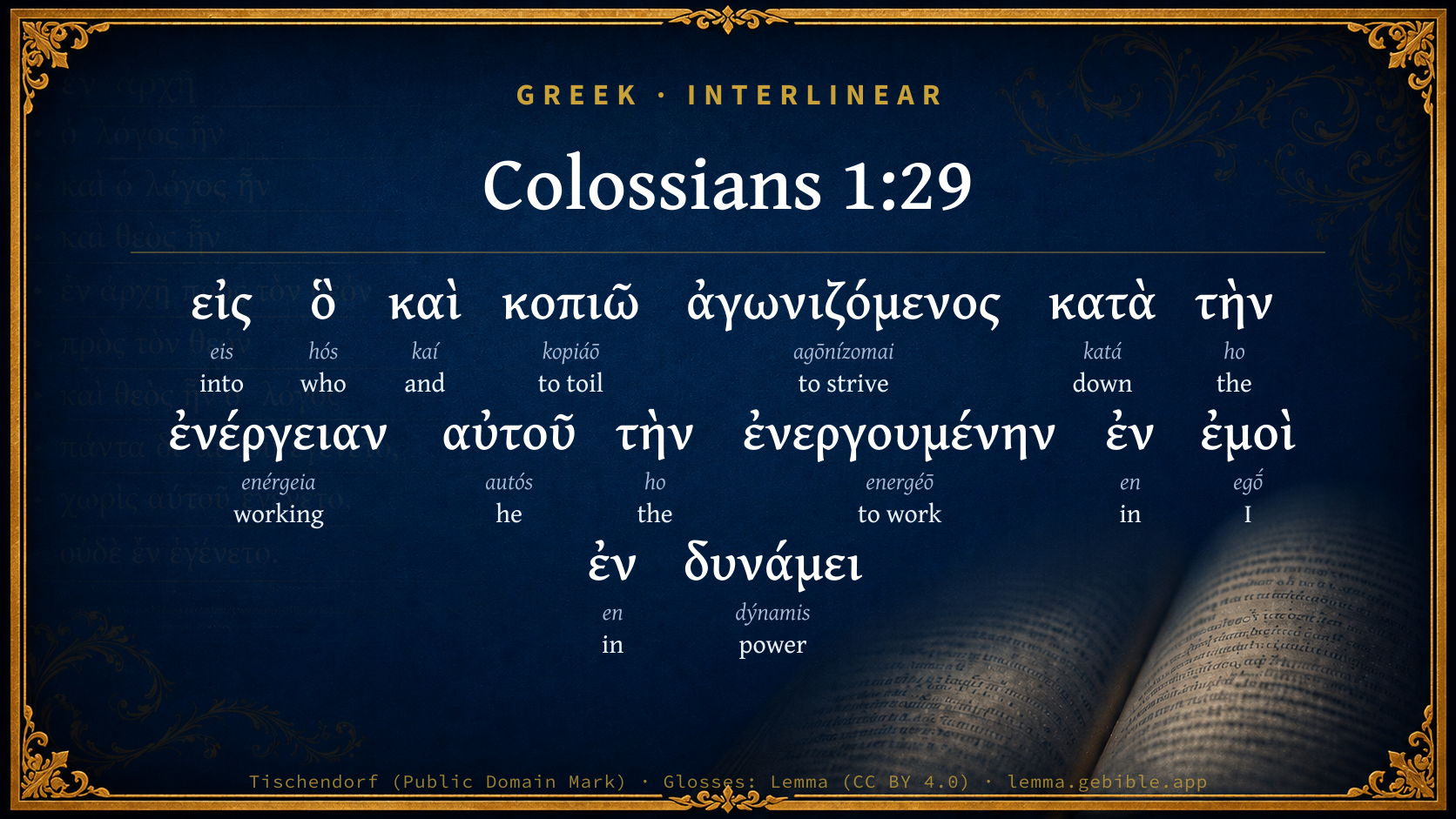
  1. εἰς eis G1519 “into” Preposition
  2. ὃ hós G3739 “who” Relative pronoun, Accusative, Singular, Neuter
  3. καὶ kaí G2532 “and” Conjunction
  4. κοπιῶ kopiáō G2872 “to toil” Verb, Present, Active, Indicative, 1st person, Singular
  5. κατὰ katá G2596 “down” Preposition
  6. τὴν ho G3588 “the” Article, Accusative, Singular, Feminine
  7. ἐνέργειαν enérgeia G1753 “working” Noun, Accusative, Singular, Feminine
  8. αὐτοῦ autós G846 “he” Personal pronoun, Genitive, Singular, Masculine
  9. τὴν ho G3588 “the” Article, Accusative, Singular, Feminine
  10. ἐνεργουμένην energéō G1754 “to work” Verb, Present, Middle, Participle, Accusative, Singular, Feminine
  11. ἐν en G1722 “in” Preposition
  12. ἐμοὶ egṓ G1473 “I” Personal pronoun, 1st person, Dative, Singular
  13. ἐν en G1722 “in” Preposition
  14. δυνάμει dýnamis G1411 “power” Noun, Dative, Singular, Feminine

About this verse

These counts appear in no published source. They are computed here, from the morphology-tagged text and Lemma’s own curated glosses. What Lemma adds →

15
words
13
distinct lemmas
Pauline Epistles
section

Notable vocabulary

The rarest word here is ἀγωνιζόμενος to strive G75 — appearing just 8 times in the whole Greek New Testament.

Shared distinctive vocabulary

ἀγωνιζόμενος to strive G75 occurs in 8 verses of the Greek New Testament. Also found in:

Repetition

Words recur within this verse:

Cross-references

27

Topical passages linked to Colossians 1:29 in the Treasury of Scripture Knowledge — connected by theme and wording, ordered by reader-vote popularity; previews shown in the World English Bible.

  • 1 Corinthians 15:10 But by the grace of God I am what I am. His grace which was bestowed on me was not futile, but I worked more than all of them; yet not I, but the grace of God which was with me.
  • Ephesians 1:19 and what is the exceeding greatness of his power toward us who believe, according to that working of the strength of his might
  • 1 Corinthians 9:25–27 Every man who strives in the games exercises self-control in all things. Now they do it to receive a corruptible crown, but we an incorruptible.
  • Ephesians 3:7 of which I was made a servant, according to the gift of that grace of God which was given me according to the working of his power.
  • Philippians 2:13 For it is God who works in you both to will and to work, for his good pleasure.
  • 2 Corinthians 12:9–10 He has said to me, "My grace is sufficient for you, for my power is made perfect in weakness." Most gladly therefore I will rather glory in my weaknesses, that the power of Christ may rest on me.
  • Colossians 2:1 For I desire to have you know how greatly I struggle for you, and for those at Laodicea, and for as many as have not seen my face in the flesh;
  • Hebrews 13:21 make you complete in every good work to do his will, working in you that which is well pleasing in his sight, through Jesus Christ, to whom be the glory forever and ever. Amen.
  • Romans 15:20 yes, making it my aim to preach the Gospel, not where Christ was already named, that I might not build on another's foundation.
  • 1 Corinthians 12:11 But the one and the same Spirit works all of these, distributing to each one separately as he desires.
  • Philippians 2:16 holding up the word of life; that I may have something to boast in the day of Christ, that I didn't run in vain nor labor in vain.
  • Colossians 4:12 Epaphras, who is one of you, a servant of Christ, salutes you, always striving for you in his prayers, that you may stand perfect and complete in all the will of God.
  • 1 Thessalonians 2:9 For you remember, brothers, our labor and travail; for working night and day, that we might not burden any of you, we preached to you the Gospel of God.
  • 2 Thessalonians 3:8 neither did we eat bread from anyone's hand without paying for it, but in labor and travail worked night and day, that we might not burden any of you;
  • Romans 15:30 Now I beg you, brothers, by our Lord Jesus Christ, and by the love of the Spirit, that you strive together with me in your prayers to God for me,
  • 1 Corinthians 12:6 There are various kinds of workings, but the same God, who works all things in all.
  • 2 Corinthians 5:9 Therefore also we make it our aim, whether at home or absent, to be well pleasing to him.
  • 2 Corinthians 6:5 in beatings, in imprisonments, in riots, in labors, in watchings, in fastings;
  • 2 Corinthians 11:23 Are they servants of Christ? (I speak as one beside himself) I am more so; in labors more abundantly, in prisons more abundantly, in stripes above measure, in deaths often.
  • 2 Corinthians 13:3 seeing that you seek a proof of Christ who speaks in me; who toward you is not weak, but is powerful in you.
  • Ephesians 3:20 Now to him who is able to do exceedingly abundantly above all that we ask or think, according to the power that works in us,
  • Philippians 1:27 Only let your manner of life be worthy of the Gospel of Christ, that, whether I come and see you or am absent, I may hear of your state, that you stand firm in one spirit, with one soul striving for the faith of the Gospel;
  • Philippians 1:30 having the same conflict which you saw in me, and now hear is in me.
  • 2 Timothy 2:10 Therefore I endure all things for the chosen ones' sake, that they also may obtain the salvation which is in Christ Jesus with eternal glory.
  • Revelation 2:3 You have perseverance and have endured for my name's sake, and have not grown weary.
  • Luke 13:24 "Strive to enter in by the narrow door, for many, I tell you, will seek to enter in, and will not be able.
  • Hebrews 12:4 You have not yet resisted to blood, striving against sin;

Cross-references courtesy of OpenBible.info (CC BY 4.0).

Commentary

Notes on Colossians 1:29 from classic Christian and Jewish commentators (each source and its license shown beneath its notes). The classic Christian expositions comment on the surrounding passage and are grouped to its opening verse, so a note may address several verses; the Jewish commentaries on the Tanakh (Rashi and others) are per-verse, so they appear only where the commentator wrote on this verse.

Lemma curates 59 commentaries, every one of them public domain or Creative Commons licensed, each selected and text-cleaned for this edition rather than reprinted as found. About our sources →

The Biblical Illustrator

Joseph S. Exell

Col_1:29

Whereunto I also labour, striving according to His working.

Work in us and work by us

The work of Christ in us and for us does not exempt us from work. Nor does the Holy Spirits operation supersede human effort, but rather excites it. This truth is illustrated in--

I. The believers salvation. If any man be saved, the work within is entirely wrought by the Holy Ghost, but that does not exempt from, but necessitates, energetic labour. To enforce this we remark--

1. That the Christian life is always described as a thing of energy: as a journey, a race, a boxing match.

2. That there is no illustration in Scripture which allows the supposition that heaven is won by sloth. That is everywhere condemned.

3. That it is natural it should be so. When the Holy Spirit comes the sinner sees his danger, and exclaims, What must I do to be saved? He sees the excellence of salvation, and is desirous of finding the pearl of great price at all costs. Having found Christ, the believer is moved at once to glorify Him with all his powers.

4. That it is most certain that all saving acts must be performed by the man himself. Faith is the gift of God, but the Holy Ghost never believed for anybody. Repentance is His work, but the sinner must repent. He helps our infirmities in prayer, but we have to pray.

5. That if He were not made active, but one simply called upon, there is a reduction of manhood to materialism. There is no moral good or evil to me in a work which is not my own. In the Square of St. Mark, at Venice, at certain hours the bell of the clock is struck by two bronze figures as large as life, wielding hammers. Now, nobody ever thought of presenting thanks to those bronze men for the diligence with which they have struck the hours; of course, they cannot help it, they are wrought upon by machinery, and they strike the hours from necessity. Some years ago a stranger was upon the top of the tower, and incautiously went too near one of these bronze men; his time was come to strike the hour; he knocked the stranger from the battlement of the tower and killed him; nobody said the bronze man ought to be hanged; nobody ever laid it to his charge at all. There was no moral good or moral evil, because there was no will in the concern. It was not a moral act, because no mind and heart gave consent to it. Am I to believe that grace reduces men to this?

6. I warn any who imagine a man is a merely passive being in salvation against putting their theory into practice.

II. The ministry of the saints in the conversion of others. The Holy Spirit alone can convert a soul, but wherever He works, as a general rule, it is in connection with the earnest efforts of Christian men.

This is clear--

1. From the example of the text. Paul certifies that the salvation of souls is the sole work of Christ, but he declares that He laboured agonizing. Labouring means--

(1) Abundant work. No man can be said to labour who only does half a days work; and a soul labourer will not make his work a by-play, but put in long hours, and be ever at it.

(2) Hard work. He is no labourer who takes a spade to play with it as a little child upon the sand.

(3) Personal work. No man is a labourer who works through his servants; and the power of the Church lies in the personal influence of her members.

(4) All this must have combined with it inward soul conflict. If your heart never breaks for another, you will never be the means of breaking his heart.

2. This is plain from the work itself.

(1) Souls are not converted, as a rule, without previous prayer. So we must be stirred up to prayer, and the petitions God hears are not those of people half asleep.

(2) Souls are saved instrumentally through teaching, but not cold, dead teaching. Some warn souls in such a careless tone as to create unbelief.

(3) Teaching is not all; we must use earnest, persevering persuasion.

3. Earnest zeal is a natural result of the Spirits working on the soul.

(1) He sanctifies in each the natural instinct which leads them to wish others to be like themselves. Having experienced salvation, we desire others to have the same happiness.

(2) He bestirs in us the impulse of gratitude to Christ, and so consecration to Him.

(3) He sanctifies the desire for the prosperity of the community to which we belong, and so we ardently labour for the success of the Church.

4. The whole history of the Church confirms what has been stated, our Lords ministry, Pentecost, Chrysostom and Augustine, Luther, etc. (C. H. Spurgeon.)

.

The Biblical Illustrator, edited by Joseph S. Exell (c. 1880s–1900s) — public domain. Text from a community e-Sword module.

MacLaren's Expositions of Holy Scripture

Alexander MacLaren

Colossians

CHRISTIAN ENDEAVOUR

Col 1:29.

I have chosen this text principally because it brings together the two subjects which are naturally before us to-day. All ‘Western Christendom,’ as it is called, is to-day commemorating the Pentecostal gift. My text speaks about that power that ‘worketh in us mightily.’ True, the Apostle is speaking in reference to the fiery energy and persistent toil which characterised him in proclaiming Christ, that he might present men perfect before Him. But the same energy which he expended on his apostolic office he expended on his individual personality. And he would not have discharged the one unless he had first laboured on the other. And although in a letter contemporary with this one from which my text is taken he speaks of himself as no longer young, but ‘such an one as Paul the aged, and likewise, also a prisoner of Jesus Christ,’ the young spirit was in him, and the continual pressing forward to unattained heights. And that is the spirit, not only of a section of the Church divided from the rest by youth and by special effort, but of the whole Church if it is worth calling a Church, and unless it is thus instinct, it is a mere dead organisation.

So I hope that what few things I have to say may apply to, and be felt to be suitable by all of us, whether we are nominally Christian Endeavourers or not. If we are Christian people, we are such. If we are not endeavouring, shall I venture to say we are not Christians? At any rate, we are very poor ones.

Now here, then, are two plain things, a great universal Christian duty and a sufficient universal Christian endowment. ‘I work striving’; that is the description of every true Christian. ‘I work striving, according to His working, who worketh in me mightily’: there is the great gift which makes the work and the striving possible. Let me briefly deal, then, with these two.

I. The solemn universal Christian obligation.

Now the two words which the Apostle employs here are both of them very emphatic. ‘His words were half battles,’ was said about Luther. It may be as truly said about Paul. And that word ‘work’ which he employs, means, not work with one hand, or with a delicate forefinger, but it means toil up to the verge of weariness. The notion of fatigue is almost, I might say, uppermost in the word as it is used in the New Testament. Some people like to ‘labour’ so as never to turn a hair, or bring a sweat-drop on to their foreheads. That is not Christian Endeavour. Work that does not ‘take it out of you’ is not worth doing. The other word ‘striving’ brings up the picture of the arena with the combatants’ strain of muscle, their set teeth, their quick, short breathing, their deadly struggle. That is Paul’s notion of Endeavour. Now ‘Endeavour,’ like a great many other words, has a baser and a nobler side to it. Some people, when they say, ‘I will endeavour,’ mean that they are going to try in a half-hearted way, with no prospect of succeeding. That is not Christian Endeavour. The meaning of the word--for the expression in my text might just as well be rendered ‘endeavouring’ as ‘striving’--is that of a buoyant confident effort of all the concentrated powers, with the certainty of success. That is the endeavour that we have to cultivate as Christian men. And there is only one field of human effort in which that absolute confidence that it shall not be in vain is anything but presumptuous arrogance; namely, in the effort after making ourselves what God means us to be, what Jesus Christ longs for us to be, what the Spirit of God is given to us in order that we should be. ‘We shall not fail,’ ought to be the word of every man and woman when they set themselves to the great task of working out, in their own characters and personalities, the Divine intention which is made a Divine possibility by the sacrifice of Jesus Christ and the gift of the Divine Spirit.

So then what we come to is just this, dear brethren, if we are Christians at all, we have to make a business of our religion; to go about it as if we meant work. Ah! what a contrast there is between the languid way in which Christian men pursue what the Bible designates their ‘calling’ and that in which men with far paltrier aims pursue theirs! And what a still sadder contrast there is between the way in which we Christians go about our daily business, and the way in which we go about our Christian life! Why, a man will take more pains to learn some ornamental art, or some game, than he will ever take to make himself a better Christian. The one is work. What is the other? To a very large extent dawdling and make-believe.

You remember the old story,--it may raise a smile, but there should be a deep thought below the smile,--of the little child that said as to his father that ‘he was a Christian, but he had not been working much at it lately.’ Do not laugh. It is a great deal too true of--I will not venture to say what percentage of--the professing Christians of this day. Work at your religion. That is the great lesson of my text. Endeavour with confidence of success. The Book of Proverbs says: ‘He that is slothful in his work is brother to him that is a great waster,’ and that is true. A man that does ‘the work of the Lord negligently’ is scarcely to be credited with doing it at all. Dear friends, young or old, if you name the name of Christ, be in earnest, and make earnest work of your Christian character.

And now may I venture two or three very plain exhortations? First, I would say--if you mean to make your Christian life a piece of genuine work and striving, the first thing that you have to do is to endeavour in the direction of keeping its aim very clear before you. There are many ways in which we may state the goal of the Christian life, but let us put it now into the all-comprehensive form of likeness to Jesus Christ, by entire conformity to His Example and full interpretation of His life. I do not say ‘Heaven’; I say ‘Christ.’

That is our aim, the loftiest idea of development that any human spirit can grasp, and rising high above a great many others which are noble but incomplete. The Christian ideal is the greatest in the universe. There is no other system of thought that paints man as he is, so darkly; there is none that paints man as he is meant to be, in such radiant colours. The blacks upon the palette of Christianity are blacker, and the whites are whiter, and the golden is more radiant, than any other painter has ever mixed. And so just because the aim which lies before the least and lowest of us, possessing the most imperfect and rudimentary Christianity, is so transcendent and lofty, it is hard to keep it clear before our eyes, especially when all the shabby little necessities of daily life come in to clutter up the foreground, and hide the great distance. Men may live up at Darjeeling there on the heights for weeks, and never see the Himalayas towering opposite. The lower hills are clear; the peaks are wreathed in cloud. So the little aims, the nearer purposes, stand out distinct and obtrusive, and force themselves, as it were, upon our eyeballs, and the solemn white Throne of the Eternal away across the marshy levels, is often hid, and it needs an effort for us to keep it clear before us. One of the main reasons for much that is unsatisfactory in the spiritual condition of the average Christian of this day is precisely that he has not burning ever before him there, the great aim to which he ought to be tending. So he gets loose and diffused, and vague and uncertain. That is what Paul tells you when he proposes himself as an example: ‘So run I, not as uncertainly,’ The man who knows where he is running makes a bee-line for the goal. If he is not sure of his destination, of course he zigzags. ‘So fight I, not as one that beateth the air’--if I see my antagonist I can hit him. If I do not see him clearly I strike like a swordsman in the dark, at random, and my sword comes back unstained. If you want to make the harbour, keep the harbour lights always clear before you, or you will go yawing about, and washing here and there, in the trough of the wave, and the tempest will be your master. If you do not know where you are going you will have to say, like the men in the old story in the Old Book, ‘Thy servant went no whither.’ If you are going to endeavour, endeavour first to keep the goal clear before you.

And endeavour next to keep up communion with Jesus Christ, which is the secret of all peaceful and of all noble living. And endeavour next after concentration. And what does that mean? It means that you have to detach yourself from hindrances. It means that you have to prosecute the Christian aim all through the common things of Christian life. If it were not possible to be pursuing the great aim of likeness to Jesus Christ, in the veriest secularities of the most insignificant and trivial occupations, then it would be no use talking about that being our aim. If we are not making ourselves more like Jesus Christ by the way in which we handle our books, or our pen, or our loom, or our scalpel, or our kitchen utensils, then there is little chance of our ever making ourselves like Jesus Christ. For it is these trifles that make life, and to concentrate ourselves on the pursuit of the Christian aim is, in other words, to carry that Christian aim into every triviality of our daily lives.

There are three Scripture passages which set forth various aspects of the aim that we have before us, and from each of these aspects deduce the one same lesson. The Apostle says ‘giving all diligence, add to your faith virtue,’ etc., ‘for if ye do these things ye shall never fail.’ He also exhorts: ‘Give diligence to make your calling and election sure.’ And finally he says: ‘Be diligent, that ye may be found of Him in peace, without spot, blameless.’ There are three aspects of the Christian course, and the Christian aim, the addition to our faith of all the clustering graces and virtues and powers that can be hung upon it, like jewels on the neck of a queen; the making our calling and election sure, and the being found at last tranquil, spotless, stainless, and being found so by Him. These great aims are incumbent on all Christians, they require diligence, and ennoble the diligence which they require.

So, brethren, we have all to be Endeavourers if we are Christians, and that to the very end of our lives. For our path is the only path on which men tread that has for its goal an object so far off that it never can be attained, so near that it can ever be approached. This infinite goal of the Christian Endeavour means inspiration for youth, and freshness for old age, and that man is happy who can say: ‘Not as though I had already attained’ at the end of a long life, and can say it, not because he has failed, but because in a measure he has succeeded. Other courses of life are like the voyages of the old mariners which were confined within the narrow limits of the Mediterranean, and steered from headland to headland. But the Christian passes through the jaws of the straits, and comes out on a boundless sunlit ocean where, though he sees no land ahead, he knows there is a peaceful shore, beyond the western waves. ‘I work striving.’

Now one word as to the other thought that is here, and that is

II. The all-sufficient Christian gift.

‘According to His working, which worketh in me mightily.’ I need not discuss whether ‘His’ in my text refers to God or to Christ. The thing meant is the operation upon the Christian spirit, of that Divine Spirit whose descent the Church to-day commemorates. At this stage of my sermon I can only remind you in a word, first of all, that the Apostle here is arrogating to himself no special or peculiar gift, is not egotistically setting forth something which he possessed and other Christian people did not--that power which, ‘working in him mightily,’ worked in all his brethren as well. It was his conviction and his teaching--would that it were more operatively and vitally the conviction of all professing Christians to-day, and would that it were more conspicuously, and in due proportion to the rest of Christian truth, the teaching of all Christian teachers to-day!--that that Divine power is in the very act of faith received and implanted in every believing soul. ‘Know ye not,’ the Apostle could say to his hearers, ‘that ye have the Spirit of God, except ye be reprobates.’ I doubt whether the affirmative response would spring to the lips of all professing or real Christians to-day as swiftly as it would have done then. And I cannot help feeling, and feeling with increasing gravity of pressure as the days go on, that the thing that our churches, and we as individuals, perhaps need most to-day, is the replacing of that great truth--I do not call it a ‘doctrine,’ that is cold, it is experience--in its proper place. They who believe on Him do receive a new life, a supernatural communication of the new Spirit, to be the very power that rules in their lives.

It is an inward gift. It is not like the help that men can render us, given from without and apprehended and incorporated with ourselves through the medium of the understanding or of the heart. There is an old story in the history of Israel about a young king that was bid by the prophet to bend his bow against the enemies of Israel, as a symbol; and the old prophet put his withered, skinny brown hand on the young man’s fleshy one, and then said to him, ‘Shoot.’ But this Divine Spirit comes to strengthen us in a more intimate and blessed fashion than that, for it glides into our hearts and dwells in our spirits, and our work, as my text says, is His working. This ‘working within’ is stated in the original of my text most emphatically, for it is literally ‘the inworking which inworketh in me mightily.’

So, dear brethren, the first direct aim of all our endeavour ought to be to receive and to keep and to increase our gift of that Divine Spirit. The work and the striving of which my text speaks would be sheer slavery unless we had that help. It would be impossible of accomplishment unless we had it.

‘If any power we have, it is to ill, And all the power is Thine, to do and eke to will.’

Let us, then, begin our endeavour, not by working, but by receiving. Is not that the very meaning of the doctrine that we are always talking about, that men are saved, not by works but by faith? Does not that mean that the first step is reception, and the first requisite is receptiveness, and that then, and after that, second and not first, come working and striving? To keep our hearts open by desire, to keep them open by purity, are the essentials. The dove will not come into a fouled nest. It is said that they forsake polluted places. But also we have to use the power which is inwrought. Use is the way to increase all gifts, from the muscle in your arm to the Christian life in your spirit. Use it, and it grows. Neglect it, and it vanishes, and like the old Jewish heroes, a man may go forth to exercise himself as of old time, and know not that the Spirit of God hath departed from him. Dear friends, do not bind yourselves to the slavery of Endeavour, until you come into the liberty and wealth of receiving. He gives first, and then says to you, ‘Now go to work, and keep that good thing which is committed unto thee.’

There is but one thought more in this last part of my text, which I must not leave untouched, and that is that this sufficient and universal gift is not only the means by which the great universal duty can be discharged, but it ought to be the measure in which it is discharged. ‘I work according to the working in me.’ That is, all the force that came into Paul by that Divine Spirit, came out of Paul in his Christian conduct, and the gift was not only the source, but also the measure, of this man’s Christian Endeavour. Is that true about us? They say that the steam-engine is a most wasteful application of power, that a great deal of the energy which is generated goes without ever doing any work. They tell us that one of the great difficulties in the way of economic application of electricity is the loss which comes through using accumulators. Is not that like a great many of us? So much power poured into us; so little coming out from us and translated into actual work! Such a ‘rushing mighty wind,’ and the air about us so heavy and stagnant and corrupt! Such a blaze of fire, and we so cold! Such a cataract of the river of the water of life, and our lips parched and our crops seared and worthless! Ah, brethren! when we look at ourselves, and when we think of the condition of so many of the churches to which we belong, the old rebuke of the prophet comes back to us in this generation, ‘Thou that art named the House of Israel, is the Spirit of the Lord straitened? Are these His doings?’ We have an all-sufficient power. May our working and striving be according to it, and may we work mightily, being ‘strong in the Lord, and in the power of His might!’

Alexander MacLaren, Expositions of Holy Scripture (1904–1910) — public domain. Text from a community e-Sword module.

Bengel's Gnomon

Johann Albrecht Bengel

Col 1:29. Ἀγωνιζόμενος, striving) In ch. Col 2:1, the conflict (comp. Col 4:12) refers to this word.—κατὰ, according to) Paul would not be able to strive in himself: he is only mighty, according as Christ works in him.—αὐτοῦ, of Him) of Christ.

Bengel's Gnomon of the New Testament — English translation (T&T Clark, Edinburgh, 1860) — public domain. Text from a community e-Sword module.

Meyer's Critical & Exegetical Commentary

Heinrich August Wilhelm Meyer

Col_1:29. On the point of now urging upon the readers their obligation to fidelity in the faith (Col_2:4), and that from the platform of the personal relation in which he stood towards them as one unknown to them by face (Col_2:1), Paul now turns from the form of expression embracing others in common with himself, into which he had glided at Col_1:28 in harmony with its contents, back to the individual form (the first person singular), and asserts, first of all, in connection with Col_1:28, that for the purpose of the παραστῆσαι κ.τ.λ. (εἰς ὅ, comp. 1Ti_4:10) he also gives himself even toil (κοπιῶ, comp. Rom_16:6; Rom_16:12; 1Co_4:12), striving, etc.

καί] also, subjoins the κοπιᾶν to the καταγγέλλειν κ.τ.λ., in which he subjects himself also to the former; it is therefore augmentative, in harmony with the climactic progress of the discourse; not a mere equalization of the aim and the striving (de Wette). Neither this καί, nor even the transition to the singular of the verb,especially since the latter is not emphasized by the addition of an ἐγώ,can justify the interpretation of Hofmann, according to which εἰς ὅ is, contrary to its position, to be attached to ἀγωνιζόμενος, and κοπιῷ is to mean: I become weary and faint (comp. Joh_4:6; Rev_2:3, and Düsterdieck in loc.). Paul, who has often impressed upon others the μὴ ἐκκακεῖν, and for himself is certain of being more than conqueror in all things (Rom_8:37; 2Co_4:8, et al.), can hardly have borne testimony about himself in this sense, with which, moreover, the ἀγωνίζεσθαι in the strength of Christ is not consistent. In his case, as much as in that of any one, the οὐκ ἐκοπίασας of Rev_2:3 holds good.

ἀγωνιζόμενος] Compare 1Ti_4:10. Here, however, according to the context, Col_2:1 ff., the inward striving (comp. Luk_13:24) against difficulties and hostile forces, the striving of solicitude, of watching, of mental and emotional exertion, of prayer, etc., is meant; as respects which Paul, like every regenerate person (Gal_5:17), could not be raised above the resistance of the σάρξ to the πνεῦμα ruling in him. Comp. Chrysostom: καὶ οὐχ ἁπλῶς σπουδάζω, φησιν, οὐδὲ ὡς ἔτυχεν, ἀλλὰ κοπιῶ ἀγωνιζόμενος μετὰ πολλῆς τῆς σπουδῆς, μετὰ πολλῆς τῆς ἀγρυπνίας. It is not: tot me periculis ac malis objicere (Erasmus, comp. Grotius, Estius, Heinrichs, Bähr, and others), which outward struggling, according to Flatt, de Wette, Baumgarten-Crusius, and others, should be understood along with that inward striving; Col_2:1 only points to the latter; comp. Col_4:12.

κατὰ τὴν ἐνέργειαν κ.τ.λ.] for Paul does not contend, amid the labours of his office, according to the measure of his own strength, but according to the effectual working of Christ (αὐτοῦ is not to be referred to God, as is done by Chrysostom, Grotius, Flatt, Baumgarten-Crusius, and others), which worketh in him. Comp. Php_4:13. How must this consciousness, at once so humble and confident of victory, have operated upon the readers to stir them up and strengthen them for stedfastness in the faith!

τὴν ἐνεργουμ.] is middle; see on 2Co_1:6; Gal_5:6; Eph_3:20. The modal definition to it, ἐν δυνάμει, mightily (comp. on Rom_1:4), is placed at the end significantly, as in 2Th_1:11; it is groundlessly regarded by Holtzmann as probably due to the interpolator.

Meyer — Critical and Exegetical Commentary on the New Testament — English translation by Peter Christie, edited by Frederick Crombie (T&T Clark, 1880) — public domain. Text from a community e-Sword module.

Expositor's Greek Testament

ed. W. Robertson Nicoll

Col 1:29 . εἰς ὃ : to achieve which end. κοπιῶ expresses toil carried to the point of weariness. ἀγωνιζόμενος : a metaphor from the arena. Meyer takes the reference to be to inward striving against difficulties and hostile forces. Perhaps both inward and outward struggle are referred to (De W.). κατὰ . The struggle is carried on in proportion not to his natural powers, but to the mightily working energy of Christ within him. ἐνεργουμένην : a dynamic middle ( cf. Col 1:6 ).

The Expositor's Greek Testament, edited by W. Robertson Nicoll (1897–1910) — public domain. Text from a community e-Sword module.

International Critical Commentary

29. εἰς ὅ, viz. to present every man, etc.

καὶ κοπιῶ. I not only καταγγέλλω, κ.τ.λ., but carry to the point of toiling. Hofmann understands it as meaning, “I become weary,” comparing Joh 4:6; Rev 2:3, where, however, the verb is perfect. The sense, moreover, would be quite unsuitable here in connexion with the ἀγωνίζεσθαι in the power of Christ. The verb is frequently used by St. Paul of his toilsome labours in the Churches; e.g. 1Co 15:10; Gal 4:11; Php 2:16; also of the labours of others; Rom 16:12; 1Co 16:16; 1Th 5:12. But he also uses it of the labour of the hands; 1Co 4:12; Eph 4:28. The change to the singular has its ground in the personal experience described.

ἀγωνιζόμενος. Compare 1Ti 4:10, εἰς τοῦτο κοπιῶμεν καὶ ἀγωνιζόμεθα. The reference here is to inward ἀγών, as is shown by the following context; cf. 4:12.

κατὰ τὴν ἐνέργειαν αὐτοῦ. Not by his own strength, but by that which Christ supplies. τὸν αὐτου1͂ κόπον καὶ ἀγῶνα τῷ Χριστῷ ἀνατιθείς, Oecum. But Chrys., Theoph. understand the αὐτοῦ of God, against the immediate context. ἐνεργουμένην, middle, as always in St. Paul. Fritzsche on Rom 7:5 observes: “ἐνεργεῖν, vim exercere de personis, ἐνεργεῖσθαι ex se (aut suam). vim exercere de rebus collocavit, Gal 5:6; Col 1:29; 1Th 2:13; al. ut h.l. Passivo … nunquam Paulus usus est.”

ἐν δυνάμει, “in power”; cf. Rom 1:8; 2Th 1:11. Some understand this of the power of working miracles, which is quite inappropriate to the context, according to which the reference is to κοπιῶ ἀγωνιζόμενος.

Boh Bohairic. Cited by Tisch. as “Coptic,” by Tregelles as “Memphitic,” by WH. as “me.”

Arm Armenian.

WH Westcott and Hort.

Syr-Harcl. The Harclean Syriac.

Syr-Pesh The Peshitto Syriac.

Fuld. Cod. Fuldensis

Eth Ethiopic.

Tisch. Tischendorf.

Treg. Tregelles.

Ell Ellicott.

De W De Wette.

Alf Alford.

International Critical Commentary — older volumes (1896–1929), various authors — public domain. Text from a community e-Sword module.

Jamieson, Fausset & Brown

Robert Jamieson, A. R. Fausset & David Brown

Whereunto--namely, "to present every man perfect in Christ."

I also labour--rather, "I labor also." I not only "proclaim" (English Version, "preach") Christ, but I labor also.

striving--in "conflict" (Col 2:1) of spirit (compare Rom 8:26). The same Greek word is used of Epaphras (Col 4:12), "laboring fervently for you in prayers": literally, "agonizing," "striving as in the agony of a contest." So Jesus in Gethsemane when praying (Luk 22:44): so "strive" (the same Greek word, "agonize"), Luk 13:24. So Jacob "wrestled" in prayer (Gen 32:24-29). Compare "contention," Greek, "agony," or "striving earnestness," Th1 2:2.

according to his working--Paul avows that he has power to "strive" in spirit for his converts, so far only as Christ works in him and by him (Eph 3:20; Phi 4:13).

mightily--literally, "in power."

Next: Colossians Chapter 2

Jamieson, Fausset & Brown — Commentary Critical and Explanatory on the Whole Bible (1871) — public domain (CC PDM 1.0). Text via the HelloAO Bible API.

Adam Clarke's Commentary

Verse 29. Whereunto I also labour] In order to accomplish this end, I labour with the utmost zeal and earnestness; and with all that strength with which God has most powerfully furnished me. Whoever considers the original words, αγωνιζομενος κατα την ενεργειαν αυτου την ενεργουμενην - εν δυναμει, will find that no verbal translation can convey their sense. God worked energetically in St. Paul, and he wrought energetically with God; and all this was in reference to the salvation of mankind.

1. THE preceding chapter contains the highest truths in the Christian religion, conveyed in language peculiar to this apostle; a language never taught by man, clothing ideas as vast as the human mind can grasp, and both coming immediately from that inspiration of the Almighty which giveth understanding.

2. What the apostle says on the Godhead of Christ has already been distinctly noted; and from this we must conclude that, unless there be some secret way of understanding the 16th and 17th verses, Col 1:16; Col 1:17 which God has nowhere revealed, taken in their sober and rational sense and meaning they must for ever settle this very important point. Let any man of common sense and reason hear these words, whose mind had not been previously warped by any sentiment on the subject, and who only knew, in religious matters, this one great truth, that there is a God, and that he made and governs all things; and then let him be asked, Of whom doth the apostle speak this? Would he not immediately answer, He speaketh of God? As to the difficulties on this subject, we must consider them difficulties rather to our limited intellect, than as belonging to the subject. We can know but little of an infinite and eternal Being; nothing, properly speaking, but what himself is pleased to reveal. Let us receive, this with gratitude and reverence. See my discourse on the sum and substance of apostolic preaching.

Adam Clarke's Commentary on the Bible (1810–1826) — public domain. Text from a community e-Sword/MySword module.

John Calvin's Commentaries

29. For which thing. He enhances, by two circumstances, the glory of his apostleship and of his doctrine. In the first place, he makes mention of his aim, which is a token of the difficulty that he felt; for those things are for the most part the most excellent that are the most difficult. The second has more strength, inasmuch as he mentions that the power of God shines forth in his ministry. He does not speak, however, merely of the success of his preaching, (though in that too the blessing of God appears,) but also of the efficacy of the Spirit, in which God manifestly shewed himself; for on good grounds he ascribes his endeavors, inasmuch as they exceeded human limits, to the power of God, which, he declares, is seen working powerfully in this matter.

John Calvin's Commentaries (1540-1563) — public domain. Text from the Calvin Translation Society English edition (1840s-50s) via the Christian Classics Ethereal Library (ccel.org). Calvin's coverage is partial (roughly two-thirds of the Bible); uncommented books and verses are honest gaps, never fabricated. The 19th-century editor's footnotes and remarks are omitted so the notes are faithfully Calvin's own voice.

Ellicott's Commentary for English Readers

(29) Whereunto I also labour.—In this verse St. Paul passes from the plural to the singular, evidently in preparation for the strong personal remonstrance of Col_2:1-7.

His working . . .—See Eph_1:12, and Note there. Perhaps, as in Gal_2:8 (“He that wrought effectually in Peter to the Apostleship of the Circumcision, the same was mighty in me towards the Gentiles”), there is special allusion to the grace given to him for his Apostleship of the Gentiles.

A Bible Commentary for English Readers, edited by Charles John Ellicott (1878–1897) — public domain. Text from a community e-Sword module.

The Cambridge Bible for Schools and Colleges

gen. ed. J. J. S. Perowne

29. also] i.e. “actually,” “as a matter of fact.”

labour] The Greek verb denotes toil even to weariness. It (or its cognate noun) occurs e.g. 1Co_15:10; 1Co_15:58; Gal_4:11; Php_2:16; 1Th_1:3; 1Th_5:12; 1Ti_4:10; 2Ti_2:6; Rev_2:2-3.

striving] The Greek verb (our word “agony” is the descendant of a cognate) occurs e.g. Luk_13:24; 1Co_9:25; below, Col_4:12; 1Ti_6:12; and a cognate, Php_1:30 (see note); below, Col_2:1 (see note); 1Th_2:2; Heb_12:1 (“race” A.V.). By usage, the word gives the thought of the strife and stress of the athletic arena; a thought conspicuous in e.g. 1Co_9:25; 1Ti_6:12. It thus conveys an impression of contest with obstacles in view of a definite goal.

See our note on a similar phrase, Php_1:27.

according to, &c.] Observe the intimation, at once restful and animating, that the presence and movement within him of the power (“working,” energeia) of God were the force behind all his apostolic activity. “By Him he moves, in Him he lives;” while yet the man’s “moving” and “living” is none the less genuinely personal. Cp. 1Co_15:10; 2Co_3:5; 2Co_4:7; 2Co_12:9-10; Php_2:12-13; Php_4:13; and above, Col_1:11.

mightily] Lit. and better, in power. Cp. above Col_1:11, and note.

“Christ in him” was for St Paul not only “the hope of glory” but also the mainspring of action; the secret of a “power” which was anything but violence, or disorder, but which brought with it a wonderful victory and an inexhaustible energy of life and love. For every “recipient of Christ” (Joh_1:12) the same secret is to do the same work, as it is reverently recognized and welcomed, according to each one’s path of duty and service.

The Cambridge Bible for Schools and Colleges (gen. ed. J. J. S. Perowne; Cambridge University Press, 1878–1918) — public domain. Text from a community e-Sword module.

John Gill's Exposition

Whereunto I also labour,.... In the word and doctrine, by preaching Christ, warning sinners of their danger, teaching them the way of salvation, and their duty; with this view, that, in thee great day of account, he might bring a large number of them, and set them before Christ as the seals of his ministry, as instances of the grace of Christ, and as perfect in him:

striving according to his working, which worketh in me mightily; meaning either in his prayers, earnestly entreating of God that he would succeed his labours, and bless them to the conversion of many; which sense is favoured by the Syriac version, which renders it, "and make supplication"; that is, with that effectual fervent prayer, which was powerfully wrought in him: or in his ministry, combating with many enemies, fighting the good fight of faith; not in his own strength, but through the power of Christ; which enabled him to preach the Gospel far and near, in season and out of season; which supported his outward man, and strengthened his inward man for that service, and made it effectual to the good of the souls of many: some refer this to the signs, wonders, and miracles, which Christ wrought by him, for the confirmation of the Gospel; but the other sense, which takes in both the power by which he was assisted in preaching, both in body and soul, and that which went along with his ministry to make it useful to others, is to be preferred.

Next: Colossians Chapter 2

John Gill's Exposition of the Whole Bible (1746–1763) — public domain (CC PDM 1.0). Text via the HelloAO Bible API.

Trapp's Complete Commentary

John Trapp

29 Whereunto I also labour, striving according to his working, which worketh in me mightily.

Ver. 29. I also labour, striving] Labour to lassitude, strive even to an agony. Good ministers are great painstakers; and God that helped the Levites to bear the ark, 1Ch 15:26, will help his servants by his Spirit, working in them with power.

John Trapp, A Commentary or Exposition upon All the Books of the Old and New Testament (1647–1656) — public domain. Text from a community e-Sword module.

Albert Barnes' Notes on the Bible

Whereunto I also labour - See the notes at 1Co 15:10.

Striving - Greek agonizing. He taxed all his energies to accomplish this, as the wrestlers strove for the mastery in the Grecian games.

According to his working - Not by my own strength, but by the power which God alone can give; see the notes at 1Co 15:10.

Remarks On Colossians 1

Among the truths of practical importance taught by this chapter are the following:

1. We should rejoice in the piety of others; Col 1:2-8. It should be to us a subject of unfeigned gratitude to God; when others are faithful to their high calling, and when they so live as to adorn the blessed gospel. In all their faith, and love, and joy, we should find occasion for thankfulness to God. We should not envy it, or be disposed to charge it to wrong motives, or suspect it of insincerity or hypocrisy; but should welcome every account of the zeal and faithfulness of those who bear the Christian name - no matter who the persons are, or with what denomination of Christians they may be connected. Especially is this true in relation to our friends, or to those for whose salvation we have labored. The source of high, est gratitude to a Christian, in relation to his friends, should be, that they act as becomes the friends of God; the purest joy that can swell the bosom of a minister of Christ, is produced by the evidence that they to whom he has ministered are advancing in knowledge and love.

2. We should earnestly pray that they who have been much favored should be prospered more and more; Col 1:9-11.

3. It is a good time to pray for Christians when they are already prosperous, and are distinguished for zeal and love; Col 1:9-11. We have then encouragement to do it. We feel that our prayers will not be in vain. For a man that is doing well, we feel encouraged to pray that he may do still better. For a Christian who has true spiritual joy, we are encouraged to pray that he may have more joy. For one who is aiming to make advances in the knowledge of God, we are encouraged to pray that he may make still higher advances; and if, therefore; we wish others to pray for us, we should, show them by our efforts that there is some encouragement for them to do it.

4. Let us cherish with suitable gratitude the remembrance of the goodness of God, who has translated us from the kingdom of darkness into the kingdom of his dear Son; Col 1:12-13. By nature we, like others, were under the power of darkness. In that kingdom of sin, and error, and misery, we were born and reared, until God, in great compassion, brought us out from it, and made us heirs of light. Now, if we are true Christians, we belong to a kingdom of holiness, and knowledge, and happiness. No words can express appropriately the goodness of God in thus making us heirs of light; and not an hour of our lives should pass without a thoughtful remembrance of his mercy.

5. In the affections of our hearts let the Saviour in all things have the pre-eminence; Col 1:15-18. He is the image of God; and when we think of him, we see what God is - how holy, pure, benevolent. He is the first-born of all things; the Son of God; exalted to the highest seat in the universe. When we look on the sun, moon, and stars, let us remember that he created them all. When we think of the angels, let us remember that they are the workmanship of his hands. When we look on the earth - the floods, the rivers, the hills, let us remember that all these were made by his power. The vast universe is still sustained by him. Its beautiful order and harmony are preserved by him; and all its movements are under his control. So the church is under him. It is subject to his command; receives its laws from his lips, and is bound to do his will. Over all councils and synods; over all rule and authority in the church, Christ is the Head; and whatever may be ordained by man, his will is to be obeyed. So, when we think of the resurrection, Christ is chief. He first rose to return to death no more; he rose as the pledge that his people should also rise. As Christ is thus head over all things, so let him be first in the affections of our hearts; as it is designed that in every thing he shall have the pre-eminence, so let him have the pre-eminence in the affections of our souls. None should be loved by us as Christ is loved; and no friend, however dear, should be allowed to displace him from the supremacy in our affections.

6. In all our wants let us go to Christ; Col 1:19, “It pleased the Father that in him should all fulness dwell.” We do not have a need which he cannot supply; there is not a sorrow of our lives in which he cannot comfort us; not a temptation from which he cannot deliver us; not a pain which he cannot relieve, or enable us to hear. Every necessity of body or mind he can supply; and we never can go to him, in any circumstance of life in which we can possibly be placed, where we shall fail of consolation and support because Christ is not able to help us. True piety learns day by day to live more by simple dependence on the Saviour. As we advance in holiness, we become more and more sensible of our weakness and insufficiency, and more and more disposed to live by the faith of the Son of God.”

7. By religion we become united with the angels; Col 1:20. Harmony is produced between heaven and earth. Alienated worlds are reconciled again, and from jarring elements there is rearing one great and harmonious empire. The work of the atonement is designed to remove what separated earth from heaven; men from angels; man from God. The redeemed have substantially the same feelings now, which they have who are around the throne of God; and though we are far inferior to them in rank, yet we shall be united with them in affection and purpose, for ever and ever. What a glorious work is that of the gospel! It reconciles and harmonizes distant worlds, and produces concord and love in millions of hearts which but for that would have been alienated forever.

8. By religion we become fitted for heaven; Col 1:12, Col 1:22. We are made “meet” to enter there; we shall be presented there unblamable and unreprovable. No one will accuse us before the throne of God. Nor Satan, nor our own consciences nor our fellowmen will then urge that we ought not to be admitted to heaven. Redeemed and pardoned, renewed and sanctified, the universe will be satisfied that we ought to be saved, and will rejoice. Satan will no longer charge the friends of Jesus with insincerity and hypocrisy; our own minds will be no longer troubled with doubts and fears; and holy angels will welcome us to their presence. Not a voice will be lifted up in reproach or condemnation, and the Universal Father will stretch out his arms and press to his bosom the returning prodigals. Clothed in the white robes of salvation, we shall be welcome even in heaven, and the universe will rejoice that we are there.

9. It is a privilege to suffer for the welfare of the church; Col 1:24. Paul regarded it as such and rejoiced in the trials which came upon him in the cause of religion. The Saviour so, regarded it, and shrank not from the great sorrows involved in the work of saving his people. We may suffer much in promoting the same object. We may be exposed to persecution and death. We may be called to part with all we have - to leave country and friends and home, to go and preach the gospel to benighted people. On a foreign shore, far from all that we hold dear on earth, we may lie down and die, and our grave, unmarked by sculptured marble, may be soon forgotten. But to do good; to defend truth; to promote virtue; to save the souls of the perishing, is worth all which it costs, and he who accomplishes these things by exchanging for them earthly comforts, and even life, has made a wise exchange. The universe gains by it in happiness; and the benevolent heart should rejoice that there is such a gain, though attended with our individual and personal suffering.

10. Ministers ave a noble office Col 1:24-29. It is their privilege to make known to men the most glorious truths that can come before the human mind; truths which were hidden from ages and generations, but which are now revealed by the gospel. These great truths are intrusted to the ministry to explain and defend, and are by them to be carried around the world. The ministers of religion strive not for gold and honor and worldly pleasures; they strive in the noble effort to show to every man that he has a Saviour; that there is a heaven to which he may come; and to present everyone perfect before God. With all its sacrifices and self-denials, therefore, it is an inestimable privilege to he a minister of the gospel - for there is no man who diffuses through a community so much solid happiness; there is no one, the result of whose labors reaches so far into future ages. To a benevolent heart there is no higher privilege than to be permitted to go to every man - to the poor, the tempted, the oppressed, the slave, the penitent, and the dying sinner, and to say to him that he has a Saviour, that Christ died for him, and that, if he will have it so, he may have a home in heaven.

No matter whom he meets; no matter how debased and degraded he may be to whom he ministers, no matter though it be the poor slave, or the lonely wanderer on pathless sands, or the orphan, or the outcast, the herald of salvation may tell him that there is a heaven for him - a Saviour who died for him - a God who is ready to pardon and save his soul. In such a work it is a privilege to exhaust our strength; in the performance of the duties of such an office, it is an honor to be permitted to wear out life itself. Doing this, a man when he comes to die will feel that he has not lived in vain; and whatever self-denial he may practice in it; however much comfort, or however many friends he may forsake, all these things will give him no pang of regret when from a bed of death he looks out on the eternal world.

Albert Barnes' Notes on the Bible (1834–1885) — public domain. Text from a community e-Sword/MySword module.

Matthew Poole's English Annotations

To perform which, saith he, I earnestly endeavour and take pains to weariness, as a husbandman, 2Ti 2:6, contending as one in an agony, 1Th 5:12, by his grace which was with me {1Co 15:10} in power; not by my own strength or wisdom to do or suffer, but by his effectual aids, enabling me for his service which might, Col 1:11; Rom 15:15-21; 1Co 9:25-27; Eph 1:19,20; 3:7; Phi 4:13.

Matthew Poole's English Annotations on the Holy Bible (1683–1685) — public domain. Text from a community e-Sword/MySword module.

Whedon's Commentary on the Bible

Daniel D. Whedon

29. Labour, striving—Warning, teaching, toiling, agonizing, with all the strength God gave him, to land every convert safe in heaven. Such is the picture of this model minister of Christ before the Church of all ages.

Daniel D. Whedon (gen. ed.), Commentary on the Old and New Testaments (1874–1909) — public domain. Text from a community e-Sword module.

The Pulpit Commentary

To which end also I toil hard, striving according to his working (Col_2:1 Col_4:12, Col_4:13; 1Co_15:10; Gal_4:11; Php_2:16; 1Ti_4:10; Act_20:35) Kopiw, to labour to weariness, often used of manual labour, is a favourite word of St. Paul"s (1Co_4:12; 1Th_2:9: comp. Eph_4:28; 1Th_1:3; Joh_4:38) The figurative use of "striving" ("agonizing," i.e. "contending in the arena") is only Pauline in the New Testament: comp. (Col_2:1 Col_4:12; Php_1:30; 1Co_9:25; 1Th_2:2; 1Ti_6:12; 2Ti_4:7; also Luk_22:44; in 1Ti_4:10) (R.V) it is again connected with "toil" (kopiaw). We need not, with Meyer and Ellicott, distinguish inward from outward striving in this word. The apostle"s bodily sufferings (ver. 21) and his mental anxiety (Col_2:1) alike enter into the mighty struggle which he is maintaining on the Church"s behalf, and which strains every fibre of his nature to the utmost. (2Co_11:28) "Striving" implies opponents against whom he contends (Eph_6:12; 2Th_3:2; 2Co_11:26) "toiling hard," the painful efforts he has to make. In this toll he is divinely sustained, for he "strives according to his Christ"s: (Php_4:13) working." Energeia ("energy," "operative force," "power in action") another word of St. Paul"s vocabulary (frequent also in Aristotle) is used by him only of supernatural power, "a working of God," "of Satan". (2Th_2:9, 2Th_2:11) Which worketh in me with power. (ver. 11; Eph_3:16; Php_2:13 4:13; 2Co_12:9, 2Co_12:10) The "energy of Christ" is such that it "effectually works" in the apostle; the same idea is repeated in noun and verb (ver. 11, note). The verb is middle in voice, as this "working" is that in which the Divine "energy of Christ" puts itself forth and shows what it can do (comp.; 2Co_13:3-6) see note on "bearing fruit," ver. 6, and Winer"s "N. T. Grammar," p. 318 (dynamic middle). So it works unmistakably "in or, "with" power." Never do we find this consciousness of the Divine power dwelling in himself expressed by St. Paul with such joyous confidence as at this period. (see Php_1:20, 21 4:13; Eph_3:9, Eph_3:20; and comp. note on ver. 23 b)

The Pulpit Commentary (1880–1919), ed. H.D.M. Spence-Jones & Joseph S. Exell — public domain. Text from a community e-Sword module.

The People's New Testament

B. W. Johnson

29. According to the working. Christ within us is a life and a power. If we conquer the flesh and give ourselves entirely up to him he will work mightily.

B. W. Johnson's The People's New Testament with Notes (1889–1891) — public domain. Electronic text from the Christian Classics Ethereal Library (CCEL) ThML edition.

Cambridge Greek Testament for Schools and Colleges

29. εἰς ὃ. I.e. to present every man perfect in Christ.

καὶ, cf. Col 3:15. “Beside preaching with νουθεσία and διδαχή, I also sustain every form of κόπος (2Co 6:5) in the cause of the Gospel” (Ell.).

κοπιῶ. The singular may be used partly because St Paul is about to speak of his own work for the Colossians.

κοπιῶ means “toil” with the connotation of fatigue, which sometimes is over-mastering; cf. Joh 4:6; Rev 2:3; 1Ti 4:10, where it is connected with the metaphor of the arena. Cf. too Php 2:16. Compare also Ign. Polyc. § 6, συγκοπιᾶτε ἀλλήλοις, συναθλεῖτε, συντρέχετε, and the whole of the remarkable § 7 of “2 Clem.”

Apparently the labour is not primarily spiritual, but rather mental and bodily, the outcome of all kinds of effort.

ἀγωνιζόμενος. ἀγών (Col 2:1) was originally an assembly especially for seeing “sports,” then the arena or stadium, then the contest itself. ἀγωνίζομαι is to take part in such a contest. Both ἀγών and ἀγωνίζομαι are frequently used in a metaphorical sense by classical writers, but the fact that they were metaphors was never forgotten.

St Paul uses the verb literally in 1Co 9:25, and metaphorically in c. Col 4:12; 1Ti 6:12; 2Ti 4:7. Compare Sir 4:28, and a noble passage in 4Ma 17:11-15.

There is nothing in this verse or even in Col 2:1-2 to make us limit the exertions referred to under ἀγωνιζόμενος to prayer. Contrast Col 4:12; see also Rom 15:30.

κατὰ. The measure of his contending was His ἐνέργεια.

τὴν ἐνέργειαν αὐτοῦ, “His working.” ἐνέργεια is almost “force,” the active exercise of power.

In 2Th 2:9; 2Th 2:11 it is used of the working of fraud and of Satan, but elsewhere in the N.T. always in a good sense; Eph 4:16 of apparently individual believers; in Php 3:21 of Christ; in c. Col 2:12, Eph 1:19 (and probably Col 3:7), of God. Thus in all cases except Eph 4:16 the ἐνέργεια is considered supernatural, and even there this is implied. See further J. A. R. Ephesians, p. 242.

τὴν ἐνεργουμένην, “which is being made operative.” Always passive outside the N.T. and probably so within it, even in Gal 5:6, Jas 5:16, where see Mayor. For the meaning see 1Th 2:13, and J. A. R. Eph. pp. 241–247.

ἐν ἐμοὶ. Cf. Eph 3:20.

ἐν δυνάμει. Cf. note on ἐν πάσῃ δυνάμει, Col 1:11. Probably not merely adverbially (“mightily,” A.V., R.V., cf. Rom 1:4) but describing that in which the ἐνέργεια is exhibited; cf. the note on ἐν πάσῃ σοφίᾳ, Col 1:28. It is not in fancy or in word but in power for whatever service he was guided to undertake; cf. 1Co 4:20; 1Th 1:5.

Cambridge Greek Testament for Schools and Colleges (Cambridge University Press, 1896; 21 vols, various authors incl. Carr, Maclear, Plummer, Farrar, Lumby, Moule, M. R. James, Simcox) — public domain. Text from a community e-Sword module.

Alford’s Greek Testament

Henry Alford

29.] His own personal part in this general work—for which end (viz. the παραστῆσαι, &c.) I also (καί implies the addition of a new particular over and above the καταγγέλλειν, carrying it onwards even to this) toil in conflict (of spirit; in the earnestness with which he strove for this end, see ch. 2:1-3: not, with adversaries: this was so, but is not relevant here. See Php 1:30. 1Th 2:2), according to (after the proportion of, as is to be expected from) His (Christ’s—see Php 4:13: not God’s, as Chrys., Grot., Calv., al.) working which worketh (not passive, as Est. See on Gal 5:6, Eph 3:20, and Fritzsche on Rom 7:5) in me in power (reff.: there is no allusion to miraculous gifts, as Ambrst., Mich., al.).

Henry Alford, The Greek Testament (1849–1861) — public domain. Text from a community e-Sword module.

Lightfoot's Colossians and Philemon

J. B. Lightfoot

29. εἰς ὃ] i.e. εἰς τὸ παραστῆσαι πάντα ἄνθρωπον τέλειον, ‘that I may initiate all mankind in the fulness of this mystery,’ ‘that I may preach the Gospel to all without reserve.’ If St Paul had been content to preach an exclusive Gospel, he might have saved himself from more than half the troubles of his life.

κοπιῶ] This word is used especially of the labour undergone by the athlete in his training, and therefore fitly introduces the metaphor of ἀγωνιζόμενος: comp. 1 Tim. iv. 10 εἰς τοῦτο γὰρ κοπιῶμεν καὶ ἀγωνιζόμεθα (the correct reading), and see the passages quoted on Phil. ii. 16.

ἀγωνιζόμενος] ‘contending in the lists,’ the metaphor being continued in the next verse (ii. 1), ἡλίκον ἀγῶνα; comp. iv. 12. These words ἀγών, ἀγωνία, ἀγωνίζεσθαι, are only found in St Paul and the Pauline writings (Luke, Hebrews) in the New Testament. They occur in every group of St Paul’s Epistles. The use here most resembles 1 Thess. ii. 2 λαλῆσαι πρὸς ὑμᾶς τὸ εὐαγγέλιον τοῦ Θεοῦ ἐν πολλῷ ἀγῶνι.

ἐνεργουμένην] Comp. Eph. iii. 20. For the difference between ἐνεργεῖν and ἐνεργεῖσθαι see the note on Gal. v. 6.

J. B. Lightfoot, St Paul's Epistles to the Colossians and Philemon: a revised text with introductions, notes and dissertations (London: Macmillan, 1875) — public domain. Electronic text from Project Gutenberg (ebook #50857). Covers Colossians and Philemon only (the verse-by-verse notes; introductions and dissertations are omitted); Lightfoot's companion Galatians and Philippians volumes are not included, as the available public-domain scans carry garbled Greek that cannot be faithfully reproduced.

Lesson kit

Teaching starters — assembled from the data on this page, not authored interpretation. Every prompt links to the verse data it draws on. Edit before teaching.

Colossians, in the Pauline Epistles, opens this verse with 15 words (13 distinct Greek lemmas). Its most distinctive word is agōnízomai (“to strive”). A historical commentator’s framing appears above. Read the whole chapter for the surrounding context.

Discussion questions

  1. What does “to strive” (agōnízomai) contribute to the verse as a whole?
  2. Luke 13:24 shares the word «to strive» with this verse. How do the two illuminate each other?
  3. “the” occurs 2× in this one verse. What is the effect of the repetition?
  4. These translations render this verse differently; the difference is in the English rendering, not the original. What questions does that raise?
  5. Reading how The Biblical Illustrator and MacLaren's Expositions of Holy Scripture read this verse, where do the two commentators agree and where do they part?

Things to notice

Reading settings

Reading text

Shown beneath each verse's original-language words.

Old Testament
Old Testament edition

Read the OT as the Masoretic Hebrew (MT) or the Greek Septuagint (LXX).

English shown for the Greek Septuagint (in the Hebrew ↔ Greek comparison).

Comparing translations? Open the Compare panel on any verse page to stack up to four side by side.