

Hebrews 11:34
Greek (Tischendorf 8th ed.) Hebrews 11:34 appears in the Greek New Testament. The text above is from the Tischendorf 8th edition. Each word links to its Strong’s number and a concise gloss. Click any word for its full Thayer’s Greek Lexicon entry.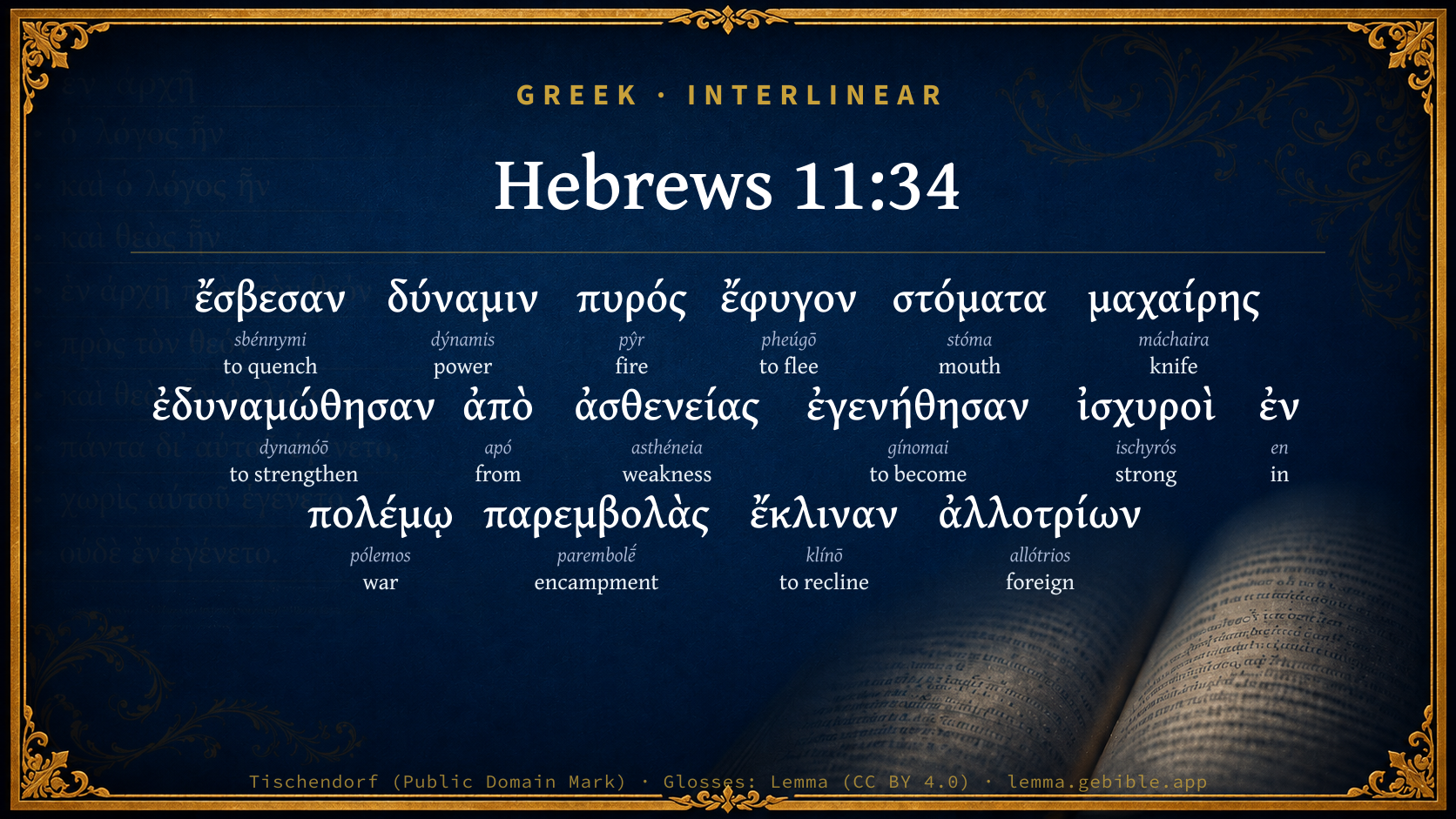
quenched the power of fire, escaped the edge of the sword, from weakness were made strong, grew mighty in war, and turned to flight armies of aliens.
Download a study sheet
One document with this verse’s original text, its word-by-word gloss line, the meaning frame, cross-references with their text, attributed commentary, and full source and license credits — printable, and it pastes into notes with its structure intact.
This verse Autodidact and up
A passage Seminary Student
Up to 50 verses in one chapter. A passage sheet keeps up to 6 commentary sources and 12 cross-references per verse, in the order this page ranks them, and says so on the sheet whenever that leaves anything out. Ask for a single verse and you get the Autodidact verse sheet above.
Everything on this page stays free to read, with no account — the sheet is a download of what is already on screen, not access to it.
Compare translations 3
The same verse in 3 English versions, stacked beneath the original-language interlinear above. Click any original word for its lexicon entry.
Each is an independent rendering of the whole verse — the interlinear is not word-aligned to these translations.
Highlighted words mark where these versions differ — a whole-verse word diff, not a word-by-word alignment.
-
World English Bible Public Domain
quenched the power of fire, escaped the edge of the sword, from weakness were made strong, grew mighty in war, and turned to flight armies of aliens.
-
King James Version Public Domain
Quenched the violence of fire, escaped the edge of the sword, out of weakness were made strong, waxed valiant in fight, turned to flight the armies of the aliens.
-
unfoldingWord Literal Text CC BY-SA 4.0
extinguished the power of fire, escaped the mouth of the sword, were empowered out of weakness, became strong in battle, routed foreign armies.
unfoldingWord Literal Text — © unfoldingWord, licensed CC BY-SA 4.0. Word-aligned USFM3 via Door43 (git.door43.org/unfoldingWord/en_ult).
Show all 19 translations
Every available English version of this verse, each an independent rendering of the whole verse.
-
World English Bible Public Domain
quenched the power of fire, escaped the edge of the sword, from weakness were made strong, grew mighty in war, and turned to flight armies of aliens.
-
Berean Standard Bible Public Domain
quenched the raging fire, and escaped the edge of the sword; who gained strength from weakness, became mighty in battle, and put foreign armies to flight.
-
Majority Standard Bible Public Domain
quenched the raging fire, and escaped the edge of the sword; who gained strength from weakness, became mighty in battle, and put foreign armies to flight.
-
King James Version Public Domain
Quenched the violence of fire, escaped the edge of the sword, out of weakness were made strong, waxed valiant in fight, turned to flight the armies of the aliens.
-
American Standard Version (1901) Public Domain
quenched the power of fire, escaped the edge of the sword, from weakness were made strong, waxed mighty in war, turned to flight armies of aliens.
-
Revised Version (1885) Public Domain
quenched the power of fire, escaped the edge of the sword, from weakness were made strong, waxed mighty in war, turned to flight armies of aliens.
-
Geneva Bible (1599) Public Domain
Quenched the violence of fire, escaped the edge of the sworde, of weake were made strong, waxed valiant in battell, turned to flight the armies of the aliants.
-
Douay-Rheims (1899) Public Domain
Quenched the violence of fire, escaped the edge of the sword, recovered strength from weakness, became valiant in battle, put to flight the armies of foreigners:
-
Young's Literal Translation Public Domain
quenched the power of fire, escaped the mouth of the sword, were made powerful out of infirmities, became strong in battle, caused to give way camps of the aliens.
-
Literal Standard Version CC BY-SA 4.0
quenched the power of fire, escaped the mouth of the sword, were made powerful out of weakness, became strong in battle, caused armies of the foreigners to give way;
-
Unlocked Literal Bible CC BY-SA 4.0
extinguished the power of fire, escaped the edge of the sword, were healed of illnesses, became mighty in battle, and defeated foreign armies.
-
unfoldingWord Literal Text CC BY-SA 4.0
extinguished the power of fire, escaped the mouth of the sword, were empowered out of weakness, became strong in battle, routed foreign armies.
-
Darby Bible Public Domain
quenched [the] power of fire, escaped [the] edge of the sword, became strong out of weakness, became mighty in war, made [the] armies of strangers give way.
-
World Messianic Bible Public Domain
quenched the power of fire, escaped the edge of the sword, from weakness were made strong, grew mighty in war, and caused foreign armies to flee.
-
Webster's Bible Public Domain
Quenched the violence of fire, escaped the edge of the sword, out of weakness were made strong, became valiant in fight, turned to flight the armies of the aliens.
-
Free Bible Version CC BY-SA 4.0
put out blazing fires, escaped being killed by the sword, were weak but made strong, did mighty deeds in war, and routed enemy armies.
-
Bible in Basic English Public Domain
Put out the power of fire, got safely away from the edge of the sword, were made strong when they had been feeble, became full of power in war, and put to flight the armies of the nations.
-
Text-Critical English NT CC BY 4.0
quenched the power of fire, escaped the edge of the sword, were made strong from weakness, became mighty in battle, and routed the armies of foreigners.
-
Tyndale New Testament (1534) Public Domain
quenched the violence of fyre escaped the edge of the swearde of weake were made stroge waxed valient in fight turned to flyght the armyes of the alientes.
Literal Standard Version (2020), Covenant Press — licensed CC BY-SA 4.0. Text via the HelloAO Bible API (eBible.org). Unlocked Literal Bible (unfoldingWord) — licensed CC BY-SA 4.0. Text via the HelloAO Bible API (eBible.org). unfoldingWord Literal Text — © unfoldingWord, licensed CC BY-SA 4.0. Word-aligned USFM3 via Door43 (git.door43.org/unfoldingWord/en_ult). Free Bible Version, Dr. Jonathan Gallagher — licensed CC BY-SA 4.0. Text via the HelloAO Bible API (eBible.org).
Word by word
More ways to search: Search by grammar → Find every occurrence → Compare this word →
Practice this passage: Drill this verse → Learn its vocabulary →
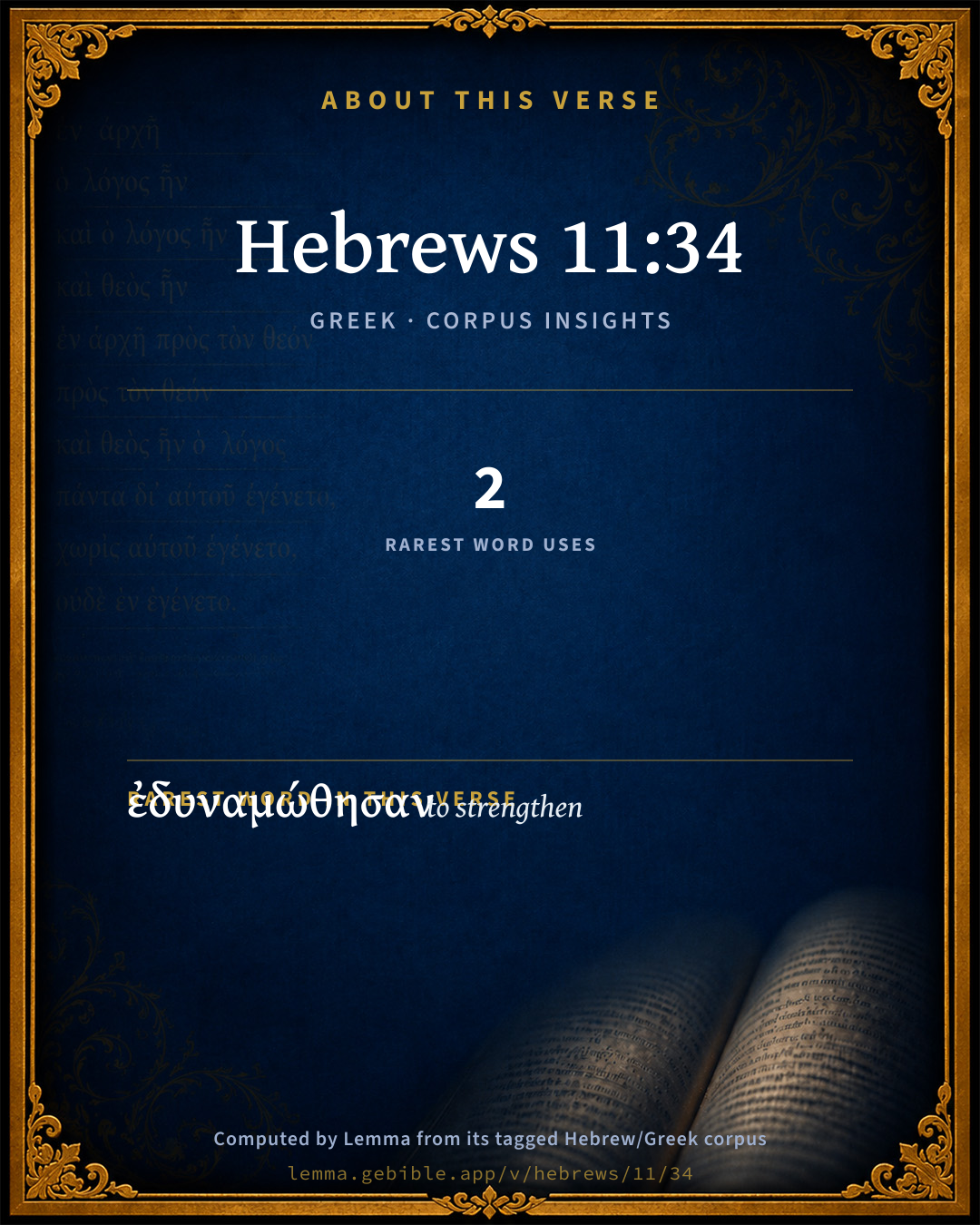
- Appears 2× in the Greek New Testament
- First appears at Colossians 1:11
- Part of Speech
- Verb
- Tense
- Aorist
- Voice
- Passive
- Mood
- Indicative
- Person
- 3rd person
- Number
- Plural
Full Thayer's Definition
- ἔσβεσαν sbénnymi G4570 “to quench” Verb, Aorist, Active, Indicative, 3rd person, Plural
- δύναμιν dýnamis G1411 “power” Noun, Accusative, Singular, Feminine
- πυρός pŷr G4442 “fire” Noun, Genitive, Singular, Neuter
- ἔφυγον pheúgō G5343 “to flee” Verb, Aorist, Active, Indicative, 3rd person, Plural
- στόματα stóma G4750 “mouth” Noun, Accusative, Plural, Neuter
- μαχαίρης máchaira G3162 “knife” Noun, Genitive, Singular, Feminine
- ἐδυναμώθησαν dynamóō G1412 “to strengthen” Verb, Aorist, Passive, Indicative, 3rd person, Plural
- ἀπὸ apó G575 “from” Preposition
- ἀσθενείας asthéneia G769 “weakness” Noun, Genitive, Singular, Feminine
- ἐγενήθησαν gínomai G1096 “to become” Verb, Aorist, Passive deponent, Indicative, 3rd person, Plural
- ἰσχυροὶ ischyrós G2478 “strong” Adjective, Nominative, Plural, Masculine
- ἐν en G1722 “in” Preposition
- πολέμῳ pólemos G4171 “war” Noun, Dative, Singular, Masculine
- παρεμβολὰς parembolḗ G3925 “encampment” Noun, Accusative, Plural, Feminine
- ἔκλιναν klínō G2827 “to recline” Verb, Aorist, Active, Indicative, 3rd person, Plural
- ἀλλοτρίων allótrios G245 “foreign” Adjective, Genitive, Plural, Masculine
About this verse
These counts appear in no published source. They are computed here, from the morphology-tagged text and Lemma’s own curated glosses. What Lemma adds →
- 16
- words
- 16
- distinct lemmas
- General Epistles
- section
Cross-references
28Topical passages linked to Hebrews 11:34 in the Treasury of Scripture Knowledge — connected by theme and wording, ordered by reader-vote popularity; previews shown in the World English Bible.
- 1 Samuel 17:51–52 Then David ran, and stood over the Philistine, and took his sword, and drew it out of the sheath of it, and killed him, and cut off his head therewith. When the Philistines saw that their champion was dead, they fled.
- 2 Kings 6:16–18 He answered, Don't be afraid; for those who are with us are more than those who are with them.
- Judges 15:8 He struck them hip and thigh with a great slaughter: and he went down and lived in the cleft of the rock of Etam.
- Psalms 144:10 You are he who gives salvation to kings, Who rescues David, his servant, from the deadly sword.
- 2 Chronicles 32:20–22 Hezekiah the king, and Isaiah the prophet the son of Amoz, prayed because of this, and cried to heaven.
- 2 Corinthians 12:9–10 He has said to me, "My grace is sufficient for you, for my power is made perfect in weakness." Most gladly therefore I will rather glory in my weaknesses, that the power of Christ may rest on me.
- Judges 7:19–25 So Gideon, and the hundred men who were with him, came to the outermost part of the camp in the beginning of the middle watch, when they had but newly set the watch: and they blew the trumpets, and broke in pieces the pitchers that were in their hands.
- Judges 8:4–10 Gideon came to the Jordan, [and] passed over, he, and the three hundred men who were with him, faint, yet pursuing.
- Judges 15:14–20 When he came to Lehi, the Philistines shouted as they met him: and the Spirit of Yahweh came mightily on him, and the ropes that were on his arms became as flax that was burnt with fire, and his bands dropped from off his hands.
- 1 Samuel 14:13–15 Jonathan climbed up on his hands and on his feet, and his armor bearer after him: and they fell before Jonathan; and his armor bearer killed them after him.
- 2 Samuel 8:1–18 After this it happened that David struck the Philistines, and subdued them: and David took the bridle of the mother city out of the hand of the Philistines.
- 2 Samuel 10:15–19 When the Syrians saw that they were put to the worse before Israel, they gathered themselves together.
- 1 Kings 19:3 When he saw that, he arose, and went for his life, and came to Beersheba, which belongs to Judah, and left his servant there.
- 2 Kings 6:32 But Elisha was sitting in his house, and the elders were sitting with him; and [the king] sent a man from before him: but before the messenger came to him, he said to the elders, See you how this son of a murderer has sent to take away my head? behold, when the messenger comes, shut the door, and hold the door fast against him: isn't the sound of his master's feet behind him?
- Jeremiah 26:24 But the hand of Ahikam the son of Shaphan was with Jeremiah, that they should not give him into the hand of the people to put him to death.
- 2 Kings 20:7–11 Isaiah said, Take a cake of figs. They took and laid it on the boil, and he recovered.
- 2 Chronicles 14:11–14 Asa cried to Yahweh his God, and said, Yahweh, there is none besides you to help, between the mighty and him who has no strength: help us, Yahweh our God; for we rely on you, and in your name are we come against this multitude. Yahweh, you are our God; don't let man prevail against you.
- 2 Chronicles 16:1–9 In the six and thirtieth year of the reign of Asa, Baasha king of Israel went up against Judah, and built Ramah, that he might not allow anyone to go out or come in to Asa king of Judah.
- 2 Chronicles 20:6–25 and he said, Yahweh, the God of our fathers, aren't you God in heaven? and aren't you ruler over all the kingdoms of the nations? and in your hand is power and might, so that none is able to withstand you.
- Job 5:20 In famine he will redeem you from death; In war, from the power of the sword.
- Job 42:10 Yahweh turned the captivity of Job, when he prayed for his friends. Yahweh gave Job twice as much as he had before.
- Psalms 6:8 Depart from me, all you workers of iniquity, For Yahweh has heard the voice of my weeping.
- Psalms 66:12 You allowed men to ride over our heads. We went through fire and through water, But you brought us to the place of abundance.
- Isaiah 43:2 When you pass through the waters, I will be with you; and through the rivers, they shall not overflow you: when you walk through the fire, you shall not be burned, neither shall the flame kindle on you.
- Daniel 3:19–28 Then was Nebuchadnezzar full of fury, and the form of his visage was changed against Shadrach, Meshach, and Abednego: [therefore] he spoke, and commanded that they should heat the furnace seven times more than it was wont to be heated.
- 1 Peter 4:12 Beloved, don't be astonished at the fiery trial which has come upon you, to test you, as though a strange thing happened to you.
- Judges 16:19–30 She made him sleep on her knees; and she called for a man, and shaved off the seven locks of his head; and she began to afflict him, and his strength went from him.
- 2 Samuel 21:16–17 and Ishbibenob, who was of the sons of the giant, the weight of whose spear was three hundred [shekels] of brass in weight, he being girded with a new [sword], thought to have slain David.
Cross-references courtesy of OpenBible.info (CC BY 4.0).
Lesson kit
Teaching starters — assembled from the data on this page, not authored interpretation. Every prompt links to the verse data it draws on. Edit before teaching.
Hebrews, in the General Epistles, opens this verse with 16 words (16 distinct Greek lemmas). Its most distinctive word is dynamóō (“to strengthen”). A historical commentator’s framing appears above. Read the whole chapter for the surrounding context.
Discussion questions
- The word dynamóō carries the sense “to strengthen.” How does it shape the verse?
- How does Colossians 1:11, which shares the word «to strengthen», read alongside this verse?
- These translations render this verse differently; the difference is in the English rendering, not the original. What questions does that raise?
- Compare how Tyndale Open Study Notes and Bengel's Gnomon read this verse. Where do they agree or differ?
Things to notice
- These translations choose different wording for 22 words in this verse.
- 16 distinct Greek lemmas span 16 words in this verse.
Commentary
Notes on Hebrews 11:34 from classic Christian and Jewish commentators (each source and its license shown beneath its notes). The classic Christian expositions comment on the surrounding passage and are grouped to its opening verse, so a note may address several verses; the Jewish commentaries on the Tanakh (Rashi and others) are per-verse, so they appear only where the commentator wrote on this verse.
Lemma curates 59 commentaries, every one of them public domain or Creative Commons licensed, each selected and text-cleaned for this edition rather than reprinted as found. About our sources →
Tyndale Open Study Notes
Tyndale Open Resources
Tyndale Open Study Notes — © Tyndale Open Resources, licensed CC BY-SA 4.0. Text via the HelloAO Bible API.
Bengel's Gnomon
Johann Albrecht Bengel
Bengel's Gnomon of the New Testament — English translation (T&T Clark, Edinburgh, 1860) — public domain. Text from a community e-Sword module.
Meyer's Critical & Exegetical Commentary
Heinrich August Wilhelm Meyer
Meyer — Critical and Exegetical Commentary on the New Testament — English translation by Peter Christie, edited by Frederick Crombie (T&T Clark, 1880) — public domain. Text from a community e-Sword module.
Jamieson, Fausset & Brown
Robert Jamieson, A. R. Fausset & David Brown
Jamieson, Fausset & Brown — Commentary Critical and Explanatory on the Whole Bible (1871) — public domain (CC PDM 1.0). Text via the HelloAO Bible API.
Adam Clarke's Commentary
Adam Clarke's Commentary on the Bible (1810–1826) — public domain. Text from a community e-Sword/MySword module.
John Calvin's Commentaries
John Calvin's Commentaries (1540-1563) — public domain. Text from the Calvin Translation Society English edition (1840s-50s) via the Christian Classics Ethereal Library (ccel.org). Calvin's coverage is partial (roughly two-thirds of the Bible); uncommented books and verses are honest gaps, never fabricated. The 19th-century editor's footnotes and remarks are omitted so the notes are faithfully Calvin's own voice.
Ellicott's Commentary for English Readers
A Bible Commentary for English Readers, edited by Charles John Ellicott (1878–1897) — public domain. Text from a community e-Sword module.
The Cambridge Bible for Schools and Colleges
gen. ed. J. J. S. Perowne
The Cambridge Bible for Schools and Colleges (gen. ed. J. J. S. Perowne; Cambridge University Press, 1878–1918) — public domain. Text from a community e-Sword module.
John Gill's Exposition
John Gill's Exposition of the Whole Bible (1746–1763) — public domain (CC PDM 1.0). Text via the HelloAO Bible API.
Trapp's Complete Commentary
John Trapp
John Trapp, A Commentary or Exposition upon All the Books of the Old and New Testament (1647–1656) — public domain. Text from a community e-Sword module.
Albert Barnes' Notes on the Bible
Albert Barnes' Notes on the Bible (1834–1885) — public domain. Text from a community e-Sword/MySword module.
Matthew Poole's English Annotations
Matthew Poole's English Annotations on the Holy Bible (1683–1685) — public domain. Text from a community e-Sword/MySword module.
Whedon's Commentary on the Bible
Daniel D. Whedon
Daniel D. Whedon (gen. ed.), Commentary on the Old and New Testaments (1874–1909) — public domain. Text from a community e-Sword module.
The People's New Testament
B. W. Johnson
B. W. Johnson's The People's New Testament with Notes (1889–1891) — public domain. Electronic text from the Christian Classics Ethereal Library (CCEL) ThML edition.
Cambridge Greek Testament for Schools and Colleges
Cambridge Greek Testament for Schools and Colleges (Cambridge University Press, 1896; 21 vols, various authors incl. Carr, Maclear, Plummer, Farrar, Lumby, Moule, M. R. James, Simcox) — public domain. Text from a community e-Sword module.
Alford’s Greek Testament
Henry Alford
Henry Alford, The Greek Testament (1849–1861) — public domain. Text from a community e-Sword module.