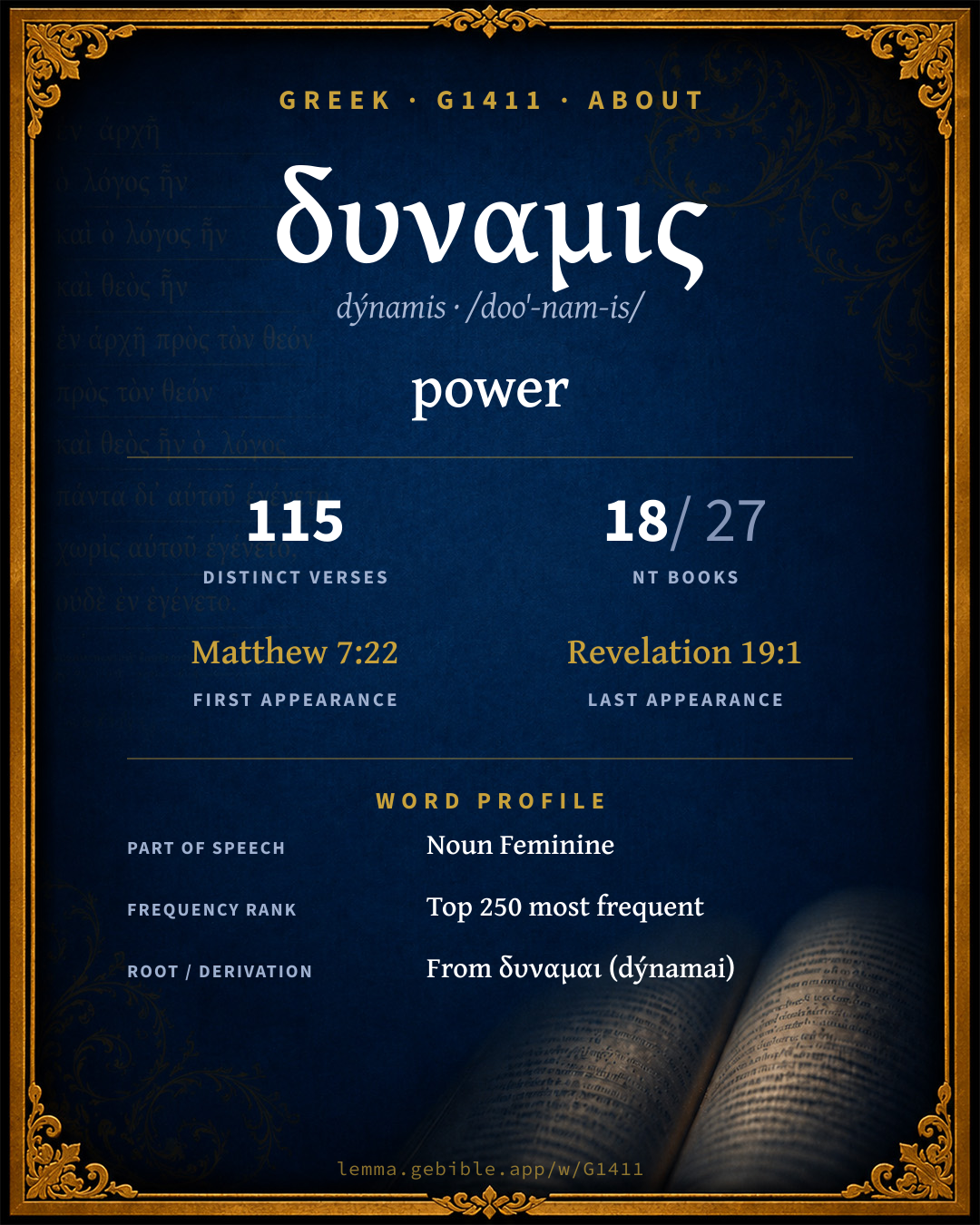
δύναμις
power
Full lexicon entry — Thayer's Greek Lexicon
From Thayer's Greek Lexicon
Where this word appears
See every Dative-case word in the Greek New Testament →
Grammar key — what these labels mean
Part of speech
- Noun
- A naming word — a person, place, thing, or idea.
Case
- Accusative
- The case of the direct object and of extent.
- Dative
- The case of the indirect object, means, or location — “to / for / with / in.”
- Genitive
- The case of source, possession, or “of” — answers “whose / from what.”
- Nominative
- The case of the subject (and the predicate nominative).
Gender
- Feminine
- Grammatically feminine.
Number
- Singular
- One.
- Plural
- More than one.
Every verse where G1411 appears in the Book of Romans — 7 distinct verses. Click any verse to open its interlinear word-by-word view. Verse text shown in the World English Bible for context — . Each verse’s Greek form is shown with its reference; the English is not keyword-highlighted, since the data carries no word-level English alignment. Use “Compare translations” on any verse to read it across multiple English versions. This concordance covers the Greek New Testament; Septuagint (Greek Old Testament) occurrences of this word are not indexed here.
Romans
- Romans 1:4 δυνάμει n dat sg fem who was declared to be the Son of God with power, according to the Spirit of holiness, by the resurrection from the dead, Jesus Christ our Lord,
- Romans 1:16 δύναμις n nom sg fem For I am not ashamed of the Gospel of Christ, for it is the power of God for salvation for everyone who believes; for the Jew first, and also for the Greek.
- Romans 1:20 δύναμις n nom sg fem For the invisible things of him since the creation of the world are clearly seen, being perceived through the things that are made, even his everlasting power and divinity; that they may be without excuse.
- Romans 8:38 δυνάμεις n nom pl fem For I am persuaded, that neither death, nor life, nor angels, nor principalities, nor things present, nor things to come, nor powers,
- Romans 9:17 δύναμίν n acc sg fem For the Scripture says to Pharaoh, "For this very purpose I caused you to be raised up, that I might show in you my power, and that my name might be published abroad in all the earth."
- Romans 15:13 δυνάμει n dat sg fem Now may the God of hope fill you with all joy and peace in believing, that you may abound in hope, in the power of the Holy Spirit.
- Romans 15:19 δυνάμει δυνάμει n dat sg fem n dat sg fem in the power of signs and wonders, in the power of God's Spirit; so that from Jerusalem, and around as far as to Illyricum, I have fully preached the Gospel of Christ;
About this entry
At a glance — auto-summarized from this page’s data, not written by a person. Every figure links to its source below. This summary describes the numbers; it doesn’t interpret them.
δυναμις — transliterated dýnamis — is a Greek noun carrying the sense “power.” Its earliest occurrence is Matthew 7:22. It appears 115 verses across 18 books of the Greek New Testament, among its common vocabulary. It shares a root with δυναμαι, δυναστης and δυνατος. See the sense tree, 115-verse concordance, and the renderings breakdown below.
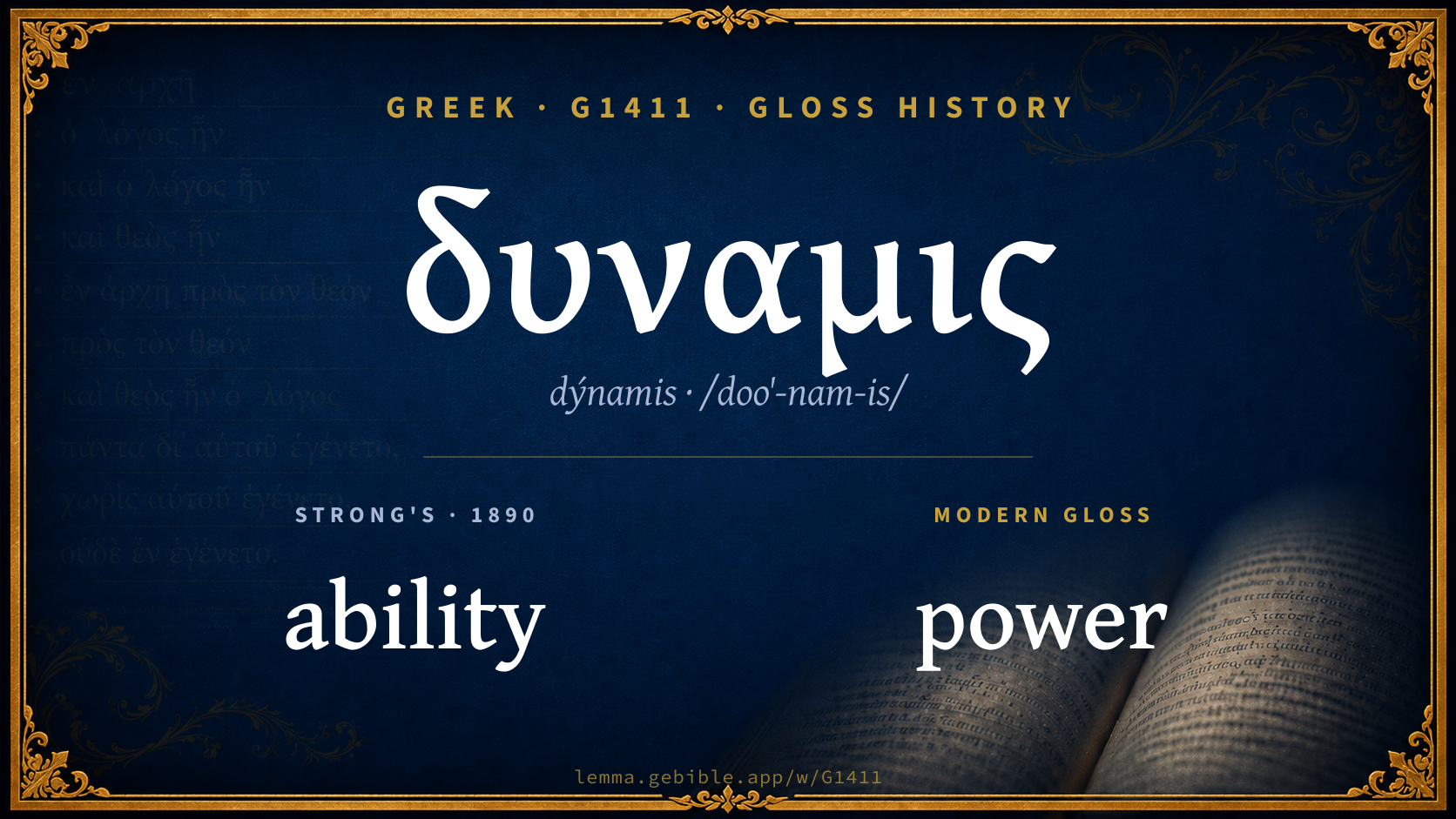
Gloss history
Strong's 1890 vs modern scholarship
About this word
Strong's G1411 catalogs a Greek word from the Greek New Testament.
These counts are not copied from any lexicon or concordance. They are computed here, from the morphology-tagged Greek New Testament. What Lemma adds →
- 115
- distinct verses
- The word appears in 115 distinct verses.
- 18 / 27
- NT books
- The word appears in 18 of 27 New Testament books.
- #138
- by frequency
- Top 250 most frequent Greek words (rank 138 of 5,347 Greek words by occurrence).
View all 115 occurrences in the concordance →
Most concentrated in
- Luke 15 verses 13%
- 1 Corinthians 15 verses 13%
- Matthew 12 verses 10%
By section of the New Testament
By traditional corpus
Conventional, traditional groupings — biblical authorship is debated, so this is a traditional corpus grouping, not an authorship claim. Some books belong to more than one corpus (Luke is in both the Gospels and the Lukan corpus, and so on), so these shares overlap and need not total 100%. Each figure is a share of the word’s 115 distinct verses.
- Pauline corpus 45 verses · 39%
- Gospels 37 verses · 32%
- Lukan (Luke–Acts) 25 verses · 22%
- Johannine 12 verses · 10%
- Revelation 12 verses · 10%
- Hebrews 6 verses · 5%
- General (Catholic) Epistles 5 verses · 4%
How translations render this word
Counts come from each version’s own published word-to-Strong’s tagging or interlinear alignment — an approximate guide to how each version renders this word, not a word-level alignment the data otherwise carries. Because each total is that version’s own tagged count, the per-version totals vary from one another and need not match the appearance or distinct-verse counts above. These counts may also differ from a printed concordance because Lemma counts each distinctly tagged rendering and does not collapse phrase taggings into a single head-word total. This is a fixed set of word-tagged versions (KJV, ASV, BSB, ULT) and does not change with the reading translation you choose elsewhere. Each version’s license is shown beside its name below (and on Sources).
- King James Version: Power 71×, Mighty works 10×, Miracles 7×
- American Standard Version: Power 83×, Mighty works 11×, Powers 7×
- Berean Standard Bible: Power 77×, Miracles 18×, Powers 5×
- unfoldingWord Literal Text: Power 83×, Miracles 13×, Powers 8×
King James Version Public Domain
Renders G1411 across 119 tagged occurrences — most commonly:
Plus 9 renderings that appear only once — usually multi-word phrases or single function words the recovered tagging swept in, not distinct renderings. Not rendered by a distinct English word in 1 further occurrence.
American Standard Version Public Domain
Renders G1411 across 122 tagged occurrences — most commonly:
Plus 11 renderings that appear only once — usually multi-word phrases or single function words the recovered tagging swept in, not distinct renderings.
Berean Standard Bible Public Domain
Renders G1411 across 116 tagged occurrences — most commonly:
Plus 11 renderings that appear only once — usually multi-word phrases or single function words the recovered tagging swept in, not distinct renderings. Not rendered by a distinct English word in 2 further occurrences.
unfoldingWord Literal Text CC BY-SA 4.0
Renders G1411 across 124 tagged occurrences — most commonly:
Plus 10 renderings that appear only once — usually multi-word phrases or single function words the recovered tagging swept in, not distinct renderings.
Senses in Thayer's
The 1 sense Thayer's distinguishes for this word, in lexicon order (not ranked by frequency or importance). The full entry — with sub-senses — is in the Lexicon Entry tab.
- strength power, ability
Word origin
Derived from δυναμαι (dýnamai) (G1410) — to be able.
From G1410 ; force (literally or figuratively); specifically miraculous power (usually by implication a miracle itself): - ability abundance meaning might (-ily -y -y deed) (worker of) miracle (-s) power strength violence mighty (wonderful) work.
— Strong’s Exhaustive Concordance (1890), public domain.
Forms in the corpus
The 10 distinct written forms G1411 takes in the Greek New Testament, most frequent first — each parse links to that case’s occurrences in the concordance.
| Form | Parsing | Example | Uses |
|---|---|---|---|
| δύναμιν dýnamin | Noun, Accusative, Singular, Feminine | Matthew 22:29 | 31 |
| δυνάμει dynámei | Noun, Dative, Singular, Feminine | Mark 9:1 | 26 |
| δυνάμεως dynámeōs | Noun, Genitive, Singular, Feminine | Matthew 24:30 | 21 |
| δυνάμεις dynámeis | Noun, Nominative, Plural, Feminine | Matthew 11:20 | 19 |
| δύναμις dýnamis | Noun, Nominative, Singular, Feminine | Luke 1:35 | 13 |
| δυνάμεων dynámeōn | Noun, Genitive, Plural, Feminine | Luke 19:37 | 3 |
| δυνάμεσιν dynámesin | Noun, Dative, Plural, Feminine | 2 Corinthians 12:12 | 2 |
| δύναμίν dýnamín | Noun, Accusative, Singular, Feminine | Romans 9:17 | 2 |
| Δυνάμεις Dynámeis | Noun, Accusative, Plural, Feminine | Acts 19:11 | 1 |
| δυνάμεσι dynámesi | Noun, Dative, Plural, Feminine | Acts 2:22 | 1 |
Same root — word family
Other Thayer's entries built from the same root as G1411, grouped by Strong’s listed origin. These share a root / origin per the lexicon — not necessarily a shared meaning. Each links to that word’s own entry.
Derives from
Shares the same root
Derived from this word
Compare all same-root words → Showing 4 of 5 — not the complete family. They share a root, not necessarily a meaning.
Septuagint usage
The same Greek word δυναμις appears 380 times in the Greek Old Testament (Septuagint), across 360 verses in 30 books.
- 380
- LXX occurrences
- Tagged occurrences of this Greek word in the Septuagint.
- 360
- verses
- Distinct Septuagint verses containing this word.
- 30 / 39
- OT books
- The word appears in 30 of the 39 Old Testament books.
Sample Septuagint occurrences
- Genesis 21:22 δύναμις
- Exodus 6:26 δύναμις
- Numbers 1:3 δύναμις
- Deuteronomy 3:24 δύναμις
- Joshua 4:24 δύναμις
- Judges 3:29 δύναμις
- Ruth 3:11 δύναμις
- 1 Samuel 2:4 δύναμις
- 2 Samuel 6:2 δύναμις
- 1 Kings 1:19 δύναμις
- 2 Kings 2:16 δύναμις
- 1 Chronicles 5:18 δύναμις
Septuagint occurrences (same lexeme)
Every verse where the same Strong’s number (G1411) appears in the Greek Septuagint — showing the first 50 of 360. Verse text shown in the World English Bible for context; the Greek form is the matched word — the English is not keyword-highlighted.
- Genesis 21:22 δύναμις It happened at that time, that Abimelech and Phicol the captain of his host spoke to Abraham, saying, "God is with you in all that you do.
- Genesis 21:32 δύναμις So they made a covenant at Beersheba. Abimelech rose up with Phicol, the captain of his host, and they returned into the land of the Philistines.
- Genesis 26:26 δύναμις Then Abimelech went to him from Gerar, and Ahuzzath his friend, and Phicol the captain of his host.
- Exodus 6:26 δύναμις These are that Aaron and Moses, to whom Yahweh said, "Bring out the children of Israel from the land of Egypt according to their hosts."
- Exodus 7:4 δύναμις But Pharaoh will not listen to you, and I will lay my hand on Egypt, and bring forth my hosts, my people the children of Israel, out of the land of Egypt by great judgments.
- Exodus 12:17 δύναμις You shall observe the feast of unleavened bread; for in this same day have I brought your hosts out of the land of Egypt: therefore shall you observe this day throughout your generations by an ordinance forever.
- Exodus 12:41 δύναμις It happened at the end of four hundred thirty years, even the same day it happened, that all the hosts of Yahweh went out from the land of Egypt.
- Exodus 12:51 δύναμις It happened the same day, that Yahweh brought the children of Israel out of the land of Egypt by their hosts.
- Exodus 14:28 δύναμις The waters returned, and covered the chariots and the horsemen, even all Pharaoh's army that went in after them into the sea. There remained not so much as one of them.
- Exodus 15:4 δύναμις Pharaoh's chariots and his host has he cast into the sea; His chosen captains are sunk in the Red Sea.
- Numbers 1:3 δύναμις from twenty years old and upward, all who are able to go out to war in Israel. You and Aaron shall number them by their divisions.
- Numbers 1:20 δύναμις The children of Reuben, Israel's firstborn, their generations, by their families, by their fathers' houses, according to the number of the names, one by one, every male from twenty years old and upward, all who were able to go out to war;
- Numbers 1:22 δύναμις Of the children of Simeon, their generations, by their families, by their fathers' houses, those who were numbered of it, according to the number of the names, one by one, every male from twenty years old and upward, all who were able to go out to war;
- Numbers 1:24 δύναμις Of the children of Gad, their generations, by their families, by their fathers' houses, according to the number of the names, from twenty years old and upward, all who were able to go out to war;
- Numbers 1:26 δύναμις Of the children of Judah, their generations, by their families, by their fathers' houses, according to the number of the names, from twenty years old and upward, all who were able to go out to war;
- Numbers 1:28 δύναμις Of the children of Issachar, their generations, by their families, by their fathers' houses, according to the number of the names, from twenty years old and upward, all who were able to go out to war;
- Numbers 1:30 δύναμις Of the children of Zebulun, their generations, by their families, by their fathers' houses, according to the number of the names, from twenty years old and upward, all who were able to go out to war;
- Numbers 1:32 δύναμις Of the children of Joseph, of the children of Ephraim, their generations, by thir families, by their fathers' houses, according to the number of the names, from twenty years old and upward, all who were able to go out to war;
- Numbers 1:34 δύναμις Of the children of Manasseh, their generations, by their families, by their fathers' houses, according to the number of the names, from twenty years old and upward, all who were able to go out to war;
- Numbers 1:36 δύναμις Of the children of Benjamin, their generations, by their families, by their fathers' houses, according to the number of the names, from twenty years old and upward, all who were able to go out to war;
- Numbers 1:38 δύναμις Of the children of Dan, their generations, by their families, by their fathers' houses, according to the number of the names, from twenty years old and upward, all who were able to go forth to war;
- Numbers 1:40 δύναμις Of the children of Asher, their generations, by their families, by their fathers' houses, according to the number of the names, from twenty years old and upward, all who were able to go forth to war;
- Numbers 1:42 δύναμις Of the children of Naphtali, their generations, by their families, by their fathers' houses, according to the number of the names, from twenty years old and upward, all who were able to go forth to war;
- Numbers 1:45 δύναμις So all those who were numbered of the children of Israel by their fathers' houses, from twenty years old and upward, all who were able to go out to war in Israel;
- Numbers 1:52 δύναμις The children of Israel shall pitch their tents, every man by his own camp, and every man by his own standard, according to their divisions.
- Numbers 2:3 δύναμις Those who encamp on the east side toward the sunrise shall be of the standard of the camp of Judah, according to their divisions: and the prince of the children of Judah shall be Nahshon the son of Amminadab.
- Numbers 2:4 δύναμις His division, and those who were numbered of them, were seventy-four thousand six hundred.
- Numbers 2:6 δύναμις His division, and those who were numbered of it, were fifty-four thousand four hundred.
- Numbers 2:8 δύναμις His division, and those who were numbered of it, were fifty-seven thousand four hundred.
- Numbers 2:9 δύναμις All who were numbered of the camp of Judah were one hundred eighty-six thousand four hundred, according to their divisions. They shall set out first.
- Numbers 2:10 δύναμις "On the south side shall be the standard of the camp of Reuben according to their divisions. The prince of the children of Reuben shall be Elizur the son of Shedeur.
- Numbers 2:11 δύναμις His division, and those who were numbered of it, were forty-six thousand five hundred.
- Numbers 2:13 δύναμις His division, and those who were numbered of them, were fifty-nine thousand three hundred.
- Numbers 2:15 δύναμις His division, and those who were numbered of them, were forty-five thousand six hundred fifty.
- Numbers 2:16 δύναμις "All who were numbered of the camp of Reuben were one hundred fifty-one thousand four hundred fifty, according to their hosts. They shall set out second.
- Numbers 2:18 δύναμις "On the west side shall be the standard of the camp of Ephraim according to their divisions: and the prince of the children of Ephraim shall be Elishama the son of Ammihud.
- Numbers 2:19 δύναμις His division, and those who were numbered of them, were forty thousand five hundred.
- Numbers 2:21 δύναμις His division, and those who were numbered of them, were thirty-two thousand two hundred.
- Numbers 2:23 δύναμις His host, and those who were numbered of them, were thirty-five thousand four hundred.
- Numbers 2:24 δύναμις "All who were numbered of the camp of Ephraim were one hundred eight thousand one hundred, according to their divisions. They shall set out third.
- Numbers 2:25 δύναμις "On the north side shall be the standard of the camp of Dan according to their divisions: and the prince of the children of Dan shall be Ahiezer the son of Ammishaddai.
- Numbers 2:26 δύναμις His division, and those who were numbered of them, were sixty-two thousand seven hundred.
- Numbers 2:28 δύναμις His division, and those who were numbered of them, were forty-one thousand and five hundred.
- Numbers 2:30 δύναμις His division, and those who were numbered of them, were fifty-three thousand four hundred.
- Numbers 2:32 δύναμις These are those who were numbered of the children of Israel by their fathers' houses. All who were numbered of the camps according to their hosts were six hundred three thousand five hundred fifty.
- Numbers 6:21 δύναμις "This is the law of the Nazirite who vows, and of his offering to Yahweh for his separation, besides that which he is able to get. According to his vow which he vows, so he must do after the law of his separation."
- Numbers 10:14 δύναμις In the first [place] the standard of the camp of the children of Judah set forward according to their hosts: and over his host was Nahshon the son of Amminadab.
- Numbers 10:15 δύναμις Over the host of the tribe of the children of Issachar was Nethanel the son of Zuar.
- Numbers 10:16 δύναμις Over the host of the tribe of the children of Zebulun was Eliab the son of Helon.
- Numbers 10:18 δύναμις The standard of the camp of Reuben set forward according to their hosts: and over his host was Elizur the son of Shedeur.
These are occurrences of the same Greek lexeme (G1411) in the Septuagint — not a translation of any one Hebrew word. The store carries no word-level Hebrew↔Greek alignment, so no Hebrew original is asserted here. Counts come from the recovered LXX Strong's tagging — high-frequency vocabulary is well covered, while rare or late forms may be untagged — so they reflect tagged occurrences and may slightly undercount.