Hebrews 7:16

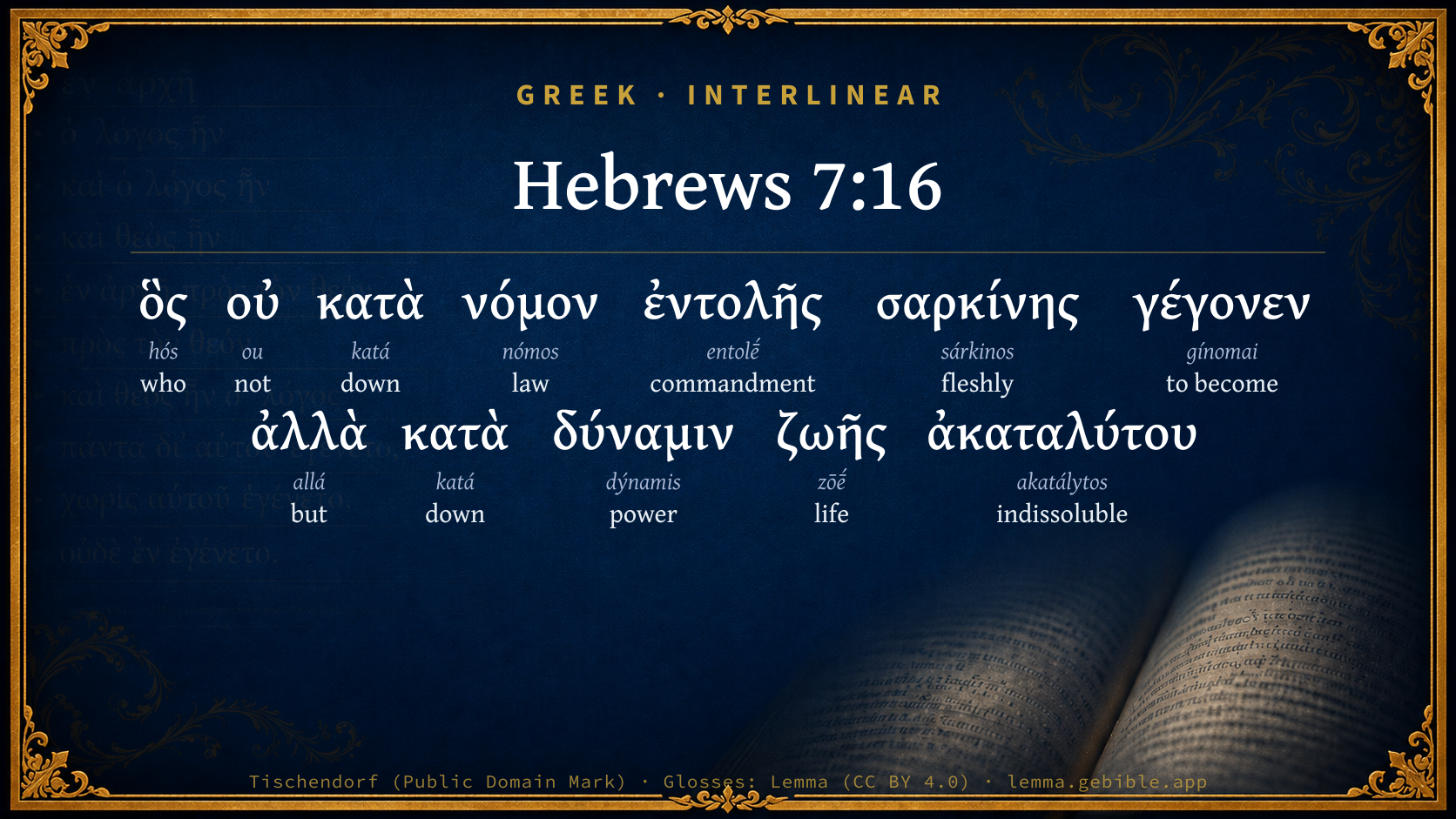
Greek (Tischendorf 8th ed.) Hebrews 7:16 appears in the Greek New Testament. The text above is from the Tischendorf 8th edition. Each word links to its Strong’s number and a concise gloss. Click any word for its full Thayer’s Greek Lexicon entry.
Download image
Cite this verse

Hebrews 7:16 (World English Bible). Public Domain. Lemma interlinear Bible study tool, https://lemma.gebible.app/v/hebrews/7/16.

Show BibTeX & RIS
BibTeX
RIS
English Translation
who has been made, not after the law of a fleshly commandment, but after the power of an endless life:
World English Bible · Public Domain
Highlights
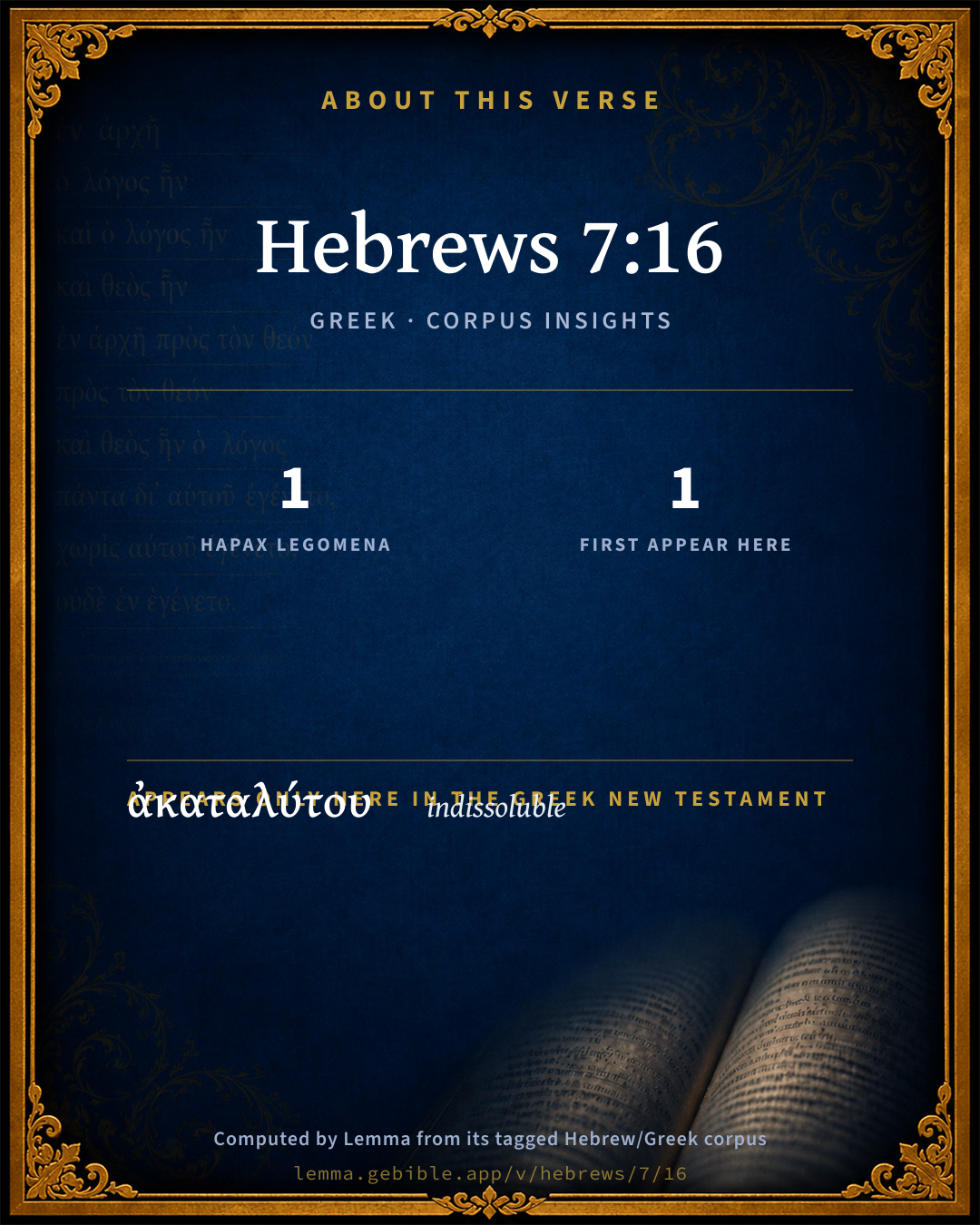
  • 1 hapax legomenon — only here in the Greek New Testament
  • 1 first appearance in the Greek New Testament
Full analysis ↓
Download a study sheet

One document with this verse’s original text, its word-by-word gloss line, the meaning frame, cross-references with their text, attributed commentary, and full source and license credits — printable, and it pastes into notes with its structure intact.

This verse Autodidact and up

Study sheet (.html) Plain text (.txt)

A passage Seminary Student

Up to 50 verses in one chapter. A passage sheet keeps up to 6 commentary sources and 12 cross-references per verse, in the order this page ranks them, and says so on the sheet whenever that leaves anything out. Ask for a single verse and you get the Autodidact verse sheet above.

Everything on this page stays free to read, with no account — the sheet is a download of what is already on screen, not access to it.

Want to remove ads? Support Godless Engineer
Compare translations 3

The same verse in 3 English versions, stacked beneath the original-language interlinear above. Click any original word for its lexicon entry.

Each is an independent rendering of the whole verse — the interlinear is not word-aligned to these translations.

Highlighted words mark where these versions differ — a whole-verse word diff, not a word-by-word alignment.

  • World English Bible Public Domain
    who has been made, not after the law of a fleshly commandment, but after the power of an endless life:
  • King James Version Public Domain
    Who is made, not after the law of a carnal commandment, but after the power of an endless life.
  • unfoldingWord Literal Text CC BY-SA 4.0
    who has become not according to a law of a fleshly command, but according to the power of an indestructible life.

unfoldingWord Literal Text — © unfoldingWord, licensed CC BY-SA 4.0. Word-aligned USFM3 via Door43 (git.door43.org/unfoldingWord/en_ult).

Versions to compare (up to 4)

3 of 4 selected

Show all 19 translations

Every available English version of this verse, each an independent rendering of the whole verse.

  • World English Bible Public Domain
    who has been made, not after the law of a fleshly commandment, but after the power of an endless life:
  • Berean Standard Bible Public Domain
    one who has become a priest not by a law of succession, but by the power of an indestructible life.
  • Majority Standard Bible Public Domain
    one who has become a priest not by a law of succession, but by the power of an indestructible life.
  • King James Version Public Domain
    Who is made, not after the law of a carnal commandment, but after the power of an endless life.
  • American Standard Version (1901) Public Domain
    who hath been made, not after the law of a carnal commandment, but after the power of an endless life:
  • Revised Version (1885) Public Domain
    who hath been made, not after the law of a carnal commandment, but after the power of an endless life:
  • Geneva Bible (1599) Public Domain
    Which is not made Priest after the Law of the carnal commandement, but after the power of the endlesse life.
  • Douay-Rheims (1899) Public Domain
    Who is made not according to the law of a carnal commandment, but according to the power of an indissoluble life:
  • Young's Literal Translation Public Domain
    who came not according to the law of a fleshly command, but according to the power of an endless life,
  • Literal Standard Version CC BY-SA 4.0
    who did not come according to the law of a fleshly command, but according to the power of an endless life,
  • Unlocked Literal Bible CC BY-SA 4.0
    It was not based on the law of fleshly descent that he became a priest, but instead was based on the power of an everlasting life.
  • unfoldingWord Literal Text CC BY-SA 4.0
    who has become not according to a law of a fleshly command, but according to the power of an indestructible life.
  • Darby Bible Public Domain
    who has been constituted not according to law of fleshly commandment, but according to power of indissoluble life.
  • World Messianic Bible Public Domain
    who has been made, not after the law of a fleshly commandment, but after the power of an endless life;
  • Webster's Bible Public Domain
    Who is made, not after the law of a carnal commandment, but after the power of an endless life.
  • Free Bible Version CC BY-SA 4.0
    and who didn't become a priest by virtue of his human ancestry but by the power of a life that cannot be ended.
  • Bible in Basic English Public Domain
    That is to say, not made by a law based on the flesh, but by the power of a life without end:
  • Text-Critical English NT CC BY 4.0
    one who has become a priest, not through a legal requirement concerning physical descent, but through the power of an endless life.
  • Tyndale New Testament (1534) Public Domain
    which is not made after the lawe of the carnall commaundment: but after the power of the endlesse lyfe

Literal Standard Version (2020), Covenant Press — licensed CC BY-SA 4.0. Text via the HelloAO Bible API (eBible.org). Unlocked Literal Bible (unfoldingWord) — licensed CC BY-SA 4.0. Text via the HelloAO Bible API (eBible.org). unfoldingWord Literal Text — © unfoldingWord, licensed CC BY-SA 4.0. Word-aligned USFM3 via Door43 (git.door43.org/unfoldingWord/en_ult). Free Bible Version, Dr. Jonathan Gallagher — licensed CC BY-SA 4.0. Text via the HelloAO Bible API (eBible.org).

Word by word

More ways to search: Search by grammar → Find every occurrence → Compare this word →

Practice this passage: Drill this verse → Learn its vocabulary →

About this verse

These counts appear in no published source. They are computed here, from the morphology-tagged text and Lemma’s own curated glosses. What Lemma adds →

12
words
11
distinct lemmas
General Epistles
section

Notable vocabulary

1 hapax legomenon — a word that appears only here in the entire Greek New Testament:

  • ἀκαταλύτου indissoluble G179

First appearance in Scripture

This word makes its first canonical appearance in the Greek New Testament here:

  • ἀκαταλύτου indissoluble G179

Shared distinctive vocabulary

σαρκίνης fleshly G4560 occurs in 4 verses of the Greek New Testament. Also found in:

Repetition

A word recurs within this verse:

  • κατὰ down G2596 ×2

Cross-references

12

Topical passages linked to Hebrews 7:16 in the Treasury of Scripture Knowledge — connected by theme and wording, ordered by reader-vote popularity; previews shown in the World English Bible.

  • Galatians 4:3 So we also, when we were children, were held in bondage under the elements of the world.
  • Galatians 4:9 But now that you have come to know God, or rather to be known by God, why do you turn back again to the weak and miserable elements, to which you desire to be in bondage all over again?
  • Colossians 2:20 If you died with Christ from the elements of the world, why, as though living in the world, do you subject yourselves to ordinances,
  • Revelation 1:18 and the Living one. I was dead, and behold, I am alive forevermore. Amen. I have the keys of Death and of Hades.
  • Colossians 2:14 wiping out the handwriting in ordinances which was against us; and he has taken it out of the way, nailing it to the cross;
  • Hebrews 7:3 without father, without mother, without genealogy, having neither beginning of days nor end of life, but made like the Son of God), remains a priest continually.
  • Hebrews 7:28 For the law appoints men as high priests who have weakness, but the word of the oath which came after the law appoints a Son forever who has been perfected.
  • Hebrews 10:1 For the law, having a shadow of the good to come, not the very image of the things, can never with the same sacrifices year by year, which they offer continually, make perfect those who draw near.
  • Hebrews 7:17 for it is testified, "You are a priest forever, According to the order of Melchizedek."
  • Hebrews 7:21 (for they indeed have been made priests without an oath), but he with an oath by him that says of him, "The Lord swore and will not change his mind, 'You are a priest forever, According to the order of Melchizedek'".
  • Hebrews 7:24–25 But he, because he lives forever, has his priesthood unchangeable.
  • Hebrews 9:9–10 which is a symbol of the present age, where gifts and sacrifices are offered that are incapable, concerning the conscience, of making the worshipper perfect;

Cross-references courtesy of OpenBible.info (CC BY 4.0).

Commentary

Notes on Hebrews 7:16 from classic Christian and Jewish commentators (each source and its license shown beneath its notes). The classic Christian expositions comment on the surrounding passage and are grouped to its opening verse, so a note may address several verses; the Jewish commentaries on the Tanakh (Rashi and others) are per-verse, so they appear only where the commentator wrote on this verse.

Lemma curates 59 commentaries, every one of them public domain or Creative Commons licensed, each selected and text-cleaned for this edition rather than reprinted as found. About our sources →

Bengel's Gnomon

Johann Albrecht Bengel

Heb 7:16. Ὃς γέγονεν) who is made a priest. Κατὰ, according to, is construed with the word, priest.—νόμον ἐντολῆς σαρκικῆς, the law of a carnal commandment) Power is presently opposed to the law; life to commandment; endless to carnal. Commandment occurs again, Heb 7:18; law, Heb 7:19. Concerning the flesh, comp. ch. Heb 9:10.—δύναμιν ζωῆς, the power of life) Both words occur again, Heb 7:25.

Bengel's Gnomon of the New Testament — English translation (T&T Clark, Edinburgh, 1860) — public domain. Text from a community e-Sword module.

Meyer's Critical & Exegetical Commentary

Heinrich August Wilhelm Meyer

Heb_7:16. Nearer indication as to what is implied by the characteristic κατὰ τὴν ὁμοιότητα Μελχισεδέκ, Heb_7:15, what peculiarity of priesthood is expressed by the same.

ὅς] sc. ἱερεὺς ἕτερος, not: Μελχισεδέκ.

ὃς … γέγονεν] who … has become so (sc. priest).

οὐ κατὰ νόμον ἐντολῆς σαρκίνης κ.τ.λ.] not according to the law of a fleshly command, but according to the power of indestructible [or indissoluble] life. In connection with νόμος, Chrysostom, Oecumenius, Theophylact, Böhme, Kuinoel, Tholuck, Delitzsch, and others think of the Mosaic law; but against this argues the singular ἐντολῆς σαρκίνης, to take which, with the expositors mentioned, in the sense of the plural (according to the Mosaic law, whose essence consists in fleshly ordinances), or as a collective designation of the constituent parts of the law as ὁ νόμος τῶν ἐντολῶν, Eph_2:15, is arbitrary. νόμος is therefore to be taken, as Rom_7:21; Rom_7:23, in the more general sense: norm (rule, standard), and the ἐντολή is the special precept or ordinance which the Mosaic law contains regarding the Levitical priesthood.

It is called fleshly, however, according to Carpzov, Böhme, Stuart, and others, because it is mutable and transitory; more correctly, nevertheless: because it lays stress only upon external, earthly things, which fall a prey to transitoriness, and (comp. the contrast ἀλλὰ κατὰ δύναμιν κ.τ.λ.) appoints as priests only mortal men, of whom one after another is snatched away by death. Schlichting: carnale (praeceptum) vocatur, quia totum ad carnem spectabat, carnisque rationem habebat. Partim enim ad certam stirpem, nempe Aaronicam, sacerdotii dignitatem adstrinxerat, partim mortalitati pontificum, quae carnis propria est, consulens, successionis jura descripserat. Inde enim factum est, ut unum alteri succedere juberet, quo, morientibus sacerdotibus, sacerdotium tamen ipsum perpetuaretur.

κατὰ δύναμιν ζωῆς ἀκαταλύτου] i.e. inasmuch as the power of living for ever is inherent in Him. Comp. Heb_7:17; Heb_7:24. Improperly do Cameron, Dorscheus, Calov, al., refer it as well, or solely, to Christs power of communicating intransitory life to others. But wrongly, too, Hofmann (Schriftbew. II. 1, 2 Aufl. p. 551 f.), Delitzsch, and Alford: the ζωὴ ἀκατάλυτος is to be limited to that life of Christ which began with His resurrection. On the contrary, the ζωὴ ἀκατάλυτος is thought of as a property inherent in the ἱερεὺς ἕτερος, without respect to relation of time. Comp. also Riehm, Lehrbegr. des Hebräerbr. p. 458, Obs.

Meyer — Critical and Exegetical Commentary on the New Testament — English translation by Peter Christie, edited by Frederick Crombie (T&T Clark, 1880) — public domain. Text from a community e-Sword module.

Expositor's Greek Testament

ed. W. Robertson Nicoll

Heb 7:16 . ὃς οὐ κατὰ νόμον … ἀκαταλύτου , “who has become such not after the law of a fleshen ordinance but after the power of an indissoluble life”. This relative clause defines the “likeness to Melchizedek,” and brings out a double contrast between the new priest and the Levitical the Levitical priesthood is κατὰ νόμον , the other κατὰ δύναμιν , the one is dependent on what is σαρκίνη , the other on what belongs to ζωὴ ἀκατάλυτος . These contrasts are significant. The Levitical priesthood rested on law, on a regulation that those should be priests who were born of certain parents. This was an outward νόμος , a thing outside of the men themselves, and moreover it was a νόμος σαρκίνης ἐντολῆς , regulating the priesthood not in relation to spiritual fitness but in accordance with fleshly descent. No matter what the man’s nature is nor how ill-suited and reluctant he is to the office, he becomes a priest because his fleshly pedigree is right. The new priest on the contrary did what He did, not because any official necessity was laid upon Him, but because there was a power in His own nature compelling and enabling Him, the power of a life which death did not dissolve. The contrast is between the official and the personal or real. All that is merely professional must be dispossessed by what is real. Hereditary kings gave way to Cromwell. The Marshals of France put their batons in their pockets when Joan of Arc appeared. For the difference between σάρκινος and σαρκικός see Trench, Synonyms , 257, who quotes the reason assigned by Erasmus for the use of the former in 2Co 3:3 , “ut materiam intelligas, non qualitatem”. The enactment was σαρκίνη inasmuch as it took to do only with the flesh. It caused the priesthood to be implicated with and dependent on fleshly descent. Opposed to this was the inherent energy and potentiality of an indissoluble or indestructible life. The life of the new priest is indissoluble, not as eternally existing in the Son, but as existing in Him Incarnate and fulfilling priestly functions. The term itself “indestructible” used in place of “eternal,” directs the thought to the death of Jesus which might naturally seem to have threatened it with destruction. His survival of death was needful to the fulfilment of His functions as priest (see Heb 7:25 ). The meaning and reference of the term is brought out by the contrast of Heb 7:28 between “men who have weakness” and υἰὸν εἰς τὸν αἰῶνα τετελειωμένον . “Unquestionably that which enables the Son to be Messianic King and High Priest of men is His rank as Son. But it is true on the other hand that it is as Son come in the flesh that He is King and Priest. And the expression ‘hath become priest’ (Heb 7:16 ) points to a historical event. It is, therefore, probable that indissoluble life is attributed to Him not in general as the eternal Son, but as the Son made man.”

The Expositor's Greek Testament, edited by W. Robertson Nicoll (1897–1910) — public domain. Text from a community e-Sword module.

Geneva Bible (1599)

Geneva Bible translators

He proveth the diversity and excellency of the institution of Melchizedek’s Priesthood, by this, that the priesthood of the Law did stand upon an outward and bodily anointing: but the sacrifice of Melchizedek is set out to be everlasting and more spiritual.

Not after the ordination, which commandeth frail and transitory things, as was done in Aaron’s consecration, and all that whole Priesthood.

Geneva Bible (1599) marginal notes — public domain. Text via Bolls.life.

Jamieson, Fausset & Brown

Robert Jamieson, A. R. Fausset & David Brown

carnal . . . endless--mutually contrasted. As "form" and "power" are opposed, Ti2 3:5; so here "the law" and "power," compare Rom 8:3, "The law was weak through the flesh"; and Heb 7:18, "weakness." "The law" is here not the law in general, but the statute as to the priesthood. "Carnal," as being only outward and temporary, is contrasted with "endless," or, as Greek, "indissoluble." Commandments is contrasted with "life." The law can give a commandment, but it cannot give life (Heb 7:19). But our High Priest's inherent "power," now in heaven, has in Him "life for ever"; Heb 9:14, "through the eternal Spirit"; Heb 7:25, "able . . . ever liveth" (Joh 5:26). It is in the power of His resurrection life, not of His earthly life, that Christ officiates as a Priest.

Jamieson, Fausset & Brown — Commentary Critical and Explanatory on the Whole Bible (1871) — public domain (CC PDM 1.0). Text via the HelloAO Bible API.

Adam Clarke's Commentary

Verse 16. Who is made] Appointed to this high office by God himself, not succeeding one that was disabled or dead, according to that law or ordinance directed to weak and perishing men, who could not continue by reason of death.

This is probably all that the apostle intends by the words carnal commandment, εντολης σαρκικης, for carnal does not always mean sinful or corrupt, but feeble, frail, or what may be said of or concerning man in his present dying condition.

But after the power of an endless life.] Not dying, or ceasing through weakness to be a priest; but properly immortal himself, and having the power to confer life and immortality on others. HE ever lives, as Priest, to make intercession for men; and they who believe on him shall never perish, but have everlasting life.

Adam Clarke's Commentary on the Bible (1810–1826) — public domain. Text from a community e-Sword/MySword module.

John Calvin's Commentaries

16. Carnal commandment, etc. It was called carnal, because it refers to things corporal, that is, to external rites. We know how Aaron and his sons were initiated into their office. What was fulfilled in Christ by the hidden and celestial power of the Spirit, was shadowed forth under the Law by ointment, various vestments, the sprinkling of blood, and other earthly ceremonies. Now this kind of institution was suitable to the nature of the priesthood; it hence follows, that the priesthood itself was liable to change. At the same time, as we shall hereafter see, the priesthood was not so carnal, but that it was still spiritual; but the Apostle here refers only to the difference between Christ and Aaron. However spiritual then might have been the meaning of these shadows, they were yet but shadows in themselves; and as they were made up of the elements of this world, they may justly be called earthly.

After the power of an endless life, or, of an indissoluble life. As Christ is a perpetual priest, it was necessary, that he should be different from Aaron as to the manner of his appointment; and so it was, for it was not Moses, a mortal man, who consecrated him, but the Holy Spirit, and that not with oil, nor with the blood of goats, nor with the outward pomp of vestments, but with celestial power, which the Apostle here sets in opposition to weak elements. We hence see how the eternity of his priesthood was exhibited in Christ.

John Calvin's Commentaries (1540-1563) — public domain. Text from the Calvin Translation Society English edition (1840s-50s) via the Christian Classics Ethereal Library (ccel.org). Calvin's coverage is partial (roughly two-thirds of the Bible); uncommented books and verses are honest gaps, never fabricated. The 19th-century editor's footnotes and remarks are omitted so the notes are faithfully Calvin's own voice.

Ellicott's Commentary for English Readers

(16) A carnal commandment.—Literally (according to the true reading of the Greek), a commandment of flesh: one that is limited to the sphere of man’s nature of flesh. As such, it is bound up with distinctions of race and tribe and family; it is limited by human infirmity and the changes wrought by sickness and death; what it accomplishes is the purifying of the flesh; in its own nature it is temporary, and may be set aside. (See Heb_9:10; Heb_9:13.) In contrast to the enactment is placed an essential right, possessed by Him of whom Melchizedek was the type: in contrast to all that is temporary and limited is placed an indissoluble life. Because He lives—in virtue of what He is—He is Priest: in virtue of an endless life He is priest for ever.

A Bible Commentary for English Readers, edited by Charles John Ellicott (1878–1897) — public domain. Text from a community e-Sword module.

The Cambridge Bible for Schools and Colleges

gen. ed. J. J. S. Perowne

16. is made] Lit., “is become.”

after the law of a carnal commandment] Rather, “in accordance with the law of a fleshen (i.e. earthly) commandment.” Neither this writer, nor even St Paul, ever called or would have called the Law “carnal” (sarkikos), a term which St Paul implicitly disclaims when he says that the Law is “spiritual” (Rom_7:14); but to call it “fleshen” (sarkinos) is merely to say that it is hedged round with earthly limitations and relationships, and therefore unfit to be adapted to eternal conditions. Its ordinances indeed might be called “ordinances of the flesh” (Heb_9:10), because they had to do, almost exclusively, with externals. An attentive reader will see that even in the closest apparent resemblances to the language of St Paul there are differences in this Epistle. For instance his relative disparagement of the Law turns almost exclusively on the conditions of its hierarchy; and his use of the word “flesh” and “fleshen,” refers not to sensual passions but to mortality and transience.

of an endless life] Lit., “of an indissoluble life,” the life of a tabernacle which “could not be dissolved.” The word (akatalutos) is not found elsewhere in the N.T. The Priest of this new Law and Priesthood is “the Prince of Life” (Act_3:15).

The Cambridge Bible for Schools and Colleges (gen. ed. J. J. S. Perowne; Cambridge University Press, 1878–1918) — public domain. Text from a community e-Sword module.

John Gill's Exposition

For he testifieth,.... That is, either David, the penman of the psalm, or rather the Holy Ghost, the enditer of it, or God in the Scripture, in Psa 110:4 of this form of citing Scripture; see Gill on Heb 2:6.

thou art a priest for ever after the order of Melchisedec; see Heb 5:6.

John Gill's Exposition of the Whole Bible (1746–1763) — public domain (CC PDM 1.0). Text via the HelloAO Bible API.

Trapp's Complete Commentary

John Trapp

16 Who is made, not after the law of a carnal commandment, but after the power of an endless life.

Ver. 16. Of a carnal command] i.e. External and ceremonial.

But after the power] Both of God the Father, who made him a priest, and of God the Son, who is the Father of eternity, Isa 9:6, and a Priest for ever; which word "for ever" the apostle expoundeth and improveth in the last clause of this verse, "the power of an endless life."

John Trapp, A Commentary or Exposition upon All the Books of the Old and New Testament (1647–1656) — public domain. Text from a community e-Sword module.

Albert Barnes' Notes on the Bible

Who is made - That is, the other priest is made, to wit, the Messiah. He was made a priest by a special law.

Not after the law of a carnal commandment - Not according to the Law of a commandment pertaining to the flesh. The word “carnal” means “fleshly;” and the idea is, that the Law under which the priests of the old dispensation were made was external, rather than spiritual; it related more to outward observances than to the keeping of the heart. That this was the nature of the Mosaic ritual in the main, it was impossible to doubt, and the apostle proceeds to argue from this undeniable truth.

But after the power of an endless life - By an authority of endless duration. That is, it was not concerned mainly with outward observances, and did not pass over from one to another by death, but was unchanging in its character, and spiritual in its nature. It was enduring and perpetual as a priesthood, and was thus far exalted above the service performed by the priests under the former dispensation.

Albert Barnes' Notes on the Bible (1834–1885) — public domain. Text from a community e-Sword/MySword module.

Matthew Poole's English Annotations

Who is made, not after the law of a carnal commandment; the gospel High Priest, the Lord Jesus Christ, was not constituted nor consecrated after that order and rule of God which did bind the Aaronical priesthood, and regulate it as to their consecrations and ministrations, obliging them by annexed temporal promises and comminations, which could not reach an immortal soul. The Mosaical rites and ceremonies were bodily, fleshly, only external. He was not made a priest by legal purifying with water, nor anointed with oil, nor sprinkled with blood, nor clothed with priestly garments, as Aaron and his order was, Exo 39:1-43; 40:13-15,31,32; nor initiated with sacrifices of bulls, goats, &c. He was not to minister in a tabernacle or temple, as they did, which was carnal, and reached only the flesh, could not expiate sins, nor procure spiritual and eternal blessings, Heb 9:1-12,19-26.

But after the power of an endless life; but was constituted and consecrated by God according to his powerful law. He was anointed with the Holy Ghost and power, Act 10:38, which mighty influence enabled him to execute his oifice effectually for saving sinners; and by it he receiveth life peculiar to his priesthood, opposed to the dead letter of the commandment, by which, and under which, souls perished by multitudes. But this High Priest hath by this law life in himself, and the best of life to give out to those who wait on his ministry, Joh 5:21,24-26, and such life as is indissoluble, opposite to carnal and bodily, which corrupts and perisheth; but the powerful life of this priest is not to be destroyed, neither in himself, nor his people. He by his death and life makes eternal expiation, and procureth eternal blessings for them: see Heb 7:25, and Heb 9:11,12,28.

Matthew Poole's English Annotations on the Holy Bible (1683–1685) — public domain. Text from a community e-Sword/MySword module.

Whedon's Commentary on the Bible

Daniel D. Whedon

16. A carnal—Or fleshly; that is, feeble and transitory, as all flesh is: in antithesis with endless. The only vitality of the former priesthood was the force of a positive but transient enactment; but the vitality animating the new priesthood is the power of an endless, immortal, life. Immortal life is in the priest, in his priesthood, and in all who are redeemed by its power.

Endless—Literally, indissoluble life, not to be dissolved or fused away into space or ether.

Daniel D. Whedon (gen. ed.), Commentary on the Old and New Testaments (1874–1909) — public domain. Text from a community e-Sword module.

The Pulpit Commentary

The constitution of our great High Priest. "Who is made, not after the law of a carnal commandment," etc. In this verse there is a triple antithesis; law is antithetical to power, commandment to life, and carnal to indissoluble. This suggests the following observations concerning the priesthood of Jesus Christ. He became Priest

I NOT BY THE OPERATION OF LITERAL "LAW," BUT BECAUSE OF HIS SPIRITUAL "POWER." Law in the text is the Levitical Law, with the fulfillment of which the Jewish priests had so much to do. It was a thing of the letter a written thing; it possessed no inherent power; it could impart no spiritual power. By this law the priests of the Judaic economy were constituted. But our Lord was constituted a priest, not by this law, but because of his own spiritual energy. He was in himself perfectly fitted for the high functions of this holy office. Because he was a Divine Being, he had power to represent God to man; because he was a human being, he had power to represent man to God. Inexhaustible spiritual strength is in him for the renewal of the lost moral power of those whose High Priest he is. Because he has power to redeem, sympathize with, succor, and save men, he was made the great High Priest for men.

II NOT BY AN EXTERNAL "COMMANDMENT," BUT BY HIS INHERENT LIFE? The "commandment" is that part of the Levitical law which ordered the institution and succession of the priesthood. By this statute the descendants of Aaron were appointed priests, irrespective of their personal character and qualifications for the office. But Jesus was made a priest, not by that commandment, but contrary to it, seeing that he was not of the tribe of Levi, but of Judah. It was because of his inner life that he was constituted the High Priest of humanity. Being what he was and is, he could do no other than take up our cause, suffer for us, die for us, and appear as our Representative with the Father. This truth is forcibly expressed by Dr. Bushnell: "Vicarious sacrifice belongs to no office or undertaking outside of holy character, but to holy character itself. Such is love that it must insert itself into the conditions, burden itself with the wants, and woes, and losses, and even wrongs, of others. It waits for no atoning office, or any other kind of office. It undertakes because it is love, not because a project is raised or an office appointed. It goes into suffering and labor and painful sympathy, because its own everlasting instinct runs that way The true and simple account of Christ"s suffering is, that he had such a heart as would not suffer him to be turned away from us, and that he suffered for us even as love must willingly suffer for its enemy. The beauty and power of his sacrifice is, that he suffers morally and because of his simple excellence, and not to fill a contrived place in a scheme of legal justification. He scarcely minds how much he suffers or how, if only he can do love"s work."Because of his perfect purity, and infinite love and unspeakable compassion, he necessarily became the great High Priest of the human race.

III NOT AS A TEMPORARY FUNCTION, BUT AS A PERMANENT RELATION. They who were made priests "after the law of a carnal commandment" were priests only for a time. One generation performed the duties of the office for a number of years, and then was succeeded in those duties by another generation, which in its turn would also pass away. "But after the power of an indissoluble life" our Savior was made a priest. He is "a Priest forever after the order of Melchizedek." By its nature his life is perpetual; and he continues forever as our Representative with God (cf. vers. 23-25). Because of the perfection of this priesthood, human salvation in glorious fullness is attainable. Laws and ceremonies alone could not work out for us any real deliverance from sin, or work in us any true and progressive spiritual life. We need vitality and power in any system or person who would render to us effective help. And in this aspect "the priesthood of Christ," as Bushnell says, "is graduated by the wants and measures of the human soul; the endless life in which he comes matches and measures the endless life in mankind whose fall he is to restore; providing a salvation as strong as their sin, and as long or lasting as the run of their immortality. He is able thus to save unto the uttermost." His life is reproductive. His power is communicable. He imparts spiritual energy to those who by faith are one with him. Apart from him we can do nothing. We can do all things in him that strengtheneth us. W.J.

The power of an endless life. We have here illustrated

I THE FEEBLENESS OF THAT WHICH DEPENDS UPON THE FLESH. Here the particular institution is that of priesthood; but the truth obtains with regard to all institutions dependent on the limits of fleshly human nature and the faculties of fallen human nature. The law of the Jewish priesthood was a law that had to take particular notice of the limitations of human life. The office was held by a man whose term of office at the longest was but brief, and his death had to be prepared for, and his successor duly initiated. That successor was a son, and who should say what sort of man he would turn out? There are certain things law can do and certain other things it cannot do. A law could be made setting apart a tribe for holy service, and a family for priestly service; but there the power stopped. No law can secure character. No law can secure willing, hearty, devoted service. Indeed, there might even be a show of fairness in men belonging to the tribe of Levi saying, "Why should we be tied down, willing or unwilling, to this work of the altar?" Note how power is contrasted in this verse with law, as much as to intimate the necessary feebleness of law. Its very strength in one direction helps to constitute its feebleness in another. It has nothing to fall back upon but the caprices and fluctuations of natural character. It brings to men knowledge, indeed; but, bringing that, brings only too often little but exasperation, irritation, depression. How many things there are in which the law of the fleshly commandment fails! The good king is succeeded by the bad one. The father uses his possession wisely; the son comes in to squander, neglect, and alienate. The father makes a fortune through frugality and industry; the son scatters it all to the winds.

II THE CONTRASTED POWER OF THE ENDLESS LIFE. The Aaronic priest stands as the great representative of service limited by the necessary boundaries of human nature. Jesus stands forward as One whose service is unlimited save by the negligence or the unbelief of those whom he seeks to save. My fellow-man can only serve me as long as he is in the world, and even while in the world he may be cramped in many ways so that his service becomes an almost ineffectual thing. But Jesus has an endless, that is an indissoluble life. Duration is not the only thing to be thought of. There might be an immense duration of comparative uselessness. To say that the life is indissoluble means that its fullness continues unimpaired in the slightest degree. It is not a matter of ebbings and flowings; summer fullness of sap, and winter subsidence. Wherever we find death in the service of the brother man, we find life in the service of the Man Christ Jesus. It is so in his priesthood; so in his kingship; so in his teaching; so in his ministry. Y.

The Pulpit Commentary (1880–1919), ed. H.D.M. Spence-Jones & Joseph S. Exell — public domain. Text from a community e-Sword module.

John Wesley's Explanatory Notes

Who is made - A priest. Not after the law of a carnal commandment - Not according to the Mosaic law, which consisted chiefly of commandments that were carnal, compared to the spirituality of the gospel. But after the power of an endless life - Which he has in himself, as the eternal Son of God.

John Wesley, Explanatory Notes Upon the Whole Bible (1754–1765) — public domain. Text via the GEBible commentary corpus.

Scofield Reference Notes

C. I. Scofield

carnal

fleshy, i.e. addressed to the carnal or natural man. Cf. Heb 9:10.

The Scofield Reference Bible (1917 edition), notes by C. I. Scofield — public domain. Text from a community e-Sword module.

The People's New Testament

B. W. Johnson

16. Who is made, etc. The Levitical priesthood based their claims on a a carnal commandment, a fleshly claim, that of hereditary right. Eleazer succeeded Aaron because he was his son, and so each high priest. The power of an endless life. The claim of the great high priest is not fleshly descent, but that he lives forever. He demonstrated his title to the office by rising from the dead. He was exalted to the kingly priesthood when he arose from the dead (Eph. 1:20).

B. W. Johnson's The People's New Testament with Notes (1889–1891) — public domain. Electronic text from the Christian Classics Ethereal Library (CCEL) ThML edition.

Cambridge Greek Testament for Schools and Colleges

16. σαρκίνης אABCDL. Corrected by copyists into the common word σαρκικῆς. See the note.

16. κατὰ νόμον ἐντολῆς σαρκίνης. Rather, “in accordance with the law of a fleshen (i.e. earthly) commandment.” Neither this writer, nor even St Paul, ever called or would have called the Law “carnal” (σαρκικός), a term which St Paul implicitly disclaims when he says that the Law is “spiritual” (Rom 7:14); but to call it “fleshen” (σάρκινος) is merely to say that it is hedged round with earthly limitations and relationships, and therefore unfit to be adapted to eternal conditions. Its ordinances indeed might be called “ordinances of the flesh” (Heb 9:10), because they had to do, almost exclusively, with externals. An attentive reader will see that even in the closest apparent resemblances to the language of St Paul there are differences in this Epistle. For instance his relative disparagement of the Law turns almost exclusively on the conditions of its hierarchy; and his use of the word “flesh” and “fleshen,” refers not to sensual passions but to mortality and transience.

γέγονεν, “is become.”

ζωῆς ἀκαταλύτου, “of an indissoluble life,” the life of a tabernacle which “could not be dissolved.” The word ἀκατάλυτος is not found elsewhere in the N. T. The Priest of this new Law and Priesthood is “the Prince of Life” (Act 3:15).

Cambridge Greek Testament for Schools and Colleges (Cambridge University Press, 1896; 21 vols, various authors incl. Carr, Maclear, Plummer, Farrar, Lumby, Moule, M. R. James, Simcox) — public domain. Text from a community e-Sword module.

Alford’s Greek Testament

Henry Alford

16.] who (viz. ἱερεὺς ἕτερος. τίς; ὁ Μελχισεδὲκ οὗτος; οὔ ἀλλʼ ὁ χριστός. Chrys.: and so Œc. Thl. mentions both ways of taking it, and expounds both at some length) is appointed (hath become priest) not according to the law of a carnal commandment (i. e. not in accordance with, following out, the rule and order of an exterior ordinance founded on the present fleshly and decaying state of things. So Thdrt., σαρκικὴν γὰρ ἐντολὴν τοῦτο κέκληκεν, ὡς τοῦ νόμου διὰ τὸ θνητὸν τῶν ἀνθρώπων κελεύοντος, μετὰ τὴν τοῦ ἀρχιερέως τελευτήν, τὸν ἐκείνου παῖδα τὴν ἱερωσύνην λαμβάνειν. And so most Commentators. But others take νόμος to mean strictly the law of Moses as a whole, and ἐντολῆς σαρκίνης as = a plural, and designating the character of those commandments of which the law was composed. So Syr., Chrys. (καλῶς αὐτόν—τὸν νόμον—ἐντολὴν ἐκάλεσε σαρκικήν· πάντα γὰρ ὅσα διωρίζετο σαρκικὰ ἦν. τὸ γὰρ λέγειν, περίτεμε τὴν σάρκα, χρῖσον τ. σάρκα, λοῦσον τ. σάρκα, καθάρισον τ. σάρκα, περίκειρον τ. σάρκα, ἐπίδησον τ. σάρκα, θρέψον τ. σάρκα, ἀργῆσον τῇ σαρκί, ταῦτα, εἰπέ μοι, οὐχὶ σαρκικά; εἰ δὲ θέλεις μαθεῖν καὶ τίνα ἃ ἐπηγγέλλετο ἀγαθά, ἄκουε· πολλὴ ζωή, φησί, τῇ σαρκί, γάλα κ. μέλι τῇ σαρκί, εἰρήνη τῇ σαρκί, τρυφὴ τῇ σαρκί. ἀπὸ τούτου τοῦ νόμου τὴν ἱερωσύνην ἔλαβεν ὁ Ἀαρών· ὁ μέντοι Μελχισεδὲκ οὐχ οὕτω), Œc. (τί ἐστι, κατὰ νόμον ἐντ. σαρκ.; ὅτι ὁ νόμος τὰς ἐντολὰς σαρκικὰς εἶχεν, οἷον περιτομήν, ἀργίαν, τόδε φαγεῖν κ. τόδε μὴ φαγεῖν, ὅπερ σαρκός ἦν κ. οὐ ψυχῆς καθάρεσια· οὐ γέγονιν οὖν ἀρχιερεὺς ἀπὸ τοῦ νόμου τοῦ τὰς σαρκικὰς ἐντολὰς ἐντελλομένου). Other Commentators, who take νόμον as I have done above, yet understand σαρκίνης as a subjective epithet, a law which was in itself transitory: so Böhme, Kuinoel, al.), but according to the power of an indissoluble life (the two clauses closely correspond in rhythm, as is much the practice of the Writer. The power here spoken of does not, however, strictly correspond, in its relation to the priesthood spoken of, with ‘the law of a carnal commandment’ above. That was the rule, by and after which the priesthood was constituted: this, the vigour inherent in the glorious priesthood of Christ,—for it is of His enduring Melchisedek-priesthood in glory (see Delitzsch and Hofmann) that this is spoken—to endure for ever. Camero, Calovius, al., have thought δύναμις to be, Christ’s power to confer life on others: Carpzov, al., the enduring nature of the divine decree which constituted this priesthood: but both are shewn to be wrong by the next verse, in which the ἱερεὺς εἰς τὸν αἰῶνα is the point brought out).

Henry Alford, The Greek Testament (1849–1861) — public domain. Text from a community e-Sword module.

Vincent's Word Studies in the New Testament

Marvin R. Vincent

The law of a carnal commandment [νομον εντολης σαρκινης] . The phrase N. T. o. Nomon the norm or standard, as Rom 7:21, 23. Entolhv, the specific precept of the Mosaic law regarding Levitical priests. Comp. Eph 2:15. Sarkinhv fleshly, indicates that the conditions of the Levitical priesthood had reference to the body. Fitness for office was determined largely by physical considerations. The priest must be of proper descent, without bodily blemish, ceremonially pure. See ch. Heb 9:1 - 5, 10, and comp. Rom 8:3. Such a priesthood cannot be eternal. After the power of an endless life [κατα δυαναμιν ακαταλυτου] . Dunamin inherent virtue. Rend. for endless, indissoluble. Comp. kataluqh loosened down, of a tent, 2Co 5:1; of the stones of the temple, Mt 24:2. Jesus was high priest in virtue of the energy of indissoluble life which dwelt in him, unlike the priests who die, ver. 8. This truth the writer finds in the Psalm 18, 19. The structure of the passage is as follows : The two verses contain a proposition in two parts. The verb ginetai is or comes to pass is common to both parts. jOuden - oJ nomov is parenthetical. Rend. "for there is a disannulling of a foregoing commandment, because of its weakness and unprofitableness (for the law made nothing perfect), and the bringing in thereupon of a better hope through which we draw nigh unto God."

Marvin R. Vincent, Word Studies in the New Testament (1887–1900) — public domain. Text from a community e-Sword/MySword module.

Westcott on Hebrews & the Epistles of John

Brooke Foss Westcott

16. ὅς...γέγονεν.. ἀκαταλύτον] who hath become priest not after a law expressed in ὦ commandment of Sesh, but after the power of an indissoluble life. There is a double contrast between ‘law’ and ‘power,’ and between the ‘commandment of flesh’ and the ‘indissoluble life.’ The ‘law’ is an outward restraint: the ‘power’ is an inward force. The ‘oommandment of flesh’ carries with it of necessity the issue of change and succession: the ‘indissoluble life’ is above all change except a change of form.

A pricsthood fashioned after the former type was cescutially subject to the influence of death: a privethood fashioned after the latter type must be eternal.

Kach part also in the expression of the second contrast is contrasted, ‘commandment’ with ‘life,’ that which

is of external injunction with that which is of spontaneous energy: and ‘flesh’ with ‘indiasoluble,’ that which carries with it the necessity of oorruption with that which knows no

οὐ κατὰ νόμ. dvr. capx.] Vulg. non secundum legem mandati carnalie, In the phrase κατὰ νόμον the writer necessarily thinks of the Jewish Law, but this is not directly referred to in its concrete form as ‘the Law,’ but indicated in its character as ‘a law,’ 80 that the words express a perfectly general idea: ‘not according to a law of carnal commandment.’ The ger. expresses that in which the law finds expression. Comp. Juhn vy. 29. See algo Ὁ. 2 note.

In charactorising the oummandment (dvr. capx.) tho strong form which oxprossos the substance (σάρκινος) and not simply the character of flosh (σαρκιxés) is used to mark tho element with which the commandment dealt, in which it found its embodiment. It was not only fashioned after the nature of flesh: it had ita expression in flesh (comp. ix. 10 δικαιώματα capxés). All the requirements, for example, to be satisfied by a Levitical priest were literally ‘of flesh,’ outward descent, outward perfectness, outward purity. No moral qualification was imposed.

The distinction between σόρκινος (carneus, of flesh, Aeshy) and σαρκικός (curnatis, Aesh-like, Aeshly) is obvious. The former describos that of which the object is made (comp. λίθινος John Tho lattor, which is a vory raro and late word in non-Biblical Greok, and found only onco as a false v. é. for σάρκινος in Lxx, 2 Chron. xxxii. 8, is mouldod on the typo of πνευματικός, and oxprossos that of which the objovt bears the character.

There is considerable confusion in

VIL, 17]

secundum virtutem vite insoludilie (tnfatigabilis).

The life of Christ was not endless or eternal only. It was essentially ‘indissoluble’ (dxardAvros). Although the form of its manifestation was changed and in the earthly sense He died, yet His life endured unchanged even through earthly dissolution. He died and yet He offered Himself as living in death by the eternal Spirit (c. ix. 14. Comp. John xi. 26; xix. 34 note.

This life found its complete expression after the Ascension, but it does not date from that consummation of glory (comp. vii. 3).

It must be further noticed that the poascasion of thin indissoluble life is not only tho characteristic of Christ's exerciso of His priestly office: it is the ground on which He entered upon it. Other priests were made priests in virtue of a special ordinance: He was made priest in virtue of His inherent nature. He could be, as none other, victim at once and priest.

Yet again, the permanence of the personal life of the new Priest distinguishes Him essentially from the legal priests. To Phinehas ‘the son of Eleasar the son of Aaron, and to his seed’ was given ‘the covenant of an everlasting priesthood’ (Num. xxv, 13; Ex. xl. 15); but this was subject to tho conditions of succession, and therofore to the possibility of change. A priesthood founded upon a covenant involves conditions on two sides: a priesthood founded on an oath to a

person for himself is absolute. Comp. Gal. iii. 19 ff.

Brooke Foss Westcott (1825–1901), The Epistle to the Hebrews (1889) and The Epistles of St John (1883) — public domain (pre-1929). Text recovered from Internet Archive / Google Books OCR scans. Westcott’s Gospel of John commentary is not included (its OCR lost the chapter running-heads required for reliable verse-keying). Some Greek quoted in the Hebrews volume is imperfectly rendered by the OCR.

Lesson kit

Teaching starters — assembled from the data on this page, not authored interpretation. Every prompt links to the verse data it draws on. Edit before teaching.

Hebrews, in the General Epistles, opens this verse with 12 words (11 distinct Greek lemmas). Its most distinctive word is akatálytos (“indissoluble”). A historical commentator’s framing appears above. Read the whole chapter for the surrounding context.

Discussion questions

  1. What does “indissoluble” (akatálytos) contribute to the verse as a whole?
  2. This verse holds 1 word here found nowhere else in the Greek New Testament. What might the rare word draw attention to?
  3. The word “indissoluble” first appears here in Scripture. What is being introduced at this debut?
  4. Romans 7:14 shares the word «fleshly» with this verse. How do the two illuminate each other?
  5. “down” occurs 2× in this one verse. What is the effect of the repetition?
  6. These translations render this verse differently. What is at stake in choosing one wording over another?
  7. Reading how Bengel's Gnomon and Meyer's Critical & Exegetical Commentary read this verse, where do the two commentators agree and where do they part?

Things to notice

  • 1 word in this verse appears nowhere else in the Greek New Testament.
  • 1 word makes its first canonical appearance in Scripture here.
  • These translations choose different wording for 12 words in this verse.
  • “down” occurs 2× in this single verse.
  • 11 distinct Greek lemmas span 12 words in this verse.

Reading settings

Reading text

Shown beneath each verse's original-language words.

Old Testament
Old Testament edition

Read the OT as the Masoretic Hebrew (MT) or the Greek Septuagint (LXX).

English shown for the Greek Septuagint (in the Hebrew ↔ Greek comparison).

Comparing translations? Open the Compare panel on any verse page to stack up to four side by side.