2 Thessalonians 2:9

Greek (Tischendorf 8th ed.) 2 Thessalonians 2:9 appears in the Greek New Testament. The text above is from the Tischendorf 8th edition. Each word links to its Strong’s number and a concise gloss. Click any word for its full Thayer’s Greek Lexicon entry.
Download image
Cite this verse

2 Thessalonians 2:9 (World English Bible). Public Domain. Lemma interlinear Bible study tool, https://lemma.gebible.app/v/2-thessalonians/2/9.

Show BibTeX & RIS
BibTeX
RIS
English Translation
even he whose coming is according to the working of Satan with all power and signs and lying wonders,
World English Bible · Public Domain
Download a study sheet

One document with this verse’s original text, its word-by-word gloss line, the meaning frame, cross-references with their text, attributed commentary, and full source and license credits — printable, and it pastes into notes with its structure intact.

This verse Autodidact and up

Study sheet (.html) Plain text (.txt)

A passage Seminary Student

Up to 50 verses in one chapter. A passage sheet keeps up to 6 commentary sources and 12 cross-references per verse, in the order this page ranks them, and says so on the sheet whenever that leaves anything out. Ask for a single verse and you get the Autodidact verse sheet above.

Everything on this page stays free to read, with no account — the sheet is a download of what is already on screen, not access to it.

Want to remove ads? Support Godless Engineer
Compare translations 3

The same verse in 3 English versions, stacked beneath the original-language interlinear above. Click any original word for its lexicon entry.

Each is an independent rendering of the whole verse — the interlinear is not word-aligned to these translations.

Highlighted words mark where these versions differ — a whole-verse word diff, not a word-by-word alignment.

  • World English Bible Public Domain
    even he whose coming is according to the working of Satan with all power and signs and lying wonders,
  • King James Version Public Domain
    Even him, whose coming is after the working of Satan with all power and signs and lying wonders,
  • unfoldingWord Literal Text CC BY-SA 4.0
    the arrival of whom is according to a work of Satan in all power and signs and false wonders

unfoldingWord Literal Text — © unfoldingWord, licensed CC BY-SA 4.0. Word-aligned USFM3 via Door43 (git.door43.org/unfoldingWord/en_ult).

Versions to compare (up to 4)

3 of 4 selected

Show all 19 translations

Every available English version of this verse, each an independent rendering of the whole verse.

  • World English Bible Public Domain
    even he whose coming is according to the working of Satan with all power and signs and lying wonders,
  • Berean Standard Bible Public Domain
    The coming of the lawless one will be accompanied by the working of Satan, with every kind of power, sign, and false wonder,
  • Majority Standard Bible Public Domain
    The coming of the lawless one will be accompanied by the working of Satan, with every kind of power, sign, and false wonder,
  • King James Version Public Domain
    Even him, whose coming is after the working of Satan with all power and signs and lying wonders,
  • American Standard Version (1901) Public Domain
    `even he', whose coming is according to the working of Satan with all power and signs and lying wonders,
  • Revised Version (1885) Public Domain
    even he, whose coming is according to the working of Satan with all power and signs and lying wonders,
  • Geneva Bible (1599) Public Domain
    Euen him whose comming is by the effectuall working of Satan, with all power, and signes, and lying wonders,
  • Douay-Rheims (1899) Public Domain
    Whose coming is according to the working of Satan, in all power, and signs, and lying wonders,
  • Young's Literal Translation Public Domain
    `him,' whose presence is according to the working of the Adversary, in all power, and signs, and lying wonders,
  • Literal Standard Version CC BY-SA 4.0
    whose coming is according to the working of Satan, in all power, and signs, and lying wonders,
  • Unlocked Literal Bible CC BY-SA 4.0
    The lawless one's coming will be due to the work of Satan with all power, signs, and false wonders,
  • unfoldingWord Literal Text CC BY-SA 4.0
    the arrival of whom is according to a work of Satan in all power and signs and false wonders
  • Darby Bible Public Domain
    whose coming is according to the working of Satan in all power and signs and wonders of falsehood,
  • World Messianic Bible Public Domain
    even he whose coming is according to the working of Satan with all power and signs and lying wonders,
  • Webster's Bible Public Domain
    Even him, whose coming is after the working of Satan, with all power, and signs, and lying wonders,
  • Free Bible Version CC BY-SA 4.0
    He (the lawless one) comes to do Satan's work, having all kinds of powers, using miracles, and performing amazing but deceptive displays.
  • Bible in Basic English Public Domain
    Even the one whose coming is marked by the working of Satan, with all power and signs and false wonders,
  • Text-Critical English NT CC BY 4.0
    The coming of the lawless one will be in accordance with the working of Satan, with all kinds of counterfeit miracles, signs, and wonders,
  • Tyndale New Testament (1534) Public Domain
    even him whose commynge is by the workynge of Satan wyth all lyinge power signes and wonders:

Literal Standard Version (2020), Covenant Press — licensed CC BY-SA 4.0. Text via the HelloAO Bible API (eBible.org). Unlocked Literal Bible (unfoldingWord) — licensed CC BY-SA 4.0. Text via the HelloAO Bible API (eBible.org). unfoldingWord Literal Text — © unfoldingWord, licensed CC BY-SA 4.0. Word-aligned USFM3 via Door43 (git.door43.org/unfoldingWord/en_ult). Free Bible Version, Dr. Jonathan Gallagher — licensed CC BY-SA 4.0. Text via the HelloAO Bible API (eBible.org).

Word by word

More ways to search: Search by grammar → Find every occurrence → Compare this word →

Practice this passage: Drill this verse → Learn its vocabulary →

ἐνέργειαν
enérgeia
G1753
“working”
Noun, Accusative, Singular, Feminine
Part of Speech
Noun
Case
Accusative
Number
Singular
Gender
Feminine
Full Thayer's Definition

Origin: from G1756

TDNT: 12:52,3

1. working, efficiency a. in the NT used only of superhuman power, whether of God or of the Devil
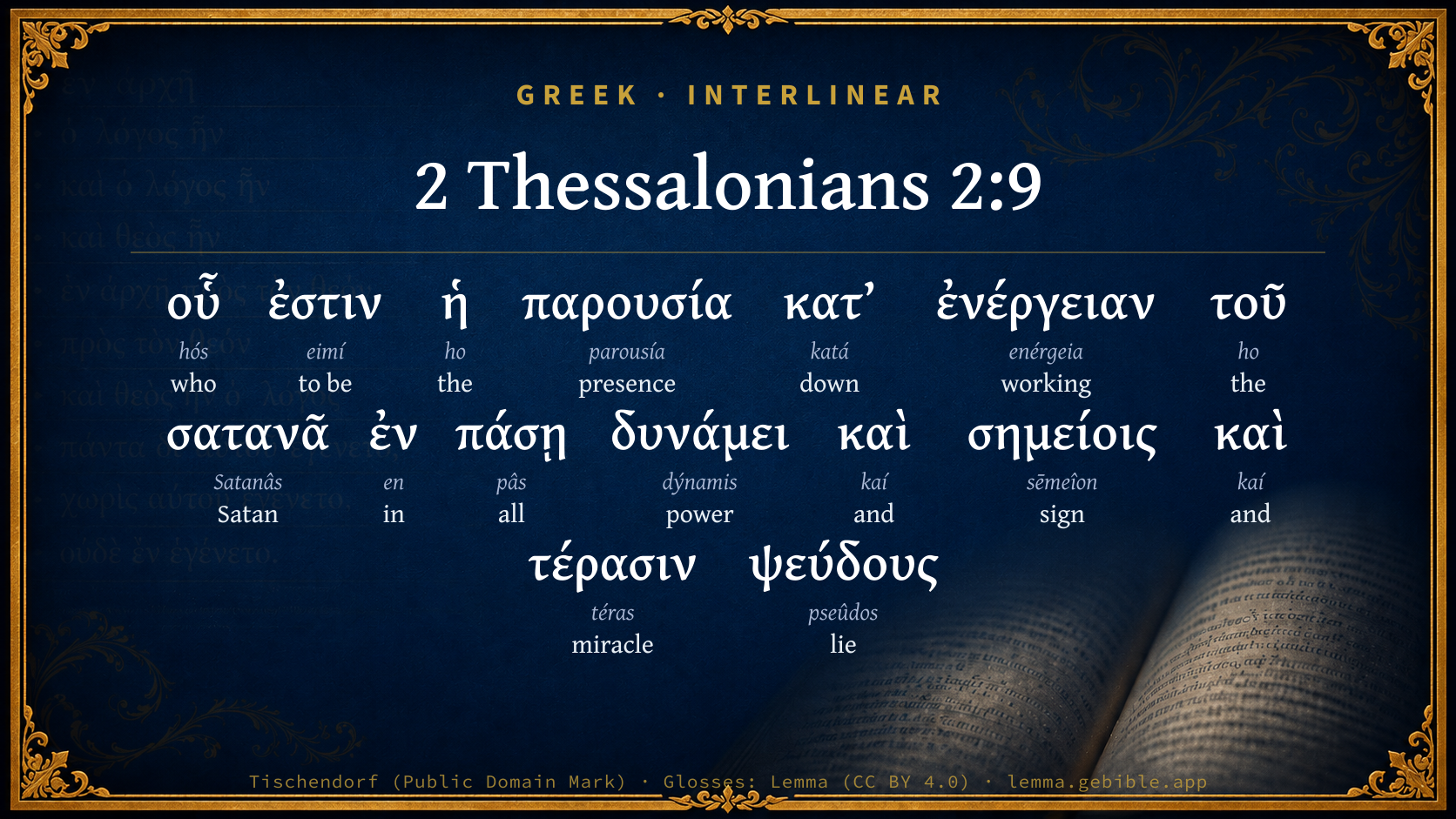
  1. οὗ hós G3739 “who” Relative pronoun, Genitive, Singular, Masculine
  2. ἐστιν eimí G1510 “to be” Verb, Present, Active, Indicative, 3rd person, Singular
  3. ἡ ho G3588 “the” Article, Nominative, Singular, Feminine
  4. παρουσία parousía G3952 “presence” Noun, Nominative, Singular, Feminine
  5. κατ’ katá G2596 “down” Preposition
  6. τοῦ ho G3588 “the” Article, Genitive, Singular, Masculine
  7. σατανᾶ Satanâs G4567 “Satan” Noun, Genitive, Singular, Masculine
  8. ἐν en G1722 “in” Preposition
  9. πάσῃ pâs G3956 “all” Adjective, Dative, Singular, Feminine
  10. δυνάμει dýnamis G1411 “power” Noun, Dative, Singular, Feminine
  11. καὶ kaí G2532 “and” Conjunction
  12. σημείοις sēmeîon G4592 “sign” Noun, Dative, Plural, Neuter
  13. καὶ kaí G2532 “and” Conjunction
  14. τέρασιν téras G5059 “miracle” Noun, Dative, Plural, Neuter
  15. ψεύδους pseûdos G5579 “lie” Noun, Genitive, Singular, Neuter

About this verse

These counts appear in no published source. They are computed here, from the morphology-tagged text and Lemma’s own curated glosses. What Lemma adds →

16
words
14
distinct lemmas
Pauline Epistles
section

Notable vocabulary

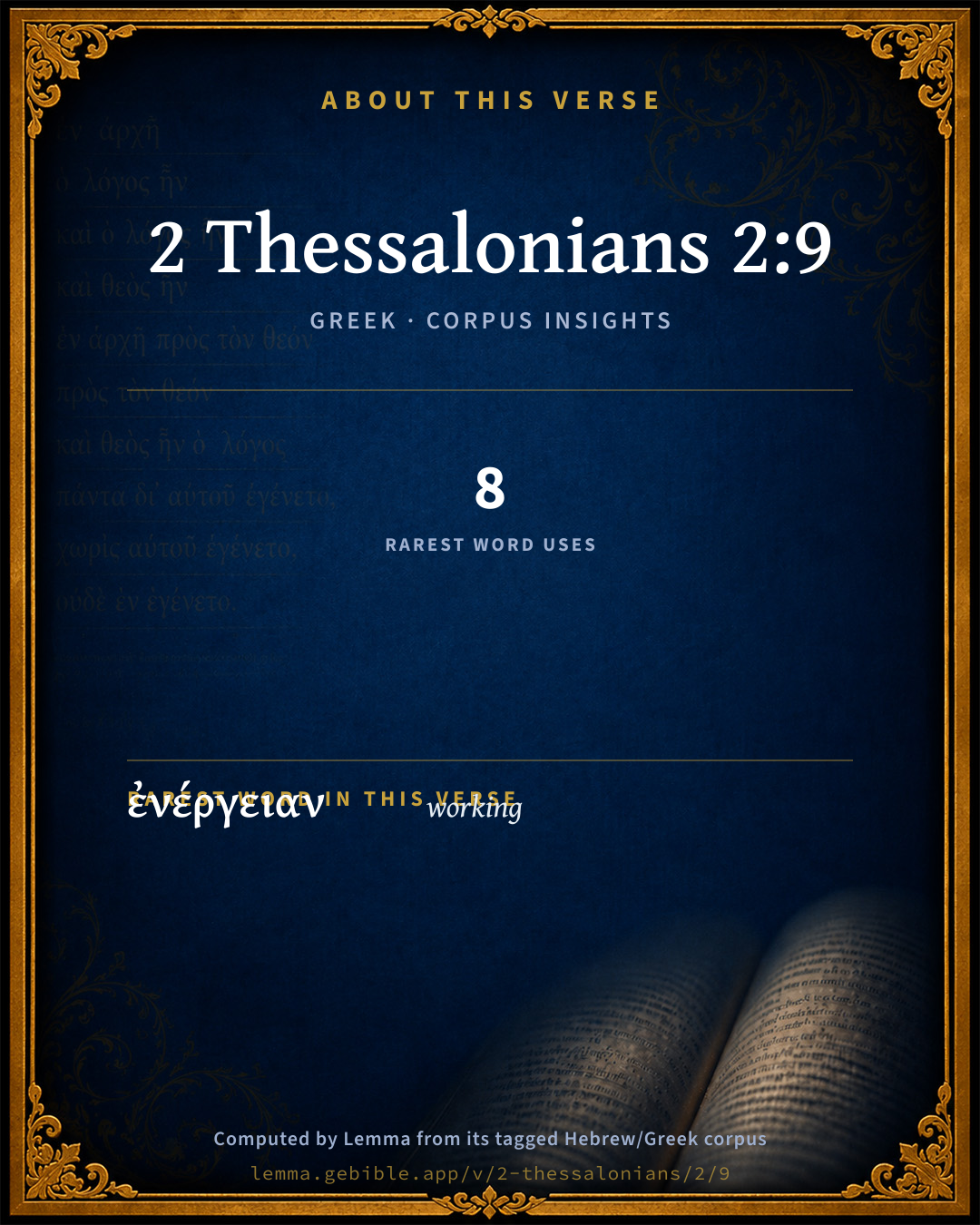
The rarest word here is ἐνέργειαν working G1753 — appearing just 8 times in the whole Greek New Testament.

Shared distinctive vocabulary

ἐνέργειαν working G1753 occurs in 8 verses of the Greek New Testament. Also found in:

Repetition

Words recur within this verse:

Cross-references

23

Topical passages linked to 2 Thessalonians 2:9 in the Treasury of Scripture Knowledge — connected by theme and wording, ordered by reader-vote popularity; previews shown in the World English Bible.

  • Matthew 24:24 For there will arise false christs, and false prophets, and they will show great signs and wonders, so as to lead astray, if possible, even the chosen ones.
  • Revelation 19:20 The beast was taken, and with him the false prophet who worked the signs in his sight, with which he deceived those who had received the mark of the beast and those who worshiped his image. These two were thrown alive into the lake of fire that burns with sulfur.
  • Ephesians 2:2 in which you once walked according to the course of this world, according to the prince of the powers of the air, the spirit who now works in the children of disobedience;
  • 2 Corinthians 11:3 But I am afraid that somehow, as the serpent deceived Eve in his craftiness, so your minds might be corrupted from the simplicity that is in Christ.
  • John 4:48 Jesus therefore said to him, "Unless you see signs and wonders, you will in no way believe."
  • Mark 13:22 For there will arise false christs and false prophets, and will show signs and wonders, that they may lead astray, if possible, even the chosen ones.
  • Deuteronomy 13:1–2 If there arise in the midst of you a prophet, or a dreamer of dreams, and he give you a sign or a wonder,
  • John 8:44 You are of your Father, the devil, and you want to do the desires of your father. He was a murderer from the beginning, and doesn't stand in the truth, because there is no truth in him. When he speaks a lie, he speaks on his own; for he is a liar, and the father of it.
  • Acts 13:10 and said, "Full of all deceit and all cunning, you son of the devil, you enemy of all righteousness, will you not cease to pervert the right ways of the Lord?
  • John 8:41 You do the works of your father." They said to him, "We were not born of sexual immorality. We have one Father, God."
  • 2 Corinthians 4:4 in whom the god of this world has blinded the minds of the unbelieving, that the light of the Gospel of the glory of Christ, who is the image of God, should not dawn on them.
  • 2 Corinthians 11:14 And no wonder, for even Satan masquerades as an angel of light.
  • Revelation 12:9 The great dragon was thrown down, the old serpent, he who is called the devil and Satan, the deceiver of the whole world. He was thrown down to the earth, and his angels were thrown down with him.
  • Revelation 13:11–15 I saw another beast coming up out of the earth. He had two horns like a lamb, and he spoke like a dragon.
  • Revelation 18:23 The light of a lamp will shine no more at all in you. The voice of the bridegroom and of the bride will be heard no more at all in you; for your merchants were the princes of the earth; for with your sorcery all the nations were deceived.
  • Revelation 20:10 The devil who deceived them was thrown into the lake of fire and sulfur, where the beast and the false prophet are also. They will be tormented day and night forever and ever.
  • 2 Timothy 3:8 Even as Jannes and Jambres opposed Moses, so do these also oppose the truth; men corrupted in mind, reprobate concerning the faith.
  • Revelation 12:17–13:5 The dragon grew angry with the woman, and went away to make war with the rest of her seed, who keep God's commandments and hold Jesus' testimony.
  • Exodus 7:22 The magicians of Egypt did in like manner with their enchantments; and Pharaoh's heart was hardened, and he didn't listen to them; as Yahweh had spoken.
  • Exodus 8:7 The magicians did in like manner with their enchantments, and brought up frogs on the land of Egypt.
  • Exodus 8:18 The magicians tried with their enchantments to bring forth lice, but they couldn't. There were lice on man, and on animal.
  • Acts 8:9–11 But there was a certain man, Simon by name, who used to practice sorcery in the city, and amazed the people of Samaria, making himself out to be some great one,
  • Revelation 9:11 They have over them as king the angel of the abyss. His name in Hebrew is "Abaddon," but in Greek, he has the name "Apollyon."

Cross-references courtesy of OpenBible.info (CC BY 4.0).

Commentary

Notes on 2 Thessalonians 2:9 from classic Christian and Jewish commentators (each source and its license shown beneath its notes). The classic Christian expositions comment on the surrounding passage and are grouped to its opening verse, so a note may address several verses; the Jewish commentaries on the Tanakh (Rashi and others) are per-verse, so they appear only where the commentator wrote on this verse.

Lemma curates 59 commentaries, every one of them public domain or Creative Commons licensed, each selected and text-cleaned for this edition rather than reprinted as found. About our sources →

Matthew Poole's English Annotations

The apostle still continues his discourse about this man of sin. He had declared whence he arose, and to what height of power, and the manner and place of his exercising it, and what opened him the way to it, and also his destruction, with the means of it. But he thought it needful to explain particularly the manner of his rising into all this power, and preserving himself in it, and the persons over whom he doth exercise it.

Whose coming is after the working of Satan; Kat’ energeian Christ’s coming is in power, and so is his: Christ comes with the Spirit of God, and his is with a spirit also, but it is of Satan: and the Spirit of God worketh with Christ in his coming, and the spirit of Satan with the man of sin in his coming; which implies either the principle of this working in his coming, it is the devil; or the similitude of it, it is like the working of Satan. If in the first sense, it shows by what spirit the antichristian church was first formed, and by which it is still informed and acted; as in natural bodies the matter is formed and informed by the spirit within it. The true church hath the Holy Spirit, that forms it into a spiritual temple, Eph 2:21,22; the false church hath the spirit of the devil, forming it into the synagogue of Satan, Rev 2:9. The dragon is said to give the beast his power, seat, and great authority, Rev 13:2; and this dragon is the devil in the heathen empire, who being cast out of his seat and power when the emperor became Christian, found the antichristian church, and here exercised that power and authority which he did formerly in the imperial seat of the heathen emperors; whence we may see whence all the furious zeal and bloody cruelties appearing in the popish church do spring, notwithstanding all their outward shows of devotion. If we take the words in the latter sense, then his coming is like the working of Satan; either with great power and energy, as the word imports: the Greek word is often used in a good sense; for God’s working in the heart, Phi 2:13, for the working of the word, 1Th 2:13, for the working of the heart in prayer, Jam 5:17; or by the same methods; by pretences of piety and devotion, as Satan transforms himself into an angel of light; or by keeping men in blindness and ignorance, so doth Satan by setting before men secular grandeur, and the pomp of the world, as thus Satan dealt with our Saviour, Mat 4:1-11; or by suggesting lies instead of truth, so he dealt with our first parents, and is called a liar from the beginning.

With all power; en pash dunamei. Besides that energy of Satan that works inwardly in this man of sin, which was mentioned before, he hath outward strength or power wherein he comes; which may be here meant. He hath the secular power to assist him, the kings of the earth giving their power to the beast; and we read of ten horns upon his head, which are the emblems of strength and power, Rev 13:1; whereupon it is said: Who is like unto the beast? who is able to make war with him? Rev 13:4.

And signs, and lying wonders: some, by the figure called hendyadis, read it, by the power of signs and lying wonders: but not properly. Observe how Satan is God’s ape; God confirmed the gospel with

signs and wonders, Rom 15:19; God bearing them witness, with signs and wonders, & c. Heb 2:4; and Satan brings this man of sin into the world in the same manner: God did it to confirm the truth, but Satan to countenance a falsehood. But though he comes with signs and wonders, yet not properly with miracles, as the Greek word is rendered in Heb 2:4; because though the devil can work the one, he cannot the other: he can by his great natural knowledge and experience improve natural causes to their utmost, but he cannot effect things above all possibility of nature, which is the same power as creating. The schoolmen give their distinction between wonders and miracles, which is not needful here to insert: all miracles are wonders, but all wonders are not miracles; and yet are esteemed miracles when their cause is not known. The Romish legends are full of stories of miracles wrought to confirm their false doctrines of purgatory, of relics, invocation of saints, &c.; which might be wonders really wrought by the devil; such as were wrought by Jannes and Jambres in Egypt, and by Simon Magus, and Apollonius Tyaneus, &c.; who used magic arts, and the people, not knowing them in their causes, might judge them miracles. And being wrought for such ends, they are termed signs, for a sign is any thing that is used to make signification, whether it be a natural or artificial, an ordinary or extraordinary sign; used either for a good end, as those shown by Christ and the apostles, or for a bad end, as those used by this man of sin. People are apt to be affected with signs.

The Jews, saith the apostle, require a sign, 1Co 1:22, as they often desired Christ to show them a sign, and therefore this man of sin comes with signs. Some signs are only for representation, as the sign of the cross, and the images of Christ, and of his death and resurrection, &c.; and he comes in these: others are for confirmation, which are either real miracles, or such as seem so; and he comes in these latter also, which are here called τερασι ψευδοις, lying wonders, or wonders of a lie, Hebrew. Though the Greek word is oft used for a real miracle, yet not so, here; for miracles are the effects of a Divine power only, Rom 15:19; Heb 2:4, and not diabolical. And called lying wonders, either because they are used to confirm a lie, or because they are not real, but feigned wonders; impostures, to cheat the people, and make them wonder; whereof we have account in Gregory’s Dialogues, and in Paulus Diaconus, and others; and yet such miracles as these the papists boast of as marks of their church to be true, though they are here by the apostle made the marks of the man of sin. And Christ foretells of false prophets that should show great signs and wonders, to deceive, if possible, the very elect, Mat 24:24. See Deu 13; Rev 13:13,14.

Matthew Poole's English Annotations on the Holy Bible (1683–1685) — public domain. Text from a community e-Sword/MySword module.

The Biblical Illustrator

Joseph S. Exell

2Th_2:9

Even he whose coming is after the working of Satan

The agency of Satan

I.

The scripture account of satan.

1. He is represented as a spirit or immaterial being (1Ki_22:1-53; Luk_10:17-20).

2. As an angel, preferable to man in understanding and might.

3. As a fallen angel (Jud_1:6).

4. As the prince or chief of infernal spirits (Mat_9:34; Mat_12:24; Mat_25:41; Luk_12:41).

As lying under punishment, in reserve to be brought forth at the great day of retribution as a monument of Gods hatred of sin.

II. The instances of his agency.

1. His introducing sin into the world (2Co_11:3-13).

2. The temptation of Christ (Mat_4:1-11).

3. Possession of bodies when Christ was in the world (1Jn_3:8; Act_10:38).

4. The objects against which his force is directed are the dishonour of God and the rum of men.

5. The subjects are good and bad men.

6. The ways in which he acts are two--force and fraud, fiery darts and subtle wiles (Eph_6:11-16).

7. He acts on persons and means with diligence, and constancy, and malice, as a roaring lion (1Pe_5:8).

8. Be his activity ever so great, it is restrained and overruled by God, who has all evil spirits under His control.

The practical improvement of the subject:

1. We should admire the wisdom and goodness of God in making a discovery of Satan.

2. We should watch against his manifold artifices.

3. We should pray for grace and power to resist him. (J. Towle.)

Emissaries of Satan

Some years ago, when the cholera was raging in New Orleans, a steamer, near nightfall, put out from the city, laden with passengers escaping from the pestilence. The steamer had been but a little while out when the engineer fell at his post with cholera. The captain, in despair, went up and down among the passengers, asking if there were any one there who could act as engineer. A man stepped out, and said that he was an engineer, and could take the position. In the night the captain was awakened by a violent motion of the steamer, and he knew there was great peril ahead. He went up, and found that the engineer was a maniac; that he had fastened down the safety valves; and he told the captain that he was the emissary of Satan, commissioned to drive that steamer to hell. By some strategy, the man was got down in time to save the steamer. There are, men engineered by maniac passions, sworn to drive them to temporal and everlasting destruction. Every part of their nature trembles under the high pressure. Nothing but the grace of Almighty God can bring down those passions, and chain them. A little while longer in this course, and all is lost. (T. De Witt Talmage.)

The Biblical Illustrator, edited by Joseph S. Exell (c. 1880s–1900s) — public domain. Text from a community e-Sword module.

Joseph Benson's Commentary

2Th 2:9-10. Him whose coming — The apostle, in his eagerness to foretel the destruction of the man of sin, having broken in upon his subject, now returns to it again, and describes the other qualifications by which this wicked one should advance and establish himself in the world. He should rise, the apostle signifies, to credit and authority by the most diabolical methods; should pretend to supernatural powers, and boast of revelations, visions, and miracles, false in themselves, and applied to promote false doctrines. The expression, whose coming, here signifies the first appearance of this lawless one in an open manner. The mystery of iniquity wrought covertly in the apostles’ days; and the man of sin was not to show himself openly, till that which restrained was taken out of the way. His coming, therefore, or his beginning to reveal himself, was to happen after the empire became Christian, and to take place in the manner described in the following clause. After the working of Satan — Whose first setting up, and further increasing of his power, is by Satan’s influence; or with such a kind of working as Satan is wont to use wherewith to seduce persons; with all power — Pretended power from God; and signs — Fictitious or false signs, namely, not such as are fit to prove the truth of the doctrines which they are brought to confirm, but are mere impostures and forgeries; and lying wonders — Such illusions and deceptions as were effected by the power of Satan, to confirm the doctrines and dominion of Antichrist, and were calculated to cause wonder in the beholders. Macknight reads this clause, with all power, and signs, and miracles of falsehood, judging the structure of the sentence requires that ψευδους, of falsehood, be joined not only with wonders, or miracles, but with power and signs. And in explication of the terms he observes, that they are either signs, miracles, and exertions of power, performed in appearance only; mere impositions upon the senses of mankind; or they are real signs and miracles performed for the establishment of error; and consequently they are the works of evil spirits. Of this sort the miracles performed by Pharaoh’s magicians may have been; also some of the miracles related by heathen historians. For the apostle intimates that by some kind of miracle, or strong working, which had the appearance of miracles in the eyes of the vulgar, Satan established idolatry in the heathen world. Nay, our Lord himself foretels that false Christs and false prophets would show great signs and wonders, insomuch that if it were possible they would deceive the very elect. Wherefore, seeing the coming of the man of sin was to be after the working of Satan, with all power, &c., it is not improbable that some of the miracles, by which the corruptions of Christianity were introduced, may have been real miracles performed by evil spirits, called here miracles of falsehood, because they were done for the establishment of error: see Rev 13:13-14, where the same events seem to be foretold. This description of the wicked or lawless one, plainly evinces that Mohammed cannot be the man of sin, as some pretend. For, instead of working miracles, he utterly disclaimed all pretensions of that sort. In like manner, and for the same reason, the man of sin cannot be the factious leaders of the Jews in their revolt from the Romans, as Le Clerc and Whitby have affirmed; nor any of the heathen Roman emperors, as others have imagined. Besides, although these emperors exalted themselves above all other kings and princes, and opposed Christ very much, they did not apostatize from the Christian faith, nor sit in the temple of God. With all deceivableness of unrighteousness — Or every unrighteous deceit, (the phrase being a Hebraism.) The apostle means those feigned visions and revelations, and other pious frauds, by which the corrupt clergy gained credit to their impious doctrines and practices. In them that perish — Who are in the highway to eternal destruction; because they received not the love of the truth — The cause this why God suffered them to fall into such destructive errors.

Joseph Benson's Commentary on the Old and New Testaments (1811–1818) — public domain. Text from a community e-Sword module.

Tyndale Open Study Notes

Tyndale Open Resources

2:9 As Christ will appear in royal and divine power (his parousia; 2:1, 8; 1 Thes 2:19; 3:13; 4:15; 5:23), this figure similarly will come (parousia) with a royal entrance.

Tyndale Open Study Notes — © Tyndale Open Resources, licensed CC BY-SA 4.0. Text via the HelloAO Bible API.

Bengel's Gnomon

Johann Albrecht Bengel

2Th 2:9. Οὗ, of whom) viz. the Iniquitous one [Wicked]. Paul now subjoins a more lengthened description of the calamity, with the design that in the way of contrast he may console the Thessalonians; 2Th 2:13.—τοῦ Σατανᾶ, of Satan) As Christ is related to God, so on the contrary is Antichrist to Satan, standing midway between Satan and lost men.—καὶ σημείοις, and signs) These signs will be shown by the false prophet, who serves the interest of the beast, and that too even before the ascent of the beast from the bottomless pit, Rev 13:13.

Bengel's Gnomon of the New Testament — English translation (T&T Clark, Edinburgh, 1860) — public domain. Text from a community e-Sword module.

Meyer's Critical & Exegetical Commentary

Heinrich August Wilhelm Meyer

2Th_2:9-10. The apostle has in 2Th_2:8 not only said when Antichrist will appear, but he has also immediately added what fate awaits him. He now goes backward in point of time, whilst in addition he describes the character of the working which Antichrist will develope before his destruction, brought about by the appearance of Christ.

οὗ] sc. τοῦ ἀνόμου. Parallel with ὅν, 2Th_2:8.

ἐστίν] the present describes the certainty of the coming in the future. See Winer, p. 237 [E. T. 331]. Incorrectly Koppe, it imports: jam agit et mox apertius majoreque cum vi aget.

κατʼ ἐνέργειαν τοῦ σατανᾶ] does not belong as an independent statement to ἐστίν (so Hofmann, as before him already Georgii, in Zellers theol. Jahrb. 1845, Part 1, p. 8, who gives the meaning that the act of the appearing of the ἄνομος will itself be a work of Satan), but is a subsidiary statement to the principal clause ἐστὶν ἐν κ.τ.λ., assigning the reason of it. It does not import after the example of the working of the devil (similiter ac si satanas ageret, Michaelis), but in conformity with it, that an ἐνέργεια τοῦ σατανᾶ is its characteristic, that is, that the devil works in and through him.

εἶναι ἔν τινι] to consist in something, to prove or make itself known in something. Against Hofmann, who arbitrarily denies this use of the phrase, comp. Winer, p. 345 [E. T. 482].

δυνάμει καὶ σημείοις καὶ τέρασιν] a rhetorical enumeration, as in Act_2:2, for the exhaustion of the idea. But as πάσῃ (see Winer, p. 466 [E. T. 660]), so also ψεύδους belongs to all three substantives. The genitive may import: in every kind of power, and in all signs and wonders whose nature is falsehood, or which proceed from falsehood, or which lead to falsehood, whose aim is falsehood. The last meaning is, with Aretius, de Wette, and others, to be preferred, as Antichrist is indeed the first to bring evil to its climax.

ψεῦδος] falsehood, belongs to the essential nature of the devil (comp. Joh_8:44). It represents evil as the counterpart of divine truth (the ἀλήθεια).

Meyer — Critical and Exegetical Commentary on the New Testament — English translation by Peter Christie, edited by Frederick Crombie (T&T Clark, 1880) — public domain. Text from a community e-Sword module.

Cambridge Greek Testament for Schools and Colleges

9. οὑ ἐστὶν ἡ παρουσία κατʼ ἐνέργειαν τοῦ Σατανᾶ, whose coming is (or who has his coming) according to Satan’s working. The παρουσία of the Lord Jesus (2Th 2:8 b) recalls the παρουσία of His “adversary” and false counterpart (see 2Th 2:4 and notes), which is further set forth in its manner (κατά), and accompaniments (ἐν), as “in accordance with (in the way or fashion of) a working of Satan”—being such a παρουσόα as might be expected from such a source—and “in all manner of power and signs and wonders … and in all deceit,” &c. The ἐνέργεια τοῦ Σατανᾶ (in respect of its agent) is an ἐνέργεια πλάνης in respect of its method, 2Th 2:11; Antichrist’s παρουσία is, on the part of “the god of this world,” a kind of mocking prelude to Christ’s. This noun and the corresponding verb ἐνεργέω (-έομαι, 1Th 2:13: see note) frequently have God or Divine powers for subject: see 1Co 12:6; Gal 2:8; Gal 3:5; Eph 1:11; Eph 1:19 f., Eph 3:20; Php 2:13, &c. As distinguished from δύναμις and ἰσχύς (see note on 2Th 2:9), ἐνέργεια means power in operation (“efficacia Satanæ,” Beza). “Satan” holds toward Antichrist a relation analogous, in a shocking sense, to that of God toward Christ; the systematic and, as one might suppose, calculated adoption by Antichrist of the attributes of Christ is the most appalling feature in the whole representation. Even as God ἐνήργηκεν ἐν τῷ χριστῷ (Eph 1:20), “by powers and wonders and signs” crowned in His resurrection (Act 2:22-24), Satan will find his supreme ἀποκάλυψις in the Antichrist (“diabolicam apostasiam in se recapitulans,” Irenæus; “medius inter Satanam et perditos homines,” Bengel), and will furnish him with δύναμις καὶ σημεῖα κ.τ.λ. to match. With ὁ Σατανᾶς we must associate ὁ ἀντικείμενος of 2Th 2:4; see note.

The series of terms in which the counterfeiting of Christ by Antichrist is indicated (see ἀποδεικνύντα ἑαυτὸν ὅτι ἔστιν θεός, ἀποκαλυφθῆναι, μυστήριον, ἐνεργεῖται, παρουσία) concludes ἐν πάσῃ δυνάμει καὶ σημείοις καὶ τέρασι,—the three expressions applied to the miracles of our Lord and His Apostles: see Mar 6:2; Luk 19:37; Joh 3:2; Act 2:22; Rom 15:19; 2Co 12:12; Heb 2:4, where they are variously combined. Of the three, σημεῖον is commonest, esp. in St John’s Gospel; occasionally σημεῖα and τέρατα are coupled together, somewhat frequently in Acts—τέρατα is never used in the Gospels of the actual works of Jesus; δύναμις (-εις, rendered in the plur., by R.V., “mighty works”) is most frequent in the Synoptics. Δύναμις names the miracle from its cause, the supernatural force acting in it; σημεῖον from its meaning, its significance; τέρας, portentum, prodigium, miraculum, from its abnormal nature and the astonishment it arouses. It is unfortunate that the “miracles” of Divine revelation have taken their modern name (through the Latin) from the last, which is the rarest and least characteristic of these synonyms; see Trench’s Syn. § 91, also On the Miracles, chap. 1. The three terms might constitute a collective idea, with πάσῃ at the beginning indicating the number and variety of Antichrist’s “signs,” and ψεύδους at the end qualifying them unitedly (Lightfoot); but—since δύναμις is singular, and rarely has this concrete sense except in the plural—we may better render the phrase: in all power—both signs and wonden of falsehood (cf. Rom 15:19, ἐν δυνάμει σημείων καὶ τεράτων; also 2Th 1:11, 1Th 1:5, Rom 1:4, Col 1:11; Col 1:29, for ἐν δυνάμει). Ψεύδους, the genitive noun of quality, does not (like ψεύδεσιν) stigmative these as “false,” i.e. pretended miracles (with no supernatural δύναμις behind them); but as “of falsehood,” belonging to this realm, to the sphere of him who is ψεύστης καὶ πατὴρ αὐτοῦ (Joh 8:44), and serving his ends; they are signs attesting and suitable to a ψεῦδος, as our Lord’s miracles attest and are suitable to ἡ ἀλήθεια: cf. Joh 3:2; Joh 10:32; Joh 14:10 f., Joh 20:30 f. These marks of Antichrist’s coming were predicted by Jesus of the ψευδόχριστοι and ψευδοπροφῆται (Mat 24:24 f.; Mar 13:22),—σημεῖα μεγάλα καὶ τέρατα ὥστε πλανῆσαι, εἰ δυνατόν, καὶ τοὺς ἐκλεκτούς. The Apocalypse ascribes them, in ch. Rev 13:11-14, to the second Wild Beast with his “lamb-like horns” and his dragon-like speech,—the Dragon aping the Lamb. Miracles are never in Scripture made as such—apart from their moral character and aim—the proof of a Divine mission; see Deu 13:1-5. This weighty ἐν clause must be attached to ἐστίν, not to ἐνέργειαν, and forms indeed its principal complement.

10a. Already cumulative, the predicate is further extended by καὶ ἐν πάσῃ ἀπάτῃ ἀδικίας τοῖς ἀπολλυμένοις (this clause belongs to 2Th 2:9), and in all deceit of unrighteousness for the perishing,—words describing the subjective effect, as ἐν πάσῃ δυνάμει κ.τ.λ. describes the objective nature, of Satan’s working in the Antichrist. Πάσῃ indicates a manifoldness of deception corresponding to the manifold forms of the deceiving agency, πάσῃ δυνάμει κ.τ.λ. Ἀπάτη ἀδικίας, construed similarly to εὐδοκία ἀγαθωσύνης in 2Th 1:11 (see note), means such “deceit” as belongs to “unrighteousness,” as it is wont to employ—subjective genitive, not unlike σημεῖα … ψεύδους above. Ἀπάτη is the active and concrete “deceit,” not “deceivableness” (A.V.), nor “deceitfulness” (elsewhere in A.V.): see Mat 13:22; Eph 4:22; Col 2:8; Heb 3:13. On ἀδικία, the comprehensive term for wrong, wrong-doing, as between persons—synon. with ἀνομία (2Th 2:8), which is wrong as committed against sovereign law—see further 2Th 2:12; it is connected with ψεῦδος, as violation of conscience with perversion of intellect, and opposed to ἀλήθεια here, much as in Rom 1:18; Rom 2:8; 1Co 13:6.

Τοῖς ἀπολλυμένοις is the dative to ἀπάτῃ, of the persons concerned; cf., for the construction, 1Co 1:18, τοῖς ἀπολλυμένοις μωρία ἐστίν. For the sense of ἀπόλλυμαι, cf. 2Th 1:8 f.; also 1Co 15:18; 2Co 4:3 f. (ἐν οἶς ὁ θεὸς τοῦ αἰῶνος τούτου ἐτύφλωσεν τὰ νοήματα τῶν ἀπίστων); Php 3:19. Οἱ ἀπολλύμενοι (see εἰς τὸ σωθῆναι following), the opposite of οἱ σωζόμενοι (1Co 1:18; 2Co 2:15); the present participle connotes their perdition as commenced and going on, in the loss of the sense for truth and right and of receptiveness for God: cf. Rom 1:18 ff., Rom 1:28 ff.; Eph 4:18 ff.; 1Ti 6:5; 2Ti 3:8; Tit 1:15 f.; Heb 10:26 f.; Jud 1:10-13. They follow the guidance of ὁ υἱὸς τῆς ἀπωλείας (2Th 2:3), and share his ruin. Satan’s devices are deceit for the perishing, for men without the life of God, whose spiritual perceptions are destroyed through sin; while the children of God escape the deception, knowing how to “prove all things” (1Th 5:21): cf., as to this contrast, 1Th 5:4 f.; 2Co 4:2-6; 1Jn 4:1-6.

10b. ἄνθʼ ὧν τὴν ἀγάπην τῆς ἀληθείας οὐκ ἐδέξαντο εἶς τὸ σωθῆναι αὐτούς, because they did not receive the love of the truth to the end they might be saved; or “in requital of their refusal to entertain the love of the truth,” &c. For ἀνθʼ ὧν (pro eo quod, Calvin), see Luk 1:20; Luk 12:3; Luk 19:44; Act 12:23 (also 3 Kingd. 11:11, Joe 3:5, in LXX; Xenophon); for ἀντί of correspondence (‘tit for tat’), cf. 1Th 5:15, &c. The dupes of Antichrist are treated after their kind; as they would not love truth, they shall not have truth, lies must be their portion: cf. the lex talionis in 2Th 1:6 f.; also Psa 18:26; Psa 109:17 ff.; Rev 16:6, and Mat 25:29. For δέχομαι, implying welcome, the opening of the heart to what is offered, cf. 1Th 1:6; 1Th 2:13, describing the opposite conduct of the Thessalonian readers.

Ἡ ἀλήθεια is not the moral quality, “truth” as sincerity in the person, but the objective reality—“the truth” coming from God in Christ, viz. the Gospel, &c.: see 2Th 2:12 f.; Rom 1:18; Rom 1:25; Rom 2:8; 2Co 4:2; Gal 5:7; Eph 4:24; Col 1:5; 1Ti 3:15; Joh 8:32, &c. Ἡ ἀγάπη τῆς ἀληθείας is the bent of the mind toward the truth, the setting of the heart upon it (cf. Pro 2:2 ff; Pro 4:6; Pro 4:13, &c.); this affection those condemned οὐκ ἐδέξαντο, inasmuch as they refused to entertain it,—they had no predilection for truth; “they loved the darkness rather than the light” (Joh 3:19). Ἀγάπη in this connexion is synonymous with εὐδοκία (2Th 1:12: cf. εὐδοκήσαντες τῇ ἀδικίᾳ, 2Th 2:12 below), but denotes the principle of affection, the radical disposition of the mind, while εὐδοκία signifies its consent and expressed inclination; cf. Rom 1:32. For εἰς τό κ.τ.λ., see notes on 2Th 2:6 and on 1Th 2:12: “that they should be saved” (see note on σωτηρία, 1Th 5:9) is the result of that embracing of “the truth” offered in the Gospel, which these men refused to give; and such refusal marks them out as οἱ ἀπολλύμενοι.

2Th 2:11-12 draw out the consequence of the criminal unbelief described in ἀνθʼ ὧν κ.τ.λ., affirming the terrible delusion above described to be a visitation on God’s part, and a δίκαιον παρὰ θεῷ (cf. 2Th 1:6)—in fact a judicial infatuation. And since this fatal and wide-spread deception is effected by the παρουσία of Antichrist, that coming, while it is the consummate manifestation of human sin and Satanic power, is brought within the scope of the Divine counsels; it proves to be an instrument in God’s sovereign hand. Cf. the conclusion of Romans 9-11, setting forth the judicial πώρωσις of Israel: Ὦ βάθος πλούτου καὶ σοφίας καὶ γνώσεως θεοῦ· ὡς ἀνεξεραύνητα τὰ κρίματα αὐτοῦ καὶ ἀνεξιχνίαστοι αἱ ὁδοὶ αὐτοῦ.

Cambridge Greek Testament for Schools and Colleges (Cambridge University Press, 1896; 21 vols, various authors incl. Carr, Maclear, Plummer, Farrar, Lumby, Moule, M. R. James, Simcox) — public domain. Text from a community e-Sword module.

Geneva Bible (1599)

Geneva Bible translators

He foretelleth that Satan will bestow all his might and power, and use all false miracles that he can to establish that seat, and that with great success, because the wickedness of the world doeth so deserve it: yet so, that only the unfaithful shall perish through his deceit.

Which are partly false, and partly wrought to establish a falsehood.

Geneva Bible (1599) marginal notes — public domain. Text via Bolls.life.

Jamieson, Fausset & Brown

Robert Jamieson, A. R. Fausset & David Brown

whose coming--The same Greek as was used for the Lord's coming (Th2 2:8) or personal "presence."

is--in its essential character.

after--according to the working ("energy") of Satan, as opposed to the energy or working of the Holy Spirit in the Church (see on Eph 1:19). As Christ is related to God, so is Antichrist to Satan, his visible embodiment and manifestation: Satan works through him. Rev 13:2, "The dragon gave him (the beast) his power . . . seat . . . great authority."

lying wonders--literally, "wonders" or "prodigies of falsehood." His "power, signs, and wonders," all have falsehood for their base, essence, and aim (Joh 8:44), [ALFORD]. In Mat 24:24 Jesus implies that the miracles shall be real, though demoniac, such mysterious effects of the powers of darkness as we read of in the case of the Egyptian sorcerers, not such as Jesus performed in their character, power, or aim; for they are against the revealed Word, and therefore not to be accepted as evidences of truth; nay, on the authority of that sure Word of prophecy (here, and Mat 24:24), to be known and rejected as wrought in support of falsehood (Deu 13:1-3, Deu 13:5; Gal 1:8-9; Rev 13:11-15; Rev 19:20). The same three Greek words occur for miracles of Jesus (Act 2:22; Heb 2:4); showing that as the Egyptian magicians imitated Moses (Ti2 3:1-8), so Antichrist will try to imitate Christ's works as a "sign," or proof of divinity.

Jamieson, Fausset & Brown — Commentary Critical and Explanatory on the Whole Bible (1871) — public domain (CC PDM 1.0). Text via the HelloAO Bible API.

Adam Clarke's Commentary

Verse 9. Whose coming is after the working of Satan] The operation of God's Spirit sends his messengers; the operation of Satan's spirit sends his emissaries. The one comes κατ' ενεργειαν του Θεου, after or according to the energy or inward powerful working of God; the other comes κατ' ενεργειαν του Σατανα, according to the energy or inward working of Satan.

With all power] Πασῃ δυναμει· All kinds of miracles, like the Egyptian magicians; and signs and lying wonders: the word lying may be applied to the whole of these; they were lying miracles, lying signs, and lying wonders; only appearances of what was real, and done to give credit to his presumption and imposture. Whereas God sent his messengers with real miracles, real signs, and real wonders; such Satan cannot produce.

Adam Clarke's Commentary on the Bible (1810–1826) — public domain. Text from a community e-Sword/MySword module.

John Calvin's Commentaries

9 Whose coming He confirms what he has said by an argument from contraries. For as Antichrist cannot stand otherwise than through the impostures of Satan, he must necessarily vanish as soon as Christ shines forth. In fine, as it is only in darkness that he reigns, the dawn of the day puts to flight and extinguishes the thick darkness of his reign. We are now in possession of Paul’s design, for he meant to say, that Christ would have no difficulty in destroying the tyranny of Antichrist, which was supported by no resources but those of Satan. In the mean time, however, he points out the marks by which that wicked one may be distinguished. For after having spoken of the working or efficacy of Satan, he marks it out particularly when he says, in signs and lying wonders, and in all deceivableness. And assuredly, in order that this may be opposed to the kingdom of Christ, it must consist partly in false doctrine and errors, and partly in pretended miracles. For the kingdom of Christ consists of the doctrine of truth, and the power of the Spirit. Satan, accordingly, with the view of opposing Christ in the person of his Vicar, puts on Christ’s mask, while he, nevertheless, at the same time chooses armor, with which he may directly oppose Christ. Christ, by the doctrine of his gospel, enlightens our minds in eternal life; Antichrist, trained up under Satan’s tuition, by wicked doctrine, involves the wicked in ruin; Christ puts forth the power of his Spirit for salvation, and seals his gospel by miracles; the adversary, by the efficacy of Satan, alienates us from the Holy Spirit, and by his enchantments confirms miserable men in error.

He gives the name of miracles of falsehood, not merely to such as are falsely and deceptively contrived by cunning men with a view to impose upon the simple — a kind of deception with which all Papacy abounds, for they are a part of his power which he has previously touched upon; but takes falsehood as consisting in this, that Satan draws to a contrary end works which otherwise are truly works of God, and abuses miracles so as to obscure God’s glory. In the mean time, however, there can be no doubt, that he deceives by means of enchantments—an example of which we have in Pharaoh’s magicians. (Exodus 7:11.)

John Calvin's Commentaries (1540-1563) — public domain. Text from the Calvin Translation Society English edition (1840s-50s) via the Christian Classics Ethereal Library (ccel.org). Calvin's coverage is partial (roughly two-thirds of the Bible); uncommented books and verses are honest gaps, never fabricated. The 19th-century editor's footnotes and remarks are omitted so the notes are faithfully Calvin's own voice.

Ellicott's Commentary for English Readers

(9) Even him, whose coming.—The “even him” does not stand in the Greek; and “whose” might, again, be rendered by for his own, or perhaps “though his own.” The purpose of the verses following is not merely to describe Antichrist more fully, but to compare word for word his coming with that which will annihilate him. Again is used of Antichrist a peculiar word consecrated to the Christ: “coming” (literally presence), being the word used in 2Th_2:8, as well as 2Th_2:1, and often. In spite of the sham being well got up, it will be seen to be a sham.

Is . . . with all power.—“Is:” St. Paul sees the future as present. The predicate is not “after the working,” but “in all power,” &c. The advent of Antichrist will be in (i.e., surrounded with, accompanied by) all kinds of miracles, “according to the working of Satan:” i.e., not only wrought by Satan, but up to the full capacity of Satan to work them. The word “lying” (literally, of falsehood) should go with all three names, “all counterfeit power and signs and wonders.” The three words are piled up to heighten the terror of the description; if you press them they mean that there will be a display of power, to attest Antichrist’s doctrine (signs), and to keep men spellbound in admiration of him (wonders). Antichrist, like Christ (1Ti_6:15), has one to support him—Satan instead of God; he, like Christ (Luk_21:25), will have his miracles—but miracles of trickery, not of truth.

A Bible Commentary for English Readers, edited by Charles John Ellicott (1878–1897) — public domain. Text from a community e-Sword module.

The Cambridge Bible for Schools and Colleges

gen. ed. J. J. S. Perowne

9. even him, whose coming is after the working of Satan] Rather, even he, whose coming is according to the working of Satan (R. V.); for this sentence does not qualify the last clause of 2Th_2:8 by itself, it looks back to the principal subject of the paragraph,—“then shall be revealed the lawless one … whose coming,” &c.

The two “comings” (2Th_2:8-9]—the parousia of the Lord Jesus and that of the Man of Lawlessness—are set in contrast. The second forms the dark background to the glory of the first. “According to the working of Satan” is not, therefore, subordinate to the clause that follows, but forms a chief predicate. It is Satan that inspires and directs the advent of the Lawless One; hence the “powers and signs” which attend it: “who comes as one empowered by Satan, attended by all kinds of lying miracles.” For “Satan” comp. 1Th_2:18, and “he that opposeth” in 2Th_2:4 above.

“Working” (Greek energeia, energy) is a word that St Paul uses elsewhere of the operation of God; comp. note on “manifestation” above; and see e.g. Col_2:12; Eph_1:19; similarly the kindred verb, as in 2Th_2:7 (see note, and on 1Th_2:13). With studied emphasis and precision he borrows for the coming of Antichrist the terms proper to the coming of Christ, making the one appear as a frightful mimicry and mocking prelude of the other. The Lawless One has his “mystery, “his “revelation,” his “parousia,” and his “power and signs and wonders,” in which the “working of Satan” in him apes the working of God in Christ. This systematic, and as one might suppose, calculated adoption by Antichrist of the attributes of Christ is a most appalling feature in the Apostle’s representation. Satan himself, through his agent, usurps God’s throne amongst men. And the Man of Lawlessness holds a relation towards Satan the counterpart of the relation of Christ to God.

with all power and signs and lying wonders] Lit., in all power and signs and wonders of falsehood. There is no reason in grammar why the conducing epithet should not be referred to the three synonyms alike; it suits them all. St Paul does not mean to say that the miracles in question are pretended miracles, but that they aid and abet falsehood. They come from “the father of falsehood” (Joh_8:44), to whose realm all lies belong. Comp. Mat_24:14, and Rev_13:13, for predictions of Satanic miracles.

The three terms by which these manifestations are designated, are precisely those used of the miracles of Christ and the Apostles; comp. Act_2:22; Rom_15:19; 2Co_12:12; Heb_2:4, where they are variously combined. Of the three, signs is the most frequent, unfortunately rendered “miracles” in the A.V. of the Fourth Gospel (corrected in R.V.); occasionally signs and wonders (never wonders alone) are combined; more frequently power is used, or powers, rendered in the Gospels “mighty works”. The Greek word for wonder, nearest in sense to our “miracle,” denotes the outward effect of such deeds, the astonishment or fear they excite; while power points to the Divine (in this instance Satanic) agency that effects them, and signs calls attention to the significance of the event, its spiritual import.

While the last clause delineates the nature of the operations of Antichrist and the means by which he is accredited, the next verse goes on to describe their fatal effect:—

The Cambridge Bible for Schools and Colleges (gen. ed. J. J. S. Perowne; Cambridge University Press, 1878–1918) — public domain. Text from a community e-Sword module.

John Gill's Exposition

Even him whose coming is after the working of Satan,.... That is, as a deceiver, a liar, and a murderer; for such was the working of Satan with our first parents; he seduced Eve, not only by subtlety, but by lying; he abode not in the truth, is the father of lies, and a murderer from the beginning: and such is the working of antichrist his firstborn; he comes in a deceitful way, under a profession of Christ, and a pretension of faith in him, and love to him; but speaks lies in hypocrisy, for such are his doctrines and tenets; and is not only a murderer of the bodies of the saints, but of the souls of men; which are the wares the whore of Babylon deals in:

with all power; not omnipotence, for that is peculiar to God, and is not in Satan nor in antichrist, though the latter assumes to himself all power in heaven and in earth, and claims a jurisdiction both temporal and spiritual over men; but rather this means great power, or all kind of power of doing miracles, as follows:

and signs, and lying wonders; that is, such signs and miracles as are not real, but reigned, only in appearance, not in truth, like those that were done by the magicians of Egypt; and these were done to countenance lies, and to induce persons to believe them; and how many miracles and lying wonders the church of Rome pretends to, everybody knows.

John Gill's Exposition of the Whole Bible (1746–1763) — public domain (CC PDM 1.0). Text via the HelloAO Bible API.

Trapp's Complete Commentary

John Trapp

9 Even him, whose coming is after the working of Satan with all power and signs and lying wonders,

Ver. 9. After the working of Satan] Who (as God’s ape) works effectually in his and by his agents upon others. By corrupt teachers Satan catcheth men, as a cunning fisher by one fish catcheth another, that he may feed upon both.

And lying wonders] The devil is ashamed (saith the Jesuit Gretser) to confirm Luther’s doctrine by miracles. But he that now requireth miracles to make him to believe, is himself a great miracle, saith Austin.

John Trapp, A Commentary or Exposition upon All the Books of the Old and New Testament (1647–1656) — public domain. Text from a community e-Sword module.

Albert Barnes' Notes on the Bible

Even him, whose coming is after the working of Satan - Greek, κατ ̓ ἐνέργειαν τοὺ Σατανᾶ kat' energeian tou Satana. According to the energy of Satan; that is, the energetic or efficient operation of Satan. The word rendered “after,” it need not be said to one who looks at the Greek, does not refer to time, but is a preposition, meaning according to; in conformity with; meaning that the manner of his appearing would be accompanied by such works as would show that the agency of Satan was employed, and such as he only could produce. It does not mean that the coming of the Lord Jesus would be after Satan had worked in this manner, but that the manifestation of that wicked one would be with such demonstrations of power and wonder as Satan only could effect. The system over which he presides is originated by Satan, and sustained by those things which he alone can perform. On the word “Satan,” see the notes on Job 1:6. The idea is, that it would be under the direction and control of the great enemy of God, and that the things on which it would rely for support could be traced to his agency. In all the pretended miracles to which it would appeal, there would be nothing which Satan could not accomplish.

With all power - With all the power which Satan can exhibit; meaning also, that there would be a great exertion of power in the case. It would not be a feeble and imbecile dominion. The dominion of the papacy has been one of the most powerful on earth. There has been none which has been more dreaded by the nations of the earth - and there have been times when nations trembled, and kings turned pale on their thrones at the frown of the Pope.

And signs - This word frequently denotes real miracles, but not necessarily so. It may be applied to pretended miracles as well as real, and is undoubtedly so used here, as it is connected with “lying wonders,” and as it is said that the thing done would be “after the working of Satan.” There is doubtless reference to such “signs and wonders” as the Saviour mentions in Mat 24:24; see the notes on that passage. It is hardly necessary to remark that the papacy has always relied for support on its pretended miracles. Even in our own age the wonders performed by the Prince Hohenloe, and by the pretended seamless garment of the Saviour, have been proclaimed as true miracles, and as furnishing indubitable evidence of the truth of the Roman Catholic system. The dissolving of the blood of Januarius, the removal of Pilate’s stairs to Rome, and the transportation to Italy of the “house of our Lady,” are among the miracles to which there is a constant reference in the papal communion. In addition to these and to all similar pretensions, there is the power claimed of performing a miracle at the pleasure of the priest by the change of bread and wine into the “body and blood, the soul and divinity” of the Lord Jesus. In 1756, there was published in London a book entitled, “The miraculous power of the Church of Christ, asserted through each successive century, from the apostles down to the present time.” The power of working miracles has been one of the standing claims of the papacy.

And lying wonders - False or pretended miracles. They would be such as would be claimed to be miracles; such as would excite wonder; and yet such as were false and delusive. No Protestant assuredly needs to be convinced that this is just the character of the pretended miracles of the papacy. It would be impossible for language to describe them more clearly, in the apprehension of all Protestants, than is done in this language of the apostle Paul.

Albert Barnes' Notes on the Bible (1834–1885) — public domain. Text from a community e-Sword/MySword module.

Whedon's Commentary on the Bible

Daniel D. Whedon

9. Even him—Italic words inserted by our translators to indicate that Paul returns from the destruction of antichrist back to a completion of his description of antichrist.

Whose coming—Antichrist is the caricature, the black shadow, of Christ. Like Christ, he has his parousia, his revelation.

Is after the working of Satan—Lunemann (followed by Alford) does not penetrate the full truth here; but he furnishes the interpretation that establishes it. The working of Satan, he says, does not mean activity after the model of Satan; but is “an energizing equivalent to a Satanic possession; that is, the devil in and through him works.” Alford says: “Satan being the agent who works in the lawless.” It is not a true incarnation, but a mock incarnation, a possession. So that here again antichrist is a mockery of Christ. The pattern of this possession is found in the demoniac of Gadara, Mar_5:9, (where see note,) where the man and demon are so identified, that predicates may be applied of the individual that suit either nature, or include both; just as in the divine unity of Christ predicates are affirmed often that suit one or the other nature, or both inclusive.

Power—The three terms here used present the miracle in three aspects, or three classes. Power is a miracle, as being a display of supernatural might; a sign is a miracle, as proof of a doctrine or authentication of a religious teacher; a wonder is a miracle viewed as an external marvel. We all know that popish history is full of professed miracles. Transubstantiation assumes to be a miracle of stupendous power; nothing less than transmuting a wafer into God! Even at the present day large communities are excited by rumoured miracles, and extensive pilgrimages are made to the scene of their performance.

Lying—This epithet properly characterizes all three classes.

Against identifying the man of sin with the papal power it is often objected that the Roman Church of the Middle Ages fills a large part of Church history, possessed a large amount of piety, and was the author of a large amount of good to mankind. This may all be cheerfully granted; for the text expressly says that it was in the very temple of God that he enthroned himself. The Western Church of the Middle Ages retained a large amount of Christian truth and power, by which she took the dead corpse of falling pagan Rome, and uniting it with the barbarians of Europe, whom she slowly civilized, laid the foundations of modern Europe and America. The churches and monasteries were built with much of holy purpose, and were largely the abodes of piety and learning. The schoolmen were among the moral and intellectual benefactors of mankind. All this proves that the Western Church could truly be called the temple of God. But to such a history there are two sides. Babylon, Persia, Greece, Rome are splendid objects in human history. They were human governments, and as such, “ordained of God,” and their rulers were “ministers of God.” And yet, on the other side, as idolatrous, apostate from God, despotic and worldly, they are in prophecy figured as “beasts.” And so in the very temple of God the papal power arose, forged the most stupendous falsehoods and the most abject superstitions, and thereon founded the most absolute despotism, sustained by the direst cruelties recorded in history. But this forbids not the trust that there is many a true saint in the Roman communion.

Daniel D. Whedon (gen. ed.), Commentary on the Old and New Testaments (1874–1909) — public domain. Text from a community e-Sword module.

The Pulpit Commentary

The apostle resumes his description of the man of sin. Even him; not in the original, but necessary for the sense. Whose coming. The use of the same term, parousia, employed to denote the coming of Christ exhibits the counterpart of the man of sin. Is after the working according to the energyof Satan. Satan is the agent who works in the man of sin; he being the organ or instrument of Satan. With all power and signs and lying wonders. The adjective "lying" ought to be rendered as a substantive, and applied to all three: "With all powers and signs and wonders of falsehood;" whose origin, nature, and purpose is falsehood. Here, also, the counterpart to Christ is manifest; for the same terms "signs," and "wonders," are employed to denote his miracles (Act_2:22; Heb_2:4) The miracles of Christ were miracles of truth; the miracles of the man of sin would be miracles of falsehood. There does not seem to be any essential difference between powers, signs, and wonders; but the words are employed as a mere rhetorical enumeration. It is not to be supposed that the man of sin will be enabled to perform real miracles; they are the wonders of falsehood; but still by them his followers will be deceived. (comp. Mat_24:24)

Vers. 9-12.

The methods of the man of sin and the retribution that overtakes his victims.

The apostle, after telling the doom of the man of sin by anticipation, goes back upon his description so as to bring out the contrast between the coming of Christ and the coming of his arch-enemy.

I THE METHODS OF THE MAN OF SIN. "Whose coming is after the working of Satan in all powers and signs and prodigies of lying.

1. The source of all this wonder working activity Satan. There is more than human depravity at work in this tremendous revelation of evil power. As Satan is a liar and the father of lies, he will stamp falsehood upon the whole system, which he will elaborate with superhuman craft for the misguidance of men.

2. The character of this activity. It is external and internal.

(1) It is externals" in powers and signs and prodigies of lying.

(a) These are to be a mimicry of Christ"s miracles, for the three words here used are twice applied to our Lord"s miracles (Heb_2:4; Act_2:22)

(b) They were not real miracles, as if they had been done by Divine power, but jugglers" tricks or such like startling wonders as might delude "the perishing" into the belief that they were done by Divine power. The signs were to be as false as their author.

(c) Their design was to attest the truth of the doctrine of the man of sin.

(2) It is internal all deceit of unrighteousness so as to pass sooner for truth. Guile marks his whole career and unrighteousness is the aim and result. He "speaks lies in hypocrisy;" "by good words and fair speeches he deceives the hearts of the simple" (1Ti_4:2; Rom_16:18) The ministers of Satan can as easily transform themselves into ministers of righteousness as Satan himself become an "angel of light". (2Co_11:14, 2Co_11:15)

3. The effects of this wonder working activity. They are confined "to those that are perishing." It is not possible "to deceive the elect". (Mar_13:22) Those who are blinded to the glory of the gospel are in the way of easy deception. (2Co_4:3) It is those on the way to perdition who are so easily deceived.

II THE RETRIBUTION THAT OVERTAKES THE VICTIMS OF THE MAN OF SIX "Because they received not the love of the truth, that they might be saved." The causes of the success of the man of sin are first described on the side of man and then on the side of God. The whole case is one of just retribution.

1. The sin of the perishing.

(1) The truth was that which brought salvation near, disclosing at once their need of a Saviour and the readiness of Christ to save them.

(2) They did not receive it, though it was offered them, but rejected and despised it.

(3) They rejected it because they had "not the love of the truth." Without this love, the truth will do us no good; it must be received into the heart as well as the head. Augustine prayed, "Lord, make me taste that by love which I taste by knowledge.

2. The Divine retribution for the sin of the perishing. "And for this cause God is sending them an inworking error, that they should believe the lie" of the man of sin. They rejected the truth of God; God will, as a judicial, punitive infliction, send them blindness so that the error of the man of sin will be received as truth. "A terrible combination when both God and Satan are agreed to deceive a man!" There is a double punishment here.

(1) They will actually believe the lie of the man of sin. Sin often in the moral government of God is punished by deeper sin. Those who care nothing for the truth are easily seduced into the worst errors. Men will at last become so perverse as to call "evil good, and good evil.

(2) They will be finally judged for the pleasure they have taken in unrighteousness. "That all may be judged who believed not the truth, but had pleasure in unrighteousness." It follows:

(a) That error is not an innocent thing. It has practical issues of the most momentous character.

(b) That it is a fearful perversion of the human soul to take pleasure in what God hates.

(c) That God allows the sin and madness of men to develop themselves to their fullest extent.

(d) That God in this way will be finally justified in their judgment; he "will be justified in his speaking, and shall be clear in his judging". T.C. (Psa_51:4)

The Pulpit Commentary (1880–1919), ed. H.D.M. Spence-Jones & Joseph S. Exell — public domain. Text from a community e-Sword module.

Burkitt's Expository Notes on the New Testament

William Burkitt

An account is here given how Antichrist doth acquire and keep up his power in the world: the first and great instrument is Satan; after the working of Satan, is as much as, by the working of Satan, denoting not only his pattern but his influence. The devil has a great hand over wicked men in the world, his way of dealing with them is most efficacious and powerful; he is certainly the first founder and supporter of the Antichristian state.

Observe, 2. The subordinate instrumental means by which Antichrist gained his power in the world; namely, by pretended miracles: With all power, and signs, and lying wonders. Miracles are called powers, because the effects of extraordinary powers; signs, from their use, because they sealed the doctrine to which they are applied; wonders, because they breed astonishment in the minds of beholders. Now Antichrist pretends to all these, but his are lying powers, lying signs, and lying wonders; because the greatest of his pretended miracles are fables, forgeries, impostures, diabolical delusions.

Learn hence, That Antichrist doth uphold and support his kingdom by a false show of signs, wonders, and mighty deeds; they are mira, but not miracula; what he cannot prove by the oracles of God, he endeavours to prove by the miracles of Satan.

William Burkitt's Expository Notes on the New Testament (1700–1703) — public domain. Text from a community e-Sword module.

McGarvey & Pendleton's Commentaries

J. W. McGarvey

even he, whose coming is according to the working of Satan with all power and signs and lying wonders [To give full force to the Greek we should here translate "all lying power, all lying signs, all lying wonders." Antichrist shall employ the methods of Satan, and shall prove his claims by false miracles, like those of Jannes and Jambres-- Exo_7:10-13 ; 2Ti_3:1-8 ],

J. W. McGarvey (with Philip Y. Pendleton), Commentaries on the New Testament (The Fourfold Gospel, 1914; Acts; and the epistles) — public domain. Text from a community e-Sword/MySword module.

The People's New Testament

B. W. Johnson

9. Whose coming. That of the Wicked power. Is after the working of Satan. That is, it will deceive men as Satan does. Lying wonders. False miracles.

B. W. Johnson's The People's New Testament with Notes (1889–1891) — public domain. Electronic text from the Christian Classics Ethereal Library (CCEL) ThML edition.

International Critical Commentary

9-12. Careless of chronological order but careful of spiritual values (cf. v. 8), Paul reverts in vv. 9-12 to the Parousia of the Anomos. The section, introduced by ου parallel to ὅ (v. 8), is intended both as a justification of the universe as moral and as an encouragement (cf. vv. 2, 13 ff.) of the disheartened among the readers. Concerned primarily in the description with the character of the advent of the Anomos, he assures the faint-hearted that his Parousia, inspired by Satan and attended by outward signs and inward deceit prompted by falsehood and unrighteousness, is intended not for believers but for unbelievers, “the destined to destruction” like “the son of destruction himself (vv. 9-10a). Then justifying the ways of God to men, he observes that the advent of the Anomos is for “the doomed” because they have already put themselves into this class by refusing to welcome the heavenly visitor, the influence of the Spirit designed to awaken within them the love for the truth of God which is essential to their salvation (v. 10b). As a consequence of their refusal, God as righteous judge is himself bound (for he, not Satan or the Anomos, is in control of the universe) to send them “an inward working to delude them” into believing the falsehood of the Anomos (v. 11), in order that, at the day of judgment, they might be condemned, all of them, on the moral ground that they believed not the truth of God but consented to the unrighteousness of the Anomos (v. 12).

9. οὗ ἐστιν ἡ παρουσία κτλ. Instead of ἡ ἀποκάλυψι (1:7), which in view of ἀποκαλύπτεσθα (vv. 3, 6, 8) might have been expected, we have Paul’s regular word παρουσί, its use here being due doubtless to association of ideas (τῆς παρουσίας αὐτου v. 8). The collocation of ου, which resumes ὅ (v. 8 = τὸν ἄνομο), with αὐτου is more difficult to the eye than to the ear. The ἐστί does not describe something in the process of happening (γίνετα), but, like πέμπε (v. 11), looks upon the “is to be” as “is” (cf. ἔρχετα I 5:2 and ἀποκαλύπτετα 1Co 3:13). This advent is first described as being “in accordance with, in virtue of (κατα), the energy, that is, the inward operation of the indwelling spirit of Satan,” daemone in eo omnia operante (Th. Mops.), the parallel between the Spirit of holiness in Christ (Rom 1:4) and the indwelling of Satan in the Anomos being thus strikingly close (cf. Th. Mops.)

The grammatical arrangement of the clauses following παρουσί is uncertain. Many commentators (e. g. Lün., Riggenbach, Born, Dob.) “connect ἐστί closely with ἐν πάση δυνάμει κτλ for the predicate and treat κατʼ ἐνέργειαν τοῦ Σατανα as a mere explanatory appendage; but with no advantage either to the grammar or the sense” (Lillie). In the light of the succession of dative clauses in such passages as Rom 15:18 ff. Col 1:11, etc., it is natural to construe ἐστί with each of the dative clauses, the και before the second ἐ (v. 10) serving to unite the parallel clauses with ἐν (ἐν πάση δυνάμει κτλ v. 9 and ἐν πάσῃ ἀπάτῃ κτλ v. 10); or we may take ἐστί with τοῖς ἀπολλυμέοι for the predicate, leaving the three prepositional phrases under the government of an unexpressed article after the subject παρουσί: “the Parousia, which is κατά, ἐ, and ἐ, is for the doomed.” But the arrangement is uncertain (see Wohl.). Logically, however, the advent of the Anomos is for the doomed, and the ἐνέργει manifests itself both in outward wonders and in inward deceit.—In the N. T. ἐνέργει appears only in Paul; it denotes the inward operation (see on ἐνεργεῖ I 2:13) of God (Eph 1:19, Eph 3:7 with κατα) and of Christ (Col 1:29, Php 3:21 with κατα). This single instance of ἐνέργει in reference to Satanic activity is in keeping with the usage of ἐνεργεῖ in v. 7 and Eph 2:2. In the Lxx ἐνέργει is found only in Sap. and 2, 3 Mac.; it indicates among other things the operation of God (Sap. 7:26, 2 Mac. 3:29, Mal 3:3 Mac. 4:21, Mal 4:5:12, 28). ἐνέργει differs from δύναμι with which it is sometimes associated (as here and Sap. 13:4, Eph 3:7), as “operative power” from “potential power” (Mill.); cf. Reitzenstein, Poimandres, 352, I. 24: δαίμονος γάρ οὐσία ἐνέργει On Satan, see I 2:18.

ἐν πάσῃ δυνάμει κτλ. The advent of the Anomos is further described in a second prepositional clause as being “in (that is, ‘clothed with,’ ‘attended by’) all power and signs and portents that originate in falsehood.” Paul co-ordinates δύναμι, the abstract potential power, with σημεῖα καὶ τέρατ, the concrete signs and portents, intending no doubt by δύναμι the specific power to perform miracles. Since he seems to feel no difficulty with this co-ordination, we need not hesitate to construe πάσῃ both with δυνάμε and (by zeugma) with σημείοις καὶ τέρασι (a common phrase in the Gk. Bib.). It follows that ψεύδου is likewise to be taken with all three substantives (cf. v. 2 ὡς διʼἡμῶ). The reality of the capacity and of its expression in outward forms is not denied; but the origin is stigmatised as falsehood.

While many expositors connect πάς and ψεύδου with all three nouns (e. g. Lün., Ell., Lillie, Lft., Schmiedel, Wohl., Mill.), some (e. g. Calv., Find., Dob.), feeling troubled it may be by the abstract δύναμι, restrict πάσῃ to the first and ψεύδου to the last two nouns, “in all power—both signs and wonders of falsehood” (cf. Vulg.).—The ἐ is variously understood, “in the sphere or domain of” (Ell., Mill., et al.), “consisting in” (Born, Dob.), or “verbunden mit” (Wohl.). The gen. ψεύδου is interpreted as of “origin” (Dob.), “quality” (Chrys., Find., Mill.), “object” (Ambst, Grot., De W., Lün., Ell.), or “reference” in the widest sense (e. g. Riggenbach, Alford, Wohl.).—As all Christians are empowered ἐν πάσῃ δυνάμε (Col 1:11), and as the indwelling Christ works in Paul ἐν δυνάμει σημείων καὶ τεράτρω (Rom 15:19), so Satan operates in the Anomos with the result that his advent is attended by all power to work wonders. Since elsewhere in Paul we have not the singular “a power” (Mar 6:5, Mar 9:39) but the plural δυνάμει (2Co 12:12; cf. Act 2:22, Heb 2:4) in reference to miracles, the rendering “with every form of external power” is evidently excluded. The phrase σημεῖα καὶ τέρατ is common in the Gk. Bib. (Exo 7:3, Exo 11:9, etc.; Rom 15:19, 2Co 12:12, Heb 2:4, etc.), σημεῖ suggesting more, clearly than τέρατ (which in N. T. appears only with σημεῖ) that the marvellous manifestations of power are indications of the presence of a supramundane being, good or evil. φεῦδο, a rare word in Paul, is opposed to ἀλήθει (vv. 11-12 Rom 1:25, Eph 4:25) and parallel with ἀδικί (vv. 10, 12).—Paul is quite content with a general description of the circumstances attending the advent of the Anomos; but later descriptions of the Antichrist delight in the details, e. g. Rev 13:13 Asc. Isa 5:4 Sib. Orac. 3:63 f., 2:167 ff.; see Bousset, Antichrist, 115 ff. and Charles on Asc. Isa 5:4.

International Critical Commentary — older volumes (1896–1929), various authors — public domain. Text from a community e-Sword module.

Vincent's Word Studies in the New Testament

Marvin R. Vincent

After the working of Satan. The sense is that the coming of Antichrist proclaims itself to be according to the working of Satan by means of power, signs, etc. 'Energeia P o. power in exercise, used only of superhuman power. See Col 1:29; Col 2:12.

Signs and lying wonders [σημειοις και τερασιν ψευδους] . Lit. signs and wonders of a lie. Of a lie characterizes the three words, power, signs, wonders. All bear the stamp of fraud. For signs and wonders see on Mt 24:24, and mighty works, Mt 11:20.

Marvin R. Vincent, Word Studies in the New Testament (1887–1900) — public domain. Text from a community e-Sword/MySword module.

Lesson kit

Teaching starters — assembled from the data on this page, not authored interpretation. Every prompt links to the verse data it draws on. Edit before teaching.

2 Thessalonians, in the Pauline Epistles, opens this verse with 16 words (14 distinct Greek lemmas). Its most distinctive word is enérgeia (“working”). A historical commentator’s framing appears above. Read the whole chapter for the surrounding context.

Discussion questions

  1. What does “working” (enérgeia) contribute to the verse as a whole?
  2. How does Ephesians 1:19, which shares the word «working», read alongside this verse?
  3. What does the repetition of “the” (2× in this one verse) do in this verse?
  4. These translations render this verse differently; the difference is in the English rendering, not the original. What questions does that raise?
  5. Compare how Matthew Poole's English Annotations and The Biblical Illustrator read this verse. Where do they agree or differ?

Things to notice

Reading settings

Reading text

Shown beneath each verse's original-language words.

Old Testament
Old Testament edition

Read the OT as the Masoretic Hebrew (MT) or the Greek Septuagint (LXX).

English shown for the Greek Septuagint (in the Hebrew ↔ Greek comparison).

Comparing translations? Open the Compare panel on any verse page to stack up to four side by side.