
Colossians 1:11

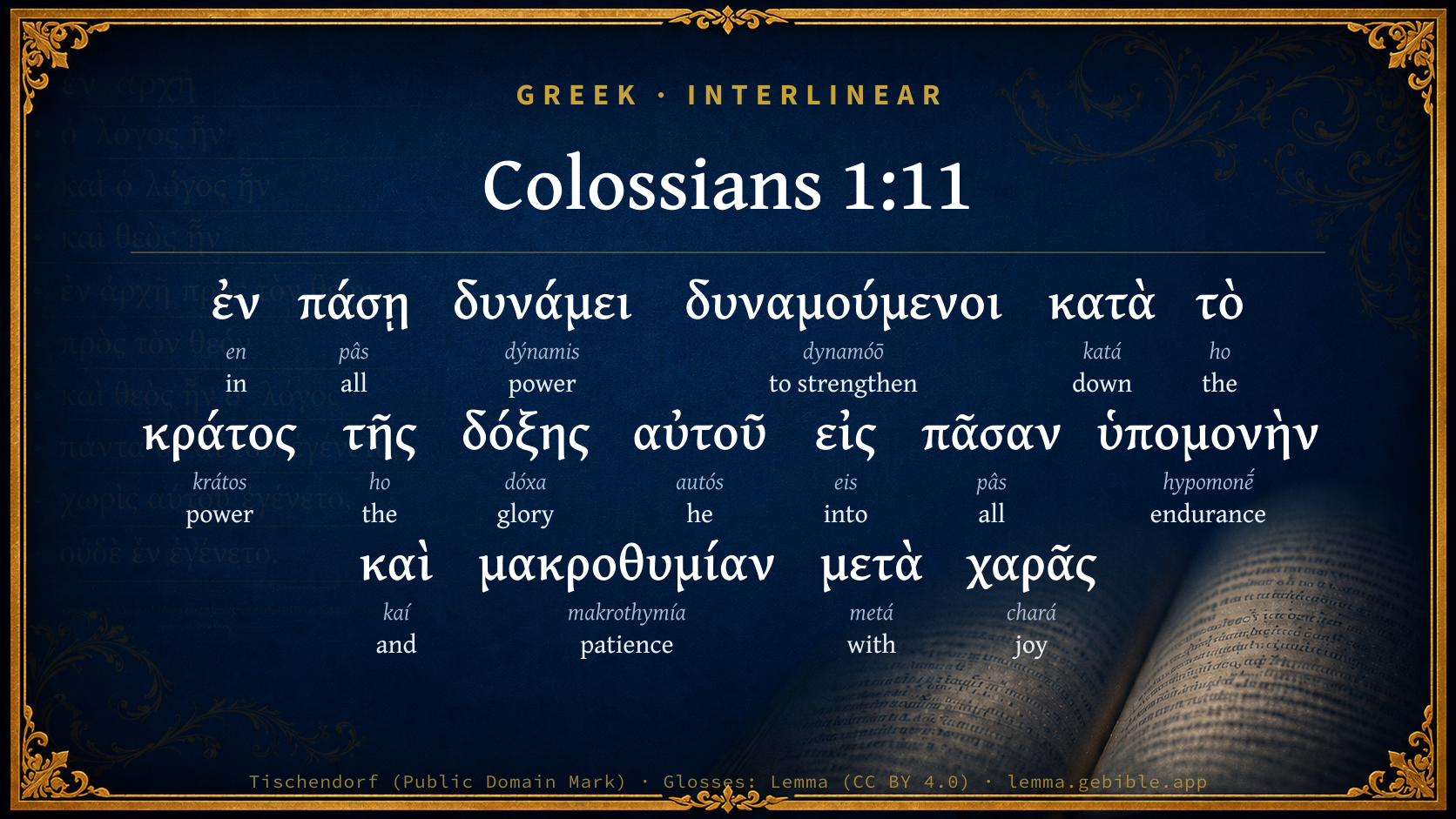
Greek (Tischendorf 8th ed.) Colossians 1:11 appears in the Greek New Testament. The text above is from the Tischendorf 8th edition. Each word links to its Strong’s number and a concise gloss. Click any word for its full Thayer’s Greek Lexicon entry.
Download image
Cite this verse

Colossians 1:11 (World English Bible). Public Domain. Lemma interlinear Bible study tool, https://lemma.gebible.app/v/colossians/1/11.

Show BibTeX & RIS
BibTeX
RIS
English Translation
strengthened with all power, according to the might of his glory, for all endurance and perseverance with joy;
World English Bible · Public Domain
Highlights
  • 1 first appearance in the Greek New Testament
Full analysis ↓
Download a study sheet

One document with this verse’s original text, its word-by-word gloss line, the meaning frame, cross-references with their text, attributed commentary, and full source and license credits — printable, and it pastes into notes with its structure intact.

This verse Autodidact and up

Study sheet (.html) Plain text (.txt)

A passage Seminary Student

Up to 50 verses in one chapter. A passage sheet keeps up to 6 commentary sources and 12 cross-references per verse, in the order this page ranks them, and says so on the sheet whenever that leaves anything out. Ask for a single verse and you get the Autodidact verse sheet above.

Everything on this page stays free to read, with no account — the sheet is a download of what is already on screen, not access to it.

Want to remove ads? Support Godless Engineer
Compare translations 3

The same verse in 3 English versions, stacked beneath the original-language interlinear above. Click any original word for its lexicon entry.

Each is an independent rendering of the whole verse — the interlinear is not word-aligned to these translations.

Highlighted words mark where these versions differ — a whole-verse word diff, not a word-by-word alignment.

  • World English Bible Public Domain
    strengthened with all power, according to the might of his glory, for all endurance and perseverance with joy;
  • King James Version Public Domain
    Strengthened with all might, according to his glorious power, unto all patience and longsuffering with joyfulness;
  • unfoldingWord Literal Text CC BY-SA 4.0
    being strengthened with all power according to the power of his glory to all endurance and patience with joy,

unfoldingWord Literal Text — © unfoldingWord, licensed CC BY-SA 4.0. Word-aligned USFM3 via Door43 (git.door43.org/unfoldingWord/en_ult).

Versions to compare (up to 4)

3 of 4 selected

Show all 19 translations

Every available English version of this verse, each an independent rendering of the whole verse.

  • World English Bible Public Domain
    strengthened with all power, according to the might of his glory, for all endurance and perseverance with joy;
  • Berean Standard Bible Public Domain
    being strengthened with all power according to His glorious might so that you may have full endurance and patience, and joyfully
  • Majority Standard Bible Public Domain
    being strengthened with all power according to His glorious might so that you may have full endurance and patience, and joyfully
  • King James Version Public Domain
    Strengthened with all might, according to his glorious power, unto all patience and longsuffering with joyfulness;
  • American Standard Version (1901) Public Domain
    strengthened with all power, according to the might of his glory, unto all patience and longsuffering with joy;
  • Revised Version (1885) Public Domain
    strengthened with all power, according to the might of his glory, unto all patience and longsuffering with joy;
  • Geneva Bible (1599) Public Domain
    Strengthened with all might through his glorious power, vnto all patience, and long suffering with ioyfulnesse,
  • Douay-Rheims (1899) Public Domain
    Strengthened with all might, according to the power of his glory, in all patience and longsuffering with joy,
  • Young's Literal Translation Public Domain
    in all might being made mighty according to the power of His glory, to all endurance and long-suffering with joy.
  • Literal Standard Version CC BY-SA 4.0
    in all might being made mighty according to the power of His glory, to all endurance and long-suffering with joy.
  • Unlocked Literal Bible CC BY-SA 4.0
    We pray you may be strengthened in every ability according to the power of his glory into all perseverance and patience.
  • unfoldingWord Literal Text CC BY-SA 4.0
    being strengthened with all power according to the power of his glory to all endurance and patience with joy,
  • Darby Bible Public Domain
    strengthened with all power according to the might of his glory unto all endurance and longsuffering with joy;
  • World Messianic Bible Public Domain
    strengthened with all power, according to the might of his glory, for all endurance and perseverance with joy,
  • Webster's Bible Public Domain
    Strengthened with all might, according to his glorious power, to all patience and long-suffering with joyfulness;
  • Free Bible Version CC BY-SA 4.0
    May you be made powerfully strong by his wonderful strength, having great patience and endurance.
  • Bible in Basic English Public Domain
    Full of strength in the measure of the great power of his glory, so that you may undergo all troubles with joy;
  • Text-Critical English NT CC BY 4.0
    being strengthened with all power, according to his glorious might, so that you may have great endurance and patience with joy;
  • Tyndale New Testament (1534) Public Domain
    strengthed with all myght thorowe hys glorious power vnto all pacience and longe sufferynge with ioyfulnes

Literal Standard Version (2020), Covenant Press — licensed CC BY-SA 4.0. Text via the HelloAO Bible API (eBible.org). Unlocked Literal Bible (unfoldingWord) — licensed CC BY-SA 4.0. Text via the HelloAO Bible API (eBible.org). unfoldingWord Literal Text — © unfoldingWord, licensed CC BY-SA 4.0. Word-aligned USFM3 via Door43 (git.door43.org/unfoldingWord/en_ult). Free Bible Version, Dr. Jonathan Gallagher — licensed CC BY-SA 4.0. Text via the HelloAO Bible API (eBible.org).

Word by word

More ways to search: Search by grammar → Find every occurrence → Compare this word →

Practice this passage: Drill this verse → Learn its vocabulary →

δυναμούμενοι
dynamóō
G1412
“to strengthen”
Verb, Present, Passive, Participle, Nominative, Plural, Masculine
Part of Speech
Verb
Tense
Present
Voice
Passive
Mood
Participle
Case
Nominative
Number
Plural
Gender
Masculine
Full Thayer's Definition

Origin: from G1411

TDNT: 06:44,2

1. to make strong, confirm, strengthen
  1. ἐν en G1722 “in” Preposition
  2. πάσῃ pâs G3956 “all” Adjective, Dative, Singular, Feminine
  3. δυνάμει dýnamis G1411 “power” Noun, Dative, Singular, Feminine
  4. κατὰ katá G2596 “down” Preposition
  5. τὸ ho G3588 “the” Article, Accusative, Singular, Neuter
  6. κράτος krátos G2904 “power” Noun, Accusative, Singular, Neuter
  7. τῆς ho G3588 “the” Article, Genitive, Singular, Feminine
  8. δόξης dóxa G1391 “glory” Noun, Genitive, Singular, Feminine
  9. αὐτοῦ autós G846 “he” Personal pronoun, Genitive, Singular, Masculine
  10. εἰς eis G1519 “into” Preposition
  11. πᾶσαν pâs G3956 “all” Adjective, Accusative, Singular, Feminine
  12. ὑπομονὴν hypomonḗ G5281 “endurance” Noun, Accusative, Singular, Feminine
  13. καὶ kaí G2532 “and” Conjunction
  14. μακροθυμίαν makrothymía G3115 “patience” Noun, Accusative, Singular, Feminine
  15. μετὰ metá G3326 “with” Preposition
  16. χαρᾶς chará G5479 “joy” Noun, Genitive, Singular, Feminine

About this verse

These counts appear in no published source. They are computed here, from the morphology-tagged text and Lemma’s own curated glosses. What Lemma adds →

17
words
15
distinct lemmas
Pauline Epistles
section

Notable vocabulary

The rarest word here is δυναμούμενοι to strengthen G1412 — appearing just 2 times in the whole Greek New Testament.

First appearance in Scripture

This word makes its first canonical appearance in the Greek New Testament here:

  • δυναμούμενοι to strengthen G1412

Shared distinctive vocabulary

δυναμούμενοι to strengthen G1412 occurs in 2 verses of the Greek New Testament. Also found in:
Repetition

Words recur within this verse:

Cross-references

25

Topical passages linked to Colossians 1:11 in the Treasury of Scripture Knowledge — connected by theme and wording, ordered by reader-vote popularity; previews shown in the World English Bible.

  • Ephesians 3:16 that he would grant you, according to the riches of his glory, that you may be strengthened with power through his Spirit in the inward man;
  • Philippians 4:13 I can do all things through Christ, who strengthens me.
  • Ephesians 4:2 with all lowliness and humility, with patience, bearing with one another in love;
  • Ephesians 6:10 Finally, be strong in the Lord, and in the strength of his might.
  • Romans 5:3–5 Not only this, but we also rejoice in our sufferings, knowing that suffering works perseverance;
  • 2 Corinthians 4:7 But we have this treasure in clay vessels, that the exceeding greatness of the power may be of God, and not from ourselves.
  • 2 Corinthians 12:9–10 He has said to me, "My grace is sufficient for you, for my power is made perfect in weakness." Most gladly therefore I will rather glory in my weaknesses, that the power of Christ may rest on me.
  • James 1:2–4 Count it all joy, my brothers, when you fall into various temptations,
  • James 5:7–8 Be patient therefore, brothers, until the coming of the Lord. Behold, the farmer waits for the precious fruit of the earth, being patient over it, until it receives the early and late rain.
  • 2 Corinthians 6:4–6 but in everything commending ourselves, as servants of God, in great endurance, in afflictions, in hardships, in distresses,
  • Acts 5:41 They therefore departed from the presence of the council, rejoicing that they were counted worthy to suffer dishonor for Jesus' name.
  • 1 Thessalonians 3:3–4 that no one be moved by these afflictions. For you know that we are appointed to this task.
  • 2 Timothy 2:1–3 You therefore, my child, be strengthened in the grace that is in Christ Jesus.
  • Hebrews 11:34–38 quenched the power of fire, escaped the edge of the sword, from weakness were made strong, grew mighty in war, and turned to flight armies of aliens.
  • Exodus 15:6 Your right hand, Yahweh, is glorious in power, Your right hand, Yahweh, dashes the enemy in pieces.
  • Acts 1:8 But you will receive power when the Holy Spirit has come upon you. You will be witnesses to me in Jerusalem, in all Judea and Samaria, and to the uttermost parts of the earth."
  • Hebrews 12:1–2 Therefore let us also, seeing we are surrounded by so great a cloud of witnesses, lay aside every weight and the sin which so easily entangles us, and let us run with patience the race that is set before us,
  • 2 Peter 1:6 and in knowledge, self-control; and in self-control patience; and in patience godliness;
  • Revelation 14:12 Here is the patience of the saints, those who keep the commandments of God, and the faith of Jesus."
  • Psalms 63:2 So I have seen you in the sanctuary, Watching your power and your glory.
  • Proverbs 24:10 If you falter in the time of trouble, Your strength is small.
  • Isaiah 45:24 Only in Yahweh, it is said of me, is righteousness and strength; even to him shall men come; and all those who were incensed against him shall be disappointed.
  • Romans 2:7 to those who by patience in well-doing seek for glory and honor and incorruptibility, eternal life;
  • Hebrews 10:34–38 For you both had compassion on me in my chains, and joyfully accepted the plundering of your possessions, knowing that you have for yourselves a better possession and an enduring one in the heavens.
  • Jude 1:25 to God our Savior, who alone is wise, be glory and majesty, dominion and power, both now and forever. Amen.

Cross-references courtesy of OpenBible.info (CC BY 4.0).

Commentary

Notes on Colossians 1:11 from classic Christian and Jewish commentators (each source and its license shown beneath its notes). The classic Christian expositions comment on the surrounding passage and are grouped to its opening verse, so a note may address several verses; the Jewish commentaries on the Tanakh (Rashi and others) are per-verse, so they appear only where the commentator wrote on this verse.

Lemma curates 59 commentaries, every one of them public domain or Creative Commons licensed, each selected and text-cleaned for this edition rather than reprinted as found. About our sources →

The Cambridge Bible for Schools and Colleges

gen. ed. J. J. S. Perowne

11. strengthened] “made powerful;” R.V. marg. The same verb occurs in the LXX. of Psalms 67 :(Heb. and Eng. 68.) 28, and some other O.T. passages, and in Heb_11:34. A compound of it occurs Act_9:12; Rom_4:20; Eph_6:10; Php_4:13.—The three last reff. are a full spiritual commentary on the word here.—The Lat. Versions have confortati; Wyclif, “counfortid.”—Observe that the Greek participle is in the present or continuing form, and suggests a maintained and abiding strengthening.

with] Lit., in.

all might] Greek dunamis; the cognate noun to the verb just rendered “strengthened.” The strengthening was to meet “all” sides and kinds of spiritual need with a corresponding completeness.—For the word in such a connexion, cp. especially Luk_24:49; Act_1:8 in the Greek.

according to his glorious power] Lit. and far better, according to the power (or might, R.V.) of His glory; in a way worthy of the forces springing from that “glory” of God which is in fact His supreme and blessed Nature in manifestation.—The word “glorious” (in the A.V.) represents similar Greek in the following passages; Rom_8:21; 2Co_4:4; Php_3:21; 1Ti_1:11; Tit_2:13; and these all gain greatly in significance by the literal rendering.

unto all patience] The “all” of result answers to the “all” of Divine supply.

“Patience:”—the Greek word rises above, while it amply includes, the thought of uncomplaining suffering. It is a noble word, denoting the endurance of the soul in the path of faith, hope, and love; perseverance, under trials, in the will of God. Cp. (in the Greek) especially Mat_10:22; Luk_8:15; Luk_21:19; Rom_2:7; Heb_12:1; Heb_12:7.

longsuffering] Latin Versions, longanimitas, a beautiful and literal equivalent for the Greek. The word “longanimity,” formed on this, and used by the Rhemish translators (1582), was adopted by Bp Jeremy Taylor (cent. 17), but has never taken root in English.—The temper indicated is the opposite to that haste of spirit which gives the man no time, under pressure of pain or (particularly) of wrong, to remember what is due to others, and to the Lord. Cp., for the use of the word and its cognates, Mat_18:26; 1Co_13:4, &c.; and, for a soul-moving reference to the “longanimity” of the Lord Himself, 1Ti_1:16.—The two words, “patience,” “longsuffering,” occur together, 2Co_6:4; 2Co_6:6; 2Ti_3:10; Jas_5:10-11.

with joyfulness] with joy. Cp. esp. Isa_29:19; Hab_3:17-18; Joh_16:20-24; Joh_17:14; Act_13:52 (a good illustration here from facts); Rom_14:17; Rom_15:13; 1Th_1:6; Heb_10:34; Jas_1:2; 1Pe_1:8. Nothing like the Gospel can open the secret of a joy, perfectly real and unaffected, under sufferings and sorrows, and that without the least tendency to blunt sensibility.

Observe the holy paradox of the thought here. The fulness of Divine power in the saints is to result primarily not in “doing some great thing” but in enduring and forbearing, with heavenly joy of heart. The paradox points to one deep characteristic of the Gospel, which prepares the Christian for service by the way of a true abnegation of himself as his own strength and his own aim.

The Cambridge Bible for Schools and Colleges (gen. ed. J. J. S. Perowne; Cambridge University Press, 1878–1918) — public domain. Text from a community e-Sword module.

Matthew Poole's English Annotations

Strengthened with all might, according to his glorious power: whereunto that they might be enabled, it was needful to pray for a power from above, for the best Christians here below are but infirm as well as imperfect, not able to perform what is required of them for doing and suffering the will of God till strengthened: See Poole on "Phi 4:13", compared with Rev 7:17. We have here great need of all might, special aids of God, to discharge difficult duties, to mortify strong corruptions, to contemn worldly allurements, to repulse frequent temptations, to bear manifold crosses, and to improve daily mercies, derived from exceeding great and mighty power; See Poole on "Eph 1:19". See Poole on "Eph 1:20". See Poole on "Eph 3:16"; an excellent glorious power, 2Co 4:7,13, needful to consummate and complete, as well as begin, the work of grace, 2Th 1:11; a great reality (and not a metaphor) to sincere converts and sound believers.

Unto all patience; every way to bear the things which come hard upon them or continue long. Philosophy, with all its prescriptions, is ineffectual to form the soul to true patience and contentment under sufferings, it must be given on the behalf of Christ, Phi 1:29, to a believer, to suffer patiently in tongue and heart, without a prevailing mixture of passion, so that evils do not make all impression upon him, but he doth possess his soul with patience to the end.

And long-suffering with joyfulness; which he could not do with a becoming Christian cheerfulness, when, surcharged with a weight of troubles, he finds himself sinking, if he were not supported with the hands of Heaven, which relieve with present comfort, and raise up to believe a future reward, Mat 5:12; Act 5:41; Rom 5:3; 1Co 11:32; 2Co 1:5; Heb 11:27; 12:10,12; Jas 1:2,4.

Matthew Poole's English Annotations on the Holy Bible (1683–1685) — public domain. Text from a community e-Sword/MySword module.

The Biblical Illustrator

Joseph S. Exell

Col_1:11

Strengthened with all might according to His glorious power.

Gods all strength

I. The strength.

1. The reference is not to intellectual strength, although no doubt as a highly intellectual man, the apostle would highly prize this in his brethren. It is important as a shield to protect from imposition, for guidance in times of sifting or wild speculation, and its possession widens the distance between man and the lower creation, and assimilates to Him whose understanding is infinite.

2. Here reference is to power distinctively spiritual. Paul prayed that they might be strengthened in their ethical principles, so that they might be stronger in their faith, hope, and love. This was important for their Christian consistency, usefulness, and prosperity,

II. The strengthening. Strengthened in all strength. As if the apostle conceived them as needing to be immersed in some other ones strength greater than their own: and as he was thinking of Divine strength, he did not scruple to say all strength, i.e., strength all-sufficient. Not merely enough for some duties and trials, but such as would enable them to say, I can do all things (Php_4:13). All kinds of strength belong to God, physical, intellectual, moral Nothing is too hard for the Lord. Power belongeth unto God, and not only that which can create and uphold. What power of perception from which nothing is hidden! of memory! looking back into infinity; of prevision! looking forward into eternity. Hence this moral power. What power of goodness, righteousness, compassion, and forgiving fervour--all inherently infinite. No wonder Paul speaks of the power of His glory, the power that is inherent in His glory and therefore glorious. No wonder that he desires that the Colossians should be steeped in it.

III. The result of the strengthening.

1. Patience is needed on the part of all in such a world as this. Men everywhere have had trials that have taxed them to the utmost, and will continue to have. But the reference here is to the trials which Christians have in addition as Christians, to which they are exposed for the gospels sake at home and in society.

2. Long-suffering is akin to patient endurance. It is the opposite of irascibility in relation to persons who deal with us unreasonably or unkindly, whereas patience has to do with things. With trying things our difficulty is to endure; with trying persons to suppress irritability.

3. But these are not enough. Paul wants joyfulness in addition. But he knew that the happy God could and would make all things work together for good, and so enable His people to rejoice in the Lord alway. (J. Morison, D. D.)

Strengthened with glorious power

I. Why does the apostle say, strengthened with all might?

1. To intimate that we fight not against one enemy, neither are opposed by weapons on one side only, but by many, and on every side. Unless we overcome these enemies, one and all, we are conquered. There is therefore need of all might against every kind of enemy.

II. The apostle could have said, we are strengthened by God, or by His power; but he adds this epithet, glorious power.

1. That we may place the greater confidence in this Divine power. Because this very word contains in itself an earnest of victory and triumph; for this could not be glorious power, if it might be overcome by an evil spirit and sin (Rom_8:1-39.).

2. It is called glorious power on account of the admirable mode of conquering the devil, the world, and the flesh. For the Spirit of God not immediately, by His absolute power, beats off these enemies of our salvation; but by inspiring us with strength, causes even ourselves to trample them under. Moreover, that power must necessarily be very admirable and glorious which makes feeble man, clothed with sinful flesh, to overcome the insults and wiles of devils, the alarms and solicitations of the flesh, the hatred, snares, and injuries of the whole world. Of this glorious power God Himself speaks (2Co_12:9; Vide 1Co_1:27). (Bishop Davenant.)

The source and object of spiritual strength

I. The process experienced. Strengthened with all might.

1. Man is essentially weak, and his frequent boasting of strength is but a sign of it. Adam was weak, and fell before the first assault; and now that sin, thus triumphing, has entered into our world, degenerate men are weaker still. It was when we were without strength that God laid help on One mighty to save.

2. Yet men rarely think of their weakness, and consider themselves equal to all the demands made upon them. It is only when a man receives new power that he is conscious of his weakness. It is when you try to stem a torrent that you know its force, so when a Christian begins to crucify his flesh he knows its power. But for him there is might to overcome. Yet how much weakness is manifest in professors. You see men conquered by the love of the world, and those who began well slackening their pace, and instead of resisting the allurements around them becoming entangled by them and falling into spiritual apostasy.

3. Mark the fulness of the blessing.

(1) With might for all the faculties of the soul, so that every power of manhood shall be invigorated.

(2) For all the wants of life created by its varied circumstances of prosperity and adversity.

II. The divine principle manifested--according to the power of His glory (Eph_3:16).

1. Spiritual power, then, is not indigenous to the soul; it is from God, who alone knows its capacities and needs. If the word or smile of an earthly: parent can strengthen the soul of his child, much more God. We can only influence from without, God from within.

2. The principle of this Divine action is according, etc. Often are Gods power and glory conjoined (Psa_63:2; Rev_19:1). Power is an essential attribute of the Divine glory.

(1) The glory of God is powerful in creation. The heavens declare, etc. Power is everywhere apparent. Even the thoughtless, who have no eye to trace His wisdom and no heart to acknowledge His goodness, are constrained to see His eternal power and Godhead.

(2) In providence (Psa_62:11; Job_9:19; Dan_4:35). What power in ordering times and seasons, governing a tumultuous world, restraining powers of darkness and preserving a feeble Church.

(3) In redemption. Christ, who is the brightness of His glory, is the power of God. The exceeding greatness of His power working by His spirit accomplishes the new creation and strengthens the souls of His children.

3. The expression suggests the measure of the might imparted--not according to human power or angelic might, but according to a Divine measure. As the power of the Divine glory is manifested in nature, providence, or redemption, so will it be in the souls,experiences, and triumphs of His people.

4. It is also the model of our might. We may be strengthened with a might corresponding to the power of Gods glory, so that we shall be strong in accordance with our finite nature as God is strong according to His infinite nature.

III. The great moral purpose of this strengthening--not so much to do as to suffer, which requires the greatest strength.

1. Patience has its sphere in relation to God.

(1) In the endurance of trial. Our discipline is often protracted, and we are apt to sink. How much we need the promised strength.

(2) In anticipation of coming good. The deliverance is long protracted. We become impatient, and ask, Where is the promise of His coming? and impatience often leads to sin, and is always a sign of weakness. To possess our souls in patience and bide Gods time requires His strength. Long-suffering has its sphere in relation to man, and means long-mindedness as opposed to shortness of temper in the midst of irritation. It requires the strength of God to imitate His forbearance who endured such contradiction of sinners.

3. The spirit of this patience or joyfulness produced by a consciousness of power to strengthen, deliver, reward. (J. Spence, D. D.)

Patience

Patience is the superintendent of all the affairs of God, and without it it is not possible to execute His commands or to wait for His promises. It defeats all its enemies without toil. Its repose is more efficacious than the movements and deeds of others. It renders those things salutary to us which, of their own nature, are most pernicious. It changes poisons into remedies, and defeats into victories. It rejoices the angels, it confounds devils, it overcomes the world. It subdues the greatest courage, and converts the most obstinate hearts. It is the strength and the triumph of the Church, according to the saying of the ancient oracle, In returning and rest shall ye be saved; in quietness and in confidence shall be your strength. (Tertullian.)

Patience and long-suffering

Long suffering will be found to express patience in respect of persons, and patience the same in respect to things. The man is long-suffering, who, having to do with injurious persons does not suffer himself easily to be provoked by them, or to blaze up into anger. The man is patient who, under a great siege of trials, bears up and does not lose heart or courage (Rom_5:3; 2Co_1:6). We should speak, there fore, of the long-suffering of David (2Sa_16:10-13), the patience of Job (Jam_5:11). Thus, while both graces are ascribed to the saints, only long-suffering is an attribute of God. Men may tempt and provoke Him, and He may and does display an infinite long-suffering in regard of them (Exo_34:6; Rom_2:4; 1Pe_3:20); there may be a resistance to God in men, because He respects the wills with which He has created them, even when those wills are fighting against Him. But there can be no resistance to God, nor burden upon Him, the Almighty, from things; therefore patience cannot find place in Him, nor is it ever rightly ascribed to Him; for when God is called the God of patience (Rom_15:5) this does not mean God whose attribute patience is, but God who gives patience to His people. (See also 1Pe_5:10; Heb_13:20; Rom_15:13). (Archbishop Trench.)

The two words occur in the same context in 2Co_6:4; 2Co_6:6; 2Ti_3:10; Jam_5:10-11. The difference of meaning is best seen in their opposites. While patience is the temper which does not easily succumb under suffering, long-suffering is the self-restraint that does not hastily retaliate a wrong. The one is opposed to cowardice or despondency, the other to wrath or revenge (Pro_15:18; Pro_16:32). (Bishop Lightfoot.)

Peace in pain

I have been ready to doubt, said Dr. Payson, whether pain be really an evil; for though more pain was crowded into last week than any other week of my life, yet it was one of the happiest weeks of my life, and now I am ready to say, Come what will, come sickness, pain, agony, poverty, loss of friends; only let God come with them, and they shall be welcome. Later, on his death-bed, he said, Every bone is almost dislocated with pain; yet while my body is thus tortured, my soul is perfectly happy and peaceful, more happy than I can possibly express to you. I seem to swim in a flood of glory which God pours down on me.

Patient long-suffering

I heard of a city missionary who was going along one of the streets and saw a little girl sleeping on the steps of a door, and he awoke her, and said, Why are you sleeping here in this drizzling rain? And she said, My father has turned me out of doors. Hes a drunkard, and Im waiting till he falls asleep, and then Im going into the house. The next morning the drunken father awakened from his dream of iniquity, and he saw his little girl preparing his breakfast, and he said, Milly, why do you stay with me? Oh, she said, father, I love you; and my mother, when she died, said I must never leave you. She said the rum fiend would sometimes go out of you, and then you would be very kind to me; and so she said I was never to leave you, and, father, I never will.

The Biblical Illustrator, edited by Joseph S. Exell (c. 1880s–1900s) — public domain. Text from a community e-Sword module.

The Pulpit Commentary

In all power being empowered, according to the might of his glory, unto all patience and long suffering with joyfulness. (vers. 24, Eph_1:19 Eph_3:16 Eph_6:10; 1Co_16:13; 2Ti_1:7, 8 2:1, 3, 9, 10; 1Pe_5:10) The same word is repeated as noun and verb (dunamiv, dunamow, power, empower) with a strong Hebraistic sort of emphasis. (otherwise in Eph_3:16) In all (every kind of) power gives the mode, according to the might of his glory the measure, and unto all patience, etc., the end of this Divine strengthening. "Might" (kratov), in distinction from power (dunamiv) and other synonyms (comp. ver. 29; Eph_1:19 Eph_6:10) implies "mastery," "sovereign sway," and, except in Heb_2:14 ("might of death") is used in the New Testament only of the power of God. "Glory," Php_3:21, bears a substantive meaning of its own, and is not a mere attributive of "might." It is the splendour of God"s revelations of himself, in which his might is So conspicuous. Gazing on this glory, especially as seen in Christ (2Co_4:6) and the gospel, (1Ti_1:11, R.V) the Christian discerns the might of him from whom it streams forth, and understands how that might is engaged in his behalf (Eph_1:19, Eph_1:20; comp.; Isa_40:28, 29 42:5, 6) and this thought fills him with invincible courage and endurance. Patience is steadfastness and stout heartedness under ill fortune (not a mere resigned patience); long suffering is gentleness of temper and magnanimity under ill treatment (comp. Col_3:12; and see Lightfoot, in loc., and Trench"s "Synonyms Christ, in his earthly life, was the supreme example of patience (2Th_3:5, R.V; 1Pe_2:21-23; Heb_12:3, Heb_12:4) which is "wrought by tribulation": (Rom_5:4) long-suffering finds its pattern in God"s dealing with "the unthankful and evil" (Rom_2:4; 1Ti_1:16 1Pe_3:20; 2Pe_3:15) "With joyfulness" belongs to this clause (Theodoret, Calvin, Bengel, Alford, Lightfoot) rather than the next, and lends a more vivid force to the foregoing words, while comparatively needless if prefixed to those that follow (so, however, Chrysostom, Erasmus, Meyer, Ellicott joy giving thanks," etc.). This paradox is genuinely Pauline, and arises from personal experience (comp. ver. 24; Php_1:29; Rom_5:3; 1Th_1:6; 2Co_1:4-8 2Co_6:10 2Co_12:9, 2Co_12:10)

The Pulpit Commentary (1880–1919), ed. H.D.M. Spence-Jones & Joseph S. Exell — public domain. Text from a community e-Sword module.

MacLaren's Expositions of Holy Scripture

Alexander MacLaren

Colossians

‘ALL POWER’

Col 1:11 {R.V.}.

There is a wonderful rush and fervour in the prayers of Paul. No parts of his letters are so lofty, so impassioned, so full of his soul, as when he rises from speaking of God to men to speaking to God for men. We have him here setting forth his loving desires for the Colossian Christians in a prayer of remarkable fulness and sweep. Broadly taken, it is for their perfecting in religious and moral excellence, and it is very instructive to note the idea of what a good man is which is put forth here.

The main petition is for wisdom and spiritual understanding applied chiefly, as is to be carefully noted, to the knowledge of God’s will . The thought is that what it most imports us to know is the Will of God, a knowledge not of merely speculative points in the mysteries of the divine nature, but of that Will which it concerns us to know because it is our life to do it. The next element in Paul’s desires, as set forth in the ideal here, is a worthy walk, a practical life, or course of conduct which is worthy of Jesus Christ, and in every respect pleases Him. The highest purpose of knowledge is a good life. The surest foundation for a good life is a full and clear knowledge of the Will of God.

Then follow a series of clauses which seem to expand the idea of the worthy walk and to be co-ordinate or perhaps slightly causal, and to express the continuous condition of the soul which is walking worthily. Let us endeavour to gather from these words some hints as to what it is God’s purpose that we should become.

I. The many-sided strength which may be ours.

The form of the word ‘strengthened’ here would be more fully represented by ‘being strengthened,’ and suggests an unintermitted process of bestowal and reception of God’s might rendered necessary by our continuous human weakness, and by the tear and wear of life. As in the physical life there must be constant renewal because there is constant waste, and as every bodily action involves destruction of tissue so that living is a continual dying, so is it in the mental and still more in the spiritual life. Just as there must be a perpetual oxygenation of blood in the lungs, so there must be an uninterrupted renewal of spiritual strength for the highest life. It is demanded by the conditions of our human weakness. It is no less rendered necessary by the nature of the divine strength imparted, which is ever communicating itself, and like the ocean cannot but pour so much of its fulness as can be received into every creek and crack on its shore.

The Apostle not merely emphasises the continuousness of this communicated strength, but its many-sided variety, by designating it ‘all power.’ In this whole context that word ‘all’ seems to have a charm for him. We read in this prayer of ‘ all spiritual wisdom,’ of ‘walking worthily of the Lord unto all pleasing,’ of ‘fruit in every good work,’ and now of ‘ all power,’ and lastly of ‘ all patience and longsuffering.’ These are not instances of being obsessed with a word, but each of them has its own appropriate force, and here the comprehensive completeness of the strength available for our many-sided weakness is marvellously revealed. There is ‘infinite riches in a narrow room.’ All power means every kind of power, be it bodily or mental, for all variety of circumstances, and, Protean, to take the shape of all exigencies. Most of us are strong only at points, and weak in others. In all human experience there is a vulnerable spot on the heel. The most glorious image, though it has a head of gold, ends in feet, ‘part of iron and part of clay.’

And if this ideal of many-sided power stands in contrast with the limitations of human strength, how does it rebuke and condemn the very partial manifestations of a very narrow and one-sided power which we who profess to have received it set forth! We have access to a source which can fill our whole nature, can flower into all gracious forms, can cope with all our exigencies, and make us all-round men, complete in Jesus Christ, and, having this, what do we make of it, what do we show for it? Does not God say to us, ‘Ye are not straitened in me, ye are straitened in yourselves; I beseech you be ye enlarged.’

The conditions on our part requisite for possessing ‘all might’ are plain enough. The earlier portion of the prayer plainly points to them. The knowledge of God’s Will and the ‘walk worthy of the Lord’ are the means whereby the power which is ever eager to make its dwelling in us, can reach its end. If we keep the channel unchoked, no doubt ‘the river of the water of life which proceedeth from the throne of God and the Lamb’ will rejoice to fill it to the brim with its flashing waters. If we do not wrench away ourselves from contact with Him, He will ‘strengthen us with all might.’ If we keep near Him we may have calm confidence that power will be ours that shall equal our need and outstrip our desires.

II. The measure of the strength.

It is ‘according to the power of His glory.’ The Authorised Version but poorly represents the fulness of the Apostle’s thought, which is more adequately and accurately expressed in the Revised Version. ‘His glory’ is the flashing brightness of the divine self-manifestation, and in that Light resides the strength which is the standard or measure of the gift to us. The tremendous force of the sunbeam which still falls so gently on a sleeper’s face as not to disturb the closed eyes is but a parable of the strength which characterises the divine glory. And wonderful and condemnatory as the thought is, that power is the unlimited limit of the possibilities of our possession. His gifts are proportioned to His resources. While He is rich, can I be poor? The only real limit to His bestowal is His own fulness. Of course, at each moment, our capacity of receiving is for the time being the practical limit of our possession, but that capacity varies indefinitely, and may be, and should be, indefinitely and continuously increasing. It is an elastic boundary, and hence we may go on making our own as much as we will, and progressively more and more, of God’s strength. He gives it all, but there is a tragical difference between the full cup put into our hands and the few drops carried to our lips. The key of the treasure-chamber is in our possession, and on each of us His gracious face smiles the permission which His gracious lips utter in words, ‘Be it unto thee even as thou wilt.’ If we are conscious of defect, if our weakness is beaten by the assaults of temptation, or crushed by sorrows that ride it down in a fierce attack, the fault is our own. We have, if we choose to make it our own and to use it as ours, more than enough to make us ‘more than conquerors’ over all sins and all sorrows.

But when we contrast what we have by God’s gift and what we have in our personal experience and use in our daily life, the contrast may well bring shame, even though the contrast brings to us hope to lighten the shame. The average experience of present-day Christians reminds one of the great tanks that may be seen in India, that have been suffered to go to ruin, and so an elaborate system of irrigation comes to nothing, and the great river that should have been drawn off into them runs past them, all but unused. Repair them and keep the sluices open, and all will blossom again.

III. The great purpose of this strength.

‘Patience and longsuffering with joyfulness’ seems at first but a poor result of such a force, but it comes from a heart that was under no illusions as to the facts of human life, and it finds a response in us all. It may be difficult to discriminate ‘patience’ from ‘longsuffering,’ but the general notion here is that one of the highest uses for which divine strength is given to us, is to make us able to meet the antagonism of evil without its shaking our souls. He who patiently endures without despondency or the desire to ‘recompense evil for evil,’ and to whom by faith even ‘the night is light about him,’ is far on the way to perfection. God is always near us, but never nearer than when our hearts are heavy and our way rough and dark. Our sorrows make rents through which His strength flows. We can see more of heaven when the leaves are off the trees. It is a law of the Divine dealings that His strength is ‘made perfect in weakness.’ God leads us in to a darkened room to show us His wonders.

That strength is to be manifested by us in ‘patience and longsuffering,’ both of which are to have blended with them a real though apparently antagonistic joy. True and profound grief is not opposed to such patience, but the excess of it, the hopeless and hysterical outbursts certainly are. We are all like the figures in some old Greek temples which stand upright with their burdens on their heads. God’s strength is given that we may bear ours calmly, and upright like these fair forms that hold up the heavy architecture as if it were a feather, or like women with water-jars on their heads, which only make their carriage more graceful and their step more firm.

How different the patience which God gives by His own imparted strength, from the sullen submission or hysterical abandonment to sorrow, or the angry rebellion characterising Godless grief! Many of us think that we can get on very well in prosperity and fine weather without Him. We had better ask ourselves what we are going to do when the storm comes, which comes to all some time or other.

The word here rendered ‘patience’ is more properly ‘perseverance.’ It is not merely a passive but an active virtue. We do not receive that great gift of divine strength to bear only, but also to work, and such work is one of the best ways of bearing and one of the best helps to doing so. So in our sorrows and trials let us feel that God’s strength is not all given us to be expended in our own consolation, but also to be used in our plain duties. These remain as imperative though our hearts are beating like hammers, and there is no more unwise and cowardly surrender to trouble than to fling away our tools and fold our hands idly on our laps.

But Paul lays a harder duty on us even in promising a great gift to us, when he puts before us an ideal of joy mingling with patience and longsuffering. The command would be an impossible one if there were not the assurance that we should be ‘strengthened with all might.’ We plainly need an infusion of diviner strength than our own, if that strange marriage of joy and sorrow should take place, and they should at once occupy our hearts. Yet if His strength be ours we shall be strong to submit and acquiesce, strong to look deep enough to see His will as the foundation of all and as ever busy for our good, strong to hope, strong to discern the love at work, strong to trust the Father even when He chastens. And all this will make it possible to have the paradox practically realised in our own experience, ‘As sorrowful yet always rejoicing.’ One has seen potassium burning underwater. Our joy may burn under waves of sorrow. Let us bring our weakness to Jesus Christ and grasp Him as did the sinking Peter. He will breathe His own grace into us, and speak to our feeble and perchance sorrowful hearts, as He had done long before Paul’s words to the Colossians, ‘My grace is sufficient for thee, and my strength is made perfect in weakness.’

Alexander MacLaren, Expositions of Holy Scripture (1904–1910) — public domain. Text from a community e-Sword module.

Bengel's Gnomon

Johann Albrecht Bengel

Col 1:11. Δυνάμει, with might) Eph 1:19; Eph 3:16; Eph 6:10.—δόξης, the power of His glory [Engl. Vers. His glorious power]) Rom 6:4.—μακροθυμίαν, long-suffering) Eph 4:2.—μετὰ χαρᾶς, with joy) Col 1:24.

Bengel's Gnomon of the New Testament — English translation (T&T Clark, Edinburgh, 1860) — public domain. Text from a community e-Sword module.

Meyer's Critical & Exegetical Commentary

Heinrich August Wilhelm Meyer

Col_1:11 is co-ordinate with the foregoing ἐν παντὶ ἔργῳ … Θεοῦ.

ἐν πάσῃ δυν. δυναμ.] ἐν is instrumental, as in Col_1:9 (Eph_6:10; 2Ti_2:1); hence not designating that, in the acquiring of which the invigoration is supposed to consist (Hofmann), but: by means of every (moral) power (by its bestowal on Gods part) becoming empowered. δυναμόω (Lobeck, ad Phryn. p. 605) does not occur in Greek authors, and is only found here and at Heb_11:34, Lachm. in the N. T.; in the LXX. at Ecc_10:10; Dan_9:27; Ps. 67:31; in Aquila; Job_36:9; Psa_64:4. Paul elsewhere uses ἐνδυναμοῦν.

κατὰ τὸ κράτος τῆς δόξ. αὐτ.] according to the might of His majesty; with this divine might (see as to κράτος on Eph_1:19), through the powerful influence of which that strengthening is to be imparted to them, it is also to be correspondentand thereby its eminent strength and efficacy are characterized (κατά in Eph_1:19 has another sense). Comp. 2Th_2:9; Php_3:21. And τὸ κράτος τ. δόξ. αὐτ. is not His glorious power (Luther, Castalio, Beza, and others; also Flatt and Bähr), against which αὐτοῦ should have been a sufficient warning; but τὸ κράτος is the appropriate attribute of the divine majesty (of the glorious nature of God). Comp. Eph_3:16; Sir_18:5. The κράτος therefore is not the glory of God (Böhmer), but the latter has the former,and the δόξα is not to be referred to a single aspect of the divine greatness (Grotius: power; Huther: love), but to its glorious whole. Comp. on Rom_6:4.

εἰς πᾶσαν ὑπομ. κ. μακροθ.] in respect to every endurance (in affliction, persecution, temptation, and the like, comp. Rom_5:3; 2Co_1:6; 2Co_6:4; Jam_1:3 f.; Luk_8:15; Rom_2:7, et al.) and long-suffering (towards the offenders and persecutors), that is, so as to be able to exercise these virtues in every way by means of that divine strengthening. The distinction of Chrysostom: μακροθυμεῖ τις πρὸς ἐκείνους οὓς δυνατὸν καὶ ἀμύνασθαι· ὑπομένει δὲ, οὓς οὐ δύναται ἀμύνασθαι, is arbitrary. See, on the contrary, for instance, Heb_12:2-3. Others understand it variously; but it is to be observed, that ὑπομονή expresses the more general idea of endurance, and that μακροθυμία, the opposite of which is ὀξυθυμία (Eur. Andr. 729; Jam_1:19) and ὀξυθύμησις (Artem. iv. 69), always refers in the N. T. to the relation of patient tolerance towards offenders. Comp. Col_3:12; Gal_5:22; Rom_2:4; Eph_4:2; also Heb_6:12; Jam_5:10.

μετὰ χαρᾶς] is joined with πᾶσαν ὑπομ. κ. μακροθ. by Theodoret, Luther, Beza, Castalio, Calvin, Grotius, Calovius, Bengel, Heinrichs, and many others, including Olshausen, Bähr, Steiger, de Wette, Baumgarten-Crusius, Dalmer, so that the true, joyful patience (comp. Col_1:24) is denoted. But the symmetry of the passage (see on Col_1:10), in which the two previous participles are also preceded by a prepositional definition, points so naturally to the connection with what follows (Syr., Chrysostom, Oecumenius, Theophylact, Erasmus, Estius, and others, including Lachmann, Tischendorf, Böhmer, Huther, Ewald, Ellicott, Bleek, Hofmann), that it cannot be abandoned without arbitrariness. Even in that case, indeed, the thought of joyful patience, which is certainly apostolic (Rom_5:3; 1Pe_1:6; Rom_12:12; comp. Mat_5:12), is not lost, when the intercession rises from patience to joyful thanksgiving. Observe also the deliberate juxtaposition of μετὰ χαρᾶς εὐχαριστ.

Meyer — Critical and Exegetical Commentary on the New Testament — English translation by Peter Christie, edited by Frederick Crombie (T&T Clark, 1880) — public domain. Text from a community e-Sword module.

Expositor's Greek Testament

ed. W. Robertson Nicoll

Col 1:11 . ἐν πάσῃ δυνάμει : “with all power,” ἐν being instrumental. κατὰ τὸ κράτος τῆς δόξης αὐτοῦ . The equipment with power is proportioned not simply to the recipient’s need, but to the Divine supply. God’s glory is His manifested nature, here as manifested in might. εἰς πᾶσαν ὑπομονὴν καὶ μακροθυμίαν . This equipment with Divine power is not, as we might have expected, said to be given with a view to deeds of great spiritual heroism, but for the practice of passive virtues, since this often puts the greater strain on the Christian’s strength. ὑπομ . is endurance, steadfastness in face of trials, temptations and persecutions; μακροθ . is forbearance, the patience of spirit which will not retaliate. “The one is opposed to cowardice or despondency , the other to wrath or revenge ” (Lightf.). There seems to be no reference in μακροθ ., as Alford supposes, to their attitude in conflict with error. μετὰ χαρᾶς : not to be taken (as by Mey., Ell., Hofm., Weiss, Abb.) with εὐχαριστ ., which would be tautological and throw a false emphasis on these words, but with ὑπομ . κ . μακροθ . It forms a very necessary addition, for the peculiar danger of the exercise of those qualities is that it tends to produce a certain gloominess or sourness of disposition. The remedy is that the Christian should be so filled with joy that he is able to meet all his trials with a buoyant sense of mastery.

The Expositor's Greek Testament, edited by W. Robertson Nicoll (1897–1910) — public domain. Text from a community e-Sword module.

Geneva Bible (1599)

Geneva Bible translators

It must not be unwilling, and as it were drawn out of us by force, but proceed from a merry and joyful mind.

The gift of continuance is not of us, but it proceedeth from the virtue of God, which he doth freely give us.

Geneva Bible (1599) marginal notes — public domain. Text via Bolls.life.

Jamieson, Fausset & Brown

Robert Jamieson, A. R. Fausset & David Brown

Greek, "Being made mighty with (literally, 'in') all might."

according to his glorious power--rather, "according to the power (the characteristic of 'His glory,' here appropriate to Paul's argument, Eph 1:19; Eph 6:10; as its exuberant 'riches,' in Eph 3:16) of His glory." His power is inseparable from His glory (Rom 6:4).

unto all patience--so as to attain to all patient endurance; persevering, enduring continuance in the faith, in spite of trials of persecutors, and seductions of false teachers.

long-suffering--towards those whom one could repel. "Patience," or "endurance," is exercised in respect to those whom one cannot repel [CHRYSOSTOM].

with joyfulness--joyful endurance (Act 16:25; Rom 5:3, Rom 5:11).

Jamieson, Fausset & Brown — Commentary Critical and Explanatory on the Whole Bible (1871) — public domain (CC PDM 1.0). Text via the HelloAO Bible API.

Adam Clarke's Commentary

Verse 11. Strengthened with all might] That they might be able to walk worthy of the Lord, bring forth fruit, &c. See Clarke on Eph 3:13, &c.

According to his glorious power] According to that sufficiency of strength which may be expected from him who has all power both in the heavens and in the earth.

Unto all patience] Relieving, hoping, and enduring all things.

With joyfulness] Feeling the continual testimony that ye please God, which will be a spring of perpetual comfort. See Clarke on Eph 4:2.

Adam Clarke's Commentary on the Bible (1810–1826) — public domain. Text from a community e-Sword/MySword module.

John Calvin's Commentaries

11. Strengthened with all might. As he has previously prayed that they might have both a sound understanding and the right use of it, so also now he prays that they may have courage and constancy. In this manner he puts them in mind of their own weakness, for he says, that they will not be strong otherwise than by the Lord’s help; and not only so, but with the view of magnifying this exercise of grace the more, he adds, according to his glorious power. “So far from any one being able to stand, through dependence on his own strength, the power of God shews itself illustriously in helping our infirmity.” Lastly, he shews in what it is that the strength of believers ought to display itself — in all patience and long-suffering. For they are constantly, while in this world, exercised with the cross, and a thousand temptations daily present themselves, so as to weigh them down, and they see nothing of what God has promised. They must, therefore, arm themselves with an admirable patience, that what Isaiah says may be accomplished,

In hope and in silence shall be your strength. (Isaiah 30:15.)

It is preferable to connect with this sentence the clause, with joy. For although the other reading is more commonly to be met with in the Latin versions, this is more in accordance with the Greek manuscripts, and, unquestionably, patience is not sustained otherwise than by alacrity of mind, and will never be maintained with fortitude by any one that is not satisfied with his condition.

John Calvin's Commentaries (1540-1563) — public domain. Text from the Calvin Translation Society English edition (1840s-50s) via the Christian Classics Ethereal Library (ccel.org). Calvin's coverage is partial (roughly two-thirds of the Bible); uncommented books and verses are honest gaps, never fabricated. The 19th-century editor's footnotes and remarks are omitted so the notes are faithfully Calvin's own voice.

Ellicott's Commentary for English Readers

(11) His glorious power.—Properly, the strength of His glory, His glory being His manifestation of Himself in love to man. (Comp. Eph_3:16, “According to the riches of His glory, to be strengthened with might by His spirit in the inner man.”) On this use of “the glory” of God, frequent in these Epistles, see Eph_1:6; Eph_1:12; Eph_1:14, and Notes there. The prayer, however, in the Ephesian Epistle looks to “knowledge of the love of Christ” as its object; the prayer here to power of endurance of trial and suffering.

Patience and longsuffering with joyfulness.—(1) “Patience” is here “endurance,” rather than what we usually call patience. It is spoken of by St. James (Jas_1:3) as the result of the bracing effect of trial, and is illustrated by the typical example of Job (Jas_5:11). Now a glance at the Book of Job will show that, while in respect of physical trial he is resignation itself (Job_1:21; Job_2:10), yet that under the spiritual trial, which is the great subject of the book, he is the reverse of what is commonly called patient. He endures and conquers, but it is not without vehement passion and spiritual struggles, occasionally verging on a repining and rebellion, of which he bitterly repents (Job_41:6). (2) To this “patience,” therefore, here as elsewhere (2Ti_3:10), St. Paul adds “longsuffering”—a word generally connected (as in 1Co_13:4) with the temper of gentleness and love, and coming much nearer to the description of our ordinary idea of a “patient” temper, which, in its calm sweetness and gentleness, hardly feels to the utmost such spiritual trials as vexed the righteous soul of Job. Of such longsuffering our Lord’s bearing of the insults of the Condemnation and the cruelties of the Passion, when “He was led as a lamb to the slaughter,” is the perfect type. (3) Yet even then St. Paul is not content without “joyfulness,” in obedience to the command of our Master (Mat_5:12), fulfilled in Himself on the cross (Heb_12:2). The ground of such joy, so often shown in Christian martyrdom, is given by St. Peter (1Pe_4:13), “Rejoice, inasmuch as ye are partakers of Christ’s sufferings, that when His glory shall be revealed, ye may be glad also with exceeding joy.” Of that joy St. Paul himself was a bright example in his present captivity. (See Php_1:18-19; Php_2:17-18.) The words therefore form a climax. “Patience” struggles and endures; “long-suffering” endures without a struggle; “joyfulness” endures and glories in suffering.

A Bible Commentary for English Readers, edited by Charles John Ellicott (1878–1897) — public domain. Text from a community e-Sword module.

John Gill's Exposition

Strengthened with all might,.... This is still a continuation of the apostle's prayer for these believers; for having prayed for an increase of spiritual knowledge, and that this might be put into practice, he proceeds to pray for strength for them, that they might be enabled to practise what they had knowledge of; to walk worthily, to please God in all things, to bring forth fruit with patience, to persevere in knowledge, practice, fruitfulness, and in an increase thereof. It implies, that believers are weak in themselves, and insufficient to do or bear anything of themselves, but stand in need of strength from above, even of "all might"; of all kind of spiritual might and strength, proportionate to the various kinds of services, temptations, and trials they are called unto, and exercised with: they have need of every kind, degree, and supply of strength, to enable them to resist the temptations of Satan, to stand against them, and bear up under them; to oppose the corruptions of their own nature, that great company which comes upon them, wars against them, threatens to carry them captive, and destroy them, and against which they have no power of their own; to bear the cross, which, without the presence and grace of Christ, is very heavy, and all afflictions and adversities of every sort, which are grievous to the flesh, and at which it recoils; to perform the various duties of religion, and the whole of the work of their generation; which though they have a will unto, yet often know not how to perform, they want renewed strength their souls; and also to persevere in faith and holiness, and hold on and out to the end: and which strength they cannot expect to have from themselves, or from any creature, but

according to his glorious power; the glorious power of God. Power belongs to God, is a perfection of his nature, and has been, and is gloriously displayed in many things; as in the creation of the heavens and the earth; in the upholding of all things in their being; in the redemption and salvation of sinners; in their faith and conversion; in supporting the saints under various trials and exercises; and in the safe keeping them through faith unto salvation: from this glorious power of God saints may hope to be supplied with all might, or a sufficient supply of strength for every service, and for every difficulty; as also from the grace that is in Christ, who has strength as well as righteousness for his people, who is the glorious power and arm of the Lord, without whom they can neither do, nor bear anything, but through him strengthening them, they can do, and bear all things; as likewise from the Spirit of the Lord, who is the finger of God, by whom Christ wrought his miracles; and is that glorious power from on high, with which the apostles being endued, did the wondrous things they did; and it is by the same Spirit that believers are strengthened with might in the inner man:

unto all patience; to bring forth fruit with patience; to run with patience the race set before them; to bear patiently all afflictions and tribulations; to wait patiently for the things promised by God, and for the coming and appearance of the Lord Jesus Christ, and the heavenly glory or hope laid up for them in heaven:

and longsuffering; to be slow to anger, and not easily provoked to wrath; to be ready to forgive injuries; and to bear long, and with patience, all reproaches and persecutions for the sake of Christ, and his Gospel; all which require daily fresh supplies of grace and strength, especially to endure all

with joyfulness, as well as with patience and longsuffering, with a cheerful spirit, or with joy in the Holy Ghost; to esteem reproach for Christ's sake above the riches and honours of this world; to rejoice when counted worthy to suffer shame for his name. This requires strength above that of nature, and a renewed supply of that of grace. This last clause, "with joyfulness", the Syriac version connects with the following verse, reading it, "with joy do ye give thanks", &c.

John Gill's Exposition of the Whole Bible (1746–1763) — public domain (CC PDM 1.0). Text via the HelloAO Bible API.

Trapp's Complete Commentary

John Trapp

11 Strengthened with all might, according to his glorious power, unto all patience and longsuffering with joyfulness;

Ver. 11. And longsuffering with joyfulness] The joy of the Lord is the strength of the soul, Neh 8:10, as true gold comforts and strengthens the heart, that alchemy doth not. At the death of Francis Gamba, a Lombard, that suffered martyrdom, the friars brought in their hands a cross for him to behold, to keep him from desperation at the feeling of the fire. But his mind, he said, was so replenished with joy and comfort in Christ, that he needed neither their cross nor them.

John Trapp, A Commentary or Exposition upon All the Books of the Old and New Testament (1647–1656) — public domain. Text from a community e-Sword module.

Albert Barnes' Notes on the Bible

Strengthened with all might - This was also an object of Paul’s earnest prayer. He desired that they might be strengthened for the performance of duty; to meet temptations; and to bear up under the various trials of life.

According to his glorious power - Not by any human means, but by the power of God. There is a manifestation of power in the spirit with which Christians are enabled to bear up under trials, which shows that it is not of human origin. It is the power which God gives them in the day of trial. This power is “glorious,” or, as it is in the Greek, it is the “power of his glory.” It is manifestly the power of the great and glorious God, and it tends to promote his glory, and to show forth his praise.

Unto all patience - So that you may be enabled to bear all your trials without complaining. It is only the power of God that can enable us to do that.

And long-suffering - Notes, 1Co 13:4.

With joyfulness - Rom 5:3, note; 2Co 7:4, note. The Syriac version, Chrysostom, and a few manuscripts attach this to the following verse, and read it: “With joyfulness giving thanks to the Father,” etc. The only difference is in the pointing, and either reading makes good sense.

Albert Barnes' Notes on the Bible (1834–1885) — public domain. Text from a community e-Sword/MySword module.

Whedon's Commentary on the Bible

Daniel D. Whedon

11. Strengthened—Another element of the walk worthy of the Lord, has respect to the spirit with which all persecutions and tribulations should be met. More than a merely human strength is requisite for a proper endurance of trials, injuries, and wrongs, in order that the soul shall be kept in purity and peace, without resentment or disturbance of its rest in Christ, and also for that longsuffering which is forbearance toward opposers, gainsayers, persecutors, and those who injure us, as well as for the active duties of religion.

All might—Every form of strength. A divine invigoration of every faculty of the soul is asked for. For the grandest human power has its bounds, beyond which it is but absolute weakness. Over against it is set the almightiness of God, whose infiniteness is the only degree of strength which he can give his trusting child. Suffering with joyfulness—Triumph in the fire, of which the glorious company of martyrs are witnesses, thus becomes a possibility.

Daniel D. Whedon (gen. ed.), Commentary on the Old and New Testaments (1874–1909) — public domain. Text from a community e-Sword module.

John Wesley's Explanatory Notes

Strengthened unto all patience and longsuffering with joyfulness - This is the highest point: not only to know, to do, to suffer, the whole will of God; but to suffer it to the end, not barely with patience, but with thankful joy.

John Wesley, Explanatory Notes Upon the Whole Bible (1754–1765) — public domain. Text via the GEBible commentary corpus.

Burkitt's Expository Notes on the New Testament

William Burkitt

In the former verses, prayer was offered up to God by St. Paul, to enable the Colossians to do his will, his whole will, acceptably; in this verse he pleads with God, to strengthen them with an almighty power to bear afflictions, the sharpest and longest afflictions, patiently and joyfully: Strengthened with all might, unto all patience with joyfulness.

Learn hence, 1. That the cross of Christ, or sufferings for Christ are unavoidable, but unsupportable; though they will shock an ordinary patience and constancy of mind, yet might, all might, power, glorious power, which is here prayed for us, and elsewhere promised to us, can and will enable us to stand under them! Glorious power will be victorious power.

Learn, 2. That patience, much patience, very much patience, yea, all patience is needful, nay, absolutely and indispensibly necessary, to enbale a Christian to bear some trials, and to glorify God in an afflicted condition. All patience, I say, is necessary in order to the cheerful bearing of afflictions, that is, patience at all times, patience under all crosses, patience, if possible, without any mixture of impatience; patience that may give a man the possession of himself, and quiet the whole man, the tongue, the hand, and the heart. Such measures and degrees of patience as will keep the heart from sinking, the tongue from complaining, the hend from revenging.

Lord! grant, that whenever any of thine are called forth to suffer either for thee, or for thine, they may be strengthened with all might, according to thy glorious power, unto all patience and long- suffering with joyfulness.

William Burkitt's Expository Notes on the New Testament (1700–1703) — public domain. Text from a community e-Sword module.

Godbey's Commentary on the New Testament

William B. Godbey

ARGUMENT 3

GOD’S DYNAMITE

11. “Being dynamited with all dynamite according to the power of his glory.” Paul, in Rom 1:6, defines gospel the

“dynamite of God unto salvation to every one that believeth.” Hence, this power (Greek, dynamite) is the only gospel. The trouble with the pulpit nowadays is the absence of the dynamite, which alone can blow sin out of the soul, and the devil out of the Church. Dynamite is like powder, but infinitely more so. The preachers are afraid to handle it, lest it blow their Churches all to pieces. They need not be afraid, for it can not blow out anything but sin, which is bound to come out, or the devil will get them. Some are willing to take the dynamite of conviction for sinners, and regeneration for penitents, but not willing to take the dynamite of sanctification for Christians. Shall we not walk in the footprints of Paul, and go for the entire bill of fare, and get the people dynamited with all dynamite? God forbid that we should leave out any of heaven’s dynamite! In so doing, we take an awful risk. Let us receive the dynamite of conviction, regeneration, and sanctification, and henceforth be true to our commission, do our utmost to get our people all dynamited with all dynamite.

William B. Godbey, Commentary on the New Testament (1896–1900) — public domain. Text from a community e-Sword module.

The People's New Testament

B. W. Johnson

11. Strengthened. Made mighty by the divine power. Unto all patience. Nothing requires more grace than patience and long-suffering under wrong, or even fancied wrong. It is especially hard to endure wrong with joyfulness.

B. W. Johnson's The People's New Testament with Notes (1889–1891) — public domain. Electronic text from the Christian Classics Ethereal Library (CCEL) ThML edition.

unfoldingWord translationNotes

Door43 World Missions Community

We pray

The word "we" refers to Paul and Timothy but not to the Colossians. (See: Exclusive and Inclusive "We")

into all perseverance and patience

Paul speaks of the Colossian believers as if God would move them into a location of perseverance and patience. In reality, he is praying that they will never stop trusting in God and that they will be completely patient as they honor him. (See: Metaphor)

has made you able to have a share

"has allowed you to share"

has made you able

Here Paul is focusing on his readers as receivers of God's blessings. But he does not mean that he himself has no share in those blessings.

inheritance

Receiving what God has promised believers is spoken of as if it were inheriting property and wealth from a family member. (See: Metaphor)

in light

This idea is opposite to the idea of the dominion of darkness in the next verse. AT: "in the glory of his presence" (See: Metaphor)

translationWords

pray

power

glory

persevere

joy

God the Father

inherit

unfoldingWord translationNotes — © Distant Shores Media and the Door43 World Missions Community, licensed CC BY-SA 4.0. Source: git.door43.org/Door43/en_tn.

Cambridge Greek Testament for Schools and Colleges

11. ἐν πάσῃ δυνάμει δυναμούμενοι, “being strengthened in all (needed) strength.” It is very uncertain whether δυνάμει refers to (1) Divine power given or (2) power in the act of being exercised by man. In favour of (2) are the parallels of ἐν πάσῃ σοφίᾳ κ. συνέσει πνευμ. (Col 1:9), ἐν παντὶ ἔργω (Col 1:10), and probably ἐν δυνάμει, Col 1:29. But in favour of (1) is the very similar passage, Eph 3:16, where δυνάμει evidently refers to the Divine power as the instrument of their being strengthened. On the whole (1) is preferable. So Theodoret, τῇ θείᾳ ῥοπῇ κρατυνόμενοι (in loco, Migne, LXXXI. 596).

The ἐν in this case is usually regarded as “instrumental.” Cf. Rev 6:8, and Mat 7:6, but ἐν in the strictly instrumental sense is so rare that it here more probably describes God’s strength as the element in which they find their strength and apart from which they are weak (cf. Joh 15:5).

δυναμούμενο. δυναμόω; in N.T. only in Heb 11:34, and perhaps Eph 6:10 (B alone of the great MSS., followed by W.H.mg.). ἐνδυναμόω is more common. In the LXX. and Hexapla fragments the reverse is the case. The tense here expresses the continuous application of the Divine power.

κατά. The measure of the strength given is limited (quâ God) only by the sovereign might inherent in God’s self-manifestation.

τὸ κράτος. δύναμις here would apparently mean the power actually exerted by the δόξα; κράτος = its general, overwhelming might compared with all else than God. For both the thought of this verse and also synonyms of “power” in relation to God see Eph 1:19 τί τὸ ὑπερβάλλον μέγεθος τῆς δυνάμεως αὐτοῦ εἰς ἡμᾶς τοὺς πιστεύοντας κατὰ τὴν ἐνέργειαν τοῦ κράτους τῆς ἰσχύος αὐτοῦ, where ἰσχύς seems to mark God’s indwelling power, shown externally as κράτος, working in each recipient with ἐνέργεια, and effective for him as δύναμις; see also Eph 3:16. In the N.T. κράτος is used always of God with the one exception of Heb 2:14, where the devil is described as τὸν τὸ κράτος ἔχοντα τοῦ θανάτου.

τῆς δόξης αὐτοῦ. Possessive genitive. By God’s δόξα we must understand here His nature as manifesting itself externally, more particularly towards man. It is nearly synonymous with ὄνομα (Mat 6:9; Joh 1:12), but this rather regards God’s revelation of Himself so far as man is able to receive it. Δόξα, on the other hand, always suggests that God’s self-manifestation is too bright for man’s eyes to face (Luk 2:9; 2Co 3:7; Act 22:11).

ὑπομονὴν καὶ μακροθυμίαν, “fortitude and forbearance.”

(1) For the combination see 2Co 6:4; 2Co 6:6-7, ἐν ὑπομονῇ πολλῇ … ἐν μακροθυμίᾳ … ἐν δυνάμει θεοῦ, and 2Ti 3:10. Compare also Jas 5:10-11, where the two words are almost contrasted.

(2) ὑπομονή. More than mere endurance; it is endurance marked by hope, nearly our “fortitude.” See Sir 41:2, ὦ θάνατε, καλόν σου τὸ κρίμα ἐστὶν ἀνθρώπῳ … ἀπολελωκότι ὑπομονήν (ואבד תקוה), “who hath lost hope,” and Col 2:14 οὐαὶ ὑμῖν τοῖς ἀπολελωκόσιν ὑπομονήν (Heb. not yet recovered). In the LXX. ὑπομονή always, and ὑπομένειν generally, represent some part of the root קוה (wait, or look eagerly, for). Compare 1Th 1:3, where work springs from faith, toil from love, ὑπομονή from hope. Hence in Tit 2:2 it is the third in the Christian triad, πίστις, ἀγάπη, ὑπομονή (cf. Lightfoot on 1Th 1:3).

(3) μακροθυμία, Col 3:12. Hardly classical.

(4) Comparing the two words

ὑπομονή lays stress on the person who possesses it not being affected. Hence it seems to refer only to things, i.e. to trials in themselves, whether from God or from man. It is thus used of man only (even in Rom 15:5).

μακροθυμία on the other hand suggests that if the person were affected it would alter his behaviour to others. Hence it is used especially with reference to persons (vide supra), and may be used of God (e.g. Rom 2:4; 1Pe 3:20; cf. Luk 18:7; see also Symm. Ecc 8:12).

Thus here ὑπομονή means their endurance of all trials in a hopeful spirit, such as Christ Himself had, 2Th 3:5, and μακροθυμία their evenness of temper, free from all irritation or impatience (cf. Trench, Synon. § LIII.). They were in need of encouragement (22).

μετὰ χαρᾶς. Probably with the preceding clause. This is more in accordance with St Paul’s style, and more suggestive. Fortitude and forbearance are to be so far from moroseness as to be accompanied by positive joy (Col 1:24). Cf. 2Co 12:8-10; 1Th 1:6.

Cambridge Greek Testament for Schools and Colleges (Cambridge University Press, 1896; 21 vols, various authors incl. Carr, Maclear, Plummer, Farrar, Lumby, Moule, M. R. James, Simcox) — public domain. Text from a community e-Sword module.

Alford’s Greek Testament

Henry Alford

11.] (corresponding to ἐν παντὶ κ.τ.λ. above) in (not instrumental (Mey.), but betokening the element: all these, ἐν πάση, ἐν παντὶ … are subjective, not objective. The instrument of this strength comes in below) all (departments of every kind of) strength being strengthened according to (in pursuance of, as might be expected from, reff.) the power of His glory (beware of the hendiadys, ‘his glorious power,’ into which E. V. has fallen here: the attribute of His glorious majesty here brought out is its κράτος (see Eph 1:19, note), the power which it has thus to strengthen. In the very similar expression Eph 3:16, it was the πλοῦτος τῆς δόξης αὐτοῦ, the exuberant abundance of the same, from which as an inexhaustible treasure our strength is to come) to (so as to produce in you, so that ye may attain to) all patient endurance (not only in tribulations, but generally in the life of the Spirit. Endurance is the result of the union of outward and inward strength) and long-suffering (not only towards your enemies or persecutors, but also in the conflict with error, which is more in question in this Epistle. Chrys.’s distinction, μακροθυμεῖ τις πρὸς ἐκείνους οὓς δυνατὸν καὶ ἀμύνασθαι· ὑπομένει δὲ οὓς οὐ δύναται ἀμύνασθαι, though in the main correct, must not be closely pressed: see (Mey.) Heb 12:2, Heb 12:3) with joy (Mey. argues that these words must be joined, as Chr., (Œc., Thl., Est., al., with εὐχαριστ., because in the other clauses the participles were preceded by these prepositional qualifications. But this can hardly be pressed, in the frequent disregard of such close parallelism by our Apostle, and seeing that εὐχαριστ. does in fact take up again μετὰ χαρᾶς, which if attached to it is flat and unmeaning: and as De Wette says, by joining μετὰ χαρ. to εὐχ., we lose the essential idea of joyful endurance,—and the beautiful train of thought, that joyfulness in suffering expresses itself in thankfulness to God. And so Luth., B.-Crus., Olsh., Eadie, al.), giving thanks to the Father (the connexion is not, as Chr., Thl., Calov., Calv., al., with οὐ παυόμεθα, the subject being we, Paul and Timothy,—but with the last words (see above), and the subjects are ‘you,’—τῷ πατρί, viz. of our Lord Jesus Christ: see reff.) who made (historical—by His gift of the Spirit through His Son) us (Christians) capable (not, ‘worthy,’ as Est. after the Vulg.) for the share (participation) of the inheritance of the saints in the light (it is much disputed with what ἐν τῷ φωτί is to be joined. Mey., after Chr., Œc., Thl., &c., regards it as instrumental—as the means of the ἱκανῶσαι which has been mentioned. But this seems unnatural, both in sense, and in the position of the words, in which it stands too far from ἱκ. to be its qualifying clause. It connects much more naturally with κλήρου, or perhaps better still with the whole, τὴν μερίδα τ. κλήρου τῶν ἁγ., giving τὸ φῶς as the region in which the inheritance of the saints, and consequently our share in it, is situated. This seems supported by the usage of κλῆρος in Act 8:21, οὐκ ἔστι σοι μερὶς οὐδὲ κλῆρος ἐν τῷ λόγῳ τούτῳ—cf. also κλῆρον ἐν τοῖς ἡγιασμένοις, ib. 26:18. And so Thdrt., al., De W., Eadie, al.—Grot., al., would take ἐν τῷ φωτί with ἁγίων: against this the omission of the article is not decisive: but it does not seem so natural, as giving too great prominence to οἱ ἅγιοι ἐν τῷ φωτί as the ἐπώνυμοι of the inheritance, and not enough to the inheritance itself. The question as to whether he is speaking of a present inheritance, or the future glory of heaven, seems best answered by Chrys., δοκεῖ δέ μοι κ. περὶ τῶν παρόντων κ. περὶ τῶν μελλόντων ὁμοῦ λέγειν. The inheritance is begun here, and the meet-ness conferred, in gradual sanctification: but completed hereafter. We are ἐν τῷ φωτί here: cf. Rom 13:12, Rom 13:13; 1Th 5:5; Eph 5:8; 1Pe 2:9 al.):

Henry Alford, The Greek Testament (1849–1861) — public domain. Text from a community e-Sword module.

International Critical Commentary

11. ἐν πάσῃ δυνάμει δυναμούμενοι. Theodoret takes this ἐν as instrumental, τῇ θείᾳ ῥοπῇ κρατυνόμενοι, and so Eadie, Ellicott, and Meyer. “Strengthened with all (every form of) strength,” Ell. (a translation which is itself ambiguous).

It is simpler and more natural to understand ἐν π. δ. as “in (i.e. in the matter of) all strength” (Alford, Lightfoot). It thus corresponds with ἐν πάσῃ σοφίᾳ and ἐν παντὶ ἔργῳ, which are both subjective. δυναμούμενοι, present, “becoming strengthened.” The simple verb is not used elsewhere by St. Paul, who, however, employs ἐνδυναμοῦσθαι several times. But δυναμοῦσθαι is in Heb 11:34, and B has it in Eph 6:10. It is frequently used by the Greek translators of the O.T., but is not a classical word. The connected virtues here, ὑπομονή and μακροθυμία, indicate that what is referred to in this clause is steadfastness under trial, as the former referred to active conduct.

κατὰ τὸ κρὰτος τῆς δόξης αὐτοῦ. “According to the might of His glory.” Strength is supplied in a manner corespondent with the power which belongs to the glory of God, i.e. His majesty as manifested to men. Compare Eph 1:19. The rendering of AV. (Beza, etc.), “His glorious power,” is sufficiently refuted by αὐτοῦ. Thomas Aquinas understands by “His glory,” “His Son Christ Jesus.” But although the Son may be called ἀπαύγασμα τῆς δόξης αὐτοῦ, it would not be intelligible to use ἡ δόξα αὐτοῦ as a substitute for His name. Lightfoot remarks that κράτος in N.T. is “applied solely to God”; but see Heb 2:14 τὸν τὸ κράτος ἔχοντα τοῦ θανάτου, τοῦτʼ ἔστι τὸν διάβολον.

εἰς πᾶσαν ὑπομονῆν καὶ μακροθυμίαν. “To all endurance and longsuffering.” “Patience” is a very inadequate rendering of ὑπομονή, which includes perseverance or steadfast continuance in a course of action. Thus we have καρποφοροῦσιν ἐν ὑπομονῇ, Luk 8:15; ὑπομονῆ ἔργου ἀγαθοῦ, Rom 2:7; διʼ ὑπομονῆς τρέχωμεν, Heb 12:1. Even the ὑπομονή of Job, to which James refers, was by no means the uncomplaining endurance of suffering to which we give the name of “patience.” Job was, in fact, the very reverse of “patient”; but he maintained his faith in God and his uprightness in spite of his sore trials. μακροθυμία comes much nearer to our notion of “patience” (cf. 1Co 13:4); not so much, however, patience under suffering, but “the self-restraint which does not hastily retaliate a wrong.” It is the opposite of ὀξυθυμία. Chrysostom distinguishes the two words thus: μακροθυμεῖ τις πρὸς ἐκείνους οὓς δυνατὸν καὶ ἀμύνασθαι· ὑπομένει δὲ οὓς οὑ δύναται ἀμύνασθαι; but this, though correct as to μακροθυμεῖ, is clearly inadequate for ὑπομένει.

11, 12. μετὰ χαρᾶς εὐχαριστοῦντες. μετὰ χαρᾶς is joined by many comm. to the preceding (Theodoret, Olsh., De W., Alf., Eadie, Lightfoot, RV.). In defence of this it is said that εὐχαριστεῖν of itself implies joyfulness, so that μετὰ χ. if attached to it would be flat and unmeaning; also that by joining the words with εὐχ. we lose the essential idea of joyful endurance. Lightfoot, quoting Jas 1:2, Jas 1:3, πᾶσαν χαράν ἡγήσασθε … ὅταν πελρασμοῖς περιπέσητε ποικίλοις γινώσκοντες ὅτι τὸ δοκίμιον ὑμῶν τῆς πιστέως κατεργάζεται ὑπομονήν, remarks that this parallel points to the connexion with the preceding, and adds that the emphatic position of the words if connected with εὐχ. cannot be explained. It may be replied that εὐχαριστεῖν does not necessarily imply joy. See, for example, 1Co 14:18, “I thank God, I speak with tongues more than you all,” 10:30; Col 3:17. χαρᾶς is so far from being flat or unmeaning, that without it εὐχαριστοῦντες would be too weak. The idea of joyful endurance is not lost when the prayer passes from endurance to joyful thanksgiving; and the emphatic position of the words is sufficiently explained by the writer’s desire to emphasise this characteristic of their thanksgiving with special reference to the trials implied in ὑπομονή and μακροθυμία. The words thus acquire greater significance than if they slipped in as it were after μακροθυμίαν. The connexion with εὐχαριστοῦντες is also favoured by the structure of the preceding clauses, each of which commences with a defining adjunct. This connexion is adopted by Chrys., Theoph., Oecum., also Ellicott, Meyer, Soden, Lachm., Tisch.

In any case εὐχ. is not to be connected with οὐ παυόμεθα, as Chrys., Theoph., al., which unnaturally separates this clause from the preceding, making them parenthetical. This interpretation was suggested by the reading ἡμᾶς: but even if that is correct, the transition from the second person to the first is quite in St. Paul’s manner; cf. 2:12, 2:13.

τῷ Πατρί. The designation of God thus absolutely as ὁ Πατήρ, when Christ has not been named immediately before (as in Rom 4:5; Eph 2:18; Act 1:4, Act 1:7, Act 1:2:33), is remarkable. But we have τοῦ Κυπίου in ver. 10, and, what is perhaps more to the point, τοῦ υἱοῦ τῆς ἀγάπης αὐτοῦ in ver. 13.

א 37 (G, Θεω τω πατρι), Vulg-Clem., Boh. al. prefix Θεῷ πατρί.

τῷ ἱκανώσαντι ὑμᾶς. “Who qualified you,” or “made you competent.” i.e. given you a title. The same verb occurs 2Co 3:6 (only). ὃς καὶ ἱκάνωσεν ἡμᾶς διακόνους καινῆς διαθήκης, “qualified us to be ministers,” cf. ib. ver. 5. The adjective ἱκανός is of frequent occurrence in the N.T., always with the idea of reaching to a certain standard, “sufficient,” and so when time or quantity is in question, “considerable.” See Mar 15:15; Luk 22:38, ἱκανόν ἐστι: Act 22:6, φῶς ἱκανόν: 2Co 2:16, πρὸς ταῦτα τίς ἱκανός: 2Ti 2:2, οἵτινες ἱκανοὶ ἔσονται καὶ ἑτέρους διδάξαι. It does not mean “dignus,” “worthy,” although with a negative that translation is not unsuitable in Mat 3:11 Mat 3:8:8. Here, then, ἱκάνωσεν is not “dignos fecit,” Vulg., but “idoneos fecit.”

There is an important variety of reading. For ἱκανώσαντι (which is read by א A C Dc K L P most MSS., Vulg., Boh., Syr. (both), Chrys., etc.) we have καλέσαντι in D* G 17 8o, Goth., Arm., Eth., also Didymus (once), Ambrosiaster; while B has καλέσαντι καὶ ἱκανώσαντι, which is adopted by Lachm., but appears to be a combination of both readings. The confusion between ΤΩΙΙΚΑΝΩςΑΝΤΙ and ΤΩΙΚΑΛΕςΑΝΤΙ would be easy, and the latter word would naturally occur to a copyist.

ὐμᾶς is the reading of א B 4 23 80 115, Amiat., Syr-Pesh marg. Eth., Didymus, Theoph., Ambrosiaster.

ἡμᾶς. A C D G K L P most MSS., Vulg-Clem., Fuld.., Syr Pesh and Harcl text, Chrys., Theodoret, etc.

Internal evidence seems rather to favour ὑμᾶς. The natural tendency of scribes would be to generalise such a statement, and this would be assisted by ἡμᾶς which presently follows. On the other hand, it would be quite natural for St. Paul to enforce the exhortation involved in his prayer by such a personal application. In the next sentence, where he passes to a direct dogmatic statement, he naturally and of course uses ἡμᾶς. (Yet P, al. Amiat., Goth. have ὑμᾶς there also.) Compare Eph 4:32, Eph 5:2. ὑμᾶς is adopted here by Tisch., WH., Soden, and is given a place in the margin by Tregelles, Lightfoot, RV.

εἰς τὴν μερίδα τοῦ κλήρου, “for, i.e. to obtain, the portion of the lot.” Compare Psa 15:5, Κύριος μερὶς τῆς κληρονομίας μου. Κλῆρος (pp. “a lot”) is not synonymous with κληρονομία, it does not designate the whole, but the allotted part; cf. Act 8:21, οὐκ ἔστι σοι μερὶς οὐδὲ κλῆρος: 26:18, κλῆρον ἐν τοῖς ἡγιασμένοις. What is a μερίς in reference to the whole is a κλῆρος in reference to the possessor. The genitive, then, is one of apposition, “the portion which consists in the lot” (Lightfoot, Soden). It is, however, possible to understand it as partitive, “to have a share in the κλῆρος and so most comm. Chrysostom observes: σιὰ τί κλῆρον καλεῖ; δεικνὺς ὅτι οὐδεὶς ἀπὸ κατορθωμάτων οἰκείων βασιλείας τυγχάνει, referring to Luk 17:10. Compare also Luk 12:32, εὐδόκησεν ὁ πατὴρ ὑμῶν δοῦναι ὑμῖν τὴν βασιλείαν.

ἐν τῷ φωτί. Chrys., Oec., Theoph. followed by Meyer, al., connect with ἱκανώσαντι, “by the light,” ἱκανοῦν ἐν τῷ φωτί being nothing else but καλεῖν εἰς τὸ φῶς (1Pe 2:9) regarded in its moral efficacy, the result of which is that men are φῶς ἐν Κυρίῳ (Eph 5:8). This light has power, it is the light of life (Joh 8:12); has its weapons (Rom 13:12); produces fruit (Eph 5:9), etc.; and without it men were incapable of partaking in the kingdom of Christ. But φῶς is not the means, but the result; and, moreover, the distance of ἐν τῷ φωτί from ἱκαν. forbids the connexion, for there is no such emphasis on the words as to account for their position. It is the deliverance that is the thought dwelt on, not the means. It is better to connect the word with τὴν μερίδα, κ.τ.λ. (Alf., Lightfoot), or, if with one of the three substantives, with κλήρου, which has a local sense (Ellicott, Soden). Thus ἐν τῷ φωτί = “in the kingdom of light.” Compare 2Co 11:14; 1Ti 6:16; 1Jn 1:7; Rev 21:24. κλῆρος ἐν τῷ φωτί, then, is equivalent to the ἐλπὶς ἀποκειμένη ἐν τοῖς οὐρανοῖς, φῶς being here chosen because the apostle had already in his thoughts the representation of the natural condition of men as σκότος. There is nothing, therefore, in the objection, that if this were the sense intended ἐν τοῖς οὐρανοῖς would have been used, or ἐν τῇ ζωῇ, or the like. Eadie’s interpretation, “the inheritance which consists in light,” is untenable, and is certainly not supported by his examples of κλῆρος ἐν from Act 8:21, Act 26:18.

13ff. From the prayer for their increase in knowledge, St. Paul goes on to give them positive instruction which will be a safeguard against the false teaching which threatens them. They have already been translated from the kingdom of darkness to the kingdom of God’s beloved Son, and it is in Him only that they have redemption.

International Critical Commentary — older volumes (1896–1929), various authors — public domain. Text from a community e-Sword module.

Vincent's Word Studies in the New Testament

Marvin R. Vincent

Strengthened [δυναμουμενοι] . Only here in the New Testament, but found in Septuagint. The compound (ejndunamow to make strong) is frequent in Paul, Rom 4:20; Eph 6:10; Phi 4:13; 1Ti 1:12.

Power - might [δυναμει - κρατος] . See on 2Pe 2:11; Joh 1:12. Glory. See on Rom 3:23.

Patience - long - suffering [υπομονην - μακροθυμιαν] . See on 2Pe 1:6; Jas 5:7.

With joyfulness. Compare ver. 24; Jas 1:2, 3; 1Pe 4:13. Some connect with giving thanks, ver. 12, and this is favored by the construction of the previous clauses : in every good work bearing fruit : with all power strengthened : with joy giving thanks. But Paul is not always careful to maintain the symmetry of his periods. The idea of joy is contained in thanksgiving, which would make the emphatic position of with joy inexplicable; besides which we lose thus the idea of joyful endurance (ver. 24) and of joyful suffering expressing itself in thanksgiving. Compare Rom 5:3.

Marvin R. Vincent, Word Studies in the New Testament (1887–1900) — public domain. Text from a community e-Sword/MySword module.

Lightfoot's Colossians and Philemon

J. B. Lightfoot

τῇ ἐπιγνώσει] ‘by the knowledge.’ The other readings, ἐν τῇ ἐπιγνώσει, εἰς τὴν ἐπίγνωσιν, are unsuccessful attempts to define the construction. The simple instrumental dative represents the knowledge of God as the dew or the rain which nurtures the growth of the plant; Deut. xxxii. 2, Hos. xiv. 5.

11. δυναμούμενοι] A word found more than once in the Greek versions of the Old Testament, Ps. lxvii (lxviii). 29 (LXX), Eccles. x. 10 (LXX), Dan. ix. 27 (Theod.), Ps. lxiv (lxv). 4 (Aq.), Job xxxvi. 9 (Aq.), but not occurring elsewhere in the New Testament, except in Heb. xi. 34 and as a various reading in Ephes. vi. 10. The compound ἐνδυναμοῦν however appears several times in St Paul and elsewhere.

κατὰ τὸ κράτος] The power communicated to the faithful corresponds to, and is a function of, the Divine might whence it comes. Unlike δύναμις or ἰσχὺς, the word κράτος in the New Testament is applied solely to God.

J. B. Lightfoot, St Paul's Epistles to the Colossians and Philemon: a revised text with introductions, notes and dissertations (London: Macmillan, 1875) — public domain. Electronic text from Project Gutenberg (ebook #50857). Covers Colossians and Philemon only (the verse-by-verse notes; introductions and dissertations are omitted); Lightfoot's companion Galatians and Philippians volumes are not included, as the available public-domain scans carry garbled Greek that cannot be faithfully reproduced.

Lesson kit

Teaching starters — assembled from the data on this page, not authored interpretation. Every prompt links to the verse data it draws on. Edit before teaching.

Colossians, in the Pauline Epistles, opens this verse with 17 words (15 distinct Greek lemmas). Its most distinctive word is dynamóō (“to strengthen”). A historical commentator’s framing appears above. Read the whole chapter for the surrounding context.

Discussion questions

  1. The word dynamóō carries the sense “to strengthen.” How does it shape the verse?
  2. This is the first place “to strengthen” appears in Scripture (first appears here). What does its debut here establish?
  3. How does Hebrews 11:34, which shares the word «to strengthen», read alongside this verse?
  4. What does the repetition of “all” (2× in this one verse) do in this verse?
  5. The translations on this page render this verse differently — a whole-verse word diff, not a word-by-word alignment. What might account for the different wordings?
  6. Compare how The Cambridge Bible for Schools and Colleges and Matthew Poole's English Annotations read this verse. Where do they agree or differ?

Things to notice

  • 1 word makes its first canonical appearance in Scripture here.
  • These translations choose different wording for 10 words in this verse.
  • “all” occurs 2× in this single verse.
  • 15 distinct Greek lemmas span 17 words in this verse.

Reading settings

Reading text

Shown beneath each verse's original-language words.

Old Testament
Old Testament edition

Read the OT as the Masoretic Hebrew (MT) or the Greek Septuagint (LXX).

English shown for the Greek Septuagint (in the Hebrew ↔ Greek comparison).

Comparing translations? Open the Compare panel on any verse page to stack up to four side by side.