1 Corinthians 15:43

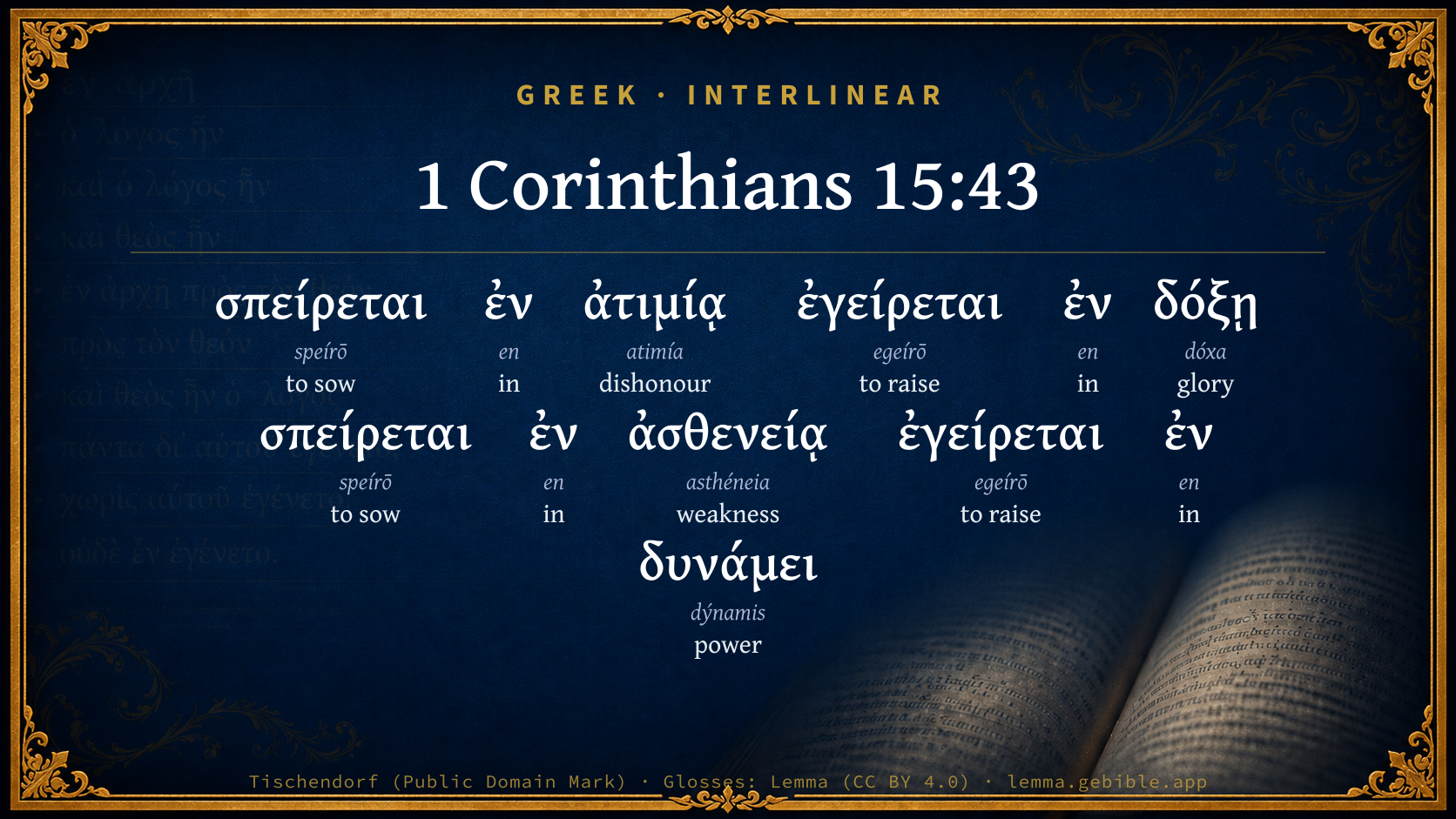
Greek (Tischendorf 8th ed.) 1 Corinthians 15:43 appears in the Greek New Testament. The text above is from the Tischendorf 8th edition. Each word links to its Strong’s number and a concise gloss. Click any word for its full Thayer’s Greek Lexicon entry.
Download image
Cite this verse

1 Corinthians 15:43 (World English Bible). Public Domain. Lemma interlinear Bible study tool, https://lemma.gebible.app/v/1-corinthians/15/43.

Show BibTeX & RIS
BibTeX
RIS
English Translation
It is sown in dishonor; it is raised in glory. It is sown in weakness; it is raised in power.
World English Bible · Public Domain
Download a study sheet

One document with this verse’s original text, its word-by-word gloss line, the meaning frame, cross-references with their text, attributed commentary, and full source and license credits — printable, and it pastes into notes with its structure intact.

This verse Autodidact and up

Study sheet (.html) Plain text (.txt)

A passage Seminary Student

Up to 50 verses in one chapter. A passage sheet keeps up to 6 commentary sources and 12 cross-references per verse, in the order this page ranks them, and says so on the sheet whenever that leaves anything out. Ask for a single verse and you get the Autodidact verse sheet above.

Everything on this page stays free to read, with no account — the sheet is a download of what is already on screen, not access to it.

Want to remove ads? Support Godless Engineer
Compare translations 3

The same verse in 3 English versions, stacked beneath the original-language interlinear above. Click any original word for its lexicon entry.

Each is an independent rendering of the whole verse — the interlinear is not word-aligned to these translations.

Highlighted words mark where these versions differ — a whole-verse word diff, not a word-by-word alignment.

  • World English Bible Public Domain
    It is sown in dishonor; it is raised in glory. It is sown in weakness; it is raised in power.
  • King James Version Public Domain
    It is sown in dishonour; it is raised in glory: it is sown in weakness; it is raised in power:
  • unfoldingWord Literal Text CC BY-SA 4.0
    It is sown in dishonor; it is raised in glory. It is sown in weakness; it is raised in power.

unfoldingWord Literal Text — © unfoldingWord, licensed CC BY-SA 4.0. Word-aligned USFM3 via Door43 (git.door43.org/unfoldingWord/en_ult).

Versions to compare (up to 4)

3 of 4 selected

Show all 19 translations

Every available English version of this verse, each an independent rendering of the whole verse.

  • World English Bible Public Domain
    It is sown in dishonor; it is raised in glory. It is sown in weakness; it is raised in power.
  • Berean Standard Bible Public Domain
    It is sown in dishonor; it is raised in glory. It is sown in weakness; it is raised in power.
  • Majority Standard Bible Public Domain
    It is sown in dishonor; it is raised in glory. It is sown in weakness; it is raised in power.
  • King James Version Public Domain
    It is sown in dishonour; it is raised in glory: it is sown in weakness; it is raised in power:
  • American Standard Version (1901) Public Domain
    it is sown in dishonor; it is raised in glory: it is sown in weakness; it is raised in power:
  • Revised Version (1885) Public Domain
    it is sown in dishonour; it is raised in glory: it is sown in weakness; it is raised in power:
  • Geneva Bible (1599) Public Domain
    It is sowen in dishonour, and is raysed in glory: it is sowen in weakenesse, and is raysed in power.
  • Douay-Rheims (1899) Public Domain
    It is sown in dishonour, it shall rise in glory. It is sown in weakness, it shall rise in power.
  • Young's Literal Translation Public Domain
    it is sown in dishonour, it is raised in glory; it is sown in weakness, it is raised in power;
  • Literal Standard Version CC BY-SA 4.0
    it is sown in dishonor, it is raised in glory; it is sown in weakness, it is raised in power;
  • Unlocked Literal Bible CC BY-SA 4.0
    It is sown in dishonor; it is raised in glory. It is sown in weakness; it is raised in power.
  • unfoldingWord Literal Text CC BY-SA 4.0
    It is sown in dishonor; it is raised in glory. It is sown in weakness; it is raised in power.
  • Darby Bible Public Domain
    It is sown in dishonour, it is raised in glory. It is sown in weakness, it is raised in power.
  • World Messianic Bible Public Domain
    It is sown in dishonor; it is raised in glory. It is sown in weakness; it is raised in power.
  • Webster's Bible Public Domain
    It is sown in dishonor, it is raised in glory: it is sown in weakness, it is raised in power:
  • Free Bible Version CC BY-SA 4.0
    It is sown in shame; it is raised in glory. It is sown in weakness; it is raised in power.
  • Bible in Basic English Public Domain
    It is planted in shame; it comes again in glory: feeble when it is planted, it comes again in power:
  • Text-Critical English NT CC BY 4.0
    It is sown in dishonor; it is raised in glory. It is sown in weakness; it is raised in power.
  • Tyndale New Testament (1534) Public Domain
    It is sowen in dishonoure and ryseth in honoure. It is sowe in weaknes and ryseth in power.

Literal Standard Version (2020), Covenant Press — licensed CC BY-SA 4.0. Text via the HelloAO Bible API (eBible.org). Unlocked Literal Bible (unfoldingWord) — licensed CC BY-SA 4.0. Text via the HelloAO Bible API (eBible.org). unfoldingWord Literal Text — © unfoldingWord, licensed CC BY-SA 4.0. Word-aligned USFM3 via Door43 (git.door43.org/unfoldingWord/en_ult). Free Bible Version, Dr. Jonathan Gallagher — licensed CC BY-SA 4.0. Text via the HelloAO Bible API (eBible.org).

Word by word

More ways to search: Search by grammar → Find every occurrence → Compare this word →

Practice this passage: Drill this verse → Learn its vocabulary →

About this verse

These counts appear in no published source. They are computed here, from the morphology-tagged text and Lemma’s own curated glosses. What Lemma adds →

12
words
7
distinct lemmas
Pauline Epistles
section

Notable vocabulary

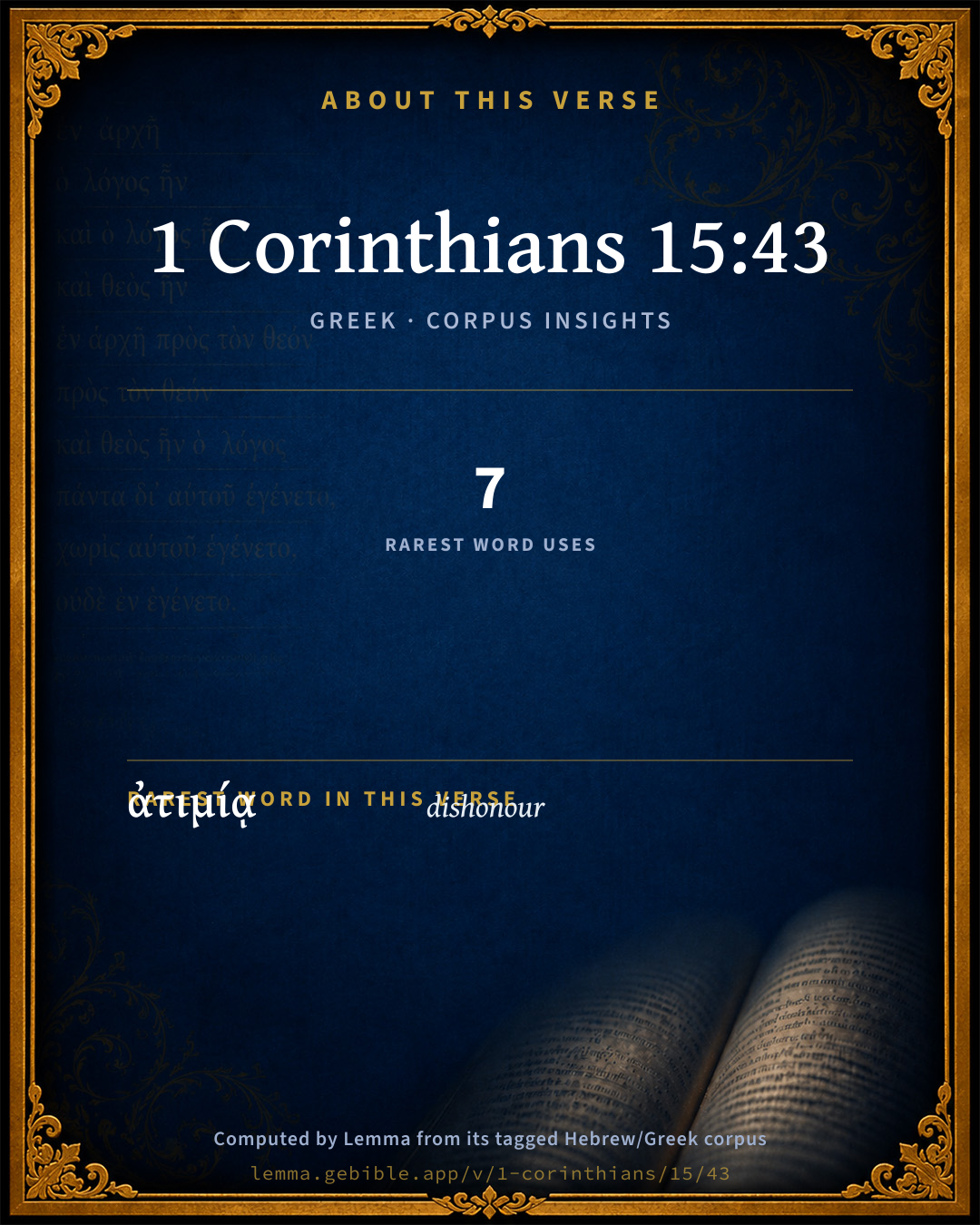
The rarest word here is ἀτιμίᾳ dishonour G819 — appearing just 7 times in the whole Greek New Testament.

Shared distinctive vocabulary

ἀτιμίᾳ dishonour G819 occurs in 7 verses of the Greek New Testament. Also found in:

Repetition

Words recur within this verse:

  • σπείρεται to sow G4687 ×2
  • ἐγείρεται to raise G1453 ×2
  • ἐν in G1722 ×4

Cross-references

12

Topical passages linked to 1 Corinthians 15:43 in the Treasury of Scripture Knowledge — connected by theme and wording, ordered by reader-vote popularity; previews shown in the World English Bible.

  • Colossians 3:4 When Christ, our life, is revealed, then you will also be revealed with him in glory.
  • 1 Corinthians 6:14 Now God raised up the Lord, and will also raise us up by his power.
  • Philippians 3:20–21 For our citizenship is in heaven, from where we also wait for a Savior, the Lord Jesus Christ;
  • Daniel 12:1 "At that time shall Michael stand up, the great prince who stands for the children of your people; and there shall be a time of trouble, such as never was since there was a nation even to that same time: and at that time your people shall be delivered, everyone who shall be found written in the book.
  • Matthew 22:29–30 But Jesus answered them, "You are mistaken, not knowing the Scriptures, nor the power of God.
  • Mark 12:24–25 Jesus answered them, "Isn't this because you are mistaken, not knowing the Scriptures, nor the power of God?
  • 2 Corinthians 13:4 For he was crucified through weakness, yet he lives through the power of God. For we also are weak in him, but we will live with him through the power of God toward you.
  • Job 14:10 But man dies, and is laid low. Yes, man gives up the spirit, and where is he?
  • Matthew 13:43 Then the righteous will shine forth like the sun in the Kingdom of their Father. He who has ears to hear, let him hear.
  • 2 Corinthians 13:14 The grace of the Lord Jesus Christ, the love of God, and the communion of the Holy Spirit, be with you all. Amen.
  • Philippians 3:10 that I may know him, and the power of his resurrection, and the fellowship of his sufferings, becoming conformed to his death;
  • Psalms 102:23 He weakened my strength along the course. He shortened my days.

Cross-references courtesy of OpenBible.info (CC BY 4.0).

Commentary

Notes on 1 Corinthians 15:43 from classic Christian and Jewish commentators (each source and its license shown beneath its notes). The classic Christian expositions comment on the surrounding passage and are grouped to its opening verse, so a note may address several verses; the Jewish commentaries on the Tanakh (Rashi and others) are per-verse, so they appear only where the commentator wrote on this verse.

Lemma curates 59 commentaries, every one of them public domain or Creative Commons licensed, each selected and text-cleaned for this edition rather than reprinted as found. About our sources →

Bengel's Gnomon

Johann Albrecht Bengel

1Co 15:43. Ἐν ἀτιμίᾳ, in dishonour) in nakedness, 1Co 15:37, to which is opposed glory, which is as it were a garment put on, 1Co 15:53; 1Co 15:49.—σπείρεται ἐν ἀσθενείᾳ, is sown in weakness. The figure is continued; but in the reality itself, a transition is made, that similitude being now finished, to a new part of the answer, of which this is the proposition [the statement to be elucidated]: There is a natural and there is a spiritual body. The expressions, in power, 1Co 15:43, and a spiritual body, 1Co 15:44, are akin to one another, Luk 1:17: just as incorruption and glory, 1Co 15:42-43.

Bengel's Gnomon of the New Testament — English translation (T&T Clark, Edinburgh, 1860) — public domain. Text from a community e-Sword module.

Hodge's Commentary on Romans, Ephesians & First Corinthians

Charles Hodge

1Co_15:43, 1Co_15:44

It is sown in dishonor, it is raised in glory: it is sown in weakness, it is raised in power: it is sown a natural body, it is raised a spiritual body. There is a natural body, and there is a spiritual body.

The apostle contemplates the body as at the moment of interment, and therefore these predicates are to be understood with special reference to its condition at that time. It is the dead body that is sown in dishonor, despoiled of the short-lived attractiveness which it had while living. It is raised in glory, i.e. in that resplendent brightness which diffuses light and awakens admiration. It is to be fashioned like unto the glorious body of the Son of God, Phi_3:21. It is sown in weakness. Nothing is more absolutely powerless than a corpse it can do nothing and it can resist nothing. The weakness which belonged to it in life, is perfected in death. It is raised in power. The future body will be instinct with energy, endowed, it may be, with faculties of which we have now no conception. It is sown a natural body, it is raised a spiritual body. This comprehends all that has been said. A natural body, σῶμα ψυχικόν, is a body of which the ψυχή, or animal life, is the animating principle; and a spiritual body σῶμα πνευματικόν, is a body adapted to the πνεῦμα, the rational, immortal principle of our nature. We know from experience what a natural body is. It is a body which has essentially the same properties as those of brutes. A natural body consists of flesh and blood; is susceptible of pain and decay; and needs air, food, and rest. It is a mere animal body, adapted to the conditions of an earthly existence. What a spiritual body is, we know only from Pauls description, and from the manifestation of Christ in his glorified body. We know that it is incorruptible, glorious, and powerful, adapted to the higher state of existence in heaven, and therefore not adapted to an earthly condition. Spiritual, in this connection, does not mean ethereal, refined, much less made of spirit, which would be a contradiction. Nor does it mean animated by the Holy Spirit. But as σῶμα ψυχικόν is a body adapted to the ψυχή or principle of animal life, the σῶμα πνευματικόν is a body adapted to the πνεῦμα or principle of rational life. The Bible uses these terms just as we do, without intending to teach that the ψυχή or life, is a distinct substance or subject from the πνεῦμα or rational spirit, but only that as we have certain attributes, considered as living creatures, in common with irrational animals, so we have now a body suited to those attributes; and, on the other hand, as we have attributes unspeakably higher than those which belong to brutes, we shall hereafter possess bodies adapted to those higher attributes. The Bible recognizes in man only two subjects or distinct separable substances, the soul and body. And this has ever been a fundamental principle of Christian anthropology.

There is a natural body, and there is a spiritual body. This is a vindication of the apparently contradictory expression, spiritual body, which according to the letter, is tantamount to immaterial matter. If, however, it is proper to speak of σῶμα ψυχικόν, a natural body, i.e. a body adapted to the principle of animal life; it is right to speak of a σῶμα πνευματικόν, a spiritual body, i.e. a body adapted to the spirit. Lachmann, Rückert, and Tischendorf, after the ancient MSS. and versions, adopt the reading εἰ ἔστι, k. t. l. If there is a natural body, there is a spiritual body. Just as certainly as we have a body adapted to our lower nature, we shall have one adapted to our higher nature. If the one exists, so does the other.

Charles Hodge — Commentary on Romans (1835), First Corinthians (1857), and Ephesians (1856) — public domain. Text from a community e-Sword module.

Geneva Bible (1599)

Geneva Bible translators

Freed from the former weakness, whereas it is subject to such alteration and change, that it cannot maintain itself without meat and drink, and such otherlike helps.

Void of honor, void of glory, and beauty.

Geneva Bible (1599) marginal notes — public domain. Text via Bolls.life.

Jamieson, Fausset & Brown

Robert Jamieson, A. R. Fausset & David Brown

in dishonour--answering to "our vile body" (Phi 3:21); literally, "our body of humiliation": liable to various humiliations of disease, injury, and decay at last.

in glory--the garment of incorruption (Co1 15:42-43) like His glorious body (Phi 4:21), which we shall put on (Co1 15:49, Co1 15:53; Co2 5:2-4).

in weakness--liable to infirmities (Co2 13:4).

in power--answering to a "spiritual body" (Co1 15:44; compare Luk 1:17, "Spirit and power"). Not liable to the weaknesses of our present frail bodies (Isa 33:24; Rev 21:4).

Jamieson, Fausset & Brown — Commentary Critical and Explanatory on the Whole Bible (1871) — public domain (CC PDM 1.0). Text via the HelloAO Bible API.

Adam Clarke's Commentary

Verse 43. It is sown in dishonour] Being now stripped of all the glory it had as a machine, fearfully and wonderfully made by the hands of God; and also consigned to death and destruction because of sin. This is the most dishonourable circumstance.

It is raised in glory] It is raised a glorious body, because immortal, and for ever redeemed from the empire of death.

It is sown in weakness] The principles of dissolution, corruption, and decay, have prevailed over it; disease undermined it; and death made it his prey.

It is raised in power] To be no more liable to weakness, through labour; decay, by age; wasting, by disease; and dissolution, by death.

Adam Clarke's Commentary on the Bible (1810–1826) — public domain. Text from a community e-Sword/MySword module.

The Cambridge Bible for Schools and Colleges

gen. ed. J. J. S. Perowne

43. it is sown in dishonour; it is raised in glory] The dishonour is, of course, corruption, with its revolting accompaniments. What the glory will be we may learn, to a certain extent, from the Transfiguration of our Lord, and from the account of the majesty and splendour of His Resurrection-Body in Rev_1:13-16. Cyril of Jerusalem, after citing Dan_12:3 and St Mat_13:43, goes on to say that “God, foreseeing the unbelief of man, gave to the smallest of worms to emit beams of light, that thereby might be inferred what was to be looked for in the world to come.”

it is sown in weakness; it is raised in power] For power see note on ch. 1Co_1:18. What the weakness is, we scarcely need to inquire. Decay of strength and vitality, ending in the absolute powerlessness of death, is the destiny of the body which is to be laid in the grave. But when it is raised, not only can it never be subject to the same weakness again, but it will be endowed with new faculties, as superior to those of the former body as those of the plant are to those of the seed.

The Cambridge Bible for Schools and Colleges (gen. ed. J. J. S. Perowne; Cambridge University Press, 1878–1918) — public domain. Text from a community e-Sword module.

John Gill's Exposition

Howbeit, that was not first which is spiritual,.... As the apostle before proves the distinction of a natural and spiritual body, and gives instances of both in the two principal men in the world, the first and the last; and points out the difference between them, the one being animated, and having life given unto it, the other animating, and giving life to others; proceeds to observe the order of these, how that one was before the other; the spiritual body, though the more perfect and most excellent, yet was not first in being:

but that which is natural; Adam's animal body was before Christ's spiritual body:

and afterwards that which is spiritual; yea, even Christ's animal, or natural body, was before his spiritual one; his body taken from the virgin, and formed in her womb, and in which he lived here on earth, was an animal body, as before observed; and upon his resurrection, it commenced a spiritual one; being the same in substance as the former, only different in qualities; and just so it is, and will be, with the bodies of the saints'; which is the apostle's design and view, in observing this order; the natural body is first, and then the spiritual; it is first a natural body, as generated and nourished, as weak and dying, and it is afterwards a spiritual one, when raised from the dead.

John Gill's Exposition of the Whole Bible (1746–1763) — public domain (CC PDM 1.0). Text via the HelloAO Bible API.

Trapp's Complete Commentary

John Trapp

43 It is sown in dishonour; it is raised in glory: it is sown in weakness; it is raised in power:

Ver. 43. It is raised in power] The resurrection will cure all infirmities. At Stratford-le-Bow were burned in Queen Mary’s days, at one stake, a lame man and a blind man. The lame man after he was chained, casting away his crutch, bade the blind man be of good comfort, for death would heal them both; and so they patiently suffered.

John Trapp, A Commentary or Exposition upon All the Books of the Old and New Testament (1647–1656) — public domain. Text from a community e-Sword module.

Albert Barnes' Notes on the Bible

It is sown in dishonour - In the grave, where it is shut out from human view; hurried away from the sight of friends; loathsome and offensive as a mass turning to decay. There is, moreover, a kind of disgrace and ignominy attending it here, as under the curse of God, and, on account of sin, sentenced to the offensiveness of the grave.

It is raised in glory - In honor; in beauty; honored by God by the removal of the curse, and in a form and manner that shall be glorious. This refers to the fact that everything like dishonor, vileness, ignominy, which attends it here shall be removed there, and that the body shall bear a resemblance to the glorified body of Jesus Christ, Eph 3:21. It shall be adapted to a world of glory; and everything which here rendered it vile, valueless, cumbersome, offensive, or degraded, shall be there removed. Of course, every idea which we can get from this is chiefly negative, and consists in denying that the body will have there the qualities which here render it vile or loathsome. The word “glory” (δόξα doxa) means dignity, splendor, honor, excellence, perfection; and is used here as denoting the combination of all those things which shall rescue it from ignominy and disgrace.

It is sown in weakness - Weak, feeble, liable to decay. Here disease prostrates the strength, takes away its power, consigns it to the dust. It denotes the many weaknesses, frailties, and liabilities to sickness, to which we are here exposed, Its feeble powers are soon prostrate; its vital functions soon cease in death.

It is raised in power - This does not denote power like that of God, nor like the angels. It does not affirm that it shall be endued with remarkable and enormous physical strength, or that it shall have the power of performing what would now be regarded as miraculous. It is to be regarded as the opposite of the word “weakness,” and means that it shall be no longer liable to disease; no more overcome by the attacks of sickness; no more subject to the infirmities and weaknesses which it here experiences. It shall not be prostrate by sickness, nor overcome by fatigue. It shall be capable of the service of God without weariness and languor; it shall need no rest as it does here (see Rev 7:15; compare Rev 22:5); but it shall be in a world where there shall be no fatigue, lassitude, disease; but where there shall be ample power to engage in the service of God forever. There is, however, no improbability in supposing that the physical powers of man, as well as his intellectual, may be greatly augmented in heaven. But on this point there is no revelation.

Albert Barnes' Notes on the Bible (1834–1885) — public domain. Text from a community e-Sword/MySword module.

Matthew Poole's English Annotations

It is sown in dishonour; it is raised in glory: there is nothing more uncomely, unlovely, and loathsome than a dead body; but it will not be so when it shall be raised again, then it shall be a beautiful, comely body. We shall rise in a full and perfect age, (as is generally thought), and without those defects and deformities which may here make our bodies appear unlovely. Daniel says, Dan 12:3, the righteous shall shine as the stars: Christ saith, Mat 13:43, they shall shine like the sun: the apostle saith, Phi 3:21, we shall be made like unto his glorious body. Three things make the body beautiful, a perfection of parts, the well putting them together and proportioning them one to another, and a well-tempered, cheerly spirit; all these will concur in the bodies of saints in the resurrection. The schoolmen determine, that much of the beauty of the saints’ bodies in the resurrection, will flow from their perfect sight of God, and the reflection of God upon them.

It is sown in weakness; it is raised in power: when it dieth it is a frail, weak body, unable to resist injuries; but it shall rise a strong body, with quick senses, and subject to no more weaknesses.

Matthew Poole's English Annotations on the Holy Bible (1683–1685) — public domain. Text from a community e-Sword/MySword module.

Whedon's Commentary on the Bible

Daniel D. Whedon

43. Dishonour—Both in life and in death the mortal body has parts, conditions, operations, and failures that render it a disgust to the contemplation. In death, decay and putrefaction render it unendurable to its fellows. “When the soul departs,” says Xenophon, “men carry out the body of the dearest friend in the quickest way, and put it out of sight.”

Glory— Phenomenal properties that attract the wonder and admiration of the beholder.

Weakness—With strength of body to effect little; liable to sickness and debility, requiring to be carried by machinery for rapid locomotion.

Power—Vigour of body to accomplish the boldest determinations of the will, exemption from fatigue, and ability to pass through space with the rapidity of thought. Grotius adds, “Endowed with a variety of new senses;” which, however true, is not so clearly said.

Daniel D. Whedon (gen. ed.), Commentary on the Old and New Testaments (1874–1909) — public domain. Text from a community e-Sword module.

The Pulpit Commentary

It is sown in dishonour. "The awful and intolerable indignity of dust to dust." In glory. "Though ye have lieu among the pots, yet shall ye be as the wings of a dove, that is covered with silver wings, and her feathers like gold". (Psa_68:13) The expression shows that, throughout, St. Paul is thinking exclusively of the resurrection of the saints.

The Pulpit Commentary (1880–1919), ed. H.D.M. Spence-Jones & Joseph S. Exell — public domain. Text from a community e-Sword module.

John Wesley's Explanatory Notes

It is sown in dishonour - Shocking to those who loved it best, human nature in disgrace! It is raised in glory - Clothed with robes of light, fit for those whom the King of heaven delights to honour. It is sown in weakness - Deprived even of that feeble strength which it once enjoyed. It is raised in power - Endued with vigour, strength, and activity, such as we cannot now conceive.

John Wesley, Explanatory Notes Upon the Whole Bible (1754–1765) — public domain. Text via the GEBible commentary corpus.

McGarvey & Pendleton's Commentaries

J. W. McGarvey

it is sown in dishonor [buried because it is repulsive and will become offensive-- Joh_11:39 ]; it is raised in glory [ Phi_3:21 ]: it is sown in weakness [devoid of all ability]; it is raised in power [ Rev_3:21 ]:

J. W. McGarvey (with Philip Y. Pendleton), Commentaries on the New Testament (The Fourfold Gospel, 1914; Acts; and the epistles) — public domain. Text from a community e-Sword/MySword module.

The People's New Testament

B. W. Johnson

43. It is sown in dishonor. The dead body is repulsive, becomes offensive, and we bury it out of sight. It is raised in glory. Has a glorious beauty. Sown in weakness. All its powers exhausted. Raised in power. Endowed with heavenly energy.

B. W. Johnson's The People's New Testament with Notes (1889–1891) — public domain. Electronic text from the Christian Classics Ethereal Library (CCEL) ThML edition.

Cambridge Greek Testament for Schools and Colleges

43. σπείρεται ἐν ἀτιμίᾳ. The dishonour is, of course, corruption, with its revolting accompaniments. What the glory will be we may learn, to a certain extent, from the Transfiguration of our Lord, and from the account of the majesty and splendour of His Resurrection-Body in Rev 1:13-16. Cyril of Jerusalem, after citing Dan 12:3 and Mat 13:43, goes on to say that ‘God, foreseeing the unbelief of man, gave to the smallest of worms to emit beams of light, that thereby might be inferred what was to be looked for in the world to come.’

σπείρεται ἐν ἀσθενείᾳ. What ἀσθένεια means we scarcely need to inquire. Decay of strength and vitality, ending in the absolute powerlessness of death, is the destiny of the body which is to be laid in the grave. But when it is raised, not only can it never be subject to the same weakness again, but it will be endowed with new faculties, as superior to those of the former body as those of the plant are to those of the seed. For δύναμις see 1Co 1:18.

Cambridge Greek Testament for Schools and Colleges (Cambridge University Press, 1896; 21 vols, various authors incl. Carr, Maclear, Plummer, Farrar, Lumby, Moule, M. R. James, Simcox) — public domain. Text from a community e-Sword module.

Alford’s Greek Testament

Henry Alford

43. ἐν ἀτιμίᾳ, ἐν δόξῃ] in dishonour (τί γὰρ εἰδεχθέστερον νεκροῦ διαῤῥυέντος; Chrys. Hom. xli. p. 390. Cf. Xen. Mem. i. 2. 53,—τῆς ψυχῆς ἐξελθούσης,.… τὸ σῶμα τοῦ οἰκειοτάτου ἀνθρώπου τὴν ταχίστην ἐξενέγκαντες ἀφανίζουσιν,—in glory: regarding, as throughout this argument (see on ver. 23), only the resurrection of the just: see Php 3:21.

ἐν ἀσθενείᾳ] in weakness,—the characteristic of the lifeless body, which is relaxed and powerless. Chrys. understands ἀσθ. of its inability to resist corruption: De Wette would refer it to the previous state of pain and disease: but it seems better to understand it of the powerlessness of the corpse, contrasted with ἐν δυν., in vigour, viz. the fresh and eternal energy of the new body free from disease and pain. “That which Grot. adds: ‘cum sensibus multis, quos nunc non intelligimus,’ is very likely in itself true, but is not implied in ἐν δυνάμει.” Meyer.

44 a. σῶμ. ψυχ.] an animal body, of which the ψυχή, the animal soul, was the acting and informing power. This soul having departed out of it, does not do away with the correctness of the predicate: its whole organism which still remains when it is sown, is arranged to suit this predominance of the animal soul.

σῶμα πνευματικόν] Theophyl., having explained σῶμα ψυχ.,—ἐν ᾧ ἡ ψυχὴ τὸ κῦρος καὶ τὴν ἡγεμονίαν ἔχει,—proceeds πνευματικὸν δέ, τὸ τὴν τοῦ ἁγίου πνεύματος καταπλουτοῦν ἐνέργειαν, καὶ ὑπʼ ἐκείνου τὰ πάντα διοικούμενον. εἰ γὰρ καὶ νῦν ἐν ἡμῖν ἐνεργεῖ τὸ πνεῦμα, ἀλλʼ οὐχ οὕτως, οὐδὲ ἀεί. ἀφίπταται γὰρ ἁμαρτανόντων. καὶ τοῦ πνεύματος δὲ παρόντος, ἡ ψυχὴ διοικεῖ τὸ σῶμα· τότε δὲ διηνεκῶς παραμενεῖ τοῖς σώμασι τῶν δικαίων τὸ πνεῦμα. But this is not quite enough:—for thus the body might remain as it is, sin only being removed: whereas it shall be no longer a body in which the ψυχή predominates to the subordination of the higher part, the πνεῦμα, but one in which the πνεῦμα, and that informed fully by the Spirit of God, shall predominate,—its organism being conformed not to au animal, but to a spiritual life: see on ch. 6:13. Some understood πνευματικόν, ætherial, aery, κουφότερον καὶ λεπτότερον, καὶ οἷον καὶ ἐπʼ ἀέρος ὀχεῖσθαι (Chrys. p. 391), or as Origen, ἀερῶδες κ. αἰθέριον (see Theophyl.), but the other is certainly right.

44 b

Henry Alford, The Greek Testament (1849–1861) — public domain. Text from a community e-Sword module.

Vincent's Word Studies in the New Testament

Marvin R. Vincent

Weakness. Compare Homer : "The feeble hands of the dead" (" Odyssey, "5, 21); and the shade of Agamemnon stretching out his hands to Ulysses," for no firm force or vigor was in him " (Id., 11, 393). See Isa 14:10.

Marvin R. Vincent, Word Studies in the New Testament (1887–1900) — public domain. Text from a community e-Sword/MySword module.

Lesson kit

Teaching starters — assembled from the data on this page, not authored interpretation. Every prompt links to the verse data it draws on. Edit before teaching.

1 Corinthians, in the Pauline Epistles, opens this verse with 12 words (7 distinct Greek lemmas). Its most distinctive word is atimía (“dishonour”). A historical commentator’s framing appears above. Read the whole chapter for the surrounding context.

Discussion questions

  1. What does “dishonour” (atimía) contribute to the verse as a whole?
  2. Romans 1:26 shares the word «dishonour» with this verse. How do the two illuminate each other?
  3. “to sow” occurs 2× in this one verse. What is the effect of the repetition?
  4. These translations render this verse differently; the difference is in the English rendering, not the original. What questions does that raise?
  5. Reading how Bengel's Gnomon and Hodge's Commentary on Romans, Ephesians & First Corinthians read this verse, where do the two commentators agree and where do they part?

Things to notice

  • These translations choose different wording for 2 words in this verse.
  • “to sow” occurs 2× in this single verse.
  • 7 distinct Greek lemmas span 12 words in this verse.

Reading settings

Reading text

Shown beneath each verse's original-language words.

Old Testament
Old Testament edition

Read the OT as the Masoretic Hebrew (MT) or the Greek Septuagint (LXX).

English shown for the Greek Septuagint (in the Hebrew ↔ Greek comparison).

Comparing translations? Open the Compare panel on any verse page to stack up to four side by side.