Revelation 11:17

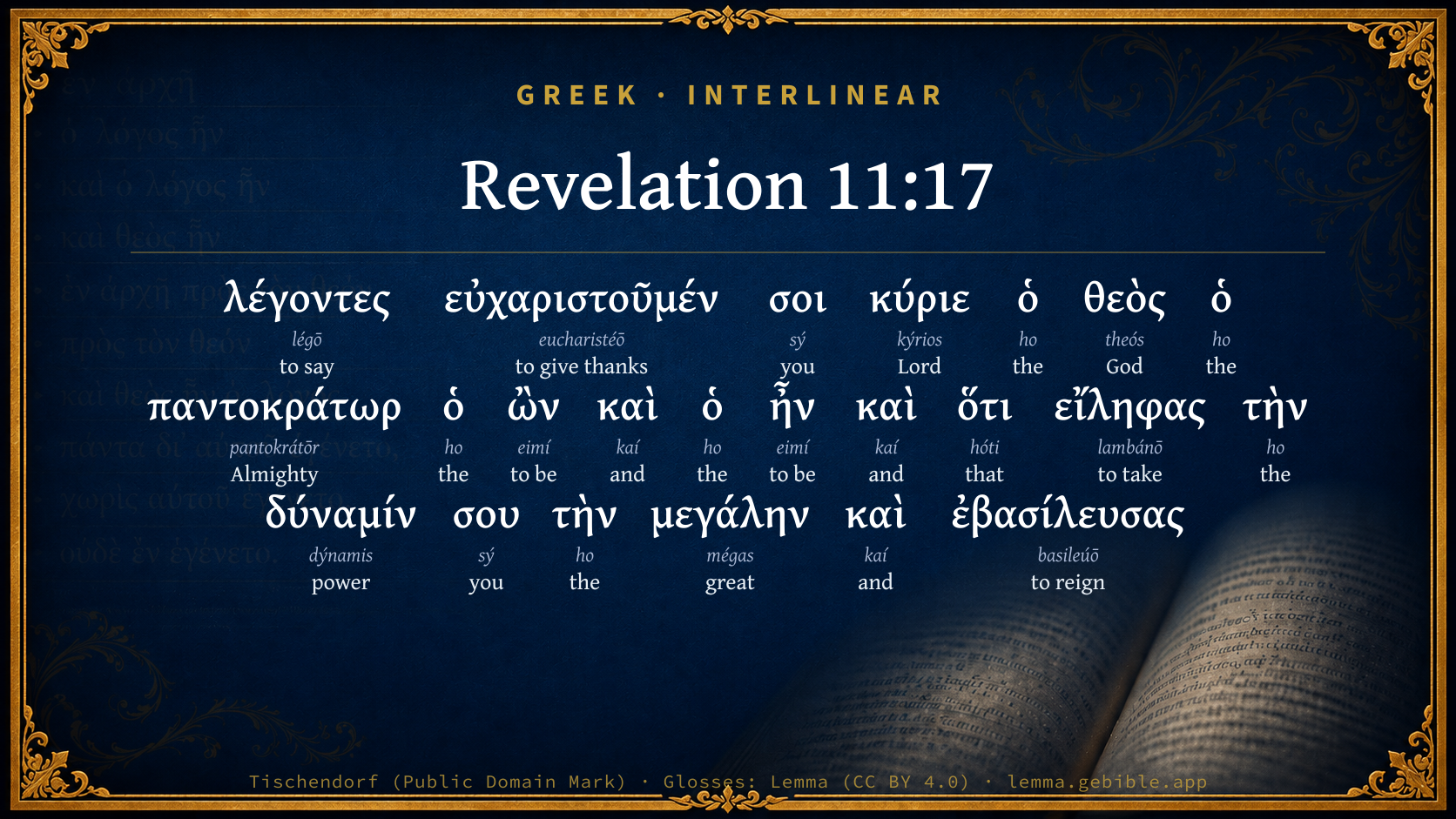
Greek (Tischendorf 8th ed.) Revelation 11:17 appears in the Greek New Testament. The text above is from the Tischendorf 8th edition. Each word links to its Strong’s number and a concise gloss. Click any word for its full Thayer’s Greek Lexicon entry.
Download image
Cite this verse

Revelation 11:17 (World English Bible). Public Domain. Lemma interlinear Bible study tool, https://lemma.gebible.app/v/revelation/11/17.

Show BibTeX & RIS
BibTeX
RIS
English Translation
saying: "We give you thanks, Lord God, the Almighty, the one who is and who was; because you have taken your great power, and reigned.
World English Bible · Public Domain
Download a study sheet

One document with this verse’s original text, its word-by-word gloss line, the meaning frame, cross-references with their text, attributed commentary, and full source and license credits — printable, and it pastes into notes with its structure intact.

This verse Autodidact and up

Study sheet (.html) Plain text (.txt)

A passage Seminary Student

Up to 50 verses in one chapter. A passage sheet keeps up to 6 commentary sources and 12 cross-references per verse, in the order this page ranks them, and says so on the sheet whenever that leaves anything out. Ask for a single verse and you get the Autodidact verse sheet above.

Everything on this page stays free to read, with no account — the sheet is a download of what is already on screen, not access to it.

Want to remove ads? Support Godless Engineer
Compare translations 3

The same verse in 3 English versions, stacked beneath the original-language interlinear above. Click any original word for its lexicon entry.

Each is an independent rendering of the whole verse — the interlinear is not word-aligned to these translations.

Highlighted words mark where these versions differ — a whole-verse word diff, not a word-by-word alignment.

  • World English Bible Public Domain
    saying: "We give you thanks, Lord God, the Almighty, the one who is and who was; because you have taken your great power, and reigned.
  • King James Version Public Domain
    Saying, We give thee thanks, O LORD God Almighty, which art, and wast, and art to come; because thou hast taken to thee thy great power, and hast reigned.
  • unfoldingWord Literal Text CC BY-SA 4.0
    saying, “We give thanks to you, Lord God, Ruler of All, the one being and the one having been, because indeed you have taken your great power and have reigned.

unfoldingWord Literal Text — © unfoldingWord, licensed CC BY-SA 4.0. Word-aligned USFM3 via Door43 (git.door43.org/unfoldingWord/en_ult).

Versions to compare (up to 4)

3 of 4 selected

Show all 19 translations

Every available English version of this verse, each an independent rendering of the whole verse.

  • World English Bible Public Domain
    saying: "We give you thanks, Lord God, the Almighty, the one who is and who was; because you have taken your great power, and reigned.
  • Berean Standard Bible Public Domain
    saying: “We give thanks to You, O Lord God Almighty, the One who is and who was, because You have taken Your great power and have begun to reign.
  • Majority Standard Bible Public Domain
    saying: “We give thanks to You, O Lord God Almighty, the One who is and who was, because You have taken Your great power and have begun to reign.
  • King James Version Public Domain
    Saying, We give thee thanks, O LORD God Almighty, which art, and wast, and art to come; because thou hast taken to thee thy great power, and hast reigned.
  • American Standard Version (1901) Public Domain
    saying, We give thee thanks, O Lord God, the Almighty, who art and who wast; because thou hast taken thy great power, and didst reign.
  • Revised Version (1885) Public Domain
    saying, We give thee thanks, O Lord God, the Almighty, which art and which wast; because thou hast taken thy great power, and didst reign.
  • Geneva Bible (1599) Public Domain
    Saying, We giue thee thankes, Lord God almightie, Which art, and Which wast, and Which art to come: for thou hast receiued thy great might, and hast obteined thy kingdome.
  • Douay-Rheims (1899) Public Domain
    We give thee thanks, O Lord God Almighty, who art, and who wast, and who art to come: because thou hast taken to thee thy great power, and thou hast reigned.
  • Young's Literal Translation Public Domain
    saying, `We give thanks to Thee, O Lord God, the Almighty, who art, and who wast, and who art coming, because Thou hast taken Thy great power and didst reign;
  • Literal Standard Version CC BY-SA 4.0
    saying, “We give thanks to You, O LORD God, the Almighty, who is, and who was, and who is coming, because You have taken Your great power and reigned;
  • Unlocked Literal Bible CC BY-SA 4.0
    They said, “We give thanks to you, Lord God Almighty, the one who is and who was, because you have taken your great power and have begun to reign.
  • unfoldingWord Literal Text CC BY-SA 4.0
    saying, “We give thanks to you, Lord God, Ruler of All, the one being and the one having been, because indeed you have taken your great power and have reigned.
  • Darby Bible Public Domain
    saying, We give thee thanks, Lord God Almighty, [He] who is, and who was, that thou hast taken thy great power and hast reigned.
  • World Messianic Bible Public Domain
    saying: “We give you thanks, Lord God, the Almighty, the one who is and who was, because you have taken your great power and reigned.
  • Webster's Bible Public Domain
    Saying, We give thee thanks, O Lord God Almighty, who art, and wast, and art to come; because thou hast taken to thee thy great power, and hast reigned.
  • Free Bible Version CC BY-SA 4.0
    They said, “We thank you, Lord God, the All-powerful One, who is and was, because you have taken up your great power and have asserted your rule.”
  • Bible in Basic English Public Domain
    We give you praise, O Lord God, Ruler of all, who is and who was; because you have taken up your great power and are ruling your kingdom.
  • Text-Critical English NT CC BY 4.0
    saying, “We give thanks to yoʋ, O Lord God, the Almighty, who is and who was, because yoʋ have taken yoʋr great power and begun to reign.
  • Tyndale New Testament (1534) Public Domain
    sayinge: we geve the thankes lorde God allmyghte: which arte and wast and arte to come for thou haste receaved thy great myght and hast raygned.

Literal Standard Version (2020), Covenant Press — licensed CC BY-SA 4.0. Text via the HelloAO Bible API (eBible.org). Unlocked Literal Bible (unfoldingWord) — licensed CC BY-SA 4.0. Text via the HelloAO Bible API (eBible.org). unfoldingWord Literal Text — © unfoldingWord, licensed CC BY-SA 4.0. Word-aligned USFM3 via Door43 (git.door43.org/unfoldingWord/en_ult). Free Bible Version, Dr. Jonathan Gallagher — licensed CC BY-SA 4.0. Text via the HelloAO Bible API (eBible.org).

Word by word

More ways to search: Search by grammar → Find every occurrence → Compare this word →

Practice this passage: Drill this verse → Learn its vocabulary →

παντοκράτωρ
pantokrátōr
G3841
“Almighty”
Noun, Nominative, Singular, Masculine
Part of Speech
Noun
Case
Nominative
Number
Singular
Gender
Masculine
Full Thayer's Definition

Origin: from G3956 and G2904

TDNT: 18:14,5

1. he who holds sway over all things 2. the ruler of all 3. almighty: God
  1. λέγοντες légō G3004 “to say” Verb, Present, Active, Participle, Nominative, Plural, Masculine
  2. εὐχαριστοῦμέν eucharistéō G2168 “to give thanks” Verb, Present, Active, Indicative, 1st person, Plural
  3. σοι sý G4771 “you” Personal pronoun, 2nd person, Dative, Singular
  4. κύριε kýrios G2962 “Lord” Noun, Vocative, Singular, Masculine
  5. ὁ ho G3588 “the” Article, Nominative, Singular, Masculine
  6. θεὸς theós G2316 “God” Noun, Nominative, Singular, Masculine
  7. ὁ ho G3588 “the” Article, Nominative, Singular, Masculine
  8. ὁ ho G3588 “the” Article, Nominative, Singular, Masculine
  9. ὢν eimí G1510 “to be” Verb, Present, Active, Participle, Nominative, Singular, Masculine
  10. καὶ kaí G2532 “and” Conjunction
  11. ὁ ho G3588 “the” Article, Nominative, Singular, Masculine
  12. ἦν eimí G1510 “to be” Verb, Imperfect, Active, Indicative, 3rd person, Singular
  13. καὶ kaí G2532 “and” Conjunction
  14. ὅτι hóti G3754 “that” Conjunction
  15. εἴληφας lambánō G2983 “to take” Verb, Perfect, Active, Indicative, 2nd person, Singular
  16. τὴν ho G3588 “the” Article, Accusative, Singular, Feminine
  17. δύναμίν dýnamis G1411 “power” Noun, Accusative, Singular, Feminine
  18. σου sý G4771 “you” Personal pronoun, 2nd person, Genitive, Singular
  19. τὴν ho G3588 “the” Article, Accusative, Singular, Feminine
  20. μεγάλην mégas G3173 “great” Adjective, Accusative, Singular, Feminine
  21. καὶ kaí G2532 “and” Conjunction
  22. ἐβασίλευσας basileúō G936 “to reign” Verb, Aorist, Active, Indicative, 2nd person, Singular

About this verse

These counts appear in no published source. They are computed here, from the morphology-tagged text and Lemma’s own curated glosses. What Lemma adds →

23
words
14
distinct lemmas
Revelation
section

Notable vocabulary

The rarest word here is παντοκράτωρ Almighty G3841 — appearing just 10 times in the whole Greek New Testament.

Shared distinctive vocabulary

παντοκράτωρ Almighty G3841 occurs in 10 verses of the Greek New Testament. Also found in:

Repetition

Words recur within this verse:

Cross-references

26

Topical passages linked to Revelation 11:17 in the Treasury of Scripture Knowledge — connected by theme and wording, ordered by reader-vote popularity; previews shown in the World English Bible.

  • Revelation 1:8 "I am the Alpha and the Omega," says the Lord God, "who is and who was and who is to come, the Almighty."
  • Revelation 16:5 I heard the angel of the waters saying, "You are righteous, who are and who were, you Holy One, because you have judged these things.
  • Revelation 1:4 John, to the seven assemblies that are in Asia: Grace to you and peace, from God, who is and who was and who is to come; and from the seven Spirits who are before his throne;
  • Revelation 4:8–9 The four living creatures, each one of them having six wings, are full of eyes around about and within. They have no rest day and night, saying, "Holy, holy, holy, holy, holy, holy, holy, holy, holy is the Lord God, the Almighty, who was and who is and who is to come!"
  • Revelation 19:6 I heard something like the voice of a great multitude, and like the voice of many waters, and like the voice of mighty thunders, saying, "Hallelujah! For the Lord our God, the Almighty, reigns!
  • Psalms 21:13 Be exalted, Yahweh, in your strength, So we will sing and praise your power.
  • Revelation 19:11–20:3 I saw the heaven opened, and behold, a white horse, and he who sat on it is called Faithful and True. In righteousness he judges and makes war.
  • Genesis 17:1 When Abram was ninety-nine years old, Yahweh appeared to Abram, and said to him, "I am God Almighty. Walk before me, and be blameless.
  • Isaiah 51:9–11 Awake, awake, put on strength, arm of Yahweh; awake, as in the days of old, the generations of ancient times. Isn't it you who did cut Rahab in pieces, who pierced the monster?
  • 1 Timothy 1:12 And I thank him who enabled me, Christ Jesus our Lord, because he counted me faithful, appointing me to service;
  • Revelation 16:7 I heard the altar saying, "Yes, Lord God, the Almighty, true and righteous are your judgments."
  • Psalms 57:11 Be exalted, God, above the heavens. Let your glory be over all the earth.
  • Daniel 6:10 When Daniel knew that the writing was signed, he went into his house (now his windows were open in his chamber toward Jerusalem) and he kneeled on his knees three times a day, and prayed, and gave thanks before his God, as he did before.
  • Matthew 11:25 At that time, Jesus answered, "I thank you, Father, Lord of heaven and earth, that you hid these things from the wise and understanding, and revealed them to infants.
  • Luke 10:21 In that same hour Jesus rejoiced in the Holy Spirit, and said, "I thank you, O Father, Lord of heaven and earth, that you have hidden these things from the wise and understanding, and revealed them to little children. Yes, Father, for so it was well-pleasing in your sight."
  • 2 Corinthians 9:15 Now thanks be to God for his unspeakable gift!
  • Revelation 11:15 The seventh angel sounded, and great voices in heaven followed, saying, "The kingdom of the world has become the Kingdom of our Lord, and of his Christ. He will reign forever and ever!"
  • Revelation 15:3 They sang the song of Moses, the servant of God, and the song of the Lamb, saying, "Great and marvelous are your works, Lord God, the Almighty; Righteous and true are your ways, you King of the nations.
  • Revelation 16:14 for they are spirits of demons, performing signs; which go forth to the kings of the whole inhabited earth, to gather them together for the war of that great day of God, the Almighty.
  • Isaiah 52:10 Yahweh has made bare his holy arm in the eyes of all the nations; and all the ends of the earth have seen the salvation of our God.
  • John 11:41 So they took away the stone from the place where the dead man was lying. Jesus lifted up his eyes, and said, "Father, I thank you that you listened to me.
  • 2 Corinthians 2:14 Now thanks be to God, who always leads us in triumph in Christ, and reveals through us the sweet aroma of his knowledge in every place.
  • Psalms 64:9–10 All mankind shall be afraid. They shall declare the work of God, And shall wisely ponder what he has done.
  • Psalms 98:1–3 Sing to Yahweh a new song, For he has done marvelous things! His right hand, and his holy arm, have worked salvation for him.
  • Psalms 102:13–18 You will arise and have mercy on Zion; For it is time to have pity on her. Yes, the set time has come.
  • Daniel 2:23 I thank you, and praise you, you God of my fathers, who have given me wisdom and might, and have now made known to me what we desired of you; for you have made known to us the king's matter.

Cross-references courtesy of OpenBible.info (CC BY 4.0).

Where the printed editions differ

1 variant

Places in this verse where the major printed Greek editions disagree on the wording in a way that affects the translation — a comparison of editions, not a manuscript-by-manuscript collation. The editions are the modern critical texts (Nestlé-Aland 28/27, SBL, Westcott-Hort, Tregelles, Tyndale House) and the traditional texts behind the KJV (the Textus Receptus and the Byzantine/Majority text). It is not a claim about which reading is original.

  1. Extra text
    καὶ ὁ ἐρχόμενος,

    “and who is coming”

    In TR Not in NA28NA27TynSBLWHTregByz

    καὶ ὁ ἐρχόμενος, (kai ho erchomenos) 'and who is coming' is only in traditional manuscripts (TR)

Textual data: Translators Amalgamated Greek New Testament (STEPBible TAGNT) · CC BY 4.0.

Commentary

Notes on Revelation 11:17 from classic Christian and Jewish commentators (each source and its license shown beneath its notes). The classic Christian expositions comment on the surrounding passage and are grouped to its opening verse, so a note may address several verses; the Jewish commentaries on the Tanakh (Rashi and others) are per-verse, so they appear only where the commentator wrote on this verse.

Lemma curates 59 commentaries, every one of them public domain or Creative Commons licensed, each selected and text-cleaned for this edition rather than reprinted as found. About our sources →

Tyndale Open Study Notes

Tyndale Open Resources

11:17 The thanksgiving prayer describes God as the one who is and who always was; the description “is still to come” (see 1:4, 8) no longer applies, because in this scene eternity has come and God has begun to reign.

Tyndale Open Study Notes — © Tyndale Open Resources, licensed CC BY-SA 4.0. Text via the HelloAO Bible API.

Bengel's Gnomon

Johann Albrecht Bengel

Rev 11:17. Ὁ ὢν καὶ ὁ ἦν, who is, and who was) Some have added, καὶ ὁ ἐρχόμενος.[121] The shorter reading here also is the true one; the fuller one is derived from a parallel passage. See App. Crit. Ed. ii. on this passage. Such varieties of reading are not to be decided in a cursory manner, on common grounds, but by careful investigation, according to the strong arguments which peculiarly and naturally belong to each passage. By which method we shall find, in the present instance, that this passage, ch. Rev 11:17, is not so much to be compared with the three preceding, as with the one which follows, ch. Rev 16:5. What is the aspect of the three preceding passages, we have before shown, on the passages themselves, and especially on ch. Rev 1:8: but now both these passages, ch. Rev 11:17 and Rev 16:5, coincide with the trumpet of the seventh angel, and therefore with the consummation of the mystery of God, in which, that which had previously been foretold by the expression, καὶ ὁ ἐρχόμενος, now is exhibited in actual operation, and indeed is exhibited first in heaven, ch. Rev 11:17, and then on earth, ch. Rev 16:5. Interpreters on this passage have long ago seen this. Ansbert says, They do not here subjoin, as they were accustomed, and who art to come; they speak of Him as already present. Haymo, who usually treads in the footsteps of Ansbert: It must be observed that he does not add, as before, who art to come. For they show Him already present in the judgment, by which all these things will be accomplished, and therefore they by no means speak of Him as (still) to come. John Purvey, in his Comm. published with the preface of Luther, says; He does not add the third clause, which he has usually added, namely, and who is to come, for this reason, because the prophet, with his intellectual vision, then saw God as it were already sitting in judgment. Zeltner published a dissertation, A. 1712, which is inscribed, Evangelium Tetragrammaton e Novo Testamento Exulans. The subject, as it is comprised in the title, derives something from the truth. When the Son of God was engaged in the world, of the promises given in the Old Testament, and comprehended in the name of Jehovah, as many as were to be fulfilled at that time, were fulfilled: and then, that which had been future, was advancing to the present. But, however, in the prophecy of the New Testament, that is, in the Apocalypse, that phrase, ὁ ὤν καὶ ὁ ἦν καὶ ὁ ἐρχόμενος, by which the tetragrammaton, יהוה, is usually expressed, is, as it were, set forth afresh; and the future itself, as though reviving in the second coming of Christ, respecting which see Heb 10:37, is placed before us, until at the entrance of the most important trumpet of the seventh angel, first the words, καὶ ὁ ἐρχόμενος, which, at the beginning, were alone contained in אהיה, and afterwards also the words καὶ ὁ ἦν, which was denoted by the termination of the noun יהוה, are most magnificently absorbed, and pass into the single expression, ὁ ὤν. Hence it comes to pass, that even great things, from this very passage, are not said to come, as lately they were said to come, Rev 11:14, and ch. Rev 9:12, but to have come, shortly afterwards, Rev 11:18, and ch. Rev 14:7; Rev 14:15, Rev 19:7. Those persons do not sufficiently hold fast the normal force of Scripture, which ought to be retained even in addresses, who even still in prayers, and in hymns, from time to time, say, Jehovah, instead of Lord, or Jah. For under the trumpet of the seventh angel this Tetragrammaton ceases to be used, and the Diagrammaton, יָהּ, is the only expression which the saints utter, together with applause; ch. Rev 19:1.

[121] Added by Rec. Text, in opposition to ABCh Vulg. Cypr.—E.

Rev 11:17-18. Ἐβασίλευσας· καὶ τὰ ἔθνη ὠργίσθησαν) Psa 99:1; Septuagint, Κύριος ἐβασίλευσεν· ὀργιζέσθωσαν λαοί. The verb ὀργιζέσθωσαν here answers to the Hebrew רגז, as Exo 15:14; 2Ki 19:28. Comp. 2Ki 19:27, in which anger is denoted, together with alarm.

Bengel's Gnomon of the New Testament — English translation (T&T Clark, Edinburgh, 1860) — public domain. Text from a community e-Sword module.

Expositor's Greek Testament

ed. W. Robertson Nicoll

Rev 11:17 . ὁ ἐρχόμενος is naturally omitted from this paean; God has already come! The variation of order in Rev 1:4 and Rev 1:8 has no occult significance. The phrase Lord God is considered by Philo (on Gen 7:5 ) specially applicable to seasons of judgment; Lord precedes God , since the former signifies not beneficence but “royal and destructive power”.

The Expositor's Greek Testament, edited by W. Robertson Nicoll (1897–1910) — public domain. Text from a community e-Sword module.

Jamieson, Fausset & Brown

Robert Jamieson, A. R. Fausset & David Brown

thanks--for the answer to our prayers (Rev 6:10-11) in destroying them which destroy the earth (Rev 11:18), thereby preparing the way for setting up the kingdom of Thyself and Thy saints.

and art to come--omitted in A, B, C, Vulgate, Syriac, CYPRIAN, and ANDREAS. The consummation having actually come, they do not address Him as they did when it was still future, "Thou that art to come." Compare Rev 11:18, "is come." From the sounding of the seventh trumpet He is to His people JAH, the ever present Lord, WHO IS, more peculiarly than JEHOVAH "who is, was, and is to come."

taken to thee thy great power--"to Thee" is not in the Greek. Christ takes to Him the kingdom as His own of right.

Jamieson, Fausset & Brown — Commentary Critical and Explanatory on the Whole Bible (1871) — public domain (CC PDM 1.0). Text via the HelloAO Bible API.

Adam Clarke's Commentary

Verse 17. O Lord God Almighty, which art] This gives a proper view of God in his eternity; all times are here comprehended, the present, the past, and the future. This is the infinitude of God.

Hast taken to thee] Thou hast exercised that power which thou ever hast; and thou hast broken the power of thy enemies, and exalted thy Church.

Adam Clarke's Commentary on the Bible (1810–1826) — public domain. Text from a community e-Sword/MySword module.

Ellicott's Commentary for English Readers

THE CHORUS OF THE CHURCH OF GOD.

(17) Saying, We give thee thanks . . .—Better,

“We thank Thee, O Lord,

The God, the Almighty,

He that is, and He that was,

Because Thou hast taken Thy great power and didst reign.

And the nations were angry,

And then came Thine anger And the season of the dead to be judged,

And to give their rewards to Thy servants the prophets, and to the saints,

And to them that fear Thy name, the small and the great,

And to destroy them that destroy the earth.”

On the expression “He that is and He that was,” comp, Rev_1:8 and the Note there. We can catch the echo of the Second Psalm throughout this chorus of grateful praise. The prayers of the groaning Church (Rev_5:10, and Luk_18:7-8) and the cries of travailing creation (Rom_8:19) have been heard; though the heathen raged and the people imagined a vain thing, their counsel against the Lord and His anointed, His Christ (compare Rev_11:16), came to nought; the joy of their triumph was short-lived; the kingdom of evil was but for a moment; the kings were assembled, they passed by, they saw, they were troubled, they hasted away (Psa_48:4-5); never did the real sovereignty of the Lord cease (Psa_2:6); but the nations would not believe in His rule; they were not wise; they turned from the kiss of reconciliation, which was life (Psa_2:10-12); then came His anger, and the season of judgment and the season of reward. The prophets, the saints, and those that fear God’s name, the small and the great— every class and rank of the true servants of the King are included here; none are forgotten; not a cup of cold water, given in His name, shall miss its reward; for not alone the pre-eminent in Christian power and in Christian holiness, but the weak, the struggling, the obscure, the small as well as the great, are remembered: “Unto the God of gods appeareth every one of them in Zion” (Psa_84:7; Prayer Book version). Nor is the gladness only for this blessing; there is a joy at the overthrow of those who destroy the earth. The reign of evil is the destruction of the earth. The judgments of God are in mercy to stay the spread of destructive powers and principles. The tender mercies of the wicked are cruel; the very judgments of God are merciful. (See Note on Rev_8:2.)

But where, we may be disposed to ask, is the “woe” in all this? We are led to expect that the seventh trumpet as a woe trumpet will bring in some period of pain and trouble, as the others have done; but all we hear is the chorus of glad voices uttering praise: we see no token of woe. The answer is that we must not overlook all that this song of rejoicing implies. The chorus we hear is the thanksgiving to God that the hour has come for the overthrow of the kingdom of evil, the manifestation of the sons of God, and the acknowledgment throughout the world of the sovereignty of the Lord and of His Christ. The overthrow of that evil kingdom, which is now to take place, brings with it woo to those who have supported it; for the time of the judgment of the dead, and of those whose lives have marred God’s world, has come. It is, then, woe on all those who have misused God’s gifts and those beautiful things which He gave us liberally to enjoy. It is a woe on those who have defiled those bodies, which are the temples of the Holy Ghost, profaned the earth, which is God’s footstool, or darkened by their evil deeds the heaven, which is His throne. Those who thus defile (or, destroy: the word is so in the margin, and is the same as that which follows) God’s temple anywhere, God will destroy (1Co_6:19; 1Co_3:17).

A Bible Commentary for English Readers, edited by Charles John Ellicott (1878–1897) — public domain. Text from a community e-Sword module.

The Cambridge Bible for Schools and Colleges

gen. ed. J. J. S. Perowne

17. Lord God Almighty] See on Rev_1:8.

which art, and wast] Omit and art to come, as in Rev_16:5. It is not, however, likely that any importance is to be attached to the omission of the full expression we had in Rev_1:4; Rev_1:8, Rev_4:8.

17, 18. thou hast taken … thy wrath is come] It is hypercritical in the N. T., and in this book particularly, to attempt to distinguish regularly between perfects and simple preterites: but here it is perhaps worth observing that all the verbs (after the first) are in the same tense: “Thou hast taken Thy great power, and didst reign: and the nations were wroth, and Thy wrath came,” &c. Cognate words are used to express the wrath of the nations and of God.

The Cambridge Bible for Schools and Colleges (gen. ed. J. J. S. Perowne; Cambridge University Press, 1878–1918) — public domain. Text from a community e-Sword module.

John Gill's Exposition

Saying, we give thee thanks, O Lord God Almighty,.... The person addressed is the Lord Jesus Christ, whose the kingdoms are become, and who now reigns in great power and authority; he is Lord of all, and truly and properly God, and the Almighty, as his works of creation, preservation, redemption, raising himself from the dead, &c. declare; and each of these titles exceedingly well suit him, when his visible kingdom on earth will be so greatly enlarged:

which art, and wast, and art to come: the everlasting, "I am", the unchangeable Jehovah: the phrase is expressive of the eternity and immutability; see Gill on Rev 1:8; and it may be observed, whereas in this description of him it is said, "and art to come", this therefore does not belong to his personal, but to his spiritual reign; he will not be as yet come in person, to raise the dead, and judge the world, when these voices shall be in heaven, and these congratulations of the elders be made: the reason of their praise and thanksgiving follows,

because thou hast taken to thee thy great power, and hast reigned; power always belonged to him, as God; he always was the mighty God, and, as such, help for his people was laid upon him, he being mighty to save, and able to bear the government of them, laid on his shoulders; and, as Mediator, all power in heaven, and in earth, was given to him at his resurrection; and he had a name given him above every name, when exalted at the right hand of God, and was made, or declared, Lord and Christ; and from that time he has, in some measure, exerted his power and reigned: he endued his apostles with power from on high; and he went forth in the ministry of the Gospel conquering, and to conquer; and has ever since reigned in the hearts of his people; but now he will manifest and display his "great" power; he will show it more openly, and use it more extensively; his kingdom shall be from sea to sea, and from the river to the ends of the earth; he shall be King over all the earth; his power has been seen in ages past, but now the "greatness" of his power will be made manifest; he has always had a kingdom on earth, but now the, "greatness" of the kingdom, under the whole heaven, will be his.

John Gill's Exposition of the Whole Bible (1746–1763) — public domain (CC PDM 1.0). Text via the HelloAO Bible API.

Trapp's Complete Commentary

John Trapp

17 Saying, We give thee thanks, O Lord God Almighty, which art, and wast, and art to come; because thou hast taken to thee thy great power, and hast reigned.

Ver. 17. Because thou hast taken] Thou hast slain and subdued those thine enemies, that sent messengers after thee, saying, "We will not have this man to rule over us."

John Trapp, A Commentary or Exposition upon All the Books of the Old and New Testament (1647–1656) — public domain. Text from a community e-Sword module.

Albert Barnes' Notes on the Bible

Saying, We give thee thanks - We, as the representatives of the church, and as identified in our feelings with it (see the notes on Rev 4:4), acknowledge thy goodness in tires delivering the church from all its troubles, and having conducted it through the times of fiery persecution, thus establishing it upon the earth. The language here used is an expression of their deep interest in the church, and of the fact that they felt themselves identified with it. They, as representatives of the church, would of course rejoice in its prosperity and final triumph.

O Lord God Almighty - Referring to God all-powerful, because it was by his omnipotent arm alone that this great work had been I accomplished. Nothing else could have I defended the church in its many trials; nothing else could have established it upon the earth.

Which art, and wast, and art to come - The Eternal One, always the same. See the notes on Rev 1:8. The reference here is to the fact that God, who had thus established his church on the earth, is unchanging. In all the revolutions which occur on the earth, he always remains the same. What he was in past times he is now; what he is now he always will be. The particular idea suggested here seems to be, that he had now shown this by having caused his church to triumph; that is, he had shown that he was the same God who had early promised that it should ultimately triumph; he had carried forward his glorious purposes without modifying or abandoning them amidst all the changes that had occurred in the world; and he had thus given the assurance that he would now remain the same, and that all his purposes in regard to his church would be accomplished. The fact that God remains always unchangeably the same is the sole reason why his church is safe, or why any individual member of it is kept and saved. Compare Mal 3:6.

Because thou hast taken to thee thy great power - To wit, by setting up thy kingdom over all the earth. Before that it seemed as if he had relaxed that power, or had given the power to others. Satan had reigned on the earth. Disorder, anarchy, sin, rebellion, had prevailed. It seemed as if God had let the reins of government fall from his hand. Now he came forth as if to resume the dominion over the world, and to take the scepter into his own hand, and to exert his great power in keeping the nations in subjection. The setting up of his kingdom all over the world, and causing his laws everywhere to be obeyed, will be among the highest demonstrations of divine power. Nothing can accomplish this but the power of God; when that power is exerted nothing can prevent its accomplishment.

And hast reigned - Prof. Stuart, “and shown thyself as king” - that is, “hast become king, or acted as a king.” The idea is, that he had now vindicated his regal power (Robinson, Lexicon) - that is, he had now set up his kingdom on the earth, and had truly begun to reign. One of the characteristics of the millennium - and indeed the main characteristic will be that God will be everywhere obeyed; for when that occurs all will be consummated that properly enters into the idea of the millennial kingdom.

Albert Barnes' Notes on the Bible (1834–1885) — public domain. Text from a community e-Sword/MySword module.

Matthew Poole's English Annotations

Which art, and wast, and art to come; it is a phrase denoting God’s eternity and immutability; we met with it before, Rev 4:8.

Because thou hast taken to the thy great power, and hast reigned; those celestial beings bless God for exerting his power, and recovering the kingdom of Christ out of the hands of antichrist, and setting his King upon his holy hill of Zion.

Matthew Poole's English Annotations on the Holy Bible (1683–1685) — public domain. Text from a community e-Sword/MySword module.

Whedon's Commentary on the Bible

Daniel D. Whedon

17. Hast taken… hast reigned—That is, will take and will reign (future-preterite) in the period signalized by the peal of this seventh trumpet. So glad is the prospect, so sure the final accomplishment, that the spirit of the utterers is transported to the close, and contemplates the battle as already fought and the glorious crown as already won and worn.

Daniel D. Whedon (gen. ed.), Commentary on the Old and New Testaments (1874–1909) — public domain. Text from a community e-Sword module.

The Pulpit Commentary

Saying, We give thee thanks. The only instance in the Apocalypse of the use of this verb. It is found in Joh_6:11, Joh_6:23, and Joh_11:41, but in none of the ether Gospels, though frequently in the Epistles. "The elders" are peculiarly indebted to God, since the establishment of his kingdom is the victory of the Church. O Lord God Almighty, which art, and wast, and art to come; the Almighty. Omit "and art to come" (Revised Version), with a, A, B, C, P, Andreas, Arethas, Primasius, Syriac, Armenian, etc. (cf. Rev_1:4 Rev_4:8) Perhaps the future is purposely omitted, since God"s "coming" is now an accomplished fact. (cf. Rev_16:5) Because thou hast taken to thee thy great power, and hast reigned; because thou hast taken thy great power, and didst reign (Revised Version). God never ceased to reign, though for a time he abrogated his power. This power he has now reassumed, and the elders thank him for it, for it is the assurance of the end of the suffering of the Church of God. So in also Rev_4:11 the elders declare that he is worthy to receive the power which he now visibly exercises. It has, indeed, been exercised before. The preservation of the Church set forth in the visions of the seals, and the punishment of the ungodly shown under the trumpet visions, are effected by means of this power; but now that power is visibly exercised.

The Pulpit Commentary (1880–1919), ed. H.D.M. Spence-Jones & Joseph S. Exell — public domain. Text from a community e-Sword module.

John Wesley's Explanatory Notes

The Almighty - He who hath all things in his power as the only Governor of them. Who is, and who was - God is frequently styled, "He who is, and who was, and who is to come." but now he is actually come, the words, "who is to come," are, as it were, swallowed up. When it is said, We thank thee that thou hast taken thy great power, it is all one as, "We thank thee that thou art come." This whole thanksgiving is partly an enlargement on the two great points mentioned in the fifteenth verse; partly a summary of what is hereafter more distinctly related. Here it is mentioned, how the kingdom is the Lord's; afterwards, how it is the kingdom of his Christ. Thou hast taken thy great power - This is the beginning of what is done under the trumpet of the seventh angel. God has never ceased to use his power; but he has suffered his enemies to oppose it, which he will now suffer no more.

John Wesley, Explanatory Notes Upon the Whole Bible (1754–1765) — public domain. Text via the GEBible commentary corpus.

Cambridge Greek Testament for Schools and Colleges

17, 18. εἵληφας … ἧλθεν ἡ ὀργή σου. It is hypercritical in the N.T., and in this book particularly, to attempt to distinguish regularly between perfects and simple preterites: but here it is perhaps worth observing that all the verbs (after the first) are in the same tense: “Thou hast taken Thy great power, and didst reign: and the nations were wroth, and Thy wrath came,” &c.

17. ὄτι εἴληφας. Tisch[387] reads καὶ ὅτι εἴλ. with א* C fuld.

[387] Tischendorf: eighth edition; where the text aud notes differ the latter are cited.

17. κύριε ὁ θεὸς ὁ παντοκράτωρ. See on Rev 1:8.

ὁ ὢν καὶ ὁ ἧν. Here and in Rev 16:5 ὁ ἐρχόμενος is omitted: no reason can be assigned for the curtailment of the full formula of Rev 1:4; Rev 1:8, Rev 4:8, and no significance can be attached to it.

Cambridge Greek Testament for Schools and Colleges (Cambridge University Press, 1896; 21 vols, various authors incl. Carr, Maclear, Plummer, Farrar, Lumby, Moule, M. R. James, Simcox) — public domain. Text from a community e-Sword module.

Vincent's Word Studies in the New Testament

Marvin R. Vincent

O Lord God, etc. See on ch. Rev 4:8.

And art to come. Omit.

Hast taken to Thee. Omit to thee.

Marvin R. Vincent, Word Studies in the New Testament (1887–1900) — public domain. Text from a community e-Sword/MySword module.

Lesson kit

Teaching starters — assembled from the data on this page, not authored interpretation. Every prompt links to the verse data it draws on. Edit before teaching.

Revelation, in the Revelation, opens this verse with 23 words (14 distinct Greek lemmas). Its most distinctive word is pantokrátōr (“Almighty”). A historical commentator’s framing appears above. Read the whole chapter for the surrounding context.

Discussion questions

  1. What does “Almighty” (pantokrátōr) contribute to the verse as a whole?
  2. How does 2 Corinthians 6:18, which shares the word «Almighty», read alongside this verse?
  3. What does the repetition of “to be” (2× in this one verse) do in this verse?
  4. The translations on this page render this verse differently — a whole-verse word diff, not a word-by-word alignment. What might account for the different wordings?
  5. Compare how Tyndale Open Study Notes and Bengel's Gnomon read this verse. Where do they agree or differ?

Things to notice

Reading settings

Reading text

Shown beneath each verse's original-language words.

Old Testament
Old Testament edition

Read the OT as the Masoretic Hebrew (MT) or the Greek Septuagint (LXX).

English shown for the Greek Septuagint (in the Hebrew ↔ Greek comparison).

Comparing translations? Open the Compare panel on any verse page to stack up to four side by side.